

Breast reduction insurance decisions turn on paperwork more than on anatomy. A plan does not ask whether the operation is a good idea in the abstract. It asks whether your record shows symptoms caused by breast weight, whether treatment short of surgery has been tried or documented, whether the surgeon expects to remove enough tissue, and whether the request matches the plan’s own written policy. Two people with similar symptoms can get different answers from different plans.
This page follows the process in order: how reviewers define medical necessity, what eight published breast reduction insurance policies actually say, what to gather, how prior authorization and appeals work, and what stays your cost even after approval. It cannot tell you whether you qualify, because only your plan documents and your clinicians can. It also leaves the operation itself to the breast reduction overview and prices to breast reduction cost.
How reviewers decide what counts as medical necessity
Behind every approval or denial sits a short chain: a benefit contract, a medical policy written under it, and a reviewer applying both to the pages your surgeon sends. Knowing which link in the chain is doing the work tells you where to look when an answer surprises you.
What “medically necessary” means in a plan document
HealthCare.gov defines medically necessary care as services or supplies needed to diagnose or treat an illness, injury, condition, disease or its symptoms that also meet accepted medical standards. For breast reduction insurance purposes, the word “symptoms” carries the weight: the plan wants physical problems attributed to breast size, not a description of how the breasts look.
The contract outranks the medical policy
Each policy opened for this page says so in its own way. Cigna states that the member’s benefit plan document controls, the Blue Cross and Blue Shield of Texas version of policy SUR716.012 says coverage depends on the benefit contract, and a Kaiser Permanente utilization document says benefit coverage must be verified in the member’s evidence of coverage. The Blue Cross policy adds that many contracts exclude cosmetic breast reduction entirely. In a 2012 to 2017 review of one institution’s requests, contract exclusion accounted for 30 percent of the denials.
The first practical step is therefore small: ask member services whether your breast reduction insurance benefit covers reduction mammaplasty (the surgical code is CPT 19318) and which medical policy it applies. Ask for the policy’s name or number so you can read it yourself.
Why one operation can be filed as functional or cosmetic
The American Society of Plastic Surgeons (ASPS) noted in a 2002 parameter that reimbursement disputes over whether reduction is reconstructive or cosmetic have continued, and that payers apply criteria of their own. Several current policies draw the line at physical findings. Blue Cross and Blue Shield of South Carolina lists poor posture, asymmetry, clothing fit and psychological considerations as reasons that do not qualify. Cigna excludes surgery for psychological symptoms without significant physical findings. A Kaiser policy refers psychosocial distress to behavioral health.
That does not make those experiences unreal. It means the plan’s test is physical symptoms, and a breast reduction insurance request that leads with appearance or distress, without the physical record, is the kind a reviewer is instructed to turn down. ASPS’s own coverage criteria take a wider view and say medical necessity and patient discomfort should both be considered.
The four questions nearly every breast reduction insurance policy asks
The policies read for this page use different wording and different numbers, but each breast reduction insurance document shares a skeleton. Reviewers want to know which symptoms are present and how long they have lasted, what treatment has been tried, how much tissue the surgeon expects to remove compared with your body size, and whether photographs and an examination support all of it.
Which symptoms count, and how many
ASPS recommends that payers require at least two documented symptoms from a list that includes chronic breast pain from breast weight, intertrigo (skin inflammation in the fold) that does not respond to treatment, upper back, neck or shoulder pain, kyphosis, and shoulder grooving from bra straps. Plans set their own bar. Kaiser asks for at least two of seven major symptoms, Aetna for persistent symptoms in at least two body areas, and Cigna for at least one symptom that does not respond to medical management.
Several policies also want other causes considered. Blue Cross and Blue Shield of South Carolina asks that arthritis, multiple sclerosis and cervical spine disease be adequately ruled out, and Humana requires that no other cause be found on medical evaluation.
What conservative treatment means, and who requires it
Here professional guidance and plan policy pull apart. The 2022 ASPS guideline recommends that surgery be offered as first-line therapy over nonoperative therapy for symptomatic patients, and the ASPS coverage criteria say non-operative therapy should not be required before approval. The 2002 ASPS parameter cites the BRAVO study, in which fewer than 1 percent of women reported full permanent relief from medications or heat, and none from other nonsurgical measures.
Breast reduction insurance plans still ask for a trial. Required lengths in the policies opened run from six weeks to three months for pain, and up to six months for some skin conditions; Cigna’s policy states no minimum length at all. Measures named include supportive bras, physical therapy, anti-inflammatory medicines, exercise programs, chiropractic care and dermatologic treatment of rashes. Which of these is appropriate for you is a question for your own clinician, not for a coverage checklist.
The surgeon’s estimate of tissue removal
Almost every policy also asks the surgeon to estimate, before surgery, how much tissue will be removed from each breast and to compare that with a minimum tied to body size. Kaiser additionally asks for nipple position measured from the sternal notch. A later section explains where that minimum comes from, because it is the rule that most often decides close cases.
Eight published breast reduction insurance policies, eight different answers
The quickest way to see how uneven breast reduction insurance rules are is to read several policies in a row. Most use the Schnur sliding scale, explained in the next section. The table summarizes the documents opened for this page, each with the date it shows. Policies are revised often, your plan may use none of these, and nothing here says what any plan will approve.
Side by side: what each policy asks for
| Document (date shown) | Symptoms and treatment tried | Tissue-weight rule | Other items |
|---|---|---|---|
| ASPS recommended criteria (2011, reaffirmed 2021); guidance for payers, not a plan policy | At least two documented symptoms; non-operative therapy should not be required | Not the primary test; replace the Schnur scale | No BMI threshold; photographs may be included |
| Aetna CPB 0017 (reviewed October 2026) | Symptoms in two or more body areas for a year; 3-month trial of measures | Schnur minimum for at least one breast, or over 1 kg per breast | Color photographs; mammogram within two years if 50 or older |
| Cigna 0152 (effective November 2025) | At least one symptom unresponsive to medical management; no minimum length stated | Above the 22nd percentile, or over 1 kg per breast | Photographs required; age 18 or breast growth complete |
| Humana (July 2024) | Severe pain or paresthesia, or skin breakdown; 3 months of treatment | At least the 22nd percentile per breast (DuBois formula) | Mammogram within 12 months if 40 or older |
| Blue Cross Massachusetts 703 (review dated April 2020) | Pain for 6 weeks or more despite conservative care, plus grooving; or resistant intertrigo | 500 g per breast preferred; below that, the Schnur scale | Prior authorization depends on the product |
| Blue Cross South Carolina 70121 (review dated August 2025) | Symptoms for a year; 3 months of treatment for pain, 6 for intertrigo | At least 22 percent of tissue plus Schnur minimum, or 1 kg per breast | Photographs may be requested |
| Blue Cross Illinois SUR716.012 (effective January 2026) | Significant symptoms affecting daily activities; at least 6 weeks of conservative care | Schnur 22nd percentile; 5th to 22nd percentile reviewed case by case | Photographs consistent with the exam; pathology may confirm weight |
| Kaiser Permanente Mid-Atlantic (approved July 2025) | Two of seven symptoms for 6 months; stable weight for 6 months | Above the 22nd percentile | Mammogram if 40 or older; BMI over 35 needs 3 months of nutrition education |
No two documents agree on how long symptoms must last or how long treatment must be tried, and the tissue-weight rule has at least four versions. Meeting one policy as written does not mean meeting the next.
Symptom history and treatment trials vary the most
Required symptom duration ranges from none stated to a year, and the required treatment trial from six weeks to six months depending on the symptom. These are the numbers most worth checking against your own history, because they are the ones a record can fall short on through timing alone. A person who has had neck pain for nine months but only saw a clinician about it recently can have a short written record under a one-year rule.
Mammograms, age limits and photographs
Imaging rules differ by age. Aetna asks for a negative mammogram within two years at 50 or older, while Humana and Kaiser ask for one within a year at 40 or older. The archived Michigan Medicaid policy asked for a physician exam under 40 and a mammogram from 40 on. Photographs are required, requested or not mentioned depending on the policy.
What studies found about breast reduction insurance denials
Two published analyses put numbers on breast reduction insurance denials. Both are limited, and neither predicts what will happen with your request.
A single-institution denial review, 2012 to 2017
Boukovalas and colleagues reviewed 295 preauthorization requests at one institution and reported in 2020 that 212 (72 percent) were approved and 83 (28 percent) denied. The denial rate rose from 18 to 41 percent across the study period. Medicaid had the lowest denial rate, 9.3 percent, while private carriers ranged from 21.4 to 62.1 percent. Of the denials, 30 percent cited contract exclusion, 39 percent inadequate documentation or unmet medical criteria, and 12 percent inadequate predicted resection weight. The authors judged the criteria arbitrary.
A seven-insurer comparison with 2022 claims
A 2023 paper in Plastic and Reconstructive Surgery Global Open compared the medical necessity criteria of seven large US insurers. Policies required one to three symptoms lasting from six weeks to a year, and every insurer used a tissue-resection threshold, but the cutoffs varied. In claims data from January to August 2022, supplied by a consulting firm, 158 of 380 reductions (41.6 percent) were denied on the first submission. The authors concluded that the inconsistencies create inefficiency, raise denial and appeal rates and delay care.

The Schnur scale and why it still shapes breast reduction insurance decisions
If your breast reduction insurance plan has a tissue-weight rule, it is probably some version of the Schnur sliding scale. The scale pairs body surface area with the grams of breast tissue a surgeon expects to remove from a breast, and a request that falls under the line is easy to deny. Understanding what the line is, and what it is not, helps you read the plan’s letter and your surgeon’s estimate.
Where the threshold came from and how it is read
The scale was built to separate operations done for medical reasons from operations done for appearance. It was never designed to predict who will feel better afterward, a point that returns below.
Calculating body surface area and finding the grams
Body surface area (BSA) is calculated from height and weight. Two formulas appear in the policies read for this page. Blue Cross and Blue Shield of Texas gives BSA as the square root of height in centimeters times weight in kilograms divided by 3,600, a form of the Mosteller formula that Blue Cross Massachusetts also names. Humana specifies the DuBois formula, with decimals cut off at two places, not rounded up. The two can give slightly different numbers for the same person.
Consider a hypothetical person who is 170 centimeters tall and weighs 61 kilograms. The Mosteller calculation gives a BSA of about 1.70 square meters, and two Blue Cross policies list 370 grams per breast as the 22nd-percentile minimum at that value. The minimum climbs quickly as body surface area rises: the policies list 199 grams at 1.35 square meters, 527 at 1.90, 628 at 2.00, 895 at 2.20 and 1,662 at 2.55.
Per breast, either breast, or a flat kilogram
Breast reduction insurance plans differ on which breast and how much. Blue Cross and Blue Shield of South Carolina and Aetna ask that the expected removal from at least one breast meet the minimum, while Humana and a Michigan Medicaid managed-care policy (archived in 2025) apply the minimum to each breast. Aetna, Cigna and Blue Cross of South Carolina offer an alternative route: more than one kilogram removed per breast, whatever the body surface area. Blue Cross Massachusetts instead names 500 grams per breast as its preferred target and sends smaller plans to the sliding scale.
Why professional guidance moved away from weight
ASPS’s recommended coverage criteria, reaffirmed in 2021, advise payers to replace the Schnur scale with symptom-based criteria. The reasoning is that the scale assumed larger breasts mean more severe symptoms, and studies have contradicted that assumption. The following subsections set the guidance beside what plans still do.
What the ASPS guideline and criteria say
The 2022 ASPS guideline, based on a review of 114 studies, found that resection weight does not accurately predict patient-oriented outcomes and should not be the main factor in medical necessity. It reports improved symptoms, pain, function and quality of life after surgery and suggests validated tools such as BREAST-Q to measure them. It adds that patients should not need to document symptoms for a significant length of time first, noting that coverage often required three to twelve months.
The guideline is also explicit about risk, which is a separate question from coverage. It advises counseling that complications may be more likely over age 50, with a body mass index above 35, or with chronic corticosteroid use, calls the evidence for a BMI between 25 and 35 equivocal, and recommends cessation support for smokers.
The gap between ASPS guidance and breast reduction insurance practice
A 2020 review in Plastic and Reconstructive Surgery concluded that although resection weight does not correlate with symptom relief, predicted resection weight remains important for approval; 12 percent of its denials cited inadequate predicted weight. Policies leave a gray zone too. Blue Cross and Blue Shield of Illinois, for example, says tissue between the 5th and 22nd percentiles may be cosmetic or reconstructive and is decided by reviewing the submitted information, and that post-operative pathology may be used to confirm the amount and type of tissue removed.
In breast reduction insurance, a threshold is a billing rule, not a surgical plan. How much tissue is removed is decided by the surgeon from anatomy, symptoms and safety, and a good consultation separates that decision from the paperwork. Ask your surgeon how the planned volume compares with your plan’s minimum, and what happens if the pathology weight differs from the estimate.
Building the breast reduction insurance file before anyone submits it
The 2020 denial review found that 39 percent of denials came down to documentation or unmet criteria, which makes the file the part of a breast reduction insurance request that you can most directly influence. The goal is a record that a reviewer who has never met you can read in five minutes and find each element the policy names.
What a reviewer needs to find in the record
ASPS’s coverage criteria list what good documentation can include: presenting symptoms such as pain with movement, difficulty with daily tasks like shopping, showering or meal preparation, any secondary skin infections, photographs, and prior therapies, which it says may be documented but are not required for approval. Individual plans narrow that list into specific demands.
| Item | Usually comes from | Why a policy asks for it | Common gap |
|---|---|---|---|
| Dated symptom history | Primary care, surgeon’s consult note | Shows duration and daily impact | Symptoms described once, with no dates or activities affected |
| Treatment notes | Physical therapy, dermatology, primary care, bra fitter | Shows measures tried and how the body responded | Treatment done but never written into the chart |
| Other causes assessed | Primary care, orthopedics or physiatry | Shows pain is attributed to breast weight, not spine disease | Neck or back pain never evaluated separately |
| Height, weight, body surface area | Surgeon’s office | Sets the tissue-weight minimum | Old weight used, or a different formula than the plan’s |
| Photographs and exam findings | Surgeon’s office | Confirms hypertrophy, grooving or skin changes | Photos do not show the findings the letter describes |
| Mammogram or breast exam | Imaging center, primary care | Required by some policies at set ages | Report too old for the policy’s window |
A dated symptom history in the chart
A reviewer reads what is written, not what is remembered. Tell the clinician about each symptom and its effect on specific activities, such as carrying bags, running, sleeping, or finding a bra that does not cut into the shoulders, and ask that it be recorded with a date. Kaiser’s policy asks that symptom severity and quality-of-life impact be documented, and Blue Cross South Carolina requires documented interference with daily activities or work for pain.
Treatment notes from other clinicians
Notes from physical therapy, dermatology, orthopedics or a custom bra fitting are often more persuasive than a one-line statement that treatment failed. Blue Cross South Carolina says records from primary care and other treating providers may be required, and Aetna’s list of measures includes chiropractic or osteopathic care, supervised weight loss and orthopedic or spine evaluation.
Measurements and photographs
Aetna asks for high-quality color frontal and side photographs, and several policies ask that photos match the exam findings, such as shoulder grooving. Plans also want height and weight. Bra cup size is not the test: the 2002 ASPS parameter says breast volume is preferred over cup size, and the reasons are covered in the article on breast reduction cup sizes. Photographs for the insurer serve a different purpose from the consult images discussed in breast reduction photos.
Six breast reduction insurance checks before the request goes in
Most avoidable problems with breast reduction insurance requests come down to six checks. The first three you can do yourself. The last three are questions for the surgeon’s office, and a clear answer is a good sign of an office that handles these requests routinely.
Checks you can do yourself
First, find the plan’s actual medical policy and read its criteria, not a summary from a forum or a clinic page. Second, confirm with member services whether the benefit contract excludes reduction and whether prior authorization is required for your plan type, since Blue Cross Massachusetts, for example, requires it for outpatient surgery under HMO and POS products but not under PPO. Third, collect dated records of symptoms and of every treatment tried.
Checks for the surgeon’s office
Fourth, ask how the planned tissue removal compares with your plan’s minimum. Fifth, ask who submits the request and what happens if it is denied: whether the practice will file an appeal and whether a conversation with the plan’s medical director is available. Sixth, ask whether the surgeon, the facility and the anesthesia group are all in your plan’s network, because out-of-network care does not count toward your out-of-pocket maximum, so an approval does not settle what you will owe. The questions that belong in a consultation more broadly are in plastic surgery consultation.

Prior authorization, timelines and what an approval does not promise
For many plans, a breast reduction insurance request goes through prior authorization before surgery is scheduled. The word suggests certainty, but it describes a medical-necessity review at one moment, not a contract to pay.
How prior authorization works in practice
HealthCare.gov defines preauthorization, also called prior approval or precertification, as a decision by your insurer that a service is needed for medical reasons. Whether a plan requires it, and for which settings, varies. Blue Cross Massachusetts requires precertification for inpatient surgery in all products but requires prior authorization for outpatient surgery only under its HMO and POS plans, and not under PPO or indemnity plans.
How long the plan has to answer
For employer plans covered by federal claims rules, the Department of Labor says a plan must decide a pre-service claim within a reasonable time and no later than 15 days after receipt, with a possible extension of up to 15 days for reasons beyond its control, and must decide urgent claims within 72 hours. Reduction requests are usually handled as standard, not urgent, because the surgery is scheduled ahead.
Separately, a 2024 CMS final rule gives Medicare Advantage plans, state Medicaid and CHIP programs and their managed care plans seven calendar days for standard prior authorization decisions and 72 hours for expedited ones, with compliance dates starting January 1, 2026.
Marketplace issuers are excluded from those timeframes, and the CMS fact sheet does not address employer-sponsored plans. From 2026 the covered payers must also give a specific reason for a denial.
Breast reduction insurance approval is not payment
HealthCare.gov states plainly that preauthorization is not a promise your plan will cover the cost. The data bear that out for reduction: in the 2022 claims analysis, 104 of the 158 first-submission denials (65.8 percent) involved claims that had received preauthorization, and in 12 cases the insurer had said no prior authorization was needed but still denied the claim. Those numbers come from one consulting firm’s client data, so they describe a pattern, not a rate you should expect.
The Illinois Blue Cross policy points to one mechanism: claims are subject to review, and pathology may be used afterward to confirm the amount and type of tissue removed. If the actual weight differs from the estimate, ask the plan and the practice in advance what that could mean for payment.
What you may still owe when the plan says yes
An approved breast reduction insurance request means the plan will apply its benefit to the operation. Your share then depends on plan design: the deductible, coinsurance or copayments, and the out-of-pocket maximum. The practical question is which of the bills on the way to surgery count toward those limits.
Deductible, coinsurance and the out-of-pocket maximum
HealthCare.gov describes the out-of-pocket maximum as the most you pay for covered services in a plan year, after which the plan pays 100 percent of covered in-network benefits. Deductibles, copayments and coinsurance for in-network care count toward it. Premiums, services your plan does not cover, out-of-network care and charges above the allowed amount do not. For Marketplace plans the federal limit is up to $10,600 for an individual and $21,200 for a family in 2026, and up to $12,000 and $24,000 in 2027. Other plan types may differ; your summary of benefits has the numbers that apply to you.
A worked example with made-up plan numbers
The table uses invented figures to show the mechanics. They are not prices, and the allowed amount stands in for the combined surgeon, facility, anesthesia and pathology charges your plan would recognize. Actual pricing is discussed in the breast reduction cost article.
| Scenario | Assumed plan terms | What you would pay | Question to ask |
|---|---|---|---|
| Approved, in network, deductible unmet | $2,500 deductible, 20% coinsurance, $20,000 allowed | $2,500 plus 20% of $17,500 = $6,000 | Is the deductible individual or shared with family? |
| Approved, deductible already met this year | Same plan; deductible paid by earlier care | 20% of $20,000 = $4,000 | Does the plan year reset before my surgery date? |
| Approved, one provider out of network | Surgeon in network; anesthesia group not | Depends on the plan; that amount does not count toward the out-of-pocket maximum | Is every billing provider in network? |
| Denied, patient chooses self-pay | Plan pays nothing toward surgery | The practice’s self-pay quote; none of it counts toward the out-of-pocket maximum | What is included in the quote, and what is not? |
If you are weighing payment options after a denial or a high estimate, plastic surgery financing covers loans, cards and contract terms.
When breast reduction insurance is denied: the letter, the appeal and outside review
A first breast reduction insurance denial is common enough that the process is worth knowing before you need it. In the 2012 to 2017 series, 28 percent of requests were denied, and in the 2022 claims data the first-submission denial figure was 41.6 percent. A denial is a decision under a specific rule, and the letter should say which one.
Reading the denial before reacting
The letter is the most useful document in the process because it names what to fix, if anything can be fixed. Read it with the plan’s medical policy beside it.
What the notice must tell you
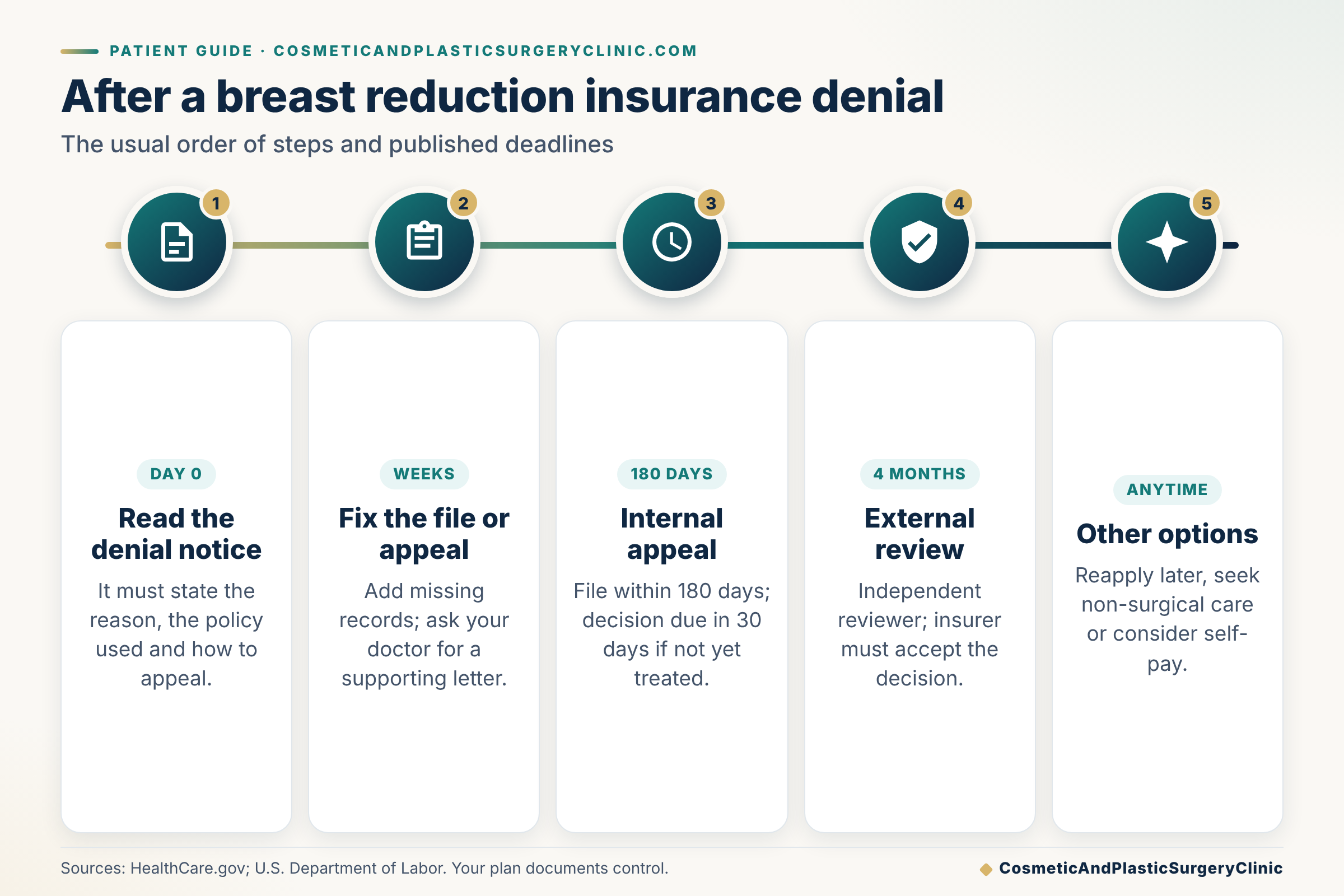
According to the Department of Labor, a denial notice for an employer plan must state the specific reasons for the denial, cite the plan provision relied on, describe any additional information needed, and explain the review and appeal procedures. For a denial based on medical necessity, it must explain the clinical judgment or offer that explanation free on request. It must also describe the rules or guidelines used, or offer a free copy. If the notice is vague, ask in writing for the criteria applied.
Matching the stated reason to a next step
The 2020 review sorted denials into contract exclusion (30 percent), documentation or unmet medical criteria (39 percent) and inadequate predicted resection weight (12 percent). Each calls for a different response.
| Stated reason | What it often means | Reasonable next step | Who acts |
|---|---|---|---|
| Contract exclusion | The benefit contract excludes the service, so the medical policy is never reached | Ask for the exclusion’s wording and whether any exception exists | You, with member services |
| Missing documentation | A photo, note, measurement or report the policy names was not in the file | Ask which item; gather it; resubmit or attach to an appeal | Surgeon’s office and you |
| Duration or treatment not met | Symptoms or treatment trial shorter than the policy’s minimum | Compare the dates with the policy; ask the clinician whether to wait or appeal | You and your clinician |
| Estimated weight too low | The surgeon’s estimate falls below the body-surface-area minimum | Check the BSA formula and inputs used; the estimate must still reflect the surgeon’s actual plan | Surgeon’s office |
Internal appeal, then independent review
Appeal rights come from federal rules for most health plans, and the clocks are firm. The steps below follow HealthCare.gov and the Department of Labor; your own plan documents state the exact process that applies to you.
Filing the internal breast reduction insurance appeal
HealthCare.gov says you generally have 180 days from receiving the denial notice to file, using the plan’s forms or a written letter with your name, claim number and insurance ID. Add anything that answers the stated reason, such as a letter from your doctor. Keep copies, and log each phone call with the date and the name and title of the person. For a service you have not yet received, the decision is due within 30 days, and 60 days for one you have. The Department of Labor gives the same 30 and 60 day limits for employer plans.
Requesting external review
If the plan upholds its denial, you can request an independent external review. HealthCare.gov says it is available for denials that involve medical judgment and for determinations that a treatment is experimental or investigational, and that it must be requested within four months of the final notice. A standard external review is decided within 45 days, and an expedited one within 72 hours. Where a fee applies it cannot exceed $25 per review, and the insurer is required by law to accept the reviewer’s decision.
The Department of Labor adds that plans not grandfathered under the Affordable Care Act must provide external review.
The outcome data are thin. In the 2020 single-institution review, 18 of the 83 denials were appealed and 13 of those succeeded. That suggests appeals are worth considering, but it reflects 18 appeals at one center, not what any individual should expect.
Situations that change breast reduction insurance rules, and options without coverage
Beyond the standard symptom-based request, a few circumstances change which rules apply. They are summarized here because they are where a general understanding of breast reduction insurance runs out and the plan’s own wording matters most.
Circumstances that change the policy language
Each situation below shows how the documents read, not how a plan will rule on any individual.
Younger patients and finished growth
Age rules vary. Aetna and Cigna cover adults or people whose breast growth is complete; Aetna defines that as breast size stable over one year. Blue Cross Massachusetts accepts ages 15 to 18 with documented Tanner stage IV or V and either six months of stable height or puberty completion on a wrist radiograph. An archived Michigan Medicaid policy required a year of finished growth plus parental consent under 18. The 2026 Illinois Blue Cross criteria set no age requirement.
Reduction around breast cancer care
Reduction connected with cancer treatment is usually written into separate language. Cigna and Humana both address surgery on the unaffected breast to produce symmetry after mastectomy or lumpectomy, and Cigna and Blue Cross Illinois address a staged reduction before nipple-sparing mastectomy to preserve nipple viability. A Michigan Medicaid policy refers symmetry procedures to the Women’s Health and Cancer Rights Act and a separate reconstruction policy. If this applies, ask for the plan’s breast reconstruction policy, not the symptom-based one.
Repeat operations and liposuction-only reduction
Blue Cross Massachusetts treats a repeat reduction as not medically necessary unless the first operation caused complications. Aetna, Cigna, Humana, Blue Cross South Carolina and the Michigan Medicaid policy classify liposuction-only reduction as experimental, investigational or unproven; the Illinois Blue Cross policy removed its liposuction statement in January 2026, so a plan’s current text is the only reliable guide. Cigna adds that liposuction used within a medically necessary reduction is not separately reimbursed. How liposuction works on fatty tissue is explained in the liposuction overview.
When the goal is lifting or shape, or the patient is male
The policies above are written around symptoms from breast weight. A request framed around lifting or reshaping does not map onto those tests, and the difference between the two operations is laid out in breast reduction vs breast lift. Male chest reduction follows separate criteria, for example glandular tissue and cause documentation in one Medicaid policy, and is covered in gynecomastia surgery.
If coverage is denied or not available
A denial that survives appeal leaves three honest options: wait and reapply when something changes, pursue symptom relief without surgery, or pay yourself. None is a failure, and none has to be decided quickly.
Waiting, reapplying and non-surgical care
Reapplication makes sense when the record changes, for instance when a longer treatment history now meets a duration rule. Meanwhile, supportive bras, physical therapy and dermatologic care for rashes help some people; ask your clinician which fit your situation. The ASPS parameter’s position is that no lasting non-operative treatment exists for breast hypertrophy, and the BRAVO figures quoted above point the same way, so not everyone finds enough relief. Waiting is a legitimate choice; the questions about suitability and risk belong in breast reduction candidate and breast reduction risks.
Paying yourself and comparing quotes
A self-pay quote should itemize the surgeon’s fee, facility, anesthesia, pathology and follow-up, and say what is not included. Remember that money spent on a service the plan does not cover does not count toward your out-of-pocket maximum. The general logic for comparing quotes is in plastic surgery cost, and checking the surgeon’s credentials and the facility comes first, as how to choose a plastic surgeon describes.
Frequently asked questions
Does breast reduction insurance depend on cup size?
In the policy documents reviewed for this page, the tests are symptoms, body surface area and estimated tissue weight, not a cup size. The 2002 ASPS parameter mentions a bra cup of D or greater as one supporting indicator of the diagnosis but says volume is preferred over cup size. Ask the surgeon how the planned volume is expressed in grams.
Can breast reduction insurance require weight loss first?
Some plans have asked for it. The 2002 ASPS parameter noted that payers commonly required patients to be within 10 percent of ideal body weight, and a current Blue Cross policy’s background describes a 20 percent rule as common but questioned. Most policies opened here list no BMI threshold, though Kaiser’s Mid-Atlantic document requires three months of nutrition education when BMI is over 35. Separately, the ASPS guideline reports higher wound and infection risk above a BMI of 35. Ask your plan which, if any, weight rule it applies.
How does breast reduction insurance treat one-sided symptoms or size differences?
Policies can treat one-sided requests differently. Kaiser’s Mid-Atlantic document calls unilateral reduction cosmetic and not customarily covered, except in breast cancer, while Blue Cross South Carolina lists asymmetry among reasons that do not qualify. Aetna refers asymmetry to its separate reconstructive policy. Symmetry procedures after cancer surgery are handled under different language, described above. With a clear size difference and one-sided symptoms, ask your surgeon how the request would be framed and which policy applies.
Do breast reduction insurance plans require a mammogram?
Some do, and the age differs. Aetna requires a negative mammogram within two years for people 50 or older, and Humana and Kaiser require one within a year at 40 or older. Other documents read here do not mention it. Even where a plan is silent, the 2002 ASPS parameter recommends preoperative mammography, and the 2022 guideline recommends sending removed tissue for pathology. Ask the surgeon separately what screening they want.
Who decides whether breast reduction insurance approves my request, the surgeon or the insurer?
The insurer decides coverage by applying its policy to the documents it receives. The surgeon supplies the clinical record, measurements and estimate, and judges whether surgery is medically appropriate. These are separate questions, so a surgeon recommending reduction does not settle coverage. If the denial rests on medical judgment, HealthCare.gov says external review is available, and the independent reviewer’s decision binds the insurer.
What happens to breast reduction insurance approval if my plan changes?
Authorization is tied to a plan, so a new employer plan or marketplace policy generally means a new review under that plan’s own policy, and the eight documents above show how differently those can read. Ask the new plan for its policy before you change anything you have scheduled. How long an authorization stays valid is set by each plan and should be stated in your paperwork.
Does breast reduction insurance approval cover anesthesia, the facility and pathology?
An approval refers to the surgical service, and other billing providers may be handled separately. Cigna’s policy says liposuction and nipple-areola reconstruction used within a medically necessary reduction are integral and not separately reimbursed, which shows that plans decide component by component. Ask the practice for a list of every provider that will bill, confirm each one’s network status, and ask what the pathology charge is. Network status affects what you owe, as the cost-sharing table above shows.
Sources and further reading
- American Society of Plastic Surgeons — Recommended Insurance Coverage Criteria for Third-Party Payers: Reduction Mammaplasty (approved 2011, updated March 2021; accessed 2026-11-12) — symptom list, documentation, no required conservative trial, Schnur replacement
- American Society of Plastic Surgeons — Evidence-Based Clinical Practice Guideline: Reduction Mammaplasty, Plastic and Reconstructive Surgery, March 2022 (accessed 2026-11-12) — first-line surgery, resection weight, BMI and age counseling, pathology
- American Society of Plastic Surgeons — Patient Care Parameter: Reduction Mammaplasty, March 2002 (accessed 2026-11-12) — payer criteria history, BRAVO findings, volume versus cup size, preoperative mammography
- Aetna — Clinical Policy Bulletin 0017: Breast Reduction Surgery and Gynecomastia Surgery (last review October 2026, accessed 2026-11-12) — macromastia criteria, mammogram, liposuction-only exclusion
- Cigna — Coverage Policy 0152: Reduction Mammoplasty for Macromastia (effective November 2025, accessed 2026-11-12) — symptoms, photographs, Schnur or 1 kg rule, exclusions
- Humana — Reduction Mammaplasty claims processing policy (effective July 2024, accessed 2026-11-12) — DuBois formula, treatment trial, mammogram
- Blue Cross Blue Shield of Massachusetts — Medical Policy 703: Reduction Mammaplasty for Breast-Related Symptoms (accessed 2026-11-12) — 6-week criterion, 500 g target, adolescent criteria, prior authorization by product
- Blue Cross Blue Shield of South Carolina — CAM 70121: Reduction Mammaplasty for Breast-Related Symptoms (review dated August 2025, accessed 2026-11-12) — one-year duration, 1 kg alternative, exclusions
- Blue Cross and Blue Shield of Illinois — Medical Policy SUR716.012: Reduction Mammaplasty (effective January 1, 2026, accessed 2026-11-12) — 6-week criterion, 5th to 22nd percentile, pathology, 2026 revisions
- Blue Cross and Blue Shield of Texas — Medical Policy SUR716.012: Reduction Mammaplasty (effective December 2024, accessed 2026-11-12) — benefit contract precedence, cosmetic exclusion, example threshold
- Kaiser Permanente Mid-Atlantic States — Reduction Mammoplasty (Female) criteria (approved July 2025, accessed 2026-11-12) — seven-symptom rule, nutrition education, mammogram, unilateral limits
- CareSource — Michigan Medicaid policy MCD-MM-1517: Breast Reduction Surgery (effective June 2024, archived May 2025; accessed 2026-11-12) — Medicaid example, adolescent and screening rules
- BlueCross BlueShield of Tennessee — The Schnur Sliding Scale chart (accessed 2026-11-12) — body surface area, 22nd percentile rule, scale description
- Schnur PL, Hoehn JG, Ilstrup DM, Cahoy MJ, Chu CP — Reduction mammaplasty: cosmetic or reconstructive procedure? Annals of Plastic Surgery, 1991 (abstract record, accessed 2026-11-12) — survey design and percentile findings
- Boukovalas S and colleagues — Insurance denials in reduction mammaplasty: how can we serve our patients better? Plastic and Reconstructive Surgery, 2020 (abstract record, accessed 2026-11-12) — 295 requests, denial reasons, appeals
- Preauthorization inconsistencies prevail in reduction mammaplasty, Plastic and Reconstructive Surgery Global Open, October 2023 (abstract record, accessed 2026-11-12) — seven-insurer comparison, 2022 claims data
- HealthCare.gov — Internal appeals (accessed 2026-11-12) — 180-day deadline, 30 and 60 day decisions
- HealthCare.gov — External review (accessed 2026-11-12) — four-month request window, 45-day and 72-hour decisions, binding result
- HealthCare.gov — Glossary: Preauthorization (accessed 2026-11-12) — definition and statement that it is not a promise of payment
- HealthCare.gov — Glossary: Out-of-pocket maximum/limit (accessed 2026-11-12) — what counts, 2026 and 2027 marketplace limits
- HealthCare.gov — Glossary: Medically necessary (accessed 2026-11-12) — definition
- U.S. Department of Labor, EBSA — Filing a claim for your health benefits (accessed 2026-11-12) — 15-day and 72-hour claim limits, appeal limits, denial notice contents
- Centers for Medicare & Medicaid Services — Interoperability and Prior Authorization Final Rule (CMS-0057-F) fact sheet, January 2024 (accessed 2026-11-12) — seven-day and 72-hour decision timeframes, covered payers, 2026 dates


