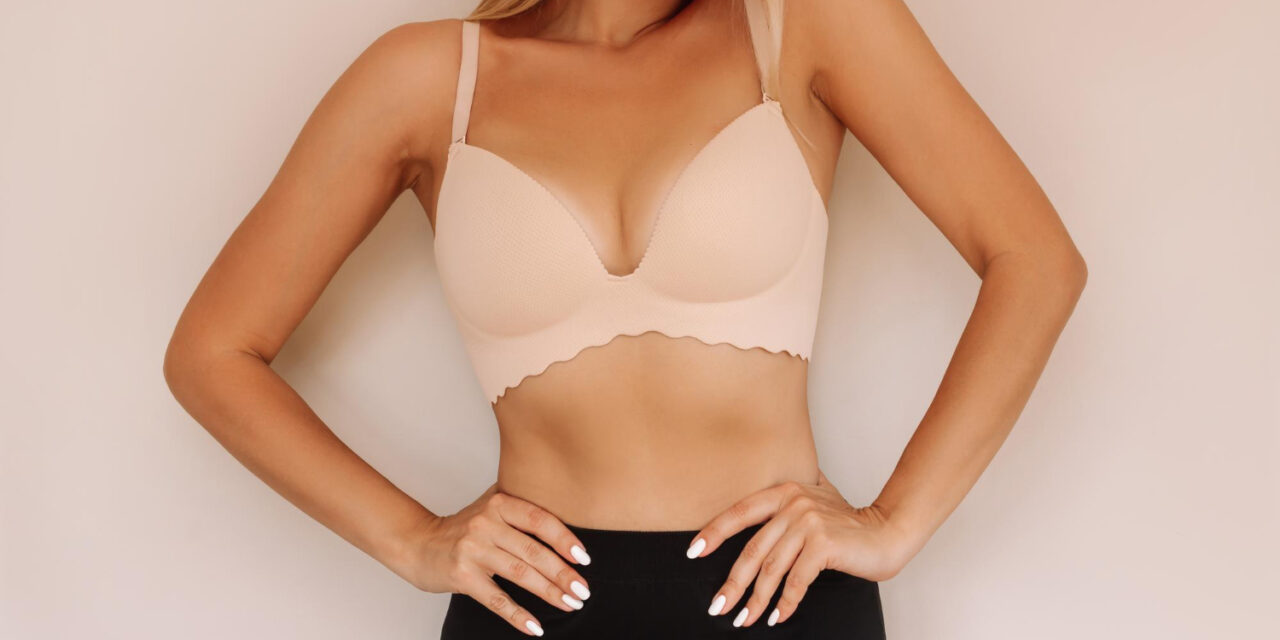
A breast lift before and after pair looks easy to read: the nipple sits higher in the second picture, the breast looks more lifted, and the scar is a thin line somewhere underneath. The difficulty is everything the pair leaves out. Two photos taken in different poses, under different light, in different months, of breasts that started in different places, can show a larger or smaller change than the surgery made. And a gallery labeled “breast lift” can quietly include implants or a reduction.
This page teaches the reading skills that are specific to lift photos: where to look, what to hold constant and which questions to bring to a consultation. The operation itself is explained in the main breast lift guide, and the rules that apply to any gallery, such as consent and advertising law, are in the article on reading before and after photos. A pair is supporting evidence about what happened to someone else. It is never a forecast of your own result.
What a breast lift before and after photo is actually measuring
The American Society of Plastic Surgeons (ASPS) describes a breast lift as removing excess skin and tightening the surrounding tissue so the breasts sit higher, with the nipple and areola moved to a more youthful height and an enlarged areola reduced if needed. The same page adds that the operation does not significantly change breast size or round out the upper part of the breast. So a breast lift before and after comparison is mainly about position and about the skin envelope, not about volume.
Position first: the nipple, the fold and the skin envelope
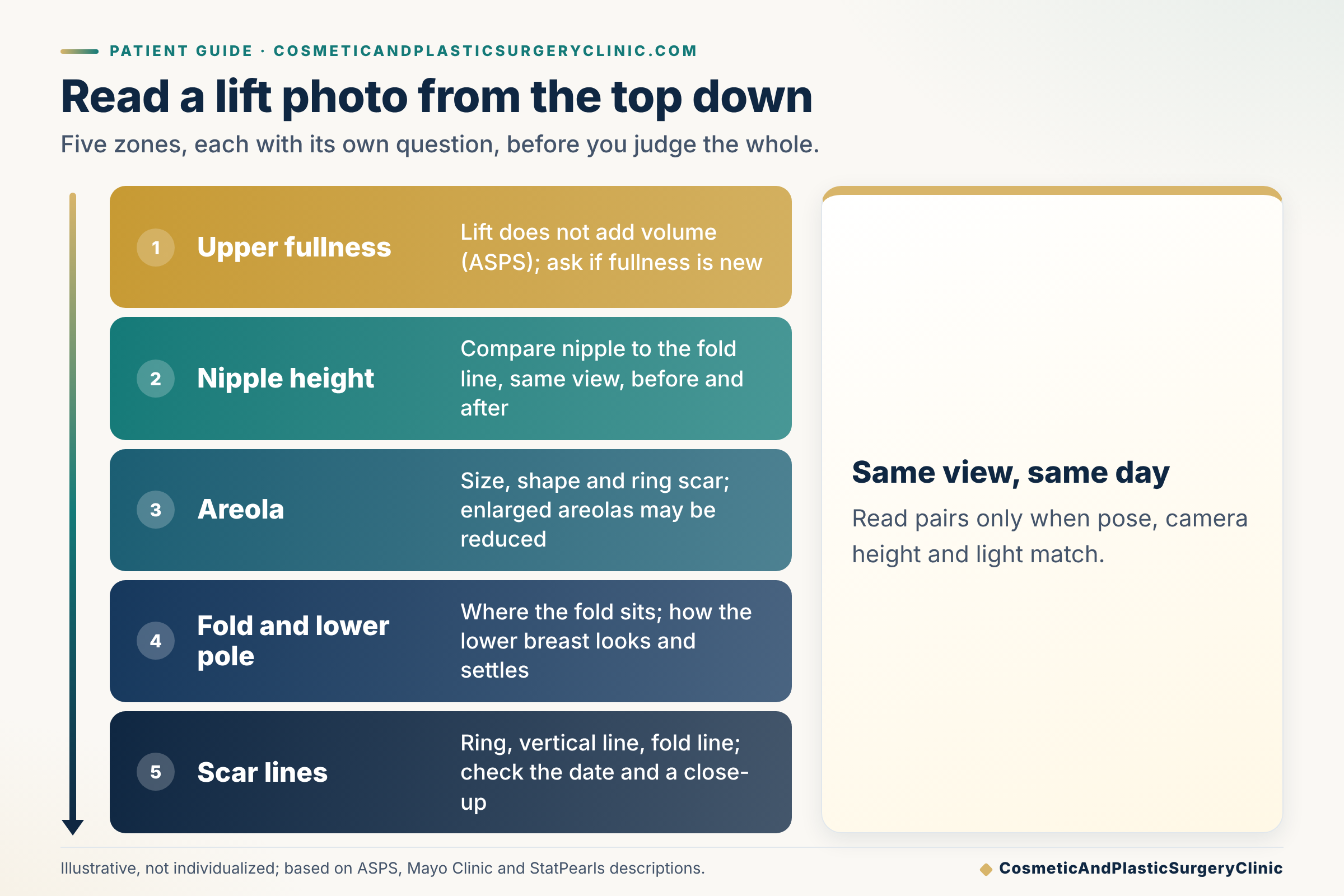
Three landmarks carry most of the story in any lift photo: the nipple, the crease where the breast meets the chest wall (the inframammary fold) and the lower edge of the breast skin. Reading a breast lift before and after change means following how those three relate to each other in the first picture and in the second.
Nipple-to-fold height is the anchor of a breast lift before and after comparison
The classic way to grade sagging, the Regnault classification, uses exactly this relationship. As summarized in the StatPearls review of breast ptosis (updated in 2023), grade 1 means the nipple is at the level of the fold; grade 2, below the fold but not the lowest part of the breast; grade 3, below the fold and the most dependent part. Pseudoptosis is a separate pattern in which the nipple sits at or above the fold while most of the breast hangs below it.
In a photo, find the fold line, then check where the nipple sits against it in the “before” and in the “after,” in the same view. A lift is expected to raise the nipple and areola. If the nipple barely moved, or sits far above the apex of the breast in the second picture, that is worth a question about technique and about how long ago the image was taken.
Why grading a breast from a photo is a judgment call
Grades are less crisp than they sound. In a 2016 study of 3D surface scans, nine plastic surgeons graded 203 breasts from 150 participants (mostly women having reconstruction), and their agreement was good but not excellent, with an average intraclass correlation of 0.69. The authors noted that the boundaries between grade 0 and 1, and between 1 and 2, were inherently ambiguous.
Standardized pictures help. A 2016 validation of the online Rainbow Scale, a five-grade photographic ptosis scale, found that six surgeons rating 15 photographs per view agreed closely, with weighted kappa values of 0.88 for the frontal view, 0.84 for the oblique and 0.82 for the lateral. Two lessons follow: a caption that says “severe ptosis” is one opinion, and the view in the photo changes how easily anyone can read the grade.
Lift or fullness? Separating position from volume in the picture
Readers of breast lift before and after photos often hear “more lifted” as “bigger.” Those are different changes, and a lift photo can blur them because raised tissue looks fuller at the top of the breast simply by moving up.
What a lift alone does not add
ASPS states that a lift does not significantly change size or round out the upper breast, and Mayo Clinic says a lift does not change breast size and can be combined with augmentation to add volume or with reduction to take it away. When a breast lift before and after pair shows a clearly larger, rounder upper breast, the first question is not “how did the lift do that?” but “what else was done in the same operation?”
A modest gain in projection is still possible
There is a nuance. In a 2018 retrospective study in Plastic and Reconstructive Surgery Global Open, Eric Swanson measured standardized lateral photographs of five women who had a vertical mastopexy. Breast projection was about 1.7 cm greater on both sides ten years later, and upper pole projection was 0.7 cm and 0.8 cm greater than before surgery. The author called it a modest increment. The sample was tiny, with no untreated comparison group, so it shows that some added fullness at the top can occur without implants, not how much to expect.
Matching the starting breasts and the procedure mix before trusting a pair
A result belongs to the breast it started from, and every breast lift before and after caption should say where that was. Before a breast lift before and after pair is allowed to shape your expectations, write down two things beside it: what the “before” breast was like, and what operation actually produced the “after.”
The starting body behind a breast lift before and after caption
ASPS lists pregnancy, breastfeeding, weight fluctuation, aging, gravity and heredity as reasons breasts lose firmness and skin elasticity. A caption that names none of them asks you to assume your history matches the patient’s.
Volume, skin quality and pregnancy history
Mayo Clinic notes that a future pregnancy can stretch the breasts and offset a lift, that surgeons often suggest waiting six months to a year after breastfeeding ends, and that larger, heavier breasts are more likely to sag again. Consider a hypothetical comparison: one “before” photo shows a breast five months after weaning, another shows a breast years after the last pregnancy at a stable weight. Both might carry a “grade 2” caption, but they are different starting points and may not heal or hold alike.
Asymmetry in the before photo
Most breasts differ a little from side to side. Mayo Clinic says a lift usually will not correct size differences that were there beforehand, and ASPS lists asymmetry among the possible risks. So compare the left-right difference in the “before” with the “after.” If a clearly uneven pair becomes evenly matched, ask what else was done, or whether the pose and lighting changed.
A quick test helps: before trusting a pair, try to write its caption in three lines. Line one is the starting breast (ptosis grade, volume, skin quality, pregnancy and weight history). Line two is the operation (incision pattern, any implant, any tissue removed). Line three is the date of each image. If you cannot fill in a line from the gallery, that line becomes your question for the practice.
Lift only, lift with implants, lift with reduction: the label problem
The ASPS gallery for this procedure shows how thin a caption can be. As viewed on 2026-11-12, each case names the procedure, the surgeon, the location and a case number. It does not state the patient’s age, the time since surgery or the variant performed. A practice gallery may be better or worse, but you cannot assume it is more detailed.
Which operation produced the picture
ASPS describes a lift as an operation that can be combined with augmentation for fuller breasts or with reduction for smaller ones. StatPearls adds that combined augmentation and lift is generally reserved for cases where both volume loss and sagging are too severe for either operation alone, and that single-stage versus two-stage timing is debated. In a gallery labeled “breast lift,” ask whether each pair was a lift alone or whether implants or tissue removal were part of it. The guide to breast lift with implants explains the combined plan, and breast augmentation photos covers the implant-specific viewing skills.
Lift photos can also appear inside torso sets. In a mommy makeover case, the breast result is one part of a larger change, as mommy makeover before and after explains.
Why a combined case is a different bet
StatPearls reports major complication figures of about 1.15% after mastopexy, 1.40% after augmentation and 1.86% after combined augmentation and mastopexy, and, from a pooled analysis of single-stage combined surgery, a 13.1% complication rate and a 10.7% reoperation rate. These come from a secondary summary of studies with different populations, so treat them as a sign that combined cases carry a different risk profile, not as odds for any individual.
The FDA also states that breast implants are not considered lifetime devices, and that the longer people have them, the greater the chance of complications. A one-year photo of a lift with implants therefore says little about the implant’s later story. For the choice between the two operations, see breast lift vs implants.

Pose, camera and light: what changes a breast lift before and after photo without any surgery
Breasts are soft tissue that hangs, shifts and casts shadow. A slightly different posture, a lower camera or a side light changes how a breast lift before and after photo reads: how high the nipple appears, how full the upper breast looks and how deep the fold reads. ASPS made this point in October 2026: chin position, posture, body rotation, camera angle, lighting and expression can alter how a result looks even when nothing surgical differs, and good medical photography “should document, not perform.”
What a standard breast photograph looks like
Six views, camera at breast height, arms relaxed
A 2017 review in the journal Mastology (Soares and colleagues) describes a six-view set: frontal, dorsal, right and left profile, and right and left oblique. The camera sits at the height of the breast, because shooting from above or below distorts the body. Arms rest at the sides for the frontal and back views, and the patient stands 50 to 90 cm from a smooth, uniform backdrop. The review recommends a 50 mm lens, soft diffuse light rather than a built-in flash, a white balance matched to the room, and no jewelry or clothing in the frame.
The same review makes the central point of this section: two photos are only comparable when the camera settings, the background and the patient’s position are the same, and positioning is “especially” important. A breast lift before and after pair that fails those conditions is a pair of pictures, not a measurement.
What studies found about arm position and pose
Research on arms is mixed, which is itself informative. In a 2021 study in Aesthetic Plastic Surgery, 3D scans of 25 women who had fat grafting to the breasts were taken with arms at the sides, hands on hips and hands on the head. Among those who received 100 to 200 ml of fat, measured volume change differed by arm position (p = 0.02); among those who received more than 200 ml it did not. The authors concluded that arm position should be kept consistent.
A 2011 study of 12 women found no significant difference in a 3D symmetry index between hands on hips and hands down, though the authors cautioned that a non-significant result with a small sample does not prove the poses are equivalent. Neither study looked at lift photos. Together they suggest that pose matters for some measurements and not others, so the most cautious assumption is that a difference in pose can matter and that consistency is what you want to see.
What else is in the frame besides the breast
Even with a well-matched stance, the items around the breast change a breast lift before and after picture. They are easy to miss because they look like part of the body.
Bras, garments, tan lines and makeup
ASPS says a lift is followed by dressings or bandages and an elastic bandage or support bra, and that a small temporary drain may be placed. An early “after” in a surgical bra, with the breasts held up and in, is a different image from a bare chest at the same date. Straps, bra marks, tan lines and body makeup can also hide or exaggerate the fold and the scars. No source reviewed for this article quantifies these effects, so the rule is simple: compare bare to bare and bra to bra, never one against the other.
Filters, crops and images made with software
Two ASPS articles, from March 2025 and October 2026, list the cues surgeons watch for: heavy filters that smooth skin, warped backgrounds, wavy lines near the body, shadows that disagree, and physics that fails, such as an earring that does not hang down. They also warn that tells alone are unreliable. A credible breast lift before and after gallery shows a body of work, with many cases from several angles photographed the same way over time, and some surgeons place the original beside any edited version. A single dramatic image is much easier to fake than a consistent series.
| Variable | How it changes the breast’s look | What to compare | Question for the practice |
|---|---|---|---|
| Camera height and distance | Shooting from above or below distorts proportions; a close lens exaggerates the nearest tissue | Same height, same distance, same lens in both pictures | Is this the practice’s standard setup for every case? |
| Arms and posture | Raised arms stretch the skin; leaning or arching shifts breast and fold | Arms at the sides, standing straight, shoulders level | Do you have the same views, with arms down, at each date? |
| Lighting | Side light deepens the fold and lower-pole shadow; flat flash hides contour and scar texture | Same light direction, same softness, same background | Is a studio or a consistent room used for follow-ups? |
| Bra, garment, clothing | A bra or bandage pushes breasts up and together | Bare chest to bare chest, or the identical garment | Was a garment worn in either photo? |
| Skin tone, tan and makeup | Tan lines, makeup and color shifts mask or add to scar contrast | Similar skin color and no cosmetic coverage | Can I see an unretouched, unfiltered original? |
| Crop, mirroring, filters | Cropping can remove the scar or the opposite breast; filters smooth skin | Full torso from collarbone to below the fold, both breasts, no smoothing | Were these images edited, cropped or flipped? |
How often real galleries fall short
One audit suggests caution about assuming that a gallery follows the standard, at least on social media.
An audit of 2,020 Instagram photographs
A 2022 study in Plastic and Reconstructive Surgery Global Open scored 510 Instagram posts, containing 2,020 clinical photographs from 102 practitioner accounts, on a nine-point scale called SEPIA. The average score was 4 out of 9, about 40% of posts were low quality, and the standards most often ignored were zoom, lighting, timing and the presentation of multiple views. Plastic surgery specialists scored higher than other practitioners (4.5 versus 3.1), and 22% of their posts were low quality compared with 54%.
What the audit does and does not say about breast lift galleries
The study covered all cosmetic treatments, not breast lifts specifically, and it looked at one platform. It does not prove that any particular breast lift before and after gallery is poor. It does show that standardization is a real, measurable variable and that a post can be well lit and still fail on timing or views. Treat each image as a claim to check, not as a measurement.
The date on a breast lift before and after photo: weeks, months and years
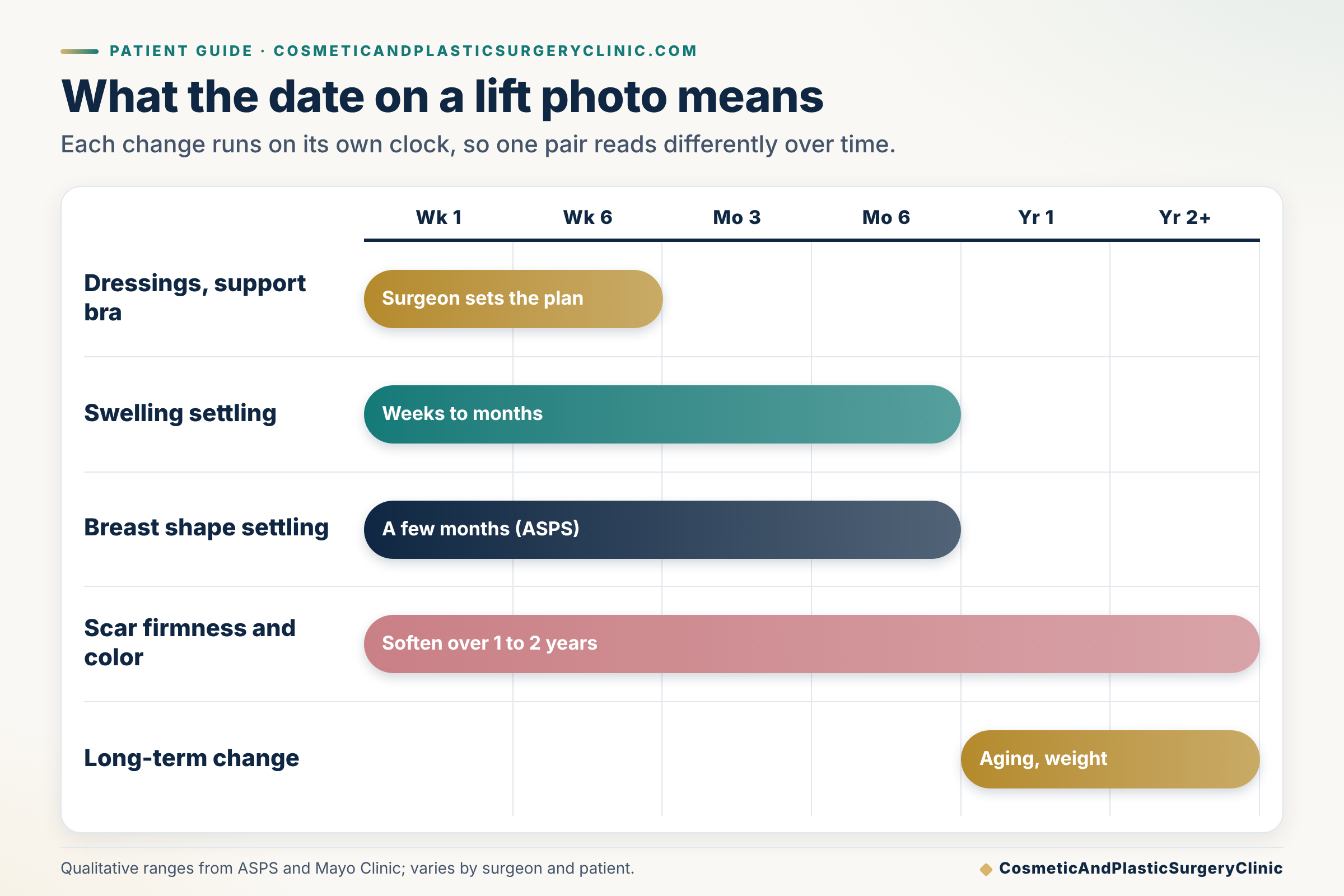
Time is the variable that most often goes unlabeled on breast lift before and after photos. A breast changes shape and a scar changes color for a long stretch after surgery, so an “after” photo without a date is not a result; it is a snapshot of an unspecified point on a curve.
The first weeks and months
Early images can be encouraging or alarming, and both reactions can be wrong for reasons that have nothing to do with the final result.
Early photos show dressings, swelling and a shape still settling
ASPS says the new position of the breasts is visible immediately, that the final result develops over the next few months as shape and position settle, and that post-surgical swelling goes away over time. Mayo Clinic gives the same overall pattern. ASPS adds, in its photo-reading advice, that an image at six weeks can differ from one at a year. A breast lift before and after pair dated “2 weeks” cannot show the settled breast, and the same pair dated “14 months” cannot show the early healing phase.
One dramatic pair or a dated series?
Ask for the same patient at more than one time, for example soon after surgery, at a few months and at a year or later. That is a practical request, not a published standard, but it solves several problems at once: it shows the trajectory, it shows whether the lift held and it makes cherry-picking harder. If a practice has only one image per patient, ask how long after surgery it was taken and whether longer follow-up exists.
Year one and beyond: what long follow-up photos show
Few photo studies follow breast lifts for years, which makes the ones that exist worth reading carefully.
A ten-year photographic study in five women
In Swanson’s 2018 study, standardized lateral photographs of five women with vertical mastopexy were matched by software before surgery, at one year and at about ten years (mean 10.8 years, range 8 to 14). The lower pole was raised by about 2.1 to 2.2 cm at one year and then settled by 0.4 cm on one side and 0.9 cm on the other by ten years, while the nipples stayed above their preoperative level.
The author listed the limits: 20 women across four groups (so five per operation), non-consecutive and retrospective, no adjustment for aging, no untreated comparison group, and findings that apply only to vertical technique. It is a useful reminder, for anyone studying breast lift before and after results, that settling continues after one year, not a forecast for any one person.
Why a one-year photo is not a lifetime forecast
ASPS says breasts can keep changing with aging and gravity, and that pregnancy and significant weight loss after surgery can reduce the benefit. Mayo Clinic says results may not last, and that skin loses elasticity with age. A photo at 12 months therefore tells you about the first year. For what drives later change, and how surgeons talk about recurrence, see how long breast lift lasts.
Reading breast lift scars in before and after photos by incision pattern
Scars are the one part of a breast lift that every honest breast lift before and after photo should show, and they are also the part most easily lost to a crop, a bra strap or flattering light. Knowing which pattern to expect tells you where to look and which photos do not add up. The full comparison of patterns, healing and care is in the guide to breast lift scars; this section covers only what shows up in a photograph.
Three patterns, three places to look
ASPS lists three common patterns, and each leaves a different map on the breast.
Periareolar, vertical and anchor patterns as ASPS describes them
On its procedure page, ASPS describes the options this way: around the areola; around the areola and vertically down from the areola to the breast crease; and around the areola, vertically down, and horizontally along the breast crease. The names most surgeons use for these are periareolar (or “donut”), vertical (or “lollipop”) and anchor (or inverted-T). The ring around the areola is therefore present in all three, which is why the areola’s edge is the first place to look in any lift photo.
A scar pattern is a clue to the starting anatomy
According to StatPearls, the periareolar approach is generally used for mild or moderate ptosis with little excess skin in the lower breast; vertical patterns can be used for any degree of ptosis; and the inverted-T is used for severe ptosis, fatty breast tissue or poor skin quality, and carries the largest scar burden.
That makes the scar a consistency check. Consider a hypothetical gallery in which the “before” shows heavy sagging and the “after” shows only a fine ring at the areola. It is not proof of anything, but it is a reason to ask which operation was performed and whether the two images show the same patient and the same breasts.
| Pattern | Where the scar runs | What to check in the photo | Question to ask |
|---|---|---|---|
| Periareolar | Around the edge of the areola | Ring width and color, areola shape, flattening of the breast mound | Does the starting anatomy suit this pattern, and how does the areola look at a year? |
| Vertical (lollipop) | Around the areola, then straight down to the fold | The vertical line’s width, any puckering near the fold, nipple height | Can I see a close-up of the vertical scar at six months and later? |
| Anchor (inverted-T) | Around the areola, down, and along the fold | The fold scar’s position, whether it is visible from the front, and bottoming out | How long is the fold scar, and is it hidden by a bra or swimsuit? |
| No scar visible | Not shown, cropped or retouched | Whether the image is dated early, or has been cropped, filtered or lit flat | Why is the scar not visible, and can I see another view? |
Scar color, firmness and age
A scar is a moving target. Breast lift before and after photographs taken weeks apart show different tissue, and the age of a scar is one of the best clues to the date of an unlabeled image.
What scars look like at weeks, months and one to two years
Mayo Clinic describes breast lift scars as hard and lumpy at first, softening within one to two years, and says they last for life but can usually be hidden by bras and swimsuits. ASPS says incision lines remain but fade over time, and a plastic surgeon quoted in its March 2025 article says incisions are often visible for a year or two before they fade. Mayo adds that poor healing can rarely make scars thick and wide, and that appearance varies from person to person.
The practical reading: a pink, raised line in a photo labeled “3 months” is unremarkable, and the same line labeled “3 years” deserves a question. A pale, fine line at three months is possible, but it is less typical. Either way, a scar photo says how that person healed, not how you will.
Zero scars at three months, and where the eye goes
The same ASPS article calls a photo with no visible scar a few weeks or months after surgery “not normal.” When that happens, the likely explanations are less exciting than a scar-free lift: a crop, filtering, a bra strap or a flat light. A reputable gallery shows the scar in a close-up as well as in the full view.
There is also a reason to step back from the areola. In a 2024 eye-tracking study in Aesthetic Plastic Surgery, 58 laypeople viewed postoperative photos of six women who had breast reductions (not lifts). Gaze went to the nipple-areola complex and the periareolar scar first and stayed longest, regardless of pattern, and the vertical and fold region of the inverted-T drew more attention than the pattern without a vertical scar. Eyes are drawn to the areola, so a deliberate look at nipple height, fold and symmetry keeps the scar from dominating the judgment.
Judging a whole gallery of breast lift before and after photos, not its best pair
A single breast lift before and after pair can be accurate and still unrepresentative. Judging the gallery means asking how many of the cases look like yours, how they were chosen and what the practice may have left out.
Counting comparable cases and missing outcomes
ASPS reported 156,131 breast lift procedures in 2025, up 8% on its reporting. Those counts are procedures, not patients, and they say nothing about how any one gallery was assembled.
Similar cases matter more than the number of cases
Fifty breast lift before and after cases that do not resemble you teach less than five that do. Ask for patients with a similar starting breast: comparable volume, similar nipple position relative to the fold, similar skin quality and a similar pregnancy and weight history. Then ask for the incision pattern the surgeon would plan for you, shown at a similar interval after surgery.
Where are the ordinary and the imperfect results?
ASPS lists among the risks of a lift asymmetry, contour and shape irregularities, poor healing of incisions, changes in nipple or breast sensation, loss of the nipple and areola, and the possibility of revisional surgery. A gallery in which no breast is uneven, no scar is wide and no one had a revision is an unusual gallery. Ask whether any patients needed revision, what the practice’s policy is, and whether you can see such cases. The article on revision breast lift explains why revisions occur and how surgeons approach them.
What no photo can show
Breast lift before and after pictures cannot display what matters to some patients most. Mayo Clinic says feeling in the nipple or breast often returns within a few weeks but some loss may last, and that breastfeeding is usually still possible although some people have trouble making enough milk. Photos also cannot show comfort, how a bra fits, how an implant is aging or whether the surgeon was easy to reach after hours.
| Gallery feature | Reassuring | Calls for a question | What it still cannot tell you |
|---|---|---|---|
| Case similarity | Several cases with starting anatomy close to yours | Only very mild or only very severe cases shown | How your own tissue will behave |
| Time point | Dates on every image, with some at a year or more | No dates, or every “after” within weeks | Long-term change from aging, pregnancy or weight |
| Procedure list | Operation named, including pattern and any implant | “Breast lift” with visibly larger breasts and no detail | Technique choices made during surgery |
| Edits and consent | Unfiltered originals, a stated consent process | Smoothed skin, mirrored or cropped images, no consent policy | Whether the patient was typical of the practice |
| Revision disclosure | Some uneven or revised cases are shown or discussed | No imperfect result anywhere | How often complications occur |
| Source of images | The surgeon’s own patients, named practice | Social-media posts from unverified accounts or stock photos | Who performed the surgery |
Edits, consent and advertising rules
Beyond how a breast lift before and after photograph was taken, there is the question of how it was obtained and used. This is where law and ethics, not photography, set the floor.
Edited, filtered and borrowed images
ASPS advises checking whether a photo comes from an ASPS member’s own practice website or from social media or unverified individuals. The Federal Trade Commission’s final rule on fake reviews and testimonials, announced on August 14, 2024, bars testimonials from people who do not exist or who lack real experience with the business, and requires insiders to disclose their connection. Whether a gallery photo counts as a testimonial is a legal question for the practice, but the principle carries over: the patient, the date and the source should be real and traceable to the practice.
What consent and advertising law say about breast photos
Under HIPAA, the HHS Safe Harbor list of identifiers includes “full-face photographs and any comparable images,” and marketing uses of health information generally require the patient’s written authorization, with limited exceptions. A cropped breast photo can still identify someone through other features, so a practice should have written permission for the specific use.
On results, FTC guidance for health products says testimonials reporting results more dramatic than users can generally expect are likely to be deceptive, and that a “results not typical” disclaimer does not cure that; the advertiser should disclose what typical consumers can expect. Apply the idea to any breast lift before and after gallery: a disclaimer is not a substitute for typical cases. For the general rules behind these points, the article on before and after photos goes further.
Turning breast lift before and after photos into consultation questions
The best use of breast lift before and after photos is as a prompt. Photos help you describe what you like, point at the features you do not want and test whether the surgeon’s picture of the operation matches yours. They are not a menu to order from.
What to ask a practice to show you
Come with requests, not impressions. Most practices will have an album or a screen at the consultation, and the quality of the answers is itself information.
Six requests that sharpen any breast lift before and after gallery
- Cases whose starting breasts resemble yours in volume, nipple position and skin quality.
- The incision pattern the surgeon would plan for you, shown at one year or later.
- A dated series for at least a few patients, not only one “after.”
- Close-ups of the scars, nipple and areola, in addition to the full torso.
- One or two cases with uneven results, slow healing or a revision, and how they were handled.
- Whether any image was filtered, cropped or retouched, and whether each patient gave written consent.
Check who the surgeon is and who took the photos
Certification by the American Board of Plastic Surgery is voluntary; the board says a certified surgeon has completed the appropriate training and passed comprehensive written and oral examinations covering plastic surgery. It also offers a public search by name or location. It does not replace checking the state medical license and any disciplinary history, which sit with the state medical board. The article on how to choose a plastic surgeon walks through the verification steps.
Using photos without letting them set your expectations
Three habits keep a gallery in its proper place: take your own comparison photos carefully, notice when nothing in the album resembles you and keep the decision about whether to operate separate from the pictures.
Photos of yourself: take them the same way each time
If you take your own photos for a consultation, borrow the standard. Stand upright with arms relaxed, use the same distance, height and light each time, wear the same bra or none, keep the background plain and note the date. Store them securely, as you would any health record, and ask how the practice stores and uses the photos it takes of you.
When nothing in the album looks like you
If no case resembles your anatomy, say so. Ask the surgeon to explain what would be different for you, how the operation might change if your breasts are in a different place, and whether a second opinion would help. The factors surgeons weigh are in the breast lift candidate article, and the questions for a plastic surgery consultation cover the rest of the visit. Choosing not to operate, or waiting, remains a legitimate outcome of the conversation.
Frequently asked questions
How many breast lift before and after photos should I look at?
No standard number exists, and the ASPS photo-reading advice does not give one. What matters more is how many resemble your starting anatomy. Look for several comparable cases at more than one time point, including a year or later, and ask to see a few from the same surgeon rather than only a handful of standouts.
Why does my own breast lift before and after photo look different from the gallery?
Usually because of conditions, not your breasts. Camera height, arms, light, a bra, a mirror and phone filters can all change how high and full a breast looks. Take your own breast lift before and after photos the way a clinic does: arms down, camera at breast height, even light, the same garment each time.
Can I tell from a photo whether implants were used with the lift?
Not reliably. A lift alone does not significantly change size or round out the upper breast, according to ASPS, so a much fuller, rounder upper breast raises the question. But a modest gain in projection can occur, and only the operative record settles it. Ask the practice directly.
Is a red scar in a breast lift before and after photo at three months a bad sign?
Not by itself. Mayo Clinic says breast lift scars are hard and lumpy at first and soften within one to two years, and an ASPS surgeon says incisions are often visible for a year or two. A scar that is getting wider, painful or opening needs a call to your surgeon, not a gallery comparison.
Do breast lift before and after photos show nipple sensation or breastfeeding ability?
No. Sensation and milk production are not visible. Mayo Clinic says feeling often returns within a few weeks but some loss may last, and that breastfeeding is usually possible, though some people have trouble making enough milk. Ask the surgeon how common these changes are in their own practice.
Are Instagram and TikTok breast lift before and after photos reliable?
Treat them as unverified. In a 2022 audit of 510 Instagram posts, about 40% were low quality, and zoom, lighting, timing and multiple views were the standards most often skipped. Plastic surgery specialists scored higher. The study was not limited to breast photos, but the lesson carries: check the source and look for a series.
Should a breast lift before and after gallery show faces?
Not necessarily, and some do not. HIPAA’s Safe Harbor list treats full-face photographs and comparable images as identifiers, and marketing uses generally need written authorization. What matters is that the patient consented in writing to the specific use, and that the practice can tell you how it handles consent and removal requests.
What if a practice will not show comparable breast lift before and after patients or revisions?
Ask why, and take that into account. Some practices have small galleries or recent cases only, which is an honest answer. A refusal to discuss imperfect or revised results, or a gallery with none, leaves you unable to judge the range of outcomes. A second opinion from another board-certified surgeon is a reasonable next step.
Sources and further reading
- American Society of Plastic Surgeons — Breast lift overview (accessed 2026-11-12) — what a lift does and does not change, causes of lost firmness, combination options
- American Society of Plastic Surgeons — Breast lift procedure (accessed 2026-11-12) — three incision patterns, nipple and areola repositioning, anesthesia
- American Society of Plastic Surgeons — Breast lift results (accessed 2026-11-12) — immediate and settled results, swelling, scars, aging and weight change
- American Society of Plastic Surgeons — Breast lift before and after photos (accessed 2026-11-12) — how its gallery captions cases
- American Society of Plastic Surgeons — Breast lift safety (accessed 2026-11-12) — listed risks
- American Society of Plastic Surgeons — Breast lift recovery (accessed 2026-11-12) — dressings, support bra, temporary drain
- American Society of Plastic Surgeons — 2025 plastic surgery by the numbers (2026-09-02; accessed 2026-11-12) — 156,131 breast lifts in 2025, up 8%
- American Society of Plastic Surgeons — Reading before and after photos (2026-10-13; accessed 2026-11-12) — standardization, timing, editing, body of work
- American Society of Plastic Surgeons — Is a before and after too good to be true? (2025-03-11; accessed 2026-11-12) — scars, filters, mismatched conditions
- Mayo Clinic — Breast lift (accessed 2026-11-12) — settling, scar softening, asymmetry, sensation, breastfeeding, size
- StatPearls — Breast ptosis (Martinez and Chung, updated 2023; accessed 2026-11-12) — Regnault grades, technique suitability, complication figures
- Plastic and Reconstructive Surgery Global Open — Swanson 2018, photometric long-term changes after vertical mammaplasty (accessed 2026-11-12) — 10-year photo measurements in five women
- Mastology — Soares, Pires and Medeiros 2017, photographic documentation (accessed 2026-11-12) — six views, camera height, distance, lens, lighting
- Journal of Plastic, Reconstructive and Aesthetic Surgery — Henseler et al. 2013, pose in 3D imaging of the ptotic breast (abstract record; accessed 2026-11-12) — fold hidden upright, pose reproducibility
- Aesthetic Plastic Surgery — Wang et al. 2021, arm position and 3D breast volume (abstract; accessed 2026-11-12) — arm position effects
- Breast Cancer: Basic and Clinical Research — Kawale et al. 2011, pose-invariant 3D symmetry (accessed 2026-11-12) — hands-on-hips versus hands-down
- Computers in Biology and Medicine — Li et al. 2016, breast ptosis from 3D scans (accessed 2026-11-12) — surgeon agreement, ambiguous grades
- Aesthetic Surgery Journal — Eyck et al. 2016, Rainbow Scale validation (abstract; accessed 2026-11-12) — photographic ptosis scale reliability
- Plastic and Reconstructive Surgery Global Open — SEPIA audit of outcomes photography on Instagram, 2022 (DOAJ record; accessed 2026-11-12) — 510 posts, 2,020 photographs
- Aesthetic Plastic Surgery — Frank et al. 2024, scar patterns after reduction mammoplasty and gaze (accessed 2026-11-12) — eye-tracking in 58 laypersons
- U.S. Food and Drug Administration — Risks and complications of breast implants (accessed 2026-11-12) — implants are not lifetime devices
- Federal Trade Commission — Final rule banning fake reviews and testimonials (2024-08-14; accessed 2026-11-12) — prohibited testimonials, insider disclosure
- Federal Trade Commission — Health products compliance guidance (accessed 2026-11-12; first part read) — testimonials, atypical results, disclaimers
- U.S. Department of Health and Human Services — HIPAA de-identification (accessed 2026-11-12) — Safe Harbor identifier list, photographs
- U.S. Department of Health and Human Services — HIPAA marketing guidance (accessed 2026-11-12) — written authorization for marketing uses
- American Board of Plastic Surgery — Verify certification (accessed 2026-11-12) — what certification covers and how to check it