
Breast reduction vs breast lift looks like a choice between two operations, but it is really a question about one thing: what should change in the breast. If the answer is weight and size, the operation removes tissue. If the answer is position and shape, it moves tissue and trims skin to hold the new position. Plenty of people want some of each, and that is where the two procedures start to overlap.
This page sorts the breast reduction vs breast lift decision by anatomy and by goal, then compares scars, recovery, risk and money. Each operation has its own page: the breast reduction overview and the breast lift guide cover the procedures themselves. Nothing here can say which one you need. That takes an examination, measurements and a conversation with a board-certified plastic surgeon.
Breast reduction vs breast lift: what each operation changes
Both procedures sit under breast surgery, use similar incisions and leave similar-looking scars, so it is easy to treat them as variations of one operation. A 2014 review in Plastic and Reconstructive Surgery Global Open by Wong, Vucovich and Rohrich says the two use comparable methods to form pedicles and plan skin excision, and differ mainly in how much breast tissue is removed. That single difference is what separates breast reduction vs breast lift in nearly everything below.
Breast reduction vs breast lift in one line: volume leaves, or volume stays
What a reduction removes, and why that lightens the breast
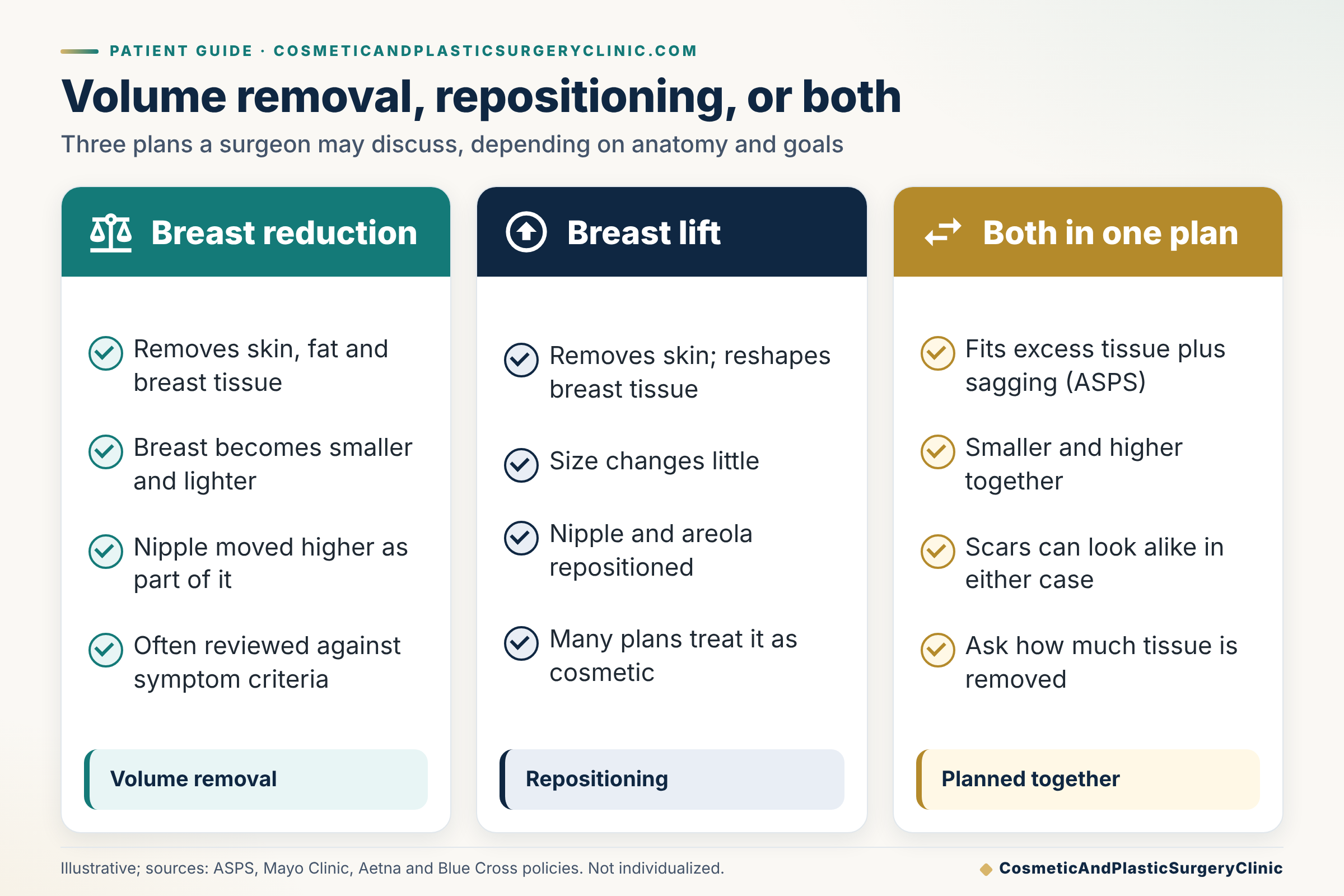
The American Society of Plastic Surgeons (ASPS) describes breast reduction as removing excess skin, fat and breast tissue to reduce size, which can take off a significant amount of volume and relieve weight on the chest. Cleveland Clinic gives the same description and says the operation takes about three to five hours under general anesthesia. The gain is mechanical: less mass hanging from the same chest wall and the same shoulders. In a breast reduction vs breast lift comparison, this is the first line to draw, because only one of the two lowers the weight.
When breasts are mostly fat, the ASPS procedure page says liposuction may be used alongside the excision. Because tissue is removed, it can also be examined by a pathologist, and the ASPS blog notes that some patients have excess tissue sent for screening.
What a lift trims, and why size barely changes
In the ASPS description, a lift reshapes and supports breast tissue and removes excess skin, “not the actual breast tissue.” Nipples and areolas are often repositioned, and enlarged areolas can be reduced. Mayo Clinic states the limit plainly: a breast lift won’t change the size of the breasts. ASPS adds that a lift does not round out the upper part of the breast.
Breasts can look smaller after a lift because they are drawn into a tighter, higher shape. The volume, however, is mostly still there, and so is its weight.
Layers under the skin: what each plan works on
The skin envelope after stretching or weight change
Pregnancy, breastfeeding, weight change and age stretch the skin and the ligaments that support the breast. ASPS notes that significant weight loss can reduce breast volume while leaving a skin envelope that does not shrink at the same rate. A lift works mostly on that envelope. A reduction works on the contents and the envelope together: once tissue is removed, the leftover skin is tailored around a smaller breast. That is why a reduction often looks lifted too.
It is also why breast reduction vs breast lift is not a contest between a big operation and a small one: both rework the skin, and the overlap section below shows where the plans merge.
The nipple and its blood and nerve supply
In both operations the nipple and areola usually stay attached to a pedicle, a bridge of tissue carrying blood and nerve supply, and are moved to a new height. ASPS says that in a reduction the nipple keeps its original supply. For extremely large breasts the nipple and areola may instead be removed and replaced as a graft, which leaves them without sensation after surgery.
Surgeons choose the pedicle by anatomy. A 2022 systematic review by Wagner, Lisiecki, Chiodo and Rohrich found, in the analytical studies, that superior and superomedial pedicles held position longer than inferior ones. Most of the 24 studies were case series, so the finding is a lead, not a rule.

The table lines up breast reduction vs breast lift feature by feature. Where a cell says a figure varies, no source opened for this page gives one fixed number.
| Feature | Breast reduction | Breast lift |
|---|---|---|
| Main reason it is done | Breasts heavy enough to cause symptoms, or a wish for a smaller size | Sagging, low nipples or stretched skin, with volume the person is content with |
| What is removed | Skin, fat and breast tissue | Skin; breast tissue is reshaped, not removed |
| Effect on size | Smaller and lighter by design | Little change; may look smaller from a tighter shape |
| Anesthesia and length | IV sedation or general anesthesia; Cleveland Clinic cites about three to five hours | IV sedation or general anesthesia; duration varies with the plan |
| Scar patterns named by ASPS | Lollipop or keyhole | Around the areola, vertical, or inverted-T |
| Downtime (ASPS blog) | 2 to 4 weeks for both operations; surgeons differ | 2 to 4 weeks for both operations; surgeons differ |
| Lasting effect | Aging, weight change and pregnancy can alter shape and size (Mayo Clinic) | Sagging can return, especially with larger, heavier breasts (Mayo Clinic) |
| Coverage logic | Often reviewed as medical when symptom criteria are documented | Usually self-pay; many plans treat it as cosmetic |
Symptoms or shape: which problem settles the breast reduction vs breast lift question
Most breast reduction vs breast lift decisions turn on which problem would be fixed first. If it is physical discomfort that breast weight seems to cause, the conversation starts with reduction. If it is appearance, with volume that already feels right, it starts with a lift. Surgeons also look for the mix of both, which is common.
When the weight of the breast is the problem
What studies say about symptom relief after a reduction
A systematic review indexed in PubMed, searching literature from 1977 to 2010, reported improvements after reduction mammaplasty in musculoskeletal pain, headaches, sleep and breathing, plus gains in self-esteem and quality of life. The abstract gave no numbers and rated the evidence level III.
Two later studies looked at how much tissue came out. Strong and Hall-Findlay (Annals of Plastic Surgery, 2015) analyzed 410 of 661 eligible patients and found improvement in several symptoms across resection volumes. Yao and colleagues (2021) followed 85 women for six months and found less pain and better BREAST-Q scores in all three specimen-weight groups, though pain in the smallest group did not improve significantly until month three. Both are single-center, patient-reported studies.
None of the sources opened tested a lift, without tissue removal, as treatment for weight-related pain. So the evidence on breast reduction vs breast lift for symptoms is lopsided: plenty on one side, a gap on the other. That is a gap in the evidence, not proof that a lift cannot help.
Steps surgeons and insurers expect first
Insurance policies show what tends to be tried before surgery. Aetna’s clinical policy bulletin 0017 (last reviewed 2026-10-26) lists a three-month trial of measures such as analgesics, muscle relaxants, dermatologic care, physical therapy, supportive bras, chiropractic care, supervised weight loss and orthopedic or spine evaluation. A Blue Cross Blue Shield of Texas policy effective 2024-12-01 asks for at least six weeks of conservative measures. These are payer rules, not medical orders, and they vary by plan.
Weight loss is one item on a long list, and it changes breast volume in some people and not others. Deciding to try supportive measures, or to stay with them, is a legitimate outcome of a consultation.
When position and shape are the problem
How surgeons read nipple position and pseudoptosis
Surgeons commonly grade sagging by where the nipple sits relative to the fold under the breast. StatPearls describes the Regnault classification: in grade 1 the nipple is at the fold, in grade 2 it is below the fold but not the lowest point, and in grade 3 it is the lowest point of the breast.
Pseudoptosis is different. The nipple sits at or above the fold while most of the breast hangs below it, often more than 6 cm in StatPearls’ description, and the article recommends augmentation or fat grafting for the upper pole in that pattern rather than a lift. Mayo Clinic’s plainer test, nipples that fall below the creases when unsupported, is a starting point for a conversation, not a diagnosis.
Why a lift is a position operation, not a fullness operation
For anyone weighing breast reduction vs breast lift because of sagging, the key limit is fullness. ASPS says that if you want your breasts to look fuller, you may consider a lift combined with augmentation, and that if you want smaller breasts you may consider a lift combined with reduction. StatPearls lists a wish to change breast volume among the reasons a lift alone is the wrong tool. For the implant side of that choice, see breast lift vs implants.
Mayo Clinic also notes that sagging can return after a lift, especially with larger, heavier breasts. For someone with both heaviness and sagging, that is a reason to ask how the plan accounts for weight, and why a breast reduction vs breast lift plan might lean toward removing tissue.
Where breast reduction vs breast lift overlap, and when a plan includes both
The line between the two is blurrier than their names suggest. A surgeon answering a patient on The Aesthetic Society’s website in 2023 said the procedures are often confused because their scar patterns can be identical, and that in textbook terms an operation becomes a reduction when roughly 500 grams of breast tissue is removed. That is one surgeon’s rule of thumb, not a standard, but it shows how much the breast reduction vs breast lift boundary depends on tissue removed.
A reduction already contains a lift
Why the nipple moves up in every reduction
ASPS says a breast reduction includes a lift, and that the areola gets smaller. The ASPS blog adds that women often see a much more lifted appearance afterward. The mechanism follows from the steps: tissue comes out, the remaining breast is reshaped on its pedicle, the nipple is set at a higher position, and the skin is tailored to fit. Position is rebuilt as part of the operation, which is why people comparing breast reduction vs breast lift sometimes ask whether they would be paying for a lift twice.
Same skin patterns, different amounts of tissue
Wong, Vucovich and Rohrich (2014) review how the pedicles and skin-excision patterns used in reduction and mastopexy developed over time, each pattern becoming popular in a different period. Both operations can use the vertical pattern and the inverted-T pattern, which is why a scar diagram alone cannot tell you which operation is being planned. Ask the surgeon how much tissue the plan removes.
Consider a hypothetical person with moderately large breasts, shoulder grooves and nipples that sit below the fold. A surgeon might describe the plan as a reduction because tissue will come out, and the nipple would still be raised as part of it. Another surgeon might call the same plan a reduction mastopexy. The names differ, but the operative questions do not: how much tissue, which pedicle, which skin pattern, and where the nipple will sit.
When a plan calls for both
Heavy and low: excess tissue plus sagging
ASPS says women with both excess tissue and sagging commonly receive a combination of reduction and lift. Mayo Clinic also states that a lift can be combined with augmentation or reduction. The combination is sometimes described as a reduction with the lifting built in. Names differ between surgeons, so ask how your plan will be written on the quote, and which part of it is tissue removal.
A lift that also lowers volume slightly
Lifts can trim a little volume. StatPearls notes that vertical mastopexies may modestly reduce breast size, and that a periareolar lift moves the nipple by at most about 2 cm. A lift is not designed to deliver a planned drop in breast weight, though. If the reason for surgery is symptoms, a fair question is whether the change a lift would make in weight is large enough to matter, and a surgeon should answer it plainly.
Scars, recovery and risk, side by side
Scars come up in every breast reduction vs breast lift comparison, and the two operations share most of their downsides. What differs is mainly how much tissue is handled and, often, how long the incision lines need to be.
Scars and downtime
Scar patterns each operation can leave
For reduction, ASPS names two patterns, lollipop and keyhole. Cleveland Clinic describes an incision around the nipple, then downward in a keyhole shape. For a lift, ASPS lists three: around the areola only, around the areola plus a vertical line, and the inverted-T with a line along the fold. StatPearls says the inverted-T is used for severe ptosis and carries the largest scar burden. Mayo Clinic says lift scars tend to soften and fade within one to two years.
Scars fade but do not disappear. The breast lift scars article covers placement, care and revision in more depth.
Downtime and what sources say about timing
The ASPS blog gives two to four weeks of downtime for both operations. The ASPS reduction recovery page sets return to work in weeks two and three depending on the job, a support bra through weeks four and five, and normal activity from week six as the surgeon advises. Cleveland Clinic suggests at least one week off, sometimes two, and no strenuous exercise for at least a month. Mayo Clinic says to limit physical activity for four to six weeks.
Those ranges overlap but are not identical, which reflects real variation between surgeons. For a reduction-specific timeline, see the breast reduction recovery guide.
Risks that overlap and risks that differ
Shared risks both operations carry
ASPS lists the same core risks on both pages: changes in nipple or breast sensation, which may be temporary or permanent; asymmetry and contour irregularities; partial or total loss of the nipple and areola; poor wound healing; and the possibility of revision surgery. Mayo Clinic adds that after a lift, feeling often returns within weeks but some loss can last.
The sources word breastfeeding differently for the two. ASPS says a reduction may limit the ability to breastfeed, although most women can still do so. Mayo Clinic says breastfeeding usually is possible after a lift, but some people may have trouble making enough milk. Neither page promises an outcome.
The general surgical risks appear on both Mayo Clinic pages as well: bleeding, infection and reactions to anesthesia, plus uneven breasts after either operation. They are part of why the breast reduction vs breast lift choice should rest on need and not on convenience.
What published numbers can and cannot say about breast reduction vs breast lift risk
Figures exist for each operation, but they are not comparable. A 2019 systematic review by di Summa and colleagues covered 34 studies and 1,888 patients having mastopexy without implants and reported overall complications of 10.4 percent, with scar-related problems at 3 percent and nipple-areola problems at 2.9 percent. StatPearls puts major complications after mastopexy at 1.15 percent.
For reduction, a 2024 single-surgeon series from one rural Ohio hospital counted 236 patients and found 44 percent had at least one complication, mostly seroma and superficial wound problems, with higher odds when BMI was 30 or above. Definitions, populations and follow-up differ across these studies, so do not subtract one number from another. The breast reduction risks article goes through the reduction side.
Matching anatomy to an operation: breast reduction vs breast lift scenarios
Hypothetical situations make the breast reduction vs breast lift choice concrete. The table is education, not a prediction for any person, and each row names the fact that could reverse it.
| Situation (hypothetical) | Option often discussed | Reasoning from the sources | Fact that could reverse it |
|---|---|---|---|
| Heavy breasts, back and shoulder pain, strap grooves, nipples near the fold | Reduction | Tissue removal addresses the weight, and nipple position is rebuilt as part of the operation | Pregnancy plans, medical or nicotine issues, or pain traced to another cause |
| Heavy and sagging, nipples well below the fold | Reduction with lifting built in | ASPS describes combining reduction and lift for excess tissue plus sagging | An exam showing a different mix of gland, fat and skin than expected |
| Comfortable volume, nipples below the fold after weight loss or pregnancy | Lift | A skin and position problem rather than a weight problem | A wish for more fullness, which points toward adding volume |
| Nipples at or above the fold, breast hanging below, little upper fullness | Often not a lift first | StatPearls recommends augmentation or fat grafting for the upper pole in this pattern | An exam that finds true ptosis as well |
| Wants a smaller size but has no symptoms | Reduction, likely self-pay | Aetna’s policy treats reduction in members without symptoms as cosmetic | Symptoms that become documented, or a decision to keep volume |
| Planning a pregnancy in the next few years | Delay often discussed for both | Mayo Clinic suggests postponing reduction if children are planned; pregnancy can offset a lift | Symptoms severe enough that the surgeon weighs earlier surgery |
A decision path from goal to operation
First fork: symptoms or shape
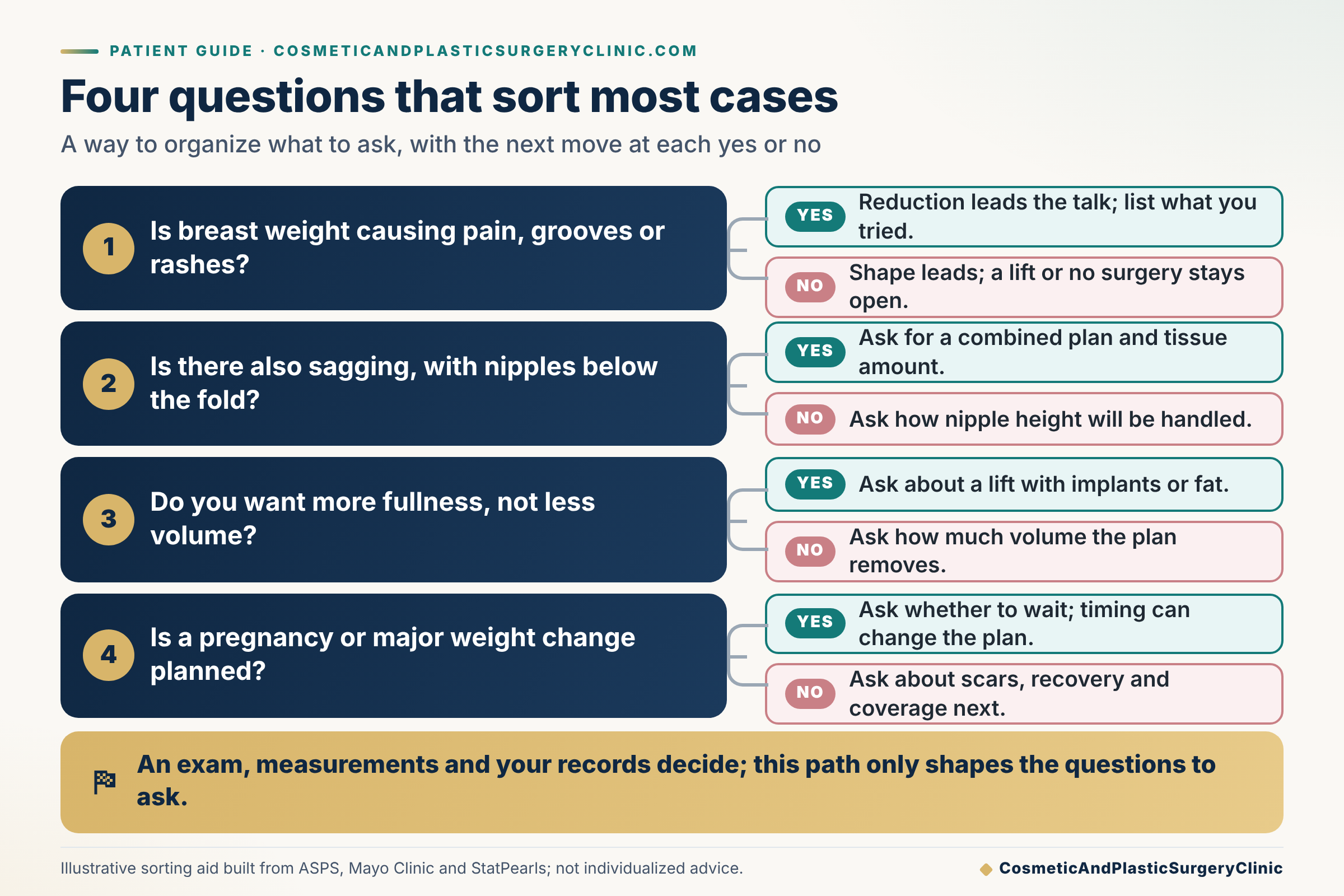
Start with the symptom question, since it organizes the whole breast reduction vs breast lift conversation. Weight-related symptoms, plus tissue the person would be willing to part with, open a reduction conversation, with measurements, photos and records of what was tried. Shape concerns with comfortable volume open a lift conversation. If neither is strong, supportive measures and waiting remain open, and a second opinion costs little compared with an operation.
Wanting a smaller size without symptoms is a personal goal and a valid one. It simply changes how a reduction is classified for payment.
Second fork: skin quality and nipple position
Once volume is settled, nipple position and skin quality decide how much lifting the plan must build in. StatPearls ties the periareolar lift to mild or moderate ptosis with little excess lower-pole skin, and the inverted-T to severe ptosis or poor skin quality. A smaller skin pattern means a shorter scar, but it only works when the skin and tissue can support it. This is the point where breast reduction vs breast lift planning becomes a matter of skin quality, not just size.
What could change the plan
Pregnancy, breastfeeding and weight plans
Mayo Clinic’s reduction page suggests postponing surgery if you plan to have children, noting that breastfeeding might be challenging afterward, and also lists planned weight loss as a reason to wait. Its lift page says breasts could stretch during pregnancy and offset the lift, and that surgeons suggest waiting about six months to a year after stopping breastfeeding. The weight point concerns breast size changing after surgery. It is not a judgment about anyone’s body.
The breast reduction candidate article covers how surgeons weigh these factors.
Health, nicotine and screening
ASPS lists medical conditions that impair healing, and smoking or vaping, as factors that may complicate candidacy for either operation. Mayo Clinic says to stop smoking at least six weeks before and after a reduction. BMI is another modifier surgeons weigh: the 2024 reduction series linked a BMI of 30 or above to higher complication odds, which is a reason to discuss timing and risk, not a verdict. Nothing about breast reduction vs breast lift removes those modifiers.
Screening matters for both. Mayo Clinic says reduction planning may require a mammogram and that a surgeon might recommend a baseline mammogram before a lift, with another a few months afterward.
Money, coverage and six checks before choosing breast reduction vs breast lift
Cost and coverage are where the two diverge most in practice, because plans often judge the two operations by different tests. Both are decisions to make with a written quote in hand.
How the money differs
Fees and what they leave out
ASPS’s pages give an average of $7,800 for aesthetic breast reduction and $6,816 for breast lift, neither with a year stated. The ASPS 2024 average-cost document lists ranges of $7,000 to $12,500 for aesthetic reduction and $6,500 to $11,000 for lift. All of these are surgeon-fee figures that exclude anesthesia, facility and related expenses.
For context on volume, ASPS’s 2025 report estimates 156,131 lifts and 76,040 reductions in the United States, extrapolated from surveys and claims data. Popularity says nothing about which operation suits a given breast. For line-by-line pricing, see breast reduction cost.
When two quotes arrive, compare scope before price. A quote for a breast reduction vs breast lift should say whether tissue removal is included, whether a lift component is priced separately, and who bills facility and anesthesia. A lower number that leaves those out is not a lower price.
Coverage rules: symptoms versus appearance
ASPS says reduction is often covered by health plans, which may ask for a letter and photos, and that most plans do not cover breast lift. Policies show the logic. Aetna’s bulletin requires persistent symptoms in at least two areas for at least a year, photos, a conservative-treatment trial and a planned resection meeting a Schnur-scale minimum. A Texas Blue Cross policy uses the 22nd percentile line of the same scale. An Oklahoma Blue Cross policy effective 2026-05-15 classifies mastopexy as cosmetic except within medically necessary reconstruction.
Strong and Hall-Findlay argue against rigid volume cutoffs, but plans set their own. The breast reduction insurance guide covers documentation and appeals, and coverage is never assured.
| Item | Breast reduction | Breast lift |
|---|---|---|
| ASPS page average (no year given) | $7,800, aesthetic reduction | $6,816 |
| ASPS 2024 average-cost document | $7,000 to $12,500, aesthetic patients only | $6,500 to $11,000 |
| Left out of those figures | Anesthesia, facility and related expenses | Anesthesia, facility and related expenses |
| ASPS statement on coverage | Often covered; a letter and photos may be needed | Most plans do not cover it or its complications |
| Payer policy examples | Aetna 0017: symptom, duration and weight criteria; cosmetic if no symptoms | Blue Cross Oklahoma SUR716.010: cosmetic outside reconstruction |
Six checks to bring to a consultation
These are the questions that keep a breast reduction vs breast lift conversation specific. Ask for the answers in writing where you can. More on preparing is in the consultation guide.
Three checks on anatomy and the plan
- Diagnosis: which problem is this, weight, position, skin or a mix, and which exam findings show it?
- Tissue: will tissue be removed, roughly how much, and how will that be measured and recorded?
- Nipple: where will it sit, how will its blood supply and sensation be protected, and what happens if that fails?
Three checks on paperwork and aftercare
- Scars and recovery: which pattern is planned, how long are the lines, and what will recovery look like for my job and household?
- Money: what does the quote cover, including facility and anesthesia, and how will my plan review this operation?
- Future change: what if I become pregnant, my weight changes, or I need a revision, and who pays for it?
If answers stay vague, that is information. Credentials and facility questions are covered in how to choose a plastic surgeon.
Frequently asked questions
Does breast reduction vs breast lift change how long results last?
Neither operation stops time. Mayo Clinic says reduction results generally last a long time but aging, weight change and pregnancy can alter size and shape, and that lift results might not last forever, with sagging able to return, especially in larger, heavier breasts. A 2022 systematic review found sustained correction of ptosis is not universal after either operation. Weight stability, pregnancy and skin quality all matter, and a surgeon can say how each applies to your tissue.
In breast reduction vs breast lift, will a reduction leave me needing a lift?
Often the lifting is part of the reduction. ASPS says a breast reduction includes a lift and that women commonly see a much more lifted appearance afterward. Whether a given breast also needs extra skin tailoring or support depends on its tissue, skin quality and nipple position, which an examination judges. Ask your surgeon to describe the expected nipple position and breast shape after the operation, and to show similar cases photographed at similar follow-up times.
Do both operations need a mammogram?
Not necessarily, and policies differ. Mayo Clinic says reduction planning may require a mammogram, and that a surgeon might recommend a baseline mammogram before a lift and another a few months afterward. Aetna’s policy asks women 50 or older for a negative mammogram within two years before a covered reduction. A 2025 systematic review found incidental carcinoma in reduction specimens ranged from 0.0 to 2.0 percent across studies, and ASPS’s 2022 guideline, as that review describes it, recommends sending reduction specimens to pathology. Ask what your surgeon requires.
How do cup sizes fit into a breast reduction vs breast lift decision?
Poorly. The policies opened for this page work from tissue weight and body surface area, using the Schnur scale, not bra cup letters, and surgeons plan from measurements and the volume to be removed. Wanting to go down a certain number of cups is a goal to discuss, but it is not a plan. The breast reduction cup sizes article explains why cup labels mislead and what to ask instead.
Is a breast lift ever covered by insurance?
Sometimes, in narrow cases. ASPS says most plans do not cover a lift or its complications. An Oklahoma Blue Cross policy effective 2026-05-15 calls mastopexy cosmetic except when done as part of medically necessary breast reconstruction. Other plans have their own rules, and the policies opened did not set out criteria for a lift done on its own. Ask your insurer in writing, and ask the surgeon’s office which billing codes would be used for the plan it proposes.
Can liposuction alone replace a reduction or a lift?
The sources opened do not present it as a substitute for either. ASPS and Mayo Clinic describe liposuction as something that may accompany a reduction. Whether it could address a particular breast depends on how much of the breast is fat rather than gland and on how well the skin recoils, which only an exam can show. Skin that has stretched usually needs a different approach than fat removal, so a surgeon should explain why liposuction would or would not fit.
How does pregnancy timing affect breast reduction vs breast lift?
Both Mayo Clinic pages raise timing. Its reduction page suggests postponing surgery if you plan children and notes breastfeeding might be challenging afterward. Its lift page says pregnancy can stretch breasts and offset a lift, and that surgeons suggest waiting about six to twelve months after you stop breastfeeding. ASPS says a reduction may limit breastfeeding, although most women can still do it. Bring your plans to the consultation so the timing question for breast reduction vs breast lift gets answered for your situation.
Sources and further reading
- American Society of Plastic Surgeons — Breast reduction (accessed 2026-11-12) — what reduction removes; symptoms linked to breast size
- American Society of Plastic Surgeons — Breast reduction procedure steps (accessed 2026-11-12) — lollipop and keyhole incisions, nipple pedicle, free nipple graft, liposuction
- American Society of Plastic Surgeons — Breast reduction risks and safety (accessed 2026-11-12) — risk list, breastfeeding and sensation statements
- American Society of Plastic Surgeons — Breast reduction candidates (accessed 2026-11-12) — symptoms, smoking and healing conditions
- American Society of Plastic Surgeons — Breast reduction recovery (accessed 2026-11-12) — week-by-week recovery outline
- American Society of Plastic Surgeons — Breast reduction costs (accessed 2026-11-12) — average surgeon fee without a stated year; insurance statement
- American Society of Plastic Surgeons — Breast lift (accessed 2026-11-12) — lift does not change size; combining with reduction or augmentation
- American Society of Plastic Surgeons — Breast lift procedure steps (accessed 2026-11-12) — three incision patterns, skin removal, nipple repositioning
- American Society of Plastic Surgeons — Breast lift candidates (accessed 2026-11-12) — nipple below the fold, weight stability, smoking
- American Society of Plastic Surgeons — Breast lift risks and safety (accessed 2026-11-12) — sensation, asymmetry, nipple loss, revision
- American Society of Plastic Surgeons — Breast lift cost (accessed 2026-11-12) — average fee without a stated year; insurance statement
- American Society of Plastic Surgeons — What’s the difference between a breast reduction and a breast lift? (accessed 2026-11-12) — tissue versus skin, combination, downtime
- American Society of Plastic Surgeons — Why a breast reduction includes a lift, video description (accessed 2026-11-12) — reduction includes a lift; areola gets smaller
- American Society of Plastic Surgeons — Cosmetic procedures average cost, 2024 (accessed 2026-11-12) — surgeon-fee ranges for lift and aesthetic reduction
- American Society of Plastic Surgeons — Plastic surgery statistics report, 2025 (accessed 2026-11-12) — procedure estimates and methodology
- Mayo Clinic — Breast reduction surgery (accessed 2026-11-12) — reasons, risks, mammogram, timing, results
- Mayo Clinic — Breast lift (accessed 2026-11-12) — size not changed, pregnancy and weight effects, scars, mammogram
- Cleveland Clinic — Breast reduction (accessed 2026-11-12) — operating time, recovery ranges, insurance documentation
- Martinez and Chung — Breast ptosis, StatPearls, NCBI Bookshelf (accessed 2026-11-12) — ptosis grades, pseudoptosis, lift techniques, complication rates
- Wong, Vucovich and Rohrich — Mastopexy and reduction mammoplasty pedicles and skin resection patterns, Plastic and Reconstructive Surgery Global Open, 2014 (abstract record, accessed 2026-11-12) — shared techniques; difference in tissue removed
- Wagner, Lisiecki, Chiodo and Rohrich — Longevity of ptosis correction in mastopexy and reduction mammaplasty, JPRAS Open, 2022 (abstract record, accessed 2026-11-12) — pedicle stability, evidence quality
- di Summa and colleagues — Systematic review of outcomes and complications in nonimplant-based mastopexy surgery, JPRAS, 2019 (abstract record, accessed 2026-11-12) — mastopexy complication rates
- Strong and Hall-Findlay — How does volume of resection relate to symptom relief for reduction mammaplasty patients? Annals of Plastic Surgery, 2015 (abstract record, accessed 2026-11-12) — symptoms by resection volume
- Yao and colleagues — Do larger reductions yield larger returns? JPRAS, 2021 (abstract record, accessed 2026-11-12) — pain and BREAST-Q by specimen weight
- PubMed — Systematic review of functional outcomes after reduction mammaplasty, literature 1977 to 2010 (record 22090252, accessed 2026-11-12) — pain, sleep, breathing, psychological outcomes; title and authors not shown on the page opened
- Suber and colleagues — Postoperative complications following reduction mammaplasty in relation to patient body mass index, ePlasty, 2024 (accessed 2026-11-12) — single-surgeon complication series and BMI
- Gong, Akiki and Sullivan — Incidental breast carcinoma in reduction mammoplasty: a systematic review, ePlasty, 2025 (accessed 2026-11-12) — pathology of reduction specimens; 2022 ASPS guideline
- Atiyeh, Fadul, Habr and Chahine — Simplified planning and marking of mastopexy and reduction mammoplasty: the circumvertical “Matryoshka” pattern, Revista Brasileira de Cirurgia Plástica, 2021 (accessed 2026-11-12) — Wise template history
- Wise — A preliminary report on a method of planning the mammaplasty, Plastic and Reconstructive Surgery, 1956 (PubMed record, no abstract, accessed 2026-11-12) — citation for the template
- Aetna — Clinical Policy Bulletin 0017, breast reduction surgery and gynecomastia surgery (last review 2026-10-26, accessed 2026-11-12) — symptom, conservative-treatment, Schnur and mammogram criteria
- Blue Cross and Blue Shield of Texas — Reduction mammaplasty, SUR716.012 (effective 2024-12-01, accessed 2026-11-12) — six-week conservative measures; 22nd percentile line
- Blue Cross and Blue Shield of Oklahoma — Mastopexy, SUR716.010 (effective 2026-05-15, accessed 2026-11-12) — mastopexy cosmetic except within reconstruction
- The Aesthetic Society — Breast reduction vs breast lift, what do I qualify for? Patient question and surgeon reply (2022 to 2023, accessed 2026-11-12) — scar patterns, 500 gram rule of thumb


