Almost every question about how long breast lift lasts starts from a reasonable worry. The operation brings scars, a recovery period and real expense, so people want to know whether the result will still be there in five or ten years. The honest answer is that how long breast lift lasts differs from person to person, and the published evidence is thinner than the confident numbers on many clinic websites suggest.
This page lays out what shapes how long breast lift lasts: aging, gravity, pregnancy and breastfeeding, weight change, skin and tissue quality, the technique used and any implant. It also separates settling in the first year from sagging years later, and it says plainly which claims come from studies and which are only repeated. It cannot predict your own result. That takes an examination by a board-certified plastic surgeon who can assess your skin and tissue directly.
What counts as a breast lift wearing off
Settling in the first year is part of the plan
Swelling, dropping and the first look
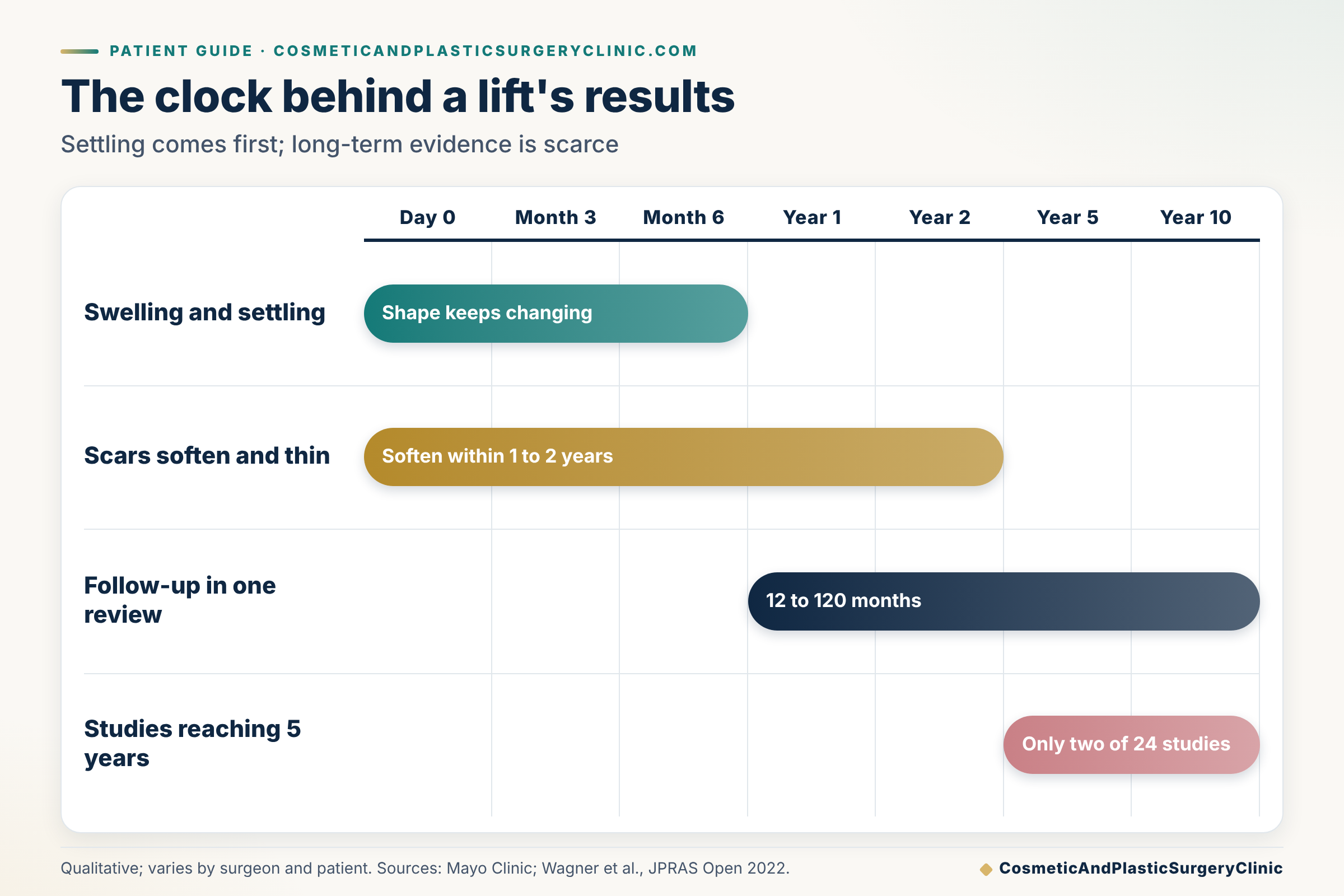
Mayo Clinic says you will see a change in the look of your breasts right away, and that the shape continues to settle over the next few months. The Aesthetic Society makes a similar point: some settling may occur over time, while the new nipple position should remain. The breast lift recovery guide covers the week-by-week arc.
For judging how long breast lift lasts, the useful point is that early change is not the same thing as the result failing. A breast that looked high and tight at two weeks and softer at six months has behaved the way surgeons describe. A different pattern, such as a nipple that has clearly moved back toward the fold, is the kind of change that raises the longevity question.
Scars soften on a different clock
Mayo Clinic says scars last forever but soften and become thin within one to two years, and that they look firm and lumpy at first. Scar quality and breast position are separate outcomes, and a breast lift can hold its shape while its scars remain visible, or the reverse.
This matters when you review photos later. A scar that looks better at eighteen months and a lower pole that looks longer at eighteen months are both normal observations, and they point to different questions for your surgeon. Keeping the two apart prevents one good detail from hiding a change in the other.
What recurrence, re-ptosis and bottoming out mean
Nipple height versus lower-pole stretch
A 1976 paper in Clinics in Plastic Surgery set out the vocabulary still used today: true ptosis, defined by where the nipple sits relative to the fold beneath the breast, is distinct from pseudoptosis, and it has three degrees. A 2022 review in JPRAS Open defines ptosis as the nipple at or below the inframammary fold, and pseudoptosis as a normal nipple position with excess tissue hanging below the fold.
The same review defines bottoming out as volume shifting from the upper pole to the lower pole. Anyone weighing how long breast lift lasts should know that a lift can lose ground in two ways. The nipple can drift down, or the lower pole can lengthen while the nipple stays put and the breast simply looks as if it has slipped. Surgeons and patients often call both “sagging,” although they are different problems. The breast lift overview explains what the operation changes in the first place.
How outcomes get measured, and why the numbers disagree
The 2022 review found no single recurrence rate in the literature. Studies mainly tracked two distances: nipple to inframammary fold, and sternal notch to nipple. Most relied on the nipple-to-fold distance alone, which the authors note does not capture overall breast shape.
That is why two papers can both be accurate and still seem to contradict each other. One may report that the nipple stayed high while another reports that the lower pole lengthened. When a clinic quotes a figure for how long breast lift lasts, the first question is what was measured, and the second is how long after surgery.
What studies say about how long breast lift lasts
The American Society of Plastic Surgeons (ASPS) estimated 156,131 breast lifts in the United States in 2025, up 8% from 144,003 in 2024. Its estimates combine member-surgeon data, a partner dataset and a national claims dataset, then extrapolate to the national level. It is a common operation, yet the evidence on how long breast lift lasts is far smaller than that volume would suggest.
What follow-up studies measured
A 24-study review with no single answer
The 2022 JPRAS Open review searched PubMed through December 2021 and included 24 studies covering 1,235 patients and 2,235 breasts. Every study followed patients for more than a year on average, with follow-up ranging from 12 to 120 months, but only two reached five years or more. Because the studies were so different, the authors did not pool the data.
Two further limits matter. The included studies mix breast reduction and mastopexy, so lift-only results cannot be separated. And age and weight change were not broken out in any of them, even though both are widely believed to matter. The authors call for controlled studies with five to ten years of follow-up.
A ten-patient pilot with a measured first-year change
A 2022 prospective pilot study in Acta Chirurgiae Plasticae followed ten patients after a Wise-pattern mastopexy that used skin excision only. It measured how far the nipple was raised using the distance from the jugular notch. Immediate lifting averaged 6.3 cm and averaged 4.6 cm at one year, a mean loss of 27.5% with a range of 12.5% to 41.7%.
Ten patients and twelve months cannot describe anyone’s future, and the technique was simple skin excision rather than the tissue reshaping that the Aesthetic Society associates with longer-lasting lifts. What the study does show is that some loss of nipple height within the first year was measurable, and its authors conclude that patients should be told recurrence is possible.
| Evidence type | What it can show | What it cannot show | Reasonable use |
|---|---|---|---|
| Society and clinic patient pages | General factors and the range of opinion | Numbers, sample sizes or follow-up length | Source of questions, not answers |
| Single-surgeon case series | What one team’s technique achieved over years | Whether other surgeons or patient types do as well | Useful when the series is large and follow-up is stated |
| Small prospective pilot studies | Measured change with a defined method | Anything reliable about rarer outcomes or long periods | A direction, not a rate |
| Systematic reviews of mixed studies | Patterns across techniques and populations | A pooled recurrence rate when methods differ | Best overview, with the caveats the authors list |
| Clinic before-and-after galleries | What the clinic chooses to display | Typical results or how many patients are missing | Check dates and matched anatomy |
Why society materials give such different answers
“Decades” versus “might not last forever”
The Aesthetic Society says breast lift results should last for decades before the breasts return to their preoperative droop, assuming a qualified surgeon and no major weight fluctuations or pregnancy. Mayo Clinic says results might not last forever, that skin becomes less elastic with age, and that sagging can return, especially with larger, heavier breasts. An ASPS member-surgeon blog from 2018, whose author states the views are his own, says some patients keep long-lasting results while others need minor revisions within a few years.
These statements are not necessarily in conflict. The first is conditional, the second is cautionary and the third describes a spread. None of the three presents data, which is why they are best read as a summary of opinion on how long breast lift lasts and a list of factors, not as a measured average.
Turning a durability claim into something you can check
A claim becomes checkable when it names a measure, a number of patients and a time. Useful questions at a consultation include how many patients the surgeon has followed to three and five years, what share were lost to follow-up, and whether there are dated photographs of patients with tissue and breast size like yours.
The guide to breast lift before-and-after photos explains how to read standardized images, including how many months should separate the two pictures. Photographs taken at one year say little about year five, so ask for the later ones directly.
Six factors that decide how long breast lift lasts
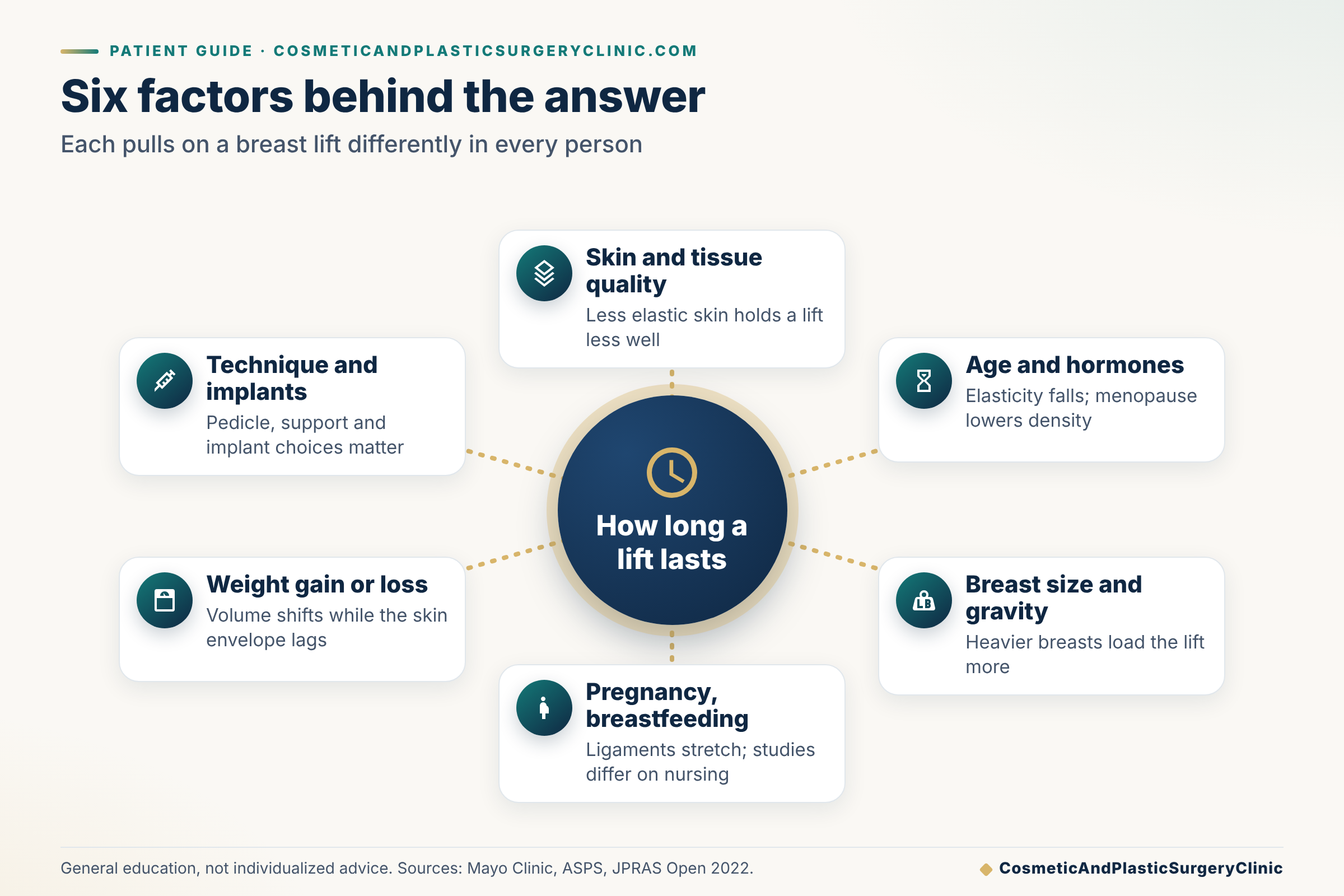
The sources reviewed for this page keep returning to the same six influences on how long breast lift lasts: skin and tissue quality, age and hormones, breast size and gravity, pregnancy and breastfeeding, weight change, and the operation itself. The first five are explained here, and the sixth gets its own section after them. None of them works alone, which is one reason no formula exists.
Factors built into your tissue
Skin and tissue quality in how long breast lift lasts
A lift raises the breast and tightens what surrounds it, but it works with the skin and supporting tissue you already have. ASPS lists the causes of lost firmness and elasticity as pregnancy, breastfeeding, weight fluctuations, aging, gravity and heredity. The ASPS member-surgeon blog adds genetics and general health to the list.
Two studies give a sense of how tissue quality and habits show up in the numbers behind how long breast lift lasts. In the 2010 Annals of Plastic Surgery study of 132 people seeking breast surgery, a history of smoking was one of the factors linked with ptosis. A small single-surgeon series published in 2019, with twelve patients in its main group and about a year of follow-up, found that lower-pole lengthening rose as the number of risk factors rose. Both are limited, but they point the same way.
Age, menopause and hormones
Mayo Clinic notes that breasts change with age, often losing firmness, and that skin loses its ability to snap back after stretching. An ASPS article from August 2026 adds that declining estrogen can make breasts less dense, which can contribute to sagging, while one surgeon quoted in it says many women gain breast fat as they get older, some more than others.
The practical meaning is that a lift performed at thirty-five and a lift performed at fifty-five start from different tissue and age on different schedules. Aging does not need an event such as a pregnancy to change how long breast lift lasts. Gradual change can happen while nothing else in your life has.
Breast size, weight and gravity
Mayo Clinic says gravity gradually stretches the ligaments of the breast and weakens its support, and that sagging is more likely to return with larger, heavier breasts. The 2010 Annals study agrees in direction: a larger bra cup size and a higher body mass index were both linked with ptosis.
The 2022 review also summarizes a reduction-surgery study of 88 patients in which nipple-to-fold distance increased by 11% when 500 to 1,200 grams were removed, compared with 34% when more than 1,200 grams were removed. That was reduction, not lift, so it does not translate directly. It does show that the amount of tissue the skin must carry is one of the variables surgeons weigh.
Factors that change after the operation
Pregnancy, breastfeeding and how long breast lift lasts
Mayo Clinic says stretching of the supporting ligaments during pregnancy might cause sagging whether or not you breastfeed, and that people who plan a future pregnancy might wait for a lift. In the 2010 study of people seeking surgery, 85% of those who had been pregnant reported adverse changes in breast shape afterward, and the number of pregnancies was a risk factor for ptosis.
Whether breastfeeding adds to the effect is disputed. The 2010 study found breastfeeding history was not a significant risk factor, but a study summarized in the 2022 review compared 57 patients who had been pregnant with 103 controls and found significantly greater nipple-to-fold lengthening after pregnancy, largest in women who breastfed. Different designs and populations may explain the gap. It remains unresolved.
Weight change and how long breast lift lasts
Mayo Clinic says weight changes can stretch breast skin and reduce its elasticity, and that keeping a stable, healthy weight afterward can help results last. A history of major weight loss, defined as more than 50 pounds, was among the ptosis risk factors in the 2010 study.
An ASPS article from September 2026 on weight-loss medications describes the mechanism: breasts contain substantial fat, so large weight loss can reduce volume while the skin envelope does not shrink at the same rate. One surgeon quoted there says future weight fluctuations may alter postoperative results. The article describes the breast changes as consistent with substantial weight loss in general, not as a proven direct effect of the medications themselves.
| Factor | Effect on outcome | Maintenance or revision implication | Review point |
|---|---|---|---|
| Skin and tissue quality | Skin that has lost elasticity gives the reshaped breast less to hold on to | Surgeon may add internal support or set more cautious expectations | Ask how your skin quality changes the plan |
| Age and hormones | Elasticity declines gradually; breast density can fall with menopause | Slow change can occur with no triggering event | Dated photos at regular intervals |
| Breast size and gravity | Heavier breasts load the lift more over time | Sagging is more likely to return in larger breasts | Lower-pole length compared with year-one photos |
| Pregnancy and breastfeeding | Ligament stretching and tissue change; studies disagree on breastfeeding | Many surgeons advise waiting until childbearing is complete | State family plans at the first consultation |
| Weight gain or loss | Volume changes while the skin envelope lags behind | Large swings may prompt a discussion of revision or volume options | Record weight before surgery and at each follow-up |
| Technique, support and implants | Pedicle, tissue reshaping, mesh or implant influence stability | Ask which approach is planned and why | Request similar-case photos at three to five years |
What the operation adds: technique, support and implants
Technique choices that influence how long breast lift lasts
Reshaping the tissue, not just trimming the skin
The Aesthetic Society says that surgeons who reshape the entire breast tissue generally achieve a longer-lasting lift than those who only remove skin. That is a society statement, not a measured result, but it matches the direction of the research: the 2022 review found that superior and superomedial pedicles, which supply the nipple from above or the side, gave more long-term stability than inferior pedicles.
The evidence is not uniform. In one study of 58 patients, nipple-to-fold change was 2.7 cm with an inferior pedicle and 2.0 cm with a superomedial one, while a study of 100 patients found no significant difference between the two. The review also noted that most vertical-pattern studies reported some elongation, bottoming out or pseudoptosis. Incision pattern affects scars as well, which the breast lift scars guide explains.
Mesh, slings and internal bras: promise without proof
Several support techniques aim to keep the lower pole from stretching. The 2022 review found that permanent or partially absorbable mesh generally did better than fully absorbable mesh, that dermal flaps and pillar sutures gave variable results, and that a muscular sling was tested in the only randomized trial, a 21-patient study that reported significantly less bottoming out over ten years than the control group.
An ASPS article from April 2025 describes an absorbable “internal bra” as a scaffold meant to help results last longer, and quotes a surgeon saying the material may not be fully dissolved until two years after surgery. The article cites no studies and gives no duration. These techniques may help, but “promising” is the most the reviewed evidence supports, and each adds time, cost and its own questions for the surgeon.
When an implant is part of the plan
Implants add weight and a lifecycle
An implant changes the question of how long breast lift lasts. The FDA says breast implants are not lifetime devices and that the longer someone has them, the more likely they are to need removal or replacement. So the useful question for a lift with an implant is how long the lift lasts and when the implant may need attention, which are two separate clocks. The breast lift with implants guide goes through the combined operation.
Published series vary widely. A 2019 retrospective series of 2,183 augmentation-mastopexy procedures in 1,131 patients, with mean follow-up of 43 months, reported a 14.7% reoperation rate, with recurrent ptosis in 3.5% of patients and a wish to change implant size in 3.2%. A 2020 series of 171 patients reported no recurrence of ptosis requiring reoperation, with nipple-to-fold elongation of 1.0 to 2.2 cm. Both come from surgeons describing their own results.
Why lift-only and lift-plus-implant durability cannot be compared directly
The Aesthetic Society says combining a lift with augmentation may extend results. The sources reviewed here contain no matched comparison of lift-only and lift-plus-implant patients, and the two groups often differ before surgery, since people who choose an implant tend to be those with volume loss.
A fair reading is that an implant may add internal support while also adding weight and a need for monitoring. Which effect dominates in a given breast is a judgment for the examining surgeon. The breast augmentation guide covers the device side, including follow-up imaging for silicone implants.
Habits that may help, and claims with little evidence
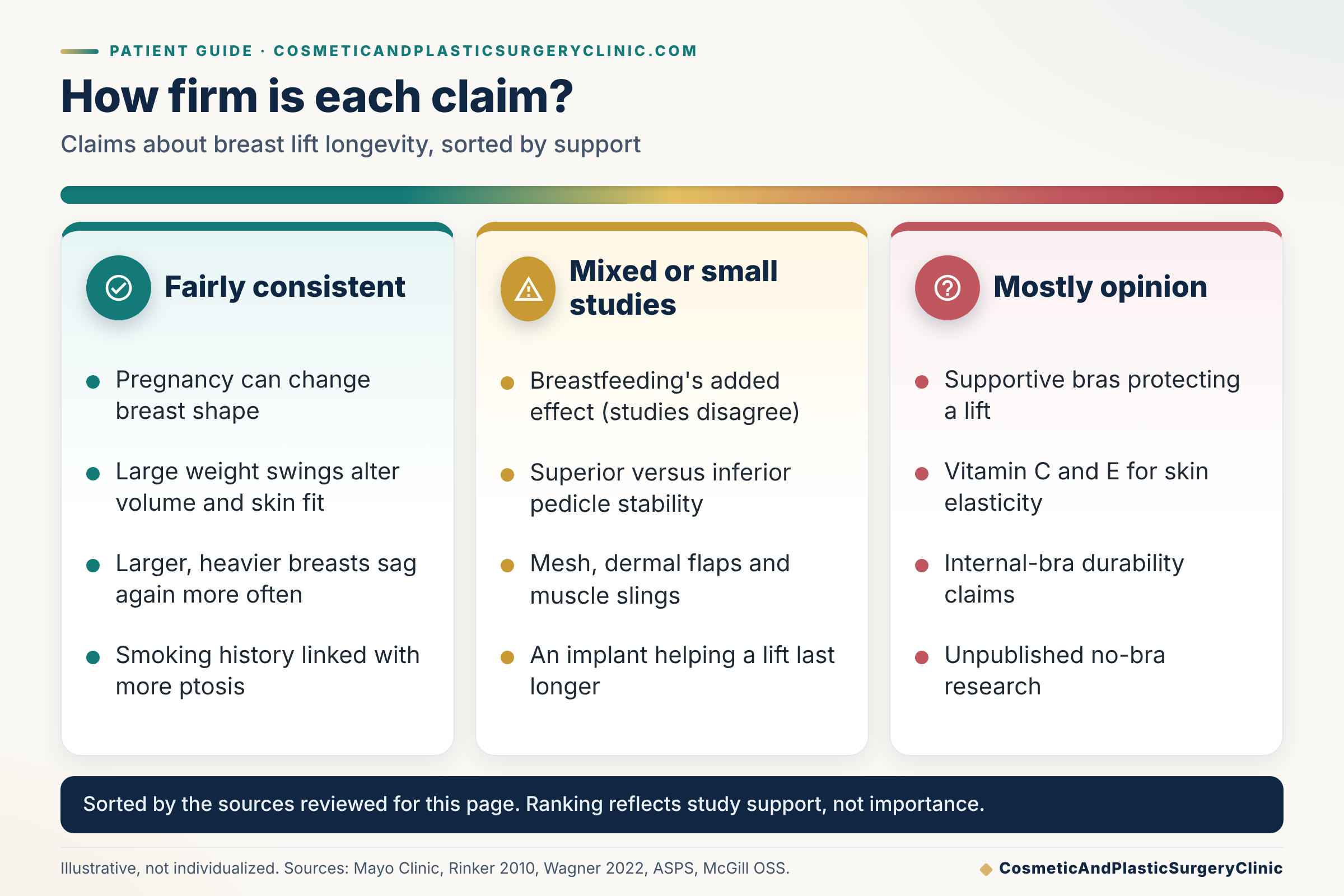
Plenty of advice circulates about how long breast lift lasts and how to protect it. Some of it rests on a plausible mechanism and consistent observations, some on small or mixed studies, and some on opinion alone. The chart sorts the claims discussed in this section so you can see which is which.
Weight, sun and nicotine
Keeping weight steady
Of the habits that bear on how long breast lift lasts, weight stability has the most consistent support. Mayo Clinic advises a stable, healthy weight after surgery, and the ASPS member-surgeon blog warns against rapid gain or loss and suggests operating only after the target weight has been reached and held.
The September 2026 ASPS article on weight-loss medications gives a concrete benchmark: one surgeon recommends documented weight stability for at least three to six months before surgery, and another says the aim is a sustainable weight, not necessarily the lowest one. It adds that continuing a medication does not automatically rule out surgery, because weight and nutritional stability are the deciding factors.
Sun, nicotine and skin care
The ASPS member-surgeon blog suggests limiting prolonged sun exposure because it may reduce skin elasticity, and mentions vitamin C and E supplements without citing a study. No source reviewed here tested supplements or sun protection against how long a lift lasts, so treat them as general skin care, not a proven lift-protection measure.
Nicotine has firmer evidence of a different kind. Smoking history was a ptosis risk factor in the 2010 study, and in the 2019 augmentation-mastopexy series smokers had a 26.1% complication rate and a 22.5% reoperation rate, against 15.3% and 14.7% for the series overall. The plastic surgery risks guide covers nicotine and wound healing in general terms.
Bras, exercise and support
What is and is not known about bras
The ASPS member-surgeon blog says that wearing ill-fitting bras, or none at all, may cause breasts to sag faster than usual. That is an opinion. The Coltman skin study suggested older women might benefit from more external support, but it measured skin, not lifted breasts. McGill University’s Office for Science and Society reviewed the question for the general public and found the evidence weak: a widely repeated French study of about 320 women was never published, and a 1990 study involved eleven young women.
No source reviewed for this page tested whether a supportive bra changes how long breast lift lasts. After surgery, follow your surgeon’s bra instructions exactly. Beyond that, fit and comfort are reasonable guides.
Exercise and early-weeks support
In the 2010 study, lack of regular upper-body exercise was not a significant risk factor for ptosis, so there is no evidence here that chest workouts protect a lift or that skipping them harms one. Exercise matters mainly for general health and for weight stability.
The early weeks are different. One surgeon quoted by ASPS in 2024 described wearing a surgical bra for about four to six weeks and avoiding heavy lifting and strenuous exercise for at least four weeks. Those are one surgeon’s habits, not a standard, and your own instructions override any general range. The breast lift recovery guide gives the usual stages.
Planning ahead: pregnancy, follow-up and revision
How long breast lift lasts when pregnancy is still possible
Why surgeons ask about future children
Mayo Clinic says that people who plan a future pregnancy might wait for a lift, because pregnancy can stretch the supporting ligaments. An ASPS article from June 2026 says breast surgery should be delayed until a woman is certain her breasts have stopped changing, and warns that a result achieved too early may not last.
Consider a hypothetical 31-year-old who is undecided about another child. She can have a lift now and accept that a later pregnancy may change the shape and could lead to a second operation, or she can wait. Neither choice is wrong. What matters is that the trade-off is discussed before the first operation. The breast lift candidate guide covers what surgeons evaluate.
Timing after a pregnancy or weaning
Mayo Clinic says surgeons suggest waiting about six months to a year after stopping breastfeeding. In the ASPS article, one surgeon prefers waiting at least three months after weaning because the tissue keeps changing, and the article says breasts can take four to six months after weaning to settle, “or not.”
Those ranges are guidance from individual surgeons and a clinic summary, not a measured threshold. The aim is to let volume, skin and hormones reach a steady state, so that the operation reshapes the breast you will actually have. The guide to timing a mommy makeover after pregnancy applies the same logic to combined plans.
When sagging returns after a lift
Watching, documenting and waiting
Because shape keeps settling for months, any record of how long breast lift lasts in your own case starts with good photographs. Dated images in the same lighting, pose and bra make it easier to tell settling from recurrence. The 2022 review treated one year as its minimum follow-up and acknowledged that even this may be too short, so a breast that looks lower at six months is not automatically a failed lift.
The ASPS member-surgeon blog says some patients need minor revisions within a few years. Whether a change is bothersome enough to act on, and how long to wait first, is covered in the revision breast lift guide. Mayo Clinic also notes that a surgeon might recommend a baseline mammogram before the lift and another a few months afterward, so mention the surgery whenever imaging is scheduled.
Asking a surgeon how long breast lift lasts in your case
The right questions turn a general topic into one you can act on. Ask which technique is planned and why it suits your tissue, whether any internal support is proposed and what evidence the surgeon relies on, what happens if weight or family plans change, and what the revision policy covers. The guides on choosing a plastic surgeon and preparing for a consultation list how to check credentials and organize your questions.
A second opinion is reasonable before any operation, and so is deciding not to operate. The table below lines up common situations with the options and questions that tend to follow. It is a conversation aid, not a verdict.
| Situation | Pathway to discuss | Benefit | Trade-off | Key question |
|---|---|---|---|---|
| Pregnancy possible within a few years | Delay the lift or plan for a later revision | Operate on tissue that has stopped changing | Living with the current shape for longer | How would a pregnancy change my plan? |
| Large weight loss still under way | Wait for documented weight stability | Fewer later changes in volume | Delay; skin excess remains meanwhile | How long should my weight stay steady first? |
| Wants more upper-breast fullness with the lift | Discuss lift with an implant or fat transfer | Position and volume addressed together | Added complexity; an implant has its own lifecycle | What is the reoperation policy for each part? |
| Sagging has returned after a lift | Dated photos, second opinion, revision consultation | Clear view of what changed and why | Another operation on already-operated tissue | What would be done differently this time? |
| Thin, stretched skin or heavy breasts | Ask about internal support and realistic expectations | Plan matches the tissue | Support techniques have limited long-term evidence | What evidence supports this technique here? |
Frequently asked questions
Is there an average number of years for how long breast lift lasts?
No verified average turned up in the sources reviewed. A 2022 review of 24 studies found no single recurrence rate, and society pages range from “decades” to “might not last forever.” If a clinic quotes a number of years, ask what it was based on: how many patients, how long they were followed, and what was measured. A figure without those details is a marketing estimate. A more useful request is photographs of patients with similar tissue, taken several years after surgery.
Will a pregnancy after a lift change how long breast lift lasts?
Mayo Clinic says pregnancy might cause sagging whether or not you breastfeed, but no source reviewed gave the odds of that happening after a lift, so how long breast lift lasts in that situation is not something a source can state. Pregnancy changes volume, skin and ligaments, so the shape can change, and some people later discuss a revision. Whether that happens, and how much, depends on the individual. This is why many surgeons ask about family plans first and why waiting until childbearing is complete is a common suggestion.
Does a lift with an implant change how long breast lift lasts?
The Aesthetic Society says combining a lift with augmentation may extend results, but the sources reviewed here contain no matched comparison. An implant adds weight and a lifecycle of its own, and the FDA says implants are not lifetime devices. Plan for two timelines, one for the lift and one for the device, and ask which findings would lead to a second operation and what the practice’s revision policy covers for each.
Can I breastfeed after a breast lift?
Mayo Clinic says breastfeeding is usually still possible after a lift, though some people have trouble producing enough milk. It lists difficulty breastfeeding among the risks of the operation. That question is separate from durability, but it connects to timing: the same pregnancy that you may want to complete before surgery is the one that raises the breastfeeding question. Raise both with the surgeon at the first visit so the plan covers them together.
Does losing weight after a lift always shorten how long breast lift lasts?
No source says it always does. Mayo Clinic says weight changes can stretch skin and reduce elasticity, and an ASPS article describes a mismatch between lost breast volume and the skin that holds it. One surgeon in that article says the changes appear driven largely by the amount and rate of weight loss, and that volume loss depends on age, menopausal status and body habitus. Gradual, modest change is a different situation from rapid, large loss.
Does menopause change how long breast lift lasts?
Menopause is not a known cutoff for how long breast lift lasts. An ASPS article from August 2026 says declining estrogen can make breasts less dense, which may contribute to sagging, while one surgeon notes that some women gain breast fat with age. No source reviewed measured the effect on a previously lifted breast. Because breast tissue changes slowly across decades, dated photographs every year or two help show whether a change is progressing, and a consultation can address whether any step is worth taking.
Do I need more mammograms after a breast lift?
Mayo Clinic says a surgeon might recommend a baseline mammogram before the lift and another a few months afterward, so changes in breast tissue can be tracked. Beyond that, your screening schedule is a decision for your own clinician and depends on age and history. When you book any imaging, mention the surgery and its date so the radiology team interprets the images with that history in mind.
Sources and further reading
- Wagner et al. — Longevity of ptosis correction in mastopexy and reduction mammaplasty, JPRAS Open 2022 (accessed 2026-11-12) — 24-study review; follow-up; pedicles, mesh, slings, pregnancy
- Sisti et al. — Recurrence of breast ptosis after mastopexy: a prospective pilot study, Acta Chirurgiae Plasticae 2022 (accessed 2026-11-12) — ten-patient one-year measurement
- Rinker, Veneracion, Walsh — Breast ptosis: causes and cure, Annals of Plastic Surgery 2010 (Europe PMC record; accessed 2026-11-12) — ptosis risk factors, pregnancy, breastfeeding
- PubMed — Breast ptosis. Definition and treatment, Clinics in Plastic Surgery 1976 (accessed 2026-11-12) — ptosis versus pseudoptosis; three degrees
- Coltman, Steele, McGhee — Effect of aging on breast skin thickness and elasticity, Skin Research and Technology 2017 (accessed 2026-11-12) — skin elasticity and thickness by age
- Messa — One-stage augmentation mastopexy: a retrospective ten-year review of 2183 consecutive procedures, Aesthetic Surgery Journal 2019 (accessed 2026-11-12) — reoperation, recurrent ptosis, smokers
- Xue, Dayan, Rohrich — Achieving predictability in augmentation mastopexy: an update, Plastic and Reconstructive Surgery Global Open 2020 (accessed 2026-11-12) — 171-patient series; ptosis recurrence
- Dermal triangular flaps to prevent pseudoptosis in mastopexy surgery: the hammock technique, Plastic and Reconstructive Surgery Global Open 2019 (accessed 2026-11-12) — lower-pole lengthening and risk factors
- Mayo Clinic — Breast lift (accessed 2026-11-12) — gravity, aging, weight, pregnancy, scars, mammograms
- American Society of Plastic Surgeons — Breast lift (accessed 2026-11-12) — causes of lost firmness; what a lift does not change
- American Society of Plastic Surgeons — How long do breast lift results last? Member-surgeon blog (2018-09-12; accessed 2026-11-12) — factors, habits, minor revisions
- The Aesthetic Society — How long will my breast lift results last? (accessed 2026-11-12) — “decades”; reshaping; combining with augmentation
- American Society of Plastic Surgeons — Post-pregnancy plastic surgery (2026-06-18; accessed 2026-11-12) — timing after pregnancy and weaning
- American Society of Plastic Surgeons — GLP-1 and breast surgery (2026-09-22; accessed 2026-11-12) — weight loss, volume, skin envelope, stability
- American Society of Plastic Surgeons — What to expect from a menopause makeover (2026-08-28; accessed 2026-11-12) — estrogen and breast density
- American Society of Plastic Surgeons — Redefining breast surgery with internal bras (2025-04-01; accessed 2026-11-12) — internal-support claims
- American Society of Plastic Surgeons — Perk up for spring (2024-03-28; accessed 2026-11-12) — surgical bra and activity restrictions
- American Society of Plastic Surgeons — 2025 plastic surgery statistics report (accessed 2026-11-12) — breast lift procedure counts and methodology
- McGill University Office for Science and Society — Does wearing a bra make your breasts sag? (accessed 2026-11-12) — weak evidence on bras
- U.S. FDA — Types of breast implants (accessed 2026-11-12) — implants are not lifetime devices