

A pair of breast reduction photos seems to answer the question you came with: smaller breasts, a nipple sitting higher, a scar that looks manageable. What the pair cannot tell you is how the second picture was made. A different pose, a different light, a different month and a different starting breast can shift the impression more than the operation did, and the label “breast reduction” can cover quite different procedures.
This page teaches the viewing skills that are specific to breast reduction photos: what the pictures do show, what no picture can show, and the questions to bring to a consultation. The operation itself is explained in the main breast reduction guide, and the rules that apply to any gallery are in the article on reading before and after photos. A gallery is evidence about other people. It is not a forecast of your own result.
What breast reduction photos can show, and what they cannot
The American Society of Plastic Surgeons (ASPS) describes breast reduction as removing skin and tissue from the breast, then reshaping and elevating it to create a smaller, more proportionate bust. Three of those changes are visible in a photograph: how much smaller the breast is, where the nipple and areola now sit, and the shape and scar lines that remain. ASPS counted 76,040 breast reductions in the cosmetic tables of its 2025 statistics report, up 7% from 70,961 in 2024, so breast reduction photos are not hard to find. The harder part is knowing what you are looking at.
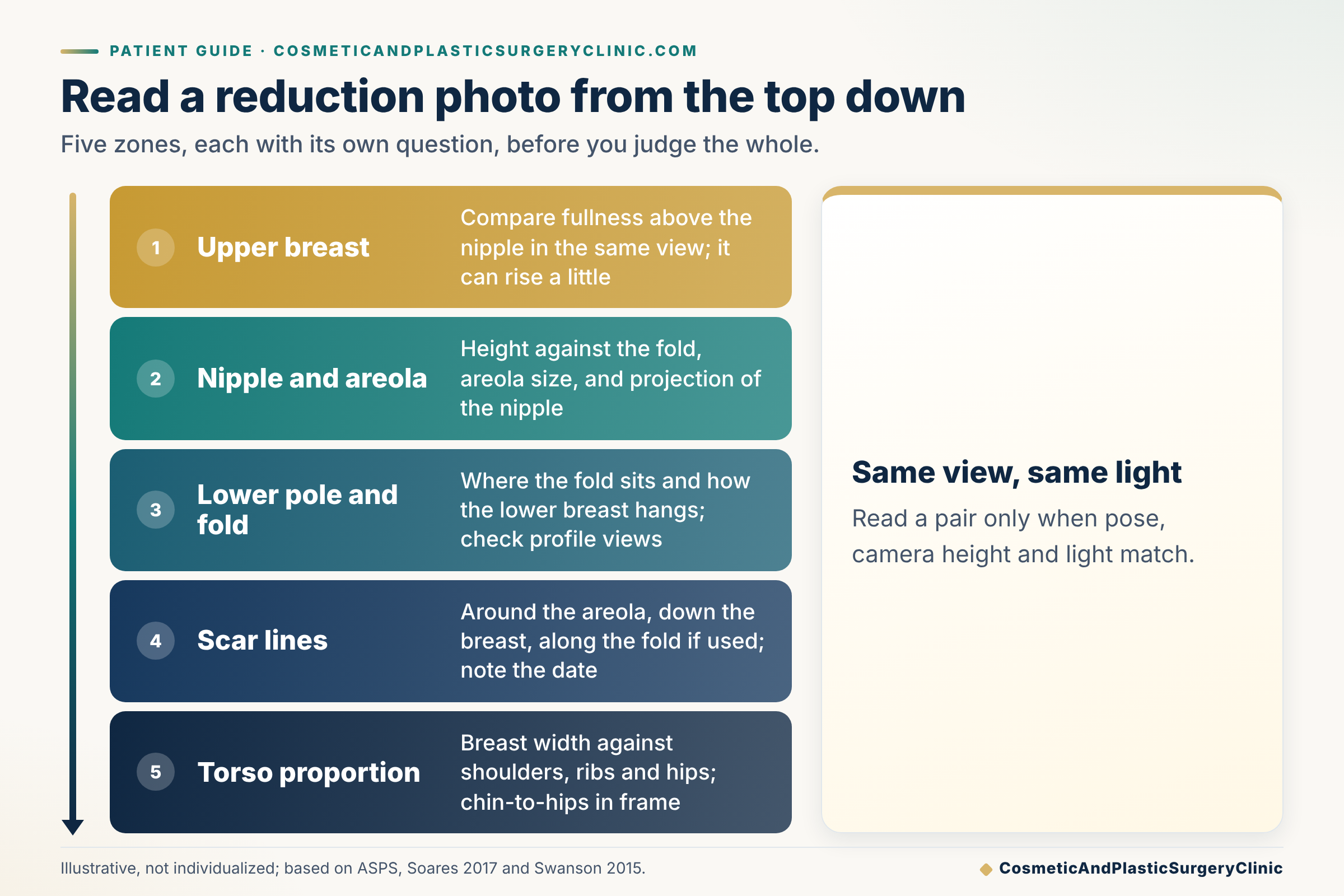
The changes breast reduction photos can document
Breast reduction photos are good at geometry. They record size relative to the torso, height of the nipple and areola, the outline of the lower breast and the line of any scar. That is a smaller list than the reasons people have surgery, which is why a strong picture can still leave the main question unanswered.
Size, nipple height and areola
ASPS says the nipple stays attached to its original blood and nerve supply and is moved to a higher position, and that the areola may be reduced by removing skin around its edge. In one 2015 series in Plastic and Reconstructive Surgery Global Open, Eric Swanson described 80 women treated by the same vertical technique; reduction-only patients averaged about 490 g removed per breast, and areola diameter fell from roughly 7 cm to 4.7 cm. It was one surgeon’s cases and one technique, so treat it as an example, not a range for everyone.
Why smaller does not always mean flatter
Many people expect a reduction to remove fullness from the top of the breast. Swanson’s measurements showed the opposite direction for reduction alone: upper-pole projection increased by 0.9 cm on the right and 0.6 cm on the left, which fits the idea that remaining tissue is lifted and reshaped, not only removed. So when breast reduction photos show a rounded upper breast, that is not automatically a sign of implants or editing, but it is a reason to ask what was done in the operation.
What no set of breast reduction photos can show
Most people who consider breast reduction do so for how their breasts feel, not only how they look. ASPS lists relief from back, neck and shoulder pain, less bra-strap grooving, less irritation under the breasts and easier exercise among the reasons. None of that appears in a pair of pictures taken in good light.
Symptoms and quality of life
A 2023 systematic review and meta-analysis in Aesthetic Surgery Journal pooled 28 studies of the BREAST-Q questionnaire after reduction. Satisfaction with the breasts rose from a pooled 22.9 before surgery to 73.0 after, and the improvements did not correlate with comorbidities, complication rates or the amount of tissue removed. The evidence is level 3 (observational), and the authors noted it as a reason to review insurance rules based on resection weight. For reading breast reduction photos, the point is simpler: a small visible change and a large symptom change can coexist, and so can the reverse.
Sensation, breastfeeding and healed complications
Nerves, milk ducts and wound healing are invisible. ASPS lists changes in nipple or breast sensation, which may be temporary or permanent, and says reduction may limit the ability to breastfeed.
The same page lists poor wound healing, including possible skin or tissue loss where incisions meet, and the NHS lists thick scars and uneven breasts or nipples. In Swanson’s series, delayed wound healing affected 16 of 80 patients (20%), and the author counted about half of all patients as having some complication, but the abstract-level summary does not separate minor events from serious ones. A healed, well-lit “after” picture is the end of that story, not the whole of it. See the breast reduction risks guide for the full list.
Match the operation before you compare the picture
“Breast reduction” is a goal, not a single technique. Surgeons choose among incision patterns and nipple methods according to anatomy, the amount of tissue to be removed and their own training, and a gallery caption rarely says which was used. Two sets of breast reduction photos with the same label can therefore reflect different scar maps, different trade-offs and different amounts of tissue removed.
Reading the scar pattern in breast reduction photos
Scar position is the one operation detail you can usually see. Knowing the usual patterns lets you tell what a photo shows from what the caption leaves out.
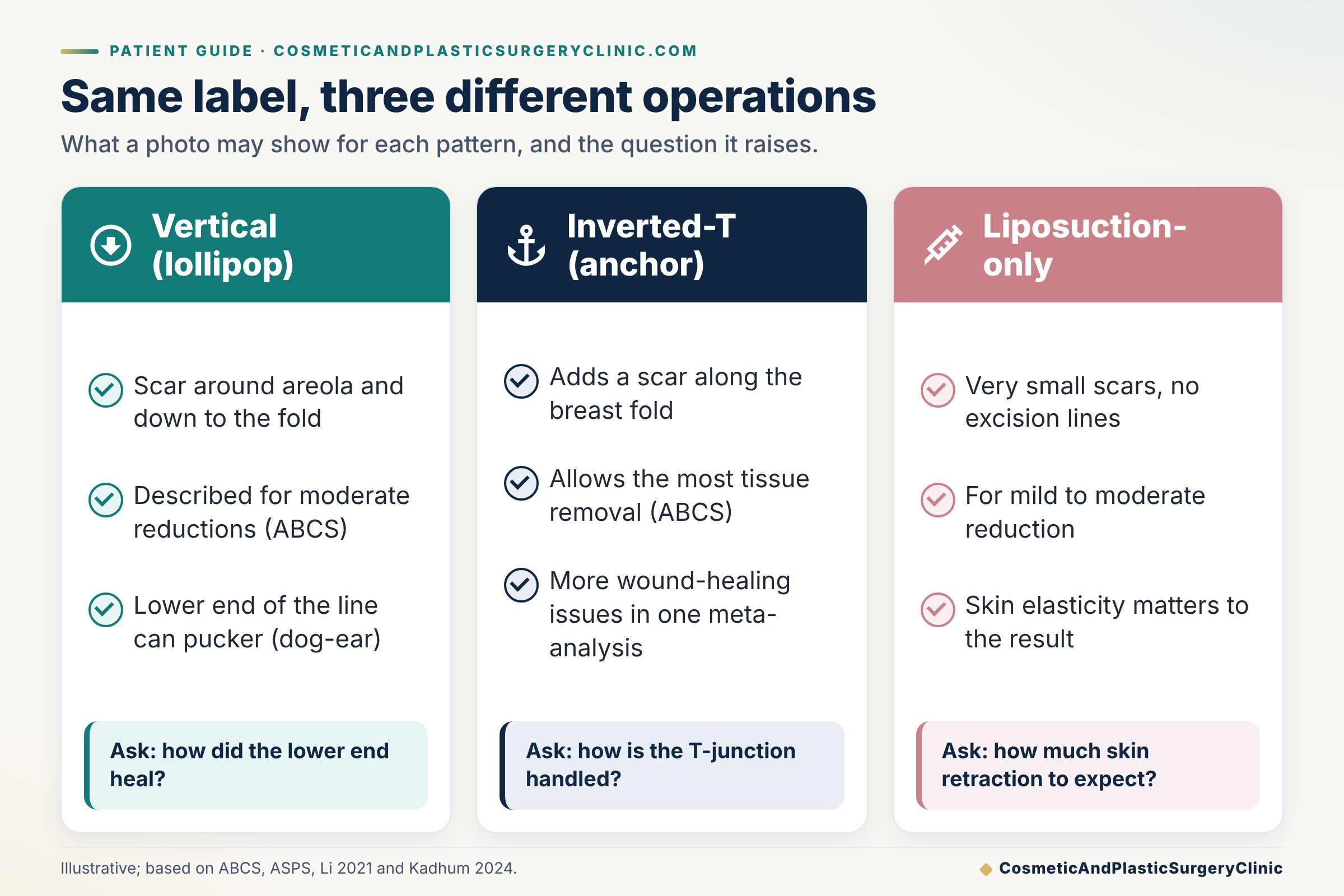
Vertical (lollipop) and inverted-T (anchor) lines
The American Board of Cosmetic Surgery patient guide describes the vertical pattern as two incisions, one around the areola and one running down to the breast crease, suited to a moderate reduction with more noticeable sagging. The inverted-T adds a third incision along the crease and is typically used for significant reduction or considerable sagging or asymmetry, because it allows the most tissue removal and reshaping. ASPS names lollipop and keyhole patterns and says the choice depends on anatomy, breast composition, the amount of reduction and the surgeon’s advice.
In breast reduction photos, look for the vertical line below the areola and for a horizontal line in the fold. A 2023 review in ePlasty (Kachare and colleagues) notes that vertical incisions are popular for their smaller scar burden but prone to dog-ears, small cone-shaped puckers at the lower end of the line, and that published revision rates for vertical scars range from 5% to 28%, so the bottom of a vertical scar deserves a close look.
What comparison studies say about the two patterns
A 2021 meta-analysis in Aesthetic Plastic Surgery (Li and colleagues) pooled two randomized trials and nine observational studies. The vertical pattern had a lower overall complication rate (odds ratio 2.06) and less wound dehiscence (odds ratio 4.62) than the inverted-T, with no significant differences in seroma, hematoma, nipple necrosis, fat necrosis or reoperation, and the authors concluded both patterns are equally safe.
A 2016 single-center study in Annals of Plastic Surgery (Fernandez and colleagues) found that, in 56 patients with complete photographs, inverted-T scars scored slightly higher for scar quality (3.5 versus 3.2 on a 1 to 5 scale) and that no technique was clearly better. A Cochrane protocol still describes surgeons as uncertain which is superior.
The practical reading: do not treat either scar pattern in breast reduction photos as the “winner.” Ask which pattern suits breasts like yours and why. The patient-facing comparison of scars after a lift, which uses some of the same incisions, is in breast lift scars.
The nipple method and the liposuction-only label
Two further variations change what the picture means without changing how it looks at a glance. Both are worth a line in any caption.
Pedicle versus free nipple graft
In the usual approach the nipple stays attached to its blood and nerve supply. For very large breasts, ASPS says the nipple and areola may need to be removed completely and repositioned higher, a free nipple graft, in which case the nipple will have no sensation after surgery and will take longer to heal. A 2005 paper in Annals of Plastic Surgery (Lacerna and colleagues) defined gigantomastia as more than 2,000 g removed per breast and listed loss of sensation, poor projection, uneven pigmentation and loss of lactation as drawbacks of free grafting.
In a photo, look at nipple color and projection and ask whether a graft was used, because the answer changes how closely any other case resembles yours.
Liposuction-only reduction is a different category
The American Board of Cosmetic Surgery guide says reduction by liposuction alone can leave “virtually undetectable scars on the breast” and is best for slight to moderate reductions with good skin elasticity. A 2024 systematic review in Aesthetic Plastic Surgery (Kadhum and colleagues; seven articles, 652 patients) reported better satisfaction, moderate volume reduction, improved ptosis and low complication rates, and described the approach as suited mainly to mild to moderate reductions with mild ptosis. The authors called for longer follow-up.
If a gallery mixes liposuction-only cases with excision cases, the scar-free ones are not a preview of the others. The technique is covered in the liposuction guide.
Match the starting breasts: weight removed, torso proportion, skin and symmetry
A result belongs to the breast it started from. Before any pair of breast reduction photos is allowed to shape your expectations, write four lines beside it: the starting breast (size, skin, asymmetry, pregnancy and weight history), the operation (pattern, nipple method, any liposuction), the grams removed from each side, and the date of each image. A line you cannot fill from the gallery becomes a question for the practice.
Start with grams, not cup letters
Gallery captions that say “reduced three cup sizes” sound precise and are not, because bra sizes are not standardized. Surgeons plan and report by tissue weight and by the position and proportion they are aiming for, as the article on cup sizes after reduction explains.
Resection weight is the caption that matters most in breast reduction photos
Weight removed tells you how large the change was and how much reshaping the skin had to do. In Swanson’s vertical-technique series, reduction-only patients averaged about 493 g from the right breast and 489 g from the left. In the 2016 Annals of Plastic Surgery comparison, removals under 1,300 g were significantly associated with an overall photo-aesthetic score of 4 or higher out of 5, although that study was a single institution’s retrospective review with a photo subgroup of 56, so it describes an association and not a rule for any one person.
If a gallery gives no weights, ask for them. A case with 300 g removed and one with 1,500 g removed are different operations with different scars, different skin management and different healing, even when both are filed under the same procedure name.
Torso proportion and the full frame
“Proportion” is about the breast relative to the body, so the photo must show the body. A 2017 review in Mastology (Soares and colleagues) frames frontal and oblique views from the chin down to the pubic symphysis, which includes the shoulders, rib cage, waist and hips. Cropped breast reduction photos that show only the chest hide the comparison that matters, because the same breast looks smaller on a broad frame and larger on a narrow one.
Consider a hypothetical: two “after” photos show similar breasts, but the first patient is tall with wide shoulders and the second is petite with a narrow rib cage. The surgeon may have aimed for the same weight in both cases, yet the second may look more reduced and need different expectations about fit and proportion. Ask for cases whose frame, height and weight range resemble yours.
Skin quality, age and asymmetry in the “before” photo
The “before” picture carries as much information as the “after.” It shows skin stretch, the position of the fold and how different the two sides were to begin with.
Age and skin quality shape what a photo can predict
In the Fernandez study, patients younger than 40 were significantly more likely to reach an overall aesthetic score of 4 or higher, while age, BMI and smoking did not correlate with complications in that group. The finding is one center’s association and is not a reason to expect any particular result at any age. It does show that galleries dominated by one age group may not represent you, and ASPS notes that breasts continue to change with aging, weight fluctuations, hormonal factors and gravity.
Asymmetry before and after
Most breasts differ a little from side to side. In the 2012 Danish study described below, patients were most concerned about asymmetry, and the NHS lists uneven breasts or nipples as a possible complication. The American Board of Cosmetic Surgery guide adds that breasts can heal at different rates, which may show up as asymmetry during the first months. So compare the left-right difference in the “before” with the “after,” and note whether the date is early enough that one side may simply be behind the other.
The date on breast reduction photos: swelling, settling and scars over time
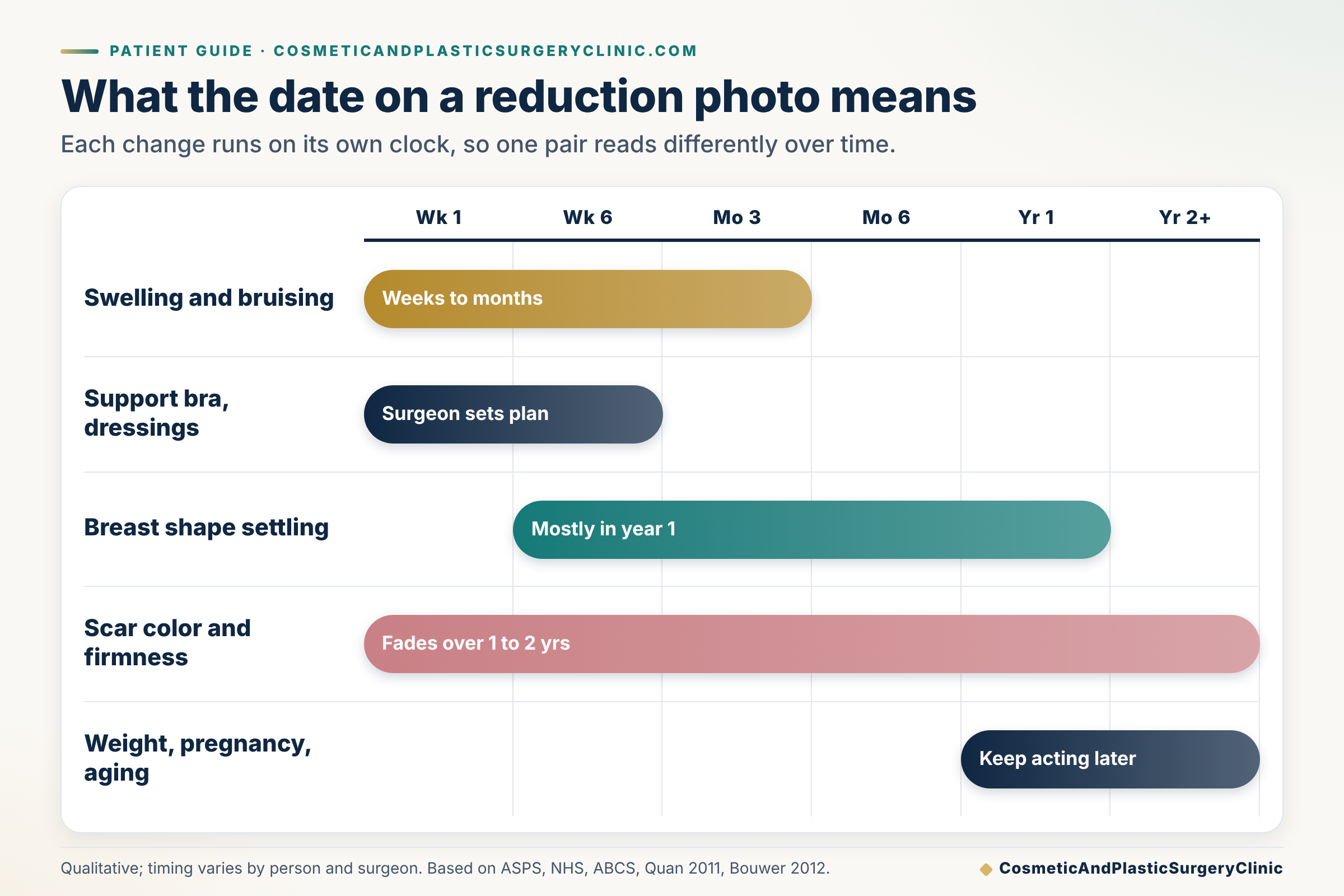
Breast tissue swells, softens, shifts and scars on different clocks. A photo taken two weeks after surgery and one taken two years after can both be captioned “after,” yet they describe different breasts. Treat the date as part of the result, and prefer breast reduction photos that show the same patient at several dates over one dramatic pair.
The first weeks and months: swelling hides the shape
Early photos are the most common source of both false alarm and false confidence, so the caption should state when they were taken.
Swelling, support bras and temporary asymmetry
ASPS says postoperative swelling and bruising may initially obscure the final results and that full recovery can take several months. The NHS says swelling may last around three months and that you will not see what your breasts look like until it has gone down. The American Board of Cosmetic Surgery guide says breasts may look larger at first, results are more or less in place after two to three months, and subtle changes can continue for six to twelve months. Among breast reduction photos, one from the first month is a record of healing, not of the result.
Comparing your own healing with breast reduction photos
One year and later: shape, scars and life changes
Long-term breast reduction photos are rarer than early ones, and the few studies that follow people with photographs are small. That is worth knowing before you lean on any single set.
Shape settles, mostly in the first year
A 2011 study in Aesthetic Plastic Surgery (Quan and colleagues) used 3D photography at one month and at one, two and three years after short-scar medial pedicle reduction. Among the 10 patients who completed three years, total breast volume fell 20.6% during the first year, about 6% of breast tissue shifted from the upper to the lower pole, and there was no significant change in years two and three. The authors read this as pseudoptosis, or bottoming out, being mostly an early finding. With only 10 patients, it is a hint, not a promise.
A 2012 follow-up in the Journal of Plastic, Reconstructive and Aesthetic Surgery (Bouwer and colleagues) followed 69 patients about ten years after vertical or inverted-T reductions. Bottoming out was recorded in 50% of the inverted-T patients and 20% of the vertical patients at ten years, from very small subgroups. It supports asking how a surgeon’s older cases look, not only the recent ones.
Scars mature over a year or more
In the same ten-year study, scars that could be graded on the Strasser scale were rated good in 37% of 46 women at three months and in 80% at ten years; poor ratings fell from 17% to 7%.
The NHS says scars may look red or different in color for the first six weeks and most fade over time, and Dr. Karen Horton, quoted in a 2025 ASPS article, notes that incisions are often visible for a year or two before they fade. A gallery photo with no scar at a few weeks is a question, not a reassurance. The 2012 Danish study also found that patients’ concern about scars grew over time.
Weight, pregnancy and aging keep working after the photo
ASPS describes results as long-lasting but notes that breasts can change with aging, weight fluctuations, hormonal factors and gravity. The American Board of Cosmetic Surgery guide says results can last a lifetime if weight stays stable and there are no further pregnancies, and that future pregnancies may reverse some changes. A one-year set of breast reduction photos therefore cannot say how a breast will look at year ten, and a ten-year photo may include changes that surgery did not cause. The breast reduction breastfeeding article covers the pregnancy side.
| Photo date | What the picture may show | Still changing | Reading caution |
|---|---|---|---|
| Week 1 to 2 | Dressings or support bra, bruising, tight swollen skin | Swelling, bruising, early asymmetry | Records healing, not the result |
| About 6 weeks | Red or discolored scars, breasts still full | Swelling, scar color, shape | NHS: scars red for first 6 weeks |
| About 3 months | Shape closer to final, scars still visible | Residual swelling, lower pole settling | ABCS: mostly in place by 2 to 3 months |
| 6 to 12 months | Settled shape, scars softening | Subtle shape change, scar maturation | Quan 2011: tissue shift mostly in year 1 |
| Several years | Long-term shape, mature scars | Weight, pregnancy, aging effects | Bouwer 2012: scar grades better at 10 years |
Audit the photography before you judge the breast
Breasts are soft tissue that hangs, rotates and casts shadow, so small changes in posture, camera position or light can alter how a picture reads even if nothing surgical differs. ASPS put it this way in October 2026, quoting Lara Devgan, MD: good medical photography should “document, not perform.” Auditing the photography comes before judging the result in any breast reduction photos.
What a standard set of breast reduction photos looks like
Standardization is the whole point of a clinical photograph. When both images in a pair follow the same rules, differences between them come from the patient, not from the studio.
Six views, camera at breast height, arms at the sides
The 2017 Mastology review describes a six-view set: frontal, back, right and left profile, and right and left oblique. The camera sits at the same height as the breast, because shooting from above or below distorts the body. In the frontal and back views the patient stands erect with arms at the sides, 50 to 90 cm from a smooth, uniform backdrop, with no jewelry or hanging clothing, under soft diffuse light that matches the camera’s white balance. The authors call a 50 mm lens satisfactory and warn against the in-camera flash, which produces flat light with harsh shadows.
A gallery of breast reduction photos that shows only a front view, or that swaps views between “before” and “after,” is not following that standard. A breast reduction photos set worth reading includes at least the oblique and profile views, since fold depth, lower-pole fullness and nipple projection are hard to judge head-on.
How pose, bra and light change a breast without surgery
Chin position, posture, body rotation and camera angle can each change how a body looks, according to the ASPS 2026 article. For breasts, the same reasoning suggests asking about arm position, whether a bra or bikini top was worn, and where the shadows fall under the breast. The table below turns these into things to compare. It rests on the Soares guidance and general photographic reasoning, because no breast reduction study that isolates each factor was found.
| Variable | How it can change the picture | What to compare | Question for the practice |
|---|---|---|---|
| Camera height | Above or below the breast distorts fullness and nipple height | Same lens height, same distance in both images | Is the camera set at breast height every time? |
| Arms and posture | Arm position and standing posture change how tissue hangs and how the fold reads | Arms relaxed at the sides, shoulders level, same rotation | What pose protocol do you follow? |
| Light and flash | Side light deepens the fold and scars; direct flash flattens them | Shadow direction under the breast and along scar lines | Was the same room and light used at each visit? |
| Bra, clothing, jewelry | Bra marks, tan lines and straps alter outline and skin tone | Bare chest in both, or the same garment in both | Were these photos taken the same way before and after? |
| Framing and crop | Chest-only crops hide torso proportion and hip width | Chin to hips visible in both images | Can I see the uncropped original set? |
Editing, selection and consent behind breast reduction photos
Even a fully standardized set can mislead if it is a selected set, or if it has been altered, or if the patient never agreed to its use. Three separate questions apply to every gallery.
Retouching, AI and cherry-picking in breast reduction photos
ASPS articles from 2025 and 2026 list signs of editing: unnatural skin texture, inconsistent shadows, warped backgrounds, bodies that look too symmetric or ideal, and differences in tone, lighting or pose between the two images. They also caution that visual clues alone are not reliable, which is why the source of the gallery matters as much as the look of the picture. An ASPS 2024 article adds that surgeons tend to show their best results, which may not reflect the average patient, and that there is no industry-wide standard for these photos.
Inconsistency is common even among surgeons. In a 2022 analysis of 104 Instagram posts by 35 oculoplastic surgeons, luminosity differed by more than 10% between before and after images in 18 posts (17.3%), and 69 of 104 photosets had magnification within 2.5%. That study looked at eyelid and facial surgery, not breasts, but it shows that unmatched images appear even in posts by trained specialists.
Consent, privacy and typical results
Before-and-after images are patient information. The HHS summary of the HIPAA Privacy Rule says a covered entity needs an individual’s written authorization before using or disclosing protected health information for marketing, with limited exceptions. The HHS de-identification guidance lists full-face photographs and comparable images, and any other unique identifying characteristic, among the elements that must be removed under its Safe Harbor method, so it is reasonable to ask how a practice handles a cropped torso with a distinctive tattoo or scar.
On results, the Federal Trade Commission’s health-products guidance says testimonials reporting more dramatic results than users can generally expect are likely to be deceptive, and that adding “results not typical” does not cure that. It also says before-and-after images can convey a claim. That guidance is written for health-product marketing, so treat it as a standard to hold any gallery to, and not as a legal opinion about one practice.
Turning breast reduction photos into consultation questions
The most useful thing a gallery can do is give you better questions. A breast reduction photos album is a conversation starter with a surgeon who can examine you, measure your anatomy and explain what they would plan. It is not a menu to choose a result from.
What a useful album includes
Ask to see cases, not highlights, when you review breast reduction photos. You are looking for the range of outcomes the surgeon gets with breasts like yours, including the average ones.
Similar cases at several dates, with the details attached
Request a handful of patients whose starting size, skin, torso and history resemble yours, shown at several dates such as early, mid and one year or later. For each, ask for the incision pattern, whether the nipple was moved on a pedicle or as a graft, the grams removed from each side and the date. The table below turns this into a checklist.
| Gallery element | What a useful gallery shows | If it is missing | Interpretation limit |
|---|---|---|---|
| Case similarity | Starting size, skin, asymmetry and torso like yours | Ask for matched cases; discount mismatched ones | A different breast is a different forecast |
| Time point | Same patient at several dates, up to a year or more | Ask the date of each image | Early photos record swelling, not the result |
| Procedure list | Pattern, nipple method, grams removed, any liposuction | Ask what else was done in the same operation | Same label can hide different operations |
| Edits and consent | Unedited originals and a stated consent practice | Ask how images are taken, stored and approved | Visual checks cannot prove authenticity |
| Revision disclosure | Some cases that healed slowly or needed more surgery | Ask how often revisions are needed and why | A gallery of only smooth cases is selected |
Ask to see the range, including slower healing and revisions
A gallery of only smooth-looking cases is a selected gallery. ASPS lists poor wound healing, skin or tissue loss where incisions meet and the possibility of revisional surgery among the risks. In Swanson’s series, persistent ptosis led to secondary surgery in 6 of the 56 reduction-only patients, and a pooled meta-analysis found the vertical pattern had less wound dehiscence than the inverted-T.
Ask what a surgeon does when the T-junction heals slowly, how often a scar or contour revision follows and what it costs, and whether any such cases are in the album. The breast reduction insurance guide covers how plans handle documentation and cost questions.
Red flags and keeping photos in their place
Most problems with breast reduction photos are ordinary rather than sinister: a busy practice, a rushed photographer, a website that mixes procedures. A pattern of them is worth a pause.
Warning signs in the gallery itself
- No scars visible in breast reduction photos taken only weeks or months after surgery, which Dr. Karen Horton, quoted by ASPS in 2025, called not normal.
- Breast reduction photos with one view only, or different poses, bras or light in the “before” and “after.”
- Captions that say “reduction” with no pattern, no weight and no date, or that mix reduction with lift, implants or liposuction-only cases.
- Images that appear to come from other practices, social media or unverified accounts. ASPS suggests checking whether photos come from an ASPS member’s practice site.
- Breast reduction photos used to press a quick booking, a deposit or a discount.
One wrinkle is the “reduction plus” case. Swanson’s study compared 24 women who had reduction with submuscular implants against reduction-only cases, so a gallery can legitimately include both, but an implant changes projection and later care. Photo-reading for implants is in breast augmentation photos, and for lifts in breast lift before and after. If the real question is reduction or lift, see breast reduction vs breast lift.
Breast reduction photos as one input among several
Breast reduction photos are one input to a decision that also rests on your symptoms, your anatomy, your goals, the surgeon’s credentials and the facility. How to check those is covered in how to choose a plastic surgeon, and a consultation checklist is in the article on preparing for a plastic surgery consultation. A reasonable answer after looking at a hundred galleries is still “I’d like a second opinion,” and not having surgery remains a legitimate outcome, as do non-surgical measures such as supportive bras and physical therapy for symptoms.
Frequently asked questions
How many breast reduction photos should I ask to see?
No published standard sets a number. A practical aim is a handful of patients who resemble you in starting size, skin quality, torso and history, each shown at more than one date, rather than a large pile of unrelated cases. If a practice offers only one or two, ask whether more are available in the consultation room. Fewer breast reduction photos, with weights, patterns and dates stated, usually teach more than a long gallery with no captions.
Can I rely on the breast reduction photos in the ASPS gallery?
As viewed on 2026-11-12, the ASPS breast reduction gallery lists ten cases, and each label gives the photo type, the surgeon’s name, city and state, and a case number. It does not give the patient’s age or the time since surgery, and the page carries no note that results vary. The gallery helps you find member surgeons and see typical pose standards, but the details still need to come from the surgeon.
Why do my own phone photos look different from my surgeon’s?
Phone cameras at arm’s length add distortion, and bathroom light, a bra or a slightly different stance change how breasts appear. The clinical standard for breast reduction photos described in the Mastology review uses a set camera height, backdrop, soft light and relaxed arms. If you want to track your own recovery, repeat the same spot, light and pose each time, and send them to the office only if the surgeon asks or something concerns you. They are a diary, not a diagnosis.
Do breast reduction photos show nipple sensation or breastfeeding ability?
No. Both depend on nerves and ducts that a camera cannot see. ASPS says reduction may interfere with sensation but that most of the time nipple sensation improves over time, and that reduction may limit the ability to breastfeed, though most women can still breastfeed afterward. The NHS lists permanent inability to breastfeed as a possible complication. Ask the surgeon about the nipple method planned for you, and see the guide to breast reduction breastfeeding.
What does “bottoming out” mean in breast reduction photos?
Bottoming out, or pseudoptosis, describes tissue settling toward the lower breast so the nipple appears to sit higher relative to where the breast hangs. It shows best in profile and oblique views and is easy to miss in a front-only photo. Because some settling happens early, a photo taken at a few weeks may not show it. Ask for profile views at one year or later, and ask how the surgeon plans for and manages it.
Is it a red flag if a practice will not show photos before a consultation?
Not necessarily. Patients must authorize use of their images, and some practices show full albums only in the office for that reason. What deserves a pause is a refusal to show any matched cases at all, or an album that never includes a patient like you. You can ask why photos are shown only in person, whether originals exist at several dates, and whether the pictures come from the surgeon you will actually see.
How can I tell whether the photos belong to the surgeon who posted them?
You often cannot tell from the image. ASPS advises confirming that photos come from a board-certified plastic surgeon’s own practice and not from social media or unverified accounts. In a consultation, ask directly whether the surgeon operated on each case, whether the album is their own work, and whether you can see the case numbers. Then check the surgeon’s board certification separately, since a gallery is not a credential.
What if no gallery shows anyone with breasts like mine?
That can happen with very large breasts, marked asymmetry, prior breast surgery or a very different body frame. Ask the surgeon for the closest cases they have and what differs. If none exist, that limits how much a photo can teach, and the consultation measurements matter more. A second opinion from another board-certified plastic surgeon is reasonable when your anatomy is not represented anywhere you can see.
Sources and further reading
- American Society of Plastic Surgeons — 2025 plastic surgery statistics report (accessed 2026-11-12) — cosmetic breast reduction counts for 2025 and 2024
- ASPS — Breast reduction overview (accessed 2026-11-12) — definition and reasons people have surgery
- ASPS — Breast reduction procedure (accessed 2026-11-12) — incision names, nipple handling, free nipple graft, liposuction
- ASPS — Breast reduction results (accessed 2026-11-12) — long-lasting results, later change with aging and weight
- ASPS — Breast reduction risks and safety (accessed 2026-11-12) — sensation, scarring, wound healing, asymmetry, breastfeeding
- ASPS — Breast reduction recovery (accessed 2026-11-12) — swelling can obscure final results
- ASPS — Breast reduction before and after photos (accessed 2026-11-12) — how gallery cases are labeled
- ASPS press release — Most women satisfied with breast reduction cosmetic results (Breiting et al., Plastic and Reconstructive Surgery, 2012; accessed 2026-11-12) — patient and surgeon ratings
- Plastic Surgery Practice — Breast reduction patients often highly satisfied (accessed 2026-11-12) — second summary of the same 2012 study
- ASPS — Can you trust that transformation? Reading before and after photos in the age of AI (Oct 13, 2026; accessed 2026-11-12) — pose, angle, editing signs
- ASPS — What is reality? Determining if a before and after is too good to be true (Mar 11, 2025; accessed 2026-11-12) — editing signs, scars at a few weeks
- ASPS — Can you trust before and after photos? (Mar 1, 2024; accessed 2026-11-12) — selection bias, no industry standard
- American Board of Cosmetic Surgery — Breast reduction guide (accessed 2026-11-12) — incision patterns, scars, results timing
- NHS — Breast reduction (accessed 2026-11-12) — scars, swelling, risks, breastfeeding
- Swanson E. — Breast reduction versus breast reduction plus implants, Plastic and Reconstructive Surgery Global Open (2015; accessed 2026-11-12) — resection weights, projection, areola size, complications
- Li Z. et al. — Vertical scar versus inverted-T scar reduction mammaplasty: meta-analysis, Aesthetic Plastic Surgery (2021; accessed 2026-11-12) — complications and wound dehiscence by pattern
- Fernandez S. et al. — Inverted-T and pure vertical scar techniques, Annals of Plastic Surgery (2016; accessed 2026-11-12) — photo-scored scar quality, resection weight, age
- Cochrane — Inverted T versus vertical scar incision technique for breast reduction (protocol; accessed 2026-11-12) — surgeons uncertain which is superior
- Bouwer L. et al. — Vertical scar versus the inverted-T scar reduction mammaplasty: a 10-year follow-up, JPRAS (2012; accessed 2026-11-12) — scar grades and bottoming out at 3 months and 10 years
- Quan M. et al. — Defining pseudoptosis (bottoming out) 3 years after short-scar medial pedicle breast reduction, Aesthetic Plastic Surgery (2011; accessed 2026-11-12) — 3D photography follow-up
- Kachare S. et al. — The 5 D’s to dunk the dog, ePlasty (2023; accessed 2026-11-12) — dog-ears in vertical reductions
- Wang A. et al. — Patient-reported outcomes after reduction mammoplasty using BREAST-Q, Aesthetic Surgery Journal (2023; accessed 2026-11-12) — pooled satisfaction scores
- Kadhum M. et al. — Liposuction-only breast reduction: a systematic review of outcomes, Aesthetic Plastic Surgery (2024; accessed 2026-11-12) — seven articles, 652 patients
- Lacerna M. et al. — Avoiding free nipple grafts during reduction mammaplasty in patients with gigantomastia, Annals of Plastic Surgery (2005; accessed 2026-11-12) — gigantomastia definition, graft drawbacks
- Soares P. et al. — Standardization of photographic records for oncoplastic and breast reconstructive surgery, Mastology (2017; accessed 2026-11-12) — six views, camera height, light, backdrop
- Maamari R. et al. — Quantitative analysis of pre- and postoperative photographs posted on social media by oculoplastic surgeons (2022; accessed 2026-11-12) — measured photo inconsistency
- U.S. Department of Health and Human Services — HIPAA marketing guidance (accessed 2026-11-12) — authorization for marketing uses
- HHS — Guidance on de-identification of protected health information (accessed 2026-11-12) — full-face photographs and comparable images
- Federal Trade Commission — Health products compliance guidance (accessed 2026-11-12) — atypical-result testimonials


