
Almost every first conversation about breast reduction cup sizes starts with a letter: “I wear a DDD, can I be a C?” It is a reasonable question and an almost unanswerable one. A cup letter is a label printed on a bra, and what it means depends on the band, the manufacturer, how the bra was fitted and even the moment in a breath when someone was measured. Surgeons plan reductions with other numbers.
This page explains what those numbers are, what published studies show when cup-size claims are tested, and how to turn a wish about breast reduction cup sizes into a goal a surgeon can actually plan. It is general education, not a verdict on any individual: whether surgery suits a particular body is a question for an examination, and nonsurgical symptom relief or simply waiting remain legitimate answers. The operation itself is covered in the breast reduction overview; this article handles one decision, the size goal.
Why breast reduction cup sizes are a poor planning unit
What a cup letter actually encodes
How breast reduction cup sizes are built from two measurements, not a volume
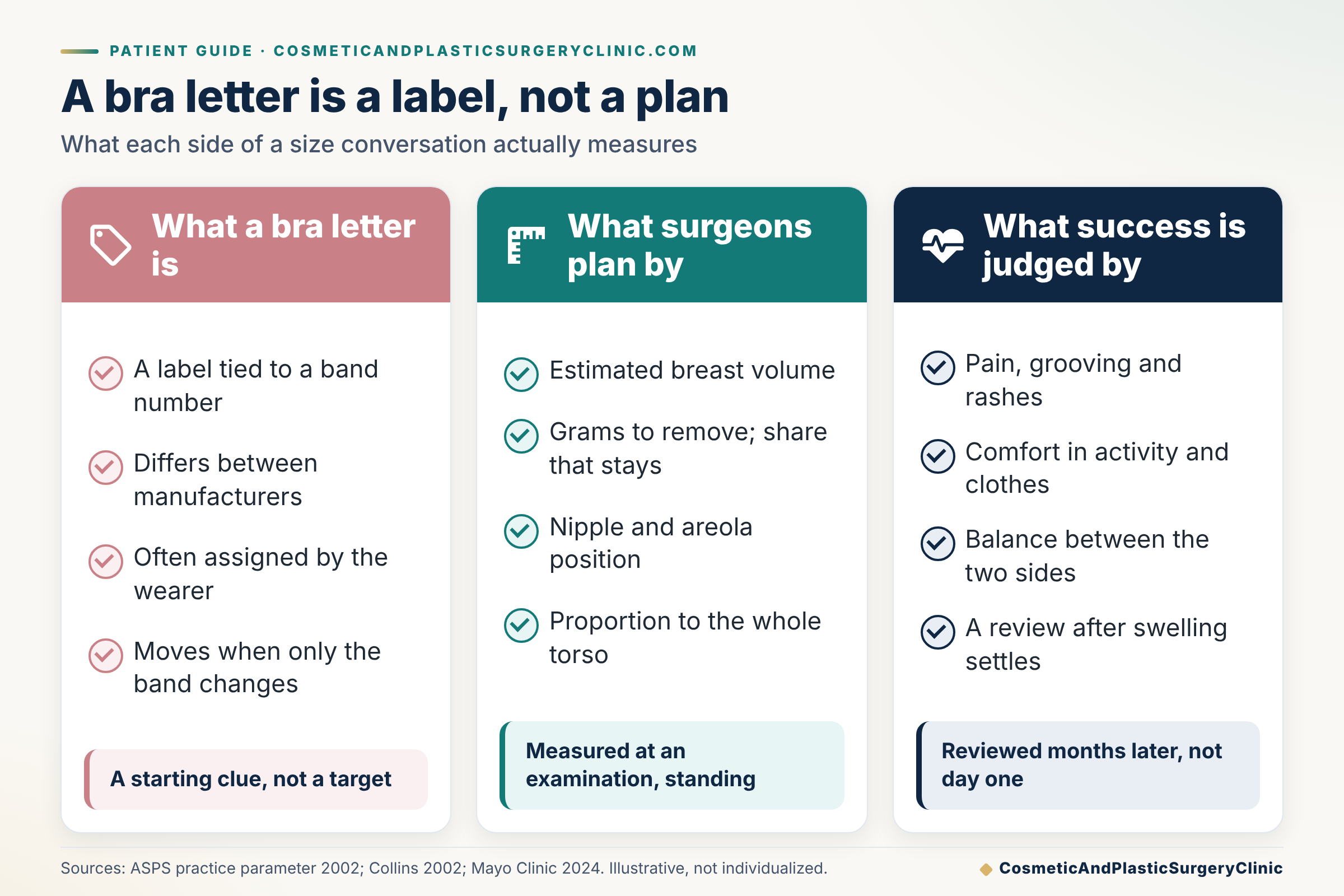
In common sizing systems a bra label has two parts. The band number comes from a measurement around the ribcage under the breasts, and the cup letter reflects how far the measurement across the fullest part of the bust exceeds it. Neither part is a volume. Change the band and the letter changes with it, even when the breast underneath stays exactly the same.
The American Society of Plastic Surgeons (ASPS) says as much in its reduction mammaplasty practice parameter, approved in 2002. It states that breast hypertrophy is “most accurately based on breast volume and not bra cup size,” and notes that women often shift a full cup up or down by increasing or decreasing the circumference of the bra.
One breast, two labels, and breast reduction cup sizes that shift
The same ASPS document gives a plain example: a woman who wears a 36D may wear a 38C with equal comfort. The breast did not change between those two labels; the band did. So breast reduction cup sizes quoted without a band, as in “I want to be a C,” are half a sentence until the band is named, and even then the cup beneath it depends on who made the bra.
Cup volume also climbs with the band. In a 2019 measurement study in Plastic and Reconstructive Surgery Global Open (Chan and colleagues), volumes rose steadily across both cup and band sizes of a single bra style. A wish framed in breast reduction cup sizes therefore describes a moving target, and surgeons who work in grams or millilitres are not being evasive. They are using the only unit that holds still. The same problem exists on the augmentation side, where breast implant size is planned in volume rather than letters.
What studies found when bra labels were checked
Fit problems are common before reduction
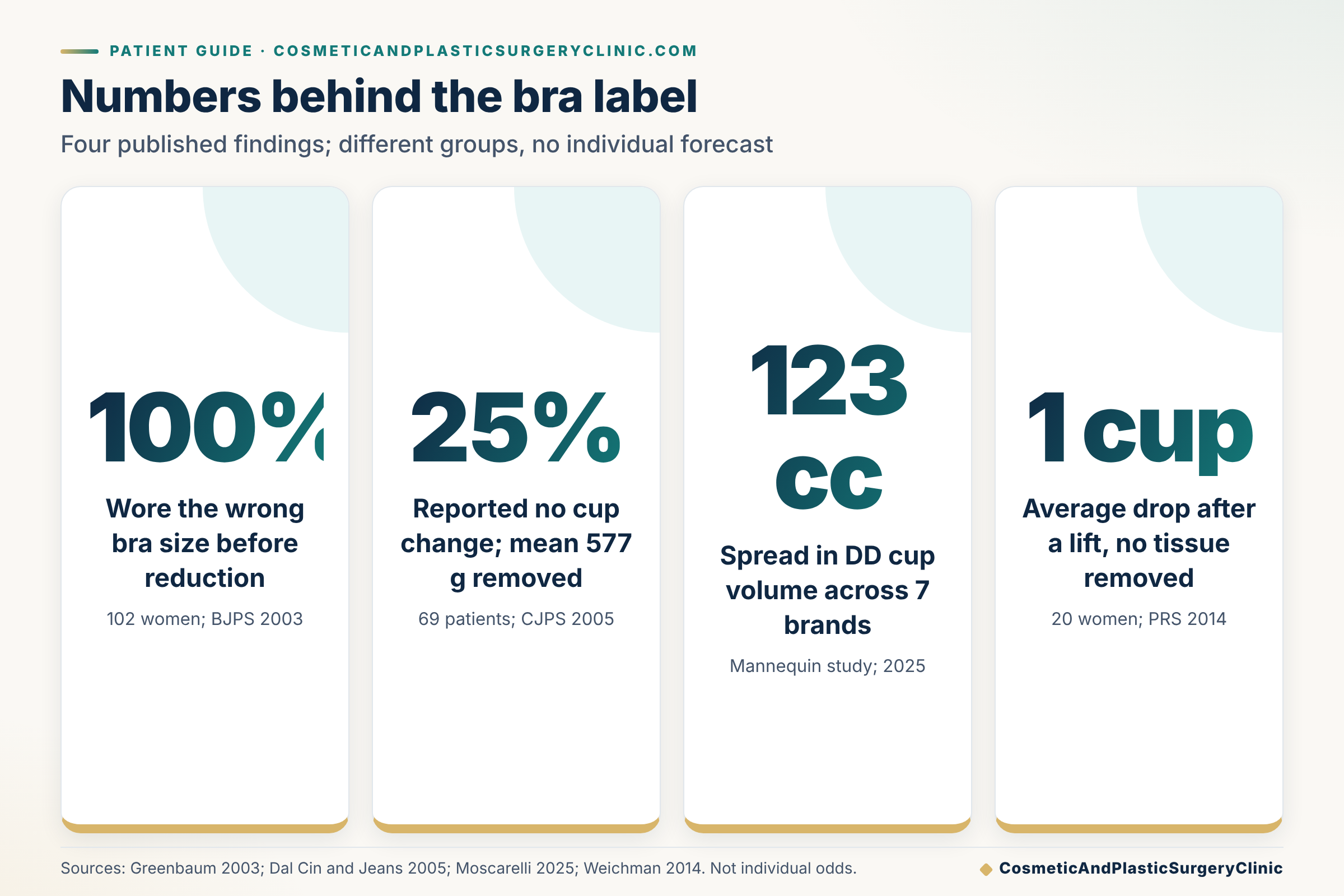
A 2003 study in the British Journal of Plastic Surgery (Greenbaum and colleagues) looked at 102 women attending a pre-assessment clinic for reduction mammaplasty. Each stated a usual bra size and was then measured. All 102 were wearing the wrong size by manufacturers’ fitting guidelines: most underestimated the band and overestimated the cup. Obesity was strongly associated with an inaccurate band measurement (correlation 0.54).
The authors concluded that women who most need a supportive bra are the least likely to be fitted for one, which can aggravate the very symptoms that bring them to a surgeon. For breast reduction cup sizes the lesson is narrower. If the starting letter is a guess, then “how many cups smaller” subtracts from a number that was never reliable. This was a single clinic’s sample, read here at abstract level.
Manufacturers disagree on breast reduction cup sizes, and the gap widens
A 2025 study from Yale researchers (Moscarelli and colleagues, Aesthetic Plastic Surgery; also presented in Plastic and Reconstructive Surgery Global Open) fitted bras from seven manufacturers, sizes 36A to 36DD, onto a mannequin and filled each cup with custom sizers that were weighed and converted to volume. Cup volume differed significantly between manufacturers at every size. The standard deviation of mean cup volume across brands was 30.9 cc at A, 40.1 cc at B, 62.2 cc at C, 69.7 cc at D and 122.8 cc at DD.
Put plainly, two labels reading the same letter can hold noticeably different amounts of breast, and the disagreement is largest at the bigger sizes. For breast reduction cup sizes that means the starting point is blurrier than it looks. The authors suggest converting alphanumeric sizes to volume to improve communication. The limits matter: one band size, seven brands, a mannequin rather than people, and no measure of how any bra fits a living body.
| Number | Who produces it | What it describes | Main limit |
|---|---|---|---|
| Cup letter on a bra | Bra maker, fitter or the wearer | A manufacturer’s label tied to a band | Differs between brands and bands; often self-assigned |
| Band number | Bra maker, fitter or the wearer | Ribcage circumference under the breasts, as that brand cuts it | Changes the cup letter when it changes; can shift with breathing |
| Estimated volume (mL) | Surgeon’s measurements, imaging or 3D scan | How much breast there is now | Methods vary in accuracy; large, drooping breasts are harder to measure |
| Weight removed (g) | Operating-room scale, after the fact | What was taken out, recorded in the operative note | A result of the plan, not a promise of a letter |
| Nipple and fold positions (cm) | Surgeon, standing, with a tape | Where the nipple sits and where it should end up | Settle over months as swelling resolves |
| Symptom list with duration | You, documented by the surgeon | Pain, grooving, rashes, activity limits | Self-reported; not visible in any photo |
Cups lost versus tissue removed: what the evidence shows
What the data say about breast reduction cup sizes after surgery
A 69-patient series: the most tissue, the fewest cups
The most direct look at breast reduction cup sizes after surgery is a small study. In a 2005 report in the Canadian Journal of Plastic Surgery, Dal Cin and Jeans reviewed 91 patients of a single surgeon, all operated between 2001 and 2003 with the inferior pedicle technique. Sixty-nine answered a follow-up request, six months to two years after surgery, with their bra sizes before and after. The authors converted every size to a standardized cup number so the same cup volume carried one value whatever the band.
The mean tissue removed was 522 g per breast, with a range of 147 g to 2,453 g. Seventeen patients (25%) reported no change in cup size; their mean removal was 577.1 g per breast. Twenty-three reported dropping one cup, at a mean of 489.2 g, and twenty-five reported two cups, at 425.8 g. The group that lost the fewest cups had, on average, lost the most tissue. The differences were not statistically significant, and every responding patient reported being satisfied by six months.
Why the authors called prediction of breast reduction cup sizes invalid
Dal Cin and Jeans did not read their numbers as proof that surgery fails some people. They read them as proof that the starting labels were unreliable. They cite literature suggesting self-reported bra size is wrong in 70% to 100% of women in this population, and estimate that at least a quarter of their patients wore the wrong size beforehand. On that basis they called using the data to predict a cup change “invalid.”
The design explains why. It was retrospective, from one surgeon, with 24% of patients not responding, uneven follow-up, and bra sizes that were reported rather than measured. Tissue weights were never paired with fitted bras, so the study cannot link a specific cup to a specific mass. The authors suggested that checking the band size gives a quick sense of whether a patient is wearing a correct size, and planned a prospective study with measured sizes; this review did not find that follow-up.
Attempts to convert breast reduction cup sizes into grams
Breast tissue is close to the density of water
One way to connect breast reduction cup sizes with grams is to measure what a cup holds. Chan and colleagues did this in 2019 using one bra style, fitted by a professional fitter onto an adjustable mannequin. The cup was filled with modeling clay, and the clay was weighed and its volume measured by water displacement, the same method used for resected tissue. From 15 resection specimens they found an average breast tissue density of 0.98 g/mL (standard deviation 0.05, range 0.92 to 1.09).
That density is a useful conversion for anyone reading an operative note: a specimen weighing 500 g is roughly 510 mL of tissue. The authors then built a table estimating the tissue weight needed to move from one cup size to another and offered it as a guide for surgeons. The prediction values are in a figure that could not be read in the text version available for this review, so they are not reproduced here.
Why even a careful table stays a guide
The authors list their own limits for predicting breast reduction cup sizes. Patients may not wear correctly fitted bras, and fitters can judge fit differently. Bras of the same labeled size from different companies may not hold the same volume, which the 2025 manufacturer comparison later measured directly. Clay may compress less than breast tissue, and the study depended on an experienced professional fitter, who is not usually present in a surgical clinic. Measuring the bust gets harder as breasts become larger and more ptotic. They conclude it is a guide and that a specific cup size cannot be promised.
That is the honest ceiling for breast reduction cup sizes: a range with an explanation, given by a surgeon who has measured you. A confident single letter offered at a first visit is not backed by anything in this literature.
Cup letters move for reasons unrelated to volume
A lift can drop a cup without removing tissue
A 2014 follow-up of 20 women who had breast lifts only, with no reduction or augmentation (Weichman and colleagues, Plastic and Reconstructive Surgery), asked about bra cup size about five years later. On average the cup fell by about one letter, for example D to C. No participant changed bra manufacturer. The authors attributed the change to bra fit and comfort rather than to lost volume: sagging breasts can fill a larger cup than their real size, so a lifted breast may sit comfortably in a smaller one.
One participant reported a substantial increase in cup size, linked by the authors to hormone therapy and weight gain. The sample was small, the women averaged 47 years old, were of low-normal weight and wore at least a C before surgery, so the findings may not carry over to other bodies. The point still holds for breast reduction cup sizes, because a reduction also lifts and reshapes; the breast reduction vs breast lift comparison covers where those goals separate.
Even a weighed specimen correlates weakly with the quoted cup
A 2022 study in Plastic and Reconstructive Surgery Global Open (Perez, Teotia and Haddock) compared self-reported cup size with the measured weight of specimens in 243 patients having mastectomy at one academic center. This is not a reduction study, so it is evidence about self-reported cup size only. Correlations between cup and specimen weight were weak, with Spearman values from 0.246 to 0.375 across mastectomy types, and body mass index and chest circumference also mattered. The authors called self-reported cup size a poor basis for estimating size after surgery and recommended counseling around appearance and quality of life.
| Study and year | Group | What it found | Main limit |
|---|---|---|---|
| Greenbaum and colleagues, 2003 | 102 women before reduction assessment | All wore the wrong size by fitting guidelines | One clinic; abstract-level reading |
| Dal Cin and Jeans, 2005 | 69 reduction patients, one surgeon | Mean 522 g removed per breast; 25% reported no cup change | Self-reported sizes; retrospective; 24% did not respond |
| Chan and colleagues, 2019 | 15 specimens; one bra style on a mannequin | Tissue density 0.98 g/mL; cup volumes rise with cup and band | Single style; clay filling is subjective |
| Moscarelli and colleagues, 2025 | Bras from 7 manufacturers, 36A to 36DD | Cup volume differed between brands; spread was 122.8 cc at DD | Mannequin; one band size |
| Perez and colleagues, 2022 | 243 mastectomy patients | Weak link between reported cup and specimen weight | Not a reduction cohort; single center |
What surgeons plan by instead of a letter
Volume and weight come first
How breast volume gets estimated
At a consultation the surgeon reviews health history, discusses goals, and, as Mayo Clinic describes it, takes measurements and photographs. ASPS lists body mass index, the distance from the sternal notch to the nipple and the distance from the nipple to the inframammary fold as useful planning measurements. Those are tape-measure numbers taken standing, and they inform how far a nipple must travel and how much skin must go.
Volume itself can be estimated several ways, and a 2016 review in Gland Surgery (Chae and colleagues, written in a reconstruction context) shows why every method has limits. Water displacement is close to a gold standard but is messy and tends to miss tissue lateral to the pectoral fold, which underestimates large breasts. Formula-based measurements impose geometric shapes on individual anatomy. MRI averaged about a 4.3% deviation in the studies reviewed. Three-dimensional surface imaging was called the most promising option, but costly and short of high-level evidence.
Grams removed and the share of the breast that remains
Once volume is estimated, the working questions become how much leaves and how much stays. The ASPS parameter says reduction will typically remove at least one-third of the estimated preoperative breast volume and a minimum of 250 cc, citing the BRAVO study (Breast Reduction: Assessment of Value and Outcomes), in which 90% of patients had resections of at least one-third and 99% had more than 250 cc removed. In the Dal Cin series the mean was 522 g per breast, with a wide spread.
A resection weight is a measurement of what the operation did, not a forecast of breast reduction cup sizes. Insurers sometimes use weight thresholds when judging medical necessity, and ASPS’s 2017 recommended criteria for payers argue that coverage should rest on documented symptoms rather than on the amount of tissue removed. That is a separate question with plan-by-plan variation, handled in the breast reduction insurance article.
Position, shape and proportion
Where the nipple and areola end up
Size is only one of the things the incisions decide. According to ASPS, in the usual approach the nipple keeps its original blood and nerve supply and is repositioned rather than detached, and the areola can be reduced by removing skin around its edge. With extremely large breasts the nipple and areola may instead be removed and replaced higher as a free graft, which leaves them without sensation and lengthens healing. Which approach is used depends, in ASPS’s words, on individual anatomy, breast composition and the amount of reduction desired.
ASPS also notes that liposuction is used alongside excision in some cases; the general principles of that technique are in liposuction. At the consultation the surgeon examines nipple and areola position, skin condition and breast shape, because those three decide the incision pattern more than any letter.
A bust proportionate to the torso
The goal ASPS states for the operation is a smaller, more proportionate bust. Proportion is a judgment about the whole torso: shoulder width, ribcage, waist, hips and height all enter it, which is why two people of the same starting label can end up with different plans. A conversation about breast reduction cup sizes has no way to carry that information; a mirror and a tape measure do.
It also explains why photographs of other patients help only up to a point. Matching a stranger’s result means matching her torso and tissue as well as her bra, a skill covered in breast reduction photos.
Symptoms are the outcome that counts, and they do not track cup size
What a prospective study found about relief and breast reduction cup sizes
A 2002 prospective study in Plastic and Reconstructive Surgery (Collins and colleagues) followed 179 reduction patients with matched before and after data and compared them with 96 women whose cup size was smaller than D and 88 women with cup D or larger who did not have surgery. Before surgery 50% of the operative group reported breast-related pain all or most of the time; 6 to 9 months afterward fewer than 10% did. The authors reported that benefit was not linked to body weight, cup size or resection weight.
ASPS reaches the same reading of the BRAVO data, stating that improvements were not significantly associated with resection weight. The group was predominantly white, middle-aged, well educated and employed, and symptoms were self-reported at a single point months after surgery, so it describes a pattern rather than your outcome. Still, it supports a reframe: the useful question is which symptoms the plan is meant to change, not which of the breast reduction cup sizes it should reach.
Nonsurgical measures and the option of waiting
Not everyone needs an operation. An ASPS-hosted blog on large breasts and back pain says anti-inflammatory medication, heat, massage and physical therapy may help mild, occasional symptoms, but rarely give lasting relief when symptoms are severe and persistent. It cautions that supportive bras may themselves aggravate some neck, shoulder and chest-wall symptoms, and that weight loss has not been shown to relieve them, though it may be worthwhile for other health reasons. Collins and colleagues found that conservative measures, including weight loss, did not provide adequate permanent relief in their groups.
Getting properly fitted costs little and does not close any door, and Greenbaum’s findings suggest poor fit is common. Whether to proceed, wait or stop at nonsurgical care is a decision for you and a clinician who has examined you; the breast reduction candidate article lists what surgeons weigh.
Turning a size wish into a goal a surgeon can plan
Say the size goal in terms the plan can use
Describe the goal without relying on breast reduction cup sizes
Quoting your breast reduction cup sizes is still a fine opening line; it tells the surgeon roughly where you are starting. The work is in what follows it. Statements a plan can use sound like these: the straps leave grooves by afternoon; a sports bra does not stop the pain when running; the rash under the fold returns every summer; a shirt that fits at the shoulders will not close at the chest. Each of those points to a symptom or a proportion that can be examined, photographed and revisited after healing.
It also helps to ask the surgeon to state the goal in the surgeon’s own units: an estimated volume today, a rough range of grams to be removed, where the nipples will sit, and what fraction of the breast is meant to remain. Then ask how those numbers might look in a bra. That order keeps breast reduction cup sizes as a translation at the end of the conversation rather than the target at the start.
| Situation | Path to discuss | What it offers | Trade-off | Question to ask |
|---|---|---|---|---|
| Goal is a specific letter | Reframe to volume and proportion | A plan that can be measured and examined | No promised letter; range only | What grams and what proportion are you aiming for? |
| Goal is symptom relief | Document symptoms; discuss surgery and alternatives | Aligns the plan with what the evidence tracks | Relief varies and cannot be forecast | Which of my symptoms is the plan meant to change? |
| Current bra is likely mis-sized | Professional fitting first | A truer starting point | A fitter’s numbers are not a surgical measurement | Can you re-measure me standing and relaxed? |
| Planning to lose or gain a lot of weight | Delay and reassess | Size is less likely to shift after surgery | Symptoms continue while waiting | How much change would alter the plan? |
| Pregnancy or breastfeeding may be ahead | Discuss timing and technique | Avoids a change in size just after healing | Delay; lactation after surgery cannot be predicted | How would pregnancy change the result? |
| Very large breasts with stretched skin | Ask about nipple technique and skin pattern | Informs the scar and sensation trade-offs | Free nipple graft means no sensation in the nipple | Will the nipple stay attached to its blood supply? |
Simulations and photographs are aids, not forecasts
Some practices offer three-dimensional simulations that show a chosen size on your own torso. A small 2025 pilot in Plastic and Reconstructive Surgery Global Open (Lava and colleagues) used one such tool with seven patients having reduction. They rated choosing a postoperative cup size as highly challenging, a mean of 9.6 on a 1 to 10 scale, and found the simulations helpful. BREAST-Q satisfaction with breasts rose from 20.1 before surgery to 78.3 at six months.
Those satisfaction gains compare before with after in a handful of people and cannot be credited to the simulations, since there was no comparison group. The authors did not test how closely the images matched actual results.
Chae’s review reports that one 3D system differed from the real outcome by 12% on average, with a range of 0.4% to 30%, in 22 augmentation patients, which is a different operation but a useful reminder that simulations carry error. Treat any image, simulated or from another patient, as a conversation aid about breast reduction cup sizes; the wider rules for reading photographs are in breast reduction photos.
Being measured well before the consultation
Professional fitting helps, with caveats
Since poor fit was common in the reduction-assessment studies, a session with an experienced bra fitter before the consultation can give both of you a cleaner starting point. Two cautions apply. First, as the fact above shows, measurements depend on when in the breath they are taken, so a single number from a single visit is a range in disguise. Second, a fitter’s result is a clothing size, not a surgical measurement. It supplements what the surgeon records standing, with a tape, and does not replace it.
If fitting is costly or unavailable, nothing about the consultation depends on it. The surgeon will take measurements and photographs regardless, as Mayo Clinic describes, and can work from there.
What to bring so the surgeon can translate
Bring the labels of two or three bras you currently wear, including the band, and note which feels most comfortable and which feels worst. Bring a list of symptoms with how long each has lasted, since both a surgeon and an insurer may ask. Bring your weight history in the last few years, any treatments you tried for pain or skin problems, and what you know of pregnancy plans. Written questions help too; the plastic surgery consultation article covers the wider visit.
Mention medical history in full, including previous breast biopsies or imaging. Mayo Clinic notes a mammogram may be part of preparation, and ASPS says surgeons will ask about family history of breast cancer and mammogram or biopsy results.
After surgery: when the size is visible and what can move it
Why breast reduction cup sizes keep changing after the operation
Swelling, settling and the final look
Mayo Clinic says the results appear right away, but that swelling and scarring take months to settle and that it can take months for swelling to go down completely before the final look is clear. A front-closing surgical bra is typical early on, with roughly four to six weeks of limited activity. An ASPS-hosted blog puts the return to full activities at around six weeks, with the final breast shape taking many months.
For breast reduction cup sizes, the practical consequence is that any bra bought in the first weeks is fitted to a breast that is still changing. A bra measured at month six or later says more about the result, and comparing it with the starting label then is a fairer test. The breast reduction recovery article covers the timeline and wound care.
Some difference between the two sides is expected
Mayo Clinic states that the surgeon will try to make the breasts look alike, but that breast size and shape might vary somewhat. A slight difference between sides, or one cup fitting more snugly than the other, belongs on the expected side of the line. A change that is rapid, painful or accompanied by redness or fluid does not, and the warning-sign paragraph below says what to do.
Life changes that move the letter later
Weight change in either direction
Mayo Clinic notes that weight changes alter breast size and advises postponing surgery if you plan to lose weight, since loss often changes it. ASPS says results are long-lasting, but that breasts change over time with aging, weight fluctuations, hormonal factors and gravity. None of this is a judgment about weight; it simply reflects that breast size can follow changes in the rest of the body.
What to do with that is individual. For some people symptoms are severe enough that waiting for a weight change is not realistic, and for others a stable weight for some months would make the plan more predictable. The surgeon’s view of how much change would matter is worth asking for directly, and the weight and health questions that come up are the same ones listed for candidacy.
Pregnancy, breastfeeding, hormones and aging
Mayo Clinic lists pregnancy among the factors that can alter breast size and shape afterward, so breast reduction cup sizes are not fixed for life. It recommends postponing surgery if you plan to have children, and says breastfeeding may be harder after surgery although certain techniques can help preserve the ability. The 2014 lift study above included one woman whose cup size rose substantially with hormone therapy and weight gain. The breast reduction breastfeeding article covers what is and is not known about lactation after reduction.
| Factor | Effect on size or shape | Review point | Warning sign or question |
|---|---|---|---|
| Early swelling | Breast looks larger and firmer than the eventual result | Re-measure at the surgeon’s follow-up visits | Fast one-sided swelling needs same-day contact |
| Weight change | Can enlarge or shrink the breast over time | Compare your weight with the one recorded at the consultation | Ask what change would call for a new plan |
| Pregnancy and breastfeeding | Can alter size and shape afterward | Raise plans before scheduling | Ask how timing changes the technique choice |
| Hormones and aging | Gradual change in volume and position | Photograph yearly under the same conditions | Rapid unexplained change deserves an exam |
| Bra fit after healing | Label may differ from before even if volume is right | Refit once swelling has settled | Straps still grooving may be worth reporting |
A consultation framework: six checks and two hypothetical visits
Six checks to run on any claim about breast reduction cup sizes
Three checks about where you start
- Is my starting size measured or assumed? Ask to be measured standing and relaxed, and ask which band the quoted letter belongs to.
- Does the same breast fit a neighboring label? If a larger band with a smaller cup is also comfortable, any goal letter needs a band number attached.
- Which symptoms do I have, for how long, and what have I tried? Write down grooving, pain, rashes and activity limits, with dates and with the treatments that did or did not help.

Three checks about the plan and its limits
- What volume do you estimate now, what range of grams will leave, and what fraction remains? Those are the numbers the plan is built on.
- Where will the nipple sit, and which technique is likely? The answer carries consequences for scars and sensation, and a goal far from the starting size may change it.
- What is the policy if size or symmetry differs from what we discussed, and what life changes would change the plan? Ask about revision timing and fees, and how weight change or pregnancy would be handled.
Notice what the six checks leave out: no demand for fixed breast reduction cup sizes and no scoring of surgeons by how confidently they name one. A surgeon who answers in ranges, explains the reasons and says what would change the estimate is behaving the way the evidence above suggests is honest.
Two hypothetical visits
Case A: the letter-first request
Consider a hypothetical patient who arrives asking to be “a small C.” Her current bra is a 38DDD she bought online, and she has never been measured. A careful consultation would begin by measuring her standing and relaxed, then restate the goal in other terms: how much smaller, in volume and as a share of the breast; where the nipples need to sit; and which symptoms the change is for.
If she still wants one of the breast reduction cup sizes afterward, the surgeon can offer a range and say honestly that the label she ends up wearing depends on the band, the brand and how much the breast settles. The letter becomes the last thing discussed, and it is described as an estimate.
Case B: the symptom-first request, and the fact that changes the plan
A second hypothetical patient does not care about breast reduction cup sizes at all. She wants her shoulder pain and strap grooves to stop and mentions, almost in passing, that she hopes to become pregnant within two years. The surgeon’s estimate of tissue to remove is the same as it would be without that remark, but the decision around it is not. Timing, technique and what she can expect for lactation now belong in the conversation, and waiting is a real option on the table.
The useful exercise is to change one fact at a time and watch what moves: a planned pregnancy changes timing, a large weight change changes the estimate, nicotine use changes risk and scheduling. A surgeon should be able to say which of those facts matter most for you, and why.
Frequently asked questions
Why can breast reduction cup sizes change when only the band changes?
Because the letter reflects the gap between the bust and band measurements, so changing the band changes the letter. ASPS’s reduction practice parameter notes a woman who wears a 36D may wear a 38C with equal comfort. After surgery, a smaller or larger band can therefore put the same breast under a different letter. That is one reason surgeons avoid stating a target letter and prefer volume, grams and proportion, which do not depend on how a bra is cut.
Do breast reduction cup sizes decide whether surgery is considered?
ASPS’s 2017 recommended criteria for payers rest on documented symptoms, not on a cup letter or the weight removed. The earlier parameter points out that cup size is unreliable. Individual plans and surgeons may set their own thresholds, and these vary, so ask the specific plan how it evaluates requests rather than relying on a letter. The insurance article linked earlier covers documentation and how plans differ.
Can I find out how much tissue was removed from each side?
Resection weights are widely recorded; the Dal Cin series and the BRAVO data both report them. Ask before surgery whether each side will be weighed and whether you may see the numbers afterward. Using the 0.98 g/mL density from Chan and colleagues, grams convert to millilitres by dividing by roughly one. The number describes what the operation removed, not the letter you will wear.
Will I need different bras as I heal?
Probably more than one. Mayo Clinic describes a front-closing surgical bra early on, and it says swelling can take months to go down completely before the final look is clear. A bra fitted in the early weeks matches a breast that is still changing. Many people wait until swelling has settled before buying several of the same size, and your surgeon can say when your own healing allows it.
Do online calculators predict breast reduction cup sizes after surgery?
No validated calculator for post-reduction sizing turned up in this review. Any tool that starts from a bra label or a self-measured band and bust inherits the problems in the studies above, and measurement itself shifts with posture and breathing; McGhee and Steele found band measurements varied by 1.9 inches on average between inhaling and exhaling. Chan and colleagues’ prediction table used one bra style and states a specific cup size cannot be promised. Treat any calculator as rough entertainment, not a plan.
What if my goal for breast reduction cup sizes is much smaller than my current size?
A larger change can alter the technique. ASPS says that with extremely large breasts the nipple and areola may be removed and replaced as a free graft, which leaves them without sensation and lengthens healing. A goal far from the starting point may also affect scars and how the remaining tissue is shaped. Raise the goal early so the surgeon can explain the trade-offs in advance, and compare more than one surgeon’s view if the plans differ widely.
What can be done if I am unhappy with my size afterward?
Mayo Clinic lists dissatisfaction with results among the risks of the operation, and notes breast size and shape might vary somewhat even when all goes to plan. Because swelling takes months to settle, the final size is usually judged later, so ask beforehand about the timing of any assessment and the practice’s revision policy and fees in writing. Revision is a separate surgical decision with its own risks, and the overview of the whole operation places it in context.
Sources and further reading
- American Society of Plastic Surgeons — Practice Parameters: Reduction Mammaplasty (approved 2002; accessed 2026-11-12) — volume versus cup size, 36D and 38C example, one-third and 250 cc resection, BRAVO
- American Society of Plastic Surgeons — Recommended Insurance Coverage Criteria for Third-Party Payers: Reduction Mammaplasty (reaffirmed 2017; accessed 2026-11-12) — symptom-based criteria, resection weight and relief
- American Society of Plastic Surgeons — Breast reduction (accessed 2026-11-12) — goal of a more proportionate bust, reported benefits
- American Society of Plastic Surgeons — Breast reduction procedure (accessed 2026-11-12) — nipple repositioning, free nipple graft, liposuction alongside excision
- American Society of Plastic Surgeons — Breast reduction results (accessed 2026-11-12) — long-lasting results, change with weight, aging and hormones
- American Society of Plastic Surgeons — Breast reduction consultation (accessed 2026-11-12) — what the surgeon examines; what to discuss
- ASPS-hosted blog — Large breasts causing back pain: breast reduction surgery offers relief (undated; accessed 2026-11-12) — nonsurgical measures, supportive bras, weight loss
- American Society of Plastic Surgeons — Breast lifting may decrease bra size, says study in Plastic and Reconstructive Surgery (2014 release; accessed 2026-11-12) — Weichman and colleagues lift-only cup change
- Mayo Clinic — Breast reduction surgery (updated 2024-06-29; accessed 2026-11-12) — measurements, swelling, size variation, weight and pregnancy
- Greenbaum and colleagues — An investigation of the suitability of bra fit in women referred for reduction mammaplasty, British Journal of Plastic Surgery, 2003 (abstract, accessed 2026-11-12) — all 102 women wore the wrong size
- Dal Cin and Jeans — Can reduction mammoplasty patients be promised a particular size postoperatively? Canadian Journal of Plastic Surgery, 2005 (accessed 2026-11-12) — cups reported versus grams removed
- Chan, Lonie, Mackay and MacGill — Reduction mammaplasty: what cup size will I be? Plastic and Reconstructive Surgery Global Open, 2019 (record and full-text XML via Europe PMC, accessed 2026-11-12) — tissue density, cup volumes, limitations
- Moscarelli and colleagues — Understanding variation in bra cup sizing among leading manufacturers, Aesthetic Plastic Surgery, 2025 (abstract, accessed 2026-11-12) — cup volume spread across seven brands
- Moscarelli and colleagues — Understanding variation in bra cup sizing among leading manufacturers, Plastic and Reconstructive Surgery Global Open, 2025 supplement abstract (accessed 2026-11-12) — same study, authors and conclusions
- McGhee and Steele — How do respiratory state and measurement method affect bra size calculations? British Journal of Sports Medicine, 2006 (accessed 2026-11-12) — breathing and band measurement
- Collins and colleagues — The effectiveness of surgical and nonsurgical interventions in relieving the symptoms of macromastia, Plastic and Reconstructive Surgery, 2002 (abstract record, accessed 2026-11-12) — relief not linked to cup size or resection weight
- Perez, Teotia and Haddock — Patient self-reported breast cup size and resultant mastectomy specimen weight, Plastic and Reconstructive Surgery Global Open, 2022 (accessed 2026-11-12) — weak link between reported cup and specimen weight
- Lava and colleagues — The role of decision aids and soft tissue simulations in breast reduction surgery: a pilot study, Plastic and Reconstructive Surgery Global Open, 2025 (accessed 2026-11-12) — simulation pilot, difficulty choosing a cup size
- Chae, Rozen, Spychal and Hunter-Smith — Breast volumetric analysis for aesthetic planning in breast reconstruction: a literature review of techniques, Gland Surgery, 2016 (accessed 2026-11-12) — volume measurement methods and simulation accuracy


