Tummy tuck cost is not one number, and the figure a practice leads with is often only one part of it. A $9,800 headline and a $13,400 package can describe the same operation or two different ones, depending on who bills the facility, who provides the anesthesia and how much follow-up is included. This article takes a tummy tuck quote apart so that you can line two of them up and see what each one actually buys.
It relies on fee reports from the American Society of Plastic Surgeons (ASPS) and the Aesthetic Society, two insurers’ written policies, IRS and CFPB guidance, and a few peer-reviewed studies. Every figure from a source carries its year. Every dollar figure in the worked example is invented and dated November 2026. Nothing here is a local tummy tuck cost quote, and nothing here tells you whether surgery is right for you. The operation itself is explained in our tummy tuck overview; billing mechanics that apply to every procedure sit in the general plastic surgery cost guide.
What national fee reports can and cannot tell you about tummy tuck cost
Four published figures, three different measurements
ASPS surgeon-fee numbers behind tummy tuck cost, 2022 to 2024
ASPS reported an average abdominoplasty surgeon fee of $7,215 for 2022 and $8,174 for 2023, a difference of $959. For 2024 it stopped printing a single average and published a projected range of $8,000 to $13,500, which it describes as an aggregate projection based on averages submitted by surveyed members. None of the three fee reports says what the fee includes. The ASPS patient cost page, checked on 2026-11-12, still quotes $8,174 with no year attached, and states that the figure does not include anesthesia, operating room facilities or other related expenses.
That switch from a point average to a range matters if you are tempted to say that tummy tuck cost “rose” or “fell.” A single average and a range are different measurements, so the 2023 and 2024 numbers cannot be subtracted. The range itself is $5,500 wide. ASPS does not say what explains the spread; the factors its cost page names are the surgeon’s experience, the type of procedure used and the office’s geographic location.
| Source and year | Figure | What the source says it covers | Limit to remember |
|---|---|---|---|
| ASPS fee report, 2022 data | $7,215 average | Surgeon or physician fee; the report prints no inclusion note | Single average; footnote limits counts to ASPS member surgeons |
| ASPS fee report, 2023 data | $8,174 average | Surgeon or physician fee; the report prints no inclusion note | Same figure the patient page prints without a year |
| ASPS fee report, 2024 data | $8,000 to $13,500 range | Projection from averages submitted by surveyed members | A range replaces an average, so years do not subtract |
| ASPS patient cost page, read 2026-11-12 | $8,174 average | Surgeon’s fee; excludes anesthesia, facility and related expenses | No year printed beside the figure |
| Aesthetic Society cost page, 2022 databank | $7,465 average | Labeled surgeon and facility fees; anesthesia, tests, prescriptions and garments may be extra | Different survey and label from ASPS |
The Aesthetic Society figure and its different label
The Aesthetic Society’s patient page gives $7,465 and cites its 2022 national databank. Unlike ASPS, it labels that number as surgeon and facility fees, and it says charges for anesthesia, medical tests, prescriptions and surgical garments may be additional. The two societies draw on different surveys and use different labels, so $7,215 (ASPS, 2022) and $7,465 (Aesthetic Society, 2022) are close but not interchangeable. The page does not explain how the facility portion was measured.
Why a national average is not your local quote
Geography, setting and the surgeon behind the fee
ASPS says a surgeon’s fee for this operation “will be based on” experience, the type of procedure used and the geographic office location. The Aesthetic Society names the same three drivers: the surgeon, the area and the abdominoplasty technique. A national average blends all of them, so tummy tuck cost at two practices in the same city can differ for the same reasons, and neither number says which practice’s plan is the larger operation.
Popularity is not a price signal either. ASPS counted 173,251 tummy tucks in 2025, up 2% from 170,544 in 2024 and third among cosmetic surgical procedures, using estimates pooled from member surgeons, an insurance partner and a claims-based dataset. High volume shows that many people choose the operation. It says nothing about what a fair tummy tuck cost looks like for a specific plan.
What every one of these figures leaves out
ASPS lists the components of a total bill: the surgeon’s fee, anesthesia, hospital or surgical facility costs, medical tests, post-surgery garments and prescriptions. Its published average covers only the first. A reader who budgets $8,174 and then receives separate facility and anesthesia invoices has not been overcharged; the budget was built from one component.
None of the sources reviewed gives a national figure for facility, anesthesia, garments, tests or revision fees specific to this operation. That means no verified “typical total” can be assembled from published data, and this article does not offer one. An honest tummy tuck cost budget starts from itemized quotes for your own plan, then uses the national numbers only as a sanity check.
Build the tummy tuck cost quote from the operation outward
A quote is a stack of separate charges, and the national averages describe only the top one. The table below lists nine lines a complete tummy tuck cost estimate should state, the graphic shows how they stack, and the sections after them explain where each line comes from.
| Line item | Why it is charged | What changes it | Billed separately? | Question to ask |
|---|---|---|---|---|
| Surgeon’s fee | Planning, the operation and routine post-operative care | Scope, muscle repair, surgeon experience, region | Usually the headline figure | Which operation, in words, and what does the fee include? |
| Facility | Operating room, nursing, sterile supplies, recovery space | Hospital, surgery center or office suite; length of stay | Often a separate invoice | Facility name, accrediting body, and who bills it? |
| Anesthesia | The anesthesia professional’s time and drugs | Provider type, operation length, flat or timed billing | Often a separate invoice | Who provides it, and is billing flat or per 15 minutes? |
| Added liposuction | Fat removal beyond the standard operation, such as the flanks | Number of zones, volume, technique | Sometimes inside the fee, sometimes extra | Which zones, and is it priced inside or beside the fee? |
| Muscle repair, navel and hernia work | Tightening the abdominal wall, reshaping the navel, repairing a hernia if present | Findings at consultation or in surgery | Varies; hernia repair can be its own line | Which are in the fee, and what if a hernia is found? |
| Garments, drains, supplies | Compression, drain care, dressings | Number of garments, replacement sizes, days of drains | Often separate and small | How many garments, and what if I need another size? |
| Tests and prescriptions | Pre-operative labs and post-operative medication | Health history, outside lab or pharmacy | Usually billed by others | Which tests, who orders them, who bills me? |
| Follow-up visits | Post-operative checks | Length of the window, who sees you | Often inside the fee for a stated period | How many months of visits are included? |
| Revision terms | What the practice charges if an adjustment is advised | Window, fees waived, who decides | A policy, often unwritten | What is waived, for how long, and in writing? |

The surgeon’s fee and the scope behind tummy tuck cost
Mini, full, extended: what to ask the fee to cover
“Tummy tuck” on a price list can mean a smaller operation below the navel, the full operation with a navel incision and muscle repair, or a wider excision that reaches the flanks. ASPS describes the full version as a horizontal incision between the pubic hairline and the navel, with weakened muscles repaired once the skin is lifted, and a second incision around the navel when excess upper-abdominal skin must come out. A fee quoted for one of these cannot be set beside a fee quoted for another.
ASPS lists lower body lift separately, at $10,000 to $16,500 for 2024, against $8,000 to $13,500 for abdominoplasty. The ranges overlap, so a quote in the overlap could be a large tummy tuck or a small lift. How the variants differ anatomically is covered in the mini versus full comparison and the extended versus fleur-de-lis comparison; for tummy tuck cost itself, ask each office to restate the scope in plain words.
Liposuction, muscle repair, navel work and hernia repair as separate lines
ASPS says that in most cases the operation restores weakened or separated muscles, so muscle repair may sit inside the base fee, but a quote should say so. Liposuction is the clearest add-on. Some practices price flank or upper-abdomen liposuction inside the surgeon’s fee and others as its own line; the liposuction cost breakdown shows how that pricing works on its own.
Hernia repair can be a separate operation with separate billing. Cigna’s 2026 policy describes hernia repair as something that may be done alone or alongside abdominoplasty or panniculectomy, and says published evidence is insufficient to show that doing both in one session improves hernia surgery access, healing or outcomes. For tummy tuck cost, the point is simple: ask what happens to the quote if a hernia is found at consultation or in the operating room.
Combining operations also changes the risk picture. In a 2015 analysis of nearly 25,000 abdominoplasties from 2008 to 2013 in a complication-insurance database, 65% of patients had combined procedures; major complications were 3.1% for abdominoplasty alone and up to 10.4% when it was combined with body contouring and liposuction (ASPS summary of Winocour and colleagues). Whether to combine is a medical decision, covered in the tummy tuck risks article; a combined plan is one booking, and it can add lines to tummy tuck cost rather than remove them.
Facility and anesthesia: the two lines quotes skip most often
Hospital, surgery center or accredited office suite
Mayo Clinic says a tummy tuck often takes place in a hospital or a surgical center. ASPS names the accepted accreditation routes (AAAASF, AAAHC, the Joint Commission, Medicare certification or a state license) and tells patients to confirm accreditation with the accrediting organization itself. An ASPS blog post from 2016 adds that most office surgical facilities are unaccredited, with no inspections or peer review, and that cost is the reason some skip accreditation.
So a low facility line in a tummy tuck cost quote can be a real efficiency or a missing safeguard, and the quote alone cannot tell you which. Setting is not a quality label in either direction. In the 2015 database analysis, office-based surgical suites had lower major-complication risk than hospitals or surgical centers; the summary does not say whether the kinds of patients treated explain that. Accreditation, the anesthesia plan and the surgeon’s judgment matter more, and the surgeon verification guide walks through the checks.
Anesthesia provider, drug time and how the clock is billed
ASPS lists intravenous sedation or general anesthesia as the options, and Mayo says patients typically receive general anesthesia, with the operation often taking less than four hours. The anesthesia professional, a physician anesthesiologist or a certified registered nurse anesthetist, may bill separately from the practice or be bundled into a package.
Payers compute anesthesia from base units tied to the procedure plus time units, usually counted in 15-minute increments from entering the operating room to hand-off to recovery, according to a trade-journal explainer from AORN Outpatient Surgery (2016). A self-pay quote may borrow that structure or use a flat fee. If the operation runs long, timed billing can raise the line; a flat fee up to a stated number of hours puts that risk on the practice. Neither is better. A quote that says “anesthesia included” without naming a provider or a time assumption has not answered the question.
Comparing two tummy tuck cost quotes so they describe the same operation
Sorting plan-driven items from optional upgrades
Items that follow from the surgical plan
Some lines follow from the operation rather than from taste. ASPS says you may be wrapped in an elastic bandage or compression garment, that small tubes may be placed temporarily to drain fluid, and that medications are used to aid healing and reduce the chance of infection. Mayo Clinic says drains may stay a few days and an abdominal binder is worn for about 6 to 8 weeks. The ASPS recovery page prints no dollar figures for any of this, so the only way to price this part of tummy tuck cost is to ask.
What you can compare is who supplies and bills each item: how many garments are included, whether a different size costs extra, whether pre-operative labs go to an outside lab and how long visits stay covered. ASPS suggests asking how long you will wear the garment and when you return for follow-up. The tummy tuck recovery article explains why those items matter medically, not just financially.
Upgrades and extras that are genuinely optional
Optional lines in a tummy tuck cost quote include an energy-device or skin-tightening add-on, premium garments, a prepaid massage package, a private-duty nurse and a private recovery stay. Not every overnight stay is optional, so ask whether a stay is a preference or part of the surgeon’s safety plan. Mayo Clinic notes that a companion should stay with you for at least the first night at home, a cost of its own if you must hire help.
Add-ons deserve a written price before the deposit. A figure first heard in the pre-operative room is hard to weigh calmly, and a quote that changes on the day of surgery should have flagged the possible change on paper earlier.
A worked comparison with invented numbers (November 2026)
Quote A and Quote B, line by line
Consider a hypothetical reader comparing two tummy tuck cost quotes for the same plan: a full abdominoplasty with muscle repair and liposuction of the flanks. Quote A is a one-line headline of $9,800. Quote B is an all-inclusive package of $13,400. After a few phone calls, the reader learns that A’s headline is the surgeon’s fee alone, and that B’s package leaves out only pre-operative labs. The table shows both quotes as received and as clarified.
| Line item | Quote A, headline then clarified | Quote B, package | Safety or fine-print note |
|---|---|---|---|
| Headline price | $9,800 “tummy tuck with flank liposuction” | $13,400 “all-inclusive package” | Neither headline is a total until each line is named |
| Surgeon’s fee | $9,800, later confirmed as fee only; includes muscle repair and flank liposuction | Included in package | Ask for the scope in words: muscle repair, navel, which zones |
| Facility | Not listed; later $2,400 for the practice’s office suite | Included; accredited surgery center | Verify accreditation with the accrediting body, not the practice |
| Anesthesia | “Included”; later a nurse anesthetist, about $1,300 for an estimated 3 hours, timed beyond that | Included; physician anesthesiologist, flat for up to 4 hours | Provider type and billing method are separate questions from price |
| Garment and drain supplies | Not listed; later $220 | Included | Number of garments and cost of a replacement size |
| Labs and prescriptions | Not listed; an outside lab and a pharmacy bill you, amounts unknown | Prescriptions included; labs $260, billed separately | Which tests, who orders them, who bills you |
| Follow-up visits | “Post-op visits,” window unstated | 12 months included | Window in months, in writing |
| Revision terms | “Discussed later” | Surgeon’s fee waived for 12 months; facility and anesthesia billed | What is waived, for how long, and who decides |
| Total with known lines | $13,720, plus unknown labs, prescriptions and any anesthesia overtime | $13,660 | A looked $3,600 lower; it is $60 higher before its unknown lines |
How missing lines reversed the tummy tuck cost ranking
At first glance Quote A’s tummy tuck cost looked $3,600 lower. Adding the clarified lines gives a known total of $13,720: $9,800 for the surgeon, $2,400 for the facility, $1,300 for anesthesia and $220 for garments. Quote B’s known total is $13,660, its package plus $260 for labs. Quote A is now $60 higher, and its labs, prescriptions and any anesthesia overtime are still unpriced.
Nothing here says B is the better operation. The numbers show only that the first ranking came from what each practice chose to include. Which plan, surgeon and setting suit you is a clinical question that no price comparison can answer. And if Quote A’s revision terms stay vague after you ask, that vagueness is information too.

When a low tummy tuck cost hides later bills
Costs that arrive after the operation
Revision, follow-up and complication terms
Revision terms are price terms, and they belong in any tummy tuck cost comparison. A 2023 study of one academic cosmetic surgery program in Wisconsin counted 125 revisions among 1,491 aesthetic procedures from 2016 to mid-2022, or 8.4%. The count is per procedure, pooled across many operations and surgeons, and the paper gives no revision rate for tummy tucks specifically, so it cannot predict your own chances (Moura and colleagues, Aesthetic Surgery Journal Open Forum).
The same paper surveyed 20 other practices and found that 11 of them (55%) charged anesthesia and facility fees for revisions, and that stated time limits ranged from 90 days to 2 years. “Free revision” can therefore mean the surgeon’s fee is waived while the operating room and anesthesia are billed. Ask for the window in months, the fees waived, who decides whether a revision is warranted, and whether any of it applies if a complication is treated elsewhere.
Surgery far from home and the second bill
A low price sometimes comes with distance: an operation booked in another state or country. The mechanics of that choice, including travel, records and who treats complications at home, belong to the medical tourism article. For the tummy tuck cost question, the relevant point is narrower. Follow-up care has a price too, and the quote you accepted may not be the one that pays it.
That finding is not an argument against every distant practice, and it says nothing about price levels. What it shows is why a quote far from home should come with a written plan for follow-up where you live, including who will examine you, on what terms, and what happens if you need to be seen sooner than planned.
Reading a very low quote
Missing lines versus real efficiencies
A low tummy tuck cost can come from real efficiencies: a practice that owns its accredited operating suite avoids a separate facility invoice, or one office may simply serve a lower-cost region. It can also come from missing lines. The test is the same either way. Ask for the nine lines in writing, then ask what the lower price removes.
If a number drops when you ask about the facility, the anesthesia professional or the follow-up window, the discount changed the safety margin rather than the price. If it stays put while the lines fill in, the quote may simply be efficient. Waiting a week to compare one more estimate costs little next to paying a deposit on a quote you cannot read.
What the FTC’s bait advertising guides describe
The Federal Trade Commission’s Guides Against Bait Advertising (16 CFR Part 238) define bait advertising as “an alluring but insincere offer to sell a product or service” that the advertiser does not intend or want to sell, whose purpose is to switch consumers to something else, usually at a higher price. Among the conduct the guides list as signs of a bait scheme is refusing to sell the advertised item on the offer’s stated terms.
The guides are general advertising guidance, not written for surgery. Still, the pattern is recognizable: a promoted tummy tuck cost that applies only to a smaller operation than the one recommended at consultation, or that vanishes when you arrive. If that happens, ask for the written terms of the advertised offer, and feel free to leave without booking.
Insurance, taxes and health accounts: where tummy tuck cost can and cannot be offset
How insurers classify the operations
Cosmetic abdominoplasty versus panniculectomy
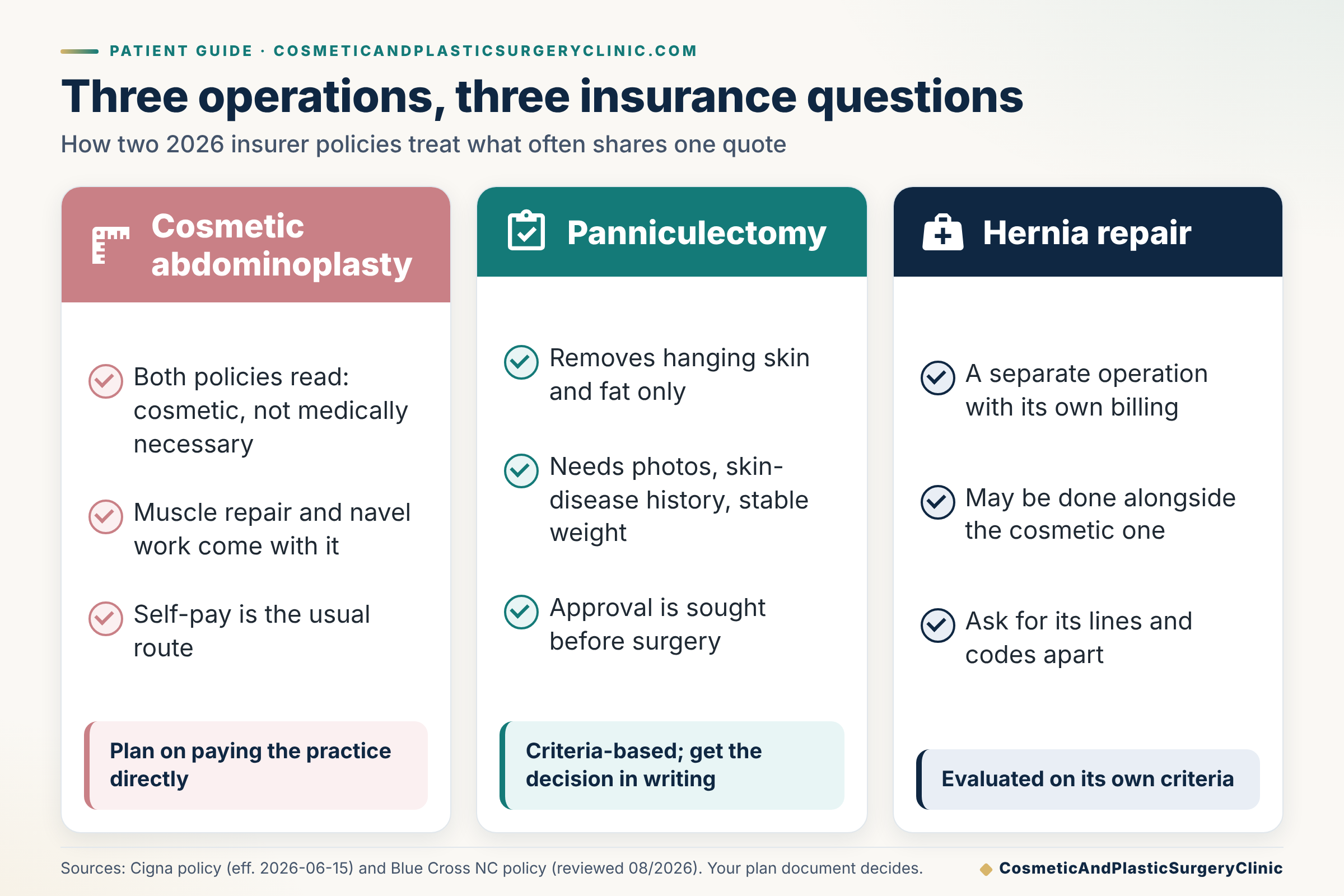
ASPS describes abdominoplasty as typically cosmetic. A panniculectomy removes hanging skin and fat without muscle plication, navel reshaping or flap elevation. A 2006 ASPS paper says procedures done solely to enhance appearance are not compensable unless the patient’s policy says otherwise, and the ASPS patient cost page states that most health plans do not cover tummy tuck surgery or its complications.
Two current insurer policies show how this plays out. Cigna’s policy, effective June 15, 2026, classifies abdominoplasty and mini-abdominoplasty as cosmetic and not medically necessary for any indication, including abdominal wall laxity. Blue Cross and Blue Shield of North Carolina, with a last review in August 2026, calls abdominoplasty cosmetic and not medically necessary for all applications.
Both policies allow panniculectomy only when criteria are met. The pannus must hang at or below the pubic symphysis, and there must be persistent skin disease that has not responded to at least three months of treatment. Cigna also requires a documented functional deficit; Blue Cross NC accepts a documented functional impairment that surgery is expected to improve as an alternative.
After significant weight loss, both require six months of stable weight, and after bariatric surgery both require at least 18 months to have passed. Those are two insurers; others differ, and your plan document controls. The article on tummy tuck after weight loss takes up that situation in depth.
Hernia repair and diastasis repair on the same bill
Cigna classifies surgical correction of diastasis recti, the separation of the abdominal muscles, as cosmetic and not medically necessary for any indication, and the Blue Cross NC policy reaches the same conclusion. Hernia repair is a different matter: it is its own operation, evaluated on its own criteria. The diastasis recti article explains how the two conditions differ.
For tummy tuck cost, the lesson is to ask a practice that combines them to show the hernia lines separately, with the billing codes. That lets you ask your plan about those lines before surgery. The plan decides, not the practice, and the cosmetic lines stay self-pay. Do not budget on coverage until the plan has put its decision in writing, before any deposit.
Taxes and health-account money
What IRS Publication 502 says about cosmetic surgery
In its 2025 edition, IRS Publication 502 says that generally you can’t include in medical expenses the amount you pay for cosmetic surgery. It defines cosmetic surgery as any procedure aimed at improving appearance that does not meaningfully promote the body’s proper function or prevent or treat illness or disease, and lists facelifts, hair transplants, electrolysis and liposuction among the examples.
Exceptions cover surgery that corrects a deformity from a congenital abnormality, a personal injury from an accident or trauma, or a disfiguring disease. Deductible medical expenses must also exceed 7.5% of adjusted gross income. A tummy tuck cost incurred for appearance therefore generally falls outside the deduction; a particular situation is a question for a tax professional, not an article.
HSA and FSA balances: ask before you budget
IRS Publication 969 (2025) defines qualified medical expenses for a health savings account as amounts paid for medical care as the tax code defines it. The passages reviewed did not address cosmetic surgery directly, and flexible spending accounts also depend on each employer’s plan. Because Publication 502 treats cosmetic surgery as generally outside medical expenses, it is unsafe to assume that a cosmetic tummy tuck cost can be paid from tax-advantaged balances.
Ask the plan administrator in writing before counting on those funds. The answer may differ for a panniculectomy or a hernia repair that a plan considers medically necessary, which is another reason to have those lines itemized separately.
Paying for a tummy tuck: total repaid, deposits and the written estimate
Total repaid beats the monthly payment
A deferred-interest card applied to Quote B
The Consumer Financial Protection Bureau’s May 2023 report found that the typical medical credit card carried a 26.99% APR, against a mean of about 16% for general-purpose cards. On a deferred-interest promotion, a balance that is not cleared by the deadline is charged interest on the full original purchase, back to the purchase date, not just on what remains. In the lender data the CFPB reviewed, which ran through 2020, interest was assessed on about 20% of healthcare purchases.
Apply that to the invented Quote B total of $13,660 on a 12-month promotion. Paying $1,000 a month leaves $1,660 at the deadline. At 26.99%, back interest on the declining balance comes to roughly $2,200, a simple monthly estimate that ignores fees and each card’s actual rules, leaving about $3,860 owed. The monthly payment hid what the tummy tuck cost had become; paying about $1,140 a month would have cleared the balance in time. The CFPB’s own advice is that minimum payments usually will not do it. Loan and plan comparisons are covered in the plastic surgery financing guide.
Costs that never appear on a quote
Some costs sit outside every quote. Mayo Clinic says many people return to work in about 2 to 4 weeks, depending on how physical the job is, and recommends arranging for someone to drive you to and from surgery. An abdominal binder for about 6 to 8 weeks may need a second size. If surgery is out of town, add travel and lodging.
None of these can be priced from the sources reviewed, so price your own: lost wages for the weeks you cannot work, child or pet care, household help, transportation, and meals you will not be cooking. A tummy tuck cost budget that stops at the invoice tends to run short by exactly these amounts.
The paperwork to have before a deposit
Deposits, cancellations and refunds
No source reviewed gives a national norm for deposit size or refund terms, so any figure would be a guess. Put the questions in writing instead: how much is the deposit, is it refundable and until what date, and what happens if the surgeon changes the plan or declines to operate after your pre-operative evaluation? Also ask whether the consultation fee is credited toward surgery, and what happens to the price if the facility or anesthesia provider changes.
If you are financing the operation, ask the same questions of the lender. A refund from the practice does not automatically cancel a loan or a card balance, so confirm who is responsible for reversing which charge.
The itemized estimate and the federal good faith estimate
The Centers for Medicare & Medicaid Services says that, usually, if you do not have or use health insurance, providers must give you a good faith estimate. It is due when you request one or schedule services at least 3 business days ahead, and you may be able to dispute a bill that is at least $400 more than the estimate. The No Surprises Act took effect on January 1, 2022.
A 2024 survey study in Plastic and Reconstructive Surgery Global Open found that most surveyed plastic surgery and aesthetic providers did not post prices online, with some citing the inaccuracy of online price estimators (abstract-level reading; it reports no percentages). The dependable document is therefore the itemized estimate you receive after consultation. A written tummy tuck cost estimate worth signing against should name:
- the operation in words, including muscle repair, navel work and each liposuction zone;
- the facility by name and its accrediting body;
- the anesthesia provider’s type and whether billing is flat or timed;
- every item billed by someone else, such as labs, pharmacy and garments;
- the follow-up window in months and the revision terms, including which fees are waived;
- the deposit, its refund conditions and the date of any price change;
- the total, with a statement of which known lines are still unpriced.
Frequently asked questions
Is a mini tummy tuck cost lower than a full one?
It can be, but no verified national figure separates the two. ASPS publishes one abdominoplasty number, and the Aesthetic Society’s page says only that cost varies by technique. A smaller operation may mean less operating time, which matters under timed anesthesia billing, but a practice may also set a minimum fee. Ask each office to quote the exact operation it recommends for you, with the nine lines, rather than comparing the names “mini” and “full.”
Does tummy tuck cost less in a smaller city?
Possibly, but none of the sources reviewed compares regions, so a claim either way would be a guess. ASPS names geographic office location as one driver of the fee and the Aesthetic Society says it varies by geographic area. A lower fee in another market also may not include travel, lodging or help at home. Compare totals after you add those, and ask who handles follow-up if you live far from the surgeon.
Can I pay tummy tuck cost in installments directly to the practice?
ASPS says many plastic surgeons offer patient financing plans, and the Aesthetic Society makes a similar statement. Terms differ widely, and a plan offered at the practice may be a third-party loan or card. Ask for the APR, any promotional period, fees, the total repaid and what happens if surgery is postponed. If it is a deferred-interest product, apply the CFPB’s warning about interest owed on the full purchase.
Will insurance pay if a complication needs treatment?
Do not assume it will. The ASPS patient cost page says most health plans do not cover tummy tuck surgery or its complications, and plans differ in how they treat follow-up for an elective operation. Ask your insurer in writing how it handles complications of cosmetic surgery, and ask the practice whether it offers or participates in any complication-coverage program, what that program covers and what it excludes.
Does tummy tuck cost go down when liposuction is done in the same operation?
Combining can mean one facility booking and one anesthetic instead of two, which may remove some repeated lines. It also makes a larger, longer operation, and a 2015 analysis of nearly 25,000 abdominoplasties found higher major-complication rates when combined with body contouring and liposuction. Ask for one itemized quote for the combined plan and one for the operations separately, then compare them line by line, and ask your surgeon why combining is or is not suggested for you.
Is the consultation fee part of tummy tuck cost?
Policies differ, and none of the sources reviewed describes them. Some practices charge a consultation fee and credit it toward surgery, some do not credit it, and some do not charge. Before you book, ask three things: the fee, whether it is credited if you proceed, and whether you will leave with an itemized written estimate. If you are not using insurance, CMS says a good faith estimate is usually due when you request it or schedule at least 3 business days ahead.
Can I negotiate a lower tummy tuck cost?
You can ask, but be careful what is being traded. A lower price from fewer liposuction zones or a smaller operation changes the plan. A lower price from dropping an accredited facility, an anesthesia professional or follow-up changes the safety margin. Ask exactly what the discount removes and request the revised itemized estimate. If a promoted price disappears when you arrive, remember the FTC’s bait advertising guidance, and it is fine to walk away.
Sources and further reading
- American Society of Plastic Surgeons — Tummy tuck cost (accessed 2026-11-12) — average surgeon fee, excluded costs, cost components, insurance statement
- ASPS — Cosmetic procedures average cost, 2024 (accessed 2026-11-12) — abdominoplasty and lower body lift fee ranges and how they were derived
- ASPS — Cosmetic procedures average cost, 2023 (accessed 2026-11-12) — 2023 and 2022 abdominoplasty averages
- ASPS — Plastic Surgery Statistics Report 2025 (accessed 2026-11-12) — tummy tuck volume, rank and data sources
- The Aesthetic Society — How much does a tummy tuck cost? (accessed 2026-11-12) — 2022 databank fee, what it covers, cost drivers, insurance statement
- ASPS — Tummy tuck overview (accessed 2026-11-12) — what the operation involves, muscle repair, scope limits
- ASPS — Tummy tuck procedure steps (accessed 2026-11-12) — anesthesia options, full-operation incisions, navel incision
- ASPS — Tummy tuck recovery (accessed 2026-11-12) — drains, garments, medications, follow-up questions
- Mayo Clinic — Tummy tuck (accessed 2026-11-12) — anesthesia, setting, duration, drains, binder, time off work
- ASPS — Accreditation (accessed 2026-11-12) — accrediting bodies and how to verify them
- ASPS — 10 features of a safe operating room (Furnas, 2016) (accessed 2026-11-12) — accreditation, unaccredited offices, anesthesia professional
- AORN Outpatient Surgery — How anesthesia gets paid, 2016 (accessed 2026-11-12) — base units and time units
- ASPS press release on Winocour et al., Plastic and Reconstructive Surgery, 2015 (accessed 2026-11-12) — complication rates, combined procedures, setting
- ASPS — Abdominoplasty and panniculectomy insurance paper, 2006 (accessed 2026-11-12) — cosmetic versus reconstructive definitions
- Cigna — Abdominoplasty and panniculectomy coverage policy, effective 2026-06-15 (accessed 2026-11-12) — cosmetic classification, panniculectomy criteria, diastasis and hernia statements
- Blue Cross and Blue Shield of North Carolina — Abdominoplasty and panniculectomy policy (accessed 2026-11-12) — cosmetic classification, panniculectomy criteria, diastasis statement
- IRS — Publication 502, Medical and Dental Expenses (2025) (accessed 2026-11-12) — cosmetic surgery exclusion, exceptions, 7.5% threshold
- IRS — Publication 969, Health Savings Accounts and Other Tax-Favored Health Plans (2025) (accessed 2026-11-12) — qualified medical expenses definition
- CMS — Good faith estimates for uninsured or self-pay patients (accessed 2026-11-12) — timing and $400 dispute threshold
- CFPB — Medical credit cards and financing plans, May 2023 (accessed 2026-11-12) — typical APR, deferred interest, share of purchases assessed
- CFPB — Health care credit cards: four things to know (2014) (accessed 2026-11-12) — interest back to purchase date, minimum payments
- Legal Information Institute — 16 CFR 238.0, Bait advertising defined (accessed 2026-11-12) — definition of bait advertising
- Legal Information Institute — 16 CFR 238.3, Discouragement of purchase (accessed 2026-11-12) — examples of conduct treated as discouraging purchase
- Moura et al. — Offering No-Cost Cosmetic Revisions, Aesthetic Surgery Journal Open Forum, 2023 (accessed 2026-11-12) — revision rate and revision-fee practices
- Hery et al. — Plastic Surgery Tourism: Complications, Costs, and Unnecessary Spending?, Aesthetic Surgery Journal Open Forum, 2023 (accessed 2026-11-12) — admission costs after destination surgery
- Rai et al. — The Controversy over Price Transparency, Plastic and Reconstructive Surgery Global Open, October 2024 (accessed 2026-11-12) — provider and patient attitudes toward price posting