

Choosing between fat transfer vs implants is not a contest between a natural option and an artificial one. It is a choice between two different ways of adding volume: a device whose size you set in advance, and living tissue that has to take hold in its new home and may not all stay. Each trade has consequences years later, in mammograms, in repeat procedures and in what you can predict on the day you sign a consent form.
This page is about that single comparison. It does not repeat the full operation, which sits in the breast augmentation overview, or the wider menu of non-implant routes in breast implant alternatives. Instead it sets fat transfer vs implants side by side on volume, fat survival, donor fat, upkeep, imaging, recovery and cost, and ends with questions to take to a consultation. It cannot tell you which option suits your body.
What fat transfer vs implants changes in the breast
Both routes enlarge a breast, so fat transfer vs implants is often framed as a rivalry. The two behave more like different tools. One places an object; the other relocates tissue. That difference explains almost everything else on this page, from why size is easier to specify with an implant to why imaging follow-up looks different.
Two materials, two different jobs
An implant adds a volume you can name in advance
A breast implant is a shell filled with saline or silicone gel, placed in a pocket made behind the breast tissue or the chest muscle. Because the device has a stated volume and shape, a surgeon can plan a result with some precision, and a surgeon quoted by the American Society of Plastic Surgeons (ASPS) in 2025 says an implant is better able to improve roundness than implant-free options. Fill and pocket are separate decisions, covered in saline vs silicone implants and over vs under muscle implants.
The cost of that precision is the device itself. An implant stays in the body as a foreign object that can wear, leak or be surrounded by a tight scar capsule, and later sections cover what the FDA says about that.
Fat grafting adds living tissue that has to settle in
Fat transfer begins with liposuction. ASPS describes it as fat taken from another part of the body, processed and injected into the breasts; Cleveland Clinic adds that the fat is spun in a centrifuge to remove impurities and then placed in several tissue layers of the breast, under general anesthesia and as an outpatient. The injected fat has to pick up a blood supply from the surrounding tissue, and not all of it does.
That is why surgeons harvest more fat than they plan to inject, and why the final size of a fat transfer cannot be read off the operating-room volume. The injected fat behaves like fat anywhere else in the body once it has settled, which has advantages for feel and drawbacks for predictability.
What neither side of fat transfer vs implants fixes on its own
Sagging breasts and nipple position
Volume added to a breast that has dropped does not lift it. Cleveland Clinic lists lack of firming for sagging breasts among the limits of fat transfer, and ASPS surgeons quoted in 2025 describe combining fat-based augmentation with a lift when drooping is present. The same logic applies to implants: a device can fill an emptied upper breast but may not correct nipple position. How lifts are priced and compared is in breast lift cost.
For readers wondering where the line falls, the question to ask a surgeon is whether your nipple sits below the fold under the breast, since that is a position problem and not a volume problem.
Shape: roundness, upper fullness and asymmetry
An ASPS surgeon quoted in 2025 says an implant is better able to improve roundness than implant-free options, and that patients with very little natural breast tissue may do better with implants. Fat grafting can, however, soften an edge, fill a hollow or even out a modest size difference between breasts, because it can be placed in small amounts exactly where it is needed.
The Aesthetic Society’s 2013 commentary from a Pittsburgh plastic surgery chair makes the same point from the other direction: fat injections may in some cases be used instead of implants to correct asymmetry. That is a narrower job than overall enlargement.
| Factor | Fat transfer | Implants |
|---|---|---|
| What is added | Your own fat, taken by liposuction and injected | A shell filled with saline or silicone gel |
| Size of change | Modest; ASPS says not the dramatic increase implants allow | Wider range, set by the device chosen |
| Predictability of final volume | Lower; some injected fat is lost over months | Higher at the start; shape can change later |
| Donor fat required | Yes, enough to spare after harvest losses | No |
| Follow-up devices and imaging | No device; lumps may need imaging to sort out | FDA: regular follow-up; silicone rupture screening |
| Repeat procedures | Possible if volume falls short | FDA: assume reoperation will be needed |
How much volume fat transfer vs implants can add
Volume is where fat transfer vs implants is most lopsided, and also where marketing is loosest. Cup size is not a standard unit, so claims in cups mean little until you ask for volume in milliliters and how it was measured.
The ceiling on fat transfer
Why the skin envelope and the fat supply set the limit
ASPS says implant-free options do not offer the dramatic increase in size available with implants, and that patients wanting a modest change with enough donor fat are the ideal match. Cleveland Clinic states that fat transfer increases breast size by one or two cup sizes, a figure stated without a study behind it, so treat it as a ceiling rather than a promise.
The skin and tissue envelope is the physical limit. Fat has to be placed into existing breast tissue, in small amounts across several layers, so that each portion can pick up a blood supply. A 2026 meta-analysis in the Aesthetic Surgery Journal notes that standard cosmetic fat grafting commonly involves 120 to 250 mL per session.
What happens when the envelope is pre-expanded
One way around the limit is to stretch the envelope first. In a 2012 study in Plastic and Reconstructive Surgery, Khouri and colleagues had patients wear an external expansion device before grafting: 71 compliant women gained an average of 233 mL per breast on MRI, against 134 mL in published studies without expansion. The authors disclosed an equity interest in the device maker, patients wore the device about ten hours a day for four weeks, and the comparison group was not randomized.
The 2026 meta-analysis suggests this kind of pre-expansion may have pushed up the pooled average of 310 mL per breast across its studies, so a large number in a study does not describe ordinary practice.
How much injected fat stays
Pooled retention is roughly half to six-tenths
A 2024 meta-analysis in the Journal of Plastic, Reconstructive and Aesthetic Surgery pooled 25 studies with 3 to 36 months of follow-up and reported 54 percent volume retention at the latest follow-up (95 percent confidence interval 48.5 to 59.5). The 2026 Aesthetic Surgery Journal analysis pooled 40 studies and 5,684 patients and reported 61.3 percent at 12 months (interval 57.1 to 65.4).
Those two figures are not rivals in the fat transfer vs implants debate; they use different studies and time points. Both papers stress variation: the 2026 paper reports high heterogeneity (I-squared of 82 percent), and its evidence is mainly single-arm observational work, graded level 3.
Retention is not the same as enlargement
The 2026 authors state plainly that percentage graft retention does not equal percentage breast enlargement. A breast that gains 200 mL and keeps 60 percent has gained about 120 mL, but the surgeon rarely knows the 200 mL figure for sure, because some fat is lost in processing and some in the injection itself.
Better graft handling may help. The 2024 review found higher retention after centrifugation than after sedimentation, and the 2026 review found higher retention with enriched grafts (68.9 versus 56.1 percent), though it rests on few comparative studies. These are research findings, not a promise from any one technique.

Donor fat: whether fat transfer vs implants is even a live choice
Why surgeons harvest more than they inject
Cleveland Clinic notes that the surgeon must be able to remove more fat than will be used, because some cells die after injection. That makes donor fat a practical limit as much as a medical one. Someone with little spare fat on the abdomen, flanks and thighs may have too little to harvest, and Cleveland Clinic says people with little body fat may need implants instead.
Harvest itself is liposuction, with its own bruising, swelling and garment routine. The liposuction overview explains how that operation works and what it does not do, and it applies to the donor sites here too.
Weight, smoking and repeat sessions
Cleveland Clinic lists drastic weight fluctuations and smoking among reasons fat transfer may not suit someone, and says some people need more than one session to reach the result they want. Weight matters for the donor side, since a person who loses weight has less to harvest, and it is fair to ask how later weight change would affect the result; the sources opened for this article do not put a number on that.
Repeat sessions multiply the practical load: another liposuction recovery, another anesthetic, another facility fee. Ask a surgeon what happens to the fee if a second session is needed.
Implant volume in the fat transfer vs implants size decision
Size is a choice, which is its own risk
With implants the question is how large to go, not whether the breast can hold it. That decision depends on chest width, existing breast tissue and how much stretch the skin allows, and it is the subject of breast implant size. The point for fat transfer vs implants is that implants can deliver a change in size that fat transfer typically cannot, and larger changes usually have bigger trade-offs.
Bigger is not free of consequences. The boxed warning wording the FDA recommends says the longer people have implants, the greater the chance of complications, some of which need more surgery.
Combining a smaller implant with fat
Some surgeons combine the two in one operation, a composite or hybrid augmentation. A 2019 systematic review in Plastic and Reconstructive Surgery Global Open describes the rationale: fat placed over an implant may address limits of soft-tissue coverage, such as an edge that shows. The 2026 meta-analysis calls hybrid augmentation a promising extension but did not include it in its pooled analysis.
The sources opened here did not give pooled complication or reoperation rates for composite augmentation, so treat it as an option to discuss, not as a way to avoid the trade-offs of either method.
Years later: what fat transfer vs implants asks of you after surgery
The first operation is the shorter part of fat transfer vs implants. Implants turn into a device you monitor; fat grafting turns into tissue you watch for lumps. Neither is maintenance-free, and the two kinds of upkeep are different enough that they deserve separate columns on your planning sheet.
Implants as devices with a service life
Reoperation and removal data
The FDA’s consumer page says breast implants are not lifetime devices, that you should assume you will need additional surgeries, and that the most common local complications are capsular contracture, reoperation and implant removal. It gives no timeline, noting that implant life varies by person and cannot be predicted. Mayo Clinic says implants last about 10 years, and Cleveland Clinic says 10 to 15; read both as rough planning figures.
For numbers, Coroneos and colleagues analyzed FDA postapproval studies of silicone and saline implants from two manufacturers, covering 99,993 patients (Annals of Surgery, 2019). At 7 years, reoperation after primary augmentation was 11.7 percent, and severe grade III or IV capsular contracture was 7.2 percent, the most common reason for reoperation after augmentation. Follow-up stops at 7 years, so it says little about decades.
Rupture screening for silicone implants
The FDA’s 2020 labeling guidance recommends that people with silicone gel implants and no symptoms have their first ultrasound or MRI at 5 to 6 years after surgery, then every 2 to 3 years; a person with symptoms or an unclear ultrasound should have an MRI. Mayo Clinic repeats that schedule. The FDA also says silicone rupture is often silent, whereas a saline implant that ruptures deflates.
Follow-through on that part of fat transfer vs implants appears to be low. In the Coroneos analysis, long-term MRI surveillance was under 5 percent. The FDA also warns that MRI or ultrasound screening may not be covered by insurance, so ask early what a surveillance plan will cost you.
Fat transfer as tissue that behaves like your own fat
Settling over months, not days, after fat transfer
Cleveland Clinic says full results can take up to six months to appear and that swelling can persist for that long; the 2026 meta-analysis measures retention at 12 months. A breast that looks full in the first weeks is a poor guide to the final size, and a second session, if one is discussed, is usually weighed after the volume has had time to settle; ask what interval your surgeon uses.
Cleveland Clinic describes results as lifelong, while the retention studies above describe a loss of part of the injected volume, measured over months to about three years in the 2024 review. Both can be true: the fat that survives can persist, while the amount that survives varies. Ask any clinic to separate those claims.
Lumps: fat necrosis, oil cysts and calcifications
Fat that loses its blood supply can form scar-like firm areas called fat necrosis, or fluid-filled oil cysts, and sometimes calcium deposits. The 2026 meta-analysis pooled an overall complication rate of 25.9 percent across 40 studies, described as mostly minor radiologic or palpable findings, with fat necrosis the most common event and about 8.8 percent seen on imaging. The pooled oil-cyst and calcification figures were reported inconsistently in the paper, so they are not quoted here.
Cleveland Clinic lists benign cysts and calcifications among the risks, and the 2012 Khouri study found fat necrosis on MRI in 12 of 75 women, which the authors judged benign. Most of this is minor, but a lump still needs a clinician to examine it, not a guess.

Imaging and safety statements in the fat transfer vs implants decision
Breast cancer screening is the question that most often goes missing from fat transfer vs implants. Any augmentation changes what a mammogram sees, and both routes have been through years of debate about how much. The FDA, the American Cancer Society and the research literature say different things about each.
Mammograms with implants, the other half of fat transfer vs implants
Extra pictures and hidden tissue
The American Cancer Society (revised July 2026) says women with implants still need regular screening mammograms and get four extra pictures, two per breast, called implant displacement views. The implant is pushed back against the chest wall and the breast pulled forward over it. Both saline and silicone implants can make it harder to see breast tissue, and views are easier when implants sit behind the chest muscle.
Tell the facility about implants when you book, and ask whether its technologists have experience with them. The same page says a mammogram can very rarely rupture an implant, and the FDA lists compression as one possible cause of rupture.
Rupture checks are not cancer checks
The FDA’s page says MRI is the most effective method for detecting silent rupture and that ultrasound is an acceptable alternative for people without symptoms. These checks look at the device. They run alongside, and do not replace, routine breast cancer screening. The FDA also says calcifications around an implant can be mistaken for cancer on a mammogram, leading to additional surgery.
If a mammogram report mentions an implant-related finding, ask your own clinician to explain it before agreeing to a biopsy or reoperation, and ask the imaging team whether it can compare with earlier images.
Mammograms after fat transfer vs implants: the fat side
Why the early history still matters
That caution explains why surgeons still talk about imaging when they discuss fat grafting. It was the original reason the procedure was set aside, and radiology has changed since.
What breast radiologists see today
The 2026 meta-analysis reports that mammograms typically show benign calcifications and oil cysts, ultrasound shows cystic lesions, and MRI shows enhancement that experienced breast radiologists can usually distinguish from cancer. It found no evidence of impaired cancer detection but grades its evidence as level 3 and did not pool cancer outcomes. Cleveland Clinic says microcalcifications are usually not cancer and that clustered ones may lead to ultrasound, MRI or a needle biopsy.
In Khouri’s 2012 series, 16 percent of women had calcifications at one year, all judged recognizable benign fat necrosis. The Aesthetic Society’s 2013 commentary still described mammography effects as an open question. Taken together, for fat transfer vs implants: imaging problems appear manageable in reported series, but the 2026 authors had no randomized comparisons with implants to draw on.
Where safety statements on fat transfer vs implants stop
Implants carry a formal warning; fat transfer does not
For implants, the FDA’s 2020 guidance recommends a boxed warning (implants are not considered lifetime devices, complications rise with time, and breast implant-associated anaplastic large cell lymphoma, or BIA-ALCL, has been reported more often with textured implants). The FDA says its October 27, 2021 actions brought boxed-warning labeling to all legally marketed implants, and that the patient decision checklist must be offered for you to initial and sign, with the implanting physician signing too.
BIA-ALCL is a cancer of the immune system, not of breast tissue, according to the FDA. Ask about it at the consultation, and see breast augmentation candidate for what surgeons evaluate before any implant plan.
Fat transfer has no equivalent label, so ask for the evidence
Fat grafting uses your own tissue, which is why Cleveland Clinic describes fewer risks than implants. That phrase compares different sorts of risk: no device failure, but more lumps, more imaging questions and more variable volume. The 2026 authors conclude that fat grafting may be a safe and effective option for selected patients, based mainly on observational evidence, and ask for randomized comparisons with implants.
The sources opened here did not include a current ASPS position statement on fat grafting for augmentation beyond the 2009 history above, so ask your surgeon which guidance they follow.
Scars, surgery day and recovery with fat transfer vs implants
In fat transfer vs implants, the two operations feel different on the day and in the weeks after, mainly because fat transfer is really two procedures at once: liposuction in one place and injection in another. That doubles the areas that bruise and need a garment, even though the breast incisions are smaller.
Marks left behind
Implant incisions and the pocket
An implant needs an opening large enough to pass the device into a pocket, and the placement of that opening is negotiated between surgeon and patient. The choices, and how they interact with pocket and fill, are laid out in the overview of the operation. Ask to see where your surgeon would place it and how scars from similar incisions looked months later in their own albums.
The scar does not tell you about the implant behind it. A well-hidden scar and a poorly chosen size can coexist, which is why scars are one line on the planning sheet and not the whole sheet.
Fat transfer vs implants scars: small entry points in two regions
Fat grafting uses thin cannulas, which pass through small entry points, both at the donor areas and at the breasts. That generally means shorter marks than an implant incision, but more of them. None of the clinical sources opened for this article gave scar lengths, so ask your surgeon to mark the entry points.
Where the donor fat comes from matters as well: Cleveland Clinic lists the stomach, hips, thighs, back and arms. The donor area changes too, and it can show bruising or contour irregularity, which is covered in liposuction recovery.
The first weeks compared
Time off, discomfort and garments
ASPS surgeons quoted in 2025 describe a three-week recovery timeline for implant-free augmentation, a timeframe similar to implant surgery, with discomfort sometimes less but a longer overall recovery because compression garments are worn longer after liposuction. Cleveland Clinic suggests about a week off work, pain, bruising and swelling lasting up to three weeks, and sleeping on the back.
Dates for work, driving and exercise are set by your surgeon, and the breast augmentation recovery article covers the implant timeline in detail.
Pressure, bras and what to ask
Cleveland Clinic says a compression bandage and surgical bra are used to help the fat settle, which is a reminder that grafted fat is delicate in the early weeks. Instructions about bras, pressure on the breasts and sleeping position differ between surgeons and between fat transfer and implants, so ask for the written plan before surgery and what to do if a rule cannot be followed.
Cost and decision logic for fat transfer vs implants
A cost comparison of fat transfer vs implants that stops at the first operation misses the part where the two diverge. Implants carry device, screening and possible reoperation costs over years. Fat transfer carries two operations in one, and sometimes more than one session.
What each plan puts on the quote
What ASPS averages show, and what they leave out
ASPS’s patient cost page, which gives no year, lists an average of $4,875 for breast augmentation with implants and $5,719 for breast augmentation with fat grafting, and says averages exclude anesthesia, operating-room facility and related expenses. ASPS’s 2024 cosmetic fee document lists ranges of $4,575 to $8,000 for implants and $5,500 to $9,500 for fat grafting only, described as projections from averages submitted by surveyed members.
These are national figures, not quotes, and not totals. Fat grafting averaging more than implants may reflect the combined work of liposuction and injection. The deeper breakdown is in breast augmentation cost.
| Cost line | Implant plan | Fat transfer plan | Question to ask |
|---|---|---|---|
| Surgeon fee | One operation | Liposuction plus grafting | Is harvest of every area included? |
| Facility and anesthesia | Single anesthetic | Single anesthetic, often longer | Are these in the quote or billed separately? |
| Device | Implants themselves | None | What happens to the cost if a size change is needed? |
| Follow-up imaging | Ultrasound or MRI at set intervals, possibly uninsured | Imaging if a lump appears | Who pays for imaging not covered by insurance? |
| Second operation | Reoperation or replacement over time | Possible repeat session | What does the revision policy cover, and for how long? |
| Garments and visits | Support bra | Compression garments and bra | Which follow-up visits are included? |
Money over years in fat transfer vs implants, not just on day one
The FDA says that even with complications, the cost of implant removal or replacement may not be covered by insurance, and that MRI or ultrasound monitoring may not be either. Fat transfer has no device to replace, but it can need another session if volume falls short. Neither side of fat transfer vs implants can be turned into a lifetime total from the sources opened here, so ask each clinic to write down what it would charge for the foreseeable second operation.
When two quotes arrive, compare them line by line using the table above, and treat any quote that bundles liposuction without naming the areas as incomplete.
Matching goals to fat transfer vs implants
Five hypothetical situations
The situations below are invented to show how the same facts lead to different questions. None describes a real person, none is a recommendation, and only an exam by a board-certified plastic surgeon can speak to your body. The column that matters most is the last one: the fact that would change the answer.
| Goal and anatomy | Option often discussed | Reason | Fact that could reverse it |
|---|---|---|---|
| A modest increase, spare donor fat, no sagging | Fat transfer | ASPS describes this as the ideal match for implant-free work | Retention lower than hoped, or reluctance to accept a second session |
| A clearly larger change | Implants | ASPS says fat options do not offer a dramatic increase | Unwillingness to accept reoperation or screening |
| Lean frame with little donor fat | Implants | Cleveland Clinic says low body fat may call for implants | A surgeon finds adequate fat in areas not obvious on a pinch test |
| Small asymmetry or an implant edge that shows | Fat transfer, alone or added to an implant | Fat can be placed in small amounts exactly where needed | Concern about lumps and added imaging |
| Sagging with nipples below the fold | Lift, with or without volume | Volume alone does not lift a breast | A surgeon judges the sag mild enough for volume alone |
Six checks before choosing between fat transfer vs implants
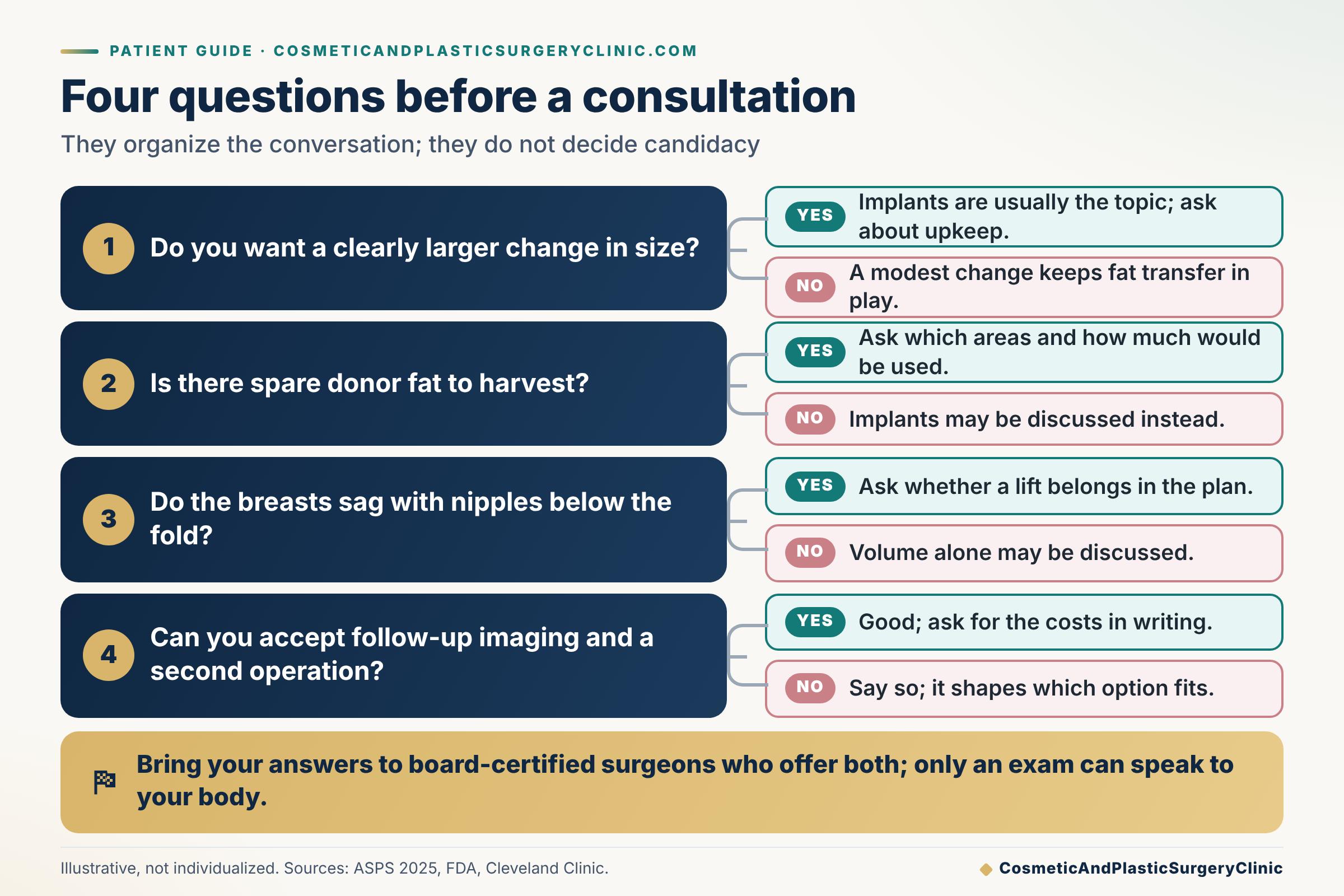
These six checks are the working questions to settle at consultation, in roughly this order. They are prompts for a conversation, not a screening that decides your candidacy; the plastic surgery consultation article covers the wider visit.
- Volume target: ask for the goal in milliliters, how it was measured in the surgeon’s own results and how much is expected to remain.
- Donor fat: ask the surgeon to name the harvest areas and say whether the amount looks sufficient without overharvesting.
- Sessions and fees: ask what a second session or a size change would cost and what the revision policy covers.
- Imaging: ask who will read your mammograms, which extra views apply, and how lumps would be worked up.
- Implant upkeep: ask for the surveillance plan, what screening costs and what removal or replacement would cost.
- Experience: ask how many of each procedure the surgeon performs and where, using how to choose a plastic surgeon to verify the answer.
Frequently asked questions
Is fat transfer vs implants cheaper over ten years?
It depends on what happens after the first operation, and neither option can be reduced to a reliable ten-year total from the sources used here. ASPS averages show fat grafting costing more than implants at the outset. Implants may add screening imaging and reoperation, which the FDA says insurance may not cover; fat transfer may add a repeat session. Ask each clinic for a written estimate of the second operation, including facility and anesthesia charges.
Does fat transfer vs implants change when I should start screening mammograms?
The sources opened for this article describe how mammograms are done after each option, not when to begin. That timing depends on your age, family history and your clinician’s advice, and neither operation replaces it. After implants the American Cancer Society says you still need regular screening and extra views; after fat grafting, tell the imaging team about the procedure so lumps and calcifications are read in context.
Can I have fat transfer first and implants later?
Surgeons do combine the two approaches in a single operation, and they sometimes stage them, but the sources opened here do not compare outcomes of fat first against implants first. Ask how earlier grafting would affect later implant planning, what happens to scar tissue and fat that has formed lumps, and whether imaging would be needed first. The answer depends on your tissue and your surgeon’s technique.
Can fat soften an implant edge, or is fat transfer vs implants always either-or?
Fat grafting over an implant is described in the literature as a way to address limits of soft-tissue coverage, and The Aesthetic Society’s 2013 commentary says fat can improve how a breast looks after augmentation. How reliable this is for any one person is not established in the sources opened here. Ask to see results of the surgeon’s own patients with a similar starting point, noting how many months after surgery the photos were taken.
Where does the fat come from in fat transfer vs implants surgery?
Cleveland Clinic lists the stomach, hips, thighs, back and arms as sources. The surgeon chooses the donor area based on where there is spare fat and how it will change your contour. Because only part of the harvested fat is injected, and because some injected fat does not survive, the amount available limits what can be done in one session.
Do lumps after fat transfer vs implants surgery mean cancer?
Not usually, but a new lump should always be examined. Cleveland Clinic says fat transfer does not increase breast cancer risk and that microcalcifications are usually not cancer; clustered ones may lead to ultrasound, MRI or a needle biopsy. The 2026 meta-analysis found fat necrosis, oil cysts and calcifications at low to moderate rates, mostly benign, but did not pool cancer outcomes.
Will insurance cover fat transfer vs implants for augmentation?
Cosmetic augmentation is generally elective, and the sources opened here did not describe coverage for either approach. The FDA does warn that the cost of implant removal or replacement, and of MRI or ultrasound monitoring, may not be covered even when complications occur. Ask the practice and your insurer in writing before surgery, and ask how revision costs are handled.
Sources and further reading
- American Society of Plastic Surgeons — Implant-free options for breast augmentation (June 10, 2025, accessed 2026-11-12) — modest increase, donor fat, less predictable volume, lift pairing, recovery and garments
- American Society of Plastic Surgeons — Breast augmentation (accessed 2026-11-12) — fat transfer defined as using fat from another part of the body
- American Society of Plastic Surgeons — Breast augmentation cost (accessed 2026-11-12) — average fees for implants and fat grafting, and exclusions; no year stated
- American Society of Plastic Surgeons — Cosmetic procedures average cost, 2024 (accessed 2026-11-12) — fee ranges for augmentation with implants and with fat grafting only
- U.S. Food and Drug Administration — Risks and complications of breast implants (current as of 12/15/2023, accessed 2026-11-12) — not lifetime devices, capsular contracture, rupture, MRI and ultrasound, BIA-ALCL
- U.S. Food and Drug Administration — Things to consider before getting breast implants (current as of 03/08/2023, accessed 2026-11-12) — assume reoperations, insurance coverage caveats, 2021 boxed warning
- U.S. Food and Drug Administration — What to know about breast implants (current as of 01/31/2025, accessed 2026-11-12) — patient decision checklist, regular screening, telling the mammography facility
- U.S. Food and Drug Administration — Breast Implants: Certain Labeling Recommendations to Improve Patient Communication (guidance issued September 29, 2020, accessed 2026-11-12) — boxed warning wording, silicone rupture screening schedule, checklist
- U.S. Food and Drug Administration — Statement on continued efforts to enhance safety information for patients considering breast implants (October 23, 2019, accessed 2026-11-12) — draft guidance on boxed warning, checklist and screening
- Cleveland Clinic — Fat transfer breast augmentation (reviewed 08/18/2022, accessed 2026-11-12) — process, donor fat, size claim, repeat sessions, recovery, risks, mammograms
- The Aesthetic Society — Breast augmentation using fat transfer (September 19, 2013, accessed 2026-11-12) — track record versus implants, asymmetry, open imaging questions
- American Cancer Society — Mammograms with breast implants (revised July 23, 2026, accessed 2026-11-12) — extra views, hidden tissue, telling the facility, rare rupture
- Mayo Clinic — Breast augmentation (September 10, 2024, accessed 2026-11-12) — implant lifespan, imaging schedule, mammogram views, risks
- Gentile and Sterodimas — Autologous fat grafting for breast augmentation and breast remodeling: a systematic review and meta-analysis, Aesthetic Surgery Journal, 2026 (accessed 2026-11-12) — 40 studies, 5,684 patients, retention, complications, imaging, limits
- Hu and Xu — Volume retention rate after breast autogenous fat grafting: a systematic review and meta-analysis, Journal of Plastic, Reconstructive and Aesthetic Surgery, 2024 (abstract record, accessed 2026-11-12) — 25 studies, pooled retention, centrifugation versus sedimentation
- Khouri and colleagues — Brava and autologous fat transfer: results of a 6-year, 81-patient, prospective multicenter study, Plastic and Reconstructive Surgery, 2012 (hosted copy, accessed 2026-11-12) — 1987 ban, 2009 task force position, expansion study, calcifications
- Coroneos and colleagues — US FDA breast implant postapproval studies: long-term outcomes in 99,993 patients, Annals of Surgery, 2019 (abstract record, accessed 2026-11-12) — 7-year reoperation, capsular contracture, MRI surveillance
- Fat grafting and breast augmentation: a systematic review of primary composite augmentation, Plastic and Reconstructive Surgery Global Open, 2019 (record with partial abstract, accessed 2026-11-12) — rationale for combining fat with implants


