Most pages about a mommy makeover candidate read like a quiz: healthy, stable weight, done having children, realistic expectations, tick, tick, tick. The quiz is a fair summary of what the American Society of Plastic Surgeons (ASPS) lists on its candidate page, but it hides the part that actually decides timing. Each box is a moving target for a woman who delivered recently, may still be nursing, and is running a household on very little sleep.
This article takes the boxes apart one at a time and explains what a surgeon is likely to look for behind each. It is education for planning a conversation, not a verdict: nobody can be declared a candidate from an article, a photo or a message. For the full definition of the combined operation, start with the mommy makeover overview.
How surgeons weigh a mommy makeover candidate before any operation is named
Candidacy is assembled from parts, not granted as one yes
Why a combined plan carries more than one set of conditions
A mommy makeover is a planned combination, not one standard operation. ASPS describes the possible parts as breast augmentation, breast lift, buttock augmentation, labiaplasty, liposuction and tummy tuck, and says the plan is typically performed as a single-stage procedure. Each part has its own preconditions. The abdomen cares about weight stability and muscle separation; the breasts care about weaning and volume; the anesthesia team cares about how long the whole plan runs.
That is why a person can be a reasonable mommy makeover candidate for one component and a poor fit for another in the same season. A woman six months into nursing may be ready to talk about her abdomen long before her breasts have finished changing. The mix of components is covered in the procedures guide; this page stays on who the mix suits and when.
What a candidate evaluation actually covers
Expect the visit to cover the pregnancy and nursing history, current weight and recent weight changes, medical conditions and medicines, nicotine use, prior surgery and scars, a physical exam of the abdominal wall, skin and breasts, and a frank conversation about goals and home support. ASPS’s preparation page adds that patients may be asked for lab work or a medical evaluation, to adjust certain medicines, to stop smoking, and to avoid aspirin, anti-inflammatory drugs and herbal supplements that raise bleeding risk.
None of that happens by questionnaire. The exam finds things history cannot, such as a small umbilical hernia or a wider-than-expected muscle gap. The consultation guide covers what to bring and what good answers sound like.
The four endings of a candidacy visit
Proceed, reshape the plan, wait, or choose another route
A mommy makeover candidate visit rarely ends in a flat yes or no. Four outcomes are common in practice: the plan goes ahead as discussed; the plan is narrowed to fewer components or split into stages; the surgeon asks for a defined wait with specific checkpoints, such as steady weight or finished weaning; or a different route fits better, from a single procedure to no surgery at all.
Treat every one of those as a legitimate result. A recommended wait is information about your tissue and timing, not a rejection, and it costs less than operating early and revising later. The staging option has its own article, staged versus combined surgery.
Who else has a say besides you and the surgeon
Three other voices often matter to a mommy makeover candidate. The anesthesia provider decides whether a long combined plan is acceptable for your health and may ask about medicines such as weight-loss injections. Your obstetric or primary care clinician knows your postpartum course, blood counts and mood. And the person who will be at your side in the first days has a veto of sorts, because the plan only works if someone can actually do the lifting.
If one of them hesitates, that is a planning input to pause on, not an obstacle to argue around.
Pregnancy plans and the postpartum clock for a mommy makeover candidate
How long after delivery is a mommy makeover candidate ready to be assessed?
What the plastic surgeons quoted by ASPS say
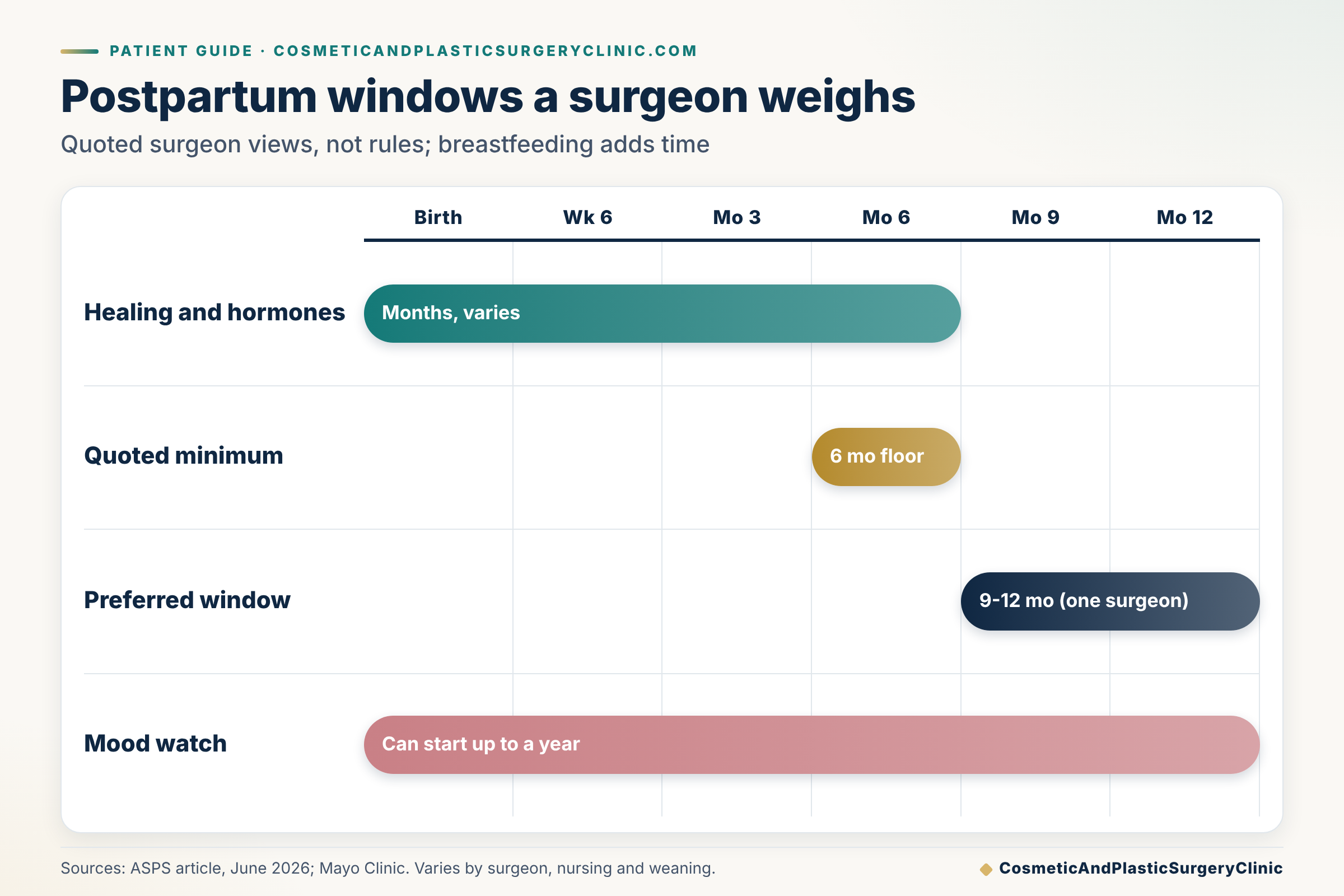
An ASPS news article published June 18, 2026 quotes two surgeons with slightly different instincts. Kristy Hamilton, MD, suggests a minimum of six months postpartum, longer if breastfeeding, and prefers nine to twelve months for most procedures; she wants surgery deferred until a patient is fully recovered, hormonally stable and ideally at or near her goal weight. Karen Horton, MD, recommends waiting up to a full year before considering plastic surgery.
A 2018 ASPS blog post by Kevin Tehrani, MD, expresses the same floor in blunter language: a reputable surgeon will ask for at least six months. Note the pattern. These are individual clinical judgments published by a professional society, not a trial-derived cutoff, and the ranges overlap rather than agree.
What the body is still doing in that window
Hamilton’s reasoning is hormonal and structural: hormonal fluctuations continue for months postpartum, and a result achieved too early may not hold. The abdominal wall is part of that. Some separation of the rectus muscles after pregnancy improves by itself, which is why a gap measured in the first weeks may say less than one measured later. A Baylor College of Medicine clinician notes that the condition typically improves after childbirth and that surgery is often not needed, with physical therapy a common first step.
Horton adds a human point: waiting for some stability and routine lowers the odds that surgery lands on top of an already overloaded life. Sleep, mood and logistics are part of readiness, which the support section below develops.
If another pregnancy is possible
Why surgeons advise finishing the family first
ASPS lists “finished with childbearing” among its four candidate criteria, and Mayo Clinic’s tummy tuck page names a possible future pregnancy as a reason a surgeon may advise against that operation. Hamilton puts it directly: a future pregnancy can undo the results, and she strongly advises waiting until the family is complete, particularly before a tummy tuck.
The mechanics are easy to picture. Pregnancy stretches the skin and muscle that the operation just tightened, and the breasts go through volume changes again. No source this article opened gives a number for how much result is lost, so be wary of anyone who offers one.
What a mommy makeover candidate can do with a “maybe” about another child
Plenty of would-be mommy makeover candidates are genuinely undecided, and the honest response is to say so at the consultation. A surgeon can then discuss which components are less sensitive to a later pregnancy and which are more, whether any should wait, and what a revision might involve if life changes. That conversation is far more useful than a rounded-off “no more kids” offered to look like a good candidate.
Consider a hypothetical: a woman delivered eight months ago, is weaned, and thinks she might try for a third child in two or three years. A surgeon might reasonably suggest waiting, or addressing only a component that holds up better, and then revisiting after the family is settled. Either path is defensible; the point is that it was chosen with the facts on the table. Timing questions specific to the months after birth have their own page, the guide to a mommy makeover after pregnancy.
Breastfeeding, weaning and the breast side of a mommy makeover candidate’s plan
Why weaning comes before breast surgery is planned
Breasts keep changing after the last feed
Horton told ASPS that after stopping breastfeeding it can take four to six months for the breasts to contract, and that breast surgery should be postponed until a woman is certain her breasts have stopped changing. Hamilton prefers to wait at least three months after weaning. The two numbers sit close together for a practical reason: a lift or implant size chosen while the tissue is still shrinking or refilling is chosen against the wrong baseline.
ASPS also notes in the same article that some procedures and treatments have not been studied in pregnant or nursing women, and advises anyone who is breastfeeding to consult an ASPS member surgeon first. The abdominal components are less tied to weaning than the breast components, which is one reason plans are sometimes split.
What a surgeon will want to know about your feeding history
Expect questions about how long you nursed, whether supply was ever a struggle, when you last fed or pumped, whether you plan to nurse another child, and how your breast volume has changed since before pregnancy. The answers steer the choice among a lift, an implant, both together, or a reduction, and they tell the surgeon whether the breast measurements on the day of the exam are stable enough to plan from.
Bring your own timeline. A few lines on paper beat memory at a visit where you are also thinking about childcare and parking.
What breast surgery can mean for nursing a future child
What the research on implants says, and what it leaves out
ASPS lists “inability to breast feed” among the risks on its mommy makeover safety page, without a rate. The best pooled evidence this article opened concerns implants only. A 2023 systematic review and meta-analysis in the Aesthetic Surgery Journal covered 11 studies: 8,197 of 9,965 women (82.25%) were able to breastfeed after breast implants. In the five studies with a comparison group, 88.45% of women without implants breastfed, and the pooled odds ratio for breastfeeding with implants was 0.45 (95% confidence interval 0.38 to 0.53).
The authors conclude there may be impairment in the ability to breastfeed and call for more research. The studies were a mix of prospective and retrospective designs, so the numbers describe groups and cannot predict one woman’s supply. No comparable pooled figures for breast lifts or reductions could be verified for this article, so those stay a question for the surgeon rather than a number here.
Anesthesia, medicines and the pumping question
Many nursing mothers assume they must stop feeding or discard milk around general anesthesia. The anesthesiologists’ guidance below says otherwise, though it covers anesthetic drugs and the plan for pain medicine is for your own anesthesia team and surgeon to settle. If you are still nursing, name it at the first visit so the team can plan around it.
That guidance is general. A surgeon may still choose a plan around medicines other than the anesthetic, and breast surgery itself can affect milk flow in the ways described above.
Weight stability, BMI and nutrition after a baby
Steady weight is a planning input, not a goal weight
What “ideal body weight” means on the ASPS mommy makeover candidate page
ASPS lists being at your ideal body weight as a candidate criterion and does not give a number. Individual surgeons fill the gap in different ways. Tehrani wrote in 2018 that “we recommend being no more than 25 pounds over your goal weight before surgery,” and Hamilton says a tummy tuck should ideally happen once a patient is back at her baseline BMI. Mayo Clinic says, for the tummy tuck alone, that surgeons ideally want weight kept stable for 6 to 12 months.
A mommy makeover candidate should read these as a family of habits rather than a standard. The shared logic is that the operation redistributes and removes tissue at one moment in time; if weight keeps moving, the result moves with it. Hamilton says plainly that surgeons cannot tighten and contour to the degree they want if the patient is swollen and above her baseline.
What the research says about losing postpartum weight
If your weight is still above where you want it to be, the evidence is modest on how much a structured program changes things. A 2013 meta-analysis in Preventive Medicine pooled four randomized trials of 547 overweight or obese postpartum women and found that activity-plus-diet programs produced about 1.22 kg (about 2.7 pounds) more weight loss than comparison groups. The trials were small, varied in timing from 4 weeks to 18 months postpartum, and were of weak methodological quality, so this is a signal, not a forecast.
The practical takeaway is not that weight loss is hopeless. It is that a plan built on a weight you have not yet reached, and may not reach in time, is fragile. Ask your surgeon what steady looks like for your frame rather than choosing a number from the internet.
GLP-1 medicines and weight that is still moving
Why a weight-loss medicine changes the timing question
If you are taking or have recently stopped a GLP-1 medicine, a mommy makeover candidate’s weight may still be falling or rebounding, and that alone can reset the timing conversation with a surgeon. It also matters to anesthesia, because these drugs slow stomach emptying.
A multisociety statement from the American Gastroenterological Association, the American Society for Metabolic and Bariatric Surgery, the American Society of Anesthesiologists and two other bodies says most patients may continue GLP-1 medicines as prescribed, that individual risk factors should still be assessed beforehand, and that some higher-risk patients should follow a liquid diet for 24 hours before a procedure. The page I opened gives the date as October 29 and omits the year, so check the current version.
Who to tell, and what not to do on your own
Tell both the surgeon and the anesthesia provider the name, the dose and the date of your last injection. Do not stop, start or change a prescription to fit a surgery date without the prescriber’s input; the guidance itself says that withholding the drug can carry its own risks. The best-case sequence is a steady-weight window agreed with your prescribing clinician and the surgeon together.
BMI and the risk arithmetic of long, combined operations
What BMI signals for a mommy makeover candidate, and what it does not
Mayo Clinic lists obesity, defined as a body mass index of 30 or higher, among the reasons a surgeon may advise against a tummy tuck, along with plans for large weight loss, a future pregnancy, serious long-term conditions, blood thinners or a high clot risk, smoking, and scar tissue from past abdominal surgery. BMI is a screening number. It says nothing about where weight sits, how healthy the person is, or how a body carries it, and many surgeons look at it alongside waist, skin quality and medical history.
Why adding components adds exposure
Longer, larger plans bring more exposure. A 2015 Plastic and Reconstructive Surgery study of about 25,000 abdominoplasties in an insurance database, summarized in an ASPS press release, found major complications in 3.1% when abdominoplasty was done alone, rising to as much as 10.4% when it was combined with body contouring plus liposuction, and a 50% higher adjusted relative risk for combined procedures. The database excluded minor complications and covered a mostly female population with average age 42, so it cannot be applied to a given person.
What it does show is that “how many things at once” is itself a risk variable, which is one reason a surgeon may propose stages. The risk side of combined plans is covered in the mommy makeover risks guide, and the single-operation versions of these candidacy questions are in the tummy tuck candidate and liposuction candidate articles.
Postpartum health, nicotine and medical history: what the exam and labs are looking for
Blood counts, mood and sleep after delivery
Anemia and recovery from the birth itself
MedlinePlus lists both blood loss and pregnancy among the causes of anemia, and mild anemia may cause no symptoms at all. Because an operation involves further blood loss and anesthesia, a surgeon or anesthesia provider may ask for a blood count and may want a low one addressed first. Treatment, if any, belongs to your own clinician.
For a mommy makeover candidate, “feeling fine” is not the same as being ready. Fatigue from a toddler and fatigue from anemia look identical from the inside, and the lab is the only way to tell them apart.
Mood after birth and what surgery cannot treat
Mayo Clinic describes “baby blues” starting within two to three days of delivery and lasting up to about two weeks, and postpartum depression as more intense and longer-lasting, able to begin during pregnancy or up to a year after birth. Surgery is not a treatment for depression, and a surgeon who also screens for low mood is doing the job well, not being intrusive.
Nicotine, medicines and clot risk
Why every nicotine product counts
ASPS guidance issued in 2024 recommends that nicotine stop about 4 to 8 weeks before surgery and stay off for at least 4 weeks afterward, and it names any form of nicotine, including patches and vaping. It acknowledges a lack of clinical data specific to e-cigarettes and presumes similar risks to cigarettes. Surgeons may order a urine cotinine or nicotine test on the day before or the day of surgery to decide whether to delay.
Older surgeon blogs, including the 2018 ASPS post mentioned earlier, give shorter windows. Use the 2024 guidance and your surgeon’s own protocol, and a mommy makeover candidate should say honestly if any product is used; tissue that is short of blood supply is the reason, and the test will show it anyway.
Why clots get their own paragraph
Hormones matter here: the CDC lists increased estrogen as a risk factor for deep vein thrombosis and pulmonary embolism. Combined operations are long, and ASPS lists deep venous thrombosis and fat embolization among the mommy makeover risks. Tell the surgeon about any personal or family history of clots, any recent travel or immobility, and any hormonal medicine.
What pregnancy and earlier surgery left in the abdominal wall
A muscle gap, a hernia, or both
A Baylor College of Medicine clinician explains that in diastasis recti the connective tissue between the six-pack muscles is stretched and is typically not painful, while a hernia is a hole in the belly wall through which fat, fluid or an organ can stick out and often causes pain at the bulge. A hernia can often be found on exam, and a CT scan can show whether there is a hole.
For a mommy makeover candidate, the distinction changes the plan. A hernia that needs repair, or a gap that physical therapy has not improved, alters what the abdominal part of the plan does. The deeper treatment is in the diastasis recti article.
Scars, adhesions and earlier operations
Mayo Clinic lists past abdominal surgery that left a lot of scar tissue among the reasons a tummy tuck might be advised against. A cesarean scar is the most common example in this group, and what it means for scar placement and tissue movement is the subject of the mommy makeover after c section guide. Tell the surgeon about every earlier operation, including ones that seemed minor.
Support at home: the factor that decides whether a mommy makeover candidate’s plan is workable
Caring for yourself and a child at the same time
What the first days and weeks ask of the people around you
ASPS’s own mommy makeover pages do not describe home support, so the detail comes from individual surgeons. Tehrani wrote in 2018 that with small children you may need around-the-clock aid with childcare for several months, that a rest area with supplies in reach and extra pillows helps, and that lifting is limited, with a limit of 25 pounds in his article. A toddler can weigh more than that, and an infant carrier plus a diaper bag can too.
Your surgeon’s instructions override any number here. The point is the shape of the problem: the people who need lifting, feeding and bathing are the ones you cannot say no to. A recovery plan for children is covered in the mommy makeover recovery guide.
What to arrange before a date is set
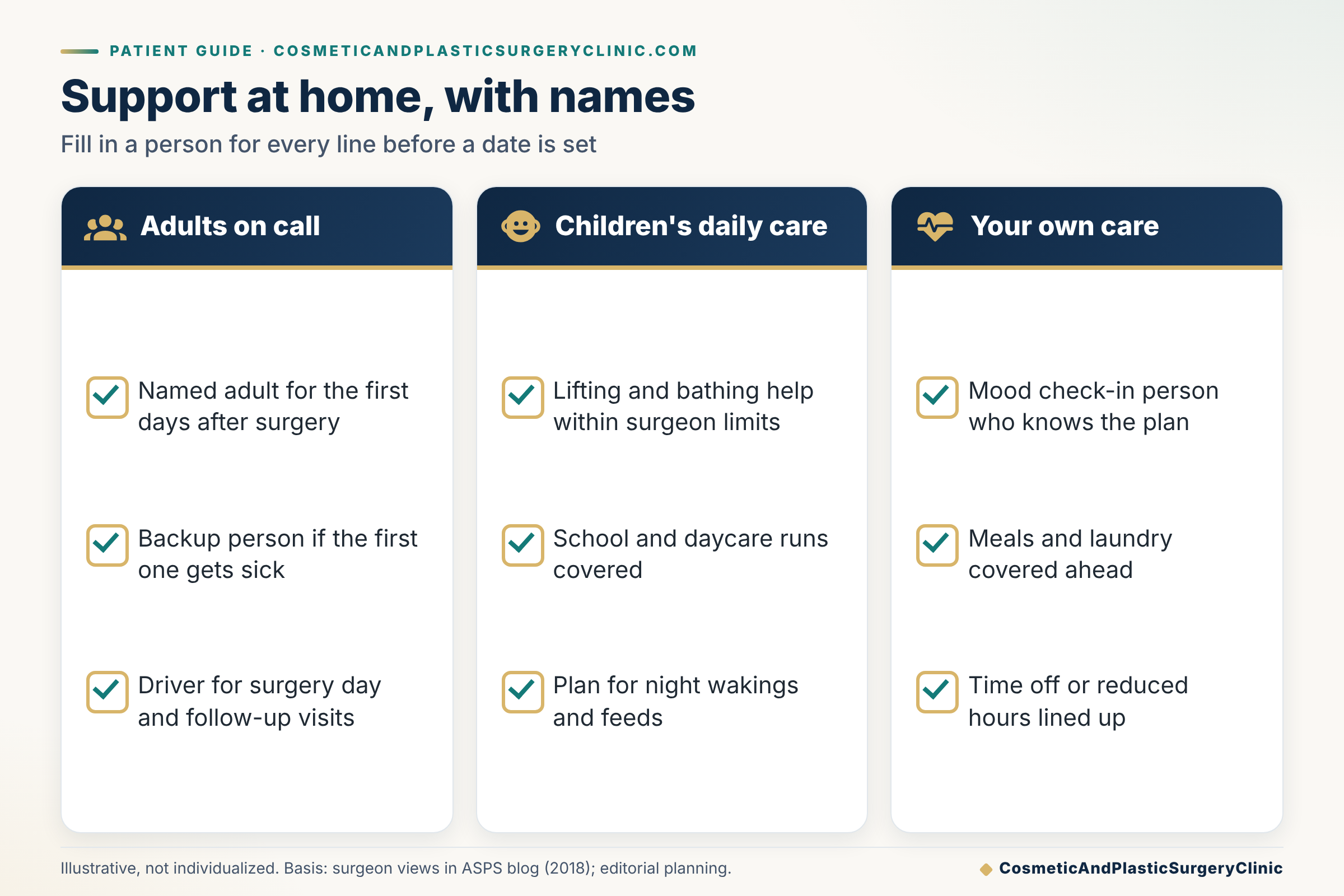
Settle names, not intentions. Who stays overnight, for how many nights, and who covers if that person gets sick? Who drives you home and to follow-up visits? Who handles school or daycare runs? Who notices if you seem unlike yourself? A written list with a name beside each line is a more reliable test of readiness than any weight or timing rule.
When the support plan says wait
Single parents, distant family and unpredictable work
Some households cannot assemble two weeks of reliable help right now, and that is a real finding. Options include waiting until a school year changes, shifting to a smaller or staged plan with a shorter first recovery, or paying for help. The comparison between one long recovery and several shorter ones is worked through in the staged mommy makeover article.
Do not plan around heroics. A mommy makeover plan that only works if nothing goes wrong, no one gets sick and no child wakes at night will fail on the first ordinary bad day.
A planner by role, not by wishful thinking
| Role | What it covers | Question to settle before a date is chosen |
|---|---|---|
| Adult on call | Overnight presence and help with movement, meals and medicines in the first days | Who, for how many nights, and who is the backup? |
| Child lifting and care | Lifting, bathing, car seats, nighttime wakings, while the surgeon’s limits apply | Is a second adult available at every hard hour? |
| Driver | Surgery day and follow-up visits; school and activity runs afterward | Who is available on a weekday morning? |
| Household manager | Meals, laundry, groceries, pets, pickups | What can be prepared or ordered ahead? |
| Mood check-in person | Someone who knows the plan and notices a change in you | Whom will you call on a hard day, and do they know it? |
Do your goals fit what a mommy makeover candidate can expect?
Goals the plan can reach, and goals that point somewhere else
Examples of specific, reachable goals
Goals that suit a combined plan are anatomical and concrete: tighter lower abdominal skin and a flatter profile after the muscles are repaired, breasts that sit higher or hold more volume than they do now, a waist contour improved by liposuction, clothing that fits the way it did before pregnancy. These are changes a surgeon can examine, mark and describe in terms of scars, trade-offs and limits.
ASPS frames the right motivation for a mommy makeover candidate simply: the surgery is a highly individualized choice made for yourself, not to meet someone else’s wishes or an ideal image. A useful test is whether you can state the goal in a sentence that mentions a body part and a measurable change, rather than a feeling you hope the surgery will deliver.
Goals that belong to another decision
Some goals need a different route first. Weight loss is not an outcome of a mommy makeover; Mayo Clinic notes, for the tummy tuck, that results tend to last when weight stays stable, and ASPS lists weight as a candidacy question, not a result. A hope that surgery will repair a strained relationship, end exhaustion or settle low mood will outrun anything the operation can deliver.
Pressure from social media, a partner or a discount timer is also a reason to pause. A real candidate decision survives a few weeks of waiting; if a plan only makes sense under a deadline, treat the deadline as the problem.
Body image, mood and the option to wait
What screening for body image is for
Plastic surgeons sometimes screen for body dysmorphic disorder, a condition marked by distressing preoccupation with perceived flaws. A 2024 meta-analysis in Healthcare pooled 65 studies and 17,107 patients in aesthetic and reconstructive plastic surgery and estimated prevalence at 18.6% (95% confidence interval 15.1% to 22.4%), with very high heterogeneity (I-squared 97.27%) and signs of small-study bias. Treat that figure as a broad range for plastic surgery patients, not a statement about new mothers.
The point of screening is care, not gatekeeping: surgery does not resolve this condition, and a surgeon who asks is protecting you from an operation that cannot meet the goal.
Why photos cannot settle candidacy
A before-and-after gallery shows other people’s tissue, timing, lighting and selection. It cannot show your skin quality, your muscle gap or your breast volume. Use galleries to form questions, not conclusions; the way to read a combined-procedure album is covered in the mommy makeover before and after guide.
Putting the factors together
Six situations and where each often leads
The first table below maps six hypothetical situations onto the usual pathways. It illustrates reasoning, not a ruling, and each row would change after an exam.
| Situation | Pathway | Benefit | Trade-off | Key question |
|---|---|---|---|---|
| Seven months postpartum, still nursing | Consult now; discuss abdomen first, breasts after weaning | Planning starts with a real exam | Breast portion waits; abdomen may still be changing | When will my breasts have settled? |
| Weaned two months, ten pounds above baseline | Wait or stage; agree on a weight checkpoint | Avoids planning from a moving baseline | Delay, and weight may not move | What range would you plan from? |
| Might have one more child in two or three years | Discuss waiting or fewer components | Avoids repeating work | Years of living with the current shape | Which components hold up best later? |
| Fourteen months postpartum, steady weight, family complete | Full evaluation of components and anesthesia length | Few timing objections | Still depends on exam and health review | How long would the combined plan run? |
| No adult help for the first two weeks | Build support or shift to a smaller plan | More workable logistics | Delay or cost of paid help | Who covers when the plan fails? |
| Uses nicotine daily | Plan a nicotine-free window with testing | Better healing conditions | Needs a quit plan; may delay | How long, and how will it be tested? |
The long view: what keeps a result and what prompts a revision
Being a mommy makeover candidate is also about the years after surgery. A plan that suits you in month twelve should still make sense when weight shifts, a child grows, and breast tissue ages. The second table lists the long-term factors and the review points worth putting on a calendar.
| Factor | Effect on the outcome | Maintenance or revision implication | Review point |
|---|---|---|---|
| Weight change | Moves skin, fat and breast volume | May blunt the result or prompt a revision discussion | Stable at each follow-up visit? |
| Another pregnancy | Stretches the abdominal wall and changes the breasts again | May undo part of the result | Before trying to conceive |
| Aging and gravity | Breast position and skin continue to change | Later touch-ups may be discussed | Scheduled surgeon check-ins |
| Breast implants | Size is fixed; surrounding tissue still changes | ASPS lists leak and capsular contracture as risks | Ask what follow-up the surgeon expects |
| Nicotine | Reduced blood supply to healing skin | Wound problems may need further care | Testing before surgery; none after |
| Hernia or muscle gap | Changes what the abdominal part does | A new bulge may need evaluation | Report new pain or bulging promptly |
Walking into the consultation as a prepared mommy makeover candidate
Questions that only an exam can answer
Bring questions that depend on your body. Which components does my tissue call for, and which are optional? Is my abdominal wall wide, or is there a hernia? How long would each combined plan run, and where would it be done? What would a staged version change? What happens if I need a revision, and what does the surgeon’s policy say about cost? The surgeon verification guide covers credentials and facility checks before you ever sit in the room.
When to wait, or to ask someone else
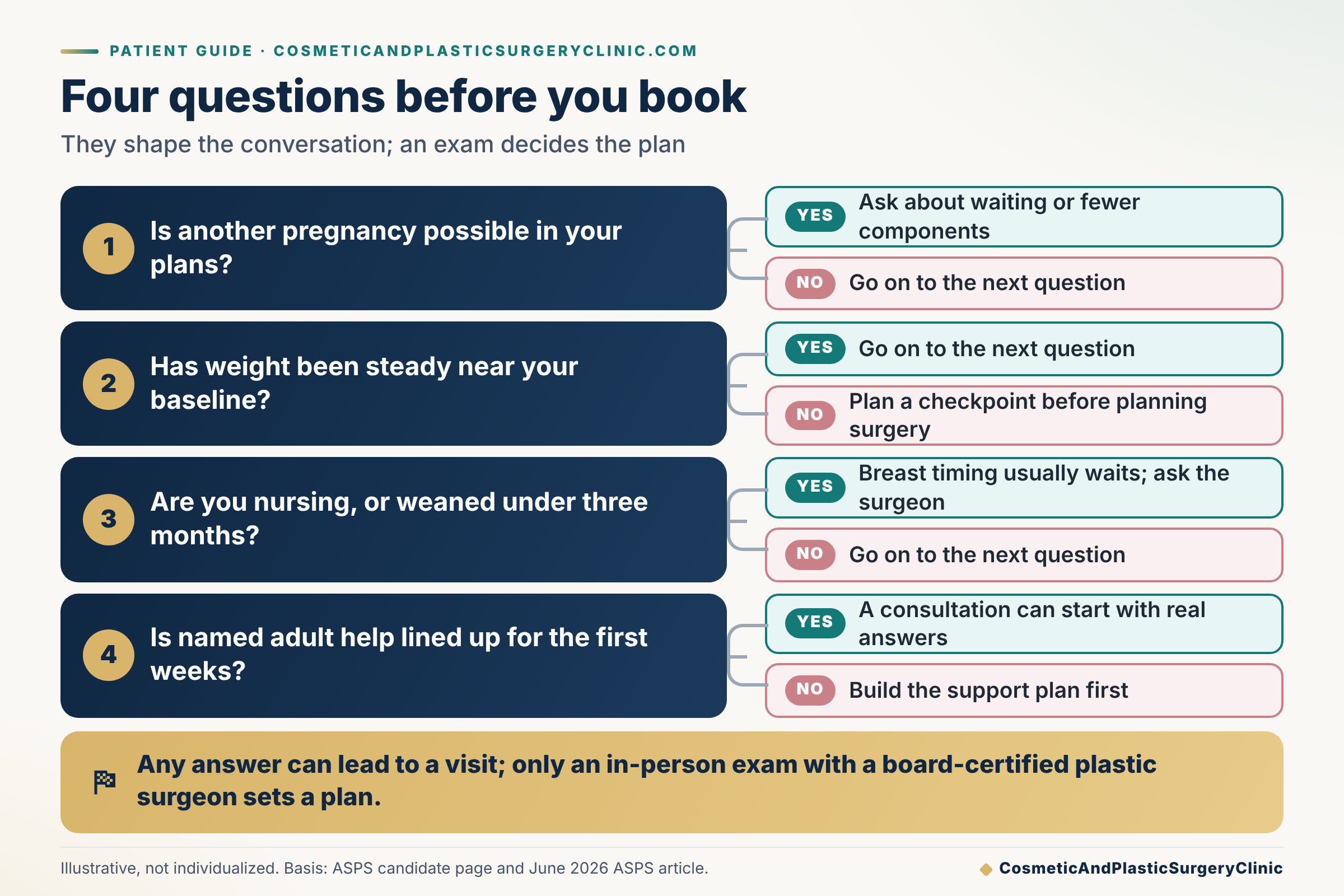
Waiting is the right answer for a mommy makeover candidate when weight is moving, nursing is ongoing, another pregnancy is possible, nicotine is in use, or no one is available to help. A second opinion is reasonable whenever two surgeons disagree on timing, because the evidence supports a range, not a point. Whether to operate at all remains an open question until the exam, and waiting is always an option.
Frequently asked questions
Can a mommy makeover candidate still be breastfeeding at the first visit?
Yes, a consultation does not require weaning, and many surgeons prefer to start the conversation early. What changes is timing: the quoted ASPS surgeons advise waiting longer if breastfeeding and at least about three months after weaning before breast surgery. Tell the surgeon how much you nurse and whether you plan to continue, so the plan can separate abdominal components from breast components and set a realistic order and date.
Does breastfeeding cause sagging, and does it change when a mommy makeover candidate stops?
One ASPS-reported study presented in 2013 followed 119 women who had breast augmentation, 57 who breastfed and 62 who did not, and found no significant difference in sagging; the press release attributes sagging to pregnancy itself. It is a small study from a press release, so it cannot settle the question for anyone, and it involved women with implants. Decide when to stop nursing for your family’s reasons and bring the timeline to your surgeon.
How much weight should a mommy makeover candidate lose before booking a consultation?
No universal figure appeared in any source this article opened. ASPS says “ideal body weight” without a number, and individual surgeons give their own rules, such as staying within about 25 pounds of a goal weight or returning to baseline BMI. You can book a visit before reaching a target. Ask the surgeon what range they would plan from, then ask whether that range is a requirement or a preference.
Can I have a cesarean scar and still be a mommy makeover candidate?
A cesarean is very common and does not by itself rule anyone out. It does change planning, because scar tissue can affect how skin and the abdominal wall move, and Mayo Clinic lists extensive scar tissue from past abdominal surgery among reasons a surgeon may advise against a tummy tuck. The surgeon will examine the scar and ask about any earlier complications. Placement and timing questions have their own page, linked in the body above.
Can a mommy makeover candidate do one part first and the rest later?
Often, yes. ASPS describes a mommy makeover as typically a single-stage procedure, but surgeons also stage plans when time under anesthesia, health, home support or weaning make one long operation hard. Staging adds a second recovery and usually a second set of facility and anesthesia costs. The right question is not which approach is better in general, but what each would change for your anatomy, your children’s schedules and your budget.
What should a mommy makeover candidate do if two surgeons give different timing advice?
Expect some disagreement: the ASPS-quoted surgeons themselves differ, from a six-month floor with nine to twelve months preferred to up to a year. Ask each to explain their reasoning for your tissue, weight and nursing status, and what they would check before agreeing to operate. If the reasons differ in substance, not just in number, a third opinion from another board-certified plastic surgeon is reasonable.
How should a mommy makeover candidate treat a deposit deadline or an expiring offer?
As a reason to slow down. A decision this large depends on timing, health and home support, none of which change because a calendar does. Ask for the refund and rescheduling terms in writing, ask what happens if the surgeon advises waiting after the exam, and compare the quote line by line against another written estimate. A practice that is comfortable with your taking time is treating the decision as the elective, high-stakes one it is.
Sources and further reading
- American Society of Plastic Surgeons — Mommy Makeover Candidates (accessed 2026-11-12) — four candidate criteria and the “for yourself” principle
- American Society of Plastic Surgeons — Mommy Makeover overview (accessed 2026-11-12) — component procedures and single-stage description
- American Society of Plastic Surgeons — Mommy Makeover Risks and Safety (accessed 2026-11-12) — risk list including inability to breastfeed
- American Society of Plastic Surgeons — Mommy Makeover Preparation (accessed 2026-11-12) — labs, medicine review, smoking, bleeding-related supplements
- American Society of Plastic Surgeons — Post-pregnancy plastic surgery: what can you do now, and what needs to wait, June 18, 2026 (accessed 2026-11-12) — surgeon-quoted timing after delivery and weaning
- American Society of Plastic Surgeons blog — Are you a good candidate for a mommy makeover? (Salemy, 2020; accessed 2026-11-12) — candidacy criteria from one surgeon
- American Society of Plastic Surgeons blog — Everything you need to know about a mommy makeover (Tehrani, 2018; accessed 2026-11-12) — one surgeon’s views on weight, childcare and home help
- American Society of Plastic Surgeons — press release on breastfeeding and sagging in augmentation patients (2013; accessed 2026-11-12) — small study, press-release level
- American Society of Anesthesiologists — Statement on Resuming Breastfeeding After Anesthesia (amended 2024; accessed 2026-11-12) — resuming breastfeeding, “sleep and keep”
- Aesthetic Surgery Journal — Breastfeeding Outcome and Complications in Females With Breast Implants, systematic review and meta-analysis (2023; accessed 2026-11-12) — breastfeeding after implants, abstract-level reading
- American Society of Plastic Surgeons — Managing the Risks of Smoking in Plastic Surgery Patients (2024; accessed 2026-11-12) — nicotine timing and testing
- American Society of Plastic Surgeons — press release on abdominoplasty complication study, Winocour et al. (2015; accessed 2026-11-12) — complication rates by combination, summary-level
- American Society of Plastic Surgeons — 2025 Plastic Surgery Statistics Report (accessed 2026-11-12) — procedure counts; no mommy makeover category
- Mayo Clinic — Tummy tuck (accessed 2026-11-12) — weight stability, reasons surgeons may advise against, smoking
- Mayo Clinic — Postpartum depression (accessed 2026-11-12) — baby blues, timing of postpartum depression, emergency help
- Healthcare — Body Dysmorphic Disorder in Aesthetic and Reconstructive Plastic Surgery, systematic review and meta-analysis (2024; accessed 2026-11-12) — pooled prevalence and limitations
- Centers for Disease Control and Prevention — About blood clots (accessed 2026-11-12) — DVT and pulmonary embolism signs
- American Gastroenterological Association — Most patients can continue GLP-1 anti-obesity drugs before surgery (accessed 2026-11-12) — multisociety guidance, year not shown
- Baylor College of Medicine — Abdominal bulging: diastasis recti or hernia? (2022; accessed 2026-11-12) — gap versus hernia
- Preventive Medicine — Physical activity and diet interventions on body weight in overweight or obese postpartum women, meta-analysis (2013; accessed 2026-11-12) — four small trials
- MedlinePlus — Anemia (accessed 2026-11-12) — causes, symptoms, when to see a provider