A cesarean is major abdominal surgery, and it leaves a mark in more layers than the one you can see in the mirror. Anyone researching a mommy makeover after c section soon runs into a practical question: does the old incision help the new plan, complicate it, or simply get absorbed into it? The answer depends on where the scar sits, what lies under it, and how many times the abdomen has been opened.
This article follows that question from the inside out. It starts with what a cesarean actually cuts, moves to where a new tummy tuck scar can go, separates diastasis from hernia, and then covers timing, risk and the consultation. The combined operation itself, including its usual components, is explained in the mommy makeover overview; here the focus is only on what a previous cesarean adds to a mommy makeover after c section.
What a cesarean leaves behind before a mommy makeover after c section is planned
Surgeons planning a mommy makeover after c section start from the abdominal wall as it is now, not as it was before pregnancy. Pregnancy stretched it, the cesarean opened it, and healing rebuilt it. Each of those events leaves something a plastic surgeon can feel or measure.
The layers a cesarean passes through
From skin to uterus, in order
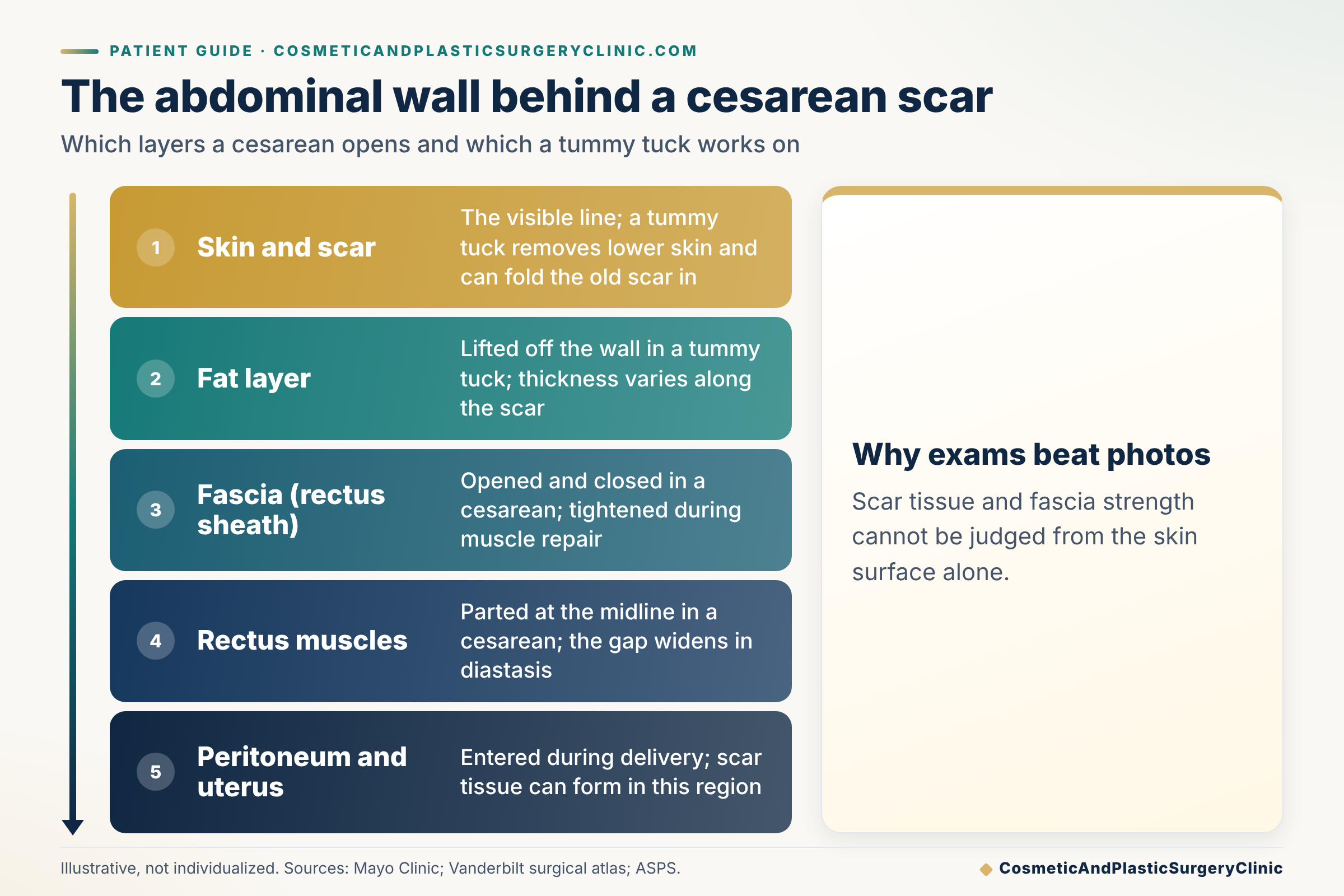
Mayo Clinic describes the usual abdominal cut as horizontal and low, near the pubic hairline, with a vertical cut from just below the navel to just above the pubic bone being less common. The cut then continues through the abdominal wall and into the uterus, usually with a low transverse incision across the lower uterus. A surgical atlas published by Vanderbilt University Medical Center describes the common low transverse approach: skin and fat down to the rectus sheath, a cut through the fascia, and then the two rectus muscles separated at the midline rather than cut across.
That last detail matters for a reader who assumes the cesarean “cut the abdominal muscles.” In the standard technique the muscles are parted and pulled aside, and the sheath that covers them is what gets opened and later closed. The fascia, the tough layer that holds the abdomen together, is where the lasting repair happens.
What the operation leaves behind
The visible scar is the skin layer. Beneath it, the fascia has its own healing line, the fat layer may be thicker or thinner along the scar, and small sensory nerves may have been stretched or cut. A tummy tuck surgeon lifts the lower abdominal skin and fat off the fascia, so these hidden layers are the ones that matter in the operating room.
None of this is unusual or a defect. It is simply the starting condition, and it differs between people. Two women with identical-looking scars can have different amounts of scar tissue beneath them, which is one reason a surgeon wants a physical examination rather than a photo.
How common a prior cesarean is, and why surgeons still ask about it
The national picture
Cesarean birth is common enough that surgeons see it in most postpartum patients. The CDC reported a total U.S. cesarean rate of 32.4% of births in 2024, with a primary cesarean rate of 22.9% among women who had not had one before. In the same final 2024 data, 15.5% of women with a previous cesarean delivered vaginally. Those are national birth statistics, not surgical-outcome data, and they say nothing about any one person’s abdomen.
The practical meaning is simple: a prior cesarean is the ordinary case when planning a mommy makeover after c section, not a special one. What changes the plan is the detail behind it.
The details that change the plan
Three details tend to matter more than the fact of a cesarean. The first is how many there have been, because Mayo Clinic notes that each additional cesarean increases the chance of scar tissue. The second is the incision direction: low horizontal, or vertical. The third is whether other abdominal operations, such as appendix surgery, hernia repair or a laparoscopy, have left their own scars.
Mayo Clinic’s tummy tuck page lists past abdominal surgery that caused a lot of scar tissue as a reason a surgeon may advise caution, and says prior surgery may limit results. That is a reason to describe every abdominal operation you have had at the first visit of a mommy makeover after c section evaluation, even the ones that seem minor.
Scar planning: where the new incision goes in a mommy makeover after c section
The scar is the part of a mommy makeover after c section that people picture first, and the part where honest expectations matter most. A tummy tuck trades loose skin for a long, lasting scar. The planning question for a mommy makeover after c section is whether the cesarean scar becomes part of that trade or sits on its own.
Folding the old scar into the new one
What surgeons usually do with a low horizontal scar
Mayo Clinic says that when a woman has a previous C-section scar, the surgeon can make the existing scar part of the new tummy tuck scar. The new incision is typically placed along the swimsuit line, and Mayo notes that scars from the operation can take up to a year to fade, with visibility varying from person to person. ASPS describes the tummy tuck scar as lasting, which is the right word: it fades, but it does not disappear.
For a typical low cesarean scar, the new incision often runs through or just above it. The old line is removed with the skin that is excised or becomes part of the closure. That is a general pattern, not a promise: where the old scar sits relative to the planned hip-to-hip line is something only an examination, usually standing, can settle.
When the old scar is not low and horizontal
Some cesarean scars run vertically from below the navel toward the pubic bone, and some people also have scars from other abdominal surgery. A vertical scar cannot simply be absorbed into a horizontal tummy tuck line, so the plan may leave it in place, excise part of it, or change the pattern. The sources opened for this article do not give outcome data for those variations, so treat it as a question rather than an expectation.
Good questions to bring are short: Where will my new scar sit compared with the old one? Will any old scar remain visible above the new line? How will the navel be handled if there is scar tissue near it? And what does the surgeon do differently if my scar is vertical? The wording of the answers tells you more than the answers themselves. A clear, anatomical explanation is a better sign than a general reassurance.
More detail on the standard operation and its scar is in the tummy tuck guide, and the tummy tuck photo-reading article explains how to judge scar height and position in consult albums.
Numbness, tethering and the shelf above the scar
Why sensation near the scar deserves a baseline
Numbness is common after a low transverse abdominal incision. A 1997 Annals of Surgery study of 243 patients with a Pfannenstiel incision, the technique behind most cesarean scars, found numbness in 25.1% and nerve entrapment in 3.7%. That series was not limited to cesarean patients and is nearly three decades old, so it describes the incision, not today’s average outcome.
The relevance is that a tummy tuck also changes sensation. Mayo Clinic lists changes in skin sensation among the risks and says they usually improve within months. If the lower abdomen is already numb or tender along the cesarean scar, say so before surgery, so that afterward you and your surgeon can tell old changes from new ones.
The overhang people call a shelf
Many women describe a fold or bulge just above the cesarean scar, where skin and fat hang over a scar that seems to be pulled inward. “Shelf” is a patient and social-media word rather than a diagnosis, and the sources opened here do not quantify it. What a surgeon assesses is how tightly the scar is attached to the layers beneath, how much loose skin lies above it, and whether the fullness is skin, fat or muscle separation.
Each of those has a different fix. Loose skin responds to excision, fat may respond to liposuction, and muscle separation is addressed by tightening the abdominal wall. Skin removal alone will not address a tethered scar, so in a mommy makeover after c section the examination, not the description, decides which applies. The comparison of liposuction and tummy tuck elsewhere on this site maps those tissue problems to operations.
Diastasis and hernia: the muscle questions behind a mommy makeover after c section
Two abdominal wall problems often get lumped together after a cesarean, because both show up as a bulge or a soft midline. They are different conditions with different treatments, and telling them apart is part of planning a mommy makeover after c section.
What muscle repair is meant to address
Diastasis begins with pregnancy, not the incision
Diastasis recti is a widening of the gap between the two rectus muscles as the connective tissue between them stretches. A prospective French study published in 2020 followed women who gave birth at one university hospital: 210 of 253 (83%) had diastasis immediately after delivery, and 51 women had persistent diastasis at the three-to-six-month follow-up. Only 139 of the 253 (about 55%) completed that follow-up, which limits how far the numbers can be pushed.
The same study found that cesarean birth was associated with persistent diastasis at a borderline significance level (p = 0.05), along with having had more than one birth. One small borderline finding from a single center does not show that a cesarean causes the gap. It does explain why the two are linked in conversation. The wider diastasis recti and tummy tuck article covers how the condition is assessed.
What the tightening step can and cannot do
ASPS says a tummy tuck typically restores weakened or separated muscles, and that is the component most plans for a mommy makeover after c section include. Tightening the sheath narrows the midline and flattens the profile from the inside. It does not remove stretch marks outside the excised skin, according to ASPS, and it does not make the cesarean scar disappear.
Note also that it is a repair of connective tissue, not a core-strength program. Strong abdominal muscles and a narrow midline are separate things, and a surgeon should explain which one the operation targets.
Hernia screening and where imaging fits
Why hernia is checked before any cosmetic plan is finalized
An incisional hernia is a defect in the fascia at a previous incision, through which tissue can bulge. In the 243-patient Pfannenstiel series described above, incisional hernia occurred in 2.1%. A 2023 scoping review of ultrasound measurement in the journal Insights into Imaging notes that severe untreated diastasis may lead to umbilical or epigastric hernias, and that hernias may need surgery.
A hernia changes the operation, not necessarily the goal. A surgeon who finds one may plan to repair it, coordinate with a general surgeon, or advise treating it before a cosmetic procedure. That is a reason to mention any bulge that grows when you cough or strain, even if it does not hurt.
When imaging comes up, and what the evidence says about measuring
Ultrasound is the tool studied most for measuring the gap between the muscles. The same 2023 review found no agreement on cutoffs: researchers have used more than 22 mm at 3 cm above the navel, two or more finger widths, and more than 16 mm at 2 cm below the navel, among others. It also says its proposed standard sites are an expert recommendation that has not been validated.
The review does not explain how to tell diastasis from hernia, and it does not compare ultrasound with CT or MRI. For a reader, the takeaway is modest. A surgeon may examine you lying and with the head lifted, may or may not order imaging, and should be able to say why. “The scan says you have a 3-centimeter diastasis” is less useful than an explanation of what the number would change.
Exercise first, or surgery?
What the rehabilitation research says
A 2024 scoping review in the International Urogynecology Journal examined 28 studies of postpartum diastasis rehabilitation, with sample sizes from 3 to 129. It concluded that exercise therapy might be effective, but also that there is no consensus on the best routine and that standardized, high-quality research is still needed. The authors note that early enrollment can be confounded by spontaneous improvement, which occurs mainly in the first eight weeks.
What exercise cannot do
Rehabilitation may improve how the abdominal wall functions and how the gap measures. It does not remove loose skin, the cesarean scar, or excess fat. For some people, a physical therapy program is a reasonable first step and for others the skin is the main concern. It can help to ask your obstetric clinician whether a postpartum physical therapy assessment makes sense before surgery is discussed.
Timing a mommy makeover after c section: four clocks that run at once
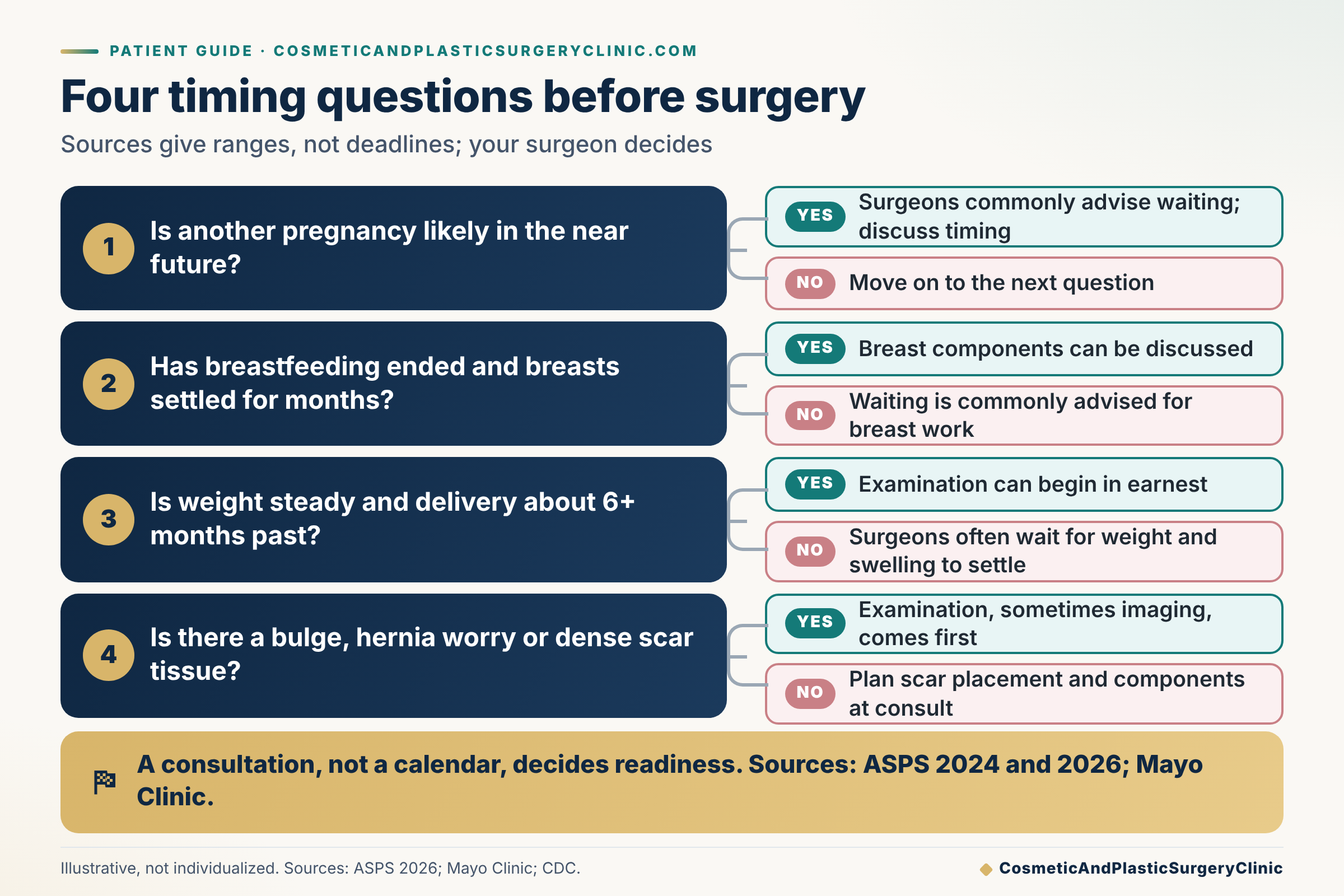
“How long after the cesarean?” is the most common question about a mommy makeover after c section, and it has no single answer because four separate clocks are running. They are the incision’s own healing, the clot-risk window after delivery, the time the body needs to settle, and any breastfeeding or pregnancy plans. Surgeons weigh all four.
Healing and clot windows after delivery
Recovering from the cesarean is not the same as being ready for surgery
Mayo Clinic’s cesarean guidance describes a short early period: avoid lifting anything heavier than 10 to 15 pounds for the first couple of weeks, allow one to two weeks before driving comfortably, and expect a postpartum checkup within 12 weeks. Those are the milestones for recovering from childbirth. They are not clearance for an elective operation, and none of the sources opened here treat them that way.
ASPS published a June 2026 article in which surgeons say the post-pregnancy body keeps changing for up to a full year. One of them recommends waiting at least six months for most procedures, with nine to twelve months as the ideal range, and another says swelling and a weight above baseline limit how much tightening and contouring is possible. The same article says a tummy tuck during a cesarean is not recommended, because it is, in one surgeon’s words, not a good idea medically or aesthetically.
Why the three months after birth matter for clot risk
The CDC states that women are especially at risk for blood clots during pregnancy, childbirth and the 3-month period after delivery, and lists delivery by C-section among the factors. An elective operation that lasts several hours adds its own clot risk, which is one reason a surgeon would rather the two periods not overlap. How to weigh clot risk for a long combined operation such as a mommy makeover after c section is covered in the mommy makeover risks article and the broader plastic surgery risk guide.
Breastfeeding, weight and the next pregnancy
Breast components follow weaning, not the cesarean
If the plan includes a breast lift, implants or reduction, the cesarean date is not the controlling date. ASPS says breast surgery should wait until the breasts stop changing, which can take four to six months after breastfeeding ends. One surgeon quoted there prefers at least three months after weaning. A 2024 ASPS article gives a lower figure from another surgeon, a minimum of six weeks without breastfeeding and ideally about three months, and says there is no single rule.
That spread is itself useful. It means a surgeon who gives you a firm number without asking about weaning is giving you a default, not a measurement. Timing for the whole postpartum period is the subject of the article on mommy makeover after pregnancy, so this page keeps to what the cesarean adds.
Weight, and another pregnancy that may involve another cesarean
ASPS says surgery should wait until weight has stabilized near a goal weight or baseline, and Mayo Clinic says a surgeon may caution against a tummy tuck for someone who is thinking about becoming pregnant. ASPS adds that a future pregnancy can undo the results and that surgeons strongly advise waiting until the family is complete. Not every surgeon treats this as a strict requirement, as the 2024 article notes.
For readers who have had a cesarean, there is an added thought. Mayo Clinic says a prior cesarean makes another one more likely, though vaginal birth after cesarean is often possible, and that each additional cesarean raises the chance of scar tissue. A person who expects another baby may be better served by waiting than by repeating an abdominal operation, and that holds for a mommy makeover after c section as much as for any other plan. That decision belongs in the candidate evaluation, not in a blog post.
What prior surgery adds to the risk conversation
Every operation carries the general risks that ASPS lists for a tummy tuck: anesthesia risks, bleeding, infection, fluid collection, poor wound healing, fat necrosis, numbness, clots, and the possibility of revision. A prior cesarean adds a few specific questions on top, and some are better supported than others.
Seroma, wound healing and scar tissue
What the seroma studies can and cannot say
A seroma is a pocket of fluid that collects under the skin after a tummy tuck. A 2024 Aesthetic Surgery Journal study by Skorochod and colleagues, covering 746 abdominoplasty patients, reported that a history of cesarean delivery was associated with a higher risk of seroma. This article read the study only through a published reply, which accepts the link and says it should enter preoperative assessment, but argues the original results could be distorted: it did not clearly address twin pregnancies, the interval between the cesarean and the tummy tuck, anemia, or how blood vessels were sealed.
A 2025 narrative review in a Russian plastic surgery journal reaches a similar place: some studies report more seroma after cesarean, but earlier work did not account for the number of deliveries, fetuses or timing, and the evidence is conflicting and confounded. The honest summary is that the association is plausible and reported, the size of it for any one person is unknown, and the studies are not strong enough to predict an outcome.
What surgeons can do about fluid
A 2024 meta-analysis in Aesthetic Surgery Journal Open Forum reviewed 20 studies of ways to reduce seroma and found the most support for progressive-tension or quilting sutures, which anchor the skin flap to the wall underneath. That was an abstract-level reading, and the authors say the evidence varies in quality and that no single method is definitive. For a reader, the useful question is “what is your approach to preventing fluid, and how do you handle it if it forms?”, not “do you use drains?”
Seroma is common enough that surgeons discuss it for every abdominoplasty, including one inside a mommy makeover after c section; the tummy tuck risks article covers it, along with wound-healing problems, in more depth.
Expected effects, complications and emergencies after a combined operation
Separating the three categories
After any abdominal operation, some things are expected: swelling, bruising, tightness, and numb or tender skin along both the old and new scars. Other findings are complications that need a surgeon’s attention soon, and a few are emergencies. Combined operations add surfaces and hours, not new categories, so the sorting below applies to a tummy tuck alone and to a mommy makeover after c section alike.
How combining and staging change the picture
ASPS says a mommy makeover is typically performed as a single-stage procedure, and that technique choices depend on the amount of restoration, incision placement and implant type. Whether a cesarean history pushes the plan toward one combined operation or two smaller ones is a trade-off between anesthesia time and a second recovery, which the staged mommy makeover article takes on directly.
The table below turns the factors that tend to outlast the operation into review points. It is a planning aid, not a forecast.
| Factor | Effect on outcome | Maintenance or revision implication | Warning sign or review point |
|---|---|---|---|
| Scar position after the tuck | New and old scars merge or sit near each other; visibility varies | Scars fade over months to a year; revision is a later conversation | Scar widening or thickening that continues past the expected fading period |
| Scar tissue under the old incision | May limit how evenly the lower abdomen drapes | Residual tethering or a fold can need a later touch-up | A dimple, fold or tight band that persists after swelling settles |
| Muscle repair | Narrows the midline and supports the wall | Weight gain or a later pregnancy can loosen the result | A new bulge at the midline or navel that grows with coughing or lifting |
| Breast shape and volume | Changes with weight, aging and any future breastfeeding | Lifts and implants are not one-time fixes for every body | Change in shape or size, or implant-related symptoms, at routine review |
| Future pregnancy | Can stretch the repair and change scars | May reopen the question of another operation | Plans change; tell your surgeon before conceiving, and tell your obstetric clinician about the surgery |

Choosing a path for a mommy makeover after c section without a universal winner
The sections above produce information about a mommy makeover after c section, not a verdict. This one organizes it into the comparison a patient and surgeon actually make: do the whole plan, do part of it, rehabilitate first, or wait. Each path has a cost in time, scars or living with the concern longer.
Comparing realistic paths side by side
Waiting, rehabilitating, partial and full operations
The table sorts common situations into pathways a surgeon might discuss. It is deliberately not a candidacy checklist; the same situation can lead to different advice depending on examination, health history and goals. The components themselves, such as which breast and body procedures are usually paired, are explained in the mommy makeover procedures article.
| Situation | Pathway discussed | What it can offer | Trade-off | Key question |
|---|---|---|---|---|
| One low horizontal scar, loose lower skin, childbearing finished | Tummy tuck as one component of the plan | Skin removal, wall tightening, old scar folded into the new line | Long, lasting scar; a recovery that lasts weeks | Where will the new scar sit compared with the old one? |
| Midline bulge, unsure whether it is diastasis or hernia | Examination first, imaging if the surgeon advises it, then planning | Clarifies what the bulge is before surgery is scheduled | May add a repair step or another specialist | Could any of this be a hernia, and how would you tell? |
| Vertical scar, several cesareans or other abdominal surgery | Detailed examination; a modified or staged plan may be discussed | A plan built around the actual scar pattern | Mayo Clinic says prior surgery may limit results | How does my scar pattern change what you can achieve? |
| Recently weaned or still breastfeeding, or another baby planned | Waiting, physical therapy, or a consultation only | Avoids operating on tissue that is still changing | Living longer with the concern | What is your timing rule, and what is it based on? |
| Main concern is fullness above the scar, little extra skin | Smaller or targeted approach, or waiting | May involve less surgery | May leave loose skin or muscle separation unaddressed | Is this fullness fat, skin or muscle? |
Why no path wins for everyone
Consider a hypothetical reader with one low cesarean scar from 14 months ago, who stopped breastfeeding half a year ago, is at a stable weight and does not plan another pregnancy. Her questions are mostly about technique and scar placement, and the full plan may be a reasonable subject for consultation.
Now consider a different hypothetical reader with three cesareans, one of them through a vertical incision, a firm bulge near the navel, and a possible pregnancy in two years. Her most useful steps may be an examination for hernia, a conversation with an obstetric clinician, and a decision to wait, because each cesarean adds scar tissue risk and another pregnancy could reverse the work. Both readers are asking about a mommy makeover after c section, and neither answer is the right one for the other.
Six planning mistakes to avoid
Mistakes about the scar and the abdominal wall
- Treating the cesarean scar as the only scar question. Other abdominal scars from laparoscopy, hernia repair or appendix surgery change tissue the same way, and they belong in the history.
- Assuming a bulge is only loose skin. Diastasis and hernia look alike from outside, and one changes the operation. Ask for the examination, not a guess from a photo.
- Booking from the calendar alone. “Six months since delivery” is a surgeon’s rule of thumb, not a readiness test. Weight, weaning and swelling matter as much as the date.
Mistakes about history, timing and cost
- Leaving out the details of the birth. Number of cesareans, incision direction, infections and complications are all relevant to a surgeon, and they are easier to recall with the discharge summary in hand.
- Scheduling surgery while planning another pregnancy. ASPS and Mayo Clinic both say a surgeon may advise waiting, and a future pregnancy can undo the result.
- Choosing combined versus staged on price alone. Two facility fees look expensive next to one, but a longer operation changes the risk and the recovery. The mommy makeover cost article shows how to compare quotes like for like.
Taking the history to a consultation
What to bring and what to say
A first visit goes further when the surgeon can see the full history. The table below lists what to collect and why each item is relevant. Nothing on it is a test you must pass; it is simply what a careful surgeon would ask about, and having it ready shortens the conversation.
| Category | What to bring or say | Why it matters |
|---|---|---|
| Delivery history | Dates, number of cesareans, incision direction if known, any infection or wound problem | Scar tissue and wall strength vary with each operation |
| Other surgery | Laparoscopy, hernia repair, appendix, gynecologic or bariatric operations | Scars and adhesions beyond the cesarean affect planning |
| Postpartum health | Weight history, anemia, medicines, any clot history, mood and sleep | Healing, anesthesia planning and recovery depend on them |
| Feeding and pregnancy plans | Weaning date, plans for more children, contraception | Breast tissue and the repair both change with a new pregnancy |
| Current symptoms | Bulge that grows with straining, pain, numbness, back or pelvic complaints | Separates a cosmetic goal from a medical problem that comes first |
| Photos and expectations | Pre-pregnancy photos, scar photos, and a short list of what bothers you most | Keeps the plan tied to your priorities, not a gallery |
Questions to ask and how to judge the answers
For a mommy makeover after c section, ask who will perform the operation, which facility and anesthesia setup are planned, how long the combined operation is expected to take, and how the surgeon approaches fluid prevention and clot prevention. A good answer names specifics and acknowledges that an examination might change the plan. A weaker answer promises that the old scar “will not matter” or quotes a result before examining you.
The wider checklist is in the consultation questions guide, and the verification steps for credentials and facilities are in how to choose a plastic surgeon. If a second opinion would help, getting one is routine. After the operation, the week-by-week realities with children at home are covered in the mommy makeover recovery article.
Frequently asked questions
Can a mommy makeover after c section be done during a repeat cesarean?
ASPS published an article in June 2026 in which a surgeon says a tummy tuck during a cesarean is not recommended, medically or aesthetically. The article gives no further explanation, and no other source opened here addresses the question. Combining a delivery with elective surgery is not something to settle from an article. This is general information; an obstetric clinician and a plastic surgeon should both be involved in any plan that involves timing around a birth.
Will a mommy makeover after c section remove my cesarean scar?
Probably not entirely, and no source opened for this article promises it. Mayo Clinic says the surgeon can make an existing C-section scar part of the new tummy tuck scar, and describes the new scar as lasting, typically placed along the swimsuit line, with fading that can take up to a year. A low old scar may be removed with excised skin or blended into the new line, and a vertical or irregular scar may behave differently. Ask the surgeon to show on your own abdomen where the new line would run in your mommy makeover after c section.
How many cesareans are too many for a mommy makeover after c section?
None of the sources opened for this article gives a cutoff, and a number would be misleading. Mayo Clinic notes that each additional cesarean raises the chance of scar tissue, and that its tummy tuck guidance lists past abdominal surgery causing a lot of scar tissue as a reason for caution. What matters to a surgeon is how the tissue feels and moves on examination, whether there are hernias, and what else has been operated on. Three cesareans with soft, mobile tissue and one with dense scarring can lead to different plans for a mommy makeover after c section.
Is the fullness above my C-section scar something a mommy makeover after c section can treat?
That depends on the tissue. The fullness can be fat, skin, muscle or a mix, and sometimes a scar attached to deeper layers makes the overlying skin fold. Fat may respond to liposuction, loose skin to excision, and separated muscle to tightening, which is why an in-person exam matters more than a description. The comparison of liposuction and tummy tuck maps these tissue problems to operations. A surgeon should tell you which component they think is responsible and what a mommy makeover after c section would and would not change about it.
Do I need an ultrasound or scan before a mommy makeover after c section?
Not necessarily. Surgeons begin with a physical examination, and imaging is a judgment call, for example when a bulge may be a hernia or the findings are unclear. A 2023 scoping review of ultrasound in physiotherapy found no agreement on how wide a muscle gap must be to count as diastasis, so a measurement alone is not a verdict. If imaging is suggested, a reasonable question is what result would change the plan. Cost and who performs the scan are fair questions as well.
Should I tell my obstetrician about a mommy makeover after c section?
If you are planning another pregnancy, yes: mention any previous abdominal surgery, including a tummy tuck, to the clinician who will manage it. Mayo Clinic says a surgeon may caution against a tummy tuck for someone who might become pregnant, and ASPS says a future pregnancy can undo the results. That includes planning around a repeat cesarean, since Mayo notes a prior cesarean makes another more likely, although vaginal birth after cesarean is often possible. The two specialties can answer different parts of the same question.
Does a prior cesarean make recovery from a mommy makeover after c section harder?
The sources opened here do not show that it does. They do show that a prior cesarean was linked to more seroma in one 2024 abdominoplasty study, and that scar tissue and nerve changes can add questions. Recovery is mostly driven by which components are combined, how long the operation takes and the help you have at home. Mayo Clinic describes about six weeks without heavy lifting after a tummy tuck, but your own surgeon’s written instructions govern.
Sources and further reading
- American Society of Plastic Surgeons — Tummy tuck (abdominoplasty) (accessed 2026-11-12) — muscle repair; pregnancy as a cause; advice to postpone with future pregnancies; stretch marks
- American Society of Plastic Surgeons — Tummy tuck safety (accessed 2026-11-12) — listed risks
- American Society of Plastic Surgeons — Mommy makeover (accessed 2026-11-12) — components; typically single-stage
- American Society of Plastic Surgeons — Post-pregnancy plastic surgery: what can you do now, and what needs to wait, June 2026 (accessed 2026-11-12) — timing ranges; weaning; weight; cesarean
- American Society of Plastic Surgeons — Mommy makeovers: what women should know about postpartum surgical procedures, May 2024 (accessed 2026-11-12) — no single timing rule; components; help at home
- Mayo Clinic — Tummy tuck (accessed 2026-11-12) — existing C-section scar; prior scar tissue; risks; recovery; pregnancy plans
- Mayo Clinic — C-section (accessed 2026-11-12) — incision types; risks; repeat cesarean; scar tissue; early restrictions
- Mayo Clinic — C-section recovery (accessed 2026-11-12) — recovery timeline; when to call
- Centers for Disease Control and Prevention — Blood clots and pregnancy (accessed 2026-11-12) — risk through three months after delivery
- Centers for Disease Control and Prevention, NCHS — Births in the United States, 2024 (accessed 2026-11-12) — primary cesarean rate
- Centers for Disease Control and Prevention, NCHS — FastStats: delivery (accessed 2026-11-12) — total cesarean rate, 2024
- Centers for Disease Control and Prevention, NCHS — Births: final data for 2024 (accessed 2026-11-12) — cesarean and vaginal birth after cesarean rates
- European Journal of Obstetrics, Gynecology, and Reproductive Biology — Diastasis of the rectus abdominis muscles in postpartum, 2020 (accessed 2026-11-12) — 253-woman prospective study
- Tang, Chen and Liu — The impact of prior cesarean section on seroma formation in abdominoplasty, Aesthetic Surgery Journal, 2025 (accessed 2026-11-12) — reply summarizing Skorochod 2024 and its limits
- Sidorenkov et al. — Options for preventing seromas after abdominoplasty, Plastic Surgery and Aesthetic Medicine, 2025 (accessed 2026-11-12) — narrative review; conflicting cesarean evidence
- Aesthetic Surgery Journal Open Forum — Decreasing seroma incidence following abdominoplasty: a systematic review and meta-analysis, 2024 (accessed 2026-11-12) — abstract-level reading; quilting sutures
- Luijendijk et al. — The low transverse Pfannenstiel incision and the prevalence of incisional hernia and nerve entrapment, Annals of Surgery, 1997 (accessed 2026-11-12) — 243-patient series; history of the incision
- Vanderbilt University Medical Center — Global surgical atlas: Pfannenstiel incision (accessed 2026-11-12) — layers; rectus muscles separated at the midline
- Opala-Berdzik et al. — Technical aspects of inter-recti distance measurement with ultrasonographic imaging, Insights into Imaging, 2023 (accessed 2026-11-12) — measurement cutoffs; hernia link
- Skoura et al. — Diastasis recti abdominis rehabilitation in the postpartum period: a scoping review, International Urogynecology Journal, 2024 (accessed 2026-11-12) — exercise therapy evidence and limits