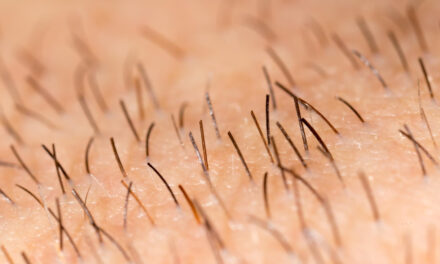
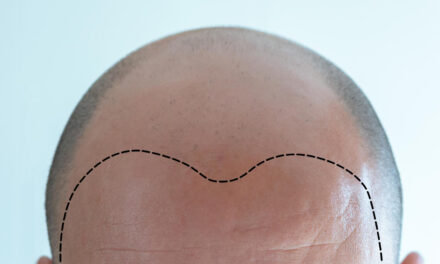
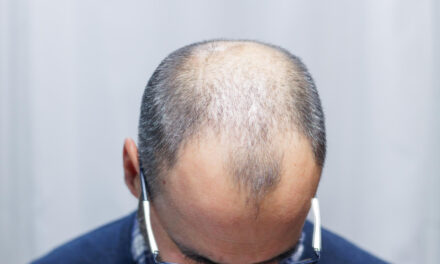
A hair transplant moves hair you already have from one part of the scalp to another. It does not create new hair, and it does not switch off the process that thinned the hair in the first place. Those two facts shape nearly every decision that follows: how many grafts exist, where they can safely come from, how a hairline is drawn, and why a surgeon may talk about medicine or waiting before talking about a date.
This page is the hub of the hair restoration cluster. It covers what a hair transplant is, the anatomy behind it, why diagnosis comes first, what the operation can and cannot change, the two main harvesting methods, planning for the hair you have not lost yet, medical therapy and other options (as education only), the recovery arc, published risk figures, cost in outline, and how to verify who is actually doing the work. Separate guides go deeper on each of those.
The demand is real. The International Society of Hair Restoration Surgery (ISHRS) reported in its 2025 Practice Census, which describes patients treated in 2024, that 95 percent of first-time surgical patients began between ages 20 and 35. Early starters face the longest planning horizon, which is exactly why a hair transplant is a long-term plan and not a one-day fix.
What a hair transplant moves, and why the hair keeps its original behavior
The principle is simple to state and easy to misread. A surgeon takes hair from an area that tends to keep growing for life and places it where hair has been lost. The new location does not change the hair’s habits, which is both the reason the operation works and the reason it has limits.
Relocation, not creation: donor dominance and a finite supply
Donor dominance: the rule behind the operation
Hair from the back and sides of the scalp resists the hormonal process behind pattern baldness. A StatPearls chapter on hair transplantation, updated in August 2025, puts it this way: because occipital hairs resist androgens, transplanted hairs keep their donor characteristics, including caliber. The ISHRS says grafts moved from this zone retain their resistance to male pattern hair loss genes and keep producing hair at the new site.
That behavior is usually called donor dominance. A 1999 review in Dermatologic Clinics by Bernstein and Rassman credits experiments by Orentreich in 1959 with establishing it. For a reader weighing a hair transplant, the practical point is that moved hair behaves like the donor area, not like its new neighbors.
The supply is finite, and surgeons treat it like a budget
Donor hair, once removed, does not regrow; the ISHRS says so directly in its FUE guidance. Because the supply is fixed, surgeons estimate it. In a 2013 survey in Dermatologic Surgery, Unger and colleagues asked 34 highly experienced surgeons to estimate the number of follicular units likely to carry long-lived hair in hypothetical 30-year-old men who would go on to Norwood type V or VI loss.
Their averages ranged from about 4,204 to 7,904 units depending on loss pattern and baseline density. These are expert estimates for hypothetical cases, not measurements of any real scalp. The authors concluded that every patient has a finite number, and offered guideline numbers to discourage goals such as an overly dense or overly forward hairline that outrun the donor area.
Anatomy in plain terms: follicular units, scalp and donor zone
Follicular units and why surgeons move them as a group
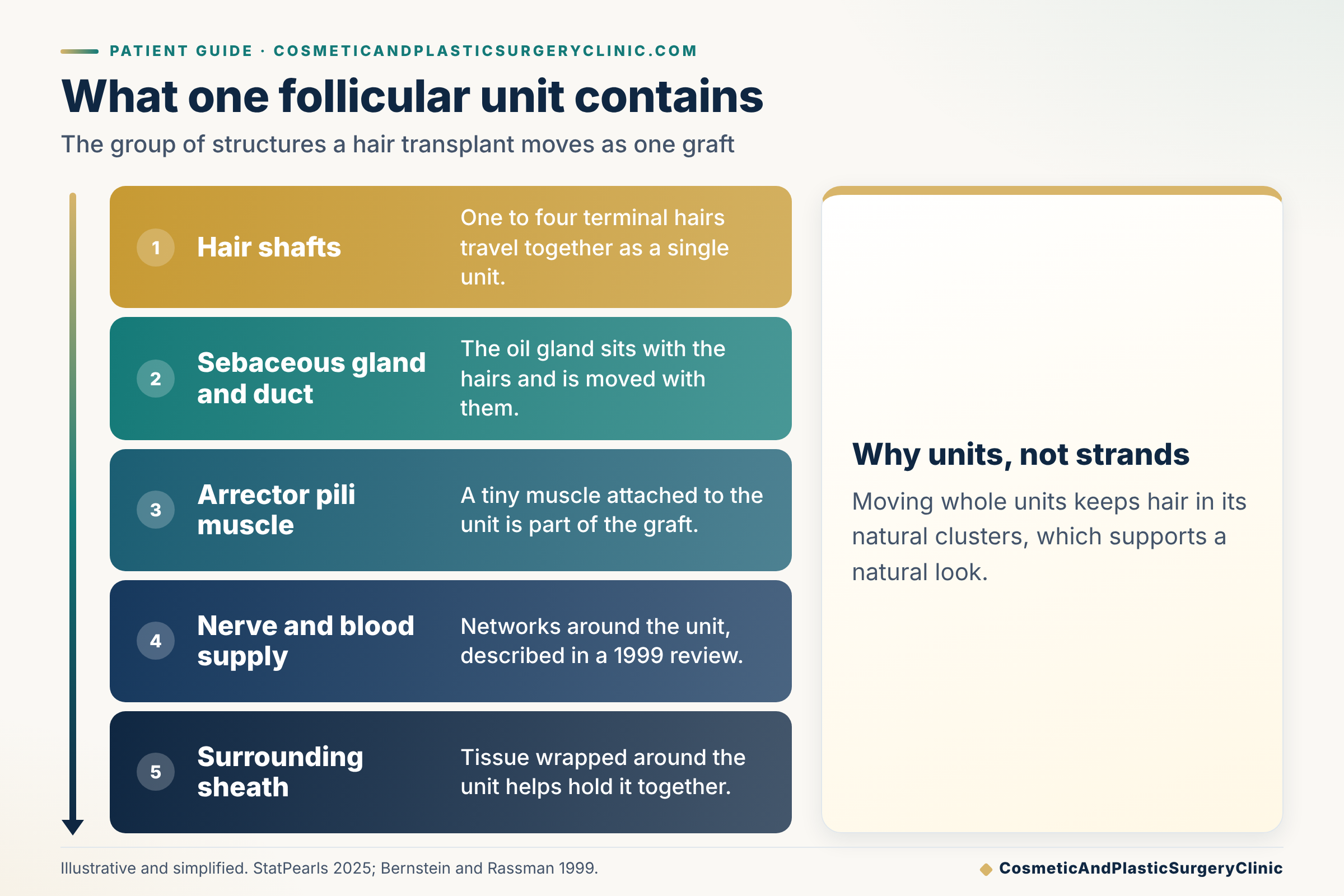
Hair does not grow one strand at a time. The StatPearls chapter describes a follicular unit as a naturally occurring group of one to four terminal hairs together with a sebaceous gland and duct and an arrector pili muscle. Bernstein and Rassman list additional structures, including nerve and blood supply and a surrounding sheath, and cite earlier work showing that intact units survived better than single-hair grafts in one comparison.
Moving whole units is why modern results can look like ordinary hair rather than the tufts of older plug techniques. The American Academy of Dermatology (AAD) notes that most surgeons now transplant a few hairs at a time, avoiding the doll-like look of older hair plugs.
The donor zone, and why its edges are uncertain
The ISHRS describes the donor area as the hair-bearing scalp from about an inch or two above the ears and temples around to the back of the head, and compares it to a savings account whose follicles are saved from hair loss and can be loaned to balding areas. It adds a caution: hair that looks safe today may still be lost over time, which is why family history and scalp examination matter.
The ISHRS FUE guidelines are blunter still. They state that the true safe zone is hard to determine, especially in younger patients. A hair transplant plan is therefore built on a boundary that is an estimate, which is one reason conservative harvesting is a recurring theme in professional guidance.
Who loses hair, why, and why diagnosis comes before any hair transplant
Hair loss is a symptom with many causes. Patterned loss is the most common reason people consider surgery, but a hair transplant treats one cause well enough to be worth discussing and several others poorly or not at all. Sorting that out is a medical question that precedes the surgical one.
Androgenetic alopecia: the usual indication
Pattern, genetics and hormones
MedlinePlus describes androgenetic alopecia as a common form of hair loss in both men and women, estimated to affect about 50 million men and 30 million women in the United States. It reports that more than 50 percent of men over age 50 have some degree of loss. In men it typically begins above both temples, producing an M-shaped recession, with thinning at the crown.
In women the usual picture differs: thinning at the top of the head and a widening part, with the front hairline typically staying put and total baldness rare. Androgens, particularly dihydrotestosterone, are linked to the process, and having a close relative with patterned loss is a risk factor. MedlinePlus names variation in the AR gene as the one gene studies have confirmed as involved.
How clinicians stage it, and what staging cannot predict
Surgeons describe male patterns with the Hamilton-Norwood scale. A 2016 review in the Journal of Cutaneous and Aesthetic Surgery notes that Norwood revised Hamilton’s classification in 1975 after studying 1,000 males. Women are commonly staged with a different system, the Ludwig scale. StatPearls lists Norwood III to V and Ludwig II and III among the typical surgical indications.
A stage is a snapshot. It says how much has been lost, not how much will be. A second 2016 review points out that the Norwood scale emphasizes the crown and does not capture temporal recession well, which is one reason surgeons also weigh age, family history and scalp examination.
Conditions that mimic, overlap or forbid a hair transplant
Scarring and inflammatory alopecias
Some conditions destroy follicles permanently through inflammation. The AAD describes central centrifugal cicatricial alopecia and frontal fibrosing alopecia among its types; the latter often causes a receding hairline and loss of eyebrows. These can look like ordinary recession at first glance, which is why a dermatology evaluation, sometimes with a biopsy, matters before surgery.
StatPearls says a hair transplant is contraindicated in active cicatricial alopecias and may be considered only after about two years of disease-free status. Transplanted hair placed into an active process can be lost along with the native hair, so confirming the diagnosis is a safety step, not a formality.
Shedding, patches and tight styles
MedlinePlus explains that physical or emotional stress can push a large share of scalp hair into shedding. Triggers include high fever, childbirth, major surgery, crash diets and certain medicines. This pattern, telogen effluvium, is usually temporary. Other causes on the MedlinePlus list include alopecia areata, thyroid disease, anemia, lupus, hair pulling and tight hairstyles.
StatPearls says alopecia areata calls for at least two years without active disease before surgery is considered, and that outcomes are often suboptimal. The AAD stresses that the key to successful treatment is the right diagnosis. For a person with sudden, patchy or diffuse shedding, a hair transplant is not the first tool.
| Pattern | Typical features | What it means for a hair transplant | First step |
|---|---|---|---|
| Male pattern hair loss | M-shaped temple recession, crown thinning | The main indication; donor hair moves from the back and sides | Confirm diagnosis and stage; plan for progression |
| Female pattern hair loss | Thinning on top, widening part, front hairline usually kept | Case by case; diffuse thinning can reach the donor area too | Evaluation with history, blood tests, trichoscopy |
| Scarring alopecias | Follicles destroyed by inflammation; may mimic recession | Active disease is a contraindication; some cases wait about two years | Dermatology exam, possibly biopsy |
| Alopecia areata | Sudden bald patches; may involve more of the head or body | Considered only after long inactive periods; outcomes often limited | Dermatologist-led treatment |
| Telogen effluvium | Diffuse shedding after fever, childbirth, surgery, diets, medicines | Usually temporary; surgery is not the answer | Review triggers with a clinician |
| Traction alopecia | Loss along tightly pulled styles | Named among surgical indications by StatPearls | Prevention first; surgeon judges the pattern |
What a hair transplant can change, and what it leaves alone
A fair read of the evidence separates three things: what the operation does to the area it treats, what it does nothing about, and what no honest clinic can promise. The second and third lists are longer than most marketing implies, and knowing them early makes consultations more productive.
What the operation does change
Coverage and density are a trade-off, not a dial
A fixed number of grafts can cover a small area at higher density or a larger area at lower density. It cannot do both. The StatPearls chapter gives a recipient-area target of about 30 follicular units per square centimeter, while Bernstein’s 2005 chapter says up to 25 units per square centimeter is generally accepted and warns that denser packing may risk graft survival.
A 2026 review in Frontiers in Medicine lists dense packing above 45 to 50 units per square centimeter among the technical risk factors for complications. Bernstein presents covering an area at moderate density and adding density in a later session as a safer approach than dense packing in one pass. How to weigh a framed face against overall fullness is a values question that belongs in the consultation.
Hair type changes how dense the same graft count looks
The ISHRS notes that wavier or thicker hair, and hair with low color contrast against the scalp, tends to look denser at the same density. ASPS likewise says hair color, texture and curl can affect the cosmetic result. Two people with the same number of grafts can look quite different, which is one reason a hair transplant consultation should include a close look at the hair itself and not only a graft estimate.
The hairline: a design problem with a face attached
Hairline design is part geometry, part judgment about age. Bernstein’s 2005 chapter notes that a transplanted hairline will not change its position or shape over time, so it should suit a mature adult rather than a teenager. It places the mid-frontal hairline roughly a finger-breadth above the brow crease and describes a natural edge as irregular and slightly asymmetric.
The same chapter says over-uniform hairlines are a more common error than overly irregular ones, and that single-hair and two-hair units belong at the front edge with larger units set back. A hairline that looks right at 25 may sit too low on a face at 50, and the ongoing loss of native hair behind it can leave an island effect. Both points favor a conservative design.
Women: density first, and a donor area that needs its own check
Goals often differ. The ISHRS says women generally prioritize density over creating a new hairline, and that the central part area can sometimes need a second procedure to match surrounding density. Because female pattern loss tends to be diffuse, the same guide stresses confirming that donor hair is resistant to hormonal miniaturization, since overharvesting a donor area that is itself thinning can cause visible thinning and limit future options.
Women made up about 15 percent of surgical patients in the ISHRS 2025 census, and the ISHRS reports that its female surgical patient numbers rose 16.5 percent from 2021 to 2024. A woman considering a hair transplant benefits from a work-up that looks at hormones, thyroid, iron and medicines first, because MedlinePlus lists thyroid disease, anemia and certain medicines among causes of hair loss that have nothing to do with pattern loss.
What it leaves alone
Native hair keeps following its own course
Mayo Clinic states that hereditary hair loss will eventually progress despite surgery. The AAD says medicine may be recommended to help keep results because thinning can continue after a transplant. The hair that was never moved remains susceptible; only the relocated hair inherits the donor’s resistance. A transplant that looks complete at 30 can look patchy by 45 if native hair around it has thinned.
Temporary shedding is separate. The ISHRS describes telogen effluvium after surgery, in which existing hair sheds and then should recover over the following months, and says the shedding can be psychologically hard. StatPearls adds that shock loss can be permanent when miniaturization in the recipient area is high. Both are reasons to ask what your surgeon will do about native hair nearby.
No promise of unlimited coverage or an exact density
Donor supply caps the outcome. ASPS says there are limits to what can be accomplished, and its candidates page adds that a person with very little hair might not be advised to have surgery. The ISHRS lists claims of unlimited grafts among the red flags of black market clinics, because donor hair is finite and a promise of unlimited supply raises the question of how the donor area will be protected.
Satisfaction depends on expectations as well as technique. A 2026 narrative review cites an ISHRS practice census in which 64 percent of men reported some disappointment with density; the review does not spell out the survey wording, so treat the figure as a prompt to discuss expectations rather than as a rate. ASPS says results may not match what you hope for.

Hair transplant techniques: how the grafts are harvested, placed and by whom
Two harvesting methods dominate, and the placement steps are broadly shared. The method matters for scars and for how a donor area can be reused. The staffing question matters for safety. Details of the technique comparison live in the dedicated guide on FUE versus FUT; this section is the overview.
Two ways to harvest: single units and a strip
FUE: follicular unit excision, one unit at a time
Follicular unit excision (FUE, which many sources still call extraction) removes individual units with a small punch. The ISHRS gives the punch size as 0.7 to 1.2 millimeters and says punches can be manual, motorized or robotic. The donor area is usually shaved. ASPS calls FUE the newer and more common method and describes it as generally less invasive with a quicker recovery.
FUE leaves marks. The ISHRS is explicit that FUE is not free of scars: it almost always leaves small round scars, which can be hidden by short hairstyles when the work is done well. Its FUE guidelines add that pinpoint pale scars are more noticeable in darker skin types and when hair is cut short, and the ISHRS warns that poor technique can cause visible donor thinning.
FUT: follicular unit transplantation from a strip
Follicular unit transplantation (FUT) removes a full-thickness strip of scalp from the donor area, which technicians then dissect into grafts under a microscope. The wound is usually closed with stitches and leaves a single linear scar. The ISHRS notes that surgeons have used FUT successfully for decades, and the AAD points out that individual removal takes longer but avoids a long narrow scar.
In the ISHRS 2025 Practice Census, based on 247 responses from member surgeons and self-reported, 85.4 percent of male surgical patients had FUE harvesting and 12.5 percent had strip harvesting; for women the split was 68.2 and 30.0 percent. Mean graft counts in a typical case were 2,262 for FUE and 2,100 for FUT. These describe members’ practices, not the whole market.
| Feature | FUE | FUT | Question to bring |
|---|---|---|---|
| Donor-area mark | Scattered small round scars | One linear scar | How short might I wear my hair? |
| Donor hair length | Usually shaved; may be trimmed to about 1 mm | Ask what will be trimmed for the strip | How much will be trimmed, and where? |
| Recovery reports | Often described as faster, less pain | Stitched wound; discomfort varies | What does my surgeon expect for my case? |
| Graft handling | Units cut out one by one | Units dissected from the strip | Who does the extraction or dissection? |
| Donor planning | Overharvesting is a named risk | Linear scar confined to one area | What is the long-term donor plan? |
Session size and what happens to grafts outside the body
How many grafts fit in one session, and why bigger is not automatically better
Session size is a planning choice with trade-offs. The 2026 Frontiers review links overharvesting to high-volume sessions, described there as above 3,000 to 4,000 grafts, and to low donor density, and lists very large sessions and dense packing among the technical risk factors for complications. The AAD notes that large transplants may need a return visit of a few hours the next day.
A larger session spends more donor hair at once and asks the recipient area to support more grafts at the same time. Bernstein’s chapter presents a staged approach, with moderate density first and density added later, as safer than packing densely in one pass. Staging costs time and sometimes money, but it keeps the donor ledger from being drawn down faster than the plan needs.
Graft counts also deserve a question. The ISHRS lists inaccurate graft counts among the problems patients reported after unlicensed work. Ask how many grafts are planned, how the count is documented on the day, and whether you will receive that number in writing.
Grafts outside the body: handling, hydration and transection
Once a unit is removed, its handling matters. The ISHRS FUE guidelines say assistants who handle extracted grafts must be trained in safe handling and must keep grafts hydrated. They also set an aim of a transection rate below 10 percent, meaning that fewer than one in ten follicles should be damaged by the punch during harvest. Transection is one of several reasons a well-run team tracks its own numbers.
Bernstein and Rassman, writing in 1999, criticized the era of cutting grafts to size, which they considered damaging to follicles. Implanters, the ISHRS says, may reduce direct handling of the bulb. For a patient, the useful questions are plain: how long do grafts stay outside the body, how are they stored, and who handles them between extraction and placement?
Placing grafts, anesthesia and the question of who does each step
Anesthesia, length of the day and graft placement
The AAD says surgery takes about four to eight hours, with large sessions sometimes needing a return visit the next day. Most patients stay awake with numbing medicine, and a mild sedative is optional. The ISHRS likewise mentions numbing, sometimes with sedation. Mayo Clinic says sedation is provided because the procedure is painful, which shows how descriptions differ; the anesthesia plan is something your surgeon sets.
Grafts go into small recipient sites, placed with forceps or with implanters at chosen angles and directions. The ISHRS says implanters may reduce direct handling of the graft bulb, but cautions that DHI is not a hair transplant method. Branded names such as Sapphire FUE or Nano FUE, it adds, do not replace a physician’s judgment.
Which steps can be delegated, and why it matters
The ISHRS FUE guidelines say FUE should be done by a trained, licensed physician. They allow the surgeon to delegate graft extraction to trained assistants, and say that when unlicensed individuals perform FUE it goes against patients’ interests and is medically unsound. The ABHRS notes that, as a matter of law, any individual with a medical license can legally perform hair restoration surgery, which makes the surgeon’s training worth checking.
Rules on who may make incisions or extract grafts differ by country and state. The practical habit is to ask, in writing, who performs each step: diagnosis, hairline design, anesthesia, incisions, extraction and placement. If the answer is vague, or if you cannot meet the surgeon beforehand, that is information. The tourism guide covers this in more depth for travelers (hair transplant tourism).
Hair transplant planning: the donor you have and the hair you have not lost yet
Planning is where a hair transplant is won or lost, long before anyone opens a punch. A plan answers four questions: how much donor hair exists, how much of it can be used without visible thinning, how the recipient area will look as native hair continues to change, and what is held back for later. The answers depend on age, family history and the exam.
Reading the donor and recipient areas
Measuring density and setting harvest limits
Surgeons measure density; the ISHRS FUE guidelines call for a handheld densitometer, and a 2026 review recommends trichoscopy of the donor area. StatPearls reports that a safe donor zone typically holds 65 to 85 follicular units per square centimeter, that densities above 80 are considered excellent, and that densities below 40 are less suitable.
Sources differ on how much a donor area tolerates. The ISHRS guidelines say removing 40 to 50 percent of the follicles in an area should not cause visible depletion, though this varies by hair characteristics. A 2026 review reports that many authors suggest limiting extraction to about 10 to 20 percent of baseline density per session. These are surgeon-level judgments, and the spread itself is a reason to ask how your surgeon sets limits.
Caliber, curl, color, and donor sites beyond the scalp
The ISHRS FUE guidelines advise evaluating hair caliber, color, curl and direction, because they change how a graft behaves and looks. The same guidelines suggest considering beard, moustache and chest hair as donor sources when the scalp supply is limited. The ISHRS also notes that a hair transplant can restore eyebrows, eyelashes and facial hair, not only scalp hair.
Non-scalp hair is not interchangeable with scalp hair in every respect, which is why the same guidelines list caliber, color, curl and direction as things to evaluate. Ask which donor sites your surgeon is considering, why, and what the result is expected to look like as that hair grows.
Planning for hair you have not lost yet
Age and the case for waiting
Professional guidance repeatedly flags young age as a risk. The ISHRS says patients in their 20s are considered riskier because of possible future loss. Its FUE guidelines advise avoiding FUE under 25 because future loss is hard to predict. StatPearls suggests deferring and using medical therapy for at least a year, and ideally considering surgery only after age 25. The AAD says men in their 20s may be asked to wait.
Against that sits the ISHRS census finding that 95 percent of first-time patients in 2024 began between 20 and 35. Both can be true: a range of starting ages exists, and individual advice depends on the pattern, the family history and how settled the loss looks. A surgeon who recommends waiting is giving a planning opinion, not refusing care.
Staged plans, the crown and the donor ledger
A younger patient with progressing loss may need several procedures over years. The ISHRS says the strategy is to keep more donor hair in reserve for future use, while older men may need fewer. Bernstein’s 2005 chapter treats the vertex transition point as a natural stopping point and says the crown should be extended only when the surgeon is fairly sure donor supply can follow further loss.
In the ISHRS 2025 Practice Census, members averaged 2,347 grafts in a first procedure and 1,637 in a subsequent one. The ISHRS FUE guidelines advise against additional sessions that would cause visible thinning in the donor zone. Think of the donor area as a ledger with a fixed balance: every withdrawal is final, and the plan should still make sense when the balance is lower.
Consider a hypothetical 26-year-old with early temple recession and a family history of loss. One plan starts with an evaluation, a baseline set of photographs and a medical discussion, and revisits surgery after a year. Another plan operates now, restores the front modestly and holds most of the donor supply back. A third operates densely at the front and leaves little for what follows. The first two keep options open, and the third narrows them.
| Factor | Effect on the result | Maintenance or revision implication | Review point |
|---|---|---|---|
| Age at surgery | Younger patients have a less predictable course | May need several sessions; donor reserve matters | Has the pattern been stable? |
| Native hair around grafts | Keeps its own course; can look patchy as it thins | Medical therapy discussions or later sessions | Who reviews the plan each year? |
| Donor density and harvest history | Caps coverage; overharvesting can thin the donor area | Limits what a second session can safely take | What is the density before and after? |
| Hair caliber, curl, color | Changes how dense the same count looks | May change graft count needed | Does the estimate use my hair type? |
| Hairline position | Fixed once placed; must suit the face over time | A conservative design leaves room for later changes | How will it look at a much older age? |
Who surgeons consider, and who is asked to wait
The clinical criteria that sources keep repeating
The ISHRS describes the ideal hair transplant candidate as someone whose hair loss has stabilized with medical therapy, who is preferably older, has good donor hair, holds realistic goals and is medically safe for surgery. StatPearls lists situations that argue against operating now: active scarring alopecia, alopecia areata, diffuse unpatterned loss with no unaffected donor area, and unstable loss or more than 15 percent miniaturization in the recipient area, with medical treatment first for 6 to 12 months.
The same chapter says that when loss is under 50 percent, medical therapy is used until it exceeds that threshold, and that young patients are deferred. These are descriptions from a reference chapter and society pages, not a test you can run on yourself. An examination, sometimes with trichoscopy or a biopsy, decides. The hair transplant candidate guide covers what clinicians evaluate in more depth.
Health, habits and expectations
The 2026 Frontiers review lists patient-related risk factors for complications: diabetes, hypertension, smoking, vascular disease, scarring alopecia and a history of abnormal scarring. Its recommendations include stopping smoking at least a month before surgery and considering a test session for people at high risk of abnormal scarring. Those are the review’s points, relayed for context; your surgeon and your own clinicians decide what applies to you.
Mindset is part of candidacy too, and discussing it is not a judgment. StatPearls lists unrealistic expectations, untreated body dysmorphic disorder and untreated trichotillomania among the contraindications, and ASPS notes that surgery can improve appearance and self-confidence while results may not match hopes. Mayo Clinic adds that more than one surgery may be needed to get the effect you want.
Medicine, camouflage and waiting: the options that sit beside a hair transplant
This section is education only. It reports what regulators and societies say, and it never suggests a dose or a prescription. Whether any medicine suits you depends on your health, your medicines and your goals, and belongs with the clinician who can prescribe it.
Where medical therapy fits
What labels and societies say
The ISHRS says the ideal hair transplant candidate has hair loss stabilized with medical therapy and names finasteride and minoxidil as the therapies used for this. The AAD says medicine may be recommended to help keep results, since thinning can continue after surgery. Mayo Clinic describes both drugs and adds that oral options such as dutasteride and spironolactone exist, with side effects to discuss with a prescriber.
The FDA label for Propecia (finasteride 1 mg) states it is indicated for male pattern hair loss in men only. The trials enrolled men aged 18 to 41 with mild to moderate loss of the vertex and anterior mid-scalp, and efficacy in temple recession has not been established. The label says women who are or may be pregnant should not handle crushed or broken tablets, and that it is not indicated for women or children.
On timing, the label says daily use for three months or more is generally needed before benefit is observed, and that withdrawal leads to reversal of the effect within 12 months. Mayo Clinic says topical minoxidil takes at least six months and needs continued use. The FDA’s drug database lists a 5 percent minoxidil solution, Rogaine Extra Strength, as an over-the-counter product whose application was approved in 1997. Dosing and monitoring are prescriber and label territory, not an article’s.
Light devices and add-ons: what was and was not reviewed
Mayo Clinic reports that the FDA has approved a low-level laser device for hereditary hair loss in men and women, and that a few small studies suggest improved density while long-term effects need more research. This page did not open evidence reviews on platelet-rich plasma or other injected add-ons, so it does not characterize them.
If a clinic sells an add-on alongside a hair transplant, ask for the published evidence on that exact product, what outcome it was measured against, and what it adds to the price. Packages that bundle several extras make it harder to see what each one costs, which is a point developed in the hair transplant cost guide.
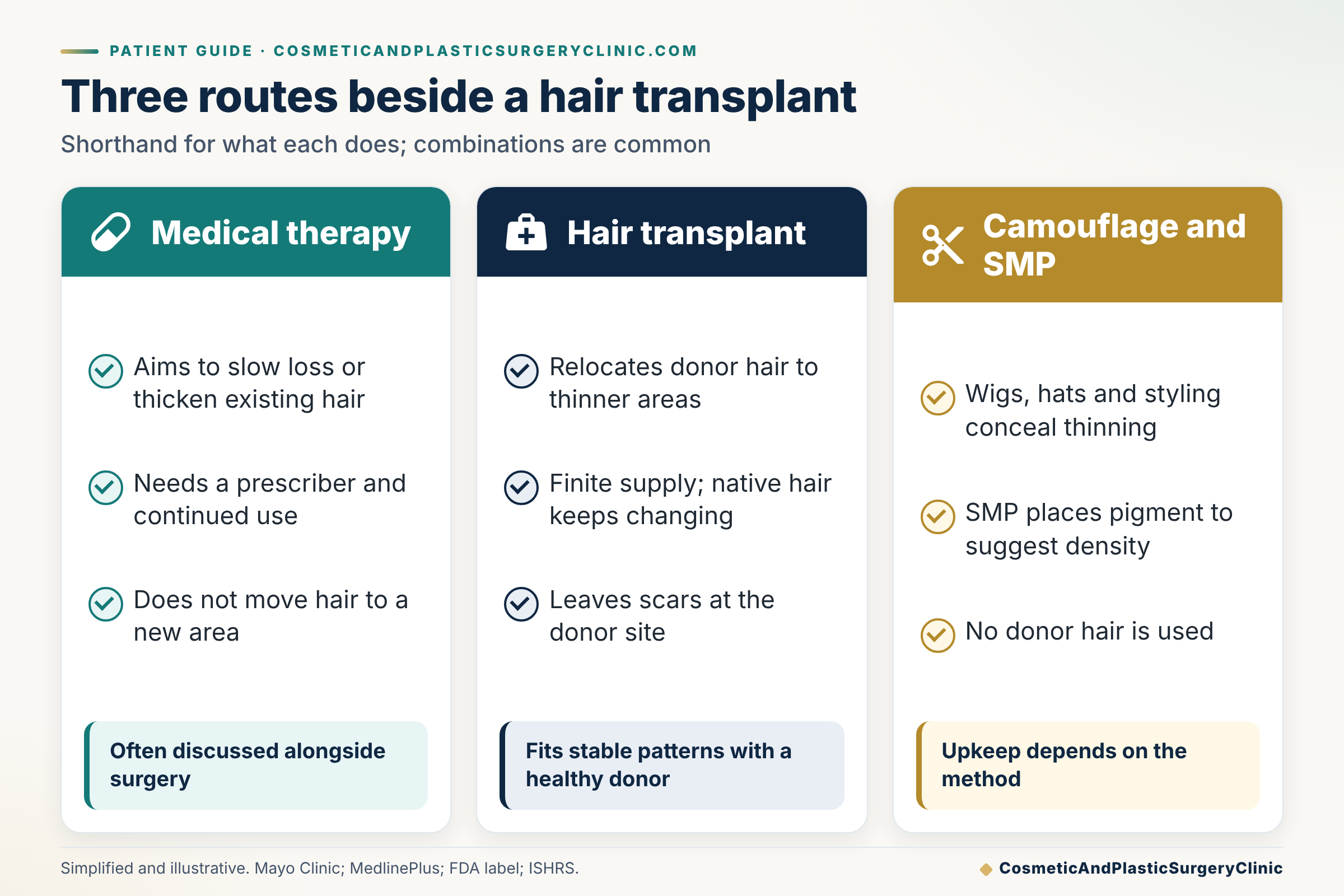
Camouflage, scalp micropigmentation and doing nothing
Concealing thin areas without surgery
MedlinePlus lists wigs, hats, hair weaves and hairstyle changes as ways to conceal hair loss, and advises against sewing hairpieces to the scalp because of scarring and infection risk. Scalp micropigmentation (SMP) is a tattoo-like technique that places pigment in the scalp to suggest density or a shaved look. It is a different tool with different limits, compared directly in hair transplant versus SMP.
Observation, a staged approach, or no treatment
An ISHRS patient-advocacy page notes that an ethical surgeon may advise medical treatment, observation or a staged approach, because a consultation should be about finding the right treatment, not selling a procedure. That framing applies to everyone, and the wider question of whether any elective operation is worth its trade-offs is the subject of plastic surgery. A person who is not bothered by thinning may reasonably do nothing, and a person who is bothered but unsure can wait and watch the pattern declare itself.
Waiting has a cost in time and has a benefit in information. Photographs at regular intervals, taken in the same light and with the same hair length, give a clearer picture of progression than memory. Those pictures also become a baseline if surgery happens later.
| Situation | Pathway often discussed | What it can offer | Trade-off | Key question |
|---|---|---|---|---|
| Stable patterned loss, healthy donor area | Hair transplant consultation | Relocated hair that keeps donor traits | Finite supply; native hair keeps changing | What is my long-term donor plan? |
| Early 20s, loss still progressing | Medical review, observation, possible delay | More information before spending donor hair | Months or years of waiting | What would change your advice? |
| Patchy loss, itching, pain or scalp redness | Dermatology evaluation first | A confirmed cause | Surgery may be unsuitable or delayed | Could this be a scarring or inflammatory condition? |
| Wants density without surgery | Camouflage, SMP, medical therapy | No donor harvest | Maintenance, fading, ongoing use | What upkeep will this need? |
| Thinning that does not bother the person | No treatment, periodic photos | No cost or procedure risk | Change continues unmanaged | What would make me revisit this? |
Hair transplant recovery, the long wait for growth, and published risk figures
The visible arc of a hair transplant runs far longer than the operation. Scabs clear in days, shedding follows within weeks, and the result takes most of a year to read. The risk picture is similar: most events are minor and temporary, a few are not, and published rates depend heavily on how each study defined the event.
The first weeks and the long wait
Scabs, shedding and the thinner-looking third month
The ISHRS says tiny scabs typically remain for about one to two weeks, depending on surgeon policy. After that, the transplanted hairs fall out while the roots stay in place. The AAD puts the shedding window between two and eight weeks after surgery, calls it normal, and adds that by the third month the area may look thinner than before the transplant. Most people are surprised by that stretch.
The ISHRS adds that most patients report no more than mild discomfort. It also tells readers to follow their own surgeon’s aftercare instructions rather than generic advice found online, because washing, sleeping position, sun and activity rules vary by technique and by clinic. The day-by-day detail is in hair transplant recovery, and time off and help at home are covered in plastic surgery recovery.
The donor area and the recipient area heal differently
Two wounds heal side by side. The donor area carries small round marks after FUE or a single stitched line after FUT, and the ISHRS FUE guidelines add that the pinpoint pale scars of FUE are more noticeable in darker skin and with short hair. The recipient area carries scabs and swelling, and the 2026 review reports forehead swelling in nearly half of FUE patients and swelling around the eyes in about 3 to 5 percent.
Aftercare is surgeon-directed, and published advice varies. The same review lists starting gentle washing within 24 to 72 hours among its recommendations, but your clinic’s written instructions are the ones to follow. Ask for them before the day, including who to call, how to reach someone after hours, and which signs mean go to an emergency department.
When the result can be judged
The AAD says most patients see results six to nine months after surgery, and for some it takes 12 months. The ISHRS says hair grows roughly one centimeter per month, so visible results take several months at minimum and often a year or more. A 2026 review recommends considering secondary procedures only after about 12 months of growth, so the first session can be judged fairly.
Month-by-month expectations, and what changes the pace, are covered in the hair transplant timeline guide. Evidence on exact return-to-work or exercise intervals was not found in the sources opened for this page, so those are left to your surgeon. Ask for the dates in writing before the procedure rather than at the follow-up visit.

Risks in proportion
Published figures and how to read them
A February 2026 narrative review in Frontiers in Medicine, which searched PubMed and Embase through September 2025, gathered complication figures for FUE. Its authors say they did not do a formal quality assessment or pooled analysis, and that definitions vary widely. Large series estimate overall complication rates of 1.2 to 4.7 percent, while one retrospective study of 1,030 FUE procedures reported notable complications in 9.9 percent, nearly half of them mild.
The two numbers are not in conflict; they measured different things in different populations. The review also states that the safety advantage of FUE over FUT has not been statistically confirmed, and that the true incidence of many complications is uncertain. Treat the table below as orientation. The complete picture, including rare serious events, is in hair transplant risks, and general risk literacy, including how to read a risk number, is in plastic surgery risks.
| Event | Reported figure | Limit to keep in mind |
|---|---|---|
| Any complication, large series | 1.2 to 4.7 percent | Definitions differ; some figures come from older strip-era data |
| Notable complications, 1,030 FUE procedures | 9.9 percent; nearly half mild | One retrospective study |
| Infection | Below 1 percent in most studies | StatPearls also calls infection low, citing the scalp’s blood supply |
| Folliculitis | About 12.1 percent | One large multicenter retrospective study |
| Recipient-area shock loss | 0.15 to 15 percent | Wide range; female sex and older age listed as risk factors |
| Poor growth | About 0.5 to 1 percent | Described as an estimate for a minority of patients |
| Long-term numbness or tingling | About 2 percent | One large series |
Expected, complication, emergency
Three categories help. Expected effects include scabs, forehead swelling, mild discomfort and temporary shedding; the review reports frontal swelling in nearly half of FUE patients. Complications that deserve a call to the surgical team include persistent redness, bumps or pimple-like lesions, cysts, numbness that does not fade, unusual pain, and poor growth. The ISHRS lists scalp cysts and mild infections among minor side effects.
Hair transplant cost, choosing who operates, travel packages and photographs
Three decisions remain once the medicine makes sense: what the plan costs, who performs it, and how to judge evidence of past work. Each has a separate guide; this section gives the outline and the traps.
Cost in outline
Per-graft pricing and what a quote leaves out
The ISHRS says most surgeons charge per graft, while some charge a set fee based on a projected graft range, and that cost varies widely with the surgeon’s experience and the type of practice, so it does not publish a figure. This page did not find a verified national average, so it gives none. A per-graft price multiplied by a graft count is only one part of a quote.
Ask what the quote includes: the surgeon’s role versus technicians, facility, anesthesia, medicines, follow-up visits, photographs, and what happens if growth is poor or a touch-up is needed. The guide on hair transplant cost works through a hypothetical, date-stamped quote, and plastic surgery cost covers general quote anatomy.
Insurance, financing and the cost of repair
Mayo Clinic says surgical procedures to treat baldness are not usually covered by insurance. Financing terms deserve the same scrutiny as any elective procedure, and plastic surgery financing explains total-cost thinking. A lower price is not a saving if the result needs repair: in the ISHRS 2025 census, 6.9 percent of patients sought repair of earlier surgery, whether from another physician or a black market transplant.
The ISHRS reports that the average share of repair cases caused by a previous black market transplant was 10 percent among responding members, up from 6 percent in 2021. That is a self-reported physician figure, not a population rate. It supports one practical point: a repair draws on the same finite donor hair as the first operation did.
Touch-ups, revision and what irreversible really means
The ISHRS says a hair transplant is irreversible but can be revised with additional surgery. Revision draws on the same finite donor hair, so a second session is part of the donor ledger, not a free correction. Ask what the clinic’s policy is if growth is sparse or an area needs filling in, whether any fee applies, and how long you would need to wait before it would be assessed.
The Aesthetic Society’s suggested questions include what your options are if the outcome does not meet the agreed goals. Get the answer in writing, and compare it between clinics. A 2026 review advises considering secondary procedures only after about 12 months of growth, so a policy that promises a fast fix before that window deserves a closer look.
Choosing who operates, and where
Verifying the physician and the team
Start with credentials, then move to roles. The ABHRS describes itself as the only board certification focusing on hair restoration surgery for physicians, and asks diplomates to use the title “ABHRS Diplomate.” The Aesthetic Society advises looking for a board-certified plastic surgeon with extensive hair transplantation experience, and the AAD points to dermatologists who perform transplants regularly. How boards and titles differ is explained in cosmetic surgeon credentials.
Then ask who does each step. The ISHRS suggests asking who handles diagnosis, hairline design, anesthesia, incisions and excision, whether you will meet the surgeon beforehand, and who manages a complication. It also suggests asking whether everyone involved is covered by malpractice insurance. The checklist-style approach in how to choose a plastic surgeon applies here, and plastic surgery consultation lists general questions to bring.
Travel packages and unlicensed settings
In the 2025 ISHRS census, 59.4 percent of responding members reported black market clinics in their city. The ISHRS has described a bait-and-switch pattern in which a physician’s credentials draw the patient in but a technician not licensed to perform surgery does the work. It lists slick websites, promises of a sure outcome and turnkey clinics with no recourse among the red flags.
The CDC advises seeing a travel health clinician at least four to six weeks before a trip, researching the clinician and facility, bringing records, and planning for follow-up care that might be costly and not covered by insurance. Its advice on delaying flights is framed around major surgery, so ask your surgeon about travel timing. See medical tourism for surgery and the hair-specific guide on hair transplant tourism.
Photographs and the questions to bring
Reading hair transplant photographs
Photographs are evidence of a clinic’s work, not a forecast for your scalp. A useful set shows the same views in the same lighting and hair length before and after, includes the donor area, and states how many months have passed. A result photographed at three months is a different thing from one at twelve, as the timeline above explains. The ISHRS and the Aesthetic Society both treat before-and-after photographs, ideally of similar cases, as part of vetting a surgeon.
Look for patients whose hair type and pattern resemble yours, and ask how the photographed patients were selected. The guide to hair transplant photos covers views, timing and concealment tricks, and before-and-after photos covers ethics and advertising rules in general.
A short list for the consultation
The Aesthetic Society suggests asking whether your goals are realistic, where the procedure will be done, how long it takes, how many treatments you may need, the full costs, the risks, and what options exist if the result does not meet agreed goals. The ISHRS adds two that matter here: what the long-term plan is if hair loss continues, and who manages care if a complication occurs.
Add a few of your own: how many grafts are planned and why, what the donor area will look like afterward, what happens to native hair near the grafts, and what you would recommend if the plan were your own head. Waiting for a second opinion costs little and protects a finite resource.

Frequently asked questions
Does a hair transplant stop hair loss?
No. A hair transplant moves hair that resists the hormonal process behind pattern loss, but it does not change what is happening to the hair you did not move. Mayo Clinic says hereditary loss will eventually progress despite surgery, and the AAD notes that medicine may be recommended to help keep results. Ask your surgeon how the plan handles native hair near the grafts, and whether a prescriber should be involved before or after surgery.
Can women have a hair transplant?
Some can, after evaluation. The ISHRS says suitable candidates typically have a stable, predictable thinning pattern, enough healthy donor hair and no untreated underlying condition, and that diagnosis can involve blood tests, trichoscopy or biopsy. Because women often thin diffusely, the donor area itself needs careful assessment. In the 2025 ISHRS census, women were about 15 percent of surgical patients, so not every surgeon sees many.
Is a hair transplant painful?
Sources describe it differently. The AAD says most patients stay awake with numbing medicine, with a mild sedative optional, while Mayo Clinic says sedation is provided because the procedure is painful. The ISHRS says most patients report no more than mild discomfort afterward. Experience varies with the technique, the anesthesia plan and the person, so ask what will be used during the hair transplant and how pain afterward is managed.
How many grafts can a person have in a lifetime?
No one number applies. The 2013 survey by Unger and colleagues asked 34 experienced surgeons for estimates in hypothetical 30-year-old men and got averages from about 4,200 to 7,900 follicular units depending on pattern and density. Those are opinions about hypothetical scalps, not measurements. A real answer comes from your own donor density, family history and age, which is why a measured plan beats a standard figure.
Will the transplanted hair fall out?
Usually, yes, and that is expected. The AAD says transplanted hair falls out between two and eight weeks after surgery, and the ISHRS says the roots stay in place so new hair grows later. New growth is then judged over many months. Hair that never regrows, or shedding of existing hair, are different issues to raise with your surgeon, particularly if scalp redness, bumps or pain accompany them.
Is FUE better than FUT?
Neither wins in every case. FUE removes individual units and leaves small round marks, while FUT removes a strip and leaves one linear scar. The 2026 Frontiers review states that FUE’s safety advantage over FUT has not been statistically confirmed. The better method depends on hair length wishes, donor density, number of grafts and the surgeon’s skill with each. The FUE versus FUT guide compares them in detail.
How do I tell whether a clinic uses unlicensed staff?
Ask in writing who performs diagnosis, hairline design, anesthesia, incisions, extraction and graft placement, and ask to meet the surgeon beforehand. The ISHRS suggests asking whether an observer may be present and whether everyone is covered by malpractice insurance. A named surgeon, verifiable license in the place where surgery happens and willingness to answer these questions are good signs. Evasion, an unnamed doctor, or a sales-first consultation are not.
Is 22 too young for a hair transplant?
Guidance leans cautious. The ISHRS describes patients in their 20s as riskier because of possible future loss, its FUE guidelines advise avoiding FUE under 25, and the AAD says men in their 20s may be asked to wait and start medicine. That is not a rule for any one person. The exam, family history and the pattern’s pace decide, which is where a hair transplant candidate evaluation comes in, and a second opinion for a young patient is reasonable.
Sources and further reading
- ISHRS — What is a hair transplant (accessed 2026-11-13) — follicular units, donor area, scabs, growth rate, per-graft pricing
- ISHRS — Surgical treatments (accessed 2026-11-13) — FUT and FUE scars, implanters, DHI caution, mild discomfort
- ISHRS — FUE: what is it (accessed 2026-11-13) — punch sizes, shaved donor area, physician-driven care, donor hair not regrowing
- ISHRS — FUE clinical practice guidelines, 2019 (accessed 2026-11-13) — who performs FUE, delegation, age, harvest limits, donor sources
- ISHRS — The donor site: savings and loan of hair (accessed 2026-11-13) — donor area, finite supply, planning for younger patients
- ISHRS — 2025 Practice Census results (accessed 2026-11-13) — first-time patient age, black market prevalence, repair share
- ISHRS — 2025 Practice Census report (accessed 2026-11-13) — respondents, gender split, FUE and strip shares, graft averages, repair cases
- ISHRS — Beware of illegal hair restoration practices (accessed 2026-11-13) — technician-performed surgery, red flags, advice to verify
- ISHRS — Hair transplant black market red flags (accessed 2026-11-13) — who performs each step, unlimited-graft claims, long-term plan questions
- ISHRS — Buyer beware: medical tourism for hair transplants (accessed 2026-11-13) — bait-and-switch pattern, questions to ask
- ISHRS — A guide to hair transplant for women (accessed 2026-11-13) — evaluation, causes needing work-up, donor assessment
- American Society of Plastic Surgeons — Hair transplant (accessed 2026-11-13) — FUE and FUT overview, causes of hair loss
- American Society of Plastic Surgeons — Hair transplantation and restoration: candidates (accessed 2026-11-13) — donor limits, hair texture, expectations
- American Academy of Dermatology — Hair transplants (accessed 2026-11-13) — length of surgery, anesthesia, shedding, results timeline, waiting in the 20s
- American Academy of Dermatology — Types of hair loss (accessed 2026-11-13) — scarring alopecias, alopecia areata, traction, diagnosis
- The Aesthetic Society — Selecting a hair transplant surgeon (accessed 2026-11-13) — credentials, consultation questions
- American Board of Hair Restoration Surgery — Home (accessed 2026-11-13) — board certification focus, diplomate title, licensing note
- Mayo Clinic — Hair loss: diagnosis and treatment (accessed 2026-11-13) — work-up, medicines, laser device, surgery expectations, insurance
- MedlinePlus — Androgenetic alopecia (accessed 2026-11-13) — prevalence, patterns, androgens, AR gene
- MedlinePlus — Hair loss (accessed 2026-11-13) — causes, telogen effluvium, when to call, concealment
- FDA — Propecia (finasteride) prescribing information, 2011 supplement (accessed 2026-11-13) — indication, trial population, women and children, handling, time to benefit
- FDA Drugs@FDA — Rogaine Extra Strength application 020834 (accessed 2026-11-13) — over-the-counter status, 1997 approval
- StatPearls — Hair transplantation, updated 2025 (accessed 2026-11-13) — follicular unit anatomy, density targets, contraindications, shock loss
- Unger, Unger and Wesley — Estimating the number of lifetime follicular units, Dermatologic Surgery 2013 (abstract, accessed 2026-11-13) — expert estimates of donor supply
- Bernstein and Rassman — The logic of follicular unit transplantation, Dermatologic Clinics 1999 (accessed 2026-11-13) — donor dominance, plugs, follicular unit anatomy
- Bernstein — Follicular unit transplantation, 2005 chapter (accessed 2026-11-13) — hairline design, density, crown planning
- Gupta and Mysore — Classifications of patterned hair loss: a review, J Cutan Aesthet Surg 2016 (accessed 2026-11-13) — Norwood 1975, Ludwig scale
- Ahmad — Ahmad’s NPRT system, J Cutan Aesthet Surg 2016 (accessed 2026-11-13) — Hamilton-Norwood use and limits
- Romera de Blas and colleagues — Complications in FUE hair transplantation, Frontiers in Medicine 2026 (accessed 2026-11-13) — narrative review of complication figures
- CDC Travelers’ Health — Medical tourism (accessed 2026-11-13) — pre-trip steps, follow-up care, records
- PubMed — Orentreich, Autografts in alopecias, Ann N Y Acad Sci 1959 (citation record, accessed 2026-11-13) — bibliographic details only; no abstract available