Hair transplant recovery has two clocks running at once. The first is short and rule-heavy: a couple of weeks of bandages, scabs, forehead swelling and careful washing. The second is slow: transplanted hairs fall out, rest, and then restart over many months. Most confusion in hair transplant recovery comes from mixing the two, so a shed hair at week three gets read as a failure when it is usually a scheduled event.
This page follows hair transplant recovery from the first night through the first month and then points to the longer arc. It covers dressings, sleep, washing, scabs, swelling, work, driving, exercise, sun, shedding, itching, numbness and the signs that something is not routine. It does not explain who qualifies for surgery or how techniques differ; the hair transplant overview covers that. Every range comes from a society page, a hospital page, a published study or a practice handout named in the text, and your own surgeon’s written instructions outrank all of them.
What hair transplant recovery includes before the first night
Hair transplant recovery covers two wounds, because the surgery involves two parts of the scalp and each heals on its own schedule. Knowing which wound an instruction protects makes the list of rules easier to follow and to question.
Two wounds, not one: the donor area and the recipient area
How the way donor hair was taken changes what you see on the back of the head
The International Society of Hair Restoration Surgery (ISHRS) explains that follicular unit excision (FUE, sometimes called extraction) leaves tiny round excisions that are left open to heal without sutures, while strip harvesting closes the wound with stitches and leaves a single linear scar. So hair transplant recovery after FUE usually means scabs scattered across a shaved or trimmed donor zone, and after a strip it means one closed line with stitches to be removed later. The choice between them is covered on the FUE versus FUT comparison page.
The recipient area is where the hairs go in, and it is the area people photograph. Tiny incisions or channels hold each graft, which is why that part of the scalp is red, crusted and tender early on, while the donor area is more often sore, tight or numb.
Why grafts are fragile early and when sources call them secure
Early hair transplant recovery is mostly about protecting grafts that are not yet anchored. A practice handout from Ziering Medical warns that increased pressure may cause grafts to pop out, and a published series of 2,896 patients from one surgeon in India recorded graft dislodgement in 8 cases, all within the first 24 hours (Garg and Garg, Indian Journal of Plastic Surgery, 2021).
One New York clinic tells patients that transplanted hairs are secure at 10 days after surgery, after which vigorous shampooing can start. That is a single practice’s rule, not a universal date, and handouts from other offices release the same restrictions at different points. Treat the first week as the fragile one, and ask your surgeon the exact day on which scrubbing, brushing and a firm shower stream become acceptable.
What you go home with on the day of surgery
Bandages, dressings and the first instruction sheet
The American Society of Plastic Surgeons (ASPS) says that if bandages are used they are usually removed about a day later, and that gentle hair washing can begin within two days. The American Academy of Facial Plastic and Reconstructive Surgery says the area may be covered for one or two days, and The Aesthetic Society says dressings will likely be worn for at least two days. StatPearls adds that a clean, loose-fitting hat is acceptable immediately after surgery.
Some practices use no head dressing at all in hair transplant recovery and instead hand out ointment and a washing schedule. Ask for the instruction sheet before the day of surgery, not after, and have the person who drives you read it too, since instructions given after sedation or local anesthesia are easy to lose. The general recovery planning page covers logistics that apply to every operation.
Discomfort: what to expect and who prescribes the relief
ISHRS says discomfort typically lasts no longer than a day or two, followed by 7 to 10 days of tenderness to the touch, and that most patients report no more than mild discomfort. The Aesthetic Society notes the scalp is sensitive and that the surgeon may prescribe pain medication for the week after surgery, and may also prescribe antibiotics to lower infection risk. Cleveland Clinic lists crusting, itching, swelling, throbbing, tightness and loss of feeling as side effects that are usually temporary.
What to take, and what to avoid, is a decision for the surgeon and the prescribing clinician, since handouts differ on ointments, sleep aids and over-the-counter pain relievers. If the hair transplant recovery plan says nothing about pain control, ask what to use and what to skip before you leave.
Hair transplant recovery from day one to week four
Sources agree on the shape of hair transplant recovery in the first month and disagree on the dates. The sections below put the published ranges side by side.
Days 1 to 3: the first wash and the first nights
Sleeping raised: what the handouts say and why it matters
Sleeping with the head elevated is the most consistent instruction. StatPearls says to elevate the head of the bed about 15 to 30 degrees for the first week to minimize swelling. A For The Face practice handout says to sleep sitting up at 30 to 45 degrees for the first three nights, and the Ziering handout says 45 degrees for the first three to four nights, using a recliner or two or three pillows. A Utah practice says several pillows or a recliner and a towel under the head if the donor area oozes.
The stated purpose is swelling control, and forehead and eyelid swelling is the visible side effect described later on this page. No source opened says when side or stomach sleeping is allowed again, and the donor area after a strip or a close trim may be tender against a pillow. Whatever angle your surgeon gives, ask how many nights it applies and what to do about the donor side.
Washing and misting: five sources, five schedules
Washing schedules for hair transplant recovery vary more than almost any other instruction. StatPearls says to wash gently 24 hours after surgery, daily with a neutral shampoo for the first week and to avoid high-pressure water. The For The Face handout says no shampoo for 24 hours, gentle dabbing for days one to four and a full-strength shower from day five. The Ziering handout keeps the shower stream off the grafts for five days and allows normal washing from day six.
The Utah handout says not to wash the hair in the shower at all at first and to mist the recipient area with water hourly while awake for five to seven days. The New York clinic (Bernstein Medical) has patients shampoo gently three times on the morning after surgery and twice daily for the rest of the first week. Those differences reflect surgeon preference and technique, which is why a written schedule from your own team beats any table.
Days 4 to 14: swelling, scabs and the first shed
Forehead and eyelid swelling: when it peaks and when it fades
Swelling in hair transplant recovery rarely sits where the surgery was done. The Ziering handout says to expect it to peak on or around day four. A 2010 prospective study of 340 patients in Tehran (Abbasi and colleagues, Journal of Cutaneous and Aesthetic Surgery) found edema most common 2 to 6 days after surgery. A New York clinic’s patient page says forehead swelling spreading across the bridge of the nose and around the eyes is almost always gone by the end of the first week, and the Utah handout calls facial swelling in the first week normal.
The frequency is harder to pin down. A 2026 narrative review of follicular unit excision complications in Frontiers in Medicine says frontal edema has been observed in nearly half of patients, with periorbital swelling in about 3 to 5 percent. The 2,896-patient series reported facial edema in 18 patients (0.62 percent). Surgeons differ in the anesthetic solution and medicines they use, and papers define edema differently, so neither figure predicts your own course.
Ice is where handouts split. StatPearls lists ice on the forehead, not on the grafts, for 20 minutes every two to three hours during the first week. The Ziering handout uses a gel pack on the forehead for 10 minutes every two hours while awake, the Utah handout allows ice on the face only, and the For The Face handout says ice packs are unnecessary. Ask which version your team uses, and never place ice on the grafted area unless told to.
Scabs: when handouts say to loosen them and why not to pick
Scabs form in both areas and are a sign of normal healing. ISHRS says tiny scabs stay until they are gently rubbed away, usually one to two weeks later, and that scab-removal policies differ by surgeon. StatPearls says to gently rub crusts from the donor area at 5 to 7 days. The Ziering handout expects scabs to be gone by day nine or ten, and the Utah handout says remaining scabs can be massaged off after two weeks and to stop if there is pain or bleeding.
Every handout opened says not to pick. The Utah sheet warns that picking may remove a graft or cause an infection, and the For The Face sheet says not to pick or force off crusts, adding that crusts usually clear within 7 to 10 days. If scabs are still thick at two weeks, that is a question for the clinic, not a reason to scrub harder.
The milestones at a glance
Reading the first-month table without treating it as a schedule
The table below stitches the sources together. Treat it as the range inside which your own hair transplant recovery plan should fall, and ask the surgeon to explain any gap.
| Phase | Common changes | Practical limits reported | Question to ask |
|---|---|---|---|
| Days 0 to 3 | Tender scalp, possible donor-area soreness, red recipient area, early crusting | Sleep raised; no shampoo or only gentle washing; no bending or heavy lifting | Which washing schedule applies, and from which hour? |
| Days 4 to 7 | Forehead or eyelid swelling peaks, then eases; scabs thick | Sun and sweat limits; no picking; strenuous exercise still held back | When do I loosen scabs, and with what? |
| Days 8 to 14 | Swelling gone for most; scabs loosening; stitches out if a strip was used | Light activity; heavier exercise from about day 10 to 14 in some handouts | When can I shampoo normally and exercise hard? |
| Weeks 3 to 4 | Scalp looks ordinary; transplanted hairs begin to shed | Vigorous exercise and contact sports cleared at three weeks or later by ASPS and Cleveland Clinic | Which sports and neck-loading lifts are cleared, and when? |
| Months 2 to 12 | Shed hairs rest; thin look at month three; new growth starts | Sun protection continues; follow-up visits | When will growth be assessed, and what counts as slow? |
Why published dates are ranges rather than promises
Three things move the dates in hair transplant recovery. The first is technique: a donor area left open after FUE heals on a different schedule from a stitched strip line. The second is size, since a session with thousands of grafts leaves more to heal than a few hundred. The third is the practice itself, because anesthetic solution, ointments and washing rules differ. ISHRS says activity limits such as return to exercise and water exposure vary among surgeons, which is the plainest reason to trust your own written plan over any average.

Work, driving, exercise and sun during hair transplant recovery
Most readers want dates for ordinary life during hair transplant recovery, and sources do give them. They describe common practice in different offices, not entitlements. A visible, crusted scalp adds a social question, so the work question is partly medical and partly about how much redness you are willing to show.
Work, driving and flying home
Back to work: three medical sources and one clinic
ASPS says you may feel well enough to go back to work and resume normal, light activity after several days, depending on the surgery’s length, complexity and type. The Aesthetic Society says you can typically return within one to two days. Cleveland Clinic lists work and light activity at days three to five. A New York clinic’s patient page says normal routines can resume almost immediately but suggests avoiding client-facing work for about 10 days because of redness, crusting and possible facial swelling.
The spread comes from the job and the scalp. A remote worker can go back sooner than someone who meets customers all day, and a large session leaves more redness than a small one. Ask for a work note in advance if your job needs one, and ask how a hat or hairstyle can cover the area without pressing on grafts.
Driving, pain medicine and the trip home
Driving gets little attention in the sources. The Ziering handout says not to take its prescribed pain medication if you will be working, driving or operating machinery, because of drowsiness, and to be careful getting in and out of cars. A sensible question for the surgeon is functional: when can you check a blind spot and turn the wheel without pulling at the scalp, and are you off any sedating medicine?
Flying is the one place where sources point in different directions. The Centers for Disease Control and Prevention (CDC) says flying after surgery can raise the risk of blood clots, including deep vein thrombosis, and mentions delaying air travel for 10 to 14 days after major surgeries. A New York clinic’s page says flying is allowed from days two to three. Whether the CDC’s wording about major operations applies to your session is a question for the surgeon, and it matters most if you travel for surgery.
Exercise, water and sun
How hard and how soon: from one week to three
ASPS says you may be told to avoid vigorous exercise and contact sports for at least three weeks, and Cleveland Clinic lists a return to exercise or sports at about three weeks. StatPearls is stricter on the first week only, advising no heavy lifting or strenuous activity for one week. Handouts sit between: a Utah practice says no exercise for the first week and strenuous exercise after 14 days, and the Ziering handout says full strenuous workouts by day 10 after FUE and day 14 after a strip.
The For The Face handout says walking is fine in the first days, lists bending from the waist, inversion, weightlifting and heavy sweating as things to avoid early, then allows lighter weights from day five and jogging after day seven. The Ziering handout asks patients to avoid anything that raises blood pressure in the first week. Neck-loading lifts, inversions and anything that presses on a strip scar deserve a separate question with a date.
Pools, sweat, hats and sunlight
StatPearls says to avoid fully immersing the head for 2 to 4 weeks and to avoid direct sunlight on the donor and recipient sites for a month. The For The Face handout allows a pool after 10 days and an ocean or lake after 14, and asks for a hat or sunscreen outdoors for 30 days. The Utah handout limits direct sun to no more than 30 minutes at a time in the first week and calls the donor and graft areas sun-sensitive for six months.
The Ziering handout is the most conservative on sun: a non-constricting hat if outdoors for more than five minutes over the next three months and no tanning for three months. These are all one-office rules for hair transplant recovery. Ask whether a chlorinated pool, the sea and a gym shower count under the same rule, whether the hat can be a baseball cap or must be loose, and when sunscreen can touch healing skin.
| Activity | Range reported | Who reported it | Clearance note |
|---|---|---|---|
| Desk or remote work | 1 to 2 days up to about 5 days | Aesthetic Society; ASPS; Cleveland Clinic | Redness and crusting may matter more than pain |
| Client-facing work | About 10 days suggested by one clinic | Bernstein Medical patient page | Ask about hats, hairstyles and a note for employers |
| Driving | No date given; not while taking sedating pain medicine | Ziering handout | Ask what you must be able to do |
| Walking and light activity | From the first days | For The Face handout; Cleveland Clinic | Avoid bending and straining early on |
| Vigorous exercise and contact sports | Day 10 to 14 in two handouts; at least 3 weeks per ASPS | Ziering; Utah Facial Plastics; ASPS | Neck-loading lifts need their own date |
| Pools, sea and hot tubs | Head immersion held back 10 days to 4 weeks | For The Face handout; StatPearls | Ask about each water type separately |
| Flying home | CDC mentions 10 to 14 days after major surgery; one clinic allows day 2 to 3 | CDC Travelers’ Health; Bernstein Medical | Ask about clot precautions and who treats a problem at home |
| Sun and tanning | Protection for 30 days to 3 months | StatPearls; handouts | Ask when sunscreen can touch the scalp |
Shedding, itching and numbness: the slow side of hair transplant recovery
The first two weeks of hair transplant recovery are about limits. The months after are about waiting, which is harder to plan for. The scalp can look worse before it looks better, and telling normal from not normal is what follow-up visits are for.
Shedding of transplanted hairs and the hair around them
What the shed hairs are and why the follicles stay
ASPS says transplanted hair often falls out within six weeks, calls this normal and almost always temporary, and says growth resumes another five to six weeks later at about half an inch per month. The American Academy of Dermatology (AAD) puts shedding between two and eight weeks. The Aesthetic Society says grafts fall out and do not regrow for approximately three months. A For The Face sheet says hair in the grafts disappears 2 to 3 weeks after the procedure, while the follicles remain and regrow hair.
The native hair near the grafts can shed too. ISHRS describes temporary telogen effluvium as shedding of original, native hairs that should come back over the following months. The 2026 Frontiers review reports recipient-site shedding with reported incidence ranging from 0.15 to 15 percent, typically beginning 2 to 8 weeks after surgery with regrowth around three months. Donor-site shedding typically starts 2 to 4 weeks after surgery and resolves within three to six months, though the review says its true incidence is unknown.
When a thin look at month three is still on schedule
The AAD says that by the third month the hair may look thinner than before the transplant, and that this is also normal. Most patients see results between six and nine months after surgery, and for some it takes 12 months. StatPearls says shock loss is transient, with new hairs typically appearing after 3 to 6 months, and recommends monitoring for 6 to 12 months until grafts mature. Cleveland Clinic’s telogen effluvium page says shedding after a stressor such as major surgery tends to start two to three months later and usually lasts three to six months.
Month-by-month growth is the subject of the hair transplant timeline page. For hair transplant recovery, the useful point is narrower: shedding that fits the ranges above is a scheduled stage, and a call is warranted when it comes with pain, pus or a scalp that is not healing. How closely a result matches a photo is a separate question, covered in the hair transplant photos guide.
Itching, tenderness and numbness
Itch, crust and tenderness in the first weeks
Cleveland Clinic lists itching among the usual temporary side effects, and the Ziering handout lists persistent itching or flaking, ingrown hairs or bumps among reasons to call the office. Itch tends to arrive as scabs loosen, which is exactly when hands go to the scalp. The Utah handout warns that scratching or picking may remove a graft or cause an infection, so ask in advance what is allowed for itch and what to do if sleep is disturbed.
ISHRS says tenderness to the touch lasts 7 to 10 days after the first day or two of discomfort. Tenderness that rises instead of easing, or spreads, is a different signal. Surgeons often prescribe or advise specific products for dryness and itch, and what is safe on healing grafts depends on the plan, so the answer belongs to the clinic rather than a pharmacy shelf.
How long numbness lasts and when it is worth a call
Numbness is common and usually temporary. A New York clinic says recipient-area numbness may last a few weeks and donor-area numbness may linger, usually resolving by months two to five. The Ziering handout says numbness usually subsides over 6 to 8 months and can last longer than 12. The Frontiers review says sensory changes usually resolve, with complete resolution typically within 4 to 8 months, and that long-term numbness or tingling occurred in about 2 percent of 1,030 procedures in one retrospective study.
In the 2,896-patient series, numbness was recorded in 18 patients (0.62 percent by its counts) and resolved within weeks. A numb scalp is a poor judge of heat and pressure, which is a practical reason to follow the sun and hat rules of hair transplant recovery even when the skin feels fine.
When hair transplant recovery stops looking routine
Most hair transplant recovery is uneventful, and the problems that do occur are usually minor and treatable. The skill is sorting signs into three bins: expected effects, reasons to call the surgical team the same day, and emergencies that belong in an emergency department.
Expected effects, same-day calls and emergencies
Bleeding, pimples and folliculitis in the first two weeks
Light oozing from the donor area on the first day is described as normal by a Utah handout. For bleeding that continues, handouts give pressure instructions: the For The Face sheet says to apply fingertip pressure for five minutes and call if it persists, and the Ziering sheet says to call if bleeding continues after 15 minutes of firm pressure. Cleveland Clinic lists heavy bleeding from the scalp among the reasons to call, and the Utah sheet defines excessive bleeding as dressings saturated with bright red blood.
Small red bumps are common. The For The Face handout says a raised, red, pimple-like area three to five days after surgery warrants a call for follow-up. The 2026 Frontiers review reports folliculitis in 12.1 percent in one multicenter retrospective study, with risk factors including sessions over 4,000 grafts, density above 45 follicular units per square centimeter and washing delayed beyond three days. The 2,896-patient series recorded sterile folliculitis in 203 patients (7.0 percent).

Infection signs and what to do when the office is closed
The Utah handout lists infection signs as spreading redness, worsening swelling, increased drainage or pus and a temperature over 101 degrees Fahrenheit. Cleveland Clinic lists a fever that does not go away, heavy bleeding, severe redness or pain and green or yellow pus from the cuts in the scalp. The Aesthetic Society says to contact the surgeon for extreme or long-lasting pain, or for redness and swelling.
Infection during hair transplant recovery is uncommon. StatPearls says the scalp’s rich blood supply allows quick healing and low infection rates, the Frontiers review says most studies report infection below 1 percent, and the 2,896-patient series recorded two infections, both in diabetic patients. Rare does not mean ignorable. Settle the after-hours route before the day of surgery: who answers a night or weekend call, and where you would be seen if the surgeon is unavailable.
How often problems occur, and what the numbers cannot say
Published complication rates and their limits
The Frontiers review cites large series estimating overall complication rates between 1.2 and 4.7 percent for follicular unit excision, with major adverse events uncommon, and one retrospective study of 1,030 procedures that reported notable complications in 9.9 percent. The 2,896-patient series reports no life-threatening or major complications, though it is a single surgeon’s own records with no comparison group and an abstract total that does not match its itemized counts.
Those figures use different definitions, techniques and follow-up, and they come from practices that publish. They cannot be read as a forecast for any one person or clinic. The hair transplant risks page sets out each risk and who is more likely to be affected, and the general risk literacy page explains how to read a risk number.
Pop-out grafts, ingrown hairs and cysts
StatPearls lists edema, graft dislodgement, bleeding, folliculitis, numbness, wound opening, scarring, telogen effluvium, cysts and ingrown hairs among possible complications, and says cysts and ingrown hairs are usually self-limiting but may rarely trigger a diffuse inflammatory response affecting the whole graft population.
If a graft falls out in the first days, do not try to replant it. The Ziering handout tells patients to call the office. In the 2,896-patient series, 8 patients had graft dislodgement and 5 had partial loss of implanted hair, and only the surgeon can judge whether a lost graft matters.
Planning hair transplant recovery around your calendar and your clinic
Published ranges matter less than how they land on your calendar. A person who meets clients, a parent of toddlers, a gym regular and a traveler flying home need different answers to the same checklist, and the checklist should be written before the date is booked.
Building a plan that fits the job, the home and the trip
Matching work, sport and travel to the ranges
| Situation | Planning issue | Question for the surgical team |
|---|---|---|
| Client-facing job | Redness and crusting show for 10 days or more in one clinic’s guidance | Can I work from home first, and what hat or style is safe? |
| Physical or outdoor job | Sweat, sun and neck strain; sources hold strenuous work back one to three weeks | Is a modified-duty note available, and for how long? |
| Gym or sport regular | Handouts range from day 7 to day 21 for hard exercise; neck loading is separate | Which lifts, which sports and what starting load? |
| Lives far from the clinic | Follow-up at about day 10 may be by phone; flights add clot and logistics questions | Who sees me near home if something changes? |
| Smoker or nicotine user | Nicotine reduces oxygen to healing wounds; handouts differ on how long to stop | When must nicotine stop, and are patches or gum allowed? |
| Lives alone | Needs a driver, help with the first washes and someone to watch for swelling | Can a friend stay the first night? |
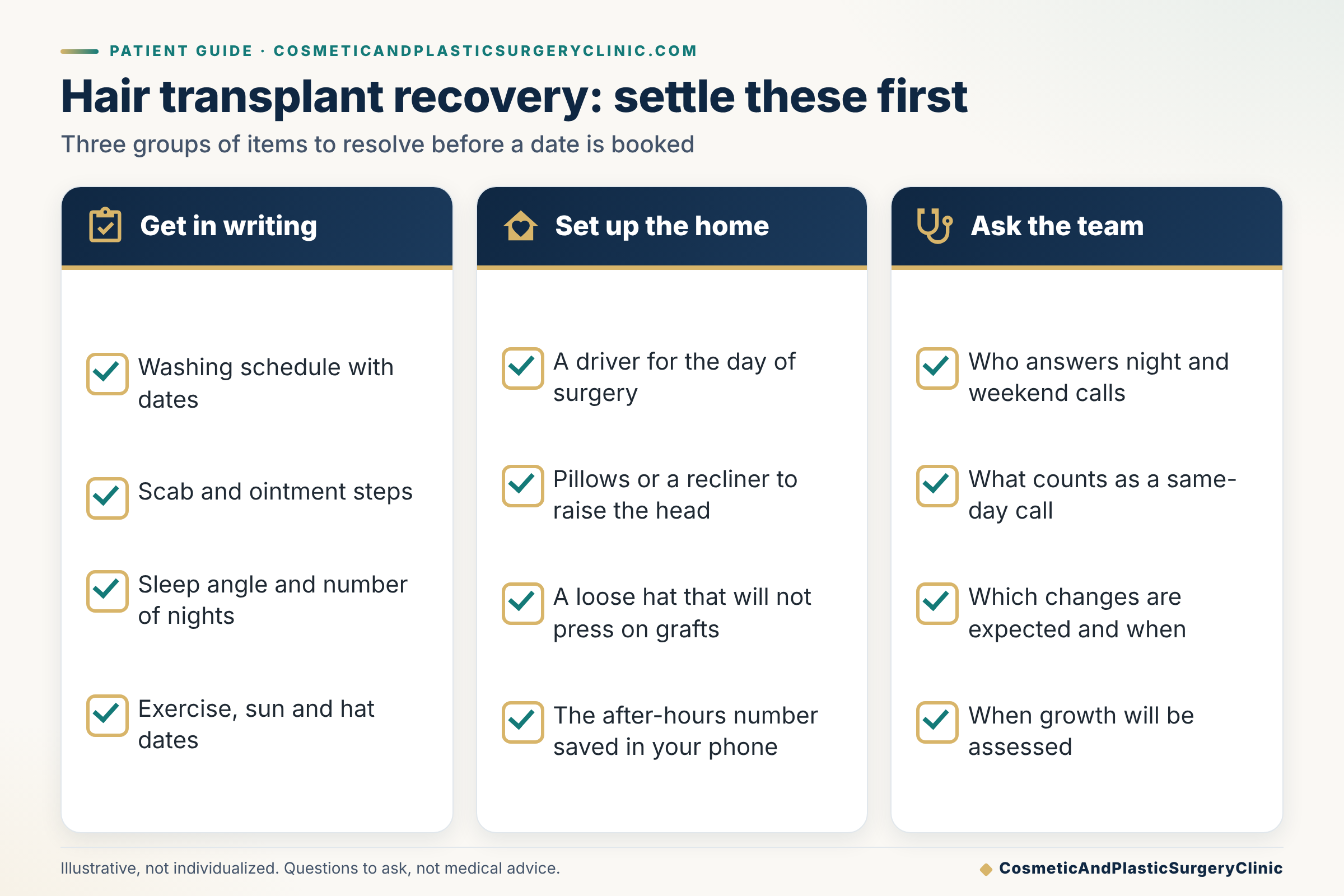
Plan the first 72 hours of hair transplant recovery as if you cannot do much: a driver, pillows that hold the head raised, meals that need no bending, a hat that will not press on grafts, and the after-hours number saved in your phone.
Smoking, alcohol and medicines around the date
MedlinePlus says most providers advise stopping tobacco at least four weeks before surgery because smoking reduces oxygen reaching the wound, and that nicotine gum around the time of surgery is not encouraged. The page does not say how long to avoid nicotine afterward. The Ziering handout says to avoid alcohol for 5 days before and after surgery and smoking for 7 days, and the Utah handout asks for no alcohol or smoking for 7 days before.
StatPearls says anticoagulants, antiplatelet drugs and supplements can usually resume 24 to 48 hours after surgery, and its post-operative plan also lists topical and oral hair-loss therapies. Starting, stopping or restarting any prescription is a decision for the prescribing clinician and the surgeon together. Bring a full list of medicines and supplements to the consultation, and do not change a prescription on the strength of an article. The AAD notes that loss can continue after a transplant and that a dermatologist may recommend medicine to slow it.
Follow-up, aftercare and who is behind the operation
Written instructions, visits and when results are judged
ASPS says the doctor will probably want to see you several times during the first month. Stitches, if used, come out between 7 and 14 days across ASPS, Cleveland Clinic and StatPearls. A New York clinic recommends a 10-day visit, by phone for those who live far away, and StatPearls says clinicians should monitor patients for 6 to 12 months until grafts have matured, with photos taken around 6 to 12 months.
Ask for a written hair transplant recovery plan that names the washing schedule, scab and ointment steps, sleep angle, exercise dates, sun rules, the first visit, the after-hours contact and the date the result will be judged. The consultation questions page covers how to ask without feeling rushed, and the touch-up conversation belongs here too, since ASPS says to anticipate that a touch-up may be needed.
Who performs the operation, and what travel changes about aftercare
ISHRS says to be sure a properly trained, experienced and licensed physician is responsible for your treatment, and warns that complications from cheap clinics abroad are often unexpected. The American Board of Plastic Surgery offers a public certification lookup that does not replace a separate license check, and the American Board of Hair Restoration Surgery lists training, post-training experience and written and oral examinations among its requirements. The surgeon verification page walks through the checks.
Aftercare is part of the quote. The CDC warns that follow-up care for complications can be expensive and might not be covered by insurance, and that treatment may be prolonged. If you are weighing surgery away from home, the hair transplant tourism page and the medical tourism page cover what to verify and who treats a problem after you fly home.
Frequently asked questions
Can I wear a hat during hair transplant recovery?
StatPearls says a clean, loose-fitting hat is acceptable immediately after surgery. Handouts add conditions: the Ziering sheet asks for a non-constricting hat when outdoors for more than five minutes and the For The Face sheet asks for a hat or sunscreen outdoors for 30 days. The common thread is that nothing should press on or rub grafts, especially in the first days. Ask your surgeon which hat style is acceptable, when a baseball cap becomes acceptable, and whether the hat should be washed or replaced after sweating.
Does shedding during hair transplant recovery mean the transplant failed?
Usually not. ASPS calls shedding within six weeks normal and almost always temporary, and the AAD puts it between two and eight weeks. The follicles remain and restart. A small share of patients do have poor growth: the 2026 Frontiers review mentions an unexplained mechanism affecting about 0.5 to 1 percent of patients, and the 2,896-patient series recorded partial loss of implanted hair in 5 patients. Growth is judged at several months, so ask when your surgeon plans to assess it and what counts as slow.
Can I smoke or drink alcohol while hair transplant recovery is under way?
Sources lean toward avoiding both. MedlinePlus says smoking reduces oxygen to surgical wounds and that nicotine gum around surgery is not encouraged. One handout asks for no alcohol for five days before and after surgery and no smoking for seven days, and another asks for neither for seven days before. These are single-office rules, and the right window depends on your plan and other medicines. Ask for the exact dates in writing, and speak to the prescribing clinician before changing any prescription.
When can I cut, dye or style my hair during hair transplant recovery?
StatPearls says to wait one week before brushing, two weeks before styling products and one month before cutting or dyeing hair. Handouts differ, and the answer depends on how the recipient area is healing and which products your surgeon allows. One New York clinic says a shaved donor area reaches a crew-cut length by the end of week two. Ask for a date for each task, including hair color and heat styling.
What if a graft falls out during hair transplant recovery?
A lost graft is uncommon: in a series of 2,896 patients, graft dislodgement occurred in 8 patients within the first 24 hours. Handouts across practices warn against picking scabs, which can remove grafts. Do not try to replant anything yourself. Tell the clinic what happened, when, and whether there was bleeding, and ask whether the result is likely to be affected.
Is hair transplant recovery easier after FUE or after a strip?
ISHRS says FUE recovery is faster and can be less uncomfortable in many cases, and that many patients report less postoperative pain after FUE than after strip surgery. FUE leaves tiny round areas open to heal, while a strip is stitched and leaves a linear scar. Stitches, when used, come out after about 7 to 14 days. Session size, anesthesia and your own healing also matter, so ask what the plan means for dressings, shaving, sleeping and exercise. The comparison page covers the decision itself.
What if hair transplant recovery happens at home after surgery abroad?
The CDC warns that follow-up care for complications can be expensive, might not be covered by health insurance and may be prolonged. ISHRS warns that complications from cheap clinics abroad are often unexpected. Before traveling, ask who will see you near home, whether that clinician will speak to the operating team, and whether you can get your records, graft counts and instruction sheet in writing.
Does hair transplant recovery hurt as much as people expect?
ISHRS says most patients report no more than mild discomfort after surgery, typically a day or two, followed by 7 to 10 days of tenderness, and that most patients say the pain was less than a visit to the dentist. That is a society statement, not a measurement, and experience varies. The Aesthetic Society says the scalp is sensitive and the surgeon may prescribe pain medicine for the week after surgery.
Sources and further reading
- ASPS — Hair transplant recovery (accessed 2026-11-13) — bandages, washing, stitches, exercise, work, follow-up visits, shedding and regrowth timing, touch-ups
- The Aesthetic Society — How long does it take to recover from a hair transplantation procedure? (accessed 2026-11-13) — return to work, dressings, pain medicine, antibiotics, shedding, warning signs
- ISHRS — A guide to hair transplant surgery (accessed 2026-11-13) — donor-area healing with FUE and strip harvesting, warning about cheap clinics abroad
- ISHRS — After hair restoration surgery (accessed 2026-11-13) — duration of discomfort and tenderness, pain relief, comparison to a dental visit
- ISHRS — FUE hair transplant: benefits, process and recovery (accessed 2026-11-13) — scabs, native-hair shedding, growth timing, surgeon-to-surgeon variation
- ISHRS — Getting started (accessed 2026-11-13) — responsible physician should be properly trained, experienced and licensed
- StatPearls — Hair transplantation (Goldin, Zito and Raggio; updated 2025; accessed 2026-11-13) — post-operative care, listed complications, shock loss, monitoring
- American Academy of Dermatology — Hair transplant (accessed 2026-11-13) — shedding, thin look at month three, results timing, ongoing loss
- American Academy of Facial Plastic and Reconstructive Surgery — Hair replacement (accessed 2026-11-13) — dressings, shampoo timing, swelling, scabs, growth timeline
- Cleveland Clinic — Hair transplant: how does it work, success rates (accessed 2026-11-13) — recovery milestones, side effects, when to call
- Cleveland Clinic — Telogen effluvium (accessed 2026-11-13) — surgery as a trigger, onset and duration of shedding
- Garg and Garg — Complications of hair transplant procedures: causes and management (Indian Journal of Plastic Surgery, 2021; accessed 2026-11-13) — 2,896 patients, folliculitis, edema, numbness, dislodgement, infection, limits
- Abbasi et al. — Hair transplantation: preventing post-operative oedema (Journal of Cutaneous and Aesthetic Surgery, 2010; accessed 2026-11-13) — 340 patients, timing of edema, prevention methods compared
- Romera de Blas et al. — Complications in follicular unit excision hair transplantation: current evidence and practical approaches (Frontiers in Medicine, 2026; accessed 2026-11-13) — edema, folliculitis, infection, shedding, numbness, overall complication ranges
- Bernstein Medical Center for Hair Restoration — After FUT hair transplant (clinic page; accessed 2026-11-13) — one clinic’s timeline for swelling, shedding, work, flying, numbness, growth
- Bernstein Medical Center for Hair Restoration — After FUE hair transplant (clinic page; accessed 2026-11-13) — donor-area healing, sleep, washing, exercise, follow-up
- For The Face — After hair transplantation instructions (practice handout; accessed 2026-11-13) — sleep angle, washing days, scabs, exercise, pool, hat, bleeding
- Ziering Medical — Hair transplant post-operative instructions, 2023 (practice handout; accessed 2026-11-13) — swelling peak, ice, exercise, sun, alcohol, smoking, numbness, when to call
- Utah Facial Plastics — Post-operative instructions for hair transplant (practice handout; accessed 2026-11-13) — sleep, washing, scabs, exercise, sun, infection signs, emergency symptoms
- CDC Travelers’ Health — Medical tourism (accessed 2026-11-13) — flying after surgery, follow-up care costs, complications abroad
- CDC — About blood clots (accessed 2026-11-13) — deep vein thrombosis and pulmonary embolism symptoms, moving after surgery
- MedlinePlus — Smoking and surgery (accessed 2026-11-13) — stopping tobacco before surgery, wound oxygen, nicotine gum
- American Board of Plastic Surgery — Verify certification (accessed 2026-11-13) — certification lookup, license requirement, state-board alerts
- American Board of Hair Restoration Surgery — Certification requirements (accessed 2026-11-13) — training, experience, written and oral examinations, physician directory