Hair transplant risks fall into a few families: wound problems such as folliculitis and infection, shedding that looks like failure but often is not, scars in the donor area, grafts that do not grow, and a hairline or density pattern that looks wrong. A hair transplant moves your own hair from one part of the scalp to another, so each of these hair transplant risks traces back to the team’s handling of living tissue and to how your scalp responds. This page sorts them into expected effects, complications and emergencies, and gives each number with its source, year and limits.
If you are new to the operation itself, the hair transplant overview explains what it relocates and what it cannot do. For how absolute and relative risk work across all elective procedures, see plastic surgery risks. Nothing here diagnoses a symptom, decides whether surgery suits you, or replaces a consultation.
Hair transplant risks in three tiers: expected, complication, emergency
The word “risk” covers events that call for opposite responses. Scabs on day four and a spreading scalp infection can both appear on a consent form, yet one means follow the aftercare sheet and the other means call the surgeon today. Sorting hair transplant risks into three tiers is the quickest way to decide whether something is routine healing, a reason to phone the team, or a reason to go to an emergency department.
Expected effects that look alarming but are not complications
Scabs, redness, swelling and the forehead
Crusting is so common after the operation that a 2026 review of follicular unit extraction (FUE) complications, in Frontiers in Medicine, labels it “very frequent” and physiological. The same review reports frontal swelling in nearly half of patients in FUE cohorts, and swelling around the eyes in roughly 3 to 5%. Swelling usually shows up on the forehead first because the recipient area sits just above it, which is why surgeons often warn about it before the day arrives.
What separates routine from worrying is direction and size. The International Society of Hair Restoration Surgery (ISHRS) says scabs, redness and occasional bleeding can be normal, while significant yellow pus, drainage or spreading redness is not. Swelling that is easing differs from swelling that keeps growing or comes with fever. The hair transplant recovery article follows the day-by-day arc; this page concentrates on the hair transplant risks that depart from it.
Shedding of transplanted hairs and a thinner look at month three
The American Academy of Dermatology (AAD) says transplanted hair typically falls out two to eight weeks after surgery, that by the third month the area may look thinner than before, and that this is normal. Most patients see results six to nine months after surgery, and some take 12 months. MedlinePlus (reviewed February 2025) likewise says grafts may seem to fall out during recovery but regrow.
That sequence is expected, not a complication, which is exactly why it frightens people. Why the shedding happens and when new hair appears is covered month by month in the hair transplant timeline; here the point is that early shedding alone does not tell you the grafts have failed.
Complications that need a call to the surgical team
Folliculitis, persistent redness and infection
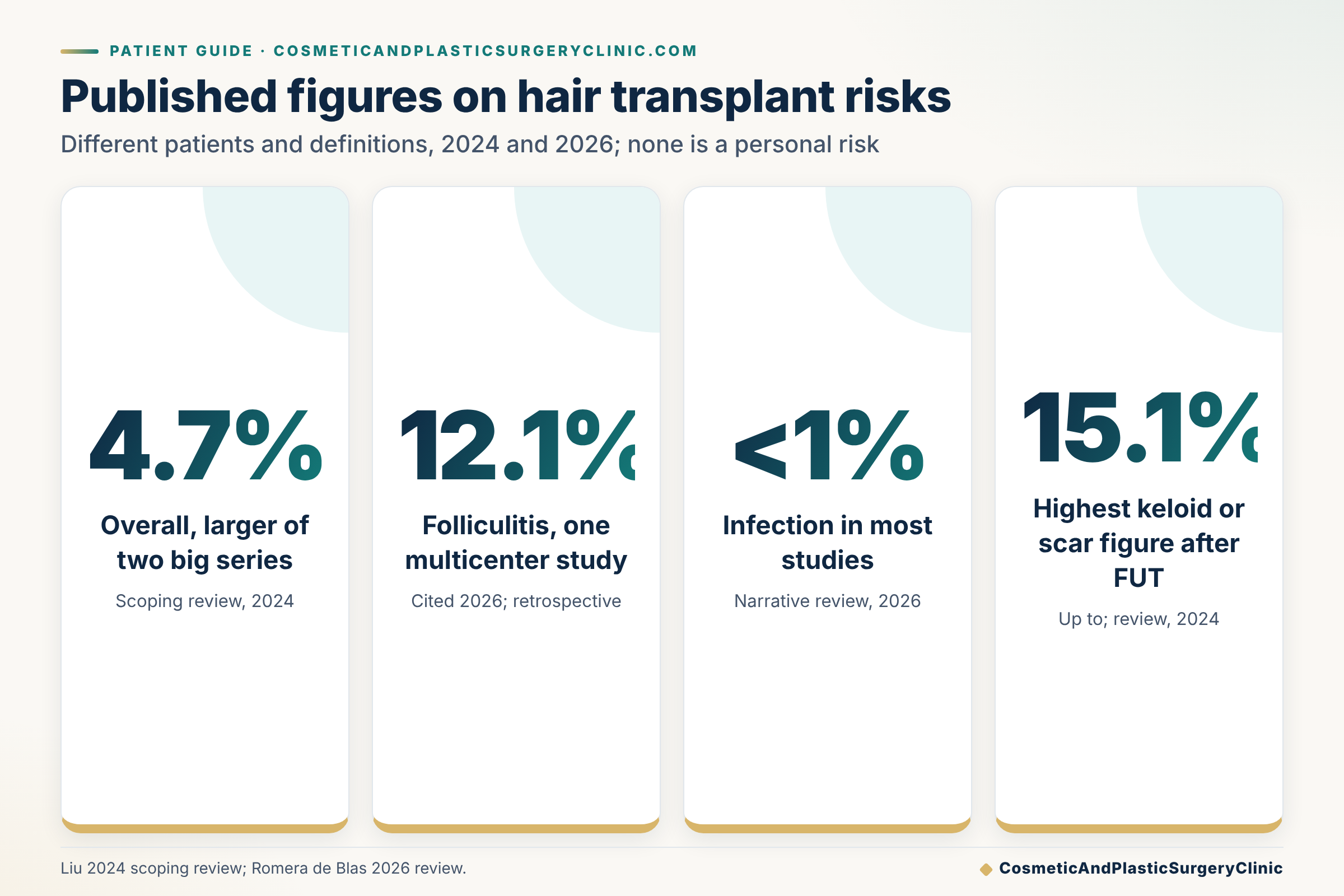
Folliculitis, inflamed hair follicles that look like small red or pus-topped bumps, is the most frequently reported wound complication. A 2026 review cites a large multicenter retrospective study at about 12% (12.1%), and a 2024 scoping review reports sterile folliculitis from poorly defined series ranging up to 53.3%. In a 2021 single-surgeon series of 2,896 patients in India, 203 had sterile folliculitis. The 2026 review adds that infection is reported below 1% in most studies.
Persistent redness is a related finding. In a cohort of 1,090 patients described in the 2026 review, perifollicular erythema, redness around the follicles, was mild in 16.3%, moderate in 5.1% and severe in 0.9%. None of these figures tells you what is wrong with a particular scalp, and hair transplant risks of this kind are sorted by the team, not by a statistic. Bumps, pus, spreading warmth or redness that is not fading are reasons to call the team, which can tell sterile inflammation from infection.
Lumps, cysts, ingrown hairs and numbness that does not fade
StatPearls (updated August 2025) says cysts and ingrown hairs are usually self-limiting, but that they may rarely set off an inflammatory response across the whole graft population, and that releasing entrapped hairs should speed resolution. ISHRS also lists scalp cysts and mild infections among minor side effects. A lump that is growing, tender or red is a question for the surgeon, not something to squeeze at home.
Numbness is among the hair transplant risks that are common early and usually fade, but not always. The 2026 review reports long-term numbness or tingling of about 2% in a large FUE series, mainly in the temporal and occipital areas, and the 2024 scoping review reports persistent numbness in up to 11% across studies. Tell the team if sensation is not returning, and ask what they have seen after their own procedures.
Emergencies: when hair transplant risks mean care now
Anesthesia, sedation, heart and breathing
If one of these hair transplant risks becomes real, do not drive yourself and do not wait for the clinic to open. Say that you recently had a hair transplant and whether you received sedation.
Spreading infection, heavy bleeding and severe pain
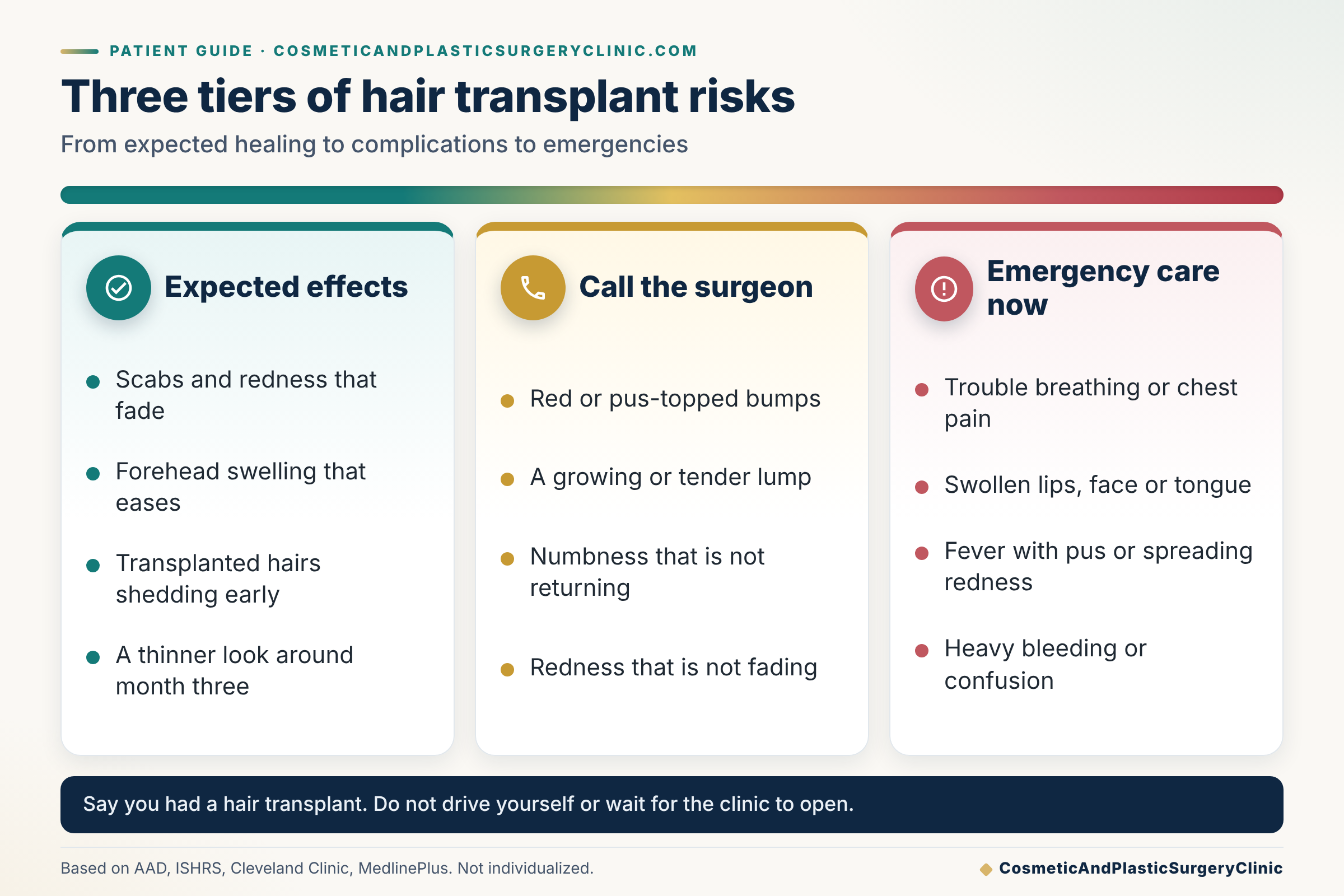
Table 1 lays the tiers side by side. It is a reading aid and a prompt for the pre-operative visit, not a tool for diagnosing yourself.
| What is noticed | Category | General response | Basis |
|---|---|---|---|
| Scabs, redness and forehead swelling that ease over days | Expected effect | Follow the surgeon’s written aftercare; mention changes at follow-up | ISHRS; Frontiers in Medicine review, 2026 |
| Transplanted hairs shedding at weeks 2 to 8, thinner look at month 3 | Expected effect | Wait and keep follow-up visits; ask when growth is judged | AAD; MedlinePlus, Feb 2025 |
| Red or pus-topped bumps, redness that is not fading | Complication | Call the team; they decide between sterile folliculitis and infection | Frontiers review, 2026; Liu, 2024 |
| Growing, tender or red lump; trapped hairs | Complication | Call the team rather than squeezing it | StatPearls, Aug 2025 |
| Numbness or tingling that is not returning | Complication, usually judged later | Raise at follow-up; ask what they usually see | Frontiers review, 2026 |
| Fever that persists, heavy bleeding, severe pain, green or yellow pus | Urgent | Contact the surgeon right away; emergency department if unreachable | Cleveland Clinic, 2021 |
| Trouble breathing, chest pain, palpitations, lip or face swelling, confusion | Emergency | Call emergency services; say you had a procedure and sedation | MedlinePlus anesthesia page, Sept 2025 |
What published studies report about hair transplant risks
Numbers on hair transplant risks come from three kinds of evidence: reviews that gather many papers, large series from single clinics, and case reports. Each counts different things, and none predicts what happens to one scalp. This section shows what each source actually measured, so the figures can be compared on fair terms and so that a clinic quoting “our complication rate” can be asked a sharper question.
Two reviews and one surgeon’s 2,896 patients
A 2024 scoping review of 43 publications
Liu and colleagues (Aesthetic Plastic Surgery, 2024) searched PubMed, EMBASE and Cochrane through the end of 2022 for studies of adults who had FUE or follicular unit transplantation (FUT, the strip method). They included 43 publications, graded at the lowest level of evidence, and excluded patients with non-traumatic or autoimmune alopecia. Two large series reported overall complication rates of 1.2% and 4.7%.
Beyond those two series, the review lists upper ends of reported ranges: bleeding needing intervention up to 8%, persistent numbness up to 11%, infection up to 11%, effluvium at the donor site up to 4.1% and at the recipient site up to 6.5%. Hypertrophic scarring or keloid after FUT, the most common donor-site complication, reached 15.1%. Its authors concluded that serious complications are rare in experienced hands, and that thorough risk discussions still matter because any complication of an elective operation can be distressing.
A 2026 FUE review and a 2021 single-surgeon series
Romera de Blas and colleagues (Frontiers in Medicine, 2026) wrote a narrative review of FUE complications, searching PubMed and Embase to September 2025. They state that no formal quality assessment or pooled analysis was done and that their incidence figures are approximate. They cite overall complications of 1.2% to 4.7% in large series, and one series of 1,030 FUE procedures in which 9.9% of cases had a notable complication, nearly half of them mild.
Garg and Garg (Indian Journal of Plastic Surgery, 2021) reported 2,896 patients operated on by one surgeon over about 10 years, mixing FUT and FUE. By the editors’ arithmetic from the published counts, roughly 7% had sterile folliculitis, 0.9% were dissatisfied, and 0.6% had facial swelling or numbness. Two infections occurred, both in diabetic patients. The paper reports no life-threatening events, but its own stated total of 0.10% does not reconcile with its counts, which is one reason to treat a single-clinic series cautiously.
| Finding | Reported figure | Source and population | Main limit |
|---|---|---|---|
| Overall complications | 1.2% and 4.7% in two large series | Liu, 2024; scoping review of 43 publications | Definitions differ; FUT and FUE mixed |
| Notable complications after FUE | 9.9%, nearly half mild | One series of 1,030 FUE procedures, cited in the 2026 review | Single series |
| Folliculitis | About 12%; sterile folliculitis up to 53.3% | Multicenter retrospective study cited in 2026; Liu, 2024 | Retrospective; poorly defined |
| Infection | Below 1% in most studies; up to 11% in some | Romera de Blas, 2026; Liu, 2024 | Ranges blend mild and serious cases |
| Shock loss or recipient effluvium | 0.15% to 15%; recipient effluvium up to 6.5% | 2026 review; Liu, 2024 | Very wide; criteria vary |
| Keloid or hypertrophic scar after FUT | Up to 15.1% | Liu, 2024 | Upper end of a range |
| Poor growth with no clear cause | About 0.5% to 1% | Earlier report cited in the 2026 review | Mechanism unclear |
Reading the ranges without being misled
Why shock loss runs from 0.15% to 15%
A hundredfold spread in hair transplant risks is not a measurement error so much as a definitions problem. Some studies count only visible loss of native hairs within the grafted area, others count any shedding that the surgeon documented, and a few count patient complaints. Some pool FUT-era data, some include only FUE, and follow-up length changes what gets noticed. The 2026 review warns that earlier reviews often mix FUE with other techniques, so numbers from one method may be quoted for another.
The practical lesson is that the useful question for a consultation is not “what is your shock loss rate” but “what do you count as shock loss, over what period, and in how many patients.” A surgeon who answers with a defined number from their own cases is giving you something a range in a review cannot.
What the figures leave out
Almost every number above describes events that a clinician recorded, usually within months. They rarely capture how a person feels about the hairline in the mirror at two years, or whether density met expectations. The 2026 review reports that 64% of men in an ISHRS practice census reported some disappointment about density, a self-reported figure whose census year and wording the review does not detail. It is a reminder that the most common unwelcome outcome is not a medical complication at all.
Take any single figure on hair transplant risks as one point in a range, and ask where a surgeon’s own practice sits.
Donor scars, graft growth and hairline design: the hair transplant risks you can see
The risks that matter most to many patients are visible ones: a donor area that looks thin or scarred, patches that grow poorly, and a hairline whose angle or spacing gives it away. These hair transplant risks are mostly the result of planning and technique, and they are the hardest to undo. Hair that has been moved cannot be put back, and ISHRS says the operation cannot be undone once done, although it can sometimes be revised.
The donor area
Overharvesting, visible thinning and round scars
The ISHRS guide to FUE names overharvesting, or harvesting outside the safe donor area, as the greatest risk of that method, and says FUE does leave scars. Its patient guide adds that FUE almost always leaves small round scars, which short hairstyles can hide, and that improper FUE can leave diffuse donor thinning and visible scars. ISHRS criticizes “no scar” advertising and says donor hair, once removed, does not grow back.
The 2026 Frontiers review describes what excess harvesting looks like: donor depletion, texture irregularities and visible pinpoint white dots, most obvious in people who wear their hair very short. It suggests graft transection, the cutting of a follicle during extraction, should stay below 10%. ISHRS also warns that punches that are too large, or placed too close together, leave multiple scars. Which method suits which scalp is the subject of FUE vs FUT hair transplant.
The strip scar, keloid and what correction involves
FUT leaves a linear scar in a single area, and ISHRS says FUT scars heal better with each successive decade of life. A 2024 scoping review found hypertrophic scarring or keloid, a raised and thickened scar, to be the most common donor-site complication after FUT, at up to 15.1% in the studies it gathered. StatPearls lists keloid and hypertrophic scars as complications and says patients should be told some scarring is expected.
Donor-area hair transplant risks can sometimes be treated: an unfavorable scar can be revised. ISHRS lists re-excision and closure, transplanting hair into the scar, and scalp micropigmentation (SMP), a tattoo-like pigment technique compared in hair transplant vs SMP. If you or a relative has ever formed thick or raised scars after minor skin injuries, tell the surgeon at the first visit, because it changes how a donor method is weighed.
The recipient area
Poor growth, density limits and blood supply
Grafts can fail to grow for reasons that include injury at extraction, rough handling, poor placement, and too little blood supply. ISHRS says improper excision, handling or placement can destroy grafts. The 2026 review lists poor growth with no identifiable cause at about 0.5 to 1% and says its mechanism is unclear. It advises against excessively high implantation densities, which can strain the blood supply to the skin and cause ischemic complications.
Smoking and bleeding feed into these hair transplant risks too: ISHRS says tobacco can reduce blood supply to the skin, which is linked to a higher risk of transplant failure, and that oozing during surgery can lengthen the time needed to place grafts and may threaten the survival of some.
Unnatural direction, spacing and the hair you have not lost yet
The Frontiers review ties an unnatural hairline to inadequate planning, inexperienced operators and uneven density. ISHRS adds that improper direction and unnatural spacing produce a result that looks transplanted. MedlinePlus lists unnatural-looking tufts among procedure-specific risks, and Cleveland Clinic says several touch-up sessions may be needed to reach a natural-looking result. This is among the hair transplant risks that photographs of one good angle cannot rule out.
Design must also allow for future loss. StatPearls warns that surgery performed too early can deplete donor supply, and that grafting only the vertex can use donor hair prematurely and risk a doughnut appearance as loss continues around it. A conservative hairline is the safer design logic, and the hair transplant candidate article covers what surgeons weigh about age and progression.
Shock loss and the hair you already have
Shock loss: usually temporary, not always
Shock loss, also called recipient-area effluvium, is the shedding of existing hairs in or near the grafted area. StatPearls describes it as transient, with new hairs typically appearing after three to six months, but it also notes that when miniaturization at the recipient site is high, shock loss can be permanent. ISHRS calls temporary telogen effluvium, the shedding of native hair, “quite psychologically devastating” but says it should recover over months.
Reported frequencies span 0.15% to 15% in the 2026 review, for reasons covered earlier. If you were already thinning in the area, ask the surgeon what they expect, because hairs that were weakened before surgery are the ones that may not return.
Ongoing native hair loss is not a surgical failure, but it can look like one
AAD says hair loss can continue after a transplant, and that a dermatologist may recommend medicine to help keep the results. StatPearls suggests deferring surgery in younger patients whose loss is progressing quickly while medical therapy is started, and describes continuing therapy after surgery. Whether and which medicine fits you is a decision for the clinician who can prescribe it, not for this article.
The practical hair transplant risk is a mismatch: a transplanted patch that holds steady while the surrounding native hair thins can look like an island, even though every graft is alive. Ask how the plan allows for further loss, and who will follow your scalp over the years, not only the first year.
Rare hair transplant risks: unusual infections, anesthesia and bleeding
Most hair transplant risks are minor or visible. A small group is neither: events that are uncommon, sometimes serious, and mostly connected to infection control, anesthesia and bleeding. Their rarity makes them hard to measure, so this section leans on case reports and review statements and says plainly where the evidence is thin.
Infection and unusual inflammatory reactions
When bumps are more than folliculitis
The 2024 scoping review reports infection in up to 11% of cases across studies and notes two reports of Kaposi varicelliform eruption, a widespread viral skin infection, and one of mucormycosis, a rare fungal infection. The 2026 Frontiers review adds other uncommon findings: arteriovenous fistula, an abnormal artery-to-vein connection, with 11 donor-area and 2 recipient-area cases in a systematic review and an incidence it describes as well below 0.1%; vasculitis-like lesions in a 10-patient series; and recipient-area necrosis, in which skin loses its blood supply, known only from case reports.
These reports are why a scalp that is getting worse, not better, deserves a call rather than waiting, even though such hair transplant risks are uncommon. StatPearls says the scalp’s rich blood supply allows quick healing and low infection rates, which fits most patients’ experience, but “low” is not “none,” and the cases above show what it can look like when it goes wrong.
Cleanliness you can actually check
ISHRS says cross-contamination in poorly run clinics can cause serious infections that damage follicles and cause scars, and it warns that “factory type” operations risk bloodborne infections such as HIV and hepatitis, while citing no specific cases.
Questions you can ask without clinical knowledge: how instruments are sterilized and how many patients are operated on at once. The choose a plastic surgeon article covers how to verify the person and the facility behind those answers.
Anesthesia, sedation and bleeding
Local anesthetic, sedation and why monitoring is a fair question
Hair transplants are usually done under local anesthesia, and AAD says some patients also take a mild sedative. MedlinePlus says anesthesia is generally safe but names heart rhythm problems, breathing problems and allergic reactions, mostly in the context of general anesthesia. ISHRS adds that cocaine can dangerously enhance the effects of lidocaine, which is why recreational drug use must be disclosed rather than hidden.
A 2026 preprint on Research Square, not yet peer reviewed, describes one fatal case in which the authors attributed a 45-year-old man’s death to systemic lidocaine toxicity on the second day of an FUE procedure in India. The authors admit that dose records were missing and that coronary narrowing might have contributed, and no incidence can be drawn from one case. It is included only to explain why, among hair transplant risks, you may fairly ask who monitors you, what resuscitation equipment is on site, and how the team limits anesthetic volume.
Medicines, supplements and bleeding
ISHRS says the risk of excessive bleeding is minimal to none for most patients, but that tobacco, alcohol, many prescription drugs, aspirin and anti-inflammatory pain relievers, some herbal products such as garlic, ginger, ginkgo and ginseng, and vitamin E supplements can all contribute. The 2024 scoping review reports bleeding needing intervention in up to 8% across studies, so the range is wide.
Give the surgeon a complete list of everything you take, including over-the-counter products and supplements. Never stop a prescribed blood thinner or any other prescribed medicine on your own because of an article; the prescriber and the surgeon decide that together, and ISHRS notes that surgery may be delayed until a risk factor has been reduced.
Why hair transplant risks differ from person to person
A pooled rate for hair transplant risks blends together scalps with different diagnoses, habits and healing, operated on by teams with very different training. A few factors that change hair transplant risks are named often enough in the sources to deserve a direct question. None of them predicts what will happen to one person, and several are about who does the work, not about the patient at all.
Patient and diagnosis factors
The diagnosis comes before the technique
Not all hair loss is pattern loss. Cleveland Clinic (updated January 2023) says a hair transplant is usually not a good treatment for scarring alopecia, because scar tissue under the skin can keep transferred hair from growing, and that a skin biopsy can confirm the diagnosis. StatPearls quotes graft survival of 87%, 71%, 60% and 41% at one, two, three and five years in the context of frontal fibrosing alopecia, a scarring condition.
The 2026 Frontiers review recommends clinical and trichoscopic examination before surgery to exclude early scarring alopecia. The ISHRS consumer alert lists misdiagnosis, and failure to diagnose hair disorders and related disease, among the risks of having evaluation done by someone unqualified. Ask who diagnoses your hair loss, and whether anything beyond a look at the scalp will be done. Candidacy as a whole is covered in the hair transplant candidate article.
Age, tobacco, medicines and other health conditions
AAD says younger men with ongoing hair loss may be asked to wait and start hair-loss medicine first, and StatPearls ties early surgery to donor depletion, one of the quieter hair transplant risks. ISHRS says tobacco may reduce blood supply to the skin and so raise the risk of graft failure, and that alcohol impairs platelet function and certain prescription and over-the-counter drugs raise bleeding risk. The Frontiers review lists careful selection, smoking cessation and optimizing comorbidities as essential preparation.
For medical conditions, evidence is thin. In the 2021 series, the two infections were both in diabetic patients, which is two cases and proves nothing, but it is why a surgeon may ask about blood sugar or want clearance from your physician. Say everything about your health and habits at the first visit, because hair transplant risks are easier to plan around when the surgeon knows them; hiding nicotine or drug use removes a safeguard rather than protecting you.
Team, setting and facility factors
Who actually makes the incisions
ISHRS’s position statement, revised by its Board of Governors in July 2024, says any procedure with a skin incision for tissue removal or site preparation is surgery and must be done by a properly trained, licensed physician, and that robotic harvesting tools count as extensions of the operator’s hands. It recognizes that physician assistants and nurse practitioners may take part in some countries when licensed and supervised by a physician with hair surgery competence. The Frontiers review links iatrogenic injuries, harm caused by treatment, to delegating key steps to unqualified staff.
Licensure alone is a low bar. The American Board of Hair Restoration Surgery notes that any individual with a medical license can legally perform hair restoration surgery, and presents its certification as the only one focused on the field. The cosmetic surgeon credentials article explains what different credentials do and do not show, and the plastic surgery consultation article covers how to run the visit.
Very low prices, packages and cross-border clinics
Price is a legitimate reason to compare options, and many people are well served by clinics far from home. But ISHRS describes “black market” clinics run by technicians with little or no training, with professional-looking websites and testimonials. Its illegal-transplant page says patients can believe they are paying for 4,000 to 6,000 grafts while receiving about half, and that there is no recourse when something goes wrong. These are the views of a professional society that campaigns against such clinics, so treat the specifics as advocacy, though they match the complications listed elsewhere.
Marketing labels do not signal safety. ISHRS says terms such as “Sapphire FUE” and “Ice FUE” are not recognised by the society and that direct hair implantation is not a transplant method. For the cross-border picture, see hair transplant tourism and the general medical tourism and surgery article, and for what a fair quote contains, hair transplant cost.
| Factor | Why it matters | Question to ask the surgeon | What is uncertain |
|---|---|---|---|
| Diagnosis of the hair loss | Scar tissue can keep grafts from growing (Cleveland Clinic, 2023) | How was my diagnosis confirmed, and is a biopsy needed? | Survival data in scarring disease come from small series |
| Young age and fast, ongoing loss | Native hair keeps thinning; early surgery can deplete donor supply (StatPearls, 2025) | How does your plan allow for the loss still to come? | No source gives a personal forecast |
| Tobacco or nicotine | May reduce blood supply to the skin and raise graft-failure risk (ISHRS) | What are your rules on nicotine before and after? | No source read measures the effect on graft survival |
| Blood-thinning drugs, aspirin, supplements | Can increase oozing and threaten some grafts (ISHRS) | Which of my medicines and supplements matter? | Risk is minimal for most patients, per ISHRS |
| Diabetes and other conditions | Two infections in a 2,896-patient series were in diabetic patients | Do you want medical clearance first? | Two cases cannot show cause |
| Who performs each step | Incisions are surgery; delegation raises injury risk (ISHRS 2024; Frontiers 2026) | Who extracts, who makes recipient sites, who implants? | Rules vary by country |
| Graft number and density in one session | Very high density can strain blood supply; overharvesting depletes donors | How many grafts, at what density, and why? | No agreed ceiling in the sources read |
Seven questions that turn hair transplant risks into specific answers
General statistics help you ask better questions; they cannot replace a surgeon’s answers about your own scalp. The questions below are built to separate a team that has thought through hair transplant risks from one that is reciting reassurance. A specific answer, with a number, a name or a written policy attached, is the signal worth listening for.

Questions about numbers, diagnosis and donor supply
Ask for the surgeon’s own rates and how they are defined
Ask what rates of folliculitis, infection, shock loss, poor growth and repair surgery the surgeon has seen in their own hair transplant patients, how each is defined, and over how many cases and how many years. A reply of “almost none” without definitions is not an answer. Ask also which problem they see most often, and what they changed after the last one.
Then ask when growth is judged. AAD says most patients see results six to nine months after surgery, and some take 12, and Cleveland Clinic says full results can take up to a year.
Ask how the diagnosis was made and how much donor hair this will use
Ask how your hair loss was diagnosed, whether a scalp examination or biopsy was part of it, and what else was considered. Then ask how many grafts the plan uses now, what donor supply is left afterward, and what happens to the plan if loss continues. The donor area is described by StatPearls as one of the primary limiting factors in this surgery regardless of technique, so a plan that spends it all early leaves less for later.
Questions about the team, the setting and what happens afterward
Who does each step, where, and who answers at night
Ask who will extract grafts, who will make the recipient sites and who will place the grafts, and ask for names and licenses. ISHRS advises asking whether you may have an observer in the room to confirm who operates and says that a refusal should make you think twice. Ask what anesthesia and monitoring are used, who gives it, and what the plan is if you feel unwell during or after the day.
Ask also who you call at 2 a.m. with spreading redness, heavy bleeding or fever, and where you would be seen. If you are traveling, ask how follow-up works once you are home; the general issues are in medical tourism and surgery, and the questions specific to this field are in the sibling guide on hair transplant tourism.
Repair terms, and when waiting or no treatment is reasonable
Ask what a touch-up or repair costs if growth is poor or the design needs adjusting, whether the surgeon’s fee, facility and anesthesia are billed again, and what the written policy says. Cleveland Clinic notes several touch-up sessions may be needed in some cases, so the policy is not a hypothetical. The general risk article explains how to read the consent form’s wording.
Waiting, a second opinion, a medical evaluation and no surgery are all legitimate. AAD says candidates need enough donor hair and that realistic goals matter, and that a full head of hair may not be a realistic goal. Pressure, vague answers, discounts that expire, or a quote with no examination should slow you down, not speed you up.
Frequently asked questions
How can I tell shedding from graft failure among hair transplant risks?
Timing is the main clue, and it is not a verdict you can reach alone. AAD says transplanted hair typically falls out two to eight weeks after surgery and that the area may look thinner by month three, with results at six to nine months and sometimes 12. Failure is a judgment made later, from comparison photographs taken at fixed intervals. Ask the surgeon when growth is assessed, what they expect to see at each visit, and what would make them call a graft problem rather than normal shedding.
Do hair transplant risks include a donor area that does not grow back?
ISHRS says donor hair, once removed, does not grow back, and that the strongest risk of FUE is overharvesting or taking hair from outside the safe donor area. Scars heal and hair around them may camouflage them, but a thinned or depleted donor zone is described as hard to correct. That is why donor supply is planned as a limited resource for the years ahead, not just for the day of surgery.
Are hair transplant risks lower with FUE than with FUT?
The 2026 Frontiers review says FUE’s slightly better safety profile compared with FUT has not been statistically confirmed, and that earlier reviews often mixed techniques. The risks differ in kind: FUT leaves one linear scar and carries the keloid and hypertrophic scar figures discussed above, while FUE spreads small round scars and carries overharvesting risk. Neither method removes the risks. Ask the surgeon which method fits your scalp and why, and read the technique comparison article.
Can the hair transplant risks of a poor hairline or a bad scar be fixed?
Sometimes. ISHRS says the operation cannot be undone but can be revised with further surgery, and its FUT page lists re-excision and closure, transplanting hair into the scar and scalp micropigmentation as options for an unfavorable scar. Cleveland Clinic notes that touch-up sessions may be needed in some cases. Repair depends on how much donor hair remains and on the tissue left behind, so an assessment by a surgeon experienced in repair is the first step, not a quote.
Do hair transplant risks include HIV or hepatitis?
ISHRS warns that clinics operating in a factory-type environment risk cross-contamination, and it names HIV and hepatitis, though the page cites no specific cases and gives no rate. The point is not to assume harm but to ask the same questions a patient would ask about any procedure: how instruments are sterilized, whether single-use items are used, and how many patients are treated at once. If you have any concern after a procedure, a clinician can advise on testing.
Who should I call first if one of the hair transplant risks appears after surgery?
Call the surgical team named in your discharge instructions, and keep the number somewhere you can find at night. Cleveland Clinic lists a fever that does not go away, excessive scalp bleeding, severe redness or pain, and green or yellow pus as reasons to contact the provider right away. If you cannot reach the team, or you have trouble breathing, chest pain, palpitations, swelling of the lips or face, or confusion, go to an emergency department or call emergency services.
Have hair transplant risks been compared between clinics at home and abroad?
Not in the sources read for this page. ISHRS says specialists see complications from cheap clinics and urges extreme caution with cross-border care, but it publishes no comparative rates, and the large reviews cited here did not separate patients by country. That absence cuts both ways. What can be checked is who operates, in what facility, and who handles problems afterward.
Sources and further reading
- Romera de Blas, Vega Díez, Ricart Vayá and Gómez Zubiaur — Complications in follicular unit excision hair transplantation: current evidence and practical approaches, Frontiers in Medicine 2026 (accessed 2026-11-13) — narrative review with incidence table
- Liu et al. — A Scoping Review on Complications in Modern Hair Transplantation: More than Just Splitting Hairs, Aesthetic Plastic Surgery 2024 (abstract; accessed 2026-11-13) — 43 publications, complication ranges
- Garg and Garg — Complications of Hair Transplant Procedures: Causes and Management, Indian Journal of Plastic Surgery 2021 (accessed 2026-11-13) — single-surgeon series of 2,896 patients
- StatPearls — Hair Transplantation (updated August 2, 2025; accessed 2026-11-13) — shock loss, scarring, donor limits, design
- ISHRS Fight the FIGHT — Beware of the Risks (modified September 16, 2026; accessed 2026-11-13) — infection, overharvesting, poor growth, unnatural design
- ISHRS Fight the FIGHT — Beware Illegal Hair Transplant (modified October 31, 2026; accessed 2026-11-13) — technician-run clinics, graft-count claims, what to verify
- ISHRS — Position Statement on Qualifications for Scalp Surgery (revised July 13, 2024; accessed 2026-11-13) — who may make incisions
- ISHRS — Consumer alert on unlicensed technicians performing hair restoration surgery (undated PDF; accessed 2026-11-13) — four questions to ask, misdiagnosis risk
- ISHRS — A Guide to Hair Transplant Surgery (modified August 25, 2024; accessed 2026-11-13) — irreversibility, scars, marketing terms
- ISHRS — Guide to FUE Hair Transplant (modified July 24, 2024; accessed 2026-11-13) — overharvesting, donor scars, telogen effluvium
- ISHRS — FUT Hair Transplant: Benefits, Procedure and Recovery (modified November 6, 2025; accessed 2026-11-13) — linear scar and correction options
- ISHRS — Smoking, drinking, medications and herbal products and hair restoration surgery (modified September 7, 2024; accessed 2026-11-13) — bleeding, blood supply, disclosure
- American Academy of Dermatology — A hair transplant can give you permanent, natural-looking results (accessed 2026-11-13) — shedding timeline, donor strip scar, ongoing loss
- Cleveland Clinic — Hair transplant (reviewed April 30, 2021; accessed 2026-11-13) — risks and when to contact a provider
- Cleveland Clinic — Scarring alopecia (updated January 6, 2023; accessed 2026-11-13) — transplant and scarring alopecia, biopsy
- MedlinePlus — Hair transplant (reviewed February 5, 2025; accessed 2026-11-13) — risks and results
- MedlinePlus — Anesthesia (updated September 30, 2025; accessed 2026-11-13) — types of anesthesia and risks
- American Board of Hair Restoration Surgery — About the board (accessed 2026-11-13) — certification and the legal-licensure point
- Gokul et al. — Fatal systemic lidocaine toxicity during hair transplantation: a case report with medicolegal analysis, Research Square preprint 2026, not peer reviewed (accessed 2026-11-13) — one fatal case report, limits stated