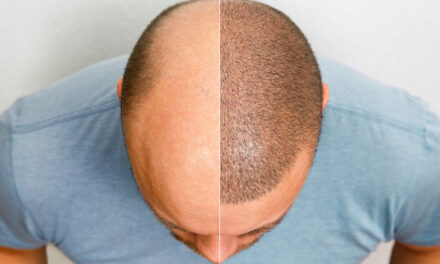
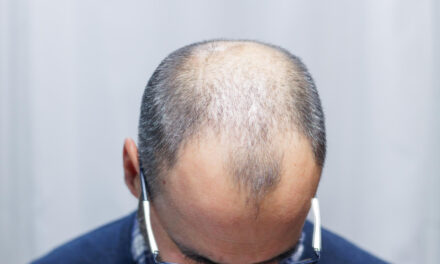
A hair transplant candidate is not someone who simply has less hair than they would like. Surgery moves hair that already exists from one part of the scalp to another, so the question a clinician asks first is whether the loss has a cause that surgery can sensibly address, and whether enough healthy hair is available to move. The answer depends on diagnosis, donor supply, stability, age, general health and what the person hopes to see.
This page explains how a hair transplant candidate is evaluated, in six checks drawn from society guidance and published reviews. It is education, not a verdict: no article, photo or online quiz can say who qualifies. The procedure itself is covered in hair transplant, and the visit where these checks actually happen is described in the general plastic surgery consultation guide.
Diagnosis first: why the cause of thinning decides who becomes a hair transplant candidate
Hair loss has many causes, and only some of them leave behind a pattern that transplanted hair can fix. Mayo Clinic calls hereditary-pattern hair loss the most common cause of baldness and describes transplant surgery as an option for the most common type of lasting loss, where only the top of the head is affected. The American Society of Plastic Surgeons (ASPS) and the American Academy of Dermatology (AAD) give similar descriptions. Other causes need other answers, which is why a good evaluation begins with a question rather than a graft count.
Pattern loss: the group surgery was designed for
How androgenetic alopecia behaves over decades
MedlinePlus Genetics estimates that androgenetic alopecia affects about 50 million men and 30 million women in the United States, and reports that more than half of men over 50 have some degree of loss. It can begin as early as the teens. Each hair normally grows for two to six years, rests, and sheds; androgen stimulation in susceptible follicles shortens the growth phase, so replacement hairs come in shorter and thinner until some follicles stop producing visible hair.
The International Society of Hair Restoration Surgery (ISHRS) describes the condition as progressive and notes that, although it is inherited, it is not always predictable. For every hair transplant candidate, today’s pattern is a snapshot of a process that may keep moving. Mayo Clinic is direct about the consequence, stating that hereditary loss will eventually progress despite surgery and that more than one operation may be needed to get the effect someone wants.
How patterns differ between men and women
In men, MedlinePlus Genetics describes loss beginning above both temples, so the hairline recedes into an M shape, with thinning at the crown that can progress to partial or complete baldness. In women, hair becomes thinner over the top of the head and the middle part widens; the hairline typically does not recede and total baldness is rare. Those two shapes lead to different conversations about who counts as a hair transplant candidate, taken up below.
Clinicians often name the stage of loss with a classification such as the Hamilton-Norwood scale for men or the Ludwig scale for women. A 2025 StatPearls review lists Norwood stages III to V and Ludwig stages II and III among the usual indications for surgery. A stage is shorthand for planning; it does not make anyone a hair transplant candidate.
Look-alikes that need a different answer
Shedding after illness, childbirth or stress
Telogen effluvium is a diffuse shedding that follows a trigger. MedlinePlus lists physical or emotional stress, high fever, childbirth, major surgery, crash diets and some medicines, and says a person may lose one half to three quarters of scalp hair. It is usually temporary, though it can become chronic. ISHRS makes the same point about pregnancy, noting that it can occasionally lead to temporary hair loss in women.
That is why a surgeon who proposes grafts to a hair transplant candidate in the middle of a recent shedding episode deserves a follow-up question. If the hair is likely to come back on its own once the trigger resolves, moving donor hair into the thinning area solves a problem that was never going to be permanent. The sensible first step is a diagnosis.
Patchy, pulled or unexplained loss
MedlinePlus describes alopecia areata as thought to be autoimmune, usually starting as one or several smooth round patches, with hair that may regrow within months without treatment; for more severe cases it says it is not clear how much treatment can change the course. Hair pulling and tight hairstyles are also on MedlinePlus’s list of causes. Mayo Clinic advises talking to a doctor about sudden or patchy loss because it can signal an underlying condition that needs treatment.
How is the cause found? Mayo Clinic lists a history and physical exam, possibly a blood test, a pull test, light microscopy of trimmed hairs and a scalp biopsy. ISHRS says androgenetic alopecia is usually diagnosed by history and examination, and that suspected scarring hair loss calls for referral to a dermatologist and possibly a biopsy. For anyone wondering whether they are a hair transplant candidate, an unexplained pattern is a reason to get the diagnosis before the quote.

Donor hair: the finite supply that sets the ceiling for any hair transplant candidate
Everything transplanted comes from somewhere else on the same head. That makes donor hair a budget, and it is spent once. ISHRS states the goal plainly: never run out of donor hair, because the result will look unnatural and cannot be fixed. A hair transplant candidate with a large area of loss and a small donor supply may be offered a smaller, carefully placed plan than the one in their imagination, and that conversation is part of competent care.
What a surgeon measures at the back and sides
Density, the safe zone and why the numbers vary
The 2025 StatPearls review describes the safe donor zone as the mid-occipital region, between the upper and lower occipital protuberances, and says hair there is androgen-resistant, so transplanted hair keeps its donor characteristics. It gives a typical donor density of 65 to 85 follicular units per square centimeter, calls densities over 80 excellent and describes densities below 40 as less suitable, and names donor supply as a primary limiting factor. Those are one review’s figures, not cut-offs any regulator applies to a hair transplant candidate.
Measuring density, usually with a magnifying device on the scalp, is a skill-dependent estimate, and it is one reason a photo-only assessment cannot show whether someone is a hair transplant candidate. A 2018 blog post hosted by the ASPS, written by a plastic surgeon and stating that it reflects the author’s views, describes an ideal donor area as dense with few or no prior hair restoration scars.
Caliber, curl and color contrast
Donor hair is judged by more than count. ISHRS lists color, caliber (shaft thickness), curl or wave, and density as the characteristics that shape a plan, and calls caliber one of the most important. Thicker hair adds bulk, so fewer grafts can look fuller; densely curled hair can look fuller with fewer grafts than fine straight hair needs; and low contrast between hair and scalp color can make density look greater because the scalp shows through less.
These traits cut both ways. StatPearls notes that lighter hair on lighter skin gives better apparent coverage with fewer grafts, and that Afro-textured hair carries higher risks of follicle transection and keloid scarring and may require specialized techniques. Neither statement ranks anyone as a better or worse hair transplant candidate; both explain why a surgeon examines hair type as carefully as hair count, and why experience with your hair type is a fair question.
Why a larger bald area does not always mean a larger plan
Coverage against supply, and the hair still to be lost
Supply and demand pull in opposite directions as loss advances. ISHRS describes demand for coverage growing while donor hair shrinks because baldness can encroach on the donor zone, and notes that women often have less donor capacity than men even though they usually lose less overall. Surgeons therefore plan a hair transplant candidate for the head a person will have in ten or twenty years, not only the one in the mirror.
The StatPearls review makes the same point in clinical terms: frontal baldness often yields the most dramatic, lasting results, and grafting only the vertex (crown) should generally be avoided, since a growing bald circle there can outrun the supply. The ASPS-hosted blog adds that surgery usually will not restore the density and hairline shape of adolescence because donor supply is limited. A realistic plan trades coverage across zones; it does not recreate a younger head.
Where the technique enters the candidacy question
Technique can change what a hair transplant candidate is offered. ISHRS says FUT (follicular unit transplantation, the strip method) tends to suit people who keep hair longer than about an inch, may heal better with age, and is often preferred in very advanced loss such as Norwood 6 or 7, where the donor zone is compressed and over-harvesting is a risk with FUE (follicular unit extraction). It gives the strip as 0.5 to 1.5 cm wide and 5 to 30 cm long, leaving a linear scar.
AAD adds the other side: the individual-follicle method takes longer but avoids the strip scar, which can matter for someone who wants very short hair. The full comparison of scars, graft handling and recovery sits in FUE vs FUT hair transplant. For this article the point is narrower: a hair transplant candidate is evaluated for a specific method as well as for surgery in general.
Age and stability: when “not yet” is the right answer for a hair transplant candidate
Two people can share the same photo and get opposite advice about being a hair transplant candidate, because one has a pattern that has settled and the other has a pattern that is still moving. Surgeons read age and rate of change as evidence about the future, and the sources agree on the direction of that evidence even when they do not agree on exact cut-offs.
Why younger men are often asked to wait
A moving pattern is hard to plan around
The AAD says men in their 20s may be asked to wait and try hair loss medicine first. The 2025 StatPearls review is more specific: it advises deferring surgery in young patients and starting medical therapy for at least a year, and says transplantation should ideally be considered only after age 25. It also suggests that more than 15% miniaturization in the recipient area warrants 6 to 12 months of medical therapy first, and that people with under 50% loss should stay on medical therapy until loss exceeds that mark.
ISHRS explains the stakes. It warns that transplanting young men, especially without medical therapy, may lead to future disasters that cannot be fixed. Consider a hypothetical 22-year-old with early temple recession who has grafts placed to rebuild a low hairline. If loss continues behind and around that line, a patch of transplanted hair can sit in front of a thinning, unplanned scalp, and the donor supply that could have helped later has already been spent.
Medical therapy as context, not a prescription
This section describes what the sources say; whether any medicine suits a given person is a decision for the prescribing clinician. ISHRS says only two medical therapies are FDA-approved for androgenetic alopecia: oral finasteride for men and topical minoxidil for men and women. It says medical therapy is far more effective in early cases before full baldness sets in, that optimal results take 6 to 12 months, and that gains dissipate if treatment stops.
MedlinePlus echoes the timing. Its minoxidil page says at least four months, possibly a year, are needed to see an effect, that it does not affect receding hairlines, and that most new hair is lost within a few months of stopping. Its finasteride page says loss is only slowed while the drug is taken. Both pages say to talk to the prescriber before changing anything. For the hair transplant candidate, medical therapy is often the test of stability, and the two approaches are frequently combined rather than chosen between.
Women and diffuse thinning
Why diffuse patterns narrow the field
ISHRS says women typically have diffuse thinning along the part line and crown without a pronounced frontal recession, and frequently have thinning even in traditional donor areas, which calls for a meticulous assessment of follicle viability. It describes better candidates as those with predictable patterns of thinning rather than widespread, rapidly progressive loss, and with donor hair resistant to hormonal miniaturization. That is a stricter test for a hair transplant candidate than many women expect.
The ISHRS page also names the tools of that assessment: scalp biopsy, blood tests and trichoscopy, which is dermoscopy of the scalp. Its androgenetic alopecia page adds that, for women, blood work covering iron, thyroid function and hormones can be important in the initial workup. The 2018 ASPS-hosted blog, again as the author’s view, says women may be candidates when hair loss is localized and resembles the male pattern rather than diffuse thinning. A woman asking whether she is a hair transplant candidate often learns the answer is a workup first.
Pregnancy, postpartum and menopause timing
Life stages change both the cause and the timing. MedlinePlus lists childbirth among telogen effluvium triggers, ISHRS notes pregnancy can occasionally cause temporary loss, and MedlinePlus Genetics says female-pattern loss is most likely after menopause. A woman who has recently delivered and is shedding heavily may be dealing with a temporary process that makes a surgical plan premature.
None of the sources we read sets a universal waiting interval after pregnancy, illness or a medicine change. The useful framing is the pattern: a clinician wants to know whether the thinning is settling, steady or still advancing, and may reasonably ask for a recheck in months before offering a plan.

Scalp disease, general health and habits that move the timing
Healthy donor hair is necessary for a hair transplant candidate but not sufficient. The scalp that receives grafts has to be able to grow hair, and the person receiving anesthesia has to be well enough for elective surgery. This is where the difference between pattern loss and scarring disease is sharpest, and where the evidence is thinnest.
Scarring alopecias and the quiet-scalp rule
What “inactive” means and why waiting is built in
ISHRS says that for people with cicatricial (scarring) alopecia, the possibility of a hair transplant is usually limited or, at best, uncertain. The reason it gives is mechanistic: these conditions often involve the immune system attacking hair follicles, so new grafts can become targets too. Diagnosis typically involves a biopsy, and ISHRS names a board-certified dermatologist as the best choice for an accurate diagnosis.
StatPearls separates active from inactive disease. It lists inactive lichen planopilaris, inactive frontal fibrosing alopecia and inactive folliculitis decalvans among indications, and calls the active forms contraindications. For scarring conditions it suggests considering surgery after about two years disease-free, and says alopecia areata also calls for at least two years without activity. Those are one review’s suggestions; a dermatologist applies them case by case.
What the published evidence in scarring alopecia shows
The numbers are small. A 2019 systematic review by Ekelem and colleagues found 15 reports covering 34 patients with primary scarring alopecia. Twenty-six had moderate to positive results and eight had negative results or recurrence. Reported positive outcomes included central centrifugal cicatricial alopecia, en coup de sabre, discoid lupus and folliculitis decalvans, while lichen planopilaris and frontal fibrosing alopecia showed both good and poor results. The authors warn of publication bias toward positive reports.
The same authors call medical therapy after transplantation absolutely decisive for success and say surgery should be considered only if the person commits to frequent follow-up and adherence. For a possible hair transplant candidate with a scarring condition, then, the question is not just “is it quiet,” but “who will watch it, and for how long.”
General health, medicines and habits
Conditions that complicate elective surgery
The StatPearls review lists smoking, diabetes with microvascular damage, hypertension, heart disease, immune deficiency, excessive alcohol use and advanced scalp sun damage as conditions that complicate surgery. ISHRS says certain underlying medical issues must be addressed and stabilized before transplantation. Mayo Clinic notes the operation does not require hospitalization but is painful, so sedation is typically given, and lists bleeding, bruising, swelling and infection as possible risks.
Sedation brings the same screening questions as any elective procedure: heart and lung history, medicines, prior reactions to anesthesia and who monitors you. Procedure-specific complications are laid out in hair transplant risks, and the general effect of nicotine on wound healing is covered under plastic surgery risks.
Medicines, supplements and the written list
Medicines can be part of the cause, part of the plan, or a safety issue. Mayo Clinic lists medications and supplements among causes of hair loss and says that when a medicine is responsible, addressing it comes first. MedlinePlus advises keeping a written list of every medicine, supplement and vitamin and bringing it to appointments, and says not to stop a prescribed medicine without talking to the prescriber.
Bring that list to every opinion, including blood thinners, over-the-counter pain relievers, hormones, supplements, and any product used on the scalp. A surgeon cannot judge bleeding risk, healing or interactions from an unspoken list, and a hair transplant candidate who keeps a habit private is removing the information that makes the plan safe.
Expectations: the check that no scalp exam can measure for a hair transplant candidate
Being a hair transplant candidate has a human half. The sources that describe donor density and disease activity also describe expectations as a gate, and with reason: the outcome of a technically good operation can still be disappointing if the hoped-for result was never available. Reading about what surgery can and cannot do is part of the evaluation, not a preamble to it.
What a realistic goal sounds like
Fuller, not full: goals worded in specifics
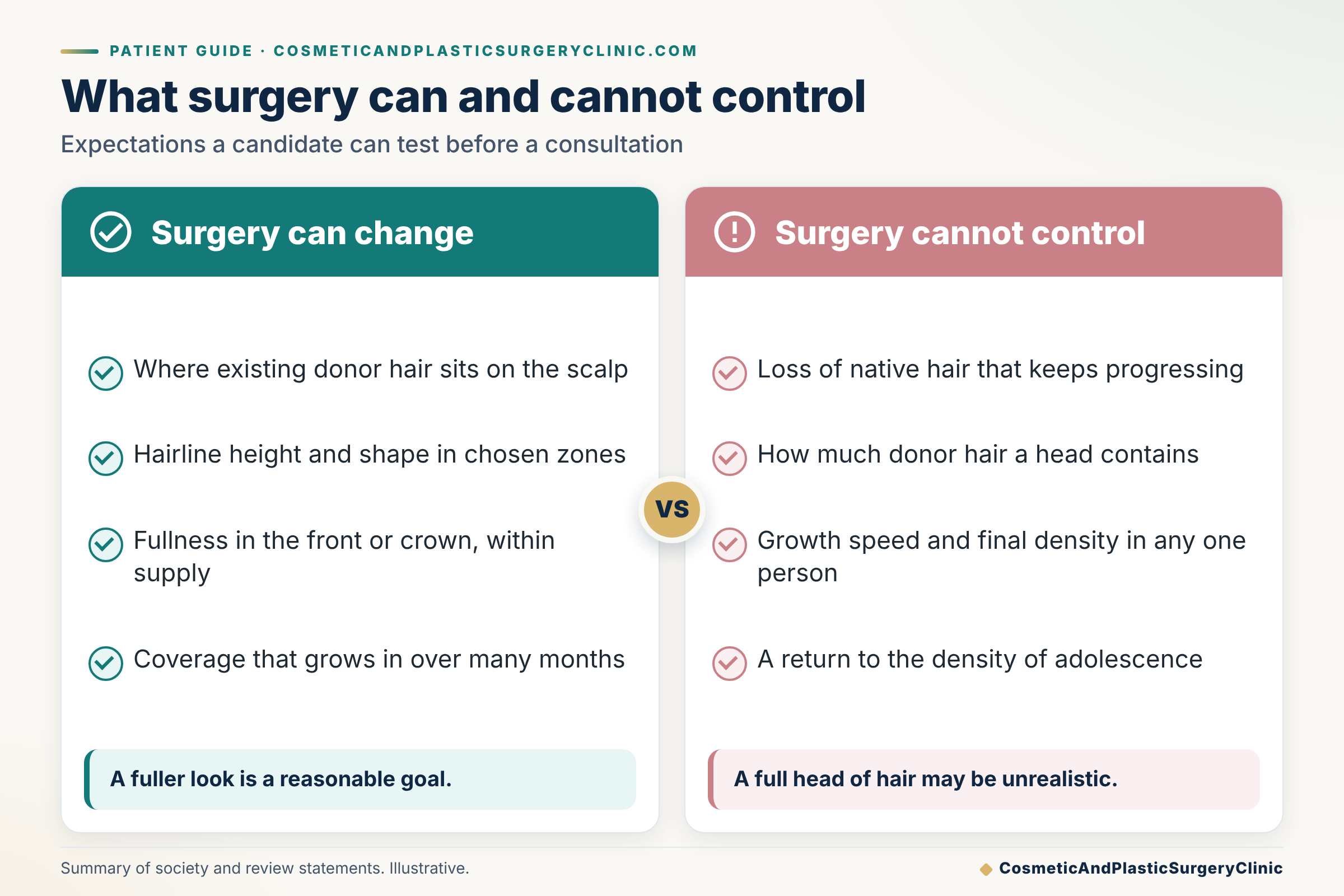
The AAD puts it in one sentence: a full head of hair may be unrealistic, but a fuller head of hair can be a reasonable goal. The ASPS-hosted 2018 blog says patients must have realistic expectations as for any elective cosmetic procedure and that surgery may create or restore a frontal hairline and add density to the crown, but usually will not restore the density and shape of adolescence. Goals that fit that language are specific: a conservative hairline that frames the face, less scalp showing at the crown under bright light, or filling a corner of recession.
Goals that do not fit are the ones nobody can measure: “my old hair back,” “like that photo,” “never think about it again.” The AAD says transplanted hair typically sheds two to eight weeks after surgery and may look thinner around the third month, which it calls normal, with most people seeing results at 6 to 9 months and some at 12. The month-by-month detail lives in hair transplant timeline; for candidacy, the point is that a result is judged after many months, not on the day.
Ongoing loss, further procedures and what a second session means
Native hair that was not transplanted keeps following its own course. The AAD says hair loss can continue after a transplant and that a dermatologist may recommend medicine to slow new loss and help keep results. ISHRS adds that surgery is not free of marks (it states that no surgery is without scars) and that further loss may call for additional procedures. Mayo Clinic says hereditary loss will eventually progress despite surgery and that insurance does not usually cover these procedures.
That makes the long game part of being a hair transplant candidate: how many sessions might plausibly be needed, what each would cost, and how much donor hair would remain afterward. The 2018 ASPS-hosted blog, as the author’s view, says further procedures should wait at least one to two years. Cost mechanics are covered in hair transplant cost; for now it is enough to ask for a staged plan, not just a first-session quote.
| Factor | Effect on the outcome | Maintenance or revision implication | Review point or warning sign |
|---|---|---|---|
| Progressive native loss | Untransplanted hair keeps thinning around grafts | Further sessions or medical therapy may be discussed | Plan does not mention the hair that is still to be lost |
| Finite donor supply | Caps total coverage across a lifetime | Each session spends supply that a later session cannot use | Quote covers a larger area than the donor zone can supply |
| Young age at surgery | Longer time for the pattern to change | Higher chance a hairline looks isolated later | Surgery proposed before any observation or medical trial |
| Active scalp disease | Grafts may be damaged by the same process | Close follow-up and treatment alongside surgery | No biopsy or dermatology input for a scarring pattern |
| Hair type and contrast | Changes how fuller a given graft count looks | Planning density and technique differ by hair type | Same graft count promised for every head |
| Goals and motivation | Drive satisfaction more than technique does in one review | Dissatisfaction can lead to repeat surgery | Wanting a single photo reproduced exactly |
Psychological readiness and motivation
Screening for body dysmorphic disorder and low mood
Hair loss can be distressing, and that distress is legitimate. A 2025 narrative review by Tan and Jafferany in the Journal of Cosmetic Dermatology reports that validated tools suggest a quality-of-life burden comparable to or greater than some chronic skin conditions. The StatPearls review lists unrealistic expectations, body dysmorphic disorder and trichotillomania (compulsive hair pulling) as reasons for deferral or psychological evaluation before surgery.
The Tan and Jafferany review recommends brief screening tools and says a positive screen does not disqualify a patient but signals the need for further assessment. It also says standardized screening guidelines for hair restoration do not yet exist, and its figures come mostly from studies it cites rather than from its own data. In practice, a surgeon who asks about mood, motivation and sleep is being thorough, not dismissive, and a referral for support is a fair outcome rather than a rejection.
Motivation, social media and the pull of “just do it”
The same review reports that internally motivated patients tend to be more satisfied over time, externally motivated patients are more prone to dissatisfaction, and satisfaction appears more closely tied to expectation management than to technique. It also notes that misinformation from social media and from unlicensed consultations can drive unrealistic expectations. It also quotes survey satisfaction of 75% to 90% from works it cites, which we did not verify and which describe groups, not individuals.
A practical check is to write the goal down before any consultation and read it a week later. If it is mostly about how someone else will react, or about a result in a photo, it may help to talk with the surgeon about that gap. Photos are useful for communicating a goal and weak as a forecast, a point developed in hair transplant photos.
Taking the review into the consultation: who decides, and when to pause
Being a hair transplant candidate is a conclusion a qualified clinician reaches after an exam, not a feature of a website or a photo upload. The last step is knowing who should be doing the evaluating, what an honest “wait” looks like, and which questions turn a sales conversation into a clinical one. The visit itself follows the general pattern in plastic surgery consultation guidance, with hair-specific additions here.
Who should be making the call
A licensed physician should diagnose and plan
ISHRS says hair restoration surgery should only be performed by a properly trained and licensed physician, and lists diagnosis, surgery planning, execution (including donor harvesting, hairline design and recipient-site creation), managing adverse reactions and postoperative care as tasks for licensed physicians. Its questions are worth copying: who will evaluate my hair loss, who will perform each step, will anyone not licensed by the state make incisions or harvest grafts, and is everyone covered by malpractice insurance.
ISHRS warns that technicians performing diagnostic or surgical tasks risk misdiagnosis, missed hair disorders or related systemic disease, and unnecessary surgery. On titles, the American Board of Hair Restoration Surgery (ABHRS) says its diplomates should describe themselves as ABHRS Diplomates, not as board certified by ABHRS, and that anyone with a medical license can legally perform hair restoration surgery. Verification steps for any surgeon are in how to choose a plastic surgeon and cosmetic surgeon credentials.
Why photos and chat assessments cannot settle candidacy
The AAD says the dermatologist checks whether there is enough healthy hair to transplant and whether the scalp can grow hair in the thinning area, through a scalp exam, with a blood test or biopsy sometimes needed to find the cause. ISHRS lists trichoscopy among diagnostic tools. None of that can be done from a phone photo, and a “you qualify” message sent before any exam is a marketing signal, not a diagnosis.
A remote preview can still be a reasonable first step for general questions. When the offer is bundled with travel, the gap between a photo assessment and a real exam widens, and hair transplant tourism explains what to verify before booking.
| Who | What they check | What it cannot replace |
|---|---|---|
| Dermatologist | Diagnosis, scalp exam, trichoscopy, biopsy, blood tests, medical therapy options | A surgical plan or donor mapping by the operating physician |
| Hair restoration surgeon (licensed physician) | Donor density, hair characteristics, hairline design, staged plan, procedure risks | A diagnosis of scarring or autoimmune disease where a specialist is needed |
| Primary care clinician | General health, medicines, conditions that affect sedation and healing | Hair-specific diagnosis or planning |
| Mental health professional | Mood, body image, motivation, when screening is positive or goals are unclear | A medical or surgical decision |
| Clinic coordinator or sales staff | Scheduling, logistics, price explanations | Any decision on who is a hair transplant candidate |
When to wait, seek a second opinion or choose another route
Alternatives and what each one trades away
Not being a hair transplant candidate today is not a dead end. Mayo Clinic describes medicines and, for some people, surgery as options; ISHRS lists scalp micropigmentation, topical agents and hair prostheses under camouflage. Each trades something away: medical therapy requires continuing use, camouflage does not add living hair, and doing nothing leaves the pattern where it is. How surgery compares with tattoo-like pigment is covered in hair transplant vs SMP.
| Situation | Pathway often discussed | Benefit | Trade-off | Key question |
|---|---|---|---|---|
| Early thinning in the twenties | Diagnosis, observation, medical therapy trial | Keeps donor supply and learns the pattern | Slower, ongoing, no instant change | What would make you recommend surgery later? |
| Settled frontal recession, dense donor area | Surgical consultation with a staged plan | Relocated hair can add coverage to chosen zones | Native loss may continue; more sessions possible | How does this plan hold up if I lose more hair? |
| Large bald area, limited donor | Smaller plan, camouflage or a mix | Spends supply where it matters most | Less coverage than the hoped-for outcome | What does the donor measurement allow? |
| Scarring alopecia, possibly active | Dermatology care first, then reassess | Treats the disease and protects any later grafts | Waiting often runs many months to years | Is the disease inactive, and how do you know? |
| Diffuse thinning, including the donor area | Workup for causes, medical therapy, second opinion | Finds treatable causes before any graft is moved | Surgery may not be offered at all | Is my donor hair resistant to thinning? |
| Sudden shedding after illness or childbirth | Clinical review and a recheck over months | Hair may recover without surgery | Uncertainty while waiting | When should we look again? |
The situations are patterns the sources describe, not predictions. Seeking another opinion is ordinary when advice conflicts, when the plan seems to ignore your diagnosis or future loss, or when you feel pressure to decide in one visit. A reputable office does not treat a second opinion as disloyalty.
A discussion checklist, not a self-approval
Use the six hair transplant candidate checks as a list of questions for the exam. Ask what the diagnosis is and how it was confirmed, what the donor density and hair characteristics are and what they allow, whether the pattern looks stable and how that is judged, whether health or medicines change timing or anesthesia plans, what a realistic result would be at 12 months, and who will perform each step. Ask for the answers in writing.
If the replies are tied to your exam and acknowledge uncertainty, that is a good sign. If they are generic, if the same plan would fit any head, or if a deposit is demanded the same day, it is reasonable to pause.
Frequently asked questions
Do I have to be completely bald to be a hair transplant candidate?
No, but the loss usually needs to be clear and established. The StatPearls review describes patient selection as a clear, stable pattern, typically at least 50% thinning or balding in one or more areas, and suggests medical therapy for people with less loss. ISHRS says that for areas of complete baldness only surgery will be effective, while medical therapy is more effective earlier. Where you fall on that range is a judgment made at an exam, so treat these as descriptions of how clinicians think, not thresholds that apply to you.
Is medical therapy required before someone can be a hair transplant candidate?
No source we read makes it a universal rule, but several treat it as common. AAD says men in their 20s may be asked to try hair loss medicine first, and StatPearls advises a trial of at least a year in young patients. ISHRS describes medicines and surgery as often combined, with medicine for thinning areas and surgery for fully bald ones. Whether a medicine is appropriate depends on health, sex, age and other factors, so that decision belongs to the prescribing clinician, not to an article.
Can someone with alopecia areata be a hair transplant candidate?
It is uncertain. MedlinePlus describes alopecia areata as autoimmune, with patches that may regrow without treatment and an unpredictable course. The StatPearls review says alopecia areata calls for at least two years without active disease before surgery is considered. Because regrowth can happen on its own and the condition can flare, many clinicians prefer evaluation and observation by a dermatologist first. A person with patchy loss should have a diagnosis confirmed before anyone calls them a hair transplant candidate.
What if hair is thin everywhere, including the back and sides?
That changes the conversation. StatPearls says diffuse unpatterned alopecia requires donor hair from an unaffected area of the scalp, and ISHRS says women often have diffuse thinning even in traditional donor areas, which calls for a careful assessment of follicle viability. If the donor hair is itself thinning or miniaturizing, moved hair may not last, and a hair transplant candidate with that finding may not be offered surgery. A workup for medical causes, such as iron, thyroid and hormones, often comes first.
Does hair color or curl decide whether I am a hair transplant candidate?
Not by itself. ISHRS says color, caliber, curl or wave and density shape how a plan is designed and how full a result looks, and that low contrast between hair and scalp can make density look greater. StatPearls says Afro-textured hair carries higher risks of follicle transection and keloid scarring and may need specialized techniques. These traits shape the plan and the technique; they do not rank anyone in or out.
Can candidacy be judged from photos or a video call?
Only in a limited way. A photo or call can help a clinic answer general questions and see the pattern, but AAD describes a scalp exam, with a blood test or biopsy sometimes needed, and ISHRS names scalp biopsy, blood tests and trichoscopy among the tools. Density, scalp health and scarring cannot be judged from a camera angle. Treat a promise of approval before an in-person physician exam as marketing.
Is it normal to be told to wait or that surgery is not recommended?
Yes. AAD says men in their 20s may be asked to wait, StatPearls describes deferral for young age, unstable loss, active scalp disease and unrealistic expectations, and ISHRS says surgery in young men without medical therapy may lead to problems that cannot be fixed. We found no figure for how often clinicians decline, so we do not give one. An honest no for a would-be hair transplant candidate, with a plan to recheck, is a sign the evaluation was real, and a second opinion is always an option.
If I have had a transplant and thinning continues, can I have another?
Possibly, but supply is the constraint. ISHRS says further loss may call for additional transplants, and StatPearls names donor supply as a primary limiting factor. The 2018 ASPS-hosted blog suggests waiting at least one to two years between procedures, as the author’s view. A surgeon needs to re-measure the donor area, review the earlier plan and scars, and discuss medical therapy. Ask how much donor hair would remain afterward, and what a different surgeon would do.
Sources and further reading
- Mayo Clinic — Hair loss: symptoms and causes (accessed 2026-11-13) — causes, patterns, hereditary loss, when to see a doctor
- Mayo Clinic — Hair loss: diagnosis and treatment (accessed 2026-11-13) — tests, cause-first treatment, transplant limits, sedation, insurance
- MedlinePlus Genetics — Androgenetic alopecia (accessed 2026-11-13) — U.S. estimates, patterns in men and women, growth cycle, genetics
- MedlinePlus — Hair loss, reviewed 2025-06-03 (accessed 2026-11-13) — telogen effluvium triggers, unusual patterns, diagnosis
- MedlinePlus — Alopecia areata (accessed 2026-11-13) — autoimmune patches, unpredictable regrowth
- MedlinePlus — Finasteride (accessed 2026-11-13) — slows loss only while taken; consult the prescriber; written medicine list
- MedlinePlus — Minoxidil topical (accessed 2026-11-13) — time to effect, receding hairlines, loss after stopping
- International Society of Hair Restoration Surgery — Androgenetic alopecia (accessed 2026-11-13) — progression, young patients, donor supply, medical therapy
- ISHRS — Hair transplant for women (accessed 2026-11-13) — diffuse thinning, donor stability, evaluation tools
- ISHRS — Patient FAQ (accessed 2026-11-13) — licensed physicians, pregnancy-related loss, unpredictable inheritance
- ISHRS — Cicatricial alopecia (accessed 2026-11-13) — limited transplant possibility, biopsy, dermatologist
- ISHRS — Hair characteristics: a major consideration in hair transplantation (accessed 2026-11-13) — caliber, curl, color contrast, density
- ISHRS — Guide to FUT hair transplant (accessed 2026-11-13) — who FUT may suit, strip dimensions, linear scar
- ISHRS — Consumer advocacy (accessed 2026-11-13) — physician tasks, questions about technicians, red flags
- American Board of Hair Restoration Surgery — Home (accessed 2026-11-13) — certification wording, directory, licensing statement
- American Academy of Dermatology — Hair transplant (accessed 2026-11-13) — hair transplant candidate criteria, waiting in the 20s, timing of results, continued loss
- ASPS-hosted blog by a plastic surgeon, 2018 — What causes hair loss and what hair restoration procedures are available (accessed 2026-11-13) — ideal candidates, donor limits, author’s view
- StatPearls — Hair transplantation, updated 2025-08-02 (accessed 2026-11-13) — indications, deferral, donor density, complications
- Ekelem, Pham and Atanaskova Mesinkovska 2019 — Systematic review of hair transplantation in primary scarring alopecia (accessed 2026-11-13) — 15 reports, 34 patients, publication bias
- Mendes-Bastos and Camps-Fresneda, Actas Dermosifiliogr 2016 — Hair transplantation for frontal fibrosing alopecia (accessed 2026-11-13) — two-year stability, loss of grafts, follow-up
- Tan and Jafferany, Journal of Cosmetic Dermatology 2025 — Psychological dimensions of hair transplantation (accessed 2026-11-13) — screening, expectations, motivation, limits