Ask three clinics for a hair transplant cost and you can get a flat fee, a rate per graft and a “package,” none of which describes the same amount of work. One quote counts every graft and names the physician who will place it. Another bundles a graft ceiling, a hotel and a flight. A third leaves out the facility, the anesthesia and what happens if a second session is needed. Prices thousands of dollars apart can all be honest, and a low one can be the least informative.
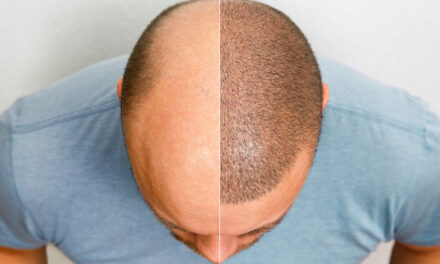
A hair transplant moves your own hair follicles from a donor area, usually the back and sides of the scalp, to thinning or bare areas. It does not add hair, and the donor supply is finite. This page takes the hair transplant cost apart: what the few published figures measure, which lines belong on a quote, why technique and who operates change the price, how repeat sessions and medical therapy enter the budget, and how to compare two quotes. The procedure itself is explained in hair transplant, and nothing below judges anyone’s hair, budget or decision to wait.
What a hair transplant cost figure actually measures
Most readers start with a number, so start there. Every published hair transplant cost figure is thinner than the confidence of the websites that print it, and knowing who produced each one tells you how much weight it can carry.
The published figures and who published them
Table 1 gathers the price figures found in the sources opened for this article, each with its year, what it covers and its limits. None is an official average from a society that surveys its surgeons’ fees.
| Source | Data year | Figure | What it covers | Limits |
|---|---|---|---|---|
| Mayo Clinic News Network Q and A | 2017 | “$10,000 or more per procedure” | One procedure; no components listed | Nine years old; a general statement |
| Knoedler et al., Plastic and Reconstructive Surgery Global Open | Survey June 2022 | Median amount respondents would pay: $4,700 (interquartile range $1,200 to $6,000) | What 1,000 U.S. adults said they would pay, not what clinics charge | Self-reported; paid online panel; authors give $4,800 elsewhere in the text |
| Medihair “study” (referral platform) | Mostly 2021 | U.S. average $13,610; Turkey average $2,675 | Reviewed clinics and doctors in 11 countries | Commercial platform with partner clinics; method not independently verified |
| AEDIT cost page (commercial) | Not stated | $1,000 to $20,000 overall; FUE $4,000 to $10,000; FUT $4,000 to $15,000 | “All the variables” except personal expenses such as travel | No year or source for prices; page contradicts itself on FUE versus FUT price |
| ASPS average cost sheet and statistics report | 2024 and 2025 | No hair transplant line | Not applicable | Fee data cover other procedures only |
Read the table as a plausibility check. Four sources give four different pictures: a 2017 floor, a willingness to pay, a clinic-platform average and an undated range. They do not form a trend, and they do not describe the same bill.
No society fee survey for hair transplants was found
ASPS publishes average surgeon fees for dozens of operations, and its 2024 sheet states that its ranges are “an aggregate projection based on averages submitted by surveyed members.” Hair transplantation is not on that sheet, and the 2025 statistics report carries no hair transplant counts or fees. ISHRS’s census, which does cover the specialty, reports volumes and techniques but no prices. Its 2022 edition estimated a worldwide market of $4.5 billion for 2021 and cautioned that the average fee behind it should not be treated as a typical price.
How much to trust a referral-site range
A range of $1,000 to $20,000 is technically true and practically useless. Platforms that sell clinic introductions have a reason to show a low starting point, and the Medihair page itself describes partner clinics and a clinic-comparison tool. Use such numbers for one thing only: noticing when a quote is far outside the crowd, high or low, and asking what was folded in or left out. The ISHRS Practice Census carries its own warning on its pages, saying the results provide “estimated information only.”
Grafts, sessions and why an average hides the variable
The hair transplant cost is driven by how much hair is moved and how many times. ISHRS’s census gives the best available sense of volume, with the caveat that it is a physician-member survey: 247 responses from 946 valid invitations in early 2025, a 26% response rate and a margin of error of plus or minus 5.4%.
What the 2024 data show about grafts per session
Members reported a mean of 2,347 grafts in a first procedure (n=173) and 1,637 in a subsequent one, and 58.4% reported 1,000 to 1,999 grafts for a first session. For a typical case the average was 2,100 grafts for FUT and 2,262 for FUE (n=185). In practical terms, a per-graft rate is multiplied by a number in the low thousands, so a small difference in rate becomes a large difference in the hair transplant cost. Those figures are volumes, not endorsements of any particular count.
Why a per-graft price needs an honest graft count
A rate per graft sounds transparent until the graft count is an estimate. Counts depend on the area planned, the density wanted and what the donor area can supply, and the number placed can differ from the number quoted. Ask whether the quote is a ceiling or a target, whether the price is adjusted if fewer grafts are harvested, and who counts them. Grafts can carry different numbers of hairs, so ask how the clinic defines a graft before comparing rates.
How the hair transplant cost is built: pricing models and nine quote lines
The same hair transplant cost can be expressed three ways, and each hides a different risk. The pricing model matters less than whether the lines behind it are visible.
Per graft, per session and package pricing
AEDIT says hair transplants are generally priced on a per-follicle basis, and ISHRS says fees vary with the type of service, the area covered, the location and the cause of hair loss. In practice you will meet three structures.
Per-graft pricing
In a per-graft hair transplant cost quote, the rate times the graft count is the surgeon-and-team portion, and the bill moves with every added hundred grafts. The risk is a low advertised rate that excludes facility, anesthesia or medications, or a rate that changes at higher counts. Ask for the rate, the planned count, the maximum count and the cost of each added block of grafts, and ask whether the rate differs by technique.
Flat session and package pricing
A flat fee for a hair transplant gives certainty about the headline number and shifts the questions to the ceiling: how many grafts it covers, what happens if the plan needs fewer, and which services sit outside the package. Travel packages add lodging, transfers and sometimes a translator, which changes the comparison again. A package is not a bad deal by definition. It is a deal you can only judge once its contents are written down, which is why the nine lines in Table 2 matter.
Nine lines of a hair transplant cost quote
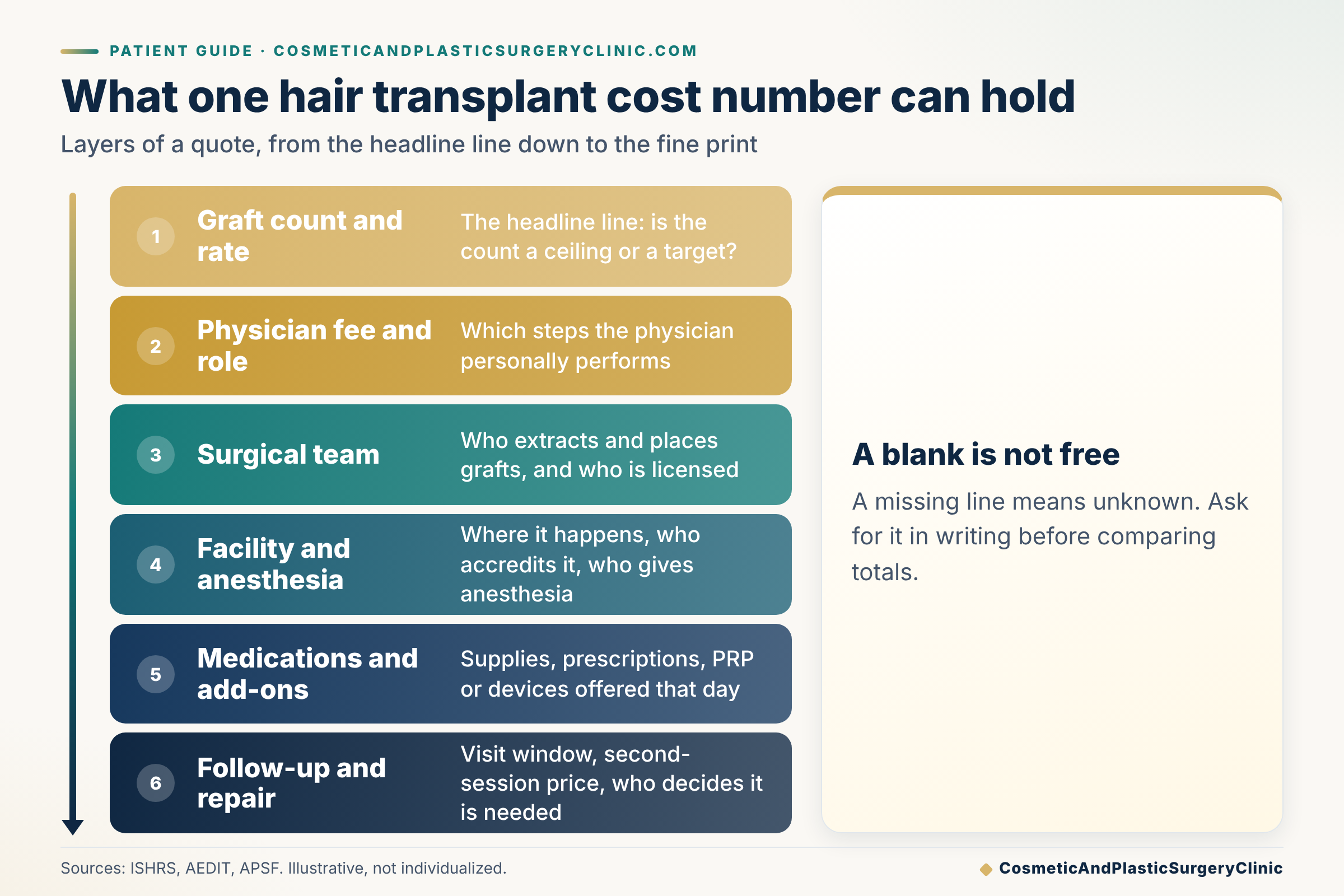
An itemized hair transplant cost quote is dull to read, and that is a good sign. Table 2 lists nine lines, why each may be charged, what moves it and the question that exposes it.
| Line item | Why it may be charged | What changes it | Often separate? | Question to ask |
|---|---|---|---|---|
| 1. Graft count and rate | Pays for harvesting and placing the hair | Area, density, donor supply, technique | Usually the headline line | Is the count a ceiling, and what if fewer are placed? |
| 2. Physician fee | Diagnosis, planning, hairline design, surgery | Training, demand, how much the physician personally performs | Sometimes folded into the rate | Which steps will the physician perform personally? |
| 3. Surgical team | Staff who assist, extract or place grafts | Team size, licensure, procedure length | Often invisible | Is anyone not licensed by the state making incisions or harvesting? |
| 4. Facility | Room, equipment, sterilization, nursing | Office suite, surgery center or hospital; accreditation | Sometimes | Where is it done, and who accredits the facility? |
| 5. Anesthesia and sedation | Numbing, any sedation, monitoring | Plan, provider type, time | Sometimes | Who gives and monitors it, and how is it billed? |
| 6. Medications and supplies | Antibiotics, pain relief, dressings, shampoo kits | Surgeon’s protocol | Often, as a pharmacy cost | Which items are included, which are bought elsewhere? |
| 7. Add-ons | PRP, devices, hairline touches offered at the visit | Clinic menu | Yes | What is the reason for it, and is it optional? |
| 8. Follow-up | Wound checks, photo reviews, long-term visits | Number of visits and the window | Sometimes, after the first weeks | How many months of visits are included? |
| 9. Touch-up and repair terms | A second session or correction if needed | Policy, time limit, graft cost | Often undefined | What would a second session cost, and who decides it is needed? |
A blank cell on a quote means unknown, not free. The most common mistake in comparing a hair transplant cost is putting a number with eight blank lines beside a number with eight filled lines, and calling the difference savings.
Who does the work: physician and team lines
ISHRS’s guidance is that the credentialed surgeon should be the one doing the surgery, and its patient questions ask directly who will be involved and in what role. A quote that does not distinguish a physician’s fee from a team’s cost cannot tell you which of them is placing the grafts. That ambiguity is a price factor and a safety factor at once, which is why it belongs in any hair transplant cost comparison. Everyone involved should be covered by malpractice insurance, another ISHRS question worth asking in writing.
Facility, anesthesia and medications
The Anesthesia Patient Safety Foundation’s patient guide reduces the setting question to two: is the facility accredited and by which organization, and who is providing anesthesia. Those answers belong on the quote with a name, not a phrase. Medications and supplies are small lines that surprise people at the pharmacy counter, so ask which are included. The decisions behind them are the surgeon’s; what an article can do is make sure they appear on the bill.
PRP, devices and other add-ons
ISHRS’s patient site files PRP, red light therapy and nutrition under “other treatments,” apart from surgical treatments. An add-on offered on the day of surgery can be reasonable, but it is also the easiest line to inflate. Ask what it is expected to do, what evidence supports it and whether surgery proceeds without it. If an add-on is presented as essential, treat the explanation as part of the quote.
Technique, surgeon and geography: why two hair transplant cost quotes can describe different operations
Even with the same graft count, two quotes can differ because the operation differs, or because the people performing it do. This is where a hair transplant cost comparison most often goes wrong, so the section separates technique, staffing and location.
Technique on the bill: FUE, FUT and robotic assistance
Follicular unit extraction (FUE) removes follicles individually with a small punch, while follicular unit transplantation (FUT, the strip method) removes a strip of scalp and separates follicles from it. ISHRS says FUT is closed with stitches and leaves a linear scar, and that FUE almost always leaves small round scars. The comparison of scars, recovery and who suits which is in FUE vs FUT hair transplant; this page covers only what the choice does to price.
What the technique changes in the hair transplant cost
ISHRS’s patient FAQ says FUE may cost more than FUT because it is more labor intensive for the physician, which is a reason for a gap rather than a size for it. AEDIT’s own text contradicts itself on which is dearer, so an unsourced “FUE costs X, FUT costs Y” line should not anchor a budget. In ISHRS’s 2024 census, FUE harvesting accounted for an average 85.4% of male procedures and strip harvesting 12.5%, so most U.S. quotes you collect will be FUE quotes. Ask whether the technique was chosen for your donor area or for the clinic’s schedule.
Robotic and device-assisted quotes
Robotic-assisted FUE accounted for an average 1.3% of procedures in the 2024 census (n=172), so a device-based quote is the exception in that survey, not the norm. AEDIT lists broader ranges for robotic systems than for manual FUE, again without a year. None of the sources opened compares results between devices, so a surcharge for a named machine is a question rather than a fact: what does the device add for my case, and who operates it?
Who performs which step
Surgeon role is the least visible price driver and the most consequential. A quote can describe an operation led by a physician, or one in which a team does most of the extraction and placement under supervision, and the numbers will not tell you which.
Physician-performed steps versus delegated steps
ISHRS’s consumer pages say hair restoration surgery should be performed by a properly trained and licensed physician, and they list a question to put to every clinic: will anyone not licensed by the state be making incisions or harvesting grafts, and why are they legally permitted to do so? Ask for the answer step by step: who plans the hairline, who makes the recipient sites, who extracts, who places. A low per-graft rate may reflect efficient staffing, or it may reflect a different division of labor than the one you assumed.
Verifying credentials before comparing prices
Check the physician, not the brochure. The American Board of Hair Restoration Surgery (ABHRS) runs a physician directory and certifies diplomates in hair restoration, and the American Board of Plastic Surgery lets you verify its certification and notes that an active, unrestricted license is required. A state license lookup confirms the license where the surgery happens. The mechanics of verification are in how to choose a plastic surgeon and cosmetic surgeon credentials, and the same checks apply to a dermatologist or other physician who performs hair transplants.
Geography and the very low price
Where a hair transplant happens changes the hair transplant cost, and the gap can be large. It also changes what you can do if something goes wrong, which is not on any quote.
What city and country ranges can and cannot tell you
AEDIT lists U.S. city ranges from $3,000 to $17,000 and country ranges from $2,500 to $5,900 for Mexico, with no year or source. The Medihair platform’s 2021 figures put the U.S. average at $13,610 and Turkey’s at $2,675. Both illustrate a gap, and both come from commercial sources. They cannot tell you what a specific physician charges, what is included at either end, or what an emergency visit, flight change or second trip would add.
Why a very low price deserves questions
ISHRS warns of complications from “cheap clinics” that no patient bargained for, and it describes bait-and-switch marketing in which a physician’s credentials attract patients who are then treated by non-physicians.
In ISHRS’s 2025 census, 59.4% of responding members (n=153) reported black market hair transplant clinics in their cities, and 24.6% said they were changing their pricing structure in response. The report does not define the term and the figures are physician self-reports, so they show competitive pressure rather than clinic quality. A low hair transplant cost is not proof of a problem. It is a reason to ask who operates, where and with what plan for follow-up. The tourism-specific checks are in hair transplant tourism and, for surgery generally, medical tourism for surgery.
Repeat sessions and medical therapy as hair transplant cost lines
A hair transplant relocates hair from a donor area expected to keep growing, but it does not stop the native hair around it from changing. That is why the budget question is not only “what does one session cost” but “what does keeping the plan on track cost.”
Second sessions and touch-ups
A hair transplant cost estimate often assumes one operation, and sources show why that may not always hold. Cleveland Clinic says several surgical sessions may be needed, and the Mayo Clinic Q and A says that in most cases, multiple procedures over time are needed for the best results. ISHRS’s surgical treatments page lists determining whether subsequent sessions are needed as part of follow-up planning.
How often a second session happens
ISHRS’s 2024 census reports an average of 1.5 procedures per patient with a median of 1.0, and 67.3% of members said most patients had one procedure (n=159). The average is therefore pulled up by a minority who return, and the subsequent-session mean was 1,637 grafts (n=173). Those are physician-reported figures for a patient population, not a forecast for any person, and the right number of sessions depends on diagnosis, donor supply and how hair loss continues.
Pricing the next session before the first one
Ask what a second session would cost under your clinic’s terms: the same per-graft rate, a repeat-patient rate or a new quote at the then-current price. Ask whether a corrective session after a poor result is priced differently from a planned second session, and who decides which it is. A clinic that has written these terms down before the first session is giving you something no national average can: a boundary on the total. Candidacy and the planning of donor use are covered in hair transplant candidate.
Medications and ongoing medical therapy
Two different things share the word medication on a hair transplant cost estimate: short-term items around surgery, and treatments for the underlying hair loss. They are budgeted and decided differently.
What the sources say about surgery and medical therapy
The Mayo Clinic Q and A notes that a hair transplant does not change genetics, so loss in untreated areas can continue, and it mentions over-the-counter minoxidil and prescription finasteride as options a clinician can discuss. Cleveland Clinic says surgery is generally done once hair loss is stabilized with medical treatments. The authors of a 2023 survey in Plastic and Reconstructive Surgery Global Open put the cost of these drugs at roughly $0.50 and $0.45 per day, a fraction of the price of surgery, though retail prices vary. Whether any medication fits a particular person is a prescriber’s decision.
Where the decision belongs
Nothing here is dosing guidance. The point for the budget is structural: if a clinician recommends ongoing therapy, it is a recurring cost that continues after the transplant bill is paid. Ask the transplant surgeon and, where relevant, a prescribing clinician which therapies are recommended, whether they are part of the plan’s success, and what they cost over a year. ISHRS’s FAQ itself says to weigh transplant cost against hairpieces or long-term medical treatments, which is a fair framing.
Insurance, tax rules and paying for a hair transplant
For most people the working assumption is self-pay. Whether a plan or the tax code treats a hair transplant cost any differently depends on why the hair was lost, and the plan, not the surgeon’s office, makes that call.
Cosmetic by default, medical in narrow cases
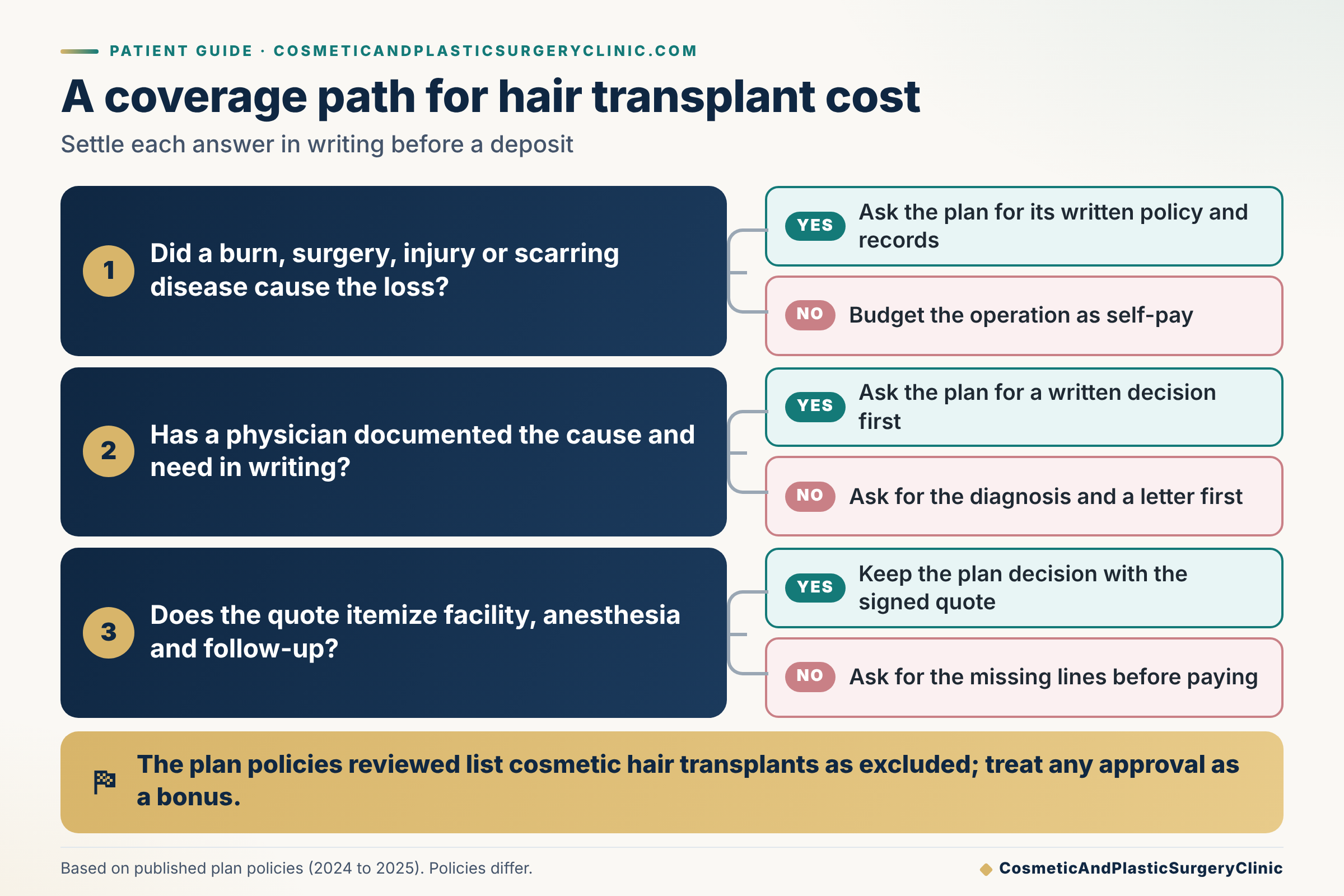
Cleveland Clinic says insurance rarely covers the cost of elective cosmetic surgery, and ISHRS says hair transplant cost is rarely covered by insurance. The Mayo Clinic Q and A makes the same point. The sources that explain where an exception might sit are plan policies, and three of them are summarized in Table 3.
| Policy | Date | Cosmetic wording | Covered indication | Documentation |
|---|---|---|---|---|
| AmeriHealth commercial, Medical Policy Bulletin 11.08.01h | Revised 08/06/2025 | Cosmetic hair transplants are a benefit contract exclusion | Permanent hair loss from trauma such as burns, surgery such as tumor removal, or diseases causing scarring alopecia | Company review, color photographs, letter of medical necessity |
| Independence Blue Cross Medicare Advantage, MA11.046c | Reissued 08/06/2025 | Cosmetic hair transplants are not covered | Same three listed causes | Medical record must show necessity; audit possible |
| Centene clinical policy CP.MP.31 | Revised 08/2024 | Hair transplantation not medically necessary unless correcting permanent hair loss caused by disease or injury | Disease or injury, within general reconstructive criteria | Medical records with photographs where applicable |
Three policies are three examples, not a rule, and the member’s own benefit document controls. The pattern is still consistent: pattern hair loss with a cosmetic purpose falls on the exclusion side, and a narrow set of injury, surgery or scarring-disease causes can be reviewed.
What the policies mean for the quote
If the hair loss followed a burn, a surgery or a scarring condition, the written policy and a physician’s letter are the starting point, and a decision in writing should come before a deposit. The prerequisite for any such review is a diagnosis, and scarring forms of hair loss are a specialist matter. If the cause is pattern hair loss, budget the full amount as self-pay and treat any approval as a surprise. Neither answer depends on how a clinic’s website describes the procedure.
Tax treatment
IRS Publication 502 (2025) says you generally cannot include in medical expenses the amount paid for procedures such as face lifts and hair transplants, and defines cosmetic surgery as a procedure aimed at improving appearance that does not meaningfully promote the body’s proper function or prevent or treat illness or disease. It makes an exception for correcting a deformity from a congenital abnormality, an injury or a disfiguring disease. Hair transplants have no separate exception, so ask a tax professional about a specific case rather than relying on a clinic’s assurance.
Paying for the hair transplant cost: the total, not the monthly payment
Financing changes the shape of the bill, not its size, and sometimes it adds to the size. General mechanics are in plastic surgery financing; this section covers what is specific to a hair transplant cost quote.
Self-pay estimates, deposits and who is asking for money
The Centers for Medicare and Medicaid Services says providers usually must give a good faith estimate to people who do not have or use insurance, when care is scheduled at least three business days ahead or on request, and a bill at least $400 above it may be disputed. Whether a cosmetic practice is covered was not verified, so ask for a written estimate regardless. Ask about the deposit, the cancellation terms and what is refunded if the surgeon decides not to proceed. A deposit demanded the day you ask for a price is a signal to slow down.
Deferred interest and a worked example
The Consumer Financial Protection Bureau’s May 2023 report says the typical medical credit card has an APR of 26.99% and that about 20% of healthcare deferred-interest purchases were charged interest, with interest adding about 23% to the starting amount in 2020 for purchases that incurred it. It also cites a New York Attorney General finding that 65% of medical cards are signed up for in providers’ offices.
Consider a hypothetical: a $9,600 procedure on a 12-month deferred-interest plan at 26.99%. A payment of $800 a month clears it. A payment of $700 a month leaves $1,200 at month 12, and if interest accrued on the declining balance is then added, the simple arithmetic is about $1,550, so roughly $2,750 is owed at once. That is an illustration with assumed terms, not any card’s offer, and compounding would make it larger. The takeaway is that a $100 monthly shortfall can cost far more than $100.
Comparing two quotes without reversing the ranking
A fair hair transplant cost comparison needs a common scope. The goal is not to find the cheapest quote but to make two quotes describe the same operation, then notice what is still missing.
Normalizing two hypothetical hair transplant cost quotes line by line
The figures below are invented round placeholders dated 2026-11-13 to show method. They are not market prices, and nothing about them says which kind of clinic is better.
Quote A and Quote B side by side
| Line | Quote A (per graft, U.S. practice) | Quote B (package, travel clinic) | Missing or conditional item | Safety note |
|---|---|---|---|---|
| Graft count and price | 2,400 grafts at $6.50 = $15,600 | “Up to 3,000 grafts” for $9,500 | B’s ceiling versus the number actually placed | More grafts is not automatically better |
| Physician role | Named physician plans and makes sites | Not stated | B: who extracts and places | Ask who is licensed to cut |
| Facility and anesthesia | Included; provider and facility named | Not stated | B may add $1,500 if billed separately | Accreditation and monitoring unknown for B |
| Medications and supplies | Estimated $150 | Not listed | B: items bought later | Wound-care kit and prescriptions |
| Follow-up and repair | Visits at three months and one year; second session priced in writing | Photo review online; repair terms not stated | B: who treats a problem at home | Emergency care is local to the patient |
| Indirect costs | $0 travel; two days off work | Flights and six nights about $2,600; a week off | B: second trip for a check or revision | Flying and activity limits after surgery |
| Normalized total | About $15,750 | $9,500 plus $2,600 plus unknowns, about $12,100 or more | B rises to about $13,600 if facility is separate | Total is only comparable once blanks are filled |
How missing lines can reverse the apparent ranking
At face value B’s hair transplant cost is $6,100 lower. After travel, the facility line and a second trip, the gap shrinks to roughly $2,100 or less, and it can close entirely if a repair is needed. The ranking did not reverse because A was better, but because B’s quote was incomplete. Fill B’s blanks first, then compare. If B names the physician, the facility, the anesthesia provider and the repair terms, it may still be the better fit for a given budget.
Red flags and a written-estimate checklist
Price is only one signal, and the more reliable ones concern transparency. A clinic comfortable with scrutiny will put every line on paper.
Pressure, photo-only quotes and unnamed providers
Be cautious about a quote built from photos without an examination, a graft count promised before anyone has looked at your donor area, a discount that expires today, a refusal to say who will operate, or a facility with no name. Another signal is a result promised in terms of density or a hairline, because hair growth varies and no clinic controls it. A consultation should leave time to think, and the questions to bring are in plastic surgery consultation questions.
A written-estimate checklist
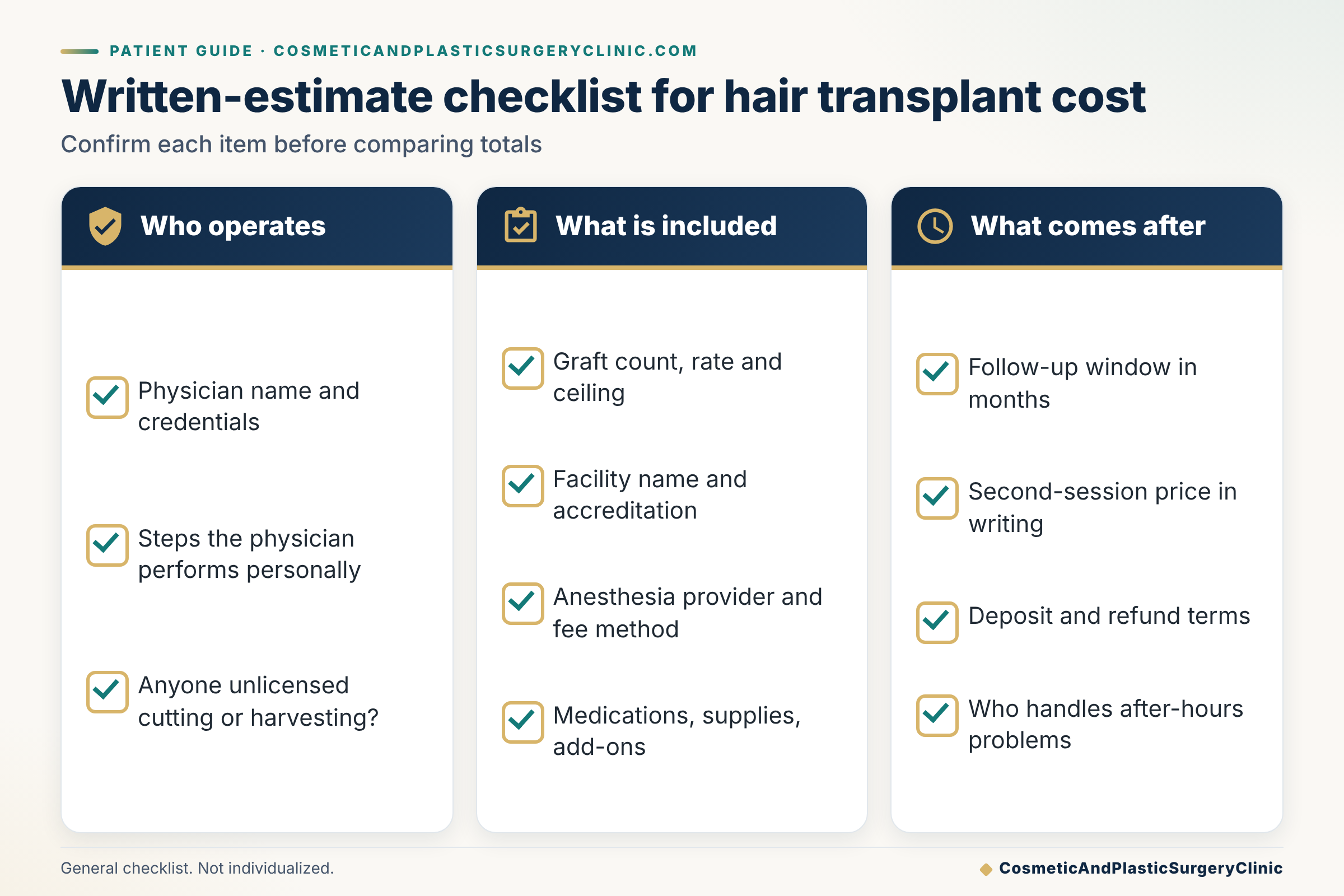
Before paying any deposit, confirm each item in writing: the physician’s name and credentials; which steps the physician performs; the facility’s name and accreditation; the anesthesia provider; the graft count, rate and ceiling; medications and add-ons; the follow-up window; the price and terms of a second or corrective session; the refund terms; and who handles an after-hours problem. For the general principles of comparing surgical prices, see plastic surgery cost.
Frequently asked questions
Why can a second session change the hair transplant cost per graft?
Some clinics price a second session differently, and some do not, so ask before the first session. ISHRS’s 2024 census shows second sessions tend to be smaller, with a mean of 1,637 grafts against 2,347 for a first procedure, which changes the total even at the same rate. A hair transplant cost quote should say whether a repeat-patient rate exists, how long it applies and whether a corrective session after a poor result is priced the same as a planned one. If the answer is not in writing, treat it as unknown.
Can an HSA or FSA pay for a hair transplant cost?
That was not verified for this article. IRS Publication 502 (2025) says the cost of hair transplants generally cannot be included in medical expenses for the tax deduction, with an exception for correcting a deformity from a congenital abnormality, injury or disfiguring disease. HSA and FSA rules are separate and plan-specific, so ask the plan administrator in writing whether a cosmetic hair transplant cost qualifies and what documentation is needed. Do not rely on a clinic’s statement that the expense is eligible.
Does a higher hair transplant cost mean a better result?
None of the sources opened shows that price tracks outcome. A higher figure may reflect more grafts, a physician-performed operation, an accredited facility, longer follow-up or simply a higher margin, and a lower one may reflect fewer lines or a different division of labor. Compare what is written on the quote: the named physician, the facility, the anesthesia provider and the repair terms. Ask for patient-matched examples with similar hair loss and time since surgery, and treat any promise of density as a reason to ask more questions.
Is a consultation fee part of the hair transplant cost?
Often not. AEDIT lists consultation fees with providers you are interviewing among personal expenses that its estimates exclude, along with travel, pre-operative care and missed work. Some practices credit a consultation toward surgery and others do not, so ask when you book. Also ask whether the visit includes an examination of the donor area and a written plan, because a quote based on photographs alone describes a hypothetical operation rather than yours.
Is medication cheaper than the hair transplant cost, and does it replace surgery?
The 2023 survey authors cite drug prices of roughly $0.50 and $0.45 per day, far below a transplant, and those are recurring costs rather than one-time ones. Cost is not the only difference. The Mayo Clinic Q and A says transplants do not change genetics and that loss elsewhere can continue, and Cleveland Clinic says surgery is generally done once loss is stabilized with medical treatment. Whether a medicine suits you is a prescriber’s decision, and some people compare options including hair transplant vs SMP.
What does time off work add to the hair transplant cost?
It depends on the job, the person and the surgeon’s instructions, and the sources opened give no single number. Cleveland Clinic says most people feel well within a day or two of surgery, but how long visible signs of the procedure last varies, so some people plan more time away from public-facing work. Add any lost wages, a driver for the day and travel changes to the comparison, and read hair transplant recovery for the week-by-week arc.
What if the hair transplant cost is too high right now?
Waiting is a legitimate option, and so is getting a second written estimate or starting with a consultation to learn the plan before committing. Hair loss that is progressing may change the plan over time, which is a reason to ask the physician what could be done now and what would be better done later, not a reason to rush. Avoid financing that charges retroactive interest unless you can clear the balance before the promotional period ends, and keep the deposit and cancellation terms in writing.
Sources and further reading
- International Society of Hair Restoration Surgery — 2025 Practice Census (accessed 2026-11-13) — 2024 data; grafts per session, procedures per patient, robotic FUE share, pricing-structure and black market responses; response rate and limits
- International Society of Hair Restoration Surgery — 2022 Practice Census (accessed 2026-11-13) — 2021 market estimate and caution about the average fee
- ISHRS — Ask your hair restoration surgeon (accessed 2026-11-13) — who performs the surgery, malpractice coverage, cost rarely covered by insurance
- ISHRS — Consumer advocacy (accessed 2026-11-13) — surgery by a licensed physician; questions about unlicensed staff
- ISHRS Fight the FIGHT — Do you know who is operating on you (accessed 2026-11-13) — question about unlicensed persons making incisions or harvesting grafts
- ISHRS — Medical tourism: the good, the bad and the ugly (accessed 2026-11-13) — lower prices abroad, complications from cheap clinics, bait-and-switch marketing
- ISHRS — Surgical treatments (accessed 2026-11-13) — FUT and FUE scars, fee variation, follow-up and subsequent sessions
- ISHRS — Facts, myths and Q and A (accessed 2026-11-13) — FUE versus FUT price relationship and cost framing
- ISHRS — Medications for hair loss (accessed 2026-11-13) — medical therapy sits apart from surgical treatments (no dosing used)
- American Society of Plastic Surgeons — Cosmetic procedures average cost, 2024 (accessed 2026-11-13) — projection wording; no hair transplant line
- American Society of Plastic Surgeons — Plastic surgery statistics report, 2025 (accessed 2026-11-13) — no hair transplant counts or fees
- AEDIT — How much does a hair transplant cost (accessed 2026-11-13) — commercial, undated ranges; per-follicle pricing; exclusions such as consultation and travel
- Medihair — Hair transplant study (accessed 2026-11-13) — referral platform; 2021 U.S. and Turkey averages; method not independently verified
- Mayo Clinic News Network — Q and A: Hair transplant treatment for hair loss, 2017 (accessed 2026-11-13) — cost statement, insurance, multiple procedures, genetics
- Cleveland Clinic — Hair replacement surgery (accessed 2026-11-13) — insurance, several sessions, timing relative to medical treatment
- Knoedler et al., Plastic and Reconstructive Surgery Global Open, 2023 — Hair transplantation in the United States: a population-based survey (accessed 2026-11-13) — willingness to pay, cited cost figures, limitations
- AmeriHealth — Medical Policy Bulletin 11.08.01h, Hair transplants and cranial prostheses (accessed 2026-11-13) — exclusion, covered causes, documentation
- Independence Blue Cross — Medicare Advantage policy MA11.046c, Hair transplants and cranial prostheses (accessed 2026-11-13) — exclusion, covered causes, record requirement
- Centene (via QualChoice) — Clinical policy CP.MP.31, Cosmetic and reconstructive procedures, 08/2024 (accessed 2026-11-13) — hair transplantation criteria and code descriptors
- Internal Revenue Service — Publication 502 (2025), Medical and dental expenses (accessed 2026-11-13) — hair transplants and the cosmetic surgery rule
- Centers for Medicare and Medicaid Services — Good faith estimate (accessed 2026-11-13) — self-pay estimate timing and dispute threshold
- Consumer Financial Protection Bureau — Medical credit cards and financing plans, May 2023 (accessed 2026-11-13) — typical APR, deferred interest, provider-office enrollment
- Anesthesia Patient Safety Foundation — Outpatient surgery: choosing the location (accessed 2026-11-13) — facility accreditation and anesthesia provider questions
- American Board of Hair Restoration Surgery — Home and physician directory (accessed 2026-11-13) — hair restoration certification and directory
- American Board of Plastic Surgery — Verify certification (accessed 2026-11-13) — verification and license requirement