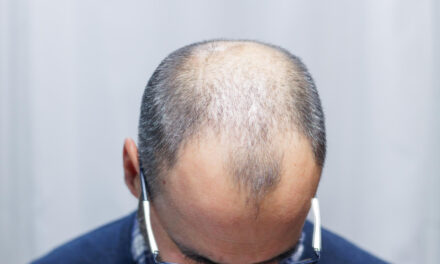
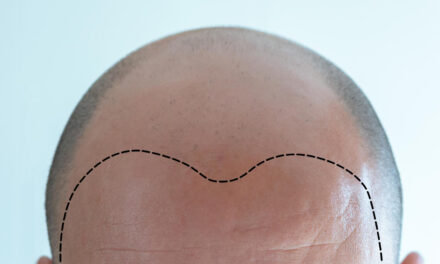
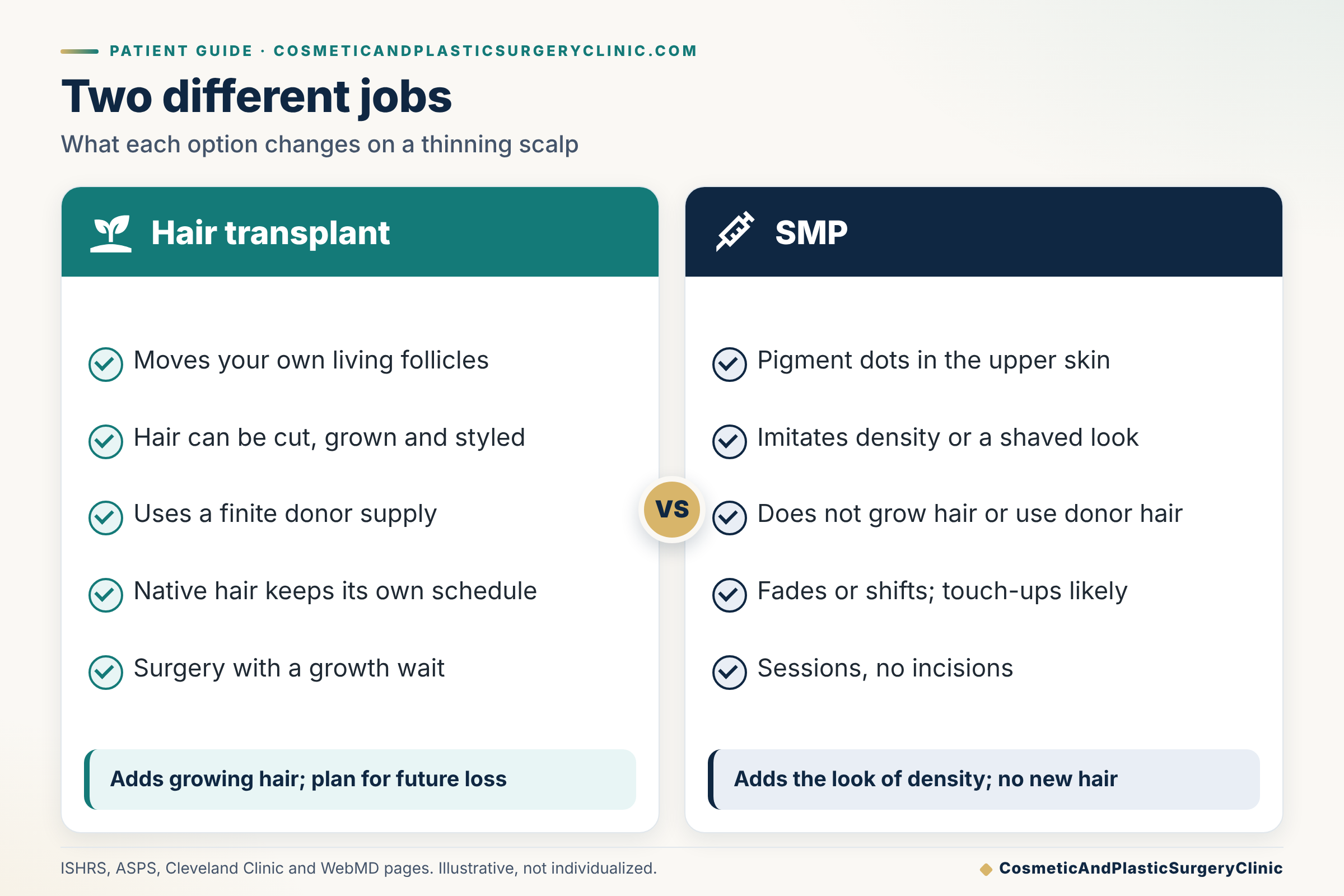
Hair transplant vs SMP is a choice between two different ideas of what a thinning scalp needs. A hair transplant moves your own living follicles from donor areas, usually the back and sides of the scalp, into thinning or bald skin. SMP, short for scalp micropigmentation, places tiny dots of pigment in the scalp skin so an area looks denser, or so a closely shaved head looks like it has stubble. One option changes how much hair grows. The other changes how the scalp looks.
This page compares hair transplant vs SMP by what each treats, the looks each can reach, recovery and fading, risks and evidence, combined use, cost logic and the questions worth bringing to a consultation. It cannot say which option fits your scalp. That takes an examination and a diagnosis of why the hair is thinning, because scarring alopecias and other medical causes need evaluation first. The full surgical picture lives on the hair transplant page, so this article stays on the comparison.
Hair transplant vs SMP: growing hair or drawing the look of it
Before comparing recovery or price in a hair transplant vs SMP decision, name the problem each option addresses. A transplant addresses a shortage of hair-bearing follicles in one area by borrowing from another. SMP addresses contrast: the visible gap between scalp skin and hair. Many frustrated decisions come from asking one tool to do the other tool’s job.
What a transplant changes and what it leaves alone
Relocated follicles keep behaving like donor hair
The American Society of Plastic Surgeons (ASPS) describes hair transplant surgery as restoring hair to scalp areas that are bald or thinning, with follicles taken from the back of the scalp and placed in the recipient area, either one at a time (follicular unit extraction, FUE) or from a removed strip (follicular unit transplantation, FUT). The comparison of those two methods has its own page on FUE vs FUT.
The International Society of Hair Restoration Surgery (ISHRS) explains why the idea works: follicles from the donor zone retain their resistance to the genes that cause male pattern hair loss and continue to produce hair at the recipient site. In a hair transplant vs SMP comparison, this is the central difference. Transplanted hair is real hair, so it can be trimmed, grown longer and styled.
The donor area is a budget, and native loss continues
ASPS says plainly that all hair replacement techniques use your existing hair. Nothing is created; hair is rearranged. The ISHRS describes the donor site as a savings-and-loan area: a family history of severe loss suggests the safe zone is limited, and some tissue that looks safe can be lost over months to years. Younger people with progressive loss may need several procedures over time, so surgeons plan to keep donor hair in reserve.
A transplant also does not stop the hair around it from thinning. The American Academy of Dermatology (AAD) lists FDA-approved medicines for male pattern hair loss and notes that loss returns after finasteride is stopped. Whether any medicine is appropriate is a decision for a prescribing clinician. The point for this comparison is that the hair left untransplanted keeps following its own genetic schedule, which affects planning, as the hair transplant candidate article explains.
What SMP changes and what it leaves alone
Dots of pigment in the upper skin layers
The ISHRS calls SMP medical-grade micro-tattooing. Microneedles place grayscale pigment as tiny dots, with shallow needle penetration of usually 0.5 millimeters that has to be adjusted across the scalp so the pigment stays in the epidermis, the ISHRS says. A 2015 review in the Journal of Clinical and Aesthetic Dermatology (Rassman and colleagues) places pigment in the upper dermis instead, and describes depth as judged by the operator’s feel and sight, which the authors call difficult and experience-dependent.
The two descriptions differ on the exact layer, which suggests depth control is a craft skill, not a measured setting. Too shallow and pigment leaks out within days; too deep and it spreads, so the practitioner matters more than the machine.
A shadow, not a follicle
Cleveland Clinic states that SMP does not grow hair or change natural hair growth, and WebMD says it does not treat hair loss. The ISHRS adds that SMP imitates the shadow of the follicle or pore, not a hair, and is not meant to match the person’s hair color exactly. Nothing about the underlying thinning changes, so hair that was going to be lost can still be lost around the pigment.
That has a practical consequence for hair transplant vs SMP decisions in people with active progression. If surrounding hair keeps thinning, a pigment pattern designed for today’s density may look different in five years. SMP does not use up donor hair, which is its quiet advantage for people whose donor supply is thin or uncertain.
Which look can each option reach in a hair transplant vs SMP decision?
Photos of the final look are what most people shop for in a hair transplant vs SMP comparison, and they differ more by hair length than by technique. The same scalp can be a good SMP candidate with a number two buzz cut and a poor one with hair kept at shoulder length.
Hair transplant vs SMP for shaved heads, buzz cuts and longer styles
Short hair is where SMP is strongest
According to the ISHRS, SMP works best on shaved heads with an all-or-nothing approach, and also suits heads with hair everywhere (over about 20 grafts per square centimeter) that is not dense enough. Dark hair on a lighter scalp is described as ideal, though light, gray or dyed hair can work with the right pigment. WebMD and Cleveland Clinic both list buzz-cut looks and scalp scars among typical uses.
The ISHRS names poor-fit situations too: a bald patch next to longer hair, where the hair is longer than roughly 3 millimeters and dense (over about 30 follicles per square centimeter), oily or flaky scalps, and active inflammatory scalp conditions until they have been stable for two to three years. These figures come from one society page, not from a trial, so treat them as rules of thumb.
Longer hair needs living hair
Pigment cannot move, lengthen or add volume at the roots, which limits SMP in any hair transplant vs SMP contest over longer styles. If the goal is hair that can be grown out, parted, tied back or styled in different directions, only a transplant puts follicles in the skin that can do that. The hair transplant vs SMP question for these people is usually not which looks better in a still photo, but which can survive daily life with their preferred hairstyle.
The reverse also applies. Someone content with a closely cropped style may find that surgery adds risk, cost and healing time to reach a look that pigment can approximate. That trade is the heart of a fair hair transplant vs SMP discussion.
Hair transplant vs SMP density thresholds: what one study of women found
The 40-patient comparison and its cutoffs
One published attempt to give people a rule is a 2024 retrospective study in the Journal of Cosmetic Dermatology (Park, Kim and You). It reviewed 40 women with female pattern hair loss, 23 who chose hair transplantation and 17 who chose SMP. Using a handheld scalp-imaging device, the authors measured hair density and caliber. Mean hair density was about 96 hairs per square centimeter in the transplant group and about 116 in the SMP group.
The authors concluded that hair density was the most important factor in choosing between the two. They recommended SMP when density was at least 104.6 hairs per square centimeter and a transplant strongly when it was 96.17 or lower. The abstract does not say what to do between those two numbers, and that gap is where real people usually live.
Why a cutoff from one study is not your number
The study was retrospective, covered women only and compared people who had already made a choice. That means the groups were not randomly assigned, and choice itself may have shaped the density difference. This summary also rests on the abstract record rather than the full paper.
Treat the thresholds as a sign that remaining density matters, not as a prescription. The same caution applies to every number in any hair transplant vs SMP comparison, including the ISHRS figures above.
Recovery, fading, undoing and cost in hair transplant vs SMP
In hair transplant vs SMP terms, the treatment burden differs in kind, not just in size. A transplant is a one-time surgical event with a long growth wait. SMP is a short series of sessions followed by indefinite maintenance. Reading only the first half of each description makes SMP look effortless; the second half evens it out.
Downtime and upkeep
From surgery recovery to a series of sessions
WebMD and Cleveland Clinic both describe SMP as less invasive than a transplant, with no incisions, less pain, a lower cost and a minimal recovery period. Both say a session can take up to five hours, and Cleveland Clinic says most people need three or more treatments spaced several weeks apart. The 2015 Rassman review reports that its authors’ patients often needed two to four sessions, some lasting up to eight hours.
SMP aftercare is not nothing. Both consumer pages advise keeping the scalp dry until the provider approves washing, and avoiding heavy exercise, steam, heat and sun for several days. A transplant asks more: surgeon-directed wound care, a donor area that heals, scabs and shedding. The hair transplant recovery article covers that arc, and the hair transplant timeline covers the months before growth shows.
Fading and touch-ups: where sources disagree
On the SMP side of hair transplant vs SMP, longevity claims vary widely. Cleveland Clinic says it usually keeps its appearance for four years or longer and that its pigments resist fading or color change. The ISHRS says well-placed SMP lasts about 5 to 10 years, that ultraviolet light fades pigment faster, and that some people choose yearly touch-ups. The Rassman review calls dermal pigment long-lasting but treats touch-ups as an important part of follow-up because the appearance changes over the first weeks to months.
Small clinical studies show faster change in some scalps. In a 2025 prospective study of 18 people with scarring alopecia (Shubham and colleagues, Journal of Cutaneous and Aesthetic Surgery, article in press), pigment faded in all patients by one month, color changed in 13, and every patient needed touch-ups. A ten-patient 2025 series (Liu and colleagues, Journal of Cosmetic Dermatology) reported modest fading at six months, mostly in scarring alopecia. Ask any provider how fading is handled in your type of scalp.
Removal and revision
Taking SMP out, or covering it
The ISHRS says a tattoo-removal laser can often clear SMP in one session without losing hair, and that partial removal looks poor, so treating the whole area is generally recommended. The U.S. Food and Drug Administration (FDA) is more cautious about tattoos in general: removal can be very difficult, typically takes several treatments, can be costly and may not be possible without scarring. Scalp pigment may sit between those two descriptions; no source read here reports removal outcomes for scalp work in numbers.
A 2024 retrospective study in the International Journal of Dermatology covered 120 people who needed correction of an unsatisfactory SMP result. Of the 120, 107 (89.2%) had their original SMP at a tattooing or cosmetic facility. The corrections were hair transplantation alone in 61.7%, transplant plus more SMP in 20.8%, laser removal then repeat SMP in 13.3% and removal only in 4.2%. The authors reported good revision satisfaction when experienced medical professionals performed the work. The study cannot say how often SMP goes wrong, because it only sees patients who came for correction.
Why a transplant is harder to walk back
A transplant has no equivalent of a removal laser. Follicles that have been moved cannot be returned, and a donor area that has been used is not refilled. Poor placement or a poorly designed hairline is addressed by repair surgery, camouflage or acceptance, not by erasing the result. The hair transplant risks article lists what can go wrong and how corrections are approached.
In a hair transplant vs SMP choice, that asymmetry is the strongest argument for starting conservatively when the outcome is uncertain. Pigment can sometimes be touched up, lightened or removed; a hairline set too low can be hard to correct. It is also an argument for choosing the surgeon with great care, and the choosing a plastic surgeon guide covers verification steps that apply in principle to hair-restoration physicians as well.
Cost logic without price tags
How each quote is built
No source read for this page gives dollar figures for SMP, so none are given here. WebMD and Cleveland Clinic say it costs less than a transplant, and Cleveland Clinic says it is not covered by insurance because it is elective and advises asking the provider about cost and the number of treatments needed. The transplant side has its own structure of per-graft or per-session pricing, surgeon and facility fees, covered on the hair transplant cost article.
For SMP, the quote questions are different: is the price per session or for a full plan, how many sessions are expected, what do touch-ups cost, and who pays if correction or removal is needed. A low headline price for one session says little about the total of a multi-session plan.
Upfront cost versus years of upkeep
Consider a hypothetical hair transplant vs SMP cost comparison. Quote A is a single surgical fee that is paid once, with the transplanted hair growing for years, but with later costs if native hair keeps thinning and a second procedure or ongoing medical therapy is advised. Quote B is a lower fee for a series of SMP sessions, with touch-ups every few years and a possible removal fee at the end. Neither is cheaper in the abstract.
The honest way to run a hair transplant vs SMP cost comparison is over the same number of years, listing everything: the first procedure, likely follow-ups, medical therapy a clinician recommends, touch-ups and the cost of reversing the choice. For general mechanics of fees and payment plans, see plastic surgery financing and compare the borrowing cost with the total price before financing any elective procedure.
| Factor | Hair transplant | SMP (scalp micropigmentation) |
|---|---|---|
| What it addresses | Too few hair-bearing follicles in one area | Contrast between scalp skin and hair; scar or shaved-head look |
| Invasiveness | Surgery with donor and recipient wounds | Needle sessions in the upper skin; no incisions |
| Reversibility | Moved follicles are not returned; repair is surgical | Laser removal or covering possible; results vary |
| Scars and downtime | Donor-area scars; scabs and shedding; weeks to months before growth | Short redness and aftercare; sessions repeated |
| Maintenance | Native hair keeps thinning; further procedures or medical care may be discussed | Fading, color change and touch-ups; sun protection |
| Main risks | Infection, poor growth, visible scarring, unnatural hairline | Color change, pigment spread, allergy, infection, unwanted look |
| Cost logic | Large fee up front; future procedures possible | Lower per-plan fee, sessions and touch-ups add up |
Cleveland Clinic says SMP pigments are not the same as tattoo ink, and the ISHRS prefers carbon-only grayscale pigment. No source read for this page explains how a specific SMP pigment is classified or tested, so asking for the product name and its safety documentation is a reasonable step before any session.
Risks and evidence: what hair transplant vs SMP research can and cannot show
Both sides of hair transplant vs SMP are marketed with before-and-after photos and glowing reviews. The published evidence is thinner than the marketing, particularly for SMP, and each option has risks that the other does not.
Risks that belong to pigment in the scalp
Color change, spread, allergy and infection
Cleveland Clinic lists three SMP risks: allergic reaction to the pigments, infection from unsterilized needles, and an unnatural or undesirable appearance. WebMD names the same three and adds that the biggest risks come from unlicensed or inexperienced providers. The ISHRS says conventional tattoo ink placed too deep or with larger needles can spread and change color, for example to blue or orange.
The Rassman review adds a longer list: pigment bleeding under the skin, black or gray pigment that looks blue or green, scarring, foreign-body granulomas and infection with unusual organisms such as nontuberculous mycobacteria linked to unsterile practice. It also says some pigment may migrate to lymph nodes, with unclear long-term significance. The FDA describes allergic reactions to tattoo pigments as rare but potentially serious, because the pigments are hard to remove.
MRI, keloids and unregulated ink
The FDA reports rare cases of swelling or burning in tattooed skin during MRI, and says pigment can sometimes affect image quality. Its advice is to tell the radiologist or technologist about the tattoo rather than avoid a recommended scan. Anyone with SMP should mention it before imaging, and a consultation is a good time to ask whether the practitioner knows which pigments are used.
WebMD and Cleveland Clinic both say people prone to keloids, raised scars that grow beyond a wound, should avoid SMP. Any history of keloid, unusual scarring or pigment allergy belongs in the first conversation, along with the full medication and skin-condition list. The related transplant concern, scarring in predisposed people, is covered with the other transplant risks.
How strong is the evidence for each side?
SMP studies are small, short and mostly single-centre
The published SMP studies read for this page are small. The 2015 Rassman review draws on its authors’ own practice and, by its own account, contains no controlled trials or standardized outcome measures. Liu and colleagues followed ten people for six months. Shubham and colleagues followed 18 for six months; their paper has internal inconsistencies, including mismatched P values and discussion figures that do not appear in the results. The Rassman group is affiliated with a hair-restoration practice, which is worth knowing when they recommend combined care.
Positive findings in the SMP literature are real but narrow. In the ten-patient series, authors reported a mean visual density score of 8.7 out of 10 immediately after treatment, no adverse events, and a mean satisfaction score of 2.7 out of 3. Those figures come from a news summary of the paper, not the full text. In the 18-patient study, favorable response, defined as more than half the pigment retained, was seen in 9 of 18 at six months, and the authors still called SMP safe and effective for scarring alopecia while recommending larger studies.
Transplant risks have their own page
This article does not review the transplant literature. The ISHRS, ASPS and AAD all describe transplantation as an established option, and planning questions include the diagnosis, donor quality and who performs each step. Infection, folliculitis, bleeding, poor graft growth, scarring and an unnatural hairline are covered on the hair transplant risks page.
Note what the numbers do not allow. No source opened for this article offers a hair transplant vs SMP comparison of complication rates in the same kind of patient. A claim that one is safer, in general, goes beyond the evidence read here.
| Source | Population | What it reports | Limit to keep in mind |
|---|---|---|---|
| Park, Kim and You, J Cosmet Dermatol 2024 | 40 women with female pattern hair loss | Density cutoffs: SMP at 104.6 or more per cm²; transplant at 96.17 or less | Retrospective; women only; abstract record read |
| Park et al., Int J Dermatol 2024 | 120 people seeking SMP correction | 89.2% had first SMP at a tattoo or cosmetic facility; 61.7% corrected by transplant alone | Referral sample; abstract record read |
| Shubham et al., J Cutan Aesthet Surg 2025 | 18 people with scarring alopecia | Pigment faded in all by 1 month; 9 of 18 favorable at 6 months | No control group; inconsistent figures; in press |
| Liu et al., J Cosmet Dermatol 2025 | 10 people (6 pattern loss, 4 scarring) | Visual density 8.7 of 10 after treatment; modest fading at 6 months | Tiny sample; news summary read |
| Rassman et al., J Clin Aesthet Dermatol 2015 | Authors’ own practice | Technique, risks and uses described | No controlled trials; authors affiliated with a hair-restoration practice |
Combining a transplant and SMP: scars, thin donors and timing
The hair transplant vs SMP framing suggests rivals, but the sources describe the two as often complementary. The combinations are specific, and order and timing matter.
Scar camouflage and see-through donor areas
Dot scars from FUE, linear scars from FUT
The ISHRS says SMP can visually reduce, and sometimes nearly erase, both dotted FUE scars and linear FUT scars, and it calls scars the most demanding and difficult situation for SMP because pigment spreads, fades and shifts color unpredictably. The 2015 Rassman review lists donor strip scars, punctate FUE scars and see-through donor areas among its suggested uses. Those uses sit on the donor side, where scars arise from either extraction method.
A 2017 paper in Plastic and Reconstructive Surgery Global Open (Rassman, Pak and Kim) argues that FUE and SMP complement each other and could reduce the number of procedures and the total cost of hair restoration. The same abstract states that FUE made up 52.6% of hair transplant procedures in 2016. It is an author-level argument, not an outcomes study, from the same group that wrote the 2015 review.
Wait for the transplant to grow in before adding pigment
Timing is the main rule. The ISHRS advises avoiding SMP for at least a year after a transplant, because transplanted hair takes 11 to 12 months to grow in and earlier SMP risks uneven density and premature fading. The ISHRS also says SMP is sometimes placed during FUE surgery to camouflage a linear scar or the shaved donor area for about one to two weeks, often as a temporary measure.
Any hair transplant vs SMP combination plan should state the order, the waiting interval and who does each step. The first year of growth looks unfinished by design, and the hair transplant photos guide shows how to read images at different stages.
Hybrid and rescue uses
Density illusion over thinning hair
The ISHRS lists hybrid hairline lowering, in which pigment adds a softer front edge, and says a shaved head can receive some real hair, roughly 10 to 20 grafts per square centimeter, for texture. In this use, the hair transplant vs SMP choice becomes a design question: how much density can living hair supply, and how much is borrowed from pigment.
Covering a poor result from an unlicensed clinic
The ISHRS says unlicensed or black-market hair transplants can cause patchy, damaged results that SMP may help camouflage. That is an uncomfortable fact of the market: some people arrive at SMP because a transplant went wrong. If you are considering a low-price clinic in another country, read the hair transplant tourism guide and the general medical tourism surgery page first.
The reverse also happens. In the 2024 correction study, hair transplantation, alone or with extra SMP, was the corrective route for 82.5% of people who were unhappy with their first SMP. Neither direction is a safe default; both depend on the skill of whoever performs the work.
Hair transplant vs SMP scenarios instead of a winner
Because the options in hair transplant vs SMP solve different problems, a single winner would be misleading. The hypothetical profiles below show how the same two options point in different directions, and what single fact could turn each one around. They are illustrations, not advice.
Two hypothetical profiles
Buzz cut, stable crown and top thinning, healthy scalp
Consider a hypothetical man who already keeps his hair very short and wants the thinning crown to read as dense stubble. In a hair transplant vs SMP discussion, SMP is the option sources describe as strongest for that look: the ISHRS says it works best on shaved heads, and it does not spend donor hair. The consultation would still need to confirm the diagnosis and that the scalp is not oily, flaky or inflamed.
What could reverse it? A skin condition under active treatment, a history of keloids, an allergy to pigments, or a later change of mind about wearing longer hair would each move the discussion toward medical advice or a transplant.
Receding hairline, strong donor area, longer style wanted
Now consider a hypothetical person with a receding front hairline, plenty of dense hair at the back and sides, and a wish to keep hair at medium length. Here the hair transplant vs SMP discussion tilts toward a transplant, because only transplanted follicles grow hair that can be styled, and the donor area can supply it. The ISHRS says surgeons weigh the donor reserve against likely future loss before committing it.
What could reverse it? A thin or unstable donor zone, rapid progression in a young person, or a diagnosis other than pattern hair loss. Any of these could make a surgeon recommend waiting, medical care first, or a lighter plan, and may bring SMP into the conversation.
Changing one variable flips the answer
A thin donor area or fast progression
Take the second profile and shrink the donor area. The ISHRS describes donor supply as limited, and warns that younger people with progressive loss may need several procedures over time. If the donor budget cannot cover the whole thinning area, a surgeon may favor treating the front only, and pigment for shaved-head density could be one way to handle the rest.
Diffuse thinning or a scarring condition
Change the profile again: a woman with diffuse thinning across the top who wants density without shaving. The 2024 study of 40 women suggests remaining density helps decide, with SMP favored at higher density and a transplant at lower density, and an unresolved middle band. Cleveland Clinic and the Rassman review both list women with thinning among the people SMP is used for; the diagnosis still comes first.
With a scarring condition such as lichen planopilaris, the question changes again. The ISHRS says active inflammatory scalp conditions should be stable for two to three years before SMP. In the 2025 18-patient study, response differed by diagnosis, with milder atrophic conditions responding better than dense fibrotic ones. Scarring alopecias need a specialist to judge activity before any procedure.
| Goal or anatomy | Option usually discussed | Reason | Fact that could reverse it |
|---|---|---|---|
| Shaved or buzz-cut look, stable thinning on top | SMP | ISHRS: works best on shaved heads; uses no donor hair | Active scalp condition, keloid history, pigment allergy |
| Receding hairline, strong donor, wants longer hair | Hair transplant | Only living follicles can be grown out and styled | Thin donor area, fast progression, other diagnosis |
| Visible donor scars with short hair | SMP for camouflage | ISHRS and Rassman list scar camouflage as a use | Scar tissue makes pigment spread or fade unpredictably |
| Diffuse thinning in a woman, density near the cutoffs | Either; measured density decides | 2024 study: SMP at 104.6 or more per cm², transplant at 96.17 or less | Diagnosis, progression, donor density, personal goal |
| Patchy loss with scalp inflammation or scarring | Specialist evaluation first | ISHRS: wait until stable for 2 to 3 years before SMP | Specialist finds the condition inactive |
Six questions to ask about hair transplant vs SMP before you book
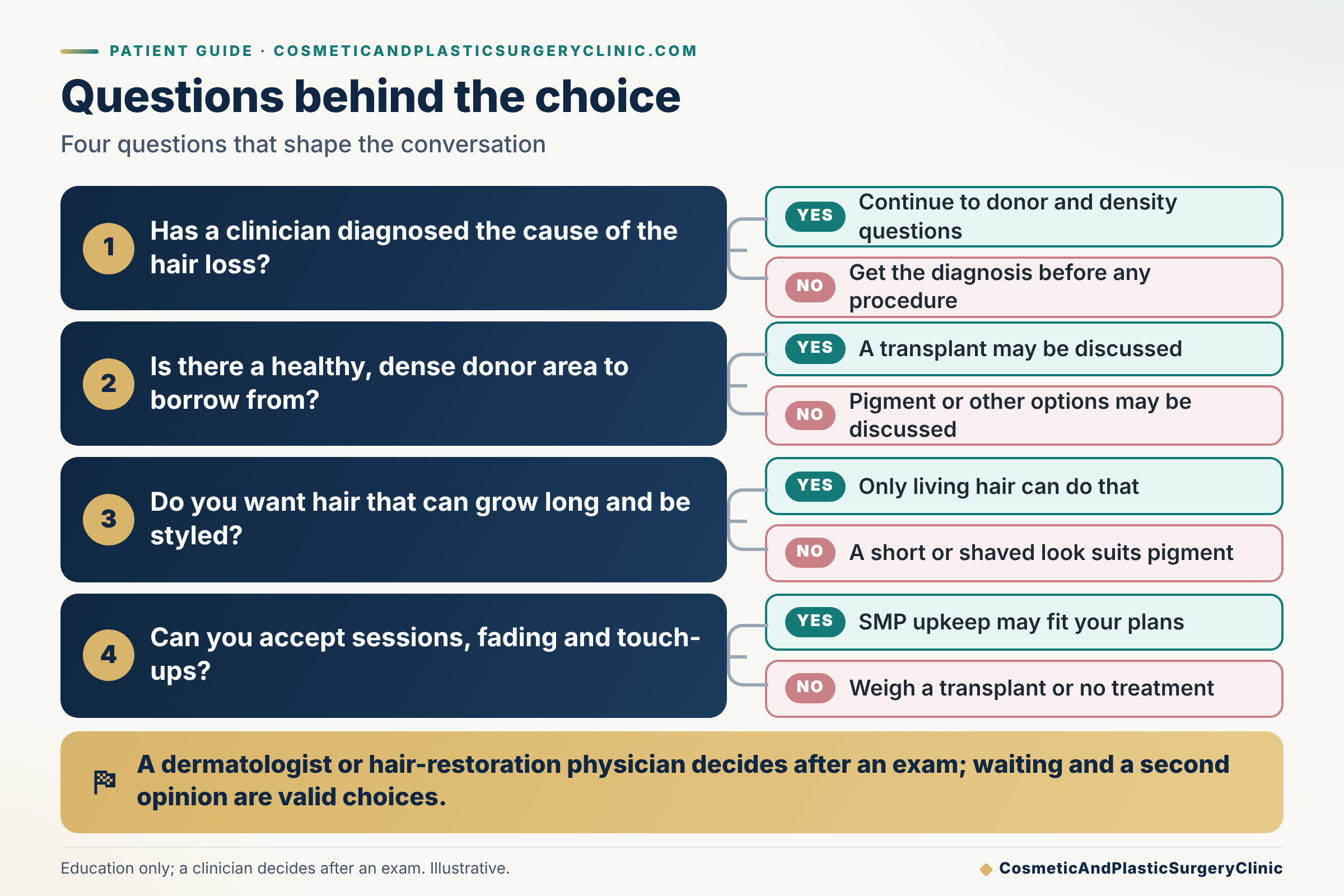
These six questions turn a hair transplant vs SMP comparison into a consultation. They sit alongside the general list on the plastic surgery consultation page. Ask them of a dermatologist or hair-restoration physician, and of any SMP practitioner you are considering.
Questions about your scalp and your options
Question 1: what is causing my hair loss, and who diagnosed it?
A useful answer names the diagnosis, how it was reached, and whether other causes were considered. The AAD says a dermatologist can tell you what type of hair loss you have and that different types need different treatments. An evasive answer skips the diagnosis and goes straight to a procedure.
Question 2: how much donor hair do I have, and what does the plan leave in reserve?
Ask for the donor density in plain terms and for an estimate of how the plan changes if thinning continues. The ISHRS describes keeping donor hair in reserve for younger people with progressive loss. If the answer is that supply is unlimited, treat it with caution; the sources read for this page describe it as finite.
Question 3: what does each option do to my later choices?
Ask what happens if you want to switch. The ISHRS says to wait at least a year after a transplant before adding SMP. No source read for this page reports how prior SMP affects the results of a later transplant, so ask the surgeon directly and bring photos of earlier work.
Questions about the practitioner and the plan
Question 4: who performs the work, and what are their credentials?
For a transplant, ask who plans the hairline, who extracts follicles and who places them, and verify the physician as described in the cosmetic surgeon credentials guide. For SMP, the ISHRS says there is currently no international licensing body, and that some places restrict dermatologic lasers to licensed medical professionals. Ask about training, supervision and the rules in your area.
Question 5: what pigment, what depth control, and what is the removal plan?
Ask what pigment is used and for its safety documentation, whether a test patch is done (the ISHRS mentions one), how needle depth is controlled, and how sterility is maintained. Ask in advance how removal would be done and who would do it. The FDA says removing tattoos can be very difficult, so an answer that it can simply be lasered off is incomplete.
Question 6: what is the itemized quote and written policy if I am unhappy?
For SMP, ask for a price that states the number of sessions, touch-up fees and correction terms. For a transplant, ask for a quote that separates surgeon, facility, anesthesia and follow-up, with the revision policy in writing. Request photos of people with a similar pattern, healed at stated intervals; the ISHRS says consistently lit before-and-after photos are better than cellphone shots, which can distort results.

Frequently asked questions
In hair transplant vs SMP, does SMP damage follicles that are still growing?
WebMD says SMP does not treat hair loss or help hair grow, but it also says SMP will not cause additional loss or damage existing follicles. The ISHRS says a tattoo-removal laser can often clear SMP without losing hair, while traditional scalp tattoo removal risks hair loss. These are descriptions from consumer and society pages, not outcome data from large studies, so ask a prospective practitioner what experience they have with SMP on scalps that still have growing hair, and what happens to that hair if pigment is later removed.
Is hair transplant vs SMP a different decision for women?
The diagnosis matters first, because female pattern hair loss is often diffuse, which changes how a transplant and pigment would each look. Cleveland Clinic lists hair loss in women among SMP uses, and the Rassman review lists women with thinning who do not respond to minoxidil and are not transplant candidates. The 2024 comparison of 40 women suggests measured density helps choose, with SMP at higher densities and a transplant at lower ones. Any plan should rest on an evaluation by a clinician who treats female hair loss.
Can I have SMP with psoriasis, alopecia areata or another scalp condition?
Sources differ. Cleveland Clinic lists alopecia areata and chemotherapy-related hair loss among reasons people have SMP. The ISHRS lists active inflammatory conditions, including scarring alopecia, psoriasis and alopecia areata, as poor-fit situations until stable for two to three years. A 2025 study of 18 people with scarring alopecia found that response varied by diagnosis. The reasonable course is to have a dermatologist judge whether the condition is active before any needle touches the scalp.
Who regulates SMP practitioners if I am weighing hair transplant vs SMP?
No single body covers the field. The ISHRS says there is currently no international licensing body for SMP practitioners, and the FDA says tattoo practice is regulated by local jurisdictions rather than by the agency. The ISHRS also notes that in some locations only licensed medical professionals may operate dermatologic lasers, which can matter for removal. Rules differ by state and country in the hair transplant vs SMP market, so ask which licenses, health-department permits or inspections apply where you live, and ask to see them.
Does insurance cover hair transplant vs SMP?
Cleveland Clinic says SMP is not covered by insurance because it is elective, and advises asking the provider about cost and the number of treatments. No source read for this page states coverage rules for hair transplants, so do not assume either way. Ask the insurer in writing before booking if coverage matters, particularly for reconstructive uses such as scarring after injury or surgery.
In hair transplant vs SMP, can I choose SMP now and a transplant later?
Some people do move from one to the other. In a 2024 study of 120 people seeking correction of an unsatisfactory SMP result, hair transplantation alone or with extra SMP was used in just over 80%. That tells you transplants are a common fix, not how pigment affects graft placement or growth. No source read for this page addresses that question, so tell any surgeon about prior SMP, bring dates and photos, and ask whether pigment would change the plan.
I am in my twenties and still losing hair. Which hair transplant vs SMP path is more cautious?
The AAD says male pattern hair loss can begin in the late teens or early twenties, and the ISHRS says younger people with progressive loss may need several procedures and that surgeons plan to keep donor hair in reserve. SMP does not use donor hair, but a pigment pattern designed around current density may need redesign as loss continues. Neither source dictates a choice; a clinician who diagnoses the pattern and looks at family history can discuss whether waiting, medical care or a limited plan makes sense.
Sources and further reading
- International Society of Hair Restoration Surgery — Scalp Micropigmentation (SMP): All You Need to Know, updated November 2025 (accessed 2026-11-13) — technique, uses, timing after transplant, removal, licensing
- International Society of Hair Restoration Surgery — The Donor Site: Savings and Loan of Hair for Transplantation, updated January 2024 (accessed 2026-11-13) — donor zone, limited supply, planning for future loss
- American Society of Plastic Surgeons — Hair Transplantation and Restoration (accessed 2026-11-13) — FUE and FUT definitions
- American Society of Plastic Surgeons — Hair transplant candidates (accessed 2026-11-13) — existing hair used, expectations, limits
- American Academy of Dermatology — Male pattern hair loss treatment, updated December 2022 (accessed 2026-11-13) — onset, role of diagnosis, medicines named, loss returns after stopping
- WebMD — What to Know About Scalp Micropigmentation, medically reviewed September 2024 (accessed 2026-11-13) — uses, risks, sessions, aftercare, keloids
- Cleveland Clinic — Scalp Micropigmentation, updated April 2022 (accessed 2026-11-13) — sessions, longevity claim, risks, insurance
- U.S. Food and Drug Administration — Tattoos and Permanent Makeup Fact Sheet, current October 2024 (accessed 2026-11-13) — ink regulation, contamination, allergy, MRI, removal
- Rassman et al., Journal of Clinical and Aesthetic Dermatology 2015 — Scalp Micropigmentation: A Concealer for Hair and Scalp Deformities (accessed 2026-11-13) — technique, risks, uses, evidence limits
- Rassman, Pak and Kim, Plastic and Reconstructive Surgery Global Open 2017 — Combining FUE and Scalp Micropigmentation, record page (accessed 2026-11-13) — combined use, FUE share
- Park, Kim and You, Journal of Cosmetic Dermatology 2024 — Hair transplantation versus scalp micropigmentation in female pattern hair loss, Europe PMC abstract record (accessed 2026-11-13) — density cutoffs, 40 women
- Park et al., International Journal of Dermatology 2024 — Revision for unsatisfactory outcomes of scalp micropigmentation, abstract record (accessed 2026-11-13) — 120 correction cases
- Shubham et al., Journal of Cutaneous and Aesthetic Surgery 2025 — Scalp micropigmentation in scarring alopecia, article in press (accessed 2026-11-13) — 18-patient study, fading
- EMJ — Scalp micropigmentation shows strong results in alopecia, summarizing Liu et al., Journal of Cosmetic Dermatology 2025 (accessed 2026-11-13) — ten-case series