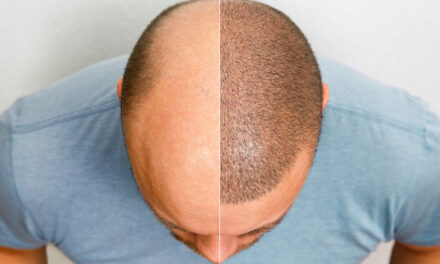
Hair transplant tourism means flying to another city or country for a surgical hair restoration procedure, usually in a package that bundles surgery, hotel and transfers. The appeal is plain: a lower headline price. The risks are less visible, because a hair transplant uses a finite supply of your own donor hair, and the quality of the result depends on who makes the incisions, who plans the hairline and who is reachable when healing goes sideways. This page is about those decisions, and nothing on it is a verdict on any clinic, country or person.
The procedure itself, and what it can and cannot change, is explained in the hair transplant overview. General rules for operations abroad sit in medical tourism for surgery, so this article stays with what is specific to hair: technician delegation, graft counts, donor depletion, slow results and repair.
Why hair transplant tourism is common, and what the price leaves out
Hair transplants are elective and are usually not covered by health insurance, so patients pay in full and compare prices hard. That comparison is where hair transplant tourism begins. It is also where the comparison most often breaks down, because a package price and a home-country surgeon’s fee rarely describe the same service.
What draws patients to hair transplant tourism, and what a package quote bundles
Package pricing in hair transplant tourism and the numbers behind it
Public price figures for hair transplant tourism are marketing-adjacent and not comparable, so treat them as examples rather than benchmarks. NPR reported in October 2025 on a California nurse who paid about $3,400 including airfare and lodging for a transplant in Istanbul, and said he had been quoted more than double that in the United States. In a 2024 Axios report, one Istanbul clinic said its programs run roughly $3,500 to $8,000, and the Foundation for Hair Restoration was cited for a U.S. average near $7,500.
Those figures differ in date, source and scope, and none states graft count, who performs which step, or what follow-up is included. For how per-graft and per-session pricing work, see the hair transplant cost article. The useful habit here is narrower: ask what a price covers before comparing it with another.
The costs that sit outside the package
Consider a hypothetical quote of $3,500 dated November 13, 2026, described as all-inclusive. Add a flight, perhaps a second trip for a follow-up visit, unpaid days off, and a local dermatology visit if scalp problems appear at home. The CDC notes that follow-up care for complications after treatment abroad may be costly and not fully covered by insurance. None of this makes the trip a bad idea. It means the real comparison for hair transplant tourism is the total across the whole year, including what happens if something needs fixing.
A local quote can look high for the same reason in reverse: it may include the surgeon’s own hands, the facility, the follow-up visits and a plan for a touch-up. Put both quotes into the same list of line items before deciding which one is cheaper.
The scale of the market and what is known about it
How many patients take part in hair transplant tourism
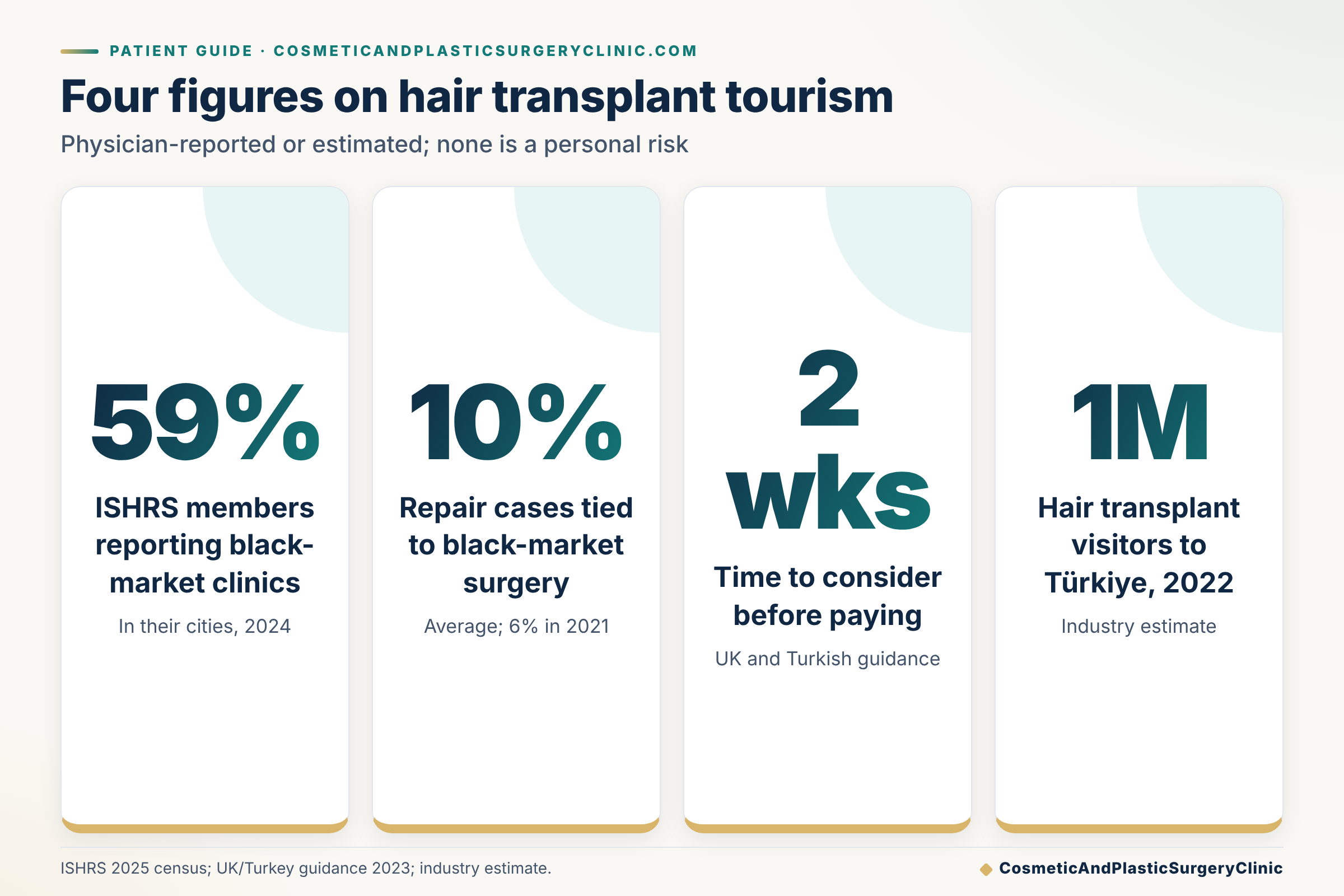
Numbers on hair transplant tourism are soft. A 2023 interview with the head of the Turkish Health Tourism Association, carried by Daily Sabah, put hair transplant visitors to Türkiye in 2022 at about 1 million and their spending at about $2 billion. The figure is derived rather than counted: it divides the spending by an assumed $2,000 per patient. NPR later reported about 2 million medical tourists to Türkiye in 2024, citing the Health Ministry, without a hair-specific split.
Treat these as signs of scale, not as a count of operations or a measure of quality. They say nothing about complication rates, and no source opened for this page gives a per-patient complication rate for hair transplant tourism specifically.
Good surgeons exist everywhere, and the evidence on hair transplant tourism is lopsided
ISHRS itself says reputable physicians around the world perform excellent transplants, and patients can find qualified surgeons locally or abroad. NPR’s 2025 report likewise notes the procedure is generally considered safe in the hands of a skilled surgeon. For hair transplant tourism specifically, in December 2023 the British hair restoration, aesthetic and plastic surgery associations and the Turkish Society of Plastic, Reconstructive and Aesthetic Surgeons issued joint minimum guidelines for patients, which shows the concern is shared on both sides.
The evidence on harm comes mainly from surgeons’ reports, news stories and regional hospital series, not from tracking a defined group of travelers over time. That does not make the warnings wrong. It means the figures below describe a pattern worth checking for, not the odds that apply to you.
Documented problems in hair transplant tourism and how much is known
The same handful of problems recur across the sources opened for this page. Most of them are about delegation and volume, not about the surgical technique itself, which is why a clinic’s before-and-after gallery says little about hair transplant tourism risks.
The recurring pattern: delegation, volume and thin follow-up
Technician-performed steps in hair transplant tourism and the “bait and switch”
ISHRS issued a consumer alert in 2014 that said the diagnosis, surgical planning, donor harvesting, hairline design and recipient-site creation should be done by licensed physicians, or licensed extenders working within their scope. Its 2016 release described a “bait and switch” in which a physician’s credentials draw patients while a technician performs the surgery, and linked Turkish rules requiring hospital settings to a black market in private clinics.
The listed consequences are misdiagnosis, missed hair disorders or related systemic disease, and unnecessary or ill-advised surgery. ISHRS also reports technicians in Europe working under licensed Turkish doctors. Rules on what a technician may legally do vary by country, so the real question is who will cut, not who owns the clinic. A clinic’s title for its owner proves little; the license and the role of the person holding the instrument matter.
Overbooked days, graft counts and a depleted donor area after hair transplant tourism
NPR’s 2025 report relayed ISHRS’s concern about unlicensed practitioners who rush through several patients a day, and quoted a clinic physician who called the atmosphere a “Wild West” in which patients must research for themselves. ISHRS’s awareness campaign says some patients who expect 4,000 to 6,000 grafts may receive about half, which is a claim from physician members, not a measured rate. It also lists over-harvested donor areas among the harms reported to the society.
Donor hair is the limited resource in any hair transplant tourism package. Grafts taken from the donor zone are not replaced, so counting matters twice: once for what you paid for, and once for what remains if a later procedure is needed. Ask how grafts will be counted and whether you may see the count recorded.
What the numbers say, and what they cannot say
The ISHRS census on hair transplant tourism: 59%, 10% and the survey’s limits
The 2025 ISHRS Practice Census, covering 2024, is the main survey source opened for this page on hair transplant tourism, and it reports that 59% of members said black-market hair transplant clinics operate in their cities, up from 51% in 2021. Members also reported that repair cases traced to a prior black-market transplant averaged 10% of their repair work, up from 6% in 2021. The survey was run by an outside research firm, with a stated margin of error of plus or minus 5.4% at 95% confidence.
Three limits apply. The data come only from participating physicians, so patients’ own experience is absent. The 10% is a share of repair cases, not a rate of failure among travelers. And ISHRS is a professional society whose members compete for the same patients, which is a reason to cross-check its warnings against independent sources, as this page tries to do.
A baseline from regulated settings, and one mixed finding on hair transplant tourism
A 2026 narrative review of follicular unit excision complications in Frontiers in Medicine reported overall complication rates between 1.2% and 4.7% in large clinical series, with major adverse events uncommon, and called true population-level incidence uncertain. It linked preventable complications and opportunistic infections to procedures done in poorly regulated or non-medical settings, but gave no tourism-specific figure.
A 2026 Swedish regional study, in the Journal of Plastic Surgery and Hand Surgery, looked at 53 patients with acute complications after cosmetic surgery, 40% of them operated abroad, most often in Türkiye. Hair transplants were not singled out. Patients operated abroad were admitted less often than those operated in Sweden, 13.6% against 48.0%, which complicates a simple story. The authors flagged a small cohort and no denominator for total procedures.
Verifying a hair transplant tourism clinic before you pay a deposit
Verification is the one part of hair transplant tourism that a patient fully controls. It costs a few emails and some patience, and the answers sort clinics quickly. What follows draws on ISHRS’s surgeon-selection checklist (updated September 2026), its awareness pages and the 2023 joint guidelines.
Check the people behind hair transplant tourism offers: license, role and presence
Which steps belong to the surgeon, and which may be delegated
ISHRS’s checklist assigns these tasks to the surgeon: the medical history and examination, ruling out hair diseases that could affect growth, drawing the hairline, making incisions in the recipient and donor areas, and placing grafts with sharp implanters. It describes pulling grafts the surgeon has scored, loading implanters and placing grafts with forceps or dull implanters, after the surgeon has made all incisions, as tasks that may be delegated to technicians where local law allows.
That split is one professional society’s view, and laws differ by country, so ask the clinic to say in writing who does each step. A vague answer such as “our medical team” is not an answer. The same checklist asks where the physician trained, when the license was granted and whether a legitimate board certified them; the choosing a plastic surgeon article covers how such lookups work in the United States.
License lookup, an observer in the room and malpractice cover
ISHRS’s October 2026 repair-day release tells patients to verify the surgeon’s credentials with the local medical licensing authority and to learn which parts of the procedure must be done by a licensed physician. Its awareness page adds that patients can ask to have an observer in the room to confirm the doctor does the surgery, and that a refusal is a reason to think twice. ISHRS also asks patients to confirm that everyone involved carries malpractice insurance.
No source opened here explains how to look up a license in a specific foreign country, so that step belongs to the licensing body of the country where you would be operated on. If you cannot find the surgeon in any register, treat that as unresolved, not as a formality.
Check the place and the paper trail before hair transplant tourism begins
Facility, sedation and a plan for problems after hours
Most hair transplants are done under local anesthesia, sometimes with a mild sedative, according to the American Academy of Dermatology, and surgery can take 4 to 8 hours. The 2023 UK and Turkish guidelines say clinics should have systems to handle complications during and outside working hours, including assessing skin necrosis, infection, cysts and altered sensation, and providing antibiotics. Ask who answers a phone on the second night, in what language, and what happens if you need a hospital.
Ask also what monitoring is used if sedation is given, who administers it, and what the nearest hospital is. Facility accreditation, where it exists, speaks to the building and its processes. It does not tell you whether the person holding the instrument is trained to do this operation.
Contracts, consent and the cooling-off period
A Turkish law firm’s 2025 commentary says some clinics present consent forms only in Turkish, and that the validity of such consent may be legally challenged. It adds that a poor result alone is not malpractice: a claim requires failure to meet the legally expected standard of care and harm caused by it. It also says a malpractice claim can be filed after returning home. That is general commentary, not legal advice, and a lawyer in the relevant country can say what applies.
The practical points are within your control. Read the consent form in a language you read fluently, before paying. Ask what the refund terms are if the surgeon who consulted you will not be the one operating. Get the touch-up policy, and what it excludes, in writing.
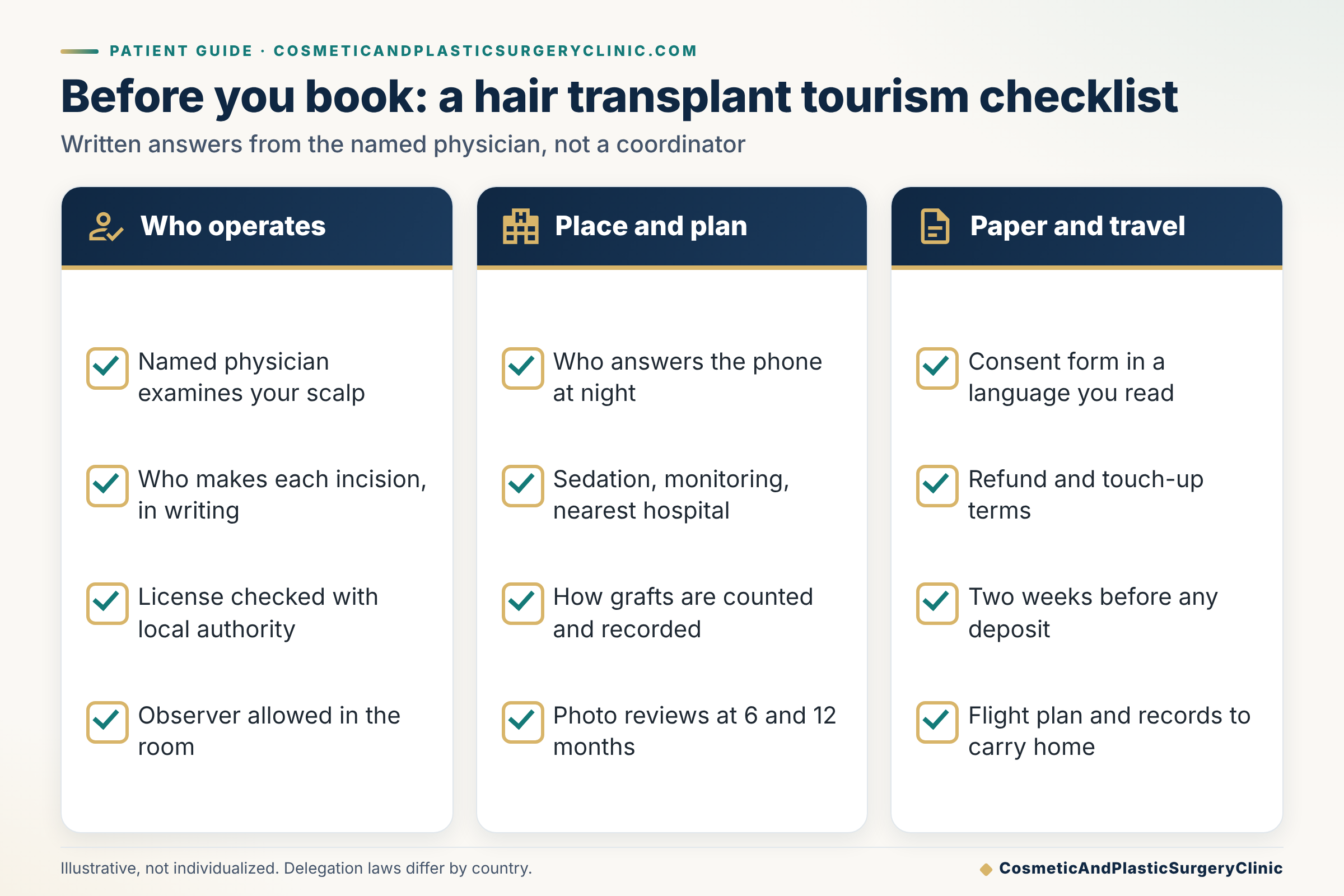
The two-week rule is worth borrowing for hair transplant tourism or for local surgery alike. A deposit demanded within hours, or a discount that expires at midnight, removes the one safeguard that costs nothing: time to read, ask and compare. Table 1 turns the checks into a form you can fill in for each hair transplant tourism clinic you are considering.
| What to confirm | Why it matters | Acceptable evidence | Pause if |
|---|---|---|---|
| Who examines you and decides the plan | Diagnosis comes before design; missed scalp disease changes the advice | A named physician examines you, in person or by live video, before a price is fixed | A quote arrives from photos alone, from a sales coordinator |
| Who makes donor and recipient incisions | ISHRS lists incisions as surgeon tasks; delegation is the most-cited problem | Written roles for each step, with names and license numbers | “Our team” with no names, or a refusal to put it in writing |
| License in the performing jurisdiction | A license in one country generally does not authorize practice in another | Entry in the local licensing authority’s register that you checked yourself | Only a certificate image or a society badge on the clinic website |
| Observer, graft count and photos | Graft counts are a reported dispute; an observer tests who operates | Permission for an observer; counting method and post-operative record explained | No observer allowed, or no way to see the count |
| Complications plan, day and night | Problems can start after you fly home | Named contact, language, hours, and a hospital arrangement in writing | Aftercare means a messaging group with no clinician |
| Contract and time to decide | Consent and refund terms are hard to contest from abroad | Consent form in your language and two weeks before paying | Deposit pressure, expiring discounts, forms you cannot read |
Marketing signals in hair transplant tourism that deserve a second look
Discounts, packages and photos you cannot trace
ISHRS’s October 2026 release lists steep discounts and fake photos of results among the tools used to draw patients to unlicensed operators, and its 2024 release adds accommodation and tour packages to the warning signs. A package is not itself a red flag in hair transplant tourism. A package that cannot say who operates is. Healthcare Improvement Scotland, the regulator for private clinics there, warned in February 2026 about overseas information events in hotels and venues promoting hair transplants and other procedures, and advised against health tourism.
The hair transplant photos guide explains how to read result galleries, including why a photo without a known surgeon, date and hair length proves little. Ask a hair transplant tourism clinic for photos of patients treated by the surgeon who will operate on you, at 12 months or later.
Claims that hair restoration is free of scars or done by a machine
ISHRS’s surgeon-selection page says there is no such thing as surgery with no scarring in hair transplantation, because both strip and individual-follicle harvesting leave scars. It also names claims of fully machine-performed surgery as a red flag. Robotic assistance exists, but it is a tool under a surgeon’s direction; the comparison of harvesting methods is in FUE vs FUT hair transplant.
Treat unconditional language in any form, such as a success rate quoted without a definition, as a prompt to ask what was measured. One clinic told NPR in 2025 that it claims a 90% to 95% success rate; the report did not say how success was defined.
Travel, flying and aftercare logistics for hair transplant tourism
A hair transplant is a short trip wrapped around a slow process. The operation takes hours, but hair sheds weeks later and the outcome is judged months after that, usually when you are back home. Planning for hair transplant tourism therefore means planning for the months after the flight.
Before departure: diagnosis, medications and records
The diagnosis step in hair transplant tourism is not optional
The American Academy of Dermatology says a candidate needs enough healthy donor hair and the ability to grow hair in the thinning area, and that a dermatologist’s exam can confirm both. Its consultation description includes a scalp exam and possibly a blood test or scalp biopsy to find the cause of hair loss, and it notes that younger men may be asked to wait. A package that skips this step skips the reason the exam exists: some causes of hair loss, including scarring conditions, need a specialist’s judgment before anyone operates.
If you have not had a diagnosis from a clinician who examined your scalp, consider getting one at home first, even if you then go ahead with hair transplant tourism. The hair transplant candidate article explains what clinicians evaluate. Whether and how to treat ongoing native hair loss with medicine is a decision for a prescribing clinician; the AAD page says only that hair loss can continue after surgery and that medicine may be recommended to slow it.
Medications, allergies and paperwork to carry
The CDC advises a pre-travel visit with a health care provider or travel medicine clinician at least 4 to 6 weeks before the trip, covering risks linked to your health, the procedure and the travel. It also advises carrying copies of medical records and lab results, medicines in original packaging, a medication list with generic and brand names, and telling the destination staff about allergies. For a hair transplant, include blood thinners, supplements and any medicine you take for hair loss; whether any should be paused is the prescribing clinician’s call, not a general rule.
Before you fly home, the CDC adds, get copies of your records from the destination facility, translated into English if needed. For this operation that means the operative note, the graft count by hair-per-graft group if recorded, the type of anesthesia and medicines given, and the names of everyone who operated.
After the operation: flying, staying nearby and the slow part of hair transplant tourism
Flying after surgery and where to recover
The CDC states that flying after surgery can increase the risk of blood clots, and advises delaying air travel for 10 to 14 days after major surgeries, particularly those involving the chest. That advice is written for major operations, and no source opened for this page sets a flight rule for hair transplants, so ask the operating surgeon for the plan in writing and describe your route, including layovers. Moving around on long flights is a general clot precaution, not a substitute for individual advice.
The ASPS 2024 practice reference on patients traveling for surgery says the operating surgeon is responsible for organizing enough postoperative coverage, should agree how long you will stay near the practice, and should caution patients against unregulated recovery homes. It was written for plastic surgeons, but the questions apply: where will you sleep, who will check your scalp and how will you reach someone if the answer is not obvious.
Months three to twelve of hair transplant tourism: who watches the result
According to the AAD, transplanted hair sheds two to eight weeks after surgery, the scalp may look thinner than before at month three, and most people see results at six to nine months, some at twelve. The hair transplant timeline and hair transplant recovery articles describe this arc.
For people in hair transplant tourism the timing matters for another reason. By the time shedding ends and growth shows, the clinic’s aftercare window may have closed and the person who planned the hairline may be several time zones away. Agree beforehand how you will send dated photos at set intervals, who will review them and what happens if a section looks sparse at a year.

When hair transplant tourism goes wrong: emergency care, records and repair
Most cases of hair transplant tourism end with a routine recovery. This section is for the minority that do not, because the practical difficulties after a poor result are largely the same everywhere: who treats it, who pays and what can still be done with the donor hair that remains.
Care after hair transplant tourism, far from the operating surgeon
Who treats you at home after hair transplant tourism, and who pays
Emergency departments treat emergencies regardless of where the operation took place. Slower problems, such as a persistent infection, cysts or a patch that is not growing, fall to whoever will take them on, and the CDC warns that follow-up for complications may be costly and not fully covered by insurance. The CDC also suggests considering supplemental travel health insurance for follow-up or emergency care after a procedure abroad; read the policy’s exclusions for elective surgery before relying on it.
ASPS’s 2019 blog post on plastic surgery tourism makes a similar point about revisions: patients may end up paying more for complications and corrections than they saved. Healthcare Improvement Scotland’s 2026 release described a burden on the NHS when patients return needing urgent care. These are warnings, not measured averages; no source opened gives a typical cost of fixing a result from hair transplant tourism.
Records, language and where a complaint can go
A home clinician can only act on what they can see. The operative note, medicine list, graft counts, photographs taken on the day and the consent form give them a starting point. If you cannot read the documents, have them translated. The 2023 guidelines say patients should be able to raise grievances through a clear complaints process, so ask where the clinic’s process is written down and who answers it.
The Turkish law firm’s 2025 commentary describes legal recourse as possible after returning home, but a claim depends on proving a departure from the expected standard of care and resulting harm. ISHRS’s awareness page is blunter, saying patients of black-market clinics may have no recourse. Whichever is closer to your situation, the time to learn the clinic’s legal identity and insurance is before paying.
Repair after a poor result from hair transplant tourism
What repair can and cannot do
ISHRS describes repair after hair transplant tourism or any poor result as rebuilding a natural hairline, correcting damage and sometimes extracting and redistributing grafts. Its repair article also notes that the first surgery often depletes the best follicular units, leaving lower-quality grafts for any later repair, and gives an example where an entirely depleted donor area meant no further surgery could be done. In one case it describes, scalp micropigmentation was the remaining option to cover a disfigured donor area; the hair transplant vs SMP article compares the two approaches.
ISHRS’s 2024 release says repairs often require more than one corrective procedure, and a surgeon quoted in it says there is no easy fix for extensive repairs. The more donor hair that remains, the more options a repair surgeon has. That is a quiet argument for counting grafts carefully the first time.
Timing, documentation and pro bono programs
A repair surgeon needs the original operative details and dated photos to plan anything; how long to wait before repair is that surgeon’s judgment, and no source opened sets an interval. ISHRS runs an annual World Hair Transplant Repair Day on November 11, and its sixth edition, announced in October 2026, offers eligible victims a chance at a pro bono corrective procedure from volunteer physicians through a registration site. The society said about 100 physician members take part.
Eligibility rules, waiting lists and the scope of free repair are set by the program, so check its own page rather than assuming a case qualifies. A second opinion from a surgeon who did not perform the original operation, and who has no stake in redoing it, is a reasonable first step.
| Factor | Effect on outcome | Maintenance or repair implication | Warning sign or review point |
|---|---|---|---|
| Donor supply | Sets the ceiling on total coverage across all operations | Grafts used now are unavailable for a later session or a repair | Graft count unclear, or a very large session planned in one day |
| Hairline design | An unnatural line can be hard to correct once grafts are placed | Reworking a line may need more than one procedure | Hairline set by a coordinator, or drawn without discussing future loss |
| Ongoing native hair loss | Native hair can keep thinning around transplanted areas | May need medical management and, later, further planning with a clinician | No discussion of long-term loss, or pressure toward medicines without a clinician’s review |
| Graft handling and placement | Affects growth and density in the treated zone | Poor growth is judged months later, when follow-up may have ended | Thin or patchy areas at 9 to 12 months, or a donor area that looks sparse |
| Follow-up and records | Lets someone compare progress with what was planned | Repair surgeons need operative details and dated photos | Missing operative note, no scheduled photo review, no named reviewer |
A decision framework for hair transplant tourism: two cases and a slow-down rule
Two people can look at the same package and reach opposite, reasonable conclusions, because the facts that matter are not on the price list. The cases below are hypothetical and are not advice for any real person.
Two hypothetical cases of hair transplant tourism and the fact that changes each decision
Case one: a clear pattern, a flexible schedule and a named surgeon
Consider a hypothetical man in his thirties whose thinning follows a typical pattern and who has been examined by a dermatologist at home. He finds a clinic abroad where a named physician offers a live video consultation, confirms in writing that the physician makes every incision, allows an observer, provides a consent form in his language and gives him two weeks before any deposit. He has booked leave for a second visit.
For him, hair transplant tourism may be a defensible choice, with open questions still to settle: the flight plan, the after-hours contact, and who will review his photos at six and twelve months. What would change the decision is a single answer. If the clinic later says that “the team” will do the incisions, the central safeguard is gone and the price advantage does not replace it.
Case two: diffuse thinning and a package with no examination
Now consider a hypothetical woman with diffuse thinning, no diagnosis and a social-media offer that fixes a graft count and price from photographs. ISHRS’s 2025 census reported that female surgical hair restoration patients rose 16.5% between 2021 and 2024, so this scenario is not rare. The missing step is the one the AAD describes: an examination that looks for the cause of hair loss, with a biopsy or blood test where indicated.
What changes her decision is the diagnosis. If a local clinician finds a cause that needs treatment before any operation, or that surgery would not help, hair transplant tourism was never the right first move. If the exam supports surgery, she can then compare surgeons on equal terms, at home or abroad, using the checks in Table 1.
| Situation | Pathway | Possible benefit | Trade-off | Key question |
|---|---|---|---|---|
| Cause of hair loss not yet diagnosed | Clinician exam at home first | Right diagnosis before spending on surgery | Time and a consultation fee | Has a clinician examined my scalp? |
| Diagnosed, wants surgery, tight budget | Surgeon abroad with verified credentials | Lower fee, possible package convenience | Distance for follow-up; travel and time costs | Who exactly makes each incision? |
| Diagnosed, wants close follow-up | Surgeon within reach of home | Easier visits, photo reviews and touch-ups | Higher headline price in many markets | What does the fee include after month three? |
| Early or uncertain loss | Wait, monitor, medical management by a clinician | Keeps donor hair and options open | Visible thinning continues meanwhile | What will my pattern likely look like in five years? |
| Poor result from an earlier transplant | Second opinion from a repair surgeon | Realistic read on remaining donor hair | Repair may be partial or take several sessions | How much donor supply is left? |
Questions to ask and a rule for slowing down
Turning the unknowns of hair transplant tourism into eight questions
Whatever the path, the unresolved items in hair transplant tourism fit into eight questions: who examines my scalp and makes the plan; who makes the incisions; where is the license verified; how many grafts, counted how; what happens if I need help at midnight; what are the refund and touch-up terms; how will my results be reviewed over 12 months; and what is left for a later procedure. The plastic surgery consultation article explains how to judge whether answers are specific or evasive.
Ask for answers in writing from the named physician, not a coordinator. Specific answers, even uncomfortable ones, are a better sign than reassurance. A clinic that welcomes these questions is also telling you something about its follow-up culture.
The slow-down rule for hair transplant tourism: no deposit under pressure
A workable rule is to pay nothing until you have had the answers in writing for at least two weeks, the interval the 2023 UK and Turkish guidelines recommend for considering the recommendation and consent form. If a discount expires sooner, treat the expiry as information about the clinic, not about the hair. Waiting also protects your options: it keeps donor hair unused while you decide, and a transplant you postpone can still be done.
If budget is the constraint, the plastic surgery financing article covers how payment plans and loans change the total you pay, and why a cheaper procedure financed at a high rate may not be cheaper. Alternatives to surgery, including scalp micropigmentation, are weighed in the same SMP comparison.
Frequently asked questions
Is hair transplant tourism to Turkey always a bad idea?
No. ISHRS says reputable physicians around the world perform excellent transplants, and a 2023 joint statement from UK and Turkish societies set minimum expectations rather than advising against travel. The concern is surgery done by unlicensed people, overbooked days and weak aftercare. Ask who makes the incisions, verify the license yourself and agree a follow-up plan before paying. A named, accountable physician matters more than the country on the invoice.
How can I tell whether a technician will do my surgery in hair transplant tourism?
Ask for the roles in writing, with a name and license number for whoever makes the donor and recipient incisions. ISHRS suggests asking whether anyone unlicensed will make incisions or harvest grafts, and why that is legal where you are. It also suggests asking to have an observer in the room. A refusal, or an answer that only says “our team,” is a reason to stop and reconsider.
When is it safe to fly home after hair transplant tourism?
No source opened for this page sets a rule for hair transplants. The CDC advises delaying air travel 10 to 14 days after major surgeries, and says flying after surgery can raise clot risk. Ask the operating surgeon, in writing, for the plan that fits your procedure, anesthesia and route. Book flexible tickets so that a delay or a complication does not force you to fly earlier than advised.
Does insurance cover problems after hair transplant tourism?
Often not fully. The CDC says follow-up for complications after care abroad may be costly and not fully covered by insurance, and suggests considering supplemental travel health insurance. Because transplants are elective, read exclusions before relying on any policy. Emergency departments still treat emergencies, but the bill, and who handles non-urgent repair, are separate questions to settle before travel.
Can a bad result from hair transplant tourism be repaired?
Sometimes partly. ISHRS describes repair as rebuilding a natural hairline, correcting damage and redistributing grafts, but notes that the first surgery often uses the best follicular units and that an entirely depleted donor area can leave no surgical option. A repair surgeon needs operative details and photos. Ask for a second opinion from someone who did not perform the first operation, and ask what donor supply remains.
What does a real consultation look like before a transplant abroad?
A physician examines your scalp, in person or by live video, and discusses the cause of hair loss, graft numbers, hairline design and future loss before any price is fixed. The AAD describes a scalp exam with possible blood test or biopsy. A quote from photographs alone, passed on by a sales coordinator, is a sign that the planning step has been skipped or delegated.
How long should I wait before judging a result from hair transplant tourism?
The AAD says transplanted hair sheds two to eight weeks after surgery, can look thinner at month three, and that most people see results at six to nine months, some at twelve. Judging earlier risks false alarm or false comfort. Take dated photos in the same lighting at set intervals, and agree beforehand who will review them. New pain, spreading redness or pus is not part of the normal wait.
Are cheaper packages a warning sign in hair transplant tourism?
Not by themselves. ISHRS lists low prices and bundled accommodation or tours among the lures it sees used by unlicensed operators, but a legitimate clinic can also sell a package. The test is what the package states about who operates, how many grafts and what aftercare follows. Ask for the same line items you would from a clinic that sells surgery alone, then compare totals including travel.
Sources and further reading
- International Society of Hair Restoration Surgery — Beware of unlicensed technicians performing hair restoration surgery (2014; accessed 2026-11-13) — surgeon tasks, risks of delegation, four patient questions
- ISHRS — Buyer beware: medical tourism for hair transplants can have costly consequences (2016; accessed 2026-11-13) — bait-and-switch description, Turkish hospital-setting rule, recommended questions
- ISHRS — Medical tourism: the good, the bad, and the ugly (2017; accessed 2026-11-13) — reputable physicians worldwide; questions to ask before booking
- ISHRS Fight the Fight — Beware illegal hair transplant (accessed 2026-11-13) — reported harms, graft-count claim, observer-in-room advice
- ISHRS Fight the Fight — Before you choose a surgeon (updated September 2026; accessed 2026-11-13) — surgeon-only and delegable tasks, credential questions, claims to question
- ISHRS Fight the Fight — Botched hair transplants and repair options (accessed 2026-11-13) — repair scope, donor depletion, scalp micropigmentation example
- ISHRS — 2025 Practice Census results (accessed 2026-11-13) — black-market clinic share, repair-case share, methodology and margin of error
- ISHRS — Practice census results page (accessed 2026-11-13) — census summary, physician-reported data
- ISHRS — Fourth annual World Hair Transplant Repair Day (2024; accessed 2026-11-13) — warning signs, harms listed, repair often needing more than one procedure
- ISHRS via Kyodo News PR Wire — Sixth annual World Hair Transplant Repair Day (October 2026; accessed 2026-11-13) — credential verification advice, pro bono repair program
- British Association of Plastic, Reconstructive and Aesthetic Surgeons — UK and Turkish medical associations issue minimum guidelines for hair transplant surgery (13 December 2023; accessed 2026-11-13) — two-week consideration period, doctor-versus-technician disclosure, out-of-hours complication systems
- Healthcare Improvement Scotland — Patient safety concerns raised over growing cosmetic tourism trend (27 February 2026; accessed 2026-11-13) — overseas information events, regulator advice
- Centers for Disease Control and Prevention — Medical tourism (accessed 2026-11-13) — pre-travel visit, flying after surgery, records, follow-up costs
- American Society of Plastic Surgeons — Appropriate care of patients traveling for surgery (practice reference, 2024; accessed 2026-11-13) — postoperative coverage, continuity of care, recovery homes
- American Society of Plastic Surgeons — Plastic surgery tourism: proceed with caution (2019; accessed 2026-11-13) — revision costs, records, insurance and legal-recourse cautions
- American Academy of Dermatology Association — Hair transplant (accessed 2026-11-13) — candidacy exam, anesthesia, surgery length, shedding and result timing
- Romera de Blas et al. — Complications in follicular unit excision hair transplantation: current evidence and practical approaches, Frontiers in Medicine (2026; accessed 2026-11-13) — complication rates in large series, poorly regulated settings
- Holm et al. — Public healthcare costs of complications of cosmetic surgery in Sweden, Journal of Plastic Surgery and Hand Surgery (2026; accessed 2026-11-13) — regional cohort of 53 patients, 40% operated abroad
- NPR / WUNC — How one country has become a top destination for hair transplants (6 October 2025; accessed 2026-11-13) — package price example, clinic claims, oversight pledge
- Axios — Americans seeking hair transplants flock to Turkey as medical tourism booms (July 2024; accessed 2026-11-13) — clinic price range, U.S. average cited
- Daily Sabah / Anadolu Agency — Around 1M people came to Türkiye for hair transplants last year (12 January 2023; accessed 2026-11-13) — industry estimate and how it was derived
- Oran Partners via Legal 500 — Hair transplant Turkey: malpractice and legal grey areas explained (26 November 2025; accessed 2026-11-13) — consent language, standard of care, claims after returning home