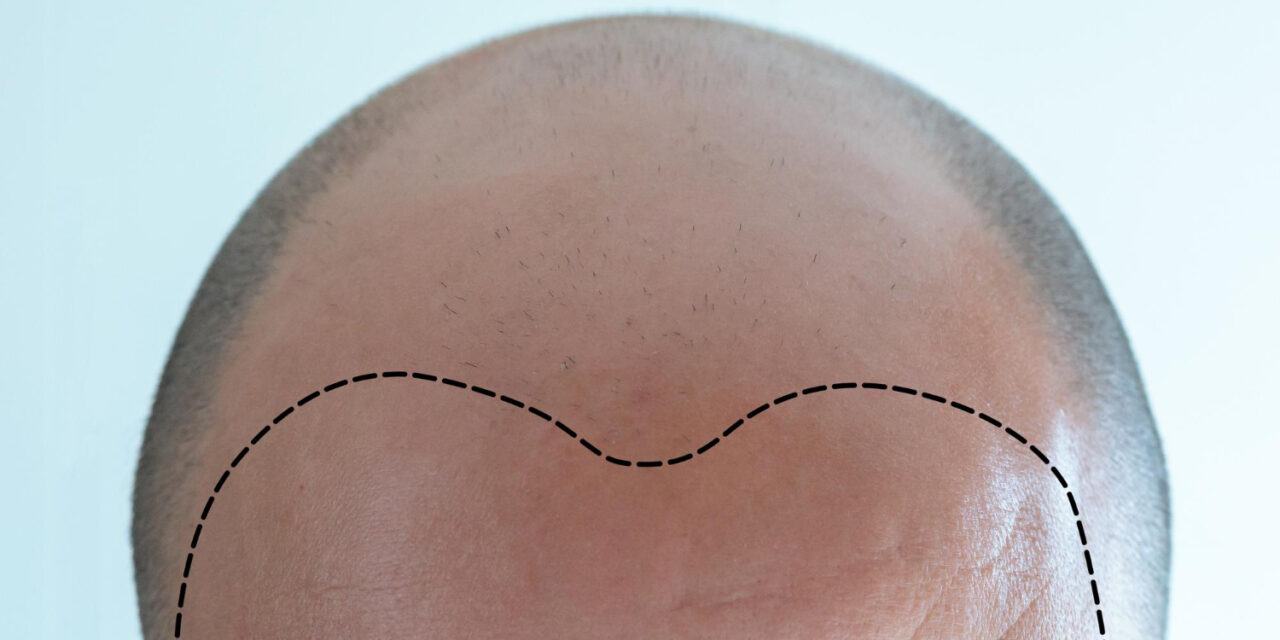
A hair transplant timeline is the part of the decision that surprises people most. The operation takes hours, yet the payoff arrives in installments: the grafts look settled within days, the transplanted hairs shed in the first two months, the follicles rest, and only then does new hair begin to grow and thicken over a year or more. Someone who expects density at week eight may decide the surgery failed. Someone who waits passively until month fourteen may miss a problem that could have been reviewed earlier.
This page follows a hair transplant timeline from the first scabs to the second year, as medical societies, hospital patient pages and a few published reports describe it. It does not decide who should have surgery, how the techniques differ or what the operation costs; the hair transplant overview and its companion pages handle those questions. Every range below comes from a page named in the text, and the written plan from your own surgeon outranks all of them.
Reading a hair transplant timeline: four clocks, not one
The word “timeline” suggests a single line, but a transplanted scalp is running several biological processes at once. Separating them is the quickest way to avoid two common errors: panicking at a normal shed and relaxing during a stall that deserves a question.
Healing, shedding, growth and maturation run on separate schedules
The four clocks inside one hair transplant timeline
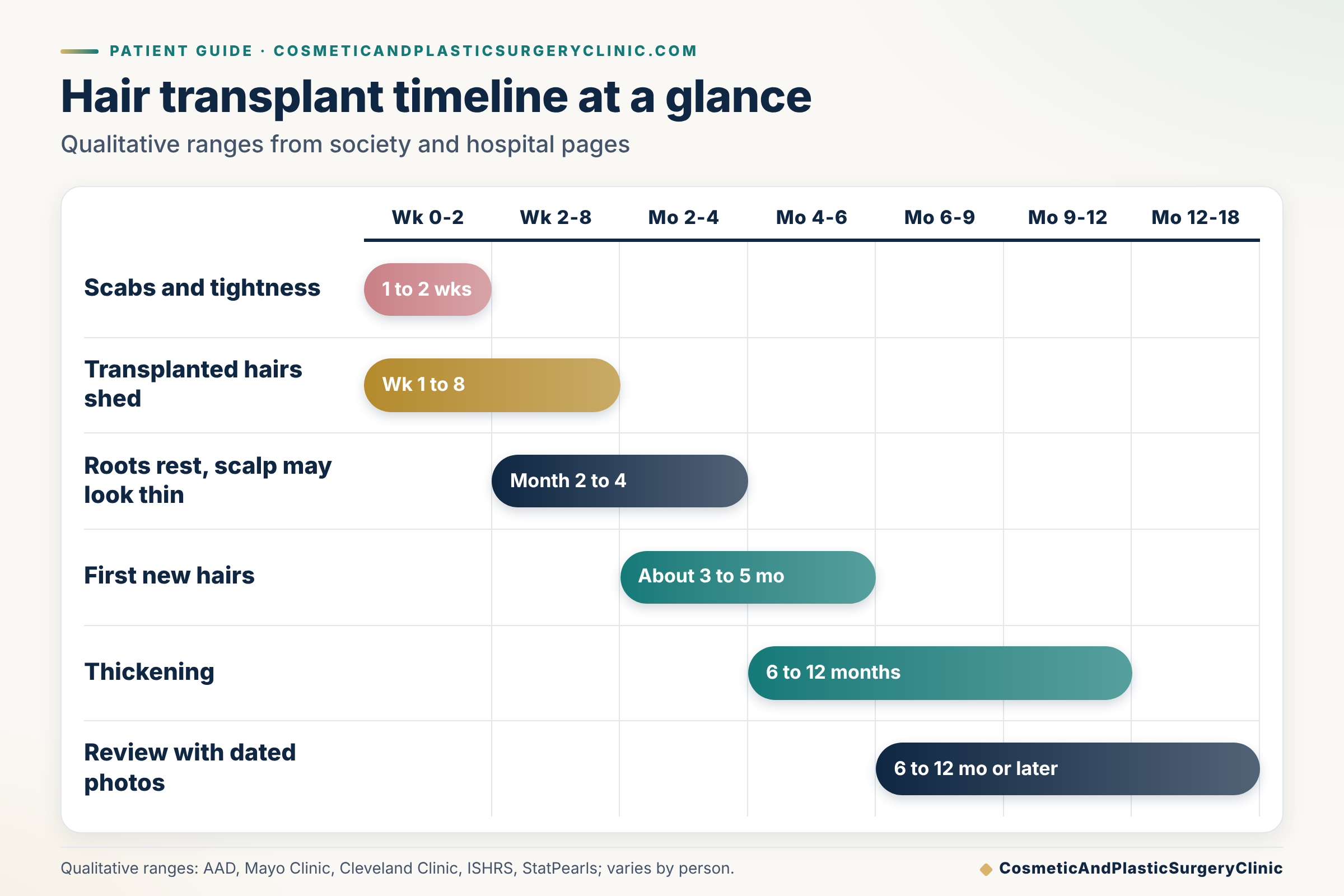
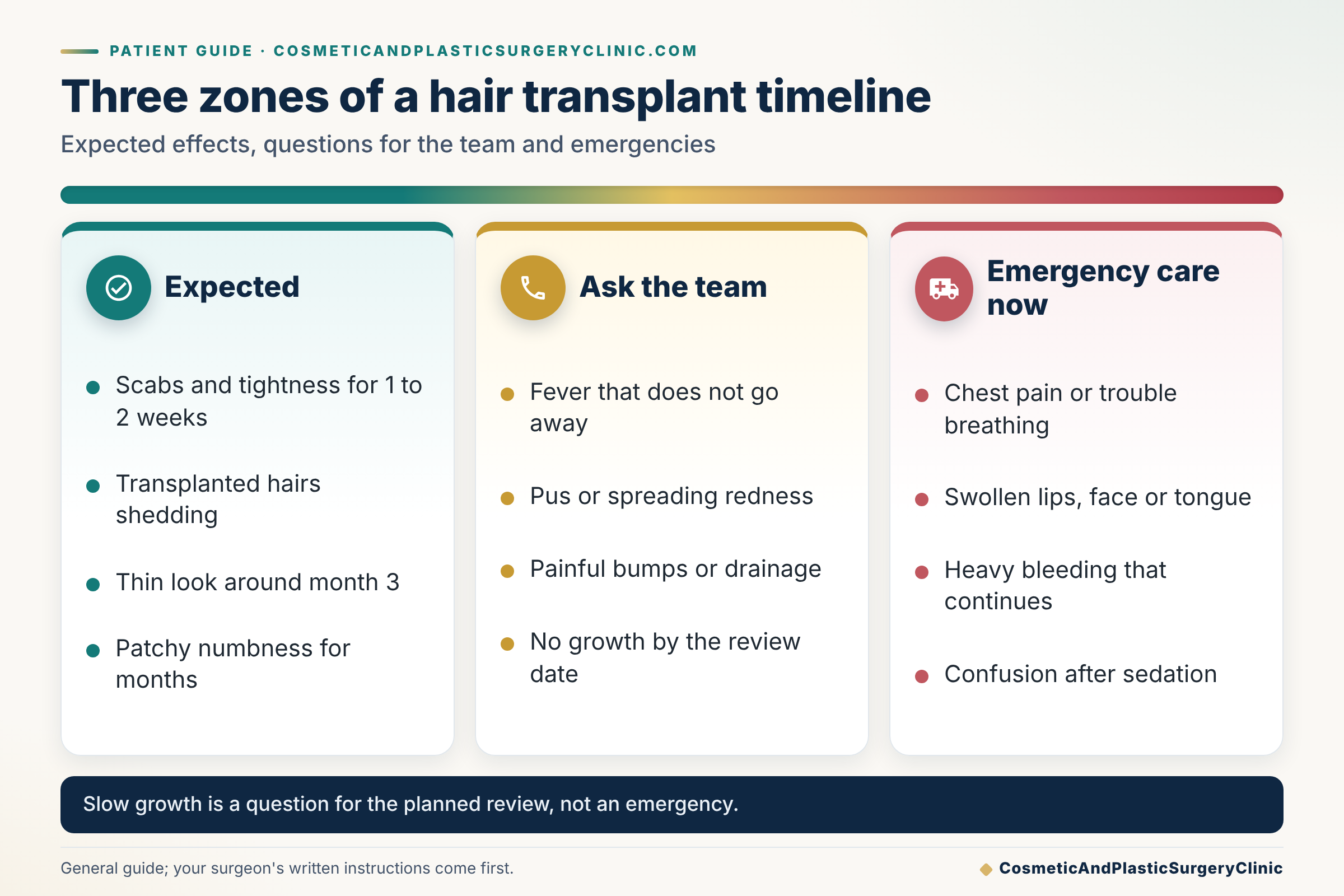
The first clock is wound healing: scabs, tightness, swelling and tenderness, which resolve over days to a couple of weeks. The second is shedding, when the transplanted hair shafts fall out while the follicles beneath the skin stay in place. The third is regrowth, when those follicles restart and produce new hair at roughly one centimeter a month, according to both the International Society of Hair Restoration Surgery (ISHRS) and Cleveland Clinic. The fourth is maturation, the slow thickening that decides how the result finally looks.
A fifth process is not part of the graft at all: the native hair around the transplanted area keeps following its own pattern of loss. Keeping that fifth clock in view explains why a hair transplant timeline can be on schedule while the overall look still changes, a point the final section returns to.
Why one source says three months and another says five
Published ranges disagree because they measure different events. One page may be describing the first visible hairs, another the point most patients feel satisfied, another the point when growth is considered complete. The American Academy of Dermatology (AAD) says most patients see results between six and nine months, and for some it takes 12. The Mayo Clinic News Network says the transplanted hair begins to grow again after three to five months and that the best results arrive at about eight to twelve months.
Neither statement is wrong. They anchor to different milestones, and both come from expert descriptions of typical experience rather than from a trial that followed a defined group with fixed photography. When a clinic quotes you a single month for “full results,” ask which milestone it means.
What the sources agree on, and how much evidence sits behind a month count
Hair transplant timeline ranges from six sources
The table below lines up what six sources say about each stage. Blank cells mean the page did not give a figure, not that none exists elsewhere. Notice how often the ranges overlap and how few sources give a hard stop.
| Source | Shedding | First new growth | Fuller result |
|---|---|---|---|
| AAD patient page | Transplanted hair falls out between 2 and 8 weeks; may look thinner than before by month 3 | Not stated | Most patients 6 to 9 months; some 12 |
| Mayo Clinic News Network | Looks the same for about a month, then falls out | 3 to 5 months | Best results about 8 to 12 months |
| ISHRS patient brochure | Hairs may be shed; roots remain, dormant about 10 to 14 weeks | Often by 10 to 16 weeks | No month count; growth expected to continue for most of life |
| Cleveland Clinic | May fall out as grafts heal; described as normal | No date given | Up to a year; touch-ups may be needed |
| ISHRS follicular unit extraction (FUE) page | Grafts fall out; the root remains | Several months at a minimum | Often a year or more |
| StatPearls (NIH Bookshelf) | Shedding after several days | New hairs after shock loss typically at 3 to 6 months | Follow patients 6 to 12 months until grafts mature |
What kind of evidence stands behind a month count
Mostly expert opinion and small series. The ISHRS FUE page itself cites small studies, one covering 1,780 follicles in four patients and another covering three patients. A 2020 retrospective report in the Medical Journal Armed Forces India followed 52 men after FUE and found recipient-area density rising from 6.21 to 36.82 follicular units per square centimeter, but the page I opened did not state how many months after surgery that count was taken, which is exactly the omission to watch for when a clinic shows you a density number.
None of this makes the ranges useless. It means they describe where most people land, not where you will, and it is why your own timeline should be anchored to dated photographs and a surgeon’s review rather than to a month count from a web page. The general recovery planning page covers the practical side of taking time off for any elective operation.
The first eight weeks of a hair transplant timeline: scabs, swelling and the shed
Early in a hair transplant timeline, almost everything visible is the skin healing and the hairs leaving. Nothing in this stage of the hair transplant timeline predicts the final density, which is why it is the worst moment to judge the operation.
Days 1 to 14: the wound-healing phase
Scabs, tightness and forehead swelling
The ISHRS FUE page says tiny scabs form and remain until they are gently rubbed away, usually one to two weeks later, and adds that surgeons’ policies differ. An ISHRS patient brochure (the file dates from 2017) gives similar numbers: crusts flake off by 5 to 14 days, donor-area tightness lasts one to two days, and swelling of the forehead, if it appears at all, starts around day three and resolves within three to four days. MedlinePlus says the scalp may be very tender and that a dressing may be worn for a day or two.
The same brochure says numbness around the donor area and rear scalp usually disappears within two to eight months, which is a reminder that some ordinary effects outlast the visible healing. These are descriptions of common courses, not care instructions. How and when to wash, what to sleep on and what to avoid touching are set by the operating surgeon, and the ISHRS FUT page notes that water and exercise rules truly differ from one surgeon to the next.
Sutures, washing and ordinary life in the hair transplant timeline
Cleveland Clinic’s recovery summary for scalp grafting runs as follows: bandages off on day one, hair washing on day two, return to work and light activity on days three to five, stitches removed after about ten days where they were used, and sports after three weeks. The ISHRS brochure puts suture or staple removal at 7 to 14 days and notes that dissolvable sutures may be used. The overlap is reassuring; the differences are normal, because techniques and surgeons vary.
Day-by-day care, driving, exercise and sleep rules belong on the hair transplant recovery page. For this hair transplant timeline, the useful point is narrower: a healed-looking scalp at week three tells you the wound has closed, not that hair is growing.
Weeks 2 to 8: the transplanted hairs shed and the roots stay
Why transplanted hairs fall out while the follicle remains
AAD says the transplanted hair falls out between two and eight weeks after surgery and that this is normal. The Mayo Clinic News Network describes hair that looks the same for about a month and then sheds. StatPearls says shedding typically occurs after several days. The ISHRS brochure says the shafts may be shed but the roots remain, dormant for roughly ten to fourteen weeks, and MedlinePlus states that the grafts may appear to fall out but will regrow.
None of these pages pins the shed on a single mechanism, but the normal hair cycle offers a comparison. Cleveland Clinic says the resting phase of the cycle can last up to four months, and StatPearls puts it at two to three months. A pause of that length looks like the quiet stretch patients describe, though the pages I opened do not claim the two are identical. If a clinic describes shedding as a sign that something went wrong, that conflicts with every source above.
Shock loss: when nearby native hairs shed too
StatPearls describes shock loss of existing hairs in the transplanted zone as transient, with new hairs typically appearing after three to six months, and warns that in unstable hair loss with heavy miniaturization the loss at the recipient site can be lasting. The ISHRS FUT page says shock loss can affect both recipient and donor areas, is usually temporary, and may be reduced, though not eliminated, by medication started weeks before surgery; whether that applies to you is a question for the surgeon and prescriber.
Cleveland Clinic explains telogen effluvium, a stress-triggered shedding, as beginning two to three months after the trigger and lasting three to six months, with major surgery on its list of triggers. A 2018 case report in Annals of Dermatology described two patients, a 51-year-old woman and a 40-year-old man, whose frontal and temporal hair thinned about a month after transplantation; biopsy showed excess telogen follicles and both recovered within 10 months. Two cases cannot show how often this happens, only that it has been seen.
Months 2 to 6: the quiet stretch and the first new hairs
If the first weeks are about healing, the next few months are about patience. This is the part of the hair transplant timeline that generates the most anxious messages to clinics, because the scalp can look worse than it did before surgery.
Months 2 to 4: when the scalp can look thinner than before
Why the dip is expected, and who can say it is on track
AAD says that by month three the hair may look thinner than before the procedure and describes this as expected. That is the overlap of two events: the transplanted shafts have shed, and nearby native hairs may have shed with them, while the new growth has not yet appeared. A person who photographs the scalp only at this stage of the hair transplant timeline will have the least encouraging pictures of the whole process.
Only an examination can say whether a particular scalp is on track, and no article can. What a reader can do is ask for a review date in advance, take dated photographs in the same conditions each time, and keep them for comparison. The hair transplant photos guide explains how to standardize those pictures so month-three and month-twelve images can be compared honestly.
What the hair cycle says about a three-to-five-month pause
Sources for the hair transplant timeline cluster. The ISHRS brochure puts first growth at 10 to 16 weeks, about two and a half to four months. Mayo Clinic says three to five months. Cleveland Clinic gives up to four months for the resting phase, and StatPearls says hairs lost to shock loss typically reappear at three to six months. Together they sketch a window from roughly month two and a half to month six in which first hairs may be seen.
That window is a composite of expert descriptions, not a measured distribution. Some people will see hairs at the early edge and some will see them well after month five. A missing hair at week twelve is therefore a reason to keep documenting, and a missing hair at month six is a reason to book the review you planned.
Months 3 to 6: early growth looks nothing like the final result
The one-centimeter-per-month arithmetic
Growth speed sets the pace of the hair transplant timeline after the first hairs appear. The pages I opened do not describe in detail what those first hairs look like, so ask your surgeon to show early-stage photographs of other patients at the same point, labeled with the months since surgery. Photographs from month nine or twelve answer a different question.
That is also why styling choices at six months are limited by length, not only by density. Hair that has grown for two or three months cannot yet cover a scalp the way a surgeon’s final-result photographs do, and the difference is arithmetic, not failure.
Itching, bumps and ingrown hairs during early growth
Cleveland Clinic lists crusts, itching, loss of feeling, pain or throbbing, swelling and tightness as usually temporary side effects of scalp grafting, without timelines. The ISHRS brochure says minor follicle inflammation can occur and usually responds to warm compresses, and StatPearls says epidermal cysts and ingrown hairs are usually self-limiting but may rarely trigger a wider inflammatory response that affects the graft population.
The practical reading is cautious. A surgical team can tell a harmless bump from an early infection; a reader cannot, and should not treat the scalp at home on the strength of a web page. Pimple-like bumps, new pain or drainage are worth a call, and the hair transplant risks page sorts expected effects from complications.
Months 6 to 18 on the hair transplant timeline: thickening and the time to judge
By month six, a hair transplant timeline moves from waiting to assessing. The risk now reverses: instead of judging too early, patients can drift past the point at which a dated comparison would have been most useful.
Months 6 to 12: the window most sources treat as the result
What AAD, Mayo Clinic and Cleveland Clinic say about six, nine and twelve months
AAD says most patients see results between six and nine months and that some need 12. Mayo Clinic says the best results come at about eight to twelve months. Cleveland Clinic says it can take up to a year to see the full results of any hair transplant and that several touch-up procedures may be needed to reach a natural-looking result. The ISHRS FUE page says the full result often takes a year or more.
Consider a hypothetical patient with surgery on 15 January 2027 who wants the hair transplant timeline in calendar form. Using the sources above, the shed window (two to eight weeks) falls between late January and mid-March 2027. First hairs (three to five months) fall in mid-April to mid-June. The AAD six-to-nine-month window runs mid-July to mid-October, and the Mayo eight-to-twelve-month window runs mid-September 2027 to mid-January 2028. That calendar is a planning aid, not a forecast.
Why photographs at set intervals beat memory
StatPearls says clinicians should follow patients for 6 to 12 months until the grafts have fully matured and places photographic documentation around the same six-to-twelve-month period. Memory is a poor measuring tool for a change that happens one centimeter at a time: the mirror shows today, and anxiety rewrites what the scalp looked like last month.
A usable record uses the same lighting, the same hair length, the same views and a date on each frame, taken at the same intervals before and after surgery. The general before-and-after photo guide covers how to read other people’s images, and the hair-specific rules are on the photos page linked earlier. Keep your own set whether or not the clinic takes its own.
Beyond month twelve: how long “final” really takes
When the sources say a year or more
Several sources put the end of the process at a year or longer: Cleveland Clinic says up to a year, and the ISHRS FUE page says oftentimes a year or more. I could not open a society or hospital page that states a firm eighteen-month figure, although some clinic sites quote twelve to eighteen months. This page therefore treats month twelve as the point at which many reviews happen and leaves any later date to the individual surgeon.
A reasonable question for the consultation is not “when is it done?” but “when will you review my photographs against the plan, and what would make you want to see me sooner?” That turns a vague deadline into a scheduled decision point on the hair transplant timeline, and the consultation questions page has more prompts of that kind.
What changes after the first year: age and the surrounding hair
The ISHRS brochure says transplanted hair is expected to keep growing for most, if not all, of a person’s life, though some age-related loss of density is likely. The native hair near the transplant follows a different rule: it keeps whatever pattern of loss it had. A result that was well matched at month twelve can therefore look different at year five, not because the grafts failed but because the surroundings changed. The last section covers what the sources say about managing that.
Why one person’s hair transplant timeline runs faster or slower than another’s
Hair transplant timeline ranges are wide because the variables are many. Some of them can be discussed before surgery, which is the best time to discuss them.
Variables that move the schedule
Technique, graft handling and who performs each step
The ISHRS FUE page says recovery from FUE is faster and can be less uncomfortable in many cases than from strip surgery, and notes that scabs from a shaved donor area stay visible for about a week; the FUT page notes the donor area is not shaved, so it stays covered during recovery. Neither page describes a different growth timeline for the transplanted hair itself. The comparison of the two methods is on the FUE versus FUT page.
Graft handling matters for a different reason. StatPearls says a transection rate of 5 percent is generally acceptable for FUE and that follicular unit transplantation is reported to have a higher graft survival because of less transection. The ISHRS says diagnosis, surgical planning, harvesting, hairline design, recipient-site creation and postoperative care should be done by a licensed physician, and it lists non-licensed technicians performing most of the work among causes of poor results. Verification steps are on the surgeon selection page.
Age, sex, hair-loss pattern and stability of the donor area
StatPearls says that unstable hair loss with heavy miniaturization raises the risk of shock loss at the recipient site, that surgery performed too early can deplete the donor supply, and that transplantation is best considered after age 25. AAD notes that men in their 20s may be asked to wait and start hair loss medicine first. None of this changes the biological clock of a healthy graft, but it changes how much of the surrounding result stays stable around it.
Cleveland Clinic says female pattern baldness without treatment gets worse, but no page I opened gives a separate hair transplant timeline for women. Whether the stages run on a different schedule is unresolved in these sources. Whether any individual is suited to surgery is a clinical judgment; the candidacy page describes what clinicians weigh.
Normal, worth a call, or an emergency
Expected changes along the hair transplant timeline
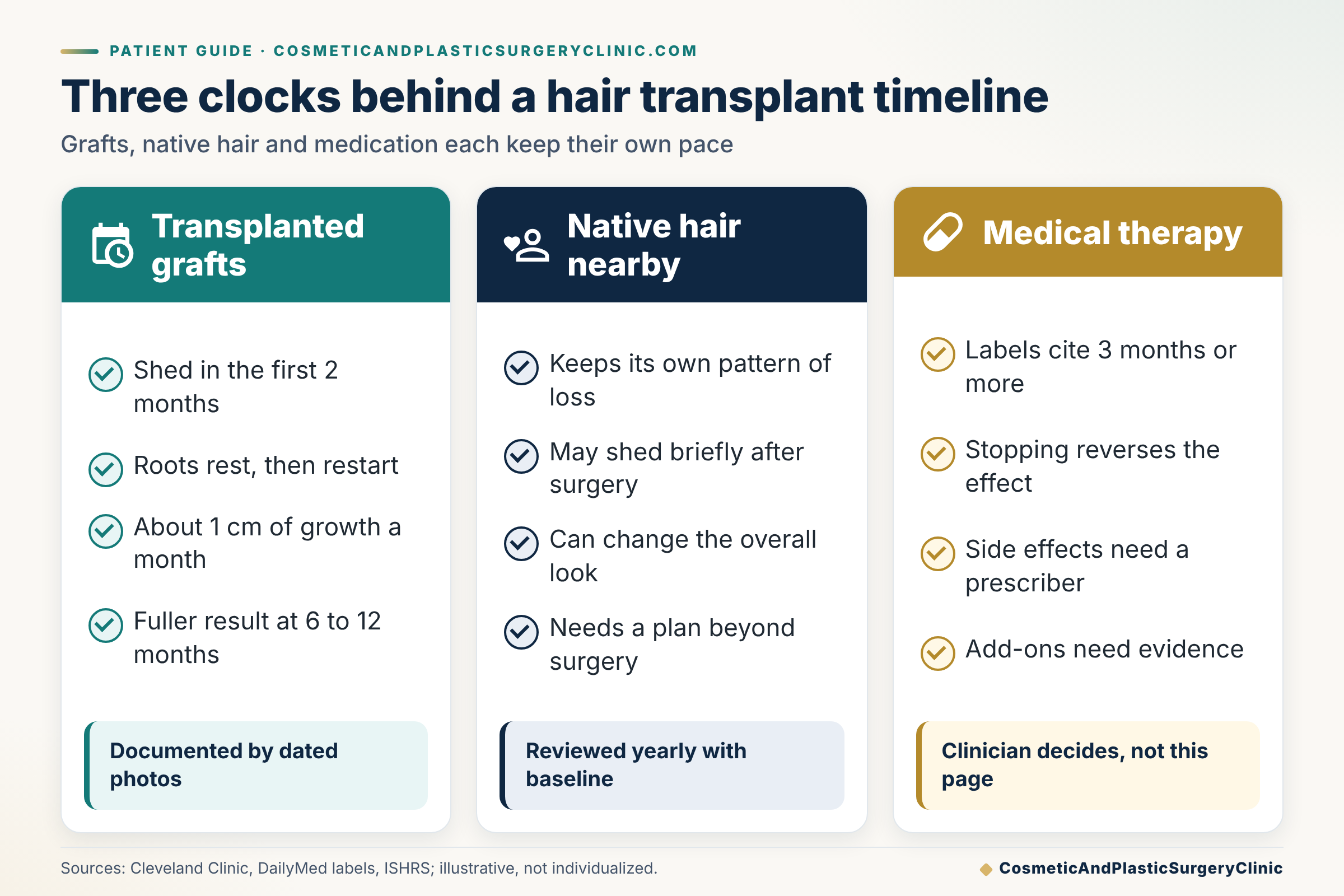
Expected effects, per the pages already cited, include scabs and crusts, tightness, itching, tenderness, swelling of the forehead for a few days, patchy numbness lasting months, shedding of the transplanted hairs, and a thinner-looking scalp around month three. Cleveland Clinic and MedlinePlus both describe the graft shed as normal. These are the changes a surgical team usually warns about in advance.
Slow growth is a different category on a hair transplant timeline. It is not an emergency, and no source I opened sets a cutoff for when growth counts as late. It is a question for the planned review, and an earlier visit is reasonable if the scalp looks different from what the surgeon described.
Warning signs, and when to seek urgent care
The general risk literacy page explains how to tell an expected effect from a complication. Keep the surgeon’s after-hours number with your photographs, and ask in advance which symptoms the team wants to hear about the same day.
Medication, ongoing loss and the second session on a long hair transplant timeline
A transplant relocates hair from the donor zone; it does not stop the pattern of loss in the hair that was left behind. This section is education only. Decisions about prescription or over-the-counter treatment, including whether and when to use them, belong to the prescribing clinician, and nothing here is a dose or a recommendation.
Native hair keeps its own clock
How medication timelines compare with graft timelines
Cleveland Clinic says minoxidil may take two to four months of daily use before improvement is noticed and finasteride at least three months, and that regrown hair falls out if either is stopped. The finasteride 1 mg label on DailyMed says daily use for three months or more is generally necessary before benefit is observed, that continued use is recommended to sustain benefit, and that withdrawal leads to reversal of effect within 12 months. The label is for men only and lists sexual side effects and reports of depression, which is why prescribing is a clinical conversation.
An over-the-counter minoxidil label for women on DailyMed says results may appear at three months, that some women need at least six, that extra shedding may continue up to two weeks after starting, and that stopping lets the normal hair loss process resume, with newly regrown hair probably lost in three to four months. AAD says a dermatologist may recommend such medicine because loss and thinning can continue after a transplant. The ISHRS brochure calls these treatments lifelong and says doctors commonly advise starting them once the problem is identified.
Other add-ons deserve more caution. Cleveland Clinic says platelet-rich plasma (PRP) takes about three months to show any improvement, with maximum improvement at one year, but cites no study data on that page. The ISHRS medications page calls PRP a relatively new addition and says important questions about dosing and efficacy remain unanswered for photobiomodulation. If a quote includes add-ons, ask what evidence supports them and how they affect the hair transplant cost estimate.
Why MedlinePlus and AAD tell different long-term stories
MedlinePlus says the replaced hairs are mostly permanent and that no long-term care is necessary. AAD says hair loss and thinning can continue even after a transplant. Both statements can be true, because they describe different hairs: the transplanted ones came from a zone less affected by pattern loss, while the untouched hair beside them was not.
The ISHRS revision page names continuing genetic loss after surgery, often when preventive medication was not used, as one cause of poor results and says some patients with an adequate first result lose more hair over time and may need more surgery. That is the reason a hair transplant timeline should be read alongside a plan for the rest of the scalp, not as a standalone endpoint.
Planning a second session without rushing it
Donor supply and the first-session verdict on a hair transplant timeline
The ISHRS FUE page says donor hair, once removed, is gone, and that sound planning keeps enough in reserve for future use. StatPearls describes the safe donor zone as typically holding 65 to 85 follicular units per square centimeter, calls donor areas under 40 less suitable, and says the donor site is one of the primary limiting factors regardless of technique. Mayo Clinic says hair loss will likely continue for some time and more transplants may be needed.
No source I opened sets a universal minimum interval between sessions. Cleveland Clinic says the scalp needs a few months to heal between grafting procedures. Because StatPearls follows patients for six to twelve months until grafts mature, deciding on a second session earlier would mean judging an unfinished result; that reading is this page’s inference, not a quoted rule. The ISHRS says that correcting a poor result can be challenging or even impossible when donor supply is low, and that not all patients can be helped.
| Situation | Pathway | Benefit | Trade-off | Key question |
|---|---|---|---|---|
| Month 2 to 3: shed and thinner look | Document with dated photos and wait for the planned review | Avoids judging an unfinished result | Weeks of uncertainty | What does on track look like for me at months 3 and 6? |
| Month 5 to 6: little or no visible growth | Request an in-person review | Exam can separate slow from stalled | The answer may still be to wait | At what date would you call my growth late? |
| Month 9 to 12: patchy or uneven density | Compare standardized photos with the surgical plan | Shows whether the plan or the hair changed | Maturation may not be finished | Is further growth still expected in these areas? |
| Native hair thinning beside the grafts | Discuss medical therapy with the prescribing clinician, or a second session | Protects the overall pattern | Ongoing treatment, side effects, donor use | Which plan keeps donor hair in reserve? |
| Irregular hairline or visible donor scar | Revision consult or camouflage such as scalp micropigmentation | May improve appearance | Not all cases can be corrected | Who treats this, and what are the limits? |
Camouflage is a real option when surgery is not. The ISHRS revision page lists topical powders and scalp micropigmentation as camouflage when surgery is not possible, and the comparison with scalp micropigmentation explains what each approach changes.
Questions for the treating team
Bring a short list to each review visit and write the answers down, so the hair transplant timeline you were quoted becomes the hair transplant timeline you can check against.
- Which of the three or four milestones in my case (shed, first growth, thickening, review) do you expect, and in what month ranges?
- When will we compare standardized photographs, and who takes them?
- What would make you want to see me earlier than planned?
- Who performs the extraction, the site creation and the implantation, and who will examine me at each visit?
- How much donor reserve will remain after this session, and how was that estimated?
- What is your policy if growth is below what we planned, including any charge for a second session?
- What after-hours number do I call, and what will you want to hear about the same day?
| Factor | Effect on the outcome | Maintenance or revision implication | Review point |
|---|---|---|---|
| Continuing native hair loss | Changes the look around the grafts over years | Medical therapy discussion; possible later session | Annual comparison with baseline photos |
| Donor supply | Caps how much can be moved, now and later | Second session competes with future reserve | Before any repeat plan |
| Age at surgery | Younger patients face less predictable future loss | More planning for staged or conservative design | Consultation, then each review |
| Hairline design | A low or straight line may age poorly | Corrections can need removal and re-placement | Month 12 photos against the plan |
| Who performed the steps | Graft handling and placement affect survival | Repair is harder if the record is unclear | Ask for the operative record |
Frequently asked questions
Do all transplanted hairs fall out during a hair transplant timeline?
AAD says the transplanted hair will fall out between two and eight weeks after surgery, Cleveland Clinic says it may fall out as the graft heals, and the ISHRS FUE page says most patients return to an invisible state when the grafts shed while the root stays. The wording differs, so a few hairs staying in place does not mean anything is wrong. Ask the surgeon what shedding to expect in your case, and in what weeks, so you can tell normal from unusual.
Can I speed up hair growth after a hair transplant?
No source I opened shows a way to shorten the hair transplant timeline of the grafts. Medications have their own timelines of months, PRP is described by Cleveland Clinic as taking three months to show any improvement without study data on that page, and the ISHRS says photobiomodulation questions about dosing and efficacy remain unanswered. Supplements are not covered in the pages I opened. Treat any promise of faster results as a question for the surgeon and ask what evidence supports it.
When can I cut, color or style my hair after a hair transplant?
StatPearls says to wait one month before cutting or dyeing hair, but that is one source, and the ISHRS notes that washing and exercise rules differ by surgeon. Styling changes also interact with the hair transplant timeline: shaved or short hair at photo appointments makes comparisons easier, while longer hair can hide shedding. Ask your surgeon which date applies to you and what hair length they want at each review.
Does a hair transplant timeline differ for women?
None of the pages I opened gives a separate timeline for women. Cleveland Clinic says female pattern baldness gets worse without treatment and recommends contacting a provider as soon as hair loss is noticed, but it gives no transplant schedule. The shed and growth stages described by AAD, Mayo Clinic and the ISHRS are not split by sex. A woman considering surgery should ask her surgeon how the diagnosis, pattern and donor area affect expectations, since the cause of the thinning matters first.
What if my hair transplant timeline shows no growth at six months?
Slow growth is not an emergency, but it is a reason for the planned review. No source sets a cutoff for late growth. StatPearls reports that graft survival differs by diagnosis; in one group with frontal fibrosing alopecia it fell from 87 percent at one year to 41 percent at five years, which is not typical of pattern loss but shows why the diagnosis matters. The ISHRS says not all poor results can be corrected. A surgeon can examine the scalp and compare your photographs.
Does a second session restart the hair transplant timeline?
No source opened describes the timeline of a second session separately. Cleveland Clinic says touch-ups may be needed and that the scalp heals for a few months between procedures. The stages described above apply to grafts that were placed, so newly placed grafts would presumably follow their own sequence of healing, shed and regrowth, while earlier grafts continue maturing; that reading is an inference. Ask how your surgeon would sequence and photograph two sessions.
How should I track my own hair transplant timeline between visits?
Take photographs in the same room, light, hair length and views before surgery and at fixed intervals afterward, with the date in each file name. StatPearls places photographic documentation around six to twelve months, but earlier frames show the shed and the first hairs. Keep a short log of symptoms such as itching or numbness. Avoid judging from the mirror, and share the set at each review; the photo guide on this site explains how to standardize the views.
Does having a transplant abroad change the hair transplant timeline?
The biological stages in the sources do not depend on location. What changes is follow-up: Cleveland Clinic says patients have several follow-up visits to check healing, and the ISHRS lists post-operative care among the tasks for a licensed physician. Reviews at three, six and twelve months are hard to attend from another country, and complications are managed locally. The hair transplant tourism page and the general medical tourism page cover that trade-off.
Sources and further reading
- Cleveland Clinic — Hair transplant: how does it work, success rates (accessed 2026-11-13) — day-by-day recovery summary, shedding, up to a year for full results, touch-ups, warning signs
- American Academy of Dermatology — Hair transplant (accessed 2026-11-13) — shedding at 2 to 8 weeks, thinner look by month 3, results at 6 to 9 or 12 months, continued loss and medicine
- MedlinePlus — Hair transplant (accessed 2026-11-13) — grafts appear to fall out then regrow, tenderness, risks, long-term outlook
- Mayo Clinic News Network — Q and A: hair transplant treatment for hair loss (accessed 2026-11-13) — one month then shed, regrowth at 3 to 5 months, best results at 8 to 12 months, further transplants
- ISHRS — Medical and surgical options to restore hair (patient brochure) (accessed 2026-11-13) — crusts, swelling, numbness, dormant roots, growth by 10 to 16 weeks, lifelong medical therapy, folliculitis
- ISHRS — FUE: what is it (accessed 2026-11-13) — scabs, shed, about 1 cm per month, a year or more, donor hair finite, evidence limits
- ISHRS — FUT (accessed 2026-11-13) — recovery varies by surgeon, shock loss in recipient and donor areas, donor scar
- ISHRS — Hair revision and correction (accessed 2026-11-13) — causes of poor results, continuing loss, camouflage, limits of repair
- ISHRS — Medications for hair loss (accessed 2026-11-13) — PRP and photobiomodulation cautions, variable response
- ISHRS — Consumer advocacy (accessed 2026-11-13) — tasks for a licensed physician, questions about technicians and malpractice coverage
- StatPearls — Hair transplantation (accessed 2026-11-13) — shock loss timing, 6 to 12 months follow-up, donor density, early-surgery donor depletion, complications
- Cleveland Clinic — Male pattern baldness (accessed 2026-11-13) — minoxidil and finasteride timelines, stopping, transplant recovery
- Cleveland Clinic — Female pattern baldness (accessed 2026-11-13) — progression without treatment, when to see a provider
- Cleveland Clinic — Telogen effluvium (accessed 2026-11-13) — onset 2 to 3 months after a trigger, 3 to 6 months duration, surgery as trigger
- Cleveland Clinic — Hair follicle (accessed 2026-11-13) — growth about 1 cm per month, growth and resting phase durations
- Cleveland Clinic — PRP therapy (accessed 2026-11-13) — three months to improvement, maximum at one year, no study data on the page
- DailyMed (NIH) — Finasteride 1 mg tablet label, consumer version (accessed 2026-11-13) — three months or more before benefit, continued use, reversal within 12 months, adverse effects
- DailyMed (NIH) — Over-the-counter minoxidil 5% topical aerosol for women, drug facts (accessed 2026-11-13) — results at 3 to 6 months, early shedding, loss of regrown hair after stopping
- Annals of Dermatology (2018) — Localized telogen effluvium following hair transplantation (case report, full-text record) (accessed 2026-11-13) — two cases, onset about one month after transplant, recovery within 10 months
- PubMed — Localized telogen effluvium following hair transplantation (abstract) (accessed 2026-11-13) — case-report design, two patients, biopsy findings
- Medical Journal Armed Forces India (2020) — Hair transplantation by follicular unit extraction for male androgenetic alopecia (abstract) (accessed 2026-11-13) — 52 patients, density 6.21 to 36.82 follicular units per cm2, retrospective design