

Anyone researching rhinoplasty cost quickly runs into the same problem: the numbers don’t line up. One website quotes a single national average, another gives a wide range, a practice’s consultation coordinator mentions a package, and a friend who had a nose job (the everyday term for rhinoplasty) paid a figure that seems to belong to a different operation. The confusion isn’t a sign that someone is being dishonest. It reflects how nasal surgery is priced: in layers, by different parties, for operations whose scope can differ a great deal even when they share a name.
This guide is written for the cost-conscious researcher who wants to understand those layers before booking consultations. It separates what published sources have actually verified from what they have not, explains the components of a typical bill, lays out what pushes a quote up or down, and walks through insurance when breathing is part of the problem, tax and leave rules, financing fine print, deposits, and a method for comparing quotes fairly. It does not give you a price for your nose, because nobody can do that without examining you, and it avoids inventing regional averages that no reliable source publishes.
If you’re still deciding whether the operation fits your goals, start with the broader rhinoplasty guide, which covers anatomy, candidacy, techniques, recovery and risks. Here the question is narrower and more practical: what will you be asked to pay, to whom, when, and what does each number actually buy?
A note on numbers: dollar figures appear in this article only where a source states a year and a population, and each is described with what it does and does not include. National averages are context for spotting outliers, never a local quote and never an offer. Where a figure could not be verified, the text describes the issue in words and the gap is flagged for editorial follow-up.
Wanting to understand cost carefully is a legitimate part of a surgical decision, not a shallow one. It is also true that price is the easiest variable to compare and the hardest to compare fairly, because a lower-looking quote may omit the item a higher one includes. The sections below aim to make the comparison honest rather than to steer you toward the highest or the lowest number, and they keep returning to one idea: a quote is only as useful as its list of what it contains.
Rhinoplasty Cost Figures in the United States: What They Tell You and What They Leave Out
Every cost discussion starts with a number, so it helps to know where that number came from before you let it anchor your expectations. The published figures for nasal surgery are fewer, older, and narrower than most web pages imply. This section lays out what has been verified from primary sources as of the editorial research cut, what each figure measures, and where the gaps are.
The verified national numbers
The most widely repeated rhinoplasty figures trace back to one organization, ASPS, which collects surgeon-fee data from its members. Understanding those documents on their own terms, including their changes in format, prevents the most common misreading: treating a surgeon’s-fee statistic as the price of the whole operation.
What ASPS has published: the cost-page average, the 2023 table and the 2024 range
The ASPS rhinoplasty cost page states an average cost of $7,637 and credits it to the society’s latest statistics, without naming a year on the page. That same figure appears in ASPS’s 2023 table of average surgeon and physician fees, where nose reshaping (the society’s term for rhinoplasty) is listed at $7,637 for 2023 and $6,324 for 2022. The match indicates that the cost-page number reflects 2023 data, which means the page was quoting a figure that was already a year or more old when this article was researched.
For 2024, ASPS changed how it presents the data. Instead of one average per procedure, its 2024 average surgeon and physician fees document gives a projected range, and the range for rhinoplasty is $7,500 to $12,500. The document explains that the society moved to a projected range rather than a single price to reflect different geographic locations and practice settings, and it describes the figures as an aggregate projection based on averages that surveyed members submitted.
Two cautions follow. First, because the format changed, the move from $6,324 (2022) to $7,637 (2023) to a $7,500 to $12,500 range (2024) should not be read as a price trend; the documents don’t say whether differences reflect changes in what surgeons charge or in who responded and how the figures were compiled. Second, the research for this article did not locate an ASPS fee table for 2025. ASPS’s 2025 statistics report, which covers procedure volumes, contains no fee or financing section. Until a newer fee document appears, the 2024 range is the most recent published surgeon-fee figure this article could verify.
| ASPS source | Year | Rhinoplasty figure | What the figure is | Main limit |
|---|---|---|---|---|
| Rhinoplasty cost page | Not stated on the page | $7,637 average | Credited to “latest statistics”; excludes anesthesia, facility and other expenses | No year; matches the 2023 table |
| Average surgeon/physician fees, 2023 | 2023 and 2022 | $7,637 (2023); $6,324 (2022) | Average fee per year in a fee table | No methodology note in the document |
| Average surgeon/physician fees, 2024 | 2024 | $7,500 to $12,500 | Projected range from averages submitted by surveyed members | Range, not a distribution; format differs from 2023 |
| Plastic surgery statistics report | 2025 | No fee given; 43,116 procedures | Procedure volume estimate for nose reshaping | No cost data; 2025 fee table not located |
Why none of these figures is a quote
The ASPS cost page is direct about the limits. It says the average does not include anesthesia, operating room facilities or other related expenses, and it lists the pieces of a rhinoplasty bill: anesthesia fees, hospital or surgical facility costs, medical tests, post-surgery garments, prescriptions, and the surgeon’s fee. It also says a surgeon’s fee for rhinoplasty is based on the surgeon’s experience, the type of procedure used, and the geographic location of the office. In other words, the society itself describes its figure as one slice of the total, set by variables that differ for every reader.
The people behind the data matter too. ASPS describes its members as plastic surgeons certified by the American Board of Plastic Surgery (ABPS) or the Royal College of Physicians and Surgeons of Canada, and the fee figures come from surveyed members. That is a defined group. Otolaryngologists (ear, nose and throat surgeons) and facial plastic surgeons who aren’t ASPS members, as well as surgeons who didn’t respond, are outside it. Their fees may be lower, higher or about the same, and the published documents can’t say.
A range also hides its own shape. Nothing in the 2024 document says whether most surgeons cluster near $8,000 or near $12,000, or how many fall outside the range. The lower number isn’t a floor, and the upper number isn’t a ceiling. Treat the range as a loose orientation for the surgeon’s-fee line only; it will help you notice a quote that is far outside the neighborhood, and it will not tell you what you personally will pay.
Other data points, and how much weight each deserves
Beyond ASPS, a few peer-reviewed studies touch on rhinoplasty pricing. They’re useful for understanding structure (for example, how insurance plan type shapes out-of-pocket exposure), but each has limits that keep it from working as a price list.
Insurance-claims data and surgeon-survey data
A 2025 study in Aesthetic Plastic Surgery by Seyidova and colleagues used the Truven MarketScan commercial claims database to analyze primary rhinoplasty claims from 2021, using procedure codes 30400, 30410 and 30420, in 1,491 patients. Mean out-of-pocket spending varied by plan type: about $234 for patients in health maintenance organization (HMO) plans compared with about $936 in high-deductible health plans (HDHP). Reported total costs also differed by region and plan type, with the North Central region highest at about $6,194 and exclusive provider organization (EPO) plans highest by plan type at about $6,377. The authors called for providers and health systems to be more transparent about cost information.
The key point is what this dataset represents: insured patients whose rhinoplasty generated a claim. Operations paid entirely by the patient and billed as cosmetic generally don’t appear in an insurer’s claims, so these numbers describe a different population from the self-pay patient who is comparing cosmetic quotes. The abstract also doesn’t itemize which components, such as facility or anesthesia claims, the “total cost” includes. Its practical lesson is about plan design: the same operation can leave a patient with very different out-of-pocket exposure depending on the deductible structure.
A second study, published in 2021 and indexed by Thieme under the title “Board Certification and Surgeon’s Fee for Aesthetic Rhinoplasty,” collected fee information for 67 surgeons in seven U.S. metropolitan areas through an internet-based approach. It reported a mean price of about $10,550 for surgeons certified by the American Board of Facial Plastic and Reconstructive Surgery (ABFPRS) versus about $8,525 for surgeons with other board certifications, a difference that was statistically significant, and found that fees correlated with how many rhinoplasties a surgeon performed each year. Mean fees by region were about $12,059 on the West Coast, $9,153 on the East Coast, and $8,316 in the mid-U.S. cities sampled.
Read that study modestly. It’s small, limited to seven cities, observational, and more than five years old at the editorial research cut. The version reviewed for this article does not state what each quoted price included, and a fee association doesn’t show that any credential causes a better or worse result. What it adds is directional: reported surgeon fees varied by region, by experience-related factors, and by credential. That’s consistent with the ASPS statement that fees depend on experience, procedure type and location.
Where rhinoplasty sits among other procedures
Context across procedures can be calibrating, because it shows how a nose operation compares with others a reader might be pricing at the same time. The ASPS 2024 document lists projected surgeon-fee ranges for several procedures; the table below sets a few beside rhinoplasty and notes only the arithmetic overlap, not any judgment about value.
| Procedure (ASPS wording) | 2024 projected range | Overlap with the rhinoplasty range of $7,500 to $12,500 |
|---|---|---|
| Nose reshaping (rhinoplasty) | $7,500 to $12,500 | Reference range |
| Abdominoplasty (tummy tuck) | $8,000 to $13,500 | Large overlap, $8,000 to $12,500 |
| Facelift | $12,000 to $19,000 | Narrow overlap, $12,000 to $12,500 |
| Breast augmentation (implant) | $4,575 to $8,000 | Narrow overlap, $7,500 to $8,000 |
| Liposuction | $4,300 to $7,500 | Touches only at $7,500 |
| Lower eyelid surgery | $3,709 to $6,500 | No overlap |
| Upper eyelid surgery | $3,000 to $5,500 | No overlap |
The table is a reminder that rhinoplasty’s surgeon-fee range, in the ASPS survey, sits in the upper-middle of common cosmetic surgeries and well above eyelid surgery. The document doesn’t explain the differences, so avoid inferring reasons such as operating time or difficulty; they may be part of it, but the source doesn’t say. If you’re comparing across procedures, the sibling guides on tummy tuck cost and blepharoplasty cost apply the same fee-stack logic to those operations.
Volume is a separate question from price, but it explains why so many people are asking. ASPS estimated 43,116 nose reshaping procedures in 2025, down 5 percent from 45,213 in 2024, from data representing more than 3,000 board-certified plastic surgeons that were statistically extrapolated to national estimates. It was not among the five most common cosmetic surgical procedures that year. Those counts reflect plastic surgeons’ practices and don’t capture every otolaryngologist or facial plastic surgeon who performs nasal surgery, so they underdescribe the total number of rhinoplasties in the country.
The Anatomy of a Rhinoplasty Bill: Surgeon, Facility, Anesthesia and Everything Else
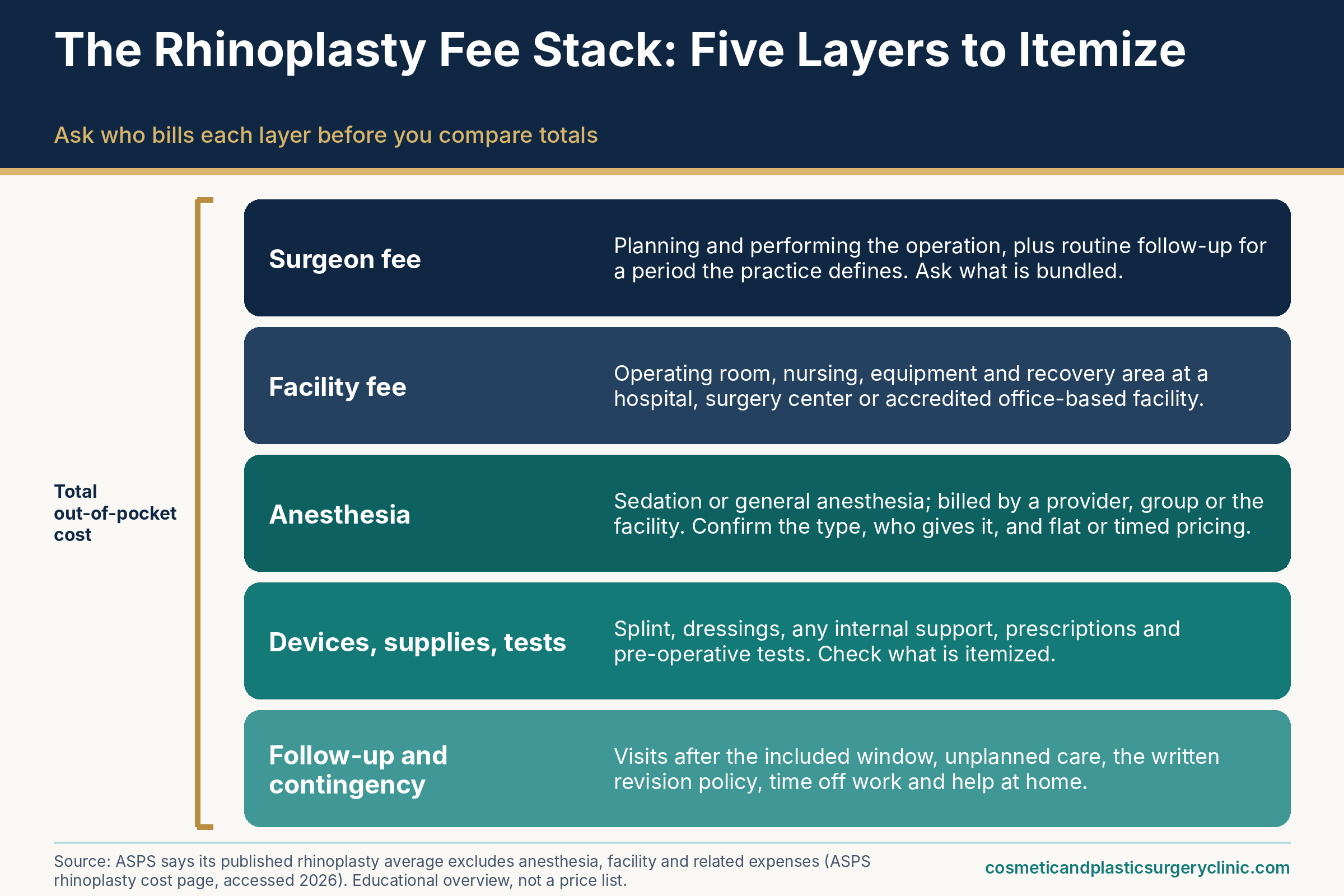
Behind a single quoted total there are usually several separate charges, and they don’t always come from the same office. The ASPS cost page names the pieces: the surgeon’s fee, anesthesia fees, hospital or surgical facility costs, medical tests, post-surgery garments and prescriptions. A helpful way to hold them in your head is as a stack. Each layer has its own logic, its own biller and its own opportunities for a quote to leave something out.
The graphic below shows the stack used throughout this guide. It is an organizing tool, not a price list: no dollar amounts appear on it because no verified source supports amounts for most layers.
The core charges: surgeon and facility
The two largest layers in most surgical bills are the professional fee for the person operating and the charge for the place where the operation happens. They’re easy to confuse because some practices own their operating rooms and present both as one number, while other surgeons operate in a hospital or surgery center that bills separately.
The surgeon’s fee: what it usually reflects and what may be bundled
The surgeon’s fee is the layer that published national figures describe. ASPS says it is based on the surgeon’s experience, the type of procedure used and the geographic location of the office. Underneath that sentence sit several things you’re paying for: the surgeon’s preoperative evaluation and planning, the operation itself, and, in many practices, a defined period of routine postoperative care. Practices differ on what they fold in, which is the main reason two surgeons’ fees aren’t automatically comparable.
Consider the items that might or might not be inside a fee: the initial consultation, a second planning visit, digital imaging of the nose, the operation, the visit when the splint and dressings are removed, additional visits during the first months, and a late follow-up. Any of these may be bundled, and any may be billed separately. The practical task is to ask for the list. If a practice charges for the consultation, ask whether that charge is applied toward the surgery fee if you proceed, and get the answer in writing rather than assuming either way.
It also helps to know what a surgeon’s fee does not usually contain: the cost of the operating room, anesthesia, or medications dispensed elsewhere. When a quote is described as “all-inclusive,” the question becomes which of those layers the practice has absorbed into its number and how it handles the possibility that the operation runs longer or changes in scope on the day. The more specifically the written quote describes the planned operation (open or closed approach, grafts anticipated, whether septal work is included), the less room there is for a surprise.
Finally, remember that the surgeon’s fee is the layer most associated with the surgeon’s reputation and demand. A busy, experienced rhinoplasty surgeon in a high-cost city may charge more than a less experienced one in a lower-cost market, and the studies discussed earlier hint at that pattern, though they can’t separate skill from supply and demand. A higher fee doesn’t establish better judgment, and a lower fee doesn’t establish worse; the credentials check described in a later section is a better use of your time than reading skill into the price.
The facility fee: hospital outpatient department, surgery center or accredited office suite
Rhinoplasty is usually same-day surgery. The Mayo Clinic says most people go home the day of the operation, and the Cleveland Clinic describes procedures lasting between one and three hours in hospital or outpatient facilities. StatPearls characterizes rhinoplasty as typically performed in ambulatory settings. Within that range, three settings are common: a hospital outpatient department, a freestanding ambulatory surgery center, and an operating room located in the surgeon’s own office.
The facility fee pays for what the building and its staff provide: the operating room itself, nursing staff, equipment, supplies used during the case, and the recovery area where you wake up. The way that fee is calculated varies. Some facilities bill a flat amount for a standard rhinoplasty, some bill by time in the operating room, and some add charges for specific supplies or implants. Ask which method applies and what happens to the fee if the operation takes longer than planned.
Setting matters for reasons beyond price. ASPS says its member surgeons are required to operate in facilities that meet quality standards: accreditation by the American Association for Accreditation of Ambulatory Surgery Facilities (now operating as Quad A), the Accreditation Association for Ambulatory Health Care (AAAHC) or the Joint Commission, or Medicare certification or state licensure. ASPS applies that expectation to procedures needing more than local anesthetic and mild oral sedation. A later section returns to how to check this; for now, the point is that “facility” on a quote should name a specific, verifiable place. The guide on accredited plastic surgery facilities covers the verification steps in more depth.
The sources used for this article don’t provide a verified price comparison between hospital outpatient departments, surgery centers and office-based suites for cosmetic rhinoplasty, so this guide makes no claim about which is less expensive. Because some surgeons own their facility, the fee may be presented as part of the practice’s global fee; because others do not, you may receive two or three separate statements. Either arrangement can be reasonable. What isn’t reasonable is not knowing which one you’ve been offered.
Anesthesia and the supporting charges
The third and fourth layers are less visible in marketing but often explain why quotes diverge. Anesthesia is a professional service with its own billing method, and the supporting charges are the small but real items that surround the operation.
Anesthesia: sedation or general anesthesia, who provides it, and how it is billed
ASPS says rhinoplasty is performed with intravenous sedation or general anesthesia and that the surgeon recommends the better choice for an individual patient. Mayo Clinic similarly describes local anesthesia with sedation or general anesthesia. StatPearls notes that general anesthesia with a breathing tube is standard in the ambulatory settings it describes. Which approach is planned affects the price because the two arrangements involve different staffing and different monitoring.
The American Society of Anesthesiologists (ASA) draws a distinction that matters for pricing. Monitored anesthesia care (often shortened to MAC) is provided by a qualified anesthesia provider whose sole job is the patient’s sedation and physiology, and it can be escalated up to general anesthesia if needed. Moderate sedation, by contrast, is often administered by a clinician who is also performing the procedure and dividing attention between the two tasks. The ASA says MAC should be paid at the same level as general or regional anesthesia. For a patient reading a quote, the implication is simple: “sedation” is not one thing, and a line that says only “anesthesia” doesn’t tell you which arrangement is being priced.
The ASA also states that anesthesiologist participation in office-based surgery is the best means of achieving high-quality anesthesia care, while acknowledging that nonphysician anesthesia providers may deliver care under medical supervision where an anesthesiologist’s participation is impractical, and that the supervising physician must be specifically trained in sedation, anesthesia and rescue techniques. Those statements bear on who is in the room, and who is in the room bears on the bill.
How anesthesia is billed varies by practice. As an illustration of the concept, Medicare’s payment rule for anesthesia services multiplies a conversion factor by the sum of base units (which reflect the service) and time units, with one time unit equal to 15 minutes of anesthesia time. Private arrangements aren’t bound by that formula, but time-based billing is a common idea: a longer operation can mean a larger anesthesia charge. Ask whether the figure is flat or hourly, who bills it, and whether it’s inside the package. The plastic surgery anesthesia guide goes further on the types and the questions.
Tests, prescriptions, splints, supplies and follow-up visits
The ASPS cost page lists medical tests, post-surgery garments and prescriptions among the components of a bill. For rhinoplasty, the relevant items are usually not garments but the devices that support the nose: a splint on the outside, sometimes internal splints or packing, tape and dressings. ASPS notes that splints and gauze packing may support the nose for a few days, and the AAO-HNSF clinical practice guideline on rhinoplasty advises against routinely placing packing in the nasal cavity, so what is used varies by surgeon. Either way, ask whether supplies are inside the facility fee or billed separately.
Preoperative tests are another gray area. Depending on your health, age and anesthesia plan, a practice may request bloodwork or a medical clearance. Those might be performed by your primary care clinician and billed to your insurance, or arranged by the practice and included in the quote, or listed as an add-on. Prescriptions are usually filled at a pharmacy and paid there. None of these amounts is large relative to the surgeon’s and facility’s fees, but they appear as surprises when nobody mentioned them.
Follow-up is the layer most likely to be underspecified. ASPS encourages patients to ask when dressings and stitches come out, when they can resume normal activity and exercise, and what the follow-up schedule is. Those questions have a billing side: how many visits are included, for how long, and what a visit costs after the included window closes. The AAO-HNSF guideline recommends documenting patient satisfaction with nasal appearance and function at a minimum of 12 months after surgery, which suggests that a good practice has some plan for late follow-up; ask whether that visit is included.
| Line item | What it usually covers | Who may bill it | What to ask |
|---|---|---|---|
| Surgeon’s fee | Planning, the operation, defined routine follow-up | Practice or surgeon | Which visits and imaging are included, and for how long? |
| Facility fee | Operating room, nursing, equipment, recovery area | Hospital, surgery center or practice | Flat or time-based? Named facility and accreditation? |
| Anesthesia | Sedation or general anesthesia and monitoring | Anesthesia group, individual provider or facility | Who provides it, which type, flat or hourly? |
| Tests and clearance | Bloodwork or medical evaluation if requested | Lab, primary clinician or practice | Are tests required, and who pays? |
| Splints, dressings, supplies | External splint, tape, any internal support | Facility or practice | Inside the facility fee or itemized? |
| Prescriptions | Medications for recovery | Pharmacy | Which ones, and are any dispensed by the practice? |
| Follow-up and contingency | Visits after the included window, unplanned care, revision terms | Practice, facility, others | What does the written revision policy cover? |
Treat the last row as seriously as the first. Contingency is where the largest, least predictable costs live. It includes visits beyond the included window, medications for an unexpected problem, and whatever the policy says about a revision, which later sections take up.
What Moves the Price: Complexity, Grafts, Surgeon, Setting and Geography
When two quotes for rhinoplasty differ by thousands of dollars, the difference usually comes from one of a handful of sources: the planned operation is not the same, the surgeons are not at the same stage or in the same market, the operating environments differ, or the quotes include different layers of the stack. Only some of these have published evidence behind them. This section sorts the drivers by how well they are supported, so you can tell a documented factor from a plausible guess.
ASPS names three variables for the surgeon’s fee: experience, the type of procedure used, and the geographic office location. Mayo Clinic adds that costs vary with the complexity of the surgery and the surgeon’s experience. Everything else in this section is either elaboration on those factors or a flagged inference.
The operation itself
The most defensible reason for a price gap is that the operations differ. “Rhinoplasty” is a family of procedures, and a quote is only as meaningful as the description of the operation attached to it.
Primary, revision and combined operations: why scope changes the number
A primary rhinoplasty is a first operation on a nose that hasn’t been surgically altered. A revision rhinoplasty is a later operation to address a result or complication from an earlier one. StatPearls notes that revision cases are significantly more difficult because of scar tissue and prior manipulation of the cartilage, and that limited graft availability compounds the challenge when the septum has already been used. Surgeons commonly price revisions on their own terms, and the guide to revision rhinoplasty cost treats that topic separately. For this article the point is that “I had a nose job before” is a different quote request from “I haven’t.”
Combined operations are the other big scope variable. A septoplasty straightens the septum, the wall of cartilage and bone dividing the nasal passages; a septorhinoplasty combines that with reshaping. ENT Health describes septoplasty alone as taking about one to one and a half hours, usually outpatient, under local or general anesthesia. Adding it to a rhinoplasty adds work, and it also changes who may pay: ASPS’s insurance coverage criteria for nasal surgery contemplate coverage of the functional portion when the problem is documented. The septorhinoplasty cost guide covers the combined operation in detail, and the insurance section later in this article explains how split billing generally works.
The aesthetic goal also shapes scope. Narrowing a bridge, refining a tip, reducing a dorsal hump, straightening a deviated line and building up a flat dorsum are different technical problems, and a plan may involve one or several. The more elements, the more operating time and the more likely grafts are involved. That’s why a coordinator who quotes before the surgeon has examined you can only give a placeholder.
An illustrative contrast (hypothetical, not drawn from any patient): one reader wants a small change to the tip and has no breathing complaints; another wants the bridge reshaped, the tip refined, and has trouble breathing through one side. Even in the same city, with the same surgeon and facility, those two plans can produce different quotes, because they involve different amounts of operating time, different grafting needs, and, for the second reader, a possible functional component. The lesson is not that either number is wrong. It’s that the shared word “rhinoplasty” hides a range of plans.
Grafts, cartilage sources and technique choices
Grafts are pieces of tissue placed to support or reshape the nose. ASPS says cartilage for a rhinoplasty graft is typically taken from the septum, occasionally from the ear, and rarely from a rib. StatPearls similarly lists septal cartilage as preferred, with auricular (ear) and costal (rib) cartilage as alternatives, and cadaveric options existing but carrying resorption concerns. Each source has a cost logic. Septal cartilage is available through the same surgical field as the nose. Ear cartilage means a second small incision. Rib cartilage means a chest-wall incision, more time, and a donor site; StatPearls notes the risk of pneumothorax (air leaking into the space around the lung) with costal harvest.
A 2022 cost-utility analysis in the Annals of Otology, Rhinology & Laryngology compared costal cartilage autografts with human cadaveric allografts. The abstract summary reports modeled costs for primary outpatient rhinoplasty of about $8,075 with cadaveric cartilage and $8,342 with rib cartilage, which the authors characterized as similar when no hospitalization is needed. The model added costs when hospital admission was involved and when complications occurred. The abstract does not describe whose prices the model used, so the dollar amounts are best read as relative, showing how the graft choice and any complications shift cost, rather than as prices you should expect.
What about technique? Open rhinoplasty uses a small incision across the columella (the strip of tissue between the nostrils) plus incisions inside the nose; closed rhinoplasty keeps incisions inside the nostrils. The sources consulted for this article describe the approaches but do not establish that either is priced higher or lower. Some quotes list the approach, some don’t, and some surgeons decide on the day. The practical step is to ask which approach the quote assumes and whether a change of plan would change the price. Side-by-side technique comparisons are in the rhinoplasty techniques guide.
One more technique-related factor is the instrument and method preference of the individual surgeon. A surgeon who prefers to harvest rib cartilage in selected patients, or one who uses a particular type of cadaveric material, may build that into the quote. If a practice mentions an unusual graft or product, ask what it is, why it was chosen for your plan, whether a cheaper alternative exists, and what it adds to the bill. Those are reasonable questions, and a good answer will be specific.
The people and the place
The remaining drivers are about who operates and where. They’re the factors most often invoked to justify a high quote and most often misread.
Surgeon training, experience, volume and board certification
ASPS says its member surgeons complete at least six years of surgical training after medical school, including at least three years of plastic surgery residency, and pass comprehensive written and oral examinations. ASPS also cautions that there is no board recognized by the American Board of Medical Specialties (ABMS) with “cosmetic surgery” in its name, and advises patients not to be confused by official-sounding boards. Rhinoplasty is also performed by otolaryngologists (ear, nose and throat surgeons) and by facial plastic surgeons. The American Board of Facial Plastic and Reconstructive Surgery (ABFPRS) states that its candidates must already hold ABMS or Royal College certification in otolaryngology or plastic surgery, pass a two-day examination, and submit operative records for at least 100 facial plastic surgeries.
These pathways are different, and the distinction affects how you verify credentials, not necessarily how you rank them. The 2021 fee study mentioned earlier found higher average fees among ABFPRS-certified surgeons than among others in its sample and a modest correlation between annual rhinoplasty volume and fee. That’s an observation about what surgeons charge, not a finding about outcomes. The ABFPRS-certified surgeons in the sample may have been disproportionately in higher-cost cities, or may have had higher rhinoplasty volumes, and the study can’t separate those influences.
The takeaway is not to pick a credential and pay its premium. It’s to find out what the specific surgeon’s training is, check it independently, and ask about rhinoplasty experience in a way that connects to your situation. How many rhinoplasties does the surgeon perform in a year? What proportion are revisions? Does the surgeon work regularly on noses like yours, including skin thickness, cartilage strength, previous trauma or ethnic variation? Experience that matches your case is a legitimate reason for a higher fee. Experience that is generic or unverifiable is not. The ABPS board-certified plastic surgeon guide explains the verification steps.
Also consider the surgeon’s role in your quote. In some practices, the surgeon who examines you is the person whose fee is quoted; in others, a patient coordinator presents the number. Either is fine, but the written quote should name the surgeon who will operate and say whether any part of the case is delegated.
Geography, setting and operating time
Geography is one of ASPS’s three named drivers, and the available studies show it in different ways. The 2021 fee study found the highest mean fees on the West Coast among its seven sampled cities. The 2025 insurance-claims study, which counts total costs for insured primary rhinoplasty patients, found the highest regional total in the North Central region and no statistically significant regional variation in out-of-pocket spending. Those two results do not contradict each other, because they measure different things in different populations. They do show that regional price patterns depend on the measure, so avoid carrying a rule such as “coastal cities cost more” into your search without checking the local market.
Operating time connects geography to the bill. The Cleveland Clinic describes rhinoplasty as taking one to three hours, and if the facility or anesthesia provider bills by time, that variability translates into dollars. The plan matters again here: a longer, more complex plan increases both the time-based charges and the surgeon’s fee. A written quote that says “estimated operating time” is more useful than one that is silent.
Some people consider traveling to another U.S. region for lower prices. An ASPS article from June 2025 on stretching a cosmetic surgery budget lists domestic travel to lower cost-of-living areas as one way to save money while keeping board-certification standards and making follow-up more practical than going overseas. The caution is the follow-up itself. Dressings, splints and any packing are removed on a schedule your surgeon sets, stitches and early checks happen at set intervals, and ASPS advises asking your surgeon about that schedule beforehand. A distant surgeon requires you either to stay for those visits or to arrange local care, and either path has a cost. Add lodging, a companion, time off, and the plan if something unexpected happens before concluding that the trip saves money.
| Driver | How it can change the quote | Support in sources reviewed | What to ask |
|---|---|---|---|
| Scope of operation | More elements and more time raise fee and time-based charges | ASPS names procedure type; Mayo cites complexity | What exactly is planned, and what would change it? |
| Revision versus primary | Scar tissue and prior grafting make the case harder | StatPearls describes added difficulty | Is a revision priced differently? |
| Septal or functional work | Adds time; a functional portion may be insurance-billed | ASPS coverage criteria; ENT Health on septoplasty | How is the functional portion documented and billed? |
| Graft source | Ear or rib harvest adds a donor site and time | ASPS and StatPearls on sources; one modeled cost analysis | Which graft is planned, and why? |
| Surgeon experience and credential | Higher fees reported for more experienced surgeons | ASPS and Mayo; one small observational study | How many rhinoplasties yearly, and how many revisions? |
| Geography | Fees differ by market | ASPS; two studies with different patterns | Is the fee typical for your area? |
| Facility type | Different facility charges and standards | No verified price comparison found | Named facility, accreditation, flat or timed fee? |
| Anesthesia type and duration | Provider type and time affect the charge | ASA statements; Medicare formula as illustration | Who provides it, and how is it billed? |
The rightmost two columns do the most work. A price driver you can’t verify isn’t a reason to pay more; a price driver you can verify is a reason to ask your own questions about it.
Insurance, Functional Surgery, Taxes and Time Off: When Someone Else Pays Part of the Bill
Rhinoplasty is unusual among cosmetic procedures because the nose does two jobs. It shapes the face, and it carries air. When a structural problem affects breathing, the same operation that changes appearance can also be medically indicated, and that opens a path to insurance that most other cosmetic surgeries don’t have. This section explains how that line is drawn, what a combined operation does to the bill, and how tax accounts and employer leave fit around it.
One caution up front. Insurance coverage is determined by a specific plan’s policy, a medical review of your own findings, and in many cases prior authorization. A general article cannot tell you whether your operation or any part of it qualifies. What follows describes how the process is generally structured so you can ask informed questions.
Cosmetic versus functional rhinoplasty
Functional nasal surgery treats a documented problem, most often an obstruction. Cosmetic nasal surgery reshapes a nose that is functioning normally. Many people want both, which is where billing becomes complicated.
How insurers draw the line between reconstructive and cosmetic nasal surgery
ASPS says on its cost page that when rhinoplasty is performed to correct breathing impairment from an obstructed airway, the procedure is considered reconstructive and may be covered by insurance. It adds that coverage depends on a detailed examination to verify the cause of the breathing problem and on prior authorization from the insurer. Mayo Clinic is similarly cautious: sometimes insurance pays for a rhinoplasty, but it depends on the policy, and prior written authorization is recommended even though approval does not ensure coverage.
The ASPS recommended insurance coverage criteria for nasal surgery, approved in 2006 and revised in May 2021, set out the society’s view of the line. It defines cosmetic surgery as operations performed to reshape normal structures in order to improve appearance and self-esteem, and reconstructive surgery as operations on abnormal structures caused by congenital defects, developmental abnormalities, trauma, infection, tumors or disease. Nasal surgery qualifies as reconstructive and medically necessary when it addresses functional airway problems, birth defects, disease-related abnormalities or trauma-related deformities. The document lists the kinds of findings that can support a functional claim, including a deviated septum confirmed on examination, turbinate enlargement (turbinates are the internal ridges that warm and humidify air), breathing difficulty at rest or with exercise, nasal valve weakness, recurrent nosebleeds, and a history of nasal fracture with radiologic evidence. It calls for preoperative photographs and clear documentation of the indication, and it says operations performed solely to enhance appearance, with no signs or symptoms of functional abnormality, are cosmetic and not covered unless a policy specifically says otherwise.
Individual insurers write their own rules, and they’re stricter than a reader might guess. As one example, a national insurer’s coverage policy for septoplasty, rhinoplasty and septorhinoplasty, with an effective date of July 1, 2026, covers septoplasty for listed indications such as nasal breathing difficulty from septal deviation, recurrent nosebleeds related to a septal deformity, and obstruction that interferes with CPAP use in documented obstructive sleep apnea. For rhinoplasty, it covers specific situations, including cleft or severe congenital craniofacial deformity at young ages, functional impairment in patients age six and older when photographs (frontal, lateral and worm’s-eye views) document it and functional improvement is expected, and post-traumatic functional impairment when additional conditions are met. It does not cover rhinoplasty performed solely to change appearance. The policy also notes that coverage varies by plan. That is one company’s policy, and yours may be more or less generous, but it illustrates the pattern: documentation, photographs, and an expectation that the operation will improve function.
Clinicians use broader frameworks to decide when surgery is warranted. The AAO-HNSF consensus statement on septoplasty (2015) reported that most of its panel did not consider a CT scan necessary solely to document a deviated septum, and it offered comments on imaging and medical management intended to help physicians with insurer requirements. ENT Health, the patient site of the same academy, advises that medical treatment is tried first and that surgery is considered when symptoms are severe enough to warrant it. Those are clinical positions and not coverage rules, but they show the kind of record, including symptoms, examination findings and what has been tried, that a payer’s reviewer tends to look for.
Split billing, prior authorization and what a denial means for the schedule
When a patient wants breathing correction and a cosmetic change in the same operation, the combined surgery is a septorhinoplasty, and billing may be divided. The ASPS criteria say that when reconstructive and cosmetic components occur in the same session, the surgeon should distinguish them and delineate the percentage that is reconstructive, and that third-party payers cover only the reconstructive portion. In practice that means the functional components are submitted to insurance and the cosmetic components are paid by the patient, with the facility and anesthesia charges divided according to the practice’s and insurer’s methods. How that split is calculated differs by office and by plan, and the insurer, not the surgeon, decides what it accepts.
Prior authorization is the insurer’s advance review of whether a planned procedure meets its criteria. Mayo Clinic and ASPS both point to it, and the process takes time, which can affect your calendar. Ask the practice whether it submits to insurance at all (some cosmetic practices do not), how they define the functional portion, what they will document, and what happens to your surgery date and your deposit if the insurer denies the request or approves only part of it.
Plan design shapes what you owe even when the insurer approves. In the MarketScan analysis of 2021 primary rhinoplasty claims, mean out-of-pocket spending was about $234 in HMO plans and about $936 in high-deductible health plans. The difference reflects deductibles and cost sharing, and it applies to the covered portion only; the cosmetic portion stays yours. Before assuming that insurance will “take care of” the functional part, ask your plan what your deductible and coinsurance are, whether the surgeon, facility and anesthesia provider are in network, and whether the plan requires a specific specialist or a trial of medical treatment first.
Medicare beneficiaries should know that Medicare has a cosmetic surgery exclusion, grounded in section 1862(a)(10) of the Social Security Act, with exceptions for prompt repair of accidental injury and for improving the function of a malformed body part. Whether a given nasal operation meets those exceptions depends on documentation and on the local Medicare contractor’s rules.
A final point deserves plain language. Insurers evaluate documented findings, so the documentation has to be accurate. Be wary of any practice that offers to “code it as functional” without an examination that documents a functional problem. That isn’t a clever route to coverage; it’s a billing integrity problem, and it can leave you with a denied claim and a bill you didn’t plan for.
HSA and FSA funds, tax rules and recovery time
The last two cost topics in this section are about money outside the doctor’s office: tax-advantaged accounts and the income you give up while you recover. Both are easy to overlook, and both are commonly asked about.
HSA and FSA funds and the medical expense deduction
The Internal Revenue Service publication on medical and dental expenses (Publication 502, 2025 edition) states that you generally can’t include in medical expenses the amount you pay for cosmetic surgery, defined as procedures directed at improving the patient’s appearance that don’t meaningfully promote the proper function of the body or prevent or treat illness or disease. It gives face lifts, hair transplants and liposuction as examples. It also says cosmetic surgery becomes includible if it is necessary to improve a deformity arising from a congenital abnormality, a personal injury resulting from an accident or trauma, or a disfiguring disease. Separately, the publication explains that you can deduct only the portion of total medical and dental expenses that exceeds 7.5 percent of adjusted gross income.
For health savings accounts (HSAs) and flexible spending arrangements (FSAs), IRS Publication 969 (2025) ties qualified medical expenses to the definition of medical care in section 213(d) of the tax code, limited to amounts not compensated by insurance or otherwise. The publication does not itself discuss cosmetic surgery, so the reading that cosmetic rhinoplasty generally fails that definition comes from Publication 502’s treatment of the same concept. It also says distributions from an HSA that aren’t used for qualified medical expenses are subject to income tax and may be subject to an additional 20 percent tax. FSAs are run by employers under plan rules, so the administrator’s answer is the one that controls reimbursement.
A functional portion of a combined operation is a different question from the cosmetic portion. Whether any part qualifies is a determination for your plan administrator, and the tax consequences are a matter for a tax professional, not for a practice’s front desk. If a practice says “yes, you can use your HSA,” ask whether it will itemize the functional and cosmetic portions on separate lines, and get your administrator’s answer in writing before spending account funds.
Budgeting the recovery: leave rules, wages and household help
Time off is a real cost, and nasal surgery recovery has a visible phase. The Cleveland Clinic describes return to work or school as possible within one to two weeks, light exercise after four to six weeks, and roughly 90 percent of swelling resolved by about three months; Mayo Clinic says most swelling resolves within a year and advises avoiding strenuous activity for several weeks. ASPS tells patients to ask their surgeon when they can resume normal activity and exercise, because the answer depends on the operation and the person. The guides to rhinoplasty recovery and returning to work after rhinoplasty go through those timelines.
For budgeting, the question is what those weeks cost you. Federal rules offer less protection than many readers assume. The Family and Medical Leave Act regulation at 29 CFR 825.113 states that conditions for which cosmetic treatments are administered, such as most plastic surgery, are not serious health conditions unless inpatient hospital care is required or complications develop. Your employer’s paid time off, sick leave and any short-term disability policy are the more likely resources, and their terms vary. Ask human resources, early and in neutral terms, how elective procedures are treated.
Two illustrative scenarios (hypothetical) show how the same operation produces different budgets. A remote worker with a flexible schedule may return to light work soon after the first week, subject to the surgeon’s guidance, and mainly needs to budget for transportation and a few days of help. Someone in a customer-facing job, or one that involves heavy lifting or contact with the face, may need a longer unpaid or paid gap, and may reasonably schedule surgery around a leave period and not around a convenient date. Neither plan is wrong; both need to be written down before you pay a deposit.
Finally, count the small items: a person to drive you home and stay for the first night, groceries and prepared food, childcare or pet care, prescriptions, and rides to follow-up visits. They rarely appear on any quote, and they add up.
| Pathway | Usually applies to | Main condition | Confirm before committing |
|---|---|---|---|
| Self-pay | Cosmetic reshaping of a normally functioning nose | Patient pays the full documented total | Itemized quote, deposit terms, refund policy |
| Health insurance, functional operation | Documented airway or structural problem | Plan criteria met; prior authorization | Written approval, in-network status for every provider |
| Combined, split billing | Functional and cosmetic goals in one operation | Surgeon delineates the reconstructive portion; payer covers only that part | How the split is calculated and itemized |
| HSA or FSA funds | Expenses that meet the tax definition of medical care | Plan administrator and IRS rules | Written eligibility answer for each portion |
| Medical expense deduction | Only if IRS exceptions apply and total exceeds the AGI threshold | Cosmetic surgery generally excluded | Advice from a tax professional |
| Medicare | Rarely, if an exception to the cosmetic exclusion applies | Accidental injury or malformed body part | Contractor rules and prior determination |
Paying for Rhinoplasty: Financing, Deposits and Payment Protection
Most cosmetic rhinoplasty is paid for by the patient, and many practices accommodate that with a financing option at the front desk. The ASPS cost page says many plastic surgeons offer patient financing plans and suggests asking. That’s a convenience, and it’s also the moment when people sign agreements they would read more carefully at home. This section is about reading them: what the main products are, what federal consumer-finance research says about the most common one, and how to protect a deposit.
Nothing here is financial advice. The aim is to give you the vocabulary and the questions, and to remind you that the monthly payment is not the cost. The cost is the total you will have paid when the last bill is settled. The broader guide to plastic surgery financing covers the same ground across procedures.
Financing options and their fine print
Financing products fall into a few families, and they behave differently when something goes wrong. The most important distinction is whether interest is charged retroactively if you miss a payoff deadline.
Medical credit cards, deferred interest and true 0 percent offers
The Consumer Financial Protection Bureau (CFPB) published a report in May 2023 on medical credit cards and financing plans. It describes deferred interest as a promotional arrangement, typically lasting six to eighteen months for medical products, in which interest is waived only if the entire balance is paid before the promotion ends. If any balance remains, interest is charged retroactively from the original purchase date on the full original amount, not only on what’s left. The report found that the typical medical credit card carried an annual percentage rate (APR) of 26.99 percent, compared with a mean of roughly 16 percent for general-purpose credit cards. It also found that about 20 percent of healthcare purchases made with deferred-interest cards between 2015 and 2020 incurred deferred interest charges, and that, across 2018 to 2020, consumers paid approximately $1 billion in deferred interest on about $23 billion in charges.
The report also describes how people enroll. Patients who sign up for a card or loan at a provider’s office may believe they’re on a payment plan offered by the practice without realizing they have opened a third-party credit account. It notes that these products were once used mainly for elective care such as cosmetic surgery, dental work and audiology and have since spread to other care. The relevance for a rhinoplasty patient is that the front-desk option is probably a credit product from a separate company with its own terms, and it is probably designed around a promotional period that ends.
An earlier CFPB consumer blog (February 2014) gives the practical advice that still holds: pay the balance off by the end of the promotion, recognize that minimum payments typically won’t do it, and understand that, if the promotion lapses with a balance, interest accrues from the date of purchase. Before you sign, ask which kind of offer it is. A promotion described as “no interest if paid in full within 12 months” is typically the deferred-interest type. Ask what the APR is after the promotion, whether it applies retroactively, and whether the lender charges application or late fees.
A simple calculation (illustrative; not a rhinoplasty price) shows the discipline involved. If you finance a $9,000 balance on a 12-month deferred-interest promotion, clearing it takes $750 a month for twelve months, before any other charge. The minimum payment on such an account is often lower than that, so paying only the minimum leaves a remaining balance at month twelve and, under a deferred-interest term, triggers interest on the whole original amount. If you can’t commit to the payoff schedule, a different product or a staged plan may be better.
Installment loans, practice payment plans, prepayment plans and savings
The CFPB report notes that third-party installment loan providers have increasingly replaced traditional hospital payment plans, offering a fixed number of payments instead of a revolving balance. An installment loan has a defined term and payment, which makes the total cost easier to calculate. You can add up the payments, subtract the amount borrowed, and see what borrowing cost. Origination fees, prepayment penalties and the APR belong in that calculation.
A June 2025 ASPS article on managing cosmetic surgery costs reported that most plastic surgeons offer some financing package, often with zero-interest periods of six to twelve months through patient financing companies, and that some practices offer monthly prepayment plans that work like layaway and spread payment over one to two years. It also suggested staging procedures over years instead of combining them. Those are descriptions of what practices offer, not endorsements. Prepayment plans carry a particular risk: you’ve paid money for a service not yet performed, so the refund terms, where the money is held and what happens if the practice cancels or you change your mind all need to be written down.
Other routes are available outside the practice. A personal loan from a bank or credit union, a general-purpose credit card paid down promptly, or savings can all be compared on the same basis: total paid over the full term. Savings have no interest cost, but they have a time cost, and there’s no rule that says earlier is better. Waiting while you save is a legitimate option, and it can improve the decision rather than delay it, because it leaves room for a second consultation.
Whatever the product, apply a simple stress test: could you cover the payments if recovery took longer than hoped, if you needed time away from work, or if a revision or an unplanned visit were needed? Debt taken for an elective operation is easier to carry when the plan assumes the less convenient scenario. If the payments only work when everything goes smoothly, borrow less or wait.
| Option | How it works | Main cost risk | Check before signing |
|---|---|---|---|
| Medical credit card with deferred interest | Promotional period, often six to eighteen months per CFPB | Retroactive interest on the full amount if not paid off in time | Promotion end date, post-promotion APR, payoff amount per month |
| Third-party installment loan | Fixed payments over a set term | High APR or fees on the total borrowed | APR, origination fee, prepayment terms, total of payments |
| Personal loan from a bank or credit union | Lump sum repaid in fixed installments | Interest cost over the full term | APR, fees, whether funds can be used for elective surgery |
| Practice prepayment plan | Monthly deposits toward a future surgery date | Money paid before the service; refund uncertainty | Written refund terms and where funds are held |
| General credit card | Revolving balance, paid as you choose | Interest if the balance isn’t cleared; limit may be too low | APR, available limit, grace period |
| Savings | You pay from your own funds | Delay, and a thinner cushion for surprises | Whether a reserve remains for contingencies |
Estimates, deposits and payment protection
Even if you pay entirely from savings, you will likely give a deposit before the operation, and you’ll want some assurance that the final charge will resemble the estimate. A few federal and consumer-protection tools help, though none is a substitute for a clear document.
Good faith estimates, written quotes and the deposit
The Centers for Medicare & Medicaid Services (CMS) says on its No Surprises Act consumer page that, usually, if you don’t have or don’t use health insurance, providers must give you a good faith estimate of what your care will cost, when you schedule care in advance or if you ask for one. It adds that you may be able to dispute a bill that is at least $400 more than the estimate. The page doesn’t discuss cosmetic surgery specifically, so whether and how the rule applies to a particular cosmetic practice is something to ask the practice directly. Either way, the principle behind it is sound: an itemized estimate before the deposit is a reasonable request, and a practice that resists producing one is giving you information.
Evidence on estimates is encouraging, though limited. A survey study in Plastic and Reconstructive Surgery Global Open (October 2024) reported that most surveyed providers do not share their costs online, while most patients who used online price estimators reported that their final cost was close to, or even less than, the estimate. The abstract available for this article did not give sample sizes, so the finding is best taken as suggestive. It supports asking for an estimate rather than assuming it will mislead.
A deposit buys something specific: usually a reserved operating room date and the surgeon’s time. The terms are not standardized. Before you pay, ask what the deposit is applied toward, whether it’s refundable and under what conditions, what happens if the surgeon recommends not going ahead after the preoperative visit, what happens if your insurance request is denied, and what happens if the practice, not you, changes the date. Ask for those answers on the quote or in the consent paperwork, not in conversation alone.
Payment method and dispute rights
How you pay affects what recourse you have. The Federal Trade Commission explains that under the Fair Credit Billing Act you can dispute certain credit card billing errors, including goods or services not delivered as agreed. You must write to the card issuer within 60 days of the first bill that contained the error; the issuer must acknowledge the complaint within 30 days and resolve it within 90 days. The FTC also notes that the dispute process covers credit cards and revolving accounts but does not cover items such as personal loans. Rights on quality disputes carry additional conditions, so read the FTC page for the specifics before relying on them.
For a deposit, a credit card can therefore offer a dispute path that cash, a personal check or some other transfer may not. That isn’t a reason to put the entire cost on a card you can’t pay off; interest on a large balance can outweigh the protection. It is a reason to ask whether the practice charges a surcharge for cards, and to think about which payment method fits the size of each payment.
Keep records of everything: the signed quote, the consent paperwork, the deposit receipt, the cancellation policy as it stood when you paid, and any messages that describe what’s included. If a dispute does arise, the written record is what lets you or your card issuer evaluate it. The same applies to financing agreements: take a copy home, read it away from the front desk, and sign when you’ve compared it with at least one outside option.
Comparing Rhinoplasty Quotes Fairly: A Like-for-Like Method
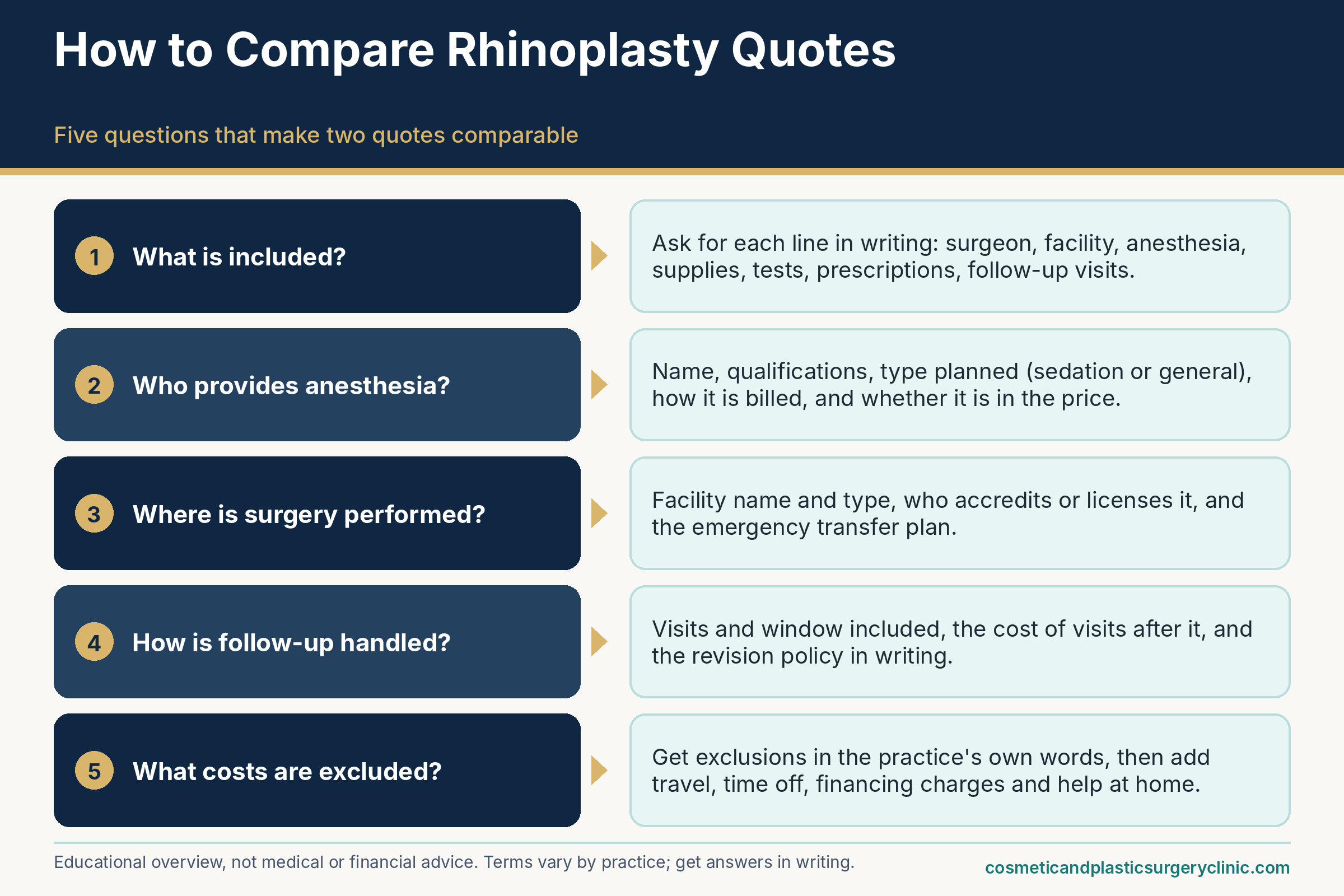
Collecting quotes is easy. Comparing them is the hard part, because practices present prices in different shapes. One lists a surgeon’s fee, another a package, a third gives a range pending an examination. A fair comparison requires converting each quote into the same list of items so that the differences you see are differences in substance and not in presentation.
The five questions in the graphic below are the backbone of that conversion. If a quote can’t answer them, the number on it can’t be compared with anything.
Normalizing two quotes
Normalizing means making two documents describe the same thing. The method is mechanical, which is its advantage: it takes the emotion and the sales conversation out of the arithmetic.
Building a like-for-like worksheet
Start with the operation, not the price. Write one or two sentences describing what each surgeon plans to do: approach (open or closed), whether the septum or turbinates will be addressed, whether grafts are expected and from where, and what you asked to change. If the two descriptions differ materially, the quotes are for different operations, and you’re comparing plans before you compare prices. Ask each surgeon to confirm your summary of the plan in writing.
Next, list the layers from the stack: surgeon, facility, anesthesia, tests, supplies and medications, follow-up, and contingency. For each quote, mark every layer as included in the number, quoted separately, or unknown. The unknowns are your to-do list. Send each practice the same follow-up email asking for the missing items, and keep the replies. Resist the urge to fill unknowns with guesses drawn from a national average; an average of surgeon fees can’t stand in for an anesthesia charge.
Third, add costs that fall outside every quote: travel and lodging if the surgeon is distant, time off work, help at home, and any financing charges. Last, compute a total for each plan using the same assumptions. If one quote has unresolved unknowns, show the total as a range or as “at least,” and treat it as incomplete until the practice answers.
| Line | Practice A (hypothetical) | Practice B (hypothetical) | How to normalize |
|---|---|---|---|
| Planned operation | “Rhinoplasty,” approach not stated | Open rhinoplasty with septal graft described | Ask A to state approach and grafts in writing |
| Surgeon’s fee | Listed alone | Part of one package number | Ask B for the surgeon’s share, or ask A for all other layers |
| Facility | Separate hospital bill, amount unknown | Practice-owned facility, included | Request an estimate from A’s facility |
| Anesthesia | Billed by an outside group | Included; provider and type named | Get A’s group name, type and billing method |
| Follow-up | Not mentioned | Visits for a defined period included | Ask A for the window and any per-visit fee |
| Revision policy | Verbal only | Written, with limits stated | Obtain A’s policy in writing |
| Extra costs outside the quote | Distant city; lodging needed | Local | Add travel, lodging and time away |
A worksheet like this often reverses first impressions. The practice with the lower headline can turn out to have the higher complete cost once the missing layers are filled in. The reverse also happens: a package that looked high may include items the other practice charges for separately. Either way, you now know why.
Why a quote is low or high: five illustrative scenarios
These scenarios are hypothetical and are not based on any practice or patient. They show the most common reasons that two reasonable quotes diverge.
Scenario 1: fee only versus package. One quote lists only the surgeon’s fee and says the facility and anesthesia will be billed separately; the other lists a single all-in figure. Compared directly, the first looks cheaper. Normalized, the question is the total after the facility and anesthesia bills arrive. This is a very common source of apparent price gaps, and it’s one reason the ASPS exclusion language matters.
Scenario 2: different plans under one name. One surgeon proposes a limited change to the tip and the other proposes reshaping the bridge, the tip and the septum. The second plan involves more work and possibly more grafting. If the goals you described to both were the same, ask why the plans differ. There may be a sound anatomical reason, such as a deviated septum that the first surgeon did not examine closely, or there may be a difference in how much each surgeon is willing to promise.
Scenario 3: different anesthesia arrangements. One practice plans sedation given by a clinician who is also supervising the operation, and another plans anesthesia from a separate qualified provider. As the ASA explains, those are different arrangements, and the price reflects the staffing. A lower price isn’t wrong, but you’re entitled to know which arrangement you are buying and to ask the surgeon why it fits your situation. The questions in the anesthesia guide help.
Scenario 4: revision policy hidden in the fine print. Two quotes match to the dollar, but one comes with a written revision policy that covers the surgeon’s fee for a defined period and the other has nothing in writing. The quotes aren’t equal. The difference doesn’t appear on the price line, and it could be worth more or less than a price gap, depending on the terms and on what happens.
Scenario 5: setting and geography. A surgeon in a high-cost metropolitan area and one in a smaller market quote similar operations. The first quote is higher, and the second looks like a bargain until you add travel, lodging for the first week, a companion, and a plan for follow-up visits. Whether the savings survive that arithmetic is a question only your own numbers can answer.
Consultation questions and pricing practices that deserve a pause
The consultation is where quotes are built and where you can learn the most about how a practice handles money. Treat it as an interview about scope and terms, not only as a medical visit.
Questions that surface the real scope
Bring a short list and ask the same questions at every practice, so the answers are comparable. A detailed question list for consultations is in the rhinoplasty consultation guide, and a cost-focused list is in the guide to questions to ask about plastic surgery cost. These ones go straight at pricing:
- Can you describe in writing the operation you propose for me, including the approach, whether the septum is involved, and whether grafts are expected and from which source?
- What does the surgeon’s fee include: the consultation, imaging, the operation, follow-up visits, and for how long?
- Where will the operation take place, who accredits or licenses that facility, and is the facility fee in your quote?
- Who will provide anesthesia, which type is planned, what are the provider’s qualifications, and how is the fee calculated?
- Which tests, medications and supplies are not in the quote?
- If the operation takes longer, or the plan changes during surgery, how does that affect the price?
- What is your revision policy, in writing, including time limits, what you cover, and what remains my cost?
- What would a visit after the included follow-up window cost?
- If part of my concern is breathing, will you document it, do you submit to insurance, and how is the bill split?
- What are the deposit terms, and when is it refundable?
Notice the tone these questions invite. They’re specific and non-adversarial, and the answers say as much about the practice as the numbers do. A surgeon or coordinator who answers clearly and puts it in writing is easier to plan around than one who keeps the conversation general.
Pricing practices that deserve a pause
None of the following proves anything improper by itself, and several have innocent explanations. Each is a reason to slow down and ask another question, particularly when more than one appears together.
- A firm price quoted before any examination, with no discussion of what you actually want changed.
- A discount that expires within days, or a “today only” price that depends on paying a deposit before you’ve compared options. Manufactured urgency has no place in an elective operation.
- A refusal to itemize, or an answer to “what’s included” that is only “everything.”
- A number described as “starting at” with no explanation of what pushes it up.
- Pressure to sign a financing agreement at the desk before you’ve seen the terms in writing.
- A larger operation or an extra procedure added to the plan without a clear reason tied to your goals.
- Statements promising a specific result or describing the operation as certain to turn out a particular way. Surgeons can describe likely outcomes and limits; no one can promise a result.
- A price far below every other quote, with no explanation about what is different.
- Reluctance to name the surgeon, the facility or the anesthesia provider.
The pattern across the list is pressure and opacity. Transparent practices tend to welcome comparison, give you time, and document terms. If you feel rushed, the usual remedy is to take the paperwork home. Nothing about a nasal operation becomes safer or cheaper because you decided this afternoon.
Price, Safety, Revision and Alternatives: Making the Decision
The final step in any cost investigation is to decide what role price should play. For an elective operation on the middle of the face, price is a useful constraint and a poor guide. It’s useful because a plan you can’t afford, or can afford only by cutting off your safety margin, isn’t a good plan. It’s a poor guide because neither a high price nor a low price tells you anything reliable about the surgeon’s training, the facility’s standards, or the likelihood of a good outcome.
Two checks come before any price comparison: who is operating, and where. The first half of this section covers both, and a checklist later in the section pulls the checks together. Work through them before a deposit changes hands, not afterward.
Checking credentials and standards before price decides
Verification is free, public and quick, which makes it the best-value step in the whole process. It also changes how you read a quote: a low price from a verified surgeon in an accredited facility is a different proposition from a low price from someone you couldn’t verify.
Verifying the surgeon, the anesthesia provider and the facility
For plastic surgeons, the American Board of Plastic Surgery (ABPS) runs a public lookup at abplasticsurgery.org, where you can search by name or location. The page states that certification is a voluntary credential, that an active, unrestricted license is a requirement for certification, and that license status itself should be checked through the Federation of State Medical Boards (FSMB). The FSMB maintains a directory of state medical boards, which is how you find the licensing authority for your state and the board where complaints are filed. For doctors certified by any board that belongs to the American Board of Medical Specialties (ABMS), the Certification Matters website offers a free search by name, state and specialty.
If the surgeon is an otolaryngologist or a facial plastic surgeon, the relevant credentials differ. ABMS-recognized certification in otolaryngology would show up in the ABMS lookup; the ABFPRS publishes a physician finder for its certified surgeons and states that candidates must already be certified by an ABMS or Royal College board in otolaryngology or plastic surgery. ASPS cautions that no ABMS-recognized board has “cosmetic surgery” in its name and urges patients not to be confused by official-sounding certifications. Training is the thing to ask about: what residency, what board, what rhinoplasty experience. The guide to choosing a plastic surgeon develops the full checklist.
For the facility, ASPS lists acceptable standards as accreditation by Quad A (formerly AAAASF), the Accreditation Association for Ambulatory Health Care, or the Joint Commission, or Medicare certification or state licensure. Quad A says it accredits ambulatory surgery centers and office-based surgery facilities where anesthesia or sedation is used and maintains a directory of accredited facilities; AAAHC accredits ambulatory and office-based surgery centers and provides a Find Accredited Organizations tool. Ask for the facility’s name and look it up on the accreditor’s site, rather than relying on a logo in a brochure.
Emergency planning belongs on the same list. Ask what happens if there is a problem with anesthesia or bleeding during or after the operation: who responds, what equipment is on site, and where you would be transferred. That’s more important in an office-based setting, where, as the ASA notes, normal institutional back-up or emergency capacity is often not available. These are not accusations; they’re the questions a prepared practice expects. More detail is in the guide on choosing an accredited facility.
Surgery abroad and distant bargains
Some of the lowest quotes come from outside the United States, and a price gap can look large enough to justify the trip. The research on what happens when things go wrong is mostly about other cosmetic procedures, not specifically nose surgery, but its lessons about cost and follow-up apply to any elective operation performed far from home.
A June 2026 CDC report reviewing consultations from 2014 through 2024 identified 2,162 consultations, of which 34 involved patients who traveled for medical procedures. It described adverse outcomes in about 145 cosmetic surgery patients across 21 reports, involving procedures such as liposuction, abdominoplasty, breast augmentation and gluteal augmentation; postsurgical infections appeared in 20 consultations, including 12 suspected or confirmed nontuberculous mycobacterial infections, and four consultations involved deaths. Investigators found deficiencies in cleaning, hand hygiene, protective equipment and surgical equipment reprocessing at facilities in the United States and abroad. The report is a case review, not a measure of how often problems occur, and it is not specific to rhinoplasty.
On cost, a 2017 study in Plastic and Reconstructive Surgery, summarized by ASPS, followed 42 patients who developed complications after cosmetic surgery abroad and were treated at a single New York medical center over 36 months. Twenty were admitted to the hospital and thirteen needed further surgery, and the average cost of treatment was about $18,000 per patient. An ASPS briefing paper states that revisions and complication care can cost more than the original operation would have cost in the United States, that credentials are difficult to assess abroad, that follow-up is limited, and that there may be no legal recourse. The CDC’s traveler guidance adds that follow-up care for complications might be expensive and might not be covered by health insurance, and recommends seeing a health care provider 4 to 6 weeks before travel.
Flying soon after surgery has its own risk. The ASPS briefing paper notes that combining travel with surgery increases the risk of blood clots and suggests waiting 7 to 10 days after facial procedures before flying, a timeframe to confirm with your own surgeon. The guide on plastic surgery abroad goes through the checklist in more depth.
Revision costs, alternatives and a budgeting plan
The last piece of the cost picture is what happens if the first operation does not meet its goals, and what else you could do with the same money. A fair decision includes both.
Revision policies and the cost of redoing
Reports of how often rhinoplasty is followed by another operation vary widely, because they use different definitions and different data. The Cleveland Clinic states that about 15 percent of people need a follow-up operation to make small changes. StatPearls says revision and complication rates are typically reported to be up to 15 percent and 3 percent, respectively. A 2020 study of Florida ambulatory surgery data from 2009 to 2014, covering 9,172 rhinoplasties, found that 4.4 percent of patients underwent revision within the database. These numbers aren’t contradictory so much as non-comparable: the denominators, follow-up windows and meanings of “revision” differ, and none is your personal likelihood.
The Florida study found something relevant to cost: among patients who had repeat procedures, about 30.8 percent changed surgeons. Cartilage grafting and self-payment were associated with a lower likelihood of switching, while cosmetic (as opposed to functional) revisions and longer intervals between procedures were associated with a higher likelihood. A patient who switches surgeons for a revision typically starts a new consultation, a new quote and a new set of layers, and may not be covered by the first surgeon’s revision policy, so ask in advance whether it would apply. That’s a cost of redoing that doesn’t appear on any initial quote.
Timing matters as well. Mayo Clinic says revision surgery requires waiting at least a year after the initial operation, and the Cleveland Clinic describes the final result as taking about a year to appear. A revision policy with a six-month limit may expire before anyone can judge whether a revision is needed. Ask for the policy’s time limit, what it covers (surgeon’s fee, facility, anesthesia), whether it applies only to specific problems, and whether it’s transferable if you move.
The 2022 cost-utility model discussed earlier gives a sense of scale for complications. It reported modeled costs of about $7,447 for an outpatient revision (about $8,228 when rib cartilage harvest was needed) and about $21,099 for a complicated revision involving a lung complication of rib harvest, concluding that complications could roughly double costs. These figures come from a modeled analysis, and the abstract does not say whose prices were used, so they illustrate relative magnitude and not what any practice charges. Read together with the revision policy, they argue for a contingency fund, not for a specific amount. For more, see the guides on revision rhinoplasty and rhinoplasty risks and complications.
Before turning to alternatives, the checklist below pulls the credential, facility, emergency-planning and revision-policy checks together, with the price decision they should come before.
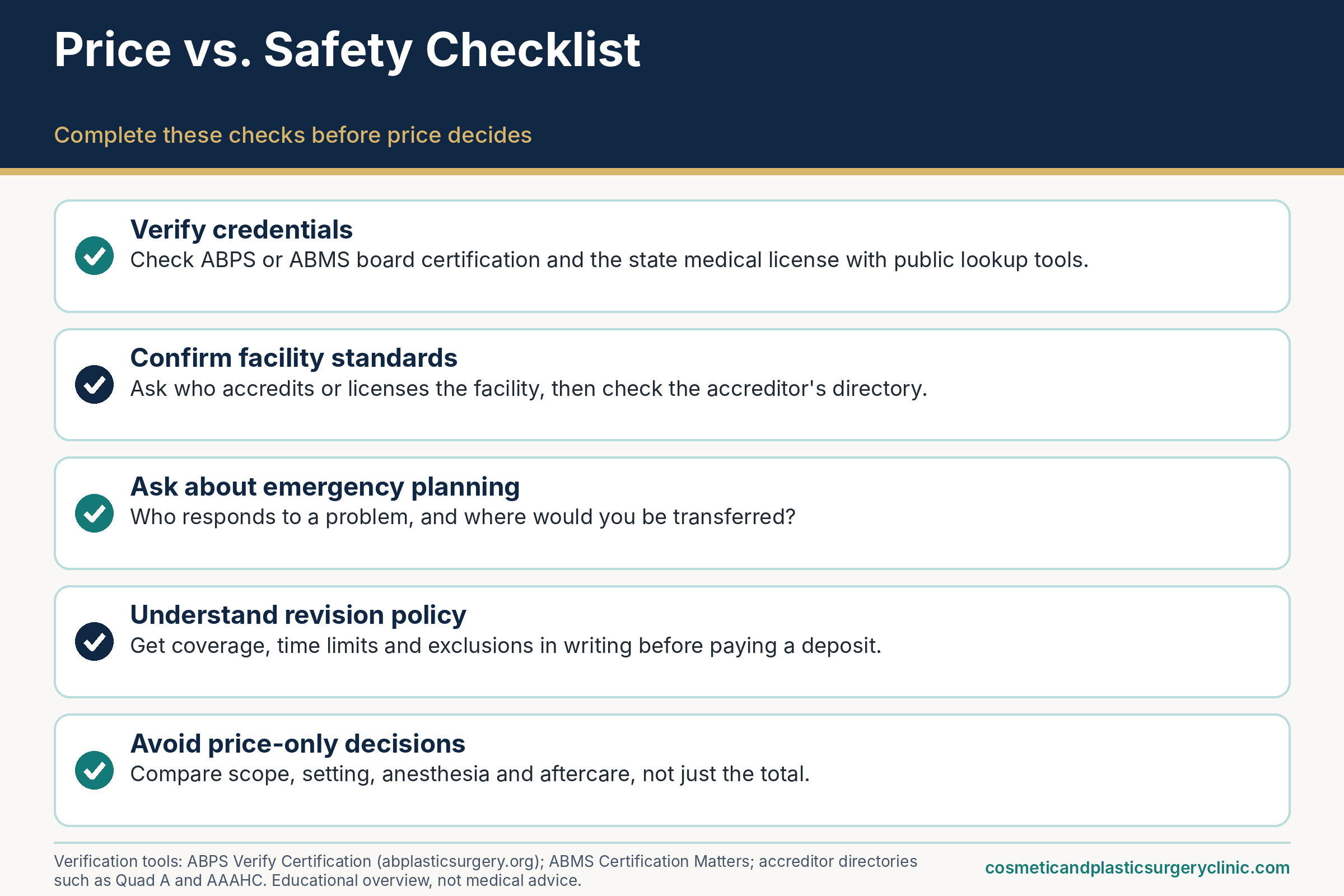
Alternatives, staging and a step-by-step plan
Alternatives to surgery exist, with their own costs and limits. The most discussed is nonsurgical rhinoplasty with injectable filler, which adds volume but cannot reduce a nose. The U.S. Food and Drug Administration lists the nose among areas where dermal fillers are not approved, warns that unintended injection into a blood vessel can lead to tissue death, vision problems including blindness, and stroke, and says only a licensed health care provider with experience in dermatology or plastic surgery should inject them. Because temporary options need repeating, their lifetime cost depends on how long you want the change. The rhinoplasty alternatives guide compares them with surgery, and it is the right place to weigh them against the operation.
Staging is another way to manage cost. ASPS has noted that some patients space procedures over years rather than combining them, and for nasal surgery, whether a functional operation and a cosmetic refinement are done together or in sequence is a surgical judgment that depends on your anatomy and goals. The financial logic is simple: combining operations can reduce duplicated facility and anesthesia costs, while staging can spread payments and reduce the size of any single financial commitment. Ask each surgeon which approach they recommend and why.
Waiting is also an option. A pause lets you save, gather a second opinion, observe whether your goals persist, and arrange leave from work. If the reason for the timing is a discount deadline, the discount is the wrong reason. The table below turns the process into a sequence with a cost-related output at each stage; timings are illustrative and vary widely.
| Stage | Typical timing (varies) | What to do | What to have in hand |
|---|---|---|---|
| Research and verify | Weeks before consultations | Check ABPS, ABMS or ABFPRS status, state license, facility accreditation | Short list of verified surgeons |
| Consultations | Several weeks | Ask the same questions at each practice; request written plans | Written plan and itemized quote from each |
| Normalize and compare | After the last consultation | Fill the worksheet; chase unknown layers | One complete total per plan |
| Insurance and tax questions | Before any deposit | Ask about functional documentation, prior authorization, HSA or FSA eligibility | Written answers from insurer or administrator |
| Financing decision | Before signing any agreement | Compare outside options; calculate total cost | Payoff schedule you can meet |
| Deposit and scheduling | Weeks to months before surgery | Pay by a method with recourse; confirm cancellation terms | Receipts and signed terms |
| Recovery budget | Before the surgery date | Arrange leave, transportation and help at home | Leave approval and a support plan |
| Follow-up window | Weeks to months after surgery | Attend scheduled visits; keep records | Visit log and any charges beyond the window |
| One-year review | About 12 months or later | Review appearance and function with your surgeon before considering revision | Revision policy status and a clear view of options |
The last row follows the AAO-HNSF guideline’s suggestion that satisfaction with appearance and function be documented at a minimum of 12 months after surgery, and Mayo Clinic’s note that revision requires waiting at least a year. Financially, it means the real conversation about revision happens a year after you’ve paid the main bill, so a plan that ignores that year is incomplete.
Frequently asked questions about rhinoplasty cost
How much does a nose job cost in the United States?
No single number covers every case. ASPS reported a 2024 projected range of $7,500 to $12,500 for the surgeon’s fee, drawn from averages submitted by surveyed members. That range leaves out anesthesia, the facility and related expenses, so a complete bill is higher and varies with the operation, the market and the practice’s terms. Other studies report different figures for different populations. The only reliable estimate for your situation is an itemized written quote from a surgeon who has examined you.
Does the published ASPS average include anesthesia and the operating room?
No. The ASPS rhinoplasty cost page says its average does not include anesthesia, operating room facilities or other related expenses, and it lists anesthesia fees, hospital or surgical facility costs, medical tests, garments, prescriptions and the surgeon’s fee as separate components. Some practices quote a package that combines them, which can make a package look higher than a surgeon’s-fee-only figure even when the underlying arrangements are similar. Ask each practice to name every item its number covers.
Why do rhinoplasty quotes differ so much between surgeons?
Usually because the quotes describe different things. The planned operation may differ in scope, with different grafts or septal work, or the quotes may include different layers such as anesthesia or the facility. Surgeon experience, geography, operating setting and the follow-up and revision terms also vary. ASPS says surgeon fees depend on experience, procedure type and office location. Before concluding that one practice is overpriced, convert both quotes to the same itemized list and compare the plans before the totals.
Is revision rhinoplasty more expensive than a first nose job?
The sources reviewed for this article don’t establish a general answer, and practices set revision fees individually. StatPearls notes that revision is more difficult because of scar tissue and earlier cartilage manipulation, which can affect operating time and grafting needs. A 2022 modeled analysis reported costs that varied with graft harvest and complications. What you can control is asking for the revision policy in writing, including time limits and whether facility and anesthesia charges are covered. The revision rhinoplasty cost guide covers this in detail.
Does insurance cover rhinoplasty?
Cosmetic reshaping is generally not covered. ASPS says rhinoplasty performed to correct breathing impairment from an obstructed airway is considered reconstructive and may be covered, after a detailed examination and prior authorization. Mayo Clinic says coverage depends on the individual policy and that prior authorization does not ensure coverage. For a combined operation, payers generally cover only the functional portion, and one insurer’s published policy requires photographs and expected functional improvement. Ask your insurer for its written criteria and request authorization before surgery.
Can I use an HSA or FSA to pay for a nose job?
It depends on whether the expense meets the tax definition of medical care. IRS Publication 969 ties qualified expenses to section 213(d), and Publication 502 says cosmetic surgery generally is not includible unless it corrects a deformity from a congenital abnormality, an accident or trauma, or a disfiguring disease. A documented functional portion is a separate question for your plan administrator. HSA withdrawals for nonqualified expenses are taxed and may carry an additional 20 percent tax, so confirm eligibility in writing and consult a tax professional.
What is a septorhinoplasty, and does it cost more?
A septorhinoplasty combines septoplasty, which straightens the septum to improve airflow, with rhinoplasty, which reshapes the outside or support of the nose. ENT Health describes septoplasty alone as taking roughly one to one and a half hours, usually as outpatient surgery. Adding the septal work adds time, and it may add a functional component that insurance considers. Whether the total is higher depends on the plan, the setting and how the bill is split, so ask for both portions itemized.
Is it cheaper to have rhinoplasty abroad?
The quoted fee may be lower, but the comparison has to include travel, lodging, a companion, time away, and what happens if there is a problem. An ASPS-summarized 2017 study of 42 patients treated at one New York medical center after cosmetic surgery abroad reported an average treatment cost of about $18,000 per patient. A 2026 CDC report described infections and deaths among travelers for cosmetic procedures, though not specifically rhinoplasty. Verify credentials and facility standards, and plan follow-up at home before comparing prices.
What is deferred interest, and does it apply to surgery financing?
Deferred interest means interest accrues in the background during a promotional period and is waived only if the full balance is paid before it ends. The CFPB says these promotions typically last six to eighteen months for medical products, and that if a balance remains, interest can be charged from the original purchase date on the full original amount. Many practices offer financing that uses this structure. Ask whether an offer is deferred interest, calculate the monthly payment needed to finish on time, and compare an outside loan.
How much deposit is reasonable, and should it be refundable?
No source reviewed sets a standard deposit amount or refund rule, so terms are set by each practice. What matters is that the terms are written before you pay: what the deposit secures, whether it is refundable, what happens if the surgeon advises against proceeding after your visit, if an insurance request is denied, or if the practice changes the date. Paying by credit card can provide a dispute path under the Fair Credit Billing Act in some circumstances. Keep the receipt and the cancellation policy as written when you paid.
How much time off work should I budget for rhinoplasty?
Recovery varies with the operation, the person and the job. The Cleveland Clinic describes return to work or school as possible within one to two weeks, with light exercise after four to six weeks, while Mayo Clinic advises avoiding strenuous activity for several weeks. ASPS recommends asking your surgeon about your timeline. Federal family leave rules treat most cosmetic treatments as not serious health conditions unless inpatient care is required or complications develop, so check employer paid leave and disability policies, and build a cushion for a slower recovery.
Does a higher price mean a better surgeon?
Not reliably. A small 2021 study of 67 surgeons in seven U.S. cities found higher average fees among surgeons with one board credential and among higher-volume surgeons, but it measured fees, not outcomes, and it can’t separate skill from local demand. Price tells you little about training, facility standards or revision terms. Verify board certification through the ABPS or ABMS tools, confirm the surgeon’s license with the state board, check the facility’s accreditation, and ask how many rhinoplasties the surgeon performs each year.
Sources and further reading
- American Society of Plastic Surgeons — Rhinoplasty Cost (undated page; accessed 2026-10-04) — $7,637 average without a stated year; exclusions for anesthesia, facility and related expenses; component list; fee drivers; insurance and financing statements
- American Society of Plastic Surgeons — 2024 Average Surgeon/Physician Fees (accessed 2026-10-04) — rhinoplasty projected range of $7,500 to $12,500; projected-range method; ranges for other procedures
- American Society of Plastic Surgeons — 2023 Average Surgeon/Physician Fees (accessed 2026-10-04) — nose reshaping $7,637 (2023) and $6,324 (2022)
- American Society of Plastic Surgeons — Plastic Surgery Statistics Report 2025 (accessed 2026-10-04) — nose reshaping volume in 2025 and 2024; data sources; no fee data
- American Society of Plastic Surgeons — Rhinoplasty: Procedure and Recovery pages (accessed 2026-10-04) — anesthesia options, open and closed approaches, graft sources, splints and packing, follow-up questions
- American Society of Plastic Surgeons — Recommended Insurance Coverage Criteria: Nasal Surgery (revised May 2021; accessed 2026-10-04) — cosmetic and reconstructive definitions, functional criteria, documentation, combined procedures
- Cigna — Coverage policy: Septoplasty, Rhinoplasty and Septorhinoplasty (effective July 1, 2026; accessed 2026-10-04) — example of one insurer’s criteria; cosmetic exclusion; photographic documentation
- Mayo Clinic — Rhinoplasty (accessed 2026-10-04) — anesthesia options, same-day surgery, insurance and prior authorization, recovery cautions, revision timing
- Cleveland Clinic — Rhinoplasty (updated November 3, 2022; accessed 2026-10-04) — operating time, anesthesia, recovery milestones, revision statement
- StatPearls — Rhinoplasty (updated September 2, 2024; accessed 2026-10-04) — setting and anesthesia, graft sources, revision difficulty, revision and complication rates
- Seyidova et al., Aesthetic Plastic Surgery 2025;49(17):4857-4863 — Nationwide Analysis of Cost and Insurance Type Coverage for Primary Rhinoplasty (abstract page; accessed 2026-10-04) — 2021 MarketScan claims; out-of-pocket by plan type; regional totals
- Thieme eJournals — Board Certification and Surgeon’s Fee for Aesthetic Rhinoplasty (published May 14, 2021; accessed 2026-10-04) — 67-surgeon, seven-city fee study
- Annals of Otology, Rhinology & Laryngology (2022) — Cost Utility Analysis of Costal Cartilage Autografts and Human Cadaveric Allografts in Rhinoplasty (abstract page; accessed 2026-10-04) — modeled costs of grafts, revision and complications
- Laryngoscope Investigative Otolaryngology (2020) — Change in surgeon for revision rhinoplasty (abstract; accessed 2026-10-04) — Florida ambulatory surgery data, revision proportion, surgeon switching
- Consumer Financial Protection Bureau — Medical Credit Cards and Financing Plans (May 2023; accessed 2026-10-04) — deferred interest, typical APR, incidence, point-of-care enrollment
- Consumer Financial Protection Bureau — What’s the deal with health care credit cards? (February 5, 2014; accessed 2026-10-04) — consumer guidance on promotional periods and retroactive interest
- Centers for Medicare & Medicaid Services — Good Faith Estimate (accessed 2026-10-04) — who may receive an estimate; $400 dispute threshold
- Internal Revenue Service — Publication 502, Medical and Dental Expenses (2025; accessed 2026-10-04) — cosmetic surgery definition, exceptions, AGI threshold
- Internal Revenue Service — Publication 969, Health Savings Accounts and Other Tax-Favored Health Plans (2025; accessed 2026-10-04) — qualified medical expenses, insurance offset, nonqualified distributions
- Federal Trade Commission — Disputing Credit Card Charges (accessed 2026-10-04) — timing and scope of billing dispute rights
- Electronic Code of Federal Regulations — 29 CFR 825.113, Serious health condition (accessed 2026-10-04) — cosmetic treatments and family leave
- Centers for Medicare & Medicaid Services — National Coverage Determination 140.4 (accessed 2026-10-04) — Medicare cosmetic surgery exclusion and exceptions
- Legal Information Institute — 42 CFR 414.46, Anesthesia services (accessed 2026-10-04) — base plus time units in Medicare anesthesia payment, used as an illustration
- American Society of Anesthesiologists — Statement on distinguishing monitored anesthesia care from moderate sedation/analgesia (October 2023; accessed 2026-10-04) — provider qualifications and payment recognition
- American Society of Anesthesiologists — Statement on qualifications of anesthesia providers in the office-based setting (reaffirmed October 23, 2024; accessed 2026-10-04) — anesthesia providers and office-based emergency capacity
- American Society of Plastic Surgeons — Accredited Facilities (accessed 2026-10-04) — accepted facility standards and accreditors
- Quad A — About Us (accessed 2026-10-04) and AAAHC — Accreditation (accessed 2026-10-04) — facility types accredited and public directories
- American Board of Plastic Surgery — Verify Certification (accessed 2026-10-04) — public certification lookup; voluntary certification; license status through FSMB
- American Board of Medical Specialties — Certification Matters (accessed 2026-10-04) — free lookup for ABMS board certification
- Federation of State Medical Boards — Contact a State Medical Board (accessed 2026-10-04) — directory of state licensing boards
- American Board of Facial Plastic and Reconstructive Surgery — Certification and Physician Finder (accessed 2026-10-04) — certification requirements and surgeon finder
- American Society of Plastic Surgeons — Choose a Plastic Surgeon You Can Trust (accessed 2026-10-04) — training requirements and caution about official-sounding boards
- American Society of Plastic Surgeons — Briefing paper: Cosmetic Surgery Tourism (undated; accessed 2026-10-04) — credentials, revision costs, follow-up, flying after surgery
- American Society of Plastic Surgeons — Medical tourism for cosmetic surgery: high risk of complications, high costs for treatment (2017 study; accessed 2026-10-04) — single-center complication series and treatment cost
- Centers for Disease Control and Prevention — CDC highlights adverse outcomes linked to travel-related cosmetic procedures (June 2, 2026; accessed 2026-10-04) — consultation review, infections and deaths
- Centers for Disease Control and Prevention — Medical Tourism, Travelers’ Health (accessed 2026-10-04) — follow-up cost, pre-travel consultation
- American Society of Plastic Surgeons — Will economic uncertainty drive more patients overseas? (June 20, 2025; accessed 2026-10-04) — financing, prepayment plans, staging, regional travel
- Plastic and Reconstructive Surgery Global Open — The Controversy over Price Transparency: Patients and Plastic Surgeons Disagree (October 2024; accessed 2026-10-04) — survey-based finding on online price disclosure and estimates
- AAO-HNS Bulletin — Clinical Practice Guideline: Improving Nasal Form and Function after Rhinoplasty (2017 guideline; accessed 2026-10-04) — preoperative assessment, packing, antibiotics, documenting satisfaction at 12 months
- ENTtoday — Clinical consensus statement on septoplasty released (AAO-HNSF, November 2015; accessed 2026-10-04) — imaging, insurance documentation comments
- ENT Health — Deviated Septum (reviewed August 2018; accessed 2026-10-04) — treatment sequence, septoplasty duration and setting
- U.S. Food and Drug Administration — Dermal Fillers (Soft Tissue Fillers) (page modified July 6, 2023; accessed 2026-10-04) — nose listed among unapproved uses; vascular occlusion risks; qualified injectors