

Most people who research plastic surgery are not really asking whether operations work. Surgeons have been reshaping tissue for centuries, and the techniques are well documented. The harder question is personal: will this particular change, at this particular cost in time, money, scars and risk, be worth it for you, and is now the right moment? That is a decision about trade-offs, and a before-and-after gallery or a procedure’s popularity can’t settle it.
This page is a map for that decision. It explains what elective plastic surgery can and can’t change, how to read national volume statistics without treating them as a recommendation, what research says about motivation, expectations and regret, and where nonsurgical treatment or no treatment belongs in the comparison. Nine companion pages on this site go deeper on single steps, such as choosing a surgeon or planning recovery. This page tells you when you need which one. Nothing here can say whether you are a candidate for any operation; that takes an in-person evaluation by a qualified clinician.
What plastic surgery covers, and what an operation can actually move
The phrase plastic surgery gets used loosely, which makes it easy to compare things that aren’t comparable. A breast reduction for back pain, a facelift and a nose reshaping all fall under the same umbrella, yet they involve different motives, different insurance logic and different expectations. Sorting that out first keeps the rest of the decision honest.
Reconstructive, cosmetic and the territory in between
A definition that starts with function
The American Society of Plastic Surgeons (ASPS) describes reconstructive surgery as treatment for body parts affected, aesthetically or functionally, by congenital defects, developmental abnormalities or trauma. Cosmetic (aesthetic) surgery is the elective counterpart: operations on structures that work normally, chosen to change how they look.
The boundary leaks in practice. ASPS lists breast reduction among its reconstructive procedures, and its 2025 trend summary notes that operations tied to comfort and everyday quality of life, such as breast reduction and labiaplasty, grew alongside purely aesthetic ones. So two people having the same operation can be doing it for quite different reasons, and that changes what counts as a good result.
The name itself describes shaping, not material. ASPS’ educational history chapter traces “plastic” to the Greek plastikos, meaning moldable, and Etymonline dates the English adjective to the 1630s and the surgical phrase to 1839, long before the 1909 date it gives for the synthetic material. Nothing about the specialty refers to plastic as a product.
Why “elective” does not mean “unimportant”
Elective means scheduled in advance rather than performed in an emergency. It says nothing about whether the concern is trivial. Someone whose shoulders ache from heavy breast tissue and someone who dislikes the shape of their nose can both be planning elective surgery, and each deserves a serious evaluation.
What the word really tells you is that you have time, and time is the most underused tool in this decision. You can wait through a season, save, compare two surgeons, try a nonsurgical option first or let a passing mood settle. Emergency care rarely offers any of that.
Insurance follows a different logic from the one you feel. Coverage generally turns on whether your plan’s written criteria consider an operation medically necessary and whether the documentation supports it, not on how distressing the concern is. If function is part of your reason, ask the plan about prior authorization in writing before assuming it will or won’t pay. If the reason is appearance alone, plan on paying for plastic surgery yourself.
What surgery changes and what it leaves alone
Tissues an operation can remove, add or reshape
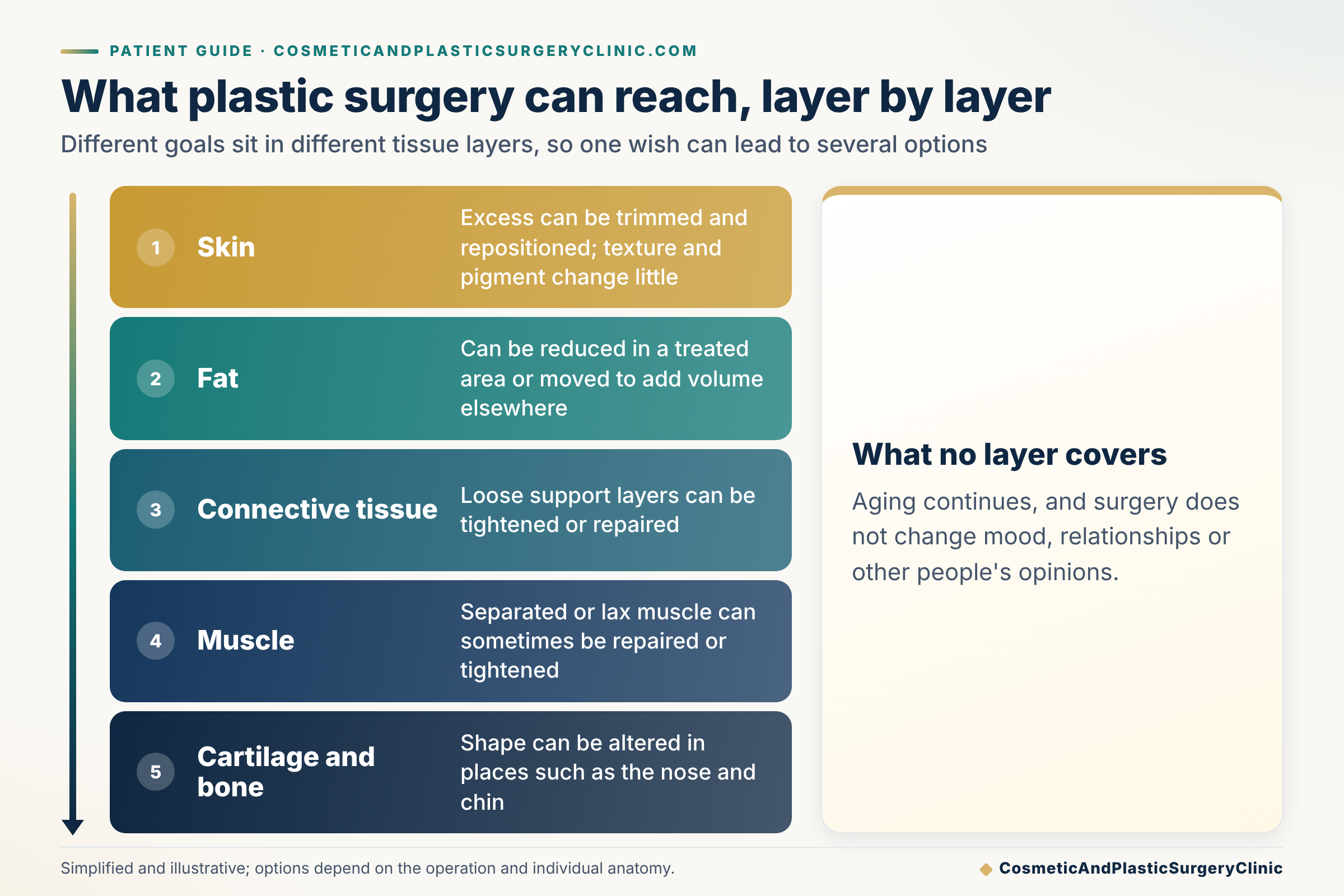
Different operations act on different layers, and the layer determines what is possible. Skin can be trimmed and repositioned. Fat can be removed from a treated area, or moved from one place to another. Connective tissue and muscle can be tightened or repaired. Implants add volume or projection. Cartilage and bone can be reshaped in places like the nose and chin.
That layering explains why “I look tired” is not one problem. Hooded upper lids, a heavy brow, hollowing under the eyes and loose skin along the jaw each sit in a different layer, and each has a different fix, including none. A surgeon who names the layer when describing your options is giving you something checkable. A surgeon who only names the operation is giving you a product.
Problems no operation addresses
Moving tissue generally doesn’t change skin quality, so texture, pigment and fine wrinkling usually call for a different tool or for acceptance. It doesn’t stop aging, either. The face and body keep changing after the best-planned operation, which is why upkeep belongs inside the decision rather than after it.
The biggest category is everything that isn’t tissue. Psychologists who study plastic surgery warn against expecting an operation to resolve long-standing personal difficulties. Sarwer, a researcher quoted in the American Psychological Association’s Monitor on Psychology, advises checking whether the concern centers on a feature that looks normal to others and whether the motivation is internal or pressure from a partner or friend. A 2002 review in the Medical Journal of Australia found that unrealistic expectations, especially about changes in external life circumstances, were linked to dissatisfaction.
A practical translation: write down what you expect to be different six months after the operation, and sort each item into “my body,” “how I feel about my body,” and “everything else.” Surgery can speak to the first. It can sometimes influence the second. It has no standing on the third.
Reading 2025 plastic surgery statistics without mistaking popularity for suitability
National plastic surgery counts feel authoritative, and they’re useful, but they answer a different question from the one you’re facing. They describe what many people chose. They don’t describe who was well matched to it.
What the latest national numbers show
Volume, procedure mix and who is having surgery
The ASPS 2025 statistics report estimates 1,523,330 cosmetic surgical procedures in the United States in 2025, up 7% from 1,425,390 the year before. Five operations make up roughly 70% of that total, by simple arithmetic on the report’s figures: liposuction (317,196), breast augmentation including implant revision (304,234), tummy tuck (173,251), breast lift (156,131) and eyelid surgery (118,978). Because ASPS reports augmentation and implant revision as one line, that figure is not a count of first-time augmentations.
About 94% of these procedures were performed on women (1,431,257, against 89,617 on men). Ages 36 to 55 accounted for nearly half. The fastest-growing age group was 66 and older, up 24% to 203,105, while the 18-to-25 group fell 9% to 62,670, according to the same report and ASPS’ press release.
Minimally invasive treatments are counted differently. ASPS gives no national total for them, because it says it has not found a data source that aligns with its surgical data. It reports only a ranking: neuromodulator injections are about half of those treatments and hyaluronic acid fillers about 30%.
Lifts up, some staples down, and the GLP-1 consultation signal
The 2025 growth wasn’t spread evenly. Facial fat grafting rose 39%, forehead and brow lifts 29%, upper body lifts 22%, arm lifts and neck lifts 21% each, thigh lifts 20%, facelifts 13% and breast lifts 8%. Rhinoplasty fell 5%, as did Brazilian butt lift, and gynecomastia surgery fell 8%, according to ASPS’ 2025 trend article.
ASPS ties the lift growth to weight loss with GLP-1 medications and the loose skin that can follow rapid loss, but hedges: the connection “may” exist, and the statistics don’t establish cause. In a companion survey, 82% of ASPS member surgeons reported consultation requests related to GLP-1 use. ASPS itself adds a caution worth repeating: consultations and completed procedures are not the same thing. Tummy tuck, one of the operations most often raised in those consultations, was statistically flat in the data.
What a volume statistic cannot tell you
How the figures are built, and where they stop
The report combines a survey of member surgeons, data from an ASPS-endorsed partner (CosmetAssure) and a national claims-based dataset, covering more than 3,000 board-certified plastic surgeons. These sources were aggregated and statistically extrapolated into national and regional estimates. That makes the figures estimates, not a census, and ASPS says so.
Three limits matter for a reader. Patient motivations in the report come from surgeons’ survey answers, not from patients, and surgeons could pick up to three reasons. Reconstructive categories moved from a survey base to insurance claims in 2025, so year-over-year comparisons there are less direct. And ASPS is a professional society whose members perform plastic surgery. That is not a reason to dismiss its data, only to remember who compiles them and for what audience.
Why a common plastic surgery choice can still be wrong for one person
Volume reflects how many people wanted something, how many surgeons offer it, how heavily it’s marketed and how it’s priced. It contains no information about how many of those people were well matched to the operation, or how many were pleased five years later. A plastic surgery ranking tells you what is common. It can’t tell you what is right.
The tummy tuck figure is a useful reminder. Interest ran high, volume stayed flat, and the data can’t say why. Plausible reasons include weight that is still changing, plans for pregnancy, cost, health factors or a surgeon advising a wait, but those are guesses, not findings from the report. Questions of timing and fit for a specific operation belong on pages built for them, such as the tummy tuck candidacy page, and ultimately in an examination room.
If you catch yourself reasoning “it’s the third most popular, so it must be well proven,” swap in the real test: does this operation address my specific problem, at a trade-off I understand? The only valid comparison is between your problem and your options.

Motivation, expectations and regret: what the research supports
Most of the evidence on how people fare after elective plastic surgery is older and thinner than the confidence of online discussion suggests. The reviews that can be opened and read are about two decades old, and the field has few long-term follow-up studies. Still, they point in a consistent direction, and that direction is practical.
Why people seek surgery and which motives raise a flag
Internal reasons and outside pressure
Susan Thorpe, interviewed in that same APA Monitor piece, says most people are motivated by body-image dissatisfaction: they want to look normal, avoid standing out, or have their appearance match how they see themselves. The article also notes that researchers who once treated cosmetic patients as a psychiatric group have mostly found few pathological differences between patients and non-patients. Wanting a change is ordinary.
Where the motive sits matters more than how strong it is. Sarwer’s screening suggestions, as the article reports them, include asking whether the person is driven from within or pushed by a partner or friend, and whether expectations are realistic. A decision you’d still make if nobody ever saw the result is on firmer ground than one made to keep a relationship or please someone.
| Signal | What reviewers associate with it | A question to ask yourself |
|---|---|---|
| The concern is one specific feature you can describe | Clearer goals and a plan a surgeon can evaluate | Can I say what I want changed in one sentence, without comparing myself to someone else? |
| The feature looks unremarkable to people you trust | A flag for clinicians to look further, per Sarwer’s screening advice | Has more than one person who knows me well said they can’t see it, and does that change how I feel? |
| A partner or friend is pushing the decision | External motivation, a recognized caution | Would I still want this if no one else had an opinion? |
| You hope surgery will repair a relationship, job or mood | Unrealistic expectations tied to external life changes, linked to dissatisfaction (MJA 2002) | What do I expect to change that isn’t my body? |
| Current or past depression or anxiety, or earlier procedures that left you unhappy | Depression or anxiety history was named a predictor of poorer outcomes in the 2004 review of 37 studies; clinicians are advised to ask about past procedures (MJA 2002) | Have I talked with a clinician who knows my history before booking? |
Expecting surgery to change a life, not a feature
The 2002 Medical Journal of Australia review by Castle, Honigman and Phillips is blunt on this point. Across the studies it covered, most patients were pleased and reported better self-esteem and less distress, but unrealistic expectations, particularly about external changes like relationships and career, went with dissatisfaction. The authors also observed that operations that change a feature’s character, such as rhinoplasty, seemed to demand more psychological adjustment than restorative ones, such as facelifts.
That second observation deserves a careful reading. It doesn’t say rhinoplasty is a poor idea. It says that when a face looks different, some people need time to recognize themselves, and it helps to expect that. If you’re considering a change to a feature other people use to identify you, ask the surgeon how patients typically describe the adjustment period.
Body dysmorphic disorder and why it belongs in every cosmetic decision
How often it appears in cosmetic settings
Body dysmorphic disorder (BDD) is a mental health condition marked by preoccupation with perceived flaws in appearance that others barely notice or can’t see. A 2016 systematic review in Body Image by Veale and colleagues, indexed in PubMed, estimated weighted prevalence at about 13% among cosmetic surgery patients overall and about 20% among rhinoplasty patients, compared with about 2% in community samples of adults and adolescents. Its authors concluded BDD is often poorly identified.
Older figures run lower. The APA article reports several studies finding 7% to 12% of plastic surgery patients with some form of BDD, and the 2002 review gives roughly 6% to 15%. The spread comes from different clinics, countries and screening methods, so treat all of these as “roughly one in eight, give or take” rather than precise rates. The shared message is that it isn’t rare.
What a careful evaluation asks about
The reviews agree on what clinicians should look at: whether the concern is out of proportion to what others see, how much distress and preoccupation it causes, expectations, earlier procedures, and psychiatric history. Both sources report that people with BDD rarely benefit from cosmetic procedures, and the APA article adds that many request repeat operations. The 2002 review recommended that patients with depression, psychosis or BDD generally be referred to mental health professionals before any cosmetic procedure, and noted that BDD is treatable: serotonin-reuptake inhibitors and cognitive behavioral therapy were effective in about two-thirds of patients.
If the description of BDD sounds uncomfortably familiar, that isn’t a diagnosis and it isn’t a ban on ever having surgery. It is a reason to speak to a primary care clinician or mental health professional first, and to tell any surgeon you consult what you’ve noticed. A surgeon who asks about your mental health is doing the job correctly, not being intrusive.
What “satisfied” and “regret” mean in the studies
Satisfaction at one year, and the evidence behind it
Satisfaction figures are real but narrow. The APA article describes a 2005 study in Aesthetic Surgery Journal in which 87% of patients reported satisfaction one year after surgery, along with better body image for the altered feature and less negative body-image emotion in social settings. The article doesn’t give the sample size, so the figure is best read as a signal, not a benchmark. The 2004 Honigman review of 37 studies reached similarly positive conclusions about body image, with possible gains in quality of life.
Evidence quality is the catch. The 2002 review found that only 11 of its 36 studies had a control group, samples were often small and possibly unrepresentative, few used blinded raters, not all used validated questionnaires, and follow-up periods varied. Its summary is worth quoting in spirit: cosmetic outcomes are generally good, but psychosocial benefit is less clearly established.
Why there is no single regret rate
An honest answer to “how many people regret plastic surgery?” is that no defensible single figure exists. Regret depends on the procedure, the person, the time point and the question asked. “Would you do it again” is not the same as “are you pleased with the result,” and neither equals “did the whole experience cost what you expected.” Studies of decision regret in surgery use different scales in different populations, so a number from one setting doesn’t transfer to another.
The reasoning behind regret, though, is clear enough to use. People tend to regret decisions that rested on a misunderstanding: about scars, recovery time, the chance of revision, the cost, or what the operation could do for their life. Someone who expected a modest, uneven improvement and got one may feel settled. Someone who expected transformation may feel let down by a technically sound result. Reducing the gap between expectation and reality is the one lever you control, and it’s the main purpose of the rest of this page.
Surgery, injectables, devices or no treatment: choosing the right lever
Many readers arrive with a specific plastic surgery procedure in mind because that’s what the search results and feeds show. The better first move is to ask what kind of change the concern needs, then see which approaches can physically deliver it.
Match the problem to what each approach can reach
When the issue is extra skin or deeper structure
Injectables add volume or relax muscle. They don’t remove skin or repair underlying tissue, so a concern rooted in excess skin or lax structure points toward a surgical consultation, if it points anywhere. That’s the situation behind much of the 2025 growth in lifts that ASPS links, with caution, to weight loss. Plastic surgery removes and repositions tissue; nothing injected does.
Where several areas are involved, combinations come up. Pages like the one on the mommy makeover explain how multi-area plans are put together. The decision-level point is that each added area brings its own scars, risks and recovery, so ask what doing everything at once gains over staging it, and who decides that trade-off.
When volume, lines or surface quality are the target
Dynamic lines from facial movement, lost volume and surface texture are usually the territory of neuromodulators, fillers and skin treatments. ASPS’ 2025 ranking has neuromodulators at about half of minimally invasive treatments, hyaluronic acid fillers at 30%, then laser skin treatments. They offer a smaller step that generally wears off, and some people choose them as a trial before deciding on surgery.
Some body areas have their own side-by-side comparisons. Readers weighing a nose change can look at rhinoplasty alternatives, and those weighing breast changes can read about breast augmentation alternatives. Their usefulness is the same as here: they separate “what I want” from “the one tool I assumed.”
Nonsurgical does not mean low-stakes
What the FDA says about fillers
The U.S. Food and Drug Administration treats dermal fillers as medical device implants and says only FDA-approved products should be used. Approved temporary fillers are for adults 22 and older, for specified areas: moderate to severe facial wrinkles and folds, and volume in the lips, cheeks, chin and back of the hand. Non-absorbable fillers are approved only for nasolabial folds and cheek acne scars.
The agency lists uses it advises against, including breast and buttock enhancement and injection into areas such as the glabella, nose, periorbital area, forehead and neck. Injectable silicone is not approved for any aesthetic use. The most serious risk is unintentional injection into a blood vessel, which can cause tissue death, vision problems including blindness, and stroke; the damage can be lasting. The FDA recommends a licensed provider trained in filler injection and advises against buying fillers online.
Counting repeat treatments against a single operation
Temporary treatments have to be repeated to maintain the effect, so their cost and their risk recur. An operation concentrates both into one event: more cost and recovery up front, then (in the ideal case) a long stretch without repeat visits, though aging and device life still apply. Neither is cheaper or safer in general. Which one is lighter depends on your time horizon, how many areas are involved, and how often the nonsurgical option needs repeating.
The question to put to any provider offering a recurring treatment: how often does this typically need repeating for the area I’m asking about, and how is that interval known? Then do the multiplication over the number of years you care about. The plastic surgery cost breakdown shows how to compare quotes line by line, and that comparison works the same way for a treatment plan as for a one-time operation.
The decision table: situations side by side
Six common situations compared
| Situation | Pathway to compare first | What it can offer | Main trade-off | Question to settle |
|---|---|---|---|---|
| Loose abdominal skin after major weight loss | Surgical consultation about skin removal | Removes tissue that injections can’t | Long scar, anesthesia, recovery, timing | Has my weight been stable long enough for a surgeon to plan around? |
| Lines between the brows or forehead | Neuromodulator treatment | No incision; effect adjustable over visits | Wears off, so repeat visits and repeat cost | How often will this repeat, and what is the multi-year total? |
| Hollowing in cheeks or thin lips | FDA-approved filler, licensed injector | Volume without surgery | Vascular risk, temporary effect, area-specific approvals | Which approved product, in which approved area? |
| Unhappiness with nasal shape | Rhinoplasty consultation; weigh against doing nothing | Structural change to cartilage and bone | Scars inside or outside, recovery, revision possibility | Why not filler? (The FDA advises against injecting the nose.) |
| Heavy breasts causing physical discomfort | Medical evaluation, then surgical and insurance review | Relief that is functional as well as aesthetic | Scars, possible sensation change, coverage uncertainty | What would my plan need documented to consider it medically necessary? |
| General unhappiness not tied to one feature | Conversation with a primary clinician or mental health professional first | Addresses the actual concern | Slower and less like the ads | If only this feature changed, would the feeling be gone? |
How to use the table without diagnosing yourself
Read each row as a category of question, not as a verdict. A real evaluation can reorder everything, and your own anatomy, health history and goals might put you in two rows at once or in none. The “pathway” column names what to compare first, not what to do.
Two rows deserve extra attention because they’re the ones most easily skipped. The nasal-shape row shows how a regulatory fact (the FDA’s advice against filler in the nose) changes an option that feeds make look easy. The last row is there because the most useful early step for some people isn’t any procedure at all, and a clinician who points that out hasn’t failed to help you.
What an operation involves, from first visit to settled result
You don’t need to know how any plastic surgery operation is performed to decide well. You do need to know the shape of the process: where the decision points are, who makes them, and how long the finish line really is. The description below stays general on purpose; the specifics belong to your surgical team and your own anatomy.
The sequence at a high level
Consultation, clearance, anesthesia and the operating day
The usual path begins with a consultation: your goals, health history, medications, a physical examination and a discussion of options, including declining all of them. A written plan and informed consent follow. Depending on your health history, the team may ask for a medical review or tests beforehand, and will give written directions about medications and supplements. What to bring and what you’ll be asked is the subject of the page on consultation questions.
Anesthesia for plastic surgery is chosen by the surgeon and the anesthesia provider based on the operation, your health and the facility, not by preference alone. One current example shows why full medication disclosure matters.
The American Society of Anesthesiologists’ 2023 guidance on GLP-1 medications raised concern that delayed stomach emptying could increase the risk of regurgitation and aspiration during general anesthesia or deep sedation. It noted that the supporting evidence was limited, mostly case reports, and a later multisociety guidance followed. The practical lesson isn’t to change anything yourself. It’s to tell the surgical and anesthesia teams about every medication, including weight-loss drugs, and follow their written directions.

Follow-up and the slow finish
In plastic surgery, the operating day is the middle of the process, not the end. Follow-up visits check healing, and what you wear, whether you have drains and what you may do vary by operation. The practical side is large enough to have its own page: recovery planning covers time off, help at home and logistics.
The slow part is scars. Chapter material on scar classification in the NCBI Bookshelf’s scar management textbook describes collagen accumulation peaking at about three weeks, followed by roughly six months of remodeling, with redness, the marker of full maturation, typically taking a year or even longer to resolve. In a volunteer study the author cites, redness in superficial scars lasted beyond a year in about one-third of participants. A photo at three months, whether yours or a gallery’s, therefore shows a scar mid-change.
Why the same operation turns out differently for different people
Anatomy, health history and technique choices
Skin elasticity, tissue thickness, earlier scars or surgery, body weight and general health all influence what a surgeon can safely and sensibly plan. Devices bring their own variables: implant type, size and placement are choices with trade-offs. And technique itself is a judgment call among reasonable options. The most informative question you can ask is why your surgeon recommends this approach over the alternatives, and what would make them change their mind.
Who makes those judgments is part of the decision. Verifying training, board certification and facility accreditation is a mechanical process, covered step by step in how to choose a plastic surgeon. The American Board of Plastic Surgery describes itself as one of 24 member boards of the American Board of Medical Specialties, and ABMS says the path runs through medical school, licensure, residency and a certification exam. Titles are another matter: “cosmetic surgeon” does not mean the same as “plastic surgeon,” a distinction unpacked in plastic surgeon versus cosmetic surgeon.
Swelling, scars, sensation and symmetry
Early swelling hides the shape an operation produced, and it fades unevenly: one side can lag the other for weeks without anything being wrong. That is why surgeons tend to talk about a result emerging over months, and why judging an outcome in the first weeks is premature.
Scars vary by body region, tension, skin type and heredity. The scar textbook describes the normal mature scar as flat, a hypertrophic scar as raised but staying within the original line, and a keloid as growth that can extend beyond it, occurring in people with a strong genetic predisposition. If you’ve ever scarred in an unusual way, tell the surgeon; your own healing history is relevant information. Sensation near incisions can be altered during healing, and bodies are asymmetrical to begin with, so an operation can reduce differences but doesn’t produce matched halves.
When a result falls short, revision may be an option, but it isn’t a promise. In its breast implant guidance, the FDA cautions that a satisfactory cosmetic outcome from any reoperation is not assured. That caution is written about implants, yet the logic carries over: a second operation starts from tissue that has already healed once.
Weighing risk, upkeep and the possibility of a second operation
Risk and maintenance are the two parts of the plastic surgery trade-off most likely to be softened by marketing. They can be understood without being frightening, and they should be, before a date goes on the calendar.
Three different kinds of “something unexpected”
Expected effects, complications and emergencies are not the same thing
Expected effects are the normal course of healing: swelling, bruising, soreness, tightness, tiredness, and sometimes temporary numbness, all in the pattern your surgeon described for your operation. Complications are events outside that course, such as infection, bleeding that collects under the skin, fluid pockets, wound-healing problems, blood clots, nerve injury, reactions to anesthesia, or a scar or asymmetry that bothers you. Many are treatable, some need another procedure. Emergencies are the subset needing immediate care. Mixing the three leads people either to panic at normal swelling or to wait through something that needed a call.
Risk numbers need a denominator, a population and a procedure before they mean anything. The FDA’s breast implant page, for instance, states that the local complications it lists occur in at least 1 percent of breast implant patients at any time. A national average describes a population; your own risk depends on your health, the operation, the facility and the surgeon. The page on plastic surgery risks teaches how to read these numbers across procedures, and operation-specific pages, such as the one on eyelid surgery risks and complications, give the detail.
Warning signs that justify an immediate call
Ask in advance who answers the phone at 2 a.m., and which hospital would treat a complication if the surgical facility can’t. A clear answer is a good sign. A vague one is information too.

Upkeep: results after plastic surgery are not frozen in place
Devices, tissues and time
Some plastic surgery operations leave something behind that needs lifelong attention. The FDA says plainly that breast implants are not considered lifetime devices, that the longer they’re in place the greater the chance of complications, and that patients may need one or more reoperations. For silicone implants, the agency says MRI is the best way to detect a silent rupture, with ultrasound an acceptable alternative for people without symptoms.
It also describes a lymphoma linked to implants (BIA-ALCL) and notes that the symptoms some patients call breast implant illness are poorly understood. Candidacy and upkeep questions specific to implants are taken up in the breast augmentation candidate page.
Tissue results are not frozen either. Aging continues, weight changes, pregnancy can alter the abdomen and breasts, and sun affects skin. None of that means surgery was a mistake. It means “how long will this last” has no single answer, and a surgeon who offers one number for everyone is simplifying.
A long-term planning table
| Factor | Effect on the outcome | Upkeep or revision implication | Review point or warning sign |
|---|---|---|---|
| Implants or other devices | Shape and volume depend on the device and on the tissue around it | Not lifetime devices; surveillance and possible reoperation | Follow device-specific guidance; report new pain, swelling or shape change |
| Weight change | Gain or loss can shift contours produced by the operation | May reduce the benefit or prompt another consultation | Discuss planned weight changes before surgery, not after |
| Pregnancy plans | Pregnancy can change the abdomen and breasts | Some people choose to wait; others accept a later revision | Raise timing at the first consultation |
| Natural aging | Tissues keep changing after any operation | Results age with you; some choose a later touch-up | Ask what the surgeon expects at 5 and 10 years, and how that is known |
| Scar maturation | Redness and firmness evolve over a year or longer | Judgments about revision usually wait for maturation | Raised, spreading or painful scars warrant an earlier visit |
| Repeat nonsurgical treatment | Effects wear off on a schedule | Recurring cost and recurring procedure risk | Re-evaluate the plan at least yearly |
The table is deliberately generic. Your surgeon’s plan will be more specific, and asking for it in writing, including what follow-up is included in the quoted price, is part of understanding the real commitment.
Money, marketing and calendar pressure
Cost, persuasion and scheduling shape elective plastic surgery decisions more than most people admit, and all three are easier to manage when named in advance. Each has a companion page; the points below are the ones that affect whether to proceed at all.
Counting the whole cost
What a quote should show, and what a low one may leave out
A quote is only comparable to another if it covers the same things. Ask for a written total that itemizes the surgeon’s fee, the facility, anesthesia, any implants or devices, pre-operative tests, medications and garments, follow-up visits, and the policy if a revision is needed. A lower figure can reflect a different facility, a different anesthesia provider or a narrower scope, not a bargain. The cost page shows how to line up two quotes and includes dated fee data; the point here is narrower: the number that matters is the total, in writing, before any deposit changes hands.
Ask one more thing early: what happens to the deposit if you postpone or decide against surgery? The answer tells you how much room you really have.
Paying over time, and paying far from home
A monthly payment can make a large total feel small, and some promotional plans can charge interest back to the first day if the balance isn’t cleared by a deadline. Loans, medical credit cards and clinic payment plans differ in ways worth understanding before signing, and the financing page works through a total-cost example.
Lower prices in another country change where follow-up care and any complication care happen, which is a safety question as much as a financial one. See medical tourism and plastic surgery abroad before treating a price difference as savings.
Separating evidence from sales material
Reading before-and-after galleries and testimonials
Federal Trade Commission guidance on health claims, written for marketers of health products and not naming cosmetic procedures, sets principles that apply by analogy. The FTC guidance says ads are judged by their overall net impression, including images, so a before-and-after photo can imply a benefit the advertiser needs to support.
An honest personal story isn’t enough to substantiate a claim that others will get the same result. A “results not typical” note doesn’t cure a testimonial showing results more dramatic than most people can expect; the FTC says the ad should instead state what a typical consumer can expect. It also expects material connections, such as payment to an endorser, to be clearly disclosed.
For a reader, that translates into three habits. Treat a gallery as a set of selected examples, not a forecast. Look for stated typical outcomes next to dramatic ones. And ask whether the person praising the result has a financial tie to the practice. How to judge standardized photos, same-anatomy matches and edited images has a page of its own: before-and-after photos.
Weighing sources: a ladder from regulators to feeds
Not every source deserves the same weight, and the useful move is knowing what each is good for. The table below sorts the types you’ll meet while researching.
| Source type | Good for | Watch for |
|---|---|---|
| Regulators (FDA, FTC) | Device approvals and warnings; advertising rules | Slow to update; say little about technique or individual outcomes |
| Professional bodies (ASPS, ABPS, ABMS) | Definitions, credential-verification tools, national volume estimates | They represent members; ASPS figures are extrapolated estimates |
| Peer-reviewed reviews and studies | Patterns in outcomes, complications and psychology | Age, small samples, few controlled studies (11 of 36 in the 2002 review) |
| Clinic websites and advertisements | Logistics, services, what a practice offers | Selected examples, sales framing, undisclosed connections |
| Social media feeds and forums | Learning the vocabulary and generating questions | ASPS notes feeds give a skewed view of the consultation room |
Time and pressure
Time off, help at home and the calendar
Recovery from plastic surgery is a logistics project with a medical core. Think about who can drive you, who stays with you, how work will cover your absence, what stairs, pets and children mean for the first weeks, and whether you can rest when you need to. The recovery planning page turns this into scenario-based tables; the decision-level point is that a plan you can’t staff is a reason to wait.
Consider a hypothetical: someone books an operation six weeks before a wedding, hoping to look their best for it. The wedding will happen on schedule. Swelling, bruising and scar redness do not read calendars, and the result keeps evolving long past the date. An event deadline is one of the most common ways a calendar becomes pressure, and it is easy to avoid by choosing a date with nothing riding on it.
When pressure is part of the pitch
Discounts that expire this week, a deposit needed today to “hold” a slot, claims that only a few openings remain, and on-screen simulations shown at the close of a visit are all designed to shorten your decision time. They aren’t evidence of anything about the operation. ASPS makes a related point about social feeds, which it says can offer a skewed view of what happens behind closed doors in the consultation room.
A practical rule: if you can’t answer the four questions in the next section, the right pace is slower than the one you’re being offered. A practice you’d want to work with will usually accept “I’d like to think about it” without changing its tone.
Deciding, deferring or declining plastic surgery: a working framework
Everything above funnels into a short sequence for any plastic surgery decision, one you can run at your kitchen table. It doesn’t tell you what to choose. It tells you if you’re ready to choose, and what’s missing if you aren’t.
A sequence of questions to run before you book
Four questions in order, then a test of time
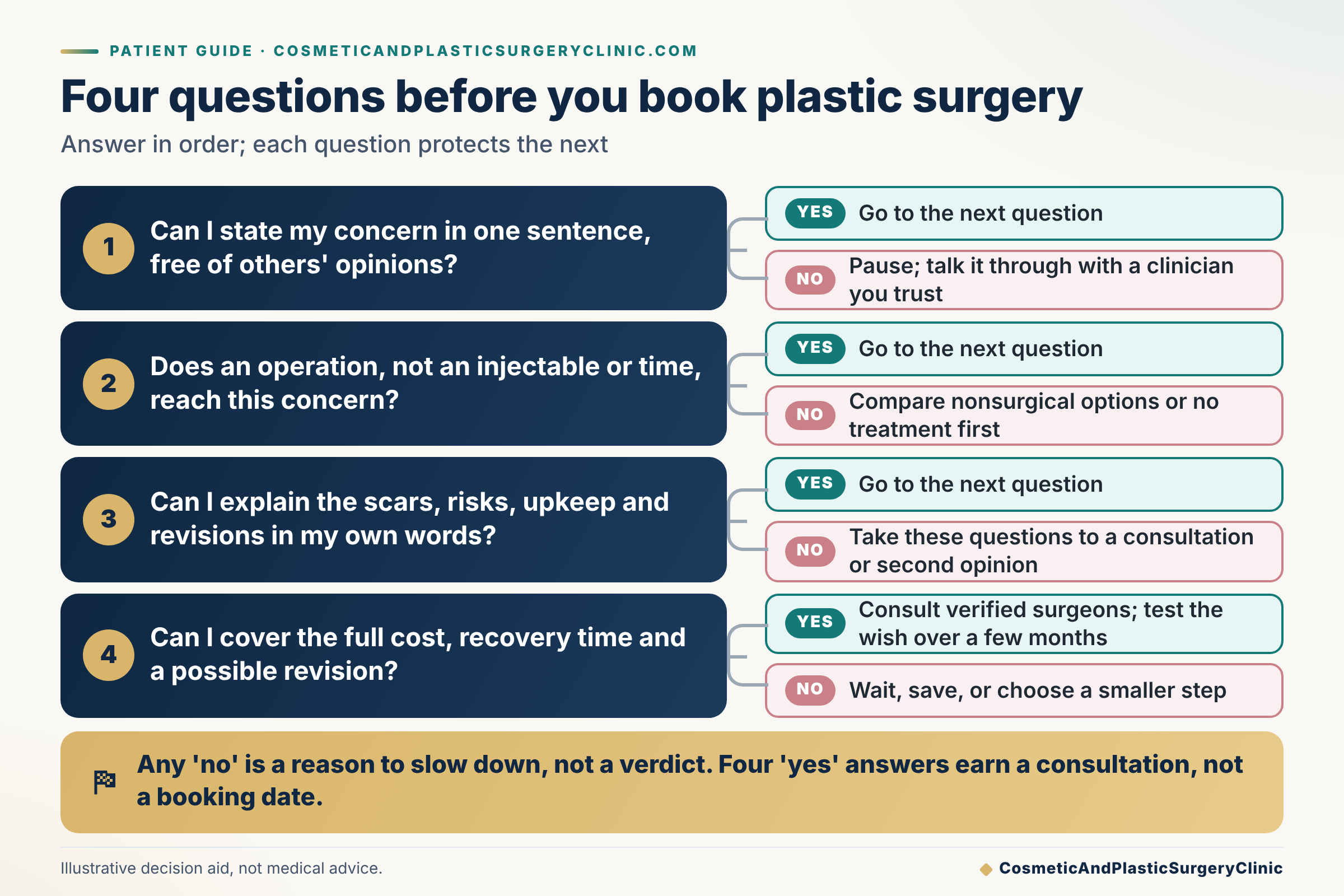
First, can you state the concern in one sentence that doesn’t depend on someone else’s opinion? Second, does an operation, as opposed to an injectable, a product or time, actually reach that concern? Third, can you explain the scars, risks, upkeep and revision possibilities in your own words? Fourth, can you cover the full cost, the recovery time and a possible second procedure without strain? The order matters because each question protects the next: a vague problem makes the choice of tool meaningless, and a mismatched tool makes a cost comparison pointless.
The test of time comes last. Give the decision a few months and note whether your answers stay the same across good weeks and bad ones. A wish that survives that is information. A wish that vanishes was probably about something else.
Questions to take into the room
If the sequence leaves gaps, a consultation can close them. These questions are designed to produce reasoning, not reassurance:
- Which tissue or structure is responsible for what bothers me, and what are all the options for it, including doing nothing?
- What are the most likely complications of this operation for someone with my health history, and how are they handled?
- Where will it be performed, who provides anesthesia, and which hospital would treat a complication?
- What does the quote include and exclude, and what happens financially if I need a revision?
- What do you expect this to look like at one year, five years and ten years, and what upkeep follows?
- What would make you advise me not to go ahead?
The last question is the most revealing. A clinician who can describe, specifically, when they’d say no is applying judgment, not selling.
A hypothetical walk-through
Consider a hypothetical reader in their late forties who lost a large amount of weight over the past year and dislikes loose skin on the abdomen and upper arms. Run the questions. The concern is specific and about how clothing fits and how skin rubs, which doesn’t depend on anyone else’s view. Skin removal falls to plastic surgery, since injectables don’t remove skin.
The scars are long and visible, and recovery involves restrictions. Two areas might be done together or staged, and that is a question for a surgeon. The cost covers several line items, and the schedule has no event attached.
Booked as two consultations rather than an operation, the story might go like this: the first surgeon outlines a plan, and the second suggests waiting until weight has settled before deciding. The reader writes a one-page note with the problem, the options, the trade-offs and a date to revisit in six months. Nothing was done, and the process worked.
Saying “not now” without losing the thread
Reasons to pause that are reasons, not failures
Some pauses are suggested by the research cited above: a concern about a feature other people don’t notice, current depression or anxiety, pressure from a partner or friend, hopes that surgery will repair a relationship, or a history of procedures that didn’t satisfy. Others are practical: weight still changing, pregnancy plans, no one to help during recovery, no financial cushion for follow-up or a revision, or questions you can’t yet answer. Any one of these is a legitimate reason to wait. Several together make a stronger case.
Pausing doesn’t mean the idea is dead. It means setting a review date and a condition, such as “weight stable for six months” or “after I’ve seen a counselor,” that you can check against. A pause with a condition tends to lead to a better decision than a pause with no end.
Second opinions, and the decision to do nothing
A second opinion is a normal part of any plastic surgery decision, and a reputable surgeon expects it. Bring your records and the first surgeon’s plan. Compare reasoning, not only price: if two surgeons propose different operations, ask each why, and treat the disagreement as data. When you choose whom to ask, verify credentials first, using the steps in the surgeon-selection page.
Choosing no plastic surgery is also a complete decision. Some people find that a consultation answered the question they actually had, whether through reassurance, a different diagnosis or a plan for later. Keeping the one-page note from your consultations lets you revisit the choice without starting over.
Frequently asked questions
Is there a recommended waiting period between a first consultation and booking plastic surgery?
No universal, research-based waiting period exists that this page could verify, so treat any fixed number you read with caution. A more useful approach is a test of stability: does the wish hold across several months and moods, and does it survive a second opinion? Practices often separate the consultation from the scheduling step. If one asks for a same-day deposit to hold a date, that is worth pausing on. Read the cancellation and refund terms before paying anything. A date that stays flexible costs little; a date you feel forced to keep can cost a lot.
Is it normal to feel low or regretful after plastic surgery even when nothing went wrong?
Emotional ups and downs are commonly described during recovery, partly because the body is swollen and restricted while the finished result is still months away. That doesn’t make the decision wrong. If low mood lasts, deepens or interferes with eating, sleeping or daily life, contact your surgeon’s office or your own primary care clinician instead of waiting it out. If you ever have thoughts of harming yourself, call or text 988, the Suicide and Crisis Lifeline in the United States, or go to the nearest emergency department. Building support around the recovery weeks in advance helps.
Will insurance pay for any part of plastic surgery?
Sometimes. Coverage depends on your specific plan and on whether the operation addresses a medical problem, in line with how ASPS defines reconstructive surgery: treatment of body parts affected, functionally or aesthetically, by congenital defects, developmental abnormalities or trauma. Purely aesthetic operations are usually self-pay. Ask the plan for its written criteria and whether prior authorization is required, ask the surgeon’s office what documentation they would submit, and keep copies. Denials can sometimes be appealed, but don’t schedule on the assumption that one will be reversed.
Can nonsurgical treatments be used to put plastic surgery off?
Sometimes people use them to buy time or to test whether a smaller change satisfies them, which is reasonable when the concern is volume, lines or surface texture. It doesn’t work for problems rooted in excess skin or lax structure, because injectables don’t remove or reposition tissue. The FDA notes that accidental injection of filler into a blood vessel can damage tissue or vision, so provider qualification and approved products matter here as much as in the operating room. Ask what result is realistic, how long it lasts and what would signal that surgery fits better.
How can I tell whether social media is shaping my wish for plastic surgery?
ASPS says feeds can offer a skewed view of what happens in the consultation room, and trends rotate quickly. Try three checks. First, describe the feature without mentioning a filter or a particular person’s face. Second, notice whether your interest spikes after certain content. Third, wait through a few cycles of your feed and see whether the wish stays. Also compare the words in your head with clinical ones: if you can’t say which structure is involved, that is a good first question for a consultation rather than a reason to book one for a specific operation.
Should I stop or change my weight-loss medication before plastic surgery?
That decision belongs to the clinician who prescribes it and to your surgical and anesthesia teams, not to an article. The American Society of Anesthesiologists raised a concern in 2023 about delayed stomach emptying and anesthesia, and a later multisociety guidance followed, so the advice you get may be specific and time-sensitive. What you can do is list every medication and supplement, make sure each team knows what the others have said, ask who will provide written instructions, and avoid starting, stopping or changing doses on your own.
Is it unusual to attend a plastic surgery consultation and then decide not to go ahead?
No. ASPS itself stresses that consultations and completed procedures aren’t the same thing; tummy tuck stayed flat in 2025 even though it ranked among the operations most raised in GLP-1-related consultations. A consultation is information gathering. You can leave with a plan, a referral, a recommendation to wait or the conclusion that you don’t need anything. Staff may follow up, and a short, polite “I’m not moving forward right now” is enough. If you would like another view, a second opinion is a normal part of the process.
Does being unhappy with a feature mean I have body dysmorphic disorder?
No. Wanting to change a feature is common and, by itself, is not a disorder. Body dysmorphic disorder involves a distressing preoccupation with a perceived flaw that others barely notice, often taking up large parts of the day or driving avoidance and repeated checking. Only a clinician can diagnose it. The 2016 review found about 2% in community samples against about 13% among cosmetic surgery patients, which is why screening matters. If your thoughts about a feature feel intrusive or exhausting, speak with a primary care clinician or mental health professional before consulting a surgeon.
Sources and further reading
- American Society of Plastic Surgeons — Plastic Surgery Statistics Report 2025 (accessed 2026-11-12) — procedure totals, top five operations, age and gender data, methodology and limitations
- American Society of Plastic Surgeons — Plastic surgery statistics landing page (accessed 2026-11-12) — top cosmetic and minimally invasive rankings, data sources
- American Society of Plastic Surgeons — Lift procedures led growth in 2025 (press release, accessed 2026-11-12) — percentage changes by procedure and age group, GLP-1 consultation survey
- American Society of Plastic Surgeons — 2025 plastic surgery by the numbers (accessed 2026-11-12) — declines in rhinoplasty and others, tummy tuck flat, social media caution
- American Society of Plastic Surgeons — Reconstructive procedures (accessed 2026-11-12) — definition of reconstructive surgery
- American Society of Plastic Surgeons — Plastic Surgery Essentials for Students, Chapter 3: History (accessed 2026-11-12) — origin of the word “plastic”
- Online Etymology Dictionary — plastic (accessed 2026-11-12) — dates for the adjective, the surgical phrase and the synthetic material
- Veale D, et al. — Body dysmorphic disorder in different settings: a systematic review and estimated weighted prevalence, Body Image 2016 (accessed 2026-11-12) — prevalence in cosmetic, rhinoplasty and community samples
- American Psychological Association — Monitor on Psychology, September 2005, cosmetic surgery coverage (accessed 2026-11-12) — motivations, screening suggestions, satisfaction at one year, BDD estimates
- Castle DJ, Honigman RJ, Phillips KA — Does cosmetic surgery improve psychosocial wellbeing? Medical Journal of Australia 2002 (accessed 2026-11-12) — review of 36 studies, expectations, evidence limits, BDD referral
- U.S. Food and Drug Administration — Dermal fillers (soft tissue fillers) (accessed 2026-11-12) — approved uses, unapproved sites, vascular risk
- U.S. Food and Drug Administration — Risks and complications of breast implants (accessed 2026-11-12) — not lifetime devices, reoperation, rupture, BIA-ALCL
- Federal Trade Commission — Health Products Compliance Guidance (accessed 2026-11-12) — net impression, testimonials, results-not-typical disclaimers
- American Society of Anesthesiologists — Consensus-based guidance on preoperative management of patients on GLP-1 receptor agonists (2023; accessed 2026-11-12) — aspiration concern and evidence limits
- NCBI Bookshelf — International Scar Classification in 2019, Textbook on Scar Management (accessed 2026-11-12) — scar maturation timeline and scar types
- University of Pittsburgh Health Sciences Library System — Treasures from the rare book room: the first book on plastic surgery (2016; accessed 2026-11-12) — Tagliacozzi’s 1597 treatise
- American Board of Plastic Surgery — About us (accessed 2026-11-12) — ABPS status within ABMS, public verification page
- American Board of Medical Specialties — Getting board certified (accessed 2026-11-12) — certification pathway and continuing certification
- American Board of Medical Specialties — Verify certification (accessed 2026-11-12) — patient verification tool pointer


