A nose that looks or works differently from what was hoped is a hard thing to sit with, and the obvious fix, another operation, is not the same operation the first time around. Revision rhinoplasty is a different kind of planning problem. Revision rhinoplasty means surgery on a nose that has already been operated on, and surgeons who write about it consistently describe it as more demanding than a first rhinoplasty. The tissue has scarred, some cartilage may be gone, and the margin for error is smaller.
This article handles one decision: whether a second operation makes sense, what it would involve, and how to approach it with fewer unknowns. It is general education, not an opinion about any particular nose. The wider picture of the procedure sits in the rhinoplasty overview, and the full list of what can go wrong is in the article on rhinoplasty risks. Here the focus stays on the second time around.
What counts as revision rhinoplasty, and who ends up considering it
The reasons people go back for a second operation
Appearance: the tip, the bridge, and the pollybeak
Complaints about how the nose looks cluster in a few places. A 2024 review by Zhang, Deane and Becker in Plastic and Aesthetic Research collected figures from several studies. Residual dorsal hump was a structural complaint in about 20 percent of cases, and persistent tip dissatisfaction ranged from 19 to 37 percent. In one prospective series the most common complaints were a dropped tip (39.5 percent), an elevated bridge (32.5 percent) and a broad nasal base (20.9 percent).
The pollybeak is a fullness above the tip that makes the bridge look like it curves down like a parrot’s bill. A 2013 review in Acta Otorhinolaryngologica Italica by Bussi and colleagues names it among the most common reasons for a second operation, tracing it to under-resection at the front of the septum or to lost tip support. The same review lists saddle deformity, a sunken bridge after too much was removed, and alar retraction, where the nostril rims pull upward.
Breathing: when function was affected
Revision rhinoplasty is not only a cosmetic question. In a 245-patient review of one facial plastic surgery clinic, published in Plastic and Reconstructive Surgery in 2021, almost two-thirds of the revision patients had both appearance and breathing problems, and more sought surgery for looks alone than for breathing alone. MedlinePlus lists worsened nasal breathing and loss of support of the nose among the risks of rhinoplasty.
Breathing complaints after surgery can come from a narrowed internal valve, a deviated septum, or a weakened tip. Those mechanisms are covered in the article on functional rhinoplasty, which is where to look if airflow is the main issue and appearance is secondary.
How common revision rhinoplasty is, and why the numbers vary
The ranges that appear in published reviews
No single figure describes everyone. The 2024 Zhang review gives revision rates of 5 to 15 percent. The 2013 Bussi review cites revision rates of up to 21 percent and calls rhinoplasty one of the most difficult aesthetic operations. A 2021 clinic series found that further revision during follow-up occurred in 10.5 percent of primary cases and 23.9 percent of cases that were already revisions.
The American Society of Plastic Surgeons (ASPS) safety page lists the possibility of revisional surgery as a risk of rhinoplasty and does not give a rate. Treat every percentage here as a range from particular groups of patients and surgeons, not a forecast for one nose.
What those figures cannot tell you
Revision rhinoplasty statistics depend on how a study defines a revision, how long patients are followed, whether the operation was a first or a repeat one, and who counted. A single clinic reporting its own cases is not the same as a national registry. Two surgeons can do the same operation on similar noses and have different rates, which is why the statistics are better for understanding the problem than for choosing a person.
One 2025 single-institution study, covering cosmetic rhinoplasties from 1979 to 2024, found at least one revision in 18 percent of patients with a recorded psychiatric diagnosis (24 of 135) and 12 percent of the rest (95 of 826). The authors also found that age 46 or older and female sex predicted revision. That is an association in one hospital’s records, not a reason to expect or rule out anything for an individual.
Why the second operation is harder: scar, cartilage, and skin

What the first operation leaves behind
Scar tissue and a changed working plane
A first rhinoplasty works in layers that separate cleanly. After surgery, healing glues some of those layers together. An ASPS blog post by Richard Chaffoo, a plastic surgeon, says scar tissue is often a factor in revision work and can limit the final result even when the second operation goes well. The post is the author’s view, not an ASPS position.
For the surgeon, revision rhinoplasty on scarred tissue means slower and more careful dissection and less predictable skin behavior. For the patient it means that the same goal, say lowering a tip, may take a different route and a different set of tools than it would have on an untouched nose.
Cartilage already used, removed, or weakened
The nose is held up by cartilage, and a first operation often reshapes or removes some of it. The Chaffoo post notes that septal cartilage, the usual first source of graft material, is often deficient in revision cases, so surgeons turn to ear cartilage or occasionally rib. A twisted septum, or one with little cartilage left, is one of the problems the Bussi review lists as complicating the work.
That supply issue is the quiet reason revision rhinoplasty is harder than a first operation. Rebuilding support requires material, and the nose may not have much left to spare.
What higher complexity looks like in practice
Extra grafts and reconstructive maneuvers in revision rhinoplasty
The 2021 Plastic and Reconstructive Surgery clinic series compared 153 primary and 92 revision rhinoplasties. Complex reconstructive techniques, extracorporeal septoplasty (shaping septal cartilage outside the nose before returning it), and grafts from outside the nose were all used more often in revisions. The authors advise surgeons to tell patients that revisions are more complex and may need extranasal grafts.
Bussi and colleagues add that for most complex secondary cases, an open approach, with a small incision across the columella and the skin lifted forward, is usually the only reasonable method because scarring makes blind dissection difficult. MedlinePlus likewise notes that an outside incision is often used in revision surgery. The trade-offs of that choice are laid out in open versus closed rhinoplasty.
A higher chance that another operation is needed
The same 2021 series found further revision during follow-up in 23.9 percent of revision patients against 10.5 percent of primary patients, a difference the authors reported as statistically significant. The Chaffoo post makes the same qualitative point, that revision has a higher revision rate than primary rhinoplasty, without giving a number.
For a patient, this is the most useful sentence in this section. Revision rhinoplasty can be a sound decision, but it works better with realistic goals: a clear, specific improvement rather than a return to an imagined original nose.
Finding the cause before choosing a fix
What a careful assessment looks at
History, operative records, and older photographs
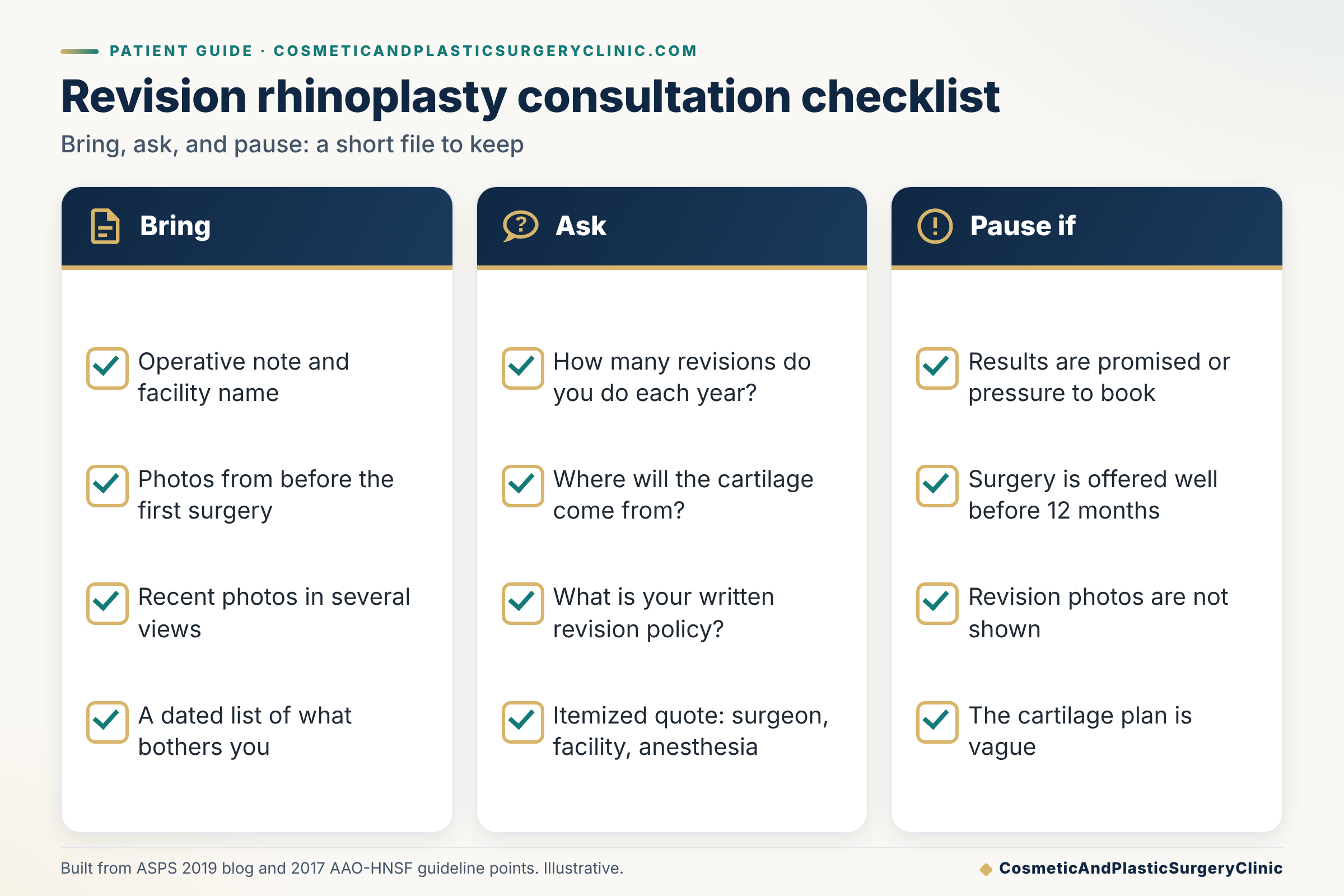
Before anything else, a revision rhinoplasty consultation is a records exercise. The surgeon wants to know what was done, through which approach, whether grafts were placed, and what the nose looked like before the first operation. Operative notes and pre-surgery photographs answer questions that no examination can. Someone whose first surgery was done elsewhere, or years ago, may need to request them from the original surgeon or facility.
The plastic surgery consultation article covers what to bring and what to expect in general. For this procedure the most useful additions are the old photographs and any imaging, plus a short written list of exactly what bothers you and when it started.
Examining the airway, not just the outside
Looking at a nose is not the same as testing how it breathes. The American Academy of Otolaryngology-Head and Neck Surgery Foundation published a clinical practice guideline in 2017 on improving nasal form and function after rhinoplasty. One of its recommendations is that the surgeon evaluate a rhinoplasty candidate for nasal airway obstruction before surgery.
A common bedside check for valve weakness is the Cottle maneuver, in which the cheek is gently pulled outward to see whether breathing improves. A 2018 study by Ziai and Bonaparte of 92 patients found it is the most widely used test of this kind but has not been validated against patient-reported outcomes, gives only a yes-or-no result, and had weak test-retest reliability. The same paper describes the NOSE questionnaire as the most widely used validated tool for nasal obstruction symptoms. An examination is a starting point, and symptoms still matter.
Matching the complaint to a likely cause
How surgeons think about common complaints
The table below turns the main situations into a decision aid. It does not diagnose anything, and surgeons weigh many more factors. Its purpose is to show why two people who both say they want revision rhinoplasty may be offered very different plans.
| Situation | Pathway often considered | Benefit | Trade-off | Key question to ask |
|---|---|---|---|---|
| Small contour irregularity, under a year after surgery | Waiting and re-assessment; sometimes a nonsurgical option for minor cases | Swelling may settle on its own | Uncertainty while the nose heals | What changes would make you operate sooner? |
| Dropped or poorly defined tip | Tip support rebuilt with sutures and grafts, often through an open approach | Addresses structure, not just shape | Needs graft material that may be limited | Where will the cartilage come from, and what is the backup? |
| New breathing difficulty after the first operation | Airway assessment for valve narrowing, septum, and turbinates; possible spreader or batten grafts | Targets the cause of obstruction | May not change appearance at all | How will you confirm that the airway is the problem? |
| Sunken bridge or saddle shape | Rebuilding the dorsum with cartilage, sometimes from the rib | Restores height and support | Larger operation; extra donor-site recovery | What happens if the graft shifts or shrinks? |
| Nostril rims pulled upward | Rim or batten grafts, often ear cartilage | Lowers retraction and may help airflow | Small graft, small margin | Is the problem skin, cartilage, or both? |
The expectations conversation, including body image
A good revision consultation tests expectations as carefully as anatomy. The 2017 AAO-HNSF guideline recommends asking every rhinoplasty candidate about motivations and expectations, giving feedback on whether they are realistic, and documenting the conversation. It also lists body dysmorphic disorder among the conditions surgeons should assess because it can modify or contraindicate surgery.
A 2023 meta-analysis in Health Science Reports pooled 18 studies of 2,132 people seeking rhinoplasty and estimated that 32.7 percent screened positive for body dysmorphic disorder, with very high variation between studies. Screening tools differ, and this is not a diagnosis for anyone. If persistent distress about the nose is part of the picture, a surgeon may suggest talking with a mental health professional before more surgery, which is a standard step and not a judgment.
Planning the repair: grafts, approach, and what the operation involves
Where the cartilage comes from
Septum and ear: the usual first choices
The Bussi review calls autogenous cartilage, meaning cartilage taken from the patient’s own body, the first choice for revision grafting, with septal cartilage preferred when enough remains, followed by conchal (ear) cartilage. The ASPS blog post says much the same: because septal cartilage is often deficient after a first surgery, surgeons commonly use ear cartilage, and occasionally rib.
Ear cartilage is curved and thin, which suits the tip and nostril rims better than a long, straight bridge. Taking it leaves a small incision at the ear, which is a separate healing site. The choice is always about matching shape and strength to the job, and about how much is available.
Rib cartilage: more material, more trade-offs
When a nose needs a lot of structural support, costal (rib) cartilage offers a larger supply. The Bussi review lists it as a third-line option because of warping and complications. Warping is cartilage bending after it is placed, and it is the best-known drawback.
A 2015 systematic review in the Aesthetic Surgery Journal by Varadharajan and colleagues pooled 21 studies from 1980 to mid-2014. It reported warping at the recipient site in 5.2 percent, recipient-site infection in 2.5 percent, graft resorption in 0.9 percent, and displacement or extrusion in 0.6 percent. At the rib donor site, pneumothorax (a collapsed lung) was 0.1 percent, pleural tear 0.6 percent, and scar-related problems 2.9 percent. The authors concluded the procedure is safe, with notable minor recipient-site complications, especially warping.
| Graft source | Typical use | Main trade-off | What the sources say |
|---|---|---|---|
| Septal cartilage | Support grafts for tip, bridge, and valves | Often already used or limited after a first operation | Preferred when available (Bussi 2013); often deficient in revisions (ASPS blog 2019) |
| Ear (conchal) cartilage | Tip, nostril rim, and small contour grafts | Curved and thin; less suited to long straight supports | Second choice after septum (Bussi 2013); common in revisions (ASPS blog 2019) |
| Rib (costal) cartilage | Larger structural grafts when other sources run short | Donor-site recovery; some warping risk | Warping 5.2%, pneumothorax 0.1% in a 21-study pool (Varadharajan 2015) |
| Temporalis fascia | Soft-tissue wrap to smooth edges of grafts | Extra incision in the hairline | Described as a natural filler to camouflage irregularities (ASPS blog 2019) |
Approach and the finer tools
Why open approaches are common in revision rhinoplasty
Revision rhinoplasty often uses the open approach because scar tissue makes blind work harder and because grafts need to be seen as they are fixed in place. That is a pattern from the literature, not a rule: a surgeon’s training and the specific problem still decide. The Bussi review states plainly that for most complex secondaries an open approach is the only reasonable method, while MedlinePlus says an outside incision is often used.
The incision across the columella usually heals into a fine line, but it is one more scar and one more source of swelling. Patients who have already been through a first recovery sometimes feel this trade-off more keenly.
Spreader grafts, batten grafts, and camouflage layers
Many revisions add small, specific grafts. Spreader grafts are narrow strips placed between the septum and the upper side cartilages to widen a narrowed internal valve. Batten grafts support a weak side wall of the nose. The ASPS blog post also mentions skin grafts, in some cases, to reopen a scarred, narrowed airway.
Grafts are not inert. The Bussi review notes that for combined dorsal grafts, some resorption, up to 30 percent, should be expected. Surgeons plan for that, and it is one reason the same dorsal graft can look different at three months and at a year.
Timing, risk, and cost of a second operation
When to wait, and how to use the time
Why surgeons commonly wait a year
Mayo Clinic’s rhinoplasty page, updated in October 2024, says that if a second surgery is needed, a person must wait at least a year, and the stated reason is that the nose can keep changing during that time. MedlinePlus says full recovery takes a year, that most swelling improves by two to three months, that the tip can stay swollen and numb for several months, and that final results may take up to a year and sometimes longer.
The 2024 Zhang review likewise generally advises waiting a full year after the first operation, with notable exceptions. The 2017 AAO-HNSF guideline recommends documenting satisfaction with both appearance and function at a minimum of 12 months after rhinoplasty. Operating on a nose that is still swollen means judging a moving target, which is why a rushed revision often swaps one uncertainty for another.

Exceptions: problems that are urgent rather than elective
The one-year convention applies to the elective question of whether to proceed with revision rhinoplasty. It does not apply to a problem that is new and worsening. Infection, bleeding, and sudden changes after an injury are matters for the surgeon who did the first operation or for emergency care, not for the one-year rule.
Risk and cost: what to expect and what to ask
Risks that rise or change in revision rhinoplasty
The ASPS safety page lists the general risks of rhinoplasty: anesthesia risks, changes in skin sensation, difficulty breathing, infection, poor wound healing or scarring, skin discoloration and swelling, unsatisfactory nasal appearance, and the possibility of revisional surgery. It calls septal perforation, a hole in the wall between the nostrils, rare and says it may be impossible to correct. A 2026 review of septal reconstruction notes that surgical repair is mostly limited to perforations smaller than about 2 centimeters.
Some risks are specific to revision rhinoplasty. Grafts add a donor site and a chance of warping or resorption, and thin skin over a rebuilt framework can show every edge. The article on rhinoplasty recovery describes what the first weeks look like, and the revision risk picture builds on the one in the risks article.
How revision rhinoplasty is priced, and the questions that matter
The ASPS cost page, accessed in November 2026, lists $7,637 as the average cost of rhinoplasty. It states that the figure does not include anesthesia, operating room facilities, or other related expenses, and the page does not state the data year or break out revisions. None of the sources reviewed for this article gives a typical price for revision rhinoplasty, so any specific number you see for it should be treated as one practice’s price list.
What can be said is how revision rhinoplasty tends to cost more: more time on the operating table, graft harvest that may add a donor site, possibly a larger facility and anesthesia bill, and more follow-up. Ask for an itemized quote that separates surgeon fee, facility, anesthesia, and any graft harvest, and ask what the surgeon’s policy is if a further adjustment is needed. The article on rhinoplasty cost goes through how to compare quotes line by line.
| Factor | Effect on the outcome | Planning implication | Review point or warning sign |
|---|---|---|---|
| Graft resorption or warping | Shape can change after the first months | Surgeons build in allowance; thicker grafts may feel stiffer | A new bend or shift on follow-up photos |
| Skin thickness and scarring | Thin skin shows edges; thick skin hides definition | Material choice and smoothing layers matter | Visible ridges or lack of definition at one year |
| Lingering swelling | Tip can look larger or blunted for months | Reassess at around 12 months before judging | Swelling that increases rather than fades |
| Remaining cartilage supply | Limits what can be rebuilt from the nose itself | May require rib or ear harvest and a larger plan | Surgeon cannot say where graft material will come from |
| Breathing after surgery | Airway may improve, stay the same, or worsen | Document symptoms before and after, for example with a validated questionnaire | New obstruction that does not ease with healing |
Choosing a surgeon for revision rhinoplasty, and what to ask
Experience that fits revision work
Credentials, and revision volume in particular
Board certification is a baseline, not a ranking. In plastic surgery, the American Board of Plastic Surgery runs a certification lookup, and the American Board of Facial Plastic and Reconstructive Surgery certifies surgeons exclusively in that field and runs a physician finder. The article on how to choose a plastic surgeon gives the verification steps, and the one on cosmetic surgeon credentials explains what each title covers.
The ASPS blog post advises choosing a board-certified plastic surgeon with substantial rhinoplasty experience, since experienced surgeons see more revision cases. The more useful questions are specific: how many revision rhinoplasties does the surgeon do each year, how often are rib grafts used, and what does the surgeon do when the cartilage supply is limited?
Reading revision photos and computer imaging with care
Photos of revision rhinoplasty cases are more informative than general rhinoplasty galleries, because the starting points are comparable: a nose that has been operated on and has a specific problem. Ask for revision cases with a similar issue, photographed at 12 months or later. How to read nose photos in general is in the article on rhinoplasty before and after photos.
Computer imaging, offered by some surgeons, can help clarify goals but is a picture, not a promise. The ASPS blog post suggests asking about it, and also says no ethical plastic surgeon can promise the outcome of a revision or any other cosmetic procedure.
Going back to the first surgeon, or going elsewhere
The conversation with the original surgeon
Returning to the surgeon who did the first operation has real advantages: that person knows exactly what was done and may have written policies on touch-ups. It can also feel uncomfortable if the relationship has soured. A fair approach is to ask for the operative record, ask about the revision policy in writing, and then decide whether a second opinion would help.
A second opinion is ordinary practice before revision rhinoplasty. It does not mean the first surgeon did something wrong, and a surgeon who welcomes questions is usually a good sign.
When the first operation was done far from home
Some people have a first rhinoplasty in another city, state, or country and then need follow-up that the original surgeon cannot easily provide. That is a practical problem rather than a moral one: local surgeons may or may not take on a repair of another surgeon’s work, and they will need the operative record to plan.
If this fits your situation, the article on medical tourism and surgery covers the continuity-of-care questions. The article on rhinoplasty candidacy explains what surgeons evaluate before any rhinoplasty, which is also true before a revision.
Frequently asked questions
Can a different surgeon perform revision rhinoplasty than the one who did the first operation?
Yes. Many people have their second operation with a different surgeon, and a second opinion is routine. The practical requirements are records: the operative note, any imaging, and before-surgery photographs. Without them a new surgeon has to work out from examination alone what was done, which adds uncertainty. Some surgeons limit how many repairs of other surgeons’ work they take on, so it is reasonable to ask early whether revision cases are a regular part of the practice and what the first visit costs.
Will insurance pay for revision rhinoplasty if I have trouble breathing?
It depends on the plan and on how the problem is documented. Insurers often distinguish between surgery to improve breathing and surgery that is purely cosmetic, and they may ask for exam findings, symptom scores, or imaging. No verified national rule on revisions turned up in the sources reviewed, so ask the plan directly and ask the surgeon’s office whether a pre-authorization request is needed. A mixed operation can be split between covered and uncovered portions, which the surgeon’s office can explain in writing.
Is recovery from revision rhinoplasty longer than after a first rhinoplasty?
No source reviewed for this article compares recovery times between first and repeat operations, so the honest answer is that it varies. What is documented is that revisions are more complex, often use extra grafts, and can involve a rib donor site, each of which can add to what recovery involves. General timelines, such as most swelling easing over the first few months and full settling taking up to a year, apply as a starting point. Your surgeon can tell you what applies to the planned operation.
Can filler fix a small bump or dip after rhinoplasty instead of revision rhinoplasty?
The 2024 Zhang review notes that minor complaints, in place of revision rhinoplasty, may be addressed with nonsurgical options such as filler. The FDA, however, lists nose injection among uses not approved for soft tissue fillers and warns that blocked blood vessels can lead to tissue death, vision problems, or stroke. If filler is considered, it should be done by a licensed clinician experienced in nasal anatomy, with the emergency symptoms understood beforehand. The article on rhinoplasty alternatives lays out the trade-offs.
Does rib cartilage always warp or feel hard after revision rhinoplasty?
No. In a 2015 pooled analysis of 21 studies, warping at the recipient site occurred in 5.2 percent of cases, and the authors judged the procedure safe overall. Stiffness is a separate issue: a 2019 technical note reports that thicker grafts, used to limit warping, led some patients to describe a stiffer nose. How a graft feels depends on its size, its position, and how thick the skin is. Ask the surgeon how the graft will be carved and where it will sit.
Is revision rhinoplasty possible if I only have breathing trouble and like how my nose looks?
That is a common situation, and the plan may focus on the airway without changing the outside shape, though sometimes grafts have small visible effects. Surgeons assess the septum, the nasal valves, and the turbinates, and may try nonsurgical measures first. The article on functional rhinoplasty explains how obstruction is assessed. Say clearly at the consultation that you want to keep your appearance, and ask what changes to the outside, if any, the plan could cause.
How many rounds of revision rhinoplasty are too many?
No source reviewed for this article sets a number, and the answer depends on how much supportive cartilage and healthy skin remain. In general, every operation on the nose uses up some tissue and adds scar, and the 2021 clinic series found further revisions were more likely after revision surgery. A fair question for any surgeon is what, specifically, a further operation would change that the previous one could not, and what the chance is that it would not be enough.
Sources and further reading
- Plastic and Reconstructive Surgery — Differences between Primary and Revision Rhinoplasty: Indications, Techniques, Grafts, and Outcomes, 2021;148(3):532-541 (accessed 2026-11-12) — 245-patient clinic series, extranasal grafts, further revision 10.5% vs 23.9%
- Bussi, Palonta and Toma — Grafting in revision rhinoplasty, Acta Otorhinolaryngologica Italica, 2013 (accessed 2026-11-12) — revision rates up to 21%, graft hierarchy, resorption, open approach, common flaws
- Zhang, Deane and Becker — Persistent cosmetic dissatisfaction in rhinoplasty and management of the difficult patient, Plastic and Aesthetic Research, 2024 (accessed 2026-11-12) — revision rates 5-15%, complaint frequencies, one-year wait, filler, rib vs ear
- Tie, Montañez-Azcarate and Lin — Association between psychiatric diagnoses and revision cosmetic rhinoplasty, Facial Plastic Surgery & Aesthetic Medicine, 2025 (accessed 2026-11-12) — 961-patient single-institution review
- Apaydin — Oblique split technique: a game changer in costal cartilage sculpting, Plastic and Aesthetic Research, 2019 (accessed 2026-11-12) — Gibson and Davis balanced cross-section, warping, stiffer noses
- Varadharajan and colleagues — Complications associated with the use of autologous costal cartilage in rhinoplasty: a systematic review, Aesthetic Surgery Journal, 2015 (record, accessed 2026-11-12) — pooled recipient-site and donor-site complication rates
- Nabavizadeh and colleagues — Prevalence of body dysmorphic disorder in rhinoplasty candidates: a systematic review and meta-analysis, Health Science Reports, 2023 (record, accessed 2026-11-12) — pooled prevalence 32.7%, 18 studies, high heterogeneity
- Ishii and colleagues — Clinical Practice Guideline: Improving Nasal Form and Function after Rhinoplasty, executive summary, Otolaryngology–Head and Neck Surgery, 2017 (accessed 2026-11-12) — expectations, comorbid conditions, airway evaluation, 12-month outcome documentation
- Ziai and Bonaparte — Reliability and construct validity of the Ottawa valve collapse scale, Journal of Otolaryngology – Head & Neck Surgery, 2018 (accessed 2026-11-12) — Cottle maneuver limits, NOSE questionnaire
- Feng and Echanique — Reconstructing the nasal septum in rhinoplasty surgery, Plastic and Aesthetic Research, 2026 (accessed 2026-11-12) — septal perforation causes and repair limits
- American Society of Plastic Surgeons — Understanding revision rhinoplasty and why patients seek out this procedure, blog post by Richard Chaffoo, MD, February 1, 2019 (accessed 2026-11-12) — scar tissue, graft sources, surgeon selection (author’s views)
- American Society of Plastic Surgeons — Rhinoplasty (nose surgery) overview (accessed 2026-11-12) — what rhinoplasty can address
- American Society of Plastic Surgeons — Rhinoplasty risks and safety (accessed 2026-11-12) — listed risks including revisional surgery and septal perforation
- American Society of Plastic Surgeons — Rhinoplasty cost (accessed 2026-11-12) — $7,637 average, exclusions, year not stated
- Mayo Clinic — Rhinoplasty (October 2, 2024; accessed 2026-11-12) — wait at least a year, swelling timeline, risks
- MedlinePlus — Rhinoplasty (reviewed February 5, 2025; accessed 2026-11-12) — recovery timeline, outside incision in revision, risks
- U.S. Food and Drug Administration — Dermal fillers (soft tissue fillers) (current as of July 6, 2023; accessed 2026-11-12) — unapproved nose use, vascular risks, emergency symptoms
- American Board of Facial Plastic and Reconstructive Surgery — home page and physician finder (accessed 2026-11-12) — scope of certification
- American Board of Plastic Surgery — home page and certification verification (accessed 2026-11-12) — certification lookup