Gynecomastia lipo vs excision is a question about tissue, not preference. “Lipo” here means liposuction: a thin cannula loosens fat and a vacuum removes it. Excision means cutting out firm glandular tissue, usually through an incision at the edge of the areola. Gynecomastia, enlargement of breast tissue in a male, can be mostly fat, mostly gland or a mix, and each tool reaches a different layer. That is why one diagnosis can lead to three different operations.
This page walks through gynecomastia lipo vs excision by tissue type, scar, published complication data, recovery and revision, then closes with six checks for a consultation. It cannot say which approach fits your chest; that takes an in-person exam by a board-certified plastic surgeon, and sometimes a medical look at why the tissue grew. A new, hard or one-sided lump, nipple discharge, skin changes or pain need a clinician’s evaluation before any surgical plan. The whole operation is covered on the gynecomastia surgery page, so it is not repeated at length here.

Gynecomastia lipo vs excision starts with what the exam finds under the skin
Before comparing tools, name what is being treated. The American Society of Plastic Surgeons (ASPS) describes gynecomastia as excess localized fat, excess glandular tissue, sometimes excess breast skin, in one or both breasts. An ASPS practice parameter from 2004 calls fat-only enlargement pseudogynecomastia and notes that the cause does not predict which tissue is present. In any gynecomastia lipo vs excision discussion, that tissue question is the first fork.
Three tissues, three different tools
Fat: soft, suction-friendly and reachable through a cannula
A 2021 ASPS article by Lin and Laikhter organizes the decision around three components: fat, breast (glandular) tissue and skin. Fat is removed with liposuction. In the ASPS procedure description, a cannula moves back and forth through several small incisions to loosen fat, which is then removed by vacuum suction.
The Aesthetic Society says a fat-only chest can be treated with scars “just large enough to admit a liposuction cannula.” That is the strongest argument for liposuction in gynecomastia lipo vs excision terms: when fat really is the whole problem, the operation matches the tissue and leaves the least scar.
Gland: a firm disc that suction does not reliably remove
Glandular tissue sits under and around the areola and feels firmer than fat. The ASPS practice parameter assigns liposuction to fatty tissue at the chest periphery and excision to fibrous, glandular tissue beneath the areola, usually through a periareolar incision.
The Aesthetic Society is blunter. It says liposuction has fewer complications than open excision but does not correct glandular gynecomastia, and that most patients require excision. That wording reflects how often a glandular component is present; it is not a forecast for any one chest. Devices that try to extend what suction can do come up later in this gynecomastia lipo vs excision comparison.
Where skin, the areola and the cause enter the plan
Skin that has to settle onto a smaller chest
Removing volume leaves skin that must settle onto a smaller contour. ASPS names excess skin as the third component and says that removing it requires re-centering the nipple-areola complex through an inverted T incision, which leaves a larger scar.
The Aesthetic Society adds that in men with reduced skin elasticity, creases can appear after surgery, and most persist for 6 to 12 months before diminishing. Skin behavior can push a gynecomastia lipo vs excision plan from small scars toward longer ones as much as tissue type does.
Why chest fat and mixed chests are planned differently
Enlargement that is fat alone is pseudogynecomastia, and many chests are mixed. Telling them apart is an exam question, sometimes helped by imaging; the gynecomastia vs chest fat article covers it. It matters here because every gynecomastia lipo vs excision plan assumes the tissue has already been identified.
One question can come before either operation. The ASPS practice parameter advises treating underlying causes first when possible, and MedlinePlus lists medicines, substances and health conditions among the causes. Do not stop any prescribed medicine without talking to the clinician who prescribed it.
Where liposuction fits, and where it stops
When gynecomastia lipo vs excision favors liposuction alone
Mechanism: hidden incisions, a cannula, fat only
ASPS says liposuction techniques alone may be used when gynecomastia is mainly excess fat. The incisions are small and placed in discreet spots around the chest, and fat leaves while the gland, if any, stays. ASPS lists intravenous sedation and general anesthesia as the options, with the surgeon recommending one.
Because nothing is cut away from the skin, the result depends on the tissue being fat to begin with and on skin that can follow the smaller contour. Both are findings made at the exam, not preferences, which is why gynecomastia lipo vs excision cannot be settled from photos or a phone call.
Energy-assisted and pull-through variations
Surgeons add devices or hybrid steps to reach firmer tissue. In a 2003 series of 61 patients at UT Southwestern (Rohrich and colleagues, Plastic and Reconstructive Surgery), ultrasound-assisted liposuction was described as effective for dense, fibrous male breast tissue, with an overall success rate of 86.9%. Excision was reserved for severe cases with excess skin after attempted liposuction. It is one center’s series from a different era of devices, and “success” was the authors’ own definition, so it informs gynecomastia lipo vs excision thinking without deciding it.
The pull-through technique blurs the line: liposuction first, then gland drawn out through a small incision. The Aesthetic Society describes an incision of about 5 millimeters at the areola edge for minimal cases. How devices differ is explained on the liposuction techniques page.
What keeps liposuction from being enough for every chest
Firm tissue left behind, and the touch-up question
A 2025 comparison in the Indian Journal of Plastic Surgery (Ali and colleagues) followed 32 breasts for six months. Redo surgery was recorded for one or two breasts after liposuction alone and none after liposuction plus endoscope-assisted gland excision. The paper contradicts itself on group sizes and redo counts, reports no statistical tests and used no power-assisted liposuction, so treat it as a hint rather than a finding.
In a 260-patient pull-through series from Bologna (Morselli and Morellini, European Journal of Plastic Surgery, 2012), 4% needed further tailoring, mainly early in the surgeons’ experience, because too little gland had come out. Under-resection is the failure mode that liposuction alone is most exposed to.
Skin that does not follow the smaller contour
A 2024 review in JPRAS Open (Frigerio and colleagues) looked at ways to tighten skin without cutting it, including laser, ultrasound and radiofrequency-assisted liposuction, for the larger grades (Simon IIb and III). It found seven studies, with complication rates of 1.5% to 10% and satisfaction of 87.5% to 100%.
The authors still concluded that controlled data are limited and that skin resection is often needed when redundancy is high. If skin already hangs before surgery, liposuction alone may leave it hanging, and the scar-sparing options do not yet have strong head-to-head evidence in the gynecomastia lipo vs excision literature.
Where excision fits, and what it costs in scars and contour
Gynecomastia lipo vs excision when firm gland is the main finding
Mechanism: the areola-edge incision and what comes out
ASPS says excision techniques are recommended where glandular tissue or excess skin must be removed. The 2021 ASPS article calls gland removal the mainstay of gynecomastia surgery, typically through a U-shaped incision at the edge of the areola that grows larger when more gland must come out. The Aesthetic Society calls it the intra-areolar, or Webster, incision, running along the lower half of the areola, or all the way around if the areola itself must shrink.
Excision also produces tissue that can be examined. In a Dutch registry study of 5,113 excised breasts (Lapid and colleagues, Annals of Plastic Surgery, 2015), invasive carcinoma appeared in 0.11%, carcinoma in situ in 0.18% and atypical ductal hyperplasia in 0.4%, and findings rose with age. These are low figures. Whether a surgeon sends removed tissue to pathology is a fair question in any gynecomastia lipo vs excision consultation.
The combined approach most surgeons describe
ASPS says gynecomastia is sometimes treated with both liposuction and excision, and the Aesthetic Society describes liposuction for fat through hidden incisions plus an areola incision for gland. In a 2022 systematic review (Innocenti and colleagues, Aesthetic Plastic Surgery), combined techniques covered 3,656 of 7,294 patients, about half the pooled literature, against 874 for aspiration alone and 2,764 for excision alone. The gynecomastia lipo vs excision literature treats the combination, not either extreme, as the common case.
A 2021 ASPS press release on a 436-man series (Hoyos and colleagues) reported that liposculpture removed the gland in 70% and open resection was needed in 30%. The release does not explain how suction removed gland, the series had no comparison group, and most men also had torso liposuction.
When skin and nipple position change the plan
Skin removal and nipple repositioning for larger chests
The Aesthetic Society says severe cases may need skin resection and nipple transposition, and that in large chests scars can extend across each side, which the surgeon tries to hide in a crease. A 2020 review of 164 men (297 breasts) at Hannover Medical School (Mett and colleagues, European Journal of Plastic Surgery) used a grade-based algorithm: subcutaneous mastectomy, often with ultrasound-assisted liposuction, for Simon grades 1 to 2b, and an inferior-pedicle reduction with a single submammary scar for grade 3.
The authors reported major complications, mainly bleeding needing revision, in 2%, minor complications in 3% and secondary surgery in 6%. It was a retrospective single-center review with short follow-up and no quality-of-life measure, so it shows one center’s gynecomastia lipo vs excision algorithm rather than a standard.
The scar-versus-contour trade-off
Each added step trades something. Liposuction alone leaves tiny scars but may leave gland or loose skin. An areola-edge incision removes gland with a scar that the Aesthetic Society says is lasting but, in most cases, fades and improves; ASPS says scars become less noticeable throughout the first year. Skin removal buys a flatter contour with longer scars. Weighing those trades is the core of gynecomastia lipo vs excision.
Contour problems run in both directions. In the 2025 comparison, puffy nipples were recorded in two breasts after liposuction alone and a crater deformity in four breasts after added gland excision. ASPS lists contour irregularities and asymmetry among the risks of gynecomastia surgery as a whole.
| Factor | Liposuction alone | Gland excision | Combined |
|---|---|---|---|
| Main indication | Mostly fat, no firm disc found | Firm glandular tissue under the areola | Mixed fat and gland, the common case |
| What leaves the chest | Fat, through small incisions | Gland, through an areola-edge incision | Fat and gland |
| Incisions and scars | Tiny, in discreet spots | Under or around the areola; longer if skin is removed | Tiny sites plus the areola incision |
| Reversibility | Removed fat is not put back | Removed gland is not put back | Same for both parts |
| Downtime | Not separately timed in sources read | Aesthetic Society: about 1 week to work for liposuction plus excision | As for excision; surgeon sets the limits |
| Main risks | Residual tissue, irregularity, numbness, fluid | Hematoma, seroma, crater contour, nipple changes | Both lists |
| Cost logic | Shorter operating time in one small study | Pathology and longer time may add charges | Ask for one itemized quote |
What the numbers say, and what they cannot say
Gynecomastia lipo vs excision complication rates in the largest review
The pooled figures
Innocenti and colleagues (Aesthetic Plastic Surgery, 2022) pooled 94 comparative studies covering 7,294 patients, published from 1987 to 2020, at level of evidence III. It is the largest pooled comparison found for this page. Complications were reported in 14.87% of the aspiration group (130 of 874), 30.64% of the excision group (847 of 2,764) and 11.76% of the combined group (430 of 3,656).
Hematoma was the most common complication, with 322 cases, 213 of them after excision. Seroma followed with 279 cases, 230 after excision. Those two fluid problems explain much of the gap between the groups.
Why severity muddies the comparison
The authors attribute part of excision’s higher rate to its use in more severe cases. The review had no unified gynecomastia classification, excluded pseudogynecomastia and did not compare satisfaction. Revision and recurrence were one combined category: 86 events, 26 after aspiration, 22 after excision and 38 after combined techniques.
So the pooled data cannot show that liposuction is safer than excision for the same chest, and gynecomastia lipo vs excision cannot be reduced to two percentages. A reasonable reading, and it is an interpretation, is that surgeons tend to use the lighter tool for lighter problems. A low rate in one group therefore does not transfer to someone whose exam finds firm tissue.
Smaller studies and single-center series
Head-to-head attempts are small
The 2025 Indian Journal of Plastic Surgery comparison reported a mean operating time of 46 minutes for liposuction alone against 65 for liposuction plus endoscope-assisted gland excision, and numbness in one breast against five. The authors concluded that cosmetic results were comparable. With 32 breasts, conflicting counts and no statistical tests, it cannot settle gynecomastia lipo vs excision.
A 2020 randomized study of 20 patients (Tripathy and colleagues, Aesthetic Plastic Surgery) compared liposuction with periareolar excision against liposuction with the pull-through technique. Two patients (10%) in the excision arm had a hematoma and none in the pull-through arm; questionnaire scores were similar. This summary rests on the abstract only.
Group averages are not personal forecasts
A 2023 review of 448 patients (Ramasamy and colleagues, Aesthetic Surgery Journal Open Forum) used liposuction, complete gland removal and a nipple-lifting plaster technique for higher grades. At least one complication occurred in 25.9%, with seroma the most common, and satisfaction was 92.9% on a self-made questionnaire returned by 74% of patients. There was no comparison group and follow-up ran 6 to 14 months.
A 2026 single-hospital cohort of 71 patients (Asiri and colleagues, Breast Care) reported complications in 12.7% after liposuction with gland excision, and linked higher BMI to more complications and lower satisfaction. Two series using similar operations reported rates that differ by a factor of two, because definitions, patients and follow-up differ. Treat any single percentage in gynecomastia lipo vs excision research as a range-finder, and ask the surgeon for the rates in their own practice and how they define a complication.
| Source | Population | What it reports | Limit to keep in mind |
|---|---|---|---|
| Innocenti et al., Aesth Plast Surg 2022 | 94 studies, 7,294 patients | Complications: aspiration 14.87%, excision 30.64%, combined 11.76% | Not adjusted for severity; pseudogynecomastia excluded |
| Ali et al., Indian J Plast Surg 2025 | 32 breasts, 6-month follow-up | Operating time 46 vs 65 minutes; numbness in 1 vs 5 breasts | Counts conflict inside the paper; no statistics |
| Tripathy et al., Aesth Plast Surg 2020 | 20 patients, randomized | Hematoma in 2 (10%) with periareolar excision, none with pull-through | Abstract-level reading; tiny sample |
| Ramasamy et al., ASJ Open Forum 2023 | 448 patients, one center | Complications 25.9%; satisfaction 92.9% | No comparison group; self-made survey |
| Asiri et al., Breast Care 2026 | 71 patients, one hospital | Complications 12.7%; BMI linked to complications | Abstract-level reading; short follow-up |
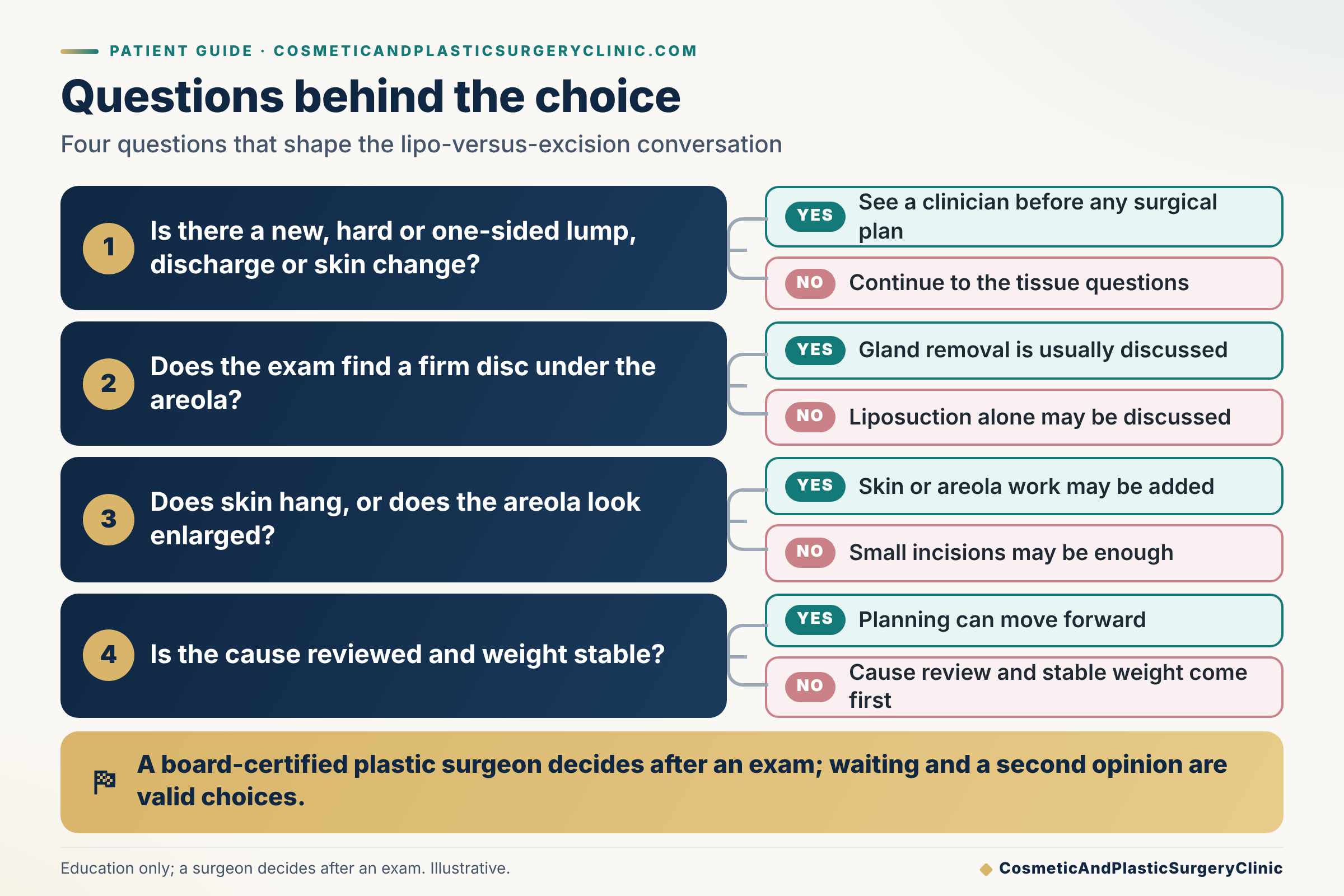
Recovery after gynecomastia lipo vs excision: what differs and what does not
Early recovery, from garments to activity limits
The first weeks
The Aesthetic Society says average patients having liposuction plus breast tissue excision are likely back at work after about a week, or 7 to 10 days depending on the job. It advises avoiding strenuous activity for 2 to 3 weeks and gentle upper-body resistance exercise at 3 to 6 weeks. The first follow-up is usually 5 to 7 days after surgery, when sutures and drains are typically removed.
ASPS in 2021 gave a different floor: limit activity for at least two weeks and upper-body exercise for at least four. Neither source splits timelines by technique, so be wary of a claim that one approach needs no recovery time. The gynecomastia surgery recovery page covers the full arc, and liposuction recovery is a useful contrast for body liposuction.
Months three to twelve: swelling, sensation and the areola
The Aesthetic Society says swelling can take three months or more to subside, while ASPS says six months or longer for final results. Sensation around the wound may decrease, more after heavy liposuction, and for most people returns after about a year. The areola may shrink by 10% to 50%, most often after significant gland removal.
In Morselli’s pull-through series, 20% had transiently reduced nipple-areola sensitivity that recovered within 2 to 8 months. Ask which sensation changes your surgeon sees after each step, and for how long.
Revision, recurrence and what stays in your hands
Touch-ups after liposuction and after excision
After gynecomastia lipo vs excision plans, the leftovers differ. Under-resection leaves firm tissue or puffy nipples; over-resection leaves a crater; either can leave asymmetry. In the Bologna series, further tailoring for residual gland was done by additional pull-through excision under local anesthesia, and surface irregularities in 4% were corrected with superficial liposuction or fat transfer.
In the 448-patient series, no one needed revision during follow-up, but 7.1% said they would want one in future. ASPS lists the possibility of revision among the risks. The revision gynecomastia surgery page covers when and how it is considered; for now, ask what the revision policy is in writing before choosing between gynecomastia lipo vs excision plans.
Weight, medicines and substances after any approach
Neither operation treats the cause. ASPS says results last in many cases but depend on avoiding certain medications and drugs, including steroids, and on avoiding weight gain; it advises discussing any medication change with your physician first. MedlinePlus lists several medicines, alcohol, marijuana and other substances among causes, and says long-standing gynecomastia is less likely to resolve on its own.
The 2026 cohort tied higher BMI to more complications and lower satisfaction. A stable weight and a reviewed medication list are part of the planning, whichever gynecomastia lipo vs excision path is chosen.
Gynecomastia lipo vs excision scenarios instead of a winner
A soft chest with no firm disc under the areola
Why liposuction alone is the usual discussion
Consider a hypothetical man whose chest is soft and fairly symmetric, whose skin springs back, and whose exam finds no firm tissue under the nipple. In gynecomastia lipo vs excision terms, a surgeon would likely discuss liposuction alone: the problem is fat, and the scars are the smallest available.
The finding that would reverse it
A firm button felt beneath the nipple, imaging that shows gland, or skin that does not recoil would each move the discussion toward gland removal or skin work. ASPS notes that surgeons use ultrasound for localized masses and order labs as indicated. Weight stability and medication review stay on the list.
A firm disc under the areola with moderate skin
Why excision with liposuction is the usual discussion
Now picture firm tissue under both areolas and skin of moderate laxity, a common gynecomastia lipo vs excision case. Excision through the areola edge handles the gland, and liposuction removes fat at the periphery. A surgeon might also raise ultrasound-assisted liposuction or a pull-through variation, as reviewed above. Which one is chosen is a surgeon-specific judgment, and the consent should say what happens if more tissue is found than expected.
Changing one variable: a larger chest and hanging skin
Keep the same chest but let the skin hang and the areola look enlarged; the gynecomastia lipo vs excision answer shifts. The discussion moves toward skin removal and nipple repositioning, with the longer scars described earlier. If major weight loss is underway or planned, surgeons may prefer a stable weight first; ASPS says skin removal is often needed in men who have lost a lot of weight.
| Goal or anatomy | Option usually discussed | Reason | Fact that could reverse it |
|---|---|---|---|
| Soft chest, firm skin, no disc felt | Liposuction alone | Fat is the problem; scars are tiny | Firm tissue found at the exam |
| Firm disc under the areola, little extra skin | Liposuction plus gland excision | Gland needs to come out; periphery needs fat removal | Surgeon proposes pull-through or ultrasound-assisted steps |
| Puffy nipples with a small chest | Combination through an areola incision | Aesthetic Society pairs liposuction and excision for this pattern | A medical cause is still being worked up |
| Large chest, hanging skin, enlarged areola | Excision with skin removal and nipple repositioning | Skin is unlikely to follow a smaller contour | Weight still changing |
| Teen, enlargement under a year past puberty | Observation first | ASPS: resection may be withheld at least one year | Persistence beyond a year with real distress or pain |
Six checks to put to a surgeon about gynecomastia lipo vs excision
These gynecomastia lipo vs excision checks separate a clear plan from a vague one. They sit alongside the general list on the plastic surgery consultation page and the fuller gynecomastia consultation guide, and they are numbered so you can take them into an appointment.
Checks about tissue and technique
Check 1: what did the exam find in fat, gland and skin?
A useful answer names each tissue in plain words and says how it was judged: by touch, by ultrasound for a localized mass, with labs if indicated, all of which the ASPS practice parameter mentions. It should also say whether a medical look at the cause is advised before surgery.
An evasive answer is “you just need lipo” with no statement about gland, or a recommendation that arrives before anyone has examined you.
Check 2: why this tool for this tissue, and what if more gland is found?
Ask which of the three gynecomastia lipo vs excision approaches is planned and why, and what the consent covers if firm tissue turns up that suction does not remove. Ask whether excision would happen in the same session. In the 2025 comparison, endoscopy was used to judge residual fibroglandular tissue and avoid unnecessary excision, so some surgeons check before removing more; ask whether yours does.
Also ask what is sent to pathology in each scenario, including a liposuction-only plan.
Checks about scars, results and recovery
Check 3: where will each scar sit, and could the plan add one?
Ask the surgeon to point to every incision on your chest. The Aesthetic Society ties scars to tissue: tiny ones for fat-only chests, one under the areola for firm tissue, one around the areola if it must shrink, and longer scars across the chest for large, female-like breasts.
Then ask what finding at the exam or in the operating room would lengthen the scar, and what happens to nipple position.
Check 4: what do photos of similar chests show, and when is the result judged?
Ask for photos of chests with the same tissue type and similar weight, shot in the same lighting, with the time since surgery stated. Swelling can take three to six months or more to settle, and scars keep changing through the first year, so early photos flatter or mislead in both directions, whichever gynecomastia lipo vs excision plan was used.
The gynecomastia before and after guide covers how to read these pictures, including how time since surgery changes what a photo shows.
Checks about the surgeon, facility and quote
Check 5: who operates, and where?
The ASPS practice parameter says the operating surgeon should have hospital privileges and board certification, such as from the American Board of Plastic Surgery. The ABPS site has a public verification page, and checking it yourself takes a minute.
Ask which accredited facility is used and who provides anesthesia. The steps for verifying all of this are on the choosing a plastic surgeon page.
Check 6: what does the quote include, and what if the plan changes?
ASPS lists an average of $5,587 for gynecomastia surgery, states no year and says it excludes anesthesia and facility costs. It also says most health plans do not cover male breast reduction or its complications; coverage varies by policy (see gynecomastia surgery insurance).
Ask for an itemized gynecomastia lipo vs excision quote: surgeon, facility, anesthesia, pathology, garment, follow-up and revision policy. Ask whether fees change if gland excision is added during surgery. The gynecomastia surgery cost article explains how the pieces add up.

Frequently asked questions
Is gynecomastia lipo vs excision decided before surgery or during it?
Mostly before, from the exam, but the plan can change if more tissue is found than expected. In the 2025 comparison from India, surgeons used an endoscope to judge residual fibroglandular tissue so that excision happened only when needed, and in the pull-through technique the gland is removed after liposuction has loosened it. Ask whether your gynecomastia lipo vs excision consent covers both liposuction and excision, what would trigger the second step, and whether the fee or facility time changes if it does.
Can a surgeon tell gland from fat by touch alone?
Touch is a standard part of the exam, and surgeons look at how firm the tissue is, where it sits and how the skin behaves. When the picture is unclear, the ASPS practice parameter says ultrasound can be used for localized masses and labs ordered as indicated. No source read for this page says that touch alone is always reliable, which is why a second look is reasonable when two surgeons disagree.
Does gynecomastia lipo vs excision change for teenagers?
Timing changes first. The ASPS practice parameter says surgical resection for adolescent gynecomastia may be withheld for at least one year, and a 2021 ASPS article lists enlargement persisting more than a year after puberty as one indicator for surgery. MedlinePlus says many boys develop some enlargement in puberty and that growth in young boys often resolves on its own. It also says a boy with breast growth before puberty should be checked by a provider. The gynecomastia lipo vs excision question comes after the watching period.
Is ultrasound or laser liposuction better for firm gynecomastia?
The evidence does not rank them. A 2003 series described ultrasound-assisted liposuction as effective for dense, fibrous tissue, and the 2022 pooled review lists small subgroups: 31 patients with 2 complications for ultrasound-assisted and 71 patients with 6 for laser lipolysis. A 2024 review called laser, ultrasound and radiofrequency options promising but said controlled studies are lacking. Ask why a device is proposed, what it adds for your tissue, and whether it changes the fee, since devices are a side branch of gynecomastia lipo vs excision.
What is the pull-through technique, and is it liposuction or excision?
It is both in sequence. Liposuction comes first, then gland is drawn out through a small incision. The Aesthetic Society describes an incision of about 5 millimeters at the areola edge for minimal cases, while Morselli and Morellini placed 8 to 12 millimeter incisions at the inframammary fold and behind the anterior axillary pillar. A 2020 randomized study of 20 patients found no complications with pull-through and two hematomas with periareolar excision, a signal too small to rely on in the gynecomastia lipo vs excision debate. Ask whether your surgeon uses it often.
Will the removed tissue be tested?
It depends on the surgeon and the plan, and gynecomastia lipo vs excision plans differ here. In Morselli’s series, specimens were sent for histology, and the ASPS practice parameter says that with any enlargement of the male breast the possibility of carcinoma should be considered. Removed tissue from excision can be examined; ask what, if anything, is sent in a liposuction-only plan, who reads it and how you would be told the result. Pathology fees may appear as a separate line on a quote.
Which is more likely to need a second operation, lipo or excision?
The pooled review lumps revision and recurrence together: 26 events among 874 aspiration patients, 22 among 2,764 after excision and 38 among 3,656 after combined techniques. Dividing those counts gives roughly 3.0%, 0.8% and 1.0%, a crude calculation from mixed studies with different follow-up and severity. It is consistent with under-resection being the main risk of liposuction alone, but it does not prove it. Ask what the surgeon’s own touch-up rate is and what the revision policy says; that matters in gynecomastia lipo vs excision planning.
How do I compare two surgeons who recommend different approaches for gynecomastia lipo vs excision?
Ask each to describe your tissue in fat, gland and skin terms, and to say what finding would make them recommend the other approach. If one proposes liposuction alone and the other excision, the disagreement is usually about whether firm tissue is present or how much skin will follow. Ask for photos of chests like yours and the touch-up policy, and bring the written plans to a third opinion if the gap remains.
Sources and further reading
- American Society of Plastic Surgeons — Gynecomastia surgery (accessed 2026-11-13) — definition: fat, gland, skin components
- American Society of Plastic Surgeons — Gynecomastia surgery procedure (accessed 2026-11-13) — liposuction, excision, combination, anesthesia
- American Society of Plastic Surgeons — Gynecomastia surgery risks and safety (accessed 2026-11-13) — listed risks
- American Society of Plastic Surgeons — Gynecomastia surgery recovery (accessed 2026-11-13) — warning signs; weight, drugs and steroids
- American Society of Plastic Surgeons — Gynecomastia surgery cost (accessed 2026-11-13) — $5,587 average, exclusions, insurance
- American Society of Plastic Surgeons — The ABCs of gynecomastia surgery, April 2021 (accessed 2026-11-13) — three components, incisions, activity limits
- American Society of Plastic Surgeons — How to get rid of gynecomastia, March 2018 (accessed 2026-11-13) — liposuction vs excision framing
- American Society of Plastic Surgeons — High-definition liposculpture press release, April 2021 (accessed 2026-11-13) — 436-man series, limits
- American Society of Plastic Surgeons — Practice parameter: gynecomastia, 2004 (accessed 2026-11-13) — techniques, pathology, grading, surgeon qualifications
- The Aesthetic Society — Gynecomastia procedure overview (accessed 2026-11-13) — liposuction, excision, pull-through, combination
- The Aesthetic Society — Gynecomastia surgery recovery (accessed 2026-11-13) — return to work, swelling, sensation, areola changes
- The Aesthetic Society — Gynecomastia surgery scars and incisions (accessed 2026-11-13) — scar placement by tissue type
- MedlinePlus — Gynecomastia (accessed 2026-11-13) — causes, treatment, when to see a provider
- Innocenti et al., Aesthetic Plastic Surgery 2022 — Incidence of complications for different approaches in gynecomastia correction (accessed 2026-11-13) — pooled complication rates
- Rohrich et al., Plastic and Reconstructive Surgery 2003 — Classification and management of gynecomastia, ultrasound-assisted liposuction, abstract record (accessed 2026-11-13) — 61-patient series
- Morselli and Morellini, European Journal of Plastic Surgery 2012 — Breast reshaping in gynecomastia by the pull-through technique (accessed 2026-11-13) — 260-patient series
- Tripathy et al., Aesthetic Plastic Surgery 2020 — Periareolar excision vs pull-through, abstract record (accessed 2026-11-13) — 20-patient randomized study
- Ali et al., Indian Journal of Plastic Surgery 2025 — Liposuction alone versus liposuction with endoscope-assisted glandular excision (accessed 2026-11-13) — small comparison
- Mett et al., European Journal of Plastic Surgery 2020 — Surgical treatment of gynaecomastia: a standard of care (accessed 2026-11-13) — grade-based algorithm, 164 patients
- Frigerio et al., JPRAS Open 2024 — Techniques to minimize scars in surgical management of gynecomastia, record page (accessed 2026-11-13) — skin retraction evidence
- Ramasamy et al., Aesthetic Surgery Journal Open Forum 2023 — Liposuction, complete gland removal and nipple areola complex lifting plaster, 448 patients (accessed 2026-11-13) — complications, satisfaction
- Asiri et al., Breast Care 2026 — Efficacy and safety of liposuction and glandular excision for gynecomastia, abstract (accessed 2026-11-13) — 71-patient cohort, BMI
- Lapid, Jolink and Meijer, Annals of Plastic Surgery 2015 — Pathological findings in gynecomastia, 5,113 breasts, abstract record (accessed 2026-11-13) — specimen findings
- American Board of Plastic Surgery — home page and verification link (accessed 2026-11-13) — certification verification