Gynecomastia surgery risks are mostly about three things: blood or fluid collecting in the space where tissue was removed, a contour that does not match the rest of the chest, and changes at the nipple-areola complex. Most men who have the operation never meet a serious version of any of them, but “most” is not a plan. This page sorts gynecomastia surgery risks into expected effects, complications and emergencies, and it gives each number with its source, year and population so you can see what it can and cannot tell you.
The operation removes glandular tissue, fat, or both, and sometimes skin; the gynecomastia surgery overview explains what it treats. For how absolute and relative risk work across all procedures, read plastic surgery risks. Nothing below diagnoses a symptom, judges whether surgery suits you, or replaces a consultation.
Gynecomastia surgery risks in three tiers: expected effects, complications and emergencies
The word “risk” covers very different events. Chest tightness on day three and a blood clot in the lung can both appear on a consent form, yet they call for opposite responses. Sorting gynecomastia surgery risks into three tiers is the quickest way to tell whether a symptom means follow the aftercare sheet, call the surgeon’s office today, or go to an emergency department now.
Expected effects that are not complications
Swelling, firmness, bruising and the compression garment
The American Society of Plastic Surgeons (ASPS) recovery page for the operation says a small, thin tube may be placed temporarily under the skin to drain excess blood or fluid, and that an elastic bandage or support garment may be used to limit swelling and support the new chest contour. It gives no day counts, so drain use, garment wear and activity limits belong to your surgeon. The ASPS patient article from December 2024 adds that swelling, numbness, bruising and firmness can last several months.
What turns an expected effect into a complication is direction and size. Swelling that is easing differs from a tense area that keeps growing on one side, and soreness that is improving differs from pain that is spreading. The gynecomastia surgery recovery article covers the week-by-week arc, so this page concentrates on the gynecomastia surgery risks that depart from it.
Numb skin and scars that mature slowly
Reduced or altered sensation over the chest and nipple is common enough that the ASPS risk list for this operation says changes in nipple or breast sensation “may be temporary or permanent.” The same ASPS patient article quotes a surgeon advising men to ask specifically about nipple sensation, and notes that scars can take about a year to fade, particularly on darker skin.
A pink or raised scar in the first months is therefore not automatically a problem. A scar that keeps thickening, widens, or sits where you did not expect it is worth raising at follow-up. Scar position is a design choice made before surgery, which is one reason the consultation matters; see gynecomastia consultation questions.
Complications that need a call to the surgical team
Fluid, bleeding and wound problems
Cleveland Clinic’s seroma page (updated February 2026) describes a seroma as a pocket of fluid under the skin that usually forms after surgery, with symptoms typically appearing seven to 10 days later. Small ones that do not hurt may only be watched; larger ones may be drained with a needle, and a recurring one may get a temporary drain. It advises contacting a provider if the seroma is uncomfortable, growing, shows signs of infection or does not improve after several weeks.
Cleveland Clinic’s hematoma page (updated November 2024) defines a hematoma as blood collecting in a space inside the body because it cannot flow or drain out, and lists internal bleeding after surgery as one cause. After chest surgery, a one-sided swelling that is firm, tight and getting larger is the pattern surgeons want to hear about quickly rather than at the next scheduled visit.
Contour, symmetry and nipple-areola changes
The ASPS risk list names breast asymmetry, contour and shape irregularities, fat necrosis (fatty tissue that dies and may feel like a firm lump), poor wound healing, persistent pain, infection and the possibility of revision surgery. None of these gynecomastia surgery risks is an emergency by itself. Each is a reason to schedule a visit, and several take months to judge because early swelling hides the final shape.
A later section gives published frequencies for these gynecomastia surgery risks. For now, the practical point is that a visible difference between the two sides at week two is common and usually unreadable; a difference that is still obvious after swelling has settled is the one to discuss, as the revision article linked later on this page explains.
Emergencies: when gynecomastia surgery risks mean emergency care now
Chest, lungs and legs
If any of these gynecomastia surgery risks becomes real after your operation, call emergency services and say that you recently had surgery. Do not drive yourself, and do not wait for the surgeon’s office to open.
Fast swelling, fever and failing skin

Table 1 puts the tiers side by side. It is a reading aid and a prompt for the pre-operative visit, not a way to diagnose yourself.
| What is noticed | Category | General response | Basis |
|---|---|---|---|
| Swelling, bruising, firmness and numbness that ease over weeks to months | Expected effect | Follow written aftercare; mention changes at follow-up | ASPS recovery page; ASPS article, Dec 2024 |
| Soft fluid bump on one side, often in the second week | Complication | Call the team; watching or needle drainage may follow | Cleveland Clinic, Feb 2026 |
| Firm, growing, tight swelling on one side | Complication, possibly urgent | Call at once; may need evaluation the same day | Cleveland Clinic hematoma page, Nov 2024 |
| Uneven sides, a dip, a firm lump, a scar that keeps widening | Complication, often judged later | Raise at follow-up; call sooner if a lump grows or hurts | ASPS risk list for the operation |
| Chest pain, breathlessness, fainting, racing heartbeat, painful swollen calf | Emergency | Call emergency services; say you had surgery | MedlinePlus, Oct 2025; CDC, Mar 2025 |
| Fever with foul drainage, wound opening, dusky or black skin | Urgent to emergency | Call the surgeon now; emergency department if unreachable | General surgical warning signs; follow your discharge sheet |
What large studies report about gynecomastia surgery risks
Published numbers for gynecomastia surgery risks come from very different kinds of data: pooled reviews of dozens of papers, a national hospital-quality database, and single-surgeon series. Each answers a different question about gynecomastia surgery risks, and none is a forecast for one man. This section lays out what each source counted, so the figures can be compared on fair terms.
Pooled complication data from 94 studies
Counting events: 7,294 patients and 1,407 complications
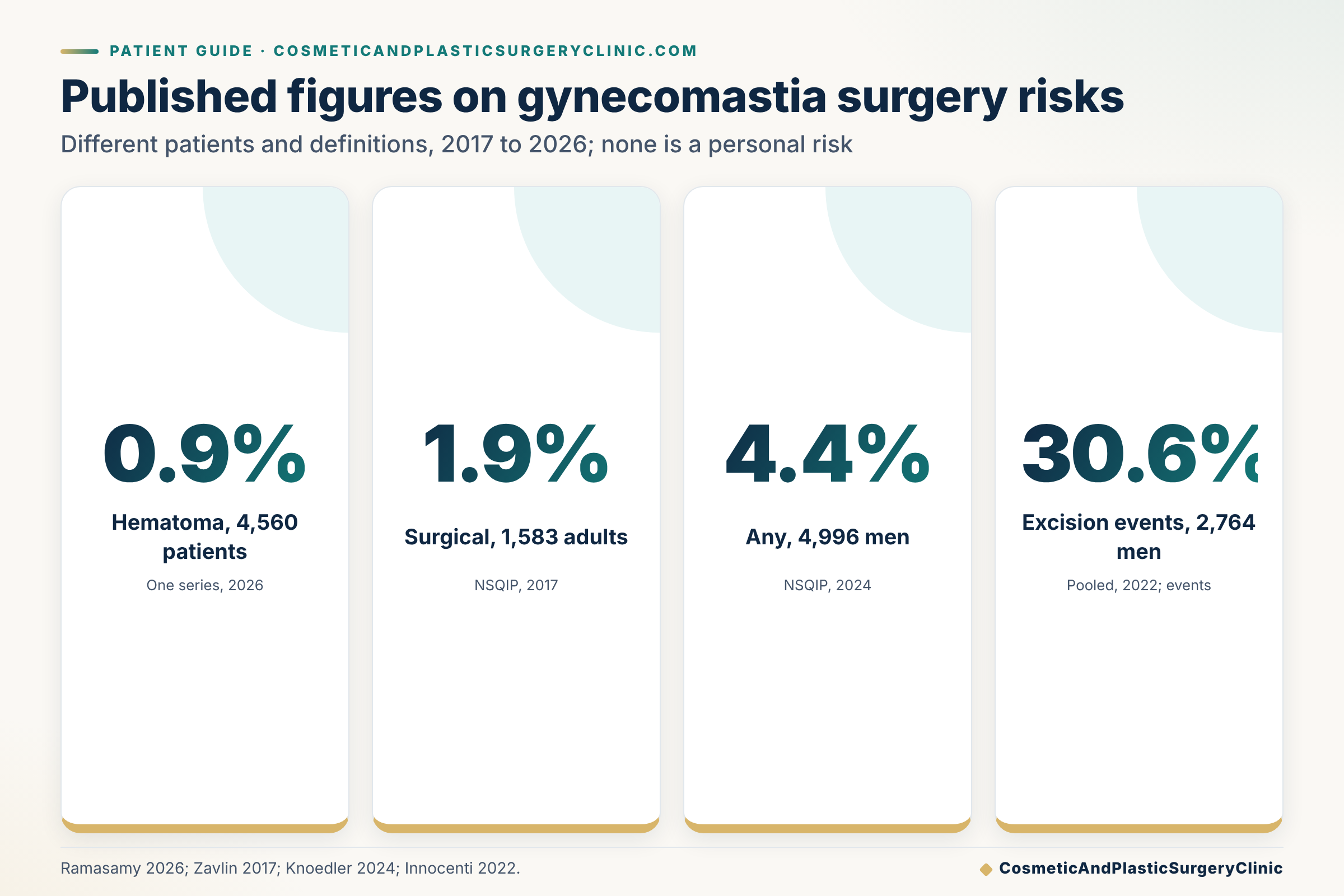
Innocenti, Melita and Dreassi (Aesthetic Plastic Surgery, 2022) searched English-language studies published from 1987 to 2020 and pooled 94 articles covering 7,294 patients: 874 treated by aspiration (liposuction), 2,764 by surgical excision and 3,656 by a combined approach. They recorded 1,407 complications in total. By the authors’ grouping, complications occurred at 14.87% for aspiration, 30.64% for excision and 11.76% for combined techniques.
Two limits matter. The review counted complications as events, so one man with both a seroma and an infection counts twice. And the authors note that excision groups probably held more severe cases, which they did not test. The figures describe how often gynecomastia surgery risks were reported in different mixes of patients, not which technique is safer for you. Choosing between them is the subject of gynecomastia lipo vs excision.
Hematoma, seroma and contour by technique
Dividing the review’s event counts by the number of patients in each group (my arithmetic, not the authors’) gives the pattern in Table 2. Hematoma and seroma clustered in the excision group, while contour irregularities and asymmetry were reported more often in the combined group. Infection was uncommon everywhere, with 10 events in 7,294 patients.
| Event type | Aspiration (874 patients) | Excision (2,764 patients) | Combined (3,656 patients) |
|---|---|---|---|
| Hematoma | 1.3 | 7.7 | 2.7 |
| Seroma | 1.7 | 8.3 | 0.9 |
| Nipple-areola necrosis or abrasion | 0.1 | 1.3 | 0.4 |
| Contour irregularity or redundant skin | 0.3 | 0.5 | 1.7 |
| Asymmetry | 0.5 | 0.1 | 0.8 |
| Revision or recurrence (reoperation) | 3.0 | 0.8 | 1.0 |
| All recorded complications | 14.9 | 30.6 | 11.8 |
Hospital-database and single-center series
National database figures: 1,583 adults and 4,996 men
Zavlin and colleagues (Aesthetic Plastic Surgery, 2017) analyzed the American College of Surgeons NSQIP database, which collects 30-day outcomes from participating hospitals. Among 1,583 adult men, 93.9% had outpatient surgery; within 30 days, surgical complications occurred in 1.9% and medical complications in 0.3%. Among 204 pediatric patients, surgical complications were 3.9%. The authors concluded the operation is safe across age groups, and that known comorbidities call for more thorough assessment.
A larger NSQIP analysis by Knoedler and colleagues (Aesthetic Plastic Surgery, 2024) covered 4,996 adult men operated on from 2008 to 2021. Any complication within 30 days occurred in 4.4% (222 men). Inpatient setting, higher BMI, prior sepsis and bleeding disorders were independent risk factors. Because NSQIP stops at 30 days and counts events surgeons report to a quality program, it says little about the later gynecomastia surgery risks of contour, symmetry and recurrence.
Newer single-surgeon series: 130 breasts and 4,560 patients
Wolter and colleagues (Aesthetic Surgery Journal, 2025) reviewed 72 patients (130 breasts) with Simon grade IIb gynecomastia treated with one combined technique by one surgeon. Hematoma needing surgical evacuation occurred in 3 breasts (2.3%), seroma in 2 (1.5%), partial nipple-areola necrosis in 2 (1.5%) and none had complete necrosis; about 88% kept nipple sensation at a mean follow-up near 17 months. A secondary operation was needed in 5 breasts (3.8%).
A 2026 series by Ramasamy and colleagues, listed with an Oxford University Press DOI, followed 4,560 consecutive patients treated from 2015 to 2025. It reported hematoma in 0.9% overall, seroma in 2% and return to the operating room for bleeding in 0.31%. These are one practice’s results after a bleeding-control protocol, so they show what a high-volume team can report, not what every surgeon achieves. The choose a plastic surgeon article covers how to verify the person behind such numbers.
Reading gynecomastia surgery risks figures without being misled
Why hematoma ranges from 0.9% to 6%
Across the sources above, hematoma, the best-measured of the gynecomastia surgery risks, runs from 0.9% (4,560 patients, 2026) through 2.3% (130 breasts, 2025) and about 4.4 per 100 patients (pooled events, 2022). A 2015 trade-publication summary of one surgeon’s series of bodybuilders reported hematoma in 6% and seroma in 12%, though that series is self-reported and single-practice. The spread has ordinary causes: whether minor collections count, whether the denominator is breasts or patients, how severe the cases were, and how long anyone looked.
That is why the useful question for a consultation is not “what is the hematoma rate” but “what do you count as a hematoma, and what was your rate over your last few hundred cases.”
What the figures leave out
Most of the numbers above stop at 30 days or about a year. They rarely capture a man’s own sense that one side is fuller, that the nipple looks different, or that numbness has not faded. A 2017 NSQIP-based analysis of surgical complications at 1.9% and a 2025 series reporting 88% preserved nipple sensation are both true and both incomplete; neither tells you how satisfied the men were.
For the broader skill of translating a percentage into a decision, see the general risk article linked at the top. Here the working rule is simple: treat any single figure on gynecomastia surgery risks as one point in a range, and ask which range the surgeon’s own practice sits in.
Hematoma and seroma: how the chest bleeds and fills after surgery
Fluid problems top most lists of gynecomastia surgery risks because the operation leaves a cavity under the skin where gland and fat used to be. Blood or serum that collects there can press on the skin, delay healing, and in the case of blood, harden into tissue that has to be dealt with later. How a team prevents and manages these gynecomastia surgery risks says more about its safety culture than almost any brochure sentence.
Why bleeding clusters where it does
Perforator anatomy and what a surgeon can control
The takeaway is not a number to memorize. Among gynecomastia surgery risks, bleeding is not random, which is why technique can reduce it. In that series, return-to-operating-room for bleeding fell from 0.54% to 0.05% after the protocol (p = 0.002), while the drop in hematoma, 1.17% to 0.60%, did not reach statistical significance (p = 0.058). It was a before-and-after comparison within one practice, so other changes over a decade may have contributed.
Recognizing a hematoma and what treatment can involve
A hematoma usually announces itself as swelling that is firmer and tighter than the other side and still growing, often with bruising that spreads and pain that is rising instead of settling. Cleveland Clinic notes that smaller hematomas may need no treatment, while serious ones can need procedures to drain pooled blood. In the 2025 Wolter series, all three hematomas required surgical evacuation, and in the 4,560-patient series the overall reoperation rate for bleeding was 0.31%.
Whether a particular collection among gynecomastia surgery risks is watched or drained is a surgeon’s judgment made in person, which is why a rapidly enlarging, tense chest should prompt an immediate call rather than waiting for the morning. Ask in advance who answers that call at night and where you would be seen.
Seroma, drains and garments
How seromas form, how long they take and how they are treated
Seroma is the most commonly counted of the fluid-related gynecomastia surgery risks in the older pooled data: 279 events among 7,294 patients in the 2022 review, concentrated in the excision group, and 2% overall in the 2026 series. Cleveland Clinic’s page describes the usual pattern. Fluid appears about seven to 10 days after surgery, small seromas may shrink over roughly a week and a half, and larger ones can take up to six weeks to resolve.
Treatment ranges from observation with activity limits to needle aspiration, a temporary drain, a sclerosing agent that helps the pocket walls stick together, and, as a last resort, surgery to remove a thick capsule. A seroma that is uncomfortable, growing, discolored, associated with fever, or lingering for several weeks warrants a call, per the same page.
What drains, garments and activity limits are meant to do
Each piece of the recovery plan has a separate job. Per ASPS, a drain removes excess blood or fluid, a support garment limits swelling and supports the new contour, and activity limits protect incisions from force and motion. The recovery page says the surgeon sets how long each lasts. A December 2024 ASPS article says most men wear a compression vest for several weeks; that is a typical description, not an instruction.
Do not shorten garment wear, resume lifting or change positioning on the strength of an article. If the written plan seems too restrictive or too loose, that is a question for the surgical team. Details of the usual recovery sequence sit in the recovery article linked earlier.
Contour, nipple-areola and sensation: the gynecomastia surgery risks you can see and feel
These gynecomastia surgery risks are the outcomes patients mention most when they are unhappy, and also the ones that no database captures well. They are judged by eye and by touch, they change as swelling resolves, and they are tied to decisions made in the operating plan: how much tissue to take, where the incision goes, and how the nipple is supported.
Too much, too little, or uneven
Over-resection, under-resection and visible steps in the contour
A chest can end up with a shallow depression where more tissue was removed than the surroundings allow, a ridge or step where treated and untreated areas meet, or residual fullness behind the nipple where gland remained. The ASPS list calls these breast contour and shape irregularities. In the 2022 pooled review, contour irregularities or redundant skin accounted for 80 events, with a higher share in the combined-technique group than in the excision group.
A 2015 trade summary of a single surgeon’s bodybuilder series described static depressions in under 1% and dynamic depressions, which show only when muscles contract, in 7%. Treat that as one surgeon’s self-reported series of gynecomastia surgery risks. The lesson for a consultation is that a contour that looks fine at rest can behave differently when you flex, which is why the photo habits described in gynecomastia before and after include movement.
Residual tissue and asymmetry
Not every case is symmetric to begin with: in the 2025 series 19% of patients had one-sided gynecomastia, and an operation may reduce a difference without erasing it. The 2022 pooled review recorded 36 asymmetry events in 7,294 patients, but no source opened for this page defines the threshold at which a difference is counted. That makes the number hard to compare with your own mirror.
Before surgery, ask what the surgeon expects the two sides to look like and which side is likely to be harder to correct. If a firm disc of tissue remains behind the nipple after the swelling has settled, the options are discussed in the revision article, not here.
The nipple-areola complex
Sensation, shape and position
The ASPS safety page lists changes in nipple or breast sensation that may be temporary or permanent, and its patient article quotes a surgeon advising men to ask about nipple sensation. The numbers vary: Wolter and colleagues reported that about 88% of patients kept nipple sensation at a mean follow-up of 17 months, which implies that some did not. Three nipple-areola revisions (2.3%) in that series reshaped the areola.
Beyond sensation, a man may notice a change in how the nipple looks or sits after healing. ASPS adds that in more severe cases the areola may be repositioned or resized and excess skin removed. Ask which of these is likely in your case, how it changes the scar, and what the surgeon does if the areola ends up asymmetric.
Partial skin loss and fat necrosis
Among gynecomastia surgery risks, skin or tissue at the nipple-areola complex can lose blood supply. In the 2022 pooled review, necrosis or abrasion at the complex accounted for 52 events in 7,294 patients, the highest per-patient share in the excision group at about 1.3 per 100. In the 2025 series, 2 breasts (1.5%) had partial loss and none had complete necrosis.
Fat necrosis, the death of fatty tissue that may feel like a firm lump, is on the ASPS list. A lump after surgery should be examined, not assumed to be benign. Nicotine matters here: the ASPS 2024 practice reference lists tissue necrosis among the risks for patients who use nicotine, and a later section covers that.
Scars and loose skin
Scar quality and placement
Scar placement depends on the technique chosen; the combined approach in the 2025 series, for example, used incisions around the areola. ASPS lists “unfavorable scarring” among the risks, and its December 2024 article says scars may take a year to fade, particularly on darker skin. Nothing in the pages read for this article quantifies how often scars thicken or widen.
If you have a history of thick or raised scars, or skin that has darkened after past injuries, tell the surgeon at the first visit. That history shapes incision choices and the aftercare plan.
Excess skin after large tissue volume or weight change
When breast tissue has stretched the skin, or when a man has lost a lot of weight, the skin may not shrink to fit the new volume. ASPS notes that in severe cases surgery may involve removing excess skin and repositioning the areola, which brings longer scars. A contour that looks flat on a lean chest may look different on a larger one, so the gynecomastia vs chest fat distinction matters for planning.
Skin laxity is a trade-off, not a surprise, when it is discussed beforehand: a smaller scar with some looseness, or a longer scar with a tighter result. Ask to see examples of both choices in men with similar chest anatomy.
Recurrence, revision and what the pathology report adds to gynecomastia surgery risks
Two questions follow the early recovery: will the tissue come back, and what did the laboratory find in what was removed. Both belong in a discussion of gynecomastia surgery risks, because one concerns the long-term result and the other concerns a rare finding that is the reason surgeons send tissue for examination.
When tissue returns or needs a second operation
Recurrence in a small long-term follow-up
Long-term data are thin. Fricke and colleagues (Aesthetic Plastic Surgery, 2017) invited 41 men operated on between 1997 and 2005 to return 10 to 19 years later; 16 attended. Among eight with predominantly glandular gynecomastia, one (12.5%) had recurrence, compared with five of eight (62.5%) of those with predominantly fatty, or lipomatous, tissue. Body mass index changes did not differ significantly between the groups. With 16 men, this is a signal to take seriously and not a rate to quote.
The pooled 2022 review recorded 86 revision or recurrence events in 7,294 patients, and the 2025 series reported secondary operations in 3.8% of breasts. Neither source separates reoperations for residual tissue, contour, bleeding or recurrence in a way that supports a single revision rate, so ask a surgeon for theirs, defined. The revision gynecomastia surgery article covers when a second operation is considered.
Causes that surgery does not remove
Surgery removes tissue; it does not treat a cause, which makes recurrence one of the gynecomastia surgery risks that a medical evaluation can address. MedlinePlus (reviewed October 2024) lists hormone imbalance, chronic liver disease, kidney failure, low testosterone, obesity, certain medicines and some substances including alcohol, amphetamines, heroin, marijuana and methadone. The ASPS articles add anabolic steroid and marijuana use, and a December 2024 article quotes a surgeon saying that testosterone supplements, injectable steroids and some muscle-building supplements containing testosterone precursors can contribute to recurrence.
That is why a medical evaluation commonly comes first, and why a surgeon will ask about everything you take. Never start or stop a prescribed medicine on your own because of gynecomastia; that decision belongs to the clinician who prescribed it. Telling the surgeon about steroids or supplements is a medical conversation, not a confession.
The pathology question
What 5,113 specimens showed
Lapid, Jolink and Meijer (Annals of Plastic Surgery, 2015) reviewed Dutch national registry pathology reports for 5,113 breasts removed as gynecomastia, in patients aged 1 to 88. Invasive carcinoma was found in 0.11% and carcinoma in situ in 0.18%; atypical ductal hyperplasia, an abnormal cell pattern that is not cancer, in 0.4%. The youngest patient with invasive cancer was 65, and the youngest with carcinoma in situ was 24. The authors called malignancy in these specimens rare but more frequent with age.
Rare does not mean ignorable among gynecomastia surgery risks. It is the reason the removed tissue is routinely sent to a pathologist, and it is a fair question at the consultation: will the tissue be examined, who pays for it, and how will you be told the result.
Breast changes that need a clinician before any operation
Male breast cancer is uncommon. The American Cancer Society estimates about 2,670 US men will be diagnosed with invasive breast cancer in 2026, under 1% of all US breast cancers, with an average lifetime risk near 1 in 755. The National Cancer Institute (updated October 2026) lists a lump or thickening, nipple changes or discharge, skin sores and dimpling as signs, while noting that many breast changes in men are benign.
Why gynecomastia surgery risks differ from man to man
A pooled rate for gynecomastia surgery risks blends together men with very different health, habits and anatomy. A few factors are named often enough in sources that they are worth asking about directly, with the caveat that none of them predicts what will happen to any one person.
Patient factors
Nicotine and other circulation-limiting exposures
The ASPS 2024 practice reference says patients who smoke or use nicotine face higher risk of postoperative complications, including infection, blood clots and pneumonia, and that in plastic surgery smoking can cause tissue necrosis. It recommends cessation four to eight weeks before surgery and at least four weeks after, treats any form of nicotine, including patches and vaping, as a risk factor, and notes that surgeons may test urine for cotinine and delay the operation.
A 2016 ASPS blog post by a surgeon, representing her own view, put the point bluntly: it is better to delay surgery than to risk tissue dying. The nipple-areola complex depends on thin vessels, which is why this matters particularly here. Of all gynecomastia surgery risks, nicotine exposure is one a patient can discuss and plan around before the operation. Disclosing it honestly lets the surgeon plan; hiding it removes the safeguard.
Bleeding disorders, BMI and past infection
In the 4,996-man NSQIP analysis, bleeding disorders, higher BMI, prior sepsis and inpatient status were independent risk factors for complications within 30 days. Inpatient status may mark sicker men or bigger operations rather than cause harm itself, so read it as a possible flag for complexity. The average BMI in that cohort was 28.2.
The practical step is a full medication and history list, including anything that thins blood or affects clotting, supplements and any personal or family history of bleeding. Do not stop a prescribed blood thinner or any medicine yourself; the prescriber and surgeon decide that together.
Procedure, anesthesia and facility factors
Extent of surgery and technique
Larger gland removal, longer operating time and skin excision plausibly add chances for problems, but the sources read give no per-factor odds. The pooled review’s technique groups differ in patient mix, so Table 2 should not be read as a ranking. What a surgeon should be able to do is explain, for your chest, which tissue they intend to remove, through which incision, and why that choice fits.
Where liposuction is part of the plan, the device and technique questions overlap with liposuction risks, including contour irregularities and fluid shifts.
Anesthesia, clots and the setting
MedlinePlus (updated September 2025) states that anesthesia is generally safe but carries risks, especially general anesthesia, including heart rhythm and breathing problems and allergic reactions. The Aesthetic Society’s 2021 safety page names blood clots in the legs or lungs as the one risk specific to gynecomastia surgery, and says significant complications are infrequent. In the 2017 NSQIP cohort, 93.9% of adults were operated on as outpatients.
Ask who gives the anesthesia and what credentials they hold, what monitoring is used, what the clot-prevention plan includes (CDC advises moving around as soon as possible after surgery), and whether the facility is accredited. The ASPS patient-safety page emphasizes choosing a board-certified plastic surgeon and attention to the facility, and the American Board of Plastic Surgery offers a certification lookup.
| Factor | What the sources say | Question to ask the surgeon |
|---|---|---|
| Nicotine in any form | ASPS 2024: higher complication risk, tissue necrosis; cessation 4 to 8 weeks before | What are your nicotine rules and do you test? |
| Bleeding disorder or clotting history | Independent risk factor in 4,996 NSQIP patients, 2024 | What testing or clearance do you want before surgery? |
| Higher BMI | Independent predictor in the same 2024 NSQIP study | How does weight change your technique and plan? |
| Steroids, supplements or other drug exposure | ASPS 2024: may contribute to recurrence; MedlinePlus lists drug causes | Should a cause be evaluated first? |
| Larger tissue volume or loose skin | ASPS: severe cases may need skin removal and areola repositioning | Will I need a longer scar, and what is the trade-off? |
| Anesthesia type and setting | MedlinePlus 2025: risks higher with general anesthesia; most NSQIP cases outpatient | Who gives anesthesia and where is it done? |
Eight questions that turn gynecomastia surgery risks into specific answers
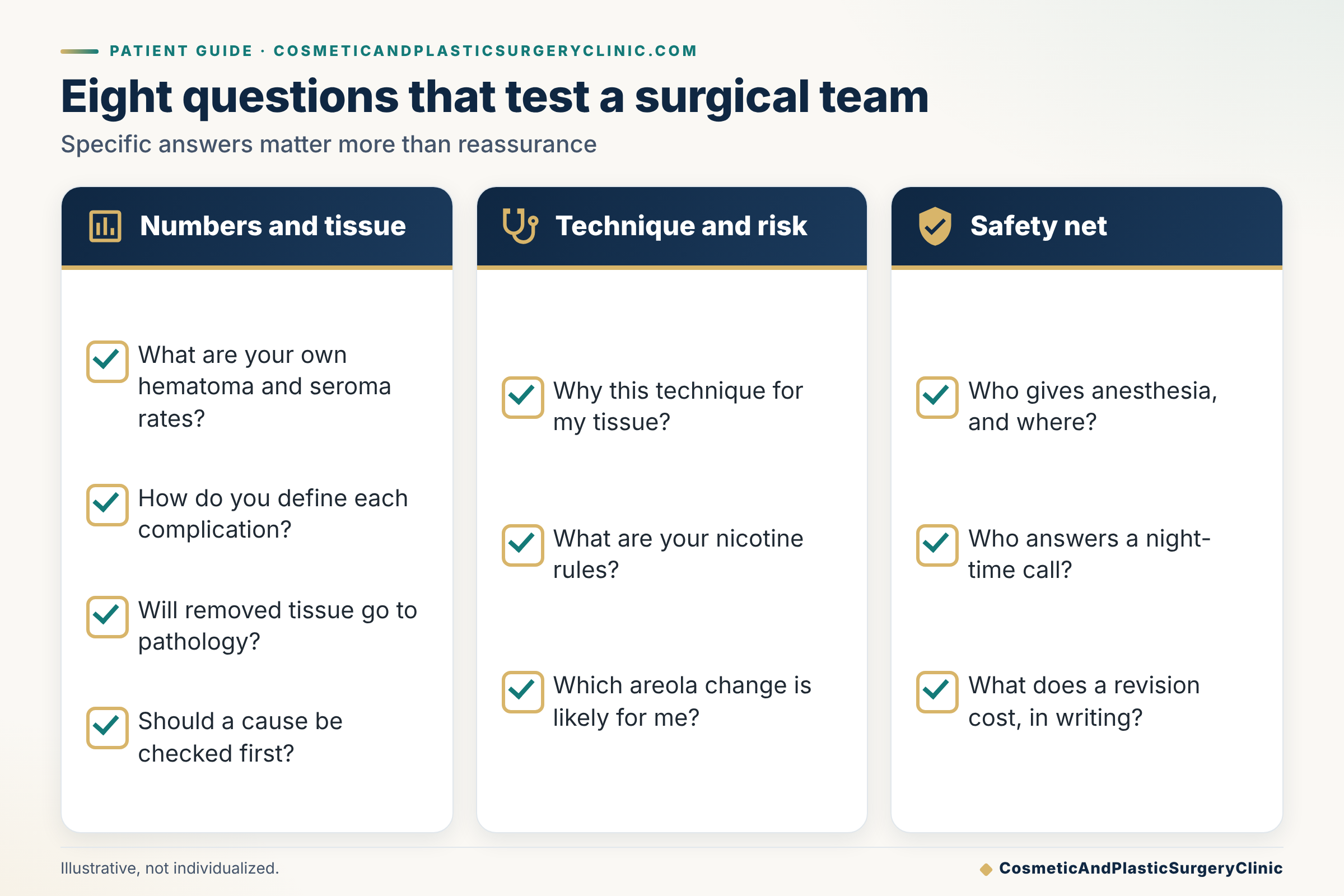
General statistics help you ask better questions; they cannot replace a surgeon’s answers about your own anatomy. The questions below are built to separate a team that has thought through gynecomastia surgery risks from one that is reciting reassurance. A specific answer, with a number or a plan attached, is the signal.
Questions about numbers, tissue and technique
Ask for the surgeon’s own rates and definitions
Ask for the surgeon’s own numbers on gynecomastia surgery risks: what rates of hematoma, seroma, infection, nipple-areola problems and revision the surgeon has seen in their own gynecomastia patients, how those are defined, and over how many cases. A surgeon who says “almost none” without definitions has not answered. Ask also which complication they see most often and what they changed after the last one.
Then ask which technique they recommend for your tissue and why not the alternative. The consultation article linked earlier goes deeper on what a good answer sounds like.
Ask what happens to the removed tissue and what else might be causing the enlargement
Ask whether removed tissue goes to pathology, who reviews the report and when you will see it. Ask what evaluation they want before surgery: medication and supplement review, hormone testing or imaging if indicated, and whether any of it should come first. If the cause is never examined, surgery may remove tissue that a continuing exposure then rebuilds.
If the enlargement is mostly fat, ask whether surgery is the first step or whether weight and other factors should be addressed first; see the fat-versus-gland article linked earlier.
Questions about the safety net, revision and waiting
Facility, anesthesia, after-hours cover and revision terms
Ask where the surgery will be done and whether the facility is accredited, who provides anesthesia, and who you call at 2 a.m. with a swelling that is getting bigger. Ask what a revision costs if one is needed, whether the surgeon’s fee, the facility and anesthesia are billed separately for a second operation, and what the written policy says. Gynecomastia surgery cost explains how those pieces are usually itemized.
Ask also how the practice handles a complication at a distance if you travel for surgery; the general issues are covered in medical tourism and surgery.
When waiting, more evaluation or no surgery is reasonable
Gynecomastia is common, and MedlinePlus says often no treatment is needed and that growth in newborns and young boys often resolves on its own. Waiting, a medical evaluation or a second opinion are all reasonable and do not close the door on surgery later. An ASPS article quoting one surgeon describes a good candidate as a nonsmoker at a normal body weight, which is a reminder that timing can change risk; it is not a test you can apply to yourself.
For a breast-reduction contrast that many men are told about, breast reduction risks describes a different operation with different complication patterns; do not transfer those figures here.
Frequently asked questions
Is a lump after gynecomastia surgery always a complication?
No. Firmness is common as tissue heals, and ASPS says swelling, numbness, bruising and firmness can last several months. Fat necrosis, a firm area where fatty tissue died, is also on the ASPS risk list. The point is not to guess. A lump that is new, growing, red, painful or only on one side should be examined by the surgical team, who can tell normal healing from a fluid collection, fat necrosis or something that needs testing.
Do both sides heal the same way after gynecomastia surgery?
Not necessarily. Many men start with different amounts of tissue on each side, and the 2022 pooled review recorded 36 asymmetry events among 7,294 patients, though no source read defines the threshold. Swelling often lingers longer on one side, which can make differences look larger early on. Ask the surgeon beforehand which side they expect to be harder to correct and when they will judge symmetry, usually after swelling has settled.
Is nipple numbness one of the gynecomastia surgery risks?
Yes. The ASPS risk list says changes in nipple or breast sensation may be temporary or permanent. In a 2025 series of 72 patients, about 88% kept nipple sensation at roughly 17 months, so some did not. ASPS describes the change only as altered sensation. Ask what the surgeon has seen in their own patients, and which incision they plan.
Do gynecomastia surgery risks depend on whether the tissue is fat or gland?
It can. The pooled review grouped complications by technique, and hematoma and seroma were reported more often in excision groups than in liposuction groups. A 2017 follow-up of 16 men found recurrence in 5 of 8 with fatty tissue and 1 of 8 with glandular tissue, too few to generalize. Tissue type changes the operation, and so the risks you discuss. A clinician has to examine you to know which applies.
How long should I avoid nicotine to lower gynecomastia surgery risks?
The ASPS 2024 practice reference recommends cessation four to eight weeks before surgery unless an emergency requires less, and at least four weeks after. It treats any nicotine, including patches and vaping, as a risk factor. A 2016 ASPS blog post by a surgeon described a window of three to six weeks before and after. Your surgeon sets the rule, may test for cotinine, and would rather delay surgery than have tissue lose blood supply.
Can gynecomastia come back, and is that part of gynecomastia surgery risks?
It can. A 2017 follow-up of 16 men 10 to 19 years after surgery found recurrence in 6, though the sample was small. Surgery removes tissue, not the cause, and a December 2024 ASPS article says testosterone supplements, injectable steroids and some muscle-building supplements can contribute. Weight gain may also matter. Ask the surgeon what they check for beforehand and what they would recommend if the tissue returned.
What does a surgeon do with the tissue that is removed?
Removed tissue is commonly sent to a pathologist; a 2015 analysis of 5,113 breasts from a Dutch registry described the findings. Invasive carcinoma was found in 0.11% of specimens, carcinoma in situ in 0.18%. Ask whether your surgeon sends all tissue, how you will be told the result, and what happens if something unexpected is found. Ask also whether pathology is billed separately.
Sources and further reading
- American Society of Plastic Surgeons — Gynecomastia surgery: risks and safety (accessed 2026-11-13) — list of risks for the operation
- American Society of Plastic Surgeons — Gynecomastia surgery: recovery (accessed 2026-11-13) — drain, support garment, chest pain and breathing warning
- American Society of Plastic Surgeons — Gynecomastia surgery overview (accessed 2026-11-13) — tissue types, causes, areola repositioning
- American Society of Plastic Surgeons — How plastic surgeons help men with gynecomastia (December 12, 2024; accessed 2026-11-13) — evaluation, sensation, scars, recurrence contributors
- American Society of Plastic Surgeons blog — What men need to know before having gynecomastia surgery (July 9, 2019; accessed 2026-11-13) — steroids, marijuana, complications named
- American Society of Plastic Surgeons — 2025 Plastic Surgery Statistics Report (accessed 2026-11-13) — male breast reduction procedure counts
- American Society of Plastic Surgeons — Managing the risks of smoking and nicotine, practice reference (2024; accessed 2026-11-13) — nicotine and cessation timing
- American Society of Plastic Surgeons blog — How nicotine sabotages plastic surgery (December 12, 2016; accessed 2026-11-13) — surgeon’s view on nicotine and delay
- American Society of Plastic Surgeons — Patient safety (accessed 2026-11-13) — board certification and facility choices
- The Aesthetic Society — Risks associated with gynecomastia surgery (October 2021; accessed 2026-11-13) — blood clots; complications infrequent
- Innocenti, Melita and Dreassi — Incidence of complications for different approaches in gynecomastia correction, Aesthetic Plastic Surgery 2022 (accessed 2026-11-13) — 94-study pooled event counts
- Zavlin, Jubbal, Friedman and Echo — Complications and outcomes after gynecomastia surgery, Aesthetic Plastic Surgery 2017 (accessed 2026-11-13) — NSQIP 1,583 adults and 204 pediatric cases
- Knoedler et al. — Gynecomastia surgery in 4996 male patients over 14 years, Aesthetic Plastic Surgery 2024 (accessed 2026-11-13) — NSQIP 30-day complications and risk factors
- Ramasamy, Narayanasamy, Sindhuja and Devi — Patterns of intraoperative bleeding in gynecomastia surgery, 2026 (DOI 10.1093/asjof/ojag207; accessed 2026-11-13) — bleeding hotspots and rates in 4,560 patients
- Wolter et al. — Innovative surgical concept for Simon’s grade IIb gynecomastia, Aesthetic Surgery Journal 2025 (accessed 2026-11-13) — single-surgeon 130-breast series
- Lapid, Jolink and Meijer — Pathological findings in gynecomastia: analysis of 5113 breasts, Annals of Plastic Surgery 2015 (accessed 2026-11-13) — specimen pathology prevalence
- Fricke, Lehner, Stark and Penna — Long-term follow-up of recurrence and patient satisfaction after surgical treatment of gynecomastia, Aesthetic Plastic Surgery 2017 (accessed 2026-11-13) — recurrence in a 16-man follow-up
- Plastic Surgery Practice — Correction of gynecomastia in bodybuilders: case series of 5,000 patients treated over 33 years (May 20, 2015; accessed 2026-11-13) — trade summary of one surgeon’s series
- MedlinePlus — Breast enlargement in males (reviewed October 1, 2024; accessed 2026-11-13) — causes, treatment, when to contact a provider
- MedlinePlus — Pulmonary embolus (reviewed October 21, 2025; accessed 2026-11-13) — symptoms and emergency advice
- MedlinePlus — Anesthesia (updated September 30, 2025; accessed 2026-11-13) — types and risks
- CDC — About blood clots (reviewed March 5, 2025; accessed 2026-11-13) — clot symptoms and moving after surgery
- Cleveland Clinic — Seroma (updated February 11, 2026; accessed 2026-11-13) — timing, treatment, when to call
- Cleveland Clinic — Hematoma (updated November 14, 2024; accessed 2026-11-13) — definition and post-surgery causes
- National Cancer Institute — Male breast cancer (updated October 13, 2026; accessed 2026-11-13) — rarity and signs
- American Cancer Society — Key statistics for breast cancer in men (2026 estimates; accessed 2026-11-13) — new cases and lifetime risk
- American Board of Plastic Surgery — Verify certification (accessed 2026-11-13) — where to confirm board certification