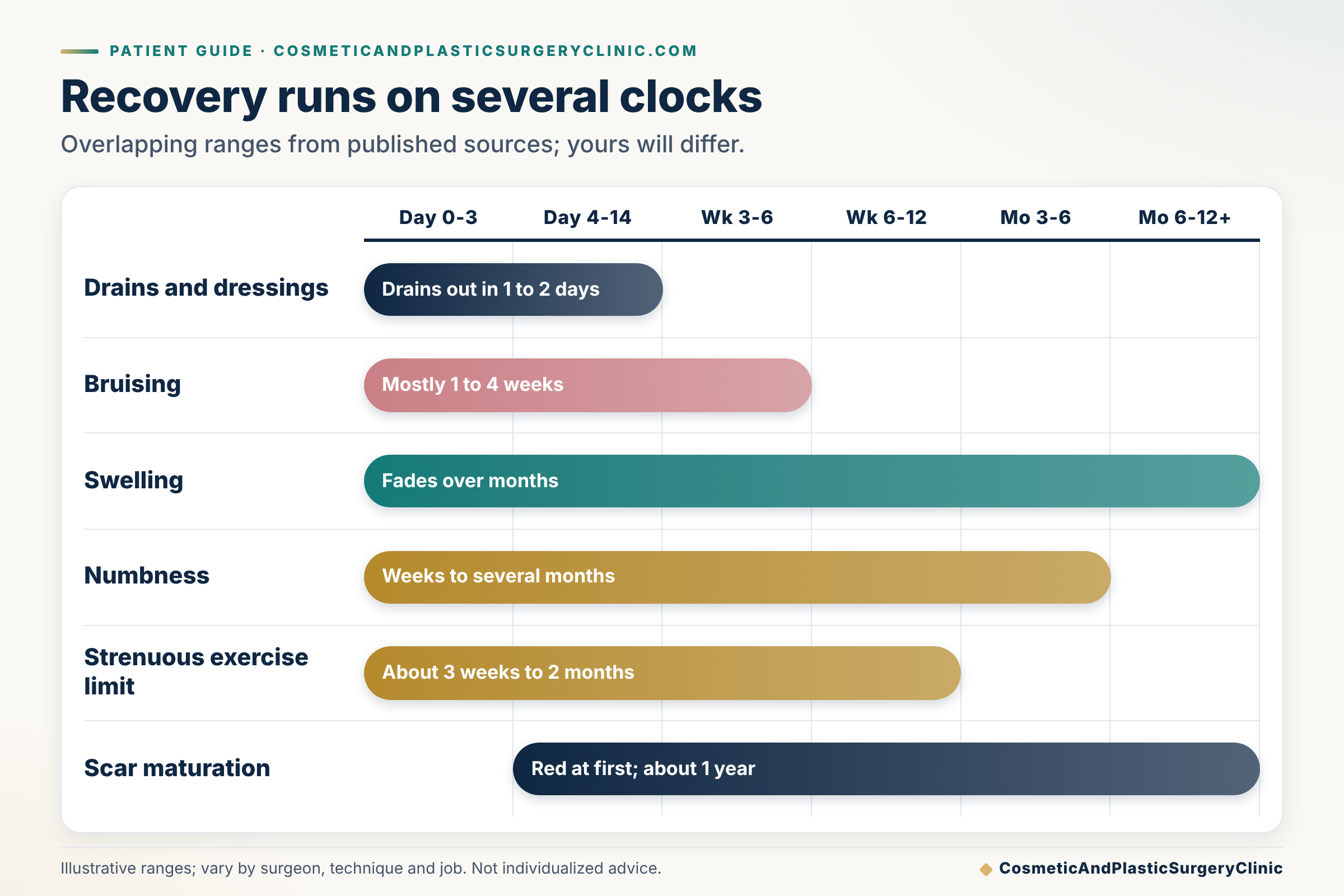
Facelift recovery is not one event but several overlapping processes: a bandage and sometimes drains in the first days, bruising that fades over roughly one to four weeks, numbness that can linger for months, and a final contour that keeps settling long after friends have stopped asking how you feel. Published guidance agrees on that arc and disagrees on the details, from the day a facial sling comes off to the week strenuous exercise is reasonable again.
This page lays out those ranges, shows where the sources differ and explains what the studies add. It is general education, not instructions for your own face; your surgeon’s written plan outranks anything here. What the operation changes is covered in the facelift overview, the complication side is in facelift risks, and logistics that apply to any operation sit in the plastic surgery recovery planning guide.
Facelift recovery is several clocks running at once
The usual mistake in planning facelift recovery is asking for a single date, the day you are back to normal. Different tissues heal on different schedules, and the schedule that matters most depends on your priority: looking presentable on a video call, driving, exercising or judging the new contour.
What the early changes in your face and neck usually represent
Swelling, bruising, tightness, numbness and tiredness do not share a schedule
Swelling is fluid and inflammation in the tissue that was lifted and repositioned. Bruising is blood pigment under the skin, and it shifts through purple, green and yellow as the body clears it. Tightness is the feeling of a snugger envelope over swollen tissue. Numbness reflects small sensory nerves that were stretched or divided during the lift, and tiredness follows anesthesia, interrupted sleep and the effort of keeping the head raised.
The sources do not agree on how long each one lasts. The Aesthetic Society says bruising and swelling peak at 36 to 48 hours and subside over 10 to 14 days. Cleveland Clinic says bruising and swelling last about 2 to 3 weeks, and MedlinePlus says paleness, bruising and puffiness typically resolve in 4 to 6 weeks. All three can be right for different patients, different extents of surgery and different definitions of “resolved.”
Why a range beats an exact-day promise for facelift recovery
Take work. Cleveland Clinic says a more extensive facelift usually means about 2 to 3 weeks away, and a less invasive mini-facelift about 5 to 7 days. An American Society of Plastic Surgeons (ASPS) article from 2018 by a practicing surgeon says many people feel like themselves and can return to work by the end of week two. For exercise, UCSF Health says non-strenuous activity can resume after about two weeks, Cleveland Clinic suggests avoiding strenuous exercise for at least three weeks, and the Aesthetic Society says at least a month.
Those gaps are real. They reflect how much was done (the mini-facelift vs facelift comparison explains why scope matters), whether neck or eyelid work was added, and how a particular person heals. A surgeon who gives you one exact day is simplifying. Ask for the range and for the signs that would extend it.
Combined operations stretch the timeline. If the face is paired with eyelid or neck work, read about blepharoplasty recovery and neck lift recovery before you block out time off.
Surgeon-side choices that may change early bruising and swelling
Drains, compression wraps, sealants and medicines given around surgery are the surgeon’s calls, and the evidence for them is mixed. Mayo Clinic notes that a small drain behind one or both ears may be used. A 2025 randomized trial in Aesthetic Plastic Surgery compared a hemostatic net with a surgical drain in 160 women having deep plane facelifts and found comparable hematoma, seroma and swelling outcomes.
An older split-face trial of 50 patients, with one side drained and the other not, reported that drains did not change hematoma or swelling but did reduce bruising; the record opened for this article does not show its year. A 2025 trial of 60 patients found no significant difference in bleeding or bruising between intravenous and local tranexamic acid. None of this is a reason to start, stop or add anything on your own. Ask which of these your surgeon uses in facelift recovery and why.
Setting up the practical plan before surgery day
Helper, driver, supplies, sleep set-up and follow-up visits
Cleveland Clinic says you are observed for about a couple of hours after surgery and that someone should stay with you for at least the first 48 hours. Mayo Clinic says someone must drive you home and help the first night if you go home the same day. Its list of supplies is practical: gauze, clean towels and washcloths, a phone within reach, ointments only as your surgeon recommends, front-fastening shirts and a thermometer.
Sleep set-up is where sources differ. MedlinePlus suggests two or three pillows or about a 30-degree angle for a couple of days, while the Aesthetic Society says to keep the head at 40 degrees for two weeks and to avoid lying flat or on the stomach. Cleveland Clinic expects several visits in the 2 to 3 weeks after surgery, and Mayo describes follow-up over about two months. Put those facelift recovery dates on a calendar before the operation, not after.
What your written facelift recovery instructions should contain
Verbal advice evaporates after anesthesia, so ask for the facelift recovery plan on paper before the day. A useful sheet answers these questions:
- When the first dressing change happens, when drains and stitches come out, and what to do if a dressing slips.
- Which pain relievers are allowed and which, such as aspirin or anti-inflammatory medicines, need the surgeon’s approval first.
- Head position, how long to keep it, and what to do about sleeping on your side.
- The bleeding, pain, temperature and swelling thresholds that mean a call, and an after-hours number saved in your phone.
- Dates or ranges for work, driving, exercise, makeup, hair color, sun and travel.
- The follow-up schedule, including who sees you if you traveled for the operation.
The guide to choosing a plastic surgeon covers how to verify who is actually responsible for that follow-up care.
The first two weeks of facelift recovery, stage by stage
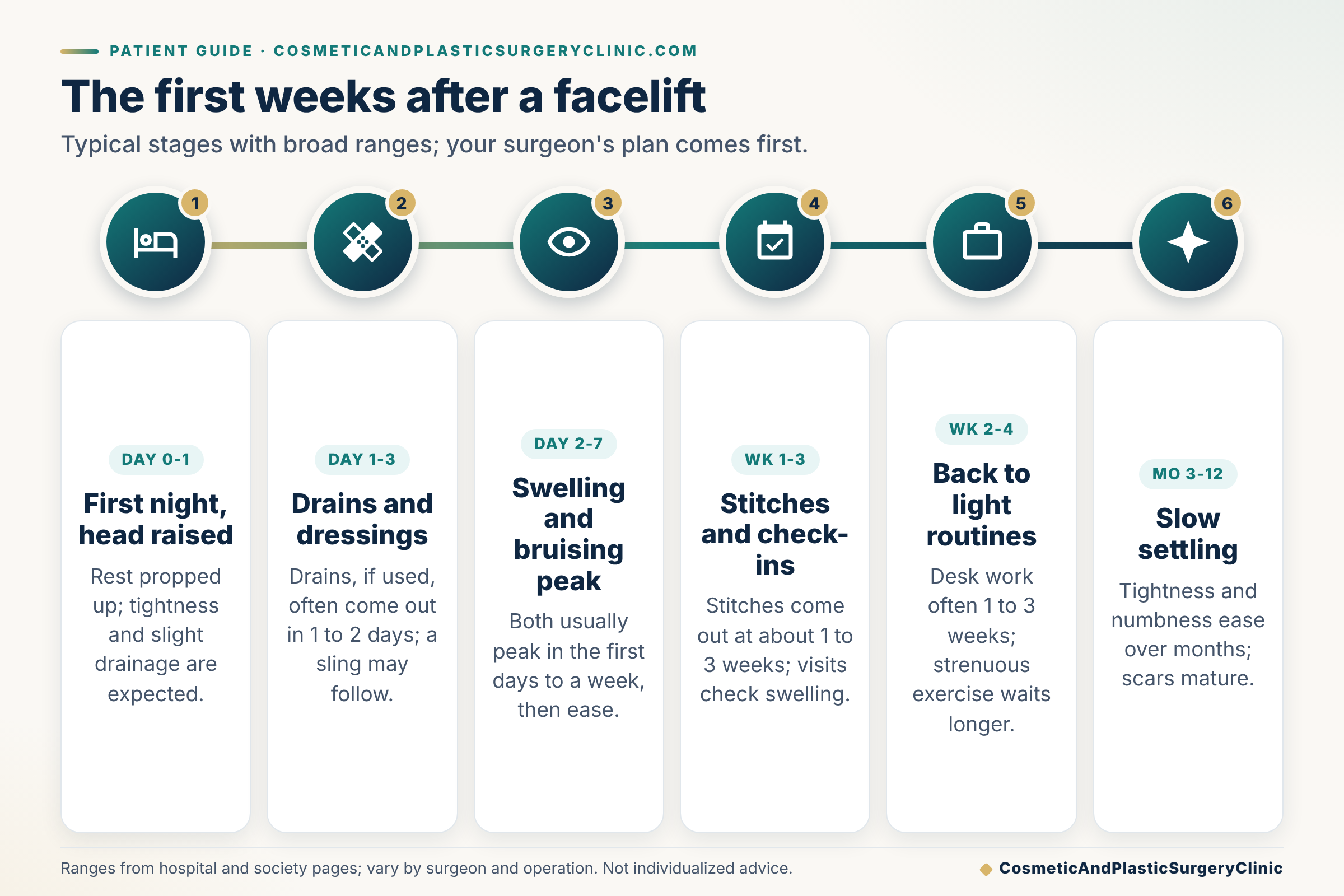
The first fortnight is the most regulated part of facelift recovery, and it is also where published instructions differ most. Knowing what is typical, and which instruction is simply your surgeon’s preference, spares you unnecessary worry.
Days 0 to 3: bandage, drains, head elevation and the first night
Bandages, drains and slings: what the sources describe
ASPS says a bandage may be placed around the face to limit swelling and bruising and that small tubes may remove excess blood or fluid. Mayo Clinic says the surgeon may remove a drain the day after surgery, apply antibiotic ointment and replace the bandages, and that about two or three days after surgery you may switch to a stretchy facial sling. The table shows how six published sources describe facelift recovery.
| Source | Dressings and drains | Bruising and swelling | Work | Strenuous exercise |
|---|---|---|---|---|
| Aesthetic Society | Bulky dressing with drains 1 to 2 days; drains usually out at first visit | Peak 36 to 48 hours; subside over 10 to 14 days | Surgeon advises; no date given | None for at least 1 month; routine fitness after about 2 months |
| Cleveland Clinic (2021) | Bandages off after a few days; small drains possible | About 2 to 3 weeks; back to normal in 2 to 3 months | 2 to 3 weeks; mini-facelift 5 to 7 days | Avoid at least 3 weeks |
| Mayo Clinic (2026) | Drain may come out next day; sling at 2 to 3 days; stitches about 1 week | No duration given; first 3 weeks are the key healing period | No date given | Avoid hard activity and sports for the first 3 weeks |
| MedlinePlus (2025) | Drain out in 1 to 2 days; bandages off in 1 to 5 days; stitches 5 to 7 days | Bruising and puffiness typically 4 to 6 weeks | No date given | Avoid straining and lifting right after surgery |
| UCSF Health | Bandages and stitches out or dissolved in the first week | Bruising peaks within the first week | Not addressed | Non-strenuous after about 2 weeks; full activity after several weeks |
| ASPS article (2018) | Dressing change at a day 2 visit | Peak at days 3 to 4; minor remnants up to a year | Many by the end of week 2 | Exercise resumes in days 15 to 30 |
These sources are not contradicting one another; they describe different surgeons’ protocols and different operations. What matters is that your own drain, dressing, sling and stitch dates appear on your own instruction sheet.
Pain, drainage, tightness and the first nights
The Aesthetic Society describes mild to moderate pain that begins to ease within 48 hours, tightness in the neck that is most noticeable in the first one to two days while the bulky dressing is on, and slight drainage for the first 48 hours. The ASPS article says the first day is usually when pain medicine is most needed, and that by days 4 to 6 most people no longer need prescription medicine.
Cold is where instructions diverge. Mayo Clinic suggests cool packs, UCSF Health says cold compresses are often recommended for the first 48 hours, and the Aesthetic Society says cool, not cold, compresses on the eyes only, for no more than 20 minutes at a time, with no ice directly on the skin. Follow your own facelift recovery sheet, because pressure and temperature on freshly lifted skin are your surgeon’s call.
Days 4 to 14 of facelift recovery: stitches, fading bruises and the first look in the mirror
Stitch removal, dressing changes and follow-up visits
Stitch timing varies with technique and closure. Mayo Clinic says stitches come out about a week after surgery, MedlinePlus says some are removed at 5 to 7 days while hairline stitches or clips may stay a few days longer, and the ASPS article says anywhere from the end of week one to week three. Cleveland Clinic notes that closure can be dissolvable stitches, stitches removed after a few days, or skin glue, and the surgeon will explain incision care before you go home.
A visit around the second day to check swelling and change dressings is typical, according to the ASPS article. Treat those visits as part of facelift recovery, not as optional extras. They are when a developing problem gets noticed by someone trained to notice it.
Bruising and numbness on a calendar
By the second week some swelling and bruising remain, and the ASPS article calls numbness, tingling and tightness common. By about week two, it says, many people feel like themselves and can manage light activity such as walking. Mayo Clinic says to avoid makeup, hard activity and sports during the first three weeks, which it calls the key healing period.
Sun is part of the plan too. Mayo Clinic says to keep the incisions out of the sun for three weeks and then use SPF 30 or higher, and the Aesthetic Society recommends sunglasses, a wide-brimmed hat and sunscreen applied at least 30 minutes before outdoor exposure. Plan the first social event or video call for week three, not week one.
Warning signs after a facelift: routine, call today, or emergency
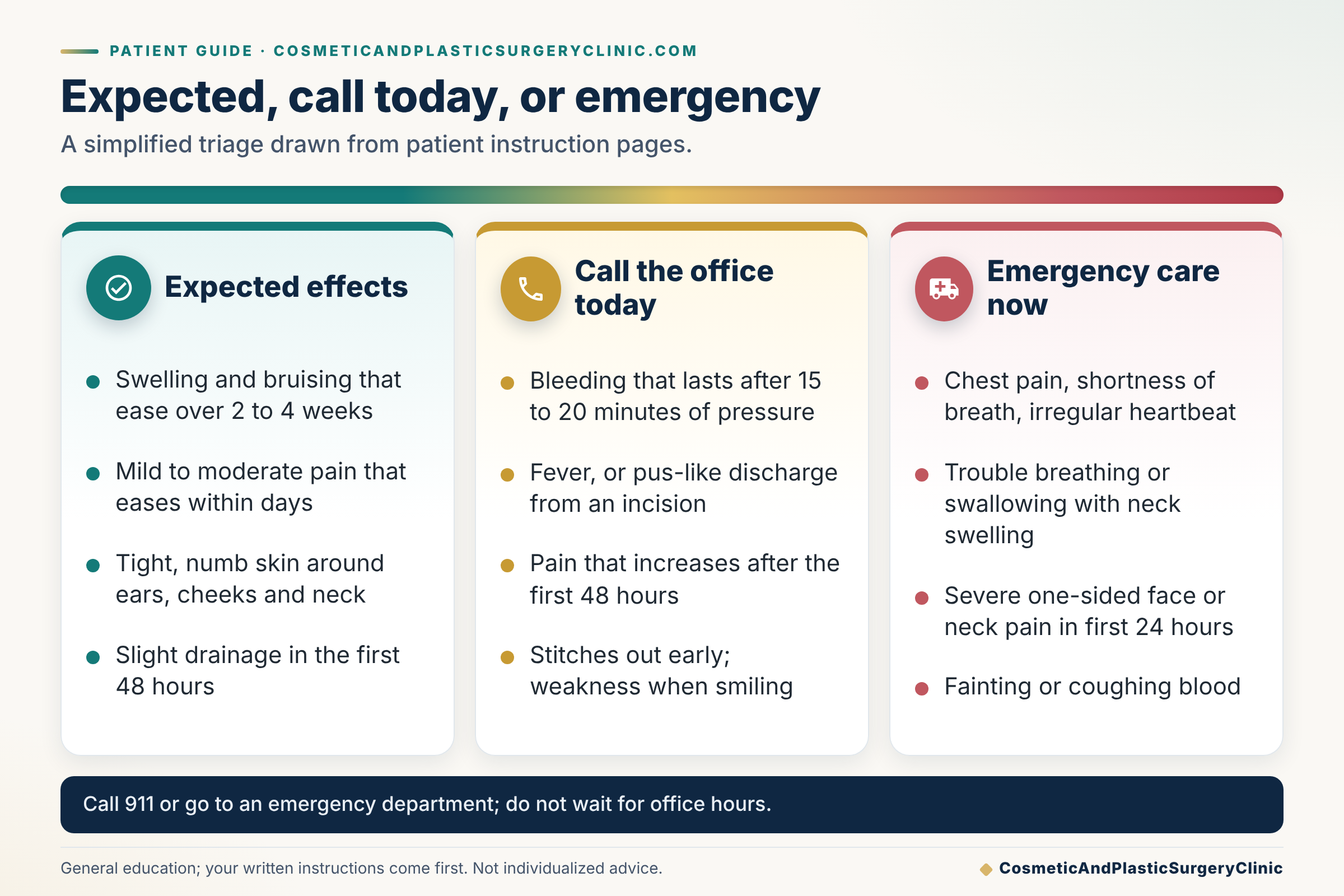
Most of facelift recovery is uncomfortable but ordinary. A small fraction is not, and the useful skill is telling the two apart quickly. Sources describe three tiers: effects that are expected, symptoms that deserve a same-day call to the surgeon’s office, and a short list that means emergency care.
Hematoma: the early complication everyone should know about
Why the first 24 to 48 hours matter in facelift recovery
A hematoma is a collection of blood under the skin flap. Mayo Clinic calls it the most common facelift complication and says it usually forms within 24 hours, and that prompt treatment prevents tissue damage. That timing is why surgeons ask for a helper on the first nights and why same-day follow-up visits exist. It also means the first night is when a quiet bedside observer is most useful.
Read it with its limits. It is one surgeon’s records, with no control group, and the protocol was a bundle of changes, so no single step can be credited. Collections drained in clinic after about day 10 were excluded from the count. What it supports is the timing: the highest-stakes window is the first day or two.
What raises hematoma risk and what surgeons do about it
A 2015 ENTtoday summary of the literature says reported hematoma rates run from 0.2% to 8% and are generally accepted at about 3% to 4%. It names elevated blood pressure before surgery as a definite risk factor and lists male sex, recent aspirin or anti-inflammatory use, platysma tightening in front of the neck, and smoking among the others. Large studies found no clear link to technique, anesthesia type or age, other than hypertension.
A 2025 meta-analysis of deep plane facelifts, summarized by ReachMD, pooled 31 studies and 8,841 patients and reported an overall hematoma rate of 2.7% and a major hematoma rate of 0.97%, with no clearly superior adjunct among tranexamic acid, sealants and hemostatic nets. Those are population rates from published series and cannot predict an individual case; the numbers and their limits are examined in facelift risks.
The Brazilian authors also link pain, anxiety, nausea and vomiting to blood-pressure spikes and hematoma. For a patient, that turns into practical questions: what is the anti-nausea plan, what is the pain plan, and who checks blood pressure before discharge? Never change a blood pressure or blood thinner regimen on your own. Smoking, per Mayo Clinic, greatly raises the risk of poor wound healing, hematoma and skin loss, and your surgeon may advise against surgery if you smoke.
Other reasons to call, and what counts as an emergency
The same-day call list
Cleveland Clinic lists these reasons to contact your provider immediately: bleeding that soaks through the bandage, extreme swelling, fever, abnormal discharge such as pus, extreme pain, and stitches coming out before they are due to be removed. The Aesthetic Society adds two precise triggers: bleeding that persists after 15 to 20 minutes of pressure and pain that increases significantly after the first 48 hours.
Ask your office what a good call during facelift recovery sounds like. A clear description (where, since when, getting worse or steady, any fever) lets staff triage you faster than “something feels off.” Photos taken in the same light each day can help you describe change; ask whether your office accepts them.
Emergency signs that should not wait for the office
Clots are a general surgical risk, not a facelift-specific one, but the symptoms are worth knowing. The CDC says deep vein thrombosis can cause swelling, pain, warmth and redness in a leg or arm, though about half of people with it have no symptoms. A pulmonary embolism can cause trouble breathing, chest pain that worsens with a deep breath, a fast or irregular heartbeat, coughing, lightheadedness or fainting, and it needs immediate medical help. The CDC also advises moving as soon as possible after being confined to bed, so ask what level of walking your surgeon wants.
Weeks 3 to 12: the slow middle of facelift recovery
After the first fortnight, facelift recovery turns into a slow fade that no calendar can pin down. The table condenses the stages described across the sources; use it as a map of ranges, not a schedule.
| Phase | Common changes | Typical limits | Planning issue | Call sooner if |
|---|---|---|---|---|
| Days 0 to 3 | Swelling and bruising build; drainage; neck tightness; fatigue | Head raised; rest; no bending or heavy lifting | Helper for at least 48 hours; saved phone numbers | One-sided pain or swelling; bleeding that continues; breathing trouble |
| Days 4 to 14 | Drains and dressings out; stitches begin to come out; numbness and tingling | No driving for about a week (Aesthetic Society); walking only | Stitch and follow-up visits; first video call | Fever, pus-like discharge, stitches out early |
| Weeks 3 to 6 | Bruising gone for many; scars red, firm, raised; numbness persists | Strenuous exercise commonly waits 3 to 4 weeks; sun care | Work return; hair color waits about 6 weeks (Mayo) | Pain that increases; a wound that opens |
| Weeks 6 to 12 | Contour more visible; mild tightness or puffiness | Easing into routine fitness around 2 months (Aesthetic Society) | Follow-up over about 2 months (Mayo); first dated photos | Weakness when smiling or moving the face |
| Months 3 to 6 | Feeling back to normal at 2 to 3 months (Cleveland); tingling fades | Sun protection continues | Six-month photos and an honest check-in | Lasting numbness or weakness; scars thickening |
| Months 6 to 12 and beyond | Scars mature; very minor swelling or tightness may remain | Usually few | Twelve-month photos; any touch-up discussion | Raised or widening scars |
Reading the swelling curve without over-reading it
What measured data exists, and what does not
Most statements about swelling in facelift recovery come from clinic experience and patient handouts. No published, measured swelling curve specific to facelift turned up among the sources opened, so every percentage you see online should be treated as a surgeon’s impression, not a measurement.
The qualitative picture is consistent, though. Cleveland Clinic says feeling back to normal may take two to three months. The Aesthetic Society says full healing inside and out can take at least six months, and that facial discomfort, tightness and tingling should be gone by then. The ASPS article says very minor swelling, bruising, tightness and numbness can take up to a year to resolve and are usually noticeable mainly to you.
Lingering tightness and puffiness late in facelift recovery: mostly noticeable to you
The ASPS article describes some swelling and tightness at weeks three and four, with contour improvements often becoming noticeable then, and says the incisions may look pinkish-red at first. That gap between what you feel and what others see explains why patients sometimes report feeling “not done” while friends comment that they look rested. If something feels tighter, not looser, as weeks pass, that is a question for the visit, not for a search engine.
Numbness, nerves and hair: what feels strange and for how long
Numbness in the ears, cheeks and neck
The Aesthetic Society says to expect numbness in the earlobes, face and neck for several weeks. UCSF Health says numbness begins to ease after several weeks and some may last several months, and MedlinePlus says face and ear numbness may last up to several months. If a brow lift is combined, MedlinePlus says forehead and scalp numbness is replaced by itching or tingling as nerves regrow, which can take up to six months to resolve.
Numbness has practical consequences: you may not feel a hot hair dryer, a curling iron or a razor on the skin near the ears. Ask your surgeon what to avoid until sensation returns.
Facial weakness is a different problem from numbness
Numbness is a sensory change and is expected. Weakness of facial movement, such as a crooked smile or a brow that will not lift, is a motor change and is not expected. A 2025 systematic review in Maxillofacial Plastic and Reconstructive Surgery, covering 20 studies, reported a pooled incidence of facial nerve injury after facelift of about 2.5%, with the frontal and marginal mandibular branches among the more vulnerable.
The same review reported that about 70% recovered fully within six months with conservative care and that roughly 10% had lasting deficits. It is a narrative-heavy review with mixed study designs and variable follow-up, and Mayo Clinic describes nerve injury as rare, with numbness or weakness that may last a few months to a year. If weakness appears, tell the surgeon promptly; the review notes that the evidence for some treatments, such as corticosteroids, is inconsistent.
Hair near the incisions
Mayo Clinic lists hair loss around the incisions as a possible effect that may be temporary or lasting, and says a hair-follicle transplant may help if it is lasting. It also advises avoiding hair coloring, bleaching or perms for at least six weeks. The facelift overview explains where incisions run in relation to the hairline and ears.
Return to life after a facelift: work, driving, exercise, makeup, sun and social downtime
Return-to-life questions are where people most want a number and where the numbers are least consistent. The table gathers what the opened sources report for facelift recovery and flags where to ask your own surgeon.
| Activity | Range reported | Where sources differ | Clearance note |
|---|---|---|---|
| Work | By end of week 2 (ASPS 2018) to 2 to 3 weeks (Cleveland); mini-facelift 5 to 7 days | Extent of surgery; how visible you must be | Ask for ranges for desk work and customer-facing work |
| Driving | Not for at least 1 week (Aesthetic Society) | Only one opened source gives a number | Get permission in writing; depends on pain medicine |
| Flying and travel | No figure found in the sources opened | Not addressed | Ask before booking; CDC advises moving early after surgery |
| Strenuous exercise | About 2 weeks (UCSF, non-strenuous) to 3 weeks (Cleveland) to 1 month (Aesthetic Society) | Widest spread of any item | Ask what counts as strenuous and whether walking is encouraged |
| Sleep position | About 30 degrees for a couple of days (MedlinePlus) to 40 degrees for 2 weeks (Aesthetic Society) | Duration and angle | Ask about side sleeping and pillow set-up |
| Sun | Incisions out of sun 3 weeks, then SPF 30 or higher (Mayo); scars out of direct sun 6 months (ASPS 2026) | Duration of strict avoidance | Ask about hats, sunglasses and which sunscreen |
| Makeup and hair color | Avoid makeup in the first 3 weeks and hair coloring for at least 6 weeks (Mayo) | Aesthetic Society: wait for surgeon approval | Ask about hair products near incisions |
Work, driving and travel
Work: one week or three
For a desk job, about two weeks is a common figure in published facelift recovery guidance, with a mini-facelift sometimes shorter. Cleveland Clinic also notes that up to three weeks off may be needed after a more invasive operation. Decide in advance whether your real constraint is energy or appearance. If it is appearance, a longer buffer costs less than rescheduling a presentation, and remote work can bridge the gap.
If your job involves lifting, bending, sweating or close contact with customers, the answer changes. The Aesthetic Society advises avoiding bending and lifting heavy objects for a week and strenuous activity for at least a month, which is a conversation to have before you book surgery, not after.
Driving, flying and being away from your surgeon
The Aesthetic Society says no driving for at least one week. None of the other opened sources gives a driving number, and none gives one for flying, so treat both as questions for the surgeon. The CDC says to start moving as soon as possible after surgery and to ask your doctor about stockings or medicine if you are at risk of clots, which is relevant to any long trip.
If you travel to have surgery, build the recovery plan around who will see your face at the first dressing change and the stitch visit. Those visits matter more than the sightseeing, and the guide to choosing a plastic surgeon shows how to confirm the follow-up arrangement in advance.
Exercise, makeup, hair color, sun and scars
Exercise: walking early, strenuous later
Gentle walking is usually encouraged. The Aesthetic Society says to stay upright and moving as much as possible to reduce swelling and rules out swimming, diving, water skiing and strenuous athletic activity for at least a month. It says you may ease back into your regular fitness routine after about two months.
Those numbers differ from the ASPS article, which says exercise and activities can resume in days 15 to 30 with little visible sign of surgery. Blood pressure is a recurring theme in the hematoma literature, and straining can raise it, so the surgeon’s own clearance matters more than a table.
Makeup, hair color, sunscreen and scar care
Mayo Clinic says scars from a facelift are permanent but usually hidden by the hairline and the contours of the face and ears, and that raised scars are rare and may respond to corticosteroid injections. The Aesthetic Society says scars may look red, slightly firm and raised for the first four to six weeks, and that their final appearance takes at least a year.
ASPS published a scar-healing article in 2026 that describes redness and texture over the first six months, maturation between months six and twelve, and advice to keep scars out of direct sun for six months, using a high-SPF mineral sunscreen and a wide-brimmed hat for facial scars. It also warns against do-it-yourself remedies, which it says can cause infection or irritation. Those timelines are longer than Mayo’s three weeks of strict sun avoidance, so ask which rule your surgeon wants you to follow.
Social downtime and the emotional side
Planning the first public outing
In facelift recovery, “social downtime” is the time until you are comfortable being seen, and it is shorter than medical recovery and longer than most people hope. Consider a hypothetical: someone with a customer-facing job and a family event five weeks after surgery. Published ranges suggest bruising has cleared for many by weeks two to four and puffiness by four to six, so week five is plausible but not certain.
A sensible plan builds in slack: a first outing around week three that you can cancel, a video call with a good light, and the important event set for week six or later if appearance is the concern. Photograph your face weekly in the same light. The trend, not any single day, tells you whether recovery is on track.
Feeling unlike yourself is common, and usually passes
An ASPS article from 2025 describes not recognizing yourself after surgery as fairly common and not necessarily a sign of regret. It quotes a surgeon describing “facial recalibration,” the time the brain needs to update its self-image, and another saying distress can last hours, days or sometimes weeks. A 2021 Psychology Today overview by two facial plastic surgeons likewise describes short-lived low mood early on for some patients and recommends discussing mental health before surgery.
Build a support system, avoid making judgments about your face in the first swollen weeks, and tell your surgeon if low mood persists or begins to disrupt daily life. The ASPS article says persistent negative thoughts about your appearance that disrupt daily life can signal body dysmorphic disorder, and that a mental health professional is the right next step in that case.
Judging the result, and what to ask before you book
The end of facelift recovery is not an announcement; it is a gradual change in how often you think about it. The honest question is when to judge the result, and what to ask so that your plan matches the surgeon’s.
When the result is judged
Months, not weeks
Facelift recovery has no official end date. Cleveland Clinic puts feeling back to normal at two to three months, while the Aesthetic Society says full healing can take at least six months and the final scar appearance at least a year. A 2019 prospective study in Aesthetic Plastic Surgery followed 36 patients at five French centers using the FACE-Q questionnaire at 3, 6 and 12 months after face and neck lift. Scores were significantly higher at three months than before surgery and stayed constant at six and twelve months.
The study is small, patient-reported and uncontrolled, and 75% of the patients had at least one additional procedure, so it does not say what a facelift alone does for any one person. What it supports is the idea that satisfaction is measured at months, not days. How long the contour itself lasts is the subject of how long a facelift lasts.
Photos at fixed intervals
Take your own facelift recovery photos in the same light, pose and distance at about one week, one month, three months, six months and twelve months. Compare them with each other, not with a photo from another person’s recovery. The facelift before and after article explains how clinical photos are standardized and why timing changes what you see.
Questions to ask your surgeon about facelift recovery
Before you book
Bring these to the consultation, along with the broader list in the plastic surgery consultation questions article:
- What are my own drain, dressing, sling and stitch dates, and who removes each?
- What is the plan for pain, nausea and blood pressure in the first 24 to 48 hours?
- Which exact symptoms mean a same-day call, and which mean 911?
- What are the dates or ranges for work, driving, exercise, sun, hair color and travel?
- Who covers after-hours problems, and where will I be seen?
- Which medicines and supplements should I discuss with my regular doctors before surgery, and who decides what to do with each?
- What is the policy if a minor touch-up is discussed later? See facelift cost for how follow-up and revision policies are usually itemized.
If your facelift recovery is slower than expected
Slower than the table is not automatically a problem. Ask for a visit, bring your dated photos and describe the specific concern: swelling that is not changing, a tight area, a scar that is thickening, numbness that is not easing. Do not try home remedies on incisions; ASPS warns that they can cause infection or irritation.
If you are not getting clear answers, a second opinion from another board-certified plastic surgeon is reasonable. The plastic surgery risks overview explains how to think about the difference between an expected effect and a complication.
Frequently asked questions
Can I shower or wash my hair during facelift recovery?
The Aesthetic Society says you can shower or bathe the day after surgery with the spray kept off your face, and wash your hair gently after 24 hours using a cap-type or cool-setting dryer, not heat. Other offices set different rules, especially around dressings and drains. Because numbness can make heat harder to judge, ask how hot is too hot, and follow your surgeon’s sheet rather than a general page.
Does smoking or nicotine slow facelift recovery?
Mayo Clinic says smoking greatly increases the risk of poor wound healing, hematoma and skin loss, and that a surgeon may advise against surgery in a smoker. A 2015 summary of the hematoma literature also lists smoking among risk factors. If quitting is difficult, tell the surgical team early, before you commit to a date.
How long should I sleep with my head raised during facelift recovery?
Sources give different answers. MedlinePlus says two or three pillows or a 30-degree angle for a couple of days, and the Aesthetic Society says 40 degrees for two weeks, avoiding lying flat or on your stomach. The difference probably reflects different protocols rather than different physiology. Side sleepers may find that two pillows under the head and a soft pillow under the mid-back are more comfortable, but ask your surgeon which position and for how long.
Can I take aspirin or ibuprofen for discomfort during facelift recovery?
Do not decide that yourself. The Aesthetic Society says to avoid aspirin and anti-inflammatory medicines for two weeks before and two weeks after surgery unless your surgeon approves, and MedlinePlus says to avoid them for the first few days. Mayo Clinic says surgeons may ask you to stop blood thinners and certain supplements about three weeks beforehand. Ask which pain relievers are acceptable, in what amounts and for how long, and get the answer in writing.
Is one-sided swelling during facelift recovery always a hematoma?
No, and you cannot tell by looking. Mayo Clinic lists severe pain on one side of the face or neck within 24 hours as a reason to seek care immediately, and a 2015 summary says hematomas range from minor bruising to large collections that can threaten the airway. Swelling is expected after a facelift, and it can be uneven. Any swelling that is tense, growing quickly or painful deserves a same-day call, and trouble breathing needs 911.
Can I fly home soon during facelift recovery?
No opened source gave a specific number of days, so this is a question for your surgeon rather than for a table. The CDC says to start moving as soon as possible after surgery and, if you are at risk of clots, to ask about compression stockings or medicine. If you traveled for surgery, ask before booking flights when you will be seen for the first dressing change and the stitch visit, and what happens if a problem appears after you leave.
Is mini-facelift recovery really shorter than full facelift recovery?
Cleveland Clinic gives about 5 to 7 days for a less invasive mini-facelift and 2 to 3 weeks for a more invasive operation, but no comparative recovery study turned up among the sources opened. Scope is the likely reason, because a smaller operation involves less dissection. Whether a mini-facelift suits a particular face is a separate question, covered in the mini-facelift vs facelift article.
Sources and further reading
- American Society of Plastic Surgeons — Facelift recovery (accessed 2026-11-12) — bandage, drains, questions to ask about dressings, stitches, makeup and activity
- American Society of Plastic Surgeons — Your facelift recovery explained from Day 1 to Day 30 (Robert Improta, MD, December 4, 2018; accessed 2026-11-12) — day-by-day ranges, return to work, minor swelling up to a year
- American Society of Plastic Surgeons — Facelift (accessed 2026-11-12) — what the operation addresses and what it cannot do
- American Society of Plastic Surgeons — What to expect as a scar heals following plastic surgery (June 5, 2026; accessed 2026-11-12) — scar stages, sun protection and avoidance of home remedies
- American Society of Plastic Surgeons — Who’s that girl I see? Postop recognition and plastic surgery results (April 21, 2025; accessed 2026-11-12) — adjusting to appearance, facial recalibration, support and when to seek mental health care
- Mayo Clinic — Face-lift (page dated March 28, 2026; accessed 2026-11-12) — drains, sling, stitches, sun, hair color, hematoma timing, nerve injury, smoking, urgent symptoms
- Cleveland Clinic — Facelift (updated August 24, 2021; accessed 2026-11-12) — timeline, helper, work, exercise, supplies and the list of reasons to call
- The Aesthetic Society — Facelift aftercare and recovery (accessed 2026-11-12) — dressings, swelling peak, driving, sleep angle, exercise, sun, scars and when to call
- MedlinePlus — Facelift (reviewed November 17, 2025; accessed 2026-11-12) — drain and bandage timing, stitches, appearance, numbness and risks
- MedlinePlus — Forehead lift (reviewed November 17, 2025; accessed 2026-11-12) — recovery and nerve-regrowth timing when a brow lift is combined
- UCSF Health — Facelift (accessed 2026-11-12) — swelling, bruising, numbness and activity timing
- Revista Brasileira de Cirurgia Plástica — Perioperative systematization for the prevention of hematomas following face-lift procedure (2019; accessed 2026-11-12) — 594 patients, hematoma timing and rates, limits
- ENTtoday — Minimizing risk of hematoma formation after rhytidectomy (Kleinberger and Spiegel, August 2015; accessed 2026-11-12) — reported hematoma range and risk factors
- ReachMD — Systematic review examines hematoma reduction techniques in facelifts (November 13, 2025; accessed 2026-11-12) — summary of a 2025 meta-analysis of 31 deep plane studies, 8,841 patients
- Aesthetic Plastic Surgery — Hemostatic net versus surgical drain after deep plane facelift surgery: a prospective randomized controlled trial (2025; accessed 2026-11-12) — 160 women, comparable hematoma, seroma and swelling
- Jones, Grover and Hamilton — The efficacy of surgical drainage in cervicofacial rhytidectomy: a prospective, randomized, controlled trial (record page; year not shown; accessed 2026-11-12) — 50 patients, split-face design, bruising
- Davison and colleagues — Comparison of tranexamic acid administration methods in rhytidectomy, Plastic and Reconstructive Surgery Global Open (March 2025; accessed 2026-11-12) — 60 patients, bleeding and bruising outcomes
- Maxillofacial Plastic and Reconstructive Surgery — Management and outcomes of facial nerve injury following rhytidectomy: a systematic review (2025; accessed 2026-11-12) — incidence, recovery proportions, limits
- Berger and colleagues — Assessing improvement of patient satisfaction following facelift surgery using the FACE-Q scales, Aesthetic Plastic Surgery (April 2019; abstract page, accessed 2026-11-12) — 36 patients, scores at 3, 6 and 12 months
- Centers for Disease Control and Prevention — About venous thromboembolism (blood clots) (reviewed March 5, 2025; accessed 2026-11-12) — clot and pulmonary embolism symptoms, moving early after surgery
- Psychology Today Canada — The psychological impact of a facelift (Reilly and Tripuraneni, April 6, 2021; accessed 2026-11-12) — overview of early low mood and long-term outcomes, used qualitatively only