A nose is small, central and unforgiving. It carries the airway, the sense of smell and a face’s most visible profile, and a change of a millimeter in cartilage can be seen or felt. That is why rhinoplasty risks are not one list of scary words. They are a set of different problems that show up on different timelines and call for different responses, from swelling that is simply part of healing to a bleed that needs emergency care.
This page sorts rhinoplasty risks into those groups, looks at what published numbers can and cannot tell you, and turns the findings into questions for a surgeon. It does not cover the day-by-day healing calendar (see rhinoplasty recovery), the money side, or the procedure overview in the rhinoplasty guide. Nothing here predicts what will happen in your nose.
Sorting rhinoplasty risks into expected effects, complications and emergencies
Most worry about rhinoplasty risks after surgery comes from not knowing which category a symptom belongs to. A swollen, blocked nose on day three and a swollen, blocked nose with a bulge inside on day three can look alike to the person living in it. The sorting below is general education drawn from patient pages and published reviews, not a replacement for the written instructions your surgeon gives you.
What counts as an expected effect
Swelling, bruising, congestion and a contour that changes by the hour
Swelling and discoloration are on the list of rhinoplasty risks published by the American Society of Plastic Surgeons (ASPS), but they are also the baseline of healing. ASPS says initial swelling goes down within a few weeks, that swelling may come and go and be worse in the morning during the first year, and that a new contour may take up to a year to refine. Mayo Clinic adds that a little bleeding and drainage of mucus and old blood is expected for a few days after surgery or after the dressing comes off.
The Aesthetic Society lists nasal blockage caused by swelling inside the nose among the nose-specific risks. In other words, a blocked nose early on is usually the swelling talking, not the surgery failing. What matters is the direction: swelling that slowly eases is different from congestion that is getting worse or sits on one side only.
Numb skin, tight skin and odd sensations
Among the rhinoplasty risks ASPS lists is a change in skin sensation, numbness or pain, and Mayo Clinic names numbness in and around the nose. Some of this is part of normal healing when nerves are cut or stretched during surgery. A StatPearls chapter on septoplasty notes that numbness of the upper teeth or lip, from handling the nasopalatine nerve, usually clears within a few months. That is a statement about septal surgery, and the timeline for the skin of the tip may differ. Ask your surgeon what to expect for your plan.
What moves into complication territory
Bleeding, collections of blood and infection
The StatPearls septoplasty chapter calls excessive bleeding the most common complication of septal surgery and says it is usually handled with nasal packing. The same chapter describes infection as rare and usually treatable with oral antibiotics. The Aesthetic Society lists hematoma or seroma, a collection of blood or fluid under the skin that may need to be removed. A septal hematoma matters for a specific reason: StatPearls says one left undrained can lead to septal perforation.
Breathing or shape that is worsening, not settling
A complication is usually defined by trajectory and function. Breathing that is worse after the swelling has gone down, a dent or bump that appears, a nose that leans or a tip that drifts are not “normal swelling” and deserve a call to the surgeon, not a wait-and-see. MedlinePlus names loss of support of the nose, contour deformities and worsening of breathing through the nose among the procedure’s risks. Whether any of these rhinoplasty risks needs treatment, and when, is the surgeon’s call.
When emergency care replaces a routine call
Know the warning signs that should not wait for office hours
Why the after-hours number matters before surgery
Rhinoplasty risks do not keep office hours. Before the operation, ask who answers calls at night, whether the surgeon or a covering colleague sees you, and which hospital would receive you. Those answers decide how a bad evening goes. If the operation is away from home, work out where a local emergency department would send you, and ask whether your surgeon will talk to that team.
| What you notice | Often expected when | Complication when | Action level |
|---|---|---|---|
| Swelling and bruising | Eases over days to weeks, may be worse in the morning | One side swells hard, tightens or keeps growing | Routine call; same-day call if rising |
| Bleeding | Slight oozing and old blood early on | Frequent bleeds or soaked dressings | Call surgeon; 911 if heavy and unstoppable |
| Breathing | Blocked from swelling inside the nose | Worse as swelling fades, or one side collapses on inhaling | Call surgeon; 911 for severe distress |
| Fever or redness | Mild tenderness only | Fever, spreading redness, pus, rising pain | Same-day call |
| Shape | Uneven look while swollen | New dent, bump or lean after swelling settles | Mention at follow-up; wait for the surgeon’s timeline |
| Sensation | Numb tip or lip that slowly improves | Spreading loss of feeling, severe pain | Routine call |

Nose-specific rhinoplasty risks: the septum, the airway and the outer shape
General surgical risks apply to nearly any operation. What sets rhinoplasty apart is the structure it works on: a thin skin envelope draped over bone and cartilage, with a septum in the middle and narrow valves that set airflow. Most of the nose-specific rhinoplasty risks come from disturbing one of those parts.
The septum: perforation and loss of support
A hole in the septum
Among rhinoplasty risks, septal perforation, a hole in the wall between the nostrils, is called rare by ASPS, which adds that repairing it may need more surgery and that it “may be impossible to correct” in some cases. StatPearls says opposing tears in the lining on both sides of the septum can lead to a perforation after surgery, and that an undrained septal hematoma can do the same. A systematic review in Plastic and Reconstructive Surgery (2019) found septal perforation rates from 0% to 2.6% across the studies that reported it.
Saddle nose and other forms of lost structure
When the septum or its supporting cartilage is weakened, the bridge can sink. StatPearls says a perforation near the keystone area, the junction under the bridge, may produce a saddle nose deformity that likely requires revision, and that cocaine use can also cause it. MedlinePlus lists loss of support of the nose as a procedure risk. This is one reason surgeons talk about preserving structure, and one reason a surgeon should ask about nasal injury and drug use, a subject covered further under patient factors below.
The airway: valves, turbinates and breathing that gets worse
Where post-surgical blockage tends to come from
ASPS and Mayo Clinic both list difficulty breathing, and MedlinePlus lists worsening of breathing through the nose. A 2008 review abstract in Facial Plastic Surgery by Ballert and Park says that when blockage follows rhinoplasty, the cause usually lies in one of three areas: the internal nasal valve, the area between the valves (described as the most common site of obstruction) or the external valve. Enlarged turbinates may also contribute. Narrowing can follow when tissue is removed or support is lost.
How common is a breathing problem that needs another operation?
Among rhinoplasty risks, blockage needing another operation was reported at modest rates. The 2019 systematic review reported nasal airway obstruction requiring revision in between 0% and 3% of operations across the studies that tracked it. A report in Plastic Surgery (2019) found respiratory complaints in 13 of 150 patients (8.7%) coming in for a second rhinoplasty. These are different populations, not comparable rates. A functional goal is a legitimate reason to operate, and the path for that is described in functional rhinoplasty.
The outer nose: asymmetry, irregularities, thin skin and scars
Why small differences show
“Unsatisfactory nasal appearance” is on the ASPS list, Mayo Clinic names an uneven-looking nose, and MedlinePlus lists contour deformities. The nose sits at the middle of the face, so a slight deviation or a ridge along the bridge can be visible from across a room. Swelling hides many of these early on, which is why surgeons usually avoid judging a result in the first months. Contour irregularities are also sensitive to the thickness of the skin covering them.
Skin problems, show-through and the open-approach scar
The Aesthetic Society lists skin breakdown from bandaging or from grafting materials exposed through thin skin, and a scar at the base of the nose with the open approach. Mayo Clinic warns that smoking or vaping can slow healing and cause tissue death. MedlinePlus notes that tiny burst blood vessels may show up as red spots on the skin, usually minor but able to last, and that closed surgery leaves no visible scars. The approach question is covered in open vs closed rhinoplasty.
What published numbers say about rhinoplasty risks, and what they cannot say
Published figures on rhinoplasty risks are useful as a sense of scale and risky as a forecast. They come from different populations, define “complication” differently and follow patients for different lengths of time. Read each one with three questions in mind: who was counted, what counted as an event, and for how long.
Large databases: low short-term event rates
A prospective cosmetic-surgery database
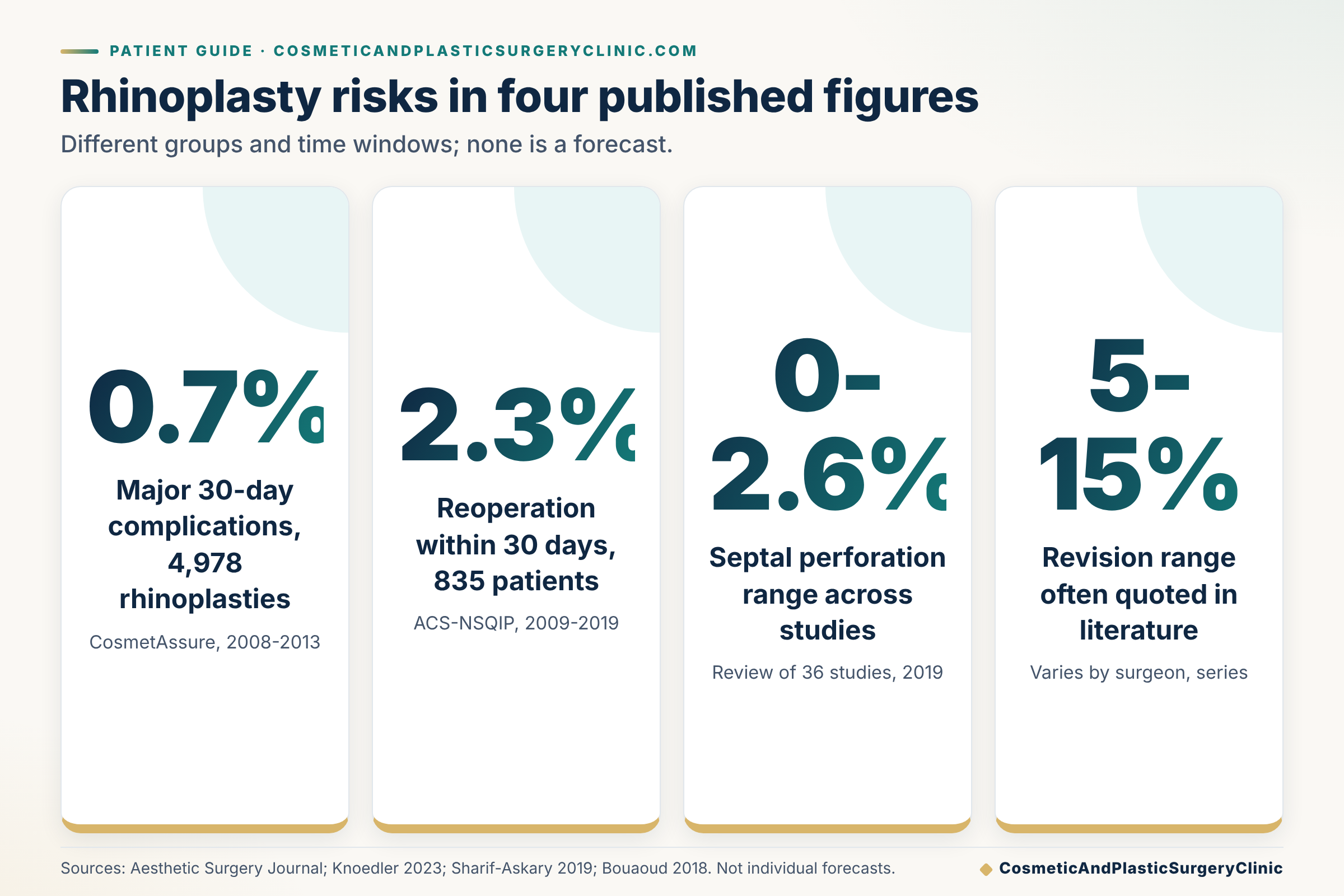
An analysis in Aesthetic Surgery Journal drew on the CosmetAssure database, with patients enrolled from May 2008 to May 2013. Of 129,007 patients, 4,978 had rhinoplasty. A major complication, defined as an emergency room visit, hospital admission or reoperation within 30 days, occurred in 0.7% (37 patients). The most common were hematoma (0.2%), infection (0.2%) and pulmonary complications (0.1%). Age 40 or older was an independent risk factor, with a relative risk of 2.05. Facility type, smoking and a body mass index of 25 or more were not significant predictors.
Hospital-based surgical quality data
A 2023 analysis in the Journal of Craniofacial Surgery used the ACS-NSQIP hospital database (2009 to 2019) and 835 rhinoplasty patients, 72% of them primary operations. Reoperation within 30 days was the most common surgical event at 2.3% (19 patients), and superficial incisional infection occurred in 1.1% (9). In the multivariable analysis, male sex and higher ASA scores (a measure of overall health) were associated with complications, as were low serum albumin and low hematocrit. The authors suggest nutrition and anemia may be worth attention before surgery; they did not test that idea.
Reviews and revision rates: wide ranges
What a systematic review found across 36 studies
Sharif-Askary and colleagues (Plastic and Reconstructive Surgery, 2019) screened 3,215 publications, kept 36 and found 14 kinds of adverse events. The highest reported rate belonged to revision, 0% to 10.9%. Other ranges were infection 0% to 4%, dehiscence (wound opening) 0% to 5%, bleeding 0% to 4.1%, septal perforation 0% to 2.6%, airway obstruction needing revision 0% to 3% and hypertrophic scarring 0% to 1.5%. The wide ranges reflect different surgeons, definitions and follow-up, and the authors call for standardized reporting.
The 5% to 15% revision figure
Several papers quote a literature range of 5% to 15% for revision rhinoplasty, and one 2019 report notes some series above 21%. A single French surgeon’s 2018 series (Bouaoud and colleagues) counted 62 revisions among 732 closed rhinoplasties done from 2005 to 2015, or 8.6%, and warned the figure may be underestimated because follow-up was limited. A figure from one surgeon’s practice says little about another’s. The revision path is in revision rhinoplasty.
Why every figure comes with a limit
Time windows, settings and definitions
A 30-day window catches bleeding and early infection but not a nose that gradually sinks or breathing that worsens once swelling fades. A hospital database says little about office-based surgery. In the NSQIP data, the procedure code could not separate cosmetic from functional operations. A 2025 comparison of plastic surgeons and ENT surgeons in that database (2,127 adults, 2005 to 2020) found 30-day morbidity of 4.5% versus 5.7% and no clinically significant differences in most outcomes. Sepsis differed, but with 8 cases in total the authors called the sample likely too small to conclude anything.
The data that are missing
Missing from most of these studies are the outcomes patients care about most: how the nose looks and breathes at a year or more, validated by standard questionnaires. The 2018 French series did not use validated instruments such as the NOSE questionnaire. Complication tallies count what happened to the nose’s tissue, not whether the person is satisfied. For satisfaction and appearance, the honest answer is that data on rhinoplasty risks are thin and the figures vary. That limit also applies to the table below.
| Source and year | Who was counted | What it reported | Main limit |
|---|---|---|---|
| CosmetAssure analysis (2008 to 2013 data) | 4,978 aesthetic rhinoplasties | 0.7% major complications within 30 days | Counts only events reaching an ER, admission or reoperation |
| ACS-NSQIP analysis, 2023 | 835 hospital cases, 2009 to 2019 | Reoperation 2.3%; superficial infection 1.1% | 30 days; hospital setting; mixed primary and secondary |
| Systematic review, 2019 | 36 studies | Revision 0% to 10.9%; septal perforation 0% to 2.6% | Ranges, not pooled; varied definitions |
| Single-surgeon series, 2018 | 732 closed rhinoplasties | 8.6% revision | One surgeon; likely underestimates long-term revision |
| Rib cartilage meta-analysis, 2023 | 20 studies, 1,648 patients | 15.13% overall complications; 2.25% revision | Grafts of one type; not typical primary surgery |
Why rhinoplasty risks change from one person to the next
Two people can sign the same consent form and carry different rhinoplasty risks. The reasons fall into what each person brings and what the plan, team and facility add. Most patient factors raise a general surgical risk; a few change a nose-specific one.
Patient and anatomy factors
Nicotine, drugs, medications, past injury and health conditions
Mayo Clinic says smoking or vaping can slow healing and cause tissue death, and that aspirin and ibuprofen may make you bleed more, with a two-week window before and after surgery named on its page. Do not change any medication on your own. Your surgeon and the clinician who prescribes it decide that together. StatPearls links cocaine use to saddle nose deformity. The reason to tell a surgeon about past nasal trauma, prior surgery or drug use is not judgment; those histories change how much supporting structure is left.
How each factor changes the odds
Each factor changes rhinoplasty risks through a mechanism. Nicotine narrows small blood vessels, and a nose has thin skin with little spare blood supply. Anticoagulants and some supplements increase bleeding. Prior surgery leaves scar tissue and less cartilage to work with. In the NSQIP analysis, low albumin and low hematocrit were linked to complications, which fits the idea that nutrition and blood count shape healing. Those are associations in a small group, not reasons to avoid surgery.
Procedure, team and facility factors
Extent of surgery, grafts and combined operations
A larger plan means more tissue handled and more time under anesthesia. Grafts add their own issues: in a 2023 meta-analysis of rib cartilage grafts (20 studies, 1,648 patients), overall complications were 15.13%, including warping 3.05%, infection 1.45% and contour irregularity 1.53%, with donor-site complications of 1.47%. Rib is used less often than septal cartilage, which ASPS says is the most common graft source. Combined cosmetic operations raised the 30-day rate in the CosmetAssure data, as noted above; mommy makeover risks shows how stacked procedures change planning.
Anesthesia, accredited setting and the surgeon’s training
ASPS says the choices include intravenous sedation or general anesthesia, and lists anesthesia risks without detail. Ask who gives it and how the facility handles emergencies. The CosmetAssure analysis found facility type was not a significant predictor, but that does not mean every setting is equal. A surgeon’s board certification and rhinoplasty experience are checkable facts; see how to choose a plastic surgeon and cosmetic surgeon credentials. In the 2025 NSQIP comparison, outcomes were similar by specialty, aside from the small sepsis numbers noted earlier.
| Factor | Why it matters | Question to ask | Uncertainty |
|---|---|---|---|
| Nicotine or vaping | Slows healing; tissue death on thin skin | How long should I be nicotine-free, and how is it checked? | No exact number for the nose in the sources opened |
| Bleeding-related medicines | May increase bleeding | Which of my medicines and supplements need your review, and who changes them? | Plans differ by drug and condition |
| Prior nasal surgery or injury | Less support, scar tissue, uneven blood supply | What structure is left, and where would grafts come from? | Hard to see before surgery |
| Cocaine or nasal sprays | Can injure the lining and septum | How does my history change the plan? | Evidence is mostly case-level |
| Combined procedures | More time under anesthesia, more wounds | Why one operation, and what is the total time? | One database; may not fit your case |
| Age and overall health | Age 40 or older had higher relative risk in one dataset | Do I need medical clearance first? | Association, not a cutoff |
The risk of an unhappy result from a technically sound operation
Not every one of the rhinoplasty risks shows up on a chart. A nose can be healthy, open and straight and still not be the nose the person pictured. ASPS lists “unsatisfactory nasal appearance” as a risk in its own right, and Mayo Clinic puts the possibility of an uneven-looking nose beside bleeding and infection. Treating dissatisfaction as a risk class, and not as a failure of the patient, makes the consultation more honest.
Why people seek a second operation
What revision patients report
Steven Pearlman, MD, writing in Plastic Surgery Practice about a 104-patient study of people seeking revision, reports that their top concern was poor aesthetic and functional results, followed by loss of trust in the first surgeon and fear that more surgery could worsen things. Their most bothersome problems were tip asymmetry, nasal obstruction and a crooked middle third. In a 2019 series of 150 secondary rhinoplasty patients, 82% had complaints about the tip. Both are single-practice reports of people who chose to seek another opinion, so they describe motives, not frequency.
Waiting before judging
Early swelling hides the final shape, and ASPS says refinement may take up to a year. Mayo Clinic says that if a second operation is planned, it should be at least a year after the first because the nose keeps changing. Rhinoplasty risks that look alarming at six weeks, such as a tip that seems too wide, may soften with time, while others, such as a tight airway, may not. The surgeon’s job at follow-up is to tell the two apart. The timeline is detailed in the recovery page.
Expectations, screening and support
What surgeons ask about, and why
Good consultations include a conversation about what you want changed and why. A surgeon who asks how long you have disliked a feature, what you expect from the change and whether others notice it is not being nosy; they are testing whether the plan can meet the goal. Some surgeons use short questionnaires. This is part of weighing the risk that a clean operation still disappoints. The candidate side is covered in rhinoplasty candidate.
Body-image concerns and where to find support
A 2023 meta-analysis in Health Science Reports pooled 18 studies with 2,132 rhinoplasty candidates and reported a prevalence of body dysmorphic disorder (BDD) of 32.7% (95% confidence interval 23.6% to 41.7%), with very high heterogeneity (I-squared 96.45%). That wide spread means the pooled figure should be read cautiously; screening tools and settings differed. Surgeons screen for distress about appearance because surgery does not treat it. If that sounds familiar, a mental health professional can help, and talking to one does not rule surgery in or out. This page cannot diagnose anyone.
Turning rhinoplasty risks into questions for a surgeon
The point of knowing about rhinoplasty risks is to ask better questions before surgery and to recognize problems early afterward. The questions below are designed to produce specific answers, not reassurance. A surgeon who answers them plainly and in writing is giving you something to compare against other consultations.
Questions to settle before surgery
Prevention and management
Ask which rhinoplasty risks matter most for your anatomy and why. Ask what the plan is for bleeding, infection and a septal hematoma, and who treats them. Some preventive measures have evidence: an umbrella review (Aesthetic Plastic Surgery, 2022; 14 systematic reviews, 128 meta-analyses of randomized trials) linked steroids, tranexamic acid, periosteal preservation and piezoelectric osteotomy to fewer complications, mainly less swelling and bruising. A 2025 meta-analysis of nine trials (484 patients) found lower blood loss, edema and bruising with tranexamic acid or dexamethasone. Ask whether your surgeon uses such measures. Never start or stop a drug on your own.
Experience, results and revision policy
Ask how many rhinoplasties the surgeon performs in a year, what their own revision rate is and how it is counted, and how many of those they perform for people whose noses resemble yours. Ask to see photos of healed results at least a year out; rhinoplasty before and after explains how to read them. Ask what the fee covers if you need a revision, and what you would pay for the facility and anesthesia. Written answers help you compare rhinoplasty risks and costs across surgeons. The wider consultation list is in plastic surgery consultation questions.

After surgery: what to track and whom to call
Notes that help the follow-up visit
A short log makes a follow-up visit more useful. Note the date, which side, whether the symptom is better or worse than yesterday and any fever. Photograph the nose in the same light each week, since swelling changes by the hour and a photo is a fairer witness than memory. Bring the log to the visit. A pattern, such as congestion worse on one side for three days, is more informative than a single bad morning.
When to call, when to wait and when to seek a second opinion
Call early for trajectory problems and urgently for the warning signs described above. If you feel dismissed, a second opinion from another board-certified surgeon is reasonable, and your surgeon should be willing to share records. For problems that persist after the first year, general surgical risk context is in plastic surgery risks, and blepharoplasty risks and complications shows how another facial operation handles the same sorting. Choosing not to operate remains a valid answer.
Frequently asked questions
How common is a hole in the septum among rhinoplasty risks?
It is listed as rare. In a 2019 systematic review of 36 studies, reported septal perforation rates ranged from 0% to 2.6%, which means some studies saw none. ASPS says repair may need more surgery and may be impossible in some cases. Symptoms people describe include crusting, bleeding or whistling when breathing, though the sources opened did not detail symptoms. Ask your surgeon how the septum would be handled and what the plan is for a septal hematoma.
Can rhinoplasty make breathing worse?
Yes, it is a listed risk. ASPS, Mayo Clinic and MedlinePlus all name breathing difficulty or worsening of nasal breathing. A review abstract by Ballert and Park says post-rhinoplasty blockage usually involves the internal valve, the area between the valves or the external valve. Early blockage is usually swelling and tends to ease. Breathing that gets worse as the swelling fades is a reason to call the surgeon. If breathing is your main complaint, read about functional rhinoplasty before you decide.
How long should I wait before deciding a bump or asymmetry is a problem?
ASPS says the new contour may take up to a year to refine, and Mayo Clinic advises that a second operation be at least a year after the first. Swelling, especially in the tip, can hide or mimic problems. That does not mean you should wait silently. Tell your surgeon what you notice, ask what is expected at each visit and keep dated photos. They can say whether a finding looks like swelling or structure.
Do rhinoplasty risks differ for men and women?
One NSQIP analysis of 835 patients found male sex associated with complications in a multivariable model, along with higher ASA scores and low albumin and hematocrit. The authors did not explain the sex finding, and the group was small and hospital-based. Treat it as a question for research, not a prediction. Your own anatomy, history and plan matter more than a single association, and your surgeon can discuss which factors apply.
Does the surgeon’s specialty change rhinoplasty risks?
A 2025 NSQIP comparison of 874 plastic-surgery and 1,253 ENT cases found no clinically significant differences in most 30-day outcomes. Sepsis was the only difference, based on 8 cases in total. Specialty is one fact among others; rhinoplasty volume, training, accredited facilities and results at one year or more also matter. The article on cosmetic surgeon credentials explains what titles and certifications verify.
Should rhinoplasty be combined with another operation?
Combining raises the rhinoplasty risks the surgeon must manage, so it is a fair question to ask why. In the CosmetAssure data, the 30-day rate rose from 0.58% for rhinoplasty alone to 2.09% with two other regions. Combining can save a recovery period and a facility fee, but it adds operative time and anesthesia. Ask your surgeon for the total expected time under anesthesia, who monitors you and how decisions are made if the schedule runs long.
Is being unhappy with the look of my nose a complication?
It depends on the cause. If the structure moved, a graft shows or a dent formed, that is a complication. If the nose is healed and as planned but not what you hoped, surgeons call it an unsatisfactory result, which ASPS lists as a risk. Either may lead to a revision discussion. Wait the recommended time, document how the nose looks and feels, and read about revision rhinoplasty before asking another surgeon for an opinion on these rhinoplasty risks.
Should I tell my surgeon about past nasal injury or drug use?
Yes. StatPearls notes that cocaine use can cause saddle nose deformity, and past trauma or surgery can leave less supporting cartilage and uneven blood supply. These histories change how a surgeon weighs rhinoplasty risks, plans grafts and decides how much structure to preserve. Surgeons ask in a medical context, and your answers help them judge risk. If a particular question feels uncomfortable, say so; a good consultation leaves room for it.
Sources and further reading
- American Society of Plastic Surgeons — Rhinoplasty safety (accessed 2026-11-12) — listed risks including septal perforation and unsatisfactory appearance
- American Society of Plastic Surgeons — Rhinoplasty recovery (accessed 2026-11-12) — swelling timeline, up to a year to refine
- American Society of Plastic Surgeons — Rhinoplasty procedure (accessed 2026-11-12) — anesthesia options, open and closed approaches, graft sources
- Mayo Clinic — Rhinoplasty (accessed 2026-11-12) — risks, bleeding, smoking and vaping, second operation timing
- The Aesthetic Society — Nose surgery safety considerations (accessed 2026-11-12) — hematoma, skin breakdown, graft show-through, open-approach scar
- MedlinePlus — Rhinoplasty (reviewed 2025-02-05; accessed 2026-11-12) — loss of support, contour deformities, breathing, further surgery
- StatPearls — Septoplasty (Watters, Brar, Yapa; updated 2022-11-08; accessed 2026-11-12) — bleeding, hematoma, perforation, saddle nose, numbness
- Sharif-Askary B et al. — Incidence of post-operative adverse events after rhinoplasty: a systematic review, Plastic and Reconstructive Surgery (2019; accessed 2026-11-12) — ranges across 36 studies
- Knoedler S et al. — Incidence and risk factors of postoperative complications after rhinoplasty: ACS-NSQIP analysis, Journal of Craniofacial Surgery (2023; accessed 2026-11-12) — 835 patients, reoperation and infection
- Chinta S et al. — Effect of surgical specialty on postoperative complications of rhinoplasty, Otolaryngology–Head and Neck Surgery (2025; accessed 2026-11-12) — 2,127 adults, specialty comparison, limits
- Incidence and preoperative risk factors for major complications in aesthetic rhinoplasty: analysis of 4978 patients, Aesthetic Surgery Journal (QxMD record of PMID 28472446; accessed 2026-11-12) — CosmetAssure data, combined-procedure rates
- Bouaoud J, Loustau M, Belloc J-B — Functional and aesthetic factors associated with revision of rhinoplasty, Plastic and Reconstructive Surgery Global Open (2018; accessed 2026-11-12) — 8.6% single-surgeon revision rate
- Loghmani S et al. — Secondary rhinoplasty: aesthetic and functional concerns, Plastic Surgery (2019; accessed 2026-11-12) — 150 patients, tip complaints, respiratory complaints
- Pearlman SJ — Revision rhinoplasty from the patient’s point of view, Plastic Surgery Practice (2011, updated 2019; accessed 2026-11-12) — reasons patients seek revision
- Ballert JA, Park SS — Functional considerations in revision rhinoplasty, Facial Plastic Surgery (2008; accessed 2026-11-12) — valve and turbinate causes of obstruction (abstract)
- Nabavizadeh SS et al. — Prevalence of body dysmorphic disorder in rhinoplasty candidates, Health Science Reports (2023; accessed 2026-11-12) — pooled prevalence and heterogeneity
- Wu B et al. — Complications associated with rhinoplasty: an umbrella review of meta-analyses, Aesthetic Plastic Surgery (2022; accessed 2026-11-12) — steroids, tranexamic acid, osteotomy techniques (abstract)
- Awaji HHH et al. — Dexamethasone and tranexamic acid in rhinoplasty: systematic review and meta-analysis, Cureus (2025; accessed 2026-11-12) — 9 trials, 484 patients
- Chen H, Wang X, Deng Y — Complications associated with autologous costal cartilage used in rhinoplasty: an updated meta-analysis, Aesthetic Plastic Surgery (2023; accessed 2026-11-12) — 20 studies, 1,648 patients (abstract)