BBL before and after photos persuade because the claim looks simple: a flat or narrow-looking rear view became rounder at the hips and buttocks. BBL (Brazilian butt lift, or gluteal fat grafting) is not one change, though. It is liposuction in one area and fat injection in another, often on the same day, and a photograph freezes the combined result at one moment, from one camera position, under one light.
This page is about reading BBL before and after photos. Societies of plastic surgeons describe this operation as high-risk, so the reading has to cover more than looks: what a photo can prove, what it cannot, and which safety questions must be answered somewhere other than a gallery. The general rules for any album are in the guide to reading before and after photos, and the operation itself is explained in the Brazilian butt lift guide.
What a BBL before and after photo actually shows
A pair of images looks like evidence about the buttocks. In practice it bundles several decisions: which areas supplied the fat, how much was injected, what else was done at the same operation, and which pair the practice chose to publish. Before judging the shape, separate what is visible from what is only implied by the caption.
One image, several operations: harvest, injection and contouring
The caption “BBL” names a goal. The photograph shows the sum of every step that served it, and those steps do not all act on the buttocks.
Waist, hip and buttock changes in BBL before and after photos can come from different steps
An American Society of Plastic Surgeons (ASPS) blog post by a plastic surgeon describes the operation as a combination of liposuction and buttock augmentation, aimed at reshaping the whole torso, with a narrower waist and a shapelier hip and buttock as the typical result. That matters for reading a rear view. A silhouette can look curvier because the hips gained fat, because the waist lost it, or because of both.
Ask which areas were harvested, since the photo rarely labels them. The back, flanks and abdomen are common sources, and each leaves its own contour. Reading the donor side of the picture is the same skill used in liposuction before and after photos, and BBL before and after photos should show those areas, not only the buttocks.
Same-day combinations hide how much the BBL did
If a caption says “BBL” and nothing else, ask whether a tummy tuck, breast surgery or another operation happened at the same time. Each one changes the torso outline and the healing load, so a combined result is not a fair preview of a BBL-only plan, and the reverse is also true. Abdominal changes have their own photo pitfalls, covered under tummy tuck before and after.
What BBL before and after photos cannot record
Two of the facts that matter most about a BBL result sit outside the picture: how much of the injected fat remained, and where in the tissue it was placed.
How much injected fat is still there
Not all injected fat survives. In ASPS articles, surgeons estimate that roughly 20% to 40% of injected fat is absorbed during healing, and an earlier ASPS post said up to 40% may not survive. So BBL before and after photos show what remained, not what went in. Published volumes also vary. A 2015 Brazilian series of 106 women reported an average of about half a liter transferred, while a 2016 study of 21 patients in the United States averaged 287 mL per buttock, with a range of 70 to 550 mL.
Those figures come from different surgeons, harvest methods and bodies, so they are not targets and cannot be lined up like prices. They do show why a caption saying “1,000 cc” tells you little by itself. Volume is a detail of one plan. The question for a gallery is what was injected, when the photo was taken, and what stayed.
Where the fat was placed is invisible
No photograph shows whether fat sat in the layer under the skin or deeper. That is the safety-critical question for this operation. A multi-society task force advisory says never to inject fat into the muscle, and a 2019 cadaver study reported in an ASPS release recommended that no subfascial or intramuscular injection be performed. A smooth contour in BBL before and after photos tells you nothing about technique. The section on safety below returns to this.
Reading the date on BBL before and after photos
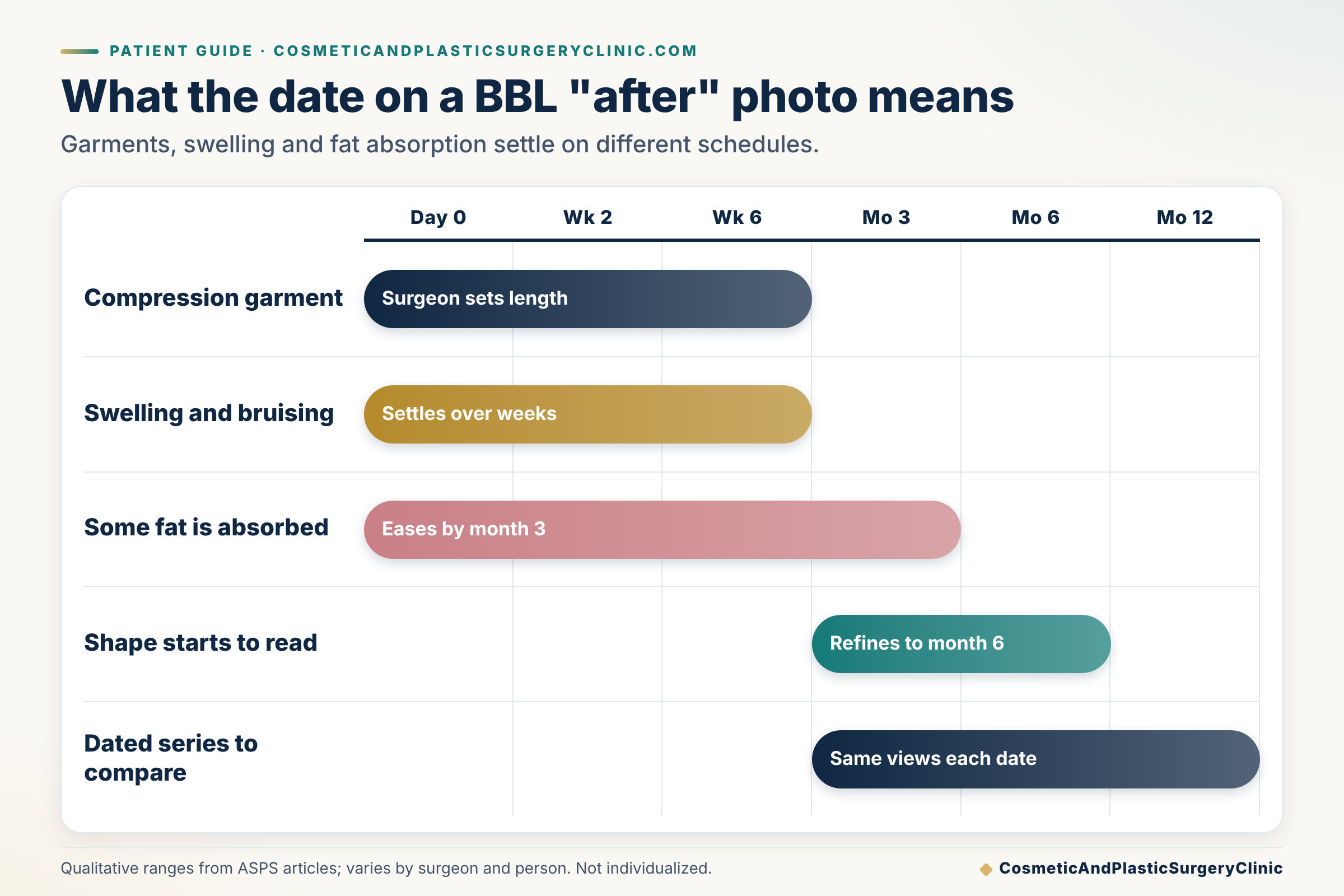
In BBL before and after photos, the date is more than a footnote. Swelling, garments and early volume all sit on top of the result in the first weeks, and some of the fat has not finished settling. Sources also differ on timing and sitting rules, which is a reason to ask each practice rather than assume. Recovery logistics are covered in the BBL recovery article.
What the calendar does to BBL before and after photos
The same body photographed at two weeks, three months and a year will look different, even with an identical camera setup. The differences come from healing, not from how skilled the surgeon was.
Weeks 1 to 6: swelling, garments and early volume
An ASPS recovery article quotes a surgeon describing compression garments worn around the clock except for showering during the first month, and at least 12 hours a day in the second month. Swelling at the liposuction sites continues into that second phase. An early photo may therefore show a garment mark, a swollen donor area and extra volume that is partly fat the body will absorb.
Aftercare rules also differ across ASPS pages. One recovery page advises avoiding prolonged sitting for about two weeks, an ASPS article quotes a surgeon limiting sitting to about 10 minutes at a time for six weeks, and an older ASPS post said at least eight weeks. Treat these as examples of surgeon-to-surgeon variation, and follow the written instructions of your own surgical team.
Months 3 to 12: when the shape begins to count
ASPS articles quote surgeons saying that around month three the acute risk of fat loss lessens and the size and shape become a good indicator of the final result, with further refinement between months three and six. That makes three months the earliest date worth weighing in BBL before and after photos, and six months or later better still.
Be careful with captions claiming a year or more. In Eric Swanson’s 2016 controlled study, mean follow-up was 5.8 months and the longest was 15.5 months, and the author listed the lack of longer data as a limitation. A gallery caption that says “12 months” is a claim about one person, and a dated series would let you check it.
| Photo date | What the image may show | What it cannot support | Basis |
|---|---|---|---|
| Surgery day, on the table | Immediate fullness while the patient is lying down | Any judgment of the final shape, or the effect of gravity when standing | American Board of Cosmetic Surgery (ABCS) social media guidance |
| Weeks 1 to 6 | Swelling, bruising, garment marks, early volume | How much fat will remain; fine contour | ASPS recovery articles |
| Months 3 to 6 | Size and shape that surgeons call a good indicator | Final refinement; later weight change | ASPS 2022 articles |
| Month 12 and later | A longer-term look for that one person | What a typical patient sees; nothing about safety | Swanson 2016 follow-up range |
A dated series beats one dramatic pair
One striking pair of BBL before and after photos shows what happened to someone at one date. A series shows a trajectory, which is much harder to arrange.
Ask for the same person at several dates
A useful request is the same person at an early date, around three months, and at six months or later, in the same views. ASPS makes a similar point in a 2026 article: the result at six weeks differs from the result at one year, and a consistent body of work photographed in the same way over time is harder to fake than one image. Ask whether the practice keeps follow-up BBL before and after photos at all.
The “on the table” image and other early pictures
The ABCS cautions against surgeons who mostly share immediate operating-room photos. A patient lying down shows none of the effect of gravity, so those pictures do not show a final outcome, and the board says reputable surgeons update them with progress and final results. Operating-room posts can also raise privacy questions, covered in the consent section.
Weight on each date
Body weight moves the outline in BBL before and after photos. The 2015 Brazilian series evaluated only women without major weight loss or gain in the year after surgery, and Swanson adjusted his photo measurements for BMI change. A pair with no weights cannot separate a graft effect from a weight effect, so ask for both numbers. How weight and tissue change affect results over time is explained in BBL results.
Camera, pose and light: the setup behind BBL before and after photos
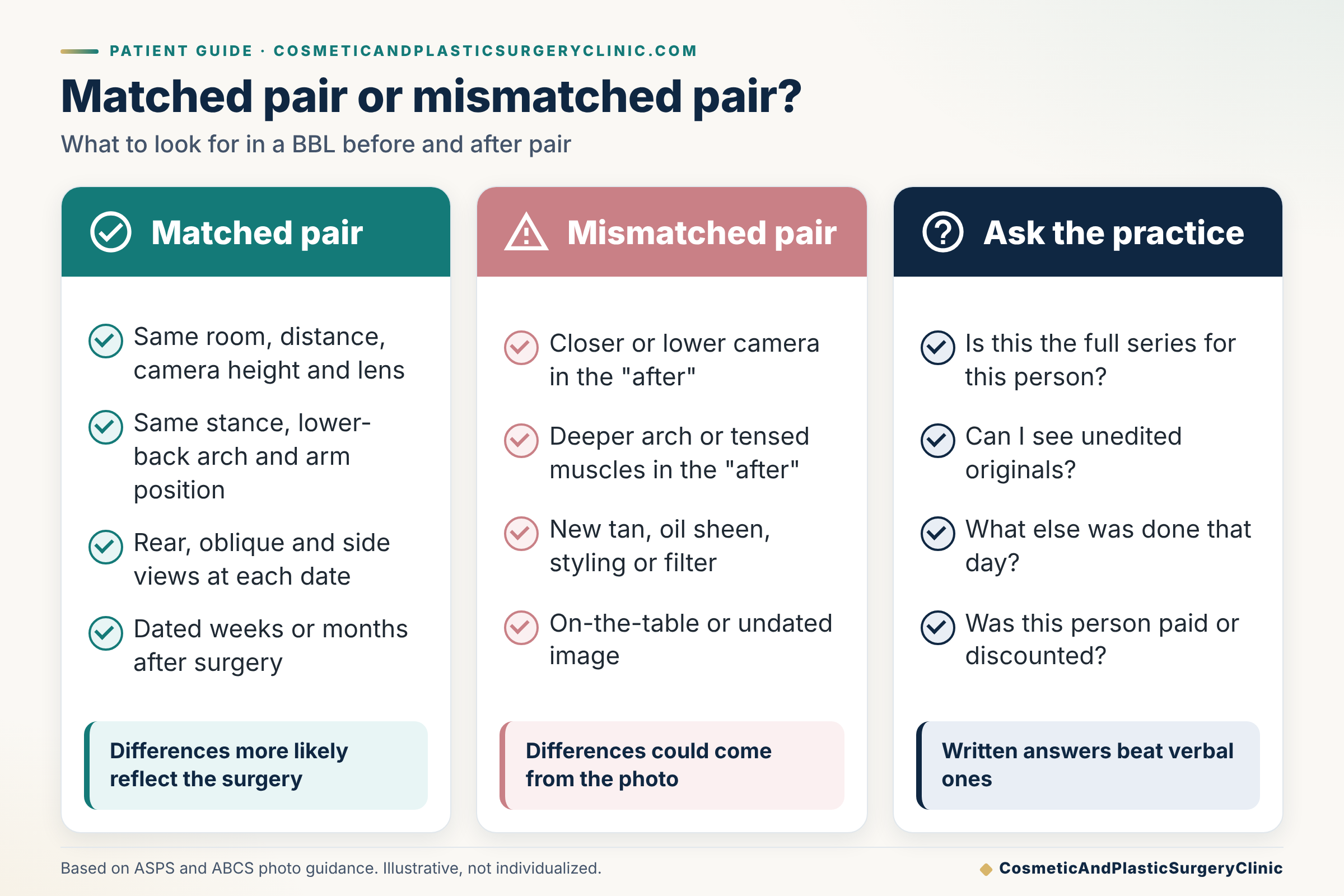
The buttocks are an awkward subject for a camera. They are close to the lens in rear views, they change shape with stance, and the hollows beside the hips are sensitive to the direction of light. A small change in any of these can add or hide more apparent shape than the difference between two operations. The table later in this section lines up the variables that shape BBL before and after photos; first, the reasons they matter.
Where the camera stands and how the body stands
Clinical photography protocols exist because these variables are easy to shift without anyone intending to. There is no single industry-wide standard for what clinics publish, as ASPS noted in 2024, so the reader of BBL before and after photos has to check consistency pair by pair.
Distance, height and lens
A University of Chicago team describing a highly standardized torso protocol kept the camera on a leveled tripod with 4 meters between it and the subject’s rotation axis, used a non-zooming 65 mm lens, and set the lens at navel height. They reported image variance under 2%. The point is not that every clinic must copy this setup. It shows what holding distance, lens and height constant looks like, and casual BBL before and after photos rarely do.
Closeness matters in a measurable way. A 2024 study in The Laryngoscope photographed 12 faces and found midface distortion at about 8 inches, including an 18% increase with a smartphone. That study was about faces, not buttocks. The optical principle that a nearby camera exaggerates what is closest to the lens applies to any subject, so ask whether the “after” was taken from the same distance and height as the “before”.
Stance, arch and muscle tension
How someone stands changes the outline. ASPS advice from 2026 notes that changes in posture, neck extension, chin position or body rotation can make an “after” image look better without any surgical difference, and a 2024 ASPS article gives arm position as an example. For the buttocks, the arch of the lower back, the tilt of the pelvis, and whether the gluteal muscles are tensed or relaxed belong on the same list.
Researchers who measure results take the arch seriously. In Swanson’s controlled study, projection was measured two ways: from the pubic mound to the most prominent point of the buttock, and from the lumbar curve to that point. Using a second reference tied to the back’s arch is a sign that posture can shift the apparent projection, so compare the arch and the angle of the hips, not only the buttocks.
Light, skin and styling
The surface of the body is what the lens records, and surface appearance is easier to change than the tissue under it.
Light direction and shadows
The Chicago protocol placed its main lights 45 degrees to the side and 45 degrees above the subject, with a ring flash for fill, a fixed arrangement meant to repeat from session to session. Direction matters because light from the side deepens hollows and shadows, and light from the front flattens them. The same hip hollow can look noticeably deeper or shallower in two pictures taken in different rooms.
Tan, oil, garments and styling
ASPS describes a common mismatch in its 2025 article: a “before” shot with poor skin tone, harsh lighting, an awkward pose and a clinical gown, paired with an “after” shot with makeup, nicer clothing, a smile and professional lighting. For BBL before and after photos, the same logic means checking whether the swimwear or underwear matches, whether the tan or skin sheen changed, and whether a garment is leaving marks. None of these are surgery.
| Variable | How it can change the picture | What to compare | Question for the practice |
|---|---|---|---|
| Camera distance and lens | Closer cameras exaggerate what is nearest the lens | Size of the buttocks relative to the head, hands and background | Were both photos taken at the same distance with the same lens? |
| Camera height and tilt | Shifts where the waist, hip and buttock line up | Horizon line, floor tiles, door frames | Is the camera level and at the same height in both? |
| Stance and lower-back arch | A deeper arch can add apparent projection | Curve of the lower back, pelvis tilt, foot position | Was the same standing position used on both dates? |
| Body rotation and view | A slight turn changes the hip-to-waist outline | Rear, oblique and side views taken at matching angles | Can I see all three views for each date? |
| Light direction | Side light deepens hollows; front light flattens them | Shadow direction on the hips and under the buttock | Was the same room and lighting used? |
| Tan, oil and styling | Skin tone and sheen change how contour reads | Skin color, shine, swimwear, hair, garment marks | Was anything added or changed for the second photo? |
| Lying down or standing | Gravity changes how fat and skin sit | Whether both images are standing, not one on the table | Are the images on the table or in clinic? |
Hip-waist ratio, projection and shape: the numbers behind BBL before and after impressions
People describe BBL results with phrases such as “snatched waist” and “projection”. Behind those words are ratios and silhouettes that can be checked, and a few facts about how researchers have measured them are useful when you look at BBL before and after photos.
What the rear and side views of BBL before and after photos can show
Each view answers a different question. The rear view shows how hip width relates to waist width, and the side view shows how far the buttock projects and how the lower back curves.
Rear view: the hip-to-waist ratio
A 2016 Plastic and Reconstructive Surgery study of about 1,150 respondents, recruited through social media, asked people to choose among images showing set proportions. In rear view the ratio of 0.65 was chosen most often, by about 44%, and 0.60 was second at 25%. The authors noted that the older 0.70 standard came from surgeon opinion and pageant and centerfold measurements.
Read that as a preference survey, not a clinical goal. It measured what an online sample liked in illustrated images, not what any operation achieves or what patients were satisfied with. A 2009 review in Seminars in Plastic Surgery found that preferences differ across ethnic groups, mainly in overall size and lateral fullness. A ratio can also move because the waist narrowed, because the hips grew, or both, so ask what produced the change in a given pair.
Side view: projection, arch and the hip hollow
In a side view, look at two things together: how far the buttock sits behind the body line, and how the lower back curves. A deeper arch in the lower back can add apparent projection without any added tissue, which is why the same pose in both images matters more here than almost anywhere else.
Look also at the hollow near the hip, which the 2009 Seminars in Plastic Surgery review lists among the photographic features of buttock shape. It describes that hollow as a normal anatomical feature that many patients find objectionable, and fat grafting as well suited to filling it. Whether a hollow is filled in BBL before and after photos reflects the person’s anatomy and goals, and a different plan could reasonably leave it alone.
Donor sites, implants and other things in the frame
BBL before and after photos include more than the buttocks. They include the places the fat came from and, sometimes, a different technique under the same label.
The liposuction side of the picture
Fat comes from somewhere, and that somewhere should look like a plausible result. Ask for photos of the harvested areas on the same dates, looking for waves, dents or asymmetries that a rear view cannot reveal. Whether an irregularity is expected, treatable or a reason to ask about revision is a surgeon-directed judgment, and the revision BBL article covers when revision is considered.
Fat, implant or filler: ask which one it was
A caption that says “buttock augmentation” may mean fat grafting, a fixed-volume gluteal implant, or a combination. The 2018 multi-society advisory told patients to discuss alternatives, such as gluteal implants. Implant results look different from fat results and carry a different set of complications, compared in BBL vs butt implants. Non-surgical biostimulatory injections are a separate category with their own limits.
Retouching, selection and consent in BBL before and after galleries
Even well-matched BBL before and after photos can mislead if the image was edited, if it was chosen from many, or if the person pictured was paid or never agreed to be shown. These are separate problems and each has a practical test.
Editing, morphing and the best-work effect
BBL before and after photos are easy to alter, because a smooth curve has no landmarks to betray a change. The editing cues are worth knowing, and so is how little they prove on their own.
Warped lines, smoothed skin and unusual proportions in BBL before and after photos
An ASPS article from October 2026 lists editing cues: odd skin texture, warped backgrounds, inconsistent shadows, wavy lines or pixelation around the body, especially with morphing software, and proportions that look too good to be true, including unusual hip or leg ratios. A surgeon quoted in the same piece cautions against relying on visual tells alone, because editing is improving.
The sturdier test is procedural. Ask whether the practice posts unedited originals, whether filters were used, and whether the picture can be seen in a consultation on the practice’s own device. The same applies to pictures you bring in. ASPS advises treating inspiration images as references rather than blueprints, and notes that no software can fully predict how a person’s tissues will heal.
Best work, branded techniques and who posts the picture
Every practice shows its best results, which ASPS acknowledged in a 2024 article that suggests asking how long after surgery the photos were taken and whether they represent typical outcomes. For BBL specifically, the ABCS cautions against a branded technique promoted as giving superior results or faster recovery, and says a credible surgeon explains how the technique supports such claims.
Source matters as well. ASPS suggests preferring pictures on a legitimate practice website and being skeptical of heavily filtered social-media images or posts by people who say they are patients. A picture you cannot trace to a named practice, a dated case and a consent process is a mood board, not evidence.
Consent, privacy and the money behind BBL before and after photos
Photos of bodies are health information, and some are advertising. Two sets of rules sit behind them, and the practice should be able to explain both.
Written permission and identifying details
The US Department of Health and Human Services lists full-face photographs and any comparable images among the identifiers that must be removed to de-identify health information, along with any other unique identifying characteristic. A rear-view photo has no face, but a distinctive tattoo, scar or birthmark could still identify someone. HHS also says the Privacy Rule generally requires written authorization before health information is used for marketing, though its marketing page does not discuss photographs specifically.
So ask whether the people in the album gave written permission for marketing use and whether it covers social media. The ABCS also advises caution about live operating-room posts, which it says can compromise patient safety and privacy. A practice that cannot describe its consent process is unlikely to have a careful one.
Discounts, paid models and “results may vary”
The Federal Trade Commission says an endorser’s connection must be disclosed when it would affect how people weigh the endorsement, and that a free or discounted product or service given in exchange for promotion counts. Saying only that something was free suggests nothing else was received. So a person who got a reduced BBL price in return for posting should disclose that connection.
The FTC also addresses unusual results. If an endorsement reports exceptional results, the advertiser needs adequate proof that they are typical, or must clearly state what is generally expected, and disclaimers such as “results not typical” or “individual results may vary” do not change how viewers read the claim. Ask the practice what a typical result looks like, and what that statement rests on.
From gallery to consultation: range, revisions and the safety checks no photo can replace
Use the pictures to generate questions, not to choose. A set of BBL before and after photos that has passed the checks above has told you what one surgeon’s work can look like. It has not told you how the operation was done, in what setting, or what happens when something goes wrong.
Judge the range, not the standout
One memorable pair is easier to publish than ten ordinary ones. The ordinary ones are the more informative.
Similar bodies, similar plans, ordinary results
Look for many cases that resemble your starting point and the plan under discussion, not only the most dramatic. The table below turns the idea into six lines you can use on any set of BBL before and after photos, along with what each line cannot tell you even when it is done well.
| Evidence line | What a useful album shows | What it still cannot tell you |
|---|---|---|
| Case similarity | Several people with a similar build, skin and weight history | How your own tissue will heal, which differs between people |
| Time point | The same person at an early date, three months and six months or later | Whether the result lasts beyond the last photo |
| Procedure list | Areas harvested, other operations that day, and what was injected | The injection plane, ultrasound use or the setting |
| Edits and consent | A statement on retouching, plus written permission to publish | Whether unseen cases were left out |
| Revision disclosure | At least one case that needed a further procedure or healed slowly | How common revision is overall |
| Number of cases | A large body of work for this operation, not a handful | How many cases that surgeon does on one day |
Revisions, volume reductions and slow healers
An album with no imperfect case is incomplete. In the 2015 Brazilian series of 106 women, three patients had a further procedure and two of those were to reduce gluteal volume, and the authors said outcomes depended on technique and aesthetic judgment rather than volume alone. That series was reported by the surgeons themselves and its release did not say how results were measured, so treat its figures as one example.
ASPS lists asymmetries, fat necrosis, fluid collections, infection and the possible need for revisionary surgery among the risks of buttock enhancement. Ask to see how the practice handles those outcomes, and read about them in the BBL risks article.
What BBL before and after photos cannot vouch for: safety
In 2018 an ASPS-led task force said gluteal fat grafting had a higher mortality rate than any other cosmetic surgery. The reasons are not visible in a photograph, and neither are the safeguards.
What the safety guidance says that pictures cannot show
A 2018 ASPS release for the Task Force for Safety in Gluteal Fat Grafting said mortality could be as high as 1 in 3,000, higher than any other cosmetic surgery, without stating the period or method. Later survey work among members of two aesthetic societies estimated about 1 in 3,448 in 2017 and about 1 in 14,952 in 2019, which the authors linked to surgeons adopting safer techniques. Those are voluntary surveys, not a registry, so treat them as estimates.
The 2022 joint statement from ASPS, The Aesthetic Society and related foundations says office-based gluteal fat grafting should be done only by surgeons with privileges for it at a licensed ambulatory surgery center or hospital. It supports real-time ultrasound to keep the cannula above the gluteal fascia, flags concern about high case volumes per surgeon per day, and asks surgeons to manage complications, including for patients who travel. Travel-related questions are in medical tourism for surgery.
Florida’s board rules show how regulators responded. A 2022 report says an emergency rule limited surgeons to three procedures a day and required ultrasound, citing 10 verified deaths in three years. The state rule text, as reproduced by Cornell’s Legal Information Institute, says fat may be injected only into the subcutaneous space and must never cross the gluteal fascia. A 2023 commentary by a plastic surgeon attributed 92% of fat-embolism deaths after fat grafting to budget, high-volume South Florida clinics, which is a commentary, not a registry count.
Professional bodies have moved the same way. The American Board of Cosmetic Surgery in 2024 called ultrasound guidance highly recommended and intramuscular injection strictly prohibited, and said surgeons should perform the procedure on one patient at a time.
ASPS counted 25,662 BBL procedures in 2025, down 5% from 27,059 in 2024. Volume shows demand, not safety. A tidy set of BBL before and after photos fits a surgeon who follows this guidance and one who does not.
Check the surgeon, the facility and the plan yourself
The American Board of Plastic Surgery offers a public search to verify certification, and says certification is voluntary, requires an active and unrestricted medical license, and for certificates issued since 1995 is valid for 10 years. Verification steps, including state licensing and facility accreditation, are in how to choose a plastic surgeon.
Then take the photo questions into the room, along with the safety ones: who harvests and who injects, in which layer the fat is placed, whether ultrasound is used, where the operation is performed, how many procedures the surgeon does that day, what anesthesia and overnight care are planned, and who treats a complication. The consultation questions guide covers how to judge the answers.
A photo-review worksheet to carry into the consultation
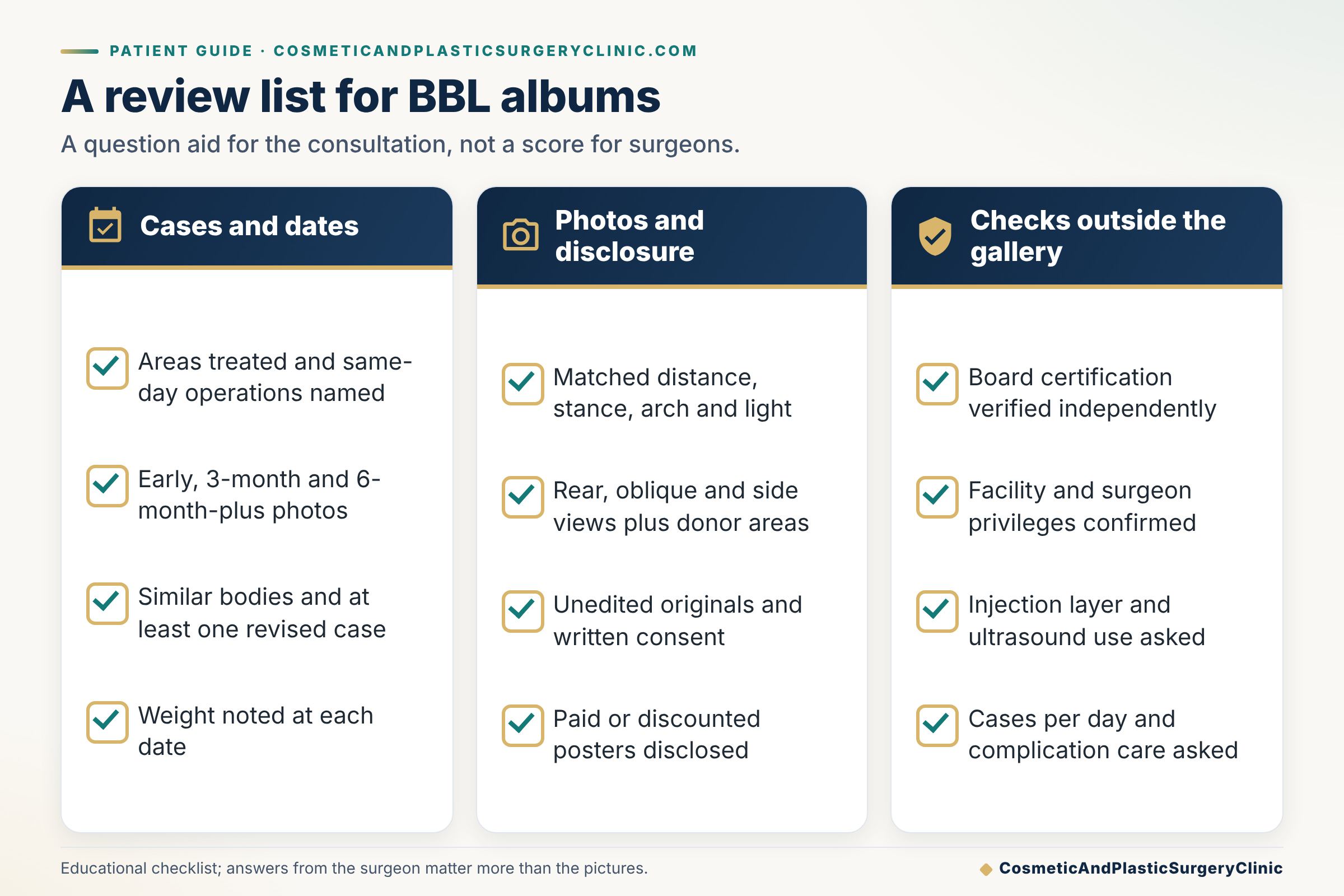
Write answers down as you review BBL before and after photos together. A practice that is comfortable with its work will not mind that you do.
Seven lines to score
- Procedures: Are the treated areas and any same-day operations named for each case?
- Dates: Is each “after” dated, with several dates for the same person?
- Setup: Do camera distance, stance, arch and light match within each pair?
- Views: Are rear, oblique and side views shown, including the donor areas?
- Edits and consent: Are originals available, and was written permission given?
- Range: Are there similar bodies, ordinary results and a revised case?
- Safety: Were credentials, facility, injection plan and complication care checked outside the gallery?
Reading the answers: proceed, pause or look elsewhere
Clear answers on most lines, with ordinary and revised cases shown and safety questions answered without irritation, are reasons to continue the conversation. Gaps in dates, vague consent, no unedited originals or an unwillingness to discuss the injection plan are reasons to pause and ask again, in writing if needed.
Vague answers on the safety lines are reasons to look elsewhere. Waiting is a legitimate outcome, and so are a second opinion or deciding against surgery. Whether the operation suits you at all is a question for a qualified surgeon, and the BBL candidate article lists what surgeons evaluate.
Frequently asked questions
Can I trust BBL before and after photos posted on social media?
Treat them as leads, not evidence. ASPS advises preferring photos on a legitimate practice website and being skeptical of heavily filtered images or posts by people who say they are patients. A social post rarely states the date, the same-day procedures, the consent or any payment, and these are the details that make BBL before and after photos readable. Find the practice, then ask to see the same case in a dated series.
Should I bring BBL before and after photos of other people to my consultation?
You can, as references. ASPS advises using images to communicate specific goals rather than a demand to look like another person, and suggests unedited photos of people with similar baseline characteristics. Say what appeals to you, such as hip width, waist or side profile, so the surgeon can discuss what your anatomy and healing may allow. A surgeon cannot copy a picture onto another person.
Can a 3D simulation or AI preview replace BBL before and after photos?
No. An ASPS article from September 2026 warns that AI-enhanced images of yourself show idealized versions that may not be realistic, and quotes a surgeon saying no software can fully predict how tissues will heal. Surgeon-led simulations using 3D scans can account for individual anatomy and may help a conversation. Think of a preview as a drawing of a goal, and of dated, real BBL before and after photos as the only record of outcomes.
What if a clinic will not show unedited BBL before and after photos or revision cases?
Pause and ask again, in writing. A clinic can explain how its images were taken, whether filters were used and how consent was obtained. If it will not, you cannot tell what you are looking at, and that is a reasonable cause to book a second consultation elsewhere. Missing revision cases do not prove a problem, but a gallery with no ordinary or imperfect cases is incomplete.
Do BBL before and after photos show whether the fat was injected safely?
No. BBL before and after photos show the surface after healing, not the layer where fat was placed, whether ultrasound guided the cannula, or how many operations the surgeon did that day. The task force advisory says never to inject into muscle, and the 2022 joint statement supports real-time ultrasound. Those are answers to get from the surgeon and the facility, and they are covered in the risks article linked above.
Does it matter if BBL before and after photos come from an overseas or package-price clinic?
The photos cannot tell you about follow-up care, which is where distance and price matter most. The 2022 joint statement asks surgeons to manage complications, including for patients who travel, and to avoid facilities where non-surgeon staff perform critical steps. Ask who treats a complication at home, who keeps the records, and whether the surgeon holds privileges at an accredited facility. The quality of BBL before and after photos does not answer any of these.
Why do some BBL before and after photos show filled hip hollows and others do not?
The hollow beside the hip is a normal anatomical feature, according to a 2009 review in Seminars in Plastic Surgery, which also describes fat grafting as well suited to filling it. Whether it is filled in a photo depends on the person’s anatomy, the surgeon’s plan and what the patient wanted. Light direction and stance also change how deep it looks, so compare matching views before drawing conclusions.
Sources and further reading
- American Society of Plastic Surgeons — Plastic surgery societies issue urgent warning about the risks associated with Brazilian butt lifts, press release, August 6, 2018 (accessed 2026-11-12) — task force mortality estimate, 2017 volume
- Multi-Society Task Force for Safety in Gluteal Fat Grafting — Gluteal Fat Grafting Safety Advisory (undated; accessed 2026-11-12) — no intramuscular injection, staging, discussing alternatives
- American Society of Plastic Surgeons — Gluteal fat grafting: a joint safety statement, August 18, 2022 (accessed 2026-11-12) — privileges, ultrasound, case volume, travelling patients
- PubMed — Improvement in Brazilian Butt Lift (BBL) Safety With the Current Recommendations from ASERF, ASAPS, and ISAPS, Aesthetic Surgery Journal 2020 (accessed 2026-11-12) — survey estimates 1 in 3,448 (2017) and 1 in 14,952 (2019)
- Mofid MM — Commentary on: Brazilian Butt Lift-Associated Mortality: The South Florida Experience, Aesthetic Surgery Journal 2023 (accessed 2026-11-12) — commentary on high-volume clinics and deaths
- American Society of Plastic Surgeons — Study proposes new standards for safely performing Brazilian butt lift, press release, May 20, 2019 (accessed 2026-11-12) — cadaver study, subcutaneous-only recommendation
- American Society of Plastic Surgeons — Seven things you need to know about a Brazilian butt lift, March 28, 2022 (accessed 2026-11-12) — month-three shape, fat absorption estimate
- American Society of Plastic Surgeons — Six things you need to know about recovering from a Brazilian butt lift, August 11, 2022 (accessed 2026-11-12) — garment schedule, sitting limits, month-three shape
- American Society of Plastic Surgeons — Buttock augmentation recovery (accessed 2026-11-12) — garments, sitting guidance
- American Society of Plastic Surgeons — Recovering from a Brazilian butt lift, blog, May 12, 2016 (accessed 2026-11-12) — eight-week garment and sitting advice, up to 40% loss
- American Society of Plastic Surgeons — Buttock augmentation with fat grafting, aka the Brazilian butt lift, blog, May 1, 2017 (accessed 2026-11-12) — liposuction plus augmentation, whole-torso reshaping
- American Society of Plastic Surgeons — Buttock augmentation safety (accessed 2026-11-12) — listed risks, revision
- American Society of Plastic Surgeons — Fat grafting for butt augmentation: combined technique gives good results, press release, April 29, 2015 (accessed 2026-11-12) — 106-woman series, volumes, further procedures
- American Society of Plastic Surgeons — Plastic Surgery Statistics Report 2025 (accessed 2026-11-12) — BBL procedure counts
- Swanson E — Prospective Controlled Study of Buttock Fat Transfer Using Ultrasound and Photographic Measurements, Plastic and Reconstructive Surgery Global Open 2016 (accessed 2026-11-12) — standardized photography, projection, follow-up, limitations
- American Society of Plastic Surgeons — Study redefines the ideal female buttocks, press release, May 26, 2016 (accessed 2026-11-12) — Wong et al. waist-to-hip preference survey
- Lee EI, Roberts TL, Bruner TW — Ethnic Considerations in Buttock Aesthetics, Seminars in Plastic Surgery 2009 (accessed 2026-11-12) — preference differences, hip hollow
- Teplica D, Schuleman D, Masri V — Highly Standardized Rotational Photography of the Torso, Journal of Biocommunication 2020 (accessed 2026-11-12) — torso photo protocol
- Derakhshan A et al. — Quantifying Facial Distortion in Modern Digital Photography, The Laryngoscope 2024 (accessed 2026-11-12) — camera distance and distortion in faces
- American Society of Plastic Surgeons — Can you trust that transformation? Reading before-and-after photos in the age of AI, October 13, 2026 (accessed 2026-11-12) — consistency, editing cues, source checks
- American Society of Plastic Surgeons — What is reality? Determining if a before-and-after is too good to be true, March 11, 2025 (accessed 2026-11-12) — mismatched presentation, red flags
- American Society of Plastic Surgeons — Can you trust before and after photos? March 1, 2024 (accessed 2026-11-12) — best-work bias, timing, no photo standard
- American Society of Plastic Surgeons — The AI face: when inspiration photos aren’t real, September 18, 2026 (accessed 2026-11-12) — inspiration images, simulation limits
- American Board of Cosmetic Surgery — How to look at cosmetic surgeons’ social media (accessed 2026-11-12) — on-the-table photos, branded BBL technique, operating-room posts
- American Board of Cosmetic Surgery — 2024 Consensus Statement on Autologous Fat Grafting to the Buttocks, April 25, 2024 (accessed 2026-11-12) — ultrasound, intramuscular injection prohibited
- Federal Trade Commission — FTC’s Endorsement Guides: What People Are Asking (last modified July 15, 2025; accessed 2026-11-12) — material connections, typical results
- US Department of Health and Human Services — Guidance on de-identification of protected health information (accessed 2026-11-12) — full-face photographs and comparable images as identifiers
- US Department of Health and Human Services — Marketing under the HIPAA Privacy Rule (accessed 2026-11-12) — written authorization for marketing
- American Board of Plastic Surgery — Is your surgeon certified? (accessed 2026-11-12) — certification lookup, license requirement
- WUSF Public Media — Appeals court upholds safety rules for so-called Brazilian butt lifts, August 11, 2022 (accessed 2026-11-12) — Florida emergency rule, three procedures a day, ultrasound
- Legal Information Institute — Fla. Admin. Code R. 64B8-9.009, Standard of Care for Office Surgery (accessed 2026-11-12) — subcutaneous-only text