A nose has two jobs, and it can fall short at either one: it shapes the face, and it moves air. Functional rhinoplasty is surgery aimed at the second job, reshaping or supporting the structures in and around the nose so that breathing improves. The complication is that the airway and the outline are built from the same cartilage and bone, so an operation on one almost always touches the other.
This article handles one decision: what separates functional rhinoplasty from cosmetic goals, how a blocked nose is assessed, and where insurers draw the line. The wider picture is in the rhinoplasty overview, who surgeons generally consider suitable is in rhinoplasty candidate, and prices sit in rhinoplasty cost. It is general education, not a judgment about any particular nose.
What functional rhinoplasty is, and where the line with cosmetic goals sits
The airway problem that functional rhinoplasty targets
Septum, turbinates and valves: three different restrictions
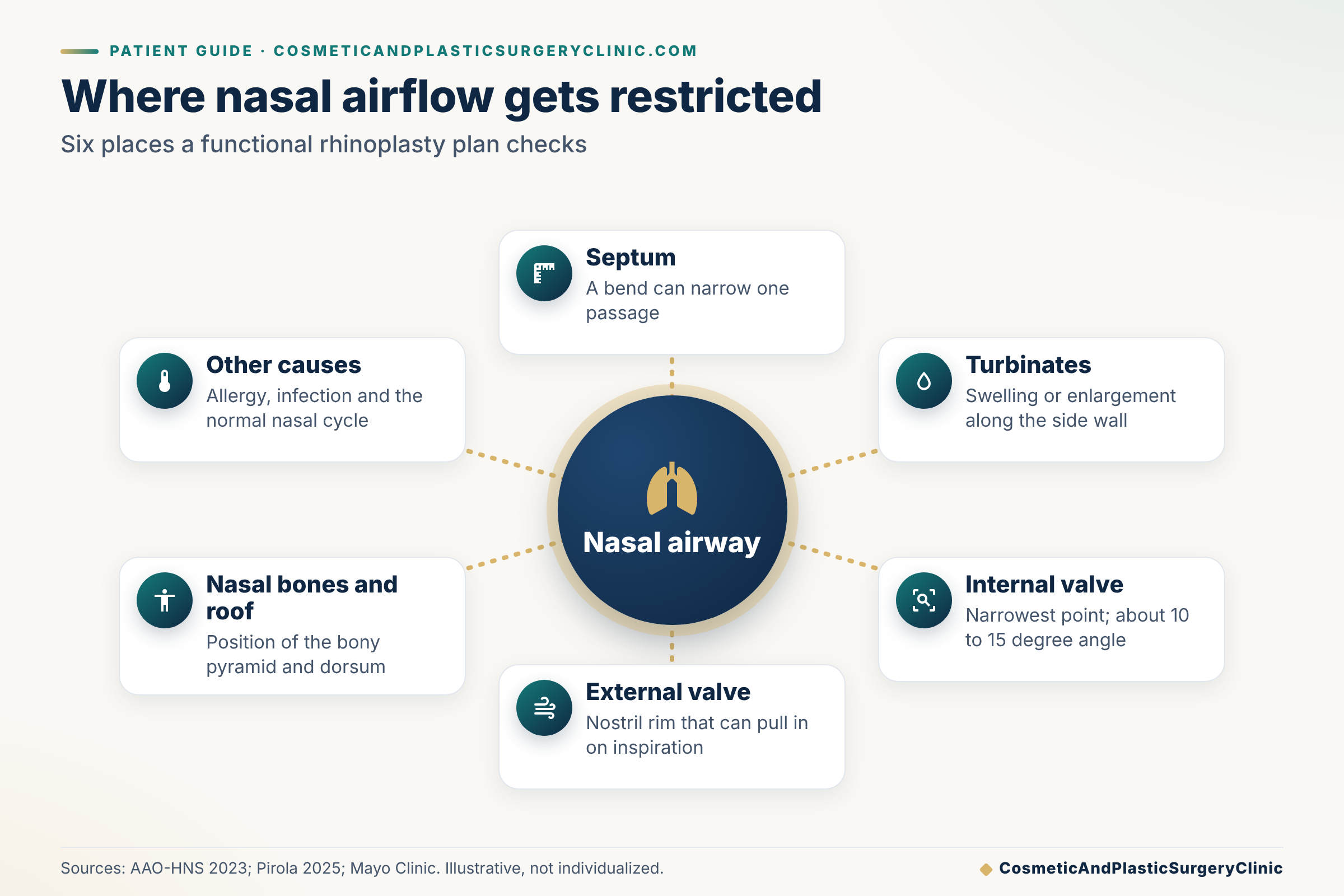
Air enters through the nostrils, passes the external valve, squeezes through the narrow internal valve, and then flows along channels shaped by the septum and the turbinates. Obstruction can arise at any of these points. A septum that bends into one side narrows that side. Turbinates, the ridged structures along the side walls, can stay swollen. The valves can be too narrow or too soft, so the sidewall is drawn inward on inspiration.
These problems are not interchangeable, and the fix for one does not repair the others. That is the main reason functional rhinoplasty is planned from an anatomical diagnosis, not from the complaint of a “blocked nose” alone. The next section takes each structure in turn.
Why a nose can look straight and still feel blocked
Appearance and airflow are only loosely linked. A nose that looks straight from the front can hide a septum that bends deep inside, and a visibly crooked nose can breathe well. The AAO-HNS position statement on nasal valve repair makes a related point: photographs do not reliably show internal valve collapse, and CT scans do not capture dynamic collapse, because the scan is taken at rest.
The reverse also holds. Mayo Clinic notes that most people with a deviated septum have no symptoms at all, while others have a blocked nostril that worsens with colds or allergies, nosebleeds, noisy breathing in sleep, or a habit of sleeping on one side. A bend in the septum is a finding; whether it matters depends on what the person experiences.
Cosmetic and functional rhinoplasty goals overlap more than the labels suggest
One operation, two lists of goals
Plenty of people want both: a straighter profile and an easier breath. Cosmetic and functional rhinoplasty goals overlap because the same maneuvers serve both. Straightening the septum can change the nasal line, a graft that widens the internal valve alters the width of the middle third of the nose, and removing a dorsal hump changes the roof that the valves hang from.
For that reason surgeons who reshape a nose are expected to think about the airway in every case. The American Society of Plastic Surgeons (ASPS) says on its rhinoplasty page that surgery to improve an obstructed airway requires careful evaluation of the nasal structure as it relates to airflow, and that a deviated septum is one of the most common causes of breathing impairment. How the work is approached from outside or through incisions inside the nose is a separate question, covered in open vs closed rhinoplasty.
Why “functional” does not mean “unchanged appearance”
Functional rhinoplasty is defined by its goal, not by a promise that the nose will look the same. Some airway operations are done entirely through incisions inside the nose and leave the outline alone; an NHS hospital leaflet on septal surgery says it makes no facial scars and is not intended to change how the nose looks. Others rebuild cartilage that does alter contour, and a surgeon should say in advance which changes to expect.
The reverse risk deserves equal attention. A purely cosmetic reduction can narrow the airway if support is removed and not rebuilt, which is why people with no breathing complaint still get airway questions in a consultation.
| Dimension | Functional-focused surgery | Cosmetic-focused surgery | Combined operation |
|---|---|---|---|
| Main indication | Persistent obstruction from septum, turbinates or valves | Dissatisfaction with shape, width, tip or profile | Both a breathing complaint and appearance goals |
| Invasiveness | Often internal incisions; grafts or sutures when valves need support | Closed or open approach with cartilage and bone reshaping | Usually the wider work; extra time and grafting are common |
| Reversibility | Removed or repositioned tissue cannot simply be restored | Resected cartilage and bone are not replaced; grafts can add back | Both limits apply; revision is possible but harder |
| Scar and downtime | Hidden internal scars; congestion and splints are typical early on | Hidden or small columellar scar; swelling and bruising dominate | Recovery follows the longest component |
| Maintenance | Symptom review at follow-up visits; some grafts and sutures may settle | Swelling takes months to resolve; photos compared at set intervals | Both, judged over months to a year or more |
| Main risks | Persistent blockage, septal hole, bleeding, scarring inside the nose | Asymmetry, contour irregularity, unwanted breathing change | Union of both lists |
| Cost logic | May fall under a medical benefit if criteria are documented | Typically an elective, self-paid benefit | Plans may treat the parts separately; ask each office and plan |
The structures behind a blocked nose
Septal deviation and what septoplasty can change
How the septum bends and why it matters
The septum is the wall of cartilage and bone that divides the nose into two passages. Mayo Clinic lists three causes of a deviated septum: it can be present from birth, follow an injury such as contact sports or a car accident, or worsen with age. Swelling from infection or irritation can narrow an already tight passage further.
When the septum sits far to one side, that passage is smaller and air meets more resistance. Surgeons also care about where the bend lies. A deviation low and far back behaves differently from one at the front, near the valve, where a small shift can matter more because the airway is already at its narrowest.
What the largest trial found about septoplasty
Septoplasty is surgery on the septum alone, and it has one of the better tests against nonsurgical care: a large randomized trial. The NAIROS trial, run at 17 NHS hospitals in the United Kingdom, assigned 378 adults with a deviated septum and nasal obstruction to septoplasty (with or without turbinate reduction) or to medical management with steroid and saline nasal sprays. At six months the surgery group scored 19.9 on the SNOT-22 symptom questionnaire and the spray group 39.5, a difference of 20 points in favor of surgery (lower scores mean fewer symptoms).
The picture was less lopsided over time. A National Institute for Health and Care Research summary reports that at one year the scores were about 21 for surgery and 30 for sprays, and that benefit was greatest in people with the most severe symptoms. Serious adverse events were uncommon, with 14 in the surgery group and 9 in the spray group, and the trial was open label, since neither side could be blinded.
NAIROS studied the septum, not appearance and not valves, so it cannot be read as proof for every functional rhinoplasty. What it does show is that surgery can outperform sprays for a well-defined group, and that the size of the advantage depends on how bad the baseline symptoms are.
Turbinates and the nasal cycle
Normal cycling versus true enlargement
Turbinates are not fixed: they swell and shrink with allergy, infection, temperature and posture. They also alternate on a schedule. A 2018 review in Rhinology Online by Pendolino and colleagues describes the nasal cycle, in which one side congests while the other opens, and reports it in roughly 70 to 80 percent of healthy adults, first described by Richard Kayser in 1895. The authors say clinicians should account for it when deciding between septal or turbinate surgery and medical therapy, so that a normal rhythm is not mistaken for disease.
For a reader, the practical point is that “my nose switches sides” can be ordinary physiology, while a nostril that stays blocked on the same side, week after week, is the pattern that prompts an exam before any functional rhinoplasty plan is made.
Turbinate reduction techniques and their trade-offs
When turbinates stay enlarged, surgeons may reduce them. A 2021 narrative review by Abdullah and Singh in the International Journal of Environmental Research and Public Health sorts the methods into those that remove mucosa, such as conventional turbinectomy and laser, and those that spare it, such as microdebrider turbinoplasty, coblation and radiofrequency. The review links the non-sparing methods to more bleeding and crusting, and calls empty nose syndrome, a paradoxical sense of obstruction despite a wide-open cavity, a late complication especially after total turbinectomy.
The same review notes there is no gold standard and no pooled analysis; its conclusions rest on small and often older studies. In practice that means a surgeon’s reason for choosing a technique, and how much tissue they plan to preserve, is a reasonable thing to ask.
The nasal valves
Internal valve: the narrowest point
The internal nasal valve is the triangular gap bounded by the septum, the upper lateral cartilage and the head of the inferior turbinate. A 2025 review in Frontiers in Surgery by Pirola, Kim and Douglas gives its apex angle as roughly 10 to 15 degrees and its average cross-sectional area as about 40 to 60 square millimeters. They state that it accounts for about half to two thirds of total nasal airway resistance, which is why a small change here can feel large.
Collapse can be static, present at rest, or dynamic, appearing when the sidewall is sucked inward during inspiration. The AAO-HNS statement treats this distinction, and the location of the valve involved, as part of the diagnosis.
External valve and the nostril rim
The external valve is the nostril opening itself, bounded by the lower end of the septum, the medial crura, the alar cartilages with their fibrofatty tissue, and the nostril floor. Weak or malpositioned alar cartilage lets the rim pull in with each breath, particularly after earlier surgery that removed support from the tip.
That history matters. The Frontiers review describes alar batten grafts as used mainly after excessive resection of the lower lateral cartilage. A person with a prior nose operation and new breathing trouble therefore faces a different diagnostic question from someone who has never had surgery, and functional rhinoplasty after an earlier operation is planned differently from a first one.
How surgeons assess whether blockage is structural
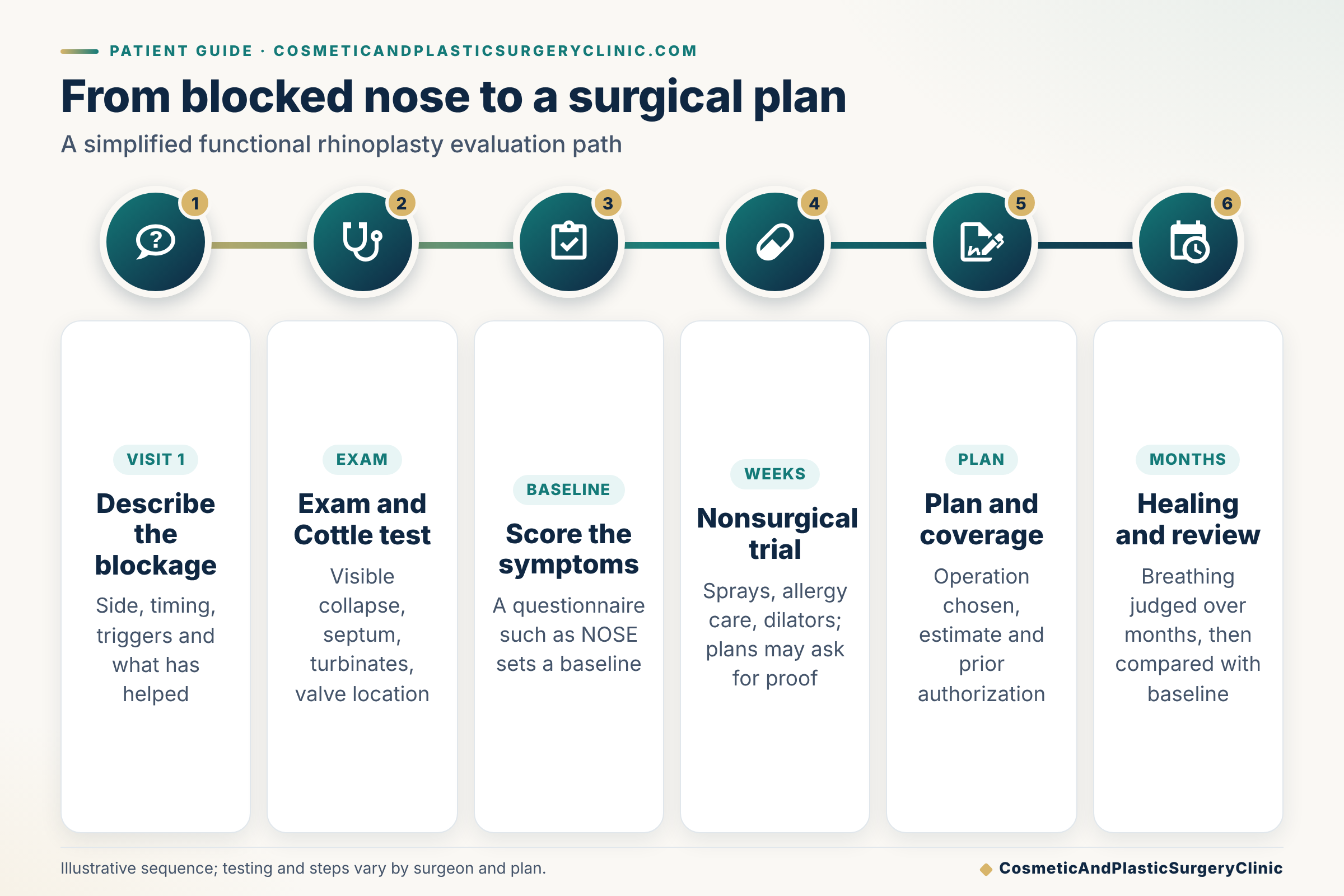
History, exam and the Cottle maneuver
Symptom questionnaires and why they are used
Surgeons rarely rely on a single question. A common tool is the Nasal Obstruction Symptom Evaluation scale, known as NOSE, which was developed and validated in a 2004 study in Otolaryngology-Head and Neck Surgery by Stewart and colleagues at four academic medical centers. The authors describe it as a valid, reliable, responsive instrument that is brief and easy to complete. It turns your description of blockage into a score that can be compared before and after treatment.
A questionnaire does not locate the problem. It records how bothersome the symptoms are, which also matters to insurers and helps show whether functional rhinoplasty changed anything.
What the Cottle maneuver can and cannot show
In the Cottle maneuver, the examiner draws the cheek skin outward to open the valve while you breathe in; a modified version lifts the sidewall from inside with a blunt tool. If breathing improves, the test supports valve narrowing. The AAO-HNS position statement says diagnosis of nasal valve collapse is clinical and that a positive Cottle or modified Cottle supports it.
The test has a known weakness. Pirola and colleagues describe its specificity as relatively low and cite a 2020 study by Das and Spiegel in which 98 of 100 volunteers reported better nasal breathing during the maneuver regardless of their anatomy. A positive result is therefore one piece of evidence, not a verdict, and it works best alongside visible collapse on deep inspiration.
Objective tests and what they add
Rhinomanometry, rhinometry and peak flow
Several instruments measure airflow or cross-sectional area: rhinomanometry records pressure and flow, acoustic rhinometry uses sound reflections to estimate cavity area, and peak nasal inspiratory flow records the fastest breath you can draw through the nose. These are mostly research tools. The 2010 AAO-HNS consensus statement on nasal valve compromise found that objective outcome measures are not routinely used, and the 2025 Frontiers review says no single diagnostic test has been proven both sensitive and specific for nasal valve obstruction.
Endoscopy, CT and photographs
A nasal endoscope, a thin camera, lets the surgeon see the septum, turbinates and back of the nose. The AAO-HNS says endoscopy is not required to diagnose valve collapse but can identify other causes of obstruction. On imaging, the 2015 septoplasty consensus statement noted that CT may not accurately show the degree of septal deviation, and the 2010 statement judged radiographic imaging not useful for valve compromise.
Photographs have a documentation role in functional rhinoplasty cases, particularly for insurers, but the position statement cautions that they do not reliably show internal valve collapse. Clear photographs at standard angles are covered in rhinoplasty before and after.
Nonsurgical steps and when functional rhinoplasty enters the conversation
Sprays, allergy care and dilators
What medical management actually meant in the trial
In NAIROS the comparison arm used a steroid nasal spray plus saline spray, a combination for swelling inside the nose. Mayo Clinic likewise states that medicines may reduce swelling and that surgery is needed to correct a deviated septum itself. A spray cannot straighten cartilage; it can only reduce the lining swelling that adds to the narrowing.
The NHS leaflet on septal surgery lists steroid sprays as the alternative, notes they must be used long term, and says a bent septum is not harmful, so it may simply be left alone. Anyone using prescribed medicine should keep following their own clinician’s instructions and discuss changes with that clinician before surgery is booked.
Dilator strips and clips as a trial of the idea
Over-the-counter external strips and internal clips hold the valve open mechanically. A 2016 review of 33 available products by Kiyohara and colleagues in JAMA Facial Plastic Surgery, reported by ScienceDaily, concluded that external strips and clips appear to relieve internal valve obstruction and may be an alternative to surgery in some patients. The summary gave no effect sizes, so the strength of that finding is unclear.
The AAO-HNS position statement adds that cones and dilator strips are not practical for long-term use. They do offer something else: if a strip makes breathing clearly easier, that hints the valve is part of the story, and it is a useful thing to mention at a consultation.
How severity and time change the case for surgery
Severity decides how much surgery adds
NAIROS reported that people with the most severe baseline symptoms gained the most from septoplasty, while those with moderate symptoms gained less and tended to improve over time with sprays. The researchers suggested surgery fits best for people with severe symptoms and no other nasal or sinus disease. About 84 percent of participants had severe or extreme symptoms at baseline, so the results lean toward that end of the range.
The economic analysis in the full trial report points the same way: septoplasty had a 15 percent probability of being cost-effective at 12 months at a threshold of 20,000 pounds per quality-adjusted life year, rising to 99 percent at 24 months. That is a UK health-system calculation, not a price quote, but it shows benefit accruing over years.
Waiting, monitoring and second opinions are legitimate options
Choosing not to proceed with functional rhinoplasty is a reasonable outcome of a consultation. A mild blockage that responds to treatment, a deviation that causes no symptoms, or a person who is not ready for surgery can all hold off and revisit the question. The plastic surgery consultation questions article lists what to bring and ask, and a second opinion is ordinary practice when surgeons disagree about which structure is responsible.
What happens inside a functional rhinoplasty operation
A functional rhinoplasty plan is usually built in layers, from the inside out: septum, turbinates, valves, then any change in outline.
Straightening the septum and reducing turbinates
Septoplasty as the foundation of functional rhinoplasty
In most functional rhinoplasty plans the septum is addressed first, because it supports the nasal roof and the tip and supplies cartilage for grafts. The surgeon frees the lining, trims or repositions the crooked portions and keeps enough cartilage in place for support. The 2015 AAO-HNSF septoplasty consensus statement, built from a modified Delphi process, reached agreement on 20 statements and failed to reach agreement on 13, which shows how many technical details are still open to surgeon judgment.
One agreed statement concerns packing: quilting sutures can remove the need for nasal packing after septoplasty. Whether packing or splints are used afterward is a detail to ask about, since it shapes the first week.
Turbinate work done at the same sitting
If enlarged turbinates are part of the diagnosis, reduction is often added to the septal surgery, as in the NAIROS surgery arm. The goal in most contemporary methods is to shrink swollen tissue while keeping the lining that warms and moistens air. Surgeons differ on technique, and the evidence cannot separate the options cleanly, so the useful question is how much tissue will be removed and why that amount.
The AAO-HNS also says that valve repair can be done alone or with septoplasty or turbinate reduction, but that those procedures do not replace valve repair, and that requiring them first is not recommended. In other words, each structure is treated on its own merits.
Rebuilding the nasal valves in functional rhinoplasty
Spreader grafts, flaps and sutures for the internal valve
Spreader grafts are slim strips of cartilage placed between the septum and the upper lateral cartilages to hold the internal valve open. Pirola and colleagues call them the gold standard for internal valve reconstruction, citing a 2018 source, and describe autospreader flaps as an alternative that folds the patient’s own upper lateral cartilages into the same position. Butterfly grafts and titanium implants are described as newer options.
Flaring sutures, which pull the sidewall outward, are an option for milder cases. The review cites older studies showing that their benefit declines over time and does not recommend them as first-line treatment.
Alar batten and rim grafts, implants and radiofrequency
For the external valve, the Frontiers review describes alar batten grafts placed under the skin of the nostril wall, a lateral crural J-flap for mild collapse that needs no graft, and alar rim grafts along the lower edge of the nostril cartilage. Cartilage for grafts usually comes from the septum, and when more is needed from the ear or a rib; the choice affects the number of incision sites and is worth asking about.
Office-based absorbable implants and radiofrequency treatment of the valve are a different category. The AAO-HNS considers cartilage grafting, open repair, suture suspension, implants and radiofrequency accepted approaches and not experimental, yet Cigna’s 2026 policy lists absorbable implants and radiofrequency valve treatment as experimental and unproven. A procedure can therefore be accepted by a specialty society and still be excluded by a plan.
| Goal and anatomy | Option often favored | Reason | Fact that could reverse it |
|---|---|---|---|
| One-sided blockage, bent septum, no wish to change appearance | Septoplasty, with or without turbinate reduction | Targets the septum through internal incisions; NAIROS studied this group | Visible valve collapse or a twisted bony pyramid; septoplasty alone may not fix the obstruction |
| Blockage on deep breaths, narrow mid-nose, sidewall pulls inward | Nasal valve repair with grafts or sutures | The internal valve controls much of the airway resistance | Septal deviation or turbinate swelling is the main cause; those need treatment first or together |
| Wants a dorsal hump reduced, no breathing complaint | Cosmetic rhinoplasty with airway protection planned | The aim is appearance; supports are preserved or rebuilt | Exam shows narrow valves; reshaping could worsen breathing |
| Crooked nose after injury, blocked on one side, wants a straighter look | Combined septorhinoplasty | One operation can address the septum, bones and outline | Plan treats the functional and cosmetic parts differently; costs change |
| Blockage that alternates sides, worse with allergy | Medical evaluation first | The nasal cycle and rhinitis can mimic structural disease | A fixed, one-sided blockage that does not respond to treatment |
Insurance for functional rhinoplasty: how the breathing and cosmetic parts are judged
What payers ask for
Symptoms, exam findings, photographs and a trial of care
ASPS states on its rhinoplasty cost page that when the operation is done to improve breathing, usually because of an obstructed airway, it is considered reconstructive and may be covered by insurance. Coverage requires a detailed examination confirming the cause and prior authorization from the insurer, and this applies whether the procedure is done alone or alongside cosmetic rhinoplasty. The page does not explain how a combined bill is divided.
Policies fill in the detail for functional rhinoplasty. Common ingredients are a documented duration of symptoms, exam findings that match the complaint, photographs, and sometimes proof of nonsurgical treatment. The 2015 consensus statement notes that some payers demand extended medical therapy before septal or turbinate surgery and that no clear evidence shows the requirement helps, which is one reason requirements keep changing.
Two 2026 policies, side by side
Two publicly posted policies show how much plans can differ. Cigna’s coverage policy 0119 took effect on July 1, 2026, and UnitedHealthcare’s Surest policy SRST.MP.019.36 lists an effective date of November 1, 2026. Both treat rhinoplasty done solely to change appearance as not medically necessary. Both also depend on the member’s plan document, which governs over the policy.
| Procedure | Cigna policy 0119 (effective 7/1/2026) | UnitedHealthcare Surest policy (effective 11/1/2026) | Question to ask |
|---|---|---|---|
| Septoplasty | Covered for breathing difficulty from septal deformity, recurrent nosebleeds from it, or interference with CPAP; no conservative-therapy step since 10/15/2025 | No standalone criteria in the portion read; it appears as a step before rhinoplasty | Does the plan require a documented trial of medication first? |
| Rhinoplasty for obstruction | Trauma-related deformity with functional impairment, photographs, and impairment not expected to resolve with septoplasty or turbinate surgery alone | Persistent obstruction from septal or bony deviation, septoplasty alone insufficient, photos match exam, at least 4 weeks of conservative care | Which structure is the documented cause? |
| Nasal valve repair | Chronic obstruction from internal valve collapse with improvement on Cottle or sidewall lift | Valve compromise after other causes are treated, visible collapse on deep inspiration, modified Cottle improvement, photos, static or dynamic noted | Is the Cottle result and valve location written in the chart? |
| Turbinate reduction | No standalone statement | No standalone criteria; must be absent, treated, or scheduled with a septal or valve procedure | Is it billed separately or bundled? |
| Absorbable implants, radiofrequency | Experimental and unproven | Unproven and not medically necessary | Is an uncovered option worth paying for out of pocket? |
The Surest policy contains a small inconsistency that shows why details matter: its rhinoplasty criteria cite at least four weeks of conservative care, while its definitions describe persistent obstruction as not responding to six weeks of medical management. Two timeframes in one document is a prompt to ask the plan which applies.
Combined operations and the money conversation
Asking how a plan treats each part
A combined functional rhinoplasty raises a billing question that a surgeon’s office should be able to answer: which portions are submitted as medically necessary, which are self-paid, and who bears the facility and anesthesia costs for each. Coverage also may require the prior-authorization step before the date is set, not after.
Fee anatomy is covered in the cost article linked earlier, and plastic surgery financing covers payment options. The same cosmetic-versus-reconstructive logic shows up in other operations, for example in breast reduction insurance rules, so the habit of reading the policy by name carries over.
A hypothetical estimate review
Consider a hypothetical person in November 2026 whose nose was broken in sports years earlier. They have one-sided blockage that persists, and they would also like the bridge straighter. The surgeon documents a bent septum and valve narrowing on exam, takes standard photographs, and the office submits for prior authorization of the airway components while the shape changes are quoted separately.
Now change one variable: the exam notes only a bent septum and no valve findings, and the plan’s policy says septoplasty alone must be shown to be insufficient before functional rhinoplasty is considered. The authorization path changes, and so might the operation proposed. The lesson is that the diagnosis written in the chart drives the coverage conversation, so ask to see what the surgeon recorded.
Healing, risks and when the result is judged
What healing looks like when the airway is the goal
Packing, splints and the blocked-nose phase
Early breathing is often worse before it is better after functional rhinoplasty. A septal surgery leaflet from an NHS hospital, published in 2022, says packing may be used and removed within hours or by the next day, an internal splint is usually removed after about a week, and swelling can leave the nose blocked for up to three months. It advises not blowing the nose for at least two days and taking about two weeks off work, and these are one UK hospital’s septoplasty instructions, not rules for every functional rhinoplasty.
Operations that add grafts, valve repair or reshaping take longer to settle. Week-by-week detail belongs in rhinoplasty recovery, and general logistics such as help at home are in plastic surgery recovery planning.
When breathing and shape can be judged
Swelling inside the nose hides the final airflow, so a judgment at two or three weeks is premature. Surgeons usually review breathing over several months, and tip swelling after shape changes can take longer still. A before-and-after symptom score such as NOSE gives that review a number instead of a mood, which is one practical use of the questionnaire.
Risks specific to airway surgery
Expected effects, complications and emergencies
Congestion, crusting, mild bleeding, bruising and numbness of the nose tip or upper teeth are expected, and the NHS leaflet calls numbness common and usually temporary. Complications are different: the leaflet lists infection that can progress to a septal abscess, a collection of blood under the septal lining called a hematoma, and a septal hole, which it calls uncommon. ASPS lists septal perforation as rare and notes that further surgery may be needed to repair it.
When breathing does not improve
Functional rhinoplasty does not always work. The NHS leaflet says the septum may not fully straighten or may re-bend in about 1 in 10 cases, and that scarring can also cause blockage. The Frontiers review reports septoplasty failure rates of 19 to 50 percent in the literature it cites, a wide range that reflects differing definitions of failure; its authors also stress that most evidence on valve surgery is retrospective, built on patient-reported measures.
Turbinate surgery has its own list, from crusting to empty nose syndrome. A fuller treatment of complications is in rhinoplasty risks, and persistent problems lead toward revision rhinoplasty.
Six checks before booking a consultation
Preparing for a functional rhinoplasty conversation
Records, photographs and a symptom diary worth bringing
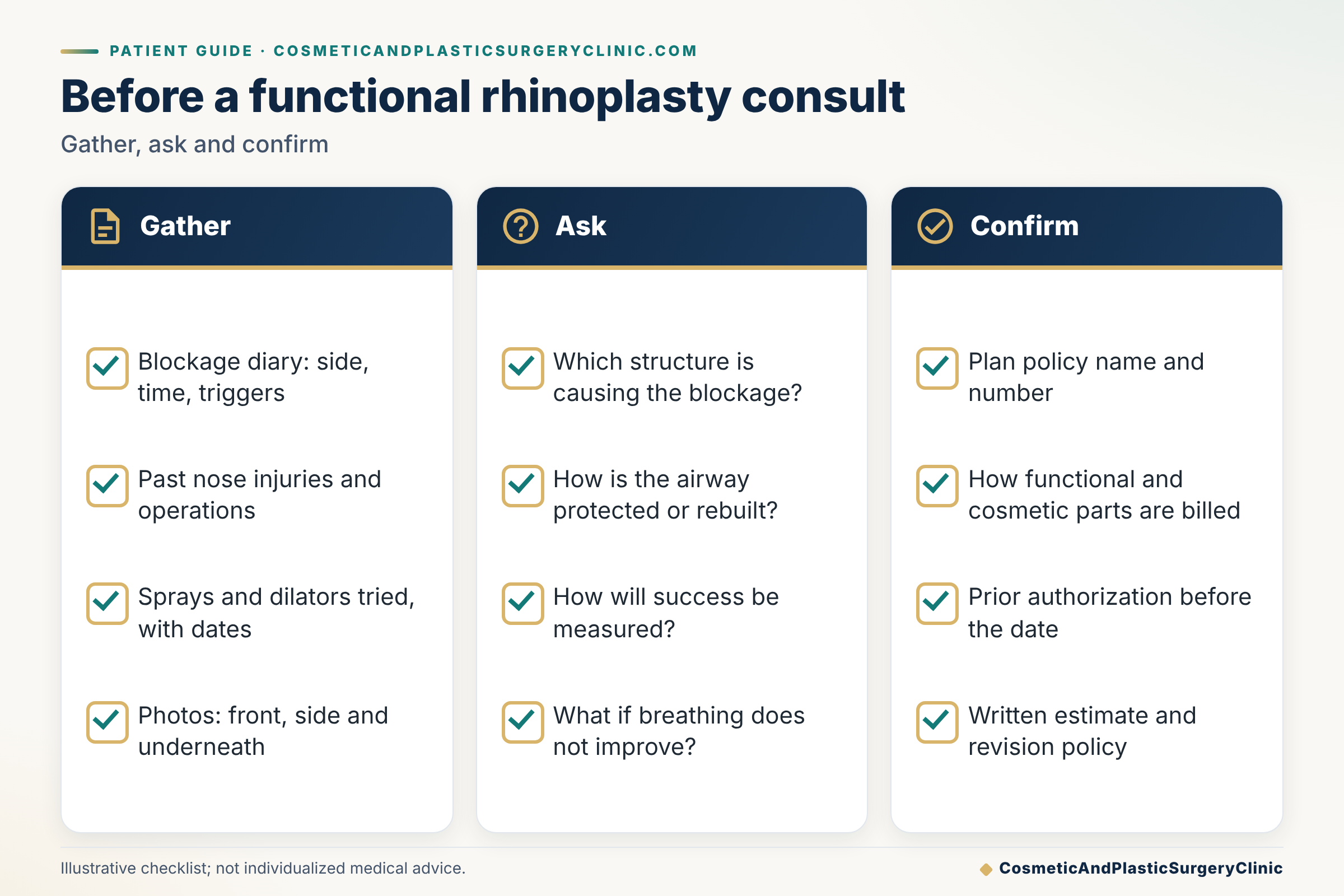
Bring any earlier imaging reports, notes about past nose injuries or operations, the names of medicines and sprays you have used, and a short diary of blockage over a couple of weeks. Clear, front, side and underneath photographs of the nose taken on a normal day help too, because the nose can look different when swollen from a cold.
Six checks that avoid surprises
Whatever the final plan, the same six checks keep a functional rhinoplasty consultation productive. Gather the answers before the visit so the time goes to the surgeon’s reasoning.
- Describe the blockage precisely. Note which side, what time of day, whether it worsens when breathing in hard or at night, and what has helped.
- Ask which structure is responsible. Septum, turbinate, internal valve or external valve each lead to a different operation.
- List what you have already tried. Sprays, allergy care and dilators, with dates, because plans may ask for them.
- Ask how the airway is protected. If the shape will change, ask how support is preserved or rebuilt.
- Ask how the plan will see it. Request the policy name and number and how functional and cosmetic parts are billed.
- Ask how success is measured. A before-and-after questionnaire and a stated plan if breathing does not improve.
Choosing who evaluates the nose
Training, scope and checking credentials
Functional rhinoplasty is done by surgeons trained in several fields, including otolaryngology, facial plastic surgery and plastic surgery. Training matters less as a label than as a record of what a surgeon routinely does: ask how many airway-focused operations they perform and how they handle valves. The mechanics of verification are in choose a plastic surgeon.
When appearance worries and breathing worries pull apart
Some people come in mainly for how the nose looks and mention breathing in passing; others come for breathing and discover strong feelings about appearance. A good functional rhinoplasty consultation separates the two, asks what each result would mean day to day, and is comfortable ending without a booking. Surgeons commonly explore expectations before nasal surgery, and anyone whose worry about appearance feels consuming can also seek support from a mental health professional, which is a reasonable step and does not rule out surgery.
Alternatives to functional rhinoplasty for appearance goals, including injectable reshaping, are covered in rhinoplasty alternatives.
Frequently asked questions
Is septoplasty the same thing as functional rhinoplasty?
Not exactly. Septoplasty works on the septum only and is usually done through internal incisions. Functional rhinoplasty is a broader term for airway surgery that may include the septum, turbinates, valves and the external framework of the nose, and some plans combine septoplasty with grafts or reshaping. A person told they need “a septoplasty” should ask whether the surgeon also expects to treat the valves or outline, since that changes the operation, the recovery and how an insurer reviews it.
Why does my blocked nostril switch sides, and does that matter for functional rhinoplasty?
Often because of the nasal cycle, a normal alternation in which one side swells while the other opens. A 2018 review reports it in roughly 70 to 80 percent of healthy adults. Switching alone is not a sign that surgery is needed. A blockage that stays on one side, persists for weeks, or comes with nosebleeds or noisy sleep is the pattern worth raising with a clinician, who can sort out cycling from structural narrowing.
Will a CT scan show whether I need functional rhinoplasty?
It may help in some cases, but it has limits. The AAO-HNS says CT does not capture dynamic valve collapse, and a 2015 consensus statement noted that CT may not accurately show the degree of septal deviation. Surgeons order scans when they suspect sinus disease or want to see bone anatomy. For most people the exam and symptom history carry more weight than imaging, and a normal scan does not rule out valve collapse.
Do nasal strips or clips tell me anything about functional rhinoplasty?
They can offer a hint. A 2016 review in JAMA Facial Plastic Surgery found that over-the-counter strips and clips appear to relieve internal valve obstruction in some people. If breathing clearly improves when the valve is held open, mention it to your surgeon. It does not prove that surgery will work, and strips are not considered practical long term. Treat the result as a conversation starter, not a diagnosis.
Do I have to try nasal sprays before functional rhinoplasty is considered?
Requirements vary. One 2026 UnitedHealthcare Surest policy asks for at least four weeks of conservative care in its rhinoplasty criteria, while a 2026 Cigna policy dropped a conservative-therapy step for septoplasty in October 2025. A 2015 consensus statement saw no clear evidence that extended medical therapy requirements help. Keep taking any prescribed medicine as directed, and ask the surgeon and the plan what must be documented before authorization.
What if my breathing is no better after functional rhinoplasty?
Tell the surgeon at follow-up, because early swelling can mask results for months and a real problem needs an exam. Possible causes include a septum that re-bent, scarring, a valve that still collapses, or turbinate swelling. A leaflet from an NHS hospital cites re-bending in about 1 in 10 septoplasties. Some people need further treatment. Ask before surgery what the revision policy is and who handles a second opinion.
Can a surgeon who focuses on appearance also perform functional rhinoplasty?
Many surgeons do both, but experience varies, and it is reasonable to ask. Questions to try: how often they treat valve collapse, how they decide between grafts and sutures, how they measure outcomes, and how they keep breathing intact in cosmetic cases. The training behind the title is less informative than their routine practice. A second consultation with an otolaryngologist or a surgeon who does airway work regularly is ordinary.
Sources and further reading
- American Society of Plastic Surgeons — Rhinoplasty (accessed 2026-11-12) — airway evaluation, deviated septum
- American Society of Plastic Surgeons — Rhinoplasty cost (accessed 2026-11-12) — reconstructive status and prior authorization for breathing surgery
- American Society of Plastic Surgeons — Rhinoplasty safety (accessed 2026-11-12) — listed risks including septal perforation
- AAO-HNS — Position statement: nasal valve repair (approved March 2023, page revised July 2026; accessed 2026-11-12) — diagnosis, valve anatomy, accepted techniques
- AAO-HNS news release via EurekAlert — Clinical consensus statement on nasal valve compromise (July 1, 2010; accessed 2026-11-12) — 2010 consensus findings
- AAO-HNS Bulletin — Clinical consensus statement: septoplasty with or without inferior turbinate reduction (2015; accessed 2026-11-12) — medical therapy, imaging, packing
- Han et al. — Clinical consensus statement: septoplasty with or without inferior turbinate reduction, Otolaryngology-Head and Neck Surgery, 2015 (record; accessed 2026-11-12) — 20 consensus and 13 non-consensus statements
- NAIROS trial, Health Technology Assessment report, 2024 (accessed 2026-11-12) — septoplasty versus medical management, 378 adults
- NIHR Evidence — Surgery is better than nasal sprays for people with severely blocked airways (April 2024; accessed 2026-11-12) — one-year results, severity effect
- Mayo Clinic — Deviated septum: symptoms and causes (accessed 2026-11-12) — symptoms, causes, complications
- Pirola, Kim and Douglas — Nasal valve obstruction: a comprehensive analysis of the current literature and proposal of a management algorithm, Frontiers in Surgery, 2025 (accessed 2026-11-12) — valve anatomy, tests, grafts, evidence limits
- Cigna — Coverage policy 0119, Rhinoplasty and septoplasty (effective 2026-07-01; accessed 2026-11-12) — example medical-necessity criteria
- UnitedHealthcare Surest — Medical policy SRST.MP.019.36, Rhinoplasty and other nasal procedures (effective 2026-11-01; accessed 2026-11-12) — example criteria and documentation
- Pendolino, Lund, Nardello and Ottaviano — The nasal cycle: a comprehensive review, Rhinology Online, 2018 (record; accessed 2026-11-12) — nasal cycle prevalence and relevance
- Stewart et al. — Development and validation of the Nasal Obstruction Symptom Evaluation (NOSE) scale, Otolaryngology-Head and Neck Surgery, 2004 (record; accessed 2026-11-12) — symptom questionnaire validation
- Royal Wolverhampton NHS Trust — Septal surgery (septoplasty) patient leaflet (published 2022; accessed 2026-11-12) — one hospital’s risks and recovery instructions
- Abdullah and Singh — Surgical interventions for inferior turbinate hypertrophy, International Journal of Environmental Research and Public Health, 2021 (accessed 2026-11-12) — turbinate techniques and complications
- Ta, Gao and Philpott — Relationship between objective and patient-reported outcome measures in sinonasal disorders, International Forum of Allergy and Rhinology, 2020 (record; accessed 2026-11-12) — poor correlation of objective tests with symptoms
- ScienceDaily — Over-the-counter nasal dilators review (Kiyohara et al., JAMA Facial Plastic Surgery, 2016; accessed 2026-11-12) — strips and clips and the internal valve