Panniculectomy vs body lift is a comparison between a narrow operation and a wide one, with a tummy tuck sitting between them. A panniculectomy removes the hanging apron of skin and fat below the navel. A tummy tuck (abdominoplasty) removes skin and fat from the front of the abdomen and usually tightens the abdominal wall muscles. A body lift (a circumferential lower body lift, also called a belt lipectomy) removes a band of tissue around the whole lower trunk, so the flanks, back and buttocks are treated along with the front.
This page compares panniculectomy vs body lift, with the tummy tuck in the middle, by anatomy, scar, insurance logic, published risk data and recovery, and by the facts that tend to change a plan. It cannot say which operation suits your body, because that takes an in-person exam by a board-certified plastic surgeon. The wider picture of skin removal after major weight loss is in the body lift after weight loss overview, and abdomen-only surgery in that setting has its own page on tummy tuck after weight loss.
Panniculectomy vs body lift begins with how much tissue each operation reaches
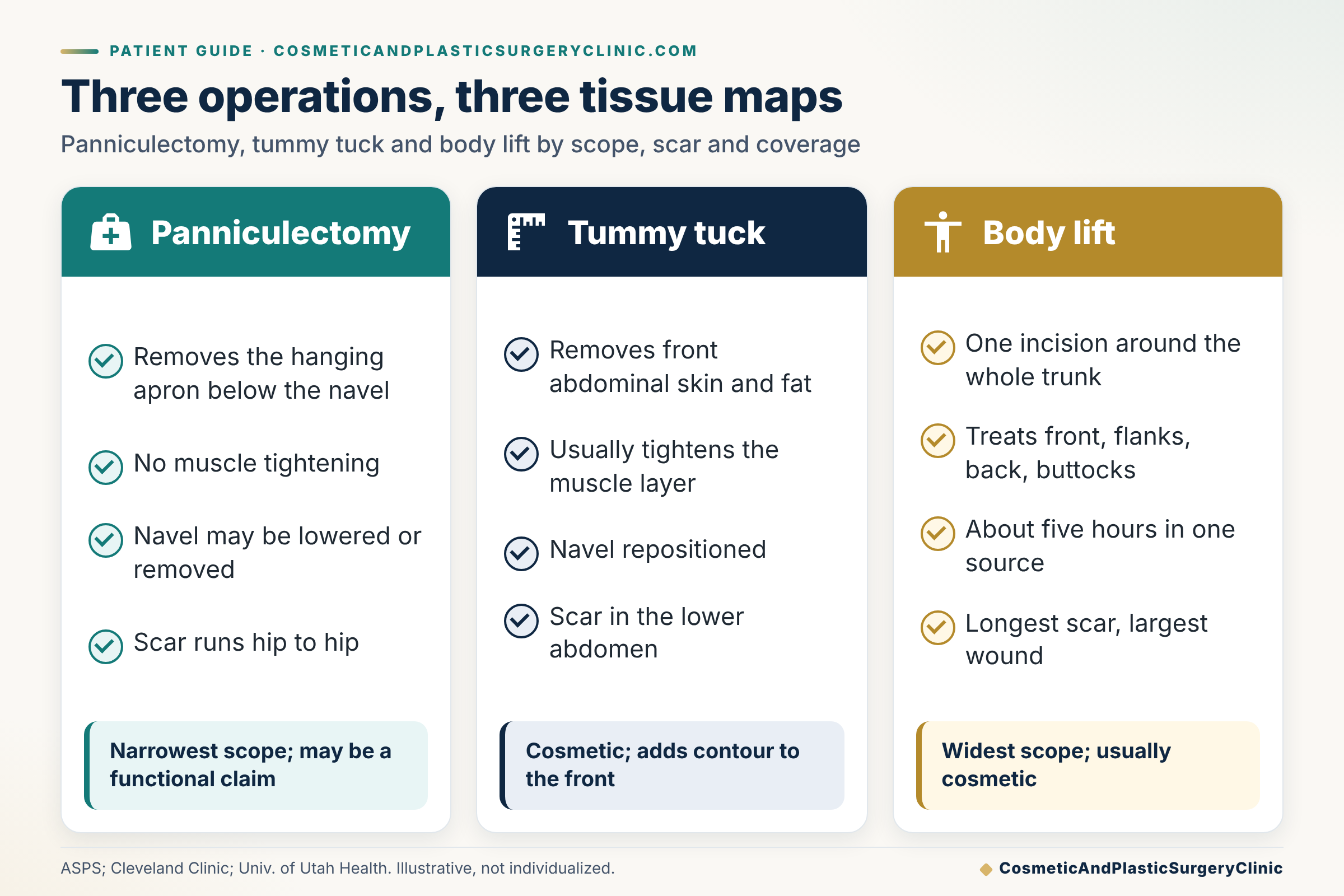
The three names describe three different amounts of surgery, not three levels of the same operation, so panniculectomy vs body lift is closer to a choice of territory than of intensity. Reading each one by what it leaves untouched is often clearer than reading it by what it removes.
Three operations, three tissue maps
Panniculectomy: the apron below the navel and little else
American Society of Plastic Surgeons (ASPS) coverage documents describe panniculectomy as removal of hanging excess skin and fat in a transverse or vertical wedge, without muscle plication, a new navel or flap elevation. Cleveland Clinic adds that it does not tighten muscles the way a tummy tuck does and is not a weight-loss operation.
The navel is affected by the size of the apron. Cleveland Clinic says it may be pulled down or removed and then repositioned, and one 2015 review states that for a very large apron the umbilicus cannot be preserved. That narrow scope is the first fact to hold onto in panniculectomy vs body lift: the operation is built to remove an overhang, not to reshape the waist.
Tummy tuck: skin, fat and the abdominal wall
ASPS says a tummy tuck removes excess fat and skin and, in most cases, restores weakened or separated muscles. Cleveland Clinic describes an opening made for the navel so it can be repositioned, and lists full, mini, extended (circumferential) and fleur-de-lis versions. The mini vs full tummy tuck comparison and the fleur-de-lis tummy tuck page cover those variants, so they are not repeated here.
In ASPS coding documents the abdominoplasty part of an operation, meaning navel transposition and muscle plication, is a cosmetic add-on to the panniculectomy code. That distinction decides how panniculectomy vs body lift is handled by a plan, as the insurance section shows. Muscle separation after pregnancy or weight change has its own page on diastasis recti and tummy tuck.
Body lift: a belt of tissue removed around the whole trunk
Cleveland Clinic describes a lower body lift as one incision around the entire torso, removing loose skin and fat at the waist, lower abdomen and buttocks, with drains often placed and general anesthesia used. University of Utah Health lists the abdomen, flanks, back, buttocks and thighs as areas that can be treated and gives about five hours as the operating time. The operation itself is explained on the lower body lift page.
Because the incision wraps around, the back and flank skin that a panniculectomy never touches is in play. That is the whole reason surgeons discuss a body lift for laxity that goes all the way around. ASPS counted 10,868 lower body lifts in 2025 against 173,251 tummy tucks, roughly one lift for every sixteen tucks, and its report does not tally panniculectomy. Counts show how often an operation is chosen, not how suitable it is.
Where the scars end up
Scar position is the most visible trade-off between the three, and it is the part of panniculectomy vs body lift that photographs of the front of the body hide.
Hip to hip, a T, or all the way around
Cleveland Clinic describes a panniculectomy scar as typically a line across the lower abdomen from hip to hip, with a fleur-de-lis technique leaving a T shape. A tummy tuck incision sits in the lower abdomen above the pubic region and lengthens with the amount of skin removed, and extended versions continue around the sides. A body lift scar runs around the waist and lower back, and surgeons try to place it where underwear or swimwear can cover it, according to University of Utah Health.
Why a longer scar is the price of a wider contour
Tissue is removed along a line, so the more territory an operation covers, the longer that line becomes. Cleveland Clinic says scars fade over several months to a year but never disappear completely, and a Stony Brook Medicine patient page says scars typically need 12 months to go through remodeling.
A wider operation trades a longer scar, including one on the back, for more contour. A narrower one trades contour for a shorter scar. Neither trade is a mistake, and it helps to say aloud at the consultation which one you would accept. Table 1 sets the three side by side.
| Factor | Panniculectomy | Tummy tuck | Body lift |
|---|---|---|---|
| Main indication | Hanging apron that causes skin or mobility problems | Cosmetic reshaping of the front abdomen, often with loose muscles | Laxity around the trunk: front, flanks, back and buttocks |
| Structures treated | Skin and fat below the navel; no muscle tightening | Skin, fat and usually the muscle layer; navel repositioned | Circumferential skin and fat; may include muscle tightening |
| Invasiveness | Smallest of the three; often outpatient per Cleveland Clinic | Moderate; one to five hours per Cleveland Clinic | Largest; about five hours in one academic source; drains common |
| Reversibility | Removed tissue is gone; an apron can re-form after large weight change | Skin removal and muscle repair stay; big weight swings can diminish results | Removed tissue and long scar are fixed; settling takes a year or more |
| Scar and downtime | Hip-to-hip line; strenuous activity paused at least six weeks | Lower-abdominal line, longer if extended; exercise often paused four to six weeks | Circumferential line; no heavy lifting for about six weeks |
| Main risks | Bleeding, infection, seroma or hematoma, delayed wound healing (Cleveland Clinic list) | Bleeding, infection, seroma, poor wound healing, blood clots (Cleveland Clinic list) | Wound separation, seroma, clots, bleeding, infection, asymmetry (Cleveland Clinic list) |
| Cost logic | Can be a covered claim if plan criteria are met | Cosmetic; ASPS average $8,174 before facility and anesthesia | Cosmetic; ASPS average $11,397 before facility and anesthesia |
Panniculectomy vs body lift in insurance terms: where function ends and contour begins
Insurance rules are the reason a choice between these operations is sometimes decided by paperwork before anatomy. A plan treats an operation as reconstructive only when it corrects a documented medical problem, and it judges each of the three differently. The policies below are examples read in November 2026, and every plan’s own contract controls.
What a functional panniculectomy claim usually has to show
Skin problems that did not respond to three months of treatment
The Blue Cross Blue Shield of Kansas policy asks for recurrent or chronic rashes, infections, cellulitis or non-healing ulcers that have not responded to conventional treatment for three months. Cigna’s 2026 policy asks for persistent intertriginous dermatitis, cellulitis or ulceration refractory to at least three months of medical management, with hygiene plus topical antifungals, corticosteroids or antibiotics. Kaiser Permanente Washington asks for a documented three-month trial of prescribed systemic antibiotics that failed.
The shared theme is treated, documented and unresolved. Panniculectomy vs body lift in an insurance setting therefore starts with a chart, not a mirror. ASPS criteria also expect photographs and a record of the type and duration of symptoms and treatment, and they state that improvement in daily activities alone is not an indication.
How far the apron hangs: pubis, symphysis and grades 1 to 5
Plans measure the apron against a landmark. Blue Cross Blue Shield of Kansas requires it to hang below the lower level of the pubis, Cigna says at or below the symphysis pubis, and the First Coast Medicare contractor summary says below the symphysis pubis, each shown on photographs.
Two other documents use ASPS grades. As quoted in a Vermont Medicaid document, grade 1 covers the hairline and mons pubis but not the genitals, grade 2 covers the genitals and upper thigh crease, grade 3 the upper thigh, grade 4 mid-thigh and grade 5 the knees or below. Vermont and Kaiser Washington both require grade 2 or higher. Asking a surgeon’s office which grade and which policy wording apply is more useful than guessing.
Why panniculectomy vs body lift is often split into covered and self-paid parts
Cosmetic add-ons and the coding that separates them
The 2017 ASPS criteria call abdominoplasty typically cosmetic and circumferential lipectomy (belt lipectomy, or lower body lift) typically cosmetic. In a circumferential operation, they say, only the abdominal portion is reconstructive. They also note that a cosmetic abdominoplasty may accompany a functional panniculectomy or be delayed until weight reduction is complete.
The coding follows the same split: CPT 15830 for the infraumbilical panniculectomy and 15847 as an add-on for the abdominoplasty component. Cigna calls abdominoplasty cosmetic for any indication, and Kaiser Washington allows an exception only for hernia-related need. The pairing can therefore become a hybrid quote, with a covered or partly covered panniculectomy and a self-paid cosmetic portion priced separately.
Weight stability, bariatric timing and prior authorization
Weight rules differ by plan. Cigna and First Coast ask for six months of stable weight and 18 months after bariatric surgery. Blue Cross Blue Shield of Kansas adds a BMI of 30 or less. Kaiser Washington, for people after bariatric surgery, asks for 18 months with 12 months of documented stability and a BMI under 35. A rule from one plan cannot be assumed for another.
Surgical guidance runs separately. A 2015 review recommended operating 12 to 18 months after a bariatric operation with four to six months free of weight fluctuation, and Stony Brook Medicine says ideally 12 months of stable weight. Process matters too: Medicare requires prior authorization for panniculectomy in hospital outpatient departments, and GoodRx reports that denials usually arrive at prior authorization and that appeals generally run up to 180 days from the denial notice.
Table 2 shows how four 2026 sources word these tests, and the body lift cost page covers what happens to the budget when a plan declines.
| Source | Apron and symptom test | Weight and bariatric timing | Tummy tuck and body lift |
|---|---|---|---|
| Blue Cross Blue Shield of Kansas (reviewed Aug 2026) | Hangs below the pubis; rash, infection or ulcer unresponsive for three months | BMI 30 or less; stable six months; 18 months after bariatric surgery | Abdominoplasty cosmetic and not covered; body lift not addressed |
| Cigna policy 0027 (effective June 2026) | At or below the symphysis pubis; dermatitis, cellulitis or ulcer refractory for three months | Stable six months; 18 months after bariatric surgery | Abdominoplasty cosmetic for any indication; body lift not mentioned |
| Kaiser Permanente Washington (effective July 2026) | Grade 2 or higher; failed three-month trial of systemic antibiotics | Stable six months; after bariatric surgery 18 months, 12 stable, BMI under 35 | Abdominoplasty cosmetic except hernia need; back lift generally not covered |
| First Coast Medicare contractor (page updated Mar 2026) | Below the symphysis pubis; intertrigo refractory three months; functional impairment | Stable six months; 18 months after bariatric surgery | Repair of wall laxity for appearance listed as not covered |
Panniculectomy vs body lift risk and recovery: what the published numbers can and cannot say
No randomized trial assigning people to panniculectomy vs body lift turned up in the sources read. What exists is single-center series, database studies and reviews that count complications differently, so the figures below describe the literature, not any one operating room. General risk literacy is in the plastic surgery risks overview, and procedure detail for the widest operation is on the body lift risks page.
Complication data for each operation
Panniculectomy and tummy tuck compared in post-bariatric series
A 2008 Annals of Plastic Surgery series covered 222 patients treated from 2001 to 2006, 89 with abdominoplasty and 133 with panniculectomy. Wound complications occurred in 34% overall: seroma 14%, infection 12%, healing disturbance 11% and hematoma 6%. The 63% who had weight-loss surgery first had more wound complications than the rest (41% against 22%). The abstract does not split results by operation, and in the adjusted analysis only anesthesia risk class stayed significant.
A 2025 retrospective cohort of 198 people who had abdominal contouring after bariatric surgery, from 2011 to 2022, found complications in 64 (32%). Compared with panniculectomy, traditional abdominoplasty carried higher odds of complications (odds ratio 2.72, 95% confidence interval 1.25 to 5.93), and vertical abdominoplasty higher still (5.50, with a very wide interval of 1.17 to 25.87). The authors concluded panniculectomy appears safer after bariatric surgery. People were not randomly assigned, so that describes operations as chosen for different anatomies, not a swap for any one person.
Body size modifies risk inside a single operation. A 2010 to 2014 national surgical-quality database study of 4,497 panniculectomies found wound complications in 17.8% of patients with class III obesity (BMI over 40) against 6.8% of the others, venous thromboembolism in 1.5% against 0.7%, and unplanned reoperation in 9.2% against 3.7%.
Body lift complication data and its limits
A 2006 Plastic and Reconstructive Surgery report followed 200 consecutive body lifts after massive weight loss from one practice. Overall complications reached 50%, skin dehiscence (wound edges separating) 32.5% and seroma 16.5%. The patients were grouped by BMI at surgery, and the higher-BMI groups gained function and contour but had more complications.
A 2016 systematic review of circumferential lower-trunk contouring, covering 42 articles and 1,748 patients, named wound dehiscence as the most frequently reported complication and called most of the evidence low-level. A 2010 comparison of 80 circumferential abdominoplasties with 38 classical ones found more delayed wound healing and less hematoma in the circumferential group.
Series differ in what counts as a complication, so a 32.5% dehiscence figure from one practice should not be set against a 12% infection figure from another as if both measured the same thing. A 2015 review adds that blood clots occur in about 2.9% of body-contouring patients overall and 8.9% above BMI 35, within a published range of 1% to 9.3%, and that people after bariatric surgery had a 60% to 87% higher complication risk than others.
Recovery: what changes with the size of the wound
A panniculectomy recovery arc
Cleveland Clinic says most panniculectomies are outpatient, with a loved one needed for the drive home and at least the first 24 hours. The first several days are often the most painful, discomfort should ease around days 5 to 7, and a visit at one to two weeks checks incisions, stitches and drains. Many people return to work, often on light duty, at about two weeks, avoid strenuous exercise for at least six weeks, and may need six months for the incision to heal fully. Of the three, this is the lightest recovery arc in panniculectomy vs body lift terms.
Tummy tuck and body lift recovery arcs, side by side
For a tummy tuck, Cleveland Clinic gives at least a week off work on average, four to six weeks before strenuous exercise for very active people, a final result in up to three months and scar change over up to a year. For a lower body lift it advises no exercise or heavy lifting for about six weeks and says full settling can take a year or more.
University of Utah Health adds drains until output is minimal, a lifting limit of 10 pounds for at least six weeks, visits every one to two weeks over that period, someone staying with you for at least two days, and several weeks off work. It says patients usually go home the same day, but length of stay varies by practice and by what is combined. Put plainly, the recovery gap in panniculectomy vs body lift is the length of the restrictions and the number of weeks away from work.
Panniculectomy vs body lift by anatomy: scenarios and what could reverse them
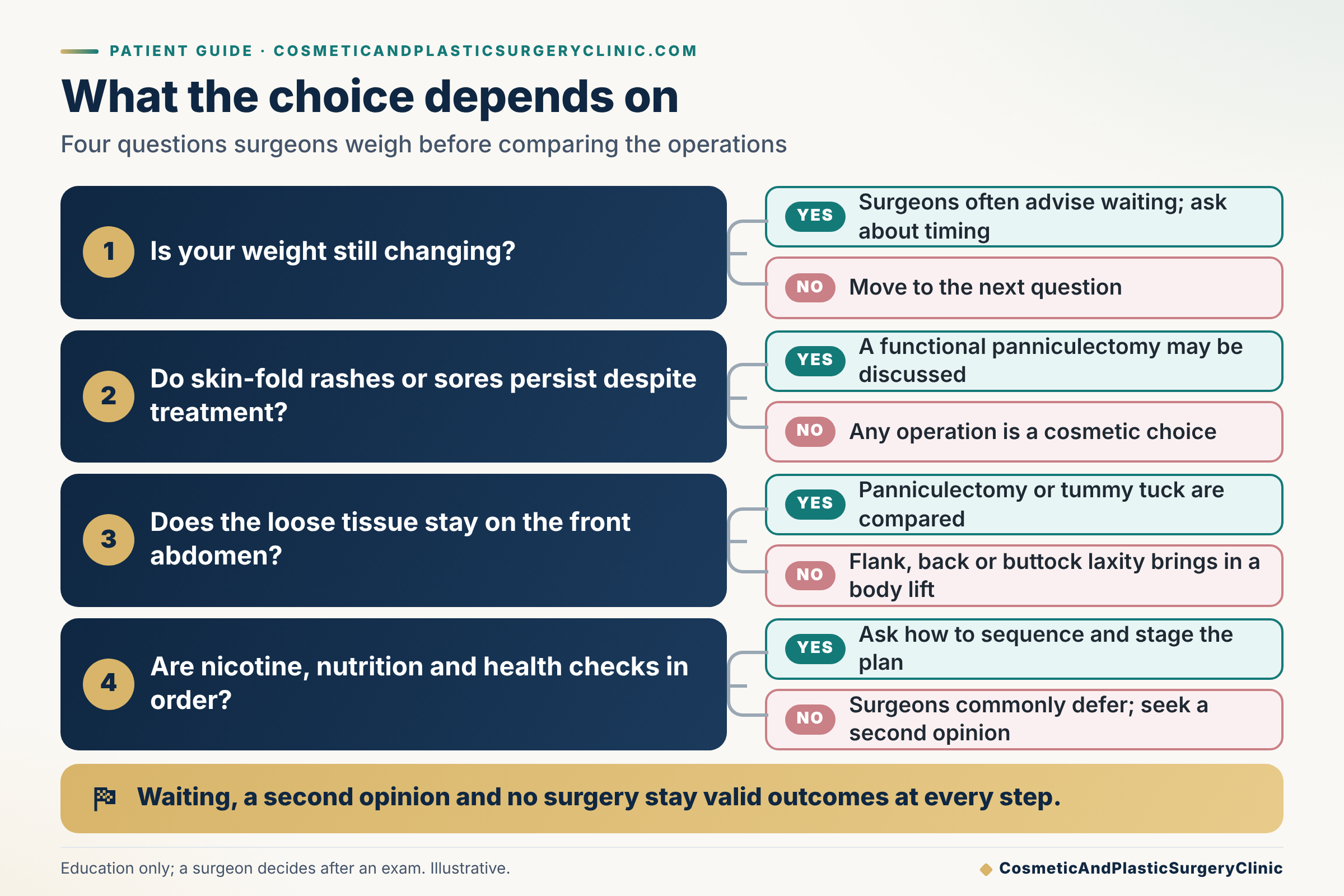
Surgeons choose among these operations by examining where tissue hangs, how it behaves standing and lying, and how well wounds are likely to heal. The scenarios below are hypothetical teaching examples, not advice for any body.
Three hypothetical anatomy patterns
An apron that overhangs while the flanks and back stay tolerable
Consider a hypothetical adult whose main problem is a skin fold that stays irritated under an apron, with no real concern about the waist or back. Panniculectomy is the operation usually discussed, because it removes the overhang with the smallest wound of the three and fits the functional criteria in Table 2. Its limit is scope: the waist, flanks and muscle layer are left as they are, and the navel may move or go.
Front laxity with separated muscles and a milder apron
Now consider a hypothetical person with loose front skin, lax muscles and little overhang. The tummy tuck family fits that map because it removes skin and tightens the abdominal wall, and the tummy tuck after weight loss page linked earlier explains how surgeons adapt it when the skin excess is also vertical. The limit is coverage: in the policies read, the cosmetic parts of panniculectomy vs body lift planning are usually paid by the patient.
Laxity that wraps around the flanks, back and buttocks
A third hypothetical person has loose tissue in a full ring, with folds at the flanks and sagging in the back and buttocks. Only the body lift reaches those areas. Its limits are the size of the wound, the length of the operation and the fact that upper arms, breasts, inner thighs and face are separate operations, which is one reason many surgeons plan staged body contouring instead of one very long session.
| Goal or anatomy | Option often discussed | Reason | Fact that could reverse it |
|---|---|---|---|
| Apron with recurring skin infections despite treatment | Panniculectomy | Removes the overhang with the smallest wound of the three | Apron above the plan’s threshold, or weight still changing |
| Front laxity after pregnancy and weight loss, loose muscles | Tummy tuck | Skin removal plus muscle tightening and a repositioned navel | Planned pregnancy or continuing weight loss |
| Loose skin around the waist, flanks, back and buttocks | Body lift | The only one of the three that reaches the back and buttocks | Nicotine use, high BMI, poor nutrition markers or no help at home |
| Large apron now, cosmetic contour wanted later | Panniculectomy first, cosmetic stage later | ASPS criteria allow cosmetic abdominoplasty to be delayed until weight reduction is complete | A second operation adds a second recovery and a second set of risks |
Facts that can reverse the plan
Weight that has not settled
Unsettled weight can reverse any panniculectomy vs body lift choice. ASPS advises people planning substantial weight loss to postpone a tummy tuck, and a 2015 review suggests those who still want to lose weight wait about six months. Cleveland Clinic warns that drastic weight change can make an apron re-form. For people whose weight is moving under medication, skin removal after GLP-1 treatment looks at timing, and any decision about the medication itself belongs to the prescribing clinician.
Nicotine, nutrition and medical conditions
Cleveland Clinic lists a steady weight, no condition that impairs healing and not smoking among the usual panniculectomy criteria. The 2015 review links low preoperative albumin and malnutrition to minor wound complications and says active smokers should defer surgery, with a urine cotinine test about a month before. These are population findings that shift the panniculectomy vs body lift calculation, and a surgeon’s own evaluation decides how they apply.
After the operation: weight change, maintenance and revision
Results are not static, and the three operations age differently. What follows is about how panniculectomy vs body lift results respond to a body that keeps changing.
What later weight change does to each result
An apron that can re-form
Cleveland Clinic says a panniculectomy result holds if weight stays steady, that gaining a few pounds will not cause much trouble, and that drastic change may let the apron re-form and may call for repeat surgery. In a panniculectomy vs body lift comparison, that is the quiet cost of the narrow operation: it removes what hangs today and does not stop new tissue from drooping if weight swings again.
Muscle repair, skin tone and body lift settling
ASPS says a tummy tuck result lasts but can be greatly diminished by significant weight fluctuation, and that stretch marks are not corrected, though some may be removed if they lie on skin that is cut away. Cleveland Clinic lists recurrent skin looseness among body lift risks and says settling takes a year or more. None of the three treats the upper arms, breasts or face, which are separate operations.
One operation now, another later
Panniculectomy as a first stage
Stony Brook Medicine says a panniculectomy or lower body lift typically comes first in a staged plan, with breast procedures combined with arm or medial thigh lifts later and a facelift often last, three to six months apart. The 2015 review prefers operations under six hours and at least three months between stages. Panniculectomy vs body lift can therefore be a question of order, and the staged body contouring page lays out example sequences.
How revisions differ and who pays
Cleveland Clinic lists a need for additional procedures among panniculectomy risks, and ASPS says most health insurance does not cover tummy tuck or body lift surgery or their complications. That makes the practice’s written revision policy a financial document, not a courtesy, whichever side of panniculectomy vs body lift you land on. Ask what is included, for how long, whether facility and anesthesia fees for a revision are covered, and who decides whether a revision is needed.
Quotes and consultation questions for panniculectomy vs body lift planning
A good consultation turns panniculectomy vs body lift into specifics: this tissue, this scar, this claim, this budget. The notes below help you test that the plan was built around your anatomy and not around a menu.
Reading a quote that mixes covered and self-paid parts
National fee averages and what they leave out
ASPS patient pages give an average of $8,174 for a tummy tuck and $11,397 for a lower body lift. Neither page states the statistics year, and both exclude anesthesia, operating room facility and related expenses. The ASPS body lift page also lists medical tests, garments and prescriptions as possible extras. No ASPS average for panniculectomy appeared in the pages read, so panniculectomy vs body lift budgeting has to rely on itemized quotes.
A 2026 GoodRx page, a consumer-health source and not a fee survey, says a lower body lift can cost around $20,000 without insurance. National averages are never local quotes, and the plastic surgery cost guide explains how to compare two quotes like for like.
Itemizing a mixed claim
For panniculectomy vs body lift pricing, consider a hypothetical practice that bills a functional panniculectomy to insurance and quotes a cosmetic abdominoplasty component separately. A clear quote shows the surgeon fee for each part, the facility and anesthesia fees, garments and supplies, the deposit, and what happens to each if prior authorization is denied or the date moves.
Ask whether the deposit is refundable, whether the cosmetic portion is priced the same if the insured part is declined, and which fees are due before a decision arrives. Payment mechanics are covered on the plastic surgery financing page.
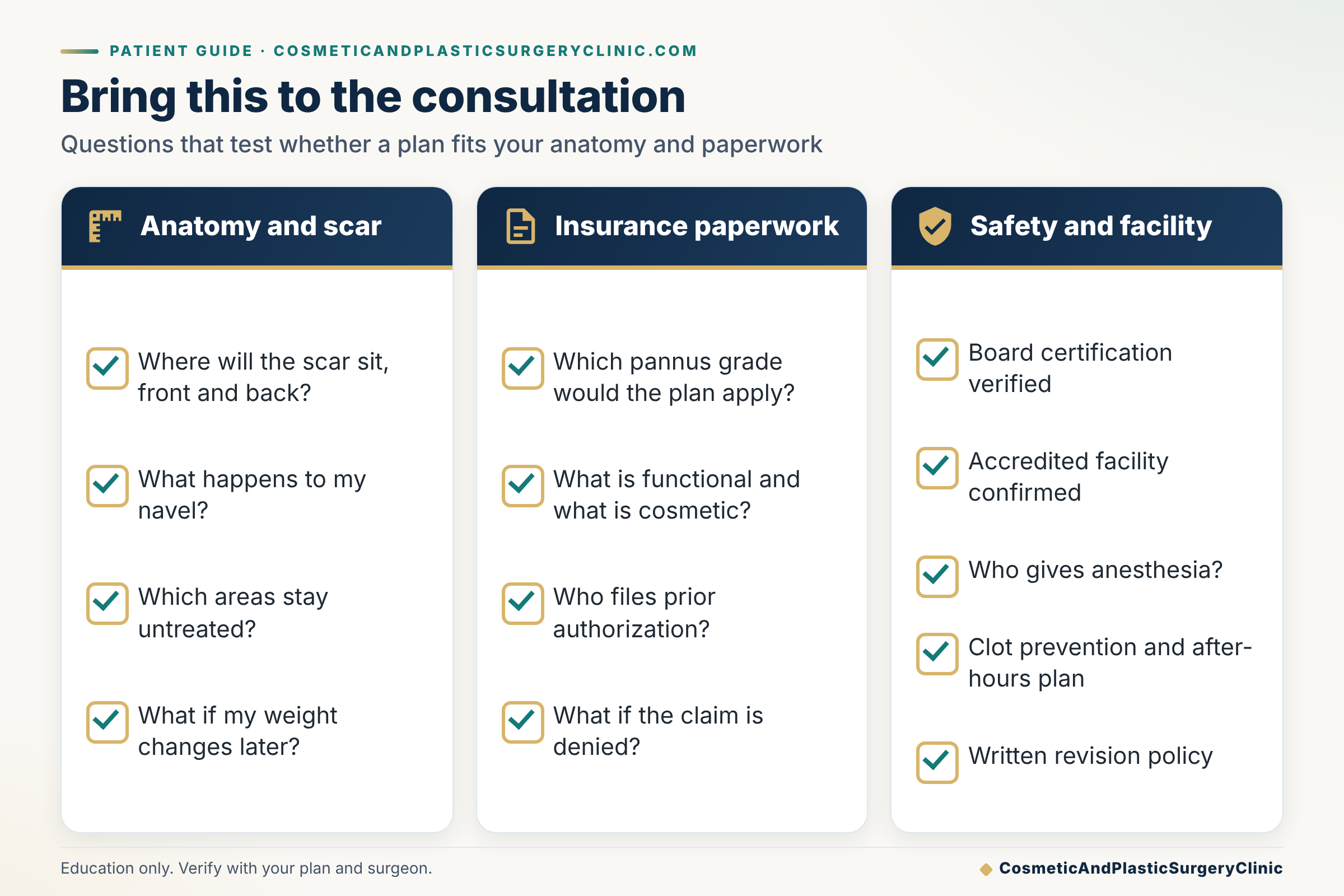
Questions to bring to the consultation
Anatomy and insurance questions
- Which pannus grade and which landmark would a plan apply to my photographs?
- Which parts of the proposed operation are reconstructive and which are cosmetic?
- If panniculectomy vs body lift is the question, what would the second operation add that the first does not?
- Does the plan I have require prior authorization, and who files it?
- What weight, BMI and timing does the surgeon want, and does that differ from the plan?
Insurance answers come from the plan’s own policy text, which a practice can usually help you request, not from a general article.
Surgeon, facility and safety questions
Check board certification by the American Board of Plastic Surgery and where the operation will be done. Body lifting is often performed by surgeons and centers with post-bariatric experience, so ask how many circumferential cases the surgeon performs and how complications are handled after hours. The guide to choosing a plastic surgeon shows how to verify credentials, and the consultation preparation page covers what to bring.
Ask who provides anesthesia, whether the facility is accredited, how clot prevention is handled and when drains and garments come off. Waiting, a second opinion and choosing no surgery all remain reasonable outcomes of panniculectomy vs body lift planning.
Frequently asked questions
In panniculectomy vs body lift planning, can one operation come first and the other later?
Sometimes surgeons plan it that way. ASPS criteria say a cosmetic abdominoplasty may be delayed until weight reduction is complete, and Stony Brook Medicine describes staged plans with three to six months between operations. A second stage means a second anesthetic and recovery, and the first scar may be reworked, so ask the surgeon to explain how a later body lift would be planned around the first incision. Whether that sequencing is wise depends on anatomy, weight stability and healing.
Does insurance ever cover a body lift?
It is unusual. ASPS criteria call circumferential lipectomy typically cosmetic and say only the abdominal portion of a circumferential operation is reconstructive. Cleveland Clinic says coverage is unlikely for purely cosmetic reasons but may be considered if sagging skin causes medical problems such as recurring infections. None of the policies read named body lift as covered, and most did not mention it at all. Ask the plan for its wording, not the practice for a prediction, and expect any panniculectomy vs body lift claim to be split.
Will any of the three remove stretch marks?
ASPS says a tummy tuck does not correct stretch marks, though marks on skin that is cut away may be removed or improved. The sources opened for panniculectomy and body lift did not address stretch marks. The same logic would plausibly apply to any operation that removes skin, but that is an inference. Ask the surgeon to mark which areas will be removed on your own body, since remaining marks stay and the position of the scar decides what leaves with the excess skin.
How much help will I need at home after each operation?
Cleveland Clinic says someone should drive you home after a panniculectomy and help care for you for at least the first 24 hours. University of Utah Health says someone should stay with you for at least two days after a belt lift. Drains, garments, limits on bending and lifting, and tiredness make the first weeks harder than they sound. Practices set their own rules, so ask for the written version before you compare panniculectomy vs body lift on logistics.
In panniculectomy vs body lift planning, what if the plan denies the panniculectomy?
GoodRx reports that denials typically happen at prior authorization and that appeals generally run up to 180 days after the denial notice. Request the written reason, because a denial for missing photographs or missing treatment records is different from one that calls the operation cosmetic. Your surgeon’s office can usually say what documentation was submitted. A second opinion, or a plan that treats the cosmetic and covered parts separately, are alternatives to discuss, and you can always choose to wait.
Can liposuction replace a panniculectomy?
Not for an apron of loose skin. ASPS says liposuction alone may suit areas where skin has good elasticity, and that body lift techniques may be combined with liposuction where elasticity is poor. Blue Cross Blue Shield of Kansas and the First Coast Medicare contractor both list liposuction as cosmetic and not covered. Removing fat does not remove excess skin, so liposuction is usually an add-on, not a substitute. Liposuction changes fat, not the skin envelope.
Is there a BMI cut-off in panniculectomy vs body lift decisions?
There is no universal number. Blue Cross Blue Shield of Kansas asks for a BMI of 30 or less for panniculectomy coverage, Kaiser Washington asks for under 35 after bariatric surgery, and a 2015 review says some authors suggest an upper limit of 32 while noting that no clear cut-off exists. University of Utah Health describes belt lift candidates as near their target weight and stable. Surgeons weigh BMI with nutrition and healing, so treat these thresholds as discussion points, not verdicts.
Sources and further reading
- American Society of Plastic Surgeons — Recommended Insurance Coverage Criteria: Abdominoplasty and Panniculectomy (accessed 2026-11-13) — definitions, CPT 15830 and 15847, cosmetic vs reconstructive
- American Society of Plastic Surgeons — Recommended Insurance Coverage Criteria: skin redundancy for obese and massive weight loss patients, 2017 (accessed 2026-11-13) — functional vs cosmetic, circumferential lipectomy, documentation
- American Society of Plastic Surgeons — Panniculectomy coverage criteria, re-approved March 2019 (accessed 2026-11-13) — panniculectomy definition
- American Society of Plastic Surgeons — Tummy tuck (accessed 2026-11-13) — what it does, weight and stretch-mark statements
- American Society of Plastic Surgeons — Body lift (accessed 2026-11-13) — areas treated, liposuction contrast
- American Society of Plastic Surgeons — Tummy tuck cost (accessed 2026-11-13) — undated average, exclusions, insurance statement
- American Society of Plastic Surgeons — Body lift cost (accessed 2026-11-13) — undated lower body lift average, exclusions
- American Society of Plastic Surgeons — 2025 Plastic Surgery Statistics Report (accessed 2026-11-13) — lower body lift and tummy tuck counts
- Cleveland Clinic — Panniculectomy (accessed 2026-11-13) — anatomy, navel, scar, recovery, weight stability
- Cleveland Clinic — Lower body lift (accessed 2026-11-13) — circumferential incision, recovery, risks, insurance
- Cleveland Clinic — Abdominoplasty (tummy tuck) (accessed 2026-11-13) — types, navel, recovery, risks
- University of Utah Health — Belt lift (circumferential) (accessed 2026-11-13) — areas treated, operating time, recovery
- Blue Cross and Blue Shield of Kansas — Panniculectomy and abdominoplasty medical policy (accessed 2026-11-13) — coverage criteria example
- Cigna — Coverage policy 0027, abdominoplasty and panniculectomy (accessed 2026-11-13) — coverage criteria example
- Kaiser Permanente Washington — Panniculectomy criteria (accessed 2026-11-13) — grades, weight and bariatric timing
- Vermont Department of Vermont Health Access — Panniculectomy supplement (accessed 2026-11-13) — pannus grades 1 to 5
- First Coast Service Options — Panniculectomy Medicare page (accessed 2026-11-13) — Medicare contractor criteria and prior authorization
- Centers for Medicare & Medicaid Services — Prior authorization for certain hospital outpatient department services (accessed 2026-11-13) — services list from July 2020
- GoodRx — Does insurance cover skin-removal surgery after weight loss? (accessed 2026-11-13) — appeals window, consumer cost estimate
- Annals of Plastic Surgery 2008 — Weight loss surgery, BMI and wound complications after abdominal contouring, PubMed abstract (accessed 2026-11-13) — 222-patient series
- PubMed record 39844002, 2025 cohort of abdominal contouring after bariatric surgery, read through a mirror (accessed 2026-11-13) — odds ratios against panniculectomy
- Aesthetic Plastic Surgery 2018 — Abdominal contouring outcomes in class III obesity, ACS-NSQIP analysis, abstract (accessed 2026-11-13) — panniculectomy complication rates by BMI
- Plastic and Reconstructive Surgery 2006 — Body lift: an account of 200 consecutive cases in the massive weight loss patient, abstract (accessed 2026-11-13) — complication rates
- Aesthetic Plastic Surgery 2016 — Circumferential contouring of the lower trunk, systematic review (accessed 2026-11-13) — 42 articles, dehiscence most frequent
- Journal of Plastic, Reconstructive and Aesthetic Surgery 2010 — Circumferential body contouring in bariatric and non-bariatric patients, PubMed abstract (accessed 2026-11-13) — circumferential vs classical abdominoplasty
- Open Access Surgery 2015 — Removal of excess skin after massive weight loss: challenges and solutions (accessed 2026-11-13) — timing, BMI, clot risk, staging
- Stony Brook Medicine — FAQs about body contouring after bariatric surgery and major weight loss (accessed 2026-11-13) — weight stability, staging, insurer coverage