
Gynecomastia surgery recovery is easier to plan than most men expect, and harder to predict than most websites admit. The operation that reduces enlarged male breast tissue usually takes a few hours. The healing that follows runs from a few tender, swollen days at home to a year or more of slow contour and scar changes, and how long each stretch lasts depends on what the surgeon actually does: liposuction alone, removal of firm glandular tissue, or a larger operation that also takes out skin and repositions the nipple. This guide walks through recovery phase by phase, from the first 24 to 72 hours to the twelve-month mark, and turns those general ranges into questions, checklists, and a worksheet you can take to a consultation.
Every timeline here is a common range, not a promise. Anatomy, health, age, the exact technique, the anesthesia, and the surgeon’s own protocol all change the picture, and written instructions from your own surgical team always outrank a general article. Nothing below is a diagnosis or a personal treatment plan.
This page covers recovery only. If you are still working out what gynecomastia is, what causes it, or whether surgery makes sense, start with the main gynecomastia surgery guide, which handles evaluation, candidacy, alternatives to surgery, techniques, and cost. The sections below explain why technique shapes healing, lay out the timeline, describe what healing feels like, and then work through work, driving, exercise, travel, pain planning, home setup, emotional recovery, warning signs, scars, teens and parents, and the questions worth asking before you book.
What Shapes Gynecomastia Surgery Recovery Before Day One
Ask five men how their recovery went and you may get five different stories, partly because “gynecomastia surgery” is not one operation. It is a family of approaches chosen to match what is actually enlarging the chest. Enlargement can come from fat, from firm glandular tissue behind the nipple, or from a mix, and in larger or longer-standing cases there may also be stretched skin. The American Society of Plastic Surgeons (ASPS) describes gynecomastia surgery as using liposuction, excision, or both, with skin removal and nipple repositioning reserved for situations that call for them (ASPS gynecomastia procedure page). Each of those choices changes the incisions, the dressings, and the pace of healing.
Technique Drives the Recovery Plan
Think of technique as the first variable in any recovery forecast. Before you ask “how long is recovery,” it helps to ask “which operation is my surgeon planning, and why?” The answer tells you roughly how many incisions to expect, whether a drain is likely, how much garment time to plan for, and which kinds of problems your team will be watching for.
Liposuction-only, gland excision, and combined approaches
In a liposuction-only operation, a thin hollow tube called a cannula is passed through a few small incisions to loosen and suction out fatty tissue (ASPS). Because the incisions are small and no gland is cut out, this is generally the lightest version of the recovery. Soreness, bruising, and swelling still happen, since liposuction leaves a tunneled, bruised layer of tissue that needs time to settle, and a compression garment is commonly used to support it. For general context, ASPS’s liposuction recovery guidance mentions an elastic bandage, support garment, or compression garment, with bruising typically fading and swelling starting to subside around the fourth to fifth week, and gradual return to gentle exercise around week six or later (ASPS liposuction recovery page). That guidance is about liposuction in general, so treat it as an outline for the liposuction component, not a gynecomastia rule.
Excision is a different kind of operation. Firm glandular tissue usually does not come out through a liposuction cannula, particularly when it has been present for a long time. A StatPearls clinical review notes that fibrosis in long-standing cases can make liposuction alone insufficient and an open procedure necessary (StatPearls gynecomastia review, updated August 2023). Excising the gland means cutting it out through an incision, commonly placed near the areola, though ASPS notes that incision patterns vary with the situation and the surgeon’s preference. More cutting generally means more internal surface where fluid or blood can collect, more stitches to protect, and a higher chance that the surgeon will want a drain or a closer follow-up schedule.
The combined approach, liposuction plus gland excision, is common because many men have both fatty and glandular components. Recovery then blends the two: the small cannula entry points of liposuction plus the incision and deeper dissection of excision. A published systematic review of 94 articles covering 7,294 patients found complication rates of 14.87% for aspiration or liposuction alone, 30.64% for excision alone, and 11.76% for combined approaches, and the authors concluded that combining the two seemed to lower complications compared with excision alone (Innocenti and colleagues, Aesthetic Plastic Surgery, 2022). Read those percentages with care. The studies pooled in that review used different techniques, definitions, and patient groups, and the authors themselves flagged the lack of a unified classification as a source of bias. Men who needed excision alone may also have had larger or firmer tissue to begin with. The numbers are useful for seeing that technique and complication patterns are linked, not for predicting your own risk.
| Approach | What it addresses | Typical incisions | Recovery themes to ask about |
|---|---|---|---|
| Liposuction only | Excess fatty tissue; fewer options for firm gland | A few small cannula entry points | Garment duration, bruising pattern, swelling that settles over weeks to months, contour irregularities |
| Gland excision, often with liposuction | Firm glandular tissue behind the nipple, plus fat | Small incision near the areola in many plans, plus cannula points; patterns vary | Drain or no drain, dressing care, fluid or blood collection watch, nipple sensation, firmness under the incision |
| Excision with skin removal or nipple repositioning | Larger or longer-standing enlargement with excess or low-hanging skin | Longer incisions around the areola or across the chest; patterns vary | Longer restrictions, wound-edge protection, nipple and skin healing checks, scar maturation, possible staged revision |
| Staged or secondary procedure | Residual tissue or contour concerns after earlier healing | Depends on what is being corrected | Timing of revision (often after swelling settles), a fresh set of restrictions |
Skin excision and nipple repositioning for larger or looser cases
When enlargement is large, or the skin has stretched and sagged, removing tissue alone may leave extra skin with nowhere to go. A StatPearls review distinguishes cases suited to liposuction with excision from those needing open excision with possible skin resection when there is a large amount of ptosis, meaning sagging (StatPearls). ASPS likewise lists skin removal, areola reduction, and nipple repositioning among the approaches used when the chest needs more than fat and gland removal.
These operations usually mean longer incisions, which are more visible as scars and need more protection while they heal. Recovery planning changes accordingly. Surgeons often want to keep tension off the wound edges, so lifting, reaching, and arm-heavy activity may be limited for longer. The healing of the nipple and areola is checked more closely, because repositioning disturbs the tissue that supplies them, and the systematic review above tracked nipple-areola necrosis and abrasion among the complications it counted. Ask the surgeon how the nipple will be supported during healing, how soon dressings come off, and what a healthy nipple looks like on days three, seven, and fourteen, so that you can tell a normal bruise from a signal worth a phone call.
Larger operations are also the ones most likely to lead to a conversation about staged work. If swelling hides the final shape or some skin or tissue remains, a second, smaller procedure may be discussed after several months of settling. That possibility is worth hearing about before the first surgery, not after. The main gynecomastia surgery guide covers technique selection in more depth, and a planned page on combining gynecomastia surgery with other procedures covers what changes when additional work is added.
Patient and Plan Factors That Move the Timeline
Technique is only the first variable. The same operation can feel easy for one man and exhausting for another, and the reasons are usually practical rather than mysterious.
Tissue, extent, anesthesia, and facility
The amount and type of tissue removed matters. In one retrospective series of 138 male patients, the average amount removed was about 350 mL per breast (Aesthetic Surgery Journal, 2014), but cases range widely, and a larger volume or a firm, long-standing gland generally leaves more raw surface behind. Symmetry matters too, because many men have more tissue on one side, and your surgeon may plan different amounts per side, which can mean one side swells or bruises more than the other for a while.
Anesthesia and setting also shape the first day. ASPS lists intravenous sedation and general anesthesia as the options for gynecomastia surgery. Grogginess, nausea, and fatigue after anesthesia usually fade within a day or so, but they influence how much help you need on the first night. If you want to understand the choices, the planned guide to anesthesia for plastic surgery covers the questions to ask. The facility matters mainly for logistics: whether there is an overnight option, how after-hours calls are handled, and who you reach if a problem appears at 2 a.m.
Finally, whether a drain is placed, how the incisions are closed, and what dressing goes on are surgeon-specific habits. They are not a measure of how well or poorly the operation went. Two surgeons can both get good results and give you different instructions.
Health history, nicotine, medicines, and the job you return to
Your own health history can speed or slow healing. ASPS describes appropriate candidates as healthy men without conditions that impair healing and as nonsmokers and non-drug users (ASPS candidacy page). MedlinePlus advises stopping smoking at least four weeks before surgery and notes that stopping for as long as ten weeks can reduce complications further, because smoking lowers the oxygen reaching wound tissue and raises clot risk. It adds that nicotine gum still interferes with wound healing (MedlinePlus, smoking and surgery). Any form of nicotine, including vaping products and patches, is worth raising with your surgeon rather than assuming it is exempt. The planned guide to smoking and plastic surgery covers the details.
Medicines and supplements are the other major category. Some affect bleeding, and others affect anesthesia, so your surgeon will want a complete list, including over-the-counter products, herbal supplements, and anything used for bodybuilding. Do not stop or start any prescribed medicine on your own because of an article. Ask your surgeon what to avoid and for how long, and write the answer down.
The last factor is the life you are returning to. A desk job, a job that involves lifting, a toddler at home, a lifting-heavy gym routine, and a trip that cannot be moved all change what “recovered enough” means. Two men with identical surgeries can have recoveries that look completely different simply because one of them needs to lift a toolbox on day ten. Section four below turns this into concrete planning, and the worksheet near the end puts it on paper.
The Gynecomastia Surgery Recovery Timeline, Phase by Phase
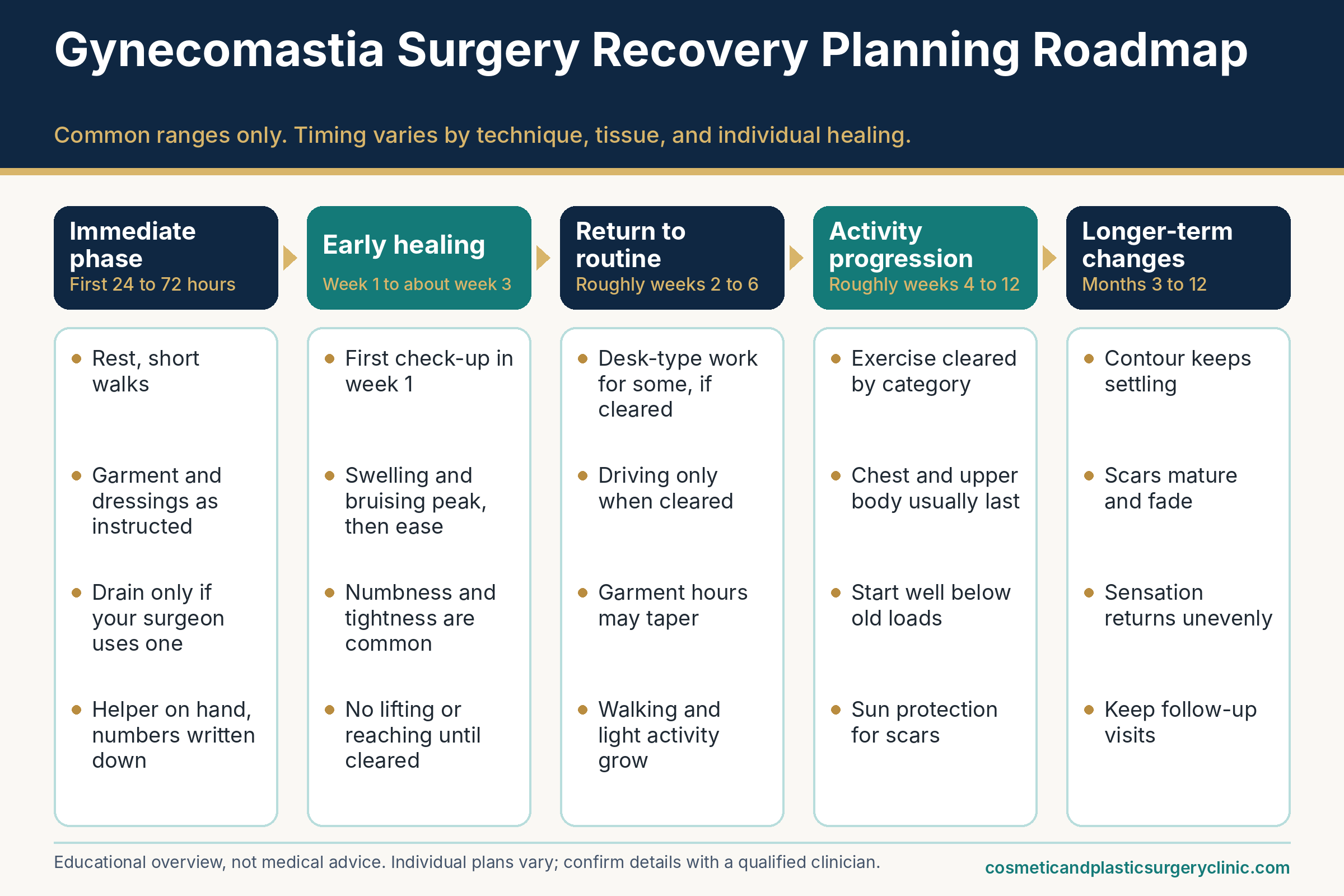
The phases below follow the way most surgical teams talk through male breast reduction recovery: the first 24 to 72 hours, the first week, weeks two and three, weeks four to six, months two and three, and then months three through twelve. The edges between phases are soft, and they overlap. A man who had liposuction alone through tiny incisions may be driving himself to lunch on day nine, while a man who had gland excision with skin removal may still be planning around restrictions at week four. Both can be entirely normal.
It is worth being plain about what the public record does and does not say. ASPS describes dressings, an elastic bandage or support garment, a possible temporary drain, written instructions, and follow-up visits, but it does not publish day counts for stitches, dressing changes, or the return of normal activity (ASPS gynecomastia recovery page). One other professional society’s patient page, updated in 2021, offers a sample schedule: a first visit around days five to seven, desk-type work around seven to ten days, gentle upper-body resistance work somewhere in weeks three to six, and final results visible at three months or later (The Aesthetic Society aftercare page). That is one example of a typical pattern, not a standard, and some surgeons will be more cautious. The ranges in this article draw on those frames and on general surgical convention, which is why they are written as ranges.
The First Week
The first seven days carry the most instructions and, for most men, the most uncertainty. The goals are simple: protect the incisions, keep swelling and fluid from building, move enough to support circulation, and be easy to reach if something looks wrong.
The first 24 to 72 hours
Depending on the facility, the plan, and your health history, you may go home the same day after a period of observation, or you may stay overnight. You will leave with a dressing, a compression garment or elastic wrap, and possibly a drain, plus written instructions on care, medicines, warning signs, and follow-up, which is the package ASPS describes. Expect to feel groggy for a day. Nausea, a scratchy throat if you had general anesthesia, and a heavy kind of tiredness are common.
Soreness in the chest is usual, and it often feels more like tightness, pressure, or a deep ache than a sharp pain. Your chest may feel numb in places, tender in others, and oddly pulled when you move your arms. Many surgeons ask for short, frequent walks around the house and for resting with the upper body slightly raised, and they ask you to avoid reaching overhead, pushing, or carrying anything heavy. Rest does not mean lying flat for days. The Centers for Disease Control and Prevention (CDC) notes that moving soon after surgery is part of preventing blood clots (CDC blood clot information). Your written plan will say how much movement is right.
Swelling usually keeps building for a day or two before it levels off, which surprises people who expected to look flatter every morning. A little spotting on a dressing is not unusual, but dressings that are soaking through, or a chest that is getting visibly tighter and bigger on one side, is a different situation, and the warning-signs section later in this guide covers it. Have the after-hours number written down and within reach before you leave, and have someone stay with you the first night if you can.
Days 4 to 7: first visit, drains, and dressings
Somewhere in this window you will typically see the surgical team. The visit may involve looking at both sides, checking for fluid or firmness, asking about pain and sensation, changing or removing dressings, and removing a drain if you have one. The sample schedule mentioned above places the first visit at about five to seven days, with sutures and drains removed then; if your sutures dissolve, the visit may be mostly inspection.
Whether a drain is used at all is a place where surgeons honestly differ. A ten-year retrospective review of 163 breasts after subcutaneous mastectomy for gynecomastia found that needle-drained seromas were more common without drains (6.5%) than with them (0%), while hematoma rates did not differ significantly (2.2% without drains versus 6.0% with), and the authors suggested surgeons consider drains and discuss the trade-offs with patients (Chao and colleagues, Aesthetic Plastic Surgery, 2017). A 2014 analysis of 138 men concluded that routine closed-suction drains were unnecessary (Aesthetic Surgery Journal, 2014). Both were retrospective, which limits what they can prove, and they point in somewhat different directions. The practical takeaway is that a drain is a tool chosen for a reason and is not a sign of trouble, and its absence is not a sign of carelessness.
The first look at your chest without the dressings can be a strong emotional moment. Bruising may have spread, the skin may look puffy or irregular, and the contour you see in week one is not your final shape. Knowing that in advance prevents a lot of unnecessary worry. By the end of the first week, the pattern you hope to see is gradual improvement in soreness, easier sleep, and bruise colors shifting from purple toward green and yellow. If you see the opposite, including rapid one-sided swelling, worsening pain, fever, or trouble breathing, contact the team or seek emergency care rather than waiting for the next scheduled visit.
Weeks 2 Through 12 and Beyond
After the first week, recovery becomes less about dressings and more about how quickly your daily life and activity can widen. The slow work, swelling resolution, tissue softening, and scar maturation, happens mostly out of sight.
Weeks 2 to 3 and weeks 4 to 6
In weeks two and three, soreness usually becomes manageable without much medication, though stiffness and tightness persist, especially when the garment is on. Bruising often fades to yellow-green and may shift toward the abdomen or arms as gravity moves it. The sample schedule above notes that bruising can persist for two to three weeks, which is consistent with how many surgeons describe it. Many men with desk-type jobs are back at work in this window, sometimes earlier, if the surgeon agrees and if sitting at a keyboard does not involve reaching, lifting, or long hours with a tight garment pressing on a sore chest. Walking can lengthen. Strenuous activity generally remains off the table, and chest-dominant exercise is nowhere near the list yet.
Weeks four to six are when many men start to feel like themselves again. Swelling is noticeably lower, though not gone. Surgeons often begin tapering the garment around now, sometimes wearing it only during certain hours, and they may clear light cardio and lower-body training before touching the chest. ASPS’s liposuction guidance describes bruising typically gone by weeks four to five and swelling starting to subside, and says gentle exercise may be added around week six and later. In the sample gynecomastia schedule above, gentle upper-body resistance work starts somewhere in weeks three to six. Some surgeons wait longer, especially after excision with skin removal, because pectoral contraction and arm motion pull on the incisions. The sturdiest planning assumption is that your own surgeon’s date is the only one that counts, and that it may fall later than a friend’s.
Firmness is a normal topic in this phase. Under and around the incision, many men feel a ridge or a dense area that is part of normal healing. It usually softens gradually, but a new lump, a growing area, or a firm area that is red and tender is worth showing the surgeon. Sensation changes, tingling, itching, and brief electric-shock feelings are also common as small nerves recover.
Months 2 to 3 and months 3 to 12
By months two and three, most visible swelling has settled, but the chest can still look slightly puffy or uneven at certain times of day, after exercise, or in warm weather. Training typically widens to include chest and shoulder work in stages if the surgeon clears it, usually starting well below your old weights. The sample schedule describes final results as visible at three months or later, and that phrase is better read as “a good preview” than as “finished.”
From roughly months three to twelve, the changes are subtle. Residual swelling continues to drain, contour irregularities may soften, firm areas relax, and scars mature. ASPS describes scars as red for several months to about six months and then flattening and fading between six months and a year (ASPS, what to expect as a scar heals). Nipple sensation, if it changed, often improves gradually over months, though ASPS lists changes in nipple or breast sensation among the risks that may be temporary or permanent.
This is also when decisions about residual tissue, asymmetry, or contour concerns are usually made, because judging a result while swelling is still present risks correcting something that would have settled on its own. For a deeper look at what the finished chest tends to look like and how long it stays that way, see the planned guides on gynecomastia surgery results timeline and how long gynecomastia surgery results last.
| Phase | Commonly described experience | Typical planning themes | Who sets the actual date |
|---|---|---|---|
| First 24 to 72 hours | Grogginess, soreness, tightness, rising swelling, garment or dressings on, drain if used | Helper at home, short walks, medicines within reach, phone numbers written down | Surgical team’s discharge instructions |
| Week 1 | First visit, bruising spreading, drain removal if used, easier sleep by the end of the week | No lifting, reaching, or driving until cleared; keep dressings as instructed | Surgeon at the first post-operative visit |
| Weeks 2 to 3 | Soreness eases, bruising fades, tightness continues, energy returns | Desk-type work for some; walking increases; still no strenuous or chest-dominant activity | Surgeon, based on wound checks |
| Weeks 4 to 6 | Swelling noticeably lower; firmness under incisions; garment may taper | Light cardio and lower-body work for some; upper-body work introduced only if cleared | Surgeon, by exercise category |
| Months 2 to 3 | Most visible swelling gone, residual puffiness, sensation changes continuing | Staged return to chest and shoulder training; sun protection for scars | Surgeon at follow-up |
| Months 3 to 12 | Contour and scars keep maturing; sensation often improves | Judge the result after settling; discuss any revision question then | Surgeon, at later follow-up |
What Healing Feels and Looks Like: Swelling, Sensation, Garments, and Drains
Recovery timelines tell you when things tend to happen. This section describes what is actually happening in your chest and on your skin, which is the part that tends to cause the most anxiety. Most of what follows is ordinary healing. The skill is knowing the ordinary pattern well enough to notice when something departs from it.
Body Changes You May Notice
Surgery on the chest creates a wound bed under the skin, whether the tissue was suctioned, cut out, or both. The body responds with fluid, inflammation, and gradual remodeling, and that response is what you see and feel for weeks to months.
Swelling, bruising, and firmness
Swelling is the most reliable feature of recovery and the least reliable to predict. It typically rises over the first several days, eases through the first month or two, and then tapers slowly over many months. It can change over a single day: some men notice that the chest looks flatter in the morning and fuller by evening, and heat, a long day on the feet, or a workout can bring it back. That pattern, with the overall trend improving, is common. A trend that runs the other way, with a chest that is steadily getting larger or tighter, or that is far bigger on one side than the other, is the thing to report.
Bruising follows a color sequence that most people know from ordinary bruises: purple or blue early, then green, then yellow before it fades. After liposuction in particular, bruising may be widespread and may drift toward the abdomen, sides, or upper arms, because blood-stained fluid follows gravity. This often looks alarming and is often harmless, but mention it at your visit. ASPS’s liposuction recovery guidance notes bruising typically resolving around weeks four to five (ASPS liposuction recovery page); for gynecomastia, the sample schedule cited earlier says two to three weeks is common. Those two numbers disagree, which is itself the point: the range is wide.
Firmness is the quiet part of recovery. Under the skin, healing tissue lays down a dense, slightly rubbery layer, and many men feel hardness or a ridge along the incision, behind the nipple, or in areas treated with liposuction. It usually softens over weeks and months. A few other explanations exist for firm areas. A collection of fluid or blood can feel firm. ASPS lists fat necrosis, a firm area that can form when some fatty tissue loses its blood supply, among the risks of gynecomastia surgery (ASPS gynecomastia safety page). Because several different things can cause a firm area, and only an examination can sort them out, the practical rule is to show the surgeon anything that is new, growing, hot, red, or painful. Do not start massaging firm areas unless your surgeon has told you to, since the wrong pressure at the wrong time can aggravate a wound.
Asymmetry during healing deserves a sentence of its own. It is common for one side to swell more, bruise more, or soften more slowly, and the chest can look uneven for months. Early in recovery, that unevenness usually says more about swelling than about the operation. Most surgeons prefer to wait for the swelling to settle before deciding whether any remaining difference needs attention.
Numbness, tingling, and nipple sensation
Sensory nerves run through the skin and tissue that surgery disturbs, so numbness is among the most common experiences. Patches over the chest, around the incisions, and around the nipple may feel dull, as if covered by a layer of rubber. Over the following weeks, tingling, itching, prickling, or sudden zaps often appear as nerve endings wake up. Some men get the opposite problem, a hypersensitive nipple that complains about the brush of a shirt.
ASPS lists changes in nipple or breast sensation among the risks of gynecomastia surgery and says they may be temporary or permanent. Sensation often recovers gradually over months, but the final state varies, and some men have lasting reduced or heightened sensitivity. If nipple sensation, including erogenous sensation, is important to you, say so before surgery. It is a legitimate priority, and it can influence the technique a surgeon recommends and the way risks are explained.
Numb skin has one practical hazard. A numb area cannot warn you properly about heat or cold, so a heating pad, a hot shower directed at the chest, or an ice pack can cause an injury before you feel it. Ask your surgeon whether heat or ice is allowed at all, and in what way, rather than assuming either is helpful. Pain that is out of proportion, or burning that spreads, is different from the odd tingling of healing nerves and is worth a call.
Garments, Dressings, Drains, and Sleeping Position
The gear that goes home with you is mostly about managing swelling and fluid while tissue reattaches. Practices vary a good deal, which is why a printed sheet from your own surgeon beats anything generic.
Compression vest and dressings
ASPS says an elastic bandage or support garment may be used to minimize swelling and to support the chest contour as it heals. In practice, many surgeons use a compression vest or a wrap, sometimes over foam, gauze, or tape, with a specified pattern of wear. A common pattern is continuous wear for the first days to weeks, with removal only for the showers or checks the surgeon allows, then tapering to part-time wear. Other teams use a lighter approach. The sources reviewed for this article describe the purpose of garments, but none sets a standard duration: ASPS gives no day counts, and the published drain study cited earlier did not address compression at all. For a broader look at garment choices and fit across procedures, see the planned guide to compression garments after plastic surgery.
Fit matters as much as duration. A garment that is too loose does little, and one that is too tight can cause trouble: numbness or tingling in the hands, difficulty taking a deep breath, deep creases, skin blistering, or pain that builds rather than eases. “Tighter is better” is a myth worth dropping. If the garment seems to be causing pain, restricting breathing, or leaving marks that look like skin breakdown, call the office instead of loosening or cutting it yourself. Practical details help too: ask whether you will get a second garment so one can be washed, how to launder it, how to get it on and off without raising your arms too high, and what to wear over it at work.
Dressings may include gauze, foam, tape strips, or a skin adhesive over the incisions. ASPS describes the first two weeks of scar care as centered on protective dressings, minimal manipulation, and infection prevention (ASPS scar healing article). The rule that applies to nearly everyone: do not remove, trim, or replace dressings that you were told to leave alone, and do keep them dry in the way you were instructed. If a dressing is wet with blood, smells foul, or comes loose, call.
Drains, positioning, and sleeping on your back
If a drain is used, it is typically a thin flexible tube leaving the skin near the incision and connected to a small collection bulb or reservoir. ASPS notes that a small, temporary drainage tube may be placed under the skin to collect fluid that could otherwise build up. Your job at home is usually to empty it and record the amount and color of the fluid at set times, keep the tube from being tugged, and bring the log to the visit where it is removed. Safety pins, loops, or a lanyard may be suggested to keep the bulb off the tube. A drain feels odd, and removal feels odd too, but it is generally brief. As discussed earlier, not every surgeon uses drains, and the research on whether they help is mixed, so the useful question is simply, “Do you expect me to have one, and what are the removal criteria?”
Sleeping position is one of those details that no one thinks about until the first night. Many surgeons ask men to sleep on their backs, often with the head and upper body slightly raised on pillows or a wedge, and to avoid side or stomach sleeping for a period that your surgeon will specify. The aim is to avoid pressing on incisions and a swollen chest and to keep the garment from bunching. A recliner works for some men; so does a stack of firm pillows, with another under the knees to stop sliding. Getting out of bed is a skill too. If you cannot push off with your arms, practice rolling to the side and swinging your legs down while a helper steadies you. Set up the bedroom before surgery so that medicines, water, the phone, and a night-light are within reach without stretching.
How long this lasts varies by surgeon and technique. When your team says side sleeping is allowed, ease into it and stop if it presses on a tender area. Using extra pillows to wall yourself in can keep you from rolling in your sleep, and pets and small children are best kept off the bed for the first stretch.
Planning Work, Driving, Exercise, and Travel Around Healing
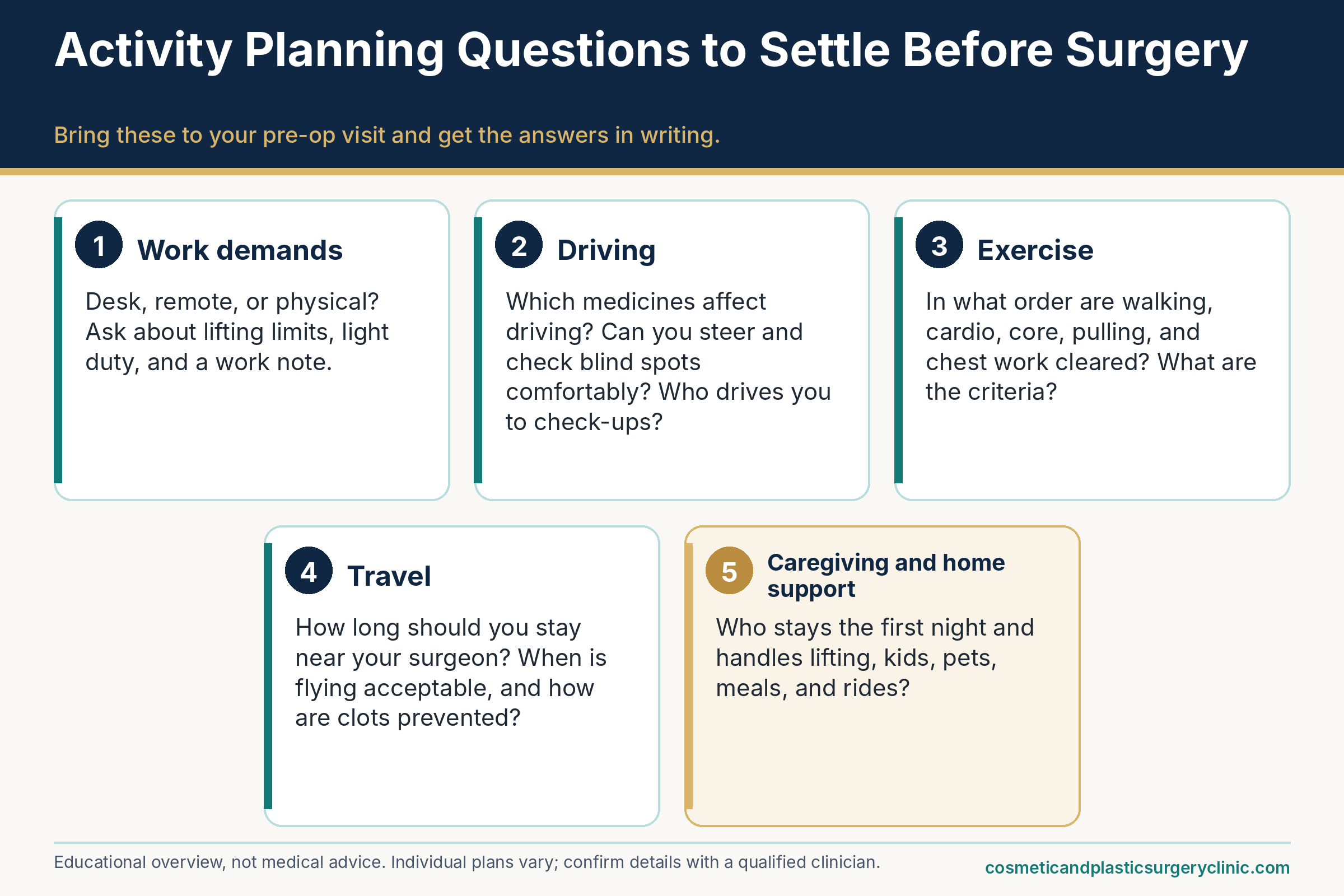
Most recovery stress comes from collisions between healing and real life: a deadline, a family obligation, a gym membership, a flight booked months ago. The most useful thing you can do before surgery is to list the activities in your life that load the chest, the shoulders, or the incisions, and ask your surgeon about each one. A few illustrative examples show how different the answers can be. These are hypothetical scenarios, not patient accounts.
A man who works at a computer from home may be sitting at a desk again within a week or two, wearing a garment under a loose shirt. A man who works on a loading dock, in construction, or in a job that involves repetitive arm lifting may be told to plan on a considerably longer absence or a light-duty arrangement. A father of toddlers may find that the biggest challenge is not work at all but lifting a child, which strains the same muscles and incisions. A regular lifter may be cleared to walk early and spend a long time waiting to bench press. None of these men is doing recovery wrong. Their jobs and bodies are doing different things.
Work, Driving, and Daily Life
Daily-life restrictions after gynecomastia surgery are mostly about two things: keeping strain off the incisions, and avoiding anything that could be compromised by pain medicine or limited arm movement. The details are individual, so use the following as a prompt for questions rather than as instructions.
Return to work: desk, hybrid, and manual jobs
Return to work is the question most men ask first, and the honest answer is a range. One professional society’s sample schedule places a return to work at roughly seven to ten days (The Aesthetic Society aftercare page, updated 2021), which is consistent with how a desk-type return is often described, though ASPS does not publish a figure. Treat seven to ten days as the early end of a plausible range for light desk work and not as a target. Several things can push it later: a larger operation, a drain that is still in, a sore chest that makes sitting upright uncomfortable, or pain medicine that clouds concentration.
For desk jobs, think about the details beyond the days. Will you be sitting for hours in a garment? Is there a commute that involves driving, a seat belt strap across the chest, or carrying a bag? Can you take brief walks every hour or so? Can you work from home or in a hybrid arrangement for the first stretch? A phased return, with part-days or remote days at the start, often feels easier than a full return on a Monday morning. Some men find that the first day back is more tiring than expected, even though they have been sitting for days. That is common and is not a reason to panic.
For manual or physical jobs, the thinking is different. Lifting, pushing, pulling, overhead work, and repeated arm motion all load the chest and the incisions, and the work is often impossible to scale back without an employer’s cooperation. Ask your surgeon for specific limits in plain terms (how much weight, how high, how often) and for a written work note. Ask whether light duty or modified tasks are possible. Plan on a longer absence than a desk worker would need, and recognize that returning before you are cleared risks swelling, bleeding, or wound stress. If your job involves a harness, tool belt, heavy uniform, body armor, or other gear that presses on the chest, raise it explicitly. Many men forget until the week before they go back.
Whatever your work, tell your employer what you can about expected absence and restrictions early, and ask about leave and accommodation options through your human resources office. Details vary by employer and state, and a general article cannot sort them out for you. For a deeper treatment of jobs, timing, and conversations with employers, a planned page covers when you can return to work after gynecomastia surgery.
Driving, childcare, and everyday lifting
Driving restrictions usually rest on two conditions. First, you should not drive while taking medicines that cause drowsiness, which commonly includes prescription pain medicine, and many surgeons attach conditions to that. Second, you should be able to turn the wheel fully, check blind spots, and react to an emergency without pain or guarding. Wearing a seat belt across a tender chest can be uncomfortable, and a small pad over the strap may help, but ask your surgeon before adding anything between the belt and the chest. Plan a ride to and from the first follow-up, and do not agree to drive someone else’s children or run errands until you have been cleared.
Everyday lifting is where recovery most often goes wrong, because it does not feel like exercise. Groceries, laundry baskets, a pet, a car seat, a suitcase, a gallon of milk on a high shelf, or a toddler who wants to be picked up all load the chest. The typical instruction is to avoid lifting anything heavier than a stated, fairly light weight for a period, and to avoid reaching overhead and pushing or pulling motions. Ask for numbers and examples, because “nothing heavy” is subjective. Rearrange the house in advance so that items you use daily sit between waist and shoulder height, and line up help for the heavy tasks.
Other daily details come up quickly: shirts that open in front are easier than pullovers; washing your hair may need help; getting dressed can be hard if you cannot raise your arms; and intimacy and sexual activity are topics men often hesitate to raise. A short, matter-of-fact question to the surgical team, such as “when is sexual activity okay with the garment and incisions?”, gets you a straight answer.
Exercise, Sports, and Travel
Exercise and travel are the two areas in which people want dates most and in which general articles can responsibly give the fewest. What can be said is that both usually follow a pattern: low-load activities first, high-load or high-risk activities later, each cleared by the surgeon one category at a time.
Chest and upper-body exercise progression
ASPS says incisions should not be subjected to excessive force, swelling, abrasion, or motion during healing and that following the surgeon’s instructions is essential. It does not publish an exercise calendar, and neither will this article. The useful way to think about it is as a ladder of categories, with the surgeon deciding when you step to each rung.
Walking is the bottom rung and typically starts almost immediately. Lower-body work and light cardio that does not bounce or pull the chest come next for many men. Core work that does not involve the arms or chest, and shoulder-neutral movements, come after that. Upper-body pulling comes later, and pressing and chest-dominant lifts, such as bench press, push-ups, dips, and flyes, are typically last, because the pectoral muscles sit directly beneath the operated area and contract with every rep. Sports that involve contact, impact, or the risk of a blow to the chest fall at the end of the line, and swimming or other activities that involve soaking incisions have to wait for wound healing.
When your surgeon clears a category, restart well below your old loads. Muscle and connective tissue have been inactive for weeks, and the chest tissue is still remodeling. Stop and call if a workout produces new swelling, pain at the incisions, a pulling or tearing sensation, or bleeding or fluid from a wound. Some men notice that the chest looks fuller after a workout; that temporary swelling is common, but a persistent or one-sided increase is worth a call. For more detail, a planned page covers exercise after gynecomastia surgery.
| Activity category | Where it usually falls in the sequence | Why surgeons are cautious | Question to ask |
|---|---|---|---|
| Walking and light household tasks | First; often from the first day | Supports circulation; little chest load | How far and how often in week one? |
| Desk work and driving | Early, once medicine and arm movement allow | Drowsy medicines, limited arm motion, seat belt pressure | What must be true before I drive or sit through a work day? |
| Lower-body training and light cardio | Middle; before the chest | Bounce and arm swing can pull on incisions | Is stationary cycling or walking uphill okay before running? |
| Core and shoulder-neutral exercise | Middle to later | Core work can strain the chest wall indirectly | Which core moves are fine and which are not? |
| Upper-body pulling and light resistance | Later; introduced in stages | Arm and back motion tugs on chest incisions and tissue | What weight and range of motion are allowed? |
| Chest pressing, push-ups, dips, heavy lifting | Last of the strength categories | Pectoral contraction directly stresses the operated area | What are the criteria, not just the date, for chest work? |
| Contact sports and swimming | Last overall | Impact risk, wound exposure, infection risk with soaking | When can incisions be submerged or struck? |
Travel, flying, and clot awareness
Travel is a legitimate planning concern for two reasons. One is the surgery itself. If you travel for your operation, your surgeon will probably want you to stay within reach for the first visit and possibly longer, so that an early problem does not happen hundreds of miles from the team that knows your chest. The other is blood clots. The CDC lists vein injury and reduced blood flow from immobility among the factors that raise clot risk, recommends getting moving soon after surgery or illness, and advises people on trips longer than about four hours to walk around every one to two hours, wear loose-fitting clothing, and move their leg muscles while seated with heel and toe raises (CDC blood clot information).
Whether you can fly, and when, depends on your surgeon, your health, and how long the trip is. Short car rides are usually less of a concern than long flights or drives, but a long car ride has the same sitting problem. Practical points: lifting a suitcase into an overhead bin loads the chest, so check the bag or use a helper; a garment may need to be worn as prescribed; and trip insurance and refundable bookings protect you if the date moves. Ask your surgeon about clot prevention measures such as stockings or other steps, rather than starting any on your own. The CDC also notes that about half of people with a deep vein clot have no symptoms, so awareness of the warning signs listed later matters even if you feel fine. For a longer discussion of flights, road trips, and travel logistics, see the planned page on travel after gynecomastia surgery.
Pain, Medicines, Hygiene, Home Setup, and Emotional Recovery
The practical details of the first weeks, such as what to take for discomfort, when to shower, who stays with you, and how you will feel about the changes in the mirror, rarely make it into the headlines about surgery. They determine whether recovery feels manageable or chaotic. This section covers them in the order you are likely to need them.
Pain, Medicines, Showering, and Hygiene
Medication and wound-care instructions are some of the most personal parts of a surgical plan, because they depend on your health history, your other medicines, and your surgeon’s protocol. What follows is background to help you ask better questions. It is not a medication plan, and it contains no doses.
Pain and medication planning
Pain after gynecomastia surgery is usually described as soreness, pressure, and tightness more than sharp pain, and it commonly peaks in the first few days before easing. One professional society’s patient page describes pain as typically mild to moderate and says most patients need only over-the-counter relief, while advising people to contact the surgeon about extreme or long-lasting pain (The Aesthetic Society aftercare page). Experiences vary, and nobody can predict yours. Men who had liposuction over a wide area, gland excision, or skin removal often report more discomfort than those with a limited operation.
A good pain plan is agreed in advance. Ask your surgeon what medicines you will be given or advised to take, in what order, for how long, and which symptoms mean the plan is not working. Ask which over-the-counter products, if any, you may use. Ask what to avoid. Some surgeons restrict aspirin, ibuprofen and similar anti-inflammatory medicines, certain supplements, and some herbal products around surgery because of their possible effect on bleeding, but the specifics vary, and it is not safe to guess or to self-medicate based on what a friend did. Bring a complete list of everything you take, including bodybuilding supplements and anything bought online, to the pre-operative visit.
If a prescription opioid is part of your plan, a few general points apply. These medicines commonly cause drowsiness, constipation, and nausea, and they are not to be combined with alcohol or other sedating substances unless the prescriber has approved it. They interact with driving, which is why driving restrictions exist. Ask about a stool softener or other measures for constipation, because straining is unpleasant when your chest is sore. Keep medicines where other household members cannot reach them. When you are done, the U.S. Food and Drug Administration (FDA) recommends drug take-back options as the first choice for unused opioids and, when none is available, lists opioids among medicines that may be flushed (FDA, disposal of unused medicines). Ask the pharmacy about take-back.
Non-drug comfort measures help too, and the right ones are for your surgeon to specify: a supportive pillow arrangement, loose front-opening shirts, short walks, distraction, and a consistent routine. Cold packs are often assumed to be helpful, but as noted earlier, numb skin and fresh incisions are reasons to ask before applying any ice or heat. Pain that is getting worse after the first several days, pain that is much stronger on one side, pain with fever, or pain with spreading redness are not things to ride out. They are reasons to call.
Showering, hygiene, and incision care
Rules on showering vary with the dressings, any drains, and the surgeon’s preference. Some teams allow a shower within a day or two once dressings are protected or removed, and others want sponge baths for longer, especially while a drain is in. Because there is no universal answer, ask three things: when can I shower, what must I do with dressings and the garment beforehand, and how should I dry the area afterward? Keep the water from pounding on the chest at first, and let soap run over incisions rather than scrubbing at them, unless told otherwise.
Soaking is a separate topic. Bathtubs, hot tubs, swimming pools, lakes, and the ocean can expose healing incisions to bacteria and soften tissue, and surgeons typically hold them back until the wounds are closed and sealed. Ask for a specific condition, such as “incisions fully closed and dry,” rather than a vague “a few weeks.”
Hygiene is mostly common sense plus consistency. Wash your hands before touching any dressing or drain. Keep the garment as clean as the schedule allows, which is another reason to have a second one so that one can be laundered. A thin, soft cotton layer between skin and garment can reduce chafing and sweat, if your surgeon agrees. Watch for rashes, blisters, or sores under the garment, which are signs that something is rubbing or too tight. Ask about shaving chest hair, applying deodorant or lotions near incisions, and using adhesives, because skin products and tapes can irritate healing skin. For the same reason, avoid adding your own creams, oils, or scar products until you have been told it is time.
Home Setup and Emotional Recovery
The physical side of recovery gets the attention, but home logistics and mindset do a lot of the work. A calm, prepared setting makes the first days easier, and an honest view of the emotional side keeps small worries from growing.
Home setup and helper checklist
Set up before surgery, not after. The following checklist is a starting list to adapt, and your surgical team may add to it.
- Arrange a ride home and a responsible adult to stay with you for the first night, and ask how long a helper is recommended after that.
- Prepare a sleeping spot that allows you to stay on your back with your upper body slightly raised, with pillows or a wedge, a flat surface for water and medicines, and a night-light.
- Stock easy meals and drinks you can reach without lifting, along with fiber and fluids if you expect to take prescription pain medicine.
- Move frequently used items to waist-to-shoulder height and put heavy items out of reach so that no one asks you to lift.
- Buy or set out front-opening shirts that fit loosely over a garment and slip-on shoes that need no bending.
- Gather supplies your surgeon names, such as gauze, tape, a thermometer, drain-care items, and a second compression garment, and ask for the supply list in writing.
- Keep a small log for temperature, medicine times, and drain output if you have a drain, and bring it to visits.
- Write down your surgeon’s office number, the after-hours number, and the nearest emergency department, and save them in your phone and on paper.
- Line up help for pets, children, rides, laundry, and groceries for the weeks when lifting and reaching are limited.
- Tell your employer, school, or team about the expected absence and restrictions, and ask for any work or school note you need.
Helpers have jobs too. A friend or relative who understands what is normal and what is not can notice problems that you might miss through grogginess. Show your helper the warning-signs list, the after-hours number, and how to reach you. Make clear that if you cannot be woken easily, or if you are short of breath or confused, they should call emergency services and not wait for a callback.
Emotional recovery and body image
Many men feel relief after gynecomastia surgery, and many also feel unsettled in the first weeks. Both reactions are common and can exist side by side. The chest you see in the mirror at week one is swollen, bruised, and wrapped, and it does not look like the chest you imagined. Some men feel disappointed, some feel anxious about asymmetry, and some feel a flat, tired sadness that is partly the effect of anesthesia, pain medicine, disrupted sleep, and being stuck at home. Knowing that this pattern is ordinary can help you ride it out.
Gynecomastia often carries a history. Many men have spent years avoiding swimming, changing in locker rooms, or wearing fitted shirts, and the emotional meaning of the operation can be large. A 2022 study in Plastic and Reconstructive Surgery of 145 males aged 12 to 21, summarized by ASPS, found improvements in seven of eight quality-of-life domains among the 51 patients with detailed follow-up (median follow-up about 33 months), even though some had complications (ASPS press release). That is a single young-patient series summarized in a press release, so it does not predict how any particular man will feel. It does suggest that the emotional side of the operation matters to patients and is measurable.
A few habits help. Resist comparing your week-two chest with photographs from other people’s later stages, and treat social-media images with caution, since they show selected moments and unknown techniques. If you want to understand how to look at result photographs critically, a planned guide on evaluating gynecomastia before-and-after photos covers that. Talk to someone you trust. Keep a loose daily routine of getting dressed, eating at regular times, and walking. If low mood, anxiety, or worry about your body persists, grows, or interferes with sleeping and eating, tell your surgeon or primary care clinician. Persistent distress is a health matter that deserves attention in its own right, and asking about it is not a failure.
Safety: Hematoma, Seroma, Infection, and Warning Signs
Most gynecomastia surgery recoveries go along without a serious problem, and this guide is not meant to frighten anyone. But some complications are time-sensitive, and recovery education is incomplete without them. ASPS lists bleeding (hematoma), fluid accumulation (seroma), infection, blood clots, poor wound healing, persistent pain, fat necrosis, sensation changes, asymmetry, contour irregularities, and unfavorable scarring among the risks of gynecomastia surgery, along with anesthesia risks and the possibility of revision (ASPS gynecomastia safety page). This section concentrates on the ones that show up during recovery, what they look like, and what to do. The full risk picture, including later issues, is covered in the planned page on gynecomastia surgery risks and complications.
Early Collections and Wound Problems
Two different fluid problems tend to be discussed together because they look alike from the outside: a collection of blood and a collection of clear fluid. They differ in timing, urgency, and treatment, so it helps to understand both.
Hematoma: what it is and why early signs matter
A hematoma is a collection of blood in a space where it cannot drain, as opposed to the flat bruising that stays within the skin (Cleveland Clinic, hematoma). After chest surgery, it means bleeding into the space where the tissue was removed. A small one may be absorbed with watching. A larger one can swell the chest quickly, put pressure on healing tissue, raise the risk of infection, and delay healing, and it may need drainage or a return to the operating room. Pooled estimates from research put hematoma among the most commonly reported problems after gynecomastia surgery: a review of 17 studies and 1,112 patients reported a hematoma rate of 5.8%, with wide variation in major complications across studies (Holzmer and colleagues, Plastic and Reconstructive Surgery Global Open, 2020).
What matters for you is recognition. Signs that raise concern include swelling that grows quickly, particularly on one side; a chest that feels tight, hard, or tense; pain that is increasing instead of easing; dark purple or blue discoloration that is expanding fast; or a dressing that soaks through. These signs often show up in the early days, which is one reason surgeons want you reachable and nearby during that period, but they can appear later, so do not assume the danger window closes on a particular date. If you see them, contact your surgical team immediately. If you cannot reach them promptly, or if you also feel faint, short of breath, or are bleeding heavily, seek emergency care.
Why does an early call matter? A collection that is caught early is generally simpler to manage than one that has been left to grow. That is a general principle and not a prediction for any individual, but it explains why surgeons tend to say “call when in doubt” and why nearly all of them would rather hear from a patient who turns out to be fine. Avoid the temptation to wait for the morning, the weekend, or the scheduled visit.
Seroma, infection, and wound-healing problems
A seroma is a pocket of clear, pale-yellow fluid that collects under the skin after surgery. Cleveland Clinic describes it as a soft, squishy bump, often noticed seven to ten days after surgery, sometimes painless and sometimes tender, and says small seromas may be watched while larger ones may need needle drainage, occasionally repeated (Cleveland Clinic, seroma). In gynecomastia surgery, the 10-year review of 163 breasts mentioned earlier found that seromas requiring needle drainage occurred in 6.5% of breasts without drains and in none with drains, though overall fluid-collection rates were similar between groups, at 19.6% and 16.2% (Chao and colleagues, 2017). A seroma is not a sign of carelessness. It is a known possibility that the team prepares for with drains, garments, or follow-up. Call if a soft swelling appears, grows, becomes painful, or looks red.
Infection is less common but important. Signs include redness that spreads from an incision, increasing warmth and swelling, worsening pain after an initial improvement, drainage that is cloudy, thick, or foul-smelling, and fever. The ASPS summary of the 2022 teen study reported minor infections in 2.2% of breasts (ASPS press release). Infection after surgery needs a medical assessment, and antibiotics are prescribed by clinicians who have examined you. Do not use leftover antibiotics or borrowed prescriptions.
Wound-healing problems include edges that separate, skin that darkens or looks dusky, an incision that stays wet or drains, and a nipple or areola that changes color or looks different from the other side in a way your team did not predict. Nicotine, tension on the wound, infection, and fluid collections are among the contributors, which is why nicotine and early heavy lifting get so much attention. Fat necrosis, listed by ASPS, can show up as a firm, sometimes tender lump. None of these should be handled with home remedies. Report them, and keep the area clean and covered as instructed until you are seen.
| Source and year | Population and design | Finding relevant to recovery | Caution |
|---|---|---|---|
| Innocenti et al., Aesthetic Plastic Surgery, 2022 | Systematic review: 94 articles, 7,294 patients | Complication rates 14.87% (aspiration or liposuction), 30.64% (excision), 11.76% (combined); hematoma accounted for 322 of 1,407 recorded complications | Pooled studies with differing techniques and definitions; authors cite lack of unified classification |
| Holzmer et al., PRS Global Open, 2020 | Literature review: 17 studies, 1,112 patients | Hematoma 5.8%, seroma 2.4%; major complications ranged 0% to 33% across studies | Wide range between studies; authors favor an individualized approach by grade and preference |
| Chao et al., Aesthetic Plastic Surgery, 2017 | Retrospective review, 163 breasts (46 without drains, 117 with) | Seroma needing aspiration 6.5% without vs 0% with drains; hematoma 2.2% vs 6.0% (not significant) | Single institution, retrospective; groups not randomized |
| Aesthetic Surgery Journal, 2014 | Retrospective analysis, 138 men, mean age 29 | One postoperative hematoma; authors concluded routine suction drains were unnecessary | Retrospective; reflects one center’s selection of cases and technique |
| PRS study of 145 males aged 12 to 21, 2022 (ASPS press release) | Adolescent and young-adult series | Hematomas 7.8% (mostly minor); minor infections 2.2%; later complications such as residual tissue 12.6% | Press-release summary; young patients only; not adult-specific |
Clots, Breathing Symptoms, and Who to Call
The most serious recovery problems are also the ones most easily missed because they look unlike the surgical site. A blood clot in a leg can cause no chest symptoms at all, and its first sign may be at the calf.
Blood clots, shortness of breath, and emergency symptoms
A deep vein thrombosis (DVT) is a blood clot in a deep vein, usually in the leg. A pulmonary embolism (PE) happens when a clot or part of one travels to the lungs. ASPS lists deep vein thrombosis, cardiac and pulmonary complications among the risks of gynecomastia surgery and directs patients to seek immediate medical attention for shortness of breath, chest pains, or an unusual heartbeat. The CDC describes DVT signs as swelling, pain or tenderness, warmth, and redness or discoloration, usually in one leg, and notes that about half of people with a DVT have no symptoms. For PE, it lists difficulty breathing, a faster or irregular heartbeat, chest pain that worsens with a deep breath or cough, coughing up blood, and lightheadedness or fainting, and calls for immediate medical help (CDC blood clot information).
That translates into a simple rule. Calf pain, tenderness, or swelling, especially on one side, deserves a same-day call to your team or a medical evaluation. Shortness of breath, chest pain, a racing or irregular heartbeat, coughing blood, or fainting is an emergency, and the right response is to call emergency services, not to drive yourself or wait to see whether it passes. Be careful not to confuse these with ordinary chest-wall soreness. Surgical soreness is usually tied to movement and touch and does not typically come with breathlessness, whereas a clot-related symptom may not change with touch. When it is unclear, treat it as urgent.
Prevention is largely about movement and your surgeon’s instructions: walking as directed, avoiding long stretches of sitting, staying hydrated if told, and following any measures your team prescribes for people at higher risk. Do not start blood thinners, stockings, or other steps on your own.
Who to call and how to escalate
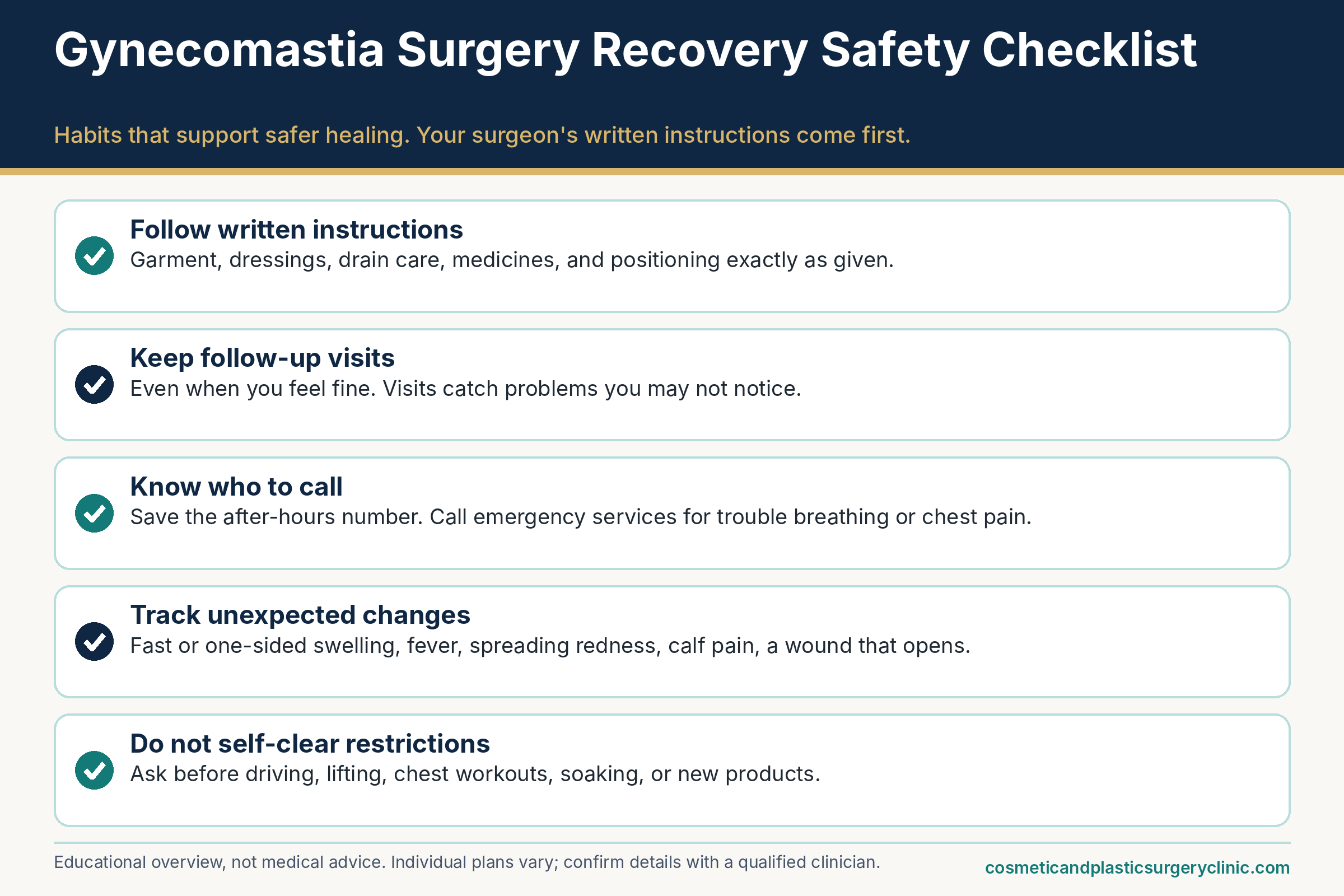
It helps to think in three tiers. The first is an office-hours question: a mild rash under the garment, a dressing question, an itch, a question about showering. The second is a same-day call, including after hours: increasing swelling, new fluid, rising pain, redness that is spreading, fever, calf pain, a wound that opens, or a drain that has stopped or is leaking heavily. The third is emergency care: trouble breathing, chest pain, fainting, heavy bleeding that does not stop, or confusion. Your discharge papers should list the numbers for each, and if they do not, ask before you leave.
When you call, have key facts ready: the date and type of surgery, what you are seeing and when it began, your temperature if relevant, what medicines you have taken, and whether the symptom is getting worse. Ask whether the team wants photographs through a secure portal, and do not send images by ordinary text unless the office says it is acceptable. If you cannot reach the surgical team and you are worried, go to an emergency department, bring your discharge paperwork, and tell the staff you recently had surgery, then let the surgeon’s office know afterward. Follow-up visits matter even when you feel well, because some issues are visible to a trained eye before they are obvious to you.
| What you notice | Why it matters | Typical response |
|---|---|---|
| Rapid swelling, tightness, or firmness, especially one-sided | May indicate bleeding into the wound space (hematoma) | Contact the surgical team right away; emergency care if you cannot reach them or feel faint or short of breath |
| Soft, growing, fluid-filled swelling several days after surgery | May be a seroma | Same-day call; the team decides whether to watch or drain |
| Spreading redness, warmth, fever, cloudy or foul drainage | Possible infection | Contact the surgical team the same day; do not self-treat |
| Severe or worsening pain not eased by the prescribed plan | May accompany a collection, infection, or tight garment | Contact the surgical team promptly |
| Wound edges opening, skin darkening, or a nipple that looks dusky | Possible healing problem | Contact the surgical team promptly; keep covered as instructed |
| Calf pain, tenderness, warmth, or swelling, usually one leg | Possible DVT | Same-day medical evaluation; emergency care if breathing symptoms appear |
| Shortness of breath, chest pain, unusual heartbeat, coughing blood, fainting | Possible pulmonary embolism or another serious problem | Call emergency services |
Scars, Sun, Settling, Recurrence, and Teens and Parents
The last stretch of gynecomastia surgery recovery is the least dramatic and the longest. It covers the slow changes in scars and contour, what you can do to protect them, whether the chest can enlarge again, and the particular planning issues that come with adolescents. Patience is the main tool here, with a few specific habits.
Scars, Sun Protection, and Settling
Every incision leaves a scar, and the question is how visible it will be and how well it matures. Technique decides how many scars you have and where they sit, and your skin, genetics, wound tension, and sun exposure influence how they look.
Scar care and sun protection
After liposuction alone, the marks are small and tend to blend in over time. When gland is excised, a short incision near the areola is common, though patterns vary. When skin is removed or the nipple is repositioned, scars are longer and more noticeable. ASPS describes scar maturation in phases: dressings and minimal manipulation in the first two weeks, redness from increased blood flow and collagen production for several months to about six months, and then flattening and fading over roughly six months to a year as the scar matures (ASPS, what to expect as a scar heals). Scars that become thickened (hypertrophic) or raised and wide (keloid) are worth showing to the surgeon, since treatment options exist. For a closer look at placement and healing, see the planned guide to gynecomastia surgery scars and scar care.
The same ASPS article mentions silicone gel and silicone tape among common scar-care options. The timing is a surgeon decision. Silicone products and massage are started when the wound is closed and stable, not on day one, and starting too early can irritate or open a healing incision. Ask what to use, when to start, and how long to continue, and avoid layering on creams, oils, or “scar removal” products that you found online.
Sun is a distinctive concern for the chest. Many men spend time shirtless in summer, at pools, or on the beach, and fresh scars are vulnerable. The ASPS scar article advises avoiding direct sun on a healing scar for about the first six months and using a mineral sunscreen of SPF 50 or higher when exposure cannot be avoided, with protective clothing. A separate ASPS article recommends SPF 30 at minimum, SPF 50 as a more forgiving choice, mineral formulations for healing scars, reapplication after about 90 minutes and after swimming or sweating, and UPF-rated clothing (ASPS, protecting plastic surgery scars). In practice, that often means a UPF swim shirt at the pool, a regular shirt on the beach, and no tanning beds. Sun can darken scars and prolong redness, and it adds swelling to a chest that is still settling. Ask your surgeon when it is safe to apply sunscreen on the incisions themselves, since that depends on whether the wound is fully closed.
When results look settled, and why follow-up matters
“Final result” is an elastic phrase. A preview emerges at around three months, when much of the swelling has gone, but fine contour, firmness, and scar color continue to change through the first year. ASPS says the final results of gynecomastia surgery are permanent in many cases, with a caveat discussed in the next section. The same page tells patients that following their surgeon’s instructions is essential to the success of the surgery, and that includes attending visits.
Follow-up visits tend to be spaced closely at first and then widen: a check in the first week, another one or two in the first month or two, and often a visit at around three months and at six to twelve months. The exact schedule differs by practice. Each visit has a job: early visits look for fluid and wound problems, middle visits check on activity clearance and garment use, and later visits assess contour, scars, and any residual tissue. Ask what each visit will cover and what decisions it informs, so you know when it is appropriate to raise questions about sensation, asymmetry, or revision.
Some surgeons take standardized photographs at visits, and this can be useful for you as well: gradual change is hard to notice in a mirror. If you are bothered by something at six months, such as a small amount of remaining tissue, a contour step, or a scar, write down what it is and bring it to the visit. Revision decisions are made after swelling has settled, and many surgeons advise waiting several months to a year before judging, because the chest keeps changing. The ASPS summary of the teen study reported residual tissue in 12.6% and contour irregularities in 9.2% of patients at later follow-up (ASPS press release), which is a reminder that some men need secondary work, and that a surgeon should discuss that possibility beforehand.
Recurrence and Special Situations
Two topics often come up late in recovery planning: whether the chest can enlarge again, and what is different when the patient is a teenager. Both are covered at length elsewhere on this site, so the treatment here is brief and practical.
Recurrence factors: weight, medications, and hormones
ASPS says the results of gynecomastia surgery are permanent in many cases, but that they may not hold if the condition was caused or sustained by prescription medicines, drugs including anabolic steroids, or weight gain, and that patients should stay free of those influences and maintain a stable weight (ASPS gynecomastia recovery page). MedlinePlus lists several contributors to male breast enlargement: hormone imbalances between estrogen and testosterone, chronic liver or kidney disease, obesity, low testosterone, certain medicines, alcohol and other substances, and exposure to endocrine-disrupting chemicals (MedlinePlus, breast enlargement in males). The Mayo Clinic’s overview lists medicine classes associated with gynecomastia, including anti-androgens, anabolic steroids, antiretrovirals, and some antidepressants (Mayo Clinic, symptoms and causes, reviewed October 2023).
For recovery planning, the useful points are modest. If you take a medicine linked to gynecomastia, do not stop it without talking to the prescriber, since stopping some medicines is dangerous. Bring up the question before surgery, and ask whether an evaluation for hormonal or medical causes is appropriate. If you notice new growth, tenderness, or a lump months or years later, tell a clinician rather than assuming it is leftover tissue. MedlinePlus lists a hard breast lump, dark or bloody nipple discharge, and skin sores over the breast among the reasons to see a provider. Weight change matters too, and a planned page covers gynecomastia surgery after major weight loss. The main gynecomastia surgery guide explains causes and evaluation in more depth than is useful to repeat here.
Teens and parents: supervision, school, and sports
Adolescent gynecomastia is common and often temporary. MedlinePlus states that in adolescents breast growth often goes away in six months to two years, and the National Health Service in England likewise says puberty-related gynaecomastia usually goes away by itself (NHS, gynaecomastia, reviewed May 2024). ASPS says appropriate candidates are men whose breast development has stabilized, and that adolescents may benefit from surgery although secondary procedures may be needed if development continues (ASPS candidacy page). The question of whether and when surgery is appropriate is an individual decision for the teen, the parents, and the surgeon, and a planned page on the best age for gynecomastia surgery covers it.
If surgery goes ahead, recovery planning for a teenager has extra layers. A parent or guardian typically manages medicines, drain care, appointments, and the decision to call, so they should read the discharge instructions in full and attend the teaching session. Teens may underreport pain or problems, either to avoid fuss or out of embarrassment, so ask directly about pain, swelling, and fever, and check the garment fit. Keep medicines locked away and supervised, as with any household opioid.
School and sports need advance planning. Ask for written guidance on when the teen can return to class, carry a backpack, take physical education, and resume team practice, and share notes with the school nurse, coaches, and athletic trainers. Gym class, weight room, swimming, wrestling, football, and other contact or upper-body sports are typically cleared late and by category, not all at once. Scheduling surgery around a school break may reduce missed class, but not at the expense of a rushed recovery. Finally, give privacy a thought. A teen may not want classmates to know, and a plan for what to say, and who needs to know, reduces stress.
Recovery Worksheet, the Cost of Downtime, and Questions for Your Surgeon
General ranges are only useful once they are converted into your own calendar. This final section does that work. It gives you a worksheet, a way to think about what downtime costs beyond the surgeon’s fee, and a short list of ways to verify and question a surgeon about recovery before you commit.
Build Your Recovery Calendar
The simplest way to plan is to work backward from the dates that cannot move and forward from the surgery date with the ranges your surgeon gives you. Where the two collide, you have a decision to make early, while the choices are still cheap.
The recovery calendar worksheet
Start by listing every fixed obligation in the three months after your intended surgery date: deadlines, trips, weddings, exams, competitions, family events, and beach or pool plans. Then ask your surgeon how each would interact with a typical recovery from your specific operation. Build two calendars, a smooth one and a slower one. If the slower calendar still works, the plan has margin. If only the smooth calendar works, you are betting on the best case, and it is wise to move something.
Fill in the worksheet below with your surgeon’s actual answers, in pencil, as they will change. The right-hand column is the one that matters, because it records the surgeon’s words rather than your hopes.
| Recovery phase | Work, school, and obligations | Home help and logistics | Surgeon’s answer to record |
|---|---|---|---|
| Before surgery (weeks before) | Leave requests, work notes, coverage for tasks, school notice | Rides, helper schedule, supplies, second garment, bedroom setup | Medicines and supplements to avoid or continue; nicotine stop date; pre-op tests; arrival time |
| First 24 to 72 hours | No obligations scheduled | Adult overnight, meals ready, medicines within reach, phone numbers posted | Garment wear, dressings, drain care, sleeping position, who to call after hours |
| Week 1 | Remote tasks only if cleared; no commute | Ride to the first visit; help with laundry, pets, and children | Date of first visit, shower rules, driving rule, walking goals |
| Weeks 2 to 3 | Possible desk or hybrid return; work note for limits | Lifting help still needed; garment washing routine | Lifting limit, work clearance, garment hours, next visit |
| Weeks 4 to 6 | Fuller work schedule if cleared; plan for travel only after clearance | Gradual return of chores; exercise plan drafted | Exercise categories cleared, garment taper, sun and scar instructions |
| Months 2 to 12 | Social events, swimming, beach, and photos scheduled after clearance | Sun protection kit; reminder for follow-up visits | Chest and upper-body training criteria, scar care start date, plan for judging the result and any revision |
Three planning habits make the worksheet work. First, put the slowest realistic date on anything that depends on recovery, and treat anything earlier as a bonus. Second, avoid scheduling gym goals, photo shoots, or beach trips in the first months, since you will not look the way you will at month six. Third, use your surgeon’s visits as checkpoints, and replan after each one instead of defending the original schedule.
The cost of downtime
The fee quoted for surgery is not the whole financial picture. Time off is a cost, and so are many small items that appear after the operation. A realistic ledger usually includes the following, which you can price against your own situation.
- Lost or reduced income during the absence and the gradual return, including unpaid leave, missed overtime, or reduced self-employment work.
- Paid help, such as a helper for the first days, childcare, pet care, or house tasks you cannot do.
- Prescriptions, over-the-counter supplies, extra garments, dressings, and scar-care products.
- Follow-up visits and any related fees, and the cost of getting to them, especially if you traveled for surgery.
- Lodging, meals, and flights if you stay near the surgeon before flying home.
- Cancellation or change fees on bookings that have to move.
- The possibility of a secondary or revision procedure, which has its own fees and downtime, and how your surgeon handles revision costs.
Insurance coverage for gynecomastia surgery varies by plan and by how the condition is documented, so ask your plan and the surgeon’s office before assuming either way. For a fuller look at what shapes the price, see the planned page on gynecomastia surgery cost and price factors. Ask what the quoted fee includes and excludes: anesthesia, facility, garments, follow-up visits, and revision policy are the usual points of difference.
Choosing a Surgeon and Asking About Recovery
Recovery depends partly on the person who operates and the team that looks after you afterward. Two things deserve time before booking: checking credentials, and asking pointed questions about how recovery is run.
Verifying ABPS board certification
The American Board of Plastic Surgery (ABPS) runs a public verification tool where you can search by surgeon name or location to confirm board certification (ABPS, verify certification). The ABPS describes certification as a voluntary credential that signals completed training and passed written and oral examinations. It also separates board certification from state licensure. For license status and any discipline, the ABPS directs people to the Federation of State Medical Boards (FSMB), and says that an alert reading “See FSMB” appears in the certification status column when the board has learned of disciplinary action. An active, unrestricted license is a requirement for certification.
ASPS suggests asking whether the surgeon is certified by the American Board of Plastic Surgery, whether they have hospital privileges to perform the procedure, and whether the surgical facility is accredited by a nationally recognized agency (ASPS, questions to ask your plastic surgeon). Those answers matter for recovery because they bear on how emergencies are handled and where you would be taken if something went wrong. Write down the date you verified the credential. Membership in a society is not the same as board certification, and neither stands in for licensure, so verify each separately. A planned checklist explains how to verify a plastic surgeon’s ABPS board certification step by step.
Questions to ask your surgeon about recovery
ASPS’s list of questions for a plastic surgeon includes how long the recovery period will be, what help you will need during it, and how complications are handled. The list below turns those into specifics for gynecomastia surgery. Print it, bring it to the consultation, and write down the answers. A broader set of consultation questions appears in the planned guide to gynecomastia surgery consultation questions.
- Which technique do you expect to use for my chest, and how does that affect incisions, drains, and recovery length?
- Will I have a drain, and if so, what are the removal criteria?
- What dressing and garment will I wear, for how many hours a day, and for how long?
- Which medicines will I be given, and which medicines and supplements should I avoid?
- When can I shower, and when can I soak or swim?
- What are the lifting limits, in weights and examples?
- When can I drive, and when can I return to desk work or physical work, and will you provide a written work note?
- In what order will you clear exercise categories, and what are the criteria for chest and upper-body training?
- When is flying or long-distance travel acceptable, and what clot-prevention steps do you advise?
- What are the specific warning signs for my operation, and which number do I call at night or on weekends?
- Who sees me if you are unavailable, and where do I go in an emergency?
- How many follow-up visits are included, and when are they?
- What sensation changes are common, and what is your approach to nipple sensation?
- When would you consider a revision, how long would you wait, and what does it cost?
A good surgeon expects these questions and answers them without hurry. If answers are vague, rushed, or discouraged, that is useful information about how recovery will go.
Frequently asked questions about gynecomastia surgery recovery
When will I see my final result, and when am I “done” recovering?
There is no single finish line, because people use three different yardsticks. Medical clearance means the surgeon confirms the incisions are sound and restrictions can lift. Functional recovery means you can work, drive, and train without pain. Aesthetic recovery means swelling, firmness, scar color, and sensation have largely settled. These milestones usually arrive in that order, with the last often taking months. Ask your surgeon which milestone each follow-up visit is measuring, so that “doing well” at week three is not confused with “finished” at month three.
Will my chest look worse before it looks better?
It can look different rather than worse. Early on, swelling, bruising, and the garment hide the contour, and some men find the chest looks puffier or less flat than they hoped between the first and fourth weeks. That is usually fluid and inflammation rather than the final shape. What would be a concern is a trend in the wrong direction, such as swelling that grows, tightens, or is clearly larger on one side. Take dated photos only if your surgeon wants them, and judge progress across weeks, not from one mirror check.
Is it normal for one side to swell or heal differently from the other?
Yes, uneven healing is common. Many men have different amounts of tissue on each side before surgery, the surgeon may remove different amounts, and bruising and swelling often settle at different speeds. The earlier in recovery you are, the less a difference tells you about the final result. The distinction that matters is between slow unevenness and sudden change. A difference that appears abruptly, with rapid swelling, tightness, or pain on one side, should be reported promptly, while a difference that persists after the swelling settles can be discussed at follow-up.
Can I speed up recovery with supplements, arnica, or massage?
None of the sources reviewed for this article identifies a product or technique that shortens gynecomastia surgery recovery. Some herbal products and supplements can affect bleeding, and massage or pressure on fresh surgical tissue can do harm if the timing is wrong, so these are questions for your surgeon before you buy anything. The habits with the best-supported role in healing are mundane ones: follow wound-care and garment instructions, keep follow-up visits, avoid nicotine as advised, stay hydrated, and add activity in the order your surgeon sets.
Is alcohol okay during recovery?
That is a question for your surgeon, and the answer is often “not while you are taking prescription pain medicine.” Alcohol can intensify drowsiness from sedating medicines, can disturb sleep and hydration, and can blur your judgment about activity limits. Some surgeons also ask patients to avoid alcohol around the time of surgery for reasons related to bleeding or medicines. Because the right advice depends on what you have been prescribed, ask at the pre-operative visit and get the answer in your written instructions instead of relying on a general rule.
What should I wear to and from surgery?
Choose clothing that you can put on without raising your arms: a loose front-zip or button-front shirt or hoodie, one size larger than usual to fit over a garment and dressings, plus slip-on shoes and loose pants with a soft waistband. Leave jewelry at home, avoid anything that must be pulled over your head, and bring a second layer in case you feel cold after anesthesia. If you are traveling for surgery, pack a spare shirt and the garment instructions. Your facility may give specific guidance on what to wear and bring.
When can I have sex or masturbate after gynecomastia surgery?
It is a normal question, and surgeons hear it often, but there is no universal date. The concerns are exertion, pressure or friction on the chest, arm movement, and elevated blood pressure while incisions are fresh, along with nipple sensitivity and the garment. Many surgeons tie sexual activity to the same milestones as light exercise. Ask your surgeon directly, using plain words, and ask what positions or pressure to avoid. A direct question usually gets a short, practical answer, and it saves guessing.
Is itching or a rash under the compression vest normal?
Mild itching is common as nerves recover and as skin sits under a snug garment. A rash, blisters, open sores, or marks that look like skin breakdown are different and deserve a call, since they can come from friction, sweat, fabric reactions, tape, or a garment that is too tight. Ask whether you may wear a thin cotton layer underneath, how often to wash the garment, and whether to have a second one. Do not apply creams or home remedies to incisions without clearance, because some products can irritate healing skin.
What if I live far from my surgeon’s office?
Distance changes the plan, not the standard of follow-up. Ask how long you should stay nearby after surgery, who will see you if a problem develops while you are away, whether follow-up can happen by video, and which local emergency facility to use. Bring your operative details and discharge papers. Confirm that you will have a way to reach the team after hours, and plan lodging, transport, and the clot-prevention steps your surgeon recommends for the trip home. The planned guide on travel after gynecomastia surgery expands on this.
Does recovery change if gynecomastia surgery is combined with other procedures?
Often, yes. Adding another operation, such as liposuction in another area or a different procedure altogether, can mean longer anesthesia, more incisions, more garments, more areas of soreness, and different activity limits. The recovery plan usually follows whichever component has the strictest rules. Ask whether combining procedures changes the drain plan, the clot-prevention approach, the time off work, and the order in which you can resume activity, and whether your surgeon would recommend doing them together or separately in your situation.
Sources and further reading
- American Society of Plastic Surgeons — Gynecomastia surgery recovery (accessed 2026-10-03) — dressings, garment, possible drain, written instructions, permanence caveats, emergency symptoms
- American Society of Plastic Surgeons — Gynecomastia surgery safety and risks (accessed 2026-10-03) — risk list including hematoma, seroma, infection, clots, sensation changes
- American Society of Plastic Surgeons — Gynecomastia surgery procedure (accessed 2026-10-03) — anesthesia options, liposuction, excision, skin and nipple procedures
- American Society of Plastic Surgeons — Gynecomastia surgery candidates (accessed 2026-10-03) — health, nonsmoking, stabilized breast development, adolescents
- American Society of Plastic Surgeons — Liposuction recovery (accessed 2026-10-03) — garment, drain monitoring, general bruising and activity framework for the liposuction component
- American Society of Plastic Surgeons — What to expect as a scar heals (accessed 2026-10-03) — scar phases, silicone, sun avoidance
- American Society of Plastic Surgeons — Protecting plastic surgery scars from the sun (accessed 2026-10-03) — sunscreen and clothing guidance
- American Society of Plastic Surgeons — Press release on male breast reduction in teens, 2022 (accessed 2026-10-03) — adolescent series, quality-of-life findings, complication figures (press-release summary)
- American Society of Plastic Surgeons — Questions to ask your plastic surgeon (accessed 2026-10-03) — board certification, facility, recovery and complication questions
- American Board of Plastic Surgery — Verify certification (accessed 2026-10-03) — public certification lookup; licensure and FSMB notes
- The Aesthetic Society — Gynecomastia aftercare and recovery (page updated 2021; accessed 2026-10-03) — one sample recovery schedule (read through a summarized fetch)
- Innocenti A, Melita D, Dreassi E — Aesthetic Plastic Surgery 2022 (accessed 2026-10-03) — systematic review of complications by technique
- Holzmer SW et al. — Plastic and Reconstructive Surgery Global Open, 2020 (accessed 2026-10-03) — literature review, hematoma and seroma rates
- Chao and colleagues — Aesthetic Plastic Surgery, 2017 (accessed 2026-10-03) — drains after subcutaneous mastectomy for gynecomastia
- Necessity of suction drains in gynecomastia surgery — Aesthetic Surgery Journal, 2014 (accessed 2026-10-03) — retrospective series; abstract-level record
- StatPearls — Gynecomastia (updated August 2023; accessed 2026-10-03) — grading and surgical approach overview
- MedlinePlus — Breast enlargement in males (reviewed October 2024; accessed 2026-10-03) — causes, adolescents, when to see a provider
- NHS — Gynaecomastia (reviewed May 2024; accessed 2026-10-03) — puberty-related gynaecomastia and surgery context
- Mayo Clinic — Gynecomastia symptoms and causes (reviewed October 2023; accessed 2026-10-03) — medicines associated with gynecomastia
- Cleveland Clinic — Seroma (accessed 2026-10-03) — definition, timing, treatment options
- Cleveland Clinic — Hematoma (updated November 2024; accessed 2026-10-03) — definition and warning signs
- Centers for Disease Control and Prevention — Blood clots: signs, symptoms, and prevention (accessed 2026-10-03) — DVT and PE symptoms, travel advice
- MedlinePlus — Smoking and surgery (accessed 2026-10-03) — stopping before surgery, nicotine and healing
- U.S. Food and Drug Administration — Disposal of unused medicines (accessed 2026-10-03) — opioid take-back and flush guidance