
BBL surgery recovery is unlike recovery from most other cosmetic operations, because a Brazilian butt lift (gluteal fat grafting) leaves you with two healing zones at once: the areas where fat was removed by liposuction, and the buttocks, where that fat was placed. The first zone behaves like liposuction recovery. The second brings a set of instructions that surprises many people, such as limits on how long you sit, how you lie down, and which garment you wear. This guide walks through a week-by-week timeline expressed as ranges, explains why surgeons’ instructions differ from one another, and turns those ranges into a planning framework you can take to a consultation.
Safety belongs in the first pages of any BBL article, not the last. Major plastic surgery societies have issued repeated warnings since 2017 about fat embolism, a rare but life-threatening complication tied to how and where fat is injected. Most of that risk concentrates in the operating room and the first hours afterward, not the weeks of recovery, but it shapes how to choose a surgeon and a facility, and it is why this article includes a section on warning signs and escalation. Your own surgeon’s written instructions always outrank anything printed here.
The article moves in the order most people need it. The first section explains what the operation involves and why the safety background matters. The second lays out the phases. The sections after that cover pressure and positioning, compression, daily-life planning, healing problems, warning signs, and the questions worth asking before you commit. If you are still deciding whether to have the surgery, the complete guide to Brazilian butt lift covers that broader decision, and this page picks up when recovery planning is the question.
What BBL Surgery Recovery Involves: Two Healing Zones and a Safety Backdrop
Recovery planning starts with understanding what was done to your body, because every instruction you will receive traces back to one of two facts: fat was removed from one place, and fat was placed in another. This section explains both, then sets out the safety context that makes a Brazilian butt lift different from most elective operations and that affects how you should evaluate the team doing it.
How a Brazilian Butt Lift Works and Why Recovery Has Two Zones
The procedure at overview depth: harvest, process, inject
A Brazilian butt lift is a form of gluteal fat grafting. The American Society of Plastic Surgeons (ASPS) describes it as moving fat from one part of the body into the buttocks, and it notes that the technique is sometimes called a Brazilian butt lift. In practice the operation has three stages. First, fat is collected from other areas, most often the abdomen, flanks, back, or thighs, by liposuction. Second, the collected fat is processed so that what goes back in is mostly usable fat rather than blood and fluid. Third, the processed fat is injected through a cannula, a thin blunt tube, into the buttock tissue.
Anesthesia is typically intravenous sedation or general anesthesia, according to ASPS, and the choice is made with the surgeon and the anesthesia provider. The liposuction step usually begins with diluted local anesthetic solution placed into the donor area, after which the surgeon loosens and removes fat through small incisions. ASPS notes that a surgeon may need to harvest up to about three times the volume that will ultimately be transferred, which is one reason the donor areas can feel more involved than patients expect. If you want a deeper explanation of how suction-assisted, power-assisted, and other approaches differ, the guide to liposuction techniques covers that step, and the main liposuction guide covers candidacy and results for that part of the operation. Technique choices for the injection step are a separate topic, addressed in the article on how Brazilian butt lift techniques differ.
Processing methods vary between surgeons and facilities. Some teams let the fat settle in a closed canister, some filter it, and some wash it. This article does not argue for one method, because the evidence comparing them is not something a recovery guide can settle. What matters for planning is that the process is a surgical one with an operating room phase, a recovery-room phase, and a home phase, and each has its own decisions.
Donor-site recovery versus buttock recovery
Think of the donor areas as a liposuction recovery. They tend to feel sore, tight, and bruised, and they swell, sometimes visibly more than the buttocks do in the first days. The liposuction recovery guidance from ASPS describes bruising peaking in the first week and fading over the next several weeks, swelling beginning to subside somewhere around weeks four to five, and improvement continuing after week six. Those are general liposuction ranges, not BBL promises, but they are a useful reference for the donor side. The broader liposuction recovery timeline goes into those areas in more depth.
The buttock zone follows different logic. The grafted fat has to establish a blood supply in its new location, and surgeons generally want to limit pressure and shear on the area while that happens. The grafted fat is also not all expected to last. ASPS says patients typically retain roughly 60 to 80 percent of the transferred fat, and an ASPS news article from 2022 describes 20 to 40 percent being absorbed during healing, which is the same range expressed from the other direction. Because of that, the buttocks are usually fuller early on than they will be later, and swelling hides what the final shape will be. Planning for two zones means planning for a garment that supports the donor areas without squeezing the grafted ones, a sleeping and sitting routine that limits pressure on the buttocks, and an expectation that appearance will change as swelling resolves.
The two zones also raise different practical questions. Donor-site questions are mostly about swelling, fluid, bruising, and sensation. Buttock-site questions are mostly about pressure, position, how long to protect the area, and what firmness or volume change is expected. Asking about each separately in a consultation produces better answers than asking a general question such as how long recovery takes.
Why Recovery Planning Is Also a Safety Conversation
What the surgical societies have said about fat embolism
Fat embolism occurs when fat enters the bloodstream, travels, and blocks blood flow somewhere it should not, such as the lungs. Starting in 2017, plastic surgery organizations in the United States and internationally began publishing warnings and recommendations about this complication in gluteal fat grafting. A short chronology helps place the guidance in time.
On November 28, 2017, the Aesthetic Surgery Education and Research Foundation (ASERF) announced recommendations from a task force of board-certified plastic surgeons, later published in the Aesthetic Surgery Journal. Its points included avoiding injection into deep muscle, using a larger single-hole injection cannula (greater than 4.1 millimeters), staying aware of the cannula tip in three dimensions, and injecting only while the cannula is moving. A multi-society task force, representing ASPS, the American Society for Aesthetic Plastic Surgery, the International Society of Aesthetic Plastic Surgery (ISAPS), and others, followed with an advisory dated January 31, 2018. It stated that the death rate of approximately 1 in 3,000 was the highest of any aesthetic procedure and told surgeons to discuss the risk of death with every prospective patient. A 2018 multi-society advisory then stated that fat should never be placed in the muscle and should be placed only in the subcutaneous tissue, the layer just under the skin, and said that no published series of intramuscular injections was large enough to show the approach could be done safely. ASPS issued a press release on August 6, 2018, repeating the estimate of as high as 1 in 3,000 and noting that roughly 20,300 buttock fat-grafting procedures were performed in 2017.
On August 18, 2022, ASPS, the Plastic Surgery Foundation, The Aesthetic Society, and ASERF issued a joint statement. It said fat should be placed only in the subcutaneous space above the gluteal fascia, the thin sheet covering the muscle; supported mandates requiring real-time ultrasound imaging during injection; referred to Florida’s limit of three procedures per day; and called for surgeons to hold privileges at licensed surgery centers or hospitals and to maintain real relationships with patients before and after surgery, including patients who travel. An ISAPS-endorsed version followed in 2023. A September 2022 practice advisory in the Aesthetic Surgery Journal from the multi-society task force likewise recommended ultrasound-guided injection into the subcutaneous plane and a cap of three procedures per surgeon per day.
Guidance versus proof: how to read these recommendations
It helps to sort these statements by how firmly they are supported. Some points are well documented: deaths from fat embolism after gluteal fat grafting have been reported, and the 2018 advisory reported that autopsies in the fatal cases showed fat within the gluteal muscle. ASPS also states that life-threatening complications of the procedure occur during surgery or within hours afterward, which matters for recovery planning because it points to the operating room and immediate postoperative period as the highest-stakes window.
Other points are expert consensus rather than proven interventions. The recommendations on subcutaneous-only placement, cannula size, ultrasound, and daily case limits come from professional judgment, anatomic studies, and observation of what happened in fatal cases. The August 2022 statement itself says that further scientific study is expected to show whether the Florida measures achieved their purpose, which is a candid way of saying the evidence of benefit is still accumulating. Nothing in the sources reviewed for this article shows that any single measure eliminates the risk.
The mortality number is the most contested piece. The early estimate was as high as 1 in 3,000. A 2023 survey study of board-certified plastic surgeons in the Aesthetic Surgery Journal cited a historical figure of about 1 death per 4,000 procedures, a 2023 review from the British Association of Aesthetic Plastic Surgeons described a revised estimate of about 1 in 15,000 while noting earlier doubts about the survey methods behind the first figures, and a 2022 ASPS news article also describes current estimates of roughly 1 in 15,000. These are estimates built from different data and methods, not measurements of your personal risk, and this article does not pick a winner. Practice has also been uneven: in that 2023 survey, only about 38 percent of responding surgeons said they used ultrasound consistently or occasionally, and about 59 percent disagreed that it should always be required.
For a reader planning recovery, the practical conclusions are modest and concrete. Ask the surgeon how the fat is placed and how placement is confirmed. Ask who performs each step. Ask about the facility’s emergency plan. And treat the broader discussion of risk as part of the decision, not as fine print; the article on Brazilian butt lift risks and complications goes through the full list.
BBL Surgery Recovery Timeline: Common Phases From Hour One to Month Twelve
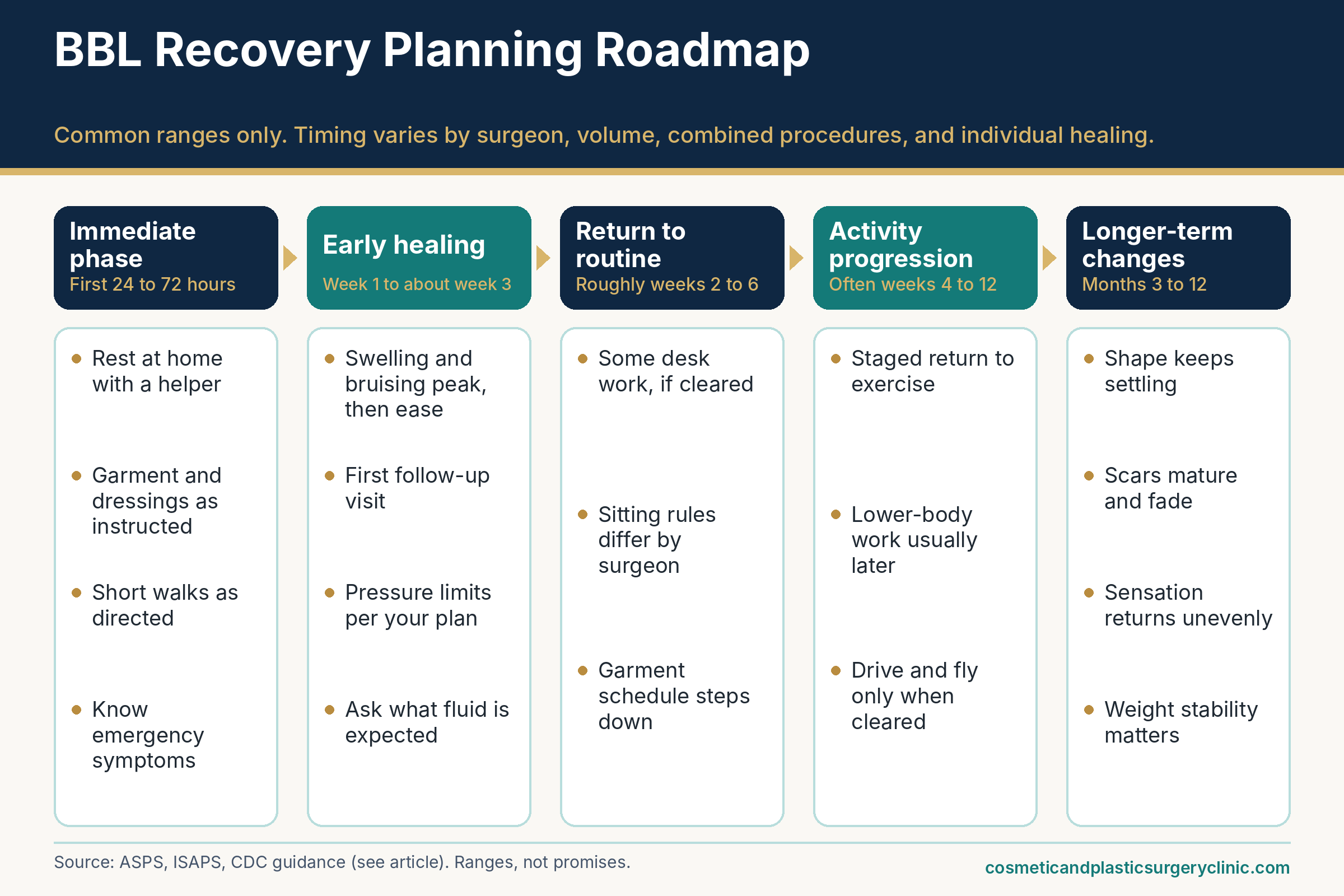
Any BBL surgery recovery timeline is a set of ranges, not a schedule. The phases below are a way to organize questions, and they will stretch or compress depending on how much fat was moved, whether other procedures were done the same day, your health and anatomy, how you heal, and your surgeon’s protocol. Two people with the same operation and the same surgeon can reasonably be on different pages at week three.
It also helps to separate three kinds of recovery that people tend to blur together. Medical recovery is when incisions are closed, fluid has settled, and the surgeon clears you. Functional recovery is when you can work, drive, sit, and move through your day with ordinary comfort. Aesthetic recovery is when swelling has resolved enough for the shape to be judged. They usually arrive in that order, with a gap of weeks to months between the first and the last.
Early Recovery: The First Hours, the First Week, and Weeks Two to Three
The first 24 to 72 hours
Most patients go home the same day or after a short observation period, though arrangements differ by surgeon and facility. You will probably leave in a compression garment, with dressings over small incisions at the donor sites and the buttocks. ASPS notes that temporary drainage tubes may be placed, and that your team will tell you how to care for them if so. Fluid leaking from incisions is commonly described by surgeons as expected in the first days, but the amount and color that count as expected is a question for your own team, so ask for a description in plain terms before you leave.
The first day or two are generally about rest, short walks as instructed, and managing soreness and nausea after anesthesia. Short, frequent walks matter for more than comfort: the Centers for Disease Control and Prevention (CDC) advises moving soon after surgery as part of lowering the risk of blood clots. Because pressure on the buttocks is a recovery concern, your instructions for lying, standing, and getting in and out of bed may feel unfamiliar, and having a helper who has read them ahead of time makes this stretch much easier.
This is also the period when the most serious complications are most likely to declare themselves. ASPS states that life-threatening complications of a BBL occur during surgery or within hours afterward. That is not a reason for alarm at home, since by the time you are discharged you have usually passed the highest-risk window, but it is a reason to know your warning signs on day one. Chest pain, trouble breathing, a racing or irregular heartbeat, fainting, or confusion are symptoms to treat as emergencies. The section on warning signs and escalation sets out those lists in detail.
An ASPS news article from 2022, drawing on surgeon interviews, describes patients commonly staying home for the first four to five days with minimal activity. Treat that as one example of a common pattern rather than a rule. Your plan might ask for longer, especially if you traveled for surgery and must stay near your surgeon.
Week 1 and weeks 2 to 3
During the first week, soreness, swelling, and bruising are typically at their most noticeable. Donor areas such as the abdomen or flanks often look and feel more swollen than the buttocks, and bruising can travel downward over days, appearing in places that were not treated. If drains are used, the surgeon decides when they come out, often based on how much fluid is collecting. A first postoperative visit is often scheduled within the first week or two, and this is the visit where a surgeon checks the incisions, drains, garment fit, and overall progress. Ask when it will happen before surgery, and whether you must attend in person.
Light walking tends to increase gradually. A 2017 blog post from ISAPS describes walking as encouraged after the first week to improve circulation, and ASPS’s list of questions for your surgeon includes when activity, driving, and exercise are cleared, which is why a written activity ladder is so useful. The point of walking is not fitness; it is circulation and clot prevention, and it also breaks up long stretches of lying down.
By weeks two and three, many people feel noticeably better. Energy returns, bruising is fading, and the garment becomes routine. It is also the stage where people are most tempted to treat feeling better as being cleared. Sitting restrictions, pressure limits, and garment rules often continue through this period. The ASPS buttock enhancement recovery page, for example, says patients should avoid prolonged sitting for about two weeks and notes that some surgeons prefer longer. Other published guidance asks for considerably longer; the next section compares those sources. Desk-type work is sometimes resumed in this range with accommodations such as a standing arrangement or a cushion placed behind the thighs, but whether that is acceptable for you depends on your surgeon’s method. The article on returning to work after a Brazilian butt lift covers job-type scenarios in more depth.
| Phase (range) | What people commonly describe | Planning decisions to make ahead | What varies most |
|---|---|---|---|
| First 24 to 72 hours | Anesthesia effects, soreness, garment and dressings on, possible drains, fluid on dressings | Driver, overnight helper, medication pickup, sleeping setup, written emergency steps | Same-day versus overnight discharge; drain use; pain plan |
| Week 1 | Peak swelling and bruising, tiredness, short walks, first postoperative visit | Meal prep, bathing help, first-visit transport, time off work | Drain removal timing; visit schedule; garment hours |
| Weeks 2 to 3 | Energy returning, bruising fading, ongoing pressure limits on the buttocks | Seating plan for any return to work, driving clearance question, sleeping routine | Sitting method and duration; work clearance; driving |
| Weeks 4 to 6 | Swelling slowly subsiding, garment rules often stepping down, gradual return of routine | Activity ladder, garment schedule, scar care, follow-up visit | When sitting limits end; when exercise starts |
| Months 2 to 6 | Continued swelling resolution, shape and volume settling, sensation changes evolving | Travel, exercise progression, check-ins, decisions about revision timing | Fat retention; asymmetry; donor-area contour |
| Months 6 to 12 | Scars maturing, contour judged as largely settled, remaining firmness easing | Photos for comparison, weight-stability plan, sun protection for scars | Scar quality; final contour; need for any touch-up |
Later Healing: Weeks Four to Six and the Months That Follow
Weeks 4 to 6
This range is where the recovery changes character. For the donor areas, ASPS’s liposuction recovery guidance places the point at which swelling starts to subside around weeks four to five, with improvement continuing after week six, and bruising generally gone by then. That is a liposuction reference, not a BBL-specific timeline, but it is the best published anchor for the donor side.
For the buttocks, this is commonly the period when restrictions begin to ease, though the pattern varies enormously. Some published guidance has patients wearing a garment around the clock for roughly the first month and for at least 12 hours a day during the second month. Other sources describe garments for up to eight weeks. Sitting restrictions may be loosened step by step, for example by allowing short periods with a cushion or pillow placed to take pressure off the grafted area, or they may continue until a specific visit. The only responsible rule is to ask your surgeon for the date or the milestone that ends each restriction, and to write it down.
Exercise is usually the slowest restriction to lift. ASPS’s recovery page says patients generally resume exercise after about six to eight weeks, and walking is typically encouraged earlier. Lower-body, high-impact, and heavy-lifting exercise may be staged later still, depending on surgeon preference. The guide to exercise after a Brazilian butt lift is the place to look for a more detailed activity ladder.
Months 2 to 6 and months 6 to 12
After the first six weeks or so, the recovery becomes mostly about waiting and observing. Swelling continues to resolve, often unevenly, and the buttocks and donor areas can look different from week to week. An ASPS news article from 2022 quotes a surgeon saying that by about month three the risk of significant additional fat loss declines, and that between months three and six the shape becomes a fairly good indicator of what will remain. A 2017 ISAPS blog post similarly described final results as visible at roughly six months because of lingering swelling. These are expert descriptions, not measured certainties, and they come with individual variation.
Sensation may be different for months. Numbness, tingling, or hypersensitivity in donor areas is common after liposuction and often improves gradually, but the extent and speed vary, and some change can be lasting. ASPS lists numbness and poor wound healing among the recognized risks of buttock enhancement. Questions about sensation that does not improve, or that is accompanied by pain, weakness, or a burning feeling, belong with your surgeon rather than in a search engine.
Scars take longest of all. ASPS describes scar maturation in phases: the first couple of weeks of protecting the incision, up to about six months when scars often look red and raised or textured, and six to twelve months when they typically flatten and fade. Incisions from a BBL are generally small and placed in discreet locations, but they are surgical scars, and the same guidance about sun protection applies: ASPS suggests avoiding direct sun on scars for the first six months and using a mineral sunscreen with a high sun protection factor when exposure cannot be avoided. Specific scar-care products and timing are surgeon-specific decisions.
Finally, the long game is about stability. Large changes in body weight can alter both the donor areas and the buttocks, and a result evaluated at six months is not necessarily the same at two years. The article on Brazilian butt lift results, timeline, and longevity goes deeper on how results evolve and what affects them.
Protecting the Grafted Area: Positioning, Sleeping, Sitting and Compression
If one topic defines BBL surgery recovery, it is what surgeons ask you to do, and not do, with the grafted buttocks. This is also the topic where published guidance disagrees the most, so this section focuses on the reasoning behind the instructions, shows how widely they differ across sources, and offers a way to turn a surgeon’s rules into a plan you can actually follow at home.
Pressure on the Buttocks: Sitting, Lying and Sleeping
Why surgeons ask patients to limit pressure
The reasoning is intuitive and widely shared, though it is a clinical convention more than a tested rule. Transferred fat cells need to connect to a blood supply in their new location, and in the early weeks that connection is fragile. Prolonged pressure, repeated compression, and shearing forces from shifting on a hard surface are thought by many surgeons to risk compressing small vessels and disturbing the graft. That is the basis for instructions such as limiting sitting, using a cushion that shifts load onto the thighs, and sleeping on the stomach or side.
It is important to be honest about the evidence. In the sources reviewed for this article, which were society pages, news articles, and published advisories, none presented controlled data that identify the number of weeks of sitting restriction that protects fat survival best. An older ASPS blog post, published in 2016, even acknowledged that a portion of transferred fat may not survive regardless of whether a patient sits, which is a reminder that restrictions are meant to protect what can be protected, not to secure the outcome. Instructions are therefore best understood as conservative practice shaped by experience and risk tolerance, not as proven protocols. That is also why they differ from one surgeon to another.
In practical terms, pressure instructions usually address four situations. Lying down covers sleeping and resting, where the common themes are lying on the stomach or the side, avoiding lying flat on the back for a period, and using pillows or a shaped support to keep weight off the buttocks. Sitting covers meals, toileting, travel, and work, where surgeons commonly describe using a cushion or pillow placed behind the thighs so that the buttocks hang slightly off the seat. Standing and walking cover the dragging, friction, and twisting that can occur when you transfer in and out of bed or a chair. Getting in and out of a car and sitting in a medical office are less obvious but common friction points.
ASPS’s recovery page describes the sitting guidance this way: avoid prolonged sitting for about two weeks, with some surgeons preferring longer, and when sitting is necessary, place a pillow or cushion behind the hamstring muscles to lift the buttocks and protect the grafts. It also says sleeping face down or on the side is encouraged. Those are descriptions from a patient-education page, and they illustrate one approach among several, not a standard that applies to your plan.
Why instructions differ: what published sources say
Placing several published sources side by side makes the variation visible. The table below compares four, with their dates, because instructions have shifted over time and because older pages stay online long after practice evolves. It is not a recommendation of any column. If you find yourself comparing a surgeon’s written plan with something online, the question to ask is not which source is right but why your surgeon chose the approach in your plan.
| Source and date | Sitting and pressure | Garment | Sleep and exercise |
|---|---|---|---|
| ASPS recovery page (current page; undated) | Avoid prolonged sitting about two weeks; some surgeons prefer longer; pillow behind hamstrings | Support garment around the clock; duration per surgeon | Face-down or side sleeping encouraged; exercise generally after about six to eight weeks |
| ASPS news article, Aug. 11, 2022 (surgeon interview) | Limit sitting to roughly 10-minute intervals for the first six weeks, using a BBL pillow | Around the clock for the first month except showering; at least 12 hours daily in the second month | Sleep on stomach at first; options for back sleepers described |
| ISAPS blog, Sept. 4, 2017 | No sitting for 10 to 14 days except for toileting | Up to eight weeks | No back sleeping in that period; walking after week one; avoid strenuous exercise at least one month |
| ASPS blog, May 12, 2016 (older) | Avoid sitting directly on the buttocks for at least eight weeks; donut or inflatable pillows behind the legs | Eight weeks; rear typically cut out | Avoid back sleeping eight weeks; normal activities by about six to eight weeks |
Look at the spread. The “avoid sitting” window runs from about two weeks to eight weeks or longer, and the allowance for sitting ranges from a few minutes at a time with a pillow to essentially none. Garment guidance runs from the first month to eight weeks, and some pages leave the duration to the surgeon. Those are not typos in the sources; they reflect different surgeons describing different methods and different risk tolerances, and some of the difference reflects the years in which the pages were written.
That variation is the reason this article does not state a universal number of weeks. It is also why the most valuable thing you can do before surgery is ask for the plan in writing, including: what position to sleep in and for how long; how you may sit and for how long at a time, with what kind of cushion; when sitting restrictions are reassessed and by whom; and what to do if the instructions conflict with something you must do, such as a medical appointment or a flight home. If you notice that a plan is silent on pressure altogether, that is a reason to ask, not a reason to assume that nothing is needed.
Compression Garments, Foam and Drains
Garment types and what they are meant to do
Compression garments are the most visible part of BBL aftercare. They are worn over the donor areas to reduce swelling and bleeding and to help the skin settle against the new contour, as medical references such as MedlinePlus explain for liposuction. ASPS’s guidance for liposuction and for buttock enhancement both describe wearing a garment or support as directed. What differs is the design, and the vocabulary gets confusing quickly because manufacturers and surgeons use different names for similar items.
A rough map helps. A full-body or high-waist girdle with a cutout or open back is meant to compress the abdomen, flanks, and sometimes the thighs while leaving the buttocks uncompressed or lightly compressed. Many people hear these called a faja, the Spanish word for girdle, and the term has become a common label for post-surgical garments. An abdominal binder is a wider band focused on the midsection. Shorts or leggings extend compression down the thighs when the thighs were treated. Some surgeons add foam pads or boards over donor areas to smooth the pressure, while others avoid them because they can leave marks or shift. Stages matter too: some surgeons use a more compressive first garment in the early weeks and a lighter second garment later, while others use one throughout.
Garment style is not a cosmetic detail. It affects whether the buttocks are loaded with pressure while the grafts are most vulnerable, whether the donor areas are supported evenly, and how easily you can use the toilet without taking everything off. The article on compression garments after plastic surgery covers general garment types and care.
Why surgeons differ and what to ask about fit
Surgeons differ on garments for the same reason they differ on sitting. There is a trade-off between supporting the donor areas, which favors firm compression, and protecting the grafted buttocks, which favors little or none over that area. The balance depends on how much was removed, where, and on how the surgeon thinks about pressure on the graft. The duration differs as well, from weeks to a couple of months, and some surgeons taper hours of wear rather than stopping abruptly.
Fit questions deserve as much attention as duration. A garment that is too tight can cause numbness, tingling, or difficulty breathing or moving, and one that rolls or folds can press creases into soft tissue. Skin irritation, blistering, or rashes from fabric or foam are reasons to call. Swelling changes quickly, so the size that fits on day three may not fit on day ten, and surgeons often anticipate that by supplying or recommending more than one size. Ask which sizes to have on hand, how to wash and dry them without losing their compression, whether you need two so one can be washed, and how to use the bathroom without removing the entire garment.
Two additional points are easy to miss. First, a garment is not a substitute for movement; lying still in a garment does not reduce clot risk. Second, social media content and vendors sometimes promote very tight garments or add-on devices to speed results, but none of the sources reviewed here supports using something tighter than your surgeon ordered. If a garment is causing pain, color change in the skin, or tingling that does not go away when you adjust it, contact your surgical team. The same is true for foam, boards, and drains: use what your surgeon provided or specified, and ask before adding anything.
Daily-Life Planning: Work, Driving, Exercise, Travel, Caregivers and Home Setup
The medical side of a BBL recovery gets most of the attention, but the practical side is where plans succeed or fail. A restriction on sitting is a medical instruction on paper and a scheduling problem in real life: it touches your commute, your desk, your car, your meals, and your bathroom. This section works through the categories that are worth clearing with your surgeon in advance, along with a calendar worksheet you can fill in.
Work, Driving and Exercise
Work: matching the job to the restrictions
Time off work is rarely a single number, because a BBL changes how you can sit and lift more than how you can think or type. The examples below are illustrative scenarios, not predictions, and they show why the same operation produces different answers for different jobs.
Consider someone with a remote desk job. Their main question is whether they can work from a recliner, a standing workstation, or lying on their stomach with a laptop at a safe height, since a chair may be off limits for a while. If the surgeon allows short periods of sitting on a cushion, they may be able to work in short blocks, but if the instruction is to avoid sitting entirely, working semi-reclined or standing may be the only option. Now consider someone in an office who commutes by car or train. Their problem is the commute: sitting for an extended period on a hard seat and then sitting at a desk, with limited ability to adjust. A person who works on their feet, such as a teacher, a retail worker, or a nurse, may have little issue with sitting but a real one with prolonged standing, garment discomfort, and swelling in the legs. A person whose job involves lifting, driving a vehicle for hours, or physical labor typically faces the longest time away, since both sitting and exertion are limited.
Caregiving is a job too. Lifting a toddler, bending to the floor, carrying groceries, and sitting through long car rides to school pickups are all activities that can conflict with restrictions on lifting and pressure. If you care for young children or an older relative, the plan needs a named backup for the first stretch, not a vague hope that family will pitch in. ASPS’s liposuction recovery guidance says return to work in weeks two to three depends on the type of job, which is a reasonable template for the donor side, but a BBL adds the sitting question on top of it. Ask your surgeon what documentation your employer may need, such as a note that lists seating and lifting limits.
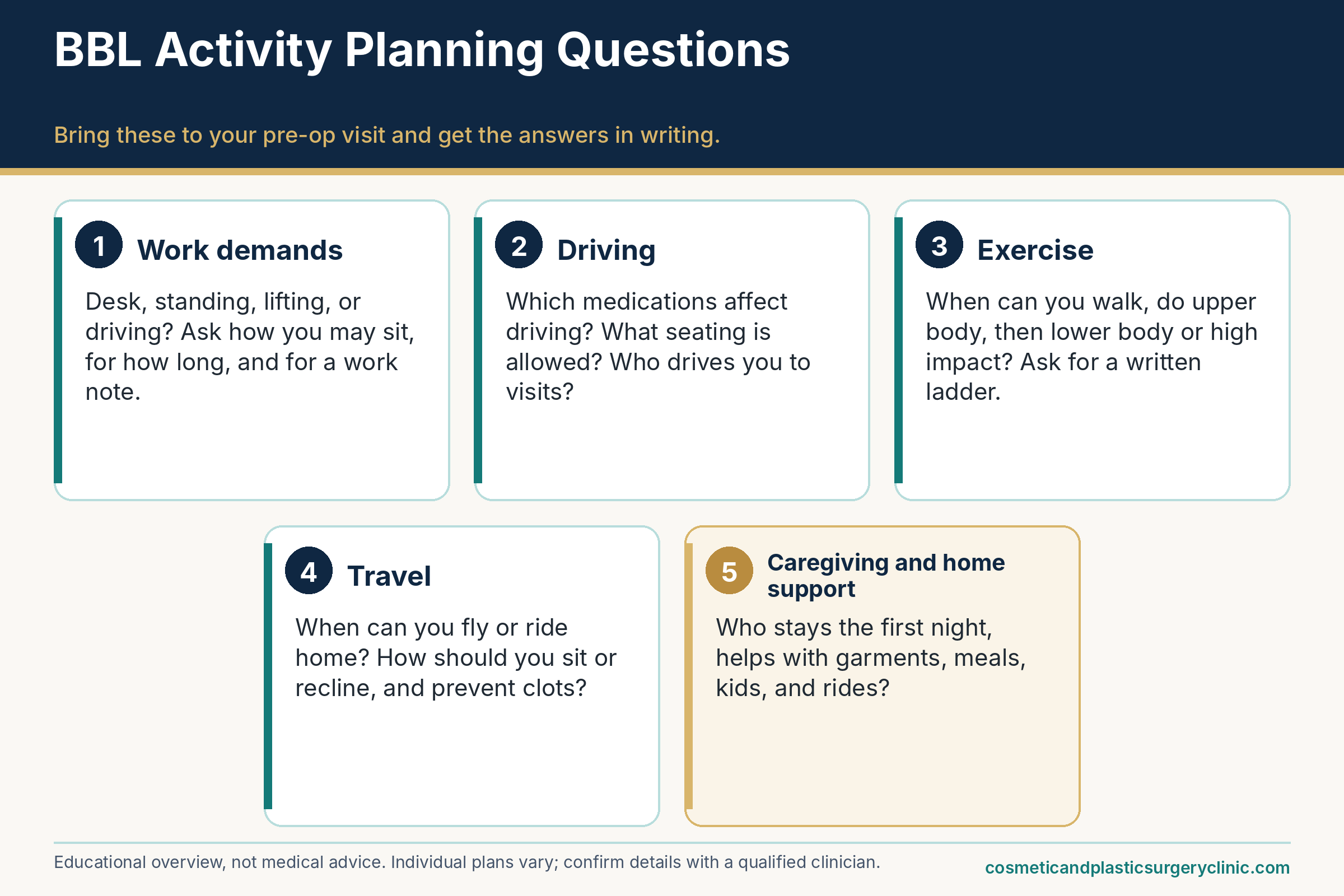
A practical approach is to ask your surgeon for a work note covering three things: the earliest date you might do phone or computer work in a reclined or standing position, the earliest date you might sit for stretches at a desk with a cushion, and the date after which lifting or labor might resume. You will not get certainty, but you can get a schedule for the conversation, and a plan for a conditional return that can move if healing does not follow the usual pace.
Driving and exercise clearance
Driving is usually cleared by the surgeon, not by how you feel. Typical considerations include whether you are still taking medication that can impair alertness, whether you can turn, brake, and react without pain or restriction, and whether you can sit in the driver’s seat in the position your plan allows. A BBL adds a special question: how long can you sit, and on what? A car seat is a firm surface that compresses the buttocks, and a cushion may change the driving position and visibility. Many surgeons want patients to be passengers for a period, possibly lying partly reclined, and to use a cushion for any car ride. Ask directly whether you may drive, when, and with what seating arrangement.
Exercise follows an arc that most surgeons describe in stages. Walking comes first, and the CDC’s advice to move soon after surgery is consistent with that. Upper-body and light movement come next as the donor areas allow. Lower-body work, especially exercises that load or contract the glutes, such as squats, lunges, and heavy leg presses, and high-impact activity are commonly the last to return. ASPS’s recovery page says patients generally resume exercise after six to eight weeks. That is a general statement, and surgeons may stage lower-body work later or earlier based on the technique and on how the grafts are healing. A written ladder helps because it removes guesswork: walking minutes per day, the first date for light resistance training, the date for lower-body work, and the date for running or high-intensity classes.
One more consideration: people who exercise intensively sometimes worry about losing fitness more than they worry about the graft. That is understandable. A plan with real milestones makes it easier to rest in the first weeks, since you know when you can start rebuilding. Beyond that, checking in about nutrition and protein intake with your surgeon is reasonable, since what to eat and drink after surgery is a medical question for your own situation.
Travel, Caregivers and Home Setup
Travel after surgery: clot risk, distance, and sitting
Travel combines two issues that matter for a BBL. One is clot risk, because long periods of sitting and reduced movement after surgery raise the risk of deep vein thrombosis (a clot in a deep vein, usually in the leg) and pulmonary embolism (a clot that travels to the lungs). The CDC lists surgery among the risk factors for blood clots, notes that about half of people with a deep vein clot have no symptoms, and advises moving soon after surgery and, on trips of four hours or more, standing up every one to two hours and doing leg exercises while seated. The other issue is the sitting restriction itself, which can conflict with a long car ride or flight.
The CDC’s medical tourism guidance says that delaying air travel for 10 to 14 days after major surgeries will lower risk. That is a general statement about major surgery, not a BBL-specific rule, and your surgeon may want a longer or shorter wait or may ask you to stay near the surgical facility. The ASPS Practice Reference on caring for patients who travel for surgery, issued on September 19, 2024, suggests that surgeons assess clot risk and travel-related complications, document how long a patient is expected to stay near the surgeon, and consider clot prophylaxis for long travel. It is directed at surgeons, but it also tells patients what to ask.
For planning, ask four things. When may you travel home, and by what method? How should you sit or recline during the trip, and for how long at a stretch? What clot-prevention steps do you need, such as walking breaks, leg exercises, hydration, and whether any medication or stockings are advised in your case? And who do you call if something changes while traveling? The guide to travel after a Brazilian butt lift explores flying, driving, and trip planning in more detail.
Caregiver planning, home setup, and a calendar worksheet
Many surgeons require a responsible adult to drive you home and stay with you for at least the first night after sedation or general anesthesia. Beyond that minimum, a helper does more than most people expect: handling medication, meals, and garment changes; helping you move between positions without putting weight on the buttocks; watching for changes such as confusion, breathing trouble, or sudden swelling; and making the call when you cannot. Ask your helper to read your written instructions ahead of time and to know the numbers to call. If nobody can stay with you, ask the facility whether it can offer an overnight recovery option, rather than hoping to manage alone.
The home itself is worth setting up before surgery. Create a sleeping area where you can lie on your stomach or side, with pillows already placed. Put frequently used items, such as phone, water, medication, and snacks, at arm’s reach. Plan the bathroom: it is surprisingly hard to use a low toilet without sitting, and some people set up a raised seat or a way to hover while a helper supports them. Choose loose clothing that fits over the garment. Set up an eating spot where you can stand or kneel comfortably. Prepare simple meals ahead of time, arrange for laundry of the garments, and organize help with children and pets for the first weeks. None of these are medical requirements, but every one of them reduces the temptation to sit for convenience.
The worksheet below turns this into a calendar you can complete with your surgeon. It deliberately leaves the answers blank, because they have to come from your plan.
| When | Questions to settle | What to arrange | Your surgeon’s answer |
|---|---|---|---|
| Before surgery | Which garment, which sizes, which pillows or cushions; written emergency steps; nearest emergency department | Garments and supplies, helper schedule, time off work, child and pet care | Write here: ________ |
| Day of surgery and days 1 to 3 | Positioning, drains, medication plan, who to call at night, bathing | Driver, overnight helper, prescriptions picked up, meals ready | Write here: ________ |
| Week 1 | First visit date, drain removal, garment hours, walking schedule, sleeping position | Transport to visit, help with bathing and garments, work coverage | Write here: ________ |
| Weeks 2 to 3 | Sitting plan, driving clearance, return-to-work conditions, bruising and fluid expectations | Cushion for car or desk, work note, a plan for commuting | Write here: ________ |
| Weeks 4 to 6 | Garment step-down, sitting changes, exercise start, scar care, follow-up | Second garment or size change, exercise plan, appointments | Write here: ________ |
| Months 2 to 12 | Travel, lower-body exercise, results review, weight plan, revision timing | Photos in consistent light, sun protection, scheduled check-ins | Write here: ________ |
Swelling, Fluid, Numbness and Pain: What Healing Can Look Like
The symptoms of BBL recovery fall into two groups. Some are ordinary parts of healing that tend to improve without treatment. Others look similar at first but signal a problem that needs a clinician. This section describes the first group in detail, because knowing what is common makes it easier to notice what is not, and then describes the problems that surgeons ask patients to report.
What Normal Healing Can Feel and Look Like
Swelling, bruising, fat retention and contour changes
Swelling after a BBL has several sources. Liposuction injures tissue and releases fluid. The injected fat and the fluid that accompanies it add volume to the buttocks. The body’s inflammatory response then adds more. This combination means the buttocks can look larger and rounder early on than they will after the swelling resolves, and the donor areas can look puffy, firm, or lumpy before they smooth out. Bruising often spreads and shifts with gravity, so a purple area on the thigh or lower back may appear days after surgery in a spot that was not directly treated.
Fat retention is the part of the story that patients most often misunderstand. Not all of the transferred fat survives. ASPS’s procedure page says that patients typically retain about 60 to 80 percent of transferred fat, and a 2022 ASPS news article describes 20 to 40 percent being absorbed during healing, with the same account noting that the average “take” is around 60 percent in one surgeon’s estimate. These sources do not quite agree on the midpoint, which is itself informative. A small 2006 study of 10 patients who had about 350 milliliters of fat injected, which was reviewed for this article only at the abstract level, used magnetic resonance imaging and calculated reabsorption of roughly 24 to 36 percent at three months. All of these are group-level figures from patient-education sources or a very small study, not predictions for any one person, and the studies used different methods.
Several factors are widely thought to influence how much fat remains, such as the amount placed, the way the fat was handled and injected, the characteristics of the tissue it was placed in, the person’s weight changes, and possibly the pressure and care in the early weeks. But the evidence for how much each factor matters is not settled, and nobody can tell you in advance which part of that 60 to 80 percent range you will land in. One honest planning response is to ask your surgeon how they think about retention in someone with your anatomy, what they say about the chance of needing a second round, and how long they wait before evaluating a touch-up. Ask, too, how the surgeon thinks about proportion, since a result that looks balanced at six months may differ from the early fullness.
Contour also changes in ways that are not purely about volume. Early on, the buttocks can feel firm or tight. As swelling resolves they usually soften. Asymmetry in swelling is common, particularly if you favor one side when lying down. The donor areas may seem to change shape more than the buttocks as the swelling subsides, and areas that were firm early can feel smoother later. Most of this evolution takes place over months, which is why a surgeon usually waits to judge results and to discuss refinements. A practical habit that helps: photograph the same areas in the same light and pose at intervals, and compare across weeks rather than judging by the mirror on a given day.
Numbness, tightness, itching and pain management
Altered sensation is one of the most common and least predictable parts of recovery. Skin over the donor areas may feel numb, tingly, or oddly sensitive for weeks to months, and sometimes the area feels tight and rubbery. ASPS’s liposuction safety page lists a change in skin sensation that may persist among the recognized risks, and its page on buttock enhancement lists numbness. Itching is also typical during healing, as nerves recover and skin stretches, and a garment can make it worse. Scratching under a garment or applying creams without asking can irritate healing skin, so check with the team before using anything.
Pain management is a medical conversation, and this article stays at an educational level, with no doses or product advice. ASPS’s 2022 article describes mild-to-moderate pain, bruising, and swelling as expected, and experiences vary a great deal. Surgeons often combine approaches, with a regimen tailored to the operation and the patient’s medical history, and they may prescribe medication for a limited period. A few principles hold regardless of the plan. Take medications only as instructed by the prescriber. Ask which over-the-counter products and supplements to avoid, since some affect bleeding and others interact with prescriptions. Ask about side effects such as drowsiness, nausea, and constipation, and about driving and alcohol. Never combine leftover medication from another source with your prescribed plan.
Also pay attention to the pattern of pain, because the pattern says more than the intensity. Soreness that is gradually improving, even slowly, is the common course. Pain that is getting worse after several days, that is out of proportion to what you were told to expect, that is not relieved by the plan, or that comes with fever, spreading redness, calf pain, chest pain, or trouble breathing should be reported promptly. Because numbness can hide pain, an area that feels fine is not necessarily fine. The article on how painful a Brazilian butt lift is discusses what patients describe and how to prepare questions about it.
When Healing Needs Attention: Fluid, Infection, Wound Problems and Firm Areas
Seromas, fluid leakage, infection and wound problems
A seroma is a pocket of clear or pale-yellow fluid that collects under the skin after surgery. The Cleveland Clinic describes seromas as most often appearing around seven to ten days after surgery, as a soft bump that may feel sore or pull on stitches. Small seromas may shrink within a little over a week, and larger ones may take up to about six weeks, and many are absorbed on their own. Treatment can range from watching a small one to draining it with a needle, placing a temporary drain, or, rarely, a procedure. The Cleveland Clinic advises contacting a provider if a seroma is uncomfortable, growing, showing signs of infection such as discoloration, severe pain, and fever, or not improving after several weeks. In a BBL, fluid can collect at donor sites or in the buttocks. Report any new swelling that feels fluid-filled, tense, or that is getting larger, because the surgeon should decide whether it needs to be drained.
Fluid leaking from an incision is a separate question. Thin, pink, or straw-colored fluid on dressings is commonly described as part of early healing, especially in the first days. What matters is volume, color, smell, and trend. Drainage that is increasing, thick, cloudy, or foul-smelling, or that comes with fever, is concerning. The CDC lists redness and pain around the surgical area, cloudy fluid draining from the wound, and fever as signs of a surgical site infection and says to call your healthcare provider right away if they appear. Infection can involve donor sites or the buttocks, and ASPS lists infection and poor wound healing among the risks of buttock enhancement.
Wound healing problems can look like incisions that open, edges that turn dark or dusky, blisters, or skin that becomes unusually pale, mottled, or cold. ASPS lists skin loss among the recognized risks of buttock enhancement. Garments, foam, and pressure can contribute to skin problems, which is another reason to report irritation early. Do not start antibiotics on your own, use leftover prescriptions, or apply ointments without guidance, since doing so can mask a problem and delay evaluation. A written wound-care plan that explains how to clean the incisions, when to change dressings, and what to leave alone is a reasonable thing to expect.
Lymphatic massage, firm areas and what the evidence supports
Lymphatic massage is a gentle technique intended to move fluid through the lymphatic system. ASPS’s recovery page on buttock enhancement lists it as optional, to be performed by a licensed therapist. An ASPS video page features a plastic surgeon describing lymphatic massage as important after liposuction and tummy tuck because drainage patterns are altered. Many surgeons recommend it, and some do not, and some want it started only after a certain point in healing.
The evidence, however, is limited. One small study from 2019 in the American Journal of Cosmetic Surgery looked at 20 women after tummy tuck with liposuction of the core. The group that received manual lymphatic drainage twice a week for three weeks had a larger average reduction in measured swelling (9.8 centimeters versus 6.6 centimeters in the comparison group), but the difference was not statistically significant, and the participants were not randomly assigned. That study does not involve a BBL, so it cannot be applied directly. A review of lymphatic massage in cosmetic procedures also appears in the literature, but it could not be opened for this article, so nothing here relies on it. The honest summary is that some patients and surgeons find massage helpful for comfort and swelling, strong controlled evidence for BBL specifically was not found, and the choice is best made by asking your surgeon.
If your surgeon recommends massage, ask about timing and technique. Pressure on the grafted buttocks is a concern for many surgeons, so ask whether the therapist should avoid that area or use only light strokes, and when sessions may start. Ask what training the therapist should have, and whether the therapist has worked with patients after fat grafting. Check with your surgeon before using handheld devices, vacuum or suction tools, deep-tissue methods, or other add-on therapies, because evidence for those after BBL is not established in the sources reviewed and aggressive pressure is not the same thing as gentle drainage.
Firm areas deserve a word of their own. Firmness in donor areas is common as tissue heals and swelling resolves, and it often softens over months. In the buttocks, firm lumps can reflect healing, fluid, or fat that did not survive. ASPS lists fat necrosis, the death of some fatty tissue, among the recognized risks of buttock enhancement, and it can present as a firm, sometimes tender area. A lump that is new, growing, painful, red, or warm should be examined rather than assumed to be normal. Surgeons have several ways to assess these changes, and the right approach depends on what the examination finds.
Warning Signs, Clot Risk and What Can Slow Healing
Most BBL recoveries involve discomfort and inconvenience, and a smaller number involve complications that need prompt care. The goal of this section is not to alarm you but to make escalation easy: to know in advance what counts as an emergency, what counts as a same-day call, and who you will call. The second half covers factors that can slow healing and how follow-up visits work.
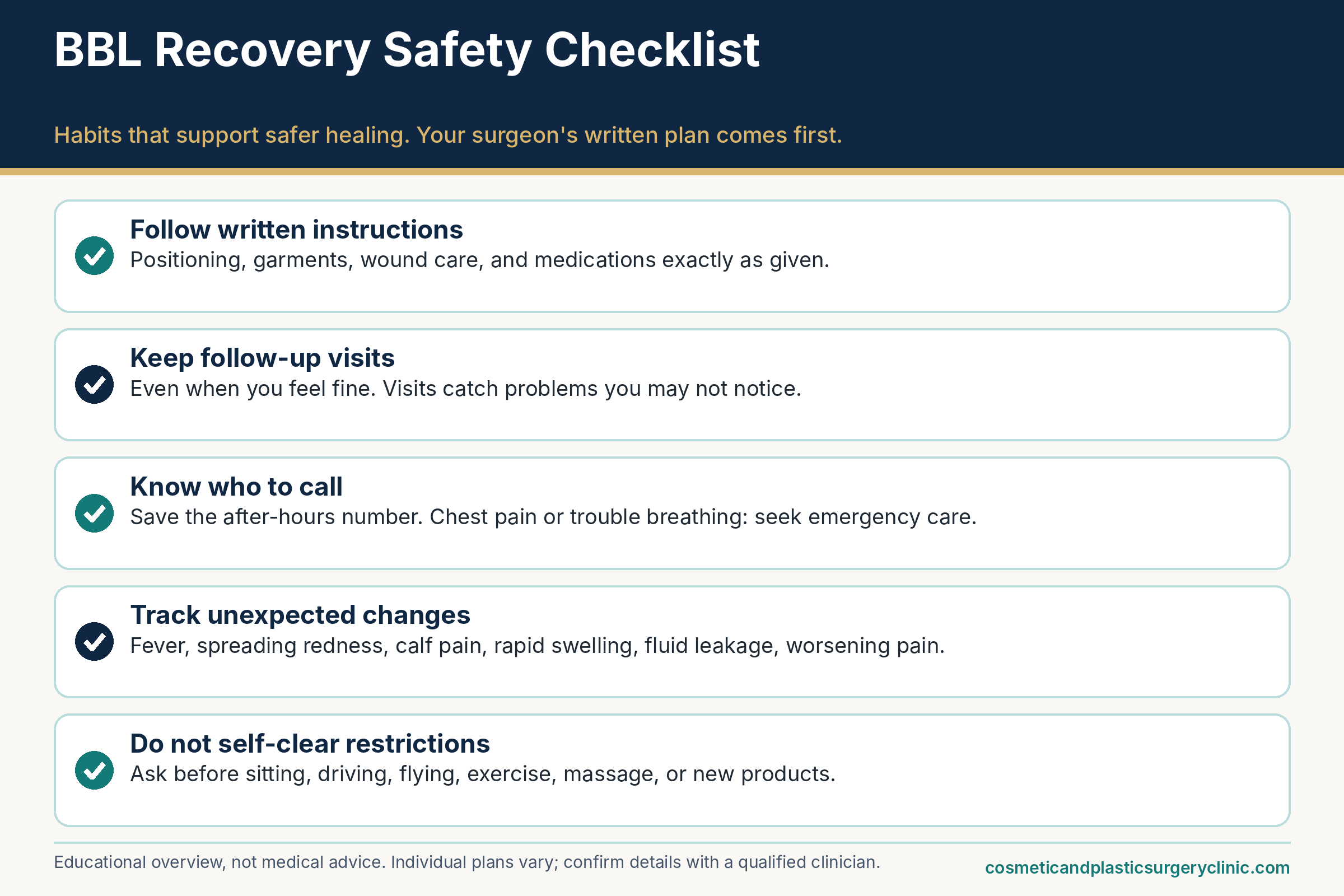
Warning Signs and Who to Call
Symptoms that call for urgent contact or emergency care
The table below sorts warning signs by what they might indicate and what kind of response surgical teams typically want. It is a general educational list built from ASPS and CDC descriptions, not a diagnostic tool and not a complete one. Your discharge instructions should list the symptoms specific to your operation, and those instructions take priority.
| Sign or symptom | Why it matters | Response category |
|---|---|---|
| Chest pain, shortness of breath, fast or irregular heartbeat, coughing blood, fainting | May signal a blood clot in the lungs, a fat embolism, or another serious cardiopulmonary problem | Seek emergency care immediately (call 911 or your local emergency number); notify your surgical team afterward |
| New confusion, severe drowsiness, difficulty waking, new weakness or speech or vision changes | Changes in alertness or neurological function can indicate several serious problems | Seek emergency care immediately; a helper should make the call if you cannot |
| Calf or leg pain, swelling, warmth or redness, especially on one side | May signal a deep vein clot; the CDC notes that about half of people with one have no symptoms at all | Contact your surgical team urgently the same day; go to emergency care if you cannot reach them or if breathing symptoms appear |
| Fever, chills, spreading redness, warmth, thick or foul-smelling drainage | Possible infection at donor sites or buttocks | Contact your surgical team promptly; seek emergency care if you feel very unwell |
| Rapidly increasing swelling, tight or tense area, expanding bruise, dizziness | Possible bleeding or fluid collection | Contact your surgical team right away; emergency care if lightheaded or faint |
| Severe or worsening pain not eased by your plan | Pain that escalates can reflect bleeding, fluid, pressure, infection, or nerve problems | Contact your surgical team promptly |
| Incision opening, dusky or darkening skin, blisters, increasing fluid leakage | Possible wound-healing problem or skin compromise | Contact your surgical team the same day |
| New leg numbness or weakness, or shooting pain down a leg | Nerve irritation is a recognized complication category in published BBL safety reviews | Contact your surgical team promptly |
ASPS’s recovery page states the emergency category plainly: shortness of breath, chest pain, or an irregular heartbeat should lead you to seek immediate medical attention, and hospitalization may be required. The CDC adds that a pulmonary embolism, the lung form of a clot, is an emergency, while signs of a deep vein clot such as swelling, pain, tenderness, warmth, or redness call for urgent evaluation. Fat embolism and clots are different problems, but they overlap in how they show up and in what you should do about them, which is to treat the symptoms as an emergency first and sort out the cause later.
Several practical points apply. If you are unsure whether something is an emergency, calling the surgical team is always acceptable, and a good team would rather hear from you early. If you cannot reach anyone promptly, or if the symptoms are severe, go to the emergency department. Do not drive yourself if you feel faint, short of breath, or confused. When you arrive, tell the staff that you recently had a Brazilian butt lift or gluteal fat grafting, give the date and the facility, and ask them to contact your surgeon. A helper who knows these steps is useful in just this situation.
Building an escalation plan before surgery
An escalation plan is a short written page that answers who you call, in what order, and where you go if you cannot reach anyone. Before surgery, ask for the surgeon’s or facility’s after-hours number, the name of a covering clinician if your surgeon is away, and what the team considers the threshold for calling at night. Ask which hospital is closest to the surgical facility, whether the facility has a written transfer agreement or procedure for emergencies, and who goes with you if you are transferred. Put the numbers on your phone, on the refrigerator, and in your helper’s phone.
Keep a simple log during the first week or two: temperature if you have a thermometer, how much you walked, how you slept, pain level in plain words, how much fluid is on dressings or in drains, and a daily photo of any area you worry about. A log turns a vague phone call into a specific one. It helps you notice a trend, and the CDC’s guidance on wound infection emphasizes knowing who to contact if you see warning signs after you leave the hospital.
People who travel for surgery need a version of this plan that works in a different city. The ASPS Practice Reference from September 2024 calls for a written plan that accounts for travel limits, identifies a qualified local physician for routine postoperative care when the patient cannot return, and spells out the length of the stay near the surgeon. Patients can ask for each of those items. They should also have copies of their operative details, medication list, and records, so that an unfamiliar emergency department can understand what was done. The CDC’s guidance on medical tourism likewise recommends bringing records and arranging follow-up care at home before leaving.
What Can Slow Healing, and What Follow-Up Looks Like
Nicotine, weight swings and other modifiable factors
Nicotine is the best-documented factor surgeons ask patients to avoid. MedlinePlus advises stopping smoking at least four weeks before surgery, with ten weeks better still, because smoking reduces the oxygen that reaches surgical wounds, slows healing, and raises the risk of infection and blood clots. It also warns that nicotine replacement products such as gum still interfere with healing, and that e-cigarettes and smokeless tobacco carry similar concerns. A BBL depends on a transferred tissue taking hold in a new location, and the ASPS description of a typical BBL candidate includes being a non-smoker. Many surgeons ask for a nicotine-free period before and after surgery, and some test for it. If you use nicotine in any form, tell your surgeon honestly; the conversation is about planning, not judgment, and help with quitting is available.
Weight is the next factor. Weight gain after a BBL can change how the buttocks and donor areas look, and losing a lot of weight can reduce the volume of the transferred fat along with other body fat. The goal that surgeons tend to describe is a stable weight before surgery and through the recovery, rather than a particular number. If you are in the middle of a diet, medication-assisted weight loss, or a recent pregnancy, ask how that affects timing. Bring the question of weight stability to the consultation explicitly, since surgeons differ on how long they want weight to hold steady.
Other modifiable factors are less glamorous but real. Following garment, positioning, and activity instructions matters, as does attending follow-up visits. Chronic conditions such as diabetes, blood pressure, and anemia can influence healing, and your surgeon’s preoperative evaluation should address them. Hydration, regular meals with enough protein, and sleep help recovery in general terms, though the evidence is not specific to BBL and individual dietary advice belongs with your team. Finally, be skeptical of unregulated supplements, creams, and devices marketed to speed healing or increase fat survival. None of the sources reviewed supports them, and some supplements can affect bleeding.
Follow-up visits and when results look settled
Follow-up schedules vary, but the pattern is usually frequent early, then spaced out. A first visit commonly happens within the first week or two for incision and drain checks. Further visits may occur in the following weeks as restrictions are reassessed, and then at intervals such as a few months and around a year, though your surgeon may choose a different cadence. Ask what each visit is meant to accomplish and what changes in your instructions are expected at each one. Attending visits is also the best way to receive clearance for sitting, driving, and exercise in a documented form.
“Settled” means different things depending on what you are asking. Medically, the incisions are closed and fluid collections have resolved. Functionally, you can sit, drive, work, and exercise as you did before. Aesthetically, swelling has gone down enough that the shape is stable from one visit to the next. A 2022 ASPS article quoted a surgeon saying that by about month three the risk of significant further fat loss falls and that months three through six give a reasonable preview of what will remain, while ISAPS wrote in 2017 that final results are visible around six months. Scars mature over six to twelve months. Many surgeons wait at least this long before assessing whether a second procedure would be useful, so planning a touch-up date around a wedding or trip is not wise.
Keep your own record too: photographs in similar light at regular intervals, notes on how sitting and sleeping have changed, and the dates of each clearance you received. These make it easier to tell your surgeon what has changed and to notice slow progress that might otherwise go unnoticed. If your recovery involved a tummy tuck or another procedure at the same time, the recovery for that procedure runs on its own timeline; the tummy tuck recovery timeline and the article on combining a Brazilian butt lift with other procedures explain how that changes the picture.
Choosing Care Before Surgery: Surgeon, Facility, Anesthesia and Recovery Questions
Recovery begins before the operation, with choices about who operates, where, and what happens afterward. For most cosmetic procedures, surgeon and facility selection is a quality question. For a BBL, the safety statements described earlier make it also a question of how risk is managed during and immediately after surgery. This section explains how to verify credentials, what to ask about the setting, how to think about surgery away from home, and which recovery-plan questions are worth bringing to a consultation.
Verifying the Team and the Setting
Board certification, license and operating privileges
Start with credentials you can check yourself. The American Board of Plastic Surgery (ABPS) maintains a public online tool for verifying whether a surgeon is board certified in plastic surgery, at the ABPS certification verification page. ABPS describes certification as a voluntary credential. For certificates issued since 1995, it has a ten-year validity period that requires continuing participation to maintain, and the site points users to the Federation of State Medical Boards to check a state license and any disciplinary actions. A medical license and board certification are two different things: a license allows a physician to practice medicine in a state, while certification reflects completion of specialty training and an examination process. The article on what ABPS board certification means explains the distinction, and the broader guide to choosing a plastic surgeon covers credentials, red flags, and questions.
For gluteal fat grafting specifically, the multi-society statements point to more than a certificate. The 2018 ASPS press release urged people to seek board-certified plastic surgeons with the necessary training, and suggested that a rise in procedures performed by surgeons who are not board certified may have contributed to complications. The August 2022 joint statement went further, saying that surgeons performing the procedure should hold privileges for it at a licensed or state-approved ambulatory surgery center or hospital, and it criticized business models that put volume and profit ahead of safety, including having inadequately trained assistants perform critical parts of the operation. You can ask directly: who performs the liposuction, who injects the fat, and who is with me in recovery? Is the surgeon who examined me the surgeon who will operate?
Other useful questions focus on experience and technique. How often does the surgeon perform BBLs in a typical year? How does the surgeon decide where fat goes, and how is cannula position confirmed? Does the practice use ultrasound? How many gluteal fat grafting cases are done on one day? Are alternatives discussed, such as gluteal implants or other approaches? The 2018 multi-society advisory asked surgeons to talk about the risk of death and alternatives in informed consent, so a thoughtful surgeon should be comfortable answering. The guide to alternatives to Brazilian butt lift outlines those options. A direct answer is more reassuring than a polished one, and defensiveness is information too.
Facility accreditation, anesthesia and emergency transfer
The facility matters as much as the surgeon because it determines monitoring, equipment, staffing, and what happens if something goes wrong. ASPS suggests asking whether the surgical location is accredited by a nationally or state-recognized accrediting agency, or is state licensed or Medicare certified, and whether the surgeon has hospital privileges. Accreditation is verifiable, usually through the accrediting body’s public directory or the state licensing agency. The guide to verifying a surgery center offers a step-by-step approach.
Ask about anesthesia as well. BBL is performed with intravenous sedation or general anesthesia, according to ASPS. Who is the anesthesia provider, what are their credentials, and will that person be dedicated to your care for the whole operation and recovery? What monitoring is used? Ask for the answers in writing, along with any pre-anesthesia evaluation your surgeon requires. Anesthesia is a major part of overall risk, so it deserves its own conversation instead of a line on a consent form.
The emergency plan is the last piece. Ask what the facility does if a patient has a serious complication: which hospital is nearest, whether the facility has an arrangement with it, how transfer is arranged, how long it typically takes, and who travels with you. Ask who covers calls after hours. Ask about the resources available in the building. You are not expecting problems; you are asking for the same kind of preparedness you would want from an airline, and a reputable team will have clear answers. If the answers are vague, or if a practice will not describe its emergency plan, treat that as meaningful.
Care Away From Home, and Questions to Bring
Surgery away from home: medical tourism and unregulated settings
Many people consider traveling for a BBL because of price, availability, or marketing. The risks that travel adds are not specific to one country; they come from distance from your surgeon, differences in standards, and the difficulty of getting follow-up care. The CDC’s medical tourism guidance lists infection risks, including wound and bloodstream infections, language barriers, and the risk of blood clots after flying, and advises seeing a health care provider or travel medicine clinician at least four to six weeks before a trip, bringing medical records, arranging follow-up care in the United States beforehand, and confirming the credentials of the clinician and the accreditation of the facility. It adds that complications after you return can be expensive and may not be covered by insurance.
ASPS’s 2024 Practice Reference on caring for patients who travel for surgery speaks to the same issues from the surgeon’s side. It recommends a preoperative evaluation, a written care plan that fits the travel constraints, a documented length of stay near the surgeon, an assessment of clot risk, and identification of a qualified local physician for routine care if the patient cannot return. It warns against unregulated recovery homes and stresses that the operating surgeon remains responsible for continuity of care. For patients, that translates into questions: where will I stay, who supervises that setting, who will see me if something happens after I fly home, and what will it cost if I need care here?
The evidence on complications after cosmetic surgery abroad comes mostly from case series, which cannot tell you how often problems occur. A 2017 review from Montefiore Medical Center, described in an ASPS press release, looked at 42 patients who needed care in the United States for complications after cosmetic surgery abroad, including procedures such as abdominoplasty, liposuction, and buttock or breast augmentation; 30 had infections and 20 required hospital admission. That tells you what kinds of problems presented, not how common they are. The article on plastic surgery and medical tourism explores planning questions in detail, and none of this means every surgeon abroad is unqualified or that every U.S. surgeon is qualified. It means verification and follow-up planning matter at least as much as they do at home.
Recovery-plan questions to bring to a consultation
A consultation is the right place to turn this article into specifics. The list below is organized so you can print it or copy it into a note. Ask for answers in writing where possible, and bring a companion who can take notes. You can also use the guide to a Brazilian butt lift consultation for the broader decision questions.
About the plan for the operation and safety
- How will you place the fat, and how is the placement confirmed during injection?
- Do you use ultrasound during injection, and how often?
- Who performs each part of the operation, and who monitors me afterward?
- Where will surgery take place, how is it accredited, and what is the emergency transfer plan?
- Who is the anesthesia provider, and what type of anesthesia do you recommend for me?
About the first days and weeks
- Will I have drains, and who will remove them and when?
- What garment will I wear, over which areas, for how many hours a day, and in which sizes?
- How should I sleep, sit, and travel in the car, and how long are those instructions expected to last?
- Whom do I call day or night, and what are the symptoms that mean going to an emergency department?
- When are my follow-up visits, and must they be in person?
About returning to routine
- When might I do desk work, and under what seating arrangement?
- When may I drive, fly, and exercise, and in what order does lower-body exercise return?
- Do you recommend lymphatic massage, and if so, when, by whom, and with what precautions?
- What should I avoid, including nicotine, supplements, and over-the-counter medication?
About results and what comes next
- How do you think about fat retention for someone with my anatomy?
- When do you assess results, and when would a touch-up be considered?
- What happens if I need a procedure to correct a problem, and who pays for it?
Notice that none of these questions asks the surgeon to promise anything. A reasonable answer is a description of a plan, its variation, and the conditions under which it changes. If the answer is a promise, a fixed date, or an offer to skip the details, treat it with caution. Take your time, compare more than one consultation if you can, and keep the written plan with your recovery supplies.
Frequently asked questions about BBL surgery recovery
How long until I can sit normally after a BBL?
There is no universal answer, and published guidance spans a wide range: an ASPS recovery page describes avoiding prolonged sitting for about two weeks with some surgeons preferring longer, while other published sources describe weeks of limited sitting or short timed intervals with a special cushion. Your surgeon’s method, the volume of fat placed, and how you are healing all play a part. Ask for the sitting plan in writing, including how long each sitting period may last, what cushion to use, and which visit or milestone ends the restriction.
Can I sleep on my back after a Brazilian butt lift?
Many surgeons ask patients to sleep on the stomach or side for a period, because lying flat on the back puts the full weight of the body on the grafted buttocks. Some patients who cannot sleep on their stomachs are given alternatives, such as supportive pillows or shaped devices that leave space under the buttocks. The right choice depends on your surgeon’s method, so ask what position to use, for how long, and what to do if you wake up on your back. Practice your sleeping setup before surgery if possible.
How long will I wear the compression garment?
The answer is set by your surgeon and differs between practices. Published descriptions range from around the clock for roughly the first month with reduced hours in the second month, to up to eight weeks, to a plan that simply says “as directed.” Garment design matters too, since some are meant to compress the donor areas while leaving the buttocks uncompressed. Ask how many hours per day, whether it comes off for showers, which sizes to buy, and what to do if it rolls, itches, or feels too tight.
Is it normal for my buttocks to look bigger at first and then shrink?
Yes, a change in appearance over time is common. Early on, swelling and the volume of transferred fat combine, so the buttocks often look fuller than they will later. As swelling resolves and some of the fat is absorbed, the shape changes. ASPS says patients typically retain roughly 60 to 80 percent of transferred fat, which is a group-level estimate, not a personal forecast. If you are worried that a change is too fast, too uneven, or accompanied by pain or firmness, report it rather than waiting to see.
When can I drive after a BBL?
Driving clearance comes from your surgeon, and it usually depends on three things: whether you are done with any medication that affects alertness, whether you can move, turn, and brake without pain, and whether your plan allows you to sit for the length of your trip. Many people are passengers for the early period and may need a cushion in the car. Ask whether the clearance applies to short local trips or longer ones, because sitting for an hour is a different request from sitting for ten minutes.
Does lymphatic massage speed up BBL recovery?
That has not been established. ASPS lists lymphatic massage by a licensed therapist as an optional part of recovery, and some surgeons recommend it for swelling and comfort. The small study found in this research, which involved tummy tuck with liposuction and not a BBL, did not show a statistically significant difference. If you want massage, ask when to start, who should do it, and whether the buttocks should be avoided or treated lightly, and do not use deep-pressure devices without clearance.
Should I try to gain weight before a BBL to have more fat to use?
Do not make that decision on your own. Surgeons assess whether there is enough donor fat, and some patients ask about gaining weight to provide more. But weight changes affect the result, and a stable weight through surgery and recovery is generally preferred. Gaining weight just to add donor fat, and then losing it, can undo the goal. Bring up this question openly at the consultation, since the answer depends on your anatomy, your health, and the surgeon’s plan, and an honest surgeon may tell you that your anatomy limits what can be done.
What if I have a problem after surgery performed in another city or country?
Contact the operating surgeon first, and if you have symptoms such as chest pain, shortness of breath, confusion, or fainting, go to the nearest emergency department and tell the staff about your procedure, the date, and the facility. Bring any records and medication lists you have. Afterward, ask whether a local surgeon can provide follow-up care. This is why surgeons are encouraged to arrange a local clinician and a written plan for patients who travel. Check in advance whether insurance would cover treatment of complications.
Can a second BBL fix fat that did not last?
Sometimes surgeons discuss a second round of fat grafting if volume or shape is not what was hoped for, and the multi-society advisories mention that staging may be needed if a result requires more than one session. Whether a second procedure is sensible depends on how much fat was retained, how much donor fat remains, your health, and the risk of repeating the operation. Surgeons generally wait for swelling to resolve and the result to settle, which is often a matter of many months, before judging.
How soon can I go back to the gym after a BBL?
Walking is usually encouraged early, but gym workouts are typically held back much longer. ASPS’s recovery page says patients generally resume exercise after about six to eight weeks, and lower-body and high-impact exercise may be held back longer at some surgeons’ direction. Because squats, lunges, and heavy leg work load the glutes directly, ask your surgeon when each category may restart. A staged plan with specific dates, such as walking first, then upper body, then lower body, is more useful than a general promise.
Sources and further reading
- American Society of Plastic Surgeons — Buttock enhancement overview (accessed 2026-10-03) — definition of fat grafting and link to safety warnings
- American Society of Plastic Surgeons — Buttock enhancement recovery (accessed 2026-10-03) — dressings, drains, garment, sitting guidance, sleeping, exercise timing, emergency symptoms
- American Society of Plastic Surgeons — Buttock enhancement procedure (accessed 2026-10-03) — anesthesia options, liposuction, fat processing, injection, typical fat retention
- American Society of Plastic Surgeons — Buttock enhancement safety (accessed 2026-10-03) — recognized risks including fat necrosis, infection, and poor wound healing
- American Society of Plastic Surgeons — Six things to know about recovering from a Brazilian butt lift (August 11, 2022; accessed 2026-10-03) — surgeon interview on garments, sitting, sleeping, and fat loss timing
- American Society of Plastic Surgeons — Seven things to know about a Brazilian butt lift (March 28, 2022; accessed 2026-10-03) — fat absorption range, timing of serious complications, mortality estimates
- American Society of Plastic Surgeons — Recovering from a Brazilian butt lift (May 12, 2016; accessed 2026-10-03) — older example of sitting and garment guidance
- International Society of Aesthetic Plastic Surgery — Brazilian butt lift recovery tips (September 4, 2017; accessed 2026-10-03) — example of sitting, garment, and activity guidance
- American Society of Plastic Surgeons — Plastic surgery societies issue urgent warning about Brazilian butt lifts (August 6, 2018; accessed 2026-10-03) — task force warning, mortality estimate, 2017 procedure volume
- Inter-society Gluteal Fat Grafting Task Force — Safety advisory (January 31, 2018; accessed 2026-10-03) — subcutaneous placement, cannula control, informed consent
- Multi-Society Task Force for Safety in Gluteal Fat Grafting — Urgent warning (2018 advisory; accessed 2026-10-03) — fat should not be placed in muscle; alternatives and staging in consent
- The Aesthetic Society — ASERF outlines recommendations to increase safety of gluteal fat grafting (November 28, 2017; accessed 2026-10-03) — first task force recommendations
- ASPS, Plastic Surgery Foundation, The Aesthetic Society, and ASERF — Gluteal fat grafting safety statement (August 18, 2022; accessed 2026-10-03) — subcutaneous-only placement, support for real-time ultrasound, privileges, care of distant patients
- Del Vecchio DA, Kenkel JM, and the Multi-Society Task Force — Practice advisory on gluteal fat grafting, Aesthetic Surgery Journal (September 2022; accessed 2026-10-03) — ultrasound-guided subcutaneous injection and case limits
- Tillo O, Nassab R, Pacifico MD — BAAPS gluteal fat grafting safety review and recommendations, Aesthetic Surgery Journal 2023 (accessed 2026-10-03) — revised mortality estimate and recommendations
- Finkelstein ER and colleagues — Survey of board-certified plastic surgeons on BBL safety practices, Aesthetic Surgery Journal (published September 2023; accessed 2026-10-03) — ultrasound use and attitudes
- Centers for Disease Control and Prevention — Venous thromboembolism: DVT and PE (accessed 2026-10-03) — symptoms, risk factors, movement and travel advice
- Centers for Disease Control and Prevention — Medical tourism (accessed 2026-10-03) — infection and clot risks, planning, flight timing, follow-up care
- Centers for Disease Control and Prevention — Surgical site infections (accessed 2026-10-03) — infection signs and when to call a provider
- American Society of Plastic Surgeons — Practice Reference: Appropriate care of patients traveling for surgery (September 19, 2024; accessed 2026-10-03) — planning, follow-up, and recovery-home cautions
- American Society of Plastic Surgeons — Medical tourism study press release (June 28, 2017; accessed 2026-10-03) — case series of complications after cosmetic surgery abroad
- American Board of Plastic Surgery — Verify certification (accessed 2026-10-03) — public board certification search
- American Society of Plastic Surgeons — Questions to ask your plastic surgeon (accessed 2026-10-03) — board certification, accredited facility, recovery questions
- American Society of Plastic Surgeons — Liposuction recovery (accessed 2026-10-03) — garments, bruising and swelling timeline for donor areas
- American Society of Plastic Surgeons — Liposuction safety (accessed 2026-10-03) — recognized liposuction risks including fluid accumulation and altered sensation
- Cleveland Clinic — Seroma (accessed 2026-10-03) — what a seroma is, timing, treatment, and when to call
- MedlinePlus — Smoking and surgery (accessed 2026-10-03) — cessation timing, nicotine replacement, healing and clot risk
- American Society of Plastic Surgeons — What to expect as a scar heals (accessed 2026-10-03) — scar phases and sun protection
- Maningas T and colleagues — Manual lymphatic drainage after abdominoplasty with core liposuction, American Journal of Cosmetic Surgery (2019; accessed 2026-10-03) — small non-randomized study; difference not statistically significant
- Cornell Legal Information Institute — Florida Administrative Code 64B8-9.009 (accessed 2026-10-03) — Florida office-surgery rule limiting gluteal fat injection to the subcutaneous space