Blepharoplasty cost looks simple until two estimates arrive for “eyelid surgery” and one is thousands of dollars higher. Often they describe different operations. One may cover only the upper lids, the other all four. One may list a named facility and anesthesia provider, the other a single fee with no explanation of what it holds.
This page is about reading blepharoplasty cost figures and written estimates: what the published averages measure, how the plan changes the price, which lines a complete quote lists, where insurance and tax rules apply, and how to set two offers side by side. What the operation changes in the eyelid is covered in the eyelid surgery overview. Nothing here predicts what any practice will charge you.
What published blepharoplasty cost figures measure, and what they omit
Search results offer a dozen eyelid surgery averages, and they rarely describe the same thing. Before any number goes into a budget, it helps to know who collected it, in which year, and which bill lines it contains.
Three sets of blepharoplasty cost numbers, three definitions
ASPS: an undated average and a projected range
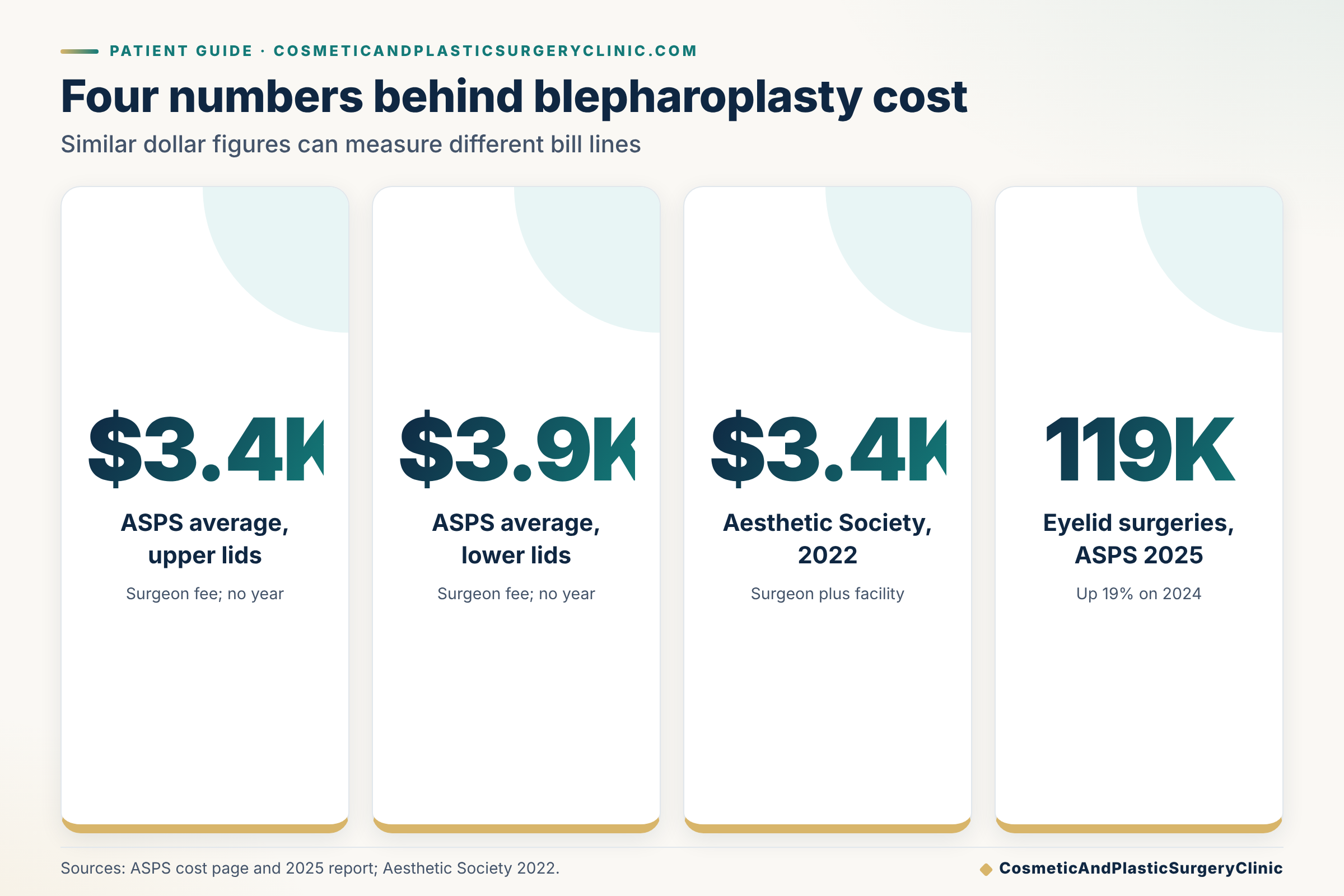
The ASPS eyelid surgery cost page states that the average cost of cosmetic eyelid surgery is $3,359 for an upper blepharoplasty and $3,876 for a lower blepharoplasty. It attributes the figures to the society’s “latest statistics” and gives no year. The page says the average is only part of the total and does not include anesthesia, operating room facilities or other related expenses.
The ASPS 2024 fee document replaces single averages with projected ranges: $3,000 to $5,500 for upper blepharoplasty and $3,709 to $6,500 for lower. ASPS describes the ranges as an aggregate projection based on averages submitted by surveyed members, reflecting different locations and practice settings. The table reviewed for this page does not list exclusions, so the cautious reading is a surgeon’s fee range, not a total.
The Aesthetic Society’s 2022 average includes the facility
The Aesthetic Society’s average cost page lists $3,387 for eyelid surgery, drawn from its 2022 national databank. It says the numbers reflect standard procedure costs, meaning surgeon and facility fees, and may not include anesthesia, medical tests, prescriptions, surgical garments or miscellaneous costs. The page gives one eyelid figure and does not split upper from lower.
Notice that $3,387 sits almost on top of ASPS’s $3,359 for upper lids, even though one number includes a facility and the other does not. The two come from different surveys, years and definitions, so they cannot be stacked, subtracted or blended into a typical blepharoplasty cost.
Volume is not price
What the 2025 counts show
The ASPS 2025 statistics report counts 118,978 eyelid surgeries in 2025, up 19% from 100,185 in 2024, and ranks eyelid surgery fifth among cosmetic surgical procedures. The report adds that eyelid surgery became the highest-volume procedure for patients aged 66 and older. ASPS built the estimates from member surgeon responses, an ASPS-endorsed partner and a national claims dataset, which it says together cover more than 3,000 board-certified plastic surgeons, and then extrapolated to national totals.
Those counts show demand. They carry no fee, and the report does not say how many procedures were upper lids, lower lids or both. A rising count cannot tell you whether a particular blepharoplasty cost is reasonable.
Why a national blepharoplasty cost figure is not a quote for your eyelids
ASPS names three drivers of the surgeon’s fee: the surgeon’s experience, the type of procedure and the office’s geographic location. A December 2023 ASPS article adds that prices tend to be higher where the cost of living is higher and that a surgeon in high demand will charge more. It also cautions that paying a lot does not necessarily buy the best quality.
So a quoted blepharoplasty cost bundles a person’s time and judgment along with the plan. The plastic surgery cost overview explains how cosmetic pricing works across procedures, and choosing a plastic surgeon covers the verification steps that belong beside any price comparison.
How the plan, not the label, sets the price of eyelid surgery
“Eyelid surgery” can mean a skin trim on two upper lids or a four-lid operation with fat repositioning and a tendon-support stitch. Two practices can quote the same person honestly and still show a different blepharoplasty cost, because each is pricing its own plan. The plan decides the operating-room clock, and the clock drives most of the bill.
Upper lids, lower lids or all four
Upper lids: the crease incision and what it can address
ASPS says the upper eyelid can be corrected through an incision within the natural crease, which allows excess skin to be removed, muscles tightened and fat removed or repositioned. A plan that removes skin alone is the smaller operation, so the first question is what the fee assumes: skin only, skin and muscle, or skin with fat work.
How surgeons weigh upper against lower lids, and when doing both at once makes sense, is the subject of upper vs lower blepharoplasty.
Lower lids: skin incision or inside-the-lid approach
ASPS describes two broad lower-lid routes. A cut just below the lower lash line allows excess skin to be removed and fat to be repositioned or removed. A transconjunctival incision, made inside the lower eyelid, removes no skin. ASPS also says a surgeon may suggest a laser or chemical peel to reduce discoloration of the lower lids, which is a separate treatment that can appear as its own line.
ASPS publishes a higher average for lower lids than for upper lids, but it does not say why. The technique detail sits in lower eyelid surgery; for pricing, the point is that “lower lids” on a quote should name the approach and whether fat is removed, repositioned or left alone.
Add-ons that change blepharoplasty cost
Drooping-lid repair and brow work are different operations
Excess upper-lid skin, a lid that sits too low (ptosis) and a brow that has dropped can look alike in a mirror, and each is treated differently. The Medicare contractor policy discussed later treats repair of a low lid margin as its own procedure with its own measurements. If a surgeon proposes ptosis repair or a brow lift alongside the lids, the quote should show it as a separate line or a named bundle, because it adds operating time and may change who is billed.
Brow position changes what the eyelids need, which is why blepharoplasty vs brow lift is worth reading before comparing a lids-only quote with a lids-plus-brow quote. The ASPS 2024 fee document lists a forehead lift, which the 2025 statistics glossary calls a brow lift, at $4,000 to $7,500 as a separate line.
Resurfacing, fat transfer and companion surgery
Fat transfer to the face and a facelift are common companions to eyelid work, and practices price them in different ways. Some list each item. Others fold the eyelid work into a larger fee. The ASPS 2024 facelift range is $12,000 to $19,000, and adding it to an eyelid range gives arithmetic, not a published combined price.
A line that reads “included” is as useful as a dollar figure only if the quote says what the bundle covers. Otherwise a lower blepharoplasty cost can simply mean fewer procedures. Facelift cost explains how the face side of a combined quote is built.
| Plan being priced | What it addresses | What the quote should name | Published fee anchor |
|---|---|---|---|
| Upper lids only | Skin folds, sometimes fat or muscle | Skin only, or skin with muscle or fat work | $3,000 to $5,500 |
| Lower lids only | Bags, loose skin, lid-cheek contour | Skin incision or inside-lid approach; fat removed or repositioned | $3,709 to $6,500 |
| Upper and lower together | All four lids in one session | One fee or two; one facility booking and one anesthetic | Two ranges, no combined price published |
| Lids with ptosis repair or brow lift | Lid position or brow position as well as skin | Each added operation, listed or bundled by name | Forehead lift $4,000 to $7,500; no ptosis fee found |
The blepharoplasty cost quote, line by line
A complete blepharoplasty cost estimate has at least six lines. Some practices bundle several into one figure, which is acceptable when the bundle is named. Trouble starts with a single number and no list of what it holds.
Charges that follow the operating-room clock
Surgeon’s fee: what it bundles
The surgeon’s fee normally covers the operation and the surgeon’s own planning. The Aesthetic Society says the bulk of the cost is the surgeon’s fee, that a consultation fee is likely, and that the office will often deduct it from the procedure cost. ASPS lists tests and prescriptions among the items that may be charged beyond the surgeon’s fee.
Ask what the fee assumes. Upper lids or all four? Skin alone or fat and muscle work as well? Does it cover suture removal and follow-up visits? A fee without a written scope cannot be compared with anything, including a later blepharoplasty cost quote from the same practice.
Facility fee: the room, the staff and the accreditation question
The facility fee pays for the operating room, nursing, instruments and recovery space. ASPS says its member surgeons use facilities that are accredited by AAAASF, AAAHC or the Joint Commission (the page uses the older JCAHO name), certified for Medicare, or licensed by the state. It exempts procedures that need only local anesthetic or mild oral sedation from that requirement.
That exemption matters for eyelid quotes, because the facility line depends on the anesthesia the plan assumes. Ask whether the fee is flat or tied to a block of time, and what happens if the case runs long. If the surgery is in the surgeon’s own office, ask how the room is accredited or licensed, and why. Verification steps work the same for eyelids as for any other operation.
Anesthesia: the type, the provider and how time is billed
The ASPS procedure page lists intravenous sedation or general anesthesia as the choices for eyelid surgery and says your surgeon will recommend the best option. Which one suits a plan is a clinical decision made with the anesthesia provider, not a lever for lowering the total, and a quote should not steer it.
What you can ask about is the billing. The American Society of Anesthesiologists describes the standard payer formula as base units plus time units plus modifying units, multiplied by a conversion factor, with a time unit typically set at 15 minutes. Practices that bill patients directly may use a flat fee or a timed one. Ask for the provider’s name, the type of anesthesia the plan assumes and how extra minutes are charged.

Charges around the operation
Tests, prescriptions and eye-care supplies
ASPS lists medical tests and prescriptions as possible costs beyond the headline average. Its recovery page mentions lubricating ointment, cold compresses and medication to aid healing, plus diligent sun protection with darkly tinted sunglasses until healing is complete. The Aesthetic Society adds that medications are paid for separately at the pharmacy.
These items are small beside the surgeon’s fee, but they belong on the list. Preoperative testing depends on health history. ASPS coverage criteria mention a dry-eye test for people with a dry-eye history and other labs “when indicated.” Ask which tests your plan would need, who orders them and who bills for them.
Follow-up visits and touch-up terms in a blepharoplasty cost quote
ASPS’s recovery page lists questions to put to a surgeon: whether stitches are removed and when, and when you return for follow-up. A quote should say how many visits are included and for how long. The blepharoplasty recovery timeline shows why those early visits matter.
Revision terms are the line most often left blank. A 2012 review in Plastic Surgery International advises that minor touch-up operations usually be delayed three months or more if possible, and that patients be told beforehand about asymmetry and the potential for touch-ups. It gives no fee data. Ask in writing whether the surgeon’s fee is waived for a touch-up, and whether facility and anesthesia charges still apply.
| Line item | Why it may be charged | What changes it | Often separate? | Question to ask |
|---|---|---|---|---|
| Surgeon’s fee | Operation and surgeon’s planning time | Scope, technique, experience, location | Usually the headline | Which lids and which steps does it assume? |
| Facility fee | Operating room, nursing, instruments, recovery space | Setting, accreditation, time in the room | Yes, unless bundled | Flat or timed? Which accreditation or license? |
| Anesthesia | Provider’s time and monitoring | Type, length of case, billing method | Often a separate bill | Who is the provider, and how are extra minutes billed? |
| Tests and prescriptions | Preoperative checks, ointment, medication | Health history, surgeon’s protocol | Yes, often paid elsewhere | Which are required, and who bills them? |
| Follow-up visits | Suture removal and healing checks | Practice policy, length of window | Sometimes included | How many visits, for how many months? |
| Touch-up and complication terms | Care if results or healing need attention | Written policy, timing, what is waived | Rarely quoted | What is waived, and what do facility and anesthesia cost? |
Where insurance, taxes and savings accounts fit into blepharoplasty cost
Most eyelid surgery done for appearance is paid out of pocket. ASPS says most health insurance does not cover cosmetic surgery or its complications, while surgery that removes redundant skin covering the eyelashes may be covered and the policy should be reviewed carefully. The full coverage process belongs to blepharoplasty insurance; this section covers how coverage changes the shape of a blepharoplasty cost quote.
When a payer may be involved
One Medicare contractor’s functional test, and why it is not a universal rule
Medicare Local Coverage Determination L34194, revised for services on or after October 16, 2025, applies to the contractor Noridian Healthcare Solutions in jurisdictions J-E and J-F. For upper-lid surgery it asks for a central “pseudo-MRD” of 2.0 mm or less caused by redundant tissue, or redundant tissue that clearly obscures the line of sight, plus a documented functional deficit and photographs. It says clinical notes and physical findings are preferred over formal visual-field testing.
Other contractors and private plans word their rules differently. A February 2021 AAO EyeNet article lists payers that require taped and untaped visual fields, and the ASPS coverage criteria ask for field testing that improves with taping. A policy that works for one plan says little about yours, and a quote that promises coverage before the plan has reviewed anything should be treated with caution.
Lower lids and mixed sessions
The same Medicare policy treats lower-lid blepharoplasty as non-covered, calling it “almost never functional in nature,” with case-by-case appeals. It also says that when a cosmetic procedure is done in the same session as a covered one, only the covered procedure is paid. The ASPS criteria state that when an operation is purely aesthetic, insurance should not be billed, and that prior authorization is always recommended.
For a combined plan, this means the estimate should separate two parts: the work submitted to the payer, with any preauthorization in hand, and the self-pay work. ASPS also notes that procedure codes alone do not distinguish cosmetic from reconstructive surgery. The documented signs and symptoms do. A code printed on a quote therefore proves nothing about coverage.
Tax rules and savings accounts
What the IRS says about cosmetic surgery
IRS Publication 502 (2025) says that, generally, you cannot include in medical expenses the amount you pay for cosmetic surgery. It defines cosmetic surgery as any procedure directed at improving the patient’s appearance that does not meaningfully promote the proper function of the body. The listed exceptions are a deformity arising from a congenital abnormality, a personal injury from an accident or trauma, or a disfiguring disease.
Even eligible medical expenses count only to the extent they exceed 7.5% of adjusted gross income. Whether a functional upper-lid operation is treated differently is a question for a tax professional, not a price list.
HSA and FSA money for blepharoplasty cost: ask before the date is set
IRS Publication 969 (2025) defines qualified HSA expenses by reference to “medical care” under section 213(d) of the Internal Revenue Code, and describes health FSAs as usually funded by voluntary salary reduction. The text reviewed for this page does not say whether eyelid surgery qualifies, and it states a 2025 health FSA salary reduction limit of $3,300, which would cover only part of many quotes.
The practical step is to ask the account administrator, in writing, whether the specific procedure qualifies and what documentation is required, before a surgery date is booked. Keep the reply with the estimate.

Paying over time without losing sight of the total
Eyelid surgery is usually a smaller bill than most operations, which makes a monthly-payment offer feel harmless. The arithmetic still deserves a pencil. General loan mechanics sit in plastic surgery financing; this section applies them to a typical blepharoplasty cost.
Turning a monthly payment back into a total
Deferred interest and the full-purchase rule
A May 2023 Consumer Financial Protection Bureau report says the APR of the typical medical credit card is 26.99%. Deferred-interest products run terms of six to eighteen months, and if a balance remains at the end, the borrower is charged all the interest that would have accrued since the original purchase date, on the full purchase amount and not just the remainder.
In the CFPB’s data, people incurred interest on about 20% of their healthcare purchases made on these products, and borrowers who incurred interest paid an additional 23% of the initial purchase. A “no interest” label is therefore a condition, not a price.
A hypothetical on a mid-sized quote
Take the hypothetical Quote B in the comparison below, normalized to $7,540 on 2026-11-12. Suppose it goes on a card with twelve months of deferred interest at 26.99%, and a small balance remains when the period ends. Interest could then be charged on the full $7,540 back to day one. At a flat 26.99% for a year that is roughly $2,035 before compounding.
Those numbers are invented to show the mechanism, and a real card agreement governs the actual calculation. The point is the size of the swing: one missed final payment can add more than a fourth to the price. Indirect costs sit outside any loan, such as time off work, a ride home and help in the first days, which the recovery timeline helps you plan.
Deposits, estimates and plans that change
The deposit and the written estimate
For people paying without insurance, CMS describes a good faith estimate that providers give for care scheduled in advance, and says you may be able to dispute a bill that is at least $400 more than that estimate. The sources reviewed here set no standard deposit or refund rule for cosmetic surgery, so those terms come from the practice.
Before paying, get the deposit amount, whether it counts toward the total, and the cancellation and refund terms with their dates in writing. Pressure to pay today is a warning sign. Waiting a few days to compare is a reasonable request.
When the date moves or the plan changes
Ask whether the quoted blepharoplasty cost holds if the surgery date shifts, and how long the estimate stays valid. Ask what happens to the deposit if the surgeon decides after a pre-surgery check that the plan should change, or if you decide to wait. Plans change for health reasons, scheduling and second thoughts, and each of these is a normal outcome of a careful process.
Comparing two blepharoplasty cost quotes like-for-like, and when a low number needs questions
A comparison is only fair when both quotes describe the same operation in the same setting. The worked example below is hypothetical, dated 2026-11-12, and uses invented prices to show a method, not a market.
A worked comparison of two hypothetical quotes
Normalizing the lines of each blepharoplasty cost quote
Quote A arrives as a single figure for upper and lower lids. Quote B arrives itemized. Before comparing, ask Practice A for the lines it left out, in writing, and fill in the same rows for both. The comparison table shows what changes once each blank has an answer.
| Line item | Quote A as written | Quote B as written | Quote A after written answers | What to verify |
|---|---|---|---|---|
| Surgeon’s fee | $5,200, upper and lower lids | $4,800, lids and approach named | $5,200, approach confirmed | Credentials and the operation described |
| Facility | Not stated | $1,500, named surgery center | $1,900, named facility | Accreditation or license; flat or timed |
| Anesthesia | Not stated | $1,100, named provider, timed | $1,350, named provider | Provider credentials; type of anesthesia |
| Tests, prescriptions, supplies | Not stated | Extra, about $140 | $140 | Who orders and who bills |
| Follow-up and touch-ups | One visit mentioned | 12 months of visits; touch-up policy written | 3 months of visits; touch-up charges unknown | What is waived; facility and anesthesia cost |
| Total before financing | $5,200 | $7,400 plus extras = $7,540 | $8,590 | Total repaid if financed |
How missing lines reverse the ranking
As written, Quote A looks $2,200 cheaper than Quote B’s $7,400. After the blanks are filled, Quote A comes to $8,590 against $7,540, which puts it $1,050 higher, and Quote A’s touch-up charges are still unknown. The ranking flipped because the cheaper-looking quote omitted the facility, the anesthesia and the aftercare, not because either practice did anything improper.
The same exercise can run the other way. A practice with an all-inclusive price may turn out to cover less than it appears to, for example by limiting follow-up to a few weeks. Normalizing protects you from both errors. It also shows where safety questions belong, because the lines most often left blank are the ones that carry facility, anesthesia and aftercare quality.
Red flags in a low or pressured price
Pressure tactics, vague facilities and unnamed anesthesia providers
ASPS says an unusually low price “ought to raise an eyebrow” and that a bargain might come with risks. The Aesthetic Society calls coupons often a plot to encourage impulse buys and warns that if a deal is too good to be true, you may be sacrificing your safety for a low-cost offer. Both say never choose a surgeon solely on lower cost.
Turn that into specific checks. Is a deadline attached to a discount? Is the facility named, and can you verify its accreditation or license? Is the anesthesia provider named? If the answer to any of these is “we will tell you later,” ask again in writing before paying. The consultation questions guide lists what to bring and what a clear answer sounds like.
Price away from home
Some of the lowest headline numbers come with travel. CDC says follow-up care for complications might be expensive, might be prolonged and might not be covered by health insurance, and advises making sure you can get any needed follow-up care in the United States. CDC also advises delaying air travel for 10 to 14 days following major surgeries because flying can raise clot risk.
Ask a surgeon at home who would manage a problem and what that visit would cost. Medical tourism has its own planning checklist, and the comparison above applies there too: add travel, lodging, a companion, lost income and the cost of a second opinion, then compare totals.
A written estimate and the option not to proceed
Seven items to have in writing
Put these in front of every practice you are comparing, and keep the answers in one folder.
- The surgeon’s name, board certification and the operation, with lids and approach described in plain words.
- The facility’s name and its accreditation or license, with the fee flat or timed.
- The anesthesia provider’s name, the type assumed and how extra time is billed.
- Tests, prescriptions and supplies, and who orders and bills them.
- The follow-up window and the number of visits included.
- Touch-up, complication and refund terms, including what facility and anesthesia would cost.
- The total including any financing cost, with deposit and cancellation dates.
Waiting, a second opinion or no surgery
A price comparison sits downstream of a medical question: whether eyelid surgery fits your anatomy and goals at all. That is decided in an examination, not here, and what surgeons evaluate shows what such an evaluation looks at. A second consultation is routine, and so is deciding to wait.
If a plan stops making sense once the real total is on the page, that is the process working. Nothing in a cost estimate should push you toward an operation you have not decided to have.
Frequently asked questions
Why is lower-lid blepharoplasty cost higher than upper-lid in the published averages?
ASPS lists $3,876 for lower and $3,359 for upper, and its 2024 ranges show the same order, but the society does not explain the gap. Plausible contributors are the number of structures treated, such as skin, fat and lid support, and the length of the operation, since time drives facility and anesthesia lines. Treat that as a reason to read the quote, not a rule. Ask what your plan involves and whether the fee depends on the approach.
Is the consultation fee part of blepharoplasty cost?
It can be. The Aesthetic Society says a consultation fee is most likely charged and that the surgeon’s office will often deduct it from the procedure. Practices differ, so ask before booking whether the fee is credited toward surgery, what it covers and whether a second visit to review a plan is billed separately. If you are collecting quotes from several practices, consultation fees are part of the real cost of comparing.
Can blepharoplasty cost be paid with an HSA or FSA?
Do not assume so. IRS Publication 969 (2025) defines qualified HSA expenses as medical care under section 213(d), and Publication 502 (2025) says cosmetic surgery generally is not medical care, with exceptions for deformities from a congenital abnormality, accident or trauma, or a disfiguring disease. FSA rules come from each plan’s own documents. Ask the account administrator in writing before the date is set, and keep the answer with the estimate.
What if the final blepharoplasty cost is higher than the written estimate?
Start by asking the practice to explain each added line against the estimate. For people paying without insurance, CMS says you may be able to dispute a bill that is at least $400 more than a good faith estimate, which is one reason to request the estimate in writing and keep it. Time overruns, added procedures and complication care are common explanations, so ask in advance which of them the estimate covers and which would be billed separately.
Is blepharoplasty cost lower abroad, and what does the price leave out?
A lower headline price may leave out travel, lodging, a companion, lost income and care at home if a problem arises. CDC notes that follow-up care for complications might be expensive and might not be covered by health insurance, and advises confirming you can get follow-up care in the United States before you travel. Compare totals, not headlines, and ask a surgeon at home who would manage a complication and what it would cost.
Does a higher blepharoplasty cost mean a better result?
No source reviewed here shows that it does. A December 2023 ASPS article says paying a lot does not necessarily mean getting the best quality, and that a surgeon in high demand will charge more. A high fee may reflect demand, location or a longer plan. Judge a practice by verified credentials, the facility, how clearly it explains risks and whether the plan matches your goals, with price as one input among several.
Does a promotion change blepharoplasty cost in a way that matters?
Treat deadlines and coupons with caution. The Aesthetic Society says coupons are often a plot to encourage impulse buys and that a deal that is too good to be true may sacrifice safety for a low-cost offer. A promotion does not change the questions that matter: the plan, the named facility and anesthesia provider, follow-up and touch-up terms, and the total including any financing. If a discount expires before you can compare quotes, you can let it expire.
Why do two practices in the same city quote a different blepharoplasty cost?
ASPS names three drivers of a surgeon’s fee: experience, the type of procedure and geography. Within one city, plans differ too: one practice may price a skin-only upper-lid operation and another a four-lid plan with fat repositioning, and the facility and anesthesia arrangements may differ. Demand for a particular surgeon also matters. Ask each office to describe its plan in plain words, then compare lines instead of totals.
Sources and further reading
- ASPS — Eyelid surgery cost (accessed 2026-11-12) — $3,359 upper and $3,876 lower averages (no year), exclusions, possible charges, insurance and financing statements
- ASPS — 2024 average surgeon/physician fees (accessed 2026-11-12) — upper, lower, forehead lift and facelift ranges; how the ranges are built
- ASPS — Plastic surgery statistics report 2025 (accessed 2026-11-12) — eyelid surgery counts, rank, age data and data sources
- ASPS — Understanding plastic surgery costs in the United States (December 2023; accessed 2026-11-12) — total cost components, price and quality, regional variation, financing, low-price caution
- ASPS — Eyelid surgery overview (accessed 2026-11-12) — what eyelid surgery treats; upper, lower or both
- ASPS — Eyelid surgery procedure (accessed 2026-11-12) — anesthesia choices, upper and lower incisions, laser or peel for discoloration
- ASPS — Eyelid surgery recovery (accessed 2026-11-12) — ointment, cold compresses, medication, sun protection, questions to ask about stitches and follow-up
- ASPS — Accreditation (accessed 2026-11-12) — accrediting bodies, Medicare certification, state license, local-anesthesia exemption
- ASPS — Recommended insurance coverage criteria: blepharoplasty (re-approved December 2020; accessed 2026-11-12) — visual field, MRD, CPT codes, cosmetic versus reconstructive, prior authorization, documentation
- The Aesthetic Society — Average plastic surgery costs (accessed 2026-11-12) — $3,387 eyelid average from the 2022 databank, inclusions and exclusions, cost factors
- The Aesthetic Society — Plastic surgery costs (accessed 2026-11-12) — what quotes include, consultation fees, cautions about coupons and low prices
- CMS — Local Coverage Determination L34194, Blepharoplasty, Eyelid Surgery, and Brow Lift (revised effective 2025-10-16; accessed 2026-11-12) — functional criteria, photographs, lower-lid and mixed-session rules
- American Academy of Ophthalmology EyeNet — Documenting the need for functional blepharoplasty (February 2021; accessed 2026-11-12) — payer documentation differences, cosmetic claim handling
- CMS — Understanding costs in advance: good faith estimates (accessed 2026-11-12) — estimate for advance-scheduled care, $400 dispute threshold
- IRS — Publication 502 (2025), Medical and Dental Expenses (accessed 2026-11-12) — cosmetic surgery exclusion, definition, exceptions, 7.5% of AGI threshold
- IRS — Publication 969 (2025), Health Savings Accounts and Other Tax-Favored Health Plans (accessed 2026-11-12) — HSA qualified expenses, FSA funding, 2025 FSA limit
- CFPB — Medical credit cards and financing plans (May 2023; accessed 2026-11-12) — typical APR, deferred-interest terms, share of purchases incurring interest
- American Society of Anesthesiologists — Anesthesia payment basics series 5 (November 2019; accessed 2026-11-12) — base, time and modifying units, conversion factor
- Oestreicher and Mehta — Complications of blepharoplasty: prevention and management, Plastic Surgery International (2012; accessed 2026-11-12) — timing of touch-ups, orbital hemorrhage incidence estimate
- Center for Public Integrity — Eyelid lifts skyrocket among Medicare patients (May 28, 2013; accessed 2026-11-12) — Medicare reimbursement per eye, billing growth, claim counts
- CDC — Medical tourism, Travelers’ Health (accessed 2026-11-12) — follow-up care costs, confirming care at home, air travel after surgery