Blepharoplasty recovery looks gentle next to most operations, and that impression is partly right. The incisions are small, most people go home the same day, and the dramatic bruising fades over a couple of weeks. What surprises people is how eye-centered it is. Ointment blurs vision, the surface of the eye can feel dry or gritty, and the skin that has to heal is delicate, sun-sensitive and in plain view.
Interest keeps growing. The American Society of Plastic Surgeons (ASPS) counted 118,978 eyelid procedures in 2025, up 19 percent, making it the fifth most common cosmetic surgical procedure in its report. That is a count of operations, not a forecast of how any one person heals. This article handles a single decision: how to plan for blepharoplasty recovery and read its stages. The operation itself is mapped in the blepharoplasty guide, and complication detail lives in blepharoplasty risks.
What shapes blepharoplasty recovery before surgery day
Most pages quote one blepharoplasty recovery timeline as if every eyelid operation were the same. Published sources do agree on the broad arc, but the details swing with the scope of surgery and with the eyes you started with. Two people can both have “eyelid surgery” and need very different amounts of time off.
The operation sets the pace
Upper lids, lower lids or all four
ASPS describes blepharoplasty as surgery on the upper lids, the lower lids, or both. Upper-lid work trims loose skin and sometimes fat; lower-lid work addresses bags, lid laxity and excess skin. MedlinePlus adds that an eyelid lift may include ptosis repair, which tightens the eyelid tendon, and that the surgeon makes small cuts in the natural lid creases. More lids and more steps usually mean more swelling to clear, so the plan matters more than the label.
Lower-lid work also carries a recovery quirk the upper lids do not: swelling can pull the lid edge down for a while. That is covered under lid position below and in lower eyelid surgery. The upper and lower differences in what each operation treats are laid out in upper vs lower blepharoplasty.
Add-ons that stretch the schedule
Brow lifts, ptosis repair, fat repositioning, lid-tightening sutures and skin resurfacing are sometimes planned in the same session. The sources reviewed here do not give separate blepharoplasty recovery clocks for each add-on, which is itself informative: nobody can promise a number without knowing your plan. Ask the office to write down which steps are included and whether any of them changes the dates for stitches, exercise or lenses. How eyelid and brow surgery fit together is the subject of blepharoplasty vs brow lift.
Setting up home and help
Ride, first-night helper and bedside supplies
Cleveland Clinic describes blepharoplasty as outpatient surgery and suggests someone stay with you for the first night or two. MedlinePlus says an adult should drive you home. The reason is practical: ointment and swelling limit what you can see, and you will want someone to fetch water, hand you drops and notice a change you cannot check yourself in a mirror.
Before surgery day, gather what the sheet will likely call for: cold packs or gauze you can chill, a wedge or extra pillows, the drops or ointment your surgeon prescribes, dark sunglasses, loose clothing that does not pull over the face, and easy meals. Mayo Clinic suggests acetaminophen for pain unless your surgeon says otherwise; aspirin and anti-inflammatory pain relievers are usually avoided because of bleeding, so ask before taking anything.

What written instructions should answer
ASPS lists the questions worth asking: where you will go after surgery, which medicines you will use, whether you will have dressings and when they come off, whether stitches are used and when they are removed, when you can resume normal activity and exercise, and when you return for follow-up. For the eyes, add four more: which drops or ointment, how often, when contact lenses can return, and which symptoms mean calling the same day.
If an office answers every question with one number, ask what that number assumes. A routine upper-lid operation under local anesthesia and a four-lid operation with a brow lift are different blepharoplasty recovery plans, and the sheet should say which one you are on. The broader planning logistics, such as time off and household help, are covered in plastic surgery recovery planning.
A blepharoplasty recovery timeline from day 0 to month 12
The blepharoplasty recovery ranges below come from patient pages at Mayo Clinic, Cleveland Clinic, MedlinePlus, the Aesthetic Society and two university medical centers, plus one patient-education site. They overlap more than they match. Treat each as a window, then replace it with the dates on your own sheet.
Days 0 to 3: home, cold care and the first look in the mirror
The first evening and night
Mayo Clinic says you can usually go home the same day after a recovery-room stay. ASPS notes that lubricating ointment and cold compresses may be applied and that the eyes may be loosely covered with gauze. Eyelids typically feel tight as the numbing wears off, according to the Aesthetic Society, and MedlinePlus says tightness and soreness are common and usually manageable with over-the-counter pain medicine unless your surgeon directs otherwise.
Bed rest is not required, the Aesthetic Society adds, but staying home and resting is sensible. Keep the head raised, follow the cold schedule on your sheet, and expect the first blepharoplasty recovery night to be lighter on sleep than usual.
Days 2 and 3, when swelling is often at its height
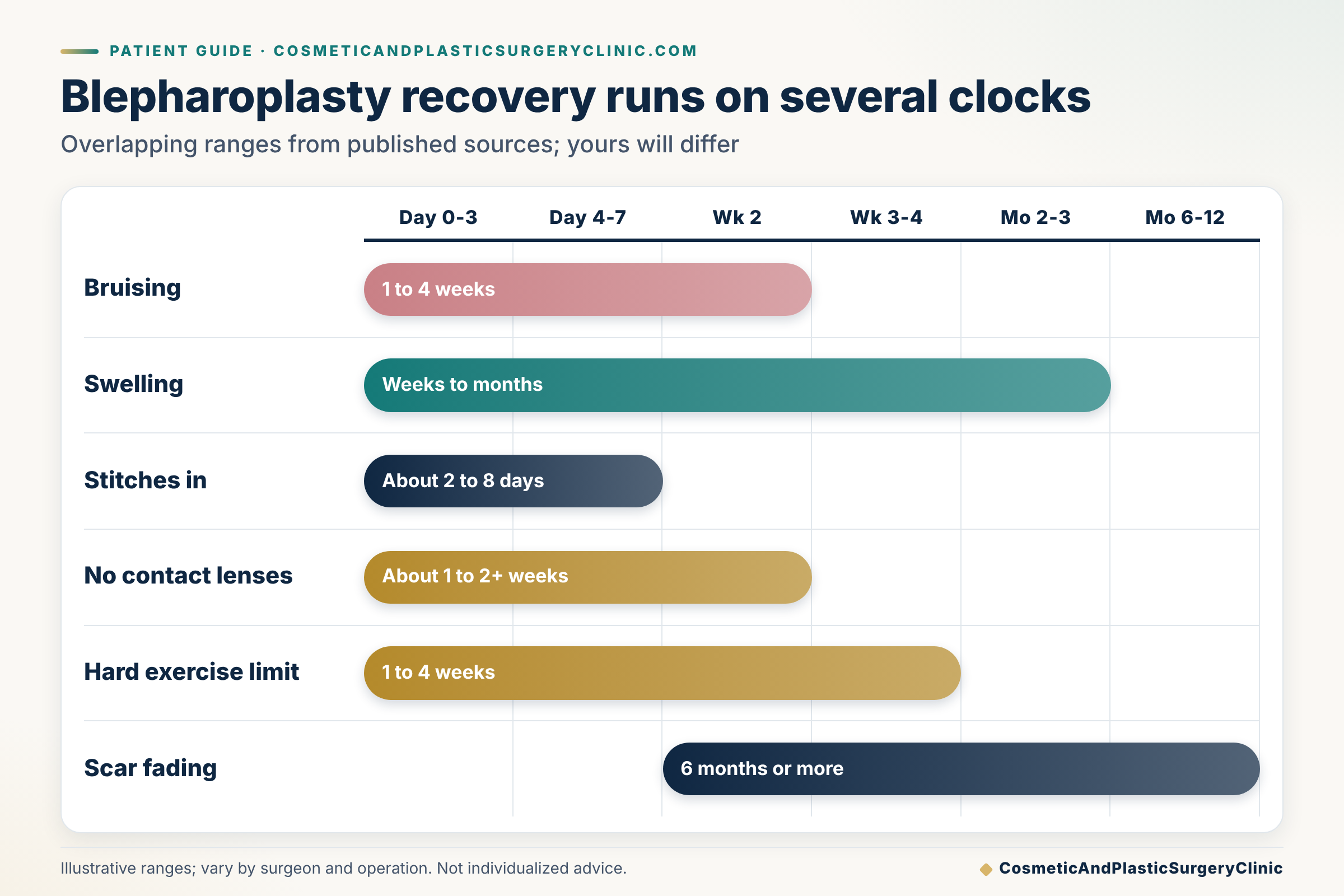
One patient-education site, EyePlastics (updated June 2026), says swelling and bruising peak around 48 hours, with a range of 48 to 72 hours in its FAQ. That matches what many people report about blepharoplasty recovery: you look worse on day two than on the night of surgery. A University of North Carolina otolaryngology sheet notes that bruising and swelling tend to move from the eyebrow toward the cheek over about 7 to 10 days.
Vision usually clears quickly. MedlinePlus says vision should be good by two to three days, and a University of Michigan sheet says reading and television can resume after two to three days. If vision is getting worse instead of better, that is a different situation, covered under warning signs below.
Days 4 to 14: stitches, fading bruises and the first public outing
Stitches and the first follow-up
The published window for stitch removal is wide. The Aesthetic Society says 2 to 7 days, the Michigan sheet says 5 to 7 days, EyePlastics says 7 to 8 days, and Cleveland Clinic says stitches stay in for about a week, with some surgeons using dissolving sutures that need no removal. MedlinePlus lists a follow-up visit within 7 days. The difference reflects suture type and surgeon habit, not an error in any source.
Tiny whiteheads at the incision line sometimes appear after stitches come out, MedlinePlus notes, and they are a question for the follow-up visit rather than something to pick at.
When you can be seen in public
Mayo Clinic says bruising and swelling generally lessen slowly over about 10 to 14 days. Cleveland Clinic says most people feel good enough to return to their usual routine after a week or two, and the Aesthetic Society puts normal activities at around day 10. MedlinePlus is more cautious, saying bruising may persist for two to four weeks. Facial makeup can usually cover yellowing bruises once stitches are out; the timing is covered in the makeup section below.
Consider a hypothetical office worker who has an upper-lid operation on a Friday. Reading the sources conservatively, a Monday video call is optimistic, a return at the one-week mark is plausible with glasses and a quiet schedule, and an in-person client meeting at day ten is a reasonable target to confirm with the surgeon. The plan has slack built in because the ranges do.
Weeks 3 to 12 and beyond: what is left after the bruises go
Leftover puffiness, tight lids and tired eyes
Bruises are the part everyone watches, but they are the least durable part of blepharoplasty recovery. The Aesthetic Society says eyes tire easily for several weeks, and its older recovery article says to limit reading, television and computer use during the first week, and possibly for three to four weeks. Cleveland Clinic says eyes may feel dry for a few weeks and that full recovery usually takes a few months.
Mild asymmetry in swelling is common during blepharoplasty recovery, because one side can clear faster than the other. A difference that is growing, rather than shrinking, belongs in a phone call.
When the result is judged
Cleveland Clinic frames full recovery as a few months. EyePlastics says final results, including scar maturation, take about three months, and up to three to six months in its FAQ. MedlinePlus says scars may stay slightly pink for six months or longer before fading to a thin, pale line within the natural eyelid fold. Take dated photos in the same light and angle at fixed points; reading blepharoplasty photos explains why single snapshots mislead.
| Phase | Common changes | Practical limits | Planning issue | Call or seek care |
|---|---|---|---|---|
| Day 0 to 1 | Tight, sore lids; ointment blur; gauze or light dressing | Rest, head raised, cold care as instructed | Ride, first-night helper, drops at hand | Severe new eye pain, sudden vision change, fast one-sided swelling |
| Days 2 to 3 | Swelling and bruising near a peak; watery, light-sensitive eyes | Gentle walking encouraged; no bending or lifting | Sleeping angle, screen use kept short | Bleeding that does not stop with light pressure; worsening vision |
| Days 4 to 7 | Bruise colors shift; stitches out or dissolving | No rubbing; no lenses; light activity only | Follow-up visit, sunglasses outdoors | Fever, pus, spreading redness, pain not eased by prescribed medicine |
| Days 8 to 14 | Most bruising fading; lids puffy, tight or dry | Many return to desk work; hard exercise still held back | First outings, makeup after stitches | Lids that will not close, stitches opening, one eye clearly worse |
| Weeks 3 to 6 | Residual swelling; tired, dry eyes; pink incision lines | Exercise phased in on surgeon’s clearance | Lens refit, travel, sun protection | Persistent redness or pain, a lid edge that stays pulled down |
| Months 3 to 12 | Scars flatten and pale; contour settles | Few limits once cleared | Dated photos, scar check, sun care | Thick, raised or itchy scar; dryness that is not improving |
Swelling and bruising: cold care, pillows and what is worth asking about
Swelling in blepharoplasty recovery is fluid and inflammation, and bruising is blood that has tracked into thin skin. Both are expected effects, and both follow gravity and time more than effort. The questions people actually ask are what to do about them, and the honest answer is that instructions differ between offices more than the underlying biology does.
Cold packs and a raised head in blepharoplasty recovery
Why cold schedules differ from sheet to sheet
Compare four published sheets. Mayo Clinic says ice packs for 10 minutes every hour on the night of surgery, then four to five times the next day. The Aesthetic Society says cold packs for the first 48 hours. A University of Michigan sheet says cold saline compresses for the first 24 hours. A UNC sheet says saline-soaked ice gauze with frozen packs over it for 48 hours. None of the sheets reviewed here cites trial evidence for its schedule, which suggests habit and surgeon preference rather than a measured optimum.
The practical lesson for blepharoplasty recovery is to follow your own sheet exactly and not blend several. MedlinePlus adds one detail worth keeping: wrap cold packs in a towel instead of placing them directly on the skin. If something about the cold plan seems unclear, such as whether to hold packs against the eyelids or the cheeks, call the office rather than guessing.
| Source | Cold care | Head position | Contact lenses | Strenuous activity |
|---|---|---|---|---|
| Mayo Clinic (2025) | 10 minutes hourly the first night, then 4 to 5 times next day | Above chest for a few days | About 2 weeks off | Avoid for 1 week |
| Aesthetic Society (2021) | Cold packs for first 48 hours | Above chest; pillows, wedge or recliner | Avoid dry-eye triggers; an older article says about a week | 10 to 14 days; limits may reach 3 to 4 weeks |
| University of Michigan sheet (2015) | Cold saline compresses, first 24 hours | About 45 degrees for several days | At least 2 weeks | 2 to 3 weeks |
| MedlinePlus oculoplastic page (2024) | Cold packs wrapped in a towel; no duration | Propped up about 1 week | Not stated | About 3 weeks for blood-pressure-raising activity |
| UNC otolaryngology sheet (2017) | Saline ice gauze plus frozen packs, 48 hours | Not addressed; avoid head-down position | Not addressed | No bending or lifting over 15 lb until stitches are out |
Sleeping propped up
Every source that mentions sleep in blepharoplasty recovery says to keep the head higher than the chest. Mayo Clinic says a few days, MedlinePlus says about a week, and the Michigan sheet says roughly 45 degrees for several days. A wedge, a recliner or a stack of firm pillows all work; the Aesthetic Society lists each. Set it up before surgery, because building a pillow fort with swollen eyes at 11 p.m. is no one’s best moment.
Avoid bending with the head below the heart and avoid sudden head movements, the Aesthetic Society adds. Dropping a pen is a small problem; picking it up with a quick stoop is the part to skip.
Supplements, medicines and bruising
Arnica was tested and not shown to help
Arnica is among the most common bruising remedies people bring up during blepharoplasty recovery. A 2010 randomized, double-blind crossover study in Ophthalmic Plastic and Reconstructive Surgery (Taban and Goldberg) tested a four-day course of homeopathic arnica against placebo in 30 men, covering 57 upper eyelids. It found no significant difference in the area or severity of bruising, or in how quickly it resolved. The study was small and tested one product in one way, so it does not settle every supplement question, but it is a reason to ask your surgeon before buying anything.
Blood-affecting medicines and nicotine
Mayo Clinic says to avoid aspirin, ibuprofen, naproxen and other drugs or supplements that increase bleeding unless your surgeon approves. MedlinePlus says to stop blood-thinning medicines as directed. Which of your own medicines to pause, and for how long, is a decision for the surgeon and your prescriber together. Do not start or stop a prescription on the strength of a web page.
Nicotine slows healing. MedlinePlus says most providers advise stopping at least four weeks before surgery, that stopping ten weeks ahead lowers complications further, and that nicotine gum interferes with wound healing too. A separate MedlinePlus oculoplastic page gives two to three weeks before and after, another example of ranges varying by source. Ask your surgeon which window applies, and see blepharoplasty candidate for the other health factors surgeons review.
Eyes, vision and dryness: the hidden half of blepharoplasty recovery
Photos of eyelid surgery show skin. They say almost nothing about the surface of the eye, which is where many of the day-to-day annoyances sit. Mayo Clinic lists the temporary side effects as blurry vision from ointment, watery eyes, light sensitivity, double vision, puffy and numb eyelids, and bruising that looks like a black eye.
Ointment, blur, tearing and light
Blurred vision from ointment, and why driving waits
Lubricating ointment is protective, and the Aesthetic Society says it can temporarily blur vision. Blur right after applying ointment is expected; what matters is blur that does not clear. Ointment and drops are often prescribed together, but your sheet decides. UNC’s sheet, for example, calls for prescription ointment twice a day for one week.
The sources reviewed do not agree on a driving date. The University of Michigan sheet says not to drive until you are off narcotic pain medicine, and MedlinePlus only says to arrange a ride home. So driving is a question to ask: when does the surgeon expect your vision to be clear enough, and are you off every sedating medicine? Ask for a date or a rule, not a hunch.
Watery, light-sensitive eyes
MedlinePlus says increased tears, light and wind sensitivity, and temporary blurred or double vision may occur for the first few weeks. Dark sunglasses help; the Aesthetic Society recommends them for the first two weeks, and ASPS says to use darkly tinted sunglasses with diligent sun protection until healing is complete. Rubbing is off the table. Crying is not generally thought to cause lasting harm, the Aesthetic Society says, though tears can add to swelling.
Dry eye and lid position after surgery
What measured studies show about dryness
Dryness is a common part of blepharoplasty recovery, and Cleveland Clinic says eyes may feel dry for a few weeks and suggests unmedicated ointment or drops from your care team. Measured data are sparse and come from small studies.
A second small study, by Zhao and colleagues in Frontiers in Medicine (2021), followed 20 patients for six months. In people without dry eye before surgery, shortened tear break-up appeared at one month and returned to baseline by six months. In nine patients who already had dry eye disease, symptom scores rose at one month and returned to baseline by six months, but tear break-up times stayed shortened at every follow-up. The authors suggest that pre-existing dry eye may raise the risk of lasting surface problems, which is why a surgeon should screen for it.
Larger trial data add a longer view. In a 2024 randomized trial in Medicina of two suture techniques in 348 upper-blepharoplasty patients, dry eye, excess tearing and difficulty closing the eyes were each reported as moderate by only a few people at three months, and by eight patients at twelve months. The item was patient-reported, not examined. Detail on dry eye as a complication is in blepharoplasty risks.
When swelling pulls the lower lid down
Early lower-lid malposition is often caused by swelling, according to a 2020 Healio clinical question-and-answer, which describes edema-related lid drooping as transient and self-limited. Weight from swelling and weaker lid muscle action can pull the lid edge down for a while. Surgeons may suggest head elevation, lubrication and, in some cases, massage or compression; do not massage the lids unless you were told to.
How a lid that is merely swollen differs from one that is truly short of skin is something only an examination can show. If your lower lid looks pulled down, your eye will not close fully, or the white of the eye shows more each day, call the office. The lower-lid operations behind this issue are described in lower eyelid surgery.
Warning signs in blepharoplasty recovery: routine, call today or emergency
Most of what you notice during blepharoplasty recovery is expected. A few things are not, and the difference matters more with eyes than with almost any other body area, because time is short when vision is at stake. Sorting symptoms into three levels beforehand makes the decision easier at 2 a.m.
Emergency signs: vision, eye pain and fast one-sided swelling
Why bleeding behind the eye is time-critical
Bleeding into the space behind the eye, called an orbital or retrobulbar hemorrhage, is uncommon but is the main reason emergency instructions exist. A 2004 survey in Ophthalmic Plastic and Reconstructive Surgery asked members of the American Society of Ophthalmic Plastic and Reconstructive Surgery about 269,433 cosmetic eyelid cases reported by 237 respondents. It counted 149 orbital hemorrhages (0.055 percent, about 1 in 2,000) and permanent visual loss at 0.0045 percent, about 1 in 22,000. It was a voluntary survey, so those are reported figures, not a rate for any one surgeon.
The same study found hemorrhage most likely in the first 24 hours, especially the first three, though it can occur several days later. A 2012 review in Plastic Surgery International says patients should be taught the signs: unusual or asymmetric pain, decreased vision and a bulging eye. It also says treatment is unlikely to help if near-total vision loss lasts beyond roughly one to six hours. That is why the advice is to move, not to wait. Rates and prevention belong to the risks discussion rather than to this recovery plan.

Chest, breathing and leg symptoms
Mayo Clinic lists shortness of breath, chest pain and an unusual heart rate among the reasons to seek immediate care after eyelid surgery. The Centers for Disease Control and Prevention (CDC) describes blood-clot warning signs that apply after any operation: leg or arm swelling, pain or tenderness, warmth and redness, and, for a clot in the lung, trouble breathing, chest pain that worsens with a deep breath, coughing blood, a fast or irregular pulse, or fainting. About half of people with a deep-vein clot have no symptoms, the CDC adds, which is one reason moving around after surgery is encouraged.
Same-day calls: infection, wounds and lids that will not close
Infection and wound signs
Cleveland Clinic lists bleeding, discharge or pus, severe swelling, severe pain and vision changes as reasons to call the care team. The University of Michigan sheet adds a temperature over 100.4 degrees Fahrenheit, yellow or green drainage or a foul odor, increasing redness along the incision, and bleeding that is hard to control with light pressure. MedlinePlus lists an incision that is not healing or is separating. Other offices set their own fever number, so use the one on your sheet.
Lids, stitches and blur that is only ointment
Ointment blur is brief after each application. Blur that does not clear, or an eye that is getting worse from one day to the next, is a call. MedlinePlus lists difficulty closing the eyes during sleep as a possible effect that is rarely permanent; a lid that will not close, or an eye that stays red and scratchy all day, deserves a same-day call so the surface of the eye can be protected.
| Level | What it can look like | What to do |
|---|---|---|
| Usually routine | Bruising that shifts color; puffy, tight lids; watery or light-sensitive eyes; ointment blur that clears; tiredness | Follow your sheet; mention anything unclear at the next visit |
| Call the office today | Fever; pus or spreading redness; pain not eased by prescribed medicine; stitches opening; a lid that will not close; blur that does not clear; swelling that is growing, not shrinking | Phone the same day; use the after-hours number |
| Emergency care now | Severe new eye pain; sudden vision loss or sharp drop; bulging eye or tense, fast one-sided swelling; chest pain; trouble breathing; coughing blood; fainting | Call 911 or go to an emergency department; then tell the surgeon |
Work, driving, exercise, lenses and makeup during blepharoplasty recovery
The same pattern holds for activities as for healing: sources give windows, and your surgeon’s clearance is the date. What helps is knowing which activities are limited by safety, which by swelling and which simply by comfort.
Work, screens and leave
Time off depends on the job, not the lids
Published blepharoplasty recovery windows for returning to work cluster around one to two weeks. Cleveland Clinic says a week or two, the Michigan sheet says 10 to 14 days, and MedlinePlus says most people return to work and social activities about two weeks after surgery. A desk job done with glasses and screen breaks is a different problem from teaching, driving for work, lifting or working in dust, smoke or sun. If the operation is combined with a facelift, the longer operation sets the pace; facelift recovery shows that contrast.
Time away from work during blepharoplasty recovery is also a paperwork question. Under 29 CFR 825.113(d), federal family and medical leave rules generally say that cosmetic treatments are not serious health conditions unless inpatient hospital care is required or complications develop. Employer policies and state rules may differ, so ask HR about paid time off or short-term leave well before the date.
Screens, reading and driving
Eyes tire quickly after surgery. The Aesthetic Society says to limit reading, television and computer use that dries the eyes in the first week, and possibly for three to four weeks; the Michigan sheet allows reading and television after two to three days. A practical approach is short bursts, frequent blinking and the lubricating drops your surgeon recommends. For driving, use the date or rule you got from the office. Travel away from your surgeon is a separate question covered in medical tourism and surgery.
Exercise, lenses and makeup
Walking early, strain later
The Michigan sheet says to start walking as soon as possible, keep activities to a minimum for three to five days and avoid strenuous activity for two to three weeks. Mayo Clinic says to avoid strenuous activity, including heavy lifting, swimming, jogging and aerobics, for one week. The Aesthetic Society says 10 to 14 days, with restrictions that may last three to four weeks, and MedlinePlus says about three weeks for activities that raise blood pressure. Alcohol is also restricted: one week on the MedlinePlus page and three weeks on the Michigan sheet.
These ranges differ because the reasons overlap. Several sheets give the same reason, that straining and bending raise blood pressure, so the first week is the strictest and the remaining weeks are staged.
Contact lenses and eye makeup
Mayo Clinic says to avoid contact lenses for about two weeks. The Michigan sheet says at least two weeks, MedlinePlus says at least two, and an earlier Aesthetic Society article says about a week or so; glasses are the alternative. A lens refit may be needed if swelling changes the surface of your eye.
For makeup, the Michigan sheet says facial makeup can cover bruising after stitches are removed, and the UNC sheet says to avoid makeup on incision sites until 24 hours after stitches are removed. The Food and Drug Administration (FDA) says not to use eye cosmetics during an eye infection or while the skin around the eye is inflamed, to wash hands before applying them, and to stop any product that irritates. Ask whether to start with fresh products.
| Activity | Published range | What shapes the date | Ask your surgeon |
|---|---|---|---|
| Desk work | About 1 to 2 weeks | Job demands, lens use, swelling | Is a half-day return acceptable? |
| Driving | No consistent range; off narcotic medicine in one sheet | Vision clarity, ointment blur, medicines | What date or rule do you use? |
| Reading and screens | Short bursts from day 2 to 3; limits may reach 3 to 4 weeks | Dryness, tiredness | Which drops, how often? |
| Walking | Encouraged early | Comfort, dizziness from medicine | How far in week one? |
| Hard exercise and lifting | 1 week to about 3 weeks, sometimes 4 | Scope of surgery, add-on steps | When can I lift or swim? |
| Contact lenses | About 1 to 2+ weeks | Dryness, swelling, comfort | Who clears lenses and when? |
| Eye makeup | After stitches are out and incisions are closed | Healing at the incision line | Fresh products first? |
| Travel away from home | No eyelid-specific range found | Follow-up visits, who treats a problem | When must I be seen in person? |
Scars, sun and judging the final result of blepharoplasty recovery
Eyelid incisions sit in or near natural creases, which is why scars are often discreet. Discreet does not mean invisible, and the timeline for scar maturation is the longest clock in blepharoplasty recovery.
How eyelid scars mature
What a 2024 trial found about scar visibility
In the 2024 Medicina trial, patients rated scar visibility on a validated questionnaire item after upper blepharoplasty. Of 348 patients analyzed, 267 (76.7 percent) reported no visible scarring at three months, and 310 (89.1 percent) at twelve months; a few reported slight or moderate visibility. The trial compared two suture techniques and found no significant difference between them. The results are self-reported, so they describe how patients saw their own scars, not an examiner’s grading.
Mayo Clinic says scars may take months to fade, and MedlinePlus says they may stay slightly pink for six months or longer, then fade to a thin, pale line in the natural fold. Pink scars at two months fit that published timing.
Sun protection and tinted sunglasses
ASPS says to practice diligent sun protection and use darkly tinted sunglasses until healing is fully complete. The Michigan sheet says to avoid sun exposure on scars for at least 12 months and, if unavoidable, to use SPF 30 or higher, with eyelid-specific sunblock for several weeks. Mayo Clinic also recommends dark sunglasses to shield delicate eyelid skin from sun and wind. Ask which sunscreen is safe to use near the eyes before you buy one.
Staying level through the swollen weeks, and what to ask
Looking worse before looking better
Day two or three is often the worst-looking stretch of blepharoplasty recovery, and many people find it unsettling, even when everything is on track. None of the sources reviewed measures mood after eyelid surgery, so this is a practical observation, not a statistic. A fair habit is to compare today’s photo against last week’s, in the same light, rather than against a mirror memory of how you looked before surgery. Ask the office whether it is fine to send a photo if you are unsure.
Questions to bring to the consultation
Bring these to the visit, and ask for the answers in writing: which lids and which add-on steps are planned; when stitches or dissolvable sutures are due out; which drops or ointment, how often, and for how long; when contact lenses, driving, exercise and makeup can resume; who answers after hours, and how fast; and what the office considers an emergency. A consultation checklist covers the wider questions, and how to choose a plastic surgeon covers verifying credentials and facility.
Also ask what follow-up visits and any touch-up policy are included in the quote, because recovery questions often turn into cost questions; the pricing side is in blepharoplasty cost. Waiting, getting a second opinion or choosing not to operate all remain valid choices.
Frequently asked questions
How long does blepharoplasty recovery take before I can go out in public?
Many sources describe about 10 to 14 days. Mayo Clinic says bruising and swelling lessen slowly over that span, and Cleveland Clinic says most people return to their routine after a week or two. MedlinePlus says bruising may persist two to four weeks. Dark glasses, a hat and makeup after stitches are out can bridge the gap. If a deadline matters, plan for the longer end and ask the surgeon what is typical for your operation.
Is it normal for one eyelid to swell more than the other during blepharoplasty recovery?
Mild unevenness is common while swelling clears, because one side can settle faster. What deserves a call is a difference that grows rather than shrinks, one-sided swelling that is tense or fast, or pain that is out of proportion. Bring a dated photo to the follow-up visit. Final symmetry in blepharoplasty recovery is judged after months, not days, and your surgeon can say whether what you see fits your plan.
Why do my eyes feel gritty weeks after the bruises are gone?
Dryness can outlast bruising. Cleveland Clinic says eyes may feel dry for a few weeks, and a 2021 Frontiers in Medicine study found symptom scores higher at one month than at one week even when tear break-up time had returned to baseline. A 20-patient study found people with dry eye before surgery had longer-lasting changes. Ask which drops to use, and call if the eye is red, painful or not improving.
Can I wear contact lenses during blepharoplasty recovery?
Not at first. Mayo Clinic says to avoid contact lenses for about two weeks, a University of Michigan sheet says at least two, and an older Aesthetic Society article says about a week. Glasses are the usual alternative. The date depends on swelling, dryness and comfort, and surgeons differ, so ask who clears lenses and whether a refit might be needed before you go back to them.
When can I put on mascara or eyeliner?
Sheets that address makeup say to wait until stitches are out; one university sheet says to avoid makeup on incision sites until 24 hours after removal. The FDA advises against eye cosmetics during an eye infection or while skin around the eye is inflamed, and to stop any product that irritates. Ask your surgeon whether to use fresh products, and apply with clean hands.
Can crying hurt the result?
The Aesthetic Society says crying is not generally thought to cause lasting harm, though tears can add to swelling and you should avoid rubbing the eyes. Emotional ups and downs are common after cosmetic surgery, especially when swelling makes the eyes look worse before they look better. If low mood lingers or feels heavy, tell your surgeon or your own clinician rather than waiting it out.
Do I need sunscreen on my eyelid scars during blepharoplasty recovery?
Yes, sun care is part of the plan. ASPS says to use diligent sun protection and darkly tinted sunglasses until healing is complete, and a University of Michigan sheet says to avoid sun on scars for at least 12 months or use SPF 30 or higher. Ask which product is safe near the eyes, because some sunscreens sting if they run into them.
What if my blepharoplasty recovery is slower than the timelines I read?
Published blepharoplasty recovery ranges overlap and none is a promise. Slower swelling can follow a larger operation, added steps, medicines or nicotine use. The useful question is direction: improving slowly is different from stuck or getting worse. Keep dated photos, note symptoms, and ask your surgeon for a check-in rather than comparing yourself with a stranger’s online timeline.
Sources and further reading
- American Society of Plastic Surgeons — Eyelid surgery recovery (accessed 2026-11-12) — ointment, cold compresses, expected symptoms, sun protection, questions to ask
- American Society of Plastic Surgeons — Eyelid surgery overview (accessed 2026-11-12) — upper and lower lid scope
- American Society of Plastic Surgeons — 2025 plastic surgery by the numbers (September 2, 2026; accessed 2026-11-12) — 118,978 eyelid procedures, up 19 percent
- Mayo Clinic — Blepharoplasty (April 29, 2025; accessed 2026-11-12) — ice schedule, side effects, activity limits, lenses, urgent symptoms
- Cleveland Clinic — Blepharoplasty (eyelid surgery) (updated September 13, 2026; accessed 2026-11-12) — outpatient care, stitches, dry eyes, return to routine, call list
- The Aesthetic Society — Eyelid surgery aftercare and recovery (October 22, 2021; accessed 2026-11-12) — recovery span, cold packs, strain limits, sunglasses, stitches
- The Aesthetic Society — Blepharoplasty: 13 things to expect when recovering (February 18, 2019; accessed 2026-11-12) — ointment blur, lenses, eyestrain, crying
- MedlinePlus — Eyelid lift (reviewed February 5, 2025; accessed 2026-11-12) — recovery timeline, risk modifiers, scar fading
- MedlinePlus — Oculoplastic procedures (reviewed October 2, 2024; accessed 2026-11-12) — head position, alcohol, return to work, call list
- MedlinePlus — Smoking and surgery (reviewed July 6, 2026; accessed 2026-11-12) — nicotine and wound healing
- University of Michigan — Blepharoplasty postoperative instructions (revised April 2015; accessed 2026-11-12) — one institution’s schedule for cold, lenses, exercise, sun, fever
- UNC Otolaryngology — Blepharoplasty postoperative instructions (page modified December 2017; accessed 2026-11-12) — cold schedule, ointment, makeup timing
- EyePlastics — Blepharoplasty (updated June 2026; accessed 2026-11-12) — patient-education page: swelling peak, stitches, emergency signs (publisher not verified)
- Ophthalmic Plastic and Reconstructive Surgery 2004 — Incidence of postblepharoplasty orbital hemorrhage and associated visual loss (abstract; accessed 2026-11-12) — 269,433 cases, timing of hemorrhage
- Oestreicher and Mehta — Complications of blepharoplasty: prevention and management, Plastic Surgery International 2012 (accessed 2026-11-12) — warning signs, time window for treatment
- American Academy of Ophthalmology — Homeopathic treatment confers no benefit after upper blepharoplasty (November 4, 2010; accessed 2026-11-12) — Taban and Goldberg arnica trial
- Medicina 2024 — Comprehensive evaluation of quality of life following upper eyelid blepharoplasty (accessed 2026-11-12) — scar visibility, dry-eye symptoms at 3 and 12 months
- Frontiers in Medicine 2021 — Effect of transcutaneous upper eyelid blepharoplasty on blink parameters and lipid layer thickness (accessed 2026-11-12) — tear break-up time and symptom score at 1 week and 1 month
- Review of Optometry — Dry eye ups risk for tear film issues post upper blepharoplasty (January 5, 2022; accessed 2026-11-12) — summary of Zhao and colleagues, 20 patients over 6 months
- Healio — How do I manage lower eyelid malposition following lower eyelid blepharoplasty? (September 2020; accessed 2026-11-12) — swelling-related lid position changes
- Centers for Disease Control and Prevention — About venous thromboembolism (reviewed March 5, 2025; accessed 2026-11-12) — clot symptoms, moving after surgery
- U.S. Food and Drug Administration — Eye cosmetic safety (current as of June 28, 2022; accessed 2026-11-12) — eye makeup use during inflammation or infection
- Legal Information Institute, Cornell Law School — 29 CFR 825.113 (accessed 2026-11-12) — cosmetic treatments and serious health conditions