If you are researching breast augmentation alternatives, you are probably in one of three places. Maybe you want more fullness but are uneasy about implants. Maybe you are not sure surgery is the right tool for what bothers you. Or maybe you want a change you can reverse, adjust, or simply live with for a while before deciding anything. All three are reasonable starting points, and the honest answer to each one is the same: it depends on what, specifically, you want to change.
This guide compares the main options by goal rather than by sales pitch. It covers fat transfer to the breasts, breast lift (mastopexy), a lift combined with an implant, bras and shapewear, weight and body-composition changes, chest exercise, and the pills, creams, injections, and devices marketed as “nonsurgical breast enhancement.” It also looks at implants as a comparison point, using what the U.S. Food and Drug Administration (FDA) tells patients, so you can see what you would be trading away or accepting with each path.
A few boundaries before we start. This is general patient education for a U.S. audience, not medical advice, and it cannot tell you what you personally need. It does not cover breast reconstruction after cancer surgery or gender-affirming chest and breast surgery, which involve different goals, insurance pathways, and care teams. Where the guide cites numbers, it states the year, the population, and the source, and it treats pooled figures from published reviews as rough orientation, not as a prediction for any one person.
The guide moves in a deliberate order. It starts with goals and anatomy, because the right question is rarely “implants or no implants” and usually “what am I actually trying to change?” It then walks through surgical alternatives, the FDA’s implant information, lower-intervention choices, marketed products, decision logic, and finally what a consultation should cover and how cost behaves over time. If you only have a few minutes, read the quick answer above, the comparison tables, and the consultation question list near the end.
Start With the Goal: What Breast Augmentation Is Meant to Solve
The problem the procedure answers, in plain English
Before comparing alternatives, it helps to be precise about what is being replaced. Breast augmentation is a cosmetic operation intended to increase breast volume, improve shape or proportion, or restore fullness that has been lost. The American Society of Plastic Surgeons (ASPS) describes it as using breast implants or fat transfer to increase the size of the breasts, and notes that it may be used to restore volume after pregnancy or weight loss, to create a rounder shape, or to even out a size difference between the two sides. Notice that fat transfer sits inside that definition. “Alternative to implants” and “alternative to augmentation” are not the same thing, and a good deal of confusion online comes from blurring them.
A terminology map for consultations and search results
The vocabulary around this topic is inconsistent, which makes it harder to compare options. Here is how the main terms are normally used, so you can read a consultation summary or a search result without translating on the fly.
Augmentation mammoplasty is the clinical name for surgical breast enlargement. In everyday speech it usually means implants, but strictly it covers any surgical method of adding volume. Breast implants are medical devices: a silicone outer shell filled with either sterile saline (saltwater) or silicone gel, according to the FDA. Fat transfer, also called fat grafting, autologous fat transfer, or lipofilling, means harvesting your own fat by liposuction and injecting it into the breasts. Some European papers call the same idea lipomodeling, so you may meet that word in research summaries.
Mastopexy is the breast lift. It removes excess skin and reshapes the tissue so the breast and nipple sit higher. Ptosis (pronounced “TOE-sis”) is the medical word for sagging, meaning the nipple sits low relative to the fold under the breast. Augmentation-mastopexy, sometimes called a lift with implants, combines a lift and an implant in one plan, either in a single operation or in stages. The inframammary fold is the crease where the breast meets the chest wall, and it is a landmark surgeons use for both incisions and measurements.
Two phrases deserve caution. “Nonsurgical breast augmentation” is a marketing label, not a recognized clinical category, and it is applied to everything from padded bras to injections that regulators have warned against. “Natural-looking” is an aesthetic goal, not a result anyone can promise, and it means different things to different people. A sentence like “I want a natural look” is worth turning into something concrete during a consultation: how much fullness, where, and how it should look in a bra, a swimsuit, and unclothed.
The goals people actually describe
People rarely arrive with the single goal of “bigger.” When you listen to how questions are phrased, a handful of distinct goals show up, and they point toward different tools.
The first is overall volume: wanting breasts that are larger or fuller in general, often from a lifelong sense that they are small for the frame. The second is upper fullness or cleavage, which is about where volume sits, not only how much there is. The third is restoration, meaning fullness that changed after pregnancy, breastfeeding, or weight loss. The ASPS lists exactly this scenario among the reasons people consider augmentation, and it is also the scenario where droop and volume loss tend to overlap.
The fourth goal is position: nipples that point downward or breasts that sit lower than they used to, with volume that may be entirely acceptable. The fifth is symmetry, where the real issue is a difference between the two sides, not the size of either. The sixth is proportion and fit, such as tops that fit across the shoulders but gap at the chest, or dresses that never sit right. The seventh is changing what you already have, which includes replacing, removing, or revising existing implants, and which has its own guides on breast implant removal.
Finally, there is a goal that is easy to overlook: avoiding something. Some readers mainly want to avoid a foreign device in the body, to avoid general anesthesia, to avoid visible scars, or to avoid signing up for future operations. That is a legitimate goal, but it competes with others. An option that avoids a device may require liposuction and donor fat. An option that avoids scars may not change very much. Naming the trade-off you care about most is often the fastest way to narrow the list.
What alternatives can and cannot change
Every option in this guide changes some features of the breast and leaves others alone. Seeing the breast as three separate variables makes that easier to judge, and it also makes marketing claims easier to test.
Volume, envelope, and position: three separate variables
According to the National Cancer Institute’s SEER training materials, the breast is built from lobes and ducts, with fat tissue that gives it size and shape, plus blood and lymph vessels. It rests on the pectoralis major, the large chest muscle, and is held to the chest wall by ligaments. The breast itself contains no muscle. Hormones, including estrogen, progesterone, and prolactin, change the glandular tissue across the menstrual cycle and around pregnancy, which is one reason breast size and feel can shift over a month and over a lifetime.
From that structure, three variables follow. Volume is how much tissue (mostly fat and glandular tissue) is present. The skin envelope is how much skin there is, and how well it holds its shape. Position is where the breast and nipple sit relative to the fold and the chest. The three move somewhat independently. A person can have modest volume and a stretched envelope, or generous volume that sits high and firm. Pregnancy, breastfeeding, weight changes, aging, gravity, and heredity are the factors the ASPS names as contributing to sagging, and they mostly act on the envelope and the supporting structures, not only on volume.
Why this matters for alternatives: adding volume to a breast whose real issue is position can enlarge the problem. Lifting a breast whose real issue is low volume can reposition it without giving the fullness the person wanted. The ASPS is direct about the second point, stating that a breast lift does not significantly change breast size or round out the upper part of the breast. That is a limitation of the lift as a tool, not a flaw in it, and it is exactly why combinations exist.
Matching a goal to the right lever
Here is the logic a surgeon or an informed patient typically applies, written as general reasoning and not as advice about any individual. If the main concern is not enough volume and the nipples sit at a position the person is comfortable with, then volume-adding options are on the table: implants, or fat transfer if the goal is a modest increase and enough donor fat is available. If the main concern is position or droop with satisfactory volume, a lift addresses the actual problem, and adding volume may be unnecessary.
If both are true, meaning low volume and a low position, the choices widen and also get more complicated: a lift alone, an implant alone, a lift with an implant, or a staged approach that treats one issue first. If the main concern is fit in clothing, tailoring and well-fitted bras may close much of the gap at no surgical risk. If the main concern is a difference between the sides, the question becomes which side should change and by how much, which is its own topic covered in the guide to breast asymmetry surgery.
Two other levers are sometimes proposed and deserve honest labels. Weight change can alter breast size, because breasts contain fat, but it is not targeted and it can move in the opposite direction from what you want. Chest exercise can change the muscle under the breast, but not the breast. Both are covered in detail later in this guide, along with what the evidence does and does not show.
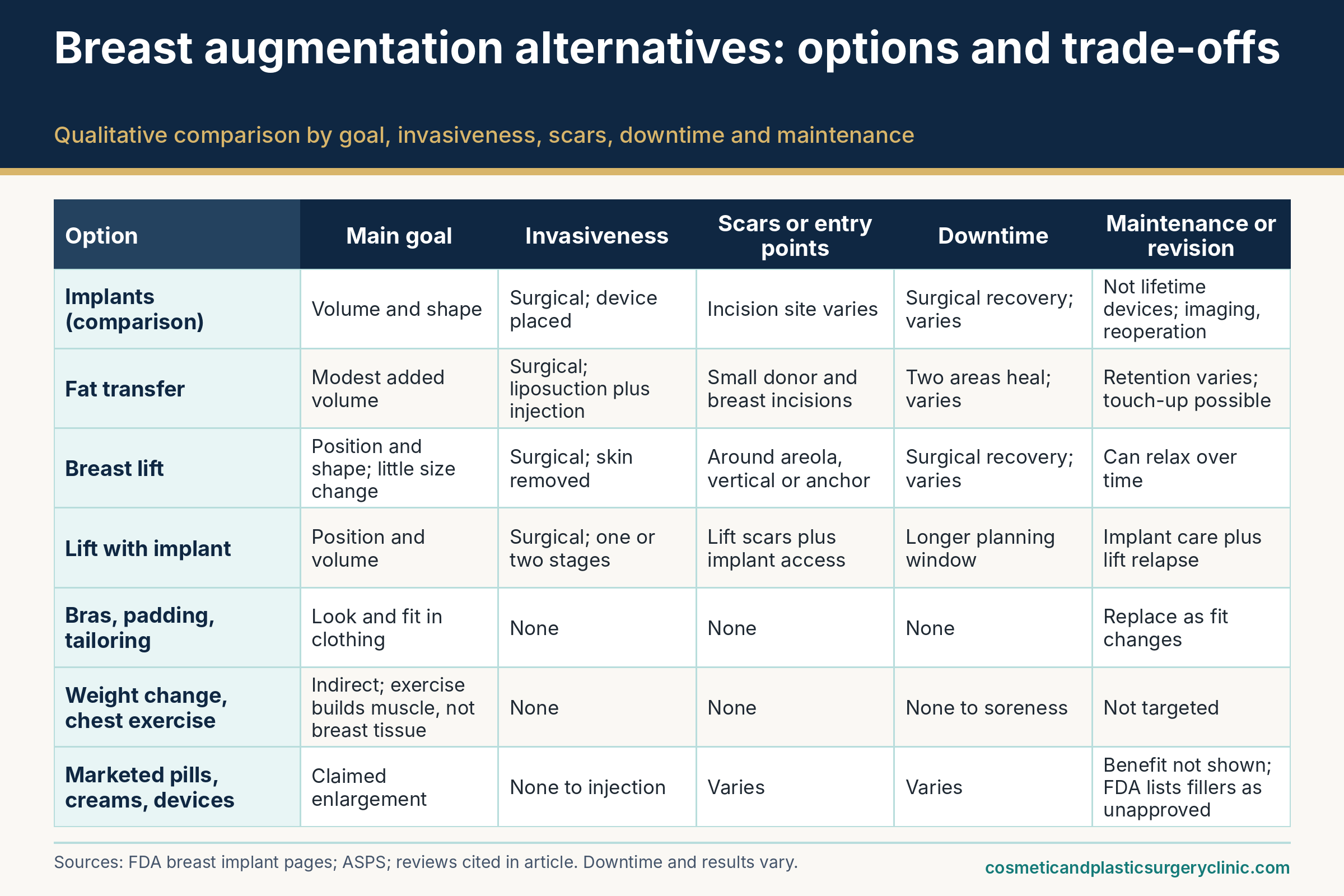
The first infographic below compresses the options into one view, using the same criteria the later tables use: the goal each option addresses, how invasive it is, where scars or entry points fall, how much downtime to plan around, and what maintenance or revision to expect. Treat it as a map, not a recommendation.
Surgical Breast Augmentation Alternatives: Fat Transfer, Breast Lift, and Combinations
When people say they want an alternative to implants, the options that come up first are surgical. They avoid a breast implant but still involve anesthesia, incisions, and a recovery period. That does not make them lesser choices. For the right goal and the right anatomy, they may be the better fit. It does mean they belong in a conversation about trade-offs, not in a category called “easy.”
Fat transfer to the breasts
Fat transfer is the most common implant-free route to added breast volume, and it has the most developed research literature among the alternatives. It is also the option where the gap between marketing language and measured results can be widest.
How fat transfer works and who it tends to suit
The ASPS describes fat transfer breast augmentation as a procedure in which a surgeon uses liposuction to take fat from another area of your body and injects it into the breasts. It positions the option for people who want a relatively small increase in breast size and who prefer a result that does not involve an implant. In practice, the sequence has three parts: harvesting fat from a donor area such as the abdomen, flanks, or thighs; processing it so that it can be injected; and placing it in small amounts through tiny incisions at several depths in the breast. The details, including how the fat is prepared, vary by surgeon and are the subject of the guide to fat transfer breast augmentation.
Two features follow from that description. First, you need a donor area with enough fat to harvest, and your goals need to be compatible with what that fat can accomplish. Someone with very little body fat may not have enough to work with, and someone hoping for a large jump in size may find the method limited. Second, injected fat is living tissue. It has to establish a blood supply from the surrounding tissue to survive, and the breast can only accept so much volume at a time before that supply is stretched. Surgeons describe this as one reason the technique tends to suit modest changes. That is general reasoning about how grafts behave, so it is worth asking any surgeon you consult how they estimate what is realistic for your anatomy.
The ASPS also offers a pointed piece of advice on motivation. Its candidate guidance says that if your interest in fat transfer comes from reservations about implants, it is important to explore those reservations with your plastic surgeon before surgery. That is good practice because “I don’t want implants” can mean many different things: worry about the device lasting indefinitely, concern about rupture or imaging, discomfort with a foreign object, a family history that makes you cautious, or a look you associate with implants. Each of those points toward a slightly different plan, and some of them may be resolved with information instead of a different operation.
There are some people for whom fat transfer is a poor match on practical grounds, and a thorough consultation should surface them: not enough donor fat, goals that exceed what the method can do, or a plan that depends on a lift the transfer cannot provide. Fat added to a breast that also needs repositioning will not move the nipple up, which brings us back to the three-variable idea: volume, envelope, and position.
What the research shows on retention, complications, and imaging
A systematic review in Plastic and Reconstructive Surgery by Seth and colleagues pooled 35 studies covering 3,757 women, with an average follow-up of about 24.5 months. It reported an average volume retention of 58 percent, with a range across studies of 44 to 83 percent. In plain terms, a typical transfer retained a bit more than half of the injected volume in the studies reviewed, and the spread between studies was wide. The same review reported an overall complication rate of 27.8 percent, with fat necrosis (areas of fat that lose blood supply and form firm or cystic areas) accounting for 43.7 percent of those complications, and average patient satisfaction of about 92 percent at one year. The authors described the included studies as good quality with a moderate risk of bias, and titled their paper to highlight the need for clinical caution. The publication year attached to this review differs between the indexes consulted for this guide (an online date in 2023 appears in one), so confirm the citation details before quoting it elsewhere.
Another systematic review, published in 2020 by Ørholt and colleagues in the same journal, looked at complications after breast augmentation with fat grafting across 22 studies and 2,073 patients. It found major complications such as hematoma (0.5 percent), infection (0.6 percent), and seroma (0.1 percent) to be uncommon, palpable cysts in about 2 percent of patients, and radiologic changes that included oil cysts (6.5 percent), calcifications (4.5 percent), and fat necrosis (1.2 percent). Around 16 percent of patients were referred for additional imaging and about 3 percent had a biopsy. The authors concluded that complication rates were low and that radiologic changes were frequent but usually without therapeutic consequence.
Those two reviews read differently, and the reason is instructive rather than contradictory. “Complication rate” depends heavily on what a study counts: a firm lump, an imaging finding, a procedure that was needed, or a symptom the patient noticed. Studies also differ in how they measure volume and how long they follow patients. For decision-making, the safe reading is that volume retention is variable and often incomplete, that most problems reported are minor or imaging-related, and that imaging findings can lead to extra tests, including biopsies that turn out to be benign.
That last point is the “imaging considerations” part of the picture. Two studies reported in Plastic and Reconstructive Surgery in 2011 reached different conclusions about whether mammography remains reliable after fat grafting. A French series of 31 post-operative mammograms found radiographic abnormalities in 46 percent of cases yet concluded follow-up was not harder to interpret when the procedure was done carefully. A Chinese series of 48 women followed for up to seven years found clustered microcalcifications in 10 patients that could not be distinguished from malignant ones on imaging, and all 10 needed biopsies that proved benign. A 2022 systematic review of imaging after fat transfer for breast reconstruction found fat necrosis to be the most frequently reported finding, noted that descriptions of the imaging features were limited in the literature, and said biopsies remain warranted in some cases to separate benign from malignant findings.
What does this mean for a reader? Fat transfer is not shown by this evidence to be dangerous, and it is not shown to be trivial. It means an honest consultation includes a discussion of how your future screening mammograms and any imaging would be read, whether baseline imaging makes sense before the procedure, and who will interpret scans with the knowledge that fat was transferred. If you are weighing it, the guides on fat transfer breast augmentation risks and complications and how long fat transfer results last go deeper.
Breast lift and the lift-with-implant combination
The second surgical family changes where the breast sits, with or without changing how much of it there is. For readers whose main concern is droop, it may be the more direct answer than any volume-adding option. For readers who want both lift and fullness, it becomes the foundation of a combination plan.
Breast lift (mastopexy): position and shape, not size
The ASPS describes a breast lift as raising the breasts by removing excess skin and tightening the surrounding tissue, and notes that it can also reduce areolas that have enlarged over time. It also states plainly that the procedure does not significantly change breast size or round out the upper part of the breast. That sentence is the single most useful fact for anyone deciding between a lift and an augmentation, so it is worth repeating in different words: a lift reshapes what is there; it does not add much.
The ASPS lists three common incision patterns. One goes around the areola (periareolar). Another goes around the areola and straight down to the breast crease (vertical, sometimes called lollipop). The third adds a horizontal line along the crease (anchor, or inverted T). Which pattern fits depends on breast size and shape, how much sagging is present, and the quality and elasticity of the skin. Scars are permanent, according to the ASPS, though in most cases they fade and improve significantly over time; some sit in natural contours, and others are visible on the surface of the breast. For a reader who is trying to avoid scars, that is a real consideration, because a lift typically trades a more visible scar for a change in position. The deeper comparison lives in the guide to breast lift techniques, and the broader overview is in the complete breast lift guide.
The ASPS safety information for breast lift lists anesthesia risks, bleeding or a collection of blood (hematoma), asymmetry, contour irregularities, changes in nipple or breast sensation that may be temporary or permanent, fat necrosis, fluid collection, infection, poor incision healing, possible partial or total loss of the nipple and areola, blood clots and cardiac or pulmonary complications, and the possibility of revision surgery. None of those items are unique to lifts, but they are material, and a procedure that moves the nipple and reshapes tissue carries a more involved risk list than the bras-and-tailoring end of the spectrum.
How long a lift lasts is a fair question and a hard one. A 2022 systematic review in JPRAS Open by Wagner and colleagues examined 24 studies covering 1,235 patients and 2,235 breasts, using measurements such as nipple-to-fold distance to track how well correction held. It concluded that superior and superomedial pedicle techniques (ways of keeping the nipple’s blood supply while moving it) tended to give greater long-term stability than inferior pedicle techniques, that supportive additions such as mesh, dermal flaps, or muscle slings looked promising, and that no single technique suits every patient. Gravity and aging continue after surgery, so the honest framing is that a lift improves position for a time, not forever.
A lift with an implant: one operation or two
For breasts that are both lower and smaller than the person wants, the ASPS notes that a lift may be needed alongside augmentation, performed at the same time or as a separate procedure. The timing choice is the heart of the decision. It is technically demanding because the two parts pull in opposite directions: a lift tightens and removes skin, while an implant stretches the envelope from the inside. Surgeons plan around that tension, and some prefer to separate the steps to reduce it.
A pooled analysis presented at an American Society for Aesthetic Plastic Surgery meeting in 2014 gives a sense of the numbers for the single-stage approach, with a caveat that it is a conference abstract and the full paper was not reviewed for this guide. It combined 14 studies covering 4,856 augmentation-mastopexies. It reported total complications of 14.5 percent, recurrent ptosis of 4.0 percent, asymmetry of 2.7 percent, capsular contracture of 1.9 percent, and reoperation of about 11 percent across the 10 studies that reported it. The authors argued that this compares favorably with a staged plan in which a second operation is built in. Both statements are fair: a single-stage plan accepts a meaningful chance of an additional operation, and a deliberately staged plan makes the second operation a certainty in exchange for treating one problem at a time.
Because pooled figures come from published series, often from experienced surgeons, they may not reflect what happens in every setting. Use them as orientation and ask the surgeon you consult for their own approach and revision policy instead. Everything in the FDA’s implant information also applies here, since the combination still involves an implant. The practical questions are the same ones that apply to any combined plan: how many operations are expected, how long you should plan to be away from work and lifting, how the scars will be placed, and what happens if the lift relaxes or the implant needs attention later. The guide to combined procedures with breast augmentation covers the planning side.
The table below puts the surgical and nonsurgical alternatives next to each other on the five criteria that most readers care about. The entries are qualitative on purpose. Downtime is shown as a planning category because recovery varies from person to person and by technique, and specific day counts would imply a precision the evidence does not support.
| Option | Main goal addressed | Invasiveness | Scars or entry points | Downtime planning | Maintenance and revision |
|---|---|---|---|---|---|
| Breast implants (comparison point) | Added volume and shape | Surgical; a device is placed under breast tissue or chest muscle | One or more incisions; placement varies by technique | Surgical recovery; restrictions on lifting and exercise vary | FDA: not lifetime devices; reoperation, imaging checks for silicone, and removal or replacement are possible |
| Fat transfer to the breasts | Modest added volume with no implant | Surgical; liposuction plus injection | Small incisions at donor areas and breasts | Two areas heal at once (donor and breast); varies | Retention varies; possible touch-up; imaging findings may need follow-up |
| Breast lift (mastopexy) | Position, skin excess, shape; little change in size | Surgical; skin removed and tissue reshaped | Around areola, vertical, or anchor pattern; permanent but usually fade | Surgical recovery; varies | Position can relax over time; revision possible |
| Lift with implant (augmentation-mastopexy) | Both position and volume | Surgical; one operation or staged | Lift scars plus implant access | Longer planning window, especially if staged; varies | Combines implant care with lift relapse; reoperation is a recognized possibility |
| Bras, padding, shapewear, tailoring | Appearance and fit in clothing | None | None | None | Replace as body or preferences change; watch skin irritation |
| Weight and body-composition change | Indirect; breast size may rise or fall | None | None | None | Not targeted; direction of change is not controllable |
| Chest exercise | Muscle beneath the breast, posture, strength | None | None | None to mild soreness | Ongoing; does not add breast tissue |
| Marketed pills, creams, devices, injections | Claimed enlargement or lift | Varies from none to injection | Varies | Varies | Evidence of benefit is lacking in sources reviewed; FDA lists fillers as unapproved for breast enlargement |
| Waiting or not changing | Time to clarify goals or life plans | None | None | None | Revisit if goals, health, or life stage change |
Implants as the Comparison Point: What the FDA Says and How the Trade-Offs Stack Up
Even if implants are the thing you are trying to avoid, you cannot judge the alternatives fairly without knowing what the implant path actually involves. This section is not a case for implants. It summarizes the FDA’s patient-facing information so you can compare like with like, and then sets implants, fat transfer, and lift side by side. For the full picture on devices, the guide to breast implant FDA safety information goes further, and the complete breast augmentation guide covers the procedure itself.
What the FDA tells patients about breast implants
The FDA maintains a dedicated breast implant information hub, and it is the first place to read before any implant decision. The overview page was marked current as of December 15, 2023 when it was reviewed for this guide, and the device pages should be rechecked at publication because labeling and safety communications change.
Types, age labeling, the boxed warning, and the patient decision checklist
The FDA describes two approved types of breast implant: saline-filled and silicone gel-filled, both with a silicone outer shell, and available in different sizes, shell thicknesses, textures, and shapes. For cosmetic augmentation, the FDA’s page on implant types states that saline-filled implants are approved for people 18 or older and silicone gel-filled implants for people 22 or older, while both are approved for reconstruction at any age and for revision surgery. The overview lists the specific approved products by manufacturer, and a surgeon should be able to tell you exactly which device is being proposed and show you its labeling.
“Approved” has a specific meaning here, and it helps to keep it separate from “cleared.” Breast implants are devices the FDA lists as approved. Approval is generally the more demanding standard: the agency describes premarket approval as its most rigorous pathway, one that requires sufficient scientific evidence that a high-risk device is safe and effective for its intended uses, and it ties that approval to the uses on the label. Many other devices reach the market through a 510(k) clearance, which the agency describes as a finding of substantial equivalence to a device already on the market, and which is not the same thing as approval. When you meet a device in the nonsurgical section of this guide, ask which of the two applies and for what labeled use.
In September 2020 the FDA issued final guidance recommending changes to breast implant labeling, and the agency’s overview notes that new labeling reflecting those recommendations was approved in October 2021. The recommendations center on two features. The first is a boxed warning, the agency’s most prominent type of label warning. As described in the guidance, it is meant to tell patients that breast implants are not considered lifetime devices, that the chance of complications rises over time and that some of those complications require additional surgery, that implants have been associated with breast implant-associated anaplastic large cell lymphoma (BIA-ALCL), that textured implants carry a higher risk of BIA-ALCL than smooth ones, and that some patients report systemic symptoms.
The second is a patient decision checklist, a structured document meant to support the conversation with the surgeon before surgery. As described in the guidance, it walks through considerations such as who should not receive implants (for example, people with an active infection, untreated breast cancer, or who are pregnant or nursing) and conditions that raise risk (such as diabetes, smoking, immunosuppressive medication, or clotting disorders), surgical risks, BIA-ALCL, systemic symptoms, long-term risks such as capsular contracture, rupture, reoperation, and interference with mammography, and follow-up requirements including imaging and registry options. Labeling is also meant to include a device identification card with the serial or lot number, style and size, and a link to current labeling. The guidance gives illustrative percentages in its example checklist, and those depend on specific device data, so this guide does not reproduce them; read the checklist that applies to the actual device.
Not lifetime devices: complications, screening, and imaging
The FDA’s risk page states that breast implants are not considered lifetime devices, and adds that the longer someone has them, the greater the chance of complications. The page on implant types makes the same point in terms of operations: the longer a person has implants, the more likely they are to need surgery to remove or replace them. The ASPS echoes this, saying implants are not promised to last a lifetime and that future surgery may be required. If you remember only one line from the implant material, make it that one, because it shapes the long-term cost, the planning, and the way fat transfer and lift are compared.
The complications the FDA lists include asymmetry, breast pain and changes in sensation, capsular contracture (scar tissue tightening around the implant, graded on the Baker scale from I to IV), infection including toxic shock syndrome, rupture or deflation, collections of fluid or blood (seroma and hematoma), wrinkling or rippling, and malposition or displacement. On the systemic side, it describes breast implant illness, in which symptoms such as fatigue, memory loss, rash, “brain fog,” and joint pain may be associated with implants, and it covers BIA-ALCL along with reports of squamous cell carcinoma and various lymphomas in the capsule around the implant. The causes of the systemic symptoms are not established, and the FDA frames them as reported associations, so this guide does the same.
Silent rupture, a leak that causes no symptoms, is why monitoring is part of the implant conversation. The FDA says MRI is the most effective method for detecting silent rupture of silicone gel-filled implants and that ultrasound is an acceptable alternative. The ASPS summarizes the FDA’s advice as screening with MRI or ultrasound five to six years after silicone implant placement and every two to three years afterward. A reader comparing options should treat that as a recurring commitment: imaging appointments, possible out-of-pocket costs, and a decision point if something is found. Implants can also complicate mammography, which is part of the FDA’s checklist, so mention them whenever you schedule breast imaging. For deeper reading on risks specific to this path, see breast augmentation risks and complications.
Implants, fat transfer, and lift: comparing the trade-offs
Comparing three different tools on one scale invites false precision. Instead of scoring them, this section lays out what each asks of you and what each cannot do, so the choice follows your priorities.
Side by side: what each path asks of you
The table below organizes the comparison around the trade-offs that tend to decide the question. It is written as general education. Each cell compresses a longer discussion, and individual anatomy can move any of these judgments.
| Trade-off | Breast implants | Fat transfer | Breast lift |
|---|---|---|---|
| What it mainly changes | Volume and shape, using a device | Modest volume, using your own fat | Position and skin envelope; little size change |
| Foreign material in the body | Yes, a silicone-shelled device | No implant; your own tissue | No implant (unless combined) |
| Predictability of size | Device size is chosen; final appearance still depends on tissue and position | Retention varies; reviews report wide ranges | Size largely stays as it is |
| Surgical sites | Breasts only | Donor area plus breasts | Breasts only |
| Scar pattern | Incision location depends on technique | Small incisions at donor and breast sites | Periareolar, vertical, or anchor scars; some sit on the breast surface |
| Long-term follow-up | Not lifetime devices; imaging checks for silicone; reoperation possible | Imaging findings such as cysts or calcifications may need evaluation | Relaxation over time; revision possible |
| Reasons people choose it | Larger or more definite volume change; predictable volume | Wish to avoid a device and to make a modest change | Main concern is droop with acceptable volume |
| Reasons people hesitate | Device longevity, monitoring, revision | Variable retention, limited maximum change, donor fat needed | Visible scars, limited effect on volume |
Two threads run through the table. The first is that the trade-offs are asymmetric. Implants give the most direct control over volume, and they ask for the longest commitment to monitoring. Fat transfer avoids a device and asks you to accept variability and a more limited ceiling. A lift improves position and asks you to accept scars and a limited effect on size. No option wins on every row, which is why reducing the decision to “which is best” misses the point.
The second thread is that the same person can reasonably choose differently depending on what they weigh. Someone who values predictability of volume may accept the long-term implant commitment. Someone who values having no device may accept variability and a smaller change. Someone whose main concern is nipple position may find that neither of the volume options fits what they asked for. The aim of a consultation is to surface which of those descriptions is closest to you, not to push toward one.
Maintenance over decades, not just the first year
A decision that feels like it ends with a recovery period usually does not. Breasts keep responding to hormones, pregnancy, weight changes, and age, and surgery changes the starting point without stopping those processes. Planning for a ten- or twenty-year horizon changes how the options look.
With implants, the realistic long-term picture includes periodic checks, a nontrivial chance of eventual removal or replacement according to the FDA, and the interaction of any future pregnancy or weight shift with the device. With fat transfer, the long-term picture includes retention that may settle at a lower level than first seen, the possibility of a touch-up, and the need for imaging teams to know about the history. With a lift, the long-term picture includes gradual relaxation, since gravity and aging continue, and the possibility of revision.
None of this means choosing nothing. It means asking a different question: not “which option gives the best result at three months,” but “which set of long-term responsibilities fits my life?” A person who dislikes medical follow-up may weigh implant monitoring heavily. A person who dislikes the idea of any additional operation may weigh the chance of reoperation heavily across all the surgical options. A person who wants a one-time change may find that none of the surgical options is quite that, and that is useful to learn before booking anything.
It is also worth separating popularity from fit. The ASPS 2025 procedural statistics, which describe U.S. activity, rank breast augmentation among the top five cosmetic surgical procedures and describe breast augmentation as climbing 11 percent and breast lift 8 percent. That tells you the procedures are common. It says nothing about whether one is the right fit for your goals, and the same report is a reminder that demand among patients is not a quality measure for any individual surgeon or option.
Lower-Intervention Options: Bras, Shapewear, Body Composition, and Exercise
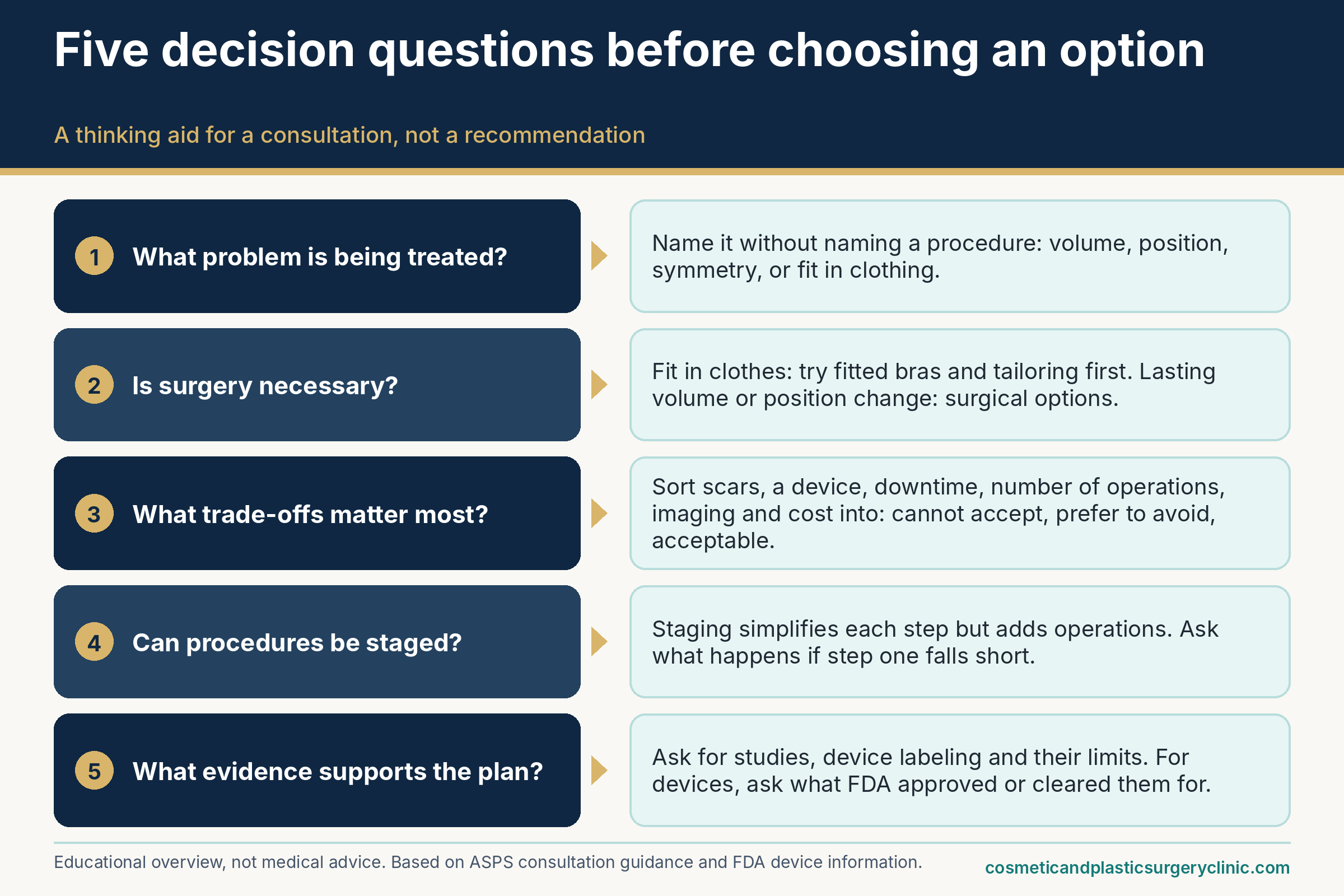
Not every goal needs an operation, and not every operation needs to come first. Some goals, particularly those about fit, proportion, and confidence in clothing, can be met with tools that carry no surgical risk at all. Others, such as adding lasting volume, cannot be reached that way. The second infographic is a sorting aid: five questions that separate the goals that point toward surgery from those that do not, and that also keep staging and evidence on the table.
Bras, padding, shapewear, and tailoring
These are the first things many people try, often without calling them “alternatives.” They deserve a serious look because they are reversible, inexpensive relative to surgery, and informative: living with a different silhouette for a few weeks can tell you a great deal about what you actually want.
Bra fit and support: the least invasive lever
Fit is more variable than most people expect. The University of Portsmouth’s Research Group in Breast Health, an academic team that studies breast and bra science, states that over 80 percent of women have been reported to be wearing the wrong size bra, and it recommends moving away from tape-measure sizing toward five fit checks: how the underband sits, whether the cup fully encloses the breast, where the underwire lies, whether the center front sits flat against the breastbone, and whether the shoulder straps are comfortable. The group also points out that breasts change size, shape, and position across the menstrual cycle and over a lifetime, so a size that fit last year may not fit now.
Why does that matter for this topic? A bra that fits properly can noticeably change how fullness is distributed and how a top hangs, which means some of the dissatisfaction people attribute to volume is partly about support and shape. That is not the same as saying a bra can substitute for tissue. It cannot change what is under the clothing. But because it is so inexpensive to test, it is worth being sure you have tried properly fitted options before assuming the problem is anatomical.
Support also matters for comfort during activity. The Portsmouth group has reported that, in a survey of 1,659 women, 51.5 percent experienced breast pain, with larger-breasted and less active women reporting it more often, and has documented that inadequate support during running is associated with greater perceived effort. If discomfort during exercise is part of what is pushing you to consider surgery, support is a first line to check, and activity-specific designs exist for that reason.
Padding, inserts, shapewear, and tailoring: what they do and where they stop
Padded cups, removable inserts, push-up designs, adhesive options, and swimwear with built-in shaping all work by changing the silhouette over the clothed breast. They add projection, lift the outline, or fill a cup, and the effect is immediate. They also share the same limit: nothing changes without the garment. Whether that matters depends on the situation. For someone whose main concern is how clothes fit, a good set of options can be close to a full answer. For someone whose concern is how their body looks and feels unclothed, it will not be.
Some practical considerations apply. Heat, friction, and adhesives can irritate skin in some people, so a trial period before an event matters more than it seems. Inserts differ in weight, and heavier ones can shift or feel awkward during movement. Tailoring helps in less obvious ways: adjusting darts, necklines, and seams can fix a recurring fit problem around the bust that no bra changes.
There is a quiet advantage in this phase. Wearing inserts of different volumes for a few weeks can give you a more realistic sense of proportion in your own wardrobe than a photograph. Surgeons often use sizing devices in consultation for the same reason, and the ASPS lists trying on sizers among the questions to raise when discussing implant size. Treat the experiment as information. If an insert at a modest volume feels right, you have learned something about the scale of change you want. If you find you want no change at all in daily life, that is useful too.
Weight, body composition, and chest exercise
Body-based approaches attract attention because they cost little and involve no device. They deserve a straight assessment, because the honest answer is that one of them is a real but uncontrollable influence on breast size, and the other changes a different structure altogether.
Weight change and breast volume
Breasts contain fat, so body weight can influence breast size. The SEER materials describe fat as the tissue that gives the breast its size and shape. Research on larger weight losses shows how far this can go: a 2016 study in Obesity Surgery by Vohra and colleagues used mammograms from 80 women before and after weight loss surgery, during which average body mass index fell from 46.0 to 33.7. Total breast volume measured by software decreased by about 39 percent on average, and fibroglandular (non-fatty) volume decreased by about 15 percent. This is a specific population with major weight loss, so it should not be extrapolated to small changes. It does show that breast volume can fall substantially, which is why people considering significant weight loss often hear that breast shape and size may change.
The reverse is less predictable. Gaining weight may increase breast fat, but it does so unevenly across individuals, alongside changes elsewhere in the body, and it carries health implications unrelated to cosmetic goals. Deliberate weight gain is not a targeted way to change breast size, and decisions about body weight belong in a conversation with a primary care clinician, not a cosmetic-surgery article. What can be said is that breast size is partly tied to body composition, that the relationship differs from person to person, and that large changes in either direction may alter how a surgical plan turns out.
That last point is why surgeons often ask about weight stability, and why timing questions come up in consultations. If you are in the middle of weight loss, whether through lifestyle, medication, or surgery, the breast you have now may not be the breast you will have in a year. The ASPS 2025 procedural statistics report, in a message from its leadership, said 82 percent of ASPS member surgeons reported consultation requests related to GLP-1 medications, with lift procedures growing as patients address excess skin after weight loss. For readers in that situation, timing becomes a central consultation topic, and surgeons commonly want to see a stable weight before planning anything permanent.
Chest exercise: what muscle can and cannot do
Chest exercise is one of the most common non-surgical suggestions, and the anatomy settles most of the question. The breast sits on top of the pectoralis major but is not made of muscle; the SEER materials say the breast rests on the chest muscle and contains no muscle tissue. Training the pectoral muscles can make that muscle stronger and, with sustained training, larger. That may change the contour of the chest, the firmness of the base on which the breast rests, and posture. It does not add breast tissue. No controlled evidence that chest exercise increases breast volume turned up in the sources reviewed for this guide, and the anatomy offers no mechanism by which it would.
Exercise can still influence appearance indirectly. Stronger upper-back and shoulder muscles may change posture, and posture changes how the chest presents. On the other hand, exercise that reduces body fat can also reduce breast fat, so a person who trains hard and loses weight may notice smaller breasts, not larger ones. This is a reason not to treat exercise as a volume strategy. It is a reasonable strategy for strength, health, and posture, and an honest one for people who want to feel stronger in their upper body.
One more link between exercise and surgery is worth a mention. If you do eventually have implants, particularly if they are placed beneath the muscle, exercise and lifting are restricted for a period and may need adjusting afterward. Those restrictions are part of the wider timeline covered in the guide to breast augmentation recovery.
Marketed “Nonsurgical Breast Enhancement”: What Regulators and the Evidence Say
Search for a nonsurgical route to bigger or higher breasts and you will find pills, creams, massage routines, suction devices, injections, radiofrequency treatments, and platelet-rich plasma. Some of these are inexpensive, some are costly, and some are performed in clinics by licensed professionals. The accurate way to sort them is not to ask whether they sound plausible, but to ask what the regulator says about the product, what kind of evidence exists, and what the claim would have to be true for the product to work. This section keeps to what the sources opened for this guide support, and it avoids alarmism: a lack of evidence is not proof of harm, and the reverse is also true.
Pills, creams, supplements, and consumer devices
This family covers products sold directly to consumers, usually online and often with testimonial-heavy marketing. They differ in form but share a regulatory profile worth understanding before reading any claim.
How these products are regulated, and why that matters
Three pieces of U.S. regulatory framing help. First, the FDA says whether a product is a cosmetic or a drug depends on its intended use, and it defines drugs as articles, other than food, intended to affect the structure or any function of the body. It also says that cosmetic products and ingredients, apart from color additives, do not require FDA approval before they go on the market. A cream marketed as a skin moisturizer is on one side of that line. A product that says it grows breast tissue is making a statement about changing the structure of the body, which is the kind of claim that framework treats seriously.
Second, for dietary supplements, the FDA states that it does not approve them for safety or effectiveness before they are marketed. Manufacturers and distributors are responsible for complying with federal requirements, and the agency can act against products that are adulterated or misbranded once they are on sale. In other words, a supplement on a shelf has not been verified by the FDA to enlarge breasts, and the label alone is not evidence that it does.
Third, advertising claims fall under the Federal Trade Commission (FTC), which expects health claims to be truthful and backed by adequate scientific evidence. A well-documented example comes from 2003, when the FTC announced a settlement with the marketers of Bloussant, a supplement promoted as stimulating breast cells to regenerate and as increasing bust size by two cups in most women. The FTC alleged that the efficacy and safety claims were unsubstantiated, that “clinically proven” statements were false, and that trial offers were deceptive. The settlement, which covered three products in total, included $3.2 million in consumer redress. That case is more than two decades old and says nothing about any product on the market today; its value is as a pattern. Strong enlargement claims, bold testimonials, and subscription-style trial offers have a track record of being challenged.
Independent consumer-health groups reach a similar view. The National Center for Health Research, a nonprofit, states on a page last updated in January 2024 that no breast enhancement product has ever been proven to work, and it advises skepticism toward promises, testimonials, and words like “breakthrough.” That is an advocacy-group assessment and not a regulatory finding, so it is best treated as consistent with the regulatory picture instead of independent proof. What we can say with confidence from the regulators’ own statements is narrower and more useful: these product categories are not pre-approved for effectiveness, and the burden of substantiation sits with the seller.
A claim checklist for products and programs
You do not need to settle the science yourself to protect your time and money. A short list of questions exposes most weak claims quickly. The table below pairs common claim types with what to ask and where to check. It is meant to be used while you are looking at an actual product page, not read once and forgotten.
| Claim type | Typical wording | What to ask or verify | Where to check |
|---|---|---|---|
| Pills and herbal supplements | “Natural,” “plant-based,” “stimulates growth” | Is there a published, controlled human study of this exact product, and who funded it? Does it contain ingredients with hormone-like activity, and has a clinician reviewed that for your history? | FDA dietary supplement page; the study itself, not the ad; your clinician or pharmacist |
| Creams, gels, and serums | “Firms,” “enlarges,” “clinically proven” | Does the claim describe appearance or a change in tissue? Who ran the “clinical” test, how many people, and for how long? | FDA cosmetic versus drug explanation; FTC advertising guidance |
| Suction cups, pumps, and massage tools | “Natural enlargement without surgery” | What happens when you stop using it? Is any result described as lasting, and is there a published measurement of volume? | Peer-reviewed literature; ask a board-certified plastic surgeon |
| Exercise programs and apps | “Grow your bust with these moves” | Does the program distinguish chest muscle from breast tissue? Is any evidence offered beyond testimonials? | Anatomy resources such as the NCI SEER training site |
| Before-and-after photos and reviews | “Real results,” “my transformation” | Is this a typical outcome or the best case? Are lighting, posture, and clothing the same in both images? Is the reviewer compensated? | Treat as anecdote; look for controlled data |
| “Clinically proven” or “doctor recommended” | A badge, a lab coat, or a named but unspecified study | Which study, which journal, what outcome, and how was it measured? Is the doctor identifiable and credentialed? | PubMed; American Board of Plastic Surgery verification page for any named surgeon |
Two further rules of thumb are easy to apply. Be wary of a product whose only supporting evidence is testimonials and photos, because those are anecdotes and cannot show what a product does on average. And be wary when the refund terms are more detailed than the evidence. Neither rule proves a product ineffective, but both are common features of claims that cannot be substantiated.
Injectables, energy devices, and platelet-rich plasma
This family is different because the services are delivered in a clinic and the providers are real clinicians, which can make them feel more credible than a pill or cream. That is exactly why the regulatory details matter. A procedure being offered by a licensed provider is not the same as the FDA having approved or cleared it for breast use.
Fillers and silicone injections: what the FDA says
The FDA’s page on dermal fillers, last updated in July 2023, is unusually direct on this topic. It lists increasing breast size as an unapproved use of dermal fillers, recommends against using fillers for body contouring and enhancement, and states that injectable silicone is not approved for any aesthetic procedure, including facial and body contouring or enhancement. It also says the risks associated with unapproved uses of dermal fillers, or with the use of unapproved products, are not known.
It helps to be clear about vocabulary here. A product is approved or cleared for specific labeled uses. Using it for a purpose outside the label is called off-label use. In the case of breast enlargement with dermal fillers, the FDA goes beyond noting that the use is off-label: it recommends against it and says the associated risks have not been characterized. That is a stronger signal than “not yet studied,” and it is the clearest regulator statement available on any option in this section. Anyone offering filler or silicone injections into the breast for enlargement should be able to explain the regulatory status clearly, and a reader who is told it is “FDA approved” without a specific labeled indication for the breast should ask for the document that says so.
Energy devices, PRP, and “nonsurgical breast lifts”
Radiofrequency, ultrasound, laser, and platelet-rich plasma (PRP, a concentrate made from your own blood) are sometimes marketed as ways to lift or firm the breasts without surgery, and the PRP version has acquired a catchy name in the press. The evidence base in the sources reviewed is thin. One example is a 2023 pilot presented at an American Society for Aesthetic Plastic Surgery meeting by Franco and colleagues, which looked at adding radiofrequency energy during a surgical mastopexy in 15 women, with an average follow-up of about 109 days. It was a safety study, with one patient experiencing delayed wound healing that resolved with conservative care. It was not a test of a standalone nonsurgical lift, and the authors acknowledged its small size, retrospective design, and short follow-up.
For PRP, a WebMD overview reviewed by a physician in October 2024 states that few studies have been done, that long-term effectiveness and safety are unknown, that effects are described as subtle and temporary, and that how it might affect mammograms is uncertain. This is a consumer-health summary and not a peer-reviewed trial, and it is cited for its candor about the evidence gap. It also reports that the FDA allows PRP for cosmetic use if an approved centrifuge and collection kit are used. That statement deserves careful reading: clearance of a kit is a statement about equipment and its labeled indications, not about whether PRP injected into breast tissue produces a lasting benefit.
The 510(k) pathway makes the point concrete. The FDA says a 510(k) clearance reflects a finding that a device is substantially equivalent to a legally marketed predicate device with the same intended use, and that it is not the same as approval. The intended use and indications for use matter: changing them can require a new submission. So when a clinic offers an energy device for breast lifting, three questions are fair. What is the device cleared for, according to its indications statement? Is breast lifting listed there? And what published evidence, beyond the manufacturer’s materials, shows the effect lasts? If the honest answers are “skin tightening in another area,” “no,” and “a small case series,” then the device is being used for a purpose not established. That does not make it dangerous. It means expectations should be set accordingly, and that anyone with a significant position concern should know that surgery, with its own trade-offs, is the option with the most established effect on position.
Deciding What Fits: Decision Logic, Staging, and the Option of Not Changing
By this point the options are on the table. What is usually missing is a method for choosing among them that does not depend on whoever you spoke to last. The goal of this section is to give you one, in a form you can use before a consultation and adapt afterward. It does not replace a clinician’s assessment of your anatomy and health, and it deliberately avoids telling you which option to pick.
A decision framework you can use before a consultation
Most poor decisions about elective surgery share a pattern: the person chose a procedure before they defined the problem, then judged every option by how well it matched the procedure they had already picked. Reversing the order tends to produce clearer questions and calmer decisions.
Five questions that sort the options
1. What problem is being treated? Write it in one sentence without naming a procedure. “My breasts look smaller than I’d like in fitted tops” points to a different set of options than “my nipples point down and the upper part looks empty” or “the left side is noticeably smaller.” If you cannot write the sentence, that is your first task, and a consultation can help you refine it. The earlier sections on volume, envelope, and position are the vocabulary for this step.
2. Is surgery necessary to address it? Not “is surgery available,” but whether the problem is one that tools without surgical risk could meet. Fit and proportion problems often can be addressed with fitted bras, tailoring, and inserts. Volume that you want to be lasting, and position that you want to change, generally are not addressed by nonsurgical tools in the sources reviewed for this guide. The honest answer to this question can be “yes, if I want this particular change,” or “no, not for what I actually described.”
3. What trade-offs matter most? List the realistic costs of the options you are considering: scars, anesthesia, a device in the body, donor-site liposuction, downtime, the number of operations, imaging follow-up, money, and uncertainty about the final size. Then sort them into three groups: cannot accept, would rather avoid, and acceptable. Your “cannot accept” list does a lot of the narrowing. Someone who cannot accept a visible scar may rule out most lift patterns, and someone who cannot accept any ongoing device monitoring may rule out implants.
4. Can the work be staged? Some plans can be split across time, with one step informing the next, and some cannot. Staging reduces the complexity of each operation and increases the total number of operations. It is worth asking whether your plan is naturally staged, and what the surgeon would do if the first step did not go as hoped.
5. What evidence supports the plan? Ask what the surgeon is relying on: their own results, published studies, device labeling, or a general sense. A good answer names evidence and also names its limits. For fat transfer, for example, a candid answer references variable retention and imaging follow-up. For a lift with an implant, it references the chance of an additional operation. For a nonsurgical device, it should reference what the device is cleared for.
Two extra filters belong alongside these questions. The first is timing: pregnancy plans, breastfeeding, anticipated weight changes, major life events, and work or caregiving schedules all affect when a procedure is sensible. The second is health: conditions and medications that affect healing or anesthesia are the clinician’s domain, and the FDA’s checklist for implants names several that raise risk, including diabetes, smoking, immunosuppressive medication, and clotting disorders.
Illustrative scenarios, not advice
The scenarios below are hypothetical composites written to show the reasoning. They are not patient accounts, and they are not recommendations for anyone in a similar situation.
The fitted-tops scenario. A person with a desk job feels their breasts look flat in fitted clothing but has no concern about droop and is comfortable unclothed. The problem statement is about clothed silhouette. The sorting questions suggest starting with professionally fitted bras, a few styles with different padding, and a tailor, since these answer the actual problem at no surgical risk. If after a few weeks the person still wants a change that holds unclothed, the conversation shifts to volume options, with a clearer idea of the scale of change.
The after-pregnancy scenario. A person who finished breastfeeding some months ago notices both less fullness and a lower nipple position. Both variables moved, so a volume-only plan may not solve the problem and a lift-only plan may not restore fullness. This is the situation where a lift, a lift with an implant, or a staged plan are all worth discussing, along with whether any future pregnancy is expected, because that affects how long results might hold. The guide to breast augmentation after pregnancy covers the timing side.
The no-device scenario. A person wants a modest increase and has a firm preference against implants. Fat transfer is the natural subject, and the sorting questions become: is there enough donor fat, am I comfortable with variable retention, and who will interpret my future imaging? If any of those answers are uncomfortable, that is useful information about fit, not a failure.
The physically demanding job scenario. A person whose work involves lifting, or an athlete, is weighing options that all involve a restricted period afterward. The trade-off here is time away from the activity and how the restrictions are handled, not just the scar. Asking each surgeon about expected lifting and exercise restrictions, and when and how the plan accounts for them, turns a vague worry into a comparison.
The weight-loss-in-progress scenario. A person midway through significant weight loss wants to address their breasts. The research on large weight loss shows breast volume can drop considerably, so doing anything permanent before the weight stabilizes risks planning for a breast that will not exist later. A common approach is to wait for stability, revisit the question then, and use bras and tailoring in between. A surgeon will typically weigh weight stability alongside other candidacy factors.
Staging, timing, and the choice to leave things as they are
Two of the most underused tools in elective decision-making are order and time. Doing things in a different sequence, or later, or not at all, are all legitimate options, and they cost nothing to consider.
Staged approaches and when order matters
Staging means separating a plan into steps, with a gap between them. Surgeons propose it for different reasons, and the reasons help you evaluate the proposal. The table below sets out common patterns, why a surgeon might raise them, the main trade-off, and a question to ask. It describes general reasoning, and any specific plan belongs to your surgeon.
| Staging pattern | Why it may be proposed | Main trade-off | Question to ask |
|---|---|---|---|
| Lift first, volume later (if still wanted) | Position changes may alter how much volume you want | Two recoveries if volume is added; lift may relax in between | What would make you recommend the second step, and how will we judge it? |
| Volume first, lift later (if still wanted) | Volume may change how much lift is needed | Possible additional operation; implant considerations apply | What are the signs that a lift will or will not be needed? |
| Lift and implant in one operation | One anesthesia and one recovery | Tighter skin and an expanding device pull against each other; pooled data show a meaningful reoperation chance | What is your experience and revision approach for combined procedures? |
| Fat transfer in more than one session | Retention varies, so a surgeon may plan around it | More than one procedure and recovery; outcome still variable | How do you judge retention, and what is your policy on touch-ups? |
| Nonsurgical trial first (bras, inserts, tailoring) | Tests how much change you actually want; no surgical risk | Only changes appearance in clothing | What scale of change would you demonstrate with sizers or inserts? |
The reasoning behind staging is straightforward even when the choice is not. Each operation can be simpler and the surgeon can reassess, but you accept more procedures overall. A single-stage plan reduces the number of operations expected, but concentrates the technical demands. The pooled analysis described earlier states this bluntly: a deliberately staged plan makes the second operation a certainty, while a single-stage plan accepts a chance of one. Neither framing is wrong, and the question is which risk profile fits your tolerance.
Choosing to wait, or not to change at all
Doing nothing is a real option, and it is the one that most marketing leaves out. There are good reasons to wait: life events that are likely to change the breasts, such as pregnancy, breastfeeding, or major weight changes; health conditions that should be stabilized first; a need to understand your own goals better; or simply not feeling ready. The ASPS candidate guidance says people who are pregnant or breastfeeding should wait, and it cautions against pursuing surgery mainly for someone else’s satisfaction. It also notes that satisfaction is high specifically when patients want the procedure for themselves.
Waiting is not passive when it is used well. It can mean a trial with fitted bras and inserts, a first consultation to gather information only, a second opinion from a separate board-certified surgeon, or a conversation with a primary care clinician about weight, medications, or health factors that affect surgery. It can also mean setting a date to revisit the question, such as after a life event or a year later, so that a delay turns into a decision, not a drift.
One more point deserves gentle mention. Dissatisfaction with a part of the body is common and does not mean anything is wrong with you. If thoughts about how your breasts look are persistent, distressing, or take up large parts of your day, talking with a mental health professional can help regardless of what you decide about surgery. A thoughtful surgeon will also ask about your reasons and expectations; that question is part of a safe consultation, not an obstacle to it.
Consultation, Credentials, and Cost: Comparing Plans Fairly
A consultation is where a general understanding turns into a plan that fits one body. It is also where information is easiest to lose, since appointments are short, the vocabulary is dense, and it is hard to compare two plans described in two different ways. The third infographic is a one-page checklist you can bring or photograph, built around five things to compare across surgeons: the rationale for the technique, the provider’s experience, the safety plan, the recovery impact, and the long-term implications.
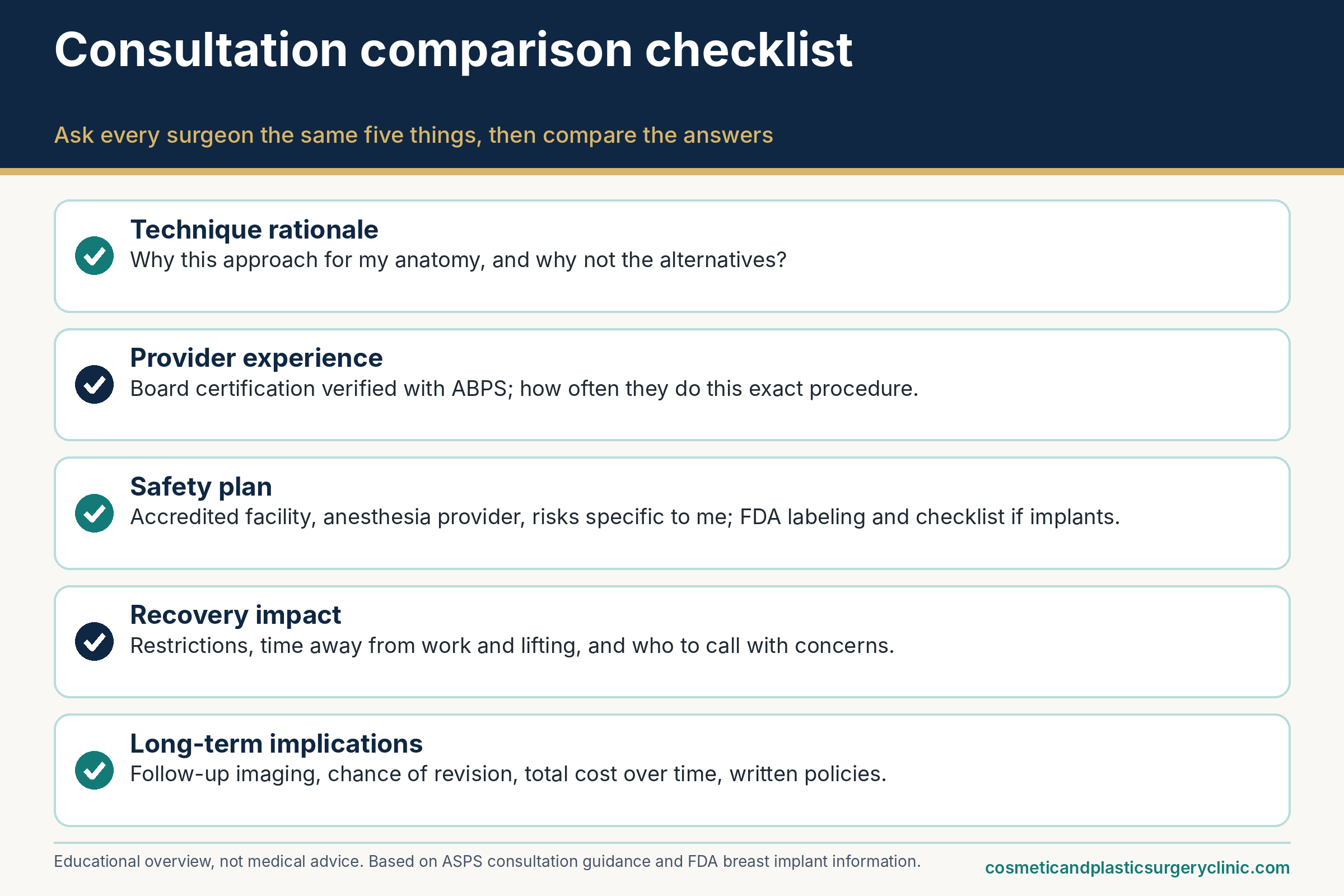
What a consultation should cover
A useful consultation does not start with a procedure. It starts with your goals, your history, and an examination, then moves to options, including the options that would not involve that surgeon at all. The principle is simple: a surgeon who can explain why a given option is or is not a good match for your goals, in specifics, is giving you something you can use. A surgeon who describes only one path and none of the trade-offs is giving you a pitch.
Questions about your goals, the alternatives, and the evidence
The ASPS publishes consultation question lists for breast augmentation, including questions about board certification, where surgery will be performed, how implant size is chosen, how to prepare for the best surgical outcomes, and what scars will look like. Those are useful, and they assume you have already decided on augmentation. The table below extends them for readers who are still comparing alternatives, organized so you can take it into the room.
| Topic | Question to ask | What a useful answer includes |
|---|---|---|
| Goals and alternatives | Based on my goals, which options would you consider, and which would you not recommend, and why? | Specific reasoning tied to volume, skin envelope, and position; names options outside the surgeon’s own practice |
| Technique rationale | Why this technique for my anatomy, and what would you change if my weight or plans change? | Anatomy-based explanation, not a script; mentions limits |
| Experience | How often do you perform this specific procedure, and do you also perform the alternatives? | Clear numbers or description of regular practice; comfort discussing options they do not offer |
| Evidence | What evidence are you relying on, and what are its limits? | Names studies, device labeling, or experience, and acknowledges uncertainty |
| Risks specific to my plan | Which complications matter most for this option and for me? | A specific list, including those in FDA or ASPS materials for the option; no minimizing |
| Imaging and follow-up | What follow-up or imaging will I need, and how often, and who reads it? | Concrete schedule; for fat transfer, how imaging teams will know the history; for silicone implants, the FDA screening timeline |
| Number of operations | How many operations should I expect, and how likely is an additional one? | Honest range; staged versus single-stage trade-offs |
| Recovery impact | What will I be unable to do, for how long, and what does my work or caregiving schedule mean for timing? | Specific restrictions and ranges, with variability acknowledged |
| Revision and costs | What happens if I need a touch-up or revision, and what does your fee cover? | Written policy; separate listing of surgeon, facility, anesthesia, and follow-up |
| Photos and expectations | Can you show examples of typical, not only best-case, outcomes for people with anatomy like mine? | Consented examples with similar anatomy; explanation that results vary |
Some of these questions can feel confrontational. They are not. A surgeon who is comfortable with them will usually answer without strain, and the content of the answers is more informative than the answers’ polish. Be alert for responses that rely on certainty: promises about size, assurances about a result, or reluctance to discuss alternatives. The ASPS also suggests seeking a second opinion from another board-certified surgeon, which is a routine step and not an insult to the first.
Credentials, facility, and anesthesia
The credential questions are the easiest to check and among the easiest to get wrong. The American Board of Plastic Surgery (ABPS) provides a public search to verify whether a surgeon holds current ABPS board certification, at abplasticsurgery.org/VerifyCert. Board certification is separate from a state medical license, and belonging to a professional society is not the same thing as certification. The phrase “board-certified plastic surgeon” is only accurate when it can be verified for that person, and the term “cosmetic surgeon” does not tell you which board, if any, certified the clinician.
The ASPS’s published guidance lists several things to ask: whether the surgeon is certified by the ABPS, whether the surgeon has hospital privileges, whether the procedure will be performed in an accredited facility with emergency capability, how often the surgeon performs the specific procedure, who will provide anesthesia (a physician anesthesiologist or a certified registered nurse anesthetist), and what the recovery timeline looks like. For breast augmentation specifically, the ASPS adds that surgery should take place in an accredited ambulatory surgery center, accredited surgical facility, or hospital surgical suite. The same logic applies to fat transfer and lift, which also involve anesthesia and liposuction or tissue removal.
If implants are part of the plan, you should leave with specifics: the exact device being proposed, its labeling, and the patient decision checklist the FDA describes, which is meant to inform the decision before surgery, so ask to review it early instead of on the day. The FDA’s guidance describes a device identification card as part of the labeling, and keeping it matters if you ever need to give a future clinician accurate information about what you have. For a broader reading list on this step, see the guide to breast augmentation consultation.
Cost, coverage, and the long-term view
Cost is a real factor in how people compare these options, and it is one of the places where comparison is easiest to get wrong. Prices quoted for different plans often include different things, and the recurring costs that follow surgery are rarely in the first number.
What drives the price of each path
The ASPS’s breast augmentation cost page explains that the average surgeon fees it publishes do not include anesthesia, operating room facilities, or related expenses. It lists additional components that may appear on the total bill: anesthesia fees, hospital or surgical facility costs, medical tests, post-surgery garments, and prescriptions. It adds that a surgeon’s fee depends on experience, the type of procedure, and geographic location, and that the published averages cover only the surgeon’s fee, so patients should ask the practice for a final figure. The page lists a higher average surgeon fee for fat grafting than for implants, but it does not state the year those figures apply to, so this guide does not quote them. For current ranges, with dates and scope, see the guide to breast augmentation cost.
Insurance is the other major variable. According to the ASPS, most health plans do not cover cosmetic breast augmentation or its complications, and some carriers exclude breast diseases in patients who have implants. That is a general statement about the market and not a statement about your plan, so check your policy language directly if you are considering any option, including follow-up imaging and complications. Nonsurgical choices avoid surgical fees entirely, but not necessarily cost: unproven products and repeated treatments add up, and they deliver nothing if the claim does not hold.
When you compare quotes for different options, compare line by line instead of by total. A useful checklist includes the surgeon’s fee, anesthesia, the facility, any liposuction component, garments and medications, preoperative testing, follow-up visits, the policy for touch-ups or revision, and whether imaging is included. If a plan has a lower headline price, find out what moved to another line. A lower price can reflect different anesthesia, facility, geography, or scope, and it does not always indicate that the plan is cheaper overall.
A lifetime view of cost: what recurs
Because breast implants are not lifetime devices, the cost of an implant plan has a recurring layer that a one-time estimate does not capture. For silicone implants, FDA-described screening begins five to six years after surgery and repeats every two to three years, each with its own imaging cost and an additional decision if something is found. There is also the chance of reoperation, removal, or replacement, which the FDA describes as growing with time. A realistic plan treats those as probabilities to budget for, not surprises.
Fat transfer has its own recurring items. If more than one session is planned, or a touch-up is needed because retention was lower than hoped, the cost multiplies. Imaging findings may lead to additional tests or, occasionally, biopsy, as the reviews described earlier report. A lift can relax over time and may eventually be revised. Even the lowest-intervention choices recur: bras and tailoring need replacing as bodies change, and products that require repeated purchase can cost more over a year than they appear to at checkout.
If you finance a procedure, compare total repayment, not the monthly figure, and read the terms of any promotional offer carefully. A genuine plan will give you time and written detail. Pressure, deadlines, and promises of a particular outcome are signals to slow down. Choosing to spend a few weeks gathering written quotes and second opinions is one of the simplest and least costly ways to improve a decision of this size.
Frequently asked questions
Can a push-up bra or padded insert permanently change breast shape?
Not in anything the sources reviewed for this guide describe. Padded and push-up designs reshape the clothed outline while worn, and the effect ends when the garment comes off. A well-fitted bra can still change how fullness is distributed under clothing, which is why fit checks are a sensible first step. If you are hoping for a change that holds without a garment, the realistic categories are surgical, and the comparison tables above show how they differ. Comfort, heat, and skin irritation are worth testing before relying on any product for a long event or workday.
What if I don’t have much body fat to use for fat transfer?
That is a practical limit rather than a failure. Fat transfer depends on harvesting enough fat from a donor area, and the ASPS describes the option as suited to a relatively small increase. A surgeon will look at where you carry fat, how much is available, and whether the amount can plausibly meet your goal. Sometimes the honest answer is that the plan would need to be modest, repeated, or replaced by a different approach. Ask any surgeon you consult how they estimate what your donor areas can provide before you invest in a plan that depends on it.
Is it true that implants have to be replaced every 10 years?
The sources opened for this guide do not give a fixed replacement interval. The FDA says breast implants are not considered lifetime devices, that complications become more likely the longer they are in place, and that the longer someone has them, the more likely they are to need surgery to remove or replace them. Replacement tends to be driven by complications, imaging findings, or personal preference, and not by a calendar date. For silicone implants, the FDA-described screening schedule begins five to six years after surgery and repeats every two to three years. Ask your surgeon how they approach follow-up for your specific device.
Is breast implant illness a reason to choose an alternative?
It can be one factor in a personal decision. The FDA describes symptoms such as fatigue, memory loss, rash, “brain fog,” and joint pain as ones that may be associated with breast implants, and presents them as reported associations, not established causes. Choosing fat transfer or a lift avoids a device, but not anesthesia, incisions, or the other risks those procedures carry. If this concern is shaping your thinking, say so directly in a consultation, ask what the labeling and patient decision checklist say, and compare how each surgeon responds. It is reasonable to want a plan that matches your comfort with uncertainty.
What is the difference between a breast lift and a breast reduction?
A lift repositions the breast and removes excess skin without significantly changing its size, according to the ASPS. A reduction removes breast tissue to make the breasts smaller, and the ASPS notes that a lift can be combined with either augmentation or reduction depending on the goal. If your concern is a breast that feels too large, a lift alone will not address that.
Will I still be able to have a screening mammogram after fat transfer?
Breast imaging remains part of care after fat transfer, and published series show that fat necrosis, oil cysts, and calcifications can appear on scans. The research reviewed here is mixed on how much those changes complicate interpretation, with some series reporting little difficulty and others reporting findings that led to biopsies that proved benign. Practically, keep a copy of your operative record, tell the imaging facility about the procedure each time, and ask your surgeon beforehand whether baseline imaging is recommended in your situation. Your screening schedule is a separate question to settle with your own clinician.
Will insurance cover an alternative to breast implants?
For purely cosmetic goals, generally not. The ASPS states that most health plans do not cover cosmetic breast augmentation or its complications, and some carriers exclude breast diseases in patients with implants. Coverage can differ when a procedure is medically indicated, but that depends on the plan and the clinical circumstances, and a cosmetic consultation does not determine it. Read your policy’s language on cosmetic procedures, ask the practice what it submits and what it does not, and request written estimates that separate surgeon, facility, and anesthesia fees so you can compare plans line by line.
How long should I wait after pregnancy or breastfeeding before considering a procedure?
There is no universal interval in the sources reviewed here. The ASPS says people who are pregnant or currently breastfeeding should wait, and the broader logic is that breast size and shape continue to change while hormones and weight settle. Many people prefer to see where their body lands before deciding, and some factor in whether they plan more pregnancies, since later pregnancy can change results. A consultation can help you judge timing for your circumstances. Meanwhile, fitted bras and tailoring cost little and can hold you over while you decide.
Can breast augmentation be undone if I change my mind?
Implants can be removed, but the appearance afterward depends on individual tissue factors and on what else is done at the same time, so the result is not necessarily a return to a starting point. Fat that has been transferred cannot simply be taken back out, and any lift is a permanent change in tissue position. This is one reason many people choose to try nonsurgical options first and to ask each surgeon how they approach revision. The guide to breast implant removal covers that path.
Sources and further reading
- U.S. Food and Drug Administration — Breast Implants (accessed 2026-10-03; content current as of December 15, 2023) — overview of approved implant types, boxed warning and patient decision checklist, BIA-ALCL and related safety communications.
- U.S. Food and Drug Administration — Risks and Complications of Breast Implants (accessed 2026-10-03; updated December 15, 2023) — implants are not considered lifetime devices; local and systemic complications; silent rupture screening.
- U.S. Food and Drug Administration — Types of Breast Implants (accessed 2026-10-03) — saline and silicone gel types; age labeling for augmentation (18 and older for saline, 22 and older for silicone).
- U.S. Food and Drug Administration — Breast Implants: Certain Labeling Recommendations to Improve Patient Communication, final guidance (September 2020; accessed 2026-10-03) and the guidance document — boxed warning content, patient decision checklist structure, device identification card, silicone implant rupture screening schedule.
- U.S. Food and Drug Administration — Dermal Fillers (Soft Tissue Fillers) (accessed 2026-10-03; updated July 6, 2023) — breast enlargement listed as an unapproved use; injectable silicone not approved for aesthetic body contouring.
- U.S. Food and Drug Administration — Is It a Cosmetic, a Drug, or Both? (accessed 2026-10-03) — intended use determines classification; cosmetics do not require premarket approval apart from color additives.
- U.S. Food and Drug Administration — Dietary Supplements (accessed 2026-10-03; updated October 1, 2024) — FDA does not approve supplements for safety or effectiveness before marketing.
- U.S. Food and Drug Administration — Premarket Notification 510(k) (accessed 2026-10-03; updated August 22, 2024) and Premarket Approval (PMA) — clearance versus approval and the role of indications for use.
- U.S. Federal Trade Commission — Bloussant breast enhancement settlement announcement, July 10, 2003 (accessed 2026-10-03) — example of enforcement over unsubstantiated breast enlargement claims.
- National Center for Health Research — Will Pills, Creams, or Other Products Increase Breast Size? (accessed 2026-10-03; updated January 8, 2024) — nonprofit consumer-health assessment of breast enhancement products.
- American Society of Plastic Surgeons — Breast Augmentation (accessed 2026-10-03), with the candidates, safety, cost, and fat transfer pages — definition, candidacy, risks, FDA screening advice, fee components, insurance.
- American Society of Plastic Surgeons — Breast Lift (accessed 2026-10-03), with the procedure and safety pages — what a lift does and does not change, incision patterns, scars, risks.
- American Society of Plastic Surgeons — Plastic Surgery Statistics, 2025 procedural statistics report (accessed 2026-10-03) — U.S. demand context for breast augmentation and breast lift.
- American Society of Plastic Surgeons — Five Questions to Ask During Your Breast Augmentation Consultation (May 7, 2019; accessed 2026-10-03) and Ten Things to Ask Before Having Plastic Surgery (August 15, 2017; accessed 2026-10-03) — consultation, facility, and credential questions.
- American Board of Plastic Surgery — Verify certification (accessed 2026-10-03) — public tool for checking a surgeon’s board certification.
- National Cancer Institute SEER Training Modules — Breast anatomy (accessed 2026-10-03) — breast composition and its relationship to the pectoralis major.
- Seth I, et al. — Autologous fat grafting in breast augmentation: a systematic review highlighting the need for clinical caution, Plastic and Reconstructive Surgery (accessed 2026-10-03; indexed 2023 and 2024) and a second index record — volume retention, complications, and satisfaction across 35 studies.
- Ørholt M, et al. — Complications after breast augmentation with fat grafting: a systematic review, Plastic and Reconstructive Surgery, 2020 (accessed 2026-10-03) — complication and radiologic findings across 22 studies.
- AuntMinnie — Do breast fat grafts reduce accuracy of mammograms? (2011; accessed 2026-10-03) — summary of two 2011 Plastic and Reconstructive Surgery studies on imaging after fat grafting.
- Rijkx MEP, et al. — Radiologic findings in women after autologous fat transfer based breast reconstruction: a systematic review, 2022 (accessed 2026-10-03) — imaging features and the need for biopsy to distinguish benign from malignant findings.
- Wagner RD, et al. — Longevity of ptosis correction in mastopexy and reduction mammaplasty: a systematic review of techniques, JPRAS Open, December 2022 (accessed 2026-10-03) — durability of lift techniques across 24 studies.
- American Society for Aesthetic Plastic Surgery meeting abstract — A systematic review and meta-analysis of single-stage augmentation-mastopexy, 2014 (accessed 2026-10-03) — pooled complication and reoperation figures; conference abstract, full paper not reviewed.
- American Society for Aesthetic Plastic Surgery meeting abstract — Mastopexy with simultaneous Renuvion treatment, pilot study to evaluate safety, 2023 (accessed 2026-10-03) — small retrospective safety pilot; not a standalone nonsurgical lift.
- Vohra N, et al. — The short-term effect of weight loss surgery on volumetric breast density and fibroglandular volume, Obesity Surgery, 2016 (accessed 2026-10-03) — breast volume change after major weight loss in 80 women.
- University of Portsmouth — Research Group in Breast Health (accessed 2026-10-03) and Revolutionising women’s health through bra science (March 2022, updated November 2024) — bra fit, breast pain, and support research.
- WebMD — Vampire Breast Lift overview (physician-reviewed October 21, 2024; accessed 2026-10-03) — consumer-health summary noting limited research on PRP breast treatments.