Breast reduction removes glandular tissue, fat and skin, then moves the nipple and areola higher while keeping them attached to their own blood and nerve supply. That design explains why breast reduction risks cluster in a few places: incision lines that heal under tension, a nipple that depends on a narrow bridge of tissue, nerves that run through the area being reshaped, and glandular tissue that is altered along with the ducts inside it. Most problems are minor and treatable; a smaller number change the result or lead to another operation.
This page sorts breast reduction risks by mechanism, puts a source, a year and a population beside every number, and ends with questions to bring to a consultation. It cannot tell you what your own risk is, because that takes an examination. For what the operation changes and how it is planned, see the main breast reduction guide; for risk-reading skills that apply to every operation, see the general plastic surgery risks page.
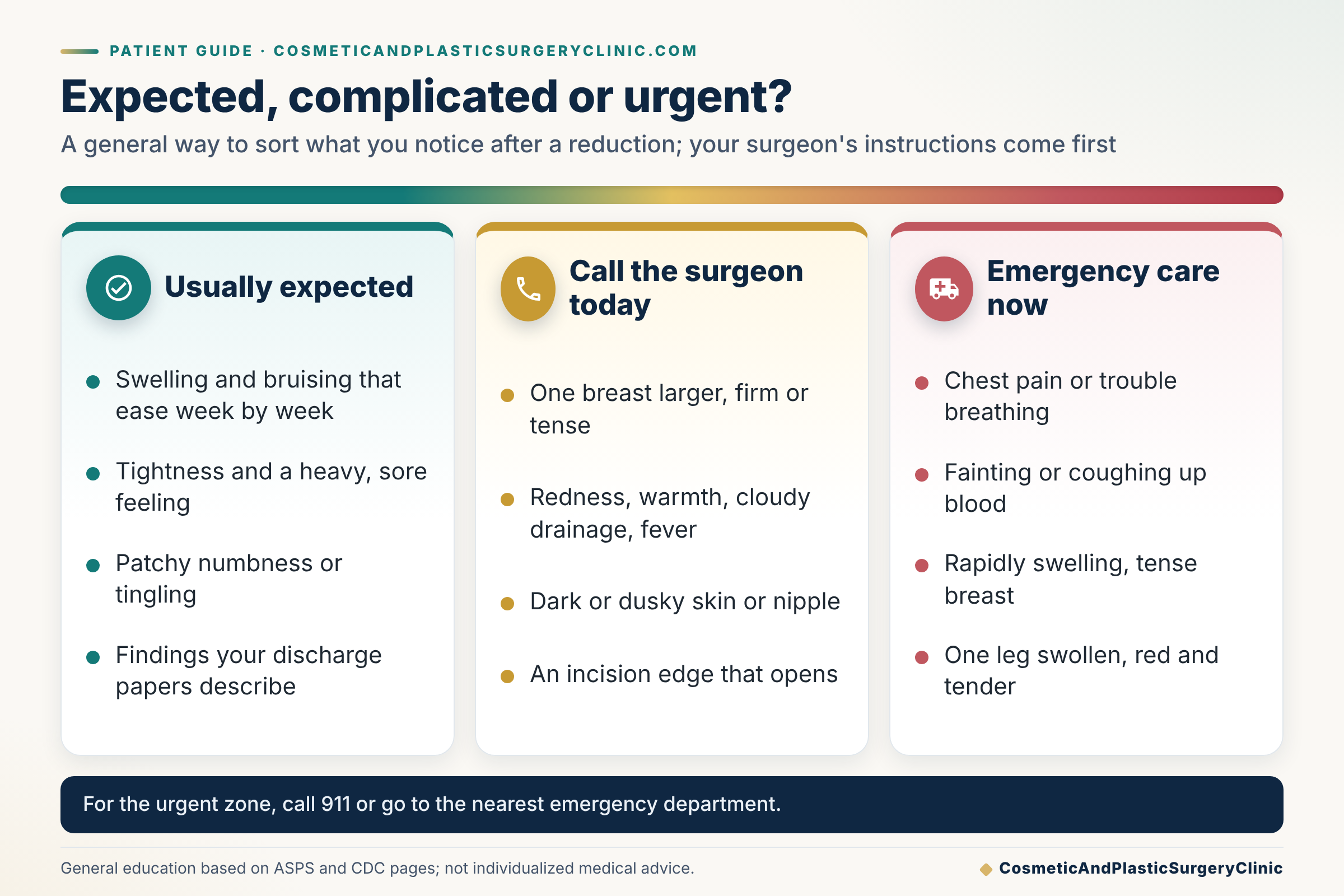
Sorting breast reduction risks into expected, complicated and urgent
What is usually expected after surgery
Swelling, bruising, tightness and patchy numbness
The American Society of Plastic Surgeons (ASPS) says swelling and bruising may initially obscure the final result and that full recovery can take several months. A support bra or elastic bandage is typical, a thin drain may be placed temporarily, and its week-by-week outline moves from significantly limited activity in week 1 to gradually increasing activity by weeks 4 and 5. Day-by-day detail belongs to the breast reduction recovery page.
Patchy numbness, tingling or a tight, heavy feeling in the skin is also common while nerves recover. ASPS notes that sensation changes may be temporary or permanent, so these sensations are expected in kind, though not predictable in length. Your written discharge instructions outrank any general list, including the table below.
The trend test: better each day, or one-sided and worsening
Expected effects tend to ease from one day to the next, affect both breasts about equally and match what the discharge papers describe. Findings that point to one of the breast reduction risks usually do the opposite: they are firm, growing, one-sided, hot, draining or changing color.
A practical habit is to compare each breast with the other and with yesterday, morning and evening, and write it down. A note such as “left breast tighter than right since last night” gives a surgical team far more to work with on a phone call than “everything feels swollen.”
When a finding becomes a complication
Findings that merit a same-day call
ASPS lists hematoma (a collection of blood), fluid accumulation, infection, poor wound healing, skin or tissue loss where incisions meet, and potential partial or total loss of the nipple and areola among breast reduction risks. In practice that means a breast that is suddenly larger, tense or more bruised than its partner, redness with warmth or cloudy drainage, a skin patch that turns dark or dusky, or an incision edge that opens.
The CDC lists redness and pain around the surgical area, cloudy fluid draining from the wound and fever as infection signs and advises calling your provider immediately if they appear. A same-day call costs little; waiting a week with a growing hematoma or an opening wound can cost a good deal more.
| What you notice | Usual category | General action level | Basis |
|---|---|---|---|
| Swelling, bruising and tightness in both breasts that ease week by week | Expected effect | Follow written instructions; keep daily notes | ASPS recovery page: results may stay obscured for months |
| Patchy numbness or tingling in the nipple or skin | Expected, length varies | Mention at follow-up; ask what change would be worrying | ASPS safety page: temporary or permanent |
| One breast clearly larger, firm, tense or more bruised | Possible hematoma or fluid collection | Call the surgeon the same day | ASPS risk list: hematoma, fluid accumulation |
| Redness, warmth, cloudy drainage or fever near an incision | Possible infection | Call the surgeon right away | CDC surgical site infection signs |
| Dark, dusky or pale skin or nipple; an incision edge opening | Possible circulation or wound problem | Call the surgeon the same day | ASPS: tissue loss where incisions meet; nipple loss |
| One leg swollen, tender, warm or red | Possible deep vein clot | Seek medical advice as soon as possible | CDC blood clot symptoms |
| Chest pain, trouble breathing, fainting or coughing blood | Possible clot in the lung or other emergency | Call 911 or go to the nearest emergency department | CDC blood clot symptoms |
Emergency signs that should not wait for a callback
The CDC states that about half of people with a deep vein clot have no symptoms at all, and that a lung clot can occur without leg symptoms, so the absence of a sore calf is not reassurance. The CDC also advises moving around as soon as possible after surgery; what your team expects from you on that point is worth asking about before the day of the operation.
Wound healing: the most reported of all breast reduction risks
What large studies counted
One Finnish hospital: 38% overall, 4% major
A 2022 Gland Surgery paper by Palve and colleagues reviewed 760 patients (1,338 breasts) who had reductions at Tampere University Hospital in Finland between 2014 and 2020; oncoplastic cases were excluded and the average removed weight was 460 g per breast. Any complication was recorded in 38% of patients, minor ones in 34% and major ones in 4%.
Of the minor group, 69% were wound problems that healed without antibiotics, 24% needed antibiotics and 7% were seromas. Among the 31 patients with major complications, hematoma accounted for 24 (3.2% of all patients), tissue necrosis for 4 (0.5%) and deep infection for 3 (0.4%). No total loss of the nipple-areola complex was reported. The study was retrospective and from a single center, so the pattern is informative, not predictive.
Why the same operation yields 4% in one study and 58% in another
A 2025 meta-analysis in the European Journal of Medical Research pooled 61 articles covering 71,149 patients and found that any-complication rates across studies ranged from 3.8% to 57.9%, with an average of study-level rates of 12.3%. That average is not a pooled estimate. The spread in reported breast reduction risks mostly reflects what each team counted: a small area of delayed healing that closes with dressings counts in one study and not in another.
Consider a hypothetical consultation in which a surgeon says breast reduction risks run “around 10%.” Useful follow-ups are what that figure includes, over what time window, in which patients and from whose cases. A minor wound problem and a return to the operating room are both “complications,” but they are not the same experience.
| Study and year | Population | What it reported | Main limit |
|---|---|---|---|
| Palve et al., Gland Surgery, 2022 | 760 patients (1,338 breasts), one Finnish hospital, 2014 to 2020 | 38% any complication; 34% minor; 4% major; hematoma in 3.2% of patients | Retrospective, single center |
| Baltodano et al., ASPS meeting abstract, 2016 | 7,068 reductions in the ACS-NSQIP database, 2005 to 2012 | 3.98% infection or wound disruption within 30 days | Counts only 30-day wound outcomes; conference abstract |
| NSQIP analysis, Annals of Plastic Surgery, 2019 | 9,110 bilateral reductions, 2013 to 2015 | 8.7% any complication (798 events) | 30-day window; read at abstract level |
| Ran et al., Eur J Med Res, 2025 | Meta-analysis of 61 articles, 71,149 patients | Study-level any-complication rates from 3.8% to 57.9%; average 12.3% | Mostly retrospective; definitions vary |
| Carty et al., ePlasty, 2012 | 1,068 reductions at one Boston hospital, 1995 to 2007; 279 surveyed patients responded | Hematoma, necrosis, infection or reoperation in 9.3% of responders | 26% response rate; single center |
The T-junction and other edges that heal slowly
Why tissue where incisions meet is vulnerable
Many reductions use an anchor-shaped incision, with a vertical line under the nipple, a curved line around the areola and a horizontal line in the fold beneath the breast. ASPS names skin or tissue loss where incisions meet as a risk, and its 2022 clinical practice guideline links smoking to T-junction necrosis, meaning loss of skin at the point where the vertical and horizontal lines join.
A frequently offered explanation is that the skin edges at that junction sit far from the main blood supply and carry the most tension, although the sources opened for this article do not test it. Whatever the mechanism, the practical result is usually a small wound that is slow to close. The same type of problem appears at the midline junction after abdominal surgery, discussed in the tummy tuck risks page.
Vertical versus inverted-T patterns: what the pooled data say
A 2021 meta-analysis in Aesthetic Plastic Surgery combined two randomized trials and nine observational comparisons. It found fewer overall complications with a vertical-scar technique than with the inverted-T pattern (odds ratio 2.06 in favor of vertical) and far fewer cases of wound dehiscence, the medical word for an incision opening (odds ratio 4.62). It found no significant difference in seroma, hematoma, nipple necrosis, fat necrosis or reoperation, and the authors concluded that both techniques are equally safe.
That does not make a vertical pattern the right choice for everyone. ASPS says the technique is determined by individual anatomy, and most of the pooled comparisons were observational, so the groups may not have started out alike. Ask why a given pattern was chosen for your anatomy rather than which pattern is “better.”
Fluid, blood and infection
Hematoma and seroma
A hematoma is a collection of blood; a seroma is a collection of clear fluid. Both can form in the space left after tissue is removed. In the Finnish series, hematoma was the main major complication at 3.2% of patients. The ASPS guideline reports that in one study of 2,142 procedures, patients with a body mass index (BMI) above 35 had about 2.9 times the seroma rate of others.
Among the breast reduction risks involving fluid or blood, a tense, rapidly growing, one-sided swelling is the pattern that matters most, and it is a reason for same-day contact, sometimes emergency care. Small, soft fluid pockets are more often watched and drained in the office; the ASPS guideline does not recommend routine drains at the time of surgery, citing no difference in complications in small trials.
Infection and the antibiotics question
Infection is one of the breast reduction risks the CDC addresses directly in patient guidance. Breast surgery counts as clean surgery, but the ASPS guideline describes infection rates up to 5% higher than in other clean cases. Redness, warmth, cloudy drainage and fever are the CDC’s signs, and its advice to patients includes quitting smoking before surgery and telling the surgeon about conditions such as diabetes or obesity.
On antibiotics, the guideline suggests that when standard surgical-infection protocols are followed, routine oral antibiotics after surgery are not necessary, while noting that higher-risk groups, such as patients with obesity, may need different strategies. Whether you receive antibiotics, and which, is your surgeon’s decision, not something to adjust on your own.
Nipple, areola and tissue circulation: rare problems with outsized consequences
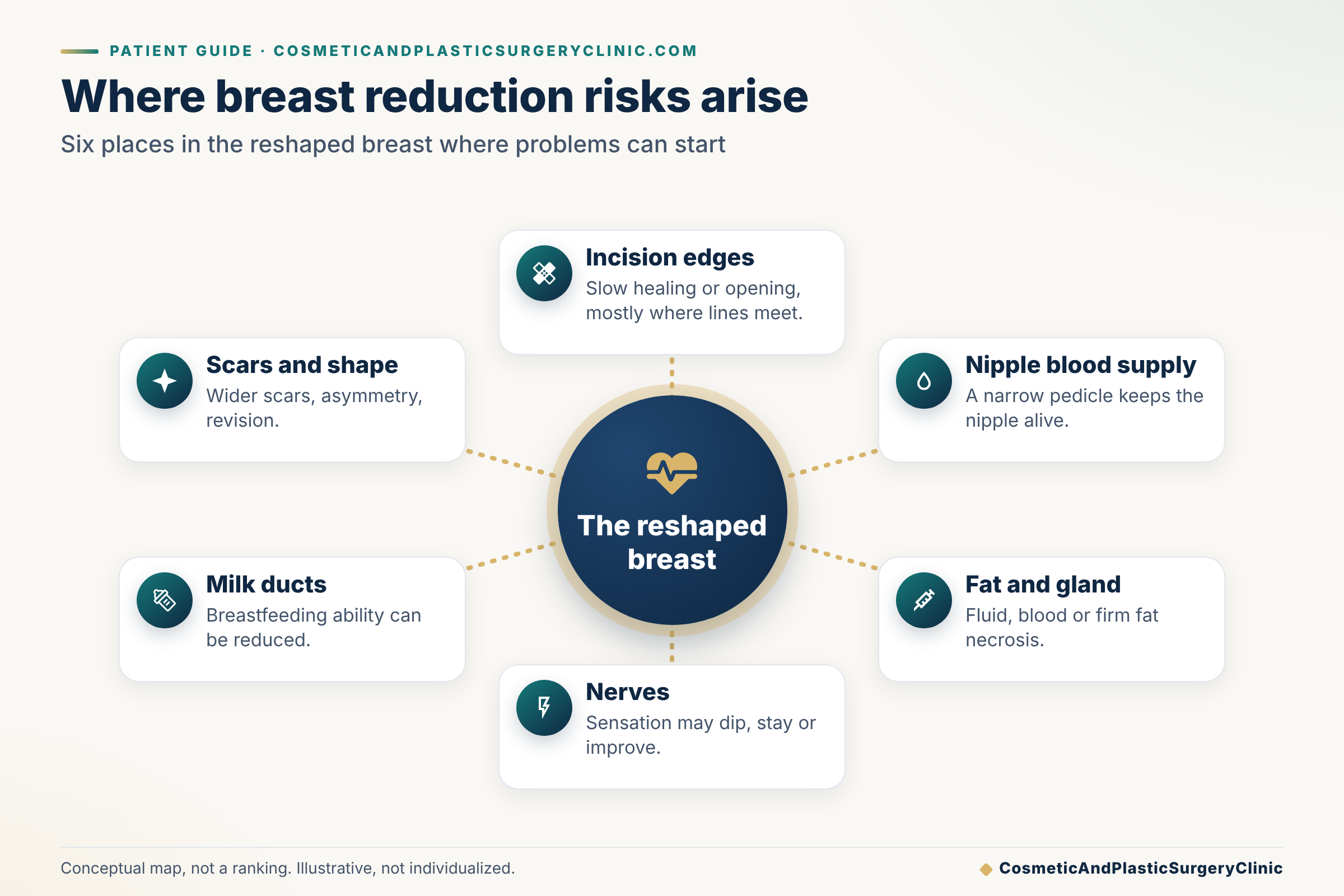
Partial or total nipple and areola loss
What the numbers suggest about how rare it is
The nipple and areola stay attached to a pedicle, a bridge of tissue that carries blood and nerves, so the question is whether that bridge keeps them alive. In the Finnish series, tissue necrosis of any kind was a major complication in 4 of 760 patients (0.5%) and no total nipple-areola loss was reported. Partial nipple necrosis was not counted separately, so a milder darkening could sit among the minor events.
A 2025 systematic review of adolescent reductions, with 11 studies and 3,289 patients, put nipple necrosis near 2% in the studies that reported it, with very high variation between studies and mostly poor-to-fair study quality. Older work agrees on the general picture: a 2002 Annals of Plastic Surgery series of 72 women found nipple-areola viability of 94% with a medial pedicle and 98% with an inferior pedicle, though the groups were chosen for different breast sizes. Together these figures show that complete loss is uncommon, not that it cannot happen.
The free nipple graft trade-off
For extremely large breasts, ASPS says a free nipple graft may be used: the nipple and areola are removed, then placed higher as a graft. The ASPS procedure page warns that grafted nipples will have no sensation after surgery and take longer to heal. That is a planned trade-off rather than a complication, made when keeping the pedicle would put the nipple’s blood supply at risk.
The possibility is worth raising at the consultation. Ask whether a graft is likely for your anatomy, what loss of sensation would mean in daily life, and whether breastfeeding is realistic with that technique. The sibling page on breast reduction breastfeeding takes up the last question.
Fat necrosis and firm areas in the breast
What fat necrosis is and which patients studies flag
Fat necrosis occurs when part of the fatty tissue loses blood supply and hardens, often feeling like a firm lump. ASPS lists “excessive breast firmness and fat necrosis” among breast reduction risks. In the ASPS guideline’s summary, patients with a BMI above 35 had about double the fat necrosis risk in one study of 2,142 procedures, and the 2025 meta-analysis found a pooled odds ratio of 2.56 for fat necrosis with BMI of 30 or higher.
Firm areas vary in size and in when they are noticed. Because a lump after reduction can also be something else, new firmness deserves an examination and, where the clinician advises, imaging, not reassurance from a web page. Keeping your operative report and any pathology result makes those later conversations much easier.
How necrosis connects to satisfaction
Among breast reduction risks, tissue loss does more than add a procedure. In a 2012 ePlasty study of 279 women who answered the BREAST-Q questionnaire after reductions at one Boston hospital, necrosis was the factor most consistently linked to lower scores. Satisfaction with the breasts averaged 50.2 with necrosis versus 68.1 without, and satisfaction with the overall outcome averaged 64.4 versus 83.3.
Only about a quarter of surveyed patients responded, and the study could not follow individuals over time, so the gap is a signal, not a measurement for any one person. It does support a simple point for planning: the risks that damage tissue matter more to how people feel afterward than the ones that heal with dressings.
Who carries higher breast reduction risks: patient, operation and team factors
Patient factors with the most consistent signals
Body mass index, nicotine and prior radiation
The 2025 meta-analysis found higher odds of any complication with a BMI of 30 or more (odds ratio 1.59), smoking (1.80) and prior breast radiation (3.24); BMI was also tied to delayed healing, fat necrosis, dehiscence and wound infection. The ASPS guideline puts the evidence for counseling on BMI above 35 and chronic corticosteroid use at moderate strength, and says nicotine users should be referred to cessation programs and encouraged to quit before surgery, citing 2 to 5 times higher complication odds in smokers.
A 2016 ASPS meeting abstract from the NSQIP database (7,068 reductions) found about 1.3 times higher odds of 30-day wound problems for each 5-unit rise in BMI, 1.6 times for smoking and 3.5 times for steroid use. These patient-level breast reduction risks are population associations, not cutoffs: how a surgeon treats a given BMI or nicotine history varies, and the factors surgeons weigh are outlined in the breast reduction candidate page.
Age, diabetes and resection weight: where studies disagree
Not every factor behind breast reduction risks behaves consistently. The ASPS guideline says risk may be higher above age 50, yet the Finnish series found higher odds in patients under 50 (odds ratio 1.87) and the 2025 meta-analysis found no significant age effect at 50 or older. For diabetes, the meta-analysis found an odds ratio of 1.41 that its own sensitivity analysis showed to be unstable, while the guideline reported no association between diabetes and complications.
Resection weight shows the same ambiguity. The Finnish series linked 650 g or more per breast to about twice the odds (2.02), while the meta-analysis found 1,000 g or more raised odds by 1.64 with a confidence interval of 0.99 to 2.71, just short of significance. Heavier resections can occur in larger breasts and at higher BMI, so the signals tangle together.
| Factor | What studies found | Question to ask | What stays uncertain |
|---|---|---|---|
| Body mass index | Meta-analysis: BMI 30 or more, odds ratio 1.59; ASPS guideline counsels more risk above 35 | How does my BMI change the plan or the timing? | Cutoffs differ; few studies include very high BMI |
| Smoking or nicotine | Guideline: 2 to 5 times the odds; meta-analysis: odds ratio 1.80 | How is nicotine-free status confirmed, and for how long before surgery? | High heterogeneity; vaping and replacement products not covered |
| Resection weight | Finnish series: 650 g or more per breast, odds ratio 2.02; meta-analysis at 1,000 g: 1.64, not significant | How much tissue do you expect to remove, and does that change the technique? | Thresholds differ and overlap with breast size and BMI |
| Age | Guideline: possibly higher above 50; Finnish series: higher under 50; meta-analysis: no effect | Does my age change anything in this plan? | Studies point in different directions |
| Diabetes | Meta-analysis: odds ratio 1.41, unstable; guideline: no association | How is blood sugar managed around surgery? | Conflicting findings and small numbers |
| Prior breast radiation | Meta-analysis: odds ratio 3.24 for any complication | Does my treatment history change the technique? | Few patients; wide confidence interval (1.94 to 5.40) |
| Pedicle technique | Inferior versus superomedial: 1.59 in the meta-analysis; no difference in matched comparisons | Which pedicle do you plan for my anatomy, and why? | Choice tracks breast size and surgeon preference |
Operation and team factors
Pedicle choice and skin pattern
The ASPS guideline calls both the superomedial and inferior pedicle techniques acceptable and says other techniques were not reviewed. Unadjusted figures can mislead: it cites a study in which overall complications were 25.6% with a superomedial pedicle and 47.1% with an inferior pedicle, but no difference once cases were matched for age and resection weight. The Finnish series likewise had 36% complications with a superomedial pedicle against 50% with an inferior one, before adjustment.
The meta-analysis, by contrast, found higher odds of any complication with an inferior pedicle than with a superomedial one (1.59), with more wound infection but fewer seromas. A fair reading is that pedicle choice shifts breast reduction risks in both directions rather than acting as a good-or-bad switch, and that the surgeon’s experience with the chosen technique carries weight that these studies cannot measure.
Surgeon experience, setting and a seasonal surprise
Experience is hard to study because it travels with case selection. A 2012 ePlasty follow-up of 1,068 reductions found no significant relationship between rising surgeon experience and patient satisfaction, which says little about complications. The NSQIP abstract adds a signal of its own: resident participation carried about 1.5 times the odds of wound problems, a reminder to ask who performs which parts of the operation.
Choosing the surgeon and facility is a separate skill, covered in the guide to choosing a plastic surgeon. For this topic the useful questions are concrete: who administers and monitors anesthesia, whether an emergency transfer agreement exists, what happens if a problem appears overnight and who the first call goes to.
Sensation, scars, shape and revision: the longer-term breast reduction risks
Nipple and breast sensation
Two studies, two very different percentages
Published breast reduction risks for sensation loss differ by more than tenfold, and the gap is mostly about method. A 2025 meta-analysis in JPRAS Open, covering 17 studies, 843 patients and 1,685 breasts, looked only at nipple-carrying pedicle reductions removing more than 1,000 g and found a pooled sensation loss of 1.3% (95% confidence interval 0.7% to 2.0%). The authors called that exceptionally low.
A 2022 review in Plastic and Reconstructive Surgery Global Open of 274 patients at one institution tested sensation by finger touch and recorded whether patients found it decreased, unchanged or increased. Decreased sensation was reported for 19% of breasts, unchanged for 74% and increased for 7.3%. The two results need not contradict each other: the populations differ (very large reductions in one, all primary bilateral cases in the other) and the second counts any reported decrease. Whenever a consultation includes a sensation figure, ask which definition it uses.
Pedicle type, resection amount and recovery over time
In that 2022 study, decreased sensation was more frequent after vertical-scar, superomedial-pedicle reductions than after Wise-pattern, inferior-pedicle ones (26% versus 13%), and more frequent in patients who had a minor complication (23% versus 15%). The ASPS guideline, summarizing another study, describes the opposite direction for pedicle type, with the inferior pedicle reducing sensation in some zones while the superomedial did not. Evidence on pedicle and sensation is therefore unsettled.
A 2002 series found that nipple sensation was retained in 86% of breasts with a medial pedicle and 92% with an inferior pedicle at a mean follow-up of 25 months, and that the amount of tissue removed did not correlate with sensory outcome. ASPS says that although surgery may interfere with sensation, most of the time nipple sensation improves over time, and that changes may be temporary or permanent. Neither source gives a firm timeline for an individual.
Scars that heal differently than hoped
What a scar can and cannot be promised to do
ASPS says incision lines do not disappear but in most cases fade over time, and lists unfavorable scarring, skin discoloration and pigmentation changes among the risks. Surgeons commonly point to tension, genetics, skin type, sun exposure and how the wound heals as influences, and a wound that opened and healed slowly can leave a wider scar. None of the sources opened for this article gives a reliable percentage for poor scarring after reduction, so any number you hear needs its source.
That is also why the earlier point about definitions matters: scarring is partly a matter of taste. A 2013 Aesthetic Surgery Journal survey of 60 patients shown drawings and photos of three scar patterns rated the horizontal pattern higher than the vertical or Wise patterns, which did not differ from each other. It measured hypothetical preference, not outcomes, and the sample was small.
Choosing a pattern: scar length, safety and what photos can show
Scars are the most visible of the breast reduction risks. Pattern selection trades scar length against how much skin and tissue can be reshaped safely. A shorter scar is not automatically better if the breast shape it leaves is not what you wanted, and a longer one is not automatically worse. The breast lift scars page compares the same patterns on the lift side, and the breast reduction photos page explains how to read scar photos by months since surgery, lighting and body position.
When you look at consultation albums, check how long after surgery each photo was taken. Scars change in color and texture over many months, so a photo from week 8 and one from year 2 can show very different scars on the same person.
Asymmetry, contour changes, regrowth and revision
Why some asymmetry is expected and some is a risk
Breasts are rarely identical before surgery, and an operation does not make them twins. ASPS lists asymmetry and contour or shape irregularities among breast reduction risks, and swelling can make one side look different from the other for weeks. Among breast reduction risks, asymmetry depends on timing: a difference that is stable and small after several months is a different question from a difference that is growing or accompanied by firmness, pain or skin changes.
Ask for your own before photos with measurements noted, so that natural asymmetry is documented. Ask also what size or shape difference the surgeon would consider worth correcting, and when, because judgments made while swelling persists can change. For comparing a shape-focused alternative, see the breast reduction versus breast lift page.
Reoperation and regrowth: what the figures show
The ASPS list of breast reduction risks includes the possibility of revisional surgery. In the ePlasty survey study of 1,068 reductions at one Boston hospital, reoperation was reported by 4.7% of surveyed patients who responded and 2.4% of non-responders, and was not significantly associated with satisfaction. Response was only 26%, so the true figure for that hospital is uncertain.
Breasts can also regrow. A 2025 review of adolescent reductions, with mostly poor-to-fair evidence and very high variation, reported pooled recurrence of 15.6% (confidence interval 8.5% to 26.9%), and ASPS notes that pregnancy and weight fluctuations can change the outcome of earlier surgery. Revision terms, including who pays for a surgical fee, facility time and anesthesia, are a line item in any quote; see the breast reduction cost page.
Breastfeeding, pathology and anesthesia: breast reduction risks outside the wound
Breastfeeding ability
What the pooled studies report
ASPS says surgery may limit breastfeeding but that most women can still breastfeed after reduction, and it lists potential inability to breastfeed as a risk. A 2024 Aesthetic Plastic Surgery review of 33 papers found that women who had reduction mammaplasty had 3.5 times the odds of being unable to breastfeed compared with controls, with about 62% of reduction patients succeeding; by pedicle, success was 64% with inferior, 59% with superior and 55% with lateral pedicles.
Individual studies disagree on which technique is best. A 2008 series of 105 women who had a child after reduction found breastfeeding rates of 60.7% with a superior pedicle and 43.5% with an inferior pedicle, the reverse of the pooled ordering. The ASPS guideline notes that definitions of success were inconsistent. For the full picture, read the page on breast reduction breastfeeding.
Why the question belongs before surgery
Breastfeeding questions belong before surgery, when technique and timing are still choices. A reader who may want to breastfeed in future can ask the surgeon how the planned technique treats the glandular tissue behind the nipple, what the surgeon’s own experience is, and whether timing the operation after childbearing is a reasonable alternative.
There is also the possibility that wanting to breastfeed later and needing relief now point in different directions. That conflict is a legitimate reason for a second opinion, and for lactation-support planning with an obstetric or lactation professional if surgery goes ahead before pregnancy.
The pathology report and breast screening
Incidental findings in removed tissue
The ASPS guideline recommends sending the removed tissue for pathologic evaluation, and reports abnormal findings in 3% to 10% of specimens and malignancy in 0.9% to 2.4%, with risk rising above age 40. A 2025 ePlasty systematic review of 23 articles found incidental carcinoma ranging from 0.0% to 2.0% (median 0.4%) in studies using both imaging and pathology, and all 23 recommended routine pathology.
This is not one of the breast reduction risks in the strict sense, but it is a finding that the operation can produce, and a patient should know the possibility exists and how results will be communicated. Ask how the report reaches you and who explains it.
Why imaging before surgery does not replace pathology
A 2017 Journal of Plastic, Reconstructive and Aesthetic Surgery study of 918 Finnish women found abnormal pathology in 10% and breast cancer in 1.2%, and 81% of those with abnormal pathology had normal imaging beforehand. The ASPS guideline offers no formal recommendation on imaging and finds no evidence for or against routine pathology under age 40.
ASPS’s recovery outline lists routine mammograms from week 6 onward, as your surgeon directs. Operative changes, scar tissue and fat necrosis can alter how a mammogram looks, so telling the imaging team you had a reduction, and bringing the operative report, is a sensible habit.
Anesthesia, clots and the rest of the general list
Anesthesia and general surgical risks
ASPS says the operation is done under intravenous sedation or general anesthesia, whichever the surgeon recommends, and lists anesthesia risks, cardiac and pulmonary complications and blood clots with deep vein thrombosis among the general breast reduction risks. These apply to many operations and depend heavily on health history, so they are matters for the anesthesia provider and your own physician.
Which medicines, if any, are used to lower clot risk is a team decision. Ask who will assess your clot risk, what steps are planned and when you will be expected to start walking. The CDC’s emergency symptoms listed earlier in this article apply for the whole recovery.
Persistent pain, allergies, piercings and deeper structures
The ASPS safety page also lists persistent pain, allergies to tape, sutures, glues and topical or injected agents, and damage to deeper structures such as nerves, blood vessels, muscles and lungs. It notes that breast and nipple piercings can cause infection. These breast reduction risks are less often discussed than wound problems but belong on the consent form discussion.
Tell the team about any previous reaction to adhesives or medications, and about piercings, well before the day of surgery. Your list of allergies is information only you can supply, and a pre-operative visit is the best time to give it.
Turning breast reduction risks into six questions for your surgeon
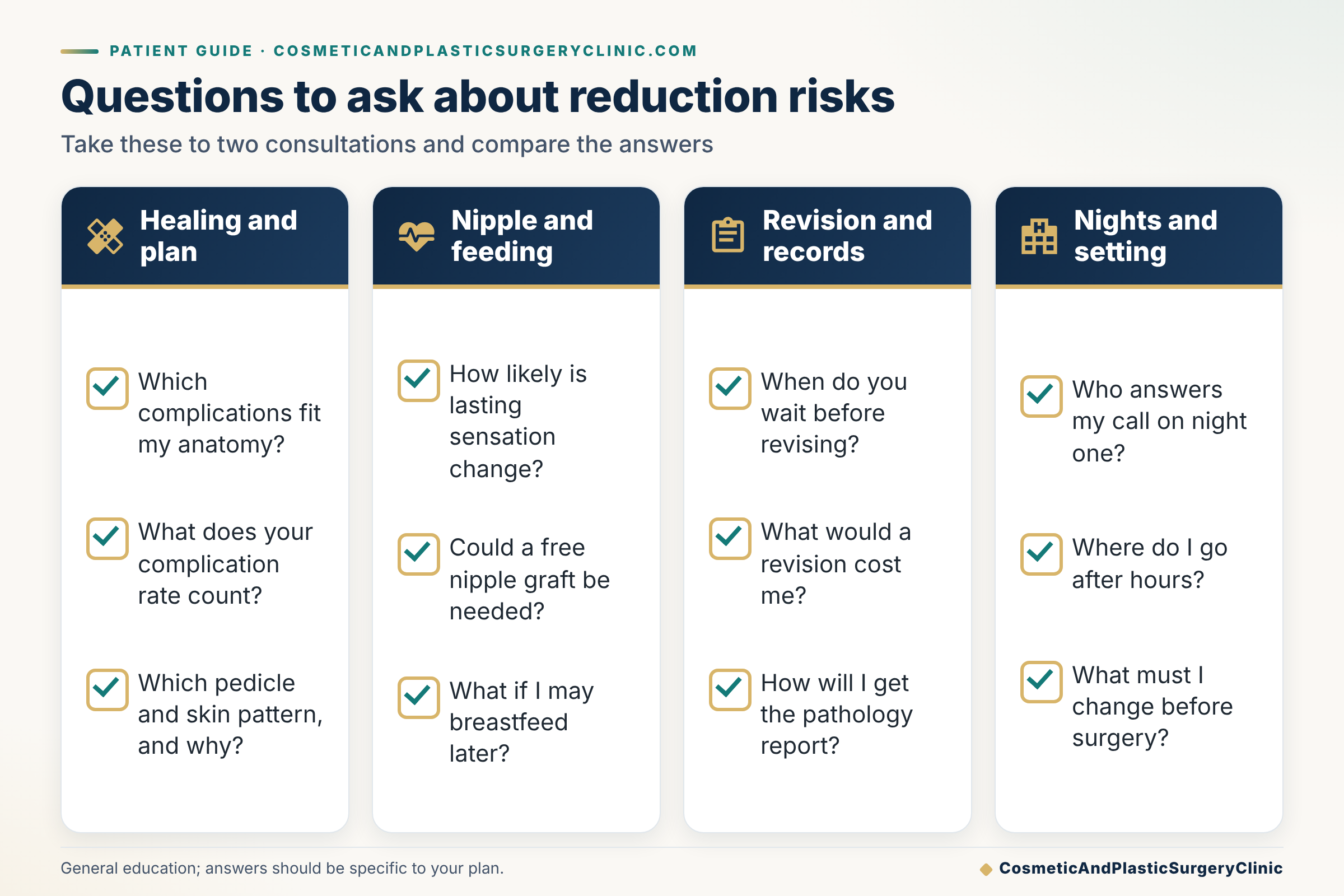
Six questions to take to the consultation
The list, in the order the risks tend to matter
Questions work best when they ask for specifics and are put to more than one surgeon. The general consultation skills, including how to judge evasive answers, are in the consultation questions page; these six are particular to breast reduction risks.
- Which complications are most likely for my anatomy, BMI and planned technique, and what does your own complication figure count?
- Which pedicle and skin pattern do you plan, and what would make you change that plan during surgery, including a free nipple graft?
- How likely is a lasting change in nipple sensation, and if I may breastfeed, how does this technique treat the tissue behind the nipple?
- What is your revision policy: when do you wait, what would it cost me and how often do your patients need reoperation?
- What do you want me to change before surgery, such as nicotine use, and how will you check?
- Who answers my call on the first nights, where do I go after hours and how will I receive the pathology report?
What a useful answer sounds like
A useful answer names a definition and a denominator: “I count wound separation that needed more than dressings, out of all my reductions over the past five years.” It separates minor events from return-to-surgery events, says what the surgeon does when a problem appears and does not treat the question as an insult.
Warning signs in an answer are a single reassuring number with no definition, a promise that you will have no problems, or a dismissal of the nicotine, BMI or breastfeeding questions. The best time to learn how a team handles uncertainty is before you sign, not after a problem appears.
Weighing breast reduction risks against waiting or other options
What the benefit side looks like
Breast reduction risks only make sense against what the operation is for. ASPS says women almost always report that smaller breasts significantly reduce back pain, and that nearly all women experience a significant reduction in bra strap pain. These are ASPS statements without a stated population, so treat them as a direction, not a forecast.
The 2022 ASPS guideline gives its strongest recommendation, with high-quality evidence, to offering reduction as a first-line option to symptomatic patients after menarche, based on symptoms instead of resection weight. Weighing breast reduction risks therefore means weighing them against your specific symptoms, not against an abstract list.
Non-surgical steps, second opinions and waiting
Supportive bras, physical therapy for neck and back pain and skin care for rashes are common non-surgical steps. Whether they are enough depends on what the symptoms are and how severe, which is a clinical question rather than a moral one. BMI is one variable surgeons weigh when planning for safety; it is not a judgment of character.
Waiting is a legitimate choice, and a second opinion is a normal part of the process, particularly if breastfeeding plans, nicotine use or a health condition complicate the picture. Documentation of symptoms and the steps already tried is covered in the sibling pages on breast reduction candidacy; none of this requires a decision this week.
Frequently asked questions
How often do breast reduction risks lead to another operation?
No single figure applies. Studies count reoperation differently: some include small office procedures, others only returns to the operating room. In the surveyed Boston series, 4.7% of responders reported reoperation, and a Finnish series recorded major complications in 4% of patients. Both describe single hospitals. Ask a prospective surgeon for their own reoperation figure, what it includes and over what period, and what their policy is on the cost of revisions.
Can I lower my breast reduction risks before surgery?
Some factors can be changed and others cannot. The CDC and ASPS guideline both advise quitting smoking before surgery, and the CDC advises telling the surgeon about conditions such as diabetes or obesity. Beyond that, the useful step is a candid health history, including medicines and supplements, because adjustments are the surgical team’s decision. Ask what they want changed, by when, and how nicotine-free status is checked.
Do I need a mammogram, and does it change breast reduction risks?
Practices vary. The ASPS guideline makes no formal recommendation on pre-operative imaging, and in one Finnish study most abnormal pathology findings followed normal imaging. ASPS’s recovery outline lists routine mammograms from week 6 onward. Bring your screening history to the consultation, ask whether imaging is advised for your age and history, and keep the operative report for your imaging team.
Is a free nipple graft a complication or a technique choice?
It is a technique choice with its own trade-offs. ASPS says it may be used for extremely large breasts and that grafted nipples have no sensation and take longer to heal. It differs from nipple loss, which is an unplanned complication where tissue does not survive. Ask whether a graft is likely for your anatomy, whether it can be decided in advance and what recovery looks like.
Among breast reduction risks, how long do nipple sensation changes last?
No source opened for this article gives a firm timeline for an individual. ASPS says most of the time nipple sensation improves over time, and that changes may be temporary or permanent. Studies disagree on how often sensation drops, partly because they define it differently. Tell the surgeon at follow-up visits what you notice, since a change that is getting better is handled differently from one that is not.
Are breast reduction risks different for teenagers?
Evidence on breast reduction risks in teenagers is thinner and more variable. ASPS says surgery can be done at any age but breasts ideally should be fully developed, and the 2022 guideline addresses patients after menarche. A 2025 review of 3,289 adolescents reported pooled complications of 17.5% and recurrence of 15.6%, with very high variation and poor-to-fair study quality; none of the studies assessed later lactation. Planning is individual and usually involves the family and a surgeon experienced with this group.
Could liposuction alone avoid the incision-related breast reduction risks?
ASPS describes liposuction as an addition to the excision techniques rather than a standalone option, and whether it suits a given breast depends on its tissue composition, which only an examination can show. It also brings its own list of concerns, covered in the liposuction risks page. If you want to explore it, ask the surgeon what it would and would not change for your symptoms.
How should I compare complication rates quoted by two surgeons?
When comparing breast reduction risks, compare definitions before numbers. Ask whether minor wound problems that healed with dressings are included, whether the figure covers a fixed window such as 30 days, how many cases it comes from, and who counted. A lower rate from a narrower definition is not better. A surgeon who can explain the figure, its limits and their own revision policy is more informative than one who quotes the lowest percentage.
Sources and further reading
- American Society of Plastic Surgeons — Breast reduction (accessed 2026-11-12) — reported symptom benefits
- American Society of Plastic Surgeons — Breast reduction safety (accessed 2026-11-12) — list of risks, sensation, breastfeeding, scarring, revision
- American Society of Plastic Surgeons — Breast reduction procedure (accessed 2026-11-12) — pedicle and free nipple graft, anesthesia, incision lines
- American Society of Plastic Surgeons — Breast reduction recovery (accessed 2026-11-12) — support bra, drains, activity outline, mammograms
- American Society of Plastic Surgeons — Evidence-based clinical practice guideline revision: reduction mammaplasty, Plastic and Reconstructive Surgery (2022) (accessed 2026-11-12) — recommendations on risk factors, pedicles, drains, pathology, antibiotics
- Gland Surgery (2022) — Predictive risk factors of complications in reduction mammoplasty: analysis of three different pedicles (accessed 2026-11-12) — 760 patients, complication rates and risk factors
- European Journal of Medical Research (2025) — Risk factors for complications after reduction mammaplasty: a systematic review and meta-analysis (accessed 2026-11-12) — 61 articles, pooled odds ratios
- ASPS annual meeting (2016) — A validated multi-institutional approach to optimizing outcomes of reduction mammoplasty: a critical analysis of 7,068 patients, abstract (accessed 2026-11-12) — NSQIP risk factors, 30-day wound outcomes
- Annals of Plastic Surgery (2019) — National Surgical Quality Improvement Program analysis of 9110 reduction mammaplasty patients, abstract via QxMD (accessed 2026-11-12) — 30-day complications, age, smoking, diabetes
- ePlasty (2012) — Patient satisfaction and surgeon experience: a follow-up to the reduction mammaplasty learning curve study (accessed 2026-11-12) — BREAST-Q, necrosis, reoperation
- Plastic and Reconstructive Surgery Global Open (2025) — Complications and satisfaction after adolescent breast reduction for juvenile macromastia: systematic review and meta-analysis (accessed 2026-11-12) — adolescent complications, recurrence, nipple necrosis
- JPRAS Open (2025) — Sensory preservation in reduction mammoplasty using the nipple-areola complex-carrying pedicle technique for gigantomastia, abstract (accessed 2026-11-12) — pooled sensation loss
- Plastic and Reconstructive Surgery Global Open (2022) — Impact of patient and operative factors on nipple-areola complex sensation after bilateral reduction mammaplasty, abstract (accessed 2026-11-12) — decreased, unchanged and increased sensation
- Annals of Plastic Surgery (2002) — Viability and sensation of the nipple-areolar complex after reduction mammaplasty, abstract via QxMD (accessed 2026-11-12) — viability and sensation by pedicle
- Aesthetic Plastic Surgery (2024) — Breastfeeding ability after breast reductions: what does the literature tell us in 2023? (accessed 2026-11-12) — 33 papers, pooled breastfeeding odds
- Aesthetic Plastic Surgery (2008) — Breastfeeding after reduction mammaplasty using different techniques, abstract via QxMD (accessed 2026-11-12) — breastfeeding rates by pedicle
- Aesthetic Plastic Surgery (2021) — Vertical scar versus inverted-T scar reduction mammaplasty: a meta-analysis and systematic review (accessed 2026-11-12) — complications and dehiscence by pattern
- Aesthetic Surgery Journal (2013) — Breast reduction scars: a prospective survey of patient preferences (accessed 2026-11-12) — scar pattern preference, 60 patients
- ePlasty (2025) — Incidental breast carcinoma in reduction mammoplasty: a systematic review (accessed 2026-11-12) — incidental carcinoma rates, pathology recommendation
- Journal of Plastic, Reconstructive and Aesthetic Surgery (2017) — Should we routinely analyze reduction mammaplasty specimens? Abstract record (accessed 2026-11-12) — 918 women, abnormal pathology and imaging
- Centers for Disease Control and Prevention — About blood clots (accessed 2026-11-12) — clot symptoms, moving after surgery
- Centers for Disease Control and Prevention — About surgical site infections (accessed 2026-11-12) — infection signs, when to call, smoking