Search for lipo online and you’ll meet a long menu of abbreviations: SAL, PAL, UAL, LAL, RFAL, WAL, plus brand names that sound more like gadgets than surgical methods. This guide explains liposuction techniques in plain English: what separates one approach from another, what each is designed to do, where the trade-offs sit, and how much of the marketing around them is actually backed by evidence. It is a technique-level companion to our complete guide to liposuction, so it won’t re-explain the whole operation, only the part where the methods diverge.
Most people arrive here after a consultation or an ad has used a term they couldn’t quite decode. That’s a reasonable moment to slow down. Technique names describe tools and sequences; they don’t describe results. A method can be well established and still be the wrong fit for a given body area, and a newer method can be heavily advertised without having shown that it does better than a simple, long-used one.
Two ground rules for the rest of the page. First, this is general education, not a recommendation for any individual; a board-certified plastic surgeon who has examined you is the right source for that. Second, wherever the research is thin, we say so plainly. You’ll see phrases like “low-certainty evidence” and “reported in one dataset” on purpose, because the honest answer to many technique questions is that nobody has run the definitive head-to-head study yet.
If you only want the highlights, the sections are arranged so you can jump around: the building blocks every technique shares, the mechanical methods, the energy-assisted methods, how area and tissue steer the choice, what the evidence really shows, how safety and recovery differ, and finally a decision framework with questions to bring to a consultation.
The Building Blocks: What Varies From One Liposuction Technique to Another
When a clinic says it offers “advanced lipo,” the phrase can mean several different things at once. Liposuction techniques are really bundles of separate choices, and it helps to pull them apart. One choice is how the tissue is prepared before any fat is removed. Another is the mechanism used to loosen fat, if any. A third is the hardware that physically reaches the fat: the cannula, its diameter and tip, and the small incisions it passes through. Two procedures labeled with the same technique name can still differ in all three.
The table below is a terminology map. Patients often meet a brand name first and the clinical name second, or never hear the clinical name at all. Matching the two is the first step toward asking useful questions.
| Name you may see | Clinical category | What the term usually means | Common mix-up |
|---|---|---|---|
| Tumescent lipo | Infiltration approach | Large volumes of dilute fluid placed in the fat before removal; used with most other techniques | Treated as a separate “type” rather than the preparation step for many types |
| Traditional or conventional lipo; SAL | Suction-assisted liposuction | Fat removed with a blunt cannula connected to a suction source, moved by the surgeon’s hand | Assumed to be outdated, though it remains the common comparison standard |
| Power lipo; PAL | Power-assisted liposuction | Cannula moves rapidly back and forth under motor power | Mistaken for an energy device that heats tissue |
| Water lipo; WAL | Water-assisted liposuction | A fine pressurized spray of fluid loosens fat as the cannula works | Confused with plain tumescent infiltration |
| Ultrasound lipo; UAL; VASER-type | Ultrasound-assisted liposuction | Ultrasonic energy fragments fat before it is suctioned | Assumed to be one single device or to guarantee tighter skin |
| Laser lipo; LAL; “lipolysis” | Laser-assisted liposuction | A laser fiber delivers heat to fat, followed by suction or drainage | Confused with external laser or “cold laser” fat treatments that do not involve incisions |
| RF lipo; RFAL | Radiofrequency-assisted liposuction | A probe under the skin delivers radiofrequency heat, often alongside suction | Confused with external radiofrequency skin-tightening treatments |
| HD lipo; lipo etching | A goal and sculpting strategy | Selective fat removal and preservation to emphasize muscle contours, often using ultrasound or other devices | Treated as a device rather than a design philosophy |
Infiltration: Preparing the Tissue Before Any Fat Is Removed
Nearly every modern approach begins the same way, by placing fluid into the fat layer before removal. The fluid, and how much of it is used, defines what surgeons call dry, wet, superwet and tumescent technique. Understanding this step matters because it carries both the main benefits of today’s liposuction and some of its most important safety questions.
What Tumescent Fluid Is, Conceptually
Tumescent infiltration means filling the targeted fat until it becomes firm and swollen. The fluid is typically an isotonic salt solution, meaning it has a salt balance similar to body fluids, mixed with a dilute local anesthetic (lidocaine) and a small amount of epinephrine, a drug that narrows blood vessels. Operating room references describe the solution as isotonic crystalloid with dilute epinephrine and low-concentration lidocaine, infiltrated roughly in proportion to the amount of fat expected to be removed. Cleveland Clinic’s clinician-facing overview credits Klein with introducing the tumescent technique in 1987, describing it as local anesthetic infiltration that reduced bleeding and made larger fat volumes practical to remove.
The 2003 Practice Advisory on Liposuction from the American Society of Plastic Surgeons (ASPS) is useful for vocabulary. It describes a dry technique with no fluid, a wet technique with a modest amount of fluid, a superwet technique with about one part fluid for each part of fat to be removed, and a tumescent technique that uses roughly three to four parts fluid per planned part of fat. The advisory cautioned against the dry technique in all but very small removals and said it should never be paired with ultrasound-assisted liposuction. It is more than twenty years old, so treat it as a historical anchor for terminology rather than a current standard of care, but its definitions are still the ones most clinicians use.
The fluid does several jobs. It makes fat easier to move through a cannula, helps limit bleeding through vessel narrowing, delivers numbing that can reduce how much general anesthetic is needed, and creates a cushion that separates the working layer from structures deeper down. A patient who hears “we use tumescent” should understand that this describes a preparation step and says very little about which tool will loosen and remove the fat afterward.
Lidocaine and Epinephrine: A Safety Framing Without Dosing
Lidocaine is the part of tumescent fluid that deserves respect. Lidocaine absorbed into the bloodstream in high amounts can affect the heart and nervous system, a problem called local anesthetic systemic toxicity. The reason tumescent practice has been considered workable is that the drug is diluted, placed in fat that has relatively little blood flow, and slowed further by epinephrine, so absorption is gradual. An Anesthesia Patient Safety Foundation newsletter from 1999 explained that blood levels rise slowly and peak many hours after infiltration, rather than within minutes as with a conventional injection. Current anesthesia teaching material makes the same point and adds that the risk window can extend for hours after the operation ends.
That delayed peak has practical consequences. It is one reason monitoring does not stop when the last incision is closed, and it is why facilities are expected to have a plan and the supplies to treat toxicity. It is also why a surgeon needs a complete medication list. Lidocaine is cleared by liver enzymes, and operating-room references note that many common drugs can interfere with that pathway, including some antibiotics, blood pressure medicines, antidepressants and sedatives. Never assume a supplement or prescription is irrelevant to anesthesia planning; tell the team about everything you take.
You may notice that this article does not state maximum doses. That is deliberate. The 1999 APSF piece observed that the dose ceilings printed on conventional lidocaine labeling are well below what tumescent practice uses, justified by dilution and slow absorption, and a 2016 volunteer study in Anesthesia & Analgesia proposed preliminary ceilings that differed depending on whether suction was performed, while describing its own figures as estimates. Published numbers differ by source, by patient factors and by whether suction is performed, and the advisory itself warned that a general limit may not hold for people with certain medical conditions. Dosing is a clinician’s calculation for a specific patient and setting. What you can usefully do is ask who is responsible for it, how absorption will be monitored, and what happens if a problem arises.
Cannulas, Incisions and the Path Through the Fat
The second set of variables is mechanical. A cannula is a narrow, hollow metal tube that carries suction into the fat, and its design influences how much tissue is disturbed and how smooth the surface ends up.
Cannula Size, Tip Design and Motion
Modern liposuction cannulas are blunt rather than sharp, with openings near the tip, a design that reduces the chance of puncturing deeper structures and cuts bleeding compared with older sharp-tipped instruments. A StatPearls reference article, last updated in 2023, notes that larger-diameter cannulas disturb more tissue and are associated with greater trauma and blood loss. In general terms, surgeons tend to use wider tubes for bulk removal in thicker areas and narrower ones for finishing, blending and delicate regions. Which size is chosen at which stage is part of surgical judgment, and no study has established a universally correct diameter.
Cannula motion matters too. In traditional suction-assisted work the surgeon’s arm provides the motion, sweeping in fan-like tunnels. Power-assisted systems add a motorized reciprocating action. Surgeons often describe working in crossing directions from different entry points so that removal blends smoothly, a pattern intended to limit ridges and grooves. These are craft details, but they explain why two surgeons using the same named technique can deliver different results, and why the person holding the cannula tends to matter at least as much as the label on the equipment.
Incision Placement and Access Points
Liposuction incisions are short, and surgeons generally try to place them in skin creases or other discreet locations. How many incisions are used depends on the area, the technique, and how the surgeon plans to cross-tunnel. Energy-based methods change this picture in one specific way: heat is generated at the instrument tip and along its shaft, so the skin at the entry site is exposed to more thermal stress than with a cold suction cannula. Port-site burns appear in the complication lists of large published series of ultrasound-assisted high-definition work, which is why skin protection at the entry sites is a fair question to put to any surgeon who plans to use a thermal device.
One simple habit pays off here: ask the surgeon to narrate the whole sequence for your case, from the fluid to the final pass. A thorough answer covers which incisions are used, whether any energy device or powered handpiece is involved, what size cannulas will be used at which stage, how contour is checked as the work progresses, and what dressings or garments go on at the end. Gaps in that story are informative. They may mean the surgeon relies on routine rather than a plan for your anatomy, or they may mean the question was not expected and a follow-up call will clear it up.
Small incisions still leave marks, and scars vary in how they heal from person to person and by body area. If scar appearance is a priority, ask where each incision will be placed and why, and read our overview of liposuction scars and healing for what ordinary scar maturation tends to involve. A technique that calls for more entry points, or for protective devices at those points, may mean more marks even when each one is small.
Mechanical Approaches: Suction-Assisted, Power-Assisted and Water-Assisted Liposuction
The mechanical family loosens and removes fat using motion and fluid rather than heat. It includes the long-standing suction-assisted method, the motorized variant, and the water-assisted variant. These are the approaches most likely to be described by a surgeon as “just lipo,” and they’re the ones with the longest track record in the published literature. Whether that track record translates into better results than newer tools is a different question, which later sections take up directly.
Suction-Assisted Liposuction: The Reference Point
Suction-assisted liposuction, usually abbreviated SAL and sometimes called conventional or traditional liposuction, is the version most other techniques are measured against. It’s also the one many ads treat as the thing to avoid, which says more about marketing than about outcomes.
How Suction-Assisted Liposuction Works and Why It Remains the Comparator
After tumescent infiltration, the surgeon passes a blunt cannula through the fat in repeated tunnels while a vacuum source pulls the loosened tissue into a collection canister. Negative pressure does the removing; the surgeon’s hand supplies the motion and, just as importantly, the feel. Experienced operators describe judging resistance, symmetry and remaining thickness through the cannula and by pinching and viewing the area throughout. A StatPearls clinical reference updated in 2023 describes SAL as the most widely used approach, and a Cleveland Clinic overview for clinicians says the same, noting that the method avoids working in the most superficial layer to reduce the risk of dimpling.
Real-world usage data point the same way. In a 2025 analysis of 69,424 patients from the CosmetAssure database, an insurance program covering elective cosmetic surgery across the United States between 2015 and 2022, conventional liposuction accounted for about 56.5% of cases, ahead of power-assisted at about 32%, laser-assisted at about 8% and ultrasound-assisted at about 4%. The same abstract reports an overall complication rate of 1.16% among patients who had liposuction alone. Those figures describe a mostly female population averaging 43 years of age, and they come from an insurance database rather than a controlled trial, so they show what is commonly done and how often claims were filed rather than what each method can achieve.
It also helps to be clear about what “removes fat” can and cannot mean. How much fat comes out in a session is limited by safety and by what the surgeon judges the area can lose while leaving a smooth, natural contour, not by how powerful the tool is. A more aggressive device cannot safely take a bigger bite out of a body that has already reached its limit. This is why most methods look similar when reviewers compare volumes removed, and why claims built around “removing more fat” should prompt a question about what the added volume would cost in safety or contour.
SAL’s status as the comparator has a practical effect on how you should read marketing. When a brochure says a newer method is “less traumatic” or “more precise,” the honest follow-up question is “compared with what, in which study, for which area?” For most newer approaches, reviewers who went looking for well-designed head-to-head comparisons found very few. We’ll lay out what they found in the evidence section.
Where Suction-Assisted Liposuction Runs Into Limits
Plain SAL asks the most of the surgeon’s arm and attention. In dense, fibrous tissue or when large areas are treated, the work is slow and physically demanding, which is the practical reason motorized and energy-assisted tools were developed. Fatigue can affect consistency, so the case for a power-assisted device is partly an ergonomic one: a steadier, faster pass.
SAL also carries surface-irregularity risk, as does every technique. A 2025 systematic review and meta-analysis of complications in isolated aesthetic liposuction pooled 23 studies and reported the highest rate of cutaneous irregularities for SAL, at 3.36%. The authors graded the evidence as “not gradable,” reported high heterogeneity across studies and noted that publication bias may have inflated complication estimates. A fair reading is that contour irregularity is a recognized outcome of liposuction in general and that no technique removes the risk; whether the pooled difference reflects the method or the kinds of cases, surgeons and reporting practices behind each number cannot be separated from that analysis.
There’s one more limit worth naming. Suction-assisted liposuction removes fat; it does not tighten loose skin or repair stretched abdominal muscle. If someone’s main concern is hanging skin or a bulge from separated muscles, the choice of cannula motion is the wrong place to look. Our guide to alternatives to liposuction covers the other surgical and nonsurgical routes.
Power-Assisted and Water-Assisted Liposuction
Two refinements keep the mechanical, no-heat character of SAL while changing either the motion of the cannula or the way fat is released.
Power-Assisted Liposuction: A Motor Behind the Cannula
In power-assisted liposuction (PAL), the cannula is driven by a small motor so that it moves rapidly back and forth over a short distance while the surgeon guides it. The rationale is that the vibration helps break through resistant tissue with less force from the operator. The Cleveland Clinic overview describes PAL as advantageous for large volumes and dense tissue, and the 2026 systematic review in Frontiers in Surgery summarized the available studies as reporting faster aspiration and reduced surgeon fatigue.
Those are credible, modest claims. They’re about efficiency and effort, not about a different final shape. The same review found that all modalities it examined achieved comparable fat reduction and contour improvement, and that certainty for most outcomes was low to very low. The mixed safety signals deserve honesty too. The meta-analysis mentioned above reported higher pooled rates of hemorrhage, infection and skin necrosis for PAL than for other techniques, yet the 2025 CosmetAssure analysis did not single PAL out as the highest-risk approach after adjusting for patient factors. When datasets disagree, a sensible conclusion is that the question is unsettled, not that one answer is secretly correct.
Power assistance also shows up in discussions about harvesting fat for grafting. A 2018 review of harvesting techniques in Annals of Medicine and Surgery concluded that power-assisted liposuction at appropriate pressures gave results comparable or better than manual syringe aspiration, while also stressing how hard it is to compare harvest methods when so many variables change at once. So the device is not inherently harsher on fat that will be reused, but the settings matter, and the review found no single protocol that everyone accepts.
From a patient’s seat, the realistic framing is this: a surgeon who prefers PAL is usually choosing it for consistency and stamina, especially in bulky or fibrous areas. That’s a legitimate reason. It is a different thing from a promise that power assistance will make recovery easier or the result smoother, and the research does not currently support such a promise.
Water-Assisted Liposuction: A Fluid Spray at the Tip
Water-assisted liposuction (WAL) uses a pressurized stream of fluid, delivered as a fine fan-shaped spray at or near the cannula tip, to loosen fat as it is being removed. Surgeons who favor it describe a gentler start to fat release and sometimes cite its use when the fat is going to be reused for grafting. The U.S. Food and Drug Administration (FDA) cleared a device of this type, the Body-Jet system, in August 2008 under the suction lipoplasty system regulation, with the indication “aesthetic body contouring.” That wording is the same broad indication found on ordinary suction systems, which is a useful reminder that a clearance does not distinguish better from worse.
In the 2026 systematic review, WAL was associated with less early pain and bruising, lower blood loss and shorter functional recovery in the studies that reported on those outcomes. The review also cautioned that the underlying evidence was heterogeneous, small and mostly observational. In other words, the signal is intriguing and not settled. If a clinic offers WAL, a reasonable question is how the added fluid is accounted for in the anesthesia and monitoring plan, since fluid management is part of safe large-volume work in general.
Another practical point about WAL is that it overlaps with how other techniques are prepared. Many surgeons already infiltrate generously before using any cannula, so the added value of a water jet has to be judged against that baseline rather than against dry, unprepared tissue. Patients sometimes hear “water lipo” described as a distinct, gentler procedure when the surgeon actually means ordinary tumescent preparation plus suction. Asking the surgeon to describe the sequence step by step, from fluid placement to the final pass, clears up which of the two is on offer.
One caution about terminology: registry and insurer databases use their own category names. The 2025 CosmetAssure study, for example, sorted cases into conventional, infusion-assisted, laser-assisted, power-assisted and ultrasound-assisted groups, and its abstract does not define “infusion-assisted” in marketing terms. The study found the infusion-assisted group had a notably higher adjusted risk, but only about 0.4% of patients fell into it. That finding should not be read as a verdict on water-assisted systems, because the abstract does not say that the categories match.
Energy-Assisted Approaches: Ultrasound, Laser and Radiofrequency Liposuction
The second family adds energy, almost always heat, to the equation. The pitch is easy to understand: if fat can be melted, fragmented or coagulated before it is removed, the surgeon may work through tough tissue more easily, and the heat might also encourage the overlying skin to contract. A 2025 literature review in Aesthetic Plastic Surgery describes these energy-based devices as the most heavily advertised options, often positioned as an alternative to surgical skin removal. That positioning is where the evidence gets thin and the caution gets important, since heat that reaches fat can also reach skin, nerves and other structures if it is delivered poorly.
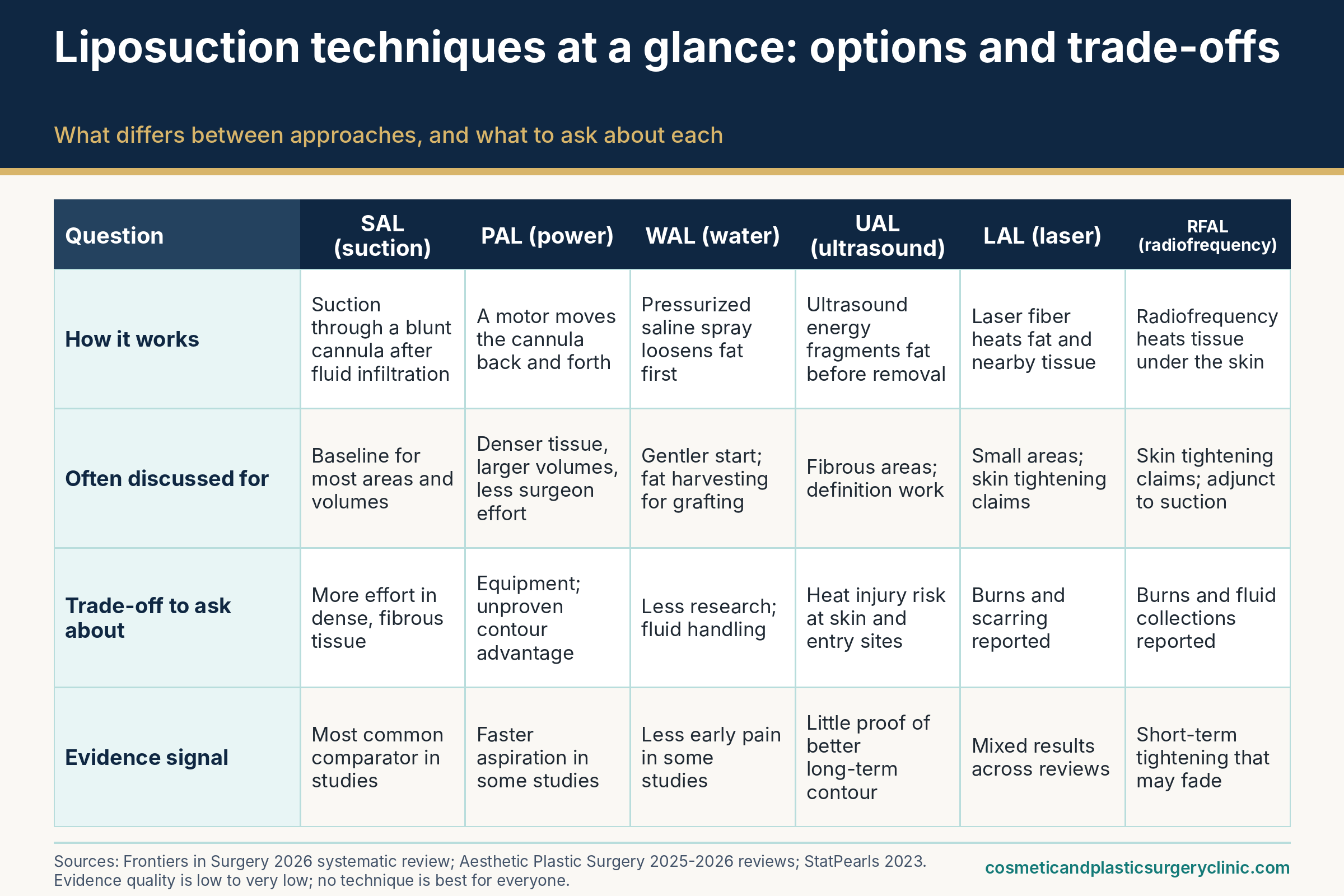
Table 2 summarizes the six approaches covered so far in one place, including the regulatory language attached to representative devices. Read the regulatory column for what it is: a statement about the legal category and wording of a device clearance, not a statement about which method gives better results.
| Technique | How fat is loosened | Designed to help with | Main trade-offs to ask about | Regulatory and evidence note |
|---|---|---|---|---|
| Suction-assisted (SAL) | Blunt cannula motion and vacuum after fluid infiltration | General fat removal across most areas | Surgeon effort in dense tissue; contour irregularity possible with any method | Suction lipoplasty systems are Class II devices whose regulation describes them as intended for aesthetic body contouring; most common comparator in studies |
| Power-assisted (PAL) | Motor-driven back-and-forth cannula motion | Dense tissue, larger volumes, reduced operator fatigue | Added equipment; no proven contour advantage | Vibrating handpieces have been cleared as part of suction lipoplasty systems; some studies report faster aspiration |
| Water-assisted (WAL) | Fan-shaped fluid spray at the cannula tip | Gentler fat release; fat harvest | Smaller evidence base; fluid management | Body-Jet cleared 2008 as a suction lipoplasty system; some studies report less early pain and bruising |
| Ultrasound-assisted (UAL) | Ultrasonic energy fragments fat before removal | Fibrous areas; detailed sculpting | Thermal injury risk at skin and entry sites; longer set-up | VASERlipo cleared 2019 for fragmentation and emulsification of subcutaneous fat for aesthetic body contouring; long-term superiority unproven |
| Laser-assisted (LAL) | Laser fiber heats fat and nearby tissue | Small areas; claimed skin effects | Burns and scarring reported; mixed pooled results | Laser surgical instruments have been cleared with a “laser-assisted lipolysis” indication; reviews disagree on relative safety |
| Radiofrequency-assisted (RFAL) | Subdermal radiofrequency heating, often combined with suction | Claimed skin tightening | Thermal injury and fluid collections in pooled data | Clearances vary by device and indication; check the specific device’s 510(k) summary |
Ultrasound-Assisted Liposuction, Including VASER-Type Systems
Ultrasound-assisted liposuction (UAL) has existed for decades, and the devices have been reworked more than once. Understanding what changed helps explain why some surgeons swear by it and others use it rarely.
How Ultrasound-Assisted Liposuction Works
UAL delivers ultrasonic vibration through a probe placed in fat that has already been infiltrated with fluid. The vibration disrupts fat cells and turns the fat into an emulsion that is then suctioned out, either by the same instrument or by a separate cannula. The Cleveland Clinic overview for clinicians lists two practical considerations: the method can be useful in fibrous areas, and it generally calls for larger incisions and carries an increased risk of thermal injury to tissue just under the skin. The authors of the 2025 literature review describe the current generation, the vibrational “VASER” type of device, as being used in around one in five liposuction cases. That figure does not sit comfortably alongside the CosmetAssure insurance dataset, in which only about 4% of patients were in the ultrasound-assisted group, and the gap is a good example of why usage statistics from different sources should not be quoted as if they were interchangeable. They describe different populations, time periods and category definitions.
UAL is also the engine behind most “high-definition” sculpting. In the 2007 article that popularized the approach, Aesthetic Surgery Journal authors who developed the technique reported a series of 306 patients treated with ultrasound-assisted high-definition liposculpture. By their account, 84% of results were rated satisfactory, with 20 seromas, 9 port-site burns, 5 cases of prolonged swelling and 10 secondary procedures to address contour irregularities. A series from the technique’s originators carries obvious limits as evidence, but it still shows that heat injury at entry points and fluid collections are real, recorded complications of the energy-based approach. Our high-definition liposuction guide takes up the sculpting side in detail.
On the regulatory side, the FDA cleared the VASERlipo System through the 510(k) pathway on May 1, 2019. The stated indication is the fragmentation and emulsification of subcutaneous fatty tissue for aesthetic body contouring, and the device is also cleared for soft-tissue fragmentation in several other surgical specialties. Two things are worth noticing. The wording covers fat fragmentation and body contouring; it does not mention skin tightening, definition or “sculpting” outcomes. And clearance means the FDA found the device substantially equivalent to a legally marketed predecessor, which is a different standard from the approval process used for higher-risk devices.
What Comparative Studies Say About Ultrasound
The 2025 Aesthetic Plastic Surgery review set out to critically compare UAL with SAL and found only five studies that directly did so. Its conclusion, in summary, was that UAL shows well-documented efficiency, relative safety, a lower incidence of postoperative anemia and less physician effort, but there are little convincing long-term data to confirm better aesthetic outcomes or skin tightening. The authors went further and cautioned that offering UAL to people with excess fat or loose skin who actually need more invasive surgery, on the promise of tightening without visible scars, “may be somewhat misleading.”
The StatPearls reference article reaches a compatible position in more general language, stating that laser- and ultrasound-assisted techniques offer no demonstrable benefit over suction-assisted liposuction for most uses, though they may help in particular cases such as gynecomastia treatment or tightening under the chin. That nuance is worth carrying forward. “No demonstrated advantage in general” is not the same as “never useful”; it means the selling point has to be specific to the case. The 2026 review of technology-assisted liposuction complications, which gathered 88 studies and a small case series of scars, reached a similar bottom line, finding no substantial evidence that technology-assisted liposuction is superior to traditional methods.
Laser-Assisted and Radiofrequency-Assisted Liposuction
Laser and radiofrequency methods are the two approaches most closely tied to skin-tightening claims. They also draw the most disagreement among reviewers, so it’s worth reading the numbers carefully.
Laser-Assisted Liposuction and “Lipolysis”
In laser-assisted liposuction (LAL), a thin optical fiber is passed through the fat and delivers laser energy that heats the tissue. The fat may then be suctioned or, in some versions, allowed to drain. The FDA’s records show that laser systems have been cleared as laser surgical instruments with specific lipolysis wording. A device cleared in 2008 was indicated for dermatological procedures requiring incision, excision and coagulation of soft tissue and was “further indicated for laser-assisted lipolysis,” and another laser family received an added lipolysis indication in a 2010 clearance. Because these are clearances under a laser-instrument regulation, the legal category differs from that of conventional suction lipoplasty systems, which is one more reason to ask for the specific device name rather than accept “FDA-cleared laser lipo” as a complete answer.
Safety and effectiveness findings point in different directions depending on the review. A 2024 review in Cosmetics comparing laser-assisted lipolysis with surgical fat removal concluded that LAL may not be a safer or more effective option, citing higher risks of burns and scarring, reported overall complication rates of roughly 2.4% to 2.6%, and evidence ranging from randomized-trial level to expert opinion. In contrast, the 2025 meta-analysis reported the lowest pooled rates of several complications for LAL, and the CosmetAssure study found about half the risk compared with conventional liposuction. The most careful reading is that LAL’s outcomes depend heavily on the operator, the device, the dose of energy and the cases chosen. The 2026 complications review adds that burns, seromas, hematomas, infections and scars were the main problems documented, and that scars in the authors’ case series, though they improved, were expected to persist for life.
Radiofrequency-Assisted Liposuction and Skin Tightening Claims
Radiofrequency-assisted liposuction (RFAL) uses a probe placed under the skin, which in common systems works with an external electrode, to deliver radiofrequency energy that heats the layer between them. The target is both the fat and the deeper skin layer, with the hope that heating encourages contraction. In the 2026 Frontiers in Surgery systematic review, RFAL showed the most consistent short-term skin tightening across body sites, especially on the abdomen, but the authors found the benefit seemed to fade over time and found no consistent evidence of a sustained difference compared with other methods.
On complications, the 2025 meta-analysis reported the highest pooled rates for seroma (3.93%) and thermal injury or blistering (1.64%) with RFAL, again with the caveat that heterogeneity was high and the evidence “not gradable.” A 2025 comparison in Aesthetic Surgery Journal of 59 men with advanced gynecomastia treated with radiofrequency plus power-assisted liposuction versus 59 treated with power-assisted liposuction alone reported better measured chest contour changes and faster tightening in the combined group, with three burns during the learning curve. It is a promising signal for a specific use, but it is one group’s experience rather than a pooled trial result.
The regulatory story for RFAL is more complicated, and we could not confirm every detail. Radiofrequency devices appear across several FDA categories: for example, external radiofrequency massage-type devices have been cleared for temporary reduction in the appearance of cellulite, while other radiofrequency applicators have been cleared as electrosurgical instruments. A clearance for an external device does not carry over to a probe placed under the skin, and each clearance names its own indications. If a practice advertises RFAL, ask for the exact device, and ask to see its FDA 510(k) summary and indication statement. A plain answer is reassuring; vagueness is informative too.
Matching Liposuction Technique to Area, Tissue and Goal
A technique name is only half of a surgical plan. The other half is the body part, the quality of the tissue in it, and what the person wants to be different afterward. The same device can be reasonable in one setting and an awkward fit in another, which is why a blanket claim like “this is the best type of lipo” should make you pause. This section looks at how those factors steer a surgeon’s choice and where the research gives real guidance versus where surgeons are working from training and habit.
How the Treatment Area and Tissue Quality Shape the Plan
Fat isn’t uniform across the body. Its thickness, how firmly it is anchored and how much connective tissue runs through it vary by region and by person, and each of those features affects how easily a technique performs.
Trunk, Limbs, Neck and Chin
Broad areas such as the abdomen, waist and hips give a surgeon room to work with wider cannulas and long passes, so efficiency-focused tools like power assistance come up most often there. Smaller zones such as the neck beneath the chin, the inner knee or the upper arm leave less margin. Skin in those areas is thinner or more mobile, and a small slip in depth shows up as a visible groove. For the chin and neck, which have their own set of considerations, see our guides to chin liposuction and chin liposuction techniques. The StatPearls article specifically mentions that laser- and ultrasound-assisted approaches may have a role in submental treatment, which fits with the idea that technique choice is most defensible when tied to a defined use.
Skin quality shapes the plan as much as fat thickness does. ASPS describes liposuction as working best in people of normal weight with firm, elastic skin and says it does not treat cellulite or obesity. When skin has lost elasticity, removing the fat beneath it can leave the surface looking looser, and that outcome depends mostly on the skin itself rather than the cannula. This is where tightening claims for heat-based devices get attention, and where evidence is weakest: the 2025 UAL review warned against promising tightening without scars to people who really need skin excision. Nonsurgical skin tightening and liposuction after major weight loss are separate subjects with their own trade-offs, and each is worth reading about before assuming a heat device will solve a skin problem.
A related planning point is how the person’s overall situation fits the procedure. Our page on candidacy for liposuction covers the health and stability factors a surgeon reviews. Technique decisions come after those, not before, because the most conservative method on paper cannot compensate for a poor match between the operation and the person.
Fibrous Tissue, Male Chest and Secondary Procedures
Some areas are described as fibrous, meaning the fat is dense and laced with connective tissue, so it resists a plain cannula. The upper back, the male chest and areas that have been operated on before are common examples. These are the settings where surgeons most often reach for ultrasound or power assistance, and the StatPearls and Cleveland Clinic sources both place the practical advantages of those tools there, not in routine cases.
Male chest enlargement shows how technique and diagnosis intersect. Gynecomastia can involve glandular tissue as well as fat, and suction alone doesn’t remove firm glandular tissue, so surgical plans often combine approaches depending on what an examination finds. A 2025 multicenter series in the Indian Journal of Plastic Surgery described a technique that combined ultrasound-assisted and power-assisted liposuction through a single side-of-the-chest incision in 967 patients with an average age of 26.3 treated between 2022 and 2023. The authors reported seroma in 0.8%, crater deformity in 0.5%, hematoma in 0.2%, and no infections or nipple-areola necrosis, with high self-reported satisfaction. Those are the originators’ own numbers from three centers, and they describe one specific approach rather than a general rule. Our overview of gynecomastia surgery explains the broader decision, including when excision enters the picture.
Secondary or revision liposuction is the other special case. Scar tissue from the first operation changes how fat behaves, and contour irregularities can be harder to correct than to prevent. We did not find a review that compares techniques specifically for revision work, so choices there come from surgeon experience and case-by-case judgment. If you’re weighing a second procedure, our page on liposuction revision lays out when a touch-up might be discussed, and it’s reasonable to ask a new surgeon what they changed in their approach compared with the first operation and why.
Sculpting Goals and Fat-Harvesting Goals
Two goals reframe the technique question entirely: shaping the body to show muscle contours, and collecting fat that will be used elsewhere. In both, the fat removal is a means rather than the end.
High-Definition Liposuction and Superficial Work
High-definition or “etching” liposuction is less a device than a design strategy. The surgeon removes fat selectively at some depths and leaves it at others so that the underlying muscle borders, such as abdominal lines or the edges of the chest, become more visible. Doing that typically means working in the thin superficial layer of fat just under the skin, where mistakes are unforgiving. Terms like “superficial” and “ultra-superficial” liposuction are used loosely in marketing, with no shared definition we could find in the sources reviewed, so asking exactly which layer is being treated and how the surgeon controls depth is a fair question.
The complication data for this style are more detailed than for most. An independent 2020 analysis in Aesthetic Plastic Surgery of 417 patients treated between 2015 and 2018 reported no systemic complications, but local problems were common: hyperpigmentation in 276 patients, seroma in 125, nodular fibrosis in 83, an unnatural contour in 17, results the surgeons judged to lack definition in 16, ultrasound-related burns in 3, and Mondor’s syndrome (a superficial vein inflammation) in 2. Satisfaction reached 94%. A fair summary is that most problems were manageable, and that the rate of minor local issues is high enough that a patient should expect to hear about them in advance. Compare these figures with the 2007 originators’ series described earlier, and notice how much depends on how complications are defined and counted. Our guide to high-definition liposuction covers expectations and cost in depth, so this page only flags where technique and sculpting intent meet.
When the Fat Is the Goal: Harvesting for Fat Grafting
Fat grafting separates two decisions that patients often lump together. One is how fat is harvested; the other is where and how it is placed. Harvesting uses liposuction, and surgeons have studied whether details like donor site, cannula diameter and suction pressure affect how much transferred fat survives. A 2018 review in Annals of Medicine and Surgery found no definitive donor-site winner, conflicting results on cannula size, laboratory evidence that lower negative pressures were gentler on fat cells than high vacuum, and no universally accepted protocol. In plain terms, harvest technique probably matters, but nobody can yet tell you the single best way to do it.
The bigger safety questions in fat grafting involve placement. A multi-society task force advisory issued in January 2018 on gluteal fat grafting stated that fat should be placed only in the subcutaneous layer, not in muscle, and said it contained no guidance on harvesting. That division of concerns is a good model for any grafting conversation: ask separately how the fat will be collected and how it will be placed. We cover those decisions in the guides to the Brazilian butt lift, facial fat grafting and fat transfer to the breasts. Also remember that the harvest area is itself being reshaped, so the contour of the donor site belongs in the plan, not just the recipient site.
What the Evidence Shows About Liposuction Techniques, and What It Doesn’t
Patients are often told that a newer method is proven to be better, and sometimes the person saying so believes it. It’s worth separating three different kinds of statements that tend to get blended together: findings supported by research, practices that surgeons follow because of training and convention, and claims made to sell a service or a device. All three can be true, partly true or unfounded. This section sorts them so you can tell which is which when you hear them.
Comparative Research: Strengths, Gaps and Conflicting Signals
If liposuction techniques had been compared the way new medicines are tested, this section would be short and tidy. They haven’t been, and the pattern of what exists says a lot about how to read it.
What Recent Reviews Conclude
Start with the oldest professional statement, the 2003 ASPS Practice Advisory on Liposuction, which said that no single liposuction technique or cannula is best suited for all patients in all circumstances. Two decades and several new devices later, reviewers keep arriving at a similar place. A systematic review in Frontiers in Surgery, published in September 2026, searched three databases for studies of isolated cosmetic liposuction from 2000 through 2025 and found 13 that met its criteria. Only one supplied complete numerical safety data. The authors reported low rates of overall complications, seroma and infection, serious complications under 0.1%, comparable fat reduction across suction, power, ultrasound, laser, water and radiofrequency methods, and patient satisfaction of at least 80% for every method. They also rated the certainty of the quantitative safety evidence as low and the certainty for secondary outcomes such as recovery, skin tightening and durability as low to very low.
A 2026 review in Aesthetic Plastic Surgery looked at complications of technology-assisted approaches, pulling together 88 studies and a series of ten patients with device-related scars. It listed skin burns, seromas, hematomas, infections and scars as the main problems, graded the evidence at the lowest tier used for intervention studies, and concluded that there is no substantial evidence that technology-assisted liposuction is superior to the traditional approach. The 2025 UAL-versus-SAL review found only five head-to-head studies, and the 2024 laser review in Cosmetics noted small samples and results that varied across studies.
Taken together, these reviews support a few cautious statements. Liposuction in general has a low reported rate of serious complications. The methods look similar on how much fat can be removed and how satisfied people say they are. Some tools may offer practical gains such as speed, less operator effort, or less early pain, but those gains come from small and varied studies. Energy-based methods add a distinct category of risk, thermal injury. And the long-term benefit that is most heavily advertised, skin tightening, has the weakest and least durable support.
| Source | Type and scope | Headline finding | Reason for caution |
|---|---|---|---|
| Frontiers in Surgery, Sept. 2026 | Systematic review; 13 studies of isolated cosmetic liposuction, 2000-2025 | Comparable fat reduction; serious complications under 0.1%; satisfaction at least 80% | Only one study gave extractable safety numbers; certainty low to very low |
| Aesthetic Plastic Surgery, Jan. 2026 | Literature review; 88 studies plus a 10-patient scar series | Burns, seromas, hematomas, infections and scars documented; no clear superiority of technology-assisted methods | Lowest tier of evidence; heterogeneous designs |
| Aesthetic Plastic Surgery, 2025 | Literature review; 5 studies comparing UAL with SAL | UAL efficient with less operator effort; little long-term proof of better contour or tightening | Very few comparative studies |
| European Journal of Plastic Surgery, 2025 | Systematic review and meta-analysis; 23 studies | Pooled complication rates differed by technique, with different methods highest for different complications | Graded not gradable; high heterogeneity; publication bias possible |
| Aesthetic Surgery Journal, July 2025 | Insurance database; 69,424 U.S. patients, 2015-2022 | 1.16% overall complications in liposuction alone; laser-assisted lower and infusion-assisted higher than conventional after adjustment | Observational; category definitions not identical to marketing names; major complications only |
| Aesthetic Surgery Journal Open Forum, 2023 | Accredited-facility reporting database; 246,119 cases, 2019-2021 | 0.40% confirmed complications; mortality 0.009% | Cannot separate liposuction alone from combined surgery; incomplete reporting |
| Cosmetics, 2024 | Review of laser-assisted lipolysis versus surgical fat removal | Laser may not be safer or more effective; higher burn and scar risk noted | Small samples; evidence from randomized trials down to expert opinion |
Why Datasets Disagree With Each Other
Read Table 3 and you’ll see the contradictions. The 2025 meta-analysis reported laser-assisted liposuction with the lowest pooled complication rates, and the large insurance database also found lower adjusted risk for laser. Yet the 2024 laser review concluded the opposite about burns and scarring, and the 2026 complication review listed burns as a leading problem of technology-assisted methods. Meanwhile, the same meta-analysis put power-assisted liposuction at the top for hemorrhage, infection and necrosis, which the insurance database did not show in the same way. These aren’t necessarily errors. They come from structural features of the research.
The first is confounding by indication. Surgeons do not assign techniques at random. They choose energy devices for certain patients and certain areas, and those patients may carry different baseline risks. A technique used mostly on lean patients with small areas will look safer than one used on bigger, more complex cases, whatever the device does. The second is definition. A database of insured major complications counts different events than a meta-analysis of published case series, and “complication” can mean anything from a sizable hematoma to temporary hyperpigmentation. The third is reporting. Series published by the people who developed or sell a technique tend to describe good outcomes, and journals publish positive findings more readily, a distortion the 2025 meta-analysis flagged when it noted that publication bias may overestimate complication rates.
Relative and absolute risk also get tangled. A figure like “6.7 times higher” sounds alarming, but if it applies to a group containing well under one percent of patients and a low baseline rate, the absolute number of affected people is small, and the confidence around it is wide. Equally, “50% lower” can describe a difference between two very small percentages. When you see a risk ratio in an ad or a news story, ask for the underlying rates and the size of the group.
Finally, different studies measure different things at different times. The outpatient accreditation analysis looked at 246,119 cases from 2019 to 2021 and found confirmed complications in 0.40% and 21 deaths, or 0.009%; its authors noted that the database could not separate liposuction performed alone from liposuction combined with other surgery. An earlier analysis of more than 4,500 liposuction patients in a national plastic surgery outcomes registry, published in 2015, reported an overall complication rate of 1.5%. These numbers cannot be lined up as though they measured the same thing. The responsible takeaway is that serious problems are uncommon in these datasets, that they are not zero, and that none of the datasets was built to rank techniques. Our guide to liposuction risks and complications covers the risk side in more detail.
It helps to carry a short checklist when you read any claim about a technique. How many people were studied, and for how long were they followed? Was there a comparison group, and were those people similar to the treated group? Who ran the study and who paid for it, since authors who developed or sell a device have a stake in the result? Were complications defined and counted the same way for every method? Were outcomes judged by someone other than the surgeon who did the operation? And was the result an objective measurement, such as photographs scored by independent reviewers or measured thickness, or a rating from patients who had paid for the procedure and wanted it to have worked? Most published technique reports fail several of these tests, which is not an accusation of bad faith so much as a description of how surgical research is usually done.
Sorting Evidence, Convention and Marketing Claims
Once you know the research is limited, the next skill is classifying what you hear. A quick mental sort can help: is this statement backed by studies, is it a widely followed practice, or is it a sales message?
A Marketing Claim Decoder
Our editorial standards rank evidence in tiers, with official regulatory sources and specialty authorities at the top, systematic reviews and well-designed studies next, and manufacturer materials and clinic marketing near the bottom. Manufacturer and clinic statements are useful for product-specific facts such as what a device physically does, but they’re a poor basis for claims about safety or superiority. Testimonials and before-and-after photos help you understand how people describe their experiences and are not evidence that a technique works better. The table below pairs common claims with what they might legitimately mean and a better question.
| Claim you may hear | What it may legitimately mean | What the research supports | A better question |
|---|---|---|---|
| “FDA-approved liposuction” | The device has an FDA clearance for some indication | Most liposuction devices are cleared through the 510(k) pathway, not approved through premarket approval; clearance wording is broad | “Which device, which clearance, and is my planned use within its indication?” |
| “Tightens your skin” | Heat may cause some skin contraction | Modest, short-term effects with laser and radiofrequency in some studies; durability uncertain | “How much tightening do you expect for my skin, and what is the evidence for my area?” |
| “Less pain and faster recovery” | Some studies report less early pain or bruising with certain methods | Small, mixed studies; recovery depends heavily on volume, areas and combined surgery | “What recovery do your patients typically report for this technique and this amount of treatment?” |
| “Fewer complications” | One dataset or study showed lower rates for a method | Datasets disagree and cannot rank techniques; confounded by who receives which method | “What complications have you seen with this method, and how do you manage them?” |
| “Melts fat” | Heat or ultrasound disrupts fat before removal | Describes a mechanism, not an outcome; removal is still surgical | “What happens to the fat after it is loosened, and how is it removed?” |
| “Scarless” or “no downtime” | Incisions are small | Incisions still leave marks; recovery always involves swelling and activity limits | “Where exactly are the incisions, and what restrictions apply in the first weeks?” |
| “Exclusive technology” | The practice owns a particular device | Ownership says nothing about outcomes | “Why is this device better for me than the alternatives you also offer?” |
What FDA Clearance Language Does and Doesn’t Mean
The FDA regulates devices, not surgical technique, and its vocabulary is precise. On its 510(k) premarket notification page, the agency explains that a 510(k) is a submission showing a device is substantially equivalent to a legally marketed device, meaning it has the same intended use as the predicate and either similar technology or different technology that does not raise different questions of safety and effectiveness. Devices that meet that standard are “cleared.” The word “approved” is reserved for a separate pathway, premarket approval, used for higher-risk devices. When an ad says a liposuction laser or ultrasound system is “FDA approved,” the most likely accurate version is that it is FDA cleared.
The regulation covering suction lipoplasty systems, 21 CFR 878.5040, defines the device as intended for aesthetic body contouring and classifies it as Class II, subject to special controls. Representative clearances we reviewed use similarly broad wording: the VASERlipo indication refers to fragmenting and emulsifying subcutaneous fat for aesthetic body contouring, the Body-Jet water system is indicated for aesthetic body contouring, and laser instruments cleared with a laser-assisted lipolysis indication fall under a different regulation covering laser surgical instruments. None of those statements says the device produces better contours, shorter recovery, higher safety or skin tightening than another cleared option. Clearance answers a narrower question: is this device substantially equivalent to something already legally on the market for its stated use?
You can check a specific device. The FDA’s 510(k) database lists clearances by device and manufacturer, and each summary states the indications for use. If a practice names its device, you or a family member can search for it. If the advertised use goes beyond the cleared indication, that isn’t automatically a problem, but it deserves a clear explanation rather than a vague reassurance. For drugs, the FDA notes that off-label use means the agency has not determined the drug is safe and effective for that use; the same plain-spoken caution is sensible whenever a practice describes something as a new application.
Safety, Anesthesia and Recovery: How Liposuction Techniques Differ in Practice
Beyond contour, three practical questions drive most decisions: how safe is the plan, what kind of anesthesia and facility does it call for, and what will recovery ask of you. Technique influences each of these, though less than people expect. Volume, the number of areas treated, whether other operations are combined, the patient’s health, and the surgical team often matter more than the name of the device.
Safety by Design: Shared Risks and Technique-Specific Risks
Every liposuction technique shares a core set of risks, because every technique involves incisions, anesthesia, fluid shifts and trauma to fat and blood vessels. Some methods add risks on top.
Risks Every Technique Shares
The 2003 ASPS advisory sorted complications into minor and severe categories. Minor events included small hematomas (collections of blood), seromas (collections of fluid) and minor contour irregularities. Severe events included lidocaine toxicity, fluid overload, infection, skin perforation, major contour defects, skin death known as necrosis, thermal injury, adverse reactions to anesthesia, blood clots traveling to the lungs and fat embolism, in which fat enters the bloodstream. The advisory noted that serious problems are rare but become more frequent as the number of treated sites and the volume of fat removed increase, and that in rare cases they can be fatal.
The outpatient accreditation database analysis offers a sense of what those categories look like in practice. Among the 984 cases with a confirmed complication out of 246,119 procedures, the most common category was an unplanned hospital presentation, at about 24% of complication cases. Wound disruption and wound infection each accounted for roughly a fifth, venous thromboembolism (blood clots in veins) for about 8%, hematoma about 7% and seroma about 4%. Those proportions describe how complications were distributed among the minority of cases that had one, not the chance that any patient will experience each event. Clots deserve a mention because they are not specific to a technique; StatPearls lists deep vein thrombosis and pulmonary embolism among the rare but serious complications of liposuction generally, and our risks and complications guide discusses ways surgical teams reduce them.
Patient factors modify the picture. The 2025 insurance-database analysis found that diabetes and being underweight were associated with higher complication risk, which is why a preoperative review of health history, medications and nutrition is more than paperwork. A technique that looked low risk in a study of healthy, weight-stable adults may behave differently in a person with other medical conditions.
Heat Injury, Fluid Collections and Large Volumes
Energy-based devices add burn risk. Skin burns appear in the complication lists of many studies that examined thermal methods: nine port-site burns in the 306-patient originators’ series of ultrasound-assisted high-definition work, three ultrasound-related burns in the independent 417-patient series, three learning-curve burns in the radiofrequency gynecomastia comparison, and a pooled thermal injury or blistering rate of 1.64% for radiofrequency in the 2025 meta-analysis. The 2026 review of technology-assisted complications concluded that burns, seromas and scars could have lasting consequences, and it included a case series in which scars improved but were expected to remain for life. These problems are uncommon, but they are specific to heat and tend to depend on the operator’s experience with the device. It’s reasonable to ask how many cases a surgeon has done with a given energy device, which settings protect the skin and what the plan is if a burn occurs.
Volume is the other major variable. The ASPS advisory defined large-volume liposuction as more than 5,000 cc of total aspirate and recommended that it take place in an acute-care hospital or in an accredited or licensed facility with overnight monitoring. It also stated that no scientific data support a specific volume at which liposuction stops being safe, while acknowledging that risk is unavoidably higher with more volume. A 2015 analysis in Plastic and Reconstructive Surgery of more than 4,500 patients from a national plastic surgery outcomes registry found an overall complication rate of 1.5%, with major complications in fewer than one in 1,000 patients. Complications occurred in 3.7% of those with more than 5 liters removed compared with 1.1% for smaller volumes, and the study reported that safe volume appears to depend on body mass index. The authors suggested that people with higher body mass index may tolerate larger volumes without a rise in risk, while the relationship was less forgiving in people with lower body mass index. The authors described their threshold as relative rather than absolute.
The practical meaning is that “how much” and “how many areas” deserve as much scrutiny as “which device.” If a plan calls for a large removal or several regions in one session, ask whether staging into more than one operation was considered, how the facility handles overnight observation if needed, and what limits the surgeon sets. Energy devices don’t override those limits; a device that makes removal faster can make it easier to exceed what is prudent.
Anesthesia and Recovery Across Techniques
Anesthesia and recovery are where many people feel the difference between plans, even if the technique label doesn’t change much.
Anesthesia Options and Facility Questions
Liposuction can be performed under local anesthesia with or without sedation, under regional anesthesia, or under general anesthesia. Which is used depends on the size of the treatment, the area, the patient’s health and the surgeon and anesthesia team’s practice. The 2003 ASPS advisory said that various anesthesia combinations are appropriate for liposuction, that general anesthesia can be used in an office setting, and that epidural and spinal anesthesia in the office were discouraged because of blood pressure effects. It also recommended that a physician be physically present in the operating room throughout the anesthetic and that procedures beyond minor local anesthesia take place in facilities that are accredited or certified. When general or regional anesthesia is used, the advisory suggested that surgeons consider whether lidocaine is needed in the infiltration fluid, a reminder that anesthesia and infiltration are planned together.
Operating-room references add monitoring detail for tumescent cases: watching fluid balance, often with a urinary catheter in larger cases, monitoring body temperature, and having lipid emulsion and the equipment to treat local anesthetic toxicity available. These aren’t things a patient needs to manage, but they make useful questions: Who administers and monitors anesthesia? Is that person a physician anesthesiologist, a nurse anesthetist or the surgeon? What is the facility’s accreditation, and where would you be transferred if there were an emergency? Our guides to anesthesia for plastic surgery and accredited plastic surgery facilities walk through these questions in more detail.
Operating time is worth asking about when a plan stacks several steps, such as ultrasound sculpting followed by suction and a skin-tightening pass. Longer anesthesia exposure is a general consideration for any lengthy operation, and the studies we reviewed did not compare anesthesia time by technique, so treat it as a question for the team rather than an established difference.
Recovery Differences: What Is and Isn’t Technique-Driven
Any liposuction involves swelling, bruising, soreness and a period of restricted activity, and many surgeons use compression garments to manage swelling. The most reliable predictors of how that period feels are how much was treated, how many areas, whether other procedures were combined, and the individual. Our liposuction recovery timeline and guide to how painful liposuction is describe typical patterns and the warning signs that should prompt a call to your surgical team.
Where technique may influence recovery, the signals are modest and uneven. The 2026 systematic review noted less early pain and bruising and shorter functional recovery with water-assisted liposuction. The 2024 laser review reported some studies with lower early pain and less blood loss for laser lipolysis than for surgical fat removal, while also describing higher risks of burns and scarring. Thermal methods can leave areas feeling firm or lumpy for a time; the independent high-definition series recorded nodular fibrosis in 83 of 417 patients and hyperpigmentation in 276, though that series involved extensive superficial sculpting rather than routine liposuction, so it shouldn’t be generalized to every thermal case.
For planning purposes, think in terms of scenarios rather than promises. Someone with a desk job and flexible hours has different needs than a person who lifts at work, cares for young children or travels. Ask the surgeon what the plan implies for returning to work, driving and exercise, and whether the proposed technique changes that answer. If the response is that energy assistance means recovery without restrictions, treat it as a claim to question, since no study we reviewed supports that. Combining liposuction with other operations typically adds recovery burden, and our page on combining liposuction with other procedures explains the trade-offs.
Making the Decision: Matrix, Cost Logic, Surgeon Questions and Verification
By now the picture should look familiar: techniques differ in meaningful but modest ways, evidence for superiority is thin, and the choice depends heavily on the area, the tissue and the person operating. This final section turns that into a decision aid, then covers cost, the questions worth asking, and how to check that the person recommending a technique is qualified to do so.
A Decision Matrix, Scenarios and Cost Logic
The matrix below isn’t a prescription. It maps common situations to the approaches that tend to be discussed for them, why, and what to weigh. It is built from the sources cited in this article and from common surgical reasoning, and where evidence is thin, the table says so.
| Situation | Approaches often discussed | Why they come up | What to weigh |
|---|---|---|---|
| Moderate fat deposits, good skin elasticity, trunk or thighs | Suction-assisted, sometimes power-assisted, with tumescent preparation | Long track record; reviews find comparable fat reduction across methods | Surgeon experience and plan matter more than device; contour irregularity is possible with any method |
| Large or bulky areas, dense tissue | Power-assisted or ultrasound-assisted | Efficiency and less operator effort reported | Volume limits, facility level, staging, and heat-related risk if energy is used |
| Fibrous areas such as upper back or male chest | Ultrasound or power assistance, sometimes with excision | Dense tissue resists plain suction; case series report favorable results | Evidence mostly case series; glandular tissue may need excision |
| Muscle-definition goals | Ultrasound-based high-definition strategies | Selective superficial work to show contours | High rates of minor local issues in series; depends on operator skill; see high-definition guide |
| Mild skin looseness with small fat deposits | Laser or radiofrequency assistance may be proposed | Heat may cause modest contraction | Effects modest and may fade; burns and scarring reported; skin excision may be more reliable for substantial laxity |
| Fat collection for grafting | Power-assisted, water-assisted or gentle suction | Harvest settings may affect fat survival in laboratory studies | No single accepted protocol; placement depth is the main safety question |
| Second operation after earlier liposuction | Individualized; sometimes with grafting for contour correction | Scar tissue and irregularities alter the options | No technique-specific comparisons found; ask what will differ from the first operation |
Three Illustrative Scenarios
These are invented illustrations, not patient stories or recommendations. They show how the same technique list produces different conversations.
Picture someone with stubborn flank fat, good skin tone and a job at a desk. In that situation, several surgeons would be comfortable with a simple suction-assisted plan, and a power-assisted option would be a matter of surgeon preference. The most useful questions would concern how many incisions, what the recovery calendar looks like, and what the surgeon does to limit contour irregularity. A device with a high-tech name isn’t needed to get a reasonable plan, and a plan that lacks a clear explanation of the steps deserves a second look.
Now imagine a person who lost a large amount of weight and has hanging abdominal skin along with some remaining fat. Here the technique debate is a distraction. The main issue is excess skin, which suction cannot remove and which heat devices may tighten only slightly, if at all. The conversation properly moves to whether excision surgery is the better route, perhaps with liposuction as a supporting step. Our guide to alternatives to liposuction lays out that landscape.
Finally, consider an athlete with low body fat who wants sharper abdominal definition. This is where high-definition strategies are discussed, along with ultrasound devices. The scenario carries a special need for careful expectations: the available series show frequent minor local complications, results depend on the surgeon’s skill with superficial work, and “definition” is partly a function of the person’s own muscle development and genetics. The responsible conversation covers touch-ups, pigment changes and the fact that results change with weight and aging.
How Technique Affects Cost, in Qualitative Terms
We aren’t quoting prices here, because no reliable, current, sourced U.S. price data specific to technique were available in the sources we reviewed. Our liposuction cost guide covers fee components and ranges with their sources and caveats. What can be said honestly about technique and cost is limited to logic.
Total fees generally reflect the surgeon’s fee, the facility, the anesthesia, the number and size of treatment areas, the length of the operation, and any follow-up and garments included. Technique can enter through operating time and equipment: a plan that layers an energy device on top of suction may take longer and may involve device-specific components, and a practice may reflect that in its quote. It can also work the other way, since a more efficient method could shorten a case. A higher price attached to a named technology is not evidence of better results; the research we reviewed does not show that it is. When comparing quotes, line up what’s included, which areas are treated, which facility and anesthesia provider are used, and what the revision policy is, so you compare like with like. A lower quote that omits anesthesia or facility fees is not actually lower.
Asking Better Questions and Verifying Who You’re Asking
A technique recommendation is only as good as the reasoning behind it and the qualifications of the person offering it. Both can be checked.
How to Ask Why a Surgeon Recommends a Technique
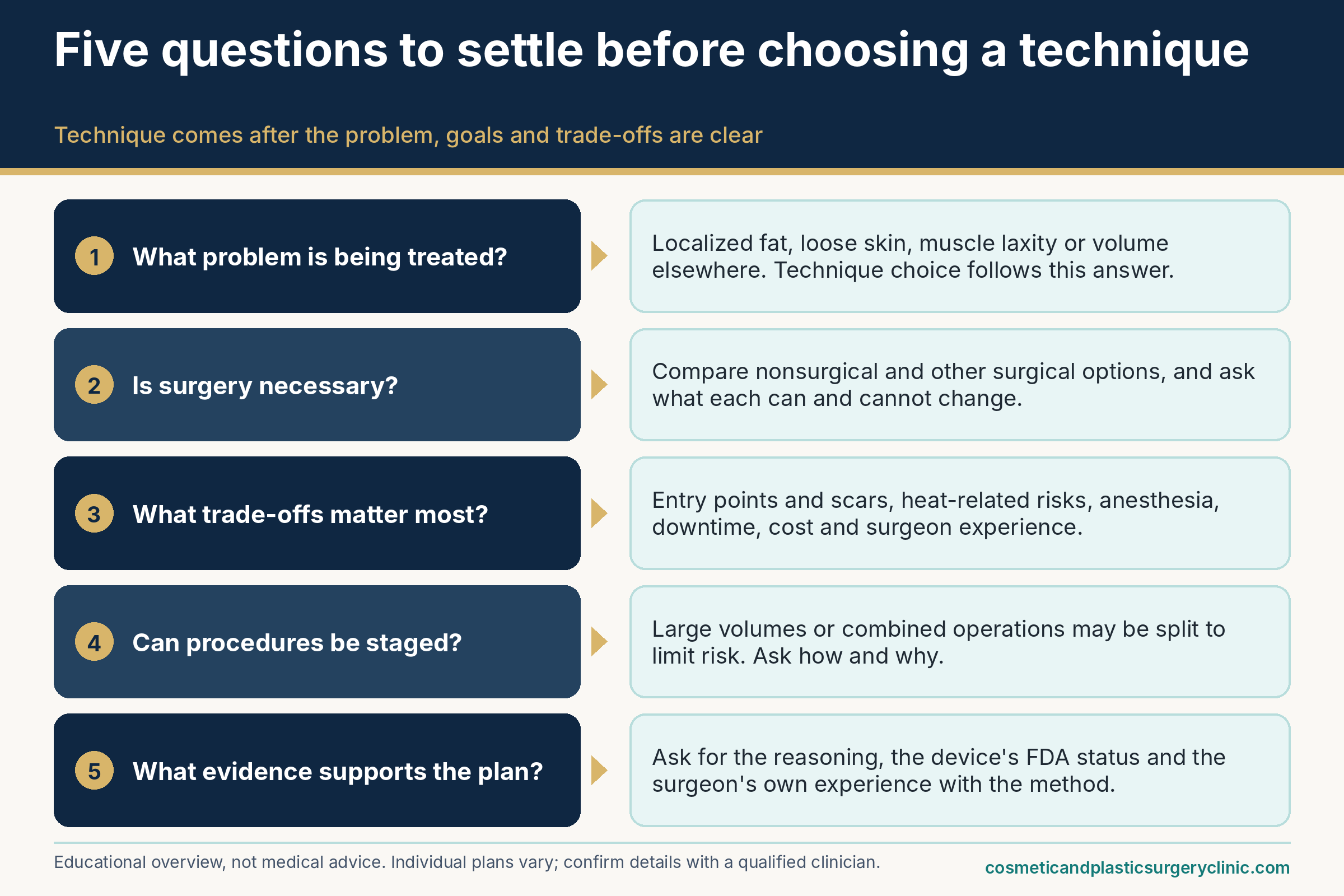
The goal in a consultation isn’t to quiz the surgeon or to arrive with a favorite device in mind. It’s to hear a coherent reason that connects your anatomy and goals to the plan. A good answer usually mentions your specific area, your skin and tissue quality, the trade-offs of the chosen method, and what the alternative would have been. Compare answers from more than one board-certified plastic surgeon where you can. Our liposuction consultation question list is a longer companion to this section.
| Question | What a clear answer includes | What should prompt follow-up |
|---|---|---|
| Why this technique for my areas and tissue? | Specific reasons tied to your anatomy, plus what the alternative would have been | Generic praise for a brand; no mention of trade-offs |
| What would you do differently with plain suction? | An honest comparison, including that outcomes may be similar | Claims of dramatically better results without evidence |
| What device will be used, and what is its FDA status? | The device name and the cleared indication, in plain words | “FDA approved” with no device name; reluctance to share details |
| What are the risks specific to this method? | Heat injury, fluid collections, irregularity, and how each is managed | “No real risks”; no plan for burns or fluid collections |
| How much volume and how many areas, and could this be staged? | A stated plan, limits, facility match and staging option | Pressure to treat more areas in one session |
| Who provides anesthesia and where will surgery occur? | Named provider type, facility accreditation, emergency transfer plan | Unclear facility or accreditation; surgeon doubling as anesthetist without explanation |
| What is the revision or touch-up policy? | Written terms, timeframe, and what costs apply | Verbal promises only |
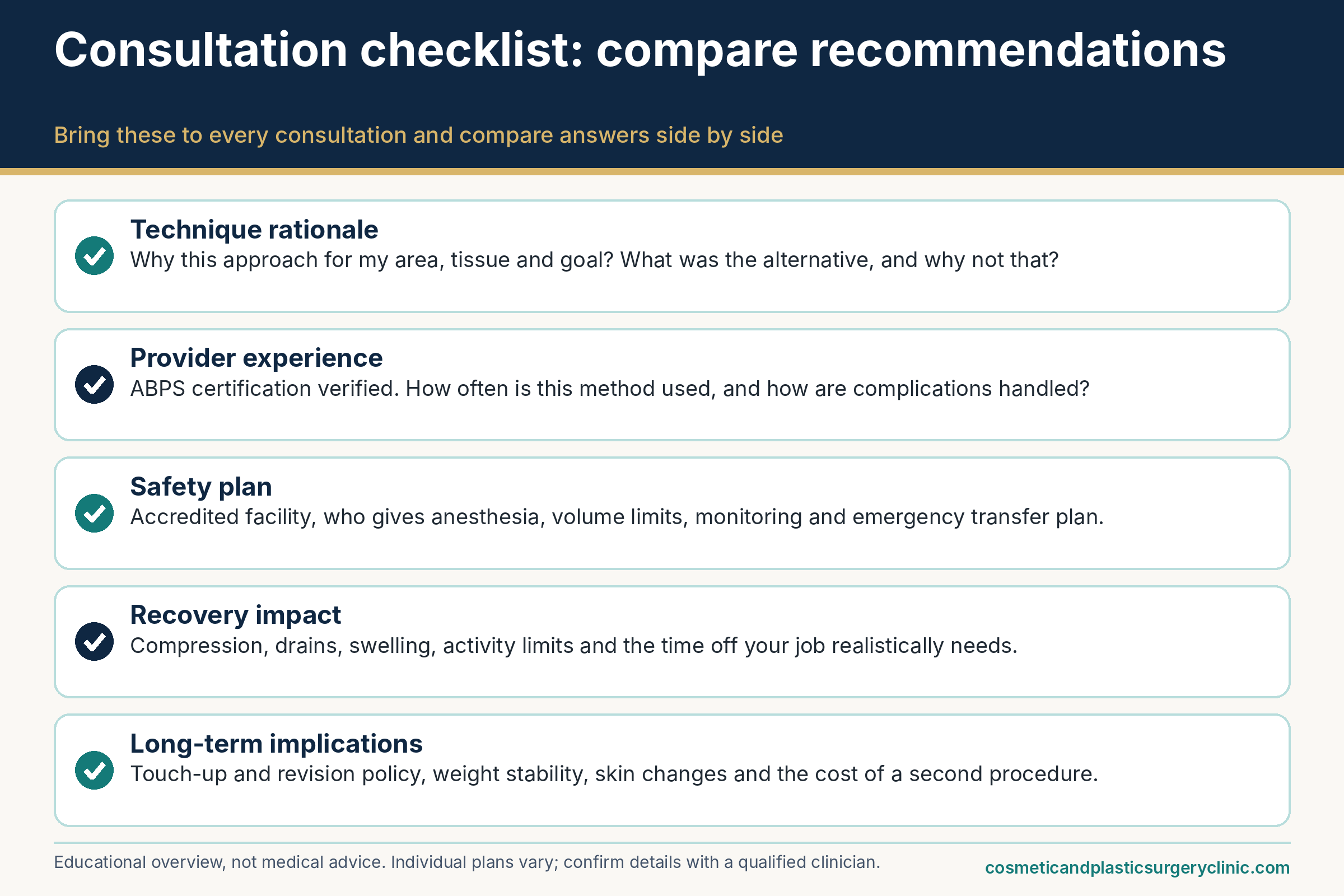
Write answers down, or ask whether you can record the key points. After the visit, compare them against the checklist in the graphic below. If two surgeons recommend different techniques, that is not a red flag in itself, because evidence permits more than one reasonable plan. What matters is whether each can explain their reasoning clearly and without pressure.
Verifying Board Certification, Licensure and the Facility
Credentials are verified, not assumed. The American Board of Plastic Surgery (ABPS) offers a public tool at the ABPS certification search where you can look up a surgeon by name or location. ABPS describes certification as a voluntary credential that signals completed training and passed examinations, and notes that certificates issued since 1995 are time-limited and require ongoing participation to maintain. Its page also points out that verifying a state medical license is a separate step done through the Federation of State Medical Boards. Board certification and licensure are different things, and a society membership is not the same as certification. “Cosmetic surgeon” is not a protected certification and shouldn’t be treated as interchangeable with board-certified plastic surgeon.
The 2003 ASPS advisory also set out expectations for who performs liposuction: a physician trained as a surgeon, certified or eligible for certification by a surgical board recognized by the American Board of Medical Specialties, with specific training in liposuction through residency or fellowship or through a course that includes hands-on cadaver work, and observation by an experienced proctor for early cases. Use those as a general sense of the standard rather than a current rule, and ask the surgeon how they trained on the particular method being recommended. Check the facility too: accreditation by a recognized organization, or Medicare certification or state licensure, was the advisory’s expectation for anything beyond minor local anesthesia. Our guide on how to choose a plastic surgeon covers credential checks in detail.
Preparation makes the visit more productive. Bring a current list of medications and supplements, since lidocaine handling and anesthesia planning depend on it, along with your health history, any earlier operations and the questions you want answered. Photos of areas you’re concerned about, taken in ordinary lighting, can help you explain your goals, although they cannot replace an in-person examination. Ask what the surgeon would do if the planned technique turned out to be a poor fit once the operation began, for example if the tissue were more fibrous or the skin less elastic than expected. A clear answer shows the surgeon has thought about contingencies rather than committing to a device in advance.
Take your time. A consultation is a conversation, not a commitment, and no technique is so exclusive that it justifies a rushed decision. Bring the questions above, compare plans, and give yourself room to decide.
Frequently asked questions
What are the main types of liposuction?
The names most often used are suction-assisted, power-assisted, water-assisted, ultrasound-assisted, laser-assisted and radiofrequency-assisted liposuction, usually shortened to SAL, PAL, WAL, UAL, LAL and RFAL. Most are done after tumescent fluid is placed in the fat. They differ in how fat is loosened: by suction and hand motion, a motorized cannula, a fluid spray, or heat and vibration energy. Patients also hear “high-definition” liposuction, which describes a sculpting goal rather than a separate device. Reviews to date have found limited evidence that any one type is superior overall, so the best fit depends on area, tissue and surgeon experience.
Is laser lipo better than traditional liposuction?
Not according to the evidence we reviewed. A 2024 review concluded laser-assisted lipolysis may not be a safer or more effective option than surgical fat removal, citing burn and scar risk, while a 2025 meta-analysis and a large insurance database reported low or lower complication rates for laser. Those conflicting results, combined with small studies and different case mixes, mean no clear winner has been established. Laser has also been marketed for skin tightening, where support is modest. If a surgeon recommends it, ask which area it is for, what the expected benefit is, and how burns are prevented.
Is VASER the same as ultrasound-assisted liposuction?
VASER is a brand name for a type of ultrasound-assisted liposuction device. The FDA cleared the VASERlipo System in 2019 for fragmenting and emulsifying subcutaneous fat for aesthetic body contouring. Other ultrasound systems exist, and not every ultrasound-assisted procedure uses this brand. Because “VASER” is often used on clinic menus as shorthand for high-definition sculpting, ask what the device is actually being used to do in your plan, which layers of fat it will target, and how skin at the incision sites is protected from heat.
Can any liposuction technique tighten loose skin?
Some heat-based methods, especially radiofrequency and laser, have shown modest short-term skin tightening in studies, but reviews describe the effect as small and possibly temporary. No technique reliably replaces skin removal surgery when skin laxity is significant. Liposuction in general works best when skin is reasonably elastic, since removing fat from loose skin can leave the surface looking looser. If skin laxity is your main concern, ask your surgeon to explain what each option can realistically change and whether an excision procedure would be discussed instead of, or in addition to, liposuction.
Is power-assisted liposuction less painful?
The studies we reviewed do not show that. Power assistance is mainly associated with faster aspiration and less operator fatigue. Reports of less early pain and bruising are more often attached to water-assisted liposuction, and even those come from small, varied studies. Discomfort after any liposuction depends on how much was treated, which areas, the anesthesia plan and individual response. Ask the surgeon what pain control plan accompanies the procedure, how long soreness typically lasts for the planned amount of treatment, and which symptoms should prompt a call to the surgical team.
Which technique is used for abdominal etching?
Abdominal etching, a form of high-definition liposuction, is most often described with ultrasound-assisted devices combined with careful superficial suction, though surgeons vary in what they use. It is better understood as a design approach: removing fat at different depths and leaving some in place to suggest muscle contours. Published series report frequent minor local issues such as pigment changes, fluid collections and firm areas, along with a smaller number of burns. Our high-definition liposuction guides cover candidacy, results and risks in more detail.
Do results last longer with one technique than another?
None of the reviews we opened reported that longevity differs by technique, and long-term follow-up is a recognized gap, with the 2026 systematic review describing durability evidence as low to very low certainty. What changes results over time for most people is weight change, aging and hormonal shifts, which can alter fat distribution regardless of how it was removed. Our page on how long liposuction results last discusses maintenance. Be cautious about any claim that a particular device produces permanent or longer-lasting results.
Are liposuction devices FDA approved?
Most are FDA cleared, which is different from approved. Suction lipoplasty systems are Class II devices regulated under 21 CFR 878.5040, and cleared products reach the market by showing substantial equivalence to an existing device through the 510(k) process. Cleared indications are usually broad, such as aesthetic body contouring, and do not establish that one device gives better results than another. To check, ask the practice for the device name and look up the 510(k) summary in the FDA’s database to read the stated indications for use.
Can I pick the technique myself?
You can state preferences and ask questions, but the technique is a surgical decision that depends on your anatomy, the area, the volume planned and the surgeon’s training. Arriving with a fixed device in mind can narrow the conversation in unhelpful ways, especially when marketing has shaped the preference. A more useful approach is to describe your goals, ask why a method is recommended, and ask what would change the recommendation. If you aren’t comfortable with the reasoning, getting a second opinion from another board-certified plastic surgeon is reasonable and common.
Does technique affect how large a volume can be removed safely?
Technique is only one factor. The ASPS advisory defined large-volume liposuction as more than 5,000 cc of total aspirate and said it belongs in a hospital or an accredited or licensed facility with overnight monitoring, while also noting that no scientific data support a specific safe maximum. Later registry data suggest the relationship between volume and complications depends on body mass index. Energy devices do not remove these limits. Ask what volume is planned, who set the limits, and whether staging the work across more than one session was considered.
Sources and further reading
- American Society of Plastic Surgeons — Practice Advisory on Liposuction, Executive Summary (approved March 15, 2003; accessed 2026-10-03) — technique definitions, infiltration terminology, volume and facility guidance, anesthesia and training statements
- American Society of Plastic Surgeons — 2025 Plastic Surgery Statistics Report (accessed 2026-10-03) — liposuction remains the most-performed cosmetic surgical procedure in ASPS estimates
- American Society of Plastic Surgeons — Liposuction (accessed 2026-10-03) — general definition; not a treatment for obesity or cellulite; works best with firm, elastic skin
- OpenAnesthesia — Tumescent liposuction (updated May 24, 2023; accessed 2026-10-03) — tumescent composition, delayed lidocaine absorption, toxicity risk window, drug interactions, monitoring
- Anesthesia Patient Safety Foundation Newsletter — Mega-dose lidocaine dangers seen in tumescent liposuction (Fall 1999; accessed 2026-10-03) — delayed peak levels and safety recommendations (historical)
- Anesthesia & Analgesia (2016) — Estimated maximal safe dosages of tumescent lidocaine, abstract via QxMD (accessed 2026-10-03) — volunteer pharmacokinetic study; preliminary dosing estimates
- StatPearls — Liposuction (updated February 14, 2023; accessed 2026-10-03) — technique overview, cannula notes, complications
- Cleveland Clinic Consult QD — Liposuction: common techniques and complications (November 12, 2020; accessed 2026-10-03) — technique summaries for clinicians
- Frontiers in Surgery (September 7, 2026) — Safety and clinical outcomes of contemporary liposuction techniques: evidence from a systematic review (accessed 2026-10-03) — 13-study systematic review; certainty ratings
- Aesthetic Plastic Surgery (January 2026) — Complications of liposuction-assisted technologies literature overview (accessed 2026-10-03) — 88-study review; burns, seromas, scars
- Aesthetic Plastic Surgery (2025) — Evidence-based comparison of suction-assisted lipectomy and ultrasound-assisted liposuction (accessed 2026-10-03) — five comparative studies; limits of UAL evidence
- European Journal of Plastic Surgery (2025) — Comparison of complications in isolated aesthetic liposuction across techniques: systematic review and meta-analysis (accessed 2026-10-03) — pooled complication rates; evidence not gradable
- Aesthetic Surgery Journal (July 30, 2025) — Nationwide analysis of complications and risks associated with types of liposuction in 69,424 patients (accessed 2026-10-03) — CosmetAssure database
- Aesthetic Surgery Journal Open Forum (2023) — Liposuction complications in the outpatient setting: 246,119 cases in accredited ambulatory surgery facilities (accessed 2026-10-03) — complication categories and mortality
- Cosmetics (2024) — Laser-assisted lipolysis versus surgical fat removal: efficacy, safety and patient satisfaction (accessed 2026-10-03) — LAL review
- Aesthetic Surgery Journal (2025) — Radiofrequency-assisted liposuction (BodyTite) for chest lift in gynecomastia correction (accessed 2026-10-03) — comparison of RF plus PAL versus PAL
- Indian Journal of Plastic Surgery (2025) — The OCCULT technique for gynecomastia: multicentric large series (accessed 2026-10-03) — ultrasound plus power-assisted series of 967 patients
- Aesthetic Plastic Surgery (2020) — High-definition liposculpture: what are the complications and how to manage them? (accessed 2026-10-03) — 417-patient series
- Aesthetic Surgery Journal (2007) — VASER-assisted high-definition liposculpture, Hoyos and Millard; copy hosted on a third-party site (accessed 2026-10-03) — originators’ 306-patient series
- Annals of Medicine and Surgery (2018) — Autologous fat grafting: harvesting techniques (accessed 2026-10-03) — harvest variables and evidence gaps
- Multi-Society Gluteal Fat Grafting Task Force — Safety advisory (issued January 31, 2018; accessed 2026-10-03) — subcutaneous placement recommendation
- Wolters Kluwer — How much liposuction is safe? Plastic and Reconstructive Surgery study summary (September 2015; accessed 2026-10-03) — volume, BMI and complication findings
- U.S. Food and Drug Administration — Premarket Notification 510(k) (accessed 2026-10-03) — meaning of 510(k) clearance and substantial equivalence
- eCFR — 21 CFR 878.5040, Suction lipoplasty system (accessed 2026-10-03) — device identification and Class II classification
- FDA 510(k) K190551 — VASERlipo System, Solta Medical (decision May 1, 2019; accessed 2026-10-03) — indications for use
- FDA 510(k) K082025 — Body-Jet suction lipoplasty system, Human Med AG (decision August 13, 2008; accessed 2026-10-03) — water-jet system clearance
- FDA 510(k) K053451 — Suction lipoplasty system with vibration handpiece, Moeller Medical (decision August 25, 2006; accessed 2026-10-03) — powered handpiece cleared within a suction lipoplasty system
- FDA 510(k) K073715 — LipoLite (eLipo) laser system, Syneron Medical (2008; accessed 2026-10-03) — laser-assisted lipolysis indication
- FDA 510(k) K102755 — Ceralas 1470 nm diode laser family, Biolitec (decision November 22, 2010; accessed 2026-10-03) — added laser-assisted lipolysis indication
- U.S. Food and Drug Administration — Understanding unapproved use of approved drugs “off label” (accessed 2026-10-03) — off-label drug use is not an FDA determination of safety and effectiveness for that use
- American Board of Plastic Surgery — Verify certification (accessed 2026-10-03) — public certification lookup; certification is voluntary; license verification is separate