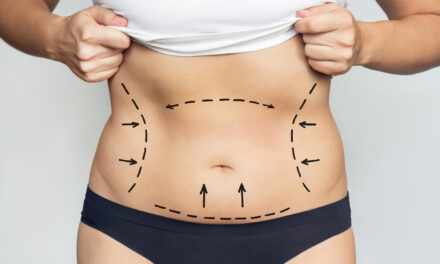

People searching for mommy makeover techniques usually run into a puzzle on the first page of results: every clinic describes a mommy makeover, and no two descriptions match. One lists a tummy tuck and breast implants. Another lists a breast lift, liposuction and a labiaplasty. A third adds a thigh or arm procedure. That isn’t sloppy marketing so much as a feature of the term itself. A mommy makeover isn’t one standardized operation; it’s a customized combination of procedures, and the techniques inside the combination vary by body area, by anatomy and by surgeon.
This guide explains how those approaches differ. It walks through the building blocks for the breasts, the abdomen and the add-on areas, the optional extras that show up on procedure menus, how surgeons decide what to do in one operation and what to stage, the safety questions that come with combining surgery, and how timing after pregnancy and breastfeeding usually enters the conversation. It’s written to help you compare plans and ask better questions, not to tell you what you personally need.
A few ground rules for the rest of the page. First, this is general education from published sources, not medical advice, and no article can examine you; a board-certified plastic surgeon can. Second, where evidence is thin or the answers conflict, we say so, because that’s more useful than false certainty. Third, this page is about techniques. If you’re looking for help judging gallery images, our guide to evaluating mommy makeover before and after photos covers that separately, and the complete mommy makeover guide covers the full picture of cost, recovery, risks and results.
The sections run roughly in the order a consultation does: what the term means, the breast options, the abdominal and body-contouring options, the optional extras, how the pieces are sequenced, what combination surgery does to the risk picture, timing and recovery, and finally a set of decision tools you can bring with you.
What a “Mommy Makeover” Actually Means
Before comparing techniques, it helps to pin down what the umbrella term covers, because the answer shapes everything that follows. A mommy makeover is a planning concept more than a procedure name, and the difference matters when you start comparing consultations and quotes.
A Customized Combination, Not a Single Standardized Operation
Two ideas sit at the center of how professional sources use the term: the goal is restoration after childbearing, and the method is a personalized mix. The sections below take them one at a time.
How the American Society of Plastic Surgeons Describes the Term
The American Society of Plastic Surgeons (ASPS) frames the goal of a mommy makeover as restoring the shape and appearance of a woman’s body after childbearing. On its patient page, the society lists six procedures that may be part of the plan: breast augmentation, breast lift, buttock augmentation, labiaplasty, liposuction and tummy tuck. It also says there are many techniques used and many factors to weigh in choosing among them, naming the amount of restoration desired, where the incisions will be placed and the type of implant as examples. The same page says a mommy makeover is typically performed as a single-stage procedure, meaning the chosen components are done in one operation rather than spread across several.
Read that wording carefully. It doesn’t define a required set of procedures, a minimum or a maximum. “May include” is doing real work. The ASPS candidate page adds that the surgery is highly individualized, and ASPS-hosted commentary from member surgeons describes it in similar terms: one surgeon calls it a menu of what a patient wants improved, and another says many surgeons consider a plan a mommy makeover when it has a breast component and a torso component. Those are individual surgeons’ descriptions rather than society policy, but they match the way the term is used in practice.
The practical takeaway is that when a clinic says “mommy makeover,” you haven’t yet learned which breast technique, which abdominal technique or which add-ons are involved. All of that is still to be decided, and it’s where the real differences live.
What the Name Hides, and a Terminology Map
Because the label is flexible, it can hide large differences between plans. A plan with a mini tummy tuck and a breast lift is a different operation, with a different scar map, recovery and risk profile, from one with a full tummy tuck, breast implants and flank liposuction, yet both may be sold under the same name. That is why a quote that says only “mommy makeover” is hard to evaluate. A useful quote itemizes which procedures, which technique for each, where the surgery will take place and who will provide anesthesia.
Patients and clinics also use everyday words that map loosely onto clinical terms. The table below translates the most common ones so you can follow a consultation without stopping to decode each phrase.
| Phrase you may hear | Clinical term | What it generally refers to | What to clarify |
|---|---|---|---|
| Tummy tuck | Abdominoplasty | Removal of excess lower-abdominal skin and fat, usually with tightening of the abdominal wall muscles | Mini, full or extended; whether muscle repair is included |
| Breast lift | Mastopexy | Raising and reshaping the breast and repositioning the nipple; removes excess skin | Incision pattern and expected scars |
| Getting volume back | Augmentation (implant or fat transfer) | Adding volume with an implant, or with the patient’s own fat taken from elsewhere | Implant type and placement, or how much fat is expected to last |
| Lipo | Liposuction (lipoplasty) | Suction removal of localized fat, often flanks, back or abdomen | Which areas, and how much total volume is planned |
| Lower-belly bulge after kids | Skin laxity, fat, or rectus diastasis | A lower-belly bulge can come from loose skin, fat, separated abdominal muscles, or a mix | Which cause was identified on your exam |
| Vaginal rejuvenation | Labiaplasty or energy-device treatments | An imprecise label covering very different procedures with very different evidence | Exactly what will be done, with what device, and why |
What the Term Does Not Describe
Just as important as what the phrase covers is what it leaves out. It doesn’t promise a specific outcome, and it doesn’t describe a treatment for everything that changes after a pregnancy.
Not a Weight-Loss Treatment and Not a Fixed Package
ASPS-hosted articles are consistent on one point: these are body-contouring procedures, not weight-loss procedures. Liposuction, a tummy tuck and a breast lift reshape tissue that is already there. They don’t replace nutrition, activity or time, and the ASPS tummy tuck page says plainly that the operation is not a substitute for weight loss or an appropriate exercise program. If a plan assumes the surgery will do the work of losing weight, the expectation is off.
It also isn’t a package in the retail sense. One ASPS-hosted article quotes a surgeon noting that not every woman needs every procedure, and some need only one or two. That’s worth holding onto if a consultation drifts toward adding components. Each additional procedure adds anesthesia time, healing sites, cost and risk, so every item should earn its place by addressing something you’ve said bothers you and that the technique can plausibly improve.
Finally, the term doesn’t cover everything postpartum bodies deal with. Pelvic floor problems, separated abdominal muscles that cause back or core symptoms, hair shedding, skin changes and mood are real parts of recovery after childbirth. Some are best addressed by physical therapy, obstetric or gynecologic care, or mental health support rather than a cosmetic operation, and a good surgeon will say when that’s the case.
Planning by Problem: Three Layers to Think Through
One way to keep a plan honest is to start from the problem rather than the procedure list. As an editorial framework (not a clinical classification), it can help to think in three layers.
The first layer is the breast: its volume, its shape and the position of the nipple. Pregnancy and breastfeeding can change all three, and different changes call for different tools, from adding volume to lifting to reducing. The second layer is the abdominal wall and skin envelope: whether the muscles have separated, whether skin is stretched beyond what it will recover, and where excess skin sits relative to the navel. The third layer is fat distribution: pockets of fat that sit on the flanks, back, thighs or abdomen and respond poorly to exercise.
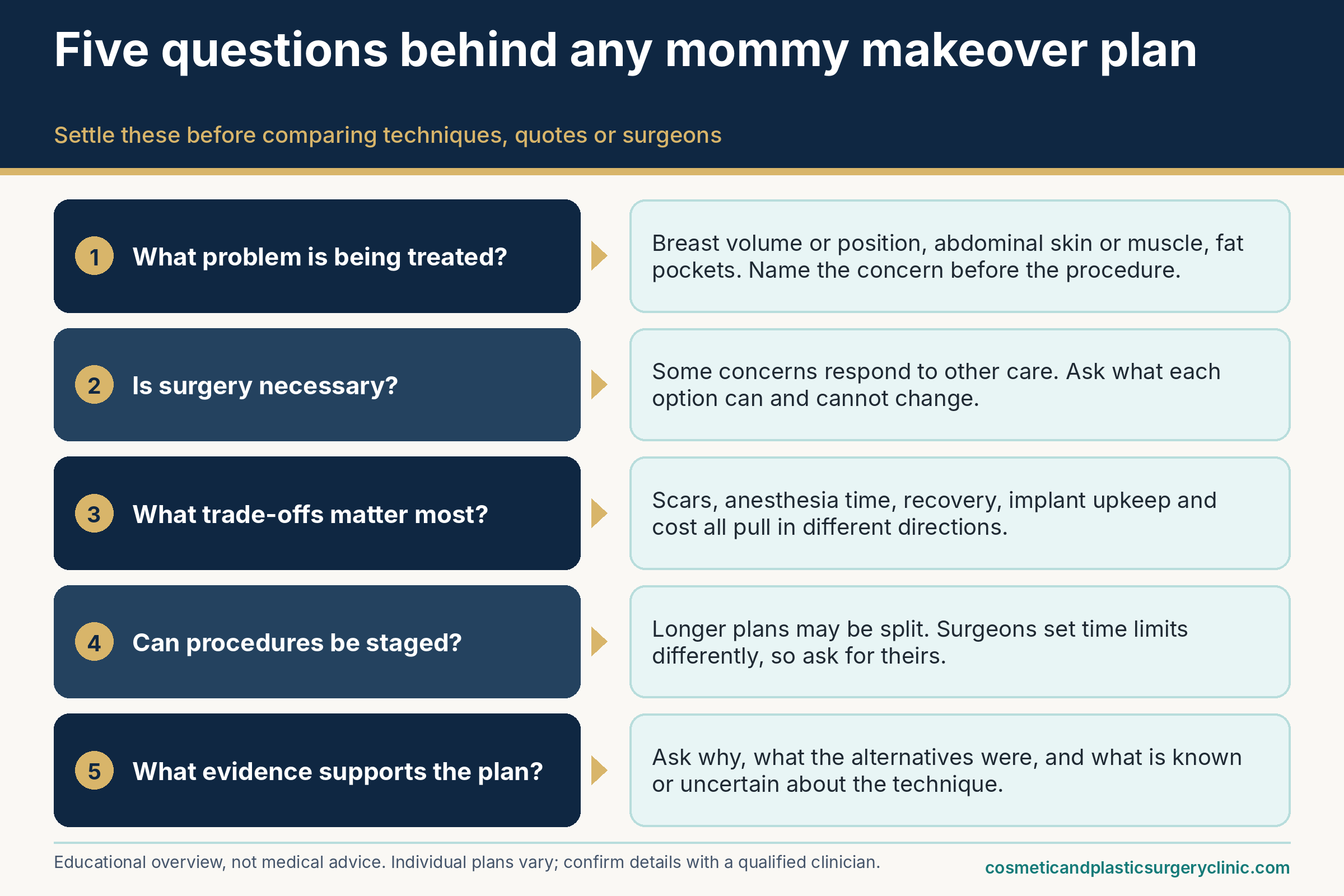
Most plans touch one to three of these layers, and the techniques in the next sections line up with them. Naming the layer first prevents a common drift, where a patient arrives concerned about a lower-belly bulge and leaves with a long list of procedures that address problems they hadn’t raised. If your main concern sits in a single layer, ask directly whether treating that layer alone would be reasonable, and what would be lost by doing so.
Breast Techniques: Volume, Lift and Reduction Options
The breast portion of a mommy makeover is where the widest range of techniques sits. Pregnancy and breastfeeding can leave some people with less volume, some with looser skin, some with a lower nipple position and some with larger, heavier breasts than before. Those are different problems, and the tools below are matched to them differently.
Adding or Restoring Volume
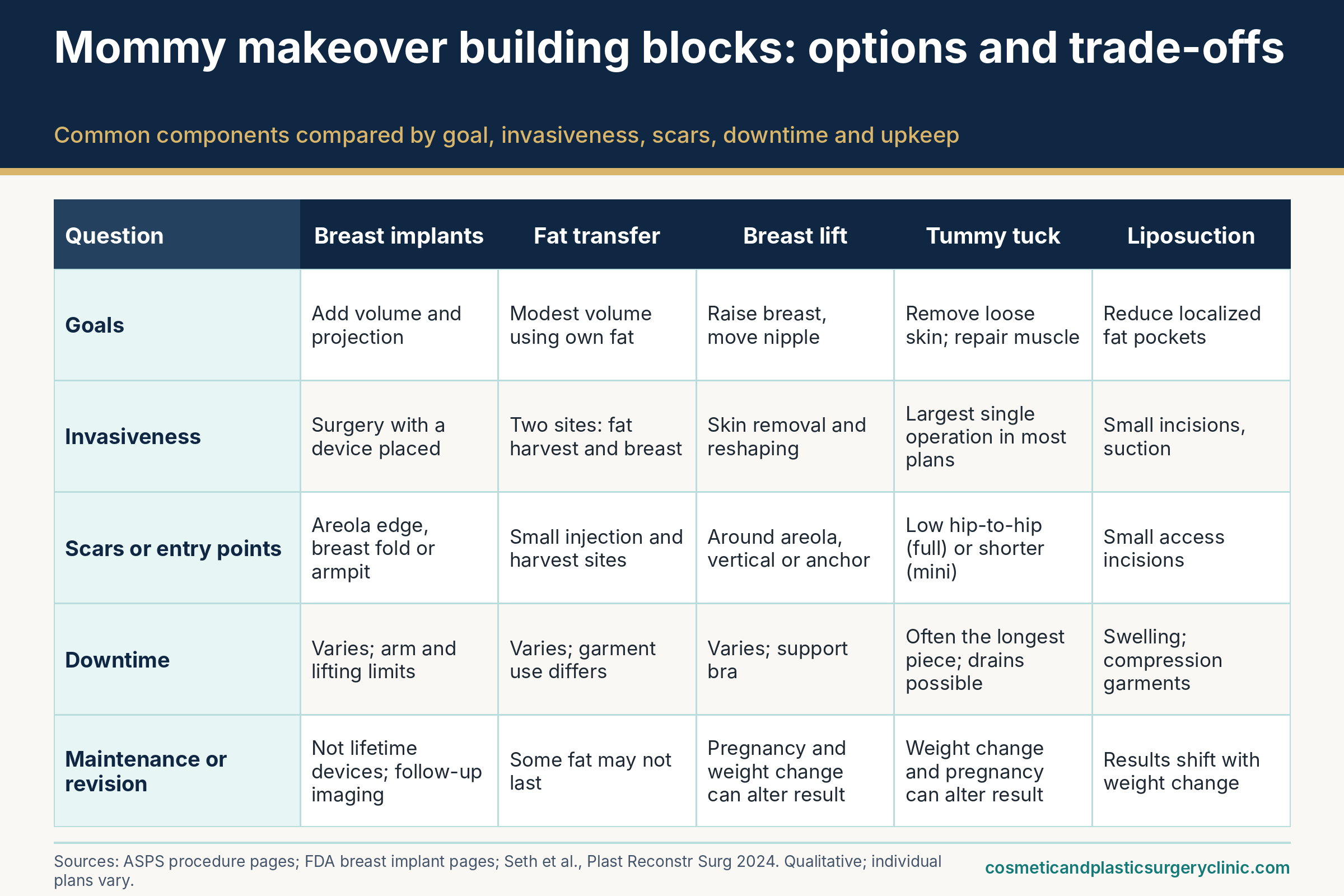
When the main concern is that the breasts feel emptier or smaller than before pregnancy, two approaches add volume: a breast implant or the patient’s own fat. They differ in how much they can add, how predictable the result is and what maintenance looks like.
Breast Implants: Types, Placement and Entry Points
Breast implants are medical devices with a silicone shell that is filled with either saline or silicone gel. According to the Food and Drug Administration (FDA), saline-filled implants are approved for breast augmentation in women 18 and older, and silicone gel-filled implants in women 22 and older. Because the breast has already been through pregnancy in this group, age is rarely the constraint, but the labeling is a useful reminder that these are regulated devices with defined uses.
Surgeons also choose where to place the implant and where to make the incision. The ASPS procedure page describes two placements, under the chest muscle (submuscular) or behind the breast tissue but over the muscle (subglandular), and three common incision locations: along the lower edge of the areola, in the fold under the breast, or in the armpit. It cautions that an approach through the belly button is associated with a higher complication rate. In a combined plan, the incision choice interacts with other work, so if a lift is also planned, ask whether the implant would go in through the lift incisions or through a separate one, and what each choice means for scars.
The FDA is direct about durability: breast implants are not considered lifetime devices, and the longer they are in place, the greater the chance of complications and of needing another operation. Its labeling recommendations from 2020 call for a boxed warning and a patient decision checklist, which you should be offered and can read in full on the FDA breast implant page or in our guide to breast implant FDA status and safety questions. Common local complications listed by the agency include capsular contracture (tightening of scar tissue around the implant), rupture, wrinkling, asymmetry, pain, infection and reoperation. For silicone gel implants, the FDA describes MRI as the most effective way to detect a silent rupture, and Mayo Clinic summarizes the agency’s screening advice as a first scan about five to six years after surgery and then every two to three years. Implants also don’t stop breasts from sagging, which is why a lift is sometimes paired with them. For a fuller walk-through of implant choices, see our guide to breast augmentation techniques.
Fat Transfer to the Breasts: What Changes When Your Own Fat Is the Filler
Fat transfer, sometimes called fat grafting or lipofilling, uses liposuction to collect fat from one part of the body and then injects a portion of it into the breasts. ASPS describes it as suited to women who want a relatively small increase in breast size and prefer natural-feeling results. In a mommy makeover that already includes liposuction, the donor fat is available in the same operation, which is part of the appeal.
The trade-off is predictability. A 2024 systematic review in Plastic and Reconstructive Surgery pooled 35 studies covering 3,757 women and reported mean fat retention of about 58 percent, with studies ranging from 44 to 83 percent. It also reported an overall complication rate of 27.8 percent, with fat necrosis (areas where transferred fat doesn’t survive and can form firm lumps) accounting for 43.7 percent of those complications, and satisfaction of about 92 percent at one year. These pooled figures come from studies that measured different things in different ways, so they illustrate the range of experience rather than a rate you should expect. The authors themselves urged clinical caution.
What this means in practice is that fat transfer tends to be a modest-volume option with a built-in uncertainty about how much stays. Some surgeons plan for that by treating the first result as provisional and discussing a second session if more volume is wanted. If you’re drawn to fat transfer because you have reservations about implants, ASPS advises talking through those reservations with your surgeon before surgery, since the real concern may have an answer. For more on this technique, see our guide to fat transfer to the breasts. It’s also reasonable to ask how fat changes could appear on future breast imaging and who would need to know about the procedure.
Repositioning or Reducing Breast Tissue
Volume isn’t always the issue. For many people the concern is shape and position, or breasts that are larger and heavier than they want after pregnancy. Those problems call for removing or rearranging tissue, which brings scars into the conversation more prominently.
Breast Lift (Mastopexy): Incision Patterns and What a Lift Can Change
A breast lift raises and reshapes the breast and moves the nipple and areola to a higher position, removing excess skin in the process. ASPS describes three common incision patterns: around the areola only, around the areola with a vertical line down to the breast crease, and an anchor or inverted-T pattern that adds a horizontal line along the crease. The choice depends on breast size and shape, the degree of sagging and the quality and elasticity of the skin. The society also notes that the lines are permanent but in most cases fade and improve over time, and that some sit hidden in natural contours while others remain visible on the breast surface.
Two limits are worth understanding. ASPS says a lift does not significantly change breast size or round out the upper part of the breast, so it isn’t a volume procedure by itself; for fuller breasts it points to combining a lift with augmentation. And results can shift with later pregnancies and weight changes, which is part of why timing comes up so often later in this guide. The scar trade-off is a genuine one: techniques with shorter incisions generally suit milder sagging, while more pronounced sagging usually requires more skin removal and longer scars. Because the pattern follows the anatomy, asking your surgeon to show where each option would leave lines on your own body is a fair request. Our guide to breast lift techniques goes deeper on the patterns.
Augmentation-Mastopexy and Breast Reduction: Why Plans Diverge
Some people want both more volume and a higher, tighter shape. Doing an implant and a lift in the same operation is called augmentation-mastopexy, and it asks for two opposing things at once: adding volume to the breast while removing skin from around it. That tension is one reason surgeons differ on whether to do it in one stage or two. A conference abstract summarizing a pooled analysis of 14 studies and 4,856 single-stage augmentation-mastopexies reported a pooled reoperation rate of 11.0 percent, with a confidence interval of about 5 to 17 percent, and concluded that the single-stage approach can be safe and effective with experienced surgeons and careful patient selection. It’s an abstract rather than a full paper, so treat it as a signal and not a settled benchmark.
Breast reduction sits at the other end of the spectrum. ASPS describes it as removing skin and tissue and then reshaping and elevating the breast to a smaller, more proportionate size. Its safety page lists changes in nipple or breast sensation that may be temporary or permanent, and says that surgery may reduce the ability to breastfeed, though most women can still breastfeed after a reduction. It adds that pregnancy-related breast changes and weight fluctuations can alter the results of a prior reduction. If future pregnancies are a possibility, that information belongs in the planning conversation at the start.
Abdominal and Body-Contouring Techniques
The torso half of a mommy makeover usually centers on the abdomen. Pregnancy stretches skin, can separate the two vertical bands of abdominal muscle, and may leave fat in places that diet and exercise don’t reach. Techniques differ in how much of the abdomen they treat, whether the muscles are repaired, and how long the scar runs.
Tummy Tuck Variations
“Tummy tuck” (abdominoplasty) is a family of operations. The ASPS tummy tuck page describes the core idea as removing excess fat and skin and, in most cases, restoring weakened or separated muscles. The variations below change how far that work extends.
Mini, Full and Extended Approaches
An ASPS news article published in January 2024 describes the most common versions. A mini tummy tuck suits people whose loose skin and fat sit below the belly button; it uses a smaller incision above the pubic area, may tighten the underlying muscle, and typically leaves the navel where it is. A full tummy tuck suits most people who need an abdominoplasty. It uses a hip-to-hip incision positioned low, plus an incision around the navel, and it repairs separated rectus abdominis muscles by sewing them together. A fleur-de-lis pattern, which adds a vertical component, is generally reserved for extensive loose skin in both directions, often after massive weight loss. A separate ASPS blog adds an extended version for people with substantial excess skin on the abdomen and flanks, using a longer incision that wraps around the sides and sometimes paired with liposuction.
Cleveland Clinic describes the same categories and notes that operations take from roughly one to five hours depending on the extent, that anesthesia is typically general, and that drains may be placed if needed to collect fluid. Mayo Clinic gives a narrower figure for a tummy tuck done on its own, typically under four hours. Those numbers matter in a combination plan, because the abdominal portion is often the largest single block of operating time, and everything added to it extends the total.
The practical differences come down to scar length, whether the navel is moved, and how much of the abdominal wall is treated. A person with a small amount of loose skin below the navel and a good upper-abdominal contour is describing a different problem from one with loose skin all the way up to the ribs. Neither is better; the technique has to match the tissue. Our guide to tummy tuck techniques compares these approaches in more depth. ASPS also notes that a tummy tuck cannot correct stretch marks except those that sit in skin that is removed, and that women who may be considering future pregnancies are advised to postpone it.
Muscle Repair and Diastasis Recti: What Is Established and What Is Not
Diastasis recti (rectus diastasis) is a widening of the connective tissue line between the two rectus abdominis muscles, which can produce a central bulge. A 2019 review in Frontiers in Surgery by Jessen and colleagues stresses that the fascia is intact, so it should not be confused with a hernia. The review reported that the condition is present in about two-thirds of women by the third trimester and that roughly 30 to 60 percent still have it after delivery, while noting that some natural improvement can occur during the first postpartum year. Estimates like these depend on how the gap is measured, so they’re best read as a general pattern.
Evidence about treatment is less tidy. The same review concluded that the studies on physiotherapy were too varied and small to recommend any particular routine. For surgery, it summarized series using plication, a technique that sews the muscles together, in which recurrence was low over the short follow-up periods reported, along with minor complications such as fluid collections (seroma) in roughly 8 to 30 percent of open procedures. Short follow-up and non-uniform measurement limit how far those figures travel.
For planning, the useful distinction is between the appearance of a bulge and how the abdominal wall functions. Some people mainly want a flatter contour and a muscle repair as part of a tummy tuck. Others have back or core symptoms and may want a physical therapy evaluation first. Whether any part of the work could be considered for insurance coverage is a separate question for the surgeon’s office and your insurer, so don’t assume that a diagnosis of diastasis changes how the operation is billed. If muscle repair is part of the plan, ask how it will be done, whether it extends above the navel, and what activities to avoid while it heals.
Liposuction and Add-On Body Areas
After the breasts and the central abdomen, the remaining decisions concern fat pockets and areas of loose skin elsewhere on the torso and limbs. This is where plans most often expand, so it’s worth knowing which additions are routine and which change the risk picture.
Liposuction as a Partner Procedure
Liposuction removes localized fat deposits; ASPS is clear that it’s not a treatment for obesity or a substitute for diet and exercise, and that skin made soft and thin by stretch marks, weight loss or aging may not reshape as well. In a mommy makeover it commonly addresses the flanks, back and upper abdomen, either alongside a tummy tuck or as a stand-alone option when skin laxity is limited. When fat is also being moved to the breasts or buttocks, liposuction supplies the donor fat.
Whether pairing liposuction with a tummy tuck adds risk has been debated. A 2005 series of 406 consecutive abdominoplasties from one surgical group found no statistically significant difference in complication rates between abdominoplasty alone and abdominoplasty with suction-assisted liposuction. A large insurance-database analysis published in 2015 reached a more cautious picture, reporting major complications in 3.1 percent of abdominoplasties done alone versus 10.4 percent when combined with body contouring and liposuction, and the authors suggested that some higher-risk patients might do better with staged procedures. The designs differ, so they don’t strictly contradict each other, but they illustrate why surgeons hold different views.
Volume matters too. In an ASPS-registry analysis summarized by its publisher in 2015, complications were more frequent above 5 liters of removed fat than below it, though the relationship depended on body mass index. And the ASPS practice advisory on liposuction, dating from 2003, states that limited volumes are routinely done with other procedures while large-volume liposuction combined with certain procedures should be avoided. If you’re curious about how the devices and methods differ, see our overview of liposuction techniques.
Back, Arms, Thighs and Body-Lift Concepts at a Glance
Plans sometimes extend beyond the abdomen and breasts. These are covered by their own guides, so here is only the orientation. An arm lift (brachioplasty), according to ASPS, reduces excess sagging skin and tightens the supporting tissue of the upper arm, and it’s aimed at sagging that exercise can’t correct. A thigh lift reshapes the thighs by reducing excess skin and fat; ASPS notes that thigh lifts and body lifts aren’t intended strictly for fat removal, and that liposuction alone may work better when skin has good elasticity, with a lift added when it doesn’t. A body lift addresses the abdomen, extending around to the sides and lower back, plus the buttocks and thighs in various combinations.
The common thread is that fat and skin are separate problems. If the skin is elastic and the concern is fat, liposuction is the usual conversation. If the skin is loose, excision procedures enter the picture, along with longer scars and longer recoveries. Stacking several of these onto a breast and abdominal plan can push the operation into territory where surgeons commonly divide the work. Our guide to body lift surgery covers the larger operations in more detail.
| Option | Often discussed when | Incision and navel | Muscle repair | Main trade-off to ask about |
|---|---|---|---|---|
| Liposuction alone | Localized fat with reasonably elastic skin | Small incisions; navel untouched | None | Cannot remove loose skin or fix separated muscles |
| Mini tummy tuck | Loose skin and fat mainly below the navel | Shorter incision above the pubic area; navel typically not moved | May tighten lower muscles | Limited reach above the navel |
| Full tummy tuck | Loose skin and separated muscles across the abdomen | Hip-to-hip incision plus a new opening for the navel | Typically repairs rectus diastasis | Longer scar, drains and a longer recovery |
| Extended tummy tuck | Excess skin extending onto the flanks | Longer incision that wraps around the sides | Included as in a full version | Longer scar; more tissue treated at once |
| Body lift (overview) | Loose skin around the trunk, buttocks or thighs, often after major weight change | Treats a wider band of the trunk than a tummy tuck; pattern varies by technique | Varies by technique | Larger operation; frequently staged |
Optional and Adjacent Procedures on the Menu
Beyond the breast and abdominal building blocks, mommy makeover menus often list extras. Some are established surgical procedures with their own bodies of evidence. Others are marketed with language that runs ahead of the science. Sorting one from the other is a skill worth building, because the extras are where plans tend to grow quietly.
Genital Cosmetic Procedures and “Vaginal Rejuvenation”
ASPS lists labiaplasty among the possible components of a mommy makeover, and its procedure page mentions vaginal rejuvenation as well. The two terms are not interchangeable, and the second is the more problematic label because it describes no single procedure.
Labiaplasty: What It Is and What the Evidence Says
Labiaplasty is surgery to change the size or shape of the labia, the folds of tissue around the vaginal opening. People consider it for physical discomfort, for appearance or for both. It’s a surgical procedure, with the risks that any surgery carries, and it has been studied far less than the breast and abdominal operations discussed above.
The American College of Obstetricians and Gynecologists (ACOG) addressed the broader category in Committee Opinion No. 795 on elective female genital cosmetic surgery. As summarized in a repository record of the opinion, ACOG points to a lack of published studies and standardized terminology, states that the safety and effectiveness of these procedures have not been established when they are done without a clinical indication, and lists potential complications that include pain, bleeding, infection, scarring, adhesions, altered sensation, painful intercourse and the need for reoperation. It recommends that clinicians tell patients about the limited quality of the data, consider screening for body image concerns before surgery, and be open about their own experience and outcomes.
None of that means labiaplasty is wrong for everyone who considers it. It means the evidence base is thinner and the counseling should be more careful than for procedures with decades of outcome data. A reasonable consultation separates symptoms (for example, irritation or discomfort during exercise) from appearance concerns, explains what is and isn’t known, and doesn’t treat the procedure as an automatic add-on because the rest of the plan is already underway. If it’s on your list, ask the surgeon how often they perform it, what technique they use, and how healing would affect the timing of other parts of the plan.
The FDA Safety Communication on Energy-Based Vaginal “Rejuvenation”
The more cautionary example is energy-based devices, such as lasers and radiofrequency instruments, marketed for vaginal “rejuvenation” or nonsurgical cosmetic vaginal treatment. On July 30, 2018, the FDA issued a safety communication warning against using these devices for such purposes. Reports quoting the communication describe the agency’s central points: the safety and effectiveness of energy-based devices for vaginal “rejuvenation” or vaginal cosmetic procedures have not been established, serious adverse events have been reported, including vaginal burns, scarring, pain during sexual intercourse and recurring or chronic pain, and the FDA had not cleared or approved any energy-based device to treat these symptoms or conditions, including symptoms related to menopause, urinary incontinence or sexual function.
The distinction between “cleared” and “approved” is worth keeping straight. A 510(k) clearance means the FDA found a device substantially equivalent to a legally marketed predicate for a stated intended use, and it’s a different and generally less demanding pathway than premarket approval. A device that is cleared for some other purpose, such as certain surgical applications, can end up being used for a purpose that is not in its cleared labeling. That is commonly called off-label use, and it isn’t an FDA finding that the device is safe or effective for the new use. News coverage at the time reported that the FDA also sent warning letters to several manufacturers over marketing claims.
For a reader comparing plans, the lesson is not to treat these treatments as part of the established mommy makeover toolkit. If a clinic offers one, it’s reasonable to ask which device is used, whether the FDA has cleared it for that specific purpose, what evidence supports the claim, what the burn and scarring risks are, and who treats complications. Readers who want the primary document should consult the FDA’s own safety communications page and check for any later updates, since this guide cannot substitute for the agency’s current wording.
Other Menu Items and How to Read a Menu Critically
The last group is a mixed bag: other surgical add-ons and nonsurgical extras that may appear in a package. The reading skills are the same for all of them.
Buttock Fat Grafting and Why Add-Ons Change the Risk Picture
ASPS includes buttock augmentation among the possible components of a mommy makeover. Buttock augmentation can be done with implants or with fat grafting, often called a Brazilian butt lift, and the fat-grafting version has drawn specific safety warnings. A January 2018 advisory from a multi-society task force reported that, in the data then available, deaths related to gluteal fat grafting were estimated at roughly one in 3,000 procedures, the highest reported for any aesthetic procedure at that time. The deaths it examined involved fat entering large veins and traveling to the heart and lungs, and the group concluded that fat had been injected more deeply than surgeons intended. Its recommendations included injecting only in the layer just under the skin, keeping track of the cannula tip at all times, and staging the work rather than injecting deeper if more volume is wanted.
That advisory is several years old, and practice may have changed, so treat the number as a historical data point rather than a current rate. Its relevance here is structural: adding a high-stakes component to an already long combination plan changes what the whole operation asks of your body and your surgical team. Our separate guide to combining a mommy makeover with other procedures goes into those trade-offs, and the questions in the final section of this guide can be applied to any extra.
Skin, Hair and Energy-Device Extras: A Checklist for Reading Any Menu
ASPS-hosted commentary notes that some packages add platelet-rich plasma treatments for hair thinning or other nonsurgical services, and some practices pair liposuction with energy-based skin-tightening devices. These are different from the core operations, and their evidence and regulatory status vary. A short checklist works for anything on a menu.
Ask what the item is meant to do, and whether that goal is something you raised or something the menu suggested. Ask what the evidence is for that purpose, and whether it comes from studies or from the manufacturer. Ask about the device or product’s regulatory status for the intended use, using the cleared, approved and off-label distinctions above. Ask whether it must be done on the same day as surgery or could be done separately later, since many nonsurgical items don’t need to share an anesthesia session. And ask what it adds in time, cost and risk. An extra that can’t answer those questions plainly may not belong in the plan yet.
Sequencing: What Is Done Together and What Is Staged
Once the components are chosen, the next question is how to arrange them in time. Some surgeons do everything in one operation. Others divide the plan across two or more operations a few months apart. Both approaches are used by qualified surgeons, and the reasons for choosing one over the other are worth understanding because they come from judgment as much as from data.
Single-Session Versus Staged Plans
ASPS says a mommy makeover is typically performed as a single-stage procedure, which tells you where the default sits. But “typically” isn’t “always,” and the right answer for a given person depends on how much is planned and how that person’s health and support system look.
The Case for Doing Everything in One Operation
The appeal of a single operation is straightforward. There’s one anesthetic, one block of time away from caring for children and work, and one recovery to plan around. An ASPS news feature on combination surgery quotes member surgeons describing the single recovery and the efficiency for busy parents as the main attractions, and notes that a single anesthetic can mean fewer anesthesia charges than repeating it across several operations. The same feature cites the society’s Insights and Trends report, in which 80 percent of surveyed surgeons agreed that their patients asked for combination procedures for longer-lasting results and shorter recovery times, based on 2021 and 2022 data. It’s a survey of surgeons’ impressions rather than a measurement of outcomes, but it explains why combination plans are common.
Surgeons who favor combining also point to cohesion: the breasts and torso are treated for proportion with each other, so the result is planned as a whole. One surgeon in the ASPS coverage offered an illustration of how a combined recovery might stretch only a little longer than a single-area one, giving the example of a breast recovery of about two weeks becoming about two and a half weeks when combined. Treat that as one clinician’s example, not a benchmark. Recovery from a combination is not the sum of its parts, but it is also not equal to the longest part, and the abdominal portion usually dominates.
For a parent, the logistics may weigh as heavily as the clinical points. One long stretch of help from a partner, family member or paid caregiver can be easier to arrange than two. That’s a legitimate factor, as long as it doesn’t push a plan beyond what the surgeon considers reasonable for the amount of tissue being treated.
The Case for Staging, and Why Surgeons Set Different Limits
Staging divides the plan so each operation is shorter and treats fewer areas. The strongest argument is that every added procedure adds anesthesia time, healing surfaces and fluid shifts. In an ASPS news article, one member surgeon described taking on any combination that can be done in under about six hours, while another described a stricter limit of roughly four to five hours of anesthesia, explaining that the priority is not doing too much for too long. A second ASPS feature reported that most surgeons cite about six hours as an upper bound and described phased plans for extensive requests, such as breasts and arms in one operation and abdomen, back and thighs in another.
These limits are professional judgment calls, not rules. The sources reviewed for this guide describe time limits as individual surgeons’ policies rather than a uniform standard, so one surgeon’s cap can differ from another’s. In a 2004 series of 248 abdominoplasties from a single surgeon, all combined operations were completed in under five hours, and the authors reported no statistically significant difference in minor complications between the groups. That is one group’s experience at one outpatient facility over ten years, and it shouldn’t be assumed to transfer to other surgeons or patients.
Staging has costs of its own. There are two recoveries, usually two sets of facility and anesthesia charges, two periods of time off work and childcare disruption, and a gap during which one area looks and feels different from the other. For people with certain risk factors, though, those costs may be worth it. The authors of the 2015 insurance-database analysis suggested that some patients at higher risk of complications might be better served by staged rather than combined surgery. The table below puts the main trade-offs side by side.
| Factor | One combined operation | Staged operations | Question to ask |
|---|---|---|---|
| Recovery periods | One, though usually longer than for any single piece | Two or more, each shorter | How much total time off will I realistically need either way? |
| Anesthesia exposure | One longer session | Several shorter sessions | What is the expected anesthesia time, and what is your limit? |
| Healing sites and mobility | Several sites healing at once; movement may be more restricted | Fewer sites at a time | How will I move, sleep and care for children in the first weeks? |
| Cost components | Facility and anesthesia charges are often counted once | Charges may repeat for each operation | What is itemized for each approach? |
| Chance to adjust the plan | Everything is decided before surgery | Early results can inform later stages | Which parts, if any, would you want to reassess after healing? |
| Higher-risk components | Stacked with the rest of the plan | Can be separated from other major work | Which item adds the most risk, and could it stand alone? |
Order of Operations Inside a Combined Plan
Even within a single session, the sequence isn’t arbitrary. Surgeons arrange the steps around what each part needs and what has to come first. Published sources say little about universal ordering, so what follows is the logic rather than a prescribed sequence.
The Logic Behind a Sequence
An ASPS video referenced on its mommy makeover safety page has a surgeon describing the idea of setting up a foundation with the main procedure and then adding one or two smaller ones. That framing is useful. As an editorial way of thinking about it, most plans have an anchor, often the abdominal operation or the breast operation, that sets the largest portion of the time, and the other components are chosen to fit around it. When you ask a surgeon what the anchor is, you learn where the time and the risk sit.
A few dependencies follow from simple logic. If fat is to be moved to the breasts or elsewhere, it has to be harvested first, so liposuction comes before the grafting step. If an operation needs the patient on the back and another needs the patient face down or on the side, there will be a repositioning step, which adds time and another sterile preparation. Dressings and garments go on at the end: a support bra or elastic bandage for the breasts and a compression garment for the abdomen and waist, as ASPS describes in its recovery guidance. And fluid management runs through the whole operation, because tissue handling, liposuction fluid and intravenous fluids all matter to the anesthesia team.
Because these considerations vary with the specific procedures and the surgeon’s habits, there isn’t a single correct order to look for. What you can look for is a surgeon who can explain their order and the reasons for it without hesitation.
What Can Change on the Day, and What to Settle Beforehand
No plan survives contact with real anatomy unchanged, and surgeons make judgment calls during the operation. The point is to know in advance how those calls are likely to be made. If a surgeon has a time or procedure limit, then a plan that runs long is a plan with a stopping rule. It’s reasonable to ask which component would be dropped or postponed first, whether you’d be asked to agree to that in advance, and whether there’s a charge or a rescheduling process if it happens.
The ASPS mommy makeover safety page notes that patients sign consent forms that describe the procedures and their risks. Read the form for what it says about the plan: which procedures it lists, whether it allows the surgeon to modify the plan, and what it says about transfusion, additional procedures and complications. If you see items you didn’t discuss, ask about them before the day of surgery rather than at pre-op check-in, when time pressure is highest. Our guide to mommy makeover consultation questions expands on what to bring to those conversations.
Safety Considerations When Procedures Are Combined
Combining operations changes the safety conversation, not because any one component becomes riskier in isolation but because the whole is bigger. More time under anesthesia, more raw surfaces, more fluid moved around and more healing sites all add up. What the research says about that is mixed, and it’s worth reading with its limits in mind.
What the Evidence Shows and How Combination Raises the Stakes
The studies below were chosen because they speak directly to combined abdominal and breast surgery or to combined abdominal procedures. None can tell you your personal risk, which depends on your health, the exact procedures, the facility and the surgeon.
Reading the Research on Combined Surgery
The most recent synthesis comes from a 2026 systematic review and meta-analysis in Aesthetic Plastic Surgery by Skorochod and Wolf. It pooled eight studies covering 138,020 patients: 9,422 who had abdominoplasty and breast surgery together, 11,700 who had abdominoplasty alone and 106,898 who had isolated breast surgery. Overall, it found no statistically significant difference in complication rates between combined and isolated procedures (odds ratio 1.11, with a 95 percent confidence interval of 0.63 to 1.96). The comparison depends heavily on the baseline. Against abdominoplasty alone, the combined group’s risk was not significantly different (odds ratio 0.66, interval 0.37 to 1.16), while against breast surgery alone it was significantly higher (odds ratio 2.71, interval 1.74 to 4.23). The authors concluded that combined procedures are generally safe in carefully selected patients, and they flagged very high heterogeneity (an I-squared of 97.9 percent) and evidence certainty ranging from moderate to very low.
In plain terms, those numbers say that bolting a breast operation onto an abdominoplasty does not clearly raise overall complications relative to the abdominoplasty, but it does appear to carry more risk than a breast operation by itself. High heterogeneity means the studies disagreed widely, so a single pooled number hides real variation. And the phrase “carefully selected” matters: surgeons may well select healthier patients for combined plans, so these studies could look better than they would in an unselected group.
Other studies add texture. The 2015 insurance-database analysis by Winocour and colleagues, which examined roughly 25,000 abdominoplasties from 2008 to 2013, reported major complications in 3.1 percent of abdominoplasties done alone and 10.4 percent when combined with body contouring and liposuction. A 2009 single-center series from the same group that wrote the 2004 and 2005 papers reviewed 268 patients who had abdominoplasty with breast surgery between 1997 and 2007. It reported an average operating time of 165 minutes (range 60 to 330), a 34 percent overall complication rate dominated by seromas and scar revisions, a 13 percent revision rate, and no deaths, pulmonary embolism or deep vein thrombosis in that series. Complication definitions in these papers differ, which is why a “34 percent” in one series and “10.4 percent” in another can’t be compared directly. All of this is observational data; none of it replaces an individual risk assessment.
Time, Anesthesia, Blood Loss, Fluid Shifts and Clots
Beyond the headline numbers, the mechanisms are worth knowing, because they explain what a surgeon is managing. Time under anesthesia is the most intuitive one. A surgeon quoted in an ASPS feature put it plainly: there is more risk because you’re asking more of the body, with more sites to heal. Longer operations mean longer exposure to anesthetic agents and a longer period of immobility on the table.
Bleeding and fluid collections scale with the surface treated. ASPS lists hematoma (a collection of blood) and seroma (a collection of clear fluid) among the complications of a mommy makeover, along with infection and poor wound healing. Fluid balance is a separate issue. The 2003 ASPS practice advisory on liposuction emphasizes accurate tracking of all fluids given during and after surgery because of the metabolic shifts that accompany larger liposuction volumes, and it calls for communication with the anesthesia team about fluid strategy. A 2015 registry analysis found higher complication rates above 5 liters of removed fat than below it, with body mass index changing the relationship.
Blood clots deserve their own mention because they are a recognized risk in abdominal contouring. A 2010 systematic review by Hatef and colleagues reported venous thromboembolism rates of about 0.35 percent for abdominoplasty alone, 0.79 percent when combined with another plastic surgery procedure, 2.17 percent when combined with an intra-abdominal procedure and 3.40 percent for circumferential abdominoplasty. Risk assessment tools such as the Caprini score, validated in plastic surgery patients in a 2010 study of 1,126 patients, rank patients by risk; in that study a score above 8 corresponded to roughly one in nine developing a clot when preventive medication was not given. Preventive steps include compression devices on the legs during surgery for moderate- and high-risk patients, early walking, and medication in selected cases, per the ASPS advisory and Mayo Clinic. Shortness of breath, chest pain or an unusual heartbeat after surgery are emergencies, and ASPS tells patients to seek immediate medical attention for them.
Facility, Anesthesia Team and Preparation
Risk management in a combined plan is mostly about three things you can ask about: where the surgery happens, who provides anesthesia and how prepared your body and household are.
Facility Type and the Anesthesia Provider
ASPS names four routes to an acceptable surgical setting: accreditation by AAAASF, by AAAHC or by the Joint Commission, certification by Medicare, or state licensure. It also says ASPS member surgeons are expected to use accredited facilities for all procedures other than those needing only local anesthesia or mild oral sedation. For a long combined operation, accreditation is a basic question, not an extra. The 2003 liposuction advisory goes further for large liposuction volumes, recommending a hospital or an accredited or licensed facility with overnight monitoring for aspirates above 5,000 cubic centimeters. Our guide to accredited plastic surgery facilities explains how to check.
Anesthesia is the other half. The ASPS procedure page says options include intravenous sedation and general anesthesia, and that the surgeon recommends the better choice for each patient. An ASPS safety checklist authored by a member surgeon advises asking who will provide anesthesia and confirming that the person is a physician anesthesiologist or a certified registered nurse anesthetist. In a combined plan that may run for hours, it’s reasonable to ask about the anesthesia team’s experience with long cases, how fluids and temperature are managed, and what monitoring continues afterward. See also our overview of anesthesia for plastic surgery.
Preparing Your Body and Your Household
Several preparation steps carry more weight when the operation is large. Nicotine is the clearest. An ASPS blog by a member surgeon explains that nicotine in any form, including patches, gum and e-cigarettes, narrows small blood vessels and can contribute to tissue loss, infection, poor healing and clots, and recommends quitting from three to six weeks before surgery through three to six weeks afterward. Your surgeon will give you the specific timeline.
Weight stability and general health matter as well. Mayo Clinic’s tummy tuck guidance advises a stable weight for six to twelve months beforehand and having the surgeon review your medications, aspirin, anti-inflammatory drugs and herbal supplements. Which of those to pause and when is something your surgical team decides, so don’t change anything on your own. Ask, too, whether the team uses a formal clot risk score and what their prevention plan involves.
Then there’s the household. In ASPS coverage of combination surgery, a surgeon asks the question that sums it up: who is going to be helping you, because help can make or break the recovery. Lifting restrictions, limited mobility and exhaustion in the first days mean someone else may need to handle infant care, school runs and meals. Many people find that mapping the first two weeks, hour by hour, shows gaps they would otherwise discover at home. Our guide to mommy makeover risks and complications covers the full list of what can go wrong and how teams respond.
Timing After Pregnancy and Recovery Differences by Combination
Two practical questions follow any discussion of technique: when, and what the recovery will be like. Neither has a single answer. Timing guidance comes from surgeon experience more than from trials, and recovery depends so much on the specific combination that general timelines can mislead. This section lays out what is commonly discussed and where the guidance diverges.
When Surgeons Commonly Discuss Timing
Timing for a mommy makeover rests on three things: whether childbearing is finished, how long it has been since delivery and breastfeeding, and whether weight and health are steady. The sources below are ASPS-hosted articles and pages, many written by individual member surgeons, so they show a range of professional opinion rather than a single standard.
Childbearing, Breastfeeding and the Body’s Settling-In Period
The most consistent point is about future pregnancies. The ASPS candidate page lists being finished with childbearing among the general criteria, the tummy tuck page advises postponing if future pregnancies are possible, and the breast reduction safety page says pregnancy-related breast changes can alter the results of a previous reduction. One member surgeon writing for ASPS goes further, noting that additional pregnancies may impact, and could even reverse, surgical results. That doesn’t make surgery impossible for someone who may have another child, but it’s the reason many surgeons prefer to wait.
On how long to wait after delivery, ASPS-hosted commentary describes a minimum of about six months for most procedures, with some surgeons preferring closer to a year because the postpartum body keeps changing over that period. Reviews of diastasis recti likewise note that some natural improvement in abdominal separation may occur during the first postpartum year, which may be one reason surgeons prefer not to judge a gap too early.
Breastfeeding adds a second clock, and here the guidance varies noticeably. Across ASPS-hosted articles, recommendations range from a minimum of about six weeks after nursing ends (with three months preferred), to at least three months after weaning, to six months after stopping. One surgeon explains that the breasts can take four to six months to settle after nursing ends. The spread between six weeks and six months is itself informative. It means there’s no universal rule, and your own breast changes, as your surgeon sees them, count for more than a number. Other considerations that appear in the commentary include recovering from a vaginal or cesarean delivery first, hormonal stability, and emotional readiness for elective surgery and for a recovery period that limits what you can do with your children. Our guides to mommy makeover after pregnancy and to mommy makeover candidacy explore this in more detail.
Weight Stability and General Health
Weight is the other recurring theme. The ASPS candidate page lists good medical health and being at ideal body weight among the general criteria, along with realistic expectations and having the surgery for yourself, not to meet someone else’s wishes. Those are population-level criteria, and what matters in practice is that weight is steady and that your surgeon judges you healthy enough for the planned anesthesia time. ASPS’s tummy tuck page warns that significant weight fluctuations can diminish the results, and Mayo Clinic advises keeping a stable weight for six to twelve months before a tummy tuck. One ASPS-hosted article from a member surgeon asks patients to be at their goal weight for at least six months before a mommy makeover.
The logic is mechanical. Liposuction and tissue removal are sized to the body as it is on the day of surgery. If weight then changes substantially, the contour changes with it, and skin that was tightened can loosen again. That’s not a judgment about anyone’s body. It’s a reason surgeons like to see a stable baseline. For people still working on postpartum weight, a reasonable conversation topic is whether to wait, and whether a smaller first step makes sense.
General health includes things you can influence and things you can’t. Nicotine use is the clearest modifiable factor, covered above. Chronic conditions, anemia, medications, prior abdominal surgery and mental health all enter the surgeon’s assessment, and a consultation should include a medical history review before any plan is proposed. If a clinic proposes a detailed plan after a brief visit without asking about your health, that’s a signal to slow down.
How Recovery Differs by Combination
Recovery from a mommy makeover isn’t one experience, because the same label covers very different operations. What follows describes shared features and then the ways combinations change daily life. It’s qualitative on purpose: the sources that give exact timelines apply them to single procedures, and they vary by surgeon.
What Recovery Has in Common Across Plans
The ASPS recovery page for mommy makeover describes the shared early features: dressings and either an elastic bandage or a support bra to limit swelling and support the breasts, and possibly a compression garment for the abdomen, waist and buttocks. You’ll be given instructions for caring for the incisions, medications, warning signs and follow-up visits. The society says healing continues for several weeks as swelling decreases, advises against putting excessive force, abrasion or motion on the incisions while they heal, and tells patients to ask about drains, bathing and when exercise can resume.
Published tummy tuck guidance fills in some of the abdominal details. Mayo Clinic says drains may stay in for several days, walking is encouraged from the first day, return to work often takes two to four weeks depending on the job, and strenuous activity is generally avoided for at least eight weeks. Cleveland Clinic gives four to six weeks before strenuous exercise. Those are tummy tuck figures, and a combined plan could differ. ASPS also notes that final results of a mommy makeover may not be apparent for several months, that scars are permanent even as they improve, and that another procedure is sometimes needed. One ASPS-hosted surgeon commentary describes swelling that can last up to a year after a tummy tuck, which is a reminder that “recovered” and “finished healing” aren’t the same. For a week-by-week view, see our mommy makeover recovery guide.
How Combinations Change Daily Life
What changes with combination is the mix of restrictions you’re living with at once. A plan that includes a tummy tuck often brings abdominal tightness and a lifting limit. A plan with breast implants or a lift brings its own movement and support-bra considerations, and one with liposuction brings garments and swelling in the treated areas. Together they can make it harder to get out of bed, lift a toddler, drive or sleep comfortably, and the combination affects you more in everyday tasks than in the clinical timeline. The table below organizes this by common pairings. It’s illustrative and hedged because actual restrictions come from your surgeon.
| Combination | Garments and drains often discussed | Daily-life areas to plan for | Question for your surgeon |
|---|---|---|---|
| Breast lift or augmentation with liposuction | Support bra; compression for treated areas | Arm movement and lifting; sleeping position; chest and bra comfort | What is my lifting limit, including for my child, and for how long? |
| Tummy tuck with liposuction | Abdominal compression; drains may be used for several days | Standing up straight, getting out of bed, stairs, bathing with drains | Will I have drains, and who teaches me to manage them? |
| Tummy tuck with breast surgery | Support bra plus abdominal compression; drains possible | Both trunk movement and arm use are limited; driving and lifting restricted | How will I get help with infant care and household tasks? |
| Tummy tuck, breast surgery and liposuction of flanks or back | More garments and more treated areas to manage | Longer swelling in more places; harder positioning for sleep | How would my recovery differ if the plan were staged? |
| Any plan with an add-on in the genital area | Specific hygiene and activity instructions for that area | Bathing, intimacy and exercise timing | How does healing there affect the timing of other activities? |
Return to work and child care are the places where the abstractions meet your calendar. Desk jobs and jobs that require lifting or standing for hours produce very different answers, and the ability to work from home is not the same as the ability to do work. Plan for the possibility that the first two weeks are mostly about rest and help, and ask the surgeon what a realistic range for your own situation looks like. Our separate guides to mommy makeover return to work, exercise and sleep expand on each of these areas.
Choosing a Plan: Selection Logic, Cost Framing and Surgeon Questions
With the building blocks, the extras and the sequencing options laid out, the last job is to turn information into a decision you can have a productive conversation about. The tools here are meant to be used in a consultation: a problem-to-options table, a matrix for comparing plans, a way to think about cost and a set of questions for judging the person and place behind the plan.
Mix-and-Match Logic and Cost Framing
Mixing and matching is the heart of a mommy makeover, and it’s also where plans get unwieldy. A little structure helps both you and your surgeon keep the discussion tied to your stated concerns.
Mommy Makeover Techniques by Problem: Selection Logic
Table 5 starts from the concern and lists the options that surgeons commonly discuss for it, using the descriptions from the ASPS, FDA and peer-reviewed sources cited earlier. The same concern can lead to different answers in different bodies, and the “key trade-off” column is the part to push on in a consultation. A table like this can’t tell you which row describes you; only an examination can.
| Concern as often described | Options often discussed | Key trade-off to explore |
|---|---|---|
| Breasts feel smaller or emptier | Implants; fat transfer for a smaller change | Implants are not lifetime devices; fat retention is uncertain |
| Nipple position is lower and skin looks loose, size is acceptable | Breast lift (mastopexy) | Scar pattern grows with the amount of sagging; a lift does not add volume |
| Breasts are both smaller and lower | Augmentation with lift, in one stage or two | Opposing goals in one operation; reoperation questions |
| Breasts are heavier than wanted | Breast reduction | Nipple sensation and breastfeeding changes; scars |
| Loose skin only below the navel | Mini tummy tuck | Limited reach above the navel |
| Loose skin plus separated abdominal muscles | Full tummy tuck with muscle repair | Hip-to-hip scar, drains, longer recovery |
| Fat on flanks or back with elastic skin | Liposuction | Does not tighten loose skin |
| Loose skin extending around the sides | Extended tummy tuck or body lift | Larger operation; staging often discussed |
| A genital appearance or comfort concern | Evaluation first; labiaplasty in selected cases | Thin evidence base; energy-device treatments carry an FDA warning |
Once you have a candidate list, the matrix in Table 6 helps compare whole plans. The “relative load” column is an editorial estimate of how much operating time, healing surface and recovery a plan asks for compared with the others in the table. It isn’t a measured value, and where a given plan lands depends on the specific procedures and the surgeon’s technique.
| Plan shape | Best matched to | Relative load (time, healing sites) | Staging often discussed? |
|---|---|---|---|
| Breast procedure only | Concerns confined to breast volume, shape or size | Lower | Rarely, except for combined lift-and-implant plans |
| Abdominal procedure only (mini or full tummy tuck, with or without liposuction) | Concerns confined to the abdomen | Moderate | Sometimes, depending on liposuction volume |
| Breast plus abdominal procedure | The classic two-part plan | Moderate to higher | Depends on total time and health |
| Breast plus abdomen plus flank or back liposuction | Added fat pockets alongside the two-part plan | Higher | Often, especially with larger liposuction volumes |
| Two-part plan plus buttock fat grafting or a body lift | Wide-ranging concerns across the trunk | Highest | Frequently, with some surgeons splitting by body region |
| Two-part plan plus a genital procedure | Added concern in that area, after counseling | Moderate to higher | Individual judgment |
If your plan sits in the bottom half of this table, the questions about staging, time limits and anesthesia deserve more of your attention. If it sits in the top half, a smaller first step may be worth asking about, even if your eventual goal is the larger plan.
Cost Framing Without a Price Tag
This guide doesn’t quote prices, because published figures for combined plans are rare and any number from one source wouldn’t match what a particular practice quotes. The ASPS mommy makeover cost page gives no dollar figure and no year. Instead, it lists what makes up the total: the surgeon’s fee, hospital or surgical facility costs, anesthesia fees, prescriptions, implants, post-surgery garments, and medical tests. It adds that the total varies with the procedures chosen, the surgeon’s expertise and geography, and that many surgeons offer financing plans. Our guide to mommy makeover cost walks through the price factors and what a quote should itemize.
What helps is an itemized comparison. Combining may reduce duplicated facility and anesthesia charges, but the total will still be larger than for any single procedure, and a device cost such as implants can change the number sharply. Ask what is and isn’t included: whether follow-up visits, garments, and revision policies are in the fee, what happens financially if the plan is shortened on the day, and whether staging would change the total. Ask your insurer whether any component might be considered for coverage rather than assuming. A lower quote can reflect a different facility, anesthesia provider, scope or location, and comparing them means comparing what is actually included, not the bottom line alone.
Surgeon, Facility and Consultation
Technique choices only matter in the hands of the right team. The following covers how to check credentials and what to ask, which together give you the means to compare plans from different practices.
Verifying the Surgeon, Facility and Anesthesia Team
Start with certification. The American Board of Plastic Surgery (ABPS) runs a public lookup at abplasticsurgery.org/VerifyCert. The board describes certification as a voluntary credential that reflects completion of appropriate training and passing written and oral examinations, and it notes that an active, unrestricted medical license is required to hold certification. Licensure is a separate matter that is verified through your state medical board, and the ABPS results point you to the Federation of State Medical Boards for that. Membership in a professional society is not the same thing as board certification, so check each separately.
Then check the setting. ASPS’s list of questions to ask asks about hospital privileges, whether the surgical facility is accredited by a nationally or state-recognized agency, how many procedures of this type the surgeon has performed and how complications are handled. An ASPS member surgeon’s checklist adds asking how often the surgeon performs the specific procedure and who administers anesthesia. For a combination plan, ask about the surgeon’s experience with the exact combination you’re considering, not just each piece. Our guides to choosing a plastic surgeon and the accredited facility check go through the process in more detail, and a second opinion from another board-certified plastic surgeon is a reasonable and common step before a large combined plan.
Consultation Questions to Bring
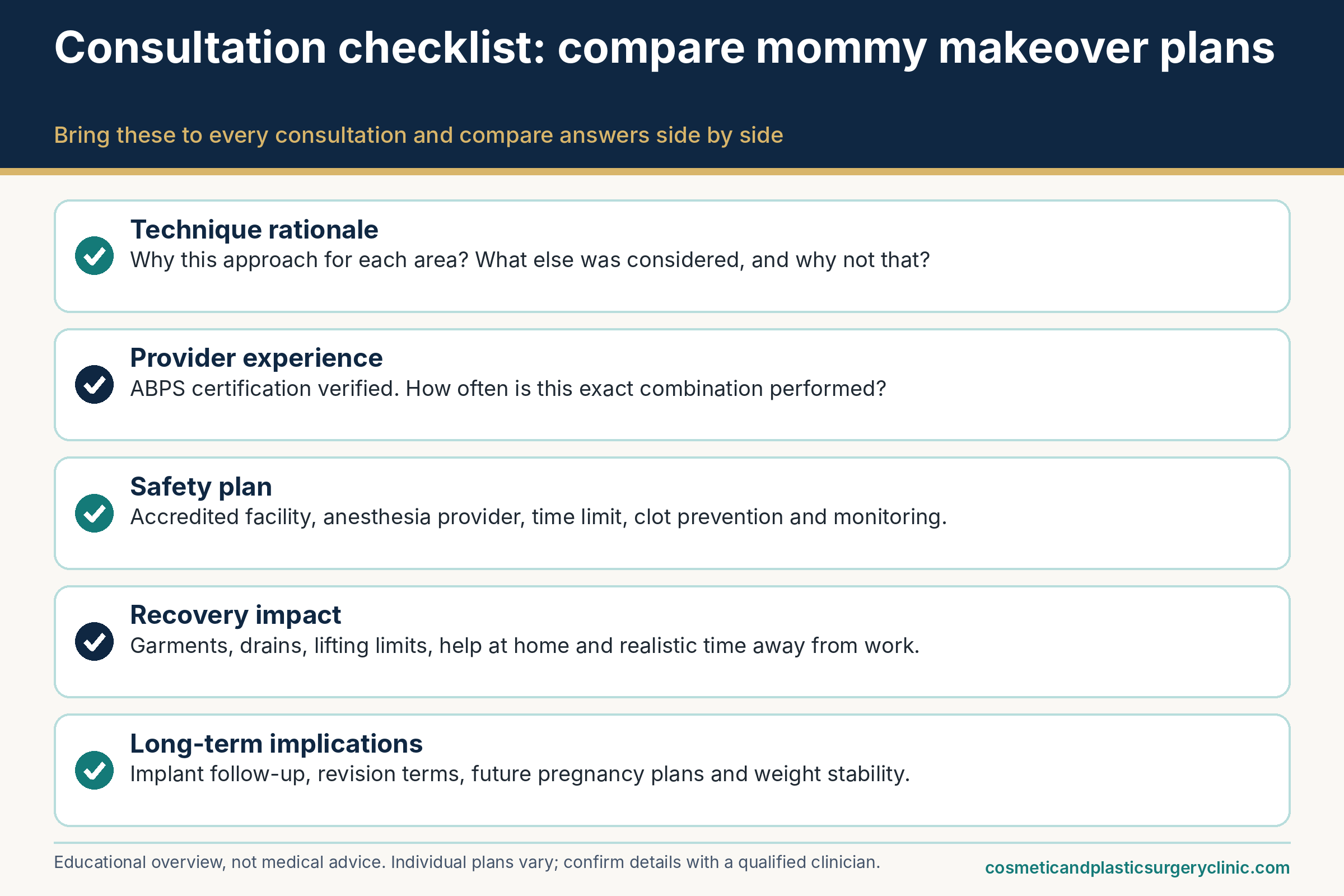
Questions work best when they’re specific, so Table 7 pairs each with the reason it matters and what a helpful answer tends to contain. A good consultation answers these without defensiveness, and if answers vary between two surgeons, the differences themselves are useful information. Our dedicated page on mommy makeover consultation questions carries a longer list, and the guide on evaluating before and after photos will help you review a surgeon’s gallery.
| Question | Why it matters | What a helpful answer includes |
|---|---|---|
| Why this technique for each area, and what else did you consider? | Shows whether the plan is matched to your anatomy or is a default package | A reason tied to your exam, plus the main alternative and why it was not chosen |
| If I could only do one part, which would it be? | Reveals the anchor procedure and what is optional | A clear priority and a view on what could wait |
| What is the expected total anesthesia time, and do you have a limit? | Time limits differ between surgeons and affect staging | A time estimate, the surgeon’s own limit and what happens if the case runs long |
| Where will surgery take place and who provides anesthesia? | Facility accreditation and anesthesia credentials are core safety checks | The facility’s accreditation and the provider’s type, plus the monitoring plan afterward |
| How do you assess and reduce clot risk? | Clots are a recognized risk in abdominal contouring and combination plans | A risk assessment method, preventive steps and warning signs to watch |
| If implants are planned, which type and what do I need to know? | FDA labeling describes ongoing risks and monitoring | The device type, the FDA patient decision checklist and a follow-up plan |
| What will recovery look like at home, week by week? | Drains, garments and lifting limits shape daily life | Concrete restrictions, help needed and when to call the office |
| What is your revision policy and what does it cover? | Another procedure is sometimes needed, per ASPS | Written terms covering the surgeon’s fee versus facility and anesthesia charges |
Take notes, compare answers across at least two practices and wait until you feel the answers are clear. There’s no reason to decide in the room, and an offer that depends on deciding quickly deserves skepticism. A good next step is to verify credentials, write down your top three concerns in your own words, and bring them with the questions above. The educational goal of this page is that when someone says “mommy makeover,” you know which questions turn the phrase into a specific plan you can evaluate on its merits.
Frequently asked questions
What is the difference between a mommy makeover and a tummy tuck?
A tummy tuck (abdominoplasty) is one operation on the abdomen. A mommy makeover is a customized combination that usually includes a tummy tuck or liposuction plus a breast procedure, and sometimes other areas. ASPS lists six possible components, but it doesn’t define a required set, so two people can have very different operations under the same name. If someone says they “had a mommy makeover,” the useful follow-up is which procedures and techniques were involved, because that determines the scars, recovery and risks.
How many procedures does a mommy makeover include?
There’s no fixed number. ASPS names breast augmentation, breast lift, buttock augmentation, labiaplasty, liposuction and tummy tuck as possibilities, and ASPS-hosted surgeon commentary says not every patient needs every procedure and some need only one or two. Many descriptions center on one breast procedure plus one torso procedure. More components mean more operating time and more healing sites, so the better question is whether each component addresses a concern you actually have and whether the total fits within your surgeon’s safety limits.
Can a mommy makeover be split into two surgeries?
Yes. ASPS describes the procedure as typically single-stage, but surgeons also stage plans, often when the total anesthesia time would be long, when a higher-risk component is involved, or when the person’s health or home support suggests two shorter recoveries. Staging usually means two sets of facility and anesthesia charges and two recovery periods. Ask your surgeon which parts would go first, how far apart the operations would be, and how the plan would change if one stage went differently than expected.
Do breast implants have to be replaced after a certain number of years?
The FDA doesn’t set a fixed replacement date. It says breast implants are not considered lifetime devices, that the longer they stay in place the greater the chance of complications, and that additional surgery to remove or replace them may be needed. For silicone gel implants, the FDA describes MRI as the most effective way to detect silent rupture, and Mayo Clinic summarizes imaging advice as a first scan at five to six years and then every two to three years. Some people keep implants for many years without problems, and some need revision sooner.
Is a mini tummy tuck enough after pregnancy?
It can be for some people, but it depends on where the loose skin and any muscle separation are. ASPS describes a mini tummy tuck as suited to loose skin and fat below the belly button, with a smaller incision and a navel that typically stays in place. A full tummy tuck, by contrast, treats the whole abdomen and repairs separated muscles. A surgeon’s exam is the only way to tell which better matches your anatomy. Ask what the mini option would leave unchanged, and whether you’d likely want more later.
Will a tummy tuck fix diastasis recti?
ASPS says a tummy tuck, in most cases, restores weakened or separated muscles, and a full version typically includes sewing the rectus muscles together. Reviews of surgical repair report low recurrence over short follow-up, but the data are limited and the muscles can be stressed again by later pregnancies or weight changes. A tummy tuck also isn’t the only route: physical therapy is one nonsurgical approach people try for core symptoms, though the evidence for any specific routine is weak. Ask your surgeon how the repair is done and what would reduce the chance of recurrence.
Can I have a mommy makeover while I’m still breastfeeding?
Surgeons commonly advise waiting, but the stated waiting periods vary. ASPS-hosted articles describe anything from about six weeks to six months after breastfeeding ends before breast surgery, with some saying at least three months. The reasoning is that breast size and shape keep changing as milk production winds down, and that hormones affect healing. Breast implant and reduction surgery can also affect later breastfeeding. If you’re nursing and thinking about surgery, mention it at the first consultation so the plan can account for it.
How long can a combined operation safely last?
There isn’t a single accepted number. Surgeons quoted in ASPS features describe personal limits ranging from roughly four to five hours of anesthesia up to about six hours, and one said most surgeons treat six hours as an upper bound. These are judgment calls shaped by the specific procedures, your health and the facility. Instead of asking for a “safe” number, ask the surgeon what the expected time is for your plan, what limit they work within, and what they would do if the case ran long.
Is vaginal rejuvenation a standard part of a mommy makeover?
No. ASPS lists labiaplasty as a possible component and mentions vaginal rejuvenation on its procedure page, but the phrase covers very different things. Labiaplasty is a surgical procedure whose evidence base ACOG describes as limited. Energy-device treatments marketed as vaginal rejuvenation prompted a 2018 FDA safety communication saying their safety and effectiveness hadn’t been established and reporting burns, scarring and chronic pain. If either is offered, ask exactly what will be done, with what device, and what the evidence and regulatory status are.
What happens to the results if I get pregnant again?
Later pregnancies can change the results. ASPS advises postponing a tummy tuck if future pregnancies are possible and says pregnancy-related breast changes can alter the outcome of a breast reduction, and a member surgeon writing for ASPS says additional pregnancies could impact or even reverse surgical results. Some people choose to have surgery after childbearing is complete for this reason. If you’re unsure about family plans, say so, because surgeons may suggest waiting or may stage the plan differently.
Does insurance cover a mommy makeover?
The ASPS cost page for mommy makeover doesn’t address insurance, and the procedures are generally elective and cosmetic. Coverage depends on your plan and on whether a specific component is judged to have a medical purpose, so the only reliable answer comes from your insurer and the surgeon’s billing office. Ask for the procedure codes the practice would use and whether any part of the plan could be submitted separately. Financing is a separate question, covered on our cost page, and it’s wise to compare what each quote includes before comparing totals.
Sources and further reading
- American Society of Plastic Surgeons — Mommy makeover (accessed 2026-10-03) — goal, list of possible components, “many techniques,” typically single-stage
- American Society of Plastic Surgeons — Mommy makeover candidates (accessed 2026-10-03) — general criteria including finished childbearing; highly individualized
- American Society of Plastic Surgeons — Mommy makeover safety (accessed 2026-10-03) — risk list, consent forms, combining procedures
- American Society of Plastic Surgeons — Mommy makeover procedure steps (accessed 2026-10-03) — anesthesia options and component procedures
- American Society of Plastic Surgeons — Mommy makeover recovery (accessed 2026-10-03) — dressings, garments, healing, questions to ask
- American Society of Plastic Surgeons — Mommy makeover results (accessed 2026-10-03) — gradual results, permanent scars, possible further surgery
- American Society of Plastic Surgeons — Mommy makeover cost (accessed 2026-10-03) — cost components; no dollar figures or year on the page
- American Society of Plastic Surgeons — Two procedures in one? Why patients are opting to combine plastic surgery procedures (accessed 2026-10-03) — surgeon-described time limits; combination risks
- American Society of Plastic Surgeons — Patients combine procedures for shorter recovery times and longer-lasting results (accessed 2026-10-03) — Insights and Trends survey figure; phased plans; support at home
- American Society of Plastic Surgeons — Post-pregnancy plastic surgery: what can you do now, and what needs to wait (accessed 2026-10-03) — surgeon commentary on timing after delivery and breastfeeding
- American Society of Plastic Surgeons — Mommy makeovers: what women should know about postpartum surgical procedures (accessed 2026-10-03) — customization; timing ranges
- American Society of Plastic Surgeons — Mommy makeover: how soon is too soon (accessed 2026-10-03) — weight and breastfeeding timing commentary
- American Society of Plastic Surgeons blog — Finding the right time for a mommy makeover (July 8, 2020; accessed 2026-10-03) — additional pregnancies and results
- American Society of Plastic Surgeons — Tummy tuck (accessed 2026-10-03) — definition, limits, pregnancy and weight cautions
- American Society of Plastic Surgeons — Tummy tuck procedure (accessed 2026-10-03) — anesthesia, incisions, muscle repair, navel
- American Society of Plastic Surgeons — There’s more than one type of tummy tuck (January 30, 2024; accessed 2026-10-03) — mini, full and fleur-de-lis versions
- American Society of Plastic Surgeons blog — Understanding the different types of tummy tucks (July 19, 2024; accessed 2026-10-03) — standard, mini and extended versions
- American Society of Plastic Surgeons — Liposuction (accessed 2026-10-03) — definition, limits, skin elasticity
- American Society of Plastic Surgeons — Practice Advisory on Liposuction, Executive Summary (approved March 15, 2003; accessed 2026-10-03) — combining with other procedures, volume, facility, fluid and clot-prevention guidance
- Wolters Kluwer — How much liposuction is safe? Plastic and Reconstructive Surgery study summary (September 2015; accessed 2026-10-03) — volume, BMI and complication findings
- American Society of Plastic Surgeons — Breast augmentation procedure (accessed 2026-10-03) — implant placement and incision options
- American Society of Plastic Surgeons — Breast lift (accessed 2026-10-03) — what a lift does and does not change
- American Society of Plastic Surgeons — Breast lift procedure (accessed 2026-10-03) — incision patterns, nipple repositioning, scars
- American Society of Plastic Surgeons — Breast reduction risks and safety (accessed 2026-10-03) — sensation, breastfeeding, pregnancy considerations
- American Society of Plastic Surgeons — Fat transfer breast augmentation (accessed 2026-10-03) — liposuction harvest; suited to relatively small increases
- American Society of Plastic Surgeons — Body lift (accessed 2026-10-03), arm lift, thigh lift and buttock augmentation overview pages — add-on area definitions and limits
- Inter-Society Gluteal Fat Grafting Task Force — Safety advisory (January 31, 2018; accessed 2026-10-03) — mortality estimate then available, injection depth and staging recommendations
- American Society of Plastic Surgeons — Accredited facilities (accessed 2026-10-03) — accrediting bodies and member requirements
- American Society of Plastic Surgeons — Questions to ask your plastic surgeon (accessed 2026-10-03) — certification, privileges, facility, experience, complications
- American Society of Plastic Surgeons blog — Ten things to ask before having plastic surgery (2017; accessed 2026-10-03) — anesthesia provider credentials, experience, second opinion
- American Society of Plastic Surgeons blog — How nicotine sabotages plastic surgery (December 12, 2016; accessed 2026-10-03) — nicotine forms and healing
- U.S. Food and Drug Administration — Breast implants (page current as of December 15, 2023; accessed 2026-10-03) — boxed warning, patient decision checklist, implant ages, not lifetime devices
- U.S. Food and Drug Administration — Risks and complications of breast implants (updated December 15, 2023; accessed 2026-10-03) — local complications, reoperation, complications increase over time
- U.S. Food and Drug Administration — Types of breast implants (accessed 2026-10-03) — approved ages, MRI for silent rupture
- U.S. Food and Drug Administration — Premarket Notification 510(k) (accessed 2026-10-03) — clearance versus approval
- Medsafe (New Zealand) — Energy-based devices for vaginal rejuvenation (September 5, 2018; accessed 2026-10-03) — regulator notice quoting the FDA July 30, 2018 safety communication
- International Urogynecological Association — FDA warns against use of energy-based devices to perform vaginal rejuvenation or vaginal cosmetic procedures (accessed 2026-10-03) — notice of the FDA safety communication (July 30, 2018)
- NBC News — FDA warns companies about deceptive vaginal rejuvenation claims (July 2018; accessed 2026-10-03) — reported adverse events and manufacturer warning letters
- American College of Obstetricians and Gynecologists — Committee Opinion No. 795: Elective Female Genital Cosmetic Surgery, repository record (accessed 2026-10-03) — evidence limits, risks, counseling recommendations
- Aesthetic Plastic Surgery (2026) — Risk of concomitant abdominoplasty and breast surgery versus isolated procedures: a systematic review and meta-analysis (accessed 2026-10-03) — pooled complication comparison; heterogeneity
- American Society of Plastic Surgeons — Tummy tuck complications: study looks at rates and risk factors (2015 Plastic and Reconstructive Surgery study; accessed 2026-10-03) — CosmetAssure analysis of abdominoplasty combinations
- Plastic and Reconstructive Surgery (2010) — Procedural risk for venous thromboembolism in abdominal contouring surgery, publication record (accessed 2026-10-03) — pooled venous thromboembolism rates
- ScienceDaily — Caprini risk assessment in plastic surgery, Journal of the American College of Surgeons study summary (November 2010; accessed 2026-10-03) — risk score validation
- Aesthetic Surgery Journal (2004) — “Extreme” cosmetic surgery: a retrospective study of morbidity in patients undergoing combined procedures; copy hosted on an author’s practice site (accessed 2026-10-03) — single-center series of 248 abdominoplasties
- Aesthetic Surgery Journal (2005) — Does lipoplasty really add morbidity to abdominoplasty? A series of 406 cases (accessed 2026-10-03) — liposuction with abdominoplasty
- Aesthetic Surgery Journal (2009) — Safe and consistent outcomes of successfully combining breast surgery and abdominoplasty: an update; copy hosted on an author’s practice site (accessed 2026-10-03) — single-center series of 268 patients
- Frontiers in Surgery (2019) — Treatment options for abdominal rectus diastasis (accessed 2026-10-03) — definition, prevalence, evidence on treatment
- Plastic and Reconstructive Surgery (2024) — Autologous fat grafting in breast augmentation: a systematic review highlighting the need for clinical caution, publication record (accessed 2026-10-03) — retention, complications, satisfaction
- American Society for Aesthetic Plastic Surgery meeting abstract (2014) — Systematic review and meta-analysis of single-stage augmentation-mastopexy (accessed 2026-10-03) — pooled reoperation rate; conference abstract only
- Mayo Clinic — Tummy tuck (accessed 2026-10-03) — typical duration, drains, return to work, weight stability
- Mayo Clinic — Breast augmentation (accessed 2026-10-03) — implants and sagging, breastfeeding, imaging advice
- Cleveland Clinic — Tummy tuck (abdominoplasty) (accessed 2026-10-03) — types, duration, activity restrictions
- American Board of Plastic Surgery — Verify certification (accessed 2026-10-03) — public certification lookup; voluntary credential; license is separate