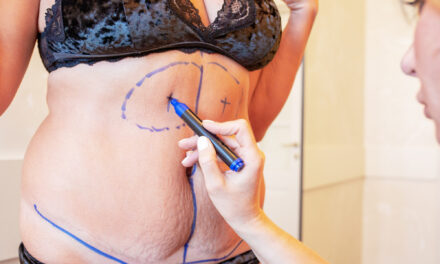

Two people can both say they had a tummy tuck (abdominoplasty) and describe operations that share little beyond the name. One had a short scar low on the abdomen and no change above the navel. Another had a scar that runs hip to hip, a repaired midline, and a relocated navel. A third had a scar that runs around the waist and across the lower back. This guide to tummy tuck techniques explains how those operations differ, what each variation is designed to address, where the evidence is firm, and where it is mostly habit, preference, or marketing.
It is a technique-level companion to our complete guide to tummy tuck (abdominoplasty), so it won’t walk through the whole experience again. Cost, recovery, candidacy, and risks have their own pages. Here the question is narrower and, for many readers, more useful: which choices are built into the operation itself, and how should a patient compare one surgeon’s plan with another’s?
A few ground rules for the rest of the page. This is general education, not a recommendation for any individual, and only a board-certified plastic surgeon who has examined you can say which approach fits. Where research is thin we say so directly, using phrases such as “single-surgeon series” or “conference abstract” on purpose. And because technique names are used loosely, you will see us return again and again to one habit: ask the surgeon to describe the operation in plain words, with a marked diagram, instead of relying on the label.
The sections run in the order most people need them. First comes a map of what actually varies and how strong the evidence is. Then the skin-removal patterns, the muscle and navel work, the fat and fluid decisions, and the practical questions of anesthesia, incisions, and scars. The last two sections show how technique is matched to anatomy, how risk and recovery differ by approach, and how to turn all of it into questions you can bring to a consultation.
The Landscape of Tummy Tuck Techniques: What Actually Varies
Abdominoplasty is not one operation with a few optional extras. It is a family of related operations that share a core idea, which is to reshape the front of the torso by removing or repositioning skin and fat and, in many cases, tightening the abdominal wall. The American Society of Plastic Surgeons (ASPS) describes it as an operation that removes excess fat and skin and, in most cases, restores weakened or separated muscles. Everything beyond that sentence is a set of choices, and those choices are what this page is about.
Four Decisions Inside Every Operation
Skin, Fascia, Fat, and Navel: The Four Building Blocks
It helps to think of a tummy tuck as four separate decisions that get bundled under one name. The first is the skin pattern: how much skin is removed, and in what shape. A horizontal ellipse low on the abdomen is the familiar version. Adding a vertical component, extending the cut around the flanks, or moving the incision to the upper abdomen are the main alternatives.
The second decision is the fascia, the tough sheet of connective tissue over the rectus muscles. When the midline has stretched, surgeons often bring the two sides closer with stitches, a step called plication. Whether to do it, how far up and down the midline it extends, how many suture layers are used, and which suture material is chosen are all variables. They affect how flat the abdomen looks and may affect recovery discomfort, though we separate what is known from what is assumed in a later section.
The third is fat and the skin flap. Some surgeons lift the entire abdominal flap widely off the wall. Others limit the lifting to preserve small blood vessels that travel up through the muscle layer to the skin, and many add liposuction. Those choices change how much tissue is disrupted, which is why they appear in discussions of fluid collections and skin healing.
The fourth is the navel. In most full operations the navel stays attached to the abdominal wall while the skin around it is pulled down, and a new opening is cut in the stretched skin so the navel can emerge in its proper position. How that opening is shaped and sewn is a small technical detail with outsized visual importance, since the navel is the one landmark everyone notices.
Almost every technique name you will hear is shorthand for a particular combination of those four decisions. That is why two operations with the same name can differ, and why a different name does not always mean a different operation.
Why Labels Mislead: Names, Nicknames, and What to Ask For
The vocabulary around abdominoplasty comes from three places: academic papers, surgeon training traditions, and clinic marketing. The academic names tend to describe geometry (fleur-de-lis, reverse, circumferential). Training traditions add eponyms and shorthand. Marketing adds brand-style names that sound precise but often carry no standard definition. A “mini” at one practice may be an operation that another practice would call a limited full tuck, and “360” can describe liposuction, scar length, or both.
The table below is a terminology map. It is not a ranking; it simply shows the typical meaning of each term in the medical literature and the confusion that tends to surround it. Treat the meanings as general, because individual surgeons use the words differently.
| Term you may hear | Usual meaning | What it does not necessarily tell you | Where it is covered here |
|---|---|---|---|
| Mini tummy tuck | Shorter incision, work concentrated below the navel | Whether the muscle is tightened, whether liposuction is included, how high the correction reaches | Skin patterns |
| Full or standard tummy tuck | Hip-to-hip type incision with the navel repositioned and the upper skin pulled down | Fascia handling, fat work, drain or suture strategy | Skin patterns; muscle and fascia |
| Extended tummy tuck | A full tuck with the incision carried farther around the flanks | Whether it stops short of the back midline or continues around the body | Skin patterns |
| Fleur-de-lis | Horizontal plus vertical skin removal, often after major weight loss | The exact vertical scar length and where the vertical component sits | Skin patterns |
| Reverse abdominoplasty | Skin removal driven from an upper incision under the breasts | Whether it can be combined with lower abdominal work | Skin patterns |
| Circumferential, belt lipectomy, lower body lift | Skin and fat removal around the waist, including the back | Whether the buttocks and thighs are lifted or only the waist is treated | Skin patterns |
| Lipoabdominoplasty | Tummy tuck combined with liposuction, usually with limited flap undermining | Which areas are suctioned and how aggressively | Fat, fluid, and blood supply |
| Plication | Stitching the stretched midline fascia closer together | Single or double layer, suture material, length of the repair | Muscle and fascia |
| 360, “HD,” or “high-definition” tuck | Usually a marketing label for tuck plus circumferential or sculpting-style liposuction | It has no single standard definition | Fat, fluid, and blood supply |
A practical rule follows from the table. When a name comes up in a consultation, ask for three details: where the incision will start and end, whether the fascia will be tightened and how far, and whether liposuction or a vertical component is part of the plan. Those three answers define the operation far more reliably than the word on the brochure.
How Strong Is the Evidence Behind Technique Choices?
What Is Supported, What Is Convention, and What Is Habit
Plastic surgery techniques spread in several ways. Some are studied head to head, some are adopted because a respected surgeon reports good results in a series of patients, and some become standard simply because that is how surgeons were trained. All three can be reasonable, but they deserve different levels of confidence, and patients are well served by knowing which is which.
For abdominoplasty, the strongest recent work concerns fluid collections (seromas) after surgery. In September–October 2026 the ASPS circulated a draft evidence-based clinical practice guideline on seroma prevention in abdominoplasty and panniculectomy for peer review and public comment. As we read the draft, its workgroup screened thousands of references and included 62 studies, and it rates the certainty for some questions as moderate, which in this literature is relatively strong. Because it is still a draft, specific wording and grades could change before final publication, so treat the details we cite from it as provisional.
Outside that question, the picture is thinner. Reviews of rectus diastasis repair, lipoabdominoplasty, and circumferential procedures repeatedly describe small samples, mostly retrospective data, single-surgeon series, and wide differences in how outcomes are defined. That does not make those techniques wrong. It does mean a claim such as “this method gives a tighter result” usually rests on surgeon experience and case series, not on randomized comparisons.
| Technique question | Best evidence found | What it suggests | Main caveat |
|---|---|---|---|
| Quilting-type (progressive tension) sutures versus drains for seroma | Meta-analyses; ASPS draft guideline (2026) | Quilting sutures probably lower seroma risk; adding drains to quilting sutures adds little for clinically meaningful seroma | Draft guideline; mixed study quality |
| Preserving Scarpa’s fascia | 2023 systematic review; ASPS draft guideline | Probably reduces seroma and shortens drain time when anatomy allows | Small trials, short follow-up, few fleur-de-lis data |
| Fibrin sealant and tissue adhesives | ASPS draft guideline | Not recommended as routine seroma prevention | Draft; certainty varies by product |
| Compression garments for seroma | ASPS draft guideline | No recommendation either way; no comparative studies found | Absence of studies is not evidence of no effect |
| Rectus plication suture type and layers | Small randomized trial; single-surgeon series; scoping review | Several approaches report low recurrence | No high-level comparison; no standard method |
| Lipoabdominoplasty versus traditional tuck | Systematic review of mostly observational studies | Lower skin-necrosis reports with limited undermining plus liposuction | Selection bias; undermining and liposuction are confounded |
| 360 or “HD” tuck claims | Case series from single surgical teams | Complications reported as comparable to other series | Level IV evidence; no controlled comparison |
The ledger shows a pattern worth remembering. Where large numbers of patients and some randomized trials exist, the conclusions are more cautious but more trustworthy. Where a technique is mostly described by the teams that use it most, the results tend to sound excellent and the uncertainty tends to be understated, through no ill intent, because those teams treat selected patients and follow them in their own way.
Reading Technique Studies Without Overreading Them
A few habits make technique research easier to interpret. Start with who wrote it. A report on a method from the surgeons who use it most is useful as a description but is not an independent test. Look at the number of patients and who they were: a series of 21 patients operated on by one surgeon with follow-up under six months, as one small Brazilian series reported for selective liposuction in abdominoplasty, can show that a method is feasible but cannot show how often problems occur.
Next, ask what the comparison group was. A statement such as “no flap loss in our series” means little without knowing how many high-risk patients were included. Complication rates also depend on definitions. Some papers count only seromas that needed drainage; others count anything seen on ultrasound. When one paper reports a figure of 7% and another 15%, the gap can be a definition problem and not a technique difference.
Be cautious about averages as well. Pooled figures describe populations, such as the 25,478 insured abdominoplasty patients in a 2008–2013 insurance-backed registry. They tell you how a technique performs across many surgeons and patients. They cannot tell you your personal odds, which depend on your health, weight, smoking history, other procedures planned, and the surgeon and facility.
Finally, watch for wording. “May reduce,” “probably decreases,” and “no demonstrated difference” are different statements. The honest answer to many technique questions is that the field has not run the definitive comparison yet, and a surgeon who says so is often more trustworthy than one who calls a method the clear winner.
Skin-Removal Patterns: Mini, Full, Extended, Fleur-de-Lis, Reverse, and Body Lift
The most visible difference between tummy tuck techniques is the shape of the skin excision, because it determines the scar. A horizontal pattern removes skin from below, a vertical pattern adds a midline cut, a reverse pattern works from above, and a belt pattern circles the torso. Each one trades correction for scar length and recovery burden. None of them is a better operation in the abstract. They are answers to different anatomical questions.
Horizontal Patterns: Mini, Full, and Extended
Mini Abdominoplasty: Scope, Limits, and the “Mini Tuck” Marketing Gap
A mini abdominoplasty is the smallest of the standard abdominal skin-removal operations. Cleveland Clinic’s patient page describes it as using a shorter incision low on the abdomen, without cutting around the belly button, and presents it as suited to people with minimal excess skin. In most descriptions the work is concentrated below the navel: the lower skin is lifted a limited distance, the excess is trimmed, and the incision is closed. Because the navel is not detached, there is no new navel opening, which removes one source of visible scarring and one potential healing problem.
The key limit is reach. The lower abdominal skin can only be advanced so far before tension is excessive, so the operation cannot meaningfully tighten skin above the navel. A person whose looseness extends to the upper abdomen, or whose midline bulge runs the full height of the abdomen, may find that a mini operation changes less than expected. That is a mismatch between goal and operation, not a failure of the technique.
Some mini operations also include tightening of the lower portion of the midline fascia, and many are combined with liposuction. There is no universal definition, so one surgeon’s mini may include plication and liposuction while another’s does not. One conference abstract from a single surgeon’s 11-year experience illustrates the variability. In that retrospective review of 264 abdominoplasties, 63 (24 percent) were classed as mini procedures, of which 36 were limited to the area below the navel and 27 were extended versions. The author reported no hematoma, skin loss, or navel necrosis in the mini group, one persistent upper-abdominal diastasis, and one reoperation for seroma, and noted that most also had liposuction. It is a conference abstract from a single surgeon’s selected patients, so it shows what is possible with careful selection, not what any given patient should expect.
That brings up what we call the marketing gap. “Mini tuck” is attractive language because it implies less surgery, a smaller scar, and faster recovery, and those can all be true when the anatomy fits. The risk lies in the reverse: when the label is offered to someone whose anatomy calls for a larger operation, the person can end up with a shorter scar and an unresolved concern, which sometimes leads to a second operation. A fair test is to ask the surgeon what the mini will not do for you, and to ask to be shown, on your own abdomen, where the lifted skin will stop. If the answer is vague, the label may be doing the selling.
It is also reasonable to ask whether a mini is truly a smaller operation in your case. A mini that adds liposuction of several areas and a muscle repair can involve more operating time than the name suggests. Judge the plan by its components, not its label, and weigh the scar savings against the chance that the operation will fall short of your goals.
Full (Standard) and Extended Abdominoplasty
A full abdominoplasty, which the ASPS also calls a standard tummy tuck, treats the entire front of the abdomen. In the ASPS description, a horizontal incision is made between the pubic hairline and the navel, and its shape and length depend on the amount of excess skin. A second incision around the navel lets the navel remain attached to the wall while the abdominal skin is lifted. The surgeon repairs the weakened muscle layer, pulls the upper skin down like a window shade, trims the excess, and creates a new opening for the navel. The skin is closed with sutures, skin adhesives, tapes, or clips.
Most differences among full operations are in the details that never make it into the name: how widely the skin was lifted, how the fascia was tightened, whether liposuction was added, how the incision was angled at its ends, and how fluid was controlled. Those are covered in the sections that follow. For now, the point is that “full” describes a scope, not a recipe.
An extended abdominoplasty carries the incision farther around the flanks. A Clinics in Plastic Surgery article on the approach describes it as aimed at excess tissue on the sides and hips that would otherwise leave a bulge or a lateral fold, sometimes called a dog-ear, at the end of a standard incision. It differs from a body lift, the article notes, because the cut runs toward the back along a line similar to a body lift incision but does not cross the midline of the back. The same discussion builds on the high-lateral-tension idea, a design philosophy associated with surgeon Lockwood that emphasizes tightening and removing tissue from the sides, where much of the laxity is thought to sit, while limiting undermining of the center.
Those words can sound abstract, but the practical consequences are simple. Extended operations remove more skin from the flanks, create a longer scar that may reach toward the hips, and take longer to perform. For a person with flank fullness, they can produce a smoother waistline than a standard incision. For a person without it, they add scar and recovery with little benefit.
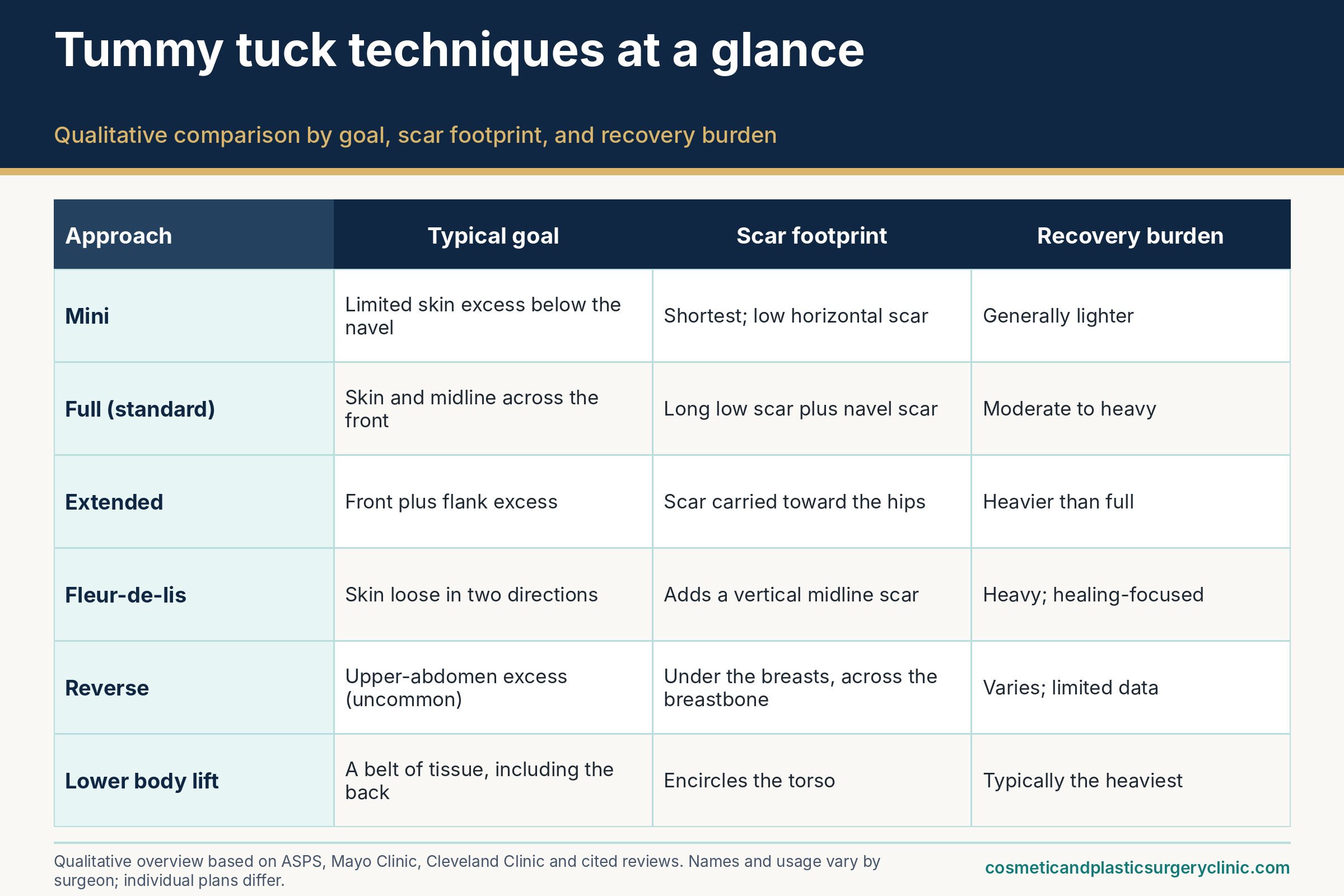
| Approach | Region addressed | Navel | Scar pattern (general) | Main trade-off to raise |
|---|---|---|---|---|
| Mini | Lower abdomen below the navel | Usually left in place; no new opening | Shorter low horizontal scar | Cannot reach the upper abdomen |
| Full (standard) | Entire front of the abdomen | New opening created in the lifted skin | Long low horizontal scar plus navel scar | Larger operation and longer recovery than a mini |
| Extended | Front plus the flanks | New opening created | Horizontal scar carried farther toward the hips | More scar length and operating time |
| Fleur-de-lis | Skin excess in both horizontal and vertical directions | New opening created or navel repositioned | Inverted-T pattern with a vertical midline scar | Added vertical scar; wound-healing demands at the junction |
| Reverse | Upper abdomen | Not usually the focus | Under the breasts and across the lower breastbone | Does not treat the lower abdomen on its own |
| Circumferential, belt lipectomy, lower body lift | Abdomen, flanks, back, and often buttocks and thighs | Varies with the plan | Belt-like scar around the torso | Largest operations in this family; higher clot-risk category in older reviews |
Beyond the Horizontal Scar: Vertical, Upper, and Circumferential Designs
Fleur-de-Lis: Adding a Vertical Excision
A fleur-de-lis abdominoplasty (also spelled fleur-de-lys) combines the familiar horizontal excision with a vertical excision along the midline, producing an inverted-T pattern. The extra cut exists because skin can be loose in two directions. After major weight loss, many people have excess skin that hangs down and also excess skin that spreads sideways across the abdomen, and a horizontal scar alone cannot pull a sheet of tissue tight in both directions. Cleveland Clinic’s patient page associates the fleur-de-lis pattern with large weight loss, and the ASPS draft seroma guideline names fleur-de-lys procedures as a distinct category within its scope.
The cost of the added correction is added scar and added wound-healing demand. The vertical scar is visible in the center of the abdomen, not hidden at the bikini line, and the point where the vertical and horizontal incisions meet is commonly described as a spot that needs careful planning because three flaps of skin meet there under tension. Those are general features of the design, which surgeons plan around, and they are among the reasons it is not a default choice.
The research is thin. A single-surgeon conference abstract reviewed 404 outpatient abdominoplasties, of which 77 used the fleur-de-lys design, and argued that the pattern was appropriate for any patient with excess skin in both directions, not only those with major weight loss. The author reported that wound problems tracked with very high or very low body mass index and with deeper stretch marks. A 2023 systematic review of Scarpa’s fascia preservation also flagged limited data on fleur-de-lis variants. In practical terms, patients considering this design are relying largely on surgeon experience and selected series, so questions about that surgeon’s own volume with the technique are especially relevant.
If the problem is a hanging apron of skin and fat and the main concern is hygiene, rashes, or skin breakdown beneath the fold, a panniculectomy is sometimes a different conversation. We cover that distinction on our panniculectomy page. For anyone whose tissue excess followed major weight loss, the tummy tuck after weight loss page explains timing and planning in more depth.
Reverse Abdominoplasty, Circumferential Procedures, and Lower Body Lift
These three are grouped here because patients often confuse them with a standard tummy tuck, yet each one solves a different problem.
A reverse abdominoplasty works from above. An ASPS blog post by a member surgeon describes incisions along the lower breast fold that cross the lower breastbone, with excess upper-abdominal skin lifted and removed. It is described as useful for people whose looseness is mainly above the navel and who have little excess below. It is also used in some breast operations to borrow upper-abdominal tissue. It is a niche operation. Our research for this article found a surgeon’s explanatory post and case-series literature, not strong comparative evidence, and one recent paper on the technique could not be read, so we treat the description as general and unverified in detail. If you are told you need one, ask why a standard approach would not address the same area.
A circumferential abdominoplasty extends the skin removal fully around the torso, including the back. Related terms include belt lipectomy and lower body lift. A systematic review of circumferential lower-trunk contouring, which pooled 42 articles and 1,748 patients, separated two broad types: belt lipectomy, which tends to be used for the waist and hip rolls and places the scar around the waistline, and lower body lift, which is described as more effective for sagging of the buttocks and thighs. In that review, massive weight loss was the most common reason for surgery, wound dehiscence (the incision partly reopening) was the complication reported most often, and only two of the included studies reached level II evidence. The ASPS body lift page describes a complete lower body lift as treating the abdomen, groin, waist, thigh, and buttock regions with an incision around the body, and says final results may take one to two years to develop.
The vital distinction is scale. A tummy tuck treats the front of the abdomen. A circumferential procedure treats a belt of tissue. A lower body lift can also reposition the buttocks and outer thighs. The operations are different in operative time, blood loss risk, position changes during surgery, and recovery, and they are often discussed in the context of massive weight loss. A pooled review found venous thromboembolism (blood clots in the legs or lungs) in 3.40 percent of circumferential abdominoplasty cases compared with 0.35 percent for abdominoplasty alone, and its authors recommended that circumferential procedures be classed in a higher clot-risk category. That review is from 2010 and pools reports with different methods, so the numbers show direction, not present-day rates.
For the larger operations, see our planned lower body lift guide. This page stays with the abdominoplasty family and uses the body lift only as a boundary marker.
Muscle, Fascia, Hernias, and the Navel: The Work Beneath the Skin
Skin removal is what shows on the outside, but for many patients the reason for choosing abdominoplasty over liposuction alone is what happens underneath. When the midline of the abdominal wall has stretched, often after pregnancy or weight change, skin removal does not address the bulge. The techniques for the wall itself are less standardized than the skin patterns, and the evidence for choosing among them is thinner than most patients assume.
Rectus Plication: How the Wall Is Tightened and What We Know
Plication Basics: Layers, Sutures, and What Studies Compare
The two rectus abdominis muscles run vertically on either side of the midline, joined by a band of connective tissue called the linea alba. When that band widens and thins, the muscles sit farther apart and the abdomen can bulge forward, a condition called rectus diastasis. During abdominoplasty the surgeon can stitch the stretched fascia on each side toward the middle, which is plication. The ASPS lists restoring weakened or separated muscles as part of most tummy tucks.
Beyond the basic idea, the variables are many. The repair can be made in one layer or two. It can use sutures that are absorbable, long-lasting absorbable, or permanent. Stitches can be interrupted or run continuously. The repair can extend from the breastbone to the pubic bone or only part of that distance, and surgeons differ on whether to add a horizontal component. A 2021 scoping review of surgical techniques for rectus diastasis screened 61 studies, of which 46 used an open approach and 15 a laparoscopic one. All of them relied on plication, with single-layer or double-layer variations, and permanent sutures were the most common. The authors reported low recurrence and low complication rates for both open and laparoscopic approaches, yet they concluded that there was a lack of high-level evidence and that no technique could be recommended over the others.
Two more specific studies show how the question is typically examined. A small randomized trial from Brazil (published 2016) assigned 30 women to a continuous double-laced absorbable suture (PDS) or interrupted nylon stitches. The continuous method shortened plication time by almost 40 percent, with no difference in aesthetic outcome and no recurrence found by ultrasound at 10 to 12 months in either group. The trial was small and compared different materials as well as different stitch patterns, so it cannot isolate which factor mattered, and follow-up ended at about a year.
A 2024 single-surgeon retrospective series in Aesthetic Surgery Journal Open Forum looked at 71 women who had a double-layer closure using long-lasting absorbable sutures and a minimum six-month follow-up (an average of about 21 months). No recurrence was found on physical examination, with a complication profile that included delayed wound healing in 11 percent, seroma in 8.5 percent, hematoma in 2.8 percent, and deep vein thrombosis or pulmonary embolism in 2.8 percent. The authors acknowledged that they had no imaging, no patient-reported outcome measures, and no control group.
Taken together, these reports support a modest conclusion: several plication strategies can hold up in the short to medium term in the hands of the surgeons who report them. They do not show that one suture type, one layer count, or one pattern is superior. If a practice describes its method as the only one that lasts, that is a marketing claim; ask what comparison supports it. It is entirely reasonable to ask which suture material and how many layers your surgeon uses, and why, simply so you understand the plan.
Does Plication Improve Function or Back Pain?
Many patients hope that repairing the midline will improve core strength, reduce back pain, or help posture. The evidence is mixed. A systematic review in Cureus (December 2020) pooled seven studies with 497 patients and asked whether plication during abdominoplasty improves strength and function. Strength results were inconsistent: two of three studies showed improvements in measured or reported strength, while one showed no meaningful difference between plicated and non-plicated groups. Function looked more encouraging, since all four studies that used the SF-36 questionnaire reported improvement in its physical function subscale. The review reported an overall complication rate of 17.0 percent (47 of 276 patients) among the studies where it could be counted, and it described wide variation in outcome measures and patients that prevented a meta-analysis. The authors called for larger standardized trials.
Mayo Clinic notes that a tummy tuck may improve associated low back pain in people with separated muscles, language that is appropriately hedged. We would read that as a possibility, not a promise. The honest framing is that a flatter, firmer abdominal contour is the established goal of plication, whereas functional gains are plausible, reported in some studies, and not yet consistently shown.
This matters for expectations in two directions. People who are told the surgery will fix back pain or restore core strength may be disappointed, and the operation is not a substitute for physical therapy or rehabilitation. Equally, people whose main concern is a functional complaint, such as pain or a bulge that appears when they sit up, should say so plainly, because it can change the surgeon’s approach and the evaluation, for example whether a hernia is present or whether a nonsurgical program should come first.
One more point deserves a place here. How tightly the wall is drawn together is a design variable that surgeons weigh, because a very tight repair raises the tension on the closure and changes how the torso feels in the early weeks. We did not find a sourced figure for how often that matters, so we leave it as a question you can ask: “How tight do you plan the repair, and what do patients feel in the first weeks?”
Hernias and the Navel: Two Details That Change the Plan
Diastasis Is Not a Hernia, and Hernia Repair Is a Separate Decision
Patients, and sometimes the internet, use “diastasis” and “hernia” as if they meant the same thing. They don’t. In diastasis the midline band is wide and thin but intact, so the bulge is a broad, soft widening, often running the length of the abdomen. A hernia is a defect, a hole in the wall through which tissue can protrude. An ASPS insurance-coding document from 2006 draws the line explicitly: diastasis recti repair is part of a standard abdominoplasty and is not a hernia repair, while hernia repair involves opening the fascia and dissecting a hernia sac. The document is dated, but the distinction it describes is still how surgeons talk about the two.
Why does this matter for technique? If a hernia is present, whether at the navel or elsewhere in the midline, it may need its own repair. That repair is done by a surgeon qualified to do it, which may or may not be the same person doing the cosmetic work. It changes the operation’s scope, can affect how the navel is handled, and often changes insurance and billing, because a hernia repair is a medical service while a cosmetic abdominoplasty usually is not covered. Our tummy tuck cost guide covers how quotes treat these items.
Practical questions follow. Has the surgeon examined for a hernia, and how, for example by physical examination or imaging? If one is found, will it be repaired during the tuck or separately? Would a different specialist be involved? And does the quote separate the hernia repair from the cosmetic portion? Asking these before the day of surgery avoids surprises.
Umbilicoplasty: Keeping, Moving, or Recreating the Navel
The navel looks like a small detail until it looks wrong. In a full abdominoplasty the navel stays tethered to the wall by its stalk while the skin around it is separated. Once the skin is pulled down and trimmed, a new opening is made in the skin where the navel should emerge, and the navel is sewn into it. The shape of that opening, the way the skin is sutured to the navel, and the depth of the surrounding tissue all affect whether the result looks natural.
There is no single standard technique. A 2020 literature review in Aesthetic Plastic Surgery examined 77 papers on reconstruction of a missing navel, a related but not identical problem, and counted about 60 different techniques. Its authors observed that no universal algorithm exists for choosing among them, and the evidence base was level III. That tells us less about navel handling in routine tummy tucks than about how many approaches exist. It supports the practical conclusion that surgeons rely heavily on personal preference and training here.
You will hear several words. Some surgeons keep the navel on its stalk and bring it through a new opening. Others describe detaching and repositioning it, using terms such as transposition or “float.” A few reconstruct a navel entirely, for example when it has to be removed during complex abdominal wall surgery. These terms are not used identically across practices, and we did not find a standardized definition of the “float” approach in the sources we reviewed, so ask what the term means in your surgeon’s plan.
Questions worth asking: Will the original navel be kept? What shape will the opening take, and where will its scar be? How does the plan protect the navel’s blood supply? What happens if the navel does not heal as expected, and is that covered under the practice’s revision policy? The navel is also one of the places where a reduced blood supply can show up. Mayo Clinic lists tissue damage or death as a risk of tummy tuck, particularly for smokers, which is one more reason to take preoperative nicotine instructions seriously.
Fat, Fluid, and Blood Supply: Liposuction, Scarpa’s Fascia, Drains, and Quilting Sutures
The techniques in this section are the ones least visible in a photo and most discussed among surgeons. They concern how much the skin flap is disturbed, whether fat is suctioned at the same time, and how the empty space under the flap is managed so that fluid does not collect. Because they influence healing more than appearance, they get less attention in marketing, but they are where most of the actual research on abdominoplasty technique sits.
Liposuction as an Adjunct: What Changes and What Claims Need Scrutiny
Lipoabdominoplasty and the Case for Preserving Perforators
In a traditional abdominoplasty, the abdominal flap is lifted widely off the muscle wall, which cuts many of the small vessels, called perforators, that travel from the muscle up to the skin and fat. The skin of the lower flap then depends on blood coming in from other directions. Lipoabdominoplasty is a family of approaches that pair liposuction with a more limited lift of the flap, sparing some of those perforating vessels, particularly in the upper abdomen, and using liposuction to thin and shape the tissue. Work by a surgeon named Saldanha, which a recent review cites as lipoabdominoplasty with anatomical definition, is often held up as the model, and the idea of sparing vessels is what separates it from simply adding liposuction to a standard tuck.
The ASPS draft seroma guideline notes that limiting undermining to preserve upper abdominal perforators is assumed to be current standard practice, which tells us this idea has largely entered the mainstream. Stein and colleagues, who analyzed 8,990 abdominoplasty cases submitted by 390 board-certified surgeons to the American Board of Plastic Surgery between 2005 and 2021, found that the more recent cases involved less wide undermining and more liposuction, alongside a slight but statistically significant decrease in adverse events. Because those surgeons chose which cases to submit, the data describe a particular group of practitioners, not every provider.
A systematic review and meta-analysis that pooled 12 studies and 12,388 patients compared lipoabdominoplasty (liposuction with selective undermining) with traditional abdominoplasty (wide undermining). It reported skin necrosis in 0.37 percent of lipoabdominoplasty cases versus 1.01 percent for traditional operations and surgical revision in 0.40 versus 1.33 percent, and concluded that the combined approach had a lower rate of necrotic complications. Those are observational comparisons, with eight of the 12 studies retrospective, and the two variables, liposuction and limited undermining, travel together, so the data cannot say which one deserves the credit. We could not confirm the review’s journal and publication year from the page we reached, so a reader citing it should check the record.
Adding liposuction does not remove risk in the other direction. The Winocour analysis of 25,478 abdominoplasties in a 2008–2013 complication-insurance database found an overall complication rate of 4.0 percent: 3.1 percent for abdominoplasty alone, 3.8 percent with liposuction, 6.8 percent with another body-contouring procedure, and 10.4 percent with both liposuction and another body-contouring procedure. Those groups are not randomly assigned, since larger combined operations are often chosen for different patients, but they illustrate the direction. A narrative review in the International Surgery Journal in late 2025 described seroma rates of roughly 6.5 to 8.8 percent in lipoabdominoplasty and listed higher body mass index, smoking, diabetes, and older age as risk factors. Our page on combining tummy tuck with other procedures explores that trade-off.
One sensible way to read all this: lipoabdominoplasty seems to be an acceptable and, in some series, slightly favorable way to reshape the contour when done by an experienced surgeon on a suitable patient. It does not make the operation smaller. Ask which areas will be suctioned, how many total hours of surgery are planned, and whether staging would be an option if the plan grows.
Liposuction Choices and Decoding “360” and “High-Definition” Claims
Liposuction in a tummy tuck setting can use the same range of methods discussed in our guide to liposuction techniques: plain suction-assisted, power-assisted, ultrasound-assisted, and others. We don’t repeat that comparison here. The point for tummy tuck planning is that the liposuction method is a separate choice from the tuck itself, and that device names are not outcome evidence. A method that has been used in thousands of procedures is not proven better than a simple one simply because it is newer or more heavily advertised.
Two phrases deserve a decoder. “360” usually means that liposuction is performed all the way around the trunk, including the flanks and back, in addition to the abdomen, alongside the tuck. In the published literature we found, one group reported 1,125 women treated between 2014 and 2022 with 360-degree liposuction of the abdomen and back, fat grafting to the hips, excision of redundant tissue, and wide plication; the authors said complication rates were comparable to other abdominoplasty series. It is a retrospective chart and claims review from one team’s practice.
“High-definition” or “HD” abdominoplasty typically refers to combining a tuck with contouring liposuction that aims to show or suggest muscle lines. A 2018 report in Plastic and Reconstructive Surgery described 736 women treated by one team of surgeons in Colombia with circumferential ultrasound-assisted liposuction, rectus plication, and a newly created navel. It reported seroma in 7.3 percent, longer bruising in about 10 percent, and no flap necrosis or infection, with a nonstandardized satisfaction survey and no independent comparison group, so it is level IV evidence. A separate prospective series of 21 patients used selective liposuction of the natural shadow lines of the abdomen. It reported no complications, but was single-surgeon with under six months of follow-up.
What can a patient do with this? First, treat “360” and “HD” as descriptions of what extra work is planned, not as quality marks. Ask exactly which areas will be suctioned, how much fat is expected to be removed, and whether fat grafting is included. Second, remember that definition in the abdomen comes partly from body fat level and underlying muscle shape, which no technique name can promise to create. Third, pay attention to the added operating time and how it affects recovery planning and clot-prevention steps. Our research found no standard definition of either label in the ASPS or American Board of Plastic Surgery materials we reviewed, so the meaning is whatever the practice says it is. Make them say it.
Controlling Fluid After the Flap Is Lifted
Scarpa’s Fascia Preservation: What It Is and What the Evidence Says
Just beneath the fatty layer of the abdomen sits a thin membrane called Scarpa’s fascia. In many traditional tummy tucks, the surgeon dissects deeper than this layer, down to the muscle fascia, and removes the fat and Scarpa’s together. In a Scarpa-preserving approach, the surgeon leaves this membrane, and a thin layer of fat just below it, on the abdominal wall. The proposed rationale is that the retained tissue helps with lymphatic drainage and blood supply and leaves less raw space where fluid can pool.
A 2023 systematic review in Aesthetic Surgery Journal identified eight controlled studies, five randomized and three retrospective, with 846 patients, almost all women with a mean age of about 40 and mostly a body mass index under 30. It found seroma in 5.3 percent of the Scarpa-preservation groups versus 15.1 percent of controls, with drain output averaging 256 mL versus 625 mL and time to drain removal falling from about seven days to about four. Infection rates were lower too, at 2.1 versus 5.2 percent. The authors recommended routine consideration of the approach, but also acknowledged variable follow-up, single-surgeon studies, small samples, and limited data on fleur-de-lis variants.
The ASPS draft seroma guideline reached a similar direction with a larger evidence base. It counted 13 studies with 1,161 patients on seroma and 14 studies with 1,380 patients on drain-removal timing, and as we read the draft, it proposed a moderate-strength recommendation, based on moderate-certainty evidence, to preserve Scarpa’s fascia when anatomically appropriate. “When anatomically appropriate” matters. Not everyone has a distinct Scarpa’s layer to preserve, and in thick or heavily scarred tissue, or after major weight loss, the surgeon may judge that another dissection plane is better. If the draft is finalized with this recommendation, it will carry weight, but it remains a draft until then.
For patients, the useful question is simple: “Do you preserve Scarpa’s fascia, and if not, why not in my case?” A thoughtful answer may involve your tissue, your scars, or the extent of correction, and it tells you more about how the surgeon thinks than a yes or no.
Drains Versus Quilting (Progressive Tension) Sutures: Evidence and Habit
After the flap is lifted, a potential space remains beneath it. Fluid called serum tends to collect there, and when it accumulates it is called a seroma. Two main strategies reduce it. One is a surgical drain, a thin tube placed under the skin that carries fluid out to a small collection bulb, usually for a few days. The other is progressive tension sutures, also called quilting sutures, which anchor the flap to the wall in rows so that the space is closed down and the tension is spread across the flap. Our guide to surgical drains covers the practical side of living with them.
The evidence on this has matured. A 2017 meta-analysis in Aesthetic Surgery Journal pooled seven studies, three randomized and four retrospective. It found that patients who had quilting sutures plus drains had a significantly lower seroma rate than those with drains alone, while those with quilting sutures alone and those with sutures plus drains did not differ in seroma rate. It also found about 23 more minutes of operating time with the sutures. The authors called for larger randomized trials.
The ASPS draft guideline goes further. By the draft’s account, 20 studies and 4,110 patients compared quilting sutures with drains, and the group concluded that quilting sutures probably decrease seroma risk. Eight studies with 2,431 patients looked at drainless quilting-suture surgery, and five studies with 885 patients compared drainless with drain-containing quilting-suture surgery, finding that adding drains had no effect on clinically significant seroma. The draft recommends quilting sutures as the primary strategy and advises against drains when sutures are used, both rated moderate. It does not recommend fibrin sealant or lysine-derived urethane adhesive as routine adjuncts, gives only a weak recommendation based on very low certainty for scalpel over electrocautery, and makes no recommendation about compression garments because it found no comparative studies.
Now compare that with practice. The Stein data show that drain use in abdominoplasty declined over time, yet drains were still used in most cases through 2021. Evidence and habit are different forces, and habit changes slowly. A surgeon who still uses drains is not necessarily wrong, since drains remain a reasonable tool, particularly when tissue is thick, when the plan includes large-volume liposuction, or when the surgeon’s results with their own method are well established. A surgeon who uses quilting sutures without drains is also following a common, supported approach. What matters is that the reason is stated and the plan is explained, including what happens if fluid does collect: how it is checked, whether it is drained in the office, and what symptoms should prompt a call. For the full risk context, see our page on tummy tuck risks and complications.
Anesthesia, Facility, Incisions, and Scars: The Practical Side of Technique
Technique is not only what the surgeon does with scalpel and suture. It also includes where and under what anesthesia the operation is done, how long it takes, and where the incisions are placed. These choices interact with the surgical technique, so it makes sense to treat them as part of the same decision and not as logistics to be sorted out later.
Where Surgery Happens and How You Are Anesthetized
Anesthesia Options and Facility Type
The ASPS says the medications for a tummy tuck are given for comfort and that the choices include intravenous sedation and general anesthesia, with the surgeon recommending the better choice for the individual. Mayo Clinic describes the operation as typically done under general anesthesia. Cleveland Clinic’s patient page likewise describes general anesthesia. The overlap tells us what is common, and the difference in wording tells us that practice varies. In general, the longer and more extensive the planned operation, the more likely general anesthesia is to be chosen, though that decision belongs to the surgeon and anesthesia team. A patient’s own anesthesia plan comes from a pre-anesthesia evaluation, covered in our guide to tummy tuck anesthesia.
Facility type is often described as a matter of convenience, but it also reflects technique. A hospital, an ambulatory surgery center, and an office-based surgical suite differ in staffing, equipment, and the ability to handle emergencies or transfer a patient. The Stein dataset of board-certified surgeons found that the share of abdominoplasty cases done as outpatient surgery rose from 77 percent to 81 percent between the earlier and later periods. Outpatient does not mean unmonitored; it means the patient goes home the same day.
Be careful when interpreting facility statistics. In the Winocour analysis, the odds of complication were higher when surgery took place in a hospital or surgical center than in an office, by a factor of about 1.6. That might sound like a recommendation for office-based surgery. It isn’t. Patients with more complicated health or larger operations are more likely to be treated in hospitals and surgery centers, and the study could not fully separate patient and procedure complexity from the setting. The more useful lesson is that facility type alone is not a safety score. Ask whether the facility is accredited or licensed, who provides the anesthesia and what their credentials are, how emergencies and hospital transfers are handled, and whether the surgeon has privileges at a nearby hospital.
Medication history belongs in this conversation too. In October 2024, a multi-society group including the American Society of Anesthesiologists issued guidance that most patients on GLP-1 receptor agonist medications for diabetes or weight loss should continue them before elective surgery, with individualized risk assessment, and that those at higher risk of delayed stomach emptying may need a liquid-only diet for 24 hours beforehand. That guidance is for anesthesia teams to apply, not for patients to act on alone. The practical step is to tell the surgeon and anesthesia provider about every medication, including these, well before the date of surgery.
Operating Time, Overnight Stays, and Combined Operations
Operating time depends on technique. Mayo Clinic says a tummy tuck typically takes under four hours; Cleveland Clinic gives a range of one to five hours depending on the desired result. Mini operations sit at the shorter end, extended or lipoabdominoplasty versions run longer, and circumferential operations usually take longer still. Cleveland Clinic adds that surgery is usually an outpatient procedure, though overnight stays may occur when multiple cosmetic procedures are combined.
Time matters for reasons beyond convenience. Longer operations generally mean more time under anesthesia and a longer period when blood flow in the legs is slowed, which is relevant to clot prevention. That is why the clot literature separates procedures by type. The Hatef review found venous thromboembolism in 0.35 percent of abdominoplasty-alone cases, 0.79 percent when combined with another plastic procedure, 2.17 percent when combined with an intra-abdominal procedure, and 3.40 percent for circumferential procedures. It is an older pooled review, so treat the numbers as illustrating a gradient, not as current rates. The heparin trend in the Stein data indicates that preventive medication has become more common, and surgeons also use leg compression devices, early walking, and risk scoring to decide how much prevention a particular patient needs.
When a plan includes a tuck plus other procedures, such as breast surgery, the total operating time and the recovery experience change significantly. Some surgeons prefer to stage operations for exactly this reason. Both choices are legitimate. The point is to understand why the surgeon recommends one or the other for you, and to ask what the stopping rules are if surgery takes longer than expected, such as whether the surgeon would postpone an add-on procedure if the first part runs long.
Incision Placement and Scar Considerations
Where the Scars Go and How Technique Changes Them
Every tummy tuck leaves a permanent scar. The questions are where it sits, how long it is, and how it matures. In a standard operation, the main scar lies low on the abdomen in a horizontal line between the pubic hairline and the navel, and the ASPS notes that its length depends on how much skin is removed. A second scar circles the navel. The ASPS says the scar may take several months to a year to fade as much as it will, and Mayo Clinic and Cleveland Clinic similarly describe fading over about a year.
Technique changes the map in predictable ways. A mini operation shortens the horizontal scar and avoids a navel scar. An extended operation lengthens the horizontal scar toward the hips. A fleur-de-lis adds a vertical scar in the middle of the abdomen. A reverse abdominoplasty moves the main scar to the fold under the breasts. A circumferential operation continues the scar around the back. Where an old scar exists, such as a cesarean scar, the surgeon may incorporate it into the plan, as the ASPS results page notes for women who have had cesarean births, and the same page says previous abdominal surgery may limit the potential results.
Incision height and shape are also design choices. A practical step is to ask whether the surgeon will mark the planned line while you are standing and check it against the underwear or swimwear you wear most. That turns the abstract promise of “a low scar” into a marked line you can understand and approve. Our tummy tuck scars page goes through placement and maturation in more depth.
Scar Trade-Offs and the Limits of Technique
Scar quality depends on factors a technique cannot control, including genetics, skin type, tension on the closure, wound healing, smoking, and how the person heals. The ASPS safety page lists unfavorable scarring among the possible complications, and Mayo Clinic lists lasting scarring along the swimsuit line. The narrative review in the International Surgery Journal reported hypertrophic (raised, thick) scarring of up to 30 percent in post-bariatric patients, drawing on the studies it summarized. We read that as a signal that scarring risk varies a good deal with the population, not as a prediction for any individual.
The central trade-off in technique selection is between scar footprint and correction. Shorter operations leave less scar but fix less. Longer or more extensive operations fix more but leave a longer scar, a more complex healing area, and often a longer recovery. A person who dislikes the idea of any scar visible at the beachfront may reasonably accept less correction; a person whose excess skin is extensive may reasonably accept a longer scar for a more complete change. Neither choice is the “right” one. The only wrong version is the one made by default or by label, without the trade-off being explained.
Finally, the placement of the scar is not the only consideration. The tension used in closing the incision, the layers of deep stitches that hold the wound together, and the surgeon’s approach to wound care all affect how the scar behaves. Ask to see how the practice handles scar monitoring, what is recommended for scar care and when, and what the plan is if a scar becomes thick, widened, or discolored. Scar revision is an option for some people, though it is its own procedure with its own limits.
Matching Technique to Anatomy, Risk, and Recovery
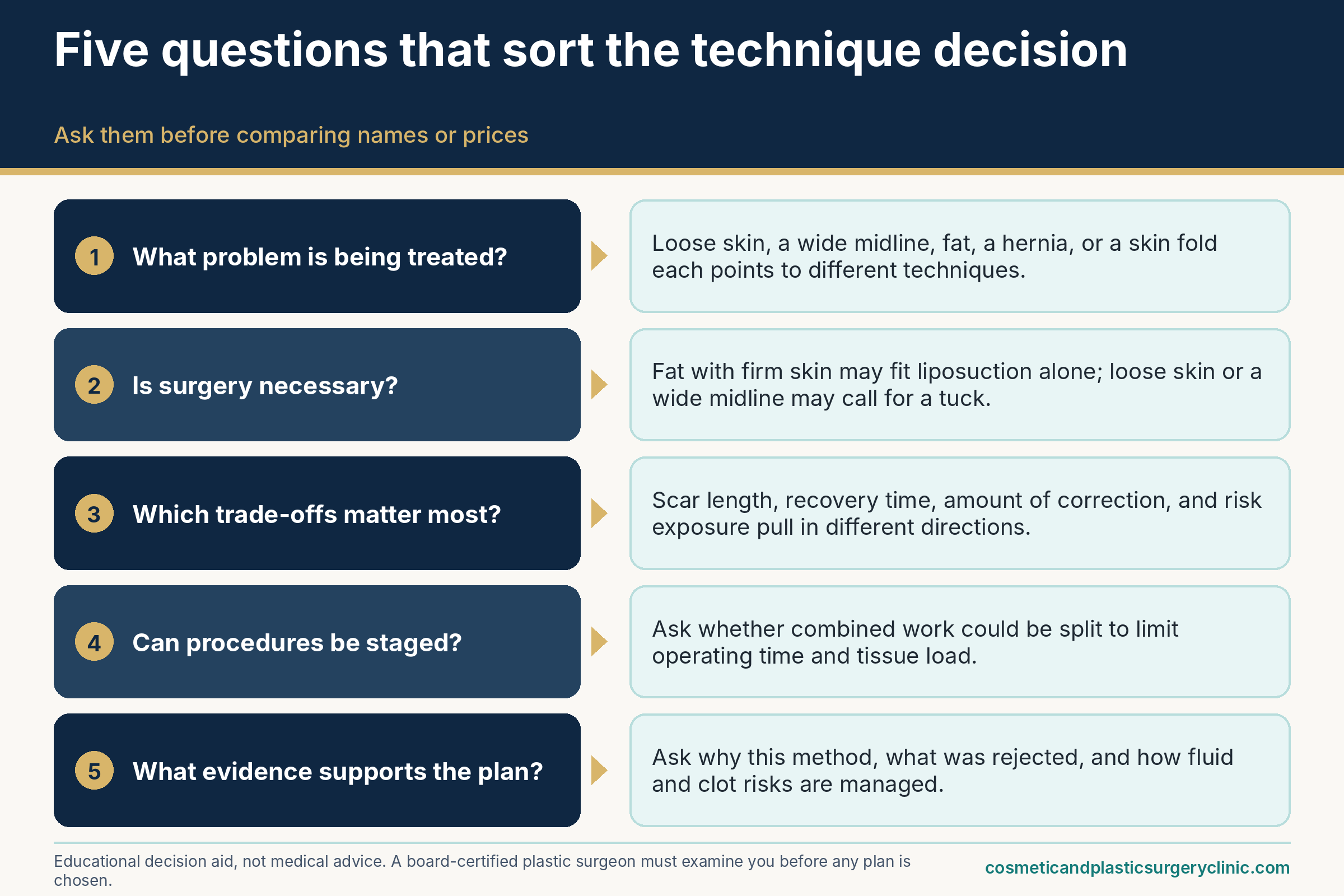
A surgeon choosing among techniques is, in effect, solving a puzzle with a handful of pieces: where the skin excess is, how loose the muscle wall is, how the fat is distributed, what scars and surgeries are already present, and what the patient’s health and plans allow. Patients can follow the same logic, which makes the consultation a conversation instead of a verdict. The tables and discussion below describe that logic in general terms. They are not a self-diagnosis tool, and nothing here tells you that you are or aren’t a candidate for any approach.
Selection Logic by Anatomy and History
Skin Excess, Muscle Laxity, and Fat Distribution
Start with the three tissue questions. The first is where the loose skin is. Skin excess only below the navel points toward the smaller horizontal designs. Excess that continues up to the ribs points toward a full operation. Excess that wraps to the flanks and back points toward extended or circumferential designs. Excess in both vertical and horizontal directions after major weight loss points toward a vertical component. Excess mostly above the navel is the reverse abdominoplasty niche.
The second question is how much the wall has widened and how far up it extends. A bulge confined to the lower abdomen may need only partial repair, while a widening along the full midline calls for a longer one. If there is little skin excess but a clear midline widening, the conversation changes again, since a skin-removal operation designed around skin may be more than the problem requires and the alternatives deserve a hearing.
The third is how fat is distributed. Fat under the skin, what surgeons call subcutaneous fat, can be thinned with liposuction. Fat inside the abdomen, around the organs, cannot be removed by either liposuction or a tummy tuck, which is one reason the ASPS describes the operation as not a substitute for weight loss. A person whose abdominal prominence is mostly internal fat may have a limited change from any technique.
| Main concern | Technique families usually discussed | Why they are discussed | Point to check |
|---|---|---|---|
| Small lower-abdominal pouch, little skin excess above the navel | Mini abdominoplasty; liposuction alone if skin is firm | Shorter scar when the correction needed is limited | Will the skin above the navel be affected at all? |
| Loose skin across the whole abdomen with a wide midline | Full abdominoplasty with fascia repair | Treats skin and the wall together | How far up the midline will the repair extend? |
| Loose skin that continues around the flanks | Extended abdominoplasty; sometimes belt-type designs | Avoids leaving a lateral fold at the end of the scar | Where will the scar end, and does it cross the back? |
| Excess skin in both directions after major weight loss | Fleur-de-lis; circumferential or lower body lift in some cases | A vertical cut addresses horizontal laxity | Timing, weight stability, and healing plan |
| Looseness mostly in the upper abdomen | Reverse abdominoplasty (rare) | Hides the scar in the breast fold | Why a standard approach would not reach the same area |
| Fat bulges at the flanks or back with reasonably firm skin | Liposuction alone, or lipoabdominoplasty if skin is also loose | Fat is the main issue; skin may not need removal | Is skin retraction realistic? Evidence for tightening is limited |
| Hanging apron causing rashes or skin breakdown | Panniculectomy discussion, sometimes with a tuck | Treats a functional problem, not only contour | Insurance criteria and what is cosmetic versus medical |
Two lines in the table need extra attention. The row about firm skin and fat bulges reminds us that a tummy tuck is not automatically the better operation when fat is the main concern. And the row about the hanging apron separates a functional from a cosmetic goal. The ASPS draft guideline describes panniculectomy as a functional procedure that debulks the apron, usually without undermining or navel transposition, while it describes abdominoplasty as a cosmetic procedure to reshape the torso after pregnancy or weight loss. Our tummy tuck candidacy page explains the surrounding health and timing factors.
Prior Surgery, Hernias, Pregnancy Plans, and Weight Stability
Anatomy is only half of the choice. History shapes the plan just as much. Prior abdominal surgery matters because scars interrupt the blood supply that a flap depends on, and because the ASPS says previous abdominal surgery may limit the potential results. A cesarean scar can sometimes be incorporated into the new one. Other incisions, such as a long vertical scar from an earlier operation, may influence which technique is chosen, and the surgeon will want to know the details.
Hernias change the plan in the ways described earlier: they may require separate repair, affect the navel, and alter insurance coding.
Pregnancy plans are a classic timing question. The ASPS advises that women who anticipate future pregnancies should consider postponing a tummy tuck, because pregnancy can stretch the abdominal wall and skin again. Technique does not remove this limit. No version of the operation is known to prevent later stretching, so a surgeon who says otherwise should be asked for evidence.
Weight stability matters as much. Mayo Clinic lists a stable weight over six to twelve months among preparation steps, and the ASPS says people planning substantial weight loss should postpone. In 2025 the ASPS reported 173,251 tummy tucks nationwide, up about 2 percent from 170,544 in 2024 and the third most common cosmetic surgical procedure, and noted a gap between consultation demand tied to weight-loss medication and completed surgeries. Those national estimates are extrapolated from surgeon and claims data. For patients on or stopping weight-loss medication, the question is when weight has settled enough that the surgical result will last; the page on tummy tuck after major weight loss, linked earlier, goes into timing, and it sits alongside the technique choice.
The last piece of history is smoking and nicotine. Mayo Clinic says tissue damage or death is a risk, especially for smokers, and advises candidates to stop smoking. A Cochrane review of preoperative smoking-cessation interventions across surgery in general found that intensive programs starting at least four weeks before surgery reduced overall complications (risk ratio 0.42). That review is not specific to abdominoplasty, but the mechanism applies to a procedure that relies on blood supply to a long flap. Technique choices such as limited undermining are partly a response to that vulnerability, and they do not make nicotine harmless.
How Risk and Recovery Differ by Technique
Qualitative Risk Differences Across Techniques
Honest comparison of risk across techniques is hard, because no study has randomized patients to every technique. What can be said is directional. Operations that remove more tissue, take longer, undermine more, or combine more procedures generally carry more risk exposure than smaller ones. That is why the clot literature, the wound dehiscence literature, and the combined-procedure literature all point the same way. The table lays this out without inventing precision.
| Technique or choice | Where risk exposure tends to concentrate | What published sources say | How to read it |
|---|---|---|---|
| Mini abdominoplasty | Smaller area lifted; mismatch risk if anatomy needs more | Single-surgeon abstract reported no hematoma, skin loss, or navel necrosis among mini cases | Low-volume, selected patients; unmet goals are the more common concern |
| Full abdominoplasty | Fluid collections, wound healing, bleeding, clots | Overall complication rate 3.1% for abdominoplasty alone in a 2008–2013 database study | Insured-patient registry; defines “complication” in its own way |
| Extended or fleur-de-lis | Longer or branching incisions; wound healing at junctions | Evidence is small series; fleur-de-lis data are limited | Ask the surgeon’s own experience with the design |
| Lipoabdominoplasty, 360, or HD | Added liposuction volume, operating time, fat necrosis, seroma | 3.8% with liposuction versus 3.1% alone in the database study; lower skin-necrosis reports with limited undermining | Mixed signals; patient selection and surgeon skill matter |
| Circumferential or lower body lift | Wound dehiscence, clots, bleeding, longer operations | Dehiscence the most frequently reported complication; clot risk higher in an older pooled review | Larger operation; often after massive weight loss |
| Drains versus quilting sutures | Seroma, hematoma, drain-related infection or discomfort | Quilting sutures probably reduce seroma; extra drains add little (draft ASPS guideline) | Draft guideline; not a final standard |
| Combined with other procedures | Cumulative time, anesthesia, and tissue load | 10.4% with liposuction plus another body-contouring procedure in the database study | Combination raises stakes; staging is an option |
Two reminders protect against misreading. First, the percentages come from different eras, different populations, and different definitions, so they should not be lined up as a league table. Second, the dominant risk modifiers are mostly about the patient and the team: body mass index of 30 or above was associated with higher risk in the database study, as were age 55 or older, male sex, and multiple procedures, and the narrative review cited earlier flags smoking and diabetes as well. A technique cannot fully cancel those factors, though it can be chosen with them in mind. The complete list of ASPS-named risks, including anesthesia, bleeding, blood clots, seroma, infection, numbness, fat necrosis, asymmetry, persistent pain, poor wound healing, skin loss, unfavorable scarring, and recurrent looseness, applies to all variations.
Recovery Differences by Technique, With Illustrative Examples
Recovery follows the extent of the operation. A smaller operation tends to mean less swelling, a shorter period of restricted movement, and often a faster return to routine. A bigger operation, with more tissue lifted, more fascia repaired, or more liposuction, tends to bring more swelling, more tightness, and a longer period of limits. Published patient pages give general ranges and not technique-specific schedules. Mayo Clinic says many people return to work in two to four weeks, advises avoiding strenuous activity and heavy lifting for about six weeks, and says sports should wait about eight weeks. Cleveland Clinic suggests about a week off work and four to six weeks without strenuous exercise, which differs from Mayo’s range. That disagreement is itself informative: recovery varies, and the surgeon’s own protocol is the one to follow.
Technique choices also change what recovery feels like. Drains mean tubes and a daily emptying routine for a few days. A drainless approach avoids that but may involve a check for fluid. A fascia repair can make the abdomen feel tight, and bending forward can be uncomfortable early on. A longer incision means more skin that is sore and numb. Our tummy tuck recovery timeline breaks down the weeks.
Here are three illustrative examples, invented for explanation and not based on any real patient. First, imagine someone who works at a desk and has a small lower-abdominal pouch after one pregnancy. If a mini operation fits their anatomy, recovery planning might center on a few weeks of lighter schedule, though they should still ask the surgeon about the specific limits. Second, imagine someone who lifts patients or boxes at work and is considering an extended operation with liposuction. Their main question is how long a lifting restriction would last and whether a physically demanding job could be modified or paused, and they may need to plan for a longer leave. Third, imagine a person with major weight loss considering a belt-style or lower body lift. They would likely face the longest recovery of the three, with more help needed at home and a longer period of limits.
None of these is a prediction. They show why the technique choice and the logistics are linked: a smaller scar and a shorter leave are real advantages when the anatomy allows them, and a bigger correction is a better fit when it addresses a real problem. Plan the recovery around the operation that the anatomy requires, not the operation that the calendar wishes for.
Choosing a Technique: Decision Matrix, Surgeon Questions, and Verification
By this point the main lesson should be clear: technique is a set of trade-offs, and the right set depends on the person. This final section turns the material into tools. One is a decision matrix that shows how common priorities and constraints push the choice. Another is a question list for the consultation. The last is a verification checklist for credentials and facility, plus a short discussion of alternatives and staging.
A Decision Matrix and the Questions to Bring
A Technique Decision Matrix: How Priorities and Constraints Push the Choice
The matrix below is organized by what matters to the patient, not by technique name. It shows which direction each priority tends to push, what is traded away, and what to confirm. It is original synthesis based on the sources cited in this article, offered as a thinking aid, and no row in it is a recommendation for any individual.
| If this is a top priority or constraint | It tends to push toward | What may be traded away | What to confirm with the surgeon |
|---|---|---|---|
| Shortest possible scar | Mini design or liposuction alone, if anatomy allows | Reach above the navel; midline correction may be partial | Will my goals be met, or will a second operation be likely? |
| Smoothing the full abdomen including the midline | Full abdominoplasty with fascia repair | Longer scar, longer recovery than a mini | How far up will the repair extend, and with which sutures? |
| Loose skin wrapping to the flanks | Extended design | Longer scar toward the hips | Where does the scar end, and does it cross the back? |
| Large weight loss with skin loose in two directions | Fleur-de-lis or circumferential designs, often with staging | Vertical scar; more wound-healing demand; longer recovery | Is my weight stable, and what is the surgeon’s own experience? |
| Reducing fluid problems after surgery | Quilting sutures; Scarpa’s preservation when appropriate | A little more operating time for sutures | Will drains be used, and why or why not? |
| Refining the waist and flanks as well | Lipoabdominoplasty or 360-style liposuction | Added operating time and tissue load | Which areas, how much, and is staging possible? |
| Planning pregnancy in the future | Waiting, or a candid discussion about durability | Timing of the improvement | How would another pregnancy affect the result? |
| Hernia or medical symptoms | Combined or separate hernia repair; panniculectomy discussion | Cosmetic-only plan; billing and coverage differ | Who repairs the hernia, and how is it coded and quoted? |
| Limited time away from work or caregiving | Smaller or staged plan; scheduling around recovery | Amount of correction at once | What is the realistic leave for this exact plan? |
The matrix has an obvious blind spot: it treats each priority separately, but real people have several at the same time. Someone may want the shortest scar and also have skin loose to the flanks. In that case the useful question is which priority gives way, and the surgeon’s job is to explain the consequences of each. A consultation that treats these as trade-offs, with the pros and cons stated, is a better sign than one that offers a single answer.
One small caution about reading across rows. A “push toward” a technique in the table is not an indication that the technique is advisable or safe for a particular person. That determination requires an examination, a health history, and often imaging or lab work, and it may change after those steps. If your plan looks different from what the matrix suggests, that may be entirely appropriate. Ask the surgeon why.
Questions to Ask Your Surgeon About Technique
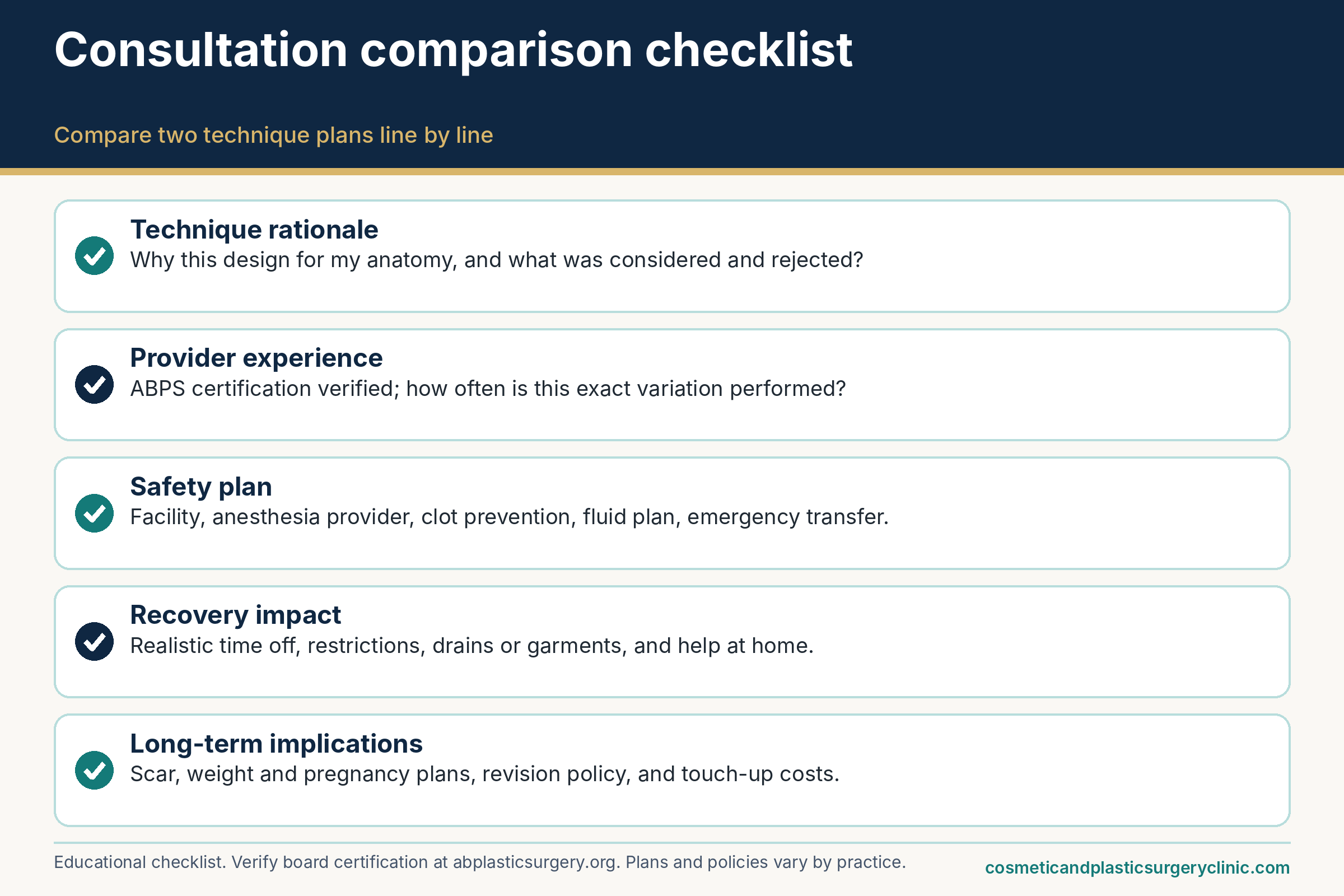
Good technique questions are specific. They invite the surgeon to explain reasoning and show that you want to understand, not argue. The table below groups questions by topic and says what a useful answer sounds like. It is deliberately worded as a set of neutral requests. If you prefer a fuller list covering the broader consultation, our tummy tuck consultation questions page goes wider than technique.
| Topic | Question to ask | What a useful answer includes |
|---|---|---|
| Name versus operation | Can you describe the operation in plain words and mark the incision on me? | Start and end points of the scar, navel plan, whether a vertical component is used |
| Reasoning | Why this technique for my anatomy, and what did you consider and reject? | Reference to my skin, muscle, fat, and history; at least one alternative explained |
| Limits | What will this operation not change? | Honest limits such as internal fat, stretch marks outside the removed skin, or upper-abdomen reach |
| Muscle repair | Will the fascia be tightened, how far, with which layers and sutures? | A clear description and why it suits my wall; acknowledgment that evidence is limited |
| Fluid control | Do you use quilting sutures, preserve Scarpa’s fascia, or use drains? | A stated approach with reasons, and a plan if fluid collects |
| Liposuction | Will liposuction be included, where, and how much? | Areas listed; reason for each; how total time is limited |
| Navel | What will happen to my navel, and what is the backup plan? | Technique named; shape and scar described; healing plan |
| Hernia | Have you checked for a hernia, and who would repair it? | Exam method; repair plan; how it is quoted |
| Experience | How often do you perform this exact variation? | A direct answer about volume without hype or exaggeration |
| Safety plan | How do you assess clot risk, and what happens if something goes wrong? | Risk assessment steps, prevention measures, emergency and transfer plan |
| Revision | If a touch-up is needed, what is your policy and what costs apply? | Written policy on revisions, including fees for the facility and anesthesia |
Pay attention to how the answers are given as much as to what they say. A surgeon who welcomes the questions, explains uncertainty, and names the downsides of the plan is demonstrating the kind of judgment you want in an operating room. A surgeon who answers technique questions with brand names, reassurance, or pressure to book soon is giving you information too.
Verification, Alternatives, and Staging
Verifying Board Certification, Facility, and Experience
Technique evidence is only as useful as the person applying it. Verification takes a few minutes. The American Board of Plastic Surgery (ABPS) maintains a public tool where you can look up a surgeon by name or location. According to the ABPS, certification is a voluntary credential that signals the surgeon has completed the required training and passed comprehensive written and oral examinations, and certified diplomates must keep up continuing self-assessment and practice improvement. The tool also displays an alert reading “See FSMB” when a state medical board has taken action, and an active, unrestricted medical license is required to maintain certification. You can use the ABPS verification tool directly. Our ABPS verification checklist walks through the steps in detail.
Two distinctions are worth keeping straight. Board certification and state licensure are separate things: a license permits a physician to practice, while certification reflects specialty training and examination. And society membership is not the same as board certification. Being a member of a professional society does not by itself show board certification, so verify the credential itself.
Beyond the surgeon, check the facility. Ask whether it is accredited or state-licensed, who gives the anesthesia, and what the plan is for emergencies. Ask how often the surgeon performs the specific variation you are considering. A surgeon who does many mini procedures and few circumferential ones may be an excellent choice for one and a poor one for the other. Experience with an exact operation is a reasonable thing to ask about, and no single number defines “enough.”
Alternatives, Staging, and Not Rushing the Decision
Not every abdominal concern needs a tummy tuck, and not every tummy tuck needs to happen in one step. Liposuction alone can suit someone whose main issue is localized fat with skin that is firm. Weight-management programs, nutritional counseling, or physical therapy for core function may come first for some people. Nonsurgical energy treatments are sometimes advertised for the abdomen, though their effects are different from surgical skin and muscle repair. We discuss the options in more depth in our planned guide to tummy tuck alternatives. Note that comparing a surgical and a nonsurgical option is not a contest in which one must win; it is a way to match intensity to the problem.
Staging means splitting a plan across more than one operation. A surgeon might propose a tuck first and liposuction touch-ups later, or a lower body lift in two stages, or a tuck separated from breast surgery. The case for staging is smaller operating time per session and less cumulative risk exposure per visit. The case against it is cost, a second recovery, and a second anesthesia. Neither is automatically better. If a surgeon proposes either approach, ask for the reasoning and for a written estimate of what each path costs.
It’s also fine to take your time. Reasonable steps include a second consultation with another board-certified plastic surgeon, a request for the surgeon’s marked diagram, and a look at how the practice documents results. If you review before-and-after photos, remember that photos of exceptional results do not establish typical results, and ask to see examples of patients with anatomy and goals similar to yours who were treated with the same technique. Nothing about this decision is urgent in the way an emergency is, and a consultation should never pressure you.
Finally, keep your decision about the technique separate from your decision about the surgeon. A thoughtful plan from one surgeon and a different thoughtful plan from another is a normal outcome of a second opinion, and the disagreement itself is useful information. When two qualified surgeons propose different operations for the same abdomen, ask each why they chose theirs and why they would not choose the other. The reasoning, and the way each of them handles the question, will usually tell you more than the label on the operation.
Frequently asked questions
What is the difference between a mini and a full tummy tuck?
A mini tummy tuck uses a shorter incision and concentrates on the area below the navel, usually without cutting around the belly button. A full tummy tuck treats the whole front of the abdomen, lifts the skin to the ribs, repositions the navel through a new opening, and usually tightens the midline fascia. The mini leaves a shorter scar and typically involves less recovery, while the full operation reaches more tissue. Because surgeons use both terms loosely, ask for the incision length, the navel plan, and the muscle plan in each case.
Can a mini tummy tuck fix loose skin above the belly button?
Generally not. A mini operation advances lower abdominal skin, and that skin cannot be pulled far enough to tighten tissue much higher without excess tension. Someone whose looseness extends to the upper abdomen may find the change smaller than expected. A full operation, an extended design, or, in a few cases, a reverse abdominoplasty may be discussed instead. Ask the surgeon to show where the tightened skin will stop on your own abdomen, and to explain what the operation is not expected to change.
What is a fleur-de-lis tummy tuck, and who is it for?
It adds a vertical excision along the midline to the usual horizontal one, forming an inverted-T. It is most often discussed for people with excess skin in both directions, which is typical after major weight loss. The trade-off is an additional visible vertical scar and greater demands on wound healing where the cuts meet. The research is mostly small series, so questions about the surgeon’s own experience with the design are reasonable. It is a surgeon’s judgment, made after examination, whether this design suits a particular person.
How is a tummy tuck different from a lower body lift?
An abdominoplasty works on the front of the torso. A lower body lift treats a belt of tissue around the torso and can include the back, hips, buttocks, and outer thighs, with an incision that encircles the body. A circumferential abdominoplasty and a belt lipectomy fall in between and are defined differently by different surgeons. Larger operations generally mean longer surgery, more wound-healing demand, and a higher clot-risk category in older research. Ask the surgeon which regions are being treated and where the scar will run.
Does a tummy tuck fix diastasis recti?
Plication of the stretched midline fascia is part of most full tummy tucks and is meant to narrow the widened gap. Several methods report low recurrence in the studies that exist, but follow-up is often short and no suture type or layering method has been shown to be best. Functional benefits such as less back pain or more core strength are possible but inconsistent in the research. If an exam suggests an actual hernia, that is a separate issue with its own repair. Surgeons can explain how they evaluate and repair the wall in your case.
Do all tummy tucks use drains?
No. Drains remain common, and board-certified surgeons’ data through 2021 show their use declined but continued in most cases. Some surgeons use quilting (progressive tension) sutures and skip drains. A draft ASPS guideline under public comment in September–October 2026 found moderate-certainty evidence that quilting sutures probably reduce seroma compared with drains and that adding drains to quilting sutures did not change clinically significant seroma. Either approach can be reasonable. Ask what your surgeon uses, why, and what happens if fluid collects.
What is lipoabdominoplasty, and is it better than a regular tummy tuck?
Lipoabdominoplasty combines a tummy tuck with liposuction, usually with a more limited lift of the skin flap so that some blood vessels are preserved. One pooled review of observational studies reported lower skin-necrosis rates with this approach than with wide undermining, but the studies were not randomized and the variables are intertwined. Combining operations can also raise risk when many procedures are stacked together. Whether it is “better” depends on anatomy, goals, and the surgeon’s experience, so ask which areas would be suctioned and why.
What does a “360 tummy tuck” mean?
There is no standard definition. In the literature it generally refers to liposuction around the entire trunk, including the flanks and back, performed together with an abdominoplasty. Some versions also add fat grafting to the hips. Clinics may use the phrase for other plans. Evidence is largely case series from single teams. Ask exactly which areas will be treated, how much fat is expected to be removed, whether fat grafting is included, how long the operation is expected to last, and whether the total plan could be staged.
Is a tummy tuck done with local anesthesia or sedation only?
The ASPS says the options for a tummy tuck include intravenous sedation and general anesthesia, and that the surgeon recommends the better choice for the individual. Mayo Clinic and Cleveland Clinic describe general anesthesia as typical. In general, longer or more extensive operations are more likely to use general anesthesia. The decision depends on the plan, health history, and the anesthesia team’s assessment, so discuss it directly, including any medications you take, and ask who will provide the anesthesia.
Will insurance cover a tummy tuck if I have diastasis or a hernia?
A cosmetic tummy tuck usually is not covered, and an ASPS coding document treats diastasis repair as part of a standard abdominoplasty and not as a hernia repair. A true hernia is a medical condition, and its repair is coded and billed differently, which is why quotes should list it separately. Coverage depends on each insurer’s written policy and your diagnosis, so the practical step is to ask the surgeon’s office to request a coverage determination in writing before you assume anything. Our cost guide covers quotes in more detail.
Does the technique change how long results last?
The ASPS describes tummy tuck results as technically permanent but reduced by significant weight changes, and it advises people who expect more pregnancies or substantial weight loss to wait. We did not find evidence that any particular technique prevents later stretching or weight-related change. Choice of technique can influence how complete the initial correction is, and revision may be needed in some cases, as the ASPS notes that another surgery may be necessary. Ask the surgeon what they would expect to change with weight or pregnancy.
How can I compare two different technique recommendations?
Ask each surgeon to describe the operation in plain words, mark the incision, and explain the reasoning behind each major choice: scar length, fascia repair, liposuction, and fluid control. Then ask what they considered and rejected, and how they would handle a problem such as a fluid collection or wound opening. Compare reasoning, not labels, and compare the safety plan and the recovery impact as well. Differences between two qualified surgeons are normal. A third opinion is reasonable if the disagreement is large.
This article is educational and does not replace an examination, diagnosis, or advice from a board-certified plastic surgeon who knows your history. Consultation is the stage at which your anatomy, health, goals, and scar tolerance can be weighed together.
Sources and further reading
- American Society of Plastic Surgeons — Tummy tuck procedure (accessed 2026-10-03) — anesthesia options, incision pattern, muscle repair, new navel opening, closure methods
- American Society of Plastic Surgeons — Tummy tuck (abdominoplasty) overview (accessed 2026-10-03) — definition; limits; weight and pregnancy timing
- American Society of Plastic Surgeons — Tummy tuck safety (accessed 2026-10-03) — list of risks
- American Society of Plastic Surgeons — Tummy tuck results (accessed 2026-10-03) — scar maturation, cesarean scar incorporation, prior surgery, possible further surgery
- American Society of Plastic Surgeons — Body lift procedure (accessed 2026-10-03) — areas treated and encircling incision
- American Society of Plastic Surgeons — Draft evidence-based clinical practice guideline: Abdominoplasty and panniculectomy, Part I, seroma prevention (draft for public comment, September–October 2026; accessed 2026-10-03) — quilting sutures, drains, Scarpa’s fascia, adhesives, compression garments; draft, wording may change
- American Society of Plastic Surgeons — Insurance criteria: abdominoplasty and panniculectomy (approved 2006; accessed 2026-10-03) — diastasis repair versus hernia repair; panniculectomy definition
- American Society of Plastic Surgeons — What is a reverse abdominoplasty and who needs it (member-surgeon blog, 2016; accessed 2026-10-03) — description of the upper-incision approach
- American Society of Plastic Surgeons — 2025 plastic surgery statistics report (accessed 2026-10-03) — tummy tuck volume and methodology
- Mayo Clinic — Tummy tuck (page reviewed January 17, 2025; accessed 2026-10-03) — risks, preparation, anesthesia, typical recovery ranges
- Cleveland Clinic — Abdominoplasty (tummy tuck) (page updated January 30, 2024; accessed 2026-10-03) — patient-level descriptions of mini, full, extended, and fleur-de-lis variations; duration and setting
- American Board of Plastic Surgery — Verify certification (accessed 2026-10-03) — public verification tool; certification is voluntary; FSMB alert
- van der Sluis et al. — Does Scarpa’s fascia preservation in abdominoplasty reduce seroma? A systematic review. Aesthetic Surgery Journal, 2023 (accessed 2026-10-03) — eight controlled studies, 846 patients
- Jabbour et al. — systematic review and meta-analysis of progressive tension sutures in abdominoplasty. Aesthetic Surgery Journal, 2017 (title paraphrased; accessed 2026-10-03) — sutures plus drains versus drains alone
- Winocour et al. — abdominoplasty complication rates and risk factors by combined procedure, CosmetAssure database. Plastic and Reconstructive Surgery, 2015 (title paraphrased; accessed 2026-10-03) — 25,478 abdominoplasties; complication rates by combination
- Wolters Kluwer — Trends in abdominoplasty (summary of Stein et al., Plastic and Reconstructive Surgery, January 2024; accessed 2026-10-03) — 8,990 cases, 2005–2021
- Hatef et al. — Procedural risk for venous thromboembolism in abdominal contouring surgery. Plastic and Reconstructive Surgery, 2010 (accessed 2026-10-03) — clot risk by procedure type
- Jackson et al. — Do absorbable sutures work for rectus diastasis repair in abdominoplasty patients? Aesthetic Surgery Journal Open Forum, 2024 (accessed 2026-10-03) — 71-patient single-surgeon series
- Fuchs et al. — Continuous absorbable suture versus interrupted permanent suture in the treatment of diastasis of the rectus abdominis muscle. Revista Brasileira de Cirurgia Plástica, 2016 (accessed 2026-10-03) — 30-patient randomized trial
- Surgical techniques for repair of abdominal rectus diastasis: a scoping review. Journal of Plastic Surgery and Hand Surgery, 2021 (accessed 2026-10-03) — 61 studies; lack of high-level evidence
- Gormley et al. — systematic review of rectus diastasis plication and abdominal strength and function. Cureus, December 2020 (title paraphrased; accessed 2026-10-03) — seven studies; strength inconsistent, function improved
- Anguiano Carranza — Lipoabdominoplasty complications: an update. International Surgery Journal, 2025 (accessed 2026-10-03) — narrative review of complications and risk factors
- Systematic review and meta-analysis: safety of lipoabdominoplasty versus abdominoplasty (journal and year to be confirmed; accessed 2026-10-03) — 12 studies, 12,388 patients
- Hoyos et al. — A report of 736 high-definition lipoabdominoplasties with circumferential VASER liposuction. Plastic and Reconstructive Surgery, 2018 (copy hosted on a technique-related site; accessed 2026-10-03) — level IV case series
- Abdominoplasty combined with hip expansion by fat grafting. Plastic and Reconstructive Surgery Global Open, August 2024 (accessed 2026-10-03) — 1,125-patient retrospective review
- Circumferential contouring of the lower trunk: indications, operative techniques, and outcomes — a systematic review (repository record; journal and year to be confirmed; accessed 2026-10-03) — 42 articles, 1,748 patients
- Friedman et al. — Aesthetic improvements in abdominal wall contouring: is there still a role for the mini-abdominoplasty? (ASPS annual meeting abstract, 2015; accessed 2026-10-03) — single-surgeon retrospective review
- Anous — The fleur-de-lys abdominoplasty: not simply for the massive weight loss patient (ASAPS meeting abstract, 2011; accessed 2026-10-03) — single-surgeon retrospective review
- The extended abdominoplasty (Clinics in Plastic Surgery, volume 41, issue 4, reproduced online; author and year to be confirmed; accessed 2026-10-03) — definition and indications
- Umbilical reconstruction techniques: a literature review. Aesthetic Plastic Surgery, 2020 (accessed 2026-10-03) — 77 papers; no universal algorithm
- Thomsen et al. — Interventions for preoperative smoking cessation. Cochrane Database of Systematic Reviews, 2014 (accessed 2026-10-03) — complication reduction with intensive programs
- American Society of Anesthesiologists — Multi-society GLP-1 guidance (October 2024; accessed 2026-10-03) — perioperative approach to GLP-1 receptor agonists