

Breast reduction cost is not one number, and for many people it is not even one kind of number. The same operation can be billed as a self-pay cosmetic service, as a covered medical service with a deductible and coinsurance, or as a claim that is denied and becomes a self-pay decision weeks later. All three routes draw on the same pieces, a surgeon, a facility, an anesthesia provider and a pathology laboratory, but they change who sends the invoice and who sets the price.
This page is about reading a breast reduction cost estimate: what each line pays for, which planning choices move it, what insurance and financing change, and how to set two quotes side by side. What the operation does is explained in the breast reduction overview, general cost mechanics are in plastic surgery cost, and how plans judge medical necessity is the subject of breast reduction insurance. Nothing here predicts what a given practice or plan will charge.
What the breast reduction cost bill is made of
A quote that gives “one price” can be honest and still be hard to compare, because the same two words describe different operations in different settings. The first job is to split the quote into lines you can read one at a time.
Seven lines a complete breast reduction cost quote should state
The surgeon’s fee, and what it assumes
The surgeon’s fee is the line most national statistics report. It generally covers planning, the operation itself and routine visits afterward, although practices define “routine” differently. ASPS says a surgeon’s fee may be based on experience, the type of procedure used and the geographic location of the office, so two quotes for similar operations can show a different breast reduction cost before any other line is added.
Ask what the fee assumes: which technique, whether liposuction is already counted (Mayo Clinic notes it may be used), how many months of visits are included and what happens to the fee if the plan changes in the operating room.
Facility and anesthesia: two bills that follow the clock
The facility charge pays for the operating room, nurses, instruments and recovery space. Anesthesia is billed by the provider, who may be a physician anesthesiologist or a certified nurse anesthetist, and in many practices it arrives as a separate invoice. Mayo Clinic describes general anesthesia for this operation, so an anesthesia charge belongs in any breast reduction cost estimate, and both lines usually track how long you are in the room.
ASPS says its national fee figure does not include anesthesia, operating room facilities or other related expenses. A quote that bundles all three should say so in writing.
Pathology, drains, garments and follow-up
The 2022 ASPS evidence-based guideline for reduction mammaplasty, published in Plastic and Reconstructive Surgery, recommends sending removed breast tissue from postmenarche female patients for pathologic evaluation, while noting it found no evidence for or against routine pathology under age 40 and that the need should be discussed with each patient. That makes a laboratory a line in any breast reduction cost estimate. Blue Cross and Blue Shield of Illinois adds a second reason to care: its policy says claims may be reviewed against post-operative pathology confirming that the tissue removed is breast, not fat.
The same guideline advises against routine drains, so drain supplies may or may not appear in a quote. Mayo Clinic describes a surgical bra and a follow-up visit afterward. Prescriptions, dressings and any garments belong in the estimate too, and the seventh line, revision and follow-up terms, gets its own section below.
| Quote line | What it pays for | What tends to change it | Ask before paying |
|---|---|---|---|
| 1. Surgeon’s fee | Planning, the operation, routine visits | Experience, technique, added procedures, region | Which technique and extras does this fee assume? |
| 2. Facility | Operating room, nursing, supplies, recovery | Hospital, surgery center or office suite; booked time | Which facility, flat fee or hourly, and who bills it? |
| 3. Anesthesia | Provider’s time and drugs | Type of anesthesia, case length, provider group | Who is the provider, and is the charge a flat sum? |
| 4. Pathology and tests | Laboratory review of removed tissue; any breast imaging requested | Surgeon and facility policy, age, history, plan rules | Which tests are expected, and who sends those bills? |
| 5. Garments, supplies, medications | Surgical bra, dressings, any drains, prescriptions | Surgeon’s protocol, pharmacy prices | Included in the quote, or bought separately? |
| 6. Follow-up and revision | Visits and any later correction | Written policy, time window, cause of the problem | Which fees does a revision waive, and for how long? |
| 7. Authorization and paperwork | Letters, photos and forms if a plan is billed | Plan rules, practice policy | Does the practice charge for forms, and is the deposit refundable if the plan says no? |

What the published national figures include and leave out
ASPS breast reduction cost data: a $7,800 average and a 2024 range
The ASPS cost page for breast reduction gives an average of $7,800 for aesthetic patients only and prints no year. The same $7,800 appears in ASPS’s 2023 average-fee release, labelled as the average surgeon or physician fee, up from $6,771 in 2022. For 2024, ASPS changed the format to a projected range, $7,000 to $12,500, described as an aggregate projection from averages submitted by surveyed members.
Read these breast reduction cost figures as surgeon-fee benchmarks from one society’s members. ASPS says they leave out anesthesia, facility fees and other related expenses, and the “aesthetic patients only” label means they do not describe what plans pay when the operation is done for symptoms. A survey of member averages is not a price list for any one practice.
The Aesthetic Society’s $6,308, and why it cannot sit beside ASPS’s
The Aesthetic Society’s page gives an average breast reduction cost of $6,308, attributed to its 2022 national databank statistics, and says that figure reflects surgeon and facility fees only; anesthesia, tests, prescriptions and garments may be extra. So its number is lower than ASPS’s yet claims to include more. The sources differ in year, in which surgeons were surveyed and in what was counted, so neither number can tell you whether a quote is high or low.
A better use of both is as a reminder of scope. For volume context, ASPS’s 2025 statistics report counts 76,040 cosmetic breast reductions in 2025, up 7 percent from 70,961 in 2024, estimated from member surgeons, a complications-insurance partner and a claims dataset covering more than 3,000 surgeons. Demand does not make any single quote reasonable.
How the operating plan, setting and anesthesia move the price
Two quotes can both say “breast reduction” and describe different amounts of surgery. Scope is the biggest reason a breast reduction cost estimate moves, and scope is set by anatomy and symptoms, not by a price list.
Planning choices that change breast reduction cost
Technique, nipple handling and liposuction
Mayo Clinic describes the operation as incisions around each nipple and areola and down each breast, removal of tissue, fat and skin, and reshaping, usually with the nipple left attached; liposuction may also be used. Surgeons choose among incision patterns and ways of keeping the nipple’s blood supply, which the breast reduction overview explains. None of the national sources read for this article prints a price difference between techniques, so none should be assumed when judging a breast reduction cost.
The useful questions are practical. Does the quote assume one technique, and what happens to the fee if the surgeon changes plans after marking you standing up? Is liposuction included or billed on top? Add-ons are priced the way liposuction cost describes: more fee, more time, more supplies.
Tissue volume, operating time and what the quote should state
A longer case raises the facility and anesthesia lines, because both follow the clock, as the last two sections below show. Premera Blue Cross’s policy lists surgery lasting more than three hours among the clinical risk conditions that can justify a hospital outpatient site instead of a surgery center, a reminder that operating time is a planning variable for plans as well as a billing one.
So a breast reduction cost quote should state the booked operating time and say whether the figure assumes that time. A quote that leaves it out cannot tell you what happens if the case runs long.
A lift, a second procedure and when a different quote applies
ASPS describes breast reduction as removing skin and tissue and then reshaping and lifting the breast, so repositioning is part of the operation and does not need its own line. A stand-alone lift is a different operation with its own pricing, covered in breast lift cost. If a surgeon proposes a separate procedure in the same session, ask for it as its own priced line so you can see what the reduction alone would cost.
The setting and the people who bill you
Hospital, surgery center or office suite
Mayo Clinic says the operation is done in a hospital or an outpatient surgical center and that you can usually go home the same day. The 2022 ASPS guideline likewise states that the majority of procedures in the United States are performed in an ambulatory, same-day setting.
Where the case is booked changes how the breast reduction cost is billed. A hospital outpatient department or a freestanding surgery center usually sends its own facility invoice; an office suite may fold the room into the surgeon’s fee or list it apart. Neither arrangement is better on its face. The problem is a quote that does not say which one applies, or a plan that authorizes a different site from the one quoted, a point the insurance section returns to.
Verifying accreditation and credentials before a deposit
ASPS requires its member surgeons to operate in a facility that is accredited by AAAASF, AAAHC or the Joint Commission, certified for Medicare or state licensed, except when only local anesthesia or mild oral sedation is used. It also says anesthesia must be given by a board-certified or board-eligible anesthesiologist or a certified nurse anesthetist, and advises checking a facility’s status directly with the accrediting organization.
Surgeon credentials are verified the same way: with the certifying board, not the brochure. The American Board of Plastic Surgery has a public Verify Certification page, and the steps are laid out in choosing a plastic surgeon. Verification is free and belongs before the deposit, not after it.
Why a longer case raises the price in two places
How anesthesia is billed: base units, time units and the payer
An AORN Outpatient Surgery explainer describes the standard model: a base number of units fixed for the type of operation, plus time units counted in 15-minute blocks from the moment the provider enters the room until report is given to the recovery nurse. The dollar value of a unit depends on who pays; the article’s examples ran at about $50 a unit for a private insurer and about $22 for Medicare.
That article does not address self-pay pricing, and neither does any national figure reviewed here. For a self-pay operation, the useful question is whether anesthesia is a flat sum for the planned case or an hourly rate with a base fee, and what happens if the case runs long.
What thirty extra minutes can mean for the facility bill
A 2018 JAMA Surgery analysis by Childers and Maggard-Gibbons of California hospital financial reports, summarized by the American Journal of Managed Care, put operating room cost at roughly $36 to $37 a minute across 302 facilities using cost reports from 2005 to 2014. That is the facility’s cost, not a charge to the patient, it covers California only, and the summary says earlier reports ranged from about $7 to over $100 a minute.
Used carefully, it shows scale: thirty extra minutes at that average is about $1,100 of cost behind the scenes, before anesthesia time is counted. It is one reason a breast reduction cost quote built on an optimistic case length can grow when the plan turns out larger.
Self-pay or plan-covered: who is billed for what
Almost every breast reduction cost conversation reaches the same fork. The operation is sometimes covered by health insurance, which sets it apart from most cosmetic procedures, and that is exactly why the bill can take three different shapes.
Two payment routes for the same operation
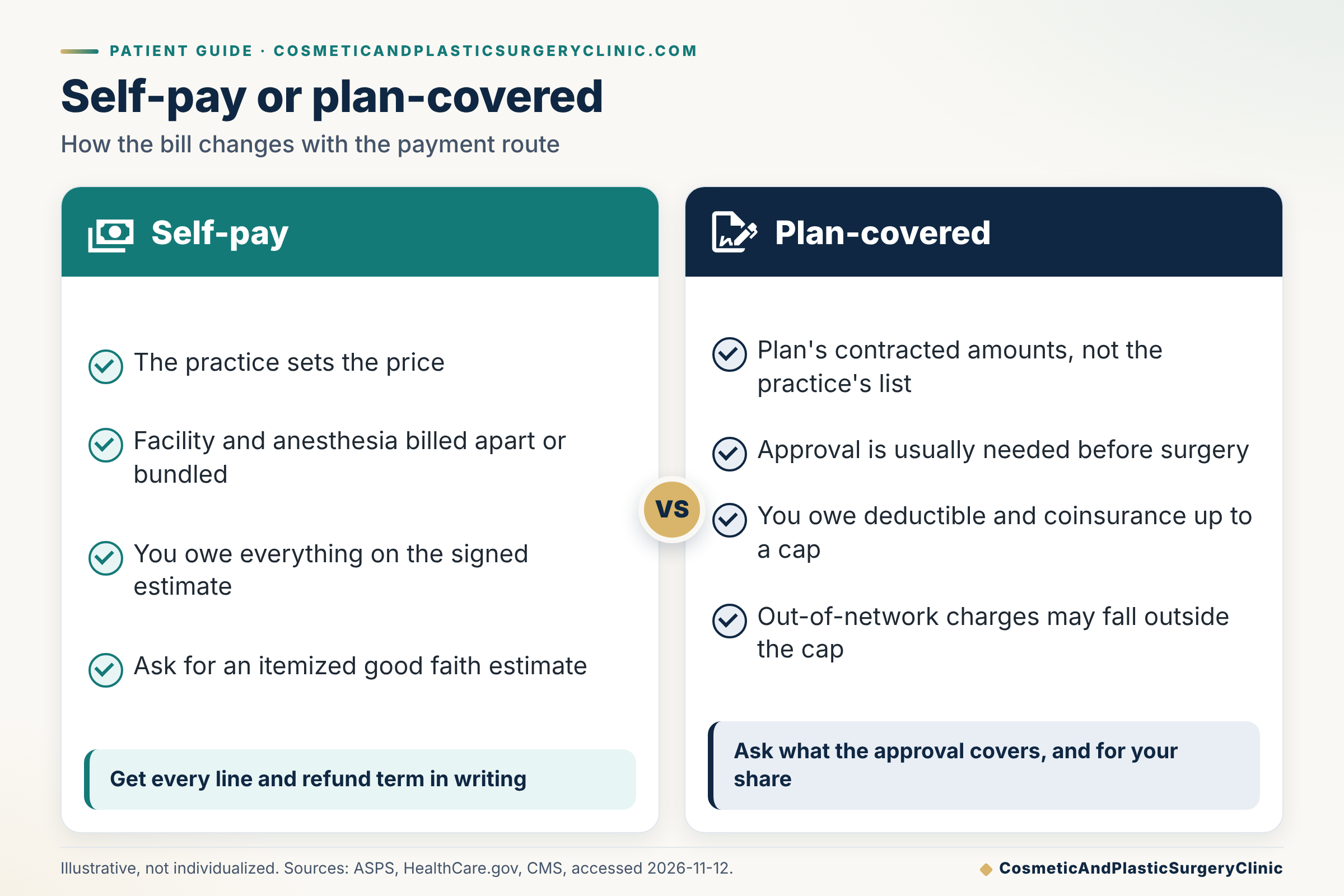
Self-pay breast reduction cost: the practice sets the price
ASPS says that if insurance does not cover the procedure, you have the option to pay out of pocket. In that route the practice sets its fees, the facility and anesthesia provider send their own bills or are bundled into one price, and nothing limits what you owe except what you agree to in writing. The Centers for Medicare & Medicaid Services says people who do not have or do not use insurance are usually entitled to a good faith estimate, covered further below.
Plan-covered: contracted rates and cost sharing
ASPS says breast reduction surgery is often covered by health insurance plans, that the surgeon may need to get approval, which may involve a letter and photos, and that you remain responsible for copayments and deductibles. The Aesthetic Society puts it more cautiously: a plan may cover the surgery if you meet its criteria, and each insurer has its own.
When a plan covers the surgery, the breast reduction cost on the claim is not the practice’s self-pay price. The AORN example above shows how much payers differ for the same service, and a plan’s allowed amounts are set by contract. What you pay is cost sharing: a deductible, coinsurance, and a ceiling.
HealthCare.gov defines the out-of-pocket maximum as the most you pay for covered services in a plan year and lists $10,600 for an individual and $21,200 for a family on Marketplace plans in 2026, rising to $12,000 and $24,000 in 2027. Premiums, non-covered services, out-of-network care and charges above the plan’s allowed amount do not count toward it. Employer plans have their own figures.
| Route | Who sets the price | What you owe | Get in writing |
|---|---|---|---|
| Self-pay, no plan involved | The practice, plus the facility and anesthesia provider if billed apart | Everything on the signed estimate | An itemized good faith estimate |
| Plan approves, in network | The plan’s contracted allowed amounts | Deductible and coinsurance, up to the plan’s out-of-pocket maximum | Approval before surgery, and a written estimate of your share |
| Plan approves, out of network | The out-of-network provider, within limits the plan sets | Possibly charges above the allowed amount, which do not count toward the maximum | Which providers, facility and anesthesia group are in network |
| Plan denies, appeal pending | Practice’s self-pay price if you proceed | Full self-pay price, or nothing if you wait | Refund terms for the deposit if surgery is delayed or approved |
What written plan policies say, at the level that matters for budgeting
Criteria that decide which route you are on
Two 2026 policies show how much plans differ. Premera Blue Cross’s policy 7.01.503, effective June 1, 2026, considers reduction medically necessary only when three conditions are all met: functional impairment documented for at least six months, no relief from appropriate conservative therapy, and expected tissue removal at or above a Schnur sliding-scale minimum. It requires approval before surgery. Blue Cross and Blue Shield of Illinois policy SUR716.012, effective January 1, 2026, asks instead for symptoms despite at least six weeks of conservative management, along with shoulder grooving or skin irritation, and the Schnur estimate.
The 2022 ASPS guideline takes a different view of both resection weight and waiting periods, recommending surgery based on multiple symptoms rather than weight and finding strong evidence for early surgery rather than a required period of conservative therapy. Those debates belong to breast reduction insurance. For a breast reduction cost budget, the point is that the route you land on depends on a plan document, not on how the operation is described.
Denials, appeals and the budget for a no
A 2020 Plastic and Reconstructive Surgery study, summarized in an ASPS press release, reviewed 295 patients at one Texas hospital from 2012 to 2017 and found 28 percent of reduction requests were denied, with the rate rising from 18 percent in 2012 to 41 percent in 2017. Of 83 denials, 18 were appealed and 13 of those appeals succeeded; denial rates ranged from about 12 to 62 percent across carriers. Medicare patients were excluded and this is one hospital’s experience, so it shows variability rather than a national rate.
The lesson for a breast reduction cost budget is modest and practical. If a plan is billed, set aside a decision in advance about what you will do if the answer is no: appeal, wait, or pay the self-pay price. Ask the practice whether a deposit is refundable if authorization is denied.
Revision terms, complications and the second bill
A quote prices the operation you expect. Revision and complication terms price the one you hope not to need, and they are the part of a breast reduction cost estimate most often left unwritten.
What a revision policy covers
Four questions a written policy should answer
A written policy should say how long after surgery it applies, whether the surgeon’s fee is waived, whether facility and anesthesia fees are waived, and what counts as a revision rather than a new procedure. A surgeon who waives the professional fee may still pass on charges from the facility and the anesthesia provider, because those are separate businesses. Ask whether a revision for a complication and a revision for a change of preference are treated differently.
If a plan paid for the first operation, ask a fifth question: would a revision need new authorization? The Premera policy sends repeat or second reductions for the same person to a medical director, so a plan may review it again.
Why the window should outlast the healing period
Mayo Clinic says results are visible right away but that swelling and scar fading can take months, and recommends limiting physical activity for four to six weeks. A revision window that closes at six weeks ends before the tissue has settled, so the useful length of a policy, and the long-run breast reduction cost, is measured in months.
ASPS’s June 2025 article on cheap deals quotes a surgeon saying revision pricing is always higher than primary pricing because the work is more difficult, and that a revision can grow from a 30-to-45-minute operation to one of two and a half hours. That is another reason to read the terms before surgery rather than after.
When something goes wrong: the bill after the quote
Who pays for treating a complication
Complications are the least predictable part of breast reduction cost, and who pays depends on the route. After a covered operation, treatment of a complication is generally a claim like any other, subject to the plan’s cost sharing. After a self-pay operation, the person may face a second set of charges from a facility and an anesthesia provider, depending on the practice’s terms. The policies reviewed here do not say how plans treat complications after a reduction they declined to cover, so that question has to be put to the plan and to the practice in writing.
Major problems are uncommon but real, and the specifics are in breast reduction risks. Mayo Clinic lists bleeding, infection, a bad reaction to anesthesia, scarring, uneven breasts and, rarely, loss of nipple or areola tissue or sensation. A clear answer on who pays is part of an honest consultation, as laid out in plastic surgery consultation questions.
Warning signs that matter more than the invoice
For less urgent changes, such as spreading redness, fever, a nipple or areola that changes color, or a wound that opens, call the surgeon’s office the same day using the contact route the practice gave in writing. A breast reduction cost quote that does not say who to call or where complications are treated is missing a line.
Paying and budgeting: tax accounts, financing and costs outside the invoice
The estimate answers what the practice will bill. The questions below cover how the breast reduction cost is paid and what falls outside the bill.
Tax accounts and financing
Deductions, HSAs and FSAs
IRS Publication 502 for 2025 says that, generally, you cannot include in medical expenses the amount you pay for cosmetic surgery, with exceptions for surgery that improves a deformity from a congenital abnormality, an accident or a disfiguring disease, and breast reconstruction after mastectomy is includible. The passages read do not mention reduction by name, so whether a reduction done for symptoms counts as medical care is a question for a tax professional. Only the part of medical expenses above 7.5 percent of adjusted gross income can be deducted on Schedule A.
Whether a health savings or flexible spending account will pay is decided by the plan administrator. IRS Publication 969 defines HSA qualified expenses by reference to “medical care” under the tax code and says FSA qualified expenses are those the plan specifies that would generally qualify for the medical expense deduction. Ask the administrator in writing, naming the procedure, before paying from an account.
Medical credit cards, deferred interest and loans
The Consumer Financial Protection Bureau’s May 2023 report found a typical medical credit card annual percentage rate of 26.99 percent, against roughly 16 percent for general-purpose credit cards (Federal Reserve data, March 2023). Healthcare deferred-interest promotions ran 6 to 18 months, about 20 percent of healthcare deferred-interest purchases were assessed interest, and borrowers paid about $1 billion in deferred interest from 2018 to 2020. The report also cites a New York Attorney General filing indicating that about 65 percent of medical credit cards are signed in providers’ offices.
The rule for a breast reduction cost is to compare total repayment, not the monthly payment. Plastic surgery financing covers deferred interest, personal loans and in-house plans in detail, and it is worth reading before signing anything in a consultation room. ASPS’s cost page links to CareCredit financing, and its 2023 cost article notes that some surgeons offer their own plans; both are options to price, not endorsements.
Costs that never appear on the estimate
Time off, help at home and garments
An ASPS article from April 2026 advises budgeting for time off work, childcare, pet boarding and meal preparation, and asking whether you would owe more if the case runs longer than planned. Mayo Clinic advises arranging a ride home and says to expect tenderness, swelling and bruising, a surgical bra and a follow-up visit. Lost income and help at home are part of the real breast reduction cost even though no invoice lists them. Week-by-week planning is in breast reduction recovery.
Weight change, pregnancy and when waiting costs less
Mayo Clinic says surgery may be postponed if you plan to have children or to lose weight, since both can change breast size, and advises not smoking for at least six weeks before and after surgery. A reduction paid for just before a pregnancy or a large weight change may not look or feel as it did at the end of recovery, which is a money question as well as a medical one. Who a surgeon may suggest should wait is explored in breast reduction candidate.
Postponing is a legitimate option. A person still weighing surgery against non-surgical symptom relief, or who has not yet had a second consultation, loses little by waiting, and a deposit paid under a time limit can cost more than a month of research. Ask about payment timing and refund terms before treating a date as fixed.
Comparing two breast reduction cost quotes like for like
The sticker prices on two breast reduction cost estimates tell you almost nothing until each has been rewritten in the same shape. The process takes an hour with a pencil and has spared many people unpleasant surprises.
A five-step method for normalizing quotes
Write the scope in plain words first
Before comparing any dollar amount, write one sentence per quote saying what is being done: the technique, whether liposuction is included, the facility, the type of anesthesia and the booked operating time. If a quote cannot be summarized that way, the missing details are the first questions to ask.
Then work through the rest in order: put every line in the same column, treat unknowns as ranges and never as zeros, check the setting and anesthesia provider, and last compare revision, deposit and refund terms. A second consultation helps here, because two surgeons’ plans for the same breasts show whether the difference is in the operation or only in the invoice.
Put every line in the same column
The table below is a hypothetical self-pay example dated 2026-11-12. Its numbers are invented to show the arithmetic and are not market data or a prediction of any practice’s fees. Quote A states everything; Quote B leads with a lower headline and leaves items open. Unknowns are entered as estimates in Quote B’s column so they are not silently counted as free.
| Line | Quote A | Quote B | What the gap may mean |
|---|---|---|---|
| Headline price | $16,350 all-in, itemized | “$8,500 breast reduction” | Different things are being counted |
| Surgeon’s fee | $9,600, technique named, 12 months of visits | $8,500, technique “decided at surgery,” 6 weeks of visits | Scope and follow-up are not equal |
| Facility | $4,200, accredited center named, 3 hours booked | About $3,300 by phone, facility not named, 2.5 hours booked | An unnamed facility cannot be verified |
| Anesthesia | $1,900 flat, anesthesiologist group named | Hourly, estimated $1,100 to $1,900 (midpoint $1,500) | An hourly rate rises if the case runs long |
| Pathology, garments, prescriptions | $650 included | Estimated $550, not included | Small lines, easy to forget |
| Revision terms | Surgeon’s fee waived 12 months; facility and anesthesia billed | Not stated | Ask before the deposit |
| Normalized total | $16,350 | About $13,850, with five open items | Gap of about $2,500 before the open items are answered |
Quote B looks about $2,500 cheaper. It also prices a shorter case, an undecided technique, a facility nobody can check, an hourly anesthesia rate and an unstated revision policy. Once those are answered the gap could shrink, vanish or grow. The comparison is a way of finding questions, not a verdict on either practice, and neither practice’s numbers say anything about the quality of care. For comparison, the surgeon lines in this example both sit inside the ASPS 2024 range of $7,000 to $12,500, which says nothing about the lines that range omits.
Reading price signals in either direction
Low quotes, bait advertising and deposits before an exam
ASPS’s June 2025 article on cheap deals warns that low-priced surgery can bring hidden costs, including emergency visits and treatment of complications, and quotes a surgeon who treats prices well below the average as a red flag. The rule at 16 CFR 238.0 defines bait advertising as an alluring but insincere offer to sell a product or service that the advertiser does not intend or want to sell, a legal definition and not an accusation about any practice.
A practical translation: be wary of a price available only “this week,” one that cannot be itemized, or one that requires a deposit before the surgeon who will operate has examined you. A quote that cannot survive a request to put it in writing is not much of a quote.
High quotes: what a premium may and may not reflect
In an ASPS article from December 2023, surgeons describe location, qualifications, demand and public profile as drivers of fees, and one cautions that a higher price does not mean better quality. Both directions get the same test: itemize, name the facility and the anesthesia provider, verify credentials and read the revision terms. Price is information about a practice’s economics, not about your result.
Written estimates, deposits and the checklist
The good faith estimate, and its plan-covered counterpart
CMS says people without insurance, or who do not use it, are usually entitled to a good faith estimate of expected costs, provided on request or when care is scheduled at least three business days ahead, and that a bill at least $400 above the estimate may be disputed. The page does not list what an estimate must contain, so treat it as a floor: an estimate you would be willing to compare, line by line, with the final invoice.
If a plan is billed, the counterpart is the plan’s written approval and its own statement of what it will treat as your share. Keep both with the signed estimate, along with the names of the facility and the anesthesia group the approval covers.
Deposits, refunds and a plan that says no
No national standard for cosmetic surgery deposits, refunds or rescheduling was found in the sources reviewed here, so these terms are whatever the contract says. Get the deposit amount, what it is applied to, the refund conditions if you cancel, what happens if the surgeon or facility reschedules, and what happens if the plan denies or delays authorization. Read the whole agreement before signing, and take it home if the practice allows it.

Frequently asked questions
Why is my breast reduction cost quote higher than the ASPS average?
National figures are surgeon-fee benchmarks, and ASPS says they exclude anesthesia and facility charges, so a full quote should usually exceed them. Differences can also come from the technique, an added procedure, a hospital-based facility, a longer booked operating time or local costs. Ask the practice to split the quote into surgeon, facility, anesthesia and other lines, then compare only the surgeon line with the ASPS range.
If insurance approves surgery, what breast reduction cost is left for me?
Usually you still owe your plan’s cost sharing. ASPS says patients remain responsible for copayments and deductibles, and HealthCare.gov says the out-of-pocket maximum does not count out-of-network care or charges above the plan’s allowed amount. Ask the practice for a written estimate of your share, and confirm that the facility and the anesthesia group are covered by the same approval.
Can HSA or FSA money pay a breast reduction cost?
That depends on the account administrator. IRS Publication 969 ties HSA qualified expenses to “medical care” under the tax code and says FSA expenses are those the plan specifies that would generally qualify for the medical expense deduction, while Publication 502 generally excludes cosmetic surgery. The passages read do not decide the question for a reduction, so ask the administrator in writing before paying.
Should I pay a deposit before the surgeon has examined me?
A deposit requested before the surgeon who will operate has examined you is a pressure signal worth questioning. The plan, and so the price, can change after the exam. If a deposit holds a date, get in writing what it is applied to, whether it is refundable if you decide against surgery or a plan denies authorization, and what happens if the practice or facility changes the date.
What if my final breast reduction cost is higher than the written estimate?
For self-pay patients, CMS says a bill at least $400 above a good faith estimate may be disputed, and an itemized comparison between the estimate and the invoice is the starting point. Ask the billing office to explain each difference in writing, whether it comes from surgeon, facility or anesthesia, and keep your signed documents. Contract terms on extra operating time or changed plans may also apply.
Is a cheaper breast reduction abroad or out of state worth it?
The visible price is only part of the breast reduction cost. ASPS warns that cheap surgery can lead to hidden costs such as emergency care, treatment of complications and revision surgery, and healing needs follow-up visits. Ask who treats a complication after you return home and who pays, then compare the quote with travel, lodging and time off. The article on medical tourism and surgery abroad goes through the questions.
Does planning a pregnancy change when to pay a breast reduction cost?
It can. Mayo Clinic says surgery may be postponed if you plan to have children, because pregnancy can change breast size, and it notes that difficulty or inability to breastfeed is a possible effect of the operation. That is a medical question with a financial side: a deposit or a coverage approval may not wait. Breast reduction breastfeeding discusses what is known and unknown about lactation after surgery.
Sources and further reading
- ASPS — Breast reduction cost (accessed 2026-11-12) — $7,800 average, exclusions, insurance approval and cost-sharing statements
- ASPS — Cosmetic procedures average cost, 2024 (accessed 2026-11-12) — projected surgeon-fee range for aesthetic breast reduction
- ASPS — Cosmetic procedures average cost, 2023 (accessed 2026-11-12) — 2023 and 2022 average surgeon fees for breast reduction
- ASPS — Plastic surgery statistics report, 2025 (accessed 2026-11-12) — 2025 and 2024 cosmetic breast reduction counts and data sources
- ASPS — Breast reduction (accessed 2026-11-12) — what the operation involves, including reshaping and lifting
- ASPS — Evidence-based clinical practice guideline: reduction mammaplasty, Plastic and Reconstructive Surgery 2022 (accessed 2026-11-12) — pathology, drains, setting, resection weight and conservative-therapy recommendations
- ASPS — Rising rates of insurance denial for breast reduction surgery, press release of July 29, 2020 (accessed 2026-11-12) — single-hospital denial and appeal figures
- ASPS — Accreditation (accessed 2026-11-12) — accrediting bodies, anesthesia requirements and verification advice
- ASPS — The real cost of plastic surgery: how to budget (Willson, April 20, 2026) (accessed 2026-11-12) — indirect costs and quote questions
- ASPS — Plastic surgery for cheap? (Willson, June 17, 2025) (accessed 2026-11-12) — hidden costs, red flags, revision pricing
- ASPS — Understanding plastic surgery costs in the United States (Brumby, December 15, 2023) (accessed 2026-11-12) — drivers of fees, exclusions, financing
- The Aesthetic Society — Breast reduction costs and insurance (accessed 2026-11-12) — $6,308 average from 2022 databank, inclusions, insurance statements
- Mayo Clinic — Breast reduction surgery (accessed 2026-11-12) — setting, anesthesia, preparation, recovery, risks, timing
- Premera Blue Cross — Breast reduction (mammaplasty), medical policy 7.01.503, effective 2026-06-01 (accessed 2026-11-12) — criteria, prior approval, site of service
- Blue Cross and Blue Shield of Illinois — Reduction mammaplasty for breast-related symptoms, SUR716.012, effective 2026-01-01 (accessed 2026-11-12) — criteria, pathology review note, cosmetic exclusion
- Lux et al., Breast Care 2021 — Is reduction mammoplasty cost-effective? A cost-utility analysis in Germany (abstract page, accessed 2026-11-12) — costs and cost-utility figures
- AORN Outpatient Surgery — How anesthesia gets paid (accessed 2026-11-12) — base units, 15-minute time units, payer-dependent rates
- American Journal of Managed Care — Implications of the costs of operating room time (accessed 2026-11-12) — 2018 JAMA Surgery California operating room cost per minute
- HealthCare.gov — Out-of-pocket maximum/limit (accessed 2026-11-12) — definition, exclusions, 2026 and 2027 Marketplace limits
- IRS — Publication 502, Medical and Dental Expenses (2025) (accessed 2026-11-12) — cosmetic surgery exclusion, exceptions, 7.5 percent threshold
- IRS — Publication 969, Health Savings Accounts and Other Tax-Favored Health Plans (2025) (accessed 2026-11-12) — HSA and FSA qualified expense wording
- CFPB — Medical credit cards and financing plans, May 2023 (accessed 2026-11-12) — typical APR, deferred interest, signing location
- CMS — Good faith estimates for uninsured or self-pay patients (accessed 2026-11-12) — timing and $400 dispute threshold
- Legal Information Institute — 16 CFR 238.0, Bait advertising defined (accessed 2026-11-12) — definition of bait advertising
- American Board of Plastic Surgery (accessed 2026-11-12) — public certification verification


