Two quotes for the same operation can sit $5,000 apart and still not be comparable. One lists the surgeon’s fee and stops there. The other folds in the operating room, the anesthesia professional, garments, and a year of follow-up visits. Plastic surgery cost is not a single price; it is a stack of separate charges from separate parties, plus a few contract clauses (cancellation, revision, complications) that decide who pays when the plan changes.
This page takes that stack apart. It covers what each line item is, why the national fee figures published by the American Society of Plastic Surgeons (ASPS) describe only part of a bill, how to line two quotes up fairly, where insurance and taxes do and do not apply, and which pricing habits deserve a pause.
Any hypothetical numbers are labeled as invented, and every real figure carries its source and year. If you are still deciding whether an elective operation makes sense at all, the decision framework for elective plastic surgery comes first; this page assumes you are already collecting quotes.
How plastic surgery cost is built into a quote
Most elective surgery in the United States is billed in pieces because different parties supply different things: the surgeon supplies the operation, a facility supplies the room and staff, and an anesthesia professional supplies sedation or general anesthesia. Some practices present those pieces as one package price, which is convenient and also makes it harder to see what is missing.
What sits inside a plastic surgery cost estimate
Before comparing anything, it helps to know what a complete plastic surgery cost estimate contains. The table below lists the usual line items, what moves each one, and the question that exposes whether it is in your number.
Surgeon, facility, anesthesia, and the smaller items
ASPS’s own cost pages list the components that can be added to the surgeon’s fee: anesthesia, hospital or surgical facility costs, medical tests, post-surgery garments, and prescriptions (ASPS liposuction cost page, accessed 2026-11-12). Each of those can come from a different bill, and each can be missing from a quote that looks complete.
Anesthesia deserves a second look because it is the line most often left vague. ASPS advises asking who administers it and confirming the person is a physician anesthesiologist or a certified registered nurse anesthetist (ASPS, ten things to ask before plastic surgery).
When anesthesia is billed to an insurer, it is built from base units plus time units counted in 15-minute increments (AORN Outpatient Surgery, 2016). A self-pay quote may be a flat figure, an hourly rate, or an estimate based on expected operating time, so ask which one you are looking at and what happens if the operation runs long.
| Line item | Why it is charged | What moves it | Often billed separately? | Question to ask |
|---|---|---|---|---|
| Surgeon’s fee | Professional fee for planning and performing the operation | Scope of the operation, surgeon’s experience, office location | Sometimes bundled with follow-up | Which structures or areas does this fee cover, and for how long are visits included? |
| Facility fee | Operating room, nursing staff, equipment, recovery space | Hospital, surgical center, or office suite; operating time | Yes, often | What is the facility’s name, and how is it accredited or licensed? |
| Anesthesia | Anesthesia professional’s time, monitoring, and drugs | Type of anesthesia, duration, provider type | Yes, often | Who provides it, and is the charge flat or time-based? |
| Implants or devices | Cost of the implant, filler, mesh, or other device | Product type, manufacturer, size or quantity | Sometimes | Which product, and does the price cover replacement if it needs revision? |
| Labs and medical clearance | Tests the surgical team requires before anesthesia | Age, health history, facility or anesthesia protocol | Often, from outside labs | Which tests are expected, and who bills them? |
| Garments, medications, supplies | Compression garments, prescriptions, dressings | Procedure, number of garments, pharmacy used | Usually | Is any of this included, and what is the typical total? |
| Follow-up visits | Post-operative checks and wound or scar care visits | Length of the included window | Sometimes | How many months of visits are included, and what happens after? |
| Revision and complication terms | Who pays if a second operation or extra care is needed | Written policy, time window, reason for the revision | Often not priced at all | What exactly is waived, and what would I still owe? |
Why a headline surgeon fee understates plastic surgery cost
ASPS says plainly that its average surgeon’s fee “is only part of the total price” and does not include anesthesia, operating room facilities, or other related expenses (ASPS tummy tuck cost page, accessed 2026-11-12). That caveat is easy to miss when a search result or a banner ad repeats a plastic surgery cost figure without it.
The fee statistics themselves changed shape recently. For 2024, ASPS stopped publishing a single average and began publishing a projected range, “an aggregate projection based on averages submitted by surveyed members” (ASPS, 2024 average surgeon/physician fees). The ASPS procedure pages checked for this article still show the earlier single averages from the 2023 report (ASPS, 2023 average surgeon fees). The two statistics are not the same thing, so do not read the bottom of a range as “the average” or the top as “the premium price.”
| Procedure | 2024 ASPS fee range | 2023 ASPS average |
|---|---|---|
| Breast augmentation (implant placement) | $4,575–$8,000 | $4,875 |
| Tummy tuck (abdominoplasty) | $8,000–$13,500 | $8,174 |
| Liposuction | $4,300–$7,500 | $4,711 |
| Facelift (rhytidectomy) | $12,000–$19,000 | $11,395 |
| Rhinoplasty (nose reshaping) | $7,500–$12,500 | $7,637 |
Treat these plastic surgery cost figures as national orientation, not a quote: they come from surveyed ASPS members, vary by geography and practice setting, and say nothing about the other charges in your own estimate. Procedure-specific pages go further into regional and technique factors, for example tummy tuck cost and rhinoplasty cost. A very low advertised “from” price may describe the least involved version of an operation, which is another reason to ask what the number covers.
Why two quotes can describe different operations
The same label on two quotes does not ensure the same work. “Tummy tuck,” “rhinoplasty,” and “facelift” are families of operations, and a price attaches to a specific plan within the family.
Scope, technique, device, operating time, and follow-up
Five differences account for most of the gap in plastic surgery cost between quotes that carry the same name. Scope is which structures or areas are treated, and whether a second area is included. Technique is the approach, which can change both the operating time and the type of facility needed.
Device is the implant or product, which has its own price and its own lifespan; the FDA states that breast implants are not considered lifetime devices and that some complications will require more surgery (FDA, risks and complications of breast implants). That makes future replacement a real, if uncertain, part of the long-run cost.
Operating time matters because facility charges and, in many arrangements, anesthesia charges follow the clock. Follow-up is the last one: a quote that covers ninety days of visits and a quote that covers a year are pricing different relationships, not the same service at different markups.
Medically necessary add-ons versus optional upgrades
Some items on an estimate exist because the surgical team requires them: pre-operative tests, a medical clearance from your own physician, a specific garment. Your surgeon and the anesthesia provider decide which of these apply to you, and a general article cannot say. Other items are choices: a second procedure added to the same session, a premium garment set, a skin-care kit, a concierge recovery package.
The distinction affects both plastic surgery cost and risk. Adding a procedure to the same operation lengthens operating time, which raises the facility and anesthesia lines, and combined operations carry a different risk profile than single ones. When you see an upgrade on a quote, ask whether it is required, recommended, or simply available, and ask for the price with and without it.
Who pays: self-pay, coverage, and the gray zone
For elective procedures, plastic surgery cost usually falls on the patient by default. ASPS’s cost pages state that most health insurance plans do not cover liposuction or tummy tuck “or its complications.” The exceptions that exist turn on documentation and plan terms, not on what the operation is called, which is where most of the confusion starts.
Where insurance applies and where it stops
Coverage questions come up most often for operations that sit on the border between appearance and function. The border is drawn by paperwork, so it pays to know what the paperwork looks like.
Cosmetic, functional, and reconstructive: the line insurers draw
ASPS publishes recommended coverage criteria that insurers can use. For eyelid surgery, the society’s criteria describe cosmetic surgery as performed to improve appearance when there are no signs or symptoms of functional abnormality, and say it is “not medically necessary.” Functional eyelid surgery, by contrast, is tied to documented findings such as visual-field obstruction, and the criteria call for visual-field testing and photographs (ASPS recommended insurance coverage criteria, blepharoplasty, 2020).
The same document notes that a billing code alone does not tell cosmetic from reconstructive; signs and symptoms do. These are the society’s recommendations, not any particular plan’s policy, but they show the kind of evidence a plan may ask for. Eyelid-specific pricing is covered on the blepharoplasty cost page.
Reconstruction after mastectomy is a separate pathway with its own federal rule. Under the Women’s Health and Cancer Rights Act of 1998, a plan that covers mastectomy and a patient who elects reconstruction triggers coverage of all stages of reconstruction of the affected breast, surgery on the other breast to produce a symmetrical appearance, prostheses, and treatment of physical complications of the mastectomy; the law does not require plans to cover mastectomies in the first place (CMS, WHCRA fact sheet).
Why a written determination beats a hopeful phone call
A front-desk assurance that “this is usually covered” is not coverage. If a functional reason may exist, the practical sequence is to have a clinician document it, ask the plan for a written determination (often called prior authorization) tied to the specific procedure and facility, and keep that letter with your estimate. If the plan covers only part of an operation, the cosmetic remainder stays self-pay, and the estimate should show the split.
Until the decision is in writing, budget as if you are paying the full amount, and be cautious about paying a deposit or locking in a surgery date on the strength of an expected approval. A denial after the money has moved is a much harder conversation than a denial before it.
Two places where elective costs catch people off guard
Beyond the quote itself, two items change plastic surgery cost after the decision is made: what the tax code does with cosmetic procedures, and what happens financially if something goes wrong.
What the IRS says about deducting cosmetic procedures
Generally, the amount you pay for cosmetic surgery cannot be counted as a medical expense for the federal deduction; IRS Publication 502 gives facelifts, hair transplants, electrolysis, and liposuction as examples. It defines cosmetic surgery as a procedure directed at improving appearance that does not meaningfully promote proper body function or treat illness or disease. The exception covers surgery necessary to correct a deformity from a congenital abnormality, a personal injury, or a disfiguring disease, with breast reconstruction after a cancer-related mastectomy as the publication’s example.
Any medical expenses that do qualify count only above 7.5% of adjusted gross income, and only if you itemize (IRS Publication 502, for 2025 returns; IRS Topic 502).
That is the general rule as published, not tax advice about your plastic surgery cost. Whether a health savings or flexible spending account can pay for a given service depends on plan and IRS rules that this article did not verify, so confirm with the plan administrator before using pre-tax money.
Why complications of an elective procedure can land on the patient
The same ASPS cost pages that say most plans do not cover cosmetic procedures say they do not cover the complications either. In plain terms, plastic surgery cost can grow after the operation: if it leads to extra treatment, who pays depends on your plan’s terms and on the practice’s policy, and neither is certain to be generous.
Ask the practice in advance what its policy is for complications, who arranges and who pays if you need to be transferred to a hospital, and whether any of that is in writing. The plastic surgery risks overview explains how expected effects, complications, and emergencies differ.

Total plastic surgery cost is not the monthly payment
Financing turns a price into a payment, and the payment’s size says little about the total. The mechanics of cards, loans, and practice plans have their own article, plastic surgery financing; this section covers only what changes plastic surgery cost once borrowing, deposits, and revision terms enter the picture.
One financing example, with invented numbers
Arithmetic makes the point faster than warnings do, so here is a deliberately simple case. The numbers are invented for illustration and do not describe any lender.
Interest, fees, and what deferred interest does
Suppose a $15,000 plastic surgery cost is put on a card with a 12-month “no interest” promotion and a hypothetical 29.99% APR. Paying $1,250 a month clears the balance in twelve months and no interest is charged. Paying $1,000 a month looks only slightly different from the monthly payment side, but it leaves $3,000 on the card at the end of the promotion. Under deferred interest, the interest is not waived; it is charged back to the purchase date, as the CFPB explains (CFPB, health care credit cards).
By simple monthly arithmetic on the declining balance, that backdated charge would be roughly $2,850, bringing the total to about $17,850. Actual lender formulas differ, so treat the figure as a sense of scale.
The CFPB’s 2023 report found that about 20% of healthcare purchases with deferred-interest promotions were assessed interest in 2015–2020, and that in 2020 the interest added about 23% to the original amount for purchases that incurred it. Those figures come from lender data on healthcare purchases generally, counted by purchase rather than by person, and do not isolate cosmetic procedures (CFPB, medical credit cards and financing plans, May 2023). The CFPB blog also notes that providers do not always explain how these cards work, so the explaining may fall to you.
Indirect costs the lender never sees
Some of the expense of surgery never appears on a quote or a loan statement: income lost during time off, a caregiver or child care for the first days, transportation to and from the facility, a recliner or extra pillows, and, if you travel for surgery, flights and lodging.
These are personal and vary enormously, so no national figure would be honest. The useful habit is to give each one its own line in your budget with a realistic range and add it to the quote total; that sum is your real plastic surgery cost and the number to compare against savings or borrowing capacity.
The guide to recovery planning walks through the logistics behind those lines, from time off work to who drives you home.
Deposits, cancellation, and revision terms: where contracts hold money
Three clauses in the paperwork decide whether a change of plans costs you a little or a lot. They are rarely in the headline price and often in the fine print of a consent or financial agreement.
Deposits and cancellation: what to read before paying
Practices set their own deposit and cancellation rules, and there is no single standard to lean on. Before paying, find out how much is due at booking, how much of it is refundable and until what date, what happens if you postpone, and what happens if the surgeon decides surgery should not go ahead after a pre-operative evaluation. Ask whether the facility and anesthesia charges are included in the deposit or collected separately, and whether the deposit is applied to the total.
If you borrow, add one more question: when the lender pays the practice up front and you later cancel, how does the refund reach the loan? Those answers belong in writing before money changes hands, and the financing article covers the borrowing side of cancellations in more detail.
Revision policies: a clause with real money in it
A revision policy answers the most overlooked question in plastic surgery cost: if a second operation is wanted or needed, what do you pay? It is easy to skip because nobody plans for it, and one center’s data show it is not negligible.
A single academic center (University of Wisconsin–Madison) reviewed 1,491 aesthetic surgeries and minimally invasive procedures from 2016 to mid-2022 and counted 125 revisions, or 8.4%, with rates that varied widely by procedure. That is one program’s experience with its own policy, not a forecast for any surgeon or operation (Moura et al., Aesthetic Surgery Journal Open Forum, 2023).
The same program’s own policy shows how the money can be divided. Surgeon, anesthesia, and facility fees were waived for revisions requested within a year of surgery (two years for rhinoplasty). For revisions requested after that window but within two years, the surgeon’s fee was waived but anesthesia and facility fees still applied, and work done by other surgeons or for a different procedure was not covered.
When a practice says it offers revisions, ask for the specifics in writing: the time window, whether a patient-requested refinement is treated differently from a complication, who pays for the operating room and anesthesia, and what voids the policy. For implant-based operations, add the longer horizon: because breast implants are not lifetime devices, a realistic cost plan includes the possibility of future replacement, or follow-up imaging for some implant types, that no revision policy is likely to cover.
Putting two quotes side by side
Comparing plastic surgery cost quotes is a normalization problem: before one number can be called lower than another, both have to describe the same list of items. The easiest way to see why is to do it once with made-up figures.
A line-by-line normalization, with invented numbers
The example below uses a tummy tuck as a stand-in, but nothing about it is specific to that operation. Every dollar figure is invented to show the arithmetic; none of them is a real price or a typical price.
Normalizing two hypothetical plastic surgery cost quotes
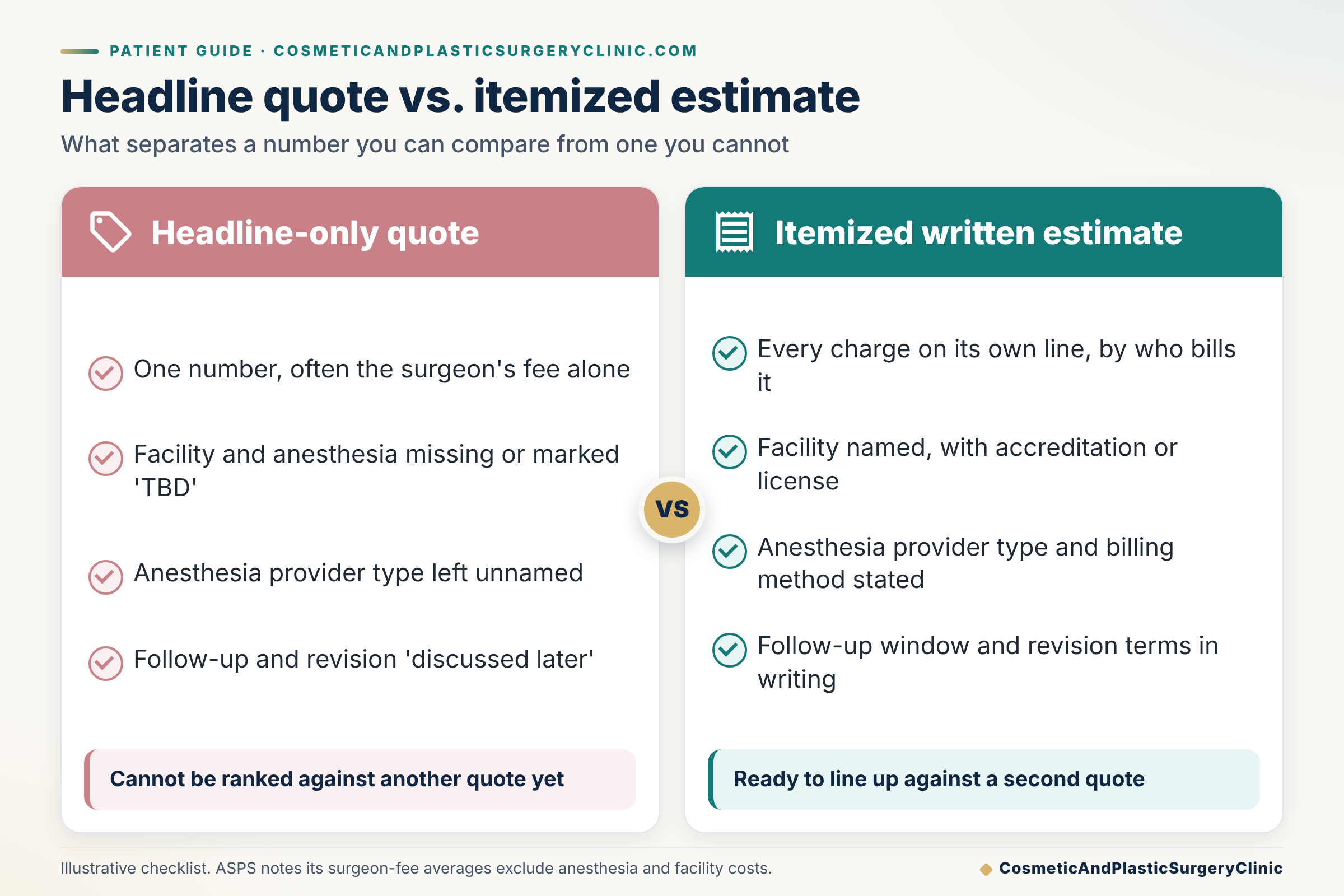
Practice A sends a one-line quote of $9,800. Practice B sends an itemized estimate totaling $14,900. On its face, A is $5,100 cheaper. The table lines them up item by item, with A’s blanks filled in after the practice answers follow-up questions.
| Line item | Quote A, as received | Quote B, as received | Quote A, after questions |
|---|---|---|---|
| Surgeon’s fee | $9,800 | $9,600 | $9,800 |
| Anesthesia | Not listed | $1,900, anesthesiologist named | $2,200, provider type confirmed |
| Facility | Not listed | $2,600, accredited surgical center | $3,100, accreditation confirmed |
| Garments and prescriptions | Not listed | $300 | $350 |
| Pre-operative labs and clearance | Not listed | $500 | Unconfirmed; not yet priced |
| Follow-up visits | 90 days | 12 months | 90 days |
| Revision terms | “Discussed after surgery” | Surgeon’s fee waived for 12 months; facility and anesthesia at cost | Still not in writing |
| Total of priced items | $9,800 | $14,900 | $15,450, plus labs |
When the cheaper-looking quote stops being cheaper
Once A’s missing lines are filled in, its total ($15,450 before labs) passes B’s ($14,900). The apparent $5,100 advantage turned into a $550 disadvantage without anything unusual happening; the first number simply left out items the second included. Had A’s anesthesia and facility come back lower, the ranking could have held. The point of the exercise is that no ranking was possible until the lines were filled in.
The comparison also exposes what the dollar column cannot capture. B includes a year of follow-up where A offers ninety days. B’s revision terms are written down and A’s are not. Those differences have a price that is hard to calculate but easy to feel if a problem occurs in month five. A fair reading treats the remaining $550 as smaller than the uncertainty around an unwritten revision policy, and it also keeps open the possibility that a higher quote is padded with upgrades you did not ask for. Neither quote wins on arithmetic alone.
Price as one input among several
Once the quotes are comparable, the remaining differences in plastic surgery cost are of two kinds: ordinary variation in what things cost, and differences in what is being delivered.
Legitimate reasons plastic surgery cost differs between practices
ASPS notes that plastic surgery cost varies with the surgeon’s experience, the type of procedure, and the office’s location. To that list you can add the type of facility (hospital outpatient department, ambulatory surgery center, or accredited office suite), the type and length of anesthesia, how much of the operation each practice includes, and how long follow-up lasts.
A higher fee in a high-cost metropolitan area is not suspicious by itself, and a lower fee in a lower-cost region is not either. What deserves attention is a low price that is low because something is missing, rather than because something costs less where the practice operates.
Why the lowest total should not win by default
Facility and anesthesia are safety topics as much as plastic surgery cost lines. ASPS requires its member surgeons to operate in facilities that meet recognized standards for any procedure beyond local anesthesia or mild oral sedation, and it names accreditation by AAAASF, AAAHC, or the Joint Commission, Medicare certification, or a state license as acceptable (ASPS, accreditation).
It also advises confirming that deep anesthesia is given by a physician anesthesiologist or a certified registered nurse anesthetist (ASPS, features of a safe operating room). A quote that is cheaper because it skipped these is not the same product at a discount.
The step-by-step checks for credentials and facilities are in how to choose a plastic surgeon. If the plastic surgery cost gap is the reason you are considering surgery abroad, the medical tourism article adds travel, follow-up, and care-at-home costs to the same comparison. And if no quote feels right, waiting, or getting a second opinion, remains a entirely reasonable outcome of the exercise.
Pricing red flags and what to have in writing
A red flag in a plastic surgery cost conversation is a reason to ask more questions, not proof of bad intent. Plenty of busy practices communicate poorly without hiding anything. The patterns below are worth a pause because they make comparison harder or hurry a decision that should not be hurried.
Pressure and vagueness in a price conversation
Two kinds of problems show up repeatedly: urgency attached to the price, and detail withheld about the parts of the bill that carry safety implications.
Countdown discounts, large deposits, and bait-style offers
A price that expires at midnight is a sales device, not a medical deadline. The same goes for a discount tied to same-day booking, a deposit demanded to “lock in” a rate before you have met the surgeon, or financing offered before anyone has described a surgical plan.
The FTC’s guides on bait advertising describe a bait offer as “an alluring but insincere offer,” and list as warning signs such practices as refusing to show or sell the advertised offering or disparaging it to steer the buyer toward something else (16 CFR Part 238, Guides Against Bait Advertising).
If the thing you were quoted turns out to be unavailable once you arrive, that is exactly the sort of mismatch to step back from.
If the pressure shows up in the consultation, the consultation question guide has language for slowing a conversation down without souring it.
Facilities and anesthesia providers that stay unnamed
An estimate that never says where the operation will happen, or who will provide anesthesia, is missing the two items most closely tied to safety. You should be able to learn, in writing, the facility’s name and the basis of its accreditation or license, and whether the anesthesia professional is a physician anesthesiologist or a nurse anesthetist. ASPS adds that accreditation can be verified directly with the accrediting organization, and that heavy promotion of local anesthesia may sometimes mask a facility’s lack of general anesthesia capability.
If the practice answers “we’ll tell you closer to the date,” treat that as an open line on the quote, not a reassurance. The price cannot be final if the facility is undecided.

The written estimate: what to ask for and what rights you have
The goal of everything above is a single plastic surgery cost document you can hold against another one. This is what that document should contain and what to do if the final bill drifts from it.
A checklist to hold an estimate against
Ask for a plastic surgery cost estimate, dated and signed or sent from the practice, that includes:
- The specific operation, which areas or structures it covers, and whether any additional procedure is included or optional.
- The surgeon’s fee, and what follow-up it covers and for how many months.
- The facility’s name, its type, and the basis of its accreditation or license, along with the facility fee.
- The anesthesia provider’s type, the type of anesthesia planned, and whether the charge is flat or time-based.
- Any implant or device, by name, and what happens to the price if it needs replacement.
- Expected labs, clearance, garments, and prescriptions, with who bills each.
- Deposit amount, refundable portion, and cancellation or postponement terms.
- Revision and complication terms: time window, what is waived, and what you would still pay.
- How long the quote is valid and what would trigger a revised one.
Bring the same list to every consultation so the answers line up, and use it to build your own table like the one above.
The Good Faith Estimate right and the $400 dispute path
Federal rules give uninsured and self-pay patients a specific tool. CMS describes a Good Faith Estimate as a written estimate of expected charges that a provider or facility must give people who are uninsured or not using insurance for a scheduled service. If you schedule at least three business days ahead, it is due within one business day of scheduling; if you schedule at least ten business days ahead, or ask for cost information without scheduling, it is due within three business days.
If a final bill from a provider or facility comes in at least $400 above its estimate, you may start a payment dispute resolution process within 120 calendar days of receiving the bill (CMS, understanding the Good Faith Estimate and dispute resolution process; CMS, good faith estimates for uninsured or self-pay patients).
CMS’s materials do not single out cosmetic surgery, so ask the practice directly whether it will provide a Good Faith Estimate for your plastic surgery cost arrangement and who is on it. The estimate lists services the provider reasonably expects to deliver, so a change of plan or an unforeseen medical issue can legitimately move the final bill. What the document gives you is a dated baseline to point to.
Frequently asked questions
Is it normal to pay plastic surgery cost in full before the surgery date?
Practices set their own payment schedules. Some collect a deposit when the date is booked and the balance days or weeks before surgery; others use different timing. What matters is not the schedule but the terms attached to it: which portion is refundable and until when, what happens if the surgeon postpones or declines to proceed after evaluation, and whether the facility and anesthesia charges are collected by the practice or billed separately.
Get those terms in writing, and keep the receipt. If you are financing, ask when the lender funds the practice, because that timing affects how a cancellation refund reaches you.
Does a higher quote mean a more skilled surgeon?
No. A quoted fee reflects a mix of region, facility type, scope, anesthesia, follow-up length, and the practice’s own overhead and positioning, and none of those measures training or technical skill. Credentials are checked separately: board certification in plastic surgery, state license status, and the facility’s accreditation can each be verified with the issuing organization.
Use price to decide what you can afford and what is included, and use verification to decide who is qualified. A high quote with an unclear facility is not reassurance, and a modest quote with every item documented is not a warning sign.
Can I negotiate plastic surgery cost?
Some flexibility may exist, but the most sensible place to negotiate is scope and logistics rather than safety-related items. Optional extras, the timing of payments, and the package contents are all reasonable subjects. CMS says Good Faith Estimate notices tell self-pay patients they can ask to have a bill updated to match the estimate, negotiate the bill, or ask about financial assistance, so asking is expected. Avoid trading away anything tied to the facility or the anesthesia provider to hit a number; those lines protect you if something does not go as planned.
How long is a quote valid, and why might it change?
Validity periods are set by each practice, so ask for the date a quote expires and what would change it. Common reasons for a revised figure include a change in the planned operation after an in-person examination, a different operating-room date or facility, an added or dropped procedure, and a longer expected operating time. A quote prepared before the surgeon has examined you is usually a working estimate rather than a final price. Ask the office to mark each estimate as preliminary or final, and to send the final one in writing before you commit.
Do “all-inclusive” packages really include everything?
The phrase has no fixed definition, so ask for a list. A package might include the surgeon, facility, and anesthesia but not labs, garments, prescriptions, or visits after a set date, or it might exclude revision costs entirely. Also ask what happens to the price if the operation runs longer than planned or a second procedure is added.
A package can be a genuine convenience if every line is named, and it can be a way of hiding gaps if they are not. Convert it into the same itemized list you would use for any other quote.
Is the ASPS average plastic surgery cost what my surgeon will charge?
Not necessarily. The ASPS plastic surgery cost figures are national projections built from averages that surveyed member surgeons reported, and since 2024 they appear as ranges because fees vary by geography and practice setting. They cover the surgeon’s fee, not the facility, anesthesia, or other costs. Your own quote may fall inside the range, below it, or above it, depending on your surgeon’s experience, region, and the specifics of your plan. Use the national figure to notice an outlier, then rely on an itemized estimate for your actual decision.
Does a price quoted by phone or email count as a quote?
It is a ballpark, and a useful one for deciding whether to book a consultation. A reliable price needs the surgeon’s examination, because the plan, the scope, and sometimes the choice of facility or anesthesia depend on what the surgeon finds. After the consultation, ask for a written, itemized estimate. If the number given before the visit and the number given after differ, ask which items changed. That comparison is also a good test of how transparent the practice’s pricing is.
Sources and further reading
- American Society of Plastic Surgeons — 2024 Average Surgeon/Physician Fees (accessed 2026-11-12) — projected fee ranges for cosmetic procedures; how ranges were built
- American Society of Plastic Surgeons — 2023 Average Surgeon Fees (accessed 2026-11-12) — single average fees for 2023
- American Society of Plastic Surgeons — Liposuction cost (accessed 2026-11-12) — fee excludes anesthesia and facility; cost components; insurance statement
- American Society of Plastic Surgeons — Tummy tuck cost (accessed 2026-11-12) — same fee caveat; insurance and complications
- American Society of Plastic Surgeons — Accreditation (accessed 2026-11-12) — facility standards and accrediting bodies
- American Society of Plastic Surgeons — Features of a safe operating room (accessed 2026-11-12) — accreditation, anesthesia provider, local-anesthesia caution
- American Society of Plastic Surgeons — Ten things to ask before plastic surgery (accessed 2026-11-12) — facility, anesthesia provider, and surgeon questions
- American Society of Plastic Surgeons — Recommended insurance coverage criteria, blepharoplasty (accessed 2026-11-12) — cosmetic versus functional documentation
- Moura et al. — Offering No-Cost Cosmetic Revisions, Aesthetic Surgery Journal Open Forum, 2023 (accessed 2026-11-12) — single-center revision rate, revision policy, practice survey
- Internal Revenue Service — Publication 502, Medical and Dental Expenses (accessed 2026-11-12) — cosmetic surgery rule, exception, 7.5% threshold
- Internal Revenue Service — Topic 502, Medical and dental expenses (accessed 2026-11-12) — itemizing and non-deductible cosmetic surgery
- Centers for Medicare & Medicaid Services — Women’s Health and Cancer Rights Act fact sheet (accessed 2026-11-12) — reconstruction coverage requirements
- Centers for Medicare & Medicaid Services — Understanding the Good Faith Estimate and dispute resolution process (accessed 2026-11-12) — timing, $400 threshold, 120-day window
- Centers for Medicare & Medicaid Services — Good faith estimates for uninsured or self-pay patients (accessed 2026-11-12) — consumer-facing summary
- Consumer Financial Protection Bureau — What’s the deal with health care credit cards (accessed 2026-11-12) — how deferred interest works
- Consumer Financial Protection Bureau — Medical credit cards and financing plans, May 2023 (accessed 2026-11-12) — share of deferred-interest purchases assessed interest, 2015–2020
- Federal Trade Commission — Guides Against Bait Advertising, 16 CFR Part 238 (accessed 2026-11-12) — definition and warning signs of bait offers
- U.S. Food and Drug Administration — Risks and complications of breast implants (accessed 2026-11-12) — implants are not lifetime devices
- AORN Outpatient Surgery — Anesthesia alert: how anesthesia gets paid, 2016 (accessed 2026-11-12) — base units plus time units in insurer billing