
If you are searching for what makes someone a tummy tuck candidate, you are probably trying to settle one practical question before you book a consultation or put money down: does anything about my body, my health, my plans, or my calendar make this a poor fit right now? That is a sensible thing to sort out early. A tummy tuck (abdominoplasty) is a major operation with real scars, a real recovery, and real risks, so the right moment matters nearly as much as the right surgeon.
One boundary up front. This article cannot tell you whether you are or are not a candidate, and nothing here is a diagnosis or a treatment plan. Candidacy is a judgment that comes out of an in-person evaluation with a qualified clinician: an examination, a medical history, a frank conversation about what you want, and a look at how your life is arranged over the next several months. What a general article can do is help you walk into that conversation knowing which factors get weighed, why they matter, and which answers deserve a second look.
The tummy tuck is also one of the most requested body procedures in the country. The ASPS 2025 procedural statistics estimate 173,251 tummy tucks in the United States that year, up 2% from 170,544 in 2024, which makes it the third most common cosmetic surgical procedure on the list. Popularity says nothing about whether a specific person is well matched to the operation, which is why the screening questions below matter more than the headline number.
Here is how the page is organized. The first section defines the vocabulary and the scope of the operation. The next two cover goals, anatomy, and health factors: weight, medical conditions, nicotine, and medications. Then comes timing, including pregnancy, breastfeeding, weight changes, GLP-1 medications, age, and your work and family calendar. After that you will find a section on red flags and reasons to postpone, one on how candidacy connects to complication risk, and a closing section on alternatives, consultation preparation, and verifying credentials. A short question-and-answer module follows. Where a topic has its own deeper article, such as the tummy tuck cost guide or the risks and complications article, we summarize and point you there instead of repeating it. For the full procedure overview, start with the complete guide to tummy tuck.
A note on language. “Tummy tuck” is the patient’s term and “abdominoplasty” is the surgical one; they mean the same family of operations, and this page uses both. “Candidate” is shorthand that clinicians use for a person whose likely benefits outweigh the risks and costs at a given moment. Where a source says “women,” we sometimes echo its wording, but anyone considering abdominal contouring, whatever their gender, benefits from the same planning conversation.
Tummy tuck candidate basics: what the term means and what the operation can change
Before getting into factors, it helps to agree on vocabulary. People use “candidate” loosely, surgeons use it a little differently, and the gap between the two explains a lot of confusion on forums and in consultation rooms.
What “candidate” means in a consultation
In plain English, a tummy tuck candidate is someone for whom the likely benefits of the operation outweigh its risks, costs, and recovery burden, given their goals, anatomy, health, and circumstances. That target moves. The same person can be a reasonable fit in one year and a poor fit in another, which is why timing shows up in nearly every section of this article. It also means “candidate” is not a label you earn once and keep.
A terminology map for candidacy conversations
Several terms get mixed together, and separating them makes the rest of the page easier to follow. A contraindication is a circumstance in which a treatment should not be used at all, at least until something changes. An active infection or an uncontrolled medical condition fits here. A relative risk factor raises the chance of a problem without ruling the operation out; nicotine use, a higher body mass index, and certain medications belong in this group. A timing issue is something that may resolve on its own, such as a weight that is still falling, a recent delivery, or a baby who is still nursing.
Then come the softer categories. An expectation gap is a mismatch between what someone hopes for and what the procedure can deliver. A readiness issue covers practical matters like childcare, time off, and money. And an unresolved symptom means a bulge, pain, or skin problem that nobody has evaluated yet. Surgeons sort concerns into roughly these buckets because each is handled differently. A timing issue might mean “come back in several months.” A contraindication might mean “not with this plan.” An expectation gap might mean “let’s talk about what we can realistically change.”
Two more vocabulary items come up constantly. Rectus diastasis is a widening of the gap between the two vertical rectus abdominis muscles (the “six-pack” muscles), often after pregnancy; it is not the same as a hernia. A panniculus, or “pannus,” is a fold of skin and fat that hangs over the lower abdomen. You will see “appropriate candidate” in patient education materials, and it carries a useful hedge: appropriate for this operation, by this approach, at this time, in the judgment of a particular clinician. Another surgeon could reasonably frame the plan differently, which is one reason many people seek a second opinion.
How surgeons weigh candidacy: a decision logic
The ASPS candidate page boils the basics down to four ideas: being physically healthy and at a stable weight, having realistic expectations, not smoking, and being bothered by the appearance of the abdomen. It also stresses that a tummy tuck is a highly individualized procedure and that people should pursue it for themselves rather than to meet someone else’s wishes or an ideal image. Those four ideas are a floor, not a scoring system. In practice, surgeons run a sequence of questions, and the order matters.
First comes safety: is there anything in your health, medications, or habits that makes an elective operation under sedation or general anesthesia unreasonably risky right now? Second comes sequence: would the result be undermined by something you plan to do next, such as lose a substantial amount of weight or have another pregnancy? Third comes fit: does the operation address what bothers you, or does the concern sit in a layer the operation does not reach? Fourth comes capacity: can you actually recover, with time off, help at home, and follow-up visits? Only after those four does the cosmetic wish list get its turn.
That logic explains why two people with identical-looking abdomens can get different advice. One has a steady weight, a job with flexible hours, and no nicotine exposure; the other is still losing weight on a prescription medication and plans another child. Same anatomy, different timing, different answer. It also explains why a “yes” from one practice and a “not yet” from another may both be reasonable. The disagreement is usually about sequence or risk tolerance, not about whether you “deserve” surgery.
Candidacy also has an evidence dimension worth naming. Many of the conventions surgeons follow, such as waiting for weight stability or stopping nicotine for several weeks, come from clinical experience and general surgical evidence rather than from large trials built specifically around tummy tuck patients. Where this article gives numbers, it says where they come from and how far they stretch. Where a rule of thumb is mostly convention, it says that too.
What a tummy tuck can and cannot change
A candidacy discussion only makes sense if the goal fits the tool. Many consultation misunderstandings come from a concern that sounds like “my stomach” but actually lives in several different layers: skin, fat, muscle, or something deeper. The tummy tuck works on some of those layers and leaves others alone.
What the operation is designed to address
According to ASPS, a tummy tuck removes excess fat and skin from the abdomen and, in most cases, restores weakened or separated muscles, producing a smoother, firmer profile. Mayo Clinic’s patient page adds the common reasons the abdomen changes in the first place: weight fluctuation, pregnancy, cesarean delivery, aging, and body type. It also notes that the operation can repair separated abdominal muscles and may help some people with associated lower back pain; the word “may” matters, because back pain has many causes and no surgeon can promise relief.
The mechanics are worth a plain-English pass. The ASPS procedure page describes a horizontal incision between the pubic hairline and the navel, sometimes with a second incision around the navel when skin higher on the abdomen is being removed. The surgeon lifts the skin, tightens the weakened muscles beneath, removes the excess skin, and creates a new opening for the navel. Anesthesia is typically intravenous sedation or general anesthesia, as ASPS describes it. The tummy tuck techniques guide covers mini, full, extended, and other variations in depth, so this page treats the technique as a single family of operations and focuses on who it suits.
Skin that is loose because of pregnancy, aging, heredity, prior surgery, or weight change is the classic target. ASPS describes the best-matched concern as a protruding or loose abdomen in a person at a normal body weight. Stretch marks inside the area of skin that gets removed go away with it; stretch marks elsewhere typically stay. ASPS says the operation cannot correct stretch marks as such, though it may improve or remove them when they sit in the excised skin.
What it does not do
The list of things a tummy tuck does not do is just as useful for deciding whether it fits. ASPS is direct that it is not a substitute for weight loss or an exercise program. It is not a treatment for obesity, and it does not remove fat from every layer. Fat that sits deeper than the muscle wall, around the internal organs, is outside the reach of an operation that works on the skin, the fat just beneath it, and the muscle sheath. A firm, full abdomen that stays rounded even at a lean weight may be driven by that deeper fat or by the structure of the rib cage and pelvis, and the operation will not change it.
It also cannot promise a particular shape for the upper abdomen, the flanks, or the back. Some variations extend toward the hips and sides, but the standard design is built around the lower abdomen, and how much it changes the upper abdomen, the flanks, and the back depends on the technique and on your anatomy. It will not erase the scar it creates, and ASPS notes that the scar may take months to a year to fade as much as it will. Results can be diminished by significant weight fluctuation after surgery, and in some cases a second operation turns out to be needed.
Finally, it does not make the abdominal wall hernia-proof. A hernia is a separate problem, a gap through which tissue pushes, and repairing it is a different step from tightening a stretched midline. The tummy tuck complete guide covers what the operation entails from start to finish. For candidacy purposes, the useful habit is to write down exactly what bothers you, and then ask each surgeon, layer by layer, which of those concerns the operation would address, which it would only partly address, and which it would not touch. Table 1 gives a general starting map.
| Concern | Commonly addressed | Addressed only partly | Not addressed by the operation alone |
|---|---|---|---|
| Loose lower abdominal skin | Excess skin below the navel is removed | Skin above the navel is pulled down, with limits | Loose skin on thighs, flanks, or back |
| Separated or stretched midline muscles | Surgeons commonly tighten the muscle sheath | Strength and back-pain effects vary by person | A true hernia, which needs its own repair decision |
| Fat just under the skin | Part of the tissue removed with the skin | Shape in the flanks may need added liposuction | Fat deep inside the abdomen around organs |
| Stretch marks | Those within the removed skin | Those near the edge of the removed area | Marks on the upper abdomen, hips, or thighs |
| Weight-related goals | Not the purpose of the operation | Tissue removal is not a weight-loss method | Weight loss, appetite, or metabolic health |
Goals, expectations and anatomy: what surgeons look at first
Most consultations start with a question that sounds simple: what bothers you? The answer shapes everything that follows, because the same word, “belly,” can describe a skin problem, a fat problem, a muscle problem, or a combination. A good candidacy conversation gets specific about which one it is.
Goals and expectations
Goals are not a formality to get through before the examination. They are the yardstick against which anyone, including you, will judge the outcome a year later. A goal that is vague (“I want to feel better in my body”) is hard to match to an operation. A goal that is specific and checkable (“I want the overhang below my navel gone and my pants to lie flat”) can be discussed honestly, including the parts the operation may not reach.
Sorting the complaint: skin, fat, muscle, or something else
People describe their abdomens in a lot of ways: an apron of skin that hangs over a waistband, a pooch that never flattens, a belly that looks flat in the morning and round by evening, a ridge or dome that shows up when sitting up from lying down, skin that looks crinkled like crepe paper after weight loss. Each description hints at a different layer, though none of them is a diagnosis.
Loose or hanging skin points toward the skin layer. Fullness that you can pinch and hold between your fingers suggests the fat just under the skin. A vertical ridge or bulge down the midline that appears when the abdominal muscles tighten may reflect separated muscles. A firm, rounded abdomen that is flat in the morning and larger later in the day may be driven by digestion, gas, or fluid, which no skin-and-muscle operation will change, and persistent or painful swelling deserves a medical evaluation of its own. Posture matters too: a pronounced curve in the lower back or a tilted pelvis can push the abdomen forward without any excess tissue at all.
Surgeons sort these layers by examining you standing, often bending forward or tensing the abdominal wall, and sometimes lying down. You can prepare by writing down when the bulge looks worst, whether it changes during the day, and whether it hurts. Some people also bring a few photos taken in consistent lighting at different times. For the visit itself, three questions do a lot of work: which layer does the surgeon think is responsible for what bothers me, which of my concerns would the operation address, and what would they suggest if the answer is mostly muscle, or mostly deep fat, or mostly skin?
Motivation, expectations and how you will judge the result
ASPS describes good candidates as people with realistic expectations who are bothered by the appearance of the abdomen, and it adds that the operation should be pursued for yourself, not to satisfy someone else or to fit an ideal image. That last point deserves more than a nod. Pressure from a partner, a social feed, or a milestone event can make a person feel like a candidate when what they really want is relief from an unrelated stress. A decision you would still make with no audience is a sturdier one.
The ASPS 2025 statistics report also gives context on why people seek this kind of surgery. In its survey of member surgeons, 75% ranked restoration after life changes, including pregnancy, aging, and significant weight loss, as the leading reason patients pursue plastic surgery, by a wide margin. That framing is useful. For many people the wish is not to look like someone else but to get back something that pregnancy, weight change, or time altered. It is also a reminder that “restoring” is a goal with limits: tissue that was stretched and thinned does not become what it was at twenty-two.
It helps to define how you will judge success before surgery, in terms you can check. Examples include clothing that fits differently, comfort in swimwear, a lower abdomen that no longer folds over a waistband, or a midline that no longer domes. Then add the trade-offs you are willing to accept in return: a long scar that sits low on the abdomen, weeks of restricted activity, numbness that can linger, and the chance that a second procedure will be recommended. If a trade-off feels unacceptable when you read it written down, that is useful information, not a failure to be motivated enough.
Finally, consider how you will feel about the result as your body keeps changing. Results are long-lasting but not frozen. Weight gain or loss, future pregnancies, and aging all continue to act on the abdomen after surgery. A person who expects the outcome to hold still for decades may be disappointed; a person who plans to maintain a steady weight and accepts gradual change is better positioned to judge the result fairly.
Anatomy factors in a tummy tuck candidate evaluation
With goals on the table, the examination turns to anatomy. The questions are mechanical: where is the excess, what is it made of, how elastic is the skin, how are the muscles behaving, and what has happened in that area before?
Skin quality, fat distribution and where the excess sits
The location of the excess skin often decides which operation fits. Excess that sits mostly below the navel can sometimes be handled with a limited approach; excess that spans the whole abdomen, wraps around the flanks, or extends onto the back leads to different designs, including extended abdominoplasty or a lower body lift. The technique guide walks through those options, and the panniculectomy candidacy article covers the related situation where the main issue is a hanging apron of skin after major weight loss.
Skin quality matters because skin that has been stretched for a long time, or thinned by rapid weight change, recoils less. ASPS makes the point in its liposuction guidance: contouring works best in people with firm, elastic skin, and skin that is soft and thin from stretch marks, weight loss, or natural aging will not reshape as well. That is one of the clearest dividing lines between a person who might do well with liposuction alone and one whose main issue is loose skin that needs to be removed. Surgeons assess elasticity by pinching and gently lifting the skin, looking at stretch marks and thickness, and asking about the history of weight change.
Fat distribution matters in a different way. The fat just under the skin can be reduced during a tummy tuck, and many surgeons add liposuction to refine the contour; the fat deeper in the abdomen cannot be. A person with a lot of deep abdominal fat may notice that the abdomen stays full after surgery, because the part driving the shape was never in reach. Weight matters here as well, which is one reason surgeons ask about stable weight and sometimes recommend reaching a steadier range first, as the health factors section explains.
Stretch marks, discoloration, and prior skin conditions also come up. Stretch marks within the planned skin removal go away with the skin, while those outside it stay. Skin conditions in the folds, such as recurring rashes, are worth mentioning, partly because they may point toward a panniculectomy conversation and partly because active skin infections need to be cleared before elective surgery.
Muscle separation, hernias and prior abdominal scars
Rectus diastasis is common after pregnancy. Cleveland Clinic states that it affects about six in ten women after childbirth, that roughly 45% still have it at six months postpartum, and that a gap wider than about 2 centimeters (roughly three-quarters of an inch) is typically considered diastasis. It is not a hernia, though the same page lists umbilical hernia as a possible complication when the separation is more severe. First-line care for many people is physical therapy and targeted exercise to engage the deep abdominal muscles, while surgery enters the picture for people who also have an umbilical hernia or who want cosmetic correction through abdominoplasty. Belly bands may feel supportive, but the page is clear that they cannot heal the separation by themselves.
How much pregnancy changes the wall varies. In a 2019 study led by surgeons at Northwestern, reported through a university press release, researchers measured CT scans of 60 women aged 18 to 45 that had been done for other reasons. The connective tissue at the midline, the linea alba, averaged about 1.14 centimeters in women with no pregnancies and about 2.29 centimeters after pregnancy, and the muscles themselves widened with the first two pregnancies. The study was retrospective and small, so it is best read as a description of how much anatomy can change, not as a rule for any one person.
Hernias are a different matter. MedlinePlus describes a hernia as tissue bulging through a weak area of muscle and lists umbilical hernias, which arise around the navel, and incisional hernias, which emerge through a surgical scar, among the common types. It says treatment is usually surgery to repair the opening and that untreated hernias can cause pain and other problems. ASPS draws the distinction in its older insurance-criteria document, dated July 2006: repairing a diastasis is part of a standard abdominoplasty, while a true hernia repair involves opening the fascia and dealing with a hernia sac. Because of that distinction, a bulge near the navel is worth showing to the surgeon and, depending on the exam, may lead to imaging or a hernia repair plan alongside the cosmetic one.
Prior surgery shapes the plan too. ASPS says previous abdominal surgery may limit the potential results of a tummy tuck, and that people with prior cesarean scars may have those scars incorporated into the new incision. StatPearls adds that previous operations through upper-abdominal incisions, such as some gallbladder, liver, or kidney procedures, can compromise the blood supply to the skin flap, and Mayo Clinic lists extensive scar tissue from earlier abdominal surgery among the reasons to reconsider or plan carefully. Tell every surgeon about every abdominal operation, even ones that seem minor or long ago: appendectomy, hysterectomy, hernia repairs with mesh, bariatric surgery, and previous liposuction or tummy tuck all matter.
Health factors: weight, medical conditions, nicotine and medications
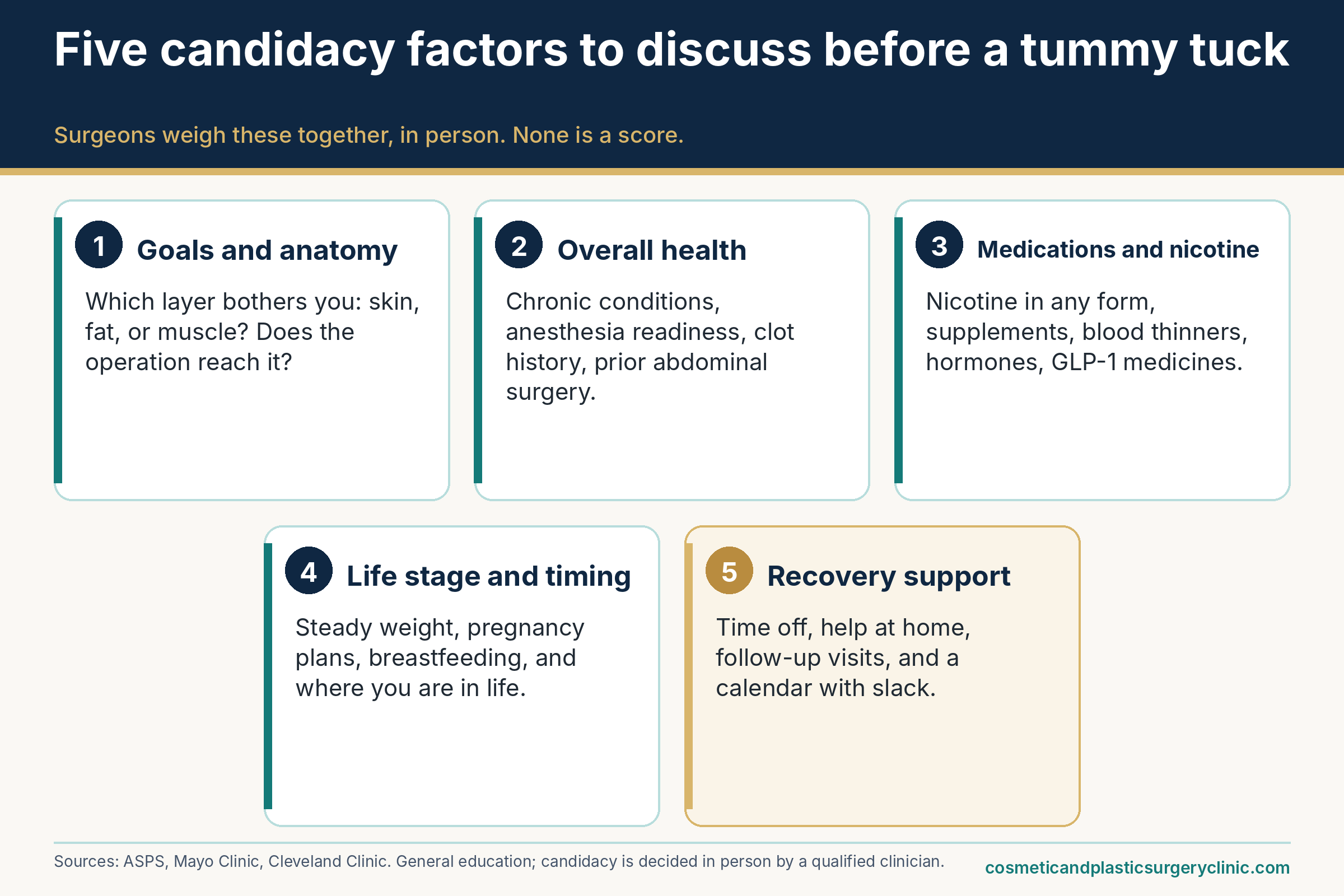
Anatomy tells a surgeon whether the operation could address what bothers you. Health tells them whether you can safely have it. A tummy tuck typically involves sedation or general anesthesia, a long incision, and a wide area of lifted tissue, so the questions in this section carry real weight. None of them is about worth or willpower. They are about wound healing, blood flow, clotting, and anesthesia.
General health and the weight question
Two things come up in almost every candidacy screen: how healthy you are overall, and where your weight sits. Both are best understood as risk modifiers, not pass-fail tests.
Overall health, anesthesia readiness and chronic conditions
ASPS lists being physically healthy as a basic criterion, and the major clinical references expand on what that means. Mayo Clinic names serious chronic conditions such as heart disease and diabetes, a need for blood-thinning medication or an elevated clot risk, a body mass index of 30 or higher, smoking, and extensive scar tissue from earlier abdominal surgery among the reasons to avoid or reconsider the operation. Cleveland Clinic adds circulation or wound-healing disorders. StatPearls, a clinical reference from the National Library of Medicine’s Bookshelf, divides the list differently: it treats active infection, uncontrolled medical disease, unstable clotting disorders, poorly controlled diabetes, pregnancy, inadequate abdominal wall support, and certain psychological conditions as absolute contraindications, and tobacco use, obesity, immune suppression, poor nutrition, and prior operations that compromise skin blood flow as relative ones.
Notice the word “controlled.” A chronic condition that is well managed and stable is a different conversation from one that is poorly controlled. Many surgeons will ask for records or a note from the clinician who manages the condition, such as a cardiologist or an endocrinologist, before agreeing to proceed. Blood tests are common too; StatPearls says preoperative evaluation includes a detailed history and examination and laboratory work, such as blood counts, chemistry, and nutritional markers, based on clinical judgment. If an issue turns up, such as anemia or a high blood sugar, the usual answer is to fix it and reschedule, not to give up the idea.
Anesthesia readiness gets its own review. In ASPS’s description, the operation is done with intravenous sedation or general anesthesia, and the surgical team chooses with you. People with heart or lung disease, sleep-related breathing problems, or a history of reactions to anesthesia may need additional evaluation or a hospital-based setting. The point is not to alarm you but to explain why a pre-op questionnaire can be long and why complete, honest answers protect you.
| Factor | Why surgeons ask | How it may change the plan | Source tier |
|---|---|---|---|
| Heart, lung or blood-pressure conditions | Anesthesia and long operations strain these systems | Clearance from the treating clinician, a hospital setting, or postponement | Mayo Clinic; StatPearls |
| Diabetes | High blood sugar impairs wound healing and raises infection risk | Better control first; poorly controlled diabetes is listed as a contraindication | StatPearls |
| Clotting history or blood thinners | Surgery and reduced movement raise clot risk; bleeding risk also matters | Individual clot-prevention plan; medication changes only through the prescriber | Mayo Clinic; CDC |
| Nicotine in any form | Narrowed blood vessels reduce oxygen to healing skin | Stopping for weeks before and after; possible cotinine testing | ASPS 2024 reference |
| Body mass index of 30 or higher | Associated with higher complication rates in several studies | Case-by-case review; some surgeons advise weight loss first | Mayo Clinic; peer-reviewed studies |
| Immune suppression or poor nutrition | Slows healing and raises infection risk | Testing, nutrition support, or delay | StatPearls |
| Prior abdominal surgery | Scars can affect skin blood supply and the available tissue | Modified incision design or a different procedure | ASPS; StatPearls |
Body mass index, body size and what the research can and cannot say
Body mass index (BMI) is a ratio of weight to height. The Centers for Disease Control and Prevention (CDC) defines adult categories as underweight below 18.5, healthy weight from 18.5 to under 25, overweight from 25 to under 30, and obesity at 30 or above, subdivided into classes 1 through 3. The CDC is explicit that BMI is a screening tool, not a diagnostic measure, and that it should be considered with other factors. It does not distinguish muscle from fat, and it says nothing about where fat sits or how metabolically healthy someone is.
Surgeons nevertheless use it, because in surgical studies a higher BMI is associated with more wound and fluid complications. A large analysis of about 25,000 abdominoplasties from a cosmetic-surgery insurance database (2008 to 2013) found a relative risk of about 1.3 for a BMI of 30 or more compared with lower BMIs, alongside higher relative risks for male sex (1.8), age 55 or older (1.4), and multiple procedures at once (1.5). A smaller single-center chart review published in 2009 found that among 139 patients, major complications were more common when BMI exceeded 30: 20.8% compared with 9.7%. Both findings are observational and describe groups, so they do not predict what will happen to any individual.
The picture is not one-directional. A single-surgeon comparison of 82 patients, summarized in a 2019 ASPS news release, found no statistically significant difference in complication rates between patients with and without a BMI of 30 or more, though seromas (fluid collections) were numerically more common in the higher-BMI group. The authors’ conclusion, as relayed by ASPS, was that a BMI above 30 should not by itself be treated as a strict contraindication, and that surgeons should evaluate patients case by case. Taken together, these studies support a nuanced reading: higher BMI raises the odds of certain problems in many series, many surgeons weigh it alongside other factors, and policies vary from practice to practice.
What does this mean if your BMI is in the obesity range? Often the conversation moves to two questions. Is there a plan to lower weight first, since Mayo Clinic suggests that people who are significantly overweight lose weight before surgery? And would the result be more durable after weight loss, since a large change afterward can undercut the contour? Some practices set a numeric BMI ceiling; others decide case by case. Neither approach is a judgment of you. If one practice declines and another agrees, ask each to explain its reasoning in plain terms, and take the more cautious answer seriously.
Nicotine, medications and supplements
Two parts of the medical history deserve extra attention because they are changeable, because they affect healing and bleeding, and because patients sometimes under-report them: what you inhale, absorb, or swallow, and what your prescriber has you taking.
Nicotine and wound healing
ASPS lists nonsmoking as a basic candidacy criterion, and its 2024 practice reference gives the mechanism and the timing. Nicotine constricts blood vessels, which is especially concerning in operations that depend on adequate blood flow. The document recommends that, depending on overall health and the operation, smoking cessation occur 4 to 8 weeks before surgery and continue for at least 4 weeks afterward, with similar logic for e-cigarettes and other nicotine products. It also suggests that surgeons consider a urine cotinine or nicotine test on the day before or the day of surgery to decide whether to delay. The complications it lists for smokers include delayed wound healing, tissue death, infection, blood clots, and skin slough.
Other sources give slightly different windows. An ASPS blog post from 2016 advises quitting three to six weeks before surgery through three to six weeks after, and StatPearls recommends at least four weeks before and after. The windows differ because they come from different authors, different dates, and different operations; none is a promise of safety at the shorter end. The practical rule is simple: your surgeon’s instruction governs, and if a surgeon quotes you a window longer than another source, the stricter one is not wrong.
Product type matters less than people hope. The ASPS reference lists cigarettes, e-cigarettes, patches, chewing tobacco, and lozenges as nicotine sources, and the 2016 post stresses that nicotine from gum, patches, or vaping still narrows blood vessels. If you are using a nicotine patch or gum to quit smoking, that is a conversation to have openly with your surgeon and prescriber, not something to hide because it feels like progress. Marijuana is flagged separately by ASPS for its effects on the nervous, cardiovascular, and respiratory systems and possible anesthesia interactions; tell the surgical team about any use. The smoking and plastic surgery guide covers timelines and cessation planning in more depth.
A final note on honesty. A cotinine test can detect recent use, but the point of asking is not to catch anyone out. It is to protect a flap of skin whose survival may depend on it. If you slip during the cessation window, the ASPS blog author advises telling the surgeon at once and considering postponement over proceeding. That is almost always the better trade.
Medications, supplements, hormones and GLP-1 prescriptions
Bring a complete list to the consultation, including over-the-counter drugs, vitamins, herbal products, and anything you take only occasionally. Mayo Clinic’s preparation advice says to avoid aspirin, anti-inflammatory drugs, and herbal supplements before surgery, and to discuss the details with your surgeon. The American Society of Anesthesiologists (ASA) notes that supplements such as ginkgo, ginseng, garlic, and vitamin E can raise bleeding risk, that about half of people who use herbal supplements do not tell their physicians before surgery, and that in some cases an anesthesiologist may recommend stopping them at least two weeks beforehand. That brochure dates from 2015, so treat the two-week figure as an example of the kind of lead time involved, not a rule.
Hormones count as medications. The CDC lists increased estrogen levels among the contributors to venous blood clots, and surgery itself is a risk factor through vein injury and immobility. If you use hormonal contraception, hormone therapy, or any treatment that changes estrogen levels, the surgeon and anesthesia team need to know. Do not stop or change anything on your own; a missed dose of a blood thinner, a seizure medicine, or a heart medication can cause harm. Decisions about prescribed drugs belong with the prescriber and the surgical team together.
GLP-1 receptor agonist medicines deserve a specific mention because so many tummy tuck inquiries now involve them. In October 2024, five medical societies including the ASA issued multisociety guidance saying that most patients should continue GLP-1 medicines before elective surgery, with an individualized risk assessment. The guidance flags the early escalation phase of treatment, roughly the first four to eight weeks, and active gastrointestinal symptoms such as nausea, vomiting, abdominal pain, or constipation as reasons to defer elective procedures. For higher-risk patients, it describes strategies such as a 24-hour liquid diet before the procedure, ultrasound of the stomach, and a modified anesthesia plan, coordinated among the anesthesiologist, surgeon, and prescriber. Because individual plans differ, ask your surgeon how they handle these medicines and tell the anesthesia team exactly what you take and when you last took it. The weight-related side of GLP-1 use, such as when to plan surgery as weight comes down, appears in the timing section below.
| Category | Examples to mention | Why it matters | Who usually decides |
|---|---|---|---|
| Nicotine and other substances | Cigarettes, vaping, patches, gum, chewing tobacco, marijuana | Blood flow, healing, anesthesia effects | Surgeon, with your own quit plan and prescriber |
| Blood thinners and clotting history | Prescribed anticoagulants, aspirin, past clots, family history | Bleeding and clot balance | Prescriber and surgeon together |
| Supplements and over-the-counter products | Herbals, vitamin E, anti-inflammatory pain relievers | Some raise bleeding risk | Surgeon and anesthesiologist |
| Hormones | Birth control, hormone therapy | Estrogen is linked to clot risk | Prescriber and surgeon together |
| Weight-loss and diabetes medicines | GLP-1 receptor agonists and other prescriptions | Stomach emptying and anesthesia planning, blood sugar control | Anesthesiologist, surgeon, and prescriber |
Timing and life stage: pregnancy, weight changes, age and your calendar
Ask surgeons what separates a good time from a poor time for a tummy tuck, and the answers cluster around a few moving parts: whether the abdomen is still likely to change, whether life is likely to stretch it again, and whether you can actually take the recovery. The anatomy may be identical in a good month and a poor one. The sequence is what differs.
Pregnancy, breastfeeding and weight changes
The two forces that reshape the abdomen most are pregnancy and weight change. Both can work against a result if they happen after surgery, and both are often in motion at the exact moment someone starts researching candidacy.
After pregnancy, and when more pregnancies are possible
On future pregnancies, the major sources agree. ASPS lists women considering future pregnancies among those who should postpone, noting that additional stretching affects results. Cleveland Clinic says that those planning to expand their family should wait because muscles and skin can stretch after pregnancy, which can affect the outcome, and Mayo Clinic includes future pregnancy among the reasons to reconsider. StatPearls treats current pregnancy as an absolute contraindication to the operation, which is a separate point: an elective abdominal operation is not done during pregnancy.
What happens when someone does become pregnant after a tummy tuck? Here the evidence is thin. One published report, a 2020 case report in JPRAS Open, described a single woman who had an uneventful pregnancy and delivery after an abdominoplasty with mesh reinforcement for diastasis and showed no recurrence of the muscle separation. The authors themselves warned that one patient cannot represent everyone, and recommended individual counseling and professional monitoring if pregnancy occurs after such surgery. A case report is the weakest form of evidence. It shows that something can happen; it does not tell you how often. For that reason, the sources reviewed here frame a later pregnancy as a reason to wait if you can, not as something that is either ruled out or settled.
There is also an anatomical reason surgeons ask about the family plan. The 2019 CT-scan study mentioned earlier found that the midline connective tissue and the muscles widen with pregnancy, and the authors suggested that those changes could compromise standard tummy tuck results. In plain terms, a second or third pregnancy asks the same tissue to stretch again after it has been tightened. A person who is sure the family is complete is in a different position from a person who is unsure.
For people who recently delivered, the first question is usually not surgery at all. Cleveland Clinic reports that about 45% of women still have diastasis six months after delivery and that many people improve with physical therapy and targeted exercise. That suggests a sequence worth discussing with your obstetric clinician and a surgeon: give the body time to settle, try the nonsurgical measures that fit, and see what remains. None of the primary sources reviewed for this article sets a fixed number of months to wait after delivery, and practices differ. The mommy makeover after pregnancy article covers timing when a tummy tuck is combined with breast procedures.
Breastfeeding adds its own set of questions. From the anesthesia side, the Academy of Breastfeeding Medicine’s 2017 protocol says that mothers with healthy term or older infants can generally resume breastfeeding as soon as they are awake, stable, and alert after anesthesia, and that milk usually does not need to be pumped and discarded; a brief interruption may be considered for vulnerable infants. The same protocol cautions that opioids can pass into breast milk and may cause infant sedation, recommends judicious short-term use, and calls for closer monitoring if they are used for more than four days. Those are general statements, not instructions for your child. The practical problems are often bigger: the operation limits lifting, and an infant or toddler is heavy; you may be wearing a garment and managing drains while up at night. Those considerations belong in the planning conversation.
Weight stability, major weight loss and GLP-1 medicines
“Stable weight” appears in every source. ASPS lists it as a criterion, Cleveland Clinic advises that people still losing weight wait until it stabilizes, and Mayo Clinic’s preparation guidance mentions maintaining a stable weight for 6 to 12 months before surgery. The reasoning is mechanical. If weight keeps falling after the operation, new loose skin appears; if weight climbs, the contour softens. ASPS says that significant weight fluctuation after surgery can diminish results.
The question is harder for people who lost a great deal of weight, whether through diet, bariatric surgery, or medication. After massive weight loss, skin laxity may be extensive, nutrition may be marginal, and the complication rates in the surgical literature are higher. StatPearls notes an overall complication rate in the range of 10% to 20% for abdominoplasty and says it may reach 30% to 50% in patients after massive weight loss. Those ranges are broad because studies define complications differently, and they describe populations, not you. The tummy tuck after major weight loss article goes into that situation in depth, and the weight stability guide covers how surgeons define a plateau.
GLP-1 medicines have changed the timing conversation. The ASPS 2025 statistics report found that 82% of ASPS member surgeons received consultation requests related to GLP-1 medications, and that tummy tuck was the body procedure surgeons most often discussed with those patients, at 88%, ahead of breast surgery (87%), arm lifts (84%), and thigh lifts (80%). The same report noted that completed tummy tuck volume rose only 2% to 173,251 and described the gap as a distinction between demand for consultations and completed surgery. One reading of that gap is a pipeline of people who are still waiting for their weight to settle, which fits what surgeons say about timing.
Stability is hard to define for someone on one of these drugs. In an extension of a major semaglutide trial, participants who stopped the drug regained about two-thirds of their prior weight loss within a year, according to a secondary summary from a university drug information service of the study of 327 participants. That is one drug, one trial, and one summary, but it shows why surgeons ask about your long-term plan. Is the medication continuing? Is the dose still changing? Is your weight flat for months, or just flat this week? A surgeon may want to see weight hold steady while you are on a maintenance plan, and may want to know what you intend to do if you stop. These are questions for you, your prescriber, and your surgeon to answer together. The GLP-1 and plastic surgery guide covers the broader picture.
| Situation | Why timing matters | Common planning approach | What to confirm with your clinicians |
|---|---|---|---|
| Still losing weight | New loose skin may appear after surgery | Wait for a plateau; many sources mention months of stability | How your surgeon defines “stable” and how it will be checked |
| Starting or changing a GLP-1 medicine | Weight and stomach emptying are both in motion | Defer elective surgery during early escalation or active stomach symptoms | Anesthesia plan and when the last dose should be |
| Recently delivered | The abdominal wall may still be recovering on its own | Allow time; consider physical therapy first | Whether diastasis is improving and whether a hernia is present |
| Breastfeeding | Medication, sleep, and lifting limits all interact with infant care | Some people wait until nursing ends; others plan around it | Which medicines are planned and whether they suit nursing |
| Another pregnancy is possible | Pregnancy may stretch tissue that was just tightened | Postponement is the common recommendation | How the surgeon would handle a pregnancy after surgery |
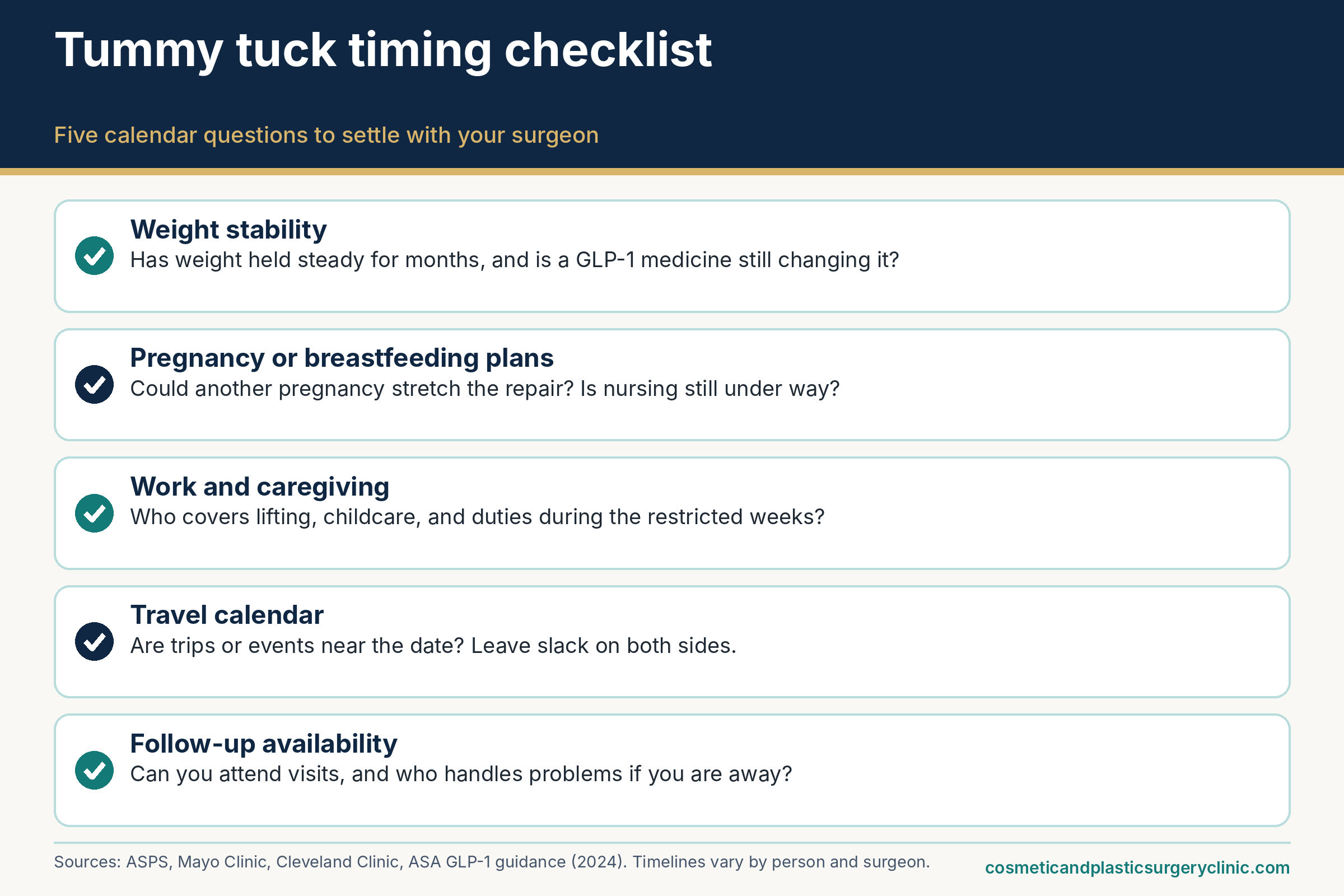
| A major event or trip is near | Swelling, scars, and restrictions last beyond a few weeks | Pick a date with slack on both sides | When flying, driving, and swimwear are realistic for your case |
Age and your calendar
Two more timing factors are less about the abdomen and more about the rest of your life: where you are in the age range, and whether the next few months can accommodate a real recovery.
Age: what the 2025 data show and what they do not
ASPS does not list an age limit on its candidate page. The 2025 statistics report gives a snapshot of who actually had the operation: an estimated 1,226 tummy tucks in people aged 18 to 25, 18,889 aged 26 to 35, 57,899 aged 36 to 45, 49,272 aged 46 to 55, 32,106 aged 56 to 65, and 13,858 aged 66 and older. The 36-to-45 group is the largest. Year over year, the 56-to-65 group grew 15% and the 66-and-older group 42%, while the 18-to-25, 26-to-35, and 36-to-45 groups declined by 24%, 7%, and 6%. By sex, the report estimates 167,445 procedures in women and 5,805 in men.
Those are national estimates built by extrapolating from member-surgeon data, a cosmetic-surgery insurance dataset, and a claims-based dataset. They describe who is having surgery, not who should. A rising count among people over 65 is not evidence that surgery is low-risk at that age, and a low count among younger adults is not evidence that it is unwise. What the data do tell you is that the operation is performed across a wide age range, and that, for most people, health and circumstances matter more than a birthday.
Where age does enter the risk picture, it is as one factor among several. In the large insurance-database analysis cited earlier, age 55 or older carried a relative risk of about 1.4 for complications, and male sex about 1.8. Those are group-level associations from 2008 to 2013 data, and they say nothing certain about any one person. Older adults commonly face more questions about heart and lung function, mobility during recovery, and support at home. Younger adults, in turn, may be asked more about future pregnancy plans and about weight that is still settling. The tummy tuck after 50 article goes deeper on the later-life questions.
Work, caregiving, travel and a recovery-planning calendar
Recovery is where an otherwise good candidate can run into trouble. Mayo Clinic says that most people return to work within two to four weeks depending on job demands, that lifting, straining, and strenuous activity are limited for about six weeks, and that an abdominal binder may be worn for a stretch of weeks. Cleveland Clinic adds that people typically need at least a week off work, that strenuous exercise is restricted for four to six weeks, and that scars keep improving for up to a year. ASPS describes dressings, an elastic wrap or compression garment, and possible temporary drains. These are ranges, not schedules. Your own timeline depends on the technique, whether other procedures are combined, and how your body heals. The tummy tuck recovery timeline lays out the stages in more detail.
Planning backward from those ranges is one of the more useful things a candidate can do. List what the next three months look like: deadlines, childcare, caring for a relative, trips, big family events, school terms. Then ask which weeks are truly movable. Also think about the first days at home. Who will drive you, stay overnight, help with meals, handle pets, and lift anything heavy? The CDC identifies limited movement as a clot risk factor, and surgeons generally encourage early walking, so the question is not only whether you can rest but also whether someone can help you move safely. The scenarios in Table 5 are illustrative only; they show how the same operation fits differently into different lives.
| Illustrative scenario | Main calendar pressure | Questions to settle before booking | Planning response to discuss |
|---|---|---|---|
| Desk job with remote option | Sitting and screen work may resume sooner, but fatigue and discomfort vary | Can meetings and deadlines flex in the first weeks? | A staged return with lighter days at first |
| Job that involves lifting or standing | Lifting limits may last longer than for desk work | Can duties change, or can leave be extended? | A longer leave or a modified-duty plan, in writing |
| Parent of a toddler | Carrying, bathing, and nighttime care all involve lifting | Who can take over lifting for the restricted weeks? | Overlapping help from family or paid care |
| Frequent traveler | Long trips mean prolonged sitting, and distance from the surgical team | When can you travel, and who handles problems while away? | Spacing the surgery away from trips; local follow-up |
| Caregiver for an adult relative | Transfers and lifting may be unavoidable | Who covers care during recovery? | A backup caregiver arranged before surgery |
Take the second row as an example. A person who works in a warehouse or lifts patients for a living may be told that returning to full duties requires considerably more time than someone who works from a laptop; that conversation is far easier before the date is set. And a parent of a young child might be a medically ideal candidate and still be a poor candidate for next month, because the helpers are not lined up. If a date on the calendar is driven by an event, such as a wedding, a vacation, or a milestone birthday, ask the surgeon whether the timeline leaves room on both sides. Swelling, the scar, and the restrictions do not fade on the day of the event.
Travel deserves its own thought. Many people consider combining a trip with surgery, whether to another city, another state, or another country. A June 2026 CDC release highlighted adverse outcomes linked to travel-related cosmetic procedures. It reviewed 2,162 CDC consultations from 2014 to 2024 and identified 21 reports involving about 145 patients with problems after procedures that included abdominoplasty, liposuction, breast augmentation, and gluteal augmentation; infections were reported in 20 consultations, and four involved patient deaths. The CDC cited lapses in infection control at some facilities. It is a case-based dataset rather than a measure of how often things go wrong, but it underlines a practical point: follow-up with the surgical team matters, and it is harder from far away. The article on combining tummy tuck with other procedures covers a related timing trade-off, and the tummy tuck consultation guide lists questions to ask about aftercare.
Red flags and reasons to postpone, reconsider or add a step
Not every red flag means “no.” Most of them mean “not yet,” “not this way,” or “not without one more step.” Sorting them into those three groups is more useful than a single pass-fail verdict, because it tells you what to do next. The groups below are an editorial framework for thinking about the conversation, not a clinical scoring system.
Medical and surgical red flags
Medical red flags tend to be the most concrete, because they connect to specific mechanisms: infection, healing, bleeding, clotting, and anesthesia.
Reasons surgeons commonly postpone
Think of three tiers. The first is fix first, then revisit. These are conditions that can improve with time or treatment: an active infection, a poorly controlled medical condition such as diabetes, anemia or poor nutrition found on testing, nicotine use within the cessation window, a skin infection in the abdominal folds, or a weight that is still moving. StatPearls names active infection, uncontrolled medical disease, and poorly controlled diabetes as absolute contraindications, and the ASPS 2024 nicotine reference describes the cessation window as part of preparing for surgery. The usual path is to resolve the issue, confirm it with testing or records, and reschedule.
The second tier is proceed only with extra planning. This covers situations where surgery may be reasonable but the risk or design changes: a higher BMI, prior abdominal operations that complicate the incision design, a history of blood clots, a need to continue a blood thinner, a heart or lung condition managed by a specialist, or an operation combined with other procedures. Mayo Clinic’s list of reasons to reconsider includes several of these, and the studies cited in the health section show higher complication rates for some of them in groups of patients. Extra planning can mean clearance letters, a hospital setting, a clot-prevention protocol, staged procedures, or a shorter operation.
The third tier is reconsider the operation or the approach. Examples include plans for substantial additional weight loss, a likely future pregnancy, a concern that sits in a layer the operation does not reach, expectations the surgeon cannot responsibly meet, or a goal that a smaller or different procedure would address more safely. ASPS lists substantial planned weight loss and future pregnancy among the reasons to postpone, and Cleveland Clinic and Mayo Clinic say much the same. Sometimes the best match is a different operation, such as liposuction alone for a person with firm skin and localized fat, or a panniculectomy for hanging skin that causes skin problems. The alternatives section below compares the options.
A few other items belong on the list. Mayo Clinic mentions the need to arrange transportation and help after surgery, and ASPS emphasizes questions about the recovery plan, which means that missing help at home is a legitimate reason to wait. Recent illness, an unexplained change in how you feel, or a recent hospitalization is also worth raising. In practice, the most frequent reasons are the least dramatic ones: weight still changing, nicotine, a pregnancy plan, or a calendar that cannot hold a recovery.
| Tier | Typical examples | What often happens next | Question to ask |
|---|---|---|---|
| Fix first, then revisit | Active infection, poorly controlled diabetes, nicotine within the window, weight still changing | Treat or stabilize, document it, reschedule | What would you need to see before you would operate? |
| Proceed with extra planning | Higher BMI, prior abdominal surgery, clot history, combined procedures, chronic conditions under care | Clearance, a different setting, staging, clot-prevention plan | How does my history change your plan and your risk estimate? |
| Reconsider the operation or approach | Large planned weight loss, likely future pregnancy, concerns in layers the operation does not reach | A different procedure, a different timeline, or no surgery | What would you recommend if I decide not to have surgery? |
Symptoms to get evaluated before you think about surgery
Some abdominal concerns belong in a medical evaluation first, not on a cosmetic wish list. A bulge near the navel or in an old incision may be a hernia. MedlinePlus describes umbilical and incisional hernias as common types and notes that treatment is usually surgery. A new or enlarging bulge, a bulge that hurts, or a feeling of pulling at a scar is worth having examined, and you should describe it to the surgeon rather than assume it is just loose skin.
Persistent symptoms after pregnancy are another category. Cleveland Clinic lists constipation, increased back pain, urinary incontinence, pain during intercourse, and pelvic and hip pain among complications associated with diastasis recti. Not all of those come from the muscle gap, and a tummy tuck is not designed to treat all of them. If you have such symptoms, mention them to your clinician, because pelvic-floor evaluation and physical therapy may be part of the picture and may change what you hope the operation will do.
Skin problems in the folds matter as well. Recurring rashes or infections under a hanging apron of skin may open a different conversation about a panniculectomy, which removes hanging skin without tightening the muscles; ASPS describes it that way. Health insurers sometimes consider that operation differently from a cosmetic tummy tuck, and the panniculectomy candidacy article goes into that.
Personal, financial and consultation red flags
Not every reason to wait is physical. Readiness, money, and the quality of the consultation are part of the candidacy picture, and they are the parts people most often skip.
Body image, mental health and motivation
Wanting a change in your abdomen does not mean anything is wrong with you. Many people who seek surgery are thoughtful and clear-eyed. But a small number are dealing with a condition that makes surgical results unreliable as a source of relief, and a good surgeon asks about it with care. Mayo Clinic defines body dysmorphic disorder as a mental health condition in which a person cannot stop thinking about perceived flaws in appearance that appear minor or invisible to others, often with repetitive checking, comparing, and avoiding. It notes that people with the condition often pursue cosmetic procedures and typically get only temporary satisfaction, with anxiety returning and attention shifting to another perceived flaw. StatPearls lists unrealistic expectations and body dysmorphic disorder among the psychological conditions that count against surgery.
The National Institute of Mental Health describes eating disorders as serious illnesses marked by severe disturbances in eating behavior, with a preoccupation with weight, body shape, or food, and says they can be treated successfully when detected early. If either of these describes you, or if thoughts about your appearance feel consuming, a mental health professional is a good place to start, and a conversation with your surgeon should include it. In a crisis, call or text 988, the Suicide and Crisis Lifeline that both pages mention. Raising these issues does not disqualify anyone forever. It changes the order of steps.
Motivation deserves a similar check. The ASPS advice to pursue surgery for yourself, and not to meet someone else’s wishes, has a practical side. People who feel pushed by a partner, a family member, or a social media feed often struggle with the recovery, which asks for patience and self-advocacy. Major life stress is another thing to weigh honestly: surgery during a divorce, a bereavement, or a job loss stacks recovery demands on top of other strain. That is not a rule, only a pattern worth recognizing. A decision made calmly, with time to change your mind, is easier to live with.
Money, pressure and consultation warning signs
Money is part of candidacy because it changes risk. ASPS notes that most health insurance plans do not cover a tummy tuck or its complications, and that the average surgeon fee it publishes does not include anesthesia, operating room facilities, or related expenses. If the budget has no room for a revision, a longer recovery, or unplanned time off, the plan is more fragile than the quoted price suggests. The cost guide covers the fee stack and financing questions in depth, so this page keeps to the candidacy angle: a plan that depends on everything going smoothly is a warning in itself.
The consultation also tells you something about whether you have found a good fit. Table 7 lists statements and behaviors worth noticing, why they matter, and what a better sign would look like. None of these proves a practice is unsafe, but a pattern of them is a reason to slow down, get a second opinion, and verify credentials before putting down a deposit.
| What you might hear or see | Why it matters | A better sign |
|---|---|---|
| “You’re definitely a candidate” before any examination | Candidacy depends on an examination and history | Time spent on your history, medications, and goals first |
| Pressure to pay a deposit today or a discount that expires | Elective surgery has no medical deadline | A written estimate and time to decide |
| Promises about results, scars, or recovery dates | Outcomes and healing vary person to person | Ranges, trade-offs, and discussion of limits |
| Little or no discussion of risks, revision, or costs if something goes wrong | Risks and possible revision are part of informed consent | A clear list of risks and a stated policy for complications |
| Skimming past weight, nicotine, or pregnancy plans | These factors strongly affect results and safety | Direct questions about each, and honest advice to wait if needed |
| Unwillingness to name the surgeon, facility, or anesthesia provider | You cannot verify what you cannot identify | Names given up front, with credentials you can check |
Risk context: how candidacy connects to complications
Candidacy and risk are two sides of one question. Everything in the previous sections matters because it changes the odds of something going wrong, the seriousness of the problem if it does, or the ease of fixing it. This section lays out the main numbers, explains what they can and cannot tell you, and shows how the choices of setting and combined procedures fit in. The tummy tuck risks and complications article covers each complication in more depth, including how it is treated.
What the numbers say, and what they cannot say
ASPS lists the risks of a tummy tuck as anesthesia risks, asymmetry, bleeding, deep vein thrombosis and cardiac or pulmonary complications, death of fatty tissue under the skin (fat necrosis), fluid accumulation (seroma), infection, numbness or other changes in skin sensation, persistent pain, poor wound healing, the possibility of revisional surgery, recurrent looseness of skin, skin discoloration or prolonged swelling, skin loss, a suboptimal aesthetic result, and unfavorable scarring. That is a long list, and it applies to everyone. What candidacy changes is how likely each item is for a particular person.
Complication data, risk factors and combined procedures
The largest dataset in the sources reviewed comes from a 2015 analysis in Plastic and Reconstructive Surgery of 25,478 abdominoplasties recorded between 2008 and 2013 in the CosmetAssure database, an insurance database for cosmetic surgery. The study reported an overall complication rate of 4.0% for abdominoplasty, compared with 1.4% for other aesthetic procedures in the same database. Hematomas (collections of blood), infections, and venous thromboembolism (blood clots) made up the largest shares of the complications. The rate climbed with the scope of the operation: 3.1% for abdominoplasty alone, 3.8% when combined with liposuction, 4.3% with a breast procedure, 4.6% with liposuction and a breast procedure, 6.8% with another body-contouring procedure, and 10.4% with both liposuction and another body-contouring procedure.
The study also identified factors linked to higher risk, expressed as relative risks: male sex (about 1.8), age 55 or older (1.4), BMI of 30 or more (1.3), multiple procedures at the same time (1.5), and surgery in a hospital or surgical center rather than an office-based facility (1.6). An ASPS summary of the study noted that smoking and diabetes did not show a significant association, and suggested a likely reason: board-certified plastic surgeons usually avoid operating on people with poorly controlled diabetes and typically require smoking cessation, so those patients were underrepresented in the data. In other words, the absence of a statistical signal is not evidence that nicotine or diabetes is harmless; it reflects screening that happened before the surgery.
A second source, the StatPearls clinical reference updated in March 2026, gives ranges rather than a single number: seroma from 5% to 43%, infection from 3% to 14%, hematoma from 3% to 7%, skin necrosis around 1.6%, deep vein thrombosis under 1%, and meralgia paresthetica (numbness or tingling in the outer thigh) around 1.4% to 1.9%, with an overall complication rate of 10% to 20% that can reach 30% to 50% after massive weight loss. A 2009 chart review of 139 patients reported minor complications in 28.8% and major complications in 11.5%. These figures look inconsistent until you notice how differently studies define a complication. A small fluid collection that resolves with a needle counts in some studies and not others; what counts as “major” differs from one dataset to the next. Table 8 lays out what each number represents.
| Source and year | Who was studied | What it reported | Main caveat |
|---|---|---|---|
| Plastic and Reconstructive Surgery, 2015 (CosmetAssure data, 2008 to 2013) | 25,478 abdominoplasties in an insured, cosmetic-surgery population | 4.0% overall; 3.1% alone; 10.4% with liposuction plus another body-contouring procedure | Insured population; the complication definition is the study’s own |
| StatPearls, updated March 2026 | Clinical reference summarizing published literature | Seroma 5% to 43%; infection 3% to 14%; hematoma 3% to 7%; overall 10% to 20% | Wide ranges reflect different definitions and populations |
| JPRAS, 2009 chart review | 139 patients | Minor 28.8%; major 11.5%; major higher at BMI above 30 (20.8% versus 9.7%) | Retrospective and small; single report |
| ASPS-reported 2019 comparison | 82 patients, one surgeon, retrospective | No statistically significant difference in complications by BMI group | Small; one surgeon’s technique and patient selection |
| Caprini validation, 2010 | 1,126 plastic and reconstructive surgery patients without clot prophylaxis | Higher scores predicted more blood clots | Mixed procedures, not only tummy tuck; practices have changed |
Two lessons follow. First, no number here is your number. Your surgeon may estimate your risk from your history, the plan, and their own outcomes, and you can ask for exactly that: “Given my health and the plan we have discussed, what problems do you think are most likely for me, and how do you handle them?” Second, the direction of the findings is consistent even when the exact figures are not. Doing more at once, carrying certain health risks, and some circumstances such as male sex or older age tend to be associated with more problems in groups of patients.
Blood clots, risk scores and why surgeons ask about your history
Venous thromboembolism is the complication surgeons talk about most when they review a history. The CDC defines it as blood clots in the veins, including deep vein thrombosis, a clot in a deep vein, and pulmonary embolism, which occurs when a clot travels to the lungs. It lists vein injury and limited movement as contributors, along with chronic illness, advanced age, family history, and higher estrogen levels, and it names surgery as a risk factor. About half of deep vein thrombosis cases have no symptoms, which is one reason surgeons plan prevention rather than rely on symptoms alone.
To organize that judgment, many surgeons use a scoring system called the Caprini model, which adds points for factors like age, surgery length, body weight, clot history, and hormone use. In a 2010 study of 1,126 plastic and reconstructive surgery patients who did not receive clot-preventing medicine, higher scores predicted more clots. Patients with scores above 8 faced disproportionately higher risk, and in the highest-risk group about one in nine had an event within 60 days when no preventive medicine was given. That study covered a mix of plastic and reconstructive procedures, not just tummy tucks, and it is more than a decade old, so it explains why risk scoring exists rather than predicting an individual’s risk. Clot-prevention practices vary: some surgeons rely on early walking and mechanical leg compression, some add blood-thinning medicine for higher-risk patients, and some weigh the bleeding trade-off differently. Ask your surgeon how they assess clot risk and what they plan for you.
Staging, setting and who is involved
Risk is not only about your body. It also depends on how much is done in one operation, where it happens, and who is in the room.
Tummy tuck alone or combined with other procedures
Combining a tummy tuck with other procedures is common, particularly in people who have had children, and the appeal is easy to see: one anesthetic, one recovery, one stretch of time off. The data in the large 2015 analysis show the trade-off. Complication rates rose as more was added, and the ASPS summary noted that some high-risk patients might do better with staged procedures than with one combined operation. That does not mean combination is wrong. It means the case for combining depends on your health, the length of the operation, and the surgeon’s judgment about how much to do at once.
A related question is liposuction at the same time. Many surgeons add it to refine the contour, and ASPS notes that liposuction can be combined with a tummy tuck when skin tightening is needed alongside fat removal. How that interacts with blood supply and fluid is a technique question the techniques guide examines. For candidacy, the practical lesson is that “tummy tuck” on a quote may describe a very different scope of work from one practice to the next, and the scope changes the risk. Ask what is being done, what is not, and why. People thinking about a combination after pregnancy often start with a broader plan; the mommy makeover articles in this series compare the choices.
Setting, anesthesia and surgeon training
The 2015 study found a relative risk of about 1.6 for hospital or surgical center settings compared with office-based facilities. That figure invites an easy and wrong conclusion that offices are safer. Different settings treat different patients, and sicker patients or more complex operations tend to go to hospitals, so the data cannot separate the effect of the setting from the effect of the patient. What does matter is that the facility is accredited, state-licensed, or Medicare-certified, that emergency equipment and staff are available, and that the anesthesia provider is qualified. ASPS states that its members must perform surgery in accredited, state-licensed, or Medicare-certified facilities, and an ASPS blog post on questions to ask before surgery advises asking whether the facility is accredited and whether the anesthesia provider is a physician or a certified registered nurse anesthetist.
Training matters too. ASPS says its members must be board-certified by the American Board of Plastic Surgery (or the Canadian equivalent), must complete at least six years of surgical training after medical school including a minimum of three years of plastic surgery residency, and must complete continuing medical education that includes patient safety each year. Those are society membership requirements, not a promise of any outcome, and board certification and membership are separate things. The last section explains how to verify each. For now, the point is that candidacy is a two-way match: a surgeon who is qualified, willing to say no or not yet, and honest about risk is part of what makes you a good candidate.
From candidacy to decision: alternatives, consultation preparation and verifying credentials
By this point you have a long list of factors and some sense of where you stand on each. The last step is turning that list into a decision process: comparing the tummy tuck against other paths, preparing for consultations so you get useful answers, and checking that the people giving those answers are who they say they are. None of that requires hurry.
Alternatives to consider before or instead of a tummy tuck
The best alternative depends on which layer is bothering you, which is why the earlier sorting exercise pays off here. A person whose concern is mostly muscle separation has different options from someone whose concern is localized fat or hanging skin.
Nonsurgical and minimally invasive options
The first group of alternatives involves no incisions. For separated abdominal muscles after pregnancy, Cleveland Clinic describes physical therapy and targeted exercises that engage the deep abdominal muscles as first-line care, and it advises avoiding movements that make the abdomen bulge outward during daily activity, such as crunches or planks. It adds that supportive belly bands can be comforting but cannot heal the separation themselves. Because the right exercises depend on your situation, this is a question for a physical therapist or clinician who has examined you, not something to start from an article.
Weight management is the second nonsurgical path, and it deserves a respectful mention. ASPS is explicit that a tummy tuck is not a substitute for weight loss or exercise, and for some people steady changes in habits, with medical support where appropriate, change the picture enough that the surgical question looks different or can wait. It is not a requirement, and it does not work for everyone, but it is a legitimate part of the conversation.
The third path is device-based body contouring. The FDA lists several non-invasive technologies that it has authorized to reduce the appearance of fat bulges or cellulite or to improve muscle tone: cryolipolysis (fat freezing), radiofrequency, light-based energy, ultrasound, low-level light, magnetic field stimulation, and mechanical massage. The agency’s page, dated October 15, 2025, states plainly that non-invasive body contouring does not treat obesity or improve health and will not cause weight loss, and it notes that these procedures do not remove excess skin. That last point matters for tummy tuck candidacy, because loose skin is often the main reason people look at surgery. The FDA also describes serious adverse events including paradoxical adipose hyperplasia, in which fatty tissue grows instead of shrinking, typically appearing months after treatment and sometimes needing surgery, as well as hernia formation in treated areas, freeze burns, nerve damage, and permanent skin changes. Weigh a modest improvement against those possibilities, and ask who will be performing the treatment and what training they have.
Liposuction, panniculectomy and other surgical alternatives
Liposuction removes fat from specific areas through small incisions. ASPS says it works best in people at a normal weight with firm, elastic skin and localized fat deposits, that it is not a treatment for obesity, and that people with excess loose skin may need more surgery to remove and tighten it. That makes liposuction a plausible alternative for a person whose concern is mostly pockets of fat over good skin, and a poor match for a person whose concern is an apron of loose skin or separated muscles. The two are also combined: ASPS notes liposuction can be done with a tummy tuck when skin tightening is needed alongside fat removal.
A panniculectomy removes hanging skin and fat from the lower abdomen. ASPS notes that it typically does not tighten abdominal muscles, the way a tummy tuck does. It is sometimes considered when the apron causes rashes, infections, or hygiene problems, and the same 2006 ASPS insurance document that defines the tummy tuck as cosmetic describes the panniculectomy as potentially reconstructive when it addresses a functional problem. Coverage depends on the plan and the documentation, so the answer is a call to your insurer. The panniculectomy candidacy article covers this in detail.
Operations that go beyond the abdomen are the other end of the spectrum. When excess skin wraps around the waist, flanks, or back, surgeons discuss extended abdominoplasty or lower body lift designs that put the scar around the trunk. Those operations are larger, and the recovery is more involved. A hernia repair alone is also an option for a person whose main issue is a hernia, and some people choose to do nothing at all after learning what the operation involves. That last choice is as legitimate as any other. Table 9 compares the main paths.
| Option | Best matched to | Does not address | Key trade-off |
|---|---|---|---|
| Physical therapy and targeted exercise | Muscle separation after pregnancy, core weakness | Excess skin; large fat deposits | Takes time and consistency; results vary |
| Non-invasive device treatments | Small, localized fat bulges in people who want no incisions | Loose skin; weight loss; muscle separation | Modest change; rare but serious FDA-listed adverse events |
| Liposuction alone | Localized fat over firm, elastic skin | Loose skin; separated muscles | Skin may not retract; may lead to a later skin-removal operation |
| Panniculectomy | A hanging apron of skin and fat, often after major weight loss | Muscle tightening; upper abdomen contour | Scar is long; insurance coverage depends on documentation |
| Tummy tuck (abdominoplasty) | Loose lower abdominal skin, with or without separated muscles | Deep abdominal fat; weight loss; skin elsewhere on the body | Long scar, recovery restrictions, and surgical risks |
| Extended or circumferential operations | Excess skin that wraps around the waist or back | Excess skin on arms, thighs, or breasts | Larger operation, longer recovery, scar around the trunk |
| Waiting or doing nothing | Uncertain timing, unresolved health factors, or mixed feelings | The original concern | The concern remains; the option stays open |
Preparing for a consultation and deciding without pressure
A consultation is not a commitment, and treating it as an information-gathering step is one of the best protections against a rushed decision. Two or three consultations with different board-certified plastic surgeons give you something to compare, and it is common for the advice to differ.
A decision-readiness checklist and the questions to bring
Before you book, a short readiness check can clarify whether this is the time for a consultation about surgery or for a conversation about preparation. Consider these questions as a self-check, not a test.
- Can I describe, in specific terms, what I want to change and which layer (skin, fat, muscle) I think is responsible?
- Is my weight steady, and do I know whether any medication I take could change it?
- Am I free of nicotine, or do I have a plan for being free of it for the weeks before and after surgery?
- Do I know whether I may have more children, and have I thought about how a future pregnancy would affect the result?
- Do I have a list of all my medications, supplements, and past operations to bring along?
- Can I realistically arrange time off, help at home, and follow-up visits?
- Am I considering this for myself, and would I still want it if nobody could see the result?
- Do I know what I would do if the surgeon recommends waiting?
For the visit itself, ASPS suggests discussing, among other topics, where you will be taken after surgery, what medication you will be given or prescribed, when dressings and sutures come off, bathing and showering rules, how long you will wear a pressure garment, when you can resume normal activity and exercise, and the follow-up schedule. A 2017 ASPS blog post by Rod Rohrich, MD, adds a set of ten questions: whether the surgeon is certified by the American Board of Plastic Surgery, whether they hold hospital privileges, whether the facility is accredited, how often they perform your specific procedure, whether they can show before-and-after photos of their own patients, what the risks and benefits are, who the anesthesia provider is, what recovery looks like, whether you should seek a second opinion, and whether they can connect you with past patients. The tummy tuck consultation guide expands on the visit itself.
Add candidacy-specific questions of your own. Ask what in your history changes the plan or the risk, what the surgeon would want to see before operating (stable weight, nicotine-free time, a clearance letter), what technique they would recommend and why, what they would do if a hernia or other surprise turned up during surgery, how they handle drains, clot prevention, and follow-up, and what happens if you need a revision. A surgeon who explains reasoning, shows comfort with the word “no,” and puts the risks on the table is giving you information that a polished brochure never will.
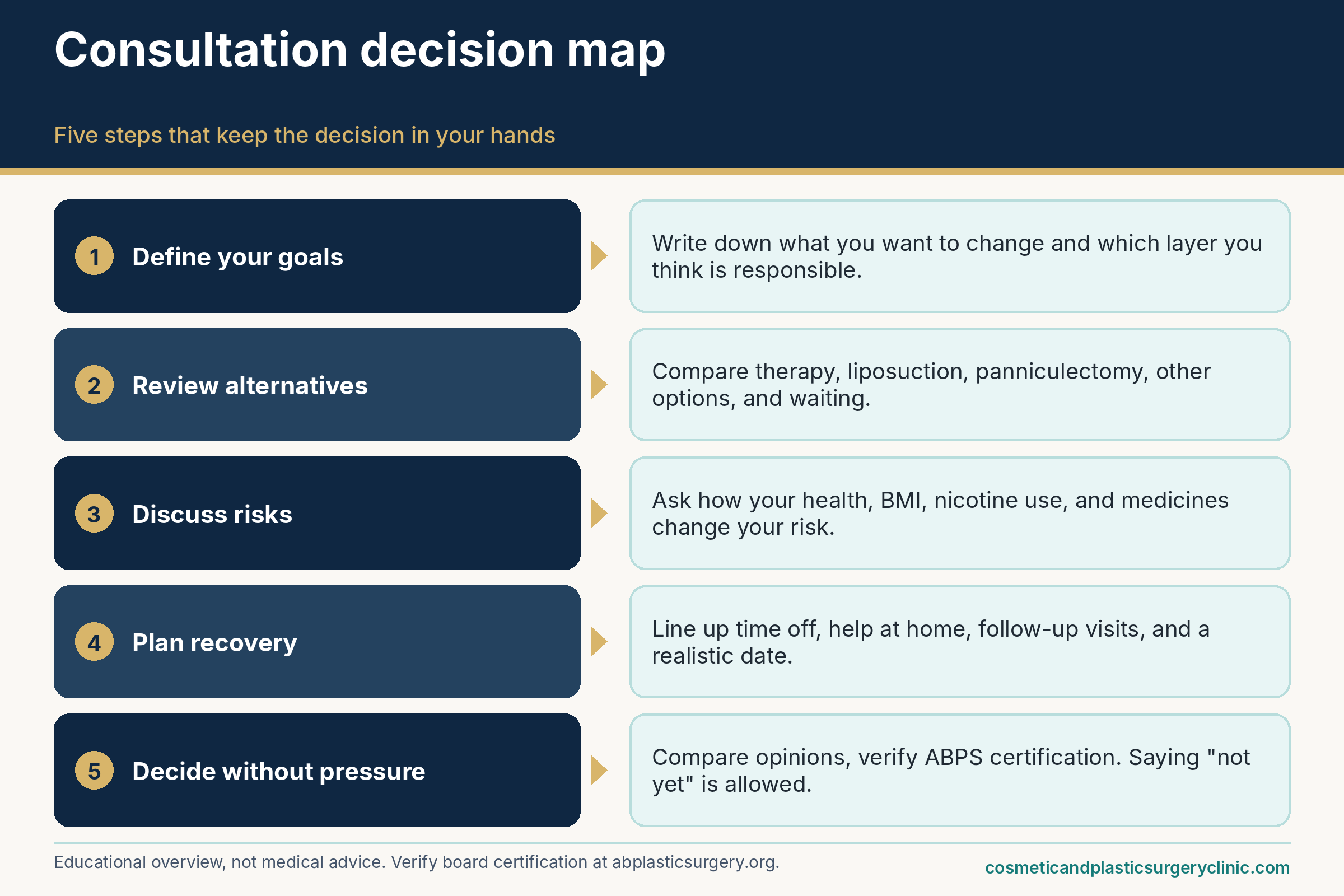
Verifying credentials and taking the next step
Board certification and state licensure are different things, and so is membership in a professional society. The American Board of Plastic Surgery (ABPS) runs a public verification tool that lets you search by name or by location, and the board describes its certification as voluntary and as reflecting completed training and passing comprehensive written and oral examinations. Use the ABPS search to confirm that a surgeon is certified before you book, and check the current status rather than relying on a website’s claim. ASPS membership adds its own requirements, including ABPS certification, at least six years of surgical training after medical school with a minimum of three in plastic surgery residency, surgery in accredited, state-licensed, or Medicare-certified facilities, and annual continuing education. The checklist for verifying ABPS board certification walks through the steps.
Then check the setting. Ask for the name of the facility and the anesthesia provider, and look up the facility’s accreditation. Quad A accredits ambulatory surgery centers and office-based surgical facilities and references a directory of accredited facilities on its site, and AAAHC likewise accredits ambulatory surgery centers and office-based surgery centers and provides a tool to find accredited organizations. Your state medical board can confirm that a physician’s license is active and whether disciplinary action has been taken. If anything on the consultation checklist does not line up, treat that as information.
Nothing about elective surgery requires speed. Give yourself time between the consultation and the commitment. Compare at least two opinions. Write down the trade-offs you are accepting. And if the answer for now is “not yet,” that is a complete outcome, not a failure. Some people come back months later with a steadier weight, a settled family plan, a nicotine-free record, and a recovery plan that works.
Questions people ask about tummy tuck candidacy
Can I have a tummy tuck while I’m still breastfeeding?
Breastfeeding on its own is not necessarily a barrier from the anesthesia standpoint. The Academy of Breastfeeding Medicine’s 2017 protocol says mothers of healthy term or older infants can usually resume nursing once they are awake, stable, and alert, and milk generally does not need to be discarded. The same protocol urges caution with opioid pain medicine, which can make an infant sleepy. Beyond anesthesia, many surgeons prefer to wait because of lifting limits, sleep disruption, and weight still shifting. Practices differ, so ask your surgeon and your child’s pediatrician how they would handle medications, lifting, and feeding in your specific situation.
How long after having a baby should I wait?
The sources reviewed for this article do not give a single number of months, and surgeons vary. What they do describe is a sequence: give the abdominal wall time to settle, try physical therapy where it fits, and decide on surgery once weight is steady and the family is complete. Cleveland Clinic notes that about 45% of women still have muscle separation six months after delivery, which is one reason a short wait may change the picture. If another pregnancy is possible, ASPS suggests postponing, because additional stretching can affect the result.
Can I have a tummy tuck if my BMI is over 30?
Sometimes, but it is a conversation, not a formula. Mayo Clinic lists a BMI of 30 or higher among reasons to reconsider, and several studies associate higher BMI with more complications. A small 2019 single-surgeon comparison reported by ASPS found no statistically significant difference in complications and concluded that BMI alone should not be a strict barrier. Practices set their own policies, and some advise losing weight first. If one surgeon declines, ask for the specific reasons, since they may involve skin, fluid, or anesthesia concerns beyond the number itself. Getting a second opinion is reasonable.
Do I need to stop my GLP-1 medicine before surgery?
Do not stop or change it on your own. A multisociety guidance statement released in October 2024 said most patients should continue GLP-1 medicines before elective surgery, with an individualized risk assessment by the care team. It advised deferring elective procedures during the early escalation phase or when nausea, vomiting, abdominal pain, or constipation are active, and described added precautions for higher-risk patients, such as a liquid diet for 24 hours. The surgeon, anesthesiologist, and prescriber should decide together, using your dose, your symptoms, and your timing.
Does vaping or using nicotine gum count as nicotine?
Yes. ASPS guidance treats e-cigarettes, patches, chewing tobacco, and lozenges as nicotine sources alongside cigarettes, because nicotine itself narrows blood vessels. A 2016 ASPS blog post makes the same point about gum, snuff, pipes, cigars, and vaping. Windows for stopping differ across sources, from roughly three to eight weeks before surgery and several weeks after, so use your surgeon’s instruction. Some surgeons test urine for cotinine. If you slip, tell the team right away, because postponing is usually safer than operating on tissue that has recently been exposed.
Is a tummy tuck the same as a mini tummy tuck or liposuction?
No. A tummy tuck removes excess skin and fat and, in most cases, tightens separated muscles. A mini version is a more limited skin-removal design, and the techniques guide in this series explains how the variations differ. Liposuction removes fat through small incisions and does not remove loose skin, which is why ASPS says it works best on firm, elastic skin. People often hear these terms used interchangeably, so ask each surgeon to describe exactly what would be done to the skin, the fat, and the muscle in your case.
Can physical therapy fix muscle separation instead of surgery?
For some people it improves function and the appearance of the midline, and it is commonly tried first. Cleveland Clinic describes physical therapy and targeted exercises for diastasis recti, while noting that surgery is considered when an umbilical hernia is present or when someone wants cosmetic correction through abdominoplasty. How much a gap narrows varies. A physical therapist or physician who has examined you can tell you what to expect and which movements to avoid, which is more reliable than general internet routines.
Will insurance pay for a tummy tuck?
Usually not for a cosmetic tummy tuck. ASPS states that most health insurance plans do not cover it or its complications. A panniculectomy, which removes hanging skin without tightening muscles, may be treated differently when a functional problem such as recurring skin infections is documented, but approval depends on the plan and its criteria. Ask your insurer for its written policy before assuming anything, and ask the surgeon’s office what it bills and what it expects you to cover if complications occur.
What if I’ve had a C-section or other abdominal surgery?
Many people considering a tummy tuck have had at least one cesarean delivery, and it does not automatically rule the operation out. ASPS says earlier scars may be incorporated into the new incision, although previous abdominal surgery may limit results. StatPearls adds that some upper-abdominal incisions can affect blood flow to the skin flap. List every operation you have had, including hernia repairs with mesh, and bring operative reports if you have them, so the surgeon can plan the incision and discuss risks.
Is there an age cutoff for a tummy tuck?
ASPS does not set an age limit on its candidate page. Its 2025 statistics estimate that the procedure was performed in every age group from 18 to 25 up through 66 and older, with the largest group aged 36 to 45. Age enters the risk picture as one factor among several: a large 2015 analysis linked age 55 or older to somewhat higher complication risk in groups of patients. Health, medications, and recovery support usually matter more for an individual than age alone.
Is it safe to travel for a tummy tuck?
Travel adds risk that is separate from the operation. A June 2026 CDC release described adverse outcomes, including serious infections, among people who traveled for cosmetic procedures such as abdominoplasty, and noted lapses in infection control at some facilities. Even within the United States, long trips soon after surgery mean prolonged sitting and a long distance from your surgical team if something goes wrong. If travel is unavoidable, ask the surgeon who will provide follow-up near you, and plan extra days before the return trip.
How do I know whether I’m emotionally ready?
A few signs of readiness are practical: you can name what you want to change, you accept the scar and recovery as trade-offs, and you would still choose surgery if nobody saw the result. If thoughts about your appearance feel consuming, or if you notice that they take hours of your day, Mayo Clinic notes that body dysmorphic disorder is a treatable condition, and a mental health professional can help you sort out the next step. Tell your surgeon about any history of eating disorders or related concerns. Readiness is not a test you pass once; it can change over months.
Sources and further reading
- American Society of Plastic Surgeons — Tummy Tuck Candidates (undated; accessed 2026-10-04) — four basic criteria and the “for yourself” principle
- ASPS — Tummy Tuck overview (undated; accessed 2026-10-04) — what the operation does and does not do; postponing for weight loss or pregnancy
- ASPS — Tummy Tuck Procedure (accessed 2026-10-04) — anesthesia, incisions, muscle repair, navel
- ASPS — Tummy Tuck Safety (accessed 2026-10-04) — list of risks and informed consent
- ASPS — Tummy Tuck Results (accessed 2026-10-04) — scars, prior abdominal surgery, possible further surgery
- ASPS — Tummy Tuck Recovery (accessed 2026-10-04) — dressings, garments, drains, questions to ask
- ASPS — Tummy Tuck Cost (statistics year not stated; accessed 2026-10-04) — insurance generally does not cover tummy tuck or its complications; fee exclusions
- ASPS — 2025 Plastic Surgery Statistics Report (accessed 2026-10-04) — procedure counts, age and sex breakdown, GLP-1 survey, methodology
- ASPS — Managing the risks of smoking/nicotine in plastic surgery (October 9, 2024; accessed 2026-10-04) — cessation windows, products, cotinine testing
- ASPS blog — How Nicotine Sabotages Plastic Surgery (December 12, 2016; accessed 2026-10-04) — nicotine products and timing from a surgeon author
- ASPS blog — Ten Things to Ask Before Having Plastic Surgery (August 15, 2017; accessed 2026-10-04) — consultation questions
- ASPS — Member qualifications (accessed 2026-10-04) — board certification, training, facility and CME requirements for members
- ASPS — Liposuction (accessed 2026-10-04) — candidates, skin elasticity, limits
- ASPS — Panniculectomy (accessed 2026-10-04) — difference from tummy tuck
- ASPS — Abdominoplasty and Panniculectomy insurance criteria (approved July 2006; older document; accessed 2026-10-04) — definitions; diastasis repair versus hernia repair
- ASPS press release — Tummy Tuck Complications Study Looks at Rates and Risk Factors (October 28, 2015; accessed 2026-10-04) — summary of the 2015 study and its caveats
- Winocour et al., Plastic and Reconstructive Surgery, November 2015 — Abdominoplasty: Risk Factors, Complication Rates, and Safety of Combined Procedures (PubMed abstract; accessed 2026-10-04) — 25,478 cases, complication rates, relative risks
- ASPS press release — No increase in complications with tummy tuck in obese patients (March 2019; accessed 2026-10-04) — 82-patient single-surgeon comparison
- Momeni et al., Journal of Plastic, Reconstructive and Aesthetic Surgery, 2009 — Complications in abdominoplasty: a risk factor analysis (publication listing; accessed 2026-10-04) — 139-patient chart review
- Mayo Clinic — Tummy tuck (updated January 17, 2025; accessed 2026-10-04) — reasons to reconsider, preparation, recovery ranges
- Cleveland Clinic — Abdominoplasty (updated January 30, 2024; accessed 2026-10-04) — candidate criteria, who should wait
- Cleveland Clinic — Diastasis Recti (updated April 21, 2025; accessed 2026-10-04) — prevalence, natural course, physical therapy, surgery
- Cleveland Clinic — Strangulated Hernia (updated March 24, 2025; accessed 2026-10-04) — emergency signs
- StatPearls — Abdominoplasty (updated March 3, 2026; accessed 2026-10-04) — contraindications, complication ranges
- MedlinePlus — Hernia (accessed 2026-10-04) — types and general treatment
- CDC — Adult BMI Categories (March 19, 2024; accessed 2026-10-04) — categories and screening-tool note
- CDC — About Venous Thromboembolism (March 5, 2025; accessed 2026-10-04) — risk factors and symptoms
- CDC — Adverse outcomes linked to travel-related cosmetic procedures (June 2, 2026; accessed 2026-10-04) — medical-travel findings
- American Society of Anesthesiologists — Multisociety GLP-1 guidance (October 29, 2024; accessed 2026-10-04) — perioperative GLP-1 management
- American Society of Anesthesiologists — Herbal and dietary supplements and anesthesia (patient brochure, 2015; accessed 2026-10-04) — supplements and bleeding
- Academy of Breastfeeding Medicine — Protocol #15: Analgesia and Anesthesia for the Breastfeeding Mother (2017; hosted copy; accessed 2026-10-04) — breastfeeding after anesthesia
- Newswise — Northwestern study of rectus muscle changes in pregnancy (Plastic and Reconstructive Surgery, August 2019; accessed 2026-10-04) — CT-based measurements
- JPRAS Open, December 2020 — Pregnancy after abdominoplasty with mesh placement: a case report (DOAJ record; accessed 2026-10-04) — single-case report
- University of Illinois Chicago Drug Information Group — Weight loss after GLP-1 discontinuation (May 2023; secondary summary; accessed 2026-10-04) — summary of a trial extension
- ScienceDaily — Caprini risk assessment study summary (Journal of the American College of Surgeons, November 2010; accessed 2026-10-04) — secondary report of Pannucci et al.
- U.S. Food and Drug Administration — Non-invasive body contouring technologies (October 15, 2025; accessed 2026-10-04) — what devices do and the adverse events described
- Mayo Clinic — Body dysmorphic disorder (December 13, 2022; accessed 2026-10-04) — definition and relation to cosmetic procedures
- National Institute of Mental Health — Eating Disorders (reviewed December 2024; accessed 2026-10-04) — overview and help resources
- American Board of Plastic Surgery — Verify Certification (accessed 2026-10-04) — public search by name or location
- Quad A — About Us (accessed 2026-10-04) — accreditation of ambulatory surgery centers and office-based facilities
- AAAHC — Accreditation (accessed 2026-10-04) — accreditation of ambulatory and office-based surgery centers