

Anyone who searches for breast lift cost quickly notices that the answers don’t line up. One page shows a single national average, another shows a range, a practice website says “starting at” a figure, and a consultation produces a quote that doesn’t resemble any of them. That’s not necessarily a sign that someone is hiding the ball. A breast lift (the surgical term is mastopexy) is priced in layers, and the operation itself can be anything from a modest adjustment around the areola to a full reshaping of the breast, sometimes paired with implants. Each practice decides which layers to show you first.
This guide is written for the cost-conscious researcher who wants to understand those layers before sitting down in a consultation. It explains what a published national figure does and doesn’t include, why two quotes for “a breast lift” can describe different operations, how the surgical setting and the anesthesia arrangement change the bill, what insurance, tax rules and financing look like in practice, and how to line quotes up so the comparison is fair. It does not tell you what your own surgery will cost, because nobody can do that without examining you, and it deliberately avoids inventing regional averages that no reliable source publishes.
If you’re still deciding whether the operation fits your goals, start with the broader breast lift guide, which covers what the surgery changes, who it may suit and what recovery involves. If you’re mainly trying to judge a surgeon’s gallery, see the separate article on breast lift before and after photos. Here the question is narrower: what will you be asked to pay, to whom, and when?
A note on numbers: this article uses dollar figures only where a published source gives a year and a population. National averages are context, never a local quote and never an offer. Where a figure could not be verified, the text describes the issue in words and flags it for editorial follow-up rather than guessing.
One more framing point. Cost is a legitimate part of a surgical decision, and wanting to understand it carefully isn’t shallow. It’s also true that price is the easiest variable to compare and the hardest to compare fairly, because a cheaper-looking quote may leave out the item that a pricier quote includes. The sections below aim to make the comparison honest rather than to steer you toward the highest or the lowest number. Breast lift is also a common operation: ASPS counted 156,131 breast lifts in its 2025 statistics report, up 8% from 144,003 in 2024. That volume means most practices have a pricing routine, and it means you can ask direct questions and expect direct answers.
What a Breast Lift Quote Is Actually Pricing
A breast lift quote is a bundle of separate charges that happen to arrive on one sheet of paper, or sometimes on several. Before comparing totals, it helps to know which bundles exist, who sends the bill for each, and which national statistics describe which layer. Most confusion about breast lift cost comes from mixing those layers together: reading a surgeon’s-fee statistic as if it were a total, or comparing a surgeon-only quote with an all-inclusive package.
The Fee Stack, Layer by Layer
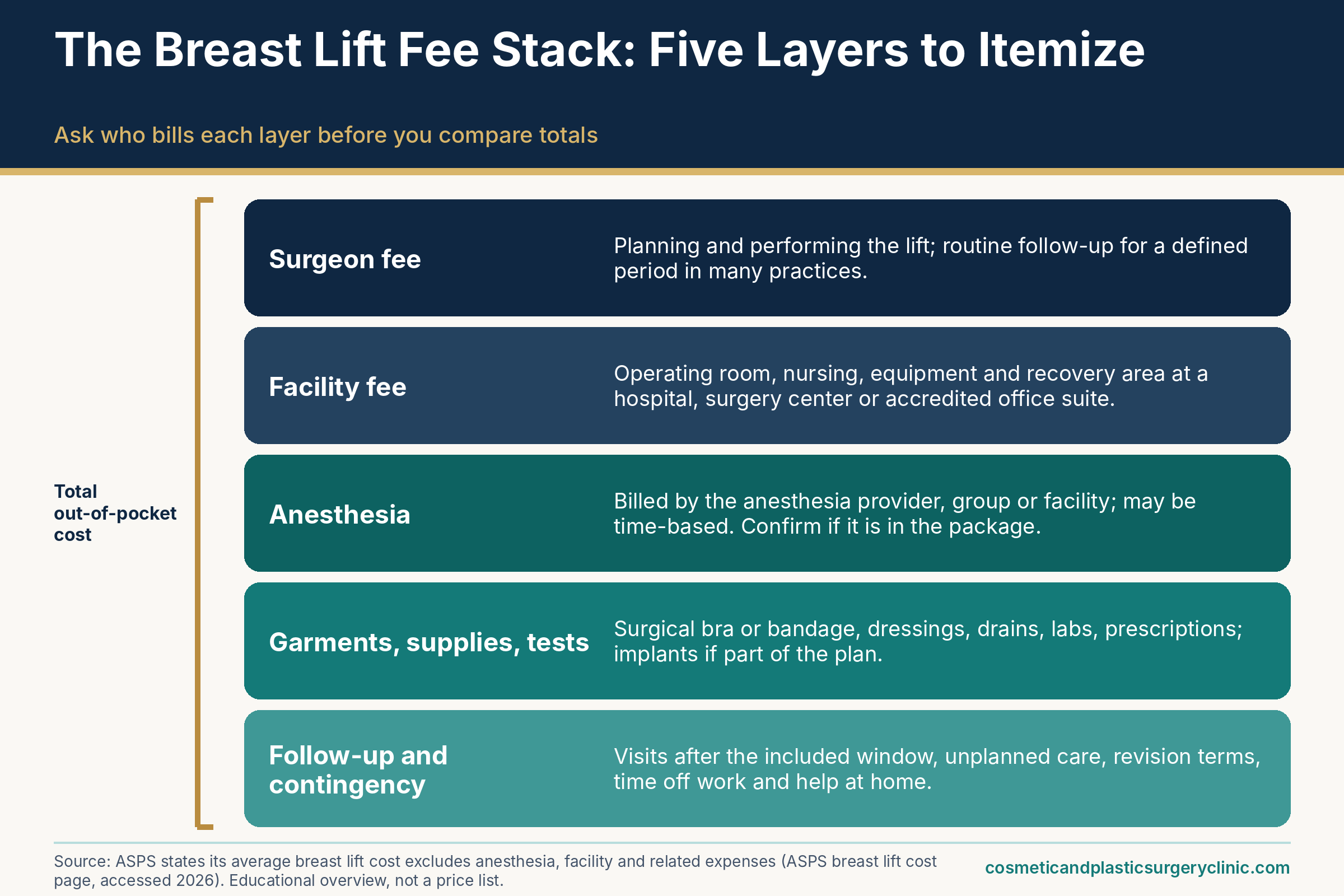
Think of the total as five layers stacked on top of one another. The first is the one most people hear about; the others are the ones that surprise people.
The surgeon’s fee and the national figures that exist
The surgeon’s fee pays for the surgeon’s planning, the operation itself and, in many practices, routine follow-up visits for a defined period. Two ASPS sources give national context, and they’re easy to confuse.
The first is the ASPS breast lift cost page, which states that the average cost of a breast lift is $6,816. That page doesn’t give a statistics year, so the figure can’t be tied to a specific period, and it says explicitly that the average does not include anesthesia, operating room facilities or other related expenses. The second is the ASPS 2024 average surgeon and physician fee document, which reports a breast lift (mastopexy) range of $6,500 to $11,000. ASPS describes those figures as a projected range, not a single price, built from averages submitted by surveyed ASPS member surgeons to reflect different geographic locations and practice settings. The document covers surgeon and physician fees only.
So the verified national picture is narrow. It comes from one professional society, it reflects the fees of its member surgeons, it measures the surgeon’s fee, and the newest dated figure is for 2024. An ASPS fee document for 2025 could not be located during research for this article, so nothing here claims a 2025 number. The $6,816 average does sit inside the 2024 range, but because it’s undated, it would be a mistake to treat the two as a matched pair.
For context on how a lift compares with its neighbors, the same 2024 ASPS document lists a surgeon’s fee range of $4,575 to $8,000 for breast augmentation with implant placement, $5,500 to $9,500 for augmentation with fat grafting only, and $7,000 to $12,500 for aesthetic breast reduction. Those figures are useful for one thing: they show that a lift is priced in the same general neighborhood as other breast operations, and that combining operations changes the fee. They’re not a basis for estimating what a combined operation will cost at any particular practice.
Facility, anesthesia, and the supply lines
ASPS lists the expenses that sit outside its average: anesthesia fees, hospital or surgical facility costs, medical tests, post-surgery garments and prescriptions for medication. In another ASPS article on budgeting, published in April 2026, the society adds the indirect costs that rarely appear on a quote, such as time off work, childcare, meal preparation and pet care, and it advises patients to ask whether the quote covers all surgical costs and whether unexpected fees apply if the procedure runs longer than planned.
The facility fee pays for the operating room, the nursing staff, the equipment and the recovery area. At a hospital or an independent surgery center it’s usually billed by that facility. In an office-based surgical suite it may be folded into the practice’s own price or listed as a separate line. The anesthesia fee pays the anesthesia professional, and it’s often tied to time. As an illustration of how time-based billing works in at least one major payer, Medicare’s anesthesia payment rule counts base units plus time units, with each time unit equal to 15 minutes of anesthesia time. That regulation applies to Medicare payments and not to cosmetic surgery quotes, but it shows why a longer operation can raise an anesthesia charge even when the surgeon’s fee stays fixed.
Facility charges also track time. A 2018 JAMA Surgery analysis of California hospital operating rooms, as summarized by the American Journal of Managed Care, put the cost of operating room time in the mid-$30s per minute, combining direct costs and staff wages and benefits. That figure describes what hospitals spend, not what they charge, and it comes from one state’s hospitals, so it can’t be turned into a price for your lift. What it supports is a general principle: the clock matters, and operations that run longer cost the facility more to host.
The remaining layers are smaller but real. Devices, garments and supplies include the surgical bra or elastic bandage that ASPS says patients wear to limit swelling and support the breasts, any drains (ASPS notes a small, thin tube may be placed temporarily to drain blood or fluid), dressings, and prescriptions. Follow-up and contingency covers visits beyond the window the practice includes, unplanned care, scar-care products if they aren’t bundled, and the revision policy. ASPS lists “possibility of revisional surgery” among the recognized risks of a lift, which is why that last layer deserves attention before you pay a deposit.
| Layer | What it usually pays for | Who typically bills | Verified national context |
|---|---|---|---|
| Surgeon’s fee | Planning, the operation, defined follow-up period | Surgeon or practice | ASPS 2024 range $6,500 to $11,000 (member survey); ASPS cost page average $6,816, undated |
| Facility fee | Operating room, nursing, equipment, recovery area | Hospital, surgery center, or practice-owned suite | No national breast lift figure found in the sources reviewed |
| Anesthesia | Anesthesia professional and monitoring; often time-based | Anesthesia group, facility, or practice package | No national figure found; Medicare uses base plus 15-minute time units (Medicare only) |
| Garments, supplies, tests, prescriptions | Surgical bra or bandage, dressings, drains, labs, medications | Practice, pharmacy, laboratory | Named by ASPS as separate from its average; no dollar figure found |
| Follow-up and contingency | Visits past the included window, unplanned care, revision policy | Practice and facility | ASPS lists possible revisional surgery as a risk; costs depend on written policy |
Reading National Breast Lift Cost Figures Without Being Misled
A national figure is a navigation aid, not a destination. Used well, it tells you whether a quote is wildly out of range and which questions to ask. Used badly, it anchors you to a number that doesn’t describe your operation, your market or your practice’s way of quoting.
Where the numbers come from and what they leave out
The ASPS 2024 fee document is based on averages that surveyed member surgeons submitted, then aggregated into a projected range. That has three consequences worth keeping in mind. First, it represents surgeons who belong to ASPS, and ASPS membership requires American Board of Plastic Surgery certification (or the Canadian equivalent), at least six years of surgical training including at least three of plastic surgery residency, and surgery in accredited, state-licensed or Medicare-certified facilities. Practices outside that group may price differently, higher or lower. Second, a survey of averages smooths out the extremes, so an entirely legitimate local quote can fall outside the published range without implying anything is wrong. Third, nothing in the document says which services a given surgeon’s average included, and ASPS states that the figures are for surgeon and physician fees alone.
The ASPS statistics report for 2025 doesn’t include fee data. It does say its procedure counts draw on member surgeons, an ASPS-endorsed partner and a national claims-based dataset, collectively representing more than 3,000 board-certified plastic surgeons. That’s helpful for knowing how common breast lift is; it isn’t a price source.
It also helps to know what hasn’t been published. During research for this article, no authoritative national figure for the facility fee or anesthesia fee specific to breast lift turned up. Several consumer websites publish “all-in” averages, but their methods are rarely explained, and a number without a described method isn’t something this guide will repeat. If a source can’t tell you the year, the population and what the figure includes, treat it as marketing until proven otherwise.
Why a quote can land above or below the range
When a quote and a published range disagree, the cause is usually one of a handful of things. The first is bundling. A package that includes the facility, anesthesia, garments and the first months of follow-up will look much higher than a surgeon’s-fee-only range, even if the surgeon’s share of it falls squarely inside that range. The reverse also happens: a quote that looks low may be the surgeon’s fee alone, with the other layers to be billed later by other parties.
The second cause is scope. A lift around the areola only, a vertical-pattern lift, a full anchor-pattern lift, a lift combined with implants, and a lift combined with a reduction are different plans. The next section covers that in detail. The third is the setting and the anesthesia arrangement, covered in the section after it. The fourth is geography and the surgeon’s experience and demand. ASPS notes that a surgeon’s fee varies with experience, the type of procedure and geographic location, and in a December 2023 article it observes that major metropolitan areas tend to charge more than rural towns and that high-demand surgeons can command premium fees.
A fifth cause is simply that prices are hard to see. A 2024 survey study in Plastic and Reconstructive Surgery Global Open found that most surveyed providers don’t share the costs of their services online. In that same study, patients who had used online price estimators reported being satisfied with estimates they received before a consultation and said final charges aligned closely with them. The takeaway isn’t that estimates are always accurate; it’s that asking for one, in writing and before you commit, is a reasonable and fairly ordinary request.
Finally, remember that a gap is a reason to ask a question, not a verdict on quality. A higher fee can reflect training, demand, a more elaborate plan, a better-staffed facility or simply a higher-cost market. A lower fee can reflect a simpler operation, an efficient practice or a different set of inclusions. It can also reflect corners you can’t see. The only way to tell is to put the quotes on equal footing, which is the subject of the final section.
Scope: Why Two “Breast Lift” Quotes Can Describe Different Operations
The biggest reason breast lift quotes diverge is that “breast lift” is a family name, not a specification. Two surgeons can both write “mastopexy” at the top of a quote and plan operations that differ in where the incisions run, how much skin is removed, whether the nipple and areola are moved, whether an implant or fat is added, and whether anything else happens on the same day. Operating time, anesthesia time and supply use all move with those choices, and so does the price.
Which version suits a particular person is a clinical judgment made after an examination. This section explains the vocabulary so you can read a quote and tell which operation it describes. For the surgical detail behind each approach, see the dedicated article on breast lift techniques.
Technique, Nipple Work and Adjuncts
Start with the pattern of the incisions, then add the extras that attach to it.
Periareolar, vertical and inverted-T: why the pattern changes the plan
ASPS describes three common approaches. A periareolar lift places the incision around the areola only. A vertical lift goes around the areola and extends down to the breast crease. An inverted T, which ASPS also calls an anchor pattern, goes around the areola, down the breast, and horizontally along the crease. Some practices use informal names for these patterns in their marketing, and those names don’t always map neatly onto the clinical terms, so it’s reasonable to ask the surgeon to describe the incision in plain words and, if possible, point to it on a diagram.
A 2023 review article in the Journal of Aesthetic Nursing offers a rule of thumb that explains much of the pricing logic. It describes the periareolar approach as suited to mild to moderate sagging, because the nipple can be repositioned by roughly 2 cm at most; the vertical approach as usable across the full range of severity; and the inverted-T as preferred for severe sagging or poor tissue quality, with a larger scar burden but predictable shaping. In practical terms, a smaller lift can mean less operating time, while a larger one can mean more skin to remove, more shaping and more closure. The relationship isn’t strictly linear, and some practices set one fee for “a breast lift” regardless of pattern, but it explains why a quote for a limited lift and a quote for an anchor-pattern lift often aren’t interchangeable.
It also means that the cheapest-looking pattern isn’t automatically the right one. Choosing a less extensive operation to save on the fee can lead to a result that doesn’t address the problem, and a revision can cost more than choosing the right operation the first time. The match between anatomy and technique is the surgeon’s call, and a trustworthy consultation explains the reasoning. Scars, healing and the trade-offs between patterns are covered in the articles on lift techniques and breast lift risks and complications; here the point is only that pattern is a pricing variable.
Nipple repositioning, areola reduction and added support materials
According to ASPS, the surgeon lifts and reshapes the underlying breast tissue, repositions the nipple-areola complex, reduces an enlarged areola if needed, removes excess skin and closes the incisions in layers using sutures, skin adhesive, surgical tape or a combination. Areola reduction and nipple repositioning are usually part of the standard plan, but quotes sometimes list them separately, so confirm they’re included.
Some surgeons add internal support, such as sutures that reshape the breast tissue or a supportive material meant to help hold the result. The evidence on those extras is mixed. The same nursing review notes conflicting findings on mesh, with some studies suggesting a benefit and others finding that implanted mesh did not prevent the sagging from coming back. If a quote includes a mesh, a dermal matrix or any other material, ask three things: what it is, why it’s being proposed for you, and whether it adds a line item. It’s also fair to ask about its regulatory status for the intended use, since device labeling and off-label use are not the same thing, and a surgeon who has thought about the question will have an answer.
Finally, ask whether tissue removed during the operation is routinely sent to a pathology laboratory. Practices differ, and when pathology is billed separately, it’s one more small line that may appear weeks later on a bill from a laboratory you’ve never heard of.
Lift Plus Something Else: Implants, Fat or Reduction
Many quotes that say “breast lift” are really quotes for a lift plus another operation. Because ASPS notes that a lift does not significantly change breast size or round out the upper part of the breast, it suggests pairing a lift with breast augmentation for fuller breasts or with breast reduction for smaller ones. Each pairing changes the price structure in its own way.
Lift with implants: one stage, two stages and the lifetime of the device
A lift and an implant solve different problems. A 2022 continuing-education presentation hosted by the American Academy of Cosmetic Surgery puts it bluntly: implants do not lift a breast, and a low nipple before augmentation will be low afterward. When a person wants both more volume and a higher breast position, the operation is called an augmentation-mastopexy, and it can be performed in a single stage or split into two operations.
The cost logic points in two directions. A single-stage operation uses one anesthesia and one facility booking, which can lower the overall bill compared with two separate operations. But it’s technically demanding. A 2024 book chapter on mastopexy with augmentation calls it one of the more complex body contouring procedures, because tightening the skin for the lift works against stretching it to accommodate the implant, which can reduce predictability and raise complication and dissatisfaction rates. The same chapter notes that many surgeons approach the combination with caution or stage it to protect blood supply to the nipple and areola. A conference abstract reporting a systematic review of single-stage augmentation-mastopexy pooled 14 studies and 4,856 procedures and reported a pooled complication rate of 14.5% and a revision rate of 11.0%. Because that is an abstract from a professional meeting, not a full peer-reviewed paper, treat it as a rough signal that a revision is a realistic possibility to budget for, not as a prediction for any individual.
Then there’s the device. FDA states that breast implants are not considered lifetime devices, and that the longer a person has them, the greater the chance of complications. FDA has also recommended that manufacturers include a boxed warning and a patient decision checklist in implant labeling, and its recommendations include imaging screening for silent rupture of silicone gel-filled implants, with intervals set out in the labeling. Each of those facts has a cost implication that extends well beyond the first quote: future imaging, a possible replacement or removal, and the practice’s policy for each. The FDA’s risk page adds that some insurance companies do not cover implant removal or replacement even when there are complications and even when the first implant surgery was covered. Ask what the quote includes for the implants themselves, which type and manufacturer are planned, and what the practice’s written policy says about the cost of future operations. The breast augmentation cost guide covers implant-specific pricing in more depth.
Lift with fat transfer, reduction or a larger body-contouring plan
Fat transfer to the breasts generally involves harvesting fat from another part of the body, usually by liposuction, processing it and injecting it into the breast. When it’s paired with a lift, the quote has to cover two body areas, a liposuction step and a breast operation, and the surgeon’s time reflects both. For orientation only, the 2024 ASPS fee document lists a surgeon’s fee range of $5,500 to $9,500 for augmentation with fat grafting alone. How much transferred fat persists varies from person to person, so ask how any later touch-up is handled and what it would cost. The topic has its own articles in this series, including the one on fat transfer to the breasts cost.
A lift combined with a breast reduction is a different kind of plan. The incisions overlap, tissue is removed, and the operation is priced as a reduction with a lift element, or the other way around, depending on the practice. The 2024 ASPS range for aesthetic breast reduction is $7,000 to $12,500 (surgeon’s fee, member survey). Reduction is also the one breast operation that sometimes crosses into insurance territory. An ASPS blog post from 2018 explains that insurers often treat reduction as cosmetic at first and expect documentation of symptoms such as neck, shoulder and back pain before they consider coverage, and it advises asking the insurer to send its criteria in writing. If you’re weighing a reduction for symptoms, the separate guide to breast reduction cost covers that process, and it’s worth asking how a practice would split a bill if part of the operation were ever covered and part were not.
Finally, a lift is sometimes one piece of a larger plan: a postpartum combination, a series of staged operations after major weight loss, or a lift timed with a tummy tuck or other body-contouring procedure. Combining can reduce duplicated facility and anesthesia setup, but it also lengthens the day, and many surgeons set limits on how much to do at once. The article on combining a breast lift with other procedures covers the safety and trade-off side. For this guide, the cost question is simply whether the quote lists each component separately, so you can see what each one is adding.
| Plan on the quote | What tends to change | What may be billed separately | Question to ask |
|---|---|---|---|
| Periareolar (around the areola) | Shorter incision; generally described for milder sagging | Areola work if not bundled | Why is this pattern enough for my anatomy, and what would make you change the plan? |
| Vertical pattern | More shaping and skin removal than periareolar | Supportive materials, if used | Is any internal support planned, and does it add a charge? |
| Inverted T (anchor) | Largest scar pattern; used for more sagging or looser tissue | Longer facility and anesthesia time | Is the facility and anesthesia fee fixed, or does it depend on the clock? |
| Lift with implants, one stage | Device cost; more complex planning; one booking | Implants, imaging later, any replacement | Are the implants in the quote, and what does your policy say about future surgery? |
| Lift with implants, two stages | Two operations, two facility and anesthesia bookings | Second-stage fees if not prepaid | Is the second operation priced now or later, and by what rule? |
| Lift with fat transfer | Liposuction step plus breast work | Harvest-area fees; touch-ups | How are touch-ups handled, and who pays? |
| Lift with reduction | Combined planning; tissue removal | Pathology; insurer-split billing if ever relevant | How would a split bill work if coverage applied to only part? |
Setting, Anesthesia, Geography and Surgeon Training: The Variables Behind the Variation
Once the operation is defined, four context variables move the price: where the surgery takes place, who provides the anesthesia, what market the practice operates in, and who is performing the operation. Each is easy to turn into a slogan (“hospitals cost more,” “big cities cost more,” “experience costs more”), and each overlaps with safety questions, which is why the slogans deserve a more careful look than they usually get.
Where the Operation Happens and Who Provides Anesthesia
The setting determines who bills you for the room and what standards govern it. The anesthesia arrangement determines who is responsible for you while you’re asleep or sedated, and who sends the second bill, if there is one.
Hospital, ambulatory surgery center or accredited office-based facility
Breast lifts are performed in three broad kinds of places. A hospital is a large institution that may offer an outpatient operating room as well as inpatient admission, with the widest range of backup services. An ambulatory surgery center (ASC) is a facility built for same-day surgery, sometimes independent and sometimes owned by physicians or a hospital system. An office-based surgical facility is an operating room inside or attached to a surgeon’s practice. Mayo Clinic describes a breast lift as performed in a hospital or an outpatient setting and as typically lasting about two hours. That duration is a general description, not a promise, and it helps explain why time-based facility and anesthesia charges matter.
From a pricing standpoint, the difference is how the facility charge appears. At a hospital or independent ASC, the facility is usually a separate entity that sends its own bill or is paid through an arrangement with the practice. In an office-based suite, the cost may be folded into the surgeon’s pricing or itemized separately. Neither presentation is inherently better. What matters is that someone can tell you what you’re paying for the room and what that payment includes.
Accreditation is the main verification route for facilities that aren’t hospitals. ASPS requires its member surgeons to operate in facilities that are accredited by AAAASF, AAAHC or the Joint Commission, or that are state-licensed or certified for Medicare participation. Quad A, the accreditor that ASPS lists under the name AAAASF, says it accredits ambulatory surgery centers and office-based surgical facilities and maintains an accredited-facilities directory on its website. AAAHC likewise accredits ambulatory surgery centers and office-based surgery centers and offers a “Find Accredited Organizations” search. Rules for office-based surgery differ from state to state, so rather than assume, ask which standard the facility meets and then check the accreditor’s directory yourself. The article on accredited plastic surgery facilities walks through that verification.
Two cautions keep this from turning into a simple rule. First, accreditation shows that a facility met an accreditor’s standards at a point in time; it doesn’t promise anything about a particular operation. Second, the setting is not a shortcut for safety in either direction. If you have medical conditions that call for the backup services of a hospital, the higher facility cost may be part of a sound plan, not a markup, and your surgeon and anesthesia provider are the right people to say so. If the quote lists a hospital, ask whether the hospital posts its prices. Federal rules require each U.S. hospital to publish a machine-readable file of its items and services and a consumer-friendly display of shoppable services, although the CMS page describing the rule doesn’t say how it applies to elective cosmetic procedures, so the best approach is to ask the facility’s billing office what it can provide in writing.
Anesthesia options, who delivers them and how they’re billed
ASPS lists intravenous sedation and general anesthesia as the options for a breast lift, with the surgeon recommending the better choice for the patient. Mayo Clinic mentions local or general anesthesia. Those are different depths of medication with different staffing and monitoring needs, and the terminology on quotes can blur them. The American Society of Anesthesiologists (ASA) distinguishes monitored anesthesia care, delivered by a qualified anesthesia provider whose primary responsibility is the patient’s sedation and safety, from moderate sedation given by a provider whose attention is divided between the procedure and the sedation. A quote that says “twilight sedation” without naming who administers it leaves out the detail that matters most for both safety and cost.
On who should be in the room, the ASA’s statement on office-based anesthesia, reaffirmed in October 2024, says that anesthesiologist participation in office-based surgery is the best means of achieving safe anesthesia care, while acknowledging that nonphysician anesthesia providers may deliver care under the supervision of a physician trained in sedation, anesthesia and rescue techniques. ASPS, in its list of questions to ask, suggests confirming that the anesthesia provider is a physician anesthesiologist or a certified registered nurse anesthetist. You don’t need to settle those debates to use the information. You need to ask: who will provide my anesthesia, what are their credentials, what type is planned, and how is the fee set?
Anesthesia shows up on quotes in three common ways. It can be included in a package, billed separately by an independent anesthesia group, or billed by the facility. If it’s billed separately, you may receive a second bill after surgery that you didn’t plan for. If it’s billed by time, the final figure depends on how long the operation takes, which is hard to know in advance and is another reason to ask whether the estimate assumes a standard duration. Some practices also bill a pre-operative anesthesia evaluation, or require medical clearance from your own physician, and those visits belong in your budget. The anesthesia question is large enough to have its own articles, including anesthesia for plastic surgery.
| Setting | How the facility charge usually appears | What to verify | Cost-planning note |
|---|---|---|---|
| Hospital (outpatient) | Separate bill from the hospital, or arranged through the practice | Surgeon’s operating privileges; the hospital’s price information; backup services | May suit people whose health history calls for backup; ask for the facility estimate in writing |
| Ambulatory surgery center | Separate facility bill, or included in a package | Accreditation or Medicare certification; state license; who owns the center | Ask whether anesthesia is billed by the center or an outside group |
| Accredited office-based suite | Folded into the surgeon’s price or itemized as a line | Accreditor and directory listing; state requirements; emergency transfer plan | Confirm what the room fee includes and whether time overruns change it |
| Unaccredited or unclear setting | Often a single lump sum with no breakdown | Everything: license, accreditation, staffing, emergency equipment | If you can’t verify it, treat the missing information as a cost of its own |
Geography, Training and Reputation
Two people can receive quotes for the same operation from two practices and find a large gap that has nothing to do with the operating room. The remaining variables are about the market and the person doing the work.
Why the same operation is priced differently across markets
ASPS says plainly that surgeon fees vary by geographic location, and a December 2023 ASPS article notes that major metropolitan areas such as New York and Los Angeles tend to charge more than rural towns, reflecting local costs and demand. Rent, staffing and malpractice insurance costs differ from city to city, and so does the number of qualified surgeons competing for patients. The same article observes that elective cosmetic surgery behaves more like other service markets that respond to supply and demand than like traditional health care, which is a useful reminder that price here is set by the practice and not negotiated through an insurer’s fee schedule.
That has two practical consequences. First, a national average is a poor predictor of what a practice in your city will charge, and no source reviewed for this article publishes a trustworthy city-level breast lift figure. Second, price differences between nearby practices can come from things you can’t see online: the level of the facility, the experience of the team, the length of the follow-up window and the cost of the revision policy. Travel for a lower price changes the equation in other ways, which the section on price shopping and travel addresses.
Board certification, experience and what a higher fee may and may not reflect
Higher fees sometimes reflect training and demand. They don’t automatically reflect better judgment or better results, and the ASPS December 2023 article makes both points: it advises choosing a board-certified plastic surgeon and notes that a higher price doesn’t always mean better quality, just as a bargain can carry risk. The right use of price is as one piece of information among several, never as a stand-in for quality.
Credentials are verifiable, and verification is free. The American Board of Plastic Surgery (ABPS) runs a public tool that lets you search by surgeon name or location, and its page notes that certification is a voluntary credential, that certificates issued since 1995 are valid for ten years, and that state license status, including whether a license is active and unrestricted, should be checked separately through the Federation of State Medical Boards. ASPS notes in a 2025 article that any doctor with an MD can perform any procedure, which is the reason board certification in plastic surgery is worth checking and not assuming. If a practice says a surgeon is “board-certified” without naming the board, ask which one, then verify it. The American Board of Medical Specialties offers a separate public lookup for certification by its member boards. Board certification in another specialty is a real credential but a different one, and the relevant question is what training and experience a surgeon has in this specific operation.
Experience is harder to verify than certification, but you can still ask: how often does the surgeon perform this specific operation, how are complications handled, and what happens if a revision is needed. ASPS’s list of questions to ask before surgery includes how frequently the surgeon performs the procedure. A longer discussion of credentials sits in the articles on how to choose a plastic surgeon and on checking board certification. For this article, the point is that fees, credentials and facility standards are separate columns on your comparison sheet, and the most useful quote is the one that lets you fill in all three.
Paying for a Breast Lift: Insurance, Tax Accounts and Financing
How you pay can add as much to the true cost of a breast lift as any line on the quote. Cosmetic breast lifts are usually self-pay, which puts the payment method, the interest rate and the paperwork squarely in your hands. This section covers what insurance generally does and doesn’t do, what the tax rules say about health accounts, and how to read financing terms before you sign anything at a front desk.
Insurance, Tax Rules and Health Accounts
The short version is that a cosmetic breast lift is generally not an insured service, that there are narrow exceptions tied to reconstruction, and that tax-advantaged accounts follow IRS definitions that exclude most cosmetic surgery. The details matter, because “generally” is not the same as “always,” and assumptions made at the consultation stage can become expensive surprises.
Why a breast lift is usually self-pay and where exceptions begin
ASPS states on its breast lift cost page that most health insurance plans do not cover breast lift surgery or its complications. A separate ASPS page on insurance puts the underlying rule simply: when a procedure is considered reconstruction, it is generally covered, and when it’s considered cosmetic, it typically isn’t. A breast lift performed to change the position and shape of the breasts falls in the second category for most plans.
Published insurer policies illustrate how this plays out. A mastopexy medical policy posted on the Blue Cross and Blue Shield of Oklahoma policy site, effective May 15, 2026, states that mastopexy is considered cosmetic except when performed as part of a medically necessary breast reconstruction. A Centene clinical policy on cosmetic and reconstructive surgery, last reviewed in March 2020, lists mastopexy as not medically necessary, with an exception for breast reconstruction after mastectomy or lumpectomy that results in significant asymmetry. These are two example plans, not a survey of the market, and your own plan’s benefit booklet controls. But the pattern they show is consistent with what ASPS says: the exceptions center on cancer-related reconstruction and symmetry, not on sagging caused by pregnancy, nursing, aging or weight change.
One federal law deserves a mention because it affects who pays when a lift is part of cancer care. Under the Women’s Health and Cancer Rights Act, a group health plan or individual insurance policy that covers mastectomy must also cover, for a person who chooses reconstruction, all stages of reconstruction of the breast on which the mastectomy was performed, surgery on the other breast to achieve a symmetrical appearance, prostheses, and treatment of physical complications such as lymphedema. Deductibles and coinsurance may still apply, at rates consistent with other benefits in the plan. If a lift on the other breast is part of a reconstruction plan, it’s a conversation for the surgeon’s billing staff and your insurer, not something to assume from an article.
Medicare follows a similar logic. Under its national coverage determination on cosmetic surgery, Medicare excludes any surgical procedure directed at improving appearance, with narrow exceptions for prompt repair of accidental injury or for improving the function of a malformed body member. Breast reduction is a separate situation; as noted earlier, insurers evaluate reduction for symptoms against documented criteria, and ASPS advises asking the carrier for those criteria in writing.
Several practical habits follow from all this. Never rely on a verbal statement from a practice that something will be covered. If any component might qualify, ask the practice to request pre-authorization and to tell you in writing what the insurer said. If you have a complication after a cosmetic operation, assume it may be your expense unless your plan or the practice’s written policy says otherwise, which is consistent with the ASPS statement that most plans don’t cover complications. For implant operations, the FDA adds that some insurers don’t cover implant removal or replacement even when the first surgery was covered. Some surgeons also participate in complications insurance programs. One program, CosmetAssure, describes itself as complications insurance for elective cosmetic surgery, offered through board-certified plastic surgeons, and its public homepage does not list what is excluded. If a practice mentions such a program, ask what it covers, what it excludes, who files the claim and what you would still owe.
HSA, FSA and the tax treatment of cosmetic surgery
IRS Publication 969 ties qualified medical expenses for health savings accounts to the definition of medical care in section 213(d) of the tax code, limited to the extent the amounts aren’t compensated by insurance. IRS Publication 502, for the 2025 tax year, says you generally can’t include in medical expenses the cost of cosmetic surgery, defined as surgery that improves appearance without meaningfully promoting bodily function or preventing or treating illness. The exception is surgery needed to improve a deformity arising from a congenital abnormality, a personal injury from an accident or trauma, or a disfiguring disease. Publication 502 specifically describes reconstruction of a breast after a mastectomy for cancer as includible.
For a purely cosmetic lift, the practical reading is that HSA and FSA funds are unlikely to qualify, and that a medical-expense deduction on a tax return is unlikely as well, since medical expenses are deductible only to the extent they exceed 7.5% of adjusted gross income. If you believe part of your care might qualify, because of cancer-related reconstruction, for example, the determination belongs to your plan administrator for account funds and to a tax professional for the return. Ask your plan administrator before you pay, not after, and keep the written answer. Neither this article nor a practice’s front-desk staff can make that determination for you.
Financing: Options and Fine Print
Because most breast lifts are self-pay, many practices present financing at the consultation. ASPS notes that many surgeons offer patient financing plans and tells patients to ask. Financing can be a reasonable tool for spreading a cost, but it’s a loan, and the cost of the loan belongs in the total.
The main ways people pay, and what each one costs beyond the sticker price
People commonly pay for elective surgery in a handful of ways. Saving up and paying in cash or by bank transfer has no borrowing cost, but it may mean waiting, and some practices ask for the balance several days or weeks before surgery. A practice payment plan, if offered, spreads payments across a period set by the practice; ask whether it charges interest or fees, whether the plan is run by the practice or a third party, and what happens if you miss a payment. A medical credit card is a third-party product, often with a promotional period. A personal loan from a bank, credit union or online lender has a fixed term and a stated annual percentage rate (APR), and may carry an origination fee. A general-purpose credit card is the easiest to use and often the most expensive way to carry a balance. ASPS, in its December 2023 article, mentions medical credit cards with promotional low or no-interest periods and surgeon-offered payment plans as the common routes.
Whatever the source, compare options by total cost, not by monthly payment. A low monthly payment on a long term can cost more than a higher payment on a short one. Ask for the APR, the term, any fee at origination, any penalty for early payoff, and the total you’ll have repaid at the end. If one lender says “no interest,” ask whether that means a true zero-interest offer or a deferred-interest arrangement, because the two behave very differently when a balance remains at the end of the promotion.
Deferred interest, promotional periods and point-of-care enrollment
The Consumer Financial Protection Bureau (CFPB) studied these products in a report released in May 2023, and its findings are worth knowing before you apply. Healthcare deferred-interest promotions ran from six to eighteen months. Under a deferred-interest plan, interest accrues in the background and is waived only if the full balance is paid by the end of the promotional period; if any balance remains, interest can be charged retroactively from the original purchase date. The CFPB reported that, as of March 2023, the typical medical credit card carried an APR of 26.99%, compared with roughly 16% for general-purpose credit cards. It found that, among healthcare purchases made with deferred interest between 2015 and 2020, about 20% were assessed interest, and that consumers paid roughly $1 billion in deferred interest from 2018 to 2020. It also reported that about 65% of medical credit cards are signed in providers’ offices, and it described complaints from patients who believed they’d signed up for a provider payment plan but had in fact opened a third-party credit account.
An arithmetic illustration, using invented numbers chosen only to show the mechanics: suppose a total of $9,000 is charged to a card with a 12-month deferred-interest promotion at a 26.99% APR. Clearing the balance in time requires about $750 a month, and the minimum payment on most cards would be lower than that. If the balance were never paid down at all, simple interest over the year would come to about $2,429, and a deferred-interest card could add that amount in a single charge. Steady payments would reduce the accrued amount, but the example shows why the first thing to compute is the payment that retires the balance within the promotional window, not the minimum due. None of these figures represents a typical price or a typical card.
Enrollment deserves its own pause. When a financing application is completed in a consultation room or at a front desk, the pressure to finish quickly can crowd out reading. You can ask to take the paperwork home, read the terms, compare an outside option such as a credit union loan, and decide the next day. A practice that is confident in its pricing will not mind. The article on plastic surgery financing covers the broader landscape.
| Pathway | How it works | Cost to watch | What to ask |
|---|---|---|---|
| Savings or cash payment | Pay the practice and facility directly, often before surgery | Waiting time; separate bills from anesthesia or lab | When is each balance due, and to whom? |
| Practice payment plan | Installments set by the practice or a partner | Fees, interest, penalties for missed payments | Who holds the loan, and what is the total repaid? |
| Medical credit card | Third-party card, often with a promotional period | Deferred interest; high standard APR after the promotion | Is the offer deferred interest or true zero percent, and what payment clears it in time? |
| Personal loan | Fixed term and rate from a bank, credit union or lender | APR, origination fee, early-payoff terms | What is the APR, and is there a prepayment penalty? |
| General credit card | Charge the bill to an existing card | Ongoing APR if the balance is carried | Can I pay it off within one or two statements? |
| HSA or FSA funds | Pay with pre-tax account funds, if eligible | Ineligible spending can create tax consequences | Will my plan administrator confirm in writing that this expense qualifies? |
Deposits, Written Estimates and the Price-Shopping Trap
The money questions don’t end with the total. A breast lift usually involves a deposit, a payment schedule, a set of terms you’ll be asked to sign, and, if you compare practices, a stack of quotes that don’t match. Handling these steps carefully protects you from the expensive kind of surprise: the one that arrives after the date is booked and the deposit is spent.
Deposits, Policies and the Written Estimate
Most practices ask for a deposit to hold an operating room date and the surgeon’s time. That’s ordinary. What varies, and what deserves attention, is what the deposit buys and what happens to it if plans change.
Deposits, cancellations and refunds: what to ask and get in writing
No national rule sets deposit or refund terms for elective cosmetic surgery that this article’s sources describe, so the practice’s own agreement is what governs, and in some cases state consumer law may add protections. This guide can’t tell you which applies to you. What it can offer is a list of situations to ask about before you hand over any money.
Start with the basics: how large is the deposit, is it applied to the total, and is any part refundable? Then ask about the scenarios that actually come up. What happens if you need to reschedule because of work, a child’s illness or a cold that makes anesthesia unsafe on the day? What happens if the surgeon postpones? What if, after the pre-operative visit, the surgeon or anesthesia provider decides surgery should wait or shouldn’t proceed, for instance because of a health finding or nicotine use? What if you change your mind? Some practices make deposits fully non-refundable but transferable to a new date; some refund a portion up to a deadline; some apply a cancellation fee that grows as the date approaches. None of these is automatically unreasonable, but you should know which one you’re agreeing to before you pay.
Ask for the consent forms and financial agreement in advance, not on the morning of surgery. Read them at home. Look for language about additional charges (if the operation runs longer than planned, if a drain or additional material is needed, if the surgeon recommends a different plan on the day), about what the fee covers after surgery, and about who is responsible for facility and anesthesia bills if they’re sent separately. Pressure tactics are a reason to slow down. A “discount if you book today” or a claim that prices are about to rise should be treated as a prompt to step back, since a decision about surgery doesn’t improve under a countdown.
The itemized estimate and the federal Good Faith Estimate
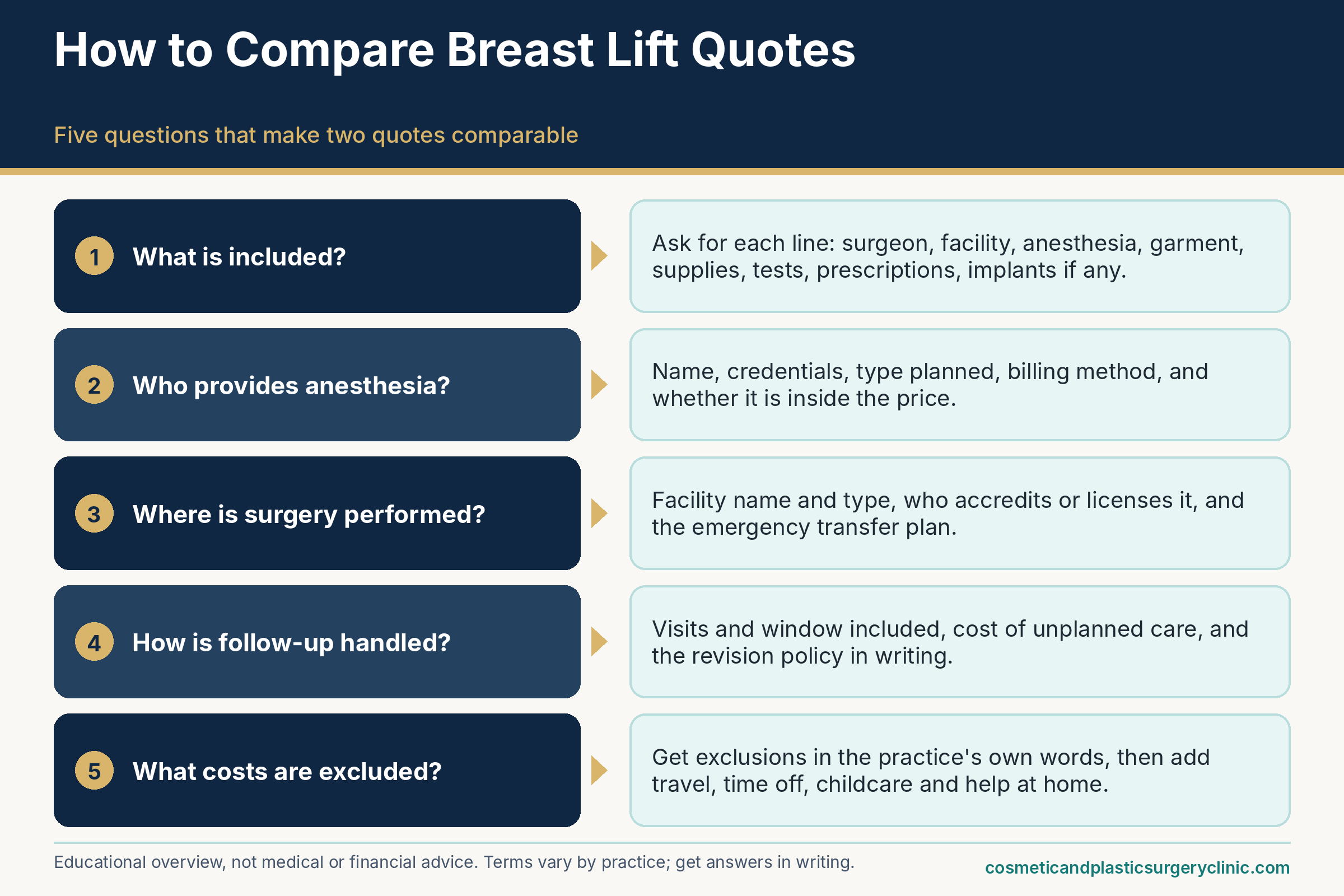
The most useful document you can ask for is an itemized written estimate. It should break out the surgeon’s fee, the facility fee, the anesthesia fee, tests and pre-operative visits, garments and supplies, prescriptions, and the follow-up and revision terms, and it should state what it assumes about the operation’s length and scope. It should identify who will send each bill.
Federal rules give some patients a related right. According to the Centers for Medicare & Medicaid Services, people who don’t have or don’t use health insurance can usually get a good faith estimate from a provider when they ask for one or when they schedule care at least three business days ahead, and they may be able to dispute a bill that comes in at least $400 above the estimate. The CMS page does not address cosmetic surgery by name, and a good faith estimate for a service involving several separate billers (the surgeon, a facility and an anesthesia group) can be complicated, so ask the practice how its itemized estimate relates to the process. The practical advice is simple and doesn’t depend on the legal details: request it in writing, before you pay a deposit, and keep it.
It also helps to know that you’ll be asking for something many practices don’t advertise. The 2024 survey study in Plastic and Reconstructive Surgery Global Open found that most surveyed providers don’t post costs online, which means the quote you receive may be the first time a price exists in writing. That makes the quote itself the important document, and it’s another reason to request it early.
Price Shopping, Discounts and Traveling for Surgery
Comparing practices is sensible. It becomes a trap when the lowest number becomes the only criterion, or when the highest number is assumed to mean the highest quality. Both shortcuts skip the real work of finding out what each price includes.
Why the lowest quote isn’t automatically the best deal, and the highest isn’t either
ASPS cautions that heavily discounted rates raise questions about where corners might be cut, such as spending on trained support staff or choosing a facility without accreditation, and it makes the point that the least expensive operation is the one done correctly the first time. In its December 2023 article, the society says that a bargain might come with risks and that a higher price doesn’t always mean better quality. Those two sentences, read together, are a fair summary of the whole price-shopping problem: price alone tells you almost nothing.
There are a few common ways a low advertised price turns into a higher final one. “Starting at” prices often describe the simplest version of the operation. Package pricing may cover the surgeon but not the facility. Promotions can be tied to financing that carries interest. A quote delivered by direct message or a call, before anyone has examined you, can’t account for your anatomy and is likely to change at the consultation. None of this implies bad faith, since an examination can legitimately change a plan. It just means a number you see before a consultation is a starting point at best.
The opposite mistake is equally real. A high quote can reflect an all-inclusive package that spares you later bills, a well-staffed accredited facility, a longer aftercare window or a surgeon whose schedule fills months ahead. It can also simply reflect a premium for a name. You can’t tell which from the total. You can tell, by asking, whether it includes anesthesia, whether the facility is accredited, how long follow-up lasts and what the revision policy says. Once those answers are on paper, the comparison becomes much clearer, and it’s often the case that the quotes are closer than their totals suggest.
Traveling for surgery: nearby cities, other states and medical tourism
Traveling to another city or state for a surgeon you trust is common, and the cost planning is straightforward: add travel, lodging for you and a companion, extra days for follow-up visits before you leave, and a plan for who will handle problems after you return home. Ask the surgeon how follow-up works for out-of-town patients, who you would see locally if something came up, and whether that local care would be billed to you.
Traveling abroad for a lower price raises larger questions, and the evidence is cautionary. ASPS’s briefing paper on cosmetic surgery tourism notes that it can be hard to assess the training and credentials of surgeons outside the United States, that packages often provide little or no follow-up once you’re home, that revision and complication care can cost more than the original surgery would have cost domestically, and that there may be no legal recourse if negligence occurs. A retrospective study published in Plastic and Reconstructive Surgery in 2017 followed 42 patients treated at one U.S. medical center over 36 months for complications after cosmetic surgery abroad and estimated an average treatment cost of about $18,000 per patient; 20 of the patients were admitted to the hospital and 13 needed further surgery. It’s a small, single-center series, so it can’t establish how common problems are, but it shows how the cost of a complication can erase a price advantage.
In June 2026 the Centers for Disease Control and Prevention (CDC) highlighted a review of consultations it handled between 2014 and 2024. Of 2,162 consultations, 34 involved patients who had traveled for medical procedures; the review described 21 reports covering roughly 145 patients with adverse outcomes after cosmetic procedures including liposuction, abdominoplasty, breast augmentation and gluteal augmentation. Twenty consultations involved post-surgical infections, 12 involved suspected or confirmed nontuberculous mycobacteria, and four involved deaths. Assessments found lapses in environmental cleaning, hand hygiene, protective equipment use and equipment reprocessing. These are cases that reached CDC, not a rate, and breast lift wasn’t among the procedures named in the release, so they don’t tell you how likely a problem is. They do show what can go wrong when infection control fails, and why CDC recommends that travelers arrange a pre-trip health visit, usually four to six weeks ahead, obtain copies of their records before coming home and understand the cost of follow-up or emergency care. CDC’s travel guidance also notes that flying after surgery raises the risk of blood clots, which is a reason to talk with your surgeon about timing any trip home.
The Total Out-of-Pocket Planning Calendar: Before, During and After Surgery
A quote describes the operation. A budget describes the whole experience, from the first consultation to the point where you stop thinking about the scars. Some of the largest swings between the quoted cost and the real cost come from items that never appear on a quote: the visits before surgery, the weeks of reduced income or extra help afterward, and the possibility of further procedures later. This section walks through the calendar in order, so you can see where costs tend to appear.
Before Surgery: From First Consultation to the Final Week
The pre-operative phase often costs less than the operation, but it’s where the small, easily forgotten lines accumulate.
Consultations, imaging, testing and the quiet line items
Start with consultations. Some practices charge a consultation fee, some credit it toward surgery if you proceed, and some don’t charge at all. If you plan to meet more than one surgeon, which ASPS’s own list of questions encourages by suggesting that patients consult multiple board-certified surgeons, those fees add up, so ask each practice about its policy when you book. A virtual consultation may be cheaper but can’t replace an in-person examination before surgery.
Mayo Clinic notes that a baseline mammogram may be recommended before a breast lift. The simplest approach is to ask the practice whether imaging is expected, who will order it, where it will be done, and how it will be billed. Other pre-operative items may include blood work, an anesthesia evaluation, medical clearance from your own physician if you have a health condition, and prescriptions for after surgery. Each one is small, and together they can amount to a meaningful line.
Nicotine deserves a specific mention because it can change both safety and schedule. The ASPS Smoking Task Force, in guidance issued in October 2024, recommends stopping smoking and other nicotine products four to eight weeks before surgery, depending on health and the procedure, and continuing for at least four weeks afterward. It also says surgeons may consider a urine cotinine or nicotine test on the day before or the day of the procedure to help decide whether to proceed. An older ASPS blog post names breast lift among the operations in which nicotine-related healing problems are a concern. The cost connection is that a positive test can mean a postponed date, and a postponed date can trigger rebooking fees or lost deposits under the policies described earlier. If this applies to you, ask the practice about its nicotine policy before you pay, and tell the team honestly where you stand; they can only plan around what they know.
Medication instructions are individual and belong to your surgical team. Mayo Clinic notes that patients may be asked to avoid aspirin, anti-inflammatory drugs and herbal supplements before surgery and to arrange help and transportation afterward. For budgeting, the point is only that the weeks before surgery can involve small purchases and changes to routines, and that a written pre-operative instruction sheet is something to request early.
The final weeks: garments, supplies, prescriptions and help at home
ASPS says patients wear an elastic bandage or a support bra after a lift to limit swelling and support the breasts as they heal. Mayo Clinic describes surgical support bras being worn for roughly three to four weeks. Some practices include a first garment in the price; others expect you to buy one from the practice or from an approved list. Ask whether a second garment is recommended, since laundering becomes a real question when you have only one.
Other supplies can include gauze and dressings, scar-care products, a pillow arrangement for sleeping, easy-to-wear tops that open in front, and over-the-counter items your surgeon names. Prescriptions, which ASPS lists among the expenses that sit outside its average, are usually filled at your own pharmacy; if you want to know the actual cost, ask the practice what is likely to be prescribed and check your plan’s coverage for it.
Then there is help. ASPS’s April 2026 budgeting article lists time off work, childcare, meal preparation and pet care among the indirect costs patients should anticipate. Because a lift is common among people who have recently had children, childcare and lifting restrictions are not abstract. Consider two illustrative situations, invented for planning purposes and not drawn from patient records. Someone with a desk job, no young children and a partner who can drive may need mainly a few days of rest and a plan for transportation. Someone who lifts toddlers daily, or whose job requires lifting or long standing, may need paid childcare help or extended time away, either of which can exceed the cost of a garment many times over. Your surgeon’s instructions determine what is safe for you; the point here is to price the help you’ll need once you know what those instructions are likely to say.
Surgery Day, Recovery and the Long Tail
The operation is a single day. The costs of recovery and the choices that follow it can run for years.
Surgery day through the first weeks: follow-up visits and lost income
ASPS explains that after a lift you’ll receive instructions about breast care, medications, warning signs and follow-up appointments, and it suggests asking when you can resume normal activity and exercise. ASPS doesn’t give specific time frames, and recovery varies with the technique, the person and the job. Mayo Clinic describes swelling and bruising lasting about two weeks and advises avoiding strenuous activity for the first one to two weeks, which gives a general sense of the early period but not a schedule for you. Plan for a range and keep a cushion. The articles on breast lift recovery and on returning to work after a breast lift cover timelines in more detail.
Time away from work is a real cost, and there’s a rule worth knowing. Under federal regulations implementing the Family and Medical Leave Act, conditions for which cosmetic treatments are administered, such as most plastic surgery, are not serious health conditions unless inpatient hospital care is required or complications develop. In plain terms, job-protected leave may not be available for an uncomplicated cosmetic operation. Check your employer’s policies on paid time off, sick leave and short-term disability, and ask HR how they treat elective surgery before you commit to a date. This is a general rule and not legal advice; your employer, state law and union agreements may add different protections.
Follow-up visits belong in the budget too. Ask how many visits the price includes, over what period, and what a visit costs after that window closes. Ask whether drain removal, suture removal and dressing changes are all included, and whether the practice charges for urgent same-day visits.
Months and years later: scar care, revision and changes in your life
Scars take time to mature. Mayo Clinic says breast lift scars generally fade over one to two years. Whether you’ll want scar treatments, and whether they’re included, is worth asking. The article on how long breast lift results last explains the aging side of the story: ASPS lists changes from pregnancy, breastfeeding, weight fluctuations, aging, gravity and heredity as the reasons breasts lose their shape in the first place, and those forces continue after surgery. Mayo Clinic notes that longevity varies and that heavier breasts are more prone to sagging again.
That matters for cost in two ways. First, a lift isn’t a one-time purchase for everyone. Some people eventually consider a second procedure, and ASPS lists the possibility of revisional surgery among the recognized risks. The practice’s written revision policy determines how much of that cost is yours, and the article on breast lift revision covers when a second operation may be considered. Second, timing relative to life events changes the value of the investment. Someone planning a pregnancy or a major weight change may reasonably ask a surgeon whether to wait; the article on breast lift after pregnancy covers that decision. If implants are part of the plan, the long tail includes periodic imaging, the possibility of replacement or removal, and the FDA’s reminder that implants aren’t lifetime devices.
| Phase | Costs that may appear | Who usually bills | What to confirm in writing |
|---|---|---|---|
| Months before | Consultation fees, second opinions, imaging, savings or financing set-up | Practices, imaging center, lender | Whether consultation fees are credited toward surgery |
| Four to eight weeks before | Deposit, pre-operative visit, labs, anesthesia evaluation, nicotine-related steps if relevant | Practice, laboratory, anesthesia group | Deposit and rebooking terms; nicotine policy |
| Final week | Garments, supplies, prescriptions, childcare and meals arranged | Practice, pharmacy, you | What garment is included and whether a second is advised |
| Surgery day | Balance of surgeon, facility and anesthesia fees | Practice, facility, anesthesia provider | Final itemized total and what could change it |
| Weeks one to twelve | Follow-up visits, dressings, scar products, unpaid time off | Practice, you | Number of included visits and charges for extra ones |
| Months to years | Scar treatments, possible revision, implant imaging or replacement if applicable | Practice, imaging center, facility | Written revision policy: coverage, time limits and exclusions |
Comparing Breast Lift Quotes and Deciding on Value, Not Price Alone
By this point you may be holding two or three quotes that don’t resemble each other. The job now is to turn them into something comparable, and then to decide what you’re actually buying. That’s a matter of method more than math. The method below works for any elective surgical quote, and it keeps the safety questions in the same spreadsheet as the dollar signs, which is where they belong.
A Quote-Comparison Framework
The framework has two parts: a sequence for lining quotes up, and a list of questions that fills in whatever the quotes leave blank.
Normalize before you compare: a five-step method
Step one: match the scope. Write down, for each quote, the operation it describes: the incision pattern, whether the nipple-areola complex is repositioned, whether implants, fat transfer, mesh or any other component is included, and whether any other procedure is bundled. If two quotes describe different operations, they’re not comparable yet, and the right next step is a question to the practice, not a conclusion about price.
Step two: add the missing layers. A surgeon’s-fee-only quote needs a facility fee, an anesthesia fee, garments, tests and prescriptions added from the other practice’s estimates or from separate written estimates. A package quote already contains these, and you want to see them itemized so you know what’s inside.
Step three: match the setting and the anesthesia. A quote at an accredited ambulatory surgery center with a physician anesthesiologist is not the same product as a quote in an unverified setting with an unnamed provider, even if the totals look identical. Record the facility name, the accreditor, who gives the anesthesia and how it’s billed.
Step four: match the aftercare. Count the included visits, the length of the window, the policy on unplanned care and the written revision terms. A shorter window with no revision language can cost you later what a longer window would have covered now.
Step five: add your own costs. Include financing charges, travel if relevant, time off work, childcare and help at home. Two quotes that look close can drift apart once you add the two weeks of unpaid leave that one location makes necessary and the other doesn’t.
An arithmetic example, with numbers invented only to show the mechanics and not representing any real practice or typical price: Practice A quotes $10,500 as an all-inclusive package covering the surgeon, an accredited surgery center, a physician anesthesiologist, a garment and twelve months of follow-up visits. Practice B quotes $7,200 for the surgeon’s fee alone. When you request the rest, you learn that Practice B’s facility charges $2,600, its anesthesia group charges $1,400, a garment is $150, and follow-up beyond three months is billed per visit. The adjusted totals are $10,500 and $11,350 before any extra visits. What looked like a $3,300 savings was an $850 premium, and Practice A’s follow-up terms are broader. The reverse can also happen, and nothing in the method assumes either result. It simply lets the numbers speak for the same thing.
Questions to ask for an itemized quote
The list below is long on purpose. You don’t need every answer from every practice, but the answers you can’t get are information too. Many of these can be handled by the practice’s coordinator, and some will need the surgeon.
- Which operation does this quote describe, and what would make you change the plan after the examination?
- Does the surgeon’s fee include the nipple-areola work, areola reduction and any internal support?
- Are implants, fat transfer or other procedures included, and are they itemized?
- Where will the surgery take place, who owns or accredits the facility, and may I check the directory myself?
- Who will provide the anesthesia, with what credentials, and is the fee fixed or based on time?
- What is the facility fee, who bills it, and does it change if the operation runs longer?
- What do the garment, supplies, tests and prescriptions cost, and which are included?
- How many follow-up visits are included, over what period, and what do extra visits cost?
- What is the revision policy in writing: what it covers, time limits and exclusions, and does it cover surgeon, facility and anesthesia?
- Does the practice participate in any complications coverage program, and what does it exclude?
- What is the deposit, what is refundable and what happens if the date moves?
- How do you handle a problem after hours, and where would I be treated in an emergency?
- Can I take the financing paperwork home, and who holds the loan?
- Can I see photographs of patients who had a similar operation, and are they the practice’s own, consented images?
The last question connects to a separate skill: reading a gallery fairly. The article on breast lift before and after photos explains how to do it, and the consultation checklist in the article on breast lift consultation questions pulls the surgical and recovery questions together with these cost ones.
| Line to record | What to write down | Why it changes the comparison | Answer that should prompt more questions |
|---|---|---|---|
| Operation described | Incision pattern, nipple work, implants or fat, other procedures | Different plans are different products | “Pricing depends on what we find on the day,” with no range or conditions |
| Surgeon’s fee and inclusions | Amount, follow-up window, who performs which steps | Fees without inclusions can’t be compared | An unclear division of roles within the operating team |
| Facility | Name, type, accreditor or license, emergency transfer plan | Drives both cost and safety standards | Facility details withheld until after the deposit |
| Anesthesia | Provider name and credentials, type, billing method | May be billed separately or by time | “The surgeon handles sedation,” with no named anesthesia professional |
| Supplies, tests, prescriptions | Garment, dressings, labs, medications | Small lines add up | A lump sum with no breakdown |
| Revision policy | Written coverage, time limit, exclusions | Defines the cost of an unplanned second operation | Only a verbal assurance, or terms revealed after payment |
| Payment terms | Deposit, schedule, refund rules, financing partner and APR | Borrowing adds to the real total | Pressure to finance on the spot |
Red Flags, Value and Safe Next Steps
After the numbers are lined up, a few judgment calls remain. This part covers the signs that should slow you down and a way to think about value when the budget is limited.
Red flags in pricing and sales practice
ASPS warns about pressure to add treatments and about relying on the title “cosmetic surgeon,” noting that any licensed physician can use it, though it has no official standing as a credential. That’s why the credential check described earlier, on the ABPS verification page and with your state medical board, is part of cost comparison and not a separate task. A price attached to an unverified credential is a price for an unknown.
None of this means a practice that offers a financing partner or a package price is doing something wrong. Many do, and many offer them in good faith. The distinction is between a practice that answers your questions in writing and gives you time, and one that makes the questions awkward.
Value, safety and alternatives when the budget is tight
Value is the match between what you need, what’s done, who does it, where, and what happens afterward, divided by what it costs all-in. A lower price lowers the denominator but can erode the numerator. If the budget is limited, the useful question is which parts of the plan can flex without touching safety.
Several options are reasonable to discuss. You can wait and save, which costs time but not safety, and which may also let you complete life events, such as a pregnancy or a weight change, that could alter the result. You can ask whether a less extensive plan is appropriate for your anatomy, with the understanding that this is the surgeon’s call and that a smaller operation is not an equivalent one. You can ask whether staging a combined plan makes sense, trading a longer timeline for lower costs at any one time. You can compare financing against an outside loan so that the interest you pay doesn’t undo the savings you found. And you can ask about nonsurgical alternatives with the same honesty you’d apply to surgery, namely what they can and can’t do for your specific concern. The article on alternatives to breast lift covers that ground.
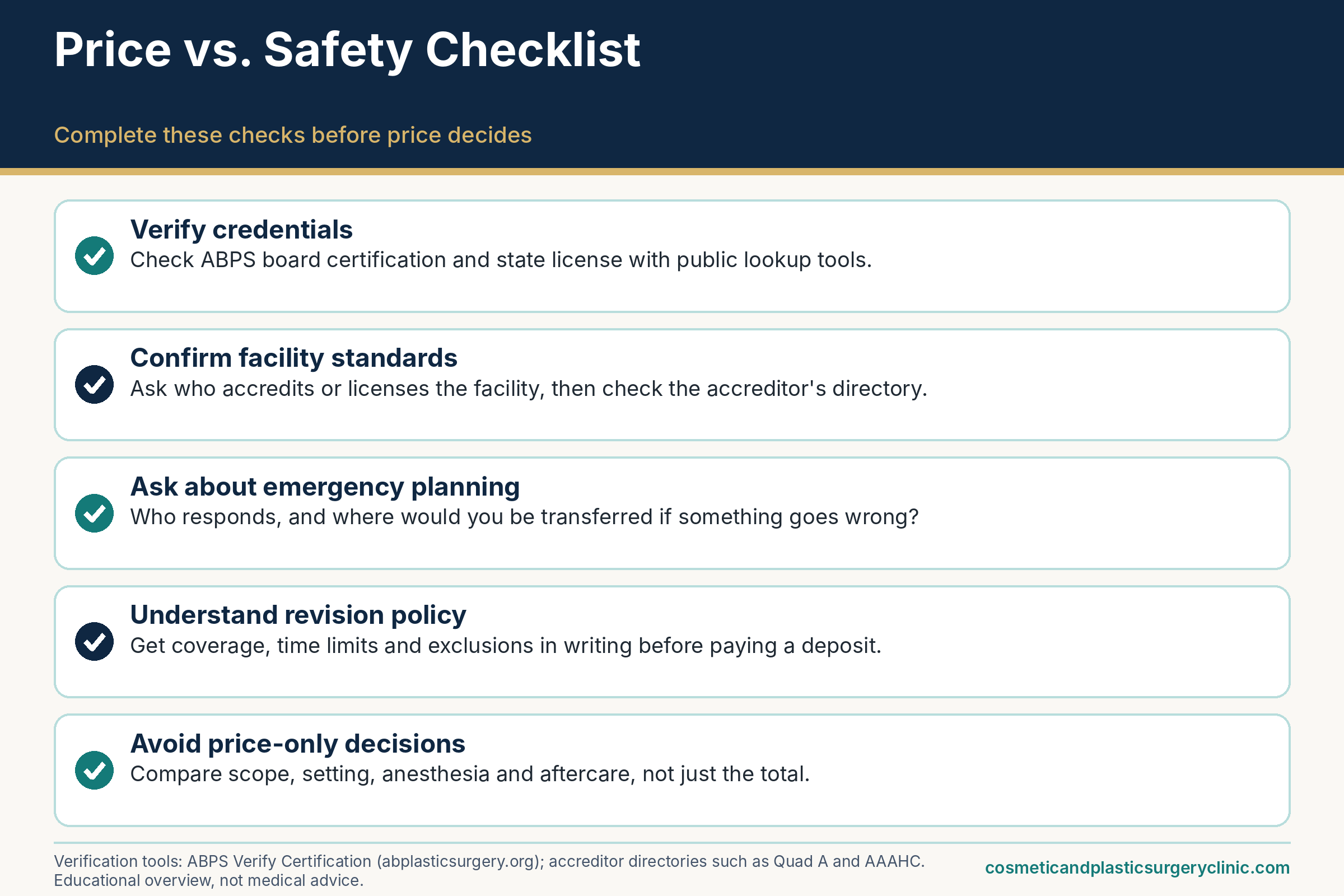
What shouldn’t flex is the part that protects you: verified credentials, a facility you’ve confirmed, a named anesthesia professional, a plan for emergencies, and written terms for follow-up and revision. Choosing a cheaper setting you can’t verify, traveling for a price without a follow-up plan, or skipping a recommended step to save a fee tends to move the cost to a later date, when it’s higher and less convenient. If the honest answer is that you can’t afford a safe version of the operation right now, deciding not to proceed yet is a legitimate decision, not a failure. The broader plastic surgery cost guide covers budgeting across procedures.
Frequently asked questions about breast lift cost
How much does a breast lift cost in the United States?
No single number covers every case. ASPS reported a 2024 average surgeon’s fee range of $6,500 to $11,000 for a breast lift, and its cost page cites an undated average of $6,816. Both describe the surgeon’s fee, and ASPS says that average excludes anesthesia, the operating room facility and other expenses. Your total adds those layers and moves with the technique, any added procedures, the setting and your market. A realistic estimate for you exists only on an itemized written quote from a surgeon who has examined you, and national figures are context, not a price list.
Is a breast lift cheaper than breast augmentation?
In the published surgeon’s-fee ranges, a lift is listed higher than augmentation at both ends, but the comparison is rough. The 2024 ASPS document lists $6,500 to $11,000 for a breast lift and $4,575 to $8,000 for augmentation with implant placement, and those ranges overlap. Implants add a device and later maintenance questions, and a lift with implants is a combined operation priced differently from either. Because the figures are surgeon’s fees from a member survey, the safer approach is to compare itemized quotes for the specific operations you are considering, not national ranges.
Does health insurance ever cover a breast lift?
Usually not. ASPS says most health insurance plans do not cover breast lift surgery or its complications. Published insurer policies describe mastopexy as cosmetic except when it is part of a medically necessary reconstruction, such as after mastectomy, and federal law requires plans that cover mastectomy to cover surgery on the other breast for symmetry when a person chooses reconstruction. Coverage depends on your plan, so ask the insurer for its criteria in writing, ask the practice to request pre-authorization if any component might qualify, and never rely on a verbal assurance at the consultation.
Does Medicare pay for a breast lift?
For an operation done to improve appearance, generally no. Medicare’s national coverage determination on cosmetic surgery excludes any procedure directed at improving appearance, with narrow exceptions for prompt repair of accidental injury and for improving the function of a malformed body member. A reconstructive situation after breast cancer treatment is evaluated differently from a cosmetic lift. If you have Medicare and are weighing surgery, check your own plan documents and confirm any coverage claim with Medicare or your plan, in writing, before paying.
Can I pay for a breast lift with an HSA or FSA?
Probably not for a purely cosmetic lift. IRS Publication 969 defines HSA qualified medical expenses by reference to the tax code’s definition of medical care, and Publication 502 says cosmetic surgery generally is not medical care unless it corrects a deformity from a congenital abnormality, an accident or trauma, or a disfiguring disease. Breast reconstruction after a cancer-related mastectomy is a separate case that Publication 502 treats as includible. Your plan administrator decides account eligibility, and a tax professional can advise on returns. Get the answer in writing before you pay with account funds.
Is a lift with implants more expensive than a lift alone?
It generally adds cost, because the quote must cover the implants, extra operating time and more complex planning, and later costs come into the picture. FDA states that breast implants are not lifetime devices and that some insurers do not cover implant removal or replacement even when the first surgery was covered. Doing both in one operation may use one anesthesia and one facility booking, while a staged plan uses two. Ask how the practice prices a second stage, which implant is planned, and what its written policy says about future surgery, imaging and replacement.
Why is my quote higher than the ASPS range?
Several reasons can apply. The ASPS range covers the surgeon’s fee alone, so an all-inclusive quote will exceed it. The plan may be larger than a standard lift, with implants, fat transfer, reduction or an extended incision pattern. Geography matters, since ASPS says its range reflects different locations and practice settings, and the data come from member surgeons who responded to a survey. A gap is a reason to ask questions, not a conclusion about quality. Ask the practice to break the quote into surgeon, facility, anesthesia, supplies and follow-up, then compare each layer to a second itemized quote.
Is financing a breast lift a good idea?
That depends on your finances and the terms, which this article cannot evaluate for you. A useful rule is to compare the total repaid under each option, not the monthly payment. The CFPB found in 2023 that the typical medical credit card carried a 26.99% APR, against roughly 16% for general-purpose cards, and that deferred-interest terms can lead to retroactive interest if a balance remains. Compare at least one outside option, such as a credit union loan, calculate the payment that clears any promotional balance in time, and take the paperwork home before signing.
What happens to my deposit if I need to postpone surgery?
It depends entirely on the practice’s written agreement, which is why you should read it before paying. Some practices transfer a deposit to a new date, some refund part of it before a deadline, and some keep it. The reason may matter: illness, a decision by the surgical team to delay, nicotine test results or a personal change of plans can be treated differently. No national rule for elective cosmetic deposits was found in the sources reviewed, and state consumer law may add protections. Ask for the terms in writing and for examples of how they apply.
Who pays if I need a revision after a breast lift?
It depends on the practice’s written revision policy, and policies differ. Some practices reduce or waive the surgeon’s fee for certain revisions within a time limit, while the facility and anesthesia charges remain yours; others offer no coverage. Because ASPS states that most insurance plans do not cover breast lift surgery or its complications, assume unplanned care could be out of pocket unless your policy or the practice’s terms say otherwise. Get the policy in writing before a deposit, including time limits, what counts as a revision and what is excluded.
Are “starting at” prices on practice websites reliable?
They are best read as a floor for the simplest version of an operation, not a forecast. A “starting at” figure may describe one incision pattern, exclude the facility or anesthesia, or assume no added procedures. A 2024 survey study found that most providers do not share costs online, so an advertised number may be the only public data point. Treat it as a reason to request an itemized written estimate after an examination, and compare practices on that document. If a price cannot be explained line by line, ask until it can.
Is a breast lift cheaper if I travel abroad?
The advertised price may be lower, but a fair comparison includes travel, lodging, a companion, flight timing and a plan for follow-up at home. ASPS cautions that credentials are hard to assess abroad and that revision costs can exceed the original savings. A 2017 study of 42 patients at one U.S. medical center estimated an average of about $18,000 to treat complications after cosmetic surgery abroad, and CDC reported infections and deaths among travelers in a 2026 review of its consultations. Those are selected cases, not rates, but they show why follow-up planning belongs in the math.
How much time off work should I budget after a breast lift?
Recovery varies with the technique, the person and the job, and no single figure is reliable. ASPS recommends asking your surgeon when you can resume normal activity and exercise, and Mayo Clinic describes swelling and bruising lasting about two weeks, with strenuous activity limited early on. For budgeting, treat time away as a cost: check paid leave and short-term disability policies, and remember that federal leave rules treat cosmetic treatments as not serious health conditions unless inpatient care is required or complications develop. Build in a cushion, and read the recovery and return-to-work guides for planning detail.
Sources and further reading
- American Society of Plastic Surgeons — Breast Lift Cost (accessed 2026-10-04) — undated average; exclusions (anesthesia, facility, other expenses); components; insurance and financing notes
- American Society of Plastic Surgeons — 2024 Average Surgeon/Physician Fees (accessed 2026-10-04) — breast lift, augmentation and reduction fee ranges; projected range from surveyed member surgeons
- American Society of Plastic Surgeons — Plastic Surgery Statistics Report 2025 (accessed 2026-10-04) — breast lift volume in 2025 and 2024; data sources and methodology note
- American Society of Plastic Surgeons — Breast Lift overview, Procedure, Recovery, Safety and Candidates pages (accessed 2026-10-04) — what a lift does and does not do, anesthesia options, incision patterns, garments and drains, listed risks, causes of changing breast shape
- American Society of Plastic Surgeons — Understanding plastic surgery costs in the United States (December 15, 2023; accessed 2026-10-04) — cost components, geographic differences, financing routes, price and quality caution
- American Society of Plastic Surgeons — The real cost of plastic surgery (April 20, 2026; accessed 2026-10-04) — indirect costs, asking whether the quote covers all surgical costs
- American Society of Plastic Surgeons — ASPS Member Qualifications (accessed 2026-10-04) — board certification, training and facility requirements for members
- American Society of Plastic Surgeons — Accredited Facilities (accessed 2026-10-04) — accrediting bodies and state license or Medicare certification alternatives
- American Society of Plastic Surgeons — Any doctor will do, right? Why board certification matters (March 26, 2025; accessed 2026-10-04) — training requirements and verification tools
- American Society of Plastic Surgeons — Ten things to ask before having plastic surgery (August 15, 2017; accessed 2026-10-04) — credential, facility, anesthesia provider and second-opinion questions
- American Society of Plastic Surgeons — How to avoid common mistakes when selecting your plastic surgeon (undated; accessed 2026-10-04) — price-focused mistakes, the cosmetic surgeon title, accreditation
- American Society of Plastic Surgeons — Managing the risks of smoking (October 9, 2024; accessed 2026-10-04) — nicotine cessation window and cotinine testing
- American Society of Plastic Surgeons — How nicotine sabotages plastic surgery (December 12, 2016; accessed 2026-10-04) — breast lift named among operations affected by nicotine-related healing problems
- American Society of Plastic Surgeons — Plastic surgery and health insurance (accessed 2026-10-04) — reconstruction versus cosmetic coverage
- American Society of Plastic Surgeons — Is breast reduction covered by health insurance? (January 19, 2018; accessed 2026-10-04) — documentation expectations for reduction; asking insurers for criteria in writing
- American Society of Plastic Surgeons — Briefing paper: cosmetic surgery tourism (accessed 2026-10-04) — credentials, follow-up, revision costs and legal recourse abroad
- American Society of Plastic Surgeons — Medical tourism for cosmetic surgery: high risk of complications, high costs for treatment (2017 study; accessed 2026-10-04) — 42-patient single-center review and average treatment cost
- Centers for Disease Control and Prevention — CDC highlights adverse outcomes linked to travel-related cosmetic procedures (June 2, 2026; accessed 2026-10-04) — consultation review, infections, nontuberculous mycobacteria, deaths
- Centers for Disease Control and Prevention — Medical Tourism (accessed 2026-10-04) — infection and clot risks, follow-up costs, records, pre-travel visit
- U.S. Food and Drug Administration — Statement on continued efforts to enhance safety information for patients considering breast implants (October 23, 2019; accessed 2026-10-04) — boxed warning, patient decision checklist, screening recommendations
- U.S. Food and Drug Administration — Breast Implants (page current as of December 15, 2023; accessed 2026-10-04) — labeling recommendations and BIA-ALCL information
- U.S. Food and Drug Administration — Risks and Complications of Breast Implants (accessed 2026-10-04) — implants are not lifetime devices; insurance may not cover removal or replacement
- Mayo Clinic — Breast lift (accessed 2026-10-04) — preparation, setting and typical duration, early recovery, scar maturation, longevity
- Consumer Financial Protection Bureau — Medical Credit Cards and Financing Plans (May 4, 2023; accessed 2026-10-04) — report overview; full PDF at files.consumerfinance.gov for deferred interest, APR and enrollment findings
- Centers for Medicare & Medicaid Services — Good faith estimate (accessed 2026-10-04) — who may receive an estimate, timing, $400 dispute threshold
- Centers for Medicare & Medicaid Services — Hospital Price Transparency (accessed 2026-10-04) — hospital price-posting requirements
- Centers for Medicare & Medicaid Services — Women’s Health and Cancer Rights Act (accessed 2026-10-04) — reconstruction and symmetry coverage requirements; Department of Labor guide to rights after a mastectomy for cost-sharing rules
- Centers for Medicare & Medicaid Services — National Coverage Determination 140.4 (accessed 2026-10-04) — Medicare cosmetic surgery exclusion and narrow exceptions
- Blue Cross and Blue Shield of Oklahoma medical policy SUR716.010, Mastopexy (effective May 15, 2026; accessed 2026-10-04) — example of an insurer classifying mastopexy as cosmetic outside reconstruction
- Centene clinical policy CP.MP.31, Cosmetic and Reconstructive Surgery (last review March 2020; accessed 2026-10-04) — example listing mastopexy as not medically necessary with a reconstruction exception
- Internal Revenue Service — Publication 502, Medical and Dental Expenses (2025; accessed 2026-10-04) — definition and tax treatment of cosmetic surgery
- Internal Revenue Service — Publication 969, Health Savings Accounts and Other Tax-Favored Health Plans (2025; accessed 2026-10-04) — HSA qualified medical expenses defined by section 213(d)
- Electronic Code of Federal Regulations — 29 CFR 825.113, Serious health condition (accessed 2026-10-04) — cosmetic treatments and serious health condition
- Legal Information Institute — 42 CFR 414.46, Additional rules for payment of anesthesia services (accessed 2026-10-04) — base units plus 15-minute time units in Medicare anesthesia payment
- American Journal of Managed Care — What are the implications of the costs of operating room time? (summary of a 2018 JAMA Surgery study; accessed 2026-10-04) — per-minute operating room costs in California hospitals
- American Society of Anesthesiologists — Statement on qualifications of anesthesia providers in the office-based setting (reaffirmed October 23, 2024; accessed 2026-10-04) — provider qualifications and supervision
- American Society of Anesthesiologists — Statement distinguishing monitored anesthesia care from moderate sedation (October 2023; accessed 2026-10-04) — differences in provider role and scope
- American Board of Plastic Surgery — Verify Certification (accessed 2026-10-04) — public certification lookup; state license verification through FSMB
- American Board of Medical Specialties — Certification Matters (accessed 2026-10-04) — public lookup for certification by ABMS member boards
- Quad A — About Us and Accredited Facilities Directory (accessed 2026-10-04) — accreditation of ambulatory surgery and office-based surgical facilities
- AAAHC — Accreditation (accessed 2026-10-04) — accreditation of ambulatory surgery centers and office-based surgery centers
- Plastic and Reconstructive Surgery Global Open — The Controversy over Price Transparency: Patients and Plastic Surgeons Disagree (October 2024; accessed 2026-10-04) — survey finding on online price disclosure
- CosmetAssure — Complications insurance for cosmetic surgery (accessed 2026-10-04) — company description of a complications insurance program offered through surgeons; homepage lists no exclusions
- IntechOpen — Mastopexy with Augmentation Mammoplasty (2024; accessed 2026-10-04) — complexity of combined augmentation and mastopexy; single-stage versus staged approaches
- American Society for Aesthetic Plastic Surgery meeting abstract — A systematic review and meta-analysis of single-stage augmentation-mastopexy (2014 meeting; accessed 2026-10-04) — pooled complication and revision rates (conference abstract, not a full paper)
- American Academy of Cosmetic Surgery — Breast anatomy, reduction and mastopexy continuing-education presentation (2022; accessed 2026-10-04) — implants do not lift; complication overview
- Journal of Aesthetic Nursing — Mastopexy: a means to correct breast ptosis (May 2023; accessed 2026-10-04) — periareolar, vertical and inverted-T approaches; mixed evidence on mesh