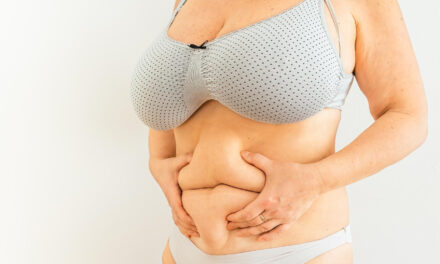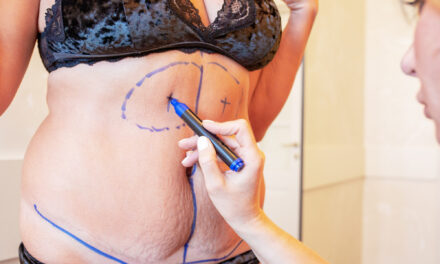

Liposuction, often shortened to lipo, is a surgical procedure that removes fat from specific areas of the body through small incisions and thin suction tubes called cannulas. It remains the most commonly performed cosmetic surgical procedure in the United States: the American Society of Plastic Surgeons (ASPS) estimated 317,196 liposuction procedures nationwide in 2025, ahead of breast augmentation and tummy tuck in its 2025 procedural statistics report. A procedure that popular attracts a lot of shorthand, and much of the shorthand is misleading. This guide slows things down and walks through what liposuction actually does, who tends to be considered a good fit, how the main techniques differ, what recovery asks of you, what can go wrong, what the national fee data show, and which questions are worth bringing to a qualified plastic surgeon.
If you are comparing this procedure with others, a quick framing helps. Liposuction changes volume in a treated area; it does not tighten loose skin, repair separated abdominal muscles, treat cellulite, or serve as a weight-loss method. Whether it is the right tool depends on your anatomy, your skin, your health, your timing, and what you hope will look different when swelling settles. Nothing here is a diagnosis or a treatment plan. It is background so that your consultation can be more specific and your decisions less rushed.
How to use this page: the sections follow the order most people move through the decision, from understanding the procedure to planning recovery to choosing a surgeon. Dedicated articles on cost, recovery, risks, alternatives and technique go deeper on single topics, and you will find links to them where they help. Everything here is written for a U.S. audience, uses figures only when a source and year can be named, and points out where the evidence is thin or where experts disagree. Where this page describes something as “typical” or “common,” it means a pattern reported by professional societies or published studies, not a promise about your own course.
What Liposuction Is, and What It Is Not
Most confusion about lipo starts with the name. “Suction” sounds like a vacuum cleaner for body fat, and the marketing around it often implies that fat anywhere on the body can be sucked away to reveal a leaner version of you. The reality is more specific and more modest. This section defines the procedure, maps the vocabulary you will hear, explains how it fits with weight loss, and sketches the anatomy that decides what suction can and cannot reach.
Definition, vocabulary and the weight-loss question
Two ideas anchor everything else: what the operation is called, and what job it is designed to do.
Lipo, lipoplasty and liposculpture: a terminology map
ASPS describes liposuction as a surgical procedure that removes excess fat from specific areas of the body, and notes that it is also called lipoplasty. In the plastic surgery literature you will see “suction-assisted lipectomy,” “suction lipectomy,” or “lipoplasty” used almost interchangeably. In consumer marketing you will also see “liposculpture,” “body sculpting,” “lipo 360,” “high-definition lipo,” and a rotating cast of brand names. Some of those words describe real differences in technique or in the aesthetic goal. Others are branding layered on top of the same basic operation.
The table below sorts the common terms into what they usually mean. Treat it as a reading aid rather than a rulebook, because surgeons and clinics do not use these words consistently. When a consultation involves an unfamiliar term, asking “what exactly will you do, in which areas, with which device?” cuts through naming differences quickly.
| Term you may see | What it usually refers to | Watch for |
|---|---|---|
| Liposuction / lipo | Removal of fat by suction through small incisions; the umbrella term used by patients and in search | “Lipo” is shorthand, not a technique |
| Lipoplasty, suction lipectomy | Clinical synonyms for liposuction | Same operation under a more formal name |
| Liposculpture, body sculpting | Liposuction with an emphasis on shaping contours, sometimes with fat grafting elsewhere | Ask whether any fat is being transferred, which changes the plan |
| High-definition (HD) lipo | A contouring approach that aims to emphasize muscle lines in lean patients | Not a distinct device; results depend on anatomy and technique |
| Tumescent technique | Infiltrating a large volume of dilute anesthetic and epinephrine solution before suction | Describes the fluid, not the suction method |
| Non-surgical “lipo” | Marketing label for cryolipolysis, laser, radiofrequency or injection treatments | These are different treatments with different evidence and regulation |
One more vocabulary note: “fat removal” and “fat reduction” are not the same thing. Surgical liposuction physically removes fat cells and the fluid that comes with them. Nonsurgical devices try to shrink or destroy fat cells in place and leave the body to clear the debris. That distinction matters for expected change, for recovery, and for how the U.S. Food and Drug Administration (FDA) regulates the tools involved, which later sections cover.
Contouring versus weight loss: what the evidence shows
ASPS is direct on this point: liposuction is not a treatment for obesity and is not a substitute for diet and exercise. It targets pockets of fat that stay put despite healthy habits, which clinicians sometimes call localized or “stubborn” adiposity. The operation reshapes; it does not meaningfully move the number on the scale for most people, and it is not designed to.
The strongest evidence that it also does not deliver the metabolic benefits of weight loss comes from a small but widely cited trial published in the New England Journal of Medicine in 2004. As summarized by the investigators’ university, researchers removed roughly a fifth of body fat from 15 women with obesity (some of whom had type 2 diabetes) and then measured insulin sensitivity, blood lipids, blood pressure and inflammatory markers. They found no meaningful changes, whereas comparable fat loss through dieting would be expected to improve those measures (Washington University summary of Klein et al., 2004). The study was small and used large-volume removal in people with obesity, so it does not describe typical cosmetic lipo, but it makes the broader point that fat location and mechanism matter more than a simple “fat removed” tally.
A second line of evidence concerns where fat goes afterward. In a randomized trial from Brazil, 36 healthy normal-weight women had small-volume abdominal liposuction and were then split into an exercise group and a non-exercise group. At six months the non-exercise group showed a 10 percent rise in visceral fat (the fat packed around internal organs), while the exercise group held steady, and the reduction in abdominal subcutaneous fat persisted in both groups (Benatti et al., Journal of Clinical Endocrinology & Metabolism, 2012). It is a small study with a short follow-up, so it is a reason to take post-operative activity seriously rather than a forecast for any individual.
The practical takeaway is simple. If the goal is overall weight or metabolic health, lipo is the wrong first tool, and a conversation with a primary care clinician comes first. If the goal is to reshape a stubborn area on a body that is otherwise at a stable, healthy weight, lipo is one of several options, and the next question is whether your anatomy and skin suit it.
A few misconceptions are worth clearing up before going further. The first is “spot reduction,” the idea that fat in one place can be targeted by exercise or by a device and nowhere else. Surgery is the one approach that does let a surgeon choose where fat is taken from, but it does so by physically removing tissue, not by instructing the body to draw fat from a chosen location. The second is the notion that lipo is a “minor” procedure because the incisions are small. The incisions are small; the operation is not necessarily minor, since it involves anesthesia, large fluid shifts, and in some cases hours of operating time. The third is “lipo 360,” a label implying that circumferential treatment around the waist is a single standard operation. It is a marketing description of a plan that covers the front, sides and back of the torso, and what it actually includes differs by practice.
It also helps to know how common the operation is, because popularity is not the same as simplicity. ASPS counted 1,523,330 cosmetic surgical procedures in the United States in 2025, so liposuction’s 317,196 cases represent roughly one in five of them. ASPS calculated those estimates by combining data from member surgeons, an ASPS endorsed partner, and a national claims dataset, and then extrapolating nationally, so the figures are estimates rather than a registry count. The same report restated the 2024 liposuction total at 320,155, which means 2025 was about 1 percent lower, essentially flat. The earlier 2024 report published a different 2024 figure under a different method, so year-to-year comparisons across ASPS reports should be made carefully, and a rise or fall of a few percent should not be read as a trend in safety or demand.
Fat anatomy and what suction can reach
Fat is not one uniform layer, and surgeons cannot treat all of it. Understanding the layers explains both the appeal and the limits.
Layers of fat: subcutaneous, visceral and why it matters
Liposuction works on subcutaneous fat, the layer between the skin and the underlying muscle fascia. It does not touch visceral fat, which sits deeper inside the abdominal cavity around organs. This is why someone with a firm, rounded abdomen caused mostly by visceral fat may see little change from lipo, and why a hands-on physical examination, not a photo, is the starting point for judging how much of an abdomen is treatable.
Subcutaneous fat itself has structure. A classic cadaver study of 18 specimens by Markman and Barton, published in Plastic and Reconstructive Surgery in 1987, described a superficial adipose layer held in compact fibrous compartments and a deeper adipose layer in looser tissue, with deeper compartments in the abdomen, lower back flanks and gluteal-thigh regions that contribute substantially to overall thickness (study record). Surgeons use this idea in practice: the deeper layer is generally where the bulk of removal happens, while the superficial layer is treated more conservatively because it sits just beneath the skin and contributes to surface smoothness. Taking too much from the superficial layer, or removing unevenly, is one pathway to the rippled or dented look that patients fear most.
Fat distribution is also personal. Genetics, sex hormones, age and prior pregnancies influence where a body stores fat, and that pattern shows up in what lipo can accomplish. A person who stores most fat in the lower abdomen and flanks may see a visible change from treating those areas. A person who carries weight more evenly may find that treating one area makes neighboring areas look different, which is one reason surgeons talk about blending and proportion rather than isolated spots.
Common treatment areas and the limits of suction
ASPS lists treatable areas that include the abdomen and waist, back, calves and ankles, chest, face, cheeks, chin and neck, hips and buttocks, inner knees, thighs and upper arms. Mayo Clinic’s patient overview adds that lipo can be used for gynecomastia, meaning excess breast tissue in men. Beyond that list, the most commonly discussed areas in consultation rooms are the abdomen, flanks (“love handles”), outer and inner thighs, upper arms, bra-line and upper back, and the submental area under the chin.
What suction cannot do is just as useful to know. It does not treat cellulite, which is related to fibrous bands tethering skin, and ASPS notes that lipo is not a cellulite treatment and lists worsening cellulite among the possible risks. It does not remove stretch marks. It does not tighten loose skin on its own. It does not strengthen or repair stretched abdominal muscles. And it cannot create muscle definition that is not already present under the fat, though some techniques aim to emphasize existing muscle contours in lean people, a concept covered in the dedicated guide to high-definition liposuction.
Some areas have their own considerations. Chin and neck treatment uses smaller cannulas and a different risk profile, covered in the chin liposuction guide. Calves and ankles are small, circumferential areas where swelling can linger. Fat from the abdomen and flanks is common to treat alongside a tummy tuck, which raises its own planning questions that appear later in this guide. In every area, the working rule is that surgeons remove what the anatomy can spare while leaving a smooth, even layer behind.
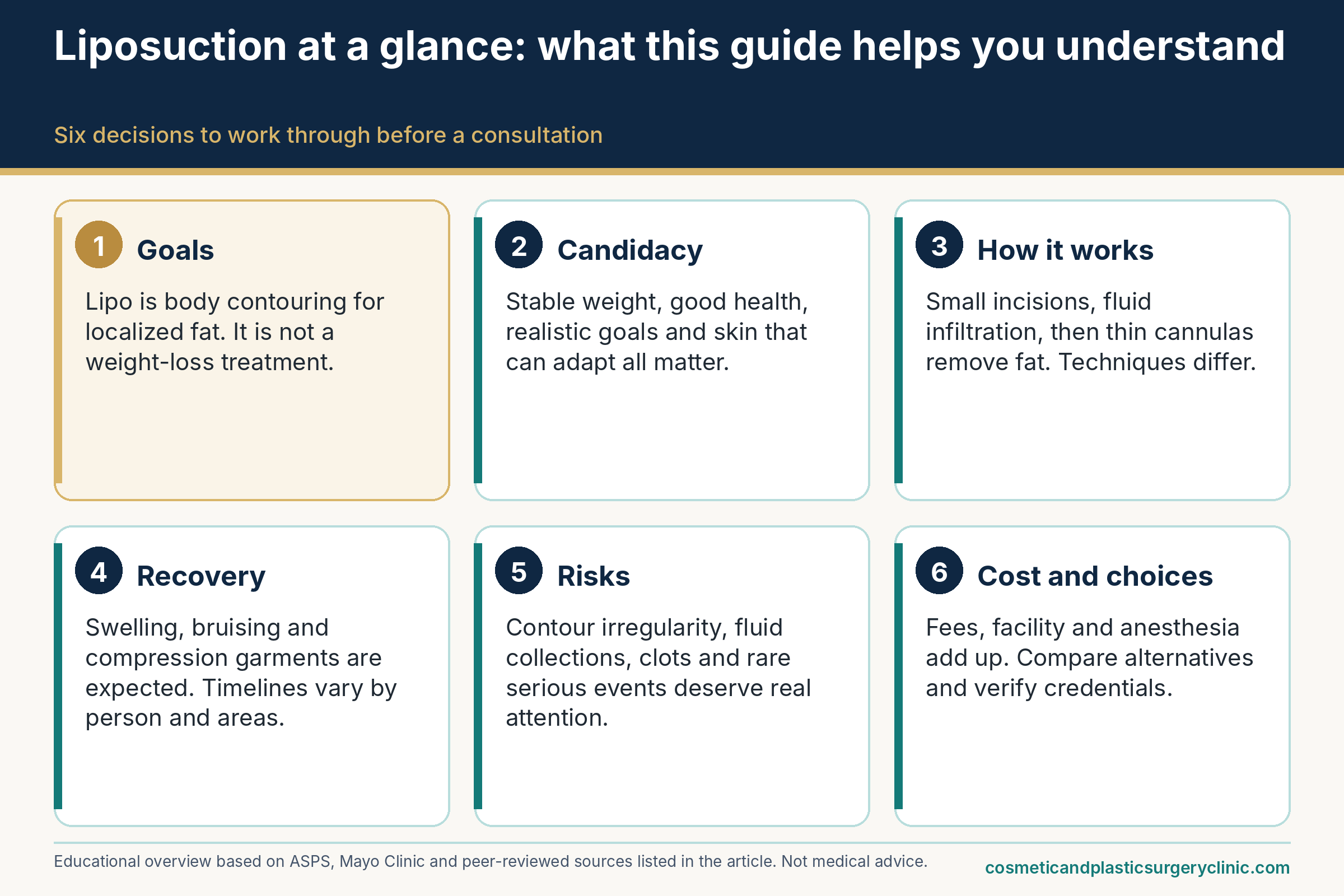
Who May Be an Appropriate Candidate for Liposuction
Candidacy is not a yes-or-no label that an article can hand out. It is a judgment a surgeon makes after a history, an examination, and a conversation about goals, and it can change with time as weight, health and life circumstances change. What a general guide can do is show the factors that usually carry weight, so that you can recognize them in your own situation and ask better questions. For a narrower walk-through of red flags and timing, the companion guide on liposuction candidacy goes deeper.
Candidate factors: goals, body and health
Surgeons tend to sort candidacy into two overlapping questions. Does the problem you want to solve match what liposuction can solve? And are you healthy and stable enough to have an operation and recover from it?
Goals, body shape and weight
ASPS describes the best-suited patient as an adult within roughly 30 percent of their ideal weight, with firm, elastic skin and good muscle tone, who is bothered by localized fat that has not responded to diet and exercise. The same page stresses that the decision should come from the person’s own motivation rather than outside pressure. Those criteria describe a typical profile, not a cutoff that automatically admits or excludes anyone.
Other reputable sources frame weight a little differently, which is worth knowing so that you are not alarmed by variation. Cleveland Clinic’s patient page describes candidates as adults at an average or modestly above-average weight, and Mayo Clinic points out that the risk of complications rises when larger body surfaces are treated or several procedures are combined. The ASPS evidence-based safety advisory on liposuction notes that body mass index is a useful way to estimate relative risk and that severely obese patients, with BMI of 35 or more, face added hazards such as poor wound healing, infection, deep vein thrombosis and sleep apnea. Taken together: the closer fat is to being truly localized, the more sense lipo makes, and the more generalized the weight, the more a surgeon will steer toward weight management first or toward a different plan.
Goals matter as much as numbers. Suction is well matched to a request like “I carry fat on my flanks that stays the same size whether I gain or lose a few pounds.” It is poorly matched to “I want to lose 20 pounds before an event” or “I want my stomach to look the way it did before pregnancy,” because the second request may involve loose skin and separated muscle that suction cannot address. A useful self-test before a consultation is to write down, in one sentence per area, what you want to look or feel different and what you would still want changed afterward. If the second list is long, that is information about whether this is the right operation.
Age shows up in the national data without defining candidacy. In ASPS’s 2025 statistics, people aged 36 to 45 accounted for the largest share of liposuction procedures (95,985), while procedures in the 56 to 65 group (up 13 percent) and 66-and-older group (up 16 percent) grew faster than younger groups, which declined. Women accounted for 298,258 of the 317,196 procedures and men for 18,938. These figures describe who is having the procedure, not who should. Older patients often have thinner, less elastic skin and more medical conditions to consider, while younger patients may have more elastic skin but still-changing bodies, and the ASPS advisory lists “youths and adolescents” among groups that are not generally appropriate candidates.
Health, habits and expectations
Medical history comes next. A surgeon will ask about heart and lung disease, diabetes, bleeding or clotting disorders, prior blood clots, kidney or liver problems, autoimmune conditions, previous surgeries or scars in the area, and every medication and supplement you take. Anything that affects bleeding, healing, or the body’s handling of anesthesia changes the risk picture. The ASPS safety advisory specifically recommends assessing inherited and acquired tendencies toward clotting, such as factor V Leiden, oral contraceptive use, or hormone replacement, because blood clots are among the most serious complications of the operation.
Smoking and vaping deserve a plain statement. ASPS lists non-smoking and non-vaping among the traits of a good candidate. Nicotine constricts small blood vessels and interferes with wound healing, and surgeons commonly ask patients to stop well before and after surgery. The exact window is individual, so ask your surgeon for theirs; our guide on smoking and plastic surgery covers the reasoning in more detail.
Expectations are the least measurable and most decisive factor. MedlinePlus describes a pre-surgical consultation that includes history, a physical exam, and often a psychological evaluation along with blood and urine tests, and says patients should understand that the results improve appearance but may not achieve an ideal shape. A responsible consultation includes room for “not yet” or “not this operation.” If you notice that a consultation only talks about what is possible and never about what is not, treat that as a signal to get another opinion.
Finally, there is the practical side of health: the ability to take time off, arrange help at home, walk regularly, wear a compression garment, keep follow-up appointments, and avoid heavy lifting for a while. A person with excellent anatomy who cannot arrange a safe recovery is in a different position from one with the same anatomy and a stable support system. Recovery logistics belong in the candidacy conversation, not only the scheduling one.
Mental readiness belongs in the same conversation as physical readiness. A reasonable surgeon will ask why you want the procedure now, what prompted the decision, and whether anyone else is influencing it. ASPS’s own description of the ideal candidate emphasizes personal motivation rather than pressure from others. People who seek surgery shortly after a breakup, an unflattering comment, or a viral social-media trend are not disqualified, but those circumstances are worth naming, because they affect how satisfied someone is likely to be with a modest, realistic change. If concerns about appearance feel out of proportion to what others see, or consume large parts of the day, a conversation with a mental health professional can be a useful step before or alongside a surgical consultation.
Gender and life stage also shape the conversation. In 2025, about 94 percent of liposuction procedures in the ASPS estimates were in women, but men have distinct goals, commonly the abdomen, flanks and chest, and similar candidacy principles apply. Postpartum bodies deserve a particular note: the abdominal wall, skin and fat distribution continue to change for many months after delivery and while breastfeeding, so timing a contouring operation too early can mean treating a body that is still in transition. The same logic applies after menopause, when hormonal shifts alter where fat is stored. None of this means waiting is always best; it means timing is a variable to discuss rather than a detail to settle by default.
Skin quality and reasons to postpone
Skin is the quiet partner in every liposuction result. When fat volume under the skin drops, the skin must redrape over what remains, and how well it does that determines whether the result looks smooth or slack.
Skin elasticity and what it means for the result
ASPS says plainly that skin can only contract so much, and that people with soft, thin skin from stretch marks or weight loss may need additional procedures to tighten it. Mayo Clinic adds that if skin in the treated areas is thin and not elastic, it may look loose after treatment. “Elasticity” is not a single measurable number you can check at home. It reflects age, genetics, sun exposure, smoking history, prior stretching from pregnancy or weight change, and the area of the body. The skin on the outer thighs of a 28-year-old who has never been pregnant is a different material from the lower abdominal skin of someone who has carried two pregnancies.
It helps to picture three hypothetical people. The first is in their thirties, at a stable weight for years, with a small, firm pocket of fat on each flank and no stretch marks. Suction treats the bulge and the skin has little reason not to follow. The second is in their mid-forties with the same bulge but also a lower abdomen that sags over a cesarean scar; suction might trim the bulge, but the sag will remain and may look more obvious next to a flatter flank. The third lost a large amount of weight and wants a smoother abdomen; here the main issue is excess skin, not excess fat, and a surgeon will likely discuss a tummy tuck or lift rather than lipo alone. These are illustrations of reasoning, not predictions, but they show why a surgeon’s hands-on skin assessment tells you more than any online quiz.
If skin laxity is part of the picture, the decision becomes a trade-off. Tightening procedures leave scars; lipo alone leaves very small ones; and combinations require longer operations and longer recovery. Our later section on skin laxity compares these options, and the guide on liposuction after major weight loss addresses that situation specifically.
When postponing or choosing another path makes sense
Several situations commonly lead surgeons to suggest waiting. Pregnancy or plans for a pregnancy in the near term top the list, because the abdominal wall, skin and fat distribution change substantially during and after pregnancy, and an operation done too early may be undone by the very changes it was meant to address. Unstable weight is another: if you are in the middle of gaining or losing weight, any contour achieved today may not match the body you have in six months. Active smoking, uncontrolled medical conditions, active skin infection or inflammation near the treatment area, and the use of blood-thinning medications (which must be managed by the prescribing clinician) all raise the case for delay. So does a recent major life stressor, when decisions are often made under pressure, or an expectation that surgery will fix a problem it cannot.
GLP-1 medications deserve a separate mention. The ASPS 2025 report found that 55 percent of ASPS member surgeons surveyed reported receiving GLP-1-related consultation requests for liposuction, and 82 percent reported such requests across their practice, while cautioning that the figures do not establish that the drugs caused growth in any procedure. For candidacy, the practical issues are weight stability and anesthesia. Patients still losing weight may not have a final shape to plan around, and a patient-safety guidance document from the International Society of Aesthetic Plastic Surgery notes that delayed stomach emptying from these medications may raise the risk of aspiration under general anesthesia, that consensus-based advice (not trial-based) suggests deferring elective surgery during the early dose-escalation phase, and that no evidence-based guideline yet defines when to hold doses. Changes to a prescribed medication belong with the prescriber and anesthesia team, never to a self-directed plan. Our guides on GLP-1 medications and plastic surgery and weight stability before body contouring expand on this.
| Factor | Often favorable | Needs careful discussion | Often leads to delay or a different plan |
|---|---|---|---|
| Fat pattern | Localized pockets resistant to diet and exercise | Fat spread across many areas | Goal is general weight loss |
| Weight | Stable, near a healthy range for an extended period | Modestly above range; recent fluctuations | Actively losing weight; BMI in the range where risk is substantially higher |
| Skin | Firm and elastic | Mild looseness, some stretch marks | Marked laxity; skin excess is the main complaint |
| Medical history | No conditions affecting healing or clotting | Controlled chronic disease, certain medications | Uncontrolled disease, recent clot, active infection |
| Nicotine | Non-smoker, non-vaper | Recent quitter | Ongoing use near surgery |
| Life stage | Family planning complete or well in the future | Postpartum within the first year | Pregnancy planned soon |
| Expectations | Specific, modest, accepts limits | Hopes for dramatic change | Expects weight loss, tight skin or cellulite removal |
Liposuction Techniques at a Glance
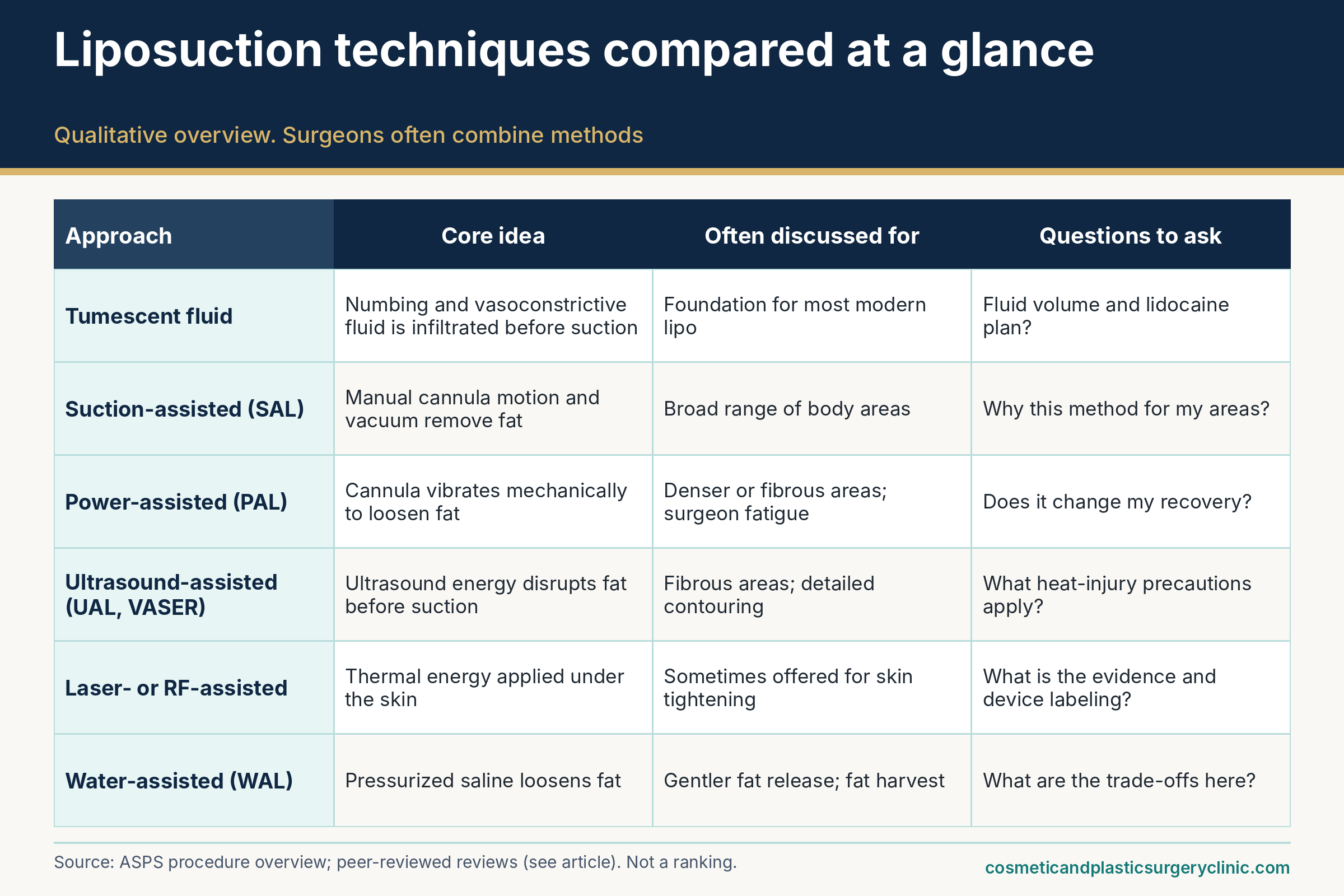
Walk into three consultations and you may hear three different technique names, each described as the key to a better result. Some of that reflects real differences in how fat is loosened and removed. Some reflects branding. This section gives a hub-level map of the main approaches and how to think about them; the separate article on liposuction techniques compares them in more depth, so this page stays on the essentials.
The core techniques
Nearly every modern liposuction starts from the same foundation, and the “named” techniques are variations on how the fat is loosened before or while it is removed.
Tumescent fluid and suction-assisted liposuction
The foundation is tumescent infiltration followed by suction-assisted liposuction (SAL). Before any fat is removed, a surgeon infuses the treatment area with a large volume of dilute fluid: saline combined with a local anesthetic (lidocaine) and epinephrine, a drug that narrows blood vessels. The fluid numbs the tissue, reduces bleeding and bruising, and swells the fat so that it separates more easily. ASPS describes the same sequence on its procedure page: a diluted local anesthetic solution is infused first, and then a thin hollow cannula is moved back and forth through small incisions to loosen fat, which is drawn out with a surgical vacuum or syringe.
Surgeons use different words for how much fluid goes in. In the ASPS evidence-based safety advisory, “superwet” infiltration means roughly one to two milliliters of fluid for each milliliter of fat expected to be removed, while “tumescent” means about three to four milliliters per planned milliliter of aspirate. Which approach is used is a surgeon’s judgment tied to the areas, the amount of fat, the anesthesia, and the facility. It also affects how much fluid and medication the body must handle, which is why the next section covers dosing context.
Tumescent technique is also the reason some liposuction can be done under local anesthesia, with or without light sedation. A large case series published in the Journal of the American Academy of Dermatology reported 3,430 consecutive liposuctions done with tumescent local anesthesia alone, found that dilute lidocaine concentrations of 400 to 500 milligrams per liter provided adequate anesthesia, and reported no deaths, while acknowledging that blood levels of lidocaine were not measured (Habbema, 2010). That is encouraging, but it is a single-center series, not a controlled comparison, and the same technique can be performed with sedation or general anesthesia in other settings.
From a regulatory angle, the suction machine, collection canister, tubing and cannulas are medical devices. FDA’s classification regulation describes a suction lipoplasty system as a device intended for aesthetic body contouring, made up of a powered suction pump with microbial filters, a collection bottle, cannula and connecting tubing, and places it in Class II, meaning special controls apply (21 CFR 878.5040). The existence of that classification says the basic equipment is regulated; it does not rank techniques or say anything about an individual surgeon’s skill.
Energy-assisted and mechanical variations
Beyond manual suction, several variations add energy or motion to loosen fat. ASPS lists them on its procedure page, and Mayo Clinic and Cleveland Clinic describe the same families.
Power-assisted liposuction (PAL) uses a cannula that vibrates rapidly, which helps break up fat so that less back-and-forth arm motion is needed. It is often discussed for denser or more fibrous areas and for large-volume cases where surgeon fatigue matters.
Ultrasound-assisted liposuction (UAL) uses ultrasonic energy to disrupt fat cells before suction. ASPS describes VASER as a newer-generation form of ultrasound-assisted lipo. Energy can create heat, and ASPS lists thermal burn or heat injury as a risk specific to ultrasound-assisted lipoplasty, which is one reason surgeons using it manage skin protection, cannula movement and treatment time carefully.
Laser-assisted liposuction places a laser fiber under the skin to liquefy fat and, in marketing at least, to promote tightening. Cleveland Clinic lists SmartLipo and SlimLipo as laser-assisted examples. Radiofrequency-assisted systems deliver radiofrequency energy under the skin for a similar combination of fat disruption and heat-based tissue contraction. Water-assisted liposuction (WAL) uses a pressurized stream of saline to loosen fat, which ASPS describes as a method of releasing fat cells with fluid rather than with energy.
What none of these pages do is rank the methods or promise that one produces a better contour or faster recovery than another. That absence is informative. When a clinic says its branded method is clearly superior, the fair response is to ask for the evidence and to ask how the claim compares with what a board-certified plastic surgeon performing a different method would say.
| Technique | How fat is loosened or removed | Why it may be chosen | Points to raise in consultation |
|---|---|---|---|
| Tumescent / superwet infiltration | Dilute anesthetic and epinephrine fluid infused before suction | Numbing, less bleeding, easier fat release | Fluid volume, lidocaine plan, monitoring |
| Suction-assisted (SAL) | Manual back-and-forth cannula motion with vacuum | Long track record across many body areas | Cannula size and strategy for my areas |
| Power-assisted (PAL) | Motorized cannula vibration | Dense or fibrous fat; large cases; reduced operator effort | Whether it changes my bruising or recovery |
| Ultrasound-assisted (UAL, VASER) | Ultrasonic energy disrupts fat before suction | Fibrous areas; fine contouring; some secondary cases | Heat-injury precautions, experience with the device |
| Laser-assisted | Laser energy under the skin liquefies fat | Marketed for added skin tightening | Evidence for tightening, device labeling, burn risk |
| Radiofrequency-assisted | Radiofrequency heat under the skin | Marketed for skin contraction after fat removal | Evidence, device labeling, thermal injury precautions |
| Water-assisted (WAL) | Pressurized saline stream loosens fat | Fluid-based fat release; fat harvesting | How the plan differs from standard tumescent |
To see how this plays out, imagine three consultation offers for the same flanks. The first practice recommends tumescent suction-assisted liposuction with sedation and explains that it uses a technique the surgeon has performed for years. The second recommends an ultrasound-assisted method, describes it as more precise, and quotes a higher fee. The third recommends a laser-assisted method with an added skin-tightening package and a bundled financing offer. None of the three proposals is automatically wrong, and none is automatically better. What separates them is the quality of the reasoning: does each surgeon connect the technique to your anatomy and skin, name the specific risks of that method, and describe what they would do if the result fell short? A surgeon who can explain why a simpler approach is enough is usually giving you better information than one who needs a premium technology to justify the fee.
Also notice where each technique is least well matched. Heat-based methods add a burn risk that purely mechanical methods do not, which is why ASPS names thermal injury under ultrasound-assisted liposuction. Mechanical and water-assisted methods trade the heat concern for other questions, such as how the fat is released and what the recovery feels like, and the sources reviewed for this guide did not establish differences in those outcomes. Because the research on head-to-head comparisons is limited, the technique matters less than the surgeon’s command of whichever method they choose, and the dedicated technique article treats these trade-offs at greater length.
Choosing between techniques and reading the marketing
The second question after “what are the techniques?” is “how do I make sense of the claims?” Two areas generate the most noise: contouring labels such as high-definition lipo, and device language such as “FDA approved.”
High-definition and sculpting concepts
High-definition (HD) liposuction is an aesthetic approach rather than a separate machine. In concept, a surgeon removes fat selectively, including from more superficial layers, to emphasize the borders of muscles such as the abdominal rectus and obliques, sometimes transferring fat to enhance muscle bulk elsewhere. It is aimed mainly at lean people who already have visible underlying muscle, and it relies on precise surgical judgment because superficial removal leaves less margin for unevenness. That is a reasonable mechanistic caution rather than a quantified risk; peer-reviewed comparisons of HD approaches against conventional approaches are limited, and the dedicated articles on high-definition liposuction techniques and natural-looking liposuction unpack the aesthetic judgment involved.
The practical advice is to treat HD and sculpting language as a conversation about aesthetic goals, not as a product. Ask the surgeon to show you consistent, dated before-and-after photographs of patients with a body type and starting point like yours, and ask how they decide how much superficial fat to leave. Our guide to evaluating liposuction before-and-after photos offers a checklist for doing that critically.
How to evaluate technique claims, device language and evidence
Start with the regulatory vocabulary, because it is frequently misused. In the U.S., drugs are approved; most aesthetic devices are cleared through the 510(k) pathway or authorized through the De Novo pathway for novel low-to-moderate-risk devices. FDA’s consumer page on non-invasive body contouring notes that a device must be reviewed for safety and effectiveness before it is legally marketed, and it separately states that such treatments do not treat obesity and may not produce the desired or lasting effect. A clearance is tied to specific labeled indications. A device cleared for one purpose and used for another is “off-label,” which is legal for physicians in many circumstances but means the labeled claims do not cover that use.
A good example of why this matters comes from FDA’s May 2023 safety communication on the Renuvion/J-Plasma device. The agency recounted that earlier use of the device for skin contraction and dermal resurfacing had been warned against, and that later clearances covered narrower uses, including an April 2023 clearance of a handpiece for coagulation of subcutaneous soft tissues following liposuction for aesthetic body contouring (FDA safety communication, May 10, 2023). The message to patients was to discuss benefits and risks with the provider and ask which device will be used. Notice how specific that clearance is: it does not say the device is proven to tighten skin after lipo, only that it is cleared for a defined use.
When a technique claim is part of a pitch, a few questions bring clarity. Which device and which labeled indication is being used? What published evidence, beyond the manufacturer’s material, supports the claim for my body area? How many cases has this surgeon performed with this method, and what do they do when it is not enough? What are the technique-specific risks, such as thermal injury with energy-based tools? A surgeon who welcomes those questions is easier to trust than one who answers with a brand name.
Anesthesia, Facility Safety and the Question of Volume Limits
If you ask anesthesiologists and plastic surgeons what separates a well-run liposuction from a risky one, the answer is seldom the cannula. It is the system around the cannula: who delivers anesthesia and monitors you, how much fluid and drug goes in, where the operation takes place, how long it lasts, how much fat is removed, and what happens in the hours after you leave. This section covers those pieces and, importantly, what professional guidance actually says about volume limits, because the internet is full of confident numbers that do not always match the source documents.
Anesthesia options and the tumescent solution
Liposuction can be performed under several levels of anesthesia, and the tumescent solution used in most cases is itself a drug-delivery decision with a dose.
Local, sedation or general anesthesia: how the choice is made
ASPS says medications are given for comfort during liposuction and that options include intravenous sedation and general anesthesia, with the surgeon recommending the best choice for the situation. In practice, there are three broad models. In tumescent local anesthesia, the dilute lidocaine solution numbs the treated tissue and you are awake, sometimes with an oral anti-anxiety medication. In sedation, an intravenous medication makes you relaxed and drowsy while local anesthetic handles the tissue numbness. In general anesthesia, you are unconscious and a breathing tube or airway device is used.
The choice depends on how many areas are treated, how much fat is expected to come out, whether other procedures are combined, your health, your preferences, and what the facility and anesthesia team can deliver safely. A small area such as the chin, or a single flank, may be done with local anesthesia and light sedation. A multi-area procedure lasting several hours generally calls for deeper anesthesia and an anesthesia professional dedicated to monitoring. The ASPS safety advisory states that general anesthesia can be used safely in the ambulatory setting (graded as an “option” with inconsistent supporting studies) and discourages epidural and spinal anesthesia in that setting because of the possibility of vasodilation, low blood pressure and fluid overload. It also states that the responsible physician must be physically present in the operating room throughout the anesthetic.
Ask who will be giving the anesthesia and what their credentials are. ASPS’s accreditation page describes facility standards that include anesthesia given by board-certified anesthesiologists or certified registered nurse anesthetists, staff trained in advanced cardiac life support, and advanced monitoring through surgery and immediate recovery. If the surgeon is the one administering sedation while also operating, ask what safeguards are in place for monitoring. You are entitled to understand the plan before the day arrives, not on a gurney.
Think, too, about the first night after surgery. In the landmark 2000 census survey of fatalities from liposuction, the authors noted that several deaths occurred the first night after discharge and suggested vigilant observation for lingering effects of sedative and anesthetic drugs (Grazer and de Jong, Plastic and Reconstructive Surgery, 2000). That is why surgical teams typically insist on a responsible adult to drive you home and stay with you overnight. Arrange that person early, and do not treat the requirement as bureaucratic.
Lidocaine and epinephrine: dose context without the guesswork
Tumescent solution contains lidocaine (the numbing agent) and epinephrine (to constrict blood vessels), and the dose is calculated by body weight. The amount absorbed matters because lidocaine in the blood at high concentrations can cause toxicity affecting the nervous system and heart. Mayo Clinic lists lidocaine toxicity among liposuction’s possible major complications, and MedlinePlus lists medication reactions or overdose from lidocaine among the serious risks.
What do the professional documents say about limits? The ASPS evidence-based safety advisory, published in 2009, concluded that an infiltrate containing up to 35 milligrams of lidocaine per kilogram of body weight is safe when injected into subcutaneous fat, provided epinephrine is included; that recommendation was graded B, which signals consistent but not top-tier evidence. It also recommended that epinephrine doses not exceed 0.07 milligrams per kilogram and cautioned against epinephrine use in people with conditions such as pheochromocytoma, hyperthyroidism, severe hypertension, cardiac disease or peripheral vascular disease.
Later pharmacology work suggests tolerance may be higher. In a 2016 study in Anesthesia & Analgesia, Klein and Jeske measured blood levels in 14 volunteers across 41 procedures with doses ranging from 19.2 to 52 milligrams per kilogram, found that all measured concentrations stayed below a mild-toxicity threshold of 6 micrograms per milliliter, and proposed preliminary maximum dosages of 28 mg/kg without liposuction and 45 mg/kg with liposuction, reasoning that fat absorbs lidocaine slowly (study record). The two sources differ, and that is the point: this is an area where researchers offer estimates, not fixed laws, and where one volunteer study of 14 people cannot settle the question.
For a patient, three takeaways follow. First, do not try to evaluate your own dose from a number you saw online; no number applies to you without your weight, medical history, other medications and the total plan. Second, ask the team how lidocaine and epinephrine are being calculated and tracked, and whether monitoring continues after the operation. Third, tell the team everything you take, including supplements and over-the-counter medicines, because other substances can influence how you handle anesthetic drugs. Disclosure is a safety step, not a formality.
Facility, staffing and volume limits
Where the operation happens, and how much is attempted in one session, shape risk more than any brand of equipment.
Accredited facilities, emergency readiness and what the data can and cannot show
ASPS says member surgeons must operate in accredited, state-licensed or Medicare-certified surgical facilities, and its accreditation page identifies three national accrediting bodies patients can check: AAAASF, AAAHC and the Joint Commission, with state licensure and Medicare certification also qualifying. Accreditation typically involves inspection of emergency equipment, medication handling, staff training, record-keeping and infection control. Our guides to accredited plastic surgery facilities and how to verify one walk through the checking process.
Large datasets from accredited facilities give some sense of scale. A 2024 national analysis in Aesthetic Surgery Journal Open Forum examined liposuction procedures in AAAASF-accredited ambulatory facilities from 2019 through 2021. It counted 984 patients with complications among 246,119 procedures, an overall rate of 0.40 percent, with unplanned emergency department presentation the most common event (24 percent of complications). The patients had a median age of 44 and a median body mass index of 28.7, and the authors recorded 21 deaths (Valentine et al., 2024). By simple division, 21 deaths among 246,119 procedures is roughly 0.009 percent, but that is this page’s arithmetic rather than a rate the authors calculated, and the study has limits: it covers facilities within one accreditation program, depends on reported events, and cannot say how many patients had other procedures at the same time.
It would be a mistake to read “accredited” as “risk-free.” Accreditation reduces avoidable hazards and standardizes emergency response, but it does not eliminate surgical risk. Equally, an unaccredited setting is not automatically unsafe, but it moves the burden of verification onto you. Ask what emergency equipment and medications are on-site, whether a defibrillator is available, what the plan is if you must be transferred to a hospital, and which hospital is the transfer partner. Ask what the team’s monitoring looks like in recovery and how soon after discharge someone checks in.
Large-volume liposuction: what the guidance actually says
“How much fat can safely be removed?” is the most searched volume question, and the honest answer is that no universal safe number exists. What exists is a set of professional recommendations, mostly based on expert opinion, with defined thresholds for added precautions.
The ASPS advisory defines large-volume liposuction as removal of 5,000 cubic centimeters (5 liters) or more of total aspirate in a single procedure, a definition graded D, meaning expert opinion. For these cases, it recommends that the operation take place in an acute care hospital or in a facility that is accredited or licensed, that vital signs and urine output be monitored overnight by qualified staff, and that fluid replacement account for the aspirate volume: intravenous fluid in addition to maintenance and infiltrate, at 0.25 milliliters per milliliter of aspirate when the aspirate reaches 5,000 mL. The advisory also states that large-volume liposuction combined with certain other procedures, abdominoplasty being the example, has led to serious complications and such combinations should be avoided. ASPS’s patient-facing risk page likewise notes special medical considerations when more than about five liters of fat is removed.
The advisory also noted that some states had set their own limits at the time of writing, listing a Florida limit of 1,000 cc of supernatant fat and a Tennessee limit of 2,000 cc for combined procedures. Because state rules change, and because this page could not verify the current text of those state rules, treat those figures as historical context from 2009 and check your state medical board for what applies today. The broader lesson is that some regulators draw lines where professional societies draw precautions.
Two cautions matter for patients. First, a threshold of 5 liters does not mean that 4.9 liters is always safe; risk reflects body size, health, operative time, fluid balance, anesthesia, and combined procedures. Second, quoting a large amount as a selling point (“we remove up to…”) is not a safety credential. A responsible surgeon talks about what each area needs rather than an impressive total.
| Topic | What the advisory says | Evidence grade | Why it matters to you |
|---|---|---|---|
| Large-volume definition | 5,000 cc or more of total aspirate in one procedure | D | Triggers additional precautions, not a pass/fail line |
| Lidocaine in infiltrate | Up to 35 mg/kg considered safe in subcutaneous fat when epinephrine is included | B | Dose is weight-based; later studies suggest estimates vary |
| Facility for large volumes | Acute care hospital, or an accredited or licensed facility | D | Ask where the procedure is booked and why |
| Overnight monitoring | Vital signs and urine output monitored overnight after large-volume cases | D | Same-day discharge may not suit large cases |
| Combined procedures | Avoid combining large-volume lipo with certain procedures such as abdominoplasty | D | Ask how combinations are staged |
| Clot risk assessment | Screen for inherited and acquired clotting tendencies; use mechanical or drug prophylaxis as appropriate | B to D | Share family and medication history |
| Spinal or epidural anesthesia | Discouraged in ambulatory settings | D | Anesthesia type is a safety choice, not only a comfort choice |
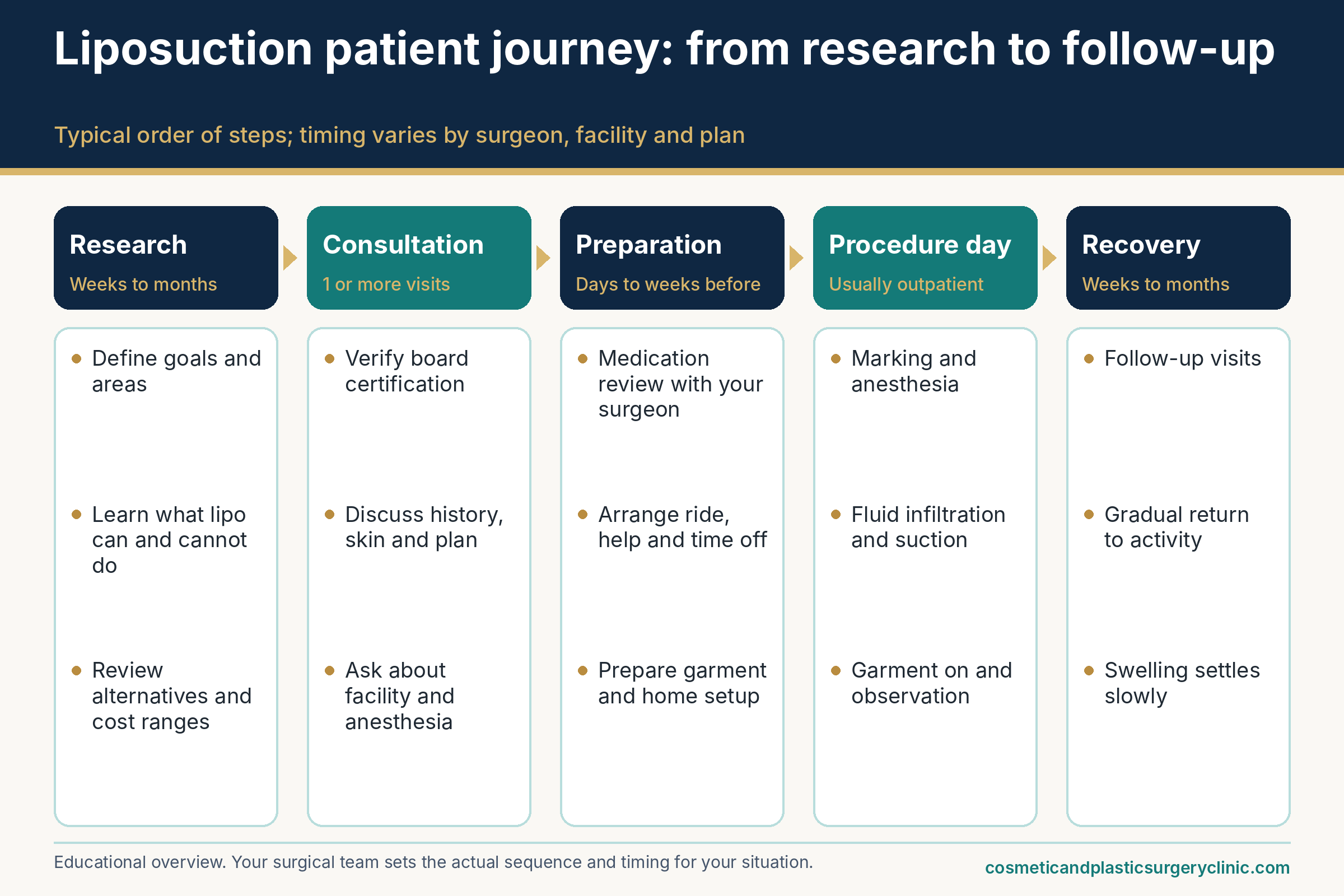
Preparation and Procedure Day: What the Sequence Looks Like
Most of what determines how a liposuction goes happens before the day itself. Good preparation means a clear surgical plan, clean medical information, a recovery setup that works for your life, and a ride home. The procedure day then follows a fairly predictable sequence. What follows is a general description based on ASPS, Mayo Clinic, MedlinePlus and Cleveland Clinic materials; your own surgeon’s instructions always take priority, and a detailed pre-op checklist is the focus of the guide on how to prepare for liposuction.
Preparation: consultation, testing and logistics
Preparation has a medical side and a life side, and both have deadlines that are easier to meet when you map them early.
Consultation, testing and medication planning
A thorough consultation covers your history, a physical exam of the areas of concern, photographs for the chart, a discussion of technique and anesthesia, the facility, the fees, and the risks. Mayo Clinic notes that the surgeon marks the treatment areas and may photograph them before the procedure, and MedlinePlus describes pre-surgery blood and urine tests along with a psychological evaluation as part of preparation. What gets tested depends on your age and health. The guide on pre-op testing for plastic surgery explains typical categories, but your surgeon and anesthesia team decide what applies to you.
Medication planning is where small oversights cause big problems. Mayo Clinic says surgeons will commonly recommend stopping certain medicines such as blood thinners and nonsteroidal anti-inflammatory drugs at least a week before surgery. That is a general statement of what is typical, not an instruction for you. Never stop a prescription medication on your own, especially anticoagulants, antiplatelet drugs, heart medications or diabetes medicines, because stopping can be dangerous. Bring a complete list, including vitamins, herbal products, weight-loss supplements and any GLP-1 medication, to the consultation and to the pre-op appointment, and ask the prescriber and the surgical team to coordinate. The time to learn that your fish oil or your birth control matters is weeks ahead of surgery, not the night before.
The informed-consent conversation is the other core piece. It should cover why this procedure and this technique, which areas and approximately how much, the specific risks that apply to you, what might require a second operation, what happens if you decide you are unhappy, what is and is not included in the fee, and who you can reach after hours. If you feel rushed to sign or to pay a non-refundable deposit on the spot, that is a pressure signal. A day or more between consultation and commitment is reasonable, and a second opinion is a normal part of decision-making; our guide to second opinions in plastic surgery shows how to use one.
Finally, align your health habits with the date. If you smoke or vape, plan your stop date with your surgeon. If your weight is moving, ask whether the date should move too. If you are on a GLP-1 medication, ask the surgeon and anesthesia team how they handle it. Aim for a stable baseline: reasonable sleep, hydration, protein intake, and any pre-op skin care your surgeon advises.
Home, work and logistics: planning around a real life
Recovery planning is a logistics project. Start with the calendar. ASPS notes that many people feel substantially better in weeks two to three and may return to work depending on job demands, while Mayo Clinic and MedlinePlus suggest returning to work within a few days is possible for some people. That wide range is exactly why you should plan by job type rather than by a generic number. A person who works at a desk and can adjust a chair may be at the early end of the range, though sitting for long periods may be uncomfortable with swollen areas. A person who lifts, bends, drives for a living, or cares for small children will likely need longer or a modified duty arrangement. Ask your surgeon how your specific job maps onto your specific procedure, and read the dedicated article on returning to work after liposuction for scenario planning.
Next, think about help. You need an adult to drive you home and stay for at least the first night. For the first several days, assume you will want someone to help with meals, pets, children, laundry and trips up and down stairs. If you live alone, ask about options such as a recovery stay or arranging a friend to check in. If you travel for the procedure, build in extra days before flying home; travel risk and clotting considerations are covered in the guide to travel after liposuction.
Set up the physical space ahead of time. Wash and lay out loose, front-opening clothing that will fit over a garment and swelling. Ask the clinic what supplies they recommend, which often include extra compression garments so you can launder one, absorbent pads for bedding or seating if drainage is expected, gauze, and a plan for showering. Fill prescriptions in advance, stock easy foods, and place a chair or bench where you can sit and dress. Confirm the payment schedule and cancellation terms in writing. If pain or sleep position are your main worry, how painful liposuction is and how to sleep after liposuction go deeper.
| When | Task | Why it helps |
|---|---|---|
| Weeks to months ahead | Consultations, credential checks, second opinion, fee comparison, weight and nicotine plan | Avoids rushed decisions and keeps the plan matched to a stable body |
| 4 to 6 weeks ahead | Medical clearance and labs if requested; review medications and supplements with prescribers | Leaves time to adjust treatment of other conditions safely |
| 1 to 2 weeks ahead | Arrange ride, overnight adult, time off, pharmacy pickup, garments, meals | Removes day-of scrambles |
| Days ahead | Confirm arrival time, fasting and shower instructions, payment, emergency contacts | Prevents cancellations and mix-ups |
| Day before | Final packing; loose clothing ready; follow fasting guidance exactly | Reduces anesthesia-related delays |
| Procedure day | Bring ID, medication list, garment if instructed; confirm marked areas and plan | Last chance to ask questions before sedation |
Think about the emotional side of the logistics too. Anticipation tends to peak the week before surgery, and it is common to feel second thoughts, to over-research, or to have trouble sleeping. Two habits help. Write down any open questions and send them to the practice before the pre-op visit, so you are not accumulating worries. And ask for a copy of the written pre-operative and post-operative instructions early, so you can read them calmly rather than for the first time on the day. If a fundamental doubt remains, such as whether you can afford the total cost or whether you are comfortable with the facility, it is acceptable and sensible to postpone. Rescheduling a procedure is easier than reversing one.
Procedure-day sequence
A typical liposuction proceeds in a recognizable order, although details vary by surgeon, areas, and facility.
Arrival, marking, anesthesia and infiltration
You arrive at the facility, confirm identity and consent, change into a gown, and meet the anesthesia provider. The surgeon examines and marks the areas to be treated, usually with you standing, because body contours look different upright than lying down. Some surgeons take pre-operative photographs at this point. An intravenous line is placed if sedation or general anesthesia is planned. Monitors for heart rhythm, blood pressure and oxygen are attached, and in longer cases a compression device is placed on the legs to support circulation, consistent with the ASPS advisory’s discussion of mechanical clot prophylaxis such as pneumatic compression devices.
After anesthesia begins and the skin is cleaned, the surgeon makes small incisions, which ASPS describes as small and inconspicuous and which surgeons try to place in natural creases or less visible spots. This is where the tumescent or superwet fluid goes in, delivered through fine cannulas in a fan-like pattern across the planned treatment region. The area swells and firms. After a short wait that allows the epinephrine to take effect, suction begins. Mayo Clinic says the procedure may last up to several hours depending on how much fat is being removed, so duration is one thing you can ask about in advance, and so is how total operative time is monitored for safety. Longer operative times were associated with wound problems in the accredited-facility analysis cited earlier.
Suction, closure, garment and discharge
During suction, the surgeon moves the cannula in a controlled back-and-forth motion through the fat in a crisscrossing pattern, often using more than one incision per area so the tunnels cross and the result blends rather than forming grooves. Aspirate collects in a canister, and the team tracks volumes by area to help maintain symmetry. The surgeon frequently pinches and examines the tissue between suction passes to judge the evenness of the remaining fat layer. The goal is a smooth layer left behind, not simply a large volume removed. If energy-assisted devices are used, they are applied at specific points in the sequence with precautions for skin protection.
Closure varies. Cleveland Clinic notes incisions may be closed with dissolvable or permanent sutures, and some surgeons leave tiny incisions open so that residual fluid can drain. ASPS describes dressings and bandages applied to the incisions and an elastic bandage, support bra or compression garment to minimize swelling and support healing; it also mentions drainage tubes where used, with a need to monitor output. If drains are part of your plan, the guide to surgical drains explains what to expect.
After the final dressings and garment go on, you move to a recovery area where nurses watch your vital signs, comfort level, and bleeding or fluid drainage as the anesthesia wears off. Discharge criteria usually include stable vital signs, adequate pain control, the ability to drink and urinate, and a responsible adult ready to take you home. Expect written instructions covering garment wear, wound care, medication, activity, warning signs, and an after-hours phone number. The first night is the time to be conservative: sit up gradually, walk short distances with help, drink fluids as instructed, and take medications exactly as directed. Anything that feels wrong, such as shortness of breath, chest pain, a leg that becomes swollen or painful, uncontrolled bleeding, or difficulty waking, warrants an immediate call to the surgical team or emergency services.
Liposuction Recovery: Timeline and Practical Aftercare
Recovery from liposuction is usually described as milder than recovery from large excisional operations such as a tummy tuck, but “milder” is relative. You will have swelling, bruising, soreness and numbness, you will wear a compression garment for a period set by your surgeon, and you will need to change what you do for a while. The more precisely you plan for the weeks after surgery, the less likely recovery is to feel like a surprise. The week-by-week companion article on liposuction recovery expands on each stage; this section gives the full arc and the planning logic.
Recovery timeline: what changes and when
Published timelines come from professional societies and large medical centers, and they agree on the general shape while differing at the edges. The sensible way to read them is as overlapping ranges.
The first days through the first two weeks
In the first day or two, expect to feel groggy, sore and swollen. Treated areas can feel tight, bruised and tender, as if after a hard workout combined with a deep bruise. Tumescent fluid and blood-tinged fluid often leak from incision sites, particularly if the incisions were left open for drainage, which is why surgeons may ask you to place absorbent pads under you at home. Some surgeons place drains; if so, you will empty and record the output. ASPS describes week one as a period of managing discomfort, swelling and bruising, with pain medication sometimes needed and a significant restriction on activity.
Walking is typically encouraged early. Short, frequent walks at home support circulation and reduce the chance of blood pooling in the legs, which matters given that blood clots are among the serious risks. That is a general principle, and your surgeon will specify how much walking is right. Resting, hydrating, taking medications as directed, and wearing the garment as instructed are the core tasks. Bruising often appears darker and spreads downward with gravity, so bruises on the thighs after abdominal liposuction are not unusual and are not necessarily a sign of a problem, although any rapidly enlarging, tense or very painful swelling should be reported at once.
Numbness and altered skin sensation are common early. MedlinePlus lists numbness lasting weeks as a typical part of recovery, and ASPS includes persistent changes in skin sensation among the risks, so the line between expected and concerning is time and trajectory. Expect early follow-up in the first days to a week; the visit checks the incisions, drain output if relevant, the garment fit, and your general condition. Between visits, your surgeon’s office should be reachable for questions, and keeping a list of questions saves anxious late-night searches.
By the end of the second week, many people feel noticeably better. ASPS places a return to work in weeks two to three depending on job demands, with activities and exercise still limited. Cleveland Clinic suggests feeling normal around two weeks. Neither statement means swelling has gone; it means energy and comfort are improving. It is common to feel good enough to overdo it at this stage, so setting activity limits in advance is useful.
Weeks three to twelve, and the long tail
From weeks three to six, bruising generally disappears. ASPS says bruising typically fades in weeks four and five while swelling begins to recede noticeably, and that from about week six onward you gradually increase activity and begin gentle exercise. MedlinePlus says visible improvement appears around four to six weeks, and that strenuous exercise should be avoided for about a month. Cleveland Clinic gives up to six weeks for resuming exercise.
The “long tail” is the portion few people anticipate. Swelling resolves slowly, sometimes over many months, and it can fluctuate: more in the evening, after salty meals, after exercise or in warm weather. Treated areas can feel firm, lumpy or uneven for a time as the tissues heal. These are common topics of conversation at follow-up visits, and your surgeon can say what is expected for your technique and whether any therapy, such as massage or other treatments, is appropriate for you. Do not start massage, devices or deep-tissue work on your own because the timing and method matter. Cleveland Clinic gives complete healing as up to six months and a view of final results at three to six months, so judging the outcome at week four is judging a work in progress. The guide to swelling after plastic surgery explains why swelling behaves this way.
Warning signs matter across the whole timeline. Cleveland Clinic advises contacting your provider for severe or lasting pain, persistent swelling, leaking fluid or blood, fever, shortness of breath or chest pain. Shortness of breath, chest pain, or a swollen, painful, warm or red leg are emergencies that call for urgent care instead of a message to the clinic. Fever, spreading redness, pus or a foul odor from an incision suggest infection. One-sided swelling that grows quickly or a tense, bruised area that is becoming painful may signal bleeding or a fluid collection. If you are unsure, call, because a quick phone call is a better outcome than a delayed one.
| Scenario | Likely early constraints | Planning notes |
|---|---|---|
| Desk job, remote option | Soreness, garment, difficulty sitting for long stretches in the first days | Some return within days to a couple of weeks; plan breaks and a comfortable chair |
| On-site office job, commute by car | Driving limits while on prescription pain medicine; swelling | Plan a ride; ask surgeon when driving is appropriate |
| Job with lifting, bending or long standing | Lifting limits, fatigue, swelling | May need weeks off or modified duty; discuss specifics and paperwork early |
| Caring for infants or toddlers | Cannot lift or carry safely at first | Arrange hands-on help for the first one to two weeks or longer |
| Regular gym routine or sport | Exercise paused; gradual return | Professional-society overviews describe weeks before gentle exercise; follow your surgeon’s schedule |
| Travel planned | Clot risk with prolonged sitting; swelling in flight | Ask surgeon for a minimum wait; avoid booking travel soon after surgery |
Practical aftercare: garments, activity and daily life
Aftercare is the portion of recovery you control. It also contains the information that has the thinnest evidence base, so it helps to separate convention from proof.
Compression garments, wound care and what the evidence supports
Nearly every liposuction protocol includes compression. ASPS states that after the procedure you must wear an elastic bandage, support bra or compression garment to minimize swelling and support your body as it heals. Mayo Clinic and MedlinePlus say garments are typically worn for several weeks. Your surgeon will specify how many hours a day, for how many weeks, and whether a second layer or foam pads are used over specific areas. The practical issues are fit (tight enough to support, not so tight that it cuts in or numbs your skin), hygiene (a spare so one can be washed), bathroom access (garments with a crotch opening or a design you can manage), and skin checks (folds, rolled edges, rashes or blisters).
It is worth knowing how modest the evidence is. A 2023 practical review in Plastic and Reconstructive Surgery Global Open examined the literature on postoperative compression garments across plastic surgery and found evidence that was highly heterogeneous in volume, quality and agreement depending on the context. The most reliable benefits were seen in rhinoplasty and in breast and abdominal procedures for pain, compression showed no effect on seroma, and the authors urged surgeons to reconsider routine use and noted potential downsides such as discomfort, venous complications and skin damage (Ormseth et al., 2023). That review was not limited to liposuction, so it does not prove that garments do nothing after lipo; it shows that the length of time and the rigid protocols patients are given rest more on custom than on controlled trials.
What follows for you? Wear the garment as your surgeon directs, because your surgeon owns the plan and knows the technique used. If it is causing numbness in your hands or feet, breathing difficulty, severe pain, or skin breakdown, call rather than loosening it on your own and hoping. If the protocol seems different from another clinic’s, ask why; there may be a specific reason related to your areas. More detail on types and fit is in the guide to compression garments after plastic surgery.
Wound care is usually simple: keep the small incisions clean and dry as instructed, change dressings when told, and shower when the surgeon says it is safe. Incisions are small and typically leave faint marks, though scarring varies; the dedicated article on liposuction scars covers placement and care.
Work, exercise, driving, travel and sleep
Think in layers. The earliest layer is basic function: getting in and out of bed, showering, dressing, short walks. The second layer is routine responsibilities, including desk work, errands, short drives and light housework. The third is strain: lifting, high-impact exercise, abdominal-heavy workouts, and prolonged standing. Your surgeon sets the gates between layers, and each gate depends on what was treated and how much. A person who had a small flank area treated may open gates faster than a person who had several areas treated at once.
Exercise is the gate people ask about most. Gentle walking is encouraged from the start. Resuming general exercise is usually weeks away, with ASPS describing gentle exercise beginning from about week six and MedlinePlus suggesting avoidance of strenuous exercise for about a month. Return to heavy lifting or intense abdominal and core work is a more conservative gate. The exercise-specific article, exercise after liposuction, gives a staged framework. Given the Brazilian trial discussed earlier, in which the non-exercising group saw a rise in visceral fat, there is also a longer-term reason to build exercise back in once cleared.
Driving requires that you are off sedating pain medication, can turn and brake without hesitating, and have been cleared by your surgeon. Air travel is a clot-risk and logistics question: prolonged sitting plus recent surgery, plus compression, plus swelling, call for surgeon-specific advice, and booking nonrefundable trips within the first weeks is a gamble. For sleep, surgeons often suggest sleeping on your back or in a position that avoids pressure on treated areas and incisions, with the garment on, but positions differ by area. Plan pillows, and leave extra time for dressing and bathing.
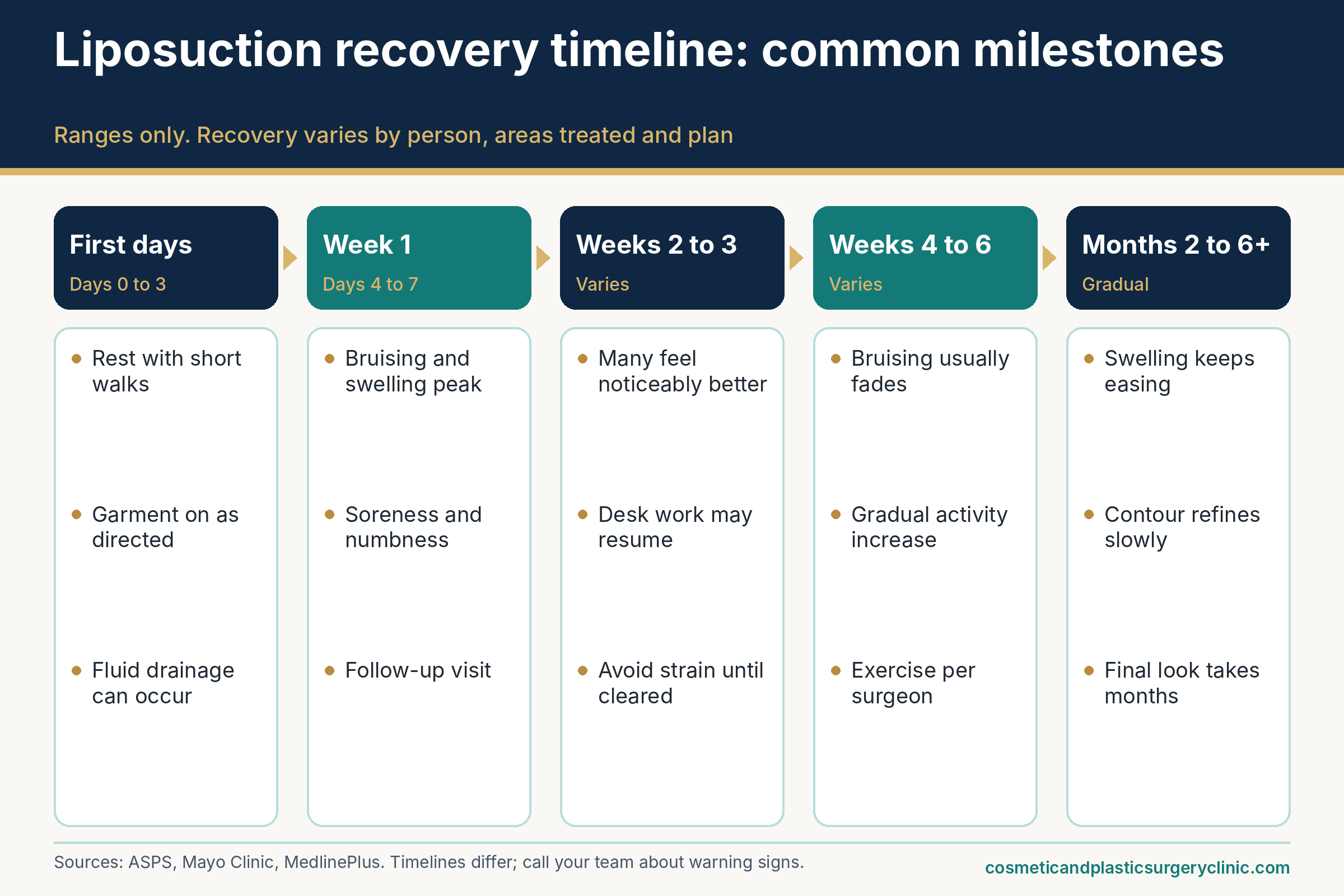
Liposuction Results: Timeline, Realistic Expectations and Longevity
Results are the part of liposuction that people picture first and understand last. The picture is a smoother waistline or slimmer thighs; the reality includes a long swelling phase, a result that is always influenced by skin and anatomy, and a durability story that is more nuanced than “fat cells are gone forever.” This section lays out when results appear, how to set expectations without relying on a single before-and-after photograph, and what the research says, and does not say, about whether the change lasts. For a narrower treatment of each subtopic, see the articles on liposuction results and how long liposuction lasts.
When results appear and what to expect
The honest answer to “when will I see my result?” is “in stages, and later than you want.”
Swelling, healing and the timeline of visible change
ASPS explains that improved body contour becomes visible once the swelling and fluid retention that follow liposuction subside. That sentence hides a lot of time. MedlinePlus says visible improvement is seen around four to six weeks after surgery. Cleveland Clinic suggests that complete healing can take up to six months and that final results are best judged at about three to six months. Those figures do not disagree; they describe the difference between the first signs of change and the point at which contour has mostly settled.
It helps to think of recovery as a three-phase curve. In the first phase, swelling hides everything, and in some people the treated area looks larger than before. In the second phase, from roughly weeks four to twelve, swelling declines enough that clothing fits differently and the new shape begins to show, although it can look uneven, firm or slightly lumpy as tissues soften. In the third phase, in the months that follow, residual swelling continues to ease and the contour refines. Some people notice fine changes even beyond six months. Because the curve is gradual, short-term comparisons mislead: a mirror check at week three tells you little about the result at month six.
A practical habit is to track progress consistently rather than emotionally. Take photographs at the same time of day, in the same lighting and posture, wearing similar clothing, at intervals such as four weeks, three months and six months. Measure with a soft tape at defined landmarks if your surgeon agrees. Compare against baseline and against your own goals, not against someone else’s pictures. Ask in advance when your surgeon would consider the result mature enough to evaluate, and whether any decisions, such as revision, should wait until then. Judging too early is a common reason people ask for revision procedures that later turn out to be unnecessary.
Keep in mind that swelling responds to conditions around it: hormonal cycles, salt intake, heat, long days on your feet, travel, and exercise intensity. A “bad day” at week ten is usually a swelling day, not a lost result, although a sudden, one-sided or painful change should be reported. Recovery-focused articles such as swelling after plastic surgery go into patterns that help you tell the difference.
Realistic expectations: what changes, what stays
Liposuction can reduce volume in treated areas and change proportions. It cannot rebuild skin, erase asymmetry that is rooted in bone or muscle, or guarantee a particular shape. Natural asymmetry, such as one hip being slightly higher or one flank carrying more fat, is common in untreated bodies and may persist after treatment; the surgeon’s goal is balance, not mirror-image symmetry. Residual fat is also expected: a good result leaves an even layer, not a bare one. Removing too much fat to chase a thinner look is a path to contour irregularities and a hollowed appearance.
What stays unchanged is as important as what changes. Cellulite usually remains. Stretch marks remain. Loose skin may remain, or may look looser once the fat beneath it is gone. Fat in untreated areas is still there and will become more noticeable by contrast. And the broader numbers on the scale generally do not move much, because the weight of removed fat is a small proportion of body mass. People who expect a wardrobe-size change may be disappointed, while those who expect a visible refinement of a stubborn area are more often satisfied. MedlinePlus summarizes outcomes in measured terms: most people are satisfied with the results, but maintaining them requires regular exercise and healthy eating.
Photographs deserve special caution. Before-and-after photos are informative only when they are consistent in angle, lighting, distance, posture and time since surgery, and when they include patients whose starting anatomy resembles yours. A single standout image says little about typical results. Ask to see a range, including ordinary outcomes and any patient who needed a second procedure, and ask what the surgeon would do differently. The article on evaluating liposuction before-and-after photos offers a more detailed checklist, and avoid trusting social-media posts as proof of what any technique can deliver.
Timing a result around real events deserves a separate comment. People often want to look their best for a wedding, a vacation or a milestone, then work backward to a surgery date. Given the timelines above, a date that leaves only a few weeks is likely to arrive in the middle of swelling, with the garment still on and the contour not yet defined. A buffer of several months before an event is a more realistic planning window, and many people choose a quiet season at work and home for the same reason. If the event is fixed and close, the more honest option may be to postpone surgery until afterward. Pressure to meet an event date is also a common reason people consent to more or faster than their surgeon would otherwise recommend.
Longevity: fat cells, weight change and maintenance
Whether the result lasts is one of the most commonly asked questions and, scientifically, one of the more interesting. The popular answer, that fat cells removed are gone for good, is partly true and partly oversimplified.
Fat cells removed, fat cells remaining: what the studies show
The simplest and best-supported part is this: the fat cells that are removed do not grow back. Mayo Clinic states that the resulting shape changes are usually permanent as long as your weight stays the same, and cautions that if you gain weight, fat levels may change. Cleveland Clinic similarly says liposuction permanently removes fat cells but that weight gain can still occur in treated areas. The complication is that the fat cells that remain can change size. A 2008 study in Nature that used carbon-14 dating to track fat cell turnover in people found that the number of fat cells in adults stays constant regardless of weight changes, with about 10 percent of fat cells renewed each year (Spalding et al., 2008). That work did not involve liposuction patients, but it supports the general logic: in adulthood, fat mass changes mostly because cells shrink or expand rather than because new ones are added or lost, so cells left behind after suction can still enlarge with weight gain.
Whether fat reappears elsewhere is where studies disagree. A 2011 paper in Obesity from the University of Colorado reported that after liposuction, fat returned within a year and showed up in other areas, notably the upper abdomen and the shoulders and triceps, which the authors interpreted as evidence that the body tightly regulates fat stores (press summary of Hernandez and Eckel). This article reviewed only the press summary, not the full abstract, so details such as the number of participants are not stated here. A 2012 study in Plastic and Reconstructive Surgery by Eric Swanson, a plastic surgeon, measured 301 patients with standardized photographs and computer-assisted measurements at least three months after surgery, some followed for a year or longer, and reported no regrowth in treated areas and no redistribution to untreated areas, including in patients who gained weight (ASPS press release summarizing the study). Note that both of those summaries come from press materials: one from a university, one from the professional society that publishes the journal.
A third piece concerns visceral fat. In the randomized trial published in 2012 by Benatti and colleagues, 36 healthy normal-weight women had small-volume abdominal liposuction. At six months the non-exercise group had a 10 percent increase in visceral fat, while the group that exercised did not, and abdominal subcutaneous fat remained lower in both groups (study record).
| Study (year) | Design and population | Reported finding | Limits to keep in mind |
|---|---|---|---|
| Spalding et al., Nature (2008) | Carbon-14 dating of fat cell age in people, not specific to liposuction | Adult fat cell number stays constant despite weight change; about 10% renewed per year | Not a liposuction trial; indirect relevance |
| Hernandez and Eckel, Obesity (2011) | Women who had liposuction, followed with body-composition scans | Fat returned within about a year, including in the upper abdomen and the shoulders and arms | Reviewed via press summary; sample size not confirmed here |
| Swanson, Plast Reconstr Surg (2012) | 301 patients; photos and computer-assisted measurements; at least 3 months, some 1 year or more | No fat regrowth in treated areas and no redistribution to untreated areas | Reviewed via ASPS press release; not randomized; author is a surgeon |
| Benatti et al., JCEM (2012) | Randomized trial, 36 healthy normal-weight women, small-volume abdominal liposuction, 6 months | Non-exercise group had about 10% more visceral fat; exercise group stable | Small, short follow-up, small-volume lipo |
Maintenance, aging, pregnancy and medications
Given the mixed research, a practical stance is to treat the result as durable but not weight-proof. The core maintenance factors are weight stability, regular physical activity, and general health habits. A stable weight gives you the best chance of keeping the contour you paid for. Gaining a moderate amount of weight after surgery does not cancel the result, but the gained fat will distribute according to your body’s pattern and remaining fat cells, and in areas that were heavily treated the change can look different than before. Losing a large amount of weight can shrink remaining cells and reveal skin looseness that was masked by volume.
Aging will continue to change both skin and fat. Collagen thins, elasticity declines, and fat distribution shifts with hormones, so even a stable-weight patient will see their treated areas age along with the rest of the body. Pregnancy changes everything in the abdomen and hips, which is why many surgeons advise delaying body contouring until family planning is complete. Medication changes can matter too. Starting or stopping a GLP-1 medication, steroids, or hormone therapy can alter weight and fat distribution. ASPS’s 2025 report found that more than half of surveyed ASPS member surgeons received GLP-1-related requests for liposuction consultations, which suggests the issue is real for many patients, though the statistics establish no causal link.
The healthiest framing is that liposuction is a milestone in a body-composition journey, not an endpoint. If weight changes later and a secondary treatment is considered, the options are discussed in the section on revision. The best insurance is a surgeon who matched the plan to a stable body to begin with, and a lifestyle that you can sustain without feeling punished. Our liposuction revision guide covers the when and why of secondary procedures.
Skin Laxity, and When Liposuction Alone Is Not the Right Tool
A frequent consultation scenario goes like this: someone arrives asking for liposuction of the lower abdomen, and the surgeon explains that what is bothering them is not just fat but loose skin and a stretched abdominal wall. The conversation shifts from “how much fat can we take?” to “which operation actually addresses the thing you see in the mirror?” This section explains why skin and muscle often decide the plan, how heat-based tightening claims should be read, and how liposuction compares with a tummy tuck and other lifts.
Understanding skin laxity
Skin that has been stretched and has lost recoil is called lax. The practical problem for lipo is that suction removes volume from beneath the skin, and the skin then has to redrape on its own.
Why skin may not redrape, and how surgeons assess it
Skin elasticity depends on collagen and elastin in the dermis. Pregnancy, major weight changes, aging, sun exposure, smoking and genetic factors all affect how well it recoils. When a stretched area loses fat volume, skin that retains good elasticity usually contracts toward the new shape, while less elastic skin may hang. ASPS summarizes it succinctly: liposuction effectively treats stubborn fat, but skin can contract only so much, and those with soft, thin skin from stretch marks or weight loss may need additional surgery. The same overview notes that secondary procedures may sometimes be recommended to reduce excess skin.
No reliable at-home test predicts how skin will respond. Surgeons judge by examination: looking at the area standing and lying down, pinching and lifting the skin to see how it snaps back, noting stretch marks and prior scars, and looking at the difference between how the area appears at rest and when you flex or bend. They also ask about weight history, pregnancies, and the time elapsed since your weight stabilized. Photographs from different angles help. Even so, prediction is imperfect. Two people with similar exams can heal differently, which is why surgeons should be candid about uncertainty and why the best consultations discuss a range of outcomes, including what the skin might look like if it doesn’t tighten.
Different areas behave differently. Skin on the upper arms and inner thighs tends to be thin and prone to laxity. Skin over the lower abdomen after pregnancy can be stretched with an overhang that no amount of fat removal will remove. Skin on the flanks and outer hips may be more forgiving in younger patients. Neck and jawline skin, relevant for chin liposuction, depends heavily on age; the chin liposuction guide addresses that area.
A realistic plan uses these exam findings to set expectations on a spectrum. At one end, good elasticity and mild fat excess favors lipo alone. In the middle, mild to moderate laxity might still be acceptable if you accept a looser or softer look, or if energy-based adjuncts or a staged approach are considered. At the other end, marked laxity or hanging skin suggests an excisional procedure, because only removing skin changes skin excess. Patients who choose lipo against that advice sometimes find the post-swelling contour is not what they hoped, and then need a second operation that includes skin removal. That sequence can be avoided when the first consultation makes the trade-off explicit.
Energy-based tightening, nonsurgical options and what the evidence supports
Many clinics promote laser-assisted or radiofrequency-assisted liposuction as providing “skin tightening,” based on the idea that heat delivered under the skin triggers contraction and collagen remodeling. Heat effects are real biological phenomena, but marketing often outruns the evidence about how much tightening occurs and whether it is clinically meaningful and durable for a given patient. Mayo Clinic and Cleveland Clinic list laser-assisted liposuction as an option; neither promises superior tightening, and ASPS’s list of risks includes thermal injury with ultrasound-assisted lipo specifically.
FDA’s own statements are a useful anchor. In its 2023 safety communication on the Renuvion/J-Plasma device, FDA reported clearances for specific uses, including a handpiece cleared to coagulate subcutaneous soft tissues after liposuction for aesthetic body contouring and another cleared for improving the appearance of loose skin in the neck and submental region, and it noted earlier warnings against using the device for skin contraction outside its labeled uses. Clearance describes a defined use and a review of safety and effectiveness for that use. It does not guarantee a particular amount of tightening on your abdomen. If a clinic proposes adding a heat-based device to your liposuction, ask what the device’s labeled indication is, what the published evidence shows for your body area, what the added cost is, and what the burn and contour risks are.
Nonsurgical skin-tightening treatments performed separately, such as radiofrequency or ultrasound devices, are a distinct category. FDA’s overview of non-invasive body contouring says these technologies aim, among other things, to improve skin tightening through collagen stimulation, while stating that results may not produce the desired effect or may be only temporary, and that maintenance treatments may be needed. For a deeper comparison see the guide to nonsurgical skin tightening. The reasonable stance for mild laxity is that these options may modestly help some people, with real costs and uncertain durability, while marked laxity is a surgical problem.
Plain-language scenarios help make the continuum concrete. Consider someone who has carried two pregnancies and has a lower belly that protrudes when standing and softens when lying down, with a faint ridge down the midline when they sit up. That description points to stretched abdominal muscles and likely some excess skin, both outside what suction can reach, so a surgeon would likely discuss abdominoplasty. Consider someone else who lost a modest amount of weight years ago, has a stable weight, and has a soft pocket of fat above each hip that has never responded to training, with skin that returns quickly when pinched. That description is a more typical match for liposuction of the flanks. A third person has fat and loose skin on the inner thighs after significant weight loss; fat reduction alone may leave a crepey, sagging contour, and the surgeon may discuss a thigh lift. These sketches are teaching examples, not evaluations, but the pattern is the point: describe what you see and feel, not just which procedure you have heard of.
Liposuction versus tummy tuck and other lift procedures
The hardest decision for many people is not whether to treat the abdomen but which operation to choose. The comparison depends on what you see: fat, loose skin, a bulging abdominal wall, or all three.
Liposuction versus abdominoplasty: the decision logic
A tummy tuck, or abdominoplasty, addresses a different set of problems than lipo. It removes excess skin from the lower abdomen, usually tightens the abdominal muscles that have stretched apart (a condition often called diastasis recti), and may reposition the navel. Lipo addresses only fat. The price of those additional effects is a longer scar placed low on the abdomen, a longer operation, a longer recovery, and a different risk profile. The tummy tuck guide covers it in detail.
A logic tree helps. If your abdominal profile bothers you mainly because of a layer of fat over firm muscle and skin that snaps back, lipo may suit. If you can pinch a roll of skin that hangs or folds, or you notice a bulge or ridge along the midline when you strain, a muscle or skin problem is likely contributing, and lipo alone will leave it in place. Both can be present together. Many surgeons use liposuction as part of a tummy tuck to refine the flanks and upper abdomen while the skin and muscle are tightened, a combination that raises safety considerations discussed in the combination section. Remember the ASPS advisory’s caution against combining large-volume liposuction with abdominoplasty.
Cost and recovery trade-offs are real. Based on ASPS surgeon fee data, the 2023 average fee was $4,711 for liposuction and $8,174 for abdominoplasty, and for 2024 ASPS reported projected ranges of $4,300 to $7,500 and $8,000 to $13,500 respectively. Those figures exclude anesthesia and facility fees and are not quotes; the point is the direction of the difference, not the exact amounts. Recovery for a tummy tuck usually involves more restriction and drains, so scheduling and caregiving needs also differ.
| Consideration | Liposuction alone | Tummy tuck (abdominoplasty) | Tummy tuck with liposuction |
|---|---|---|---|
| What it treats | Fat volume in selected areas | Excess lower abdominal skin; often muscle laxity | Skin, muscle and surrounding fat contour |
| Loose skin | Does not remove it; may reveal it | Removes excess abdominal skin | Removes skin and refines contour |
| Separated abdominal muscles | Not addressed | Often repaired | Often repaired |
| Scars | Small incisions | Longer scar low on the abdomen | Longer scar plus small incisions |
| ASPS average surgeon fee, 2023 | $4,711 | $8,174 | Quoted separately by practice |
| ASPS projected surgeon fee range, 2024 | $4,300 to $7,500 | $8,000 to $13,500 | Quoted separately by practice |
| Recovery burden | Generally lighter, weeks | Heavier, often drains and longer limits | At least that of tummy tuck |
| Main safety caution | Contour irregularity, fluid collections, clots | Wound healing, fluid collections, clots | Combined-procedure risk rises, volume matters |
Arm, thigh and body lifts, and how lipo fits in
The same fat-versus-skin logic applies beyond the abdomen. Arm lifts, thigh lifts, lower body lifts and upper body lifts remove excess skin and tighten underlying tissue in those regions, with scars placed where they can be hidden by clothing as well as possible but still permanent. They suit people with substantial laxity, often after major weight loss. Lipo is sometimes used as a supporting tool, refining areas around the lift or reducing bulk before skin is removed, but a surgeon will usually decide this during planning.
ASPS’s 2025 report shows how much interest has moved toward lifts: in its release, facial fat grafting led growth at 39 percent, and upper body lifts rose 22 percent, arm and neck lifts 21 percent each, and thigh lifts 20 percent, with the report cautioning that its statistics do not establish a causal relationship to GLP-1 use. Those growth rates describe procedure counts from a specific estimate, not outcomes, but they suggest that many people are weighing skin-removal procedures alongside lipo. The hub guide on body lift surgery explains how circumferential approaches work.
A fair summary for decision-making: choose lipo when the question is fat; choose a skin-removal procedure when the question is skin; plan for both when both matter. If a surgeon only offers one tool, ask what they would recommend if the other tool existed, and seek a second consultation with a surgeon who performs the alternative. Pressure to fit your anatomy to the procedure a practice sells most is a red flag.
Liposuction Risks, Complications and Risk Reduction
Every operation has risks, and liposuction is sometimes marketed as if it did not because the incisions are small. The scale of the surgery is smaller than many operations, but its risks are real and include a handful that can be life-threatening. This section describes what ASPS and the published literature report, gives the best available numbers with their limits, and then focuses on what patients and surgeons can do to reduce risk. For a standalone treatment of the topic, see the guide to liposuction risks and complications.
A word about numbers. Complication rates vary across studies because definitions differ (what counts as a seroma or an infection), because patients differ (healthy outpatients versus mixed populations), because some studies include combined procedures and others do not, and because follow-up lengths are inconsistent. A range is more honest than a single figure, and a figure from one accredited-facility database does not describe every setting. Read every number below as a signal about scale rather than a personal prediction.
One more tool for reading these numbers is to translate percentages into counts. A rate of 0.06 percent, the figure reported for venous thromboembolism after isolated liposuction in the 2023 review, is about 6 in 10,000 procedures. A rate of 0.40 percent, the overall complication rate in the 2024 accredited-facility analysis, is about 4 in 1,000. A 2.7 percent contour-irregularity rate is about 27 in 1,000, and a 9 percent upper-end figure is 9 in 100. Seen side by side, contour problems are far more likely than clots, and both are far more likely than death, which is why surgeons spend more time on the common issues than the rare ones even though the rare ones are more frightening. At the same time, a small probability is not a zero probability, and the person who experiences a rare event experiences it fully.
Also consider the difference between relative and absolute risk. When a study reports that combined procedures carried roughly five times the risk of complications, that multiplier applies to a baseline that was already small; five times 0.7 percent is still a minority of patients, but it is a materially larger group than 0.7 percent. A doubling or quintupling matters most when the baseline is not trivial or when the complication is severe. That is one reason the guidance on large-volume and combined procedures emphasizes extra precautions rather than prohibition.
Common and less common complications
Most complications fall into the category of contour and healing problems that are bothersome rather than dangerous, though some can require a second procedure.
Contour irregularities, fluid collections, bleeding, sensation changes and wound problems
ASPS lists the following possible risks: anesthesia-related complications, bruising, damage to deeper structures such as nerves, blood vessels, muscles, lungs or abdominal organs, cannula breakage, persistent changes in skin sensation, blood clots and cardiac or pulmonary complications, fluid accumulation, infection, asymmetrical or irregular contours, rippling, skin laxity or worsening cellulite, poor wound healing, the need for revision, and burns or heat injury from ultrasound-assisted liposuction.
Contour irregularity is the most commonly reported complication across reviews. A 2023 systematic review of 16 studies published from 2016 to 2021 reported irregular contour in up to 9 percent of cases (Barros et al., Revista Brasileira de Cirurgia Plástica, 2023), and a 2017 narrative review cited a 2.7 percent incidence of contour irregularities (Bellini et al., Annals of Medicine and Surgery, 2017). The wide gap illustrates how definitions differ. Irregularities include dents, waviness, residual fullness, asymmetry and over-resection; some soften as swelling resolves, and some persist and lead to revision.
Seroma is a collection of clear fluid beneath the skin, and hematoma is a collection of blood. The Barros review reported seroma in 2 to 19 percent depending on technique and drainage use, and hematoma in 0.15 percent of isolated liposuctions and 0.4 to 0.9 percent when combined with other procedures. Small collections may resolve; larger ones may need needle drainage or other treatment. Infection was reported at 0.1 to 4.27 percent in the Barros review, whereas the Bellini review called infection extremely uncommon at under 1 percent; again, definitions and populations differ. Hyperpigmentation, a darkening of skin over treated areas, was reported at 0.02 to 2.67 percent in the Barros review.
Numbness and altered sensation are expected early and usually improve, though ASPS lists persistent changes among the risks. Wound problems can include delayed healing or wound separation, and in the 2024 accredited-facility analysis, wound disruption was associated with the longest operative times. Severe loss of skin from compromised blood supply, called skin necrosis, is a recognized but rare problem of poor wound healing; this article was not able to verify a reliable frequency, and it is listed as an item for medical review rather than quoted. Contact your surgeon about any area of skin that becomes dusky, blistered or very painful.
When one study of 31,010 liposuction procedures performed from 2008 to 2013 in a quality-assurance database examined liposuction done alone, it reported a 0.7 percent major complication rate, including hematoma (0.15 percent), pulmonary complications (0.1 percent), infection (0.1 percent) and confirmed venous thromboembolism (0.06 percent) (Kaoutzanis et al., Aesthetic Surgery Journal, 2017). In the same study, combining liposuction with other procedures raised the overall risk of complications about fivefold (relative risk 4.81) and the risk of venous thromboembolism by a similar magnitude (relative risk 5.65).
Serious and rare events: clots, fat embolism, drug toxicity, organ injury and death
The most serious complications are rare, and that rarity is exactly what makes them hard to measure and easy to dismiss. They deserve plain description.
Venous thromboembolism (VTE) means a blood clot in a deep vein (deep vein thrombosis, DVT) that can travel to the lungs (pulmonary embolism, PE). In the 2023 systematic review, VTE was reported at 0.06 percent with isolated liposuction and 0.2 to 1.5 percent in combined procedures. An analysis of 3,338,519 surgeries in accredited facilities between 2019 and 2023 found 247 DVT or PE events overall, and among 67 plastic surgery patients with such events, liposuction was the procedure most frequently associated (38.8 percent), with more favorable outcomes for cosmetic than non-cosmetic cases (Foppiani et al., 2025). That last statistic describes the share of clots among a small group, not the chance that liposuction causes a clot, and it should not be read as a risk rate.
Fat embolism occurs when fat globules enter the bloodstream and lodge in the lungs, brain or elsewhere. Mayo Clinic and MedlinePlus both list it as a possible serious complication. The ASPS advisory describes warning signs such as rapid heartbeat, rapid breathing, fever and low oxygen, which is a clinician-facing description but a useful reminder that sudden breathing trouble after surgery is an emergency.
Lidocaine toxicity and fluid overload are related to the tumescent technique, covered earlier. Organ or deeper-structure injury, such as bowel or abdominal wall penetration, is rare but is named by ASPS and Mayo Clinic. Anesthesia reactions can occur with any anesthetic.
Death is the hardest subject and should be stated without drama. In a 2000 census survey of board-certified aesthetic plastic surgeons, 917 of 1,200 North American surgeons responded and reported 95 authenticated deaths among 496,245 procedures, a rate of about 1 in 5,224 (19.1 per 100,000), with pulmonary thromboembolism the leading cause (Grazer and de Jong, 2000). A 2024 analysis of 246,119 liposuctions in accredited ambulatory facilities between 2019 and 2021 recorded 21 deaths, and the 2023 systematic review reported mortality ranging from 0 to 0.06 percent across studies. These sources cannot be compared directly: the earlier figure came from a voluntary survey of a different era and may include combined procedures, while the later figures come from different databases. What they share is that the risk is low but not zero and that clots feature prominently.
| Complication | Reported figure | Source, population and year | Caveat |
|---|---|---|---|
| Contour irregularity | 2.7% (Bellini); up to 9% (Barros) | Narrative review (2017); systematic review of 16 studies from 2016 to 2021 (2023) | Definitions and follow-up differ |
| Seroma | 2% to 19% | Systematic review of 16 studies (2023) | Varies with technique and drain use |
| Hematoma | 0.15% alone; 0.4% to 0.9% combined | Systematic review (2023); 0.15% in 31,010 procedures (2017) | Combined procedures differ in bleeding risk |
| Infection | Under 1% (Bellini); 0.1% to 4.27% (Barros) | Narrative review (2017); systematic review (2023) | Range is wide; definitions vary |
| Venous thromboembolism | 0.06% alone; 0.2% to 1.5% combined | Systematic review (2023); 0.06% confirmed VTE in 31,010 procedures (2017) | Combined procedures carry higher risk |
| Any reported complication | 0.40% | 984 patients among 246,119 procedures, AAAASF-accredited facilities, 2019 to 2021 (2024) | Only reported complications in one accreditation program |
| Death | About 19.1 per 100,000 (1 in 5,224) | Survey of 917 responding surgeons, 95 deaths among 496,245 procedures (2000) | Older survey; voluntary reporting; different era |
Reducing risk and knowing when to call
You cannot remove risk, but you can influence several of the factors that drive it, and you can learn to recognize the signs that need action.
A risk-reduction framework: patient, plan, place and prevention
It is useful to organize risk reduction into four levers.
Patient factors. Your health, weight, medications and habits change risk. In the 2024 facility analysis, venous thromboembolism was associated with higher median body mass index (30.1), and in the 2017 study, age and BMI each independently predicted complications. Give your surgeon an honest, complete history, including prior clots, family history of clotting disorders, hormone therapy, and every medication. Follow instructions about nicotine and anticoagulants.
The plan. The scope of the operation matters. Combining liposuction with other procedures, treating many areas at once, operating for very long periods, and removing very large volumes all push risk up. The accredited-facility analysis linked wound disruption with the longest operative times (a median of 261 minutes), and the ASPS advisory urges special precautions for aspirate of 5,000 cc or more. A plan that stages procedures or limits scope may be less exciting and safer. Ask what the surgeon would do differently if safety were the only priority.
The place. Choose a facility that is accredited, licensed or Medicare-certified, with qualified anesthesia professionals, monitoring, emergency equipment and a transfer plan, as described earlier.
Prevention. The ASPS advisory recommends assessing each patient’s clotting risk and using mechanical prophylaxis such as compression stockings or intermittent pneumatic compression devices, with anticoagulation considered where appropriate. A 2025 analysis of accredited facilities found that facility-level gaps in prophylaxis ranged from 7.4 to 14.17 percent and that inadequate protocols correlated with more thromboembolic events. After surgery, early walking, a responsible overnight adult, careful medication use, and attention to symptoms are the patient’s share of prevention.
| Lever | What evidence or guidance suggests | Question to ask |
|---|---|---|
| Patient health | BMI and age predicted complications in a 31,010-procedure study; clot history matters | What in my history raises my risk, and how will you address it? |
| Scope of surgery | Combined procedures raised complication risk; long operations linked to wound problems | Should this be staged? How long will the operation take? |
| Volume and fluids | ASPS advisory sets added precautions at 5,000 cc or more of aspirate | How much do you expect to remove, and what is the fluid plan? |
| Facility | ASPS members operate in accredited, licensed or Medicare-certified facilities | Who accredits the facility, and where would I be transferred? |
| Clot prevention | ASPS advisory recommends risk screening and mechanical or drug prophylaxis as appropriate | What is your VTE prevention protocol for me? |
| Aftercare | Several deaths in the 2000 survey occurred the first night after discharge | Who stays with me overnight, and who do I call after hours? |
Red flags and how to escalate
Know in advance which symptoms call for an emergency response and which call for a same-day call. Call emergency services for chest pain, shortness of breath, coughing blood, a rapid heartbeat with anxiety or confusion, fainting, a swollen, painful, warm or discolored leg, sudden weakness or difficulty speaking, or bleeding that soaks through dressings and does not stop with gentle pressure. These can signal a pulmonary embolism, fat embolism, a stroke, or serious bleeding.
Call the surgical team promptly, the same day, for fever, spreading redness or warmth, pus or a foul odor from an incision, severe or worsening pain not controlled by prescribed medication, rapid enlargement or tension of a swollen area, skin that turns dusky or blistered, nausea and vomiting that prevent you from taking fluids, or a garment that causes numbness or tingling. Cleveland Clinic lists severe or lasting pain, persistent swelling, leaking fluid or blood, fever, shortness of breath and chest pain as reasons to contact a provider.
If you are unhappy with the appearance weeks or months later, patience and clear communication come first. Talk with your surgeon at follow-up visits, wait for swelling to settle before judging, and ask what revision would involve, its timing and its costs before agreeing to it. A second opinion from another board-certified plastic surgeon is reasonable. Not every imperfection is a complication, and not every complication is the surgeon’s fault, but a surgeon who dismisses your concerns or becomes unreachable is a problem in itself.
Combination Procedures, Revision Liposuction and Treatment Areas
Liposuction rarely lives alone in marketing. It is bundled into packages, paired with lifts, used to harvest fat for transfer, and revised when a first result does not match expectations. This section covers why surgeons combine procedures, how to weigh the added risk, how revision works, and a short area-by-area guide for readers deciding where to focus. The topic-specific article on combining liposuction with other procedures goes further, and the broader checklist for combining plastic surgery procedures applies to any pairing.
Combining liposuction with other procedures
Combining operations can be sensible, but the research is clear that the combination changes the risk picture.
Common pairings and the reasons behind them
Tummy tuck. Many surgeons add liposuction to the flanks, upper abdomen or back during an abdominoplasty to refine the contour around the area where skin and muscle are tightened. Patients sometimes describe this as “lipo 360,” a marketing label for circumferential treatment around the waist.
Mommy makeover. This term typically refers to a combination of procedures aimed at changes after pregnancy, often involving the abdomen and breasts and sometimes liposuction. The hub on mommy makeover explains how packages are built and how timing after pregnancy is handled.
Fat transfer (including Brazilian butt lift). Liposuction is the harvesting step for fat that is then injected elsewhere, for example into the buttocks, breasts or face. Fat transfer to the buttocks has its own risk profile that is separate from ordinary liposuction. The guide to Brazilian butt lift addresses that in detail, and readers considering any transfer should read it rather than assume lipo risks apply alone.
Gynecomastia surgery. Mayo Clinic notes liposuction can be used for gynecomastia, the excess breast tissue some men develop. In many cases, glandular tissue also needs excision, so the plan may combine both approaches; see the gynecomastia surgery guide.
Face and neck procedures. Chin and neck liposuction is often combined with neck lifts or facelifts when both fat and lax tissue contribute to the contour.
The reasons for combining include a single anesthesia, a single recovery period, a single set of time off work, and sometimes lower total fees through bundled facility and anesthesia charges. Those are real advantages for people with limited leave or travel constraints. The trade-off is that a longer, bigger operation raises exposure to the risks that scale with time and scope.
The safety trade-offs of combining, and how to decide whether to stage
The evidence is consistent. In the 31,010-procedure analysis published in 2017, combined procedures independently predicted complications with a relative risk of 4.81, and the combination raised risks of confirmed venous thromboembolism, pulmonary complications and infection. The 2023 systematic review similarly found isolated liposuction had notably lower complication rates than combined procedures, with VTE at 0.06 percent for isolated procedures and 0.2 to 1.5 percent for combined ones. The ASPS safety advisory goes further for large-volume cases, stating that large-volume liposuction combined with certain other procedures, such as abdominoplasty, has resulted in serious complications and such combinations should be avoided. These are the clearest reasons to treat a bundled package as a medical decision, not a convenience.
A practical decision aid begins with these questions, which you can bring to the consultation. How long will the total operation take, and what is the plan if it runs long? What is the expected aspirate volume, and does it approach the 5,000 cc line used in the ASPS advisory? What is my BMI and my clotting risk profile, and how does the surgeon address them? Would staging the procedures change safety, and by how much? What happens to recovery restrictions when the procedures conflict, for example when one needs you to avoid lifting your arms and another needs you to walk upright? Who will be on the team, and will it be the same surgeon from start to finish?
It also helps to consider who benefits from the combination. A younger, healthy patient with a smaller combined scope and a supportive recovery environment might reasonably choose a single stage. An older patient with a higher BMI, a history of clots, or a limited support network might do better with staging, even though it means two recoveries. Neither choice is universally correct. Staging costs more in time and often fees, but it can reduce the total physiologic load at any one time. A surgeon who immediately recommends a large package without explaining alternatives may be selling rather than advising.
Scenarios again clarify the choice. Suppose a healthy 38-year-old at a stable weight wants flank liposuction and a modest tummy tuck, has two weeks of leave and a partner who can help for a week, and lives close to the facility. A single-stage plan may be reasonable if the surgeon expects limited aspirate volume and a manageable total operating time. Now suppose a 52-year-old with a higher BMI, borderline blood pressure and a history of leg swelling wants lipo of the abdomen, flanks, thighs and arms alongside an abdominoplasty. The same enthusiasm now meets a very different risk profile, and a surgeon who proposes staging is not being cautious for its own sake; the published data say that scope and combination are exactly the factors that raise complication rates. The right answer is not to search until someone agrees to do everything at once.
Revision and treatment areas
Not every first result is the last one, and not every area behaves the same way. Knowing the options up front helps you judge both the plan and the surgeon.
Revision liposuction: why, when and how
Revision liposuction refers to a second procedure intended to improve a first result. Typical reasons include persistent contour irregularities, asymmetry, residual fullness in an area that was treated conservatively, over-resection leaving a hollow, or changes after weight shifts. ASPS lists the need for revision surgery among the possible risks of the procedure. The dedicated guide to liposuction revision covers the circumstances in detail.
Timing is the main question. Because swelling takes months to settle and Cleveland Clinic describes final results at three to six months, an early judgment can be premature. Surgeons commonly advise waiting until swelling has largely resolved and tissues have softened before planning a revision, though the exact interval depends on the problem and the surgeon. A revision done too early risks operating on swelling rather than on true residual fat.
The approaches differ by problem. Residual fullness may be addressed with further suction. A depression or hollow may be treated by grafting a small amount of fat into it. Skin laxity that has been revealed may need a tightening or excisional procedure rather than more lipo. Scar tissue from the first operation can make the revision technically harder and less predictable than the first procedure, and the risks of anesthesia and clotting apply again. Because revisions concentrate effort on a smaller area, they are often shorter, but that is not guaranteed.
Before accepting any revision plan, ask the original surgeon what their policy is, including whether surgeon fees are reduced or waived and whether facility and anesthesia charges still apply. Ask what the plan is to prevent a repeat of the problem. If you do not feel heard, seek a second opinion from another board-certified plastic surgeon who does revision work. Documentation from the first operation, including operative notes, volumes removed and photos, will help whoever evaluates you.
A short guide to common treatment areas
Most people come to lipo with one or two areas in mind. The table below summarizes why each is popular and what to consider, in terms that apply regardless of technique. It follows the areas ASPS lists as treatable and the considerations discussed earlier.
| Area | Why people ask about it | Key considerations | Related guide |
|---|---|---|---|
| Abdomen and waist | Localized fat that persists despite diet and exercise | Skin laxity, muscle separation and visceral fat limit what suction can do | Tummy tuck guide |
| Flanks and hips | “Love handles” and waist definition | Often forgiving; proportion with abdomen and back matters | This guide |
| Thighs, inner and outer | Stubborn fat that does not respond to training | Thin skin and cellulite; contour irregularities are more visible | Thigh lift guide |
| Upper arms | Fullness above the elbow | Skin laxity is common; an arm lift may be needed | Arm lift options |
| Back and bra line | Rolls under clothing | Garment fit and positioning during recovery | Body lift guide |
| Chin and neck | Submental fullness | Age, skin and platysma changes; smaller cannulas | Chin liposuction guide |
| Male chest | Gynecomastia with fatty component | May need gland excision; fatty versus glandular tissue | Gynecomastia guide |
| Calves and ankles | Straight-leg contour | Swelling can linger; ask about the surgeon’s experience with this area | Ask your surgeon |
Choosing which areas to treat is partly aesthetic and partly practical. Treating several areas can create a more coherent proportion but extends operative time and recovery. Treating only the area that bothers you most may leave a mismatch. A good surgeon will map the whole body in proportion, tell you what each area would add, and distinguish between “must-do” and “nice-to-do.” Take your time with that map, because it drives cost, anesthesia and risk as well as appearance.
Liposuction Cost, Insurance, Financing and Alternatives
Cost is where good information is hardest to find, because the national figures people quote are averages of one component of a larger bill. This section explains what the ASPS numbers represent and what they leave out, how insurance and taxes treat elective liposuction, how to compare quotes, and what other options exist if surgery is not the right fit. A fuller breakdown of price drivers is in the article on liposuction cost, and the alternatives are compared in alternatives to liposuction.
Cost, insurance and financing
The first rule of liposuction pricing is that a national average is not a quote. The second is that the surgeon’s fee is only one line on the invoice.
What the national figures say, and what they leave out
The ASPS liposuction cost page states that the average cost of liposuction is $4,711, citing “the latest statistics” from ASPS without naming a year on the page itself. The same figure appears in the society’s 2023 table of average surgeon and physician fees, which lists liposuction at $4,711 and abdominoplasty at $8,174, so $4,711 is a 2023 U.S. average of surgeon fees. The 2022 table listed $4,449. For 2024 the society changed how it publishes the data, replacing a single average with a projected range; the 2024 table lists liposuction at $4,300 to $7,500, described as an aggregate projection based on averages submitted by surveyed ASPS members, adopted to reflect diverse geographies and practice settings. Those numbers are national, fee-only, and based on ASPS member surgeons.
ASPS is explicit about what they exclude: the average surgeon’s fee “does not include anesthesia, operating room facilities or other related expenses.” The cost page lists the other items that can apply: anesthesia fees, hospital or surgical facility costs, medical tests and x-rays, post-surgery garments, and prescriptions. It adds that a surgeon’s fee may reflect experience, the type of procedure used, and geographic office location. That is why a total bill can be well above the quoted surgeon’s average, and why this article does not give a “typical total,” since no sourced national figure for the combined total was available.
Notice what is unknown. No verified national average for anesthesia or facility charges was available for this guide, and local markets vary widely. Some practices quote an all-inclusive package; others itemize. Some price by number of areas; others by session or hour. Geography matters; a figure that reflects practices across the country cannot tell you what your region charges. The most reliable way to learn what a procedure will cost you is a written, itemized quote from each surgeon you consult.
| Component | What it covers | In ASPS average surgeon fee? | What to ask |
|---|---|---|---|
| Surgeon’s fee | The operation and usually routine follow-up visits | Yes | Which areas and how many follow-ups are included? |
| Anesthesia | Anesthesia professional’s time and medications | No | Who provides it, and is it billed by time? |
| Facility | Operating room, nursing and recovery area | No | Is the facility accredited, and is the fee flat or hourly? |
| Pre-op testing | Labs, imaging, medical clearance | No | Which tests are required and who bills them? |
| Garments and supplies | Compression garments, pads, dressings | No | How many garments, and are they included? |
| Prescriptions | Pain, anti-nausea or antibiotic medication as prescribed | No | Approximate pharmacy cost? |
| Contingencies | Revision, complications, extra visits or time off | Policy-dependent | What does the revision policy cover and for how long? |
Insurance, taxes, financing and a quote-comparison method
Insurance rarely pays for elective liposuction. ASPS states that most health insurance plans do not cover liposuction or its complications, which means that if a complication occurs after cosmetic surgery, coverage for its treatment may be limited. The IRS adds a tax angle: its Publication 502 says that, generally, the cost of cosmetic surgery cannot be included in deductible medical expenses and names liposuction among examples, with exceptions for surgery necessary to improve a deformity from a congenital abnormality, an accident or trauma, or a disfiguring disease. Liposuction performed for a medical reason such as a diagnosed condition is a different conversation with your insurer and your doctor, and approval is never automatic.
Many surgical practices offer patient financing, as ASPS notes. Financing can make a procedure accessible, but treat it like any loan. Ask about the interest rate, how long a promotional rate lasts, whether interest is deferred and charged retroactively if the balance is not paid in time, origination fees, prepayment terms and what happens if you cancel or if the surgery is postponed. A payment plan that makes surgery feel easy to afford is not a reason to schedule it. Our guide on plastic surgery financing goes through questions to ask and mistakes to avoid.
A fair comparison of quotes works line by line. Take two written quotes and place them next to each other under the same headings from the fee-stack table. Confirm that both include the same areas, the same anesthesia type and the same facility type. Check whether the garment, medications, pre-op tests and follow-up visits are included. Ask how revision is handled and whether any revision fee covers the surgeon only or also the facility and anesthesia. Compare the credentials and facility accreditation as well as the totals. A lower price that reflects a different anesthesia provider, an unaccredited facility or a thinner scope is not the same service, and a higher quote does not mean better care. Ask each practice how long the quote is valid and whether the deposit is refundable.
The final piece is the contingency budget. Because insurance seldom covers complications of cosmetic surgery, some patients keep a reserve for unexpected expenses such as extra visits, additional garments, physical therapy or a revision. Time is also a cost: unpaid leave, childcare and travel can rival the medical fees. Include them in your decision, not after it.
A little arithmetic puts the ASPS figures in perspective. The average liposuction surgeon’s fee moved from $4,449 in 2022 to $4,711 in 2023, an increase of roughly 6 percent, though two annual averages cannot establish a trend. The 2024 projected range of $4,300 to $7,500 has a top end about 1.7 times its bottom end, which is a reminder that two equally credentialed surgeons in different cities can quote very different fees. Because the range describes surgeon fees only, a patient who then adds anesthesia, a facility fee, a garment, tests and medications can easily find that the total is a multiple of the headline fee, and national data do not predict how large that multiple will be where you live.
Now consider how hidden costs appear in practice. A practice that quotes a low surgeon fee may bill facility and anesthesia separately at a later date, or exclude the compression garment, or define “follow-up” as only a few visits. Another may advertise a flat, inclusive price that covers everything in one number but covers fewer areas. The honest comparison is the total for the same scope, in writing, under the same assumptions. Be wary of any practice that cannot or will not give you an itemized quote before you pay a deposit, and any quote that is described as expiring unless you commit immediately.
Alternatives to liposuction
Lipo is not the only way to address a stubborn area, and for some people it is not the best one. A balanced evaluation compares what each option does, the evidence behind it, and the trade-offs.
Nonsurgical fat reduction and injectables
Nonsurgical body-contouring devices try to reduce fat without incisions. FDA’s consumer overview covers a range of technologies: cryolipolysis (fat freezing), radiofrequency, light-based and ultrasound energy, low-level light, magnetic field stimulation, and mechanical massage. The agency explains that these devices must be reviewed for safety and effectiveness before they are legally marketed, through the 510(k) or De Novo pathways, and states plainly that non-invasive body contouring does not treat obesity or improve health, will not result in weight loss, may not produce the desired effect, and may be only temporary. Reported risks include redness, bruising, swelling and pain, and more serious events including paradoxical adipose hyperplasia (growth of fat tissue in the treated area), nerve damage, burns and, for cryolipolysis, hernia (FDA, Non-Invasive Body Contouring Technologies).
For cryolipolysis specifically, one FDA 510(k) summary for a device cleared in November 2017 lists cold-assisted lipolysis for areas including the upper arm, back, thigh, abdomen, flank and under the chin in people with a BMI of 30 or less. A 2015 systematic review of 19 clinical studies in Plastic and Reconstructive Surgery reported fat-layer reductions of 14.67 to 28.5 percent by caliper and 10.3 to 25.5 percent by ultrasound in treated sites, with mostly mild and short-lived side effects (Ingargiola et al., 2015). That review cited one case of paradoxical adipose hyperplasia in roughly 20,000 treatments, but a later systematic review found 16 published cases and suggested the incidence may be higher than first thought (Ho and Jagdeo, 2017). Those percentages describe a reduction in the thickness of the fat layer at a treated site over a short period, not a body-shape transformation, and they are not interchangeable with a surgical result. See the CoolSculpting guide for more.
Injectables are a separate category. FDA states that Kybella (deoxycholic acid) is the only fat-dissolving injectable drug it has approved, for improving the appearance of fat beneath the chin in adults, and warns that unapproved fat-dissolving injections sold under names such as Lipodissolve, Aqualyx and others have been linked to reports of permanent scars, serious infections, skin deformities, cysts and painful knots (FDA, content current December 20, 2023). The takeaway is to be wary of any “lipo injection” pitched for areas other than under the chin.
Lifestyle, medical weight management, GLP-1 context and waiting
The most underrated alternative is to wait or to change the problem you are solving. If the concern is overall weight, medical weight management with a primary care clinician or specialist is a better first step than any contouring procedure. Continued strength and cardio training can change body composition and shape, though they do not target specific areas. For some people, clothing adjustments, tailoring or shapewear address the visual problem at far lower cost and risk. Waiting also gives time for weight to stabilize, for pregnancy plans to resolve, and for the expectation behind the request to be examined.
GLP-1 medications are now part of many patients’ stories. ASPS reported in its 2025 statistics that 82 percent of member surgeons received consultation requests related to GLP-1 use and 55 percent of surveyed surgeons reported such requests for liposuction, while noting the data do not show that the drugs caused growth in any procedure. For readers using or considering these drugs, the practical points are these: weight loss can reveal skin laxity and shift the contour you were aiming to fix; weight that is still changing makes planning unreliable; and the anesthesia team needs to know about the medication because of delayed gastric emptying and aspiration concerns raised in ISAPS patient-safety guidance. Any change in medication belongs with the prescriber. The articles on GLP-1 medications and plastic surgery and weight stability expand on these points.
| Option | What it does | Evidence or regulatory note | Main trade-offs |
|---|---|---|---|
| Liposuction | Surgically removes fat from selected areas | Suction lipoplasty systems are Class II devices under 21 CFR 878.5040 | Surgery, anesthesia, recovery, surgical risks |
| Cryolipolysis | Cooling aims to reduce fat in a treated area | Cleared via 510(k); systematic review of 19 studies reports modest fat-layer reduction | Less change; temporary; risks include paradoxical adipose hyperplasia |
| Other energy devices | Heat, light, ultrasound or magnetic energy for fat or skin | FDA says results may be temporary and maintenance may be needed | Variable evidence by device; repeat sessions |
| Deoxycholic acid (Kybella) | Injection to reduce fat under the chin | FDA-approved drug, adults, submental fat only | Swelling and injection-related effects; limited to one area |
| Tummy tuck or lift | Removes skin and tightens tissue | Surgical procedures with their own risks | Longer scars and recovery; better for laxity |
| Weight management and exercise | Changes overall body composition | Medical care and lifestyle change; GLP-1 medications are prescribed treatments | Cannot target one area; may reveal loose skin |
| Waiting and reassessing | Allows weight and life plans to settle | No treatment risk | Concern may persist; plans may change |
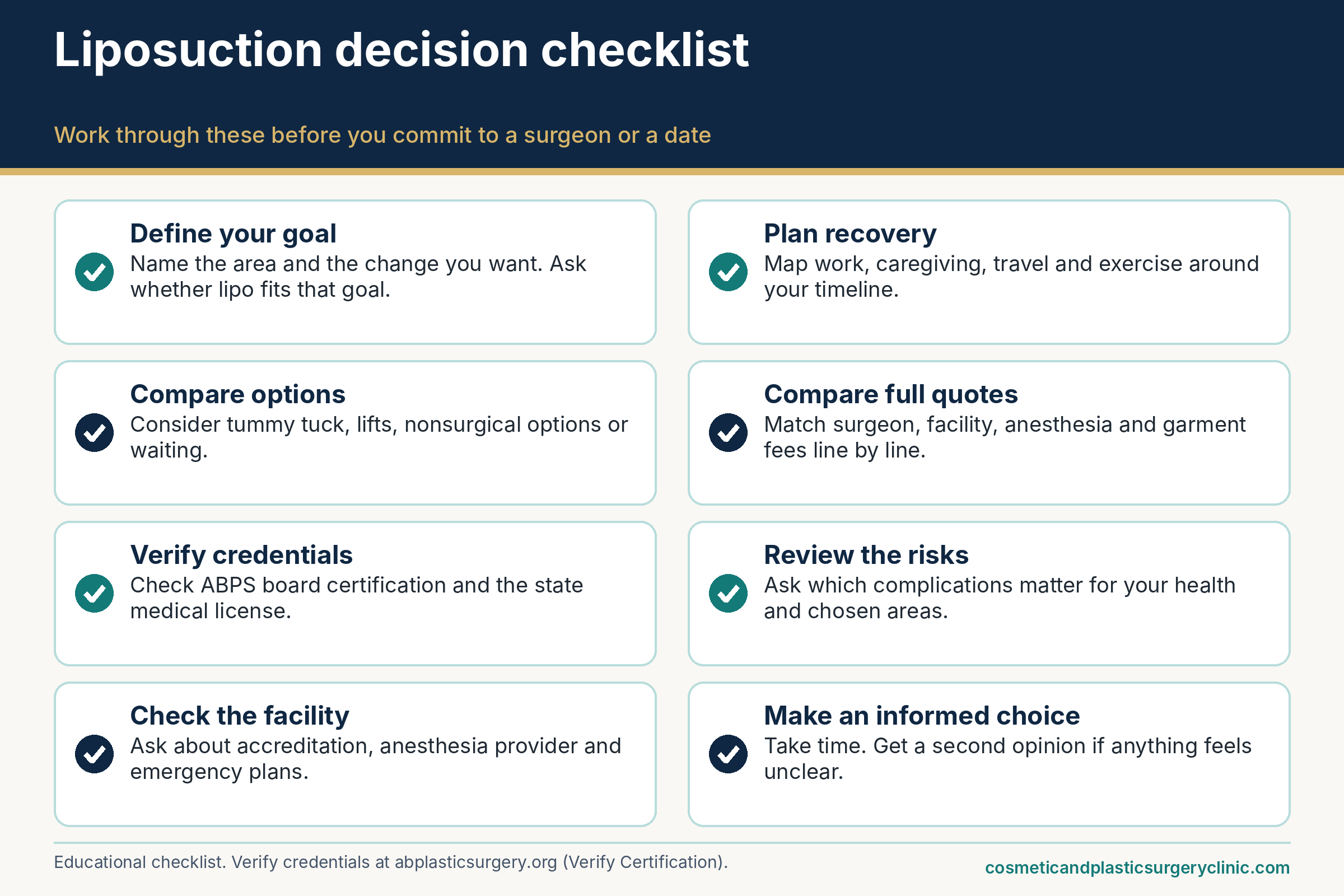
Choosing a Surgeon, Preparing for Consultation and Making the Decision
Good liposuction outcomes depend as much on judgment as on technique: judgment about whether to operate, how much to treat, which setting is appropriate, and what to do when something unexpected happens. That judgment is what you are choosing when you choose a surgeon. This section covers how to verify credentials, how to evaluate facilities and spot warning signs, a question bank for the consultation, and a simple framework for deciding. Our broader guides on the plastic surgeon credential checklist and liposuction consultation questions provide additional detail.
Verifying credentials, facility and safety signals
Credentials do not guarantee a good outcome, but they filter out a lot of avoidable risk. They also give you something objective to check before emotion and marketing take over.
Board certification, medical license and professional membership
Start with precise language. In the United States, a medical license, board certification and membership in a professional society are three separate things. A state medical board issues the license that lets a physician practice medicine, and it does not certify specialty skill. Board certification is a voluntary credential granted by a specialty board. For plastic surgery, the relevant body is the American Board of Plastic Surgery (ABPS). ASPS stresses that the government does not legally restrict who may call themselves an aesthetic, cosmetic or plastic surgeon, so titles on a website prove little by themselves.
You can check ABPS certification yourself with the board’s free Verify Certification tool. The page lets you search by name or location, states that certification is voluntary and reflects completed training and passing comprehensive written and oral examinations, notes that certificates issued since 1995 are valid for ten years and that diplomates must meet continuing certification requirements, and says that if a state medical board has taken action against a diplomate, an alert directs users to check with the Federation of State Medical Boards. That alert is a reminder to check the license separately. The FSMB’s guide to medical regulation points consumers to its DocInfo tool and to state medical board physician profiles for licensure and discipline information, and you can also search your state medical board directly.
Society membership adds another layer. According to ASPS, member surgeons must be board certified by the ABPS (or, in Canada, the Royal College of Physicians and Surgeons of Canada), complete at least six years of surgical training after medical school including a minimum of three years of plastic surgery residency, pass comprehensive exams, complete continuing medical education including patient safety each year, operate in accredited, state-licensed or Medicare-certified facilities, and adhere to a code of ethics. Membership is useful context, but board certification is the credential to verify. Be cautious with phrases like “board-certified cosmetic surgeon,” which can refer to a board other than the ABPS; ask which board and verify it. The explainer on what ABPS board certification means expands on the distinctions.
| What to check | Where to check | What it tells you | What it does not tell you |
|---|---|---|---|
| ABPS board certification | ABPS Verify Certification tool | Training and examination in plastic surgery; current certification status | Experience with your specific procedure or body type |
| State medical license | State medical board; FSMB DocInfo | Authorization to practice; potential disciplinary actions | Specialty training or skill |
| ASPS membership | ASPS find-a-surgeon resources | Training, ethics and facility standards required for members | Individual outcomes |
| Facility accreditation | AAAASF, AAAHC, Joint Commission, or state or Medicare records | Meets published safety and emergency standards | Absence of risk |
| Anesthesia provider | Ask the practice; check licenses | Who will monitor you and with what training | Individual patient fit |
| Procedure experience | Consultation conversation; consistent photos | Volume and results for cases like yours | Your own outcome |
Facility, anesthesia and warning signs
Ask where the surgery will be performed and who accredits that facility. ASPS names AAAASF, AAAHC and the Joint Commission as accreditors patients can check, with state licensure or Medicare certification also qualifying, and advises that you verify directly with the accreditor rather than relying on a certificate in the waiting room. Ask who gives anesthesia, what monitoring is used, what emergency equipment and medications are on site, and where you would go if you needed a hospital. Ask who sees you in the recovery room and who you call at night.
Several warning signs deserve respect. One is pressure: a same-day deposit, a “today only” discount, or the suggestion that your window is closing. Another is vagueness: unclear answers about who will actually operate, which anesthesia professional will be present, or which board certified the surgeon. A third is portfolio opacity: before-and-after photos that vary wildly in lighting and angle, or galleries drawn entirely from social media with no way to confirm the surgeon’s role. A fourth is guarantee language about results, scars or pain, which no honest surgeon can promise. A fifth is a price that is far below others in your area without a clear explanation of what is omitted. And a sixth is a dismissive attitude toward questions about risk, revision or complications.
Travel for surgery adds its own risks, including follow-up care that is hard to access and clot risk after long journeys. If you are considering surgery away from home, read the guide to plastic surgery medical tourism and settle in advance who will manage a complication at home. A surgeon who is comfortable saying “I might not be the right person for this” is more reassuring than one who says yes to everything.
A word about online reviews, social-media portfolios and influencer recommendations, which now shape many people’s first impression of a surgeon. Reviews can reveal practical matters such as responsiveness, wait times and staff courtesy, but they say little about surgical judgment or complication management, and they can be gamed or incentivized. Social-media galleries are curated, edited or filtered, and they seldom show patients with complications or revisions. Neither source can verify credentials, and neither should substitute for the checks in the table above. Use them to generate questions, not to answer them, and treat a practice that offers rewards for positive reviews, or discourages candid questions, with caution.
The consultation and the decision
The consultation is the single most valuable hour in the process, if you prepare for it.
A consultation question bank
ASPS’s own consultation checklist suggests asking about board certification, how often the surgeon has performed the specific procedure recently, risks, alternatives, whether the surgeon will personally perform the entire operation, whether the same surgical team is used, what postoperative care involves, whether the surgeon can show before-and-after photographs, whether the surgeon believes the procedure is reasonable for you, and how complications and unhappy patients have been handled. For liposuction specifically, the table below groups questions by theme so you can print it or take it on your phone. Bring a list of your medications, your questions, and a friend or family member who can listen and take notes.
| Topic | Questions worth asking | What a clear answer sounds like |
|---|---|---|
| Fit and goals | Is liposuction the right operation for my goals? What would it not change? | Specific to your exam; includes limits and alternatives |
| Skin and anatomy | How will my skin respond? Would a tummy tuck or lift be better? | Honest about uncertainty; explains the skin findings |
| Technique | Which technique and devices will you use, and why for me? | Names methods; explains rationale; discusses device labeling |
| Scope and volume | Which areas, how much fat, and how long will it take? Should this be staged? | Plan tied to safety, not to maximum removal |
| Anesthesia and facility | Who gives anesthesia? Is the facility accredited? What is the emergency plan? | Named provider; named accreditor; named hospital |
| Risks | Which risks matter most for me? What is your clot prevention plan? | Covers contour issues, fluid collections, clots and rare events |
| Recovery | When can I return to work, drive, travel and exercise? How long is the garment worn? | Ranges with caveats; written instructions |
| Results and revision | What if I am unhappy? What does a revision cost and when is it considered? | Clear policy; no pressure |
| Cost | What is included and not included? What if there is a complication? | Itemized quote; explicit exclusions |
| Experience | How often do you perform this operation? Can I see photos of patients like me? | Recent volume; consistent photos; candor about limits |
Making the decision: a simple framework
People decide under pressure, and pressure distorts risk. A few rules of thumb reduce it. First, sleep on it. A good surgeon will not penalize you for taking days or weeks to decide. Second, compare at least two qualified consultations when the stakes or the cost are high; differences in recommendations are information, not confusion. Third, check that the plan, price and recovery logistics all work on paper before you book a date. Fourth, ask yourself whether you would still want the procedure if the result were a modest, natural refinement rather than a dramatic change. If the honest answer is no, you may be solving a different problem.
The decision itself usually lands in one of four places. You may decide that liposuction fits your goals, your health and your timing, and proceed with a qualified surgeon. You may decide that a different procedure, such as a tummy tuck or a lift, better matches what bothers you. You may decide to wait for weight to stabilize, for pregnancy plans to resolve, or for health issues to be addressed. Or you may decide against surgery. All four are legitimate outcomes of a good consultation process, and none of them is a failure.
Whatever you decide, keep the key themes of this guide in view. Liposuction reshapes stubborn fat; it is not weight loss or skin tightening. Candidacy depends on stable weight, good health and skin that can adapt. The technique name matters less than the plan, the facility and the surgeon’s judgment. Recovery takes weeks to months, and final results take longer. Risks are mostly low and still worth respecting, with combined procedures, long operations, and clot risk deserving special attention. Costs extend beyond the surgeon’s fee. And credentials are verifiable: use the ABPS tool and your state medical board, and ask about the facility. Bring these ideas, along with a written list of questions, to a consultation with a qualified plastic surgeon.
Frequently asked questions about liposuction
How much weight can you lose with liposuction?
Usually very little, and that is by design. Fat is light, and the amount removed in cosmetic liposuction is small relative to total body weight, so the scale often barely moves even when clothing fits differently. ASPS describes the procedure as body contouring, not obesity treatment, and a 2004 trial in women with obesity found that removing a large amount of fat did not improve insulin sensitivity or other metabolic markers. If your main goal is a lower weight or better metabolic health, discuss medical weight management with a primary care clinician before considering any contouring surgery.
Does liposuction hurt, and how long does the soreness last?
Most people describe a deep soreness and tightness in treated areas rather than a sharp incision pain, along with bruising and swelling. The tumescent fluid contains local anesthetic that helps comfort in the first hours, and surgeons then prescribe a pain plan that varies by practice and patient. ASPS places the need for pain medication in the first week, and discomfort generally eases through the following weeks. Pain that is severe, escalating, one-sided, or not controlled by the prescribed plan should prompt a call to the surgical team, because it can signal a fluid collection, bleeding or another problem.
How long do you have to wear a compression garment after lipo?
Mayo Clinic and MedlinePlus describe several weeks as typical, and ASPS says the garment is worn to limit swelling and support healing while your surgeon sets the details. Practices differ on hours per day, the number of weeks, and whether foam pads or a second layer are used. A 2023 review found the evidence for routine compression across plastic surgery to be uneven and urged surgeons to reconsider routine use, so a plan that differs from a friend’s is not automatically wrong. Follow your own surgeon’s written instructions and report numbness, skin breakdown or breathing difficulty.
Can the fat come back after liposuction?
The removed fat cells do not regenerate, but the cells that remain can enlarge if you gain weight, so fat can accumulate in treated and untreated areas. Studies disagree about whether weight regain tends to return to the original areas or to other parts of the body: a 2011 report described fat returning within a year and moving to other regions, while a 2012 study of 301 patients found no regrowth in treated areas. Both are summarized earlier in this guide. The consistent message is that stable weight and regular activity protect the result better than any garment or device.
Will liposuction remove cellulite or stretch marks?
No. ASPS states that liposuction does not treat cellulite, and Mayo Clinic notes that it does not remove stretch marks. Cellulite reflects fibrous bands and fat compartments close to the skin surface, and stretch marks are changes in the skin’s structure. Irregular fat removal can even make surface dimpling more noticeable, and ASPS lists worsening cellulite among possible risks. Some nonsurgical devices are marketed for cellulite, but each has its own evidence and FDA clearance language, so ask what is specifically cleared and what published data show for your body area.
Is liposuction less risky than a tummy tuck?
Liposuction alone is a smaller operation and typically carries fewer wound-healing problems, but the two procedures solve different problems and carry different risks, so the comparison is not apples to apples. Clots, anesthesia complications and fluid collections can occur with either. Published data show that combining liposuction with other procedures raises complication risk, so a lipo-plus-tummy-tuck plan deserves a specific safety discussion. Choose by what needs to be treated: fat alone, or skin and muscle too. A surgeon should be able to explain why one operation fits your anatomy better than the other.
Can I have liposuction if I take a GLP-1 medication?
That is a decision for your surgeon, anesthesia team and prescriber together. Two issues stand out. Weight that is still changing makes it hard to plan a contour. And an ISAPS patient-safety guidance document notes that delayed stomach emptying from these drugs may raise the risk of aspiration under general anesthesia, offering consensus-based, not trial-based, advice such as deferring elective surgery during the early dose-escalation phase. Never stop or change a prescribed medication on your own in response to something you read online; disclose it and let the teams coordinate.
How soon after liposuction can I fly?
There is no universal number. The concern is blood clots, since a recent operation, swelling, reduced movement and a long sitting period all add to risk. Many surgeons prefer patients to stay near the operating facility for the first days so problems can be handled quickly, then travel only once they are cleared and able to walk regularly during the trip. If you are traveling for surgery, plan extra days before your flight home and ask your surgeon what they require, including whether compression stockings, hydration and movement breaks apply to your situation.
How many areas can be treated in one session?
It depends on the volume of fat, your health, the length of the operation, the facility and whether other procedures are planned. Risk tends to rise as more body surface is treated, and Mayo Clinic notes complication risk rises with larger surfaces and multiple procedures. The ASPS advisory sets added precautions at 5,000 cc or more of aspirate. A surgeon may recommend treating fewer areas now and revisiting others later. Ask what the safety rationale is for the number of areas in your plan, and whether staging would reduce risk.
What is the difference between liposuction and CoolSculpting?
Liposuction is a surgical procedure that physically removes fat through small incisions, usually with anesthesia. CoolSculpting is the best-known brand of cryolipolysis, a device that cools fat in a treated area without incisions. FDA describes non-invasive body contouring as not a weight-loss method, with results that may be temporary, while a systematic review of 19 cryolipolysis studies reported modest reductions in fat-layer thickness. Cryolipolysis has its own rare risk, paradoxical adipose hyperplasia. The two are not interchangeable, and the comparison is covered in the alternatives section above.
Is there an age limit for liposuction?
There is no age cutoff in the sources reviewed for this guide. ASPS counts patients from their late teens through age 66 and older in its 2025 data, with the largest share between 36 and 45, but the ASPS safety advisory lists youths and adolescents among patients who are generally not appropriate candidates. Older patients tend to have more medical conditions and less elastic skin, which affects risk and results. Candidacy is about health, skin quality, goals and timing, which is why a surgeon examines you rather than applying a number.
Do men get liposuction, and is it different?
Yes. ASPS estimated 18,938 liposuction procedures in men in 2025, compared with 298,258 in women. Men often seek treatment of the abdomen and flanks, the chest for gynecomastia, or the chin and neck. The underlying principles are the same: localized fat, stable weight, good health and realistic expectations. Because suction reaches only subcutaneous fat and not the deeper visceral fat around organs, a physical exam is what shows how much of an abdomen is treatable. The gynecomastia guide covers the chest in more detail.
Will I have visible scars after liposuction?
Liposuction scars are typically small, because ASPS describes the incisions as small and inconspicuous and surgeons place them in creases or less visible spots. Scar appearance still varies by skin type, healing and incision location, and some people develop darker or raised marks. Your surgeon can explain where incisions will go and how to care for them. Avoid sun exposure on healing scars as advised and report incisions that become red, painful, draining or unusually thick. The dedicated article on liposuction scars covers placement and care.
How do I know if lumpy or hard areas are normal during healing?
Firmness, lumpiness and uneven texture are commonly reported as tissues heal and swelling resolves, and they often soften over weeks to months. What helps is trajectory and symptoms: improving over time with no fever, redness or escalating pain is more reassuring than a lump that is growing, hot, tender or accompanied by fluid. Bring any concern to your follow-up visit, because a fluid collection or other problem looks different on examination than ordinary healing. Ask your surgeon before starting massage or devices, since timing and technique matter.
Sources and further reading
- American Society of Plastic Surgeons — Liposuction overview (accessed 2026-10-03) — definition, treatable areas, limits, skin quality
- ASPS — Liposuction cost (accessed 2026-10-03) — $4,711 average surgeon’s fee, exclusions, insurance and financing statements
- ASPS — Liposuction candidates (accessed 2026-10-03) — candidacy criteria
- ASPS — Liposuction procedure (accessed 2026-10-03) — anesthesia, incisions, technique families
- ASPS — Liposuction recovery (accessed 2026-10-03) — week-by-week overview, compression
- ASPS — Liposuction risks and safety (accessed 2026-10-03) — listed risks, large-volume note
- ASPS — 2025 Plastic Surgery Statistics Report (accessed 2026-10-03) — 317,196 liposuction procedures, demographics, GLP-1 survey findings
- ASPS — 2025 statistics press release (accessed 2026-10-03) — lift-procedure growth, GLP-1 consultation requests
- ASPS — 2024 average surgeon/physician fees (accessed 2026-10-03) — projected fee ranges
- ASPS — 2023 average surgeon/physician fees (accessed 2026-10-03) — $4,711 liposuction and $8,174 abdominoplasty
- ASPS — 2022 average surgeon/physician fees (accessed 2026-10-03) — $4,449 liposuction; fee exclusions
- Haeck et al. — Evidence-Based Patient Safety Advisory: Liposuction, Plast Reconstr Surg 2009 (accessed 2026-10-03) — volume, lidocaine, facility, clot-prevention recommendations
- ASPS — Member qualifications (accessed 2026-10-03) — training, board certification, accredited facilities
- ASPS — Consultation checklist (accessed 2026-10-03) — questions to ask a surgeon
- ASPS — Accreditation (accessed 2026-10-03) — accrediting organizations and facility standards
- ASPS — Plastic surgery versus cosmetic surgery and board certification (accessed 2026-10-03) — unrestricted use of titles
- ASPS — Press release on the 2012 Swanson study (accessed 2026-10-03) — durability study summary
- American Board of Plastic Surgery — Verify Certification (accessed 2026-10-03) — certification lookup
- Federation of State Medical Boards — Guide to medical regulation (accessed 2026-10-03) — licensure and physician lookup resources
- U.S. FDA — Non-Invasive Body Contouring Technologies (accessed 2026-10-03) — device categories, limits and risks
- U.S. FDA — Fat-dissolving injections that are not FDA approved (content current 12/20/2023; accessed 2026-10-03) — Kybella status and unapproved product harms
- U.S. FDA — Renuvion/J-Plasma safety communication (May 10, 2023; accessed 2026-10-03) — clearance language example
- U.S. FDA — 510(k) K172144 ZELTIQ CoolSculpting System (accessed 2026-10-03) — indications for use
- eCFR — 21 CFR 878.5040 Suction lipoplasty system (accessed 2026-10-03) — device classification
- Mayo Clinic — Liposuction (accessed 2026-10-03) — risks, preparation, results and permanence
- Cleveland Clinic — Liposuction (last reviewed Oct. 1, 2022; accessed 2026-10-03) — techniques, recovery milestones, warning signs
- MedlinePlus — Liposuction (reviewed May 6, 2025; accessed 2026-10-03) — risks, recovery, outlook
- Internal Revenue Service — Publication 502, Medical and Dental Expenses (accessed 2026-10-03) — cosmetic surgery and liposuction tax treatment
- Washington University — Summary of Klein et al., N Engl J Med 2004 (accessed 2026-10-03) — metabolic effects of large-volume liposuction
- Benatti et al., J Clin Endocrinol Metab 2012 (accessed 2026-10-03) — visceral fat and exercise after liposuction
- ScienceDaily — Summary of Hernandez and Eckel, Obesity 2011 (accessed 2026-10-03) — fat redistribution after liposuction (press summary)
- Spalding et al., Nature 2008, Europe PMC record (accessed 2026-10-03) — fat cell turnover in adults
- Grazer and de Jong, Plast Reconstr Surg 2000, Europe PMC record (accessed 2026-10-03) — census survey of liposuction deaths
- Bellini, Grieco and Raposio, Ann Med Surg 2017 (accessed 2026-10-03) — liposuction review, complication figures
- Barros et al., Rev Bras Cir Plást 2023 (accessed 2026-10-03) — systematic review of complications
- Kaoutzanis et al., Aesthet Surg J 2017 (accessed 2026-10-03) — 31,010 procedures, combined-procedure risk
- Valentine et al., Aesthet Surg J Open Forum 2024 (accessed 2026-10-03) — 246,119 procedures in accredited facilities
- Foppiani et al., Aesthet Surg J Open Forum 2025 (accessed 2026-10-03) — DVT/PE screening and prophylaxis in accredited facilities
- Klein and Jeske, Anesth Analg 2016 (accessed 2026-10-03) — tumescent lidocaine dosage estimates
- Habbema, J Am Acad Dermatol 2010 (accessed 2026-10-03) — 3,430 liposuctions with tumescent local anesthesia
- Markman and Barton, Plast Reconstr Surg 1987 (accessed 2026-10-03) — subcutaneous fat layers
- Ormseth et al., Plast Reconstr Surg Glob Open 2023 (accessed 2026-10-03) — compression garment evidence review
- Ingargiola et al., Plast Reconstr Surg 2015 (accessed 2026-10-03) — cryolipolysis systematic review
- Ho and Jagdeo, J Drugs Dermatol 2017 (accessed 2026-10-03) — paradoxical adipose hyperplasia systematic review
- ISAPS Patient Safety Committee — Emerging guidance on GLP-1 RA drugs (accessed 2026-10-03; publication date to be confirmed) — perioperative considerations