

Most people who search for tummy tuck cost expect a single number. What they find instead is a spread of quotes that don’t seem to describe the same thing: one practice quotes a surgeon’s fee only, another quotes a package, a third quotes “starting at” and leaves the rest for the consultation. That’s not a sign that someone is hiding the ball. It’s a sign that abdominoplasty (the clinical name for a tummy tuck) is priced in layers, and each practice decides which layers to show you first.
This guide is built for the cost-conscious researcher who wants to understand the layers. It explains what a published national figure does and doesn’t include, why two quotes for “a tummy tuck” can describe different operations, how the surgical setting and the anesthesia arrangement change the bill, what financing and tax rules look like, and how to line quotes up so the comparison is fair. It does not give you a price for your situation, because nobody can do that without examining you, and it deliberately avoids inventing regional averages that no reliable source publishes.
If you’re still deciding whether the procedure itself is right for you, start with the broader tummy tuck guide, which covers what the surgery changes, who it may suit, and what recovery involves. Here, the question is narrower: what will you be asked to pay for, to whom, and when?
A note on numbers: this article uses dollar figures only where a published source gives a year and a population. National averages are context, never a local quote and never an offer. Where a figure could not be verified, the article describes the issue in words and flags it for editorial follow-up.
One more framing point before the details. Cost is a legitimate part of a surgical decision, and wanting to understand it carefully is not shallow. It’s also true that price is the easiest variable to compare and the hardest to compare fairly, because the cheaper-looking quote may leave out the item the pricier one includes. The aim of the sections below is to make the comparison honest rather than to steer you toward the highest or lowest number.
What a Tummy Tuck Quote Is Actually Pricing
A tummy tuck isn’t one purchase. It’s a bundle of professional services, a physical space, equipment, medications and aftercare, supplied by several parties who may or may not send separate bills. The first job in understanding tummy tuck cost is to separate those pieces, because every confusing quote you’ll receive is confusing in the same way: it shows some pieces and hides others.
The Fee Stack, Line by Line
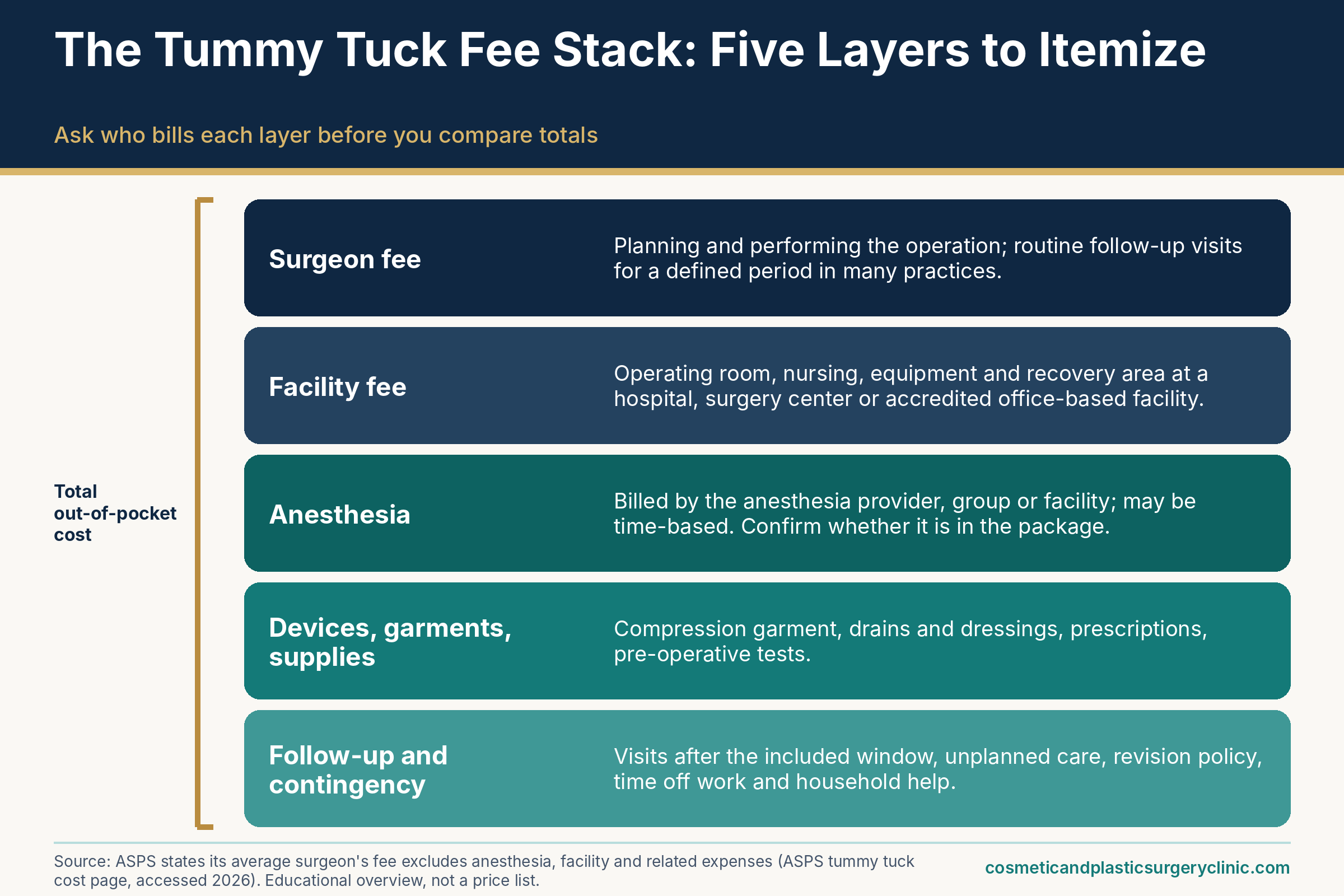
Think of the total as a stack with five layers. The surgeon’s fee sits on top because it’s the number patients ask about first. Below it sit the facility, the anesthesia, the devices and supplies, and the follow-up and contingency layer. Each layer has a different payee, a different pricing logic, and a different set of questions.
The surgeon’s fee and the one national figure that exists
The surgeon’s fee pays for the surgeon’s professional work: planning the operation, performing it, and (in most practices, though not all) the routine postoperative visits that follow. It does not pay for the room, the anesthesia team or the garment you’ll wear afterward.
The most useful published benchmark comes from the ASPS. In its 2024 report of average surgeon and physician fees, the society listed a range of $8,000 to $13,500 for abdominoplasty. Two details in how ASPS presents the figure matter for anyone reading it. First, the society says it moved to showing a projected range rather than a single price, to reflect differences in geography and practice setting. Second, the numbers are aggregate projections built from averages that surveyed ASPS member surgeons submitted, so they describe members of one society, not every practitioner who performs the operation.
You may also run into a single average on the ASPS patient-facing tummy tuck cost page: $8,174, attributed to the society’s “latest statistics.” The page shows no year next to that figure, so it can’t be tied to a specific reporting period. This article treats the dated 2024 range as the anchor and mentions the single figure only so you aren’t surprised when you see it elsewhere. The same ASPS page states plainly that its average does not include anesthesia, operating room facilities or other related expenses, and it lists anesthesia, facility costs, medical tests, post-surgery garments and prescriptions as separate items.
A fair reading, then: the ASPS range is a reference point for one line of the stack. It isn’t a total, and it isn’t a prediction for your quote. A practice in a high-cost metropolitan market may sit above the range, a practice in a lower-cost area may sit below it, and neither fact says anything on its own about quality or safety.
Facility, anesthesia, and the supply lines
The facility fee pays for the operating room and the people and equipment around it: nursing staff, sterile instruments, monitoring equipment, the recovery area. How it’s calculated varies. Some facilities charge by the block of time the room is reserved, some use a flat case rate, and some roll it into a package price. Because the operation is longer when more is done, facility charges often rise with the scope of the surgery, which is one reason a mini tummy tuck and an extended one can sit far apart.
Anesthesia is a separate professional service. ASPS describes the anesthesia choices for a tummy tuck as intravenous sedation or general anesthesia, and a StatPearls clinical review updated in March 2026 describes general anesthesia, often supplemented with regional nerve blocks, as the recommended approach. Anesthesia professionals frequently bill by time. As one reference point on how that works, Medicare’s anesthesia payment rules combine a base-unit value with time units of 15 minutes each, while private billing arrangements vary from practice to practice. Medicare generally excludes cosmetic surgery, so this is an illustration of billing logic, not a price source. Ask your practice how its anesthesia provider bills and whether that bill arrives separately.
The supply layer is the one patients most often forget. It can include a compression garment, surgical drains and dressings, prescriptions, pre-operative lab work or medical clearance, and sometimes products your surgeon recommends for scar care. Each item is small next to the surgeon’s fee, but together they can be material. ASPS’s recovery guidance mentions elastic bandages or compression garments and notes that small tubes (drains) may be placed under the skin temporarily, so these are expected parts of the process rather than exotic extras.
| Layer | Who typically bills it | What it generally covers | What to confirm in writing |
|---|---|---|---|
| Surgeon’s fee | Surgeon or practice | The operation itself; often routine postoperative visits for a defined period | Which visits and for how long; whether the fee is fixed if the plan changes in surgery |
| Facility fee | Surgical facility (hospital, ambulatory surgery center, or accredited office-based facility) | Operating room, nursing, equipment, sterile supplies, recovery area | How time is billed; what happens if the case runs long; accreditation status |
| Anesthesia | Anesthesia group, individual anesthesia professional, or the facility | Anesthesia care during and immediately after surgery | Who provides it; billing method; whether it’s in the package or billed separately |
| Devices, garments, supplies | Practice, pharmacy, laboratory | Compression garment, drains and dressings, prescriptions, pre-operative testing | Itemized list; replacement garment cost; who orders labs |
| Follow-up and contingency | Practice; sometimes facility and others | Visits after the routine window, wound care, unplanned care, revision policy | Revision policy in writing; who pays for complications and for what period |
Reading National Tummy Tuck Cost Averages Without Being Misled
Published averages are useful and easy to misuse. A few habits make them safer to lean on.
Where published averages come from
Every average is produced by a method, and the method shapes what the number means. The ASPS fee range comes from a member survey, which means it reflects who answered and how they reported. It says nothing about surgeons outside the society, and it can’t capture a bundled package price that includes the facility and anesthesia. Third-party cost calculators and “average cost” articles are a different category again. Many of them don’t disclose a year, a sample or a method, and a quick rule of thumb is to set aside any figure that can’t tell you who it counted and when.
The market context is worth a sentence. ASPS reported that tummy tuck was the third most frequently performed cosmetic surgical procedure in 2025, with 173,251 procedures, up about 2 percent from the previous year, in statistics drawn from more than 3,000 board-certified plastic surgeons nationwide. That’s a large, active field, which helps explain why pricing models are so varied: practices compete, specialize and package differently. The statistics report, in the sections reviewed for this article, did not include a fee table, and the 2025 fee document could not be located, so the 2024 range remains the latest dated fee figure verified here.
Finally, remember what an average erases. An average of a range from a lean, single-surgeon practice and a large, multi-site center in an expensive city is a number that may match neither. Use it to notice outliers in your own quotes, not to decide that a quote is fair or unfair.
Why a quote that looks high or low may not be comparable
Three structural differences account for most apparent price gaps before quality even enters the picture.
The first is bundling. An all-inclusive price rolls the surgeon’s fee, facility, anesthesia and sometimes garments and follow-up into one figure. An unbundled quote lists them separately, and the first number you see may be only the surgeon’s fee. Putting a bundled figure next to an unbundled one makes the bundled practice look expensive when it may simply be complete.
The second is scope. “A tummy tuck” can mean a limited lower-abdominal procedure or an extensive one with muscle repair and liposuction. The next section works through how those differ and why they change the arithmetic.
The third is the “starting at” phrase. A starting price is the floor for the simplest version of the service. It’s a legitimate marketing convention, but it tells you little about the number you’ll be asked to pay, and the honest response is to ask what the typical quote looks like once a surgeon has examined you.
When the numbers still look far apart after you’ve normalized for these three things, the gap deserves a direct question. Ask what’s different, and listen for specifics about time, staffing, setting and aftercare rather than general reassurance. For a broader view of how cosmetic pricing works across procedures, the plastic surgery cost guide covers the common structures.
Scope: Why Two “Tummy Tuck” Quotes Can Describe Different Operations
The single biggest reason quotes diverge is that “tummy tuck” is a family name, not a specification. Two surgeons can both write “abdominoplasty” at the top of a quote and plan operations that differ in incision length, in how much tissue is removed, in whether the abdominal wall muscles are tightened, and in whether liposuction or a hernia repair comes along. Operating time, facility time, anesthesia time and supply use all rise or fall with those choices, so the price follows.
Which version suits a particular person is a clinical judgment made after an examination. This section explains the vocabulary so that you can read a quote and tell which operation it describes. For a fuller explanation of how the approaches differ surgically, see the dedicated article on tummy tuck techniques.
Technique and Extent
Start with the shape of the operation, then add the extras that attach to it.
A terminology map: mini, full, extended, and circumferential
A StatPearls clinical review of abdominoplasty, updated in March 2026, lays out the main variations, and they make a useful map for reading quotes.
A full (traditional) abdominoplasty uses a horizontal incision in the lower abdomen, removes excess skin and fat, and repositions the navel. A mini abdominoplasty uses a shorter lower incision, doesn’t move the navel, and is generally described for people whose excess is limited to the area below it. A fleur-de-lis approach adds a vertical midline incision to address looseness in both directions, a pattern that tends to come up after major weight loss. A circumferential abdominoplasty, sometimes called a belt lipectomy, treats the abdomen, flanks and back in a 360-degree pattern. And a reverse abdominoplasty addresses upper abdominal excess through an incision beneath the breast.
You’ll also hear the word extended. It isn’t a formal category in every reference, and surgeons use it differently, but it most often signals a full tummy tuck whose incision continues further around the sides to address the flanks. Because definitions vary, an “extended tummy tuck” line on a quote is a prompt to ask exactly where the incision will run and what tissue will be treated.
For pricing, the practical point is that these are escalating operations. A smaller operation generally means less time and less material; a larger one generally means more of both. The relationship isn’t strictly linear, since some practices price by procedure name rather than by the clock, but it explains why a mini and an extended tummy tuck rarely carry the same fee, and why comparing one practice’s mini with another practice’s full operation tells you almost nothing.
Muscle repair, added liposuction, hernia repair, and navel work
Beyond the incision pattern, four add-on elements change a quote.
The first is muscle repair. ASPS describes the standard operation as removing excess skin and fat and, in most cases, restoring weakened or separated muscles. The repair involves tightening the abdominal wall with sutures, and the StatPearls review notes that the sutures may be permanent or absorbable. Practices differ in whether they treat muscle repair as part of the base operation or as a separate line. If a quote doesn’t mention it, ask whether it’s included, because a tummy tuck without muscle repair is a different plan from one with it.
The second is added liposuction. Combining abdominoplasty with liposuction of the abdomen, flanks or back is often called lipoabdominoplasty. It lengthens the operation and may be priced as a separate area-based line or folded into the surgeon’s fee. If a practice quotes liposuction separately, the liposuction cost article explains how area-based pricing typically works, though you should treat it as background rather than an additive formula.
The third is hernia repair, and this one has insurance consequences as well as price ones. ASPS has distinguished a true hernia repair, which involves opening the fascia and dissecting a hernia sac, from the repair of diastasis recti (separation of the abdominal muscles), which is part of a standard abdominoplasty. That distinction comes from an older ASPS insurance-criteria document dated 2006, so treat it as a statement of terminology rather than current payer policy. The cost implication is that when a surgeon finds or suspects a true hernia, the plan may change, the operating time may lengthen, and the billing for that portion may be handled differently from the cosmetic portion. Ask early whether a hernia has been checked for and how it would be handled on the bill if one turns up.
The fourth is navel work. In a full abdominoplasty the navel is typically repositioned through a new opening, and in a mini abdominoplasty it generally isn’t moved. That’s a small detail, but it’s one of the clearest ways to tell the two operations apart on paper.
| Quote describes | What it generally involves | How the fee stack tends to shift | Question to ask |
|---|---|---|---|
| Mini abdominoplasty | Shorter lower incision; navel typically not moved; limited lower-abdominal tissue | Often the shortest operating time, which can lower facility and anesthesia lines | Why is the mini approach planned for my anatomy? |
| Full abdominoplasty | Horizontal incision, skin and fat removal, navel repositioned, muscle repair in most cases | Reference point for most published surgeon-fee figures | Is muscle repair included in the quoted fee? |
| Extended abdominoplasty | Full approach with the incision carried further toward the sides (usage varies) | Longer operation; facility and anesthesia time rise | Where exactly will the incision end? |
| Lipoabdominoplasty | Abdominoplasty plus liposuction of selected areas | Added time and supplies; liposuction may be a separate line | Which areas are included in the liposuction fee? |
| Fleur-de-lis | Horizontal and vertical incisions for looseness in both directions | Larger operation; often discussed after major weight loss | How does this plan differ from a standard full approach? |
| Circumferential (belt lipectomy) | 360-degree treatment of abdomen, flanks and back | Longer still; the setting and any overnight stay deserve a direct question | Where will it be done and is an overnight stay planned? |
| Added hernia repair | Treatment of a true hernia during or alongside the operation | Extra time; billing for this portion may be handled differently | Will the hernia portion be billed separately, and to whom? |
Combined Procedures and the Mommy Makeover
The second major driver of scope is whether the tummy tuck is the only thing on the schedule.
How combining changes the fee lines
Many people who consider abdominoplasty are also thinking about breast surgery, liposuction elsewhere on the body, or other contouring. A combination, often marketed as a mommy makeover when it follows pregnancy, is priced as the sum of its parts in some practices and as a negotiated package in others. Either way, a few lines behave in predictable directions.
Surgeon’s fees generally add, because each component is separate surgical work, although some surgeons apply a multiple-procedure adjustment. Anesthesia is typically a single anesthetic event, but it’s longer, so a time-based bill grows. The facility charge grows with the reserved operating time. Supply costs add. And the recovery period doesn’t simply add the components together, since you recover from all of them at once, which affects the time-off line more than the surgical lines.
The honest summary is that combining may reduce some duplicated costs, such as one anesthetic event and one recovery, but it doesn’t reduce the work. If a practice presents a combined price as a large discount compared with separate procedures, ask what drives the difference: shared facility time, a package rate, or fewer follow-up visits. For the pricing framework of that specific combination, the mommy makeover cost article covers it in detail.
Sequencing, staging, and when the math doesn’t favor combining
Cost isn’t the only variable that combining touches, and a responsible comparison keeps the others in view. A 2015 study in Plastic and Reconstructive Surgery, reported by ASPS, analyzed nearly 25,000 abdominoplasties performed between 2008 and 2013 and recorded in an insurance database called CosmetAssure. Major complications occurred in about 4 percent of abdominoplasty patients overall. The rate was 3.1 percent when abdominoplasty was the only procedure and 10.4 percent when it was combined with body contouring plus liposuction. About 65 percent of patients in the data set had abdominoplasty together with other procedures.
Those figures come from one database of insured patients over a particular period, and the study couldn’t show that the combination caused the difference, since patients and surgeons choose combinations for reasons the data may not capture. They still support a plain conclusion: the number of things done in one session is a clinical decision, not just a budgeting one, and a plan that saves money by stacking procedures deserves the same scrutiny as one that costs more. The article on combining a tummy tuck with other procedures discusses the trade-offs, and the tummy tuck risks and complications article covers the risk side directly.
Staging, meaning doing procedures in separate sessions, usually raises the total because each session carries its own facility, anesthesia and recovery costs. It can still be the right choice when your surgeon judges that a shorter operation is more appropriate. The financial lesson is to ask for both versions of the plan, combined and staged, itemized the same way, and to let the surgeon explain the clinical reasoning for any recommendation before you look at the totals.
Setting, Geography and Surgeon Training: The Variables Behind the Variation
Once the operation itself is defined, three context variables move the price: where the surgery happens, what market the practice operates in, and who is performing it. All three are easy to turn into slogans (“hospitals are expensive,” “big cities cost more,” “experience costs more”), and all three deserve more careful handling, partly because they overlap with safety questions and partly because the slogans are often only half true.
Where Surgery Happens
The setting determines who bills you for the room and what standards govern it. It also determines which kind of anesthesia arrangement is available.
Hospital, ambulatory surgery center, or accredited office-based facility
Tummy tucks are performed in three broad kinds of places. A hospital is a large institution that may offer an outpatient operating room or inpatient admission, with the broadest range of backup services. An ambulatory surgery center (ASC) is a facility built for same-day surgery, sometimes independent and sometimes owned by physicians or a hospital system. An office-based surgical facility is an operating room inside or attached to a surgeon’s practice. Each can be run well, and each can be run poorly, which is why the verification questions matter more than the category.
From a pricing standpoint, the difference lies in how the facility charge appears. At a hospital or independent ASC, the facility is usually a separate entity that sends its own bill or is paid through the practice’s arrangement with it. In an office-based setting, the facility cost may be built into the surgeon’s pricing or itemized as a separate line. Neither presentation is inherently better. What matters is that someone can tell you what you’re paying for the room and what that payment includes.
Accreditation is the main verification route. Quad A, a physician-led nonprofit established in 1980, describes accrediting ambulatory surgery centers and office-based surgical practices and provides an accredited-facilities directory on its website. AAAHC likewise accredits ambulatory surgery centers and office-based surgery centers and offers a search for accredited organizations. ASPS requires its members to perform surgery in accredited, state-licensed or Medicare-certified surgical facilities, which gives ASPS members a standard to meet but doesn’t tell you anything about a surgeon who isn’t a member. Rules for office-based surgery can differ from one state to another, so it’s wise to ask which standard the facility meets rather than assume.
Two cautions keep this from becoming a simple rule. First, a facility’s accreditation shows it has met an accreditor’s standards at a point in time; it doesn’t promise anything about a single operation. Second, the setting is not a proxy for safety in either direction. The 2015 abdominoplasty study described earlier reported lower complication risk in office-based surgical suites than in hospitals or surgical centers. That was an observational finding, and it’s plausible that healthier patients and simpler cases are directed to different settings, so it shouldn’t be read as proof that one setting is safer. If you have medical conditions that call for a hospital’s backup, the extra facility cost may be part of a sound plan rather than a markup. The article on accredited plastic surgery facilities explains what to check.
The anesthesia arrangement and why it can change the total
Anesthesia shows up on quotes in three common ways: included in a package, billed separately by an independent anesthesia group, or billed by the facility. The distinction matters for two reasons. If it’s billed separately, you may receive a second bill after surgery that you didn’t factor in. And if it’s billed by time, the final figure depends on how long the operation and recovery take, which is hard to know in advance.
The type of anesthesia also affects who needs to be in the room. ASPS lists intravenous sedation and general anesthesia as the options for a tummy tuck, and a StatPearls review describes general anesthesia, frequently supplemented with regional nerve blocks, as the approach it recommends. Different approaches involve different staffing and monitoring, and a regional block, if used, may be an additional line. Ask which approach is planned, who will administer it, what their credentials are, and whether the fee is fixed or time-based.
One more detail worth confirming is the pre-operative anesthesia evaluation. Some practices include it in the package, and some bill it separately or require clearance from your own physician. Those visits and tests belong in the supply and contingency layers of your budget. Anesthesia is also a safety topic in its own right, covered in the tummy tuck anesthesia article, and it deserves a direct conversation rather than a line on a price sheet.
| Setting | How the facility charge usually appears | What to verify | Cost-planning note |
|---|---|---|---|
| Hospital (outpatient or inpatient) | Separate bill from the hospital, or arranged through the practice | Whether the surgeon has operating privileges there; overnight options | May suit people whose health history calls for backup services; ask for the facility estimate in writing |
| Ambulatory surgery center | Separate facility fee, often based on time or case type | Accreditation or licensure; how emergencies and transfers are handled | Ask how a longer-than-planned case is billed |
| Accredited office-based surgical facility | Itemized line or built into the surgeon’s pricing | Accreditor and status (check the accreditor’s directory); who provides anesthesia; transfer arrangements | Confirm what the single price includes before comparing with an itemized quote elsewhere |
| Setting that cannot document accreditation or licensure | Varies; may be bundled with little detail | Why accreditation is absent; what standards apply; emergency plan | A low price here is not comparable to a quote from an accredited setting; treat missing documentation as a reason to pause |
Geography and Surgeon Training
The second pair of variables is harder to see on a price sheet, but it explains much of the spread that national averages hide.
Why the same operation is priced differently across markets
ASPS says its fee range reflects diverse geographic locations and practice settings, which is an acknowledgment that location moves the price. Plausible reasons are the ordinary ones: local costs of rent, staffing and insurance; the number of competing practices; and local demand. Those are general economic explanations, not figures from a dataset, and this article can’t give you a city-by-city comparison because no reliable public source verified for this guide publishes one for tummy tuck.
Two practical consequences follow. The first is that a quote from a major metropolitan area and a quote from a smaller market may not be comparable even with identical scope, and the difference doesn’t by itself say anything about the surgeon’s skill. The second is that traveling to a different market can shift costs around without eliminating them. A lower surgeon’s fee may be offset by lodging, a companion’s travel, extra time off work and the cost of getting follow-up care if something comes up at home. Some practices ask out-of-area patients to stay nearby for part of the recovery, and in any case your surgeon’s team needs to be reachable. The guidance on follow-up in the tummy tuck recovery article is a good prompt for what you’d need to plan around.
If you’re evaluating out-of-area or out-of-country options, the medical tourism section later in this guide covers the trade-offs with sources.
Training, board certification, and experience: what a higher fee may and may not reflect
It’s reasonable to wonder whether a higher fee buys more training or experience. The honest answer is that sometimes it reflects them, sometimes it reflects demand or overhead, and the price alone can’t distinguish between them. This guide explains the credentials and leaves the ranking to you and your own verification.
Start with what can be verified. The American Board of Plastic Surgery (ABPS) maintains a public certification lookup, and its site describes certification as involving completion of required training and passing written and oral examinations; the American Board of Medical Specialties offers a separate public search at Certification Matters for physicians certified by its member boards. ASPS membership requires ABPS certification (or Canadian equivalent), annual continuing medical education including patient safety, and operating in accredited, state-licensed or Medicare-certified facilities. State licensure is a different matter from board certification, and a physician can hold a license without holding any particular board certification. ASPS’s qualifications page makes the point that not everyone who offers cosmetic procedures holds board certification from a recognized medical specialty board, which is why the specific credential, not a general title such as “cosmetic surgeon,” is what to check.
Experience is harder to verify, and no public metric measures it reliably. A fair question for any surgeon is how often they perform the specific operation you’re considering, how they handle complications, and whether they can describe their typical approach and recovery plan in plain terms. Longer experience and higher volume can plausibly correlate with a higher fee, but a higher fee can also reflect a longer waitlist, a more elaborate facility or simply a pricing choice. Likewise, a lower fee can reflect a newer practice, leaner overhead or a pricing strategy aimed at filling the schedule. For a structured approach to credentials, see the guide on how to choose a plastic surgeon, and you can run an ABPS certification check yourself at the ABPS verification page.
Paying for It: Financing, Credit, HSA/FSA Funds and Insurance
Knowing the price is one question. Deciding how to pay is another, and the two shouldn’t be bundled into a single moment at a consultation desk. The strongest financial position is to have an itemized quote in hand, understand what each payment pathway costs you over time, and check the rules for any tax-advantaged account before money moves. The broader guide to plastic surgery financing covers the general landscape; this section applies it to a tummy tuck.
Financing Options and Their Fine Print
ASPS notes on its tummy tuck cost page that most health insurance plans don’t cover tummy tuck surgery or its complications, and that many plastic surgeons offer patient financing plans, so asking is worthwhile. That’s the starting point for most people: a self-pay procedure and several ways to spread the payment.
The main ways people pay: savings, cards, loans and practice plans
Paying from savings is the simplest path and carries no interest, though it also means the money isn’t available for emergencies, which matters when a surgical recovery can bring unplanned expenses. A general-purpose credit card is another option; it may offer convenience and some consumer protections, and its interest rate is usually set by your credit profile rather than by the practice. A personal installment loan from a bank, credit union or online lender gives you a fixed amount, a fixed schedule and an interest rate you can compare across lenders before you commit.
Medical credit cards and health care financing plans sit in a distinct category. These are credit products marketed for health care expenses, often with a promotional period during which interest is deferred or reduced, and they’re frequently offered at the practice’s front desk. In a 2023 report on medical credit cards and financing plans, the Consumer Financial Protection Bureau (CFPB) found that the typical medical credit card carried an annual percentage rate (APR) of 26.99 percent, while the mean APR for general-purpose credit cards was about 16 percent at the time of the report. The CFPB also noted that these cards were historically associated with elective procedures and have expanded to other care, and that at least one issuer’s product explicitly covers cosmetic and plastic surgery.
Some practices run their own payment plans, collecting installments before the surgery date or spreading a balance afterward. Terms vary a great deal. An in-house plan may be interest-free and informal, or it may be administered by a third-party lender under a formal credit agreement. The label “payment plan” doesn’t tell you which one you’re being offered, so ask directly who the lender is and whether a credit check is involved.
Reading the fine print: deferred interest, promotional periods and point-of-care enrollment
The feature that surprises people most is deferred interest. The CFPB describes it this way: the card advertises a promotional period, commonly between six and eighteen months, during which you pay no interest as long as you pay the balance in full before the period ends. If any balance remains on the last day, interest can be charged retroactively, calculated from the original purchase date on the full original amount rather than only on what’s left. That’s different from a true 0 percent APR offer, where interest simply starts on the remaining balance after the promotion ends.
Consider how this can play out in an ordinary scenario without any specific numbers. Someone finances the surgery on a card with a twelve-month deferred-interest window and makes the card’s minimum monthly payments, assuming that’s on track. The minimum payment, however, is often set by the card’s terms rather than by the amount needed to clear the balance before the deadline. If a balance remains at month twelve, interest for the whole year can land on the account at once. The CFPB reported that between 2015 and 2020, people incurred interest on 20 percent of their healthcare purchases made with these deferred-interest products, and that they paid $1 billion in deferred-interest charges on health care purchases from 2018 through 2020. Those are broad figures across all health care, not tummy tuck data, but they show the risk isn’t hypothetical.
The CFPB also raised a point-of-care concern: patients can be confused about whether a product is a payment plan offered by the practice or a credit line from a third party, and enrollment can happen in the medical office, sometimes with limited explanation. If you’d like to use financing, a calmer approach is to review the terms at home after you have the written quote, compare at least one outside option such as a personal loan, and do the arithmetic for the monthly payment that would actually clear the balance before the promotional period ends.
A short question list before you sign anything: Who is the lender? Is interest deferred or is it a true 0 percent offer? What is the regular APR when the promotion ends? Is there an application, origination or late fee? Does applying involve a hard credit inquiry? What happens to the account if the surgery is postponed or canceled? Can you pay it off early without penalty? Is the credit line limited to this practice, or can it be used elsewhere? The answers belong in writing, not in a verbal summary.
HSA, FSA, Taxes and Insurance
Tax-advantaged accounts and insurance feel like they ought to help with a large expense. For a cosmetic tummy tuck they usually don’t, but the exceptions are worth understanding so you neither assume coverage nor miss a legitimate path.
HSA and FSA funds and the cosmetic surgery rule
Health savings accounts (HSAs) and health flexible spending arrangements (FSAs) pay for “medical care” as the tax code defines it. IRS Publication 969 explains that qualified medical expenses for an HSA are those that meet the definition of medical care in section 213(d) of the Internal Revenue Code, and Publication 502 spells out what that definition excludes. Publication 502 (2025 edition) defines cosmetic surgery as any procedure directed at improving appearance that doesn’t meaningfully promote the proper function of the body or prevent or treat illness or disease. It says that cosmetic surgery generally can’t be included, with an exception when the procedure corrects a deformity arising from a congenital abnormality, a personal injury resulting from an accident or trauma, or a disfiguring disease.
The practical reading is straightforward. A tummy tuck done for appearance is generally treated as cosmetic. A component performed to address a documented medical problem might be treated differently, but that is a determination for your plan administrator and, for tax purposes, a tax professional, not something a surgeon’s office or this article can settle. Don’t assume that a letter from a surgeon changes the category, and don’t pay with account funds first and hope for the best. If you want to use pre-tax dollars, ask your plan administrator, in writing, whether the specific service as it would be coded is eligible.
Timing rules are separate. FSAs generally operate on a plan year, with plan-specific rules about grace periods or limited carryover, so a surgery scheduled near a deadline raises a timing question as well as an eligibility one. None of this is tax advice. It’s a list of questions to bring to the people who administer your account.
Insurance: why a tummy tuck is usually self-pay, and where the exceptions begin
In the United States, a tummy tuck performed for cosmetic reasons is typically a self-pay service. Medicare’s national coverage policy illustrates the principle: the cosmetic surgery exclusion rooted in the Social Security Act bars payment for surgery directed at improving appearance, with narrow exceptions such as prompt repair of accidental injury or improving the function of a malformed body part. Private insurers write their own policies, which differ, but cosmetic exclusions are the norm.
The nuance lies in the neighboring procedures. ASPS’s older insurance-criteria document (dated 2006) draws a line between an abdominoplasty, which it describes as typically performed for cosmetic purposes, and a panniculectomy, which removes hanging excess skin and fat without muscle repair or navel reconstruction and can be considered reconstructive when it addresses functional problems. It also separates true hernia repair from the diastasis repair included in a standard abdominoplasty. Present-day insurer criteria are set by each plan and may require documentation of specific symptoms, a period of weight stability or failed conservative treatment, so the 2006 document is best read as vocabulary, not as a current coverage test. The panniculectomy cost article covers that pathway on its own terms.
If a medically necessary component is being discussed, the sound approach is procedural. Ask the practice whether it will submit a request to your insurer before surgery, ask the insurer for its written decision, and ask how the bill would be split if only part of the operation were covered. And plan for contingencies: because ASPS notes that most plans don’t cover a tummy tuck or its complications, treat the cost of unplanned care after a cosmetic procedure as something you may pay out of pocket, and ask your insurer how it handles complications of non-covered elective surgery.
| Pathway | How it works | Main trade-offs | Ask before using |
|---|---|---|---|
| Savings | Pay from your own funds, in one payment or by schedule | No interest; reduces your cushion for unplanned costs | What reserve will remain after the final payment? |
| General-purpose credit card | Charge to an existing card | Convenience and billing-dispute rights; APR set by your account | What is my APR and credit limit, and can I pay it down quickly? |
| Personal installment loan | Fixed amount, fixed term, fixed monthly payment | Predictable schedule; interest and fees vary by lender | What are the APR, origination fee and prepayment terms? |
| Medical credit card or financing plan | Credit line for health care, often with a promotional period | Deferred interest can be charged retroactively; typical regular APR was 26.99 percent in a 2023 CFPB report | Is it deferred interest or true 0 percent? What is the regular APR? |
| Practice payment plan | Installments administered by the practice or a partner | Terms range from informal to formal credit agreements | Who is the lender, and what are the cancellation terms? |
| HSA or FSA funds | Pre-tax account dollars used for qualified medical expenses | Cosmetic surgery is generally excluded under IRS rules; exceptions are narrow | Will my plan administrator confirm eligibility in writing? |
| Health insurance | Plan pays for covered medical services | Cosmetic procedures typically excluded; functional components assessed individually | Will the practice request pre-authorization, and how would a split bill work? |
Deposits, Written Quotes and the Price-Shopping Trap
The paperwork around a tummy tuck deserves as much attention as the operation’s price. A deposit locks in a date and sometimes a non-refundable amount; a quote defines what you have agreed to; and the way you shop determines whether the comparison you’re making is real. This section covers all three, including the question of whether going abroad changes the math.
Deposits, Policies and Paperwork
Most practices ask for a deposit to hold a surgery date, and most have written policies about what happens to it. Those policies vary, and no public rule sets a standard that you can lean on, so the sound approach is to treat every term as something to read and request in writing.
Deposits, cancellations and refunds: what to ask and get in writing
Begin with the purpose of the deposit. Is it holding the surgeon’s time, the operating room, or both? Is it applied to the final balance? Is any part of it refundable, and if so, until when? The answers can differ for different events, so ask about each one separately.
If you cancel or postpone for personal reasons, what happens to the deposit? If the surgeon decides, after examining you or reviewing your health history, that surgery isn’t appropriate or should be delayed, is the deposit returned? If you become ill before the surgery date or your pre-operative testing raises a concern, what are the rescheduling terms? If the practice has to move the date, what do you receive? The point isn’t to expect conflict. It’s that these events are common enough in surgical planning that a good policy addresses them in advance.
Next, the payment schedule. Ask when the remaining balance is due. Many practices collect the full amount before the surgery date, and knowing that deadline lets you arrange financing or transfers in time. Ask what happens if the scope changes on the day. If a surgeon finds something unexpected, for example a hernia that wasn’t suspected, who decides whether to proceed, and how is any added charge determined and communicated to you or a designated contact?
Finally, ask how the payment is taken. Paying by credit card may give you billing-dispute options that a bank transfer or cash payment wouldn’t, but you shouldn’t count on a card chargeback as a substitute for a clear refund policy, and card agreements have their own rules and time limits. Keep copies of everything you sign. If a term is confusing, you can ask for time to review it at home, and a practice that rushes you through a consent or financial agreement is giving you information about how it works.
The itemized quote and the federal Good Faith Estimate
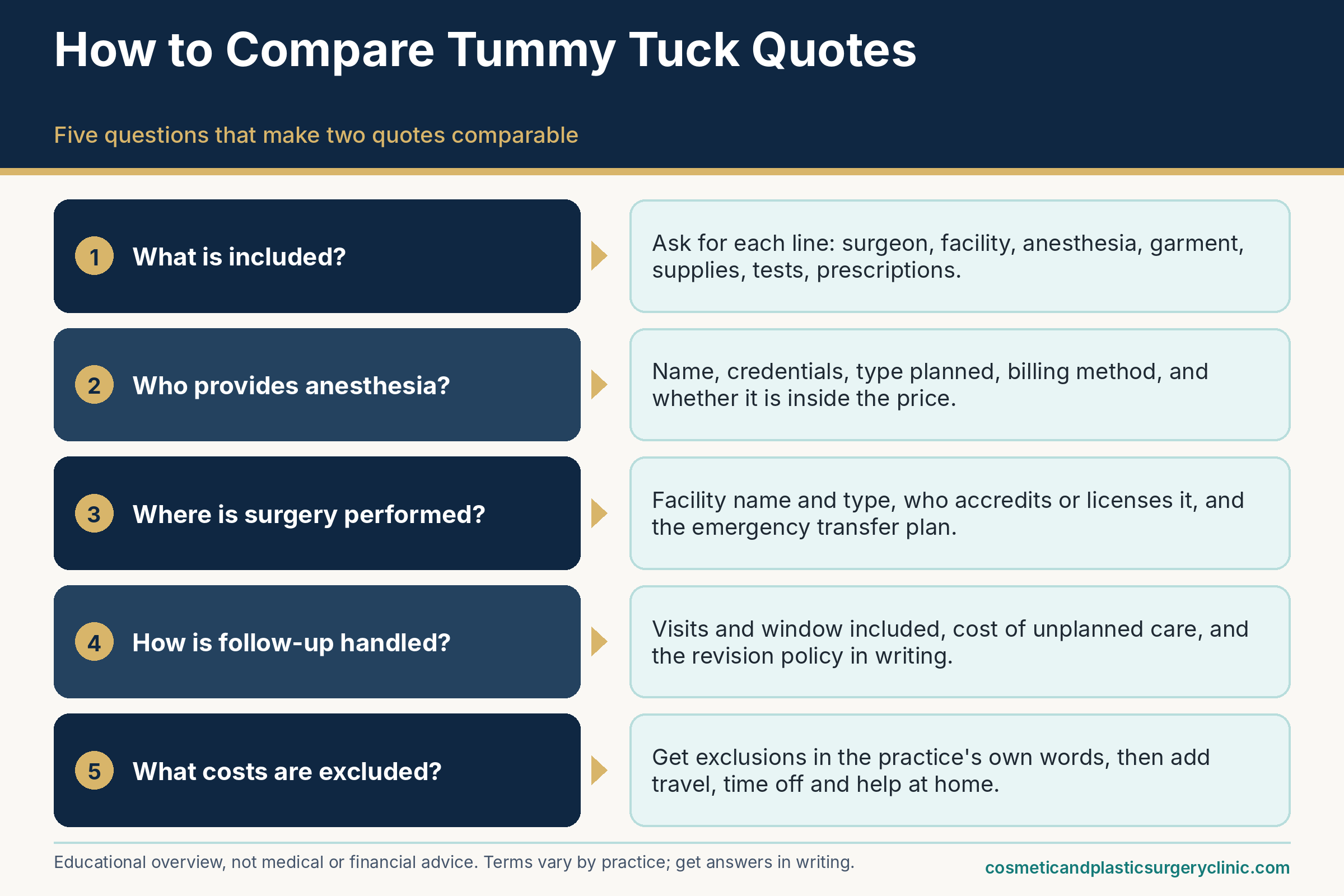
An itemized quote lists each cost layer separately, with the party that bills it. For a tummy tuck that means, at minimum, the surgeon’s fee, the facility fee, the anesthesia fee, the garments and supplies, any pre-operative testing and prescriptions, the follow-up period covered, and the revision policy. The worksheet in the final section of this guide turns that list into a template.
There is also a federal tool that may help. The Centers for Medicare & Medicaid Services (CMS) explains on its medical bill rights page that for people who don’t have or don’t use health insurance, providers usually must give a good faith estimate of the cost of care when you request one or when you schedule services at least three business days in advance. The same page says you may be able to dispute a bill if it is at least $400 more than the estimate. The page does not mention cosmetic surgery by name, and self-pay surgery plausibly falls within the described group, but whether and how the rule applies to a specific practice and service is something to confirm with the practice rather than assume.
The reason this matters is that cost transparency in plastic surgery is uneven. A 2024 survey-based study in Plastic and Reconstructive Surgery Global Open reported that most surveyed providers do not share the costs of their services online. So you probably won’t be able to price-shop from websites alone, and an itemized estimate may be the first time you see the facility and anesthesia components. Ask for it before you pay a deposit, not after.
Price Shopping and Medical Tourism
With a self-pay procedure and a wide spread of quotes, the temptation to simply pick the lowest is understandable. It’s worth being clear-eyed about what that strategy can and can’t tell you.
Why the lowest quote isn’t automatically the best deal, and why the highest isn’t either
A lower price can be legitimate. A practice in a less expensive market, with a lean operation and an efficient surgeon, can charge less than one in a high-cost city for the same operation delivered with the same care. A higher price can be legitimate, too, and it can also just be higher. The price alone can’t tell you which you’re looking at.
What you can do is test what the price includes. A lower quote may leave out the anesthesia fee, or use a setting with different staffing or emergency arrangements, or exclude garments and prescriptions, or cap follow-up visits at a shorter window than a competing quote does, or offer no coverage of the surgeon’s fee for a revision. Each of those is a trade-off a patient can accept knowingly, but each should be a decision rather than a discovery. Conversely, a high quote may include a private nurse, a longer follow-up period, or a more elaborate facility, which you may or may not want to pay for.
There’s a financial angle on risk, as well. ASPS notes that most health insurance plans don’t cover tummy tuck surgery or its complications. If unplanned care after a cosmetic operation falls to you, the cost of aftercare terms and revision policy matters more than the headline price suggests. A quote that looks cheap and offers weak support for the unexpected can turn out to be the expensive one, and a quote that looks expensive but spells out how problems are handled can turn out to be the sensible one. Neither outcome is certain, which is the reason to compare terms and not only totals.
Medical tourism: where the savings come from and what the sources say about trade-offs
Traveling for surgery, domestically or abroad, is often motivated by a lower sticker price or a packaged offer that includes lodging. The premise isn’t irrational, since pricing really does differ by market. The question is what the lower price leaves out, and the sources that describe patients’ experiences focus on four things.
The first is infection. In June 2026 the Centers for Disease Control and Prevention (CDC) highlighted a review published in Emerging Infectious Diseases (volume 32, issue 6) of 2,162 consultations the agency handled between 2014 and 2024. Thirty-four involved patients who traveled for medical procedures, and 21 reports covering about 145 patients involved cosmetic procedures, most commonly liposuction, abdominoplasty, breast augmentation and gluteal augmentation. Infections were reported in 20 of the consultations, 12 involved suspected or confirmed nontuberculous mycobacteria, and four patients died. Investigators identified lapses in infection control, including environmental cleaning, protective equipment use, hand hygiene and instrument reprocessing. These are cases that reached public health attention, so they can’t tell you how often a trip goes smoothly or what the overall risk is.
The second is cost shifted rather than avoided. A 2017 study in Plastic and Reconstructive Surgery, summarized by ASPS, reviewed 36 months of records at one New York medical center and found 42 patients with complications after cosmetic surgery performed abroad, including abdominoplasty. Thirty developed infections, 20 were hospitalized, and 13 needed additional surgery. The average cost of treating their complications was about $18,000 per patient. That’s a small, single-center, 2017 sample, so it illustrates a possibility rather than predicting an outcome.
The third is the flight home. An ASPS statement on medical tourism says that long-distance flights combined with recent surgery raise the danger of blood clots and pulmonary embolism, and that vacation activities should be avoided after surgery because they can jeopardize healing.
The fourth is follow-up. The same statement points out that local surgeons may lack knowledge of the original surgical technique, and that revisions can be more complex than the first operation. Before choosing a surgeon at a distance, ask who will provide care for complications at home, whether that clinician has agreed to do so, how your records will travel, and what the surgical team’s own policy is for problems after you leave.
If you’re still weighing it, treat the overseas or out-of-area quote like any other: itemize it, verify credentials and facility accreditation through independent sources, and add travel, lodging, a companion, extra recovery days and the cost of contingency planning to the total before you compare it with a local quote. Then look at the difference. For some people the arithmetic still favors travel, and for others it narrows considerably.
The Total Out-of-Pocket Planning Calendar: Before, During and After Surgery
Quotes describe the cost of surgery. Budgets have to describe the cost of the whole experience, and the experience starts months before the operating room and continues long after it. Mapping expenses onto a calendar helps in two ways: it shows when money actually leaves your account, and it reveals the expenses that never appear on any quote because they aren’t the practice’s to charge.
Before Surgery: From First Consultation to the Week Before
The early phase is where most people underestimate the number of small costs, partly because each one is small enough to ignore on its own.
Months to weeks ahead: consultations, testing and the quiet line items
Start with the consultation itself. Some practices charge a consultation fee, and some credit it toward surgery if you book; others don’t charge at all. If you’re collecting more than one opinion, which is reasonable for an operation of this size, those fees add up, so it helps to ask about the fee at the time you book. The tummy tuck consultation guide lists clinical questions to ask in the room, which is a different job from the financial questions here.
Next comes pre-operative preparation. Depending on your health history and your surgeon’s protocol, that might include laboratory tests, an electrocardiogram, a medical clearance visit with your own physician, or an anesthesia evaluation. These may be billed by a laboratory, a primary care office or the practice, and your insurance may or may not pay for them, since a cosmetic operation can change how a payer classifies the testing. Ask the practice which tests it requires, who performs them, and who bills for them.
ASPS lists being a nonsmoker and maintaining a stable weight among the factors it describes for tummy tuck candidacy, and both can carry costs. Nicotine cessation support, if it’s needed, may cost money; a plan to reach and hold a stable weight may involve a program or coaching. These costs are worth anticipating but not worth overspending on, and the clinical decisions belong with your surgeon and your own physician.
The financial plumbing starts here too. If you plan to finance, the application and approval take time, and a deposit often follows the decision to book. Arrange the sources for your deposit and balance while you still have time to compare options, and don’t let the surgery date force a rushed financing decision.
Then think about work. Cosmetic surgery usually doesn’t qualify for the job-protected leave provisions that apply to serious health conditions. The federal Family and Medical Leave Act regulations state that conditions for which cosmetic treatments are administered, with plastic surgery as an example, are not serious health conditions unless inpatient hospital care is required or complications develop. That means you may be relying on paid time off, employer short-term disability rules (which may also exclude elective procedures) or unpaid leave, and every day without income is a real cost of the surgery. Check your employer’s policy before you commit to a date.
The final week: garments, supplies, prescriptions and help at home
The last week before surgery is when the shopping and arranging happens, and it’s where an unlisted-cost surprise is most likely. Your practice will likely provide or specify a compression garment. ASPS describes elastic bandages or compression garments as part of recovery, so confirm whether the first garment is included, whether it’s ordered in advance for sizing, and what a second or replacement garment costs. Some surgeons recommend more than one.
Prescriptions are the next item. ASPS notes that patients receive medications to apply or take by mouth to aid healing and reduce infection risk. Ask whether prescriptions should be filled before surgery day, which pharmacy to use, and whether you’re being given a written list of what to expect and what you must not take. This is the stage to follow your surgeon’s instructions precisely and avoid improvising with over-the-counter products.
The remaining items are practical. Plan for transportation to and from the facility, because you won’t be able to drive yourself. Arrange help at home for the early recovery period, whether that’s a relative, a friend or a paid caregiver. If you have children or pets, plan for their care. Stock the kitchen with food you can prepare without bending or lifting. Consider the physical setup of your bedroom and bathroom, since your surgeon may recommend specific positioning and aids. Each of these is a cost, in dollars or in favors, and none of them will appear on your quote. The week-by-week recovery article is a good source for the logistics to plan around.
Surgery Day, Recovery and the Long Tail
Most of the money moves in a short window around the operation. The long tail afterward is smaller in dollars but easier to forget.
Surgery day through the first two weeks
On or before the surgery date, the facility and anesthesia charges are due according to the arrangement you made: perhaps rolled into one payment, perhaps billed separately afterward. If an overnight stay is planned, ask whether it’s included in the facility charge or billed separately, and whether a private-duty nurse is optional or necessary. Not every tummy tuck involves an overnight stay, and the right arrangement is a clinical and logistical question for you and your surgeon, not a standard assumption.
After you leave, the cost lines tend to be small but frequent. ASPS notes that drains may be placed temporarily, so you may need dressing supplies, and the practice may charge for items it supplies. You’ll have follow-up appointments, and the question is whether they’re included in the surgeon’s fee. Transportation to those visits, a companion’s time and meals add up. Medication refills are possible.
The cost most likely to catch people off guard is unplanned care. An unscheduled visit, a procedure in the office to address a fluid collection, or a trip to an urgent care or emergency department, can generate charges outside the practice’s package. The StatPearls review reports that overall complication rates after abdominoplasty are commonly cited in a range of roughly 10 to 20 percent. That range lumps minor and major problems together and varies across studies, so it’s context for planning, not a prediction of what will happen to you. The sensible response is a contingency reserve and a clear conversation with the practice about how unplanned care is handled and billed.
Weeks three to twelve and beyond: follow-up, scar care, revision and weight changes
As recovery moves along, the defined follow-up window may end. Find out in advance when that is, because visits after it may carry a fee. You may continue to buy garments or scar-care products if your surgeon recommends them, and your surgeon will guide when you resume exercise, which affects whether gym costs resume.
The long tail also includes the revision question. Some people consider a touch-up or revision after healing, and practices have different policies on whether any portion of the surgeon’s fee, the facility or the anesthesia is covered in that case. Get the policy in writing before surgery, including how long it applies and whether it depends on the reason for the revision. The risks and complications article explains why revisions occur.
Finally, results aren’t permanent in the sense that your body stops changing. ASPS states that results can diminish with major weight changes. If a pregnancy or significant weight shift is plausible in the future, that’s a planning variable for the timing of surgery and for any future procedure, and it belongs in the conversation with your surgeon rather than in a spreadsheet.
| Phase | Typical expense categories | Who is usually paid | Planning note |
|---|---|---|---|
| Research and consultations | Consultation fees; second opinions; records requests | Practices | Ask whether the fee is credited toward surgery |
| Pre-operative preparation | Laboratory tests; medical clearance; anesthesia evaluation; nicotine or weight support if relevant | Laboratories, your physician, the practice | Ask who orders and who bills each item |
| Booking | Deposit; financing application or fees | Practice; lender | Compare financing outside the practice before committing |
| Final week | Garments; prescriptions; household help; transportation; childcare or pet care; food preparation | Practice, pharmacy, retailers, caregivers | Most of these are not on any quote |
| Surgery day | Facility fee; anesthesia fee; remaining surgeon’s fee; overnight care if planned | Facility; anesthesia group; practice | Confirm what is due before the day and what may be billed later |
| First two weeks | Dressings and drain supplies; medications; follow-up visits; unplanned care | Practice, pharmacy, urgent care if needed | Keep a contingency reserve and ask how unplanned care is billed |
| Weeks three through twelve and beyond | Follow-up after the included window; replacement garments; scar-care products; possible revision | Practice; retailers | Get the revision policy in writing before surgery |
Comparing Quotes and Deciding on Value, Not Price Alone
Everything so far points toward one practical skill: putting two or three quotes side by side in a way that survives scrutiny. The goal isn’t to find the lowest number. It’s to be able to say, for each quote, exactly what you would get for what you would pay, and then to decide with that information.
A Quote-Comparison Framework
A framework helps because quotes arrive in different formats, and the human tendency is to compare the biggest number on each page. Normalizing them first prevents that.
Normalize before you compare: a five-step method
Work through these steps for each quote, writing the answers in the same order so that the quotes line up.
First, define the operation. Write down which tummy tuck variation is planned, whether muscle repair, liposuction and navel work are included, whether a hernia has been checked for, and whether anything else is being done at the same time. If one quote describes a mini abdominoplasty and another a full one with liposuction, the comparison is over before it begins, and you need an apples-to-apples version of one of them.
Second, define the setting. Write the name and type of facility, who accredits it, and how emergencies are handled. Third, define anesthesia: who provides it, which type is planned, how it’s billed, and whether it’s in the quoted price. Fourth, define the aftercare: the follow-up window, what’s included for garments, drains, dressings and prescriptions, what unplanned care costs, and the revision policy. Fifth, write down what’s excluded from each quote, in the practice’s own words, and add your own external costs such as travel, lodging, time off and household help.
Only then compute a total for each quote, with the same lines in the same order. If a practice won’t itemize, record that as information: you can’t treat a bundled figure as equivalent to an itemized one until you know what’s inside it.
Here’s how that plays out in a hypothetical, with no real prices. Quote A is a single figure labeled “tummy tuck” from a practice in your area. Quote B comes from another practice, lists the surgeon’s fee, the facility fee, and anesthesia separately, and offers a revision policy in writing. At first glance, A looks cheaper. When you ask A for itemization, you learn that anesthesia is billed by an outside group after surgery, the garment is extra, follow-up visits are covered for a shorter period, and the facility is an office-based suite whose accreditation you then verify. After you add those to A, the gap with B narrows, vanishes or reverses, depending on the actual numbers. Or A’s answers might be reassuring and complete, in which case A really is the less expensive option and you’ve learned that with confidence. The method doesn’t tell you which quote is right. It makes sure the comparison is honest.
| Item to record | What to write down | Why it matters | Possible concern |
|---|---|---|---|
| Operation named | Mini, full, extended or other; muscle repair; liposuction; navel work | Scope drives time and price | Vague label with no definition |
| Additional procedures | Hernia check or repair; any combined procedures | Changes time, billing and risk context | Add-ons priced only after consent |
| Surgeon and credentials | Name; ABPS certification status; state license | Credentials are separate from price | Surgeon not named in writing |
| Facility and accreditation | Name, type, accreditor, verification date | Standards and emergency arrangements | Cannot document accreditation or licensure |
| Anesthesia | Provider, type, billing method, in or out of price | Often billed separately | Unknown provider or open-ended billing |
| Included supplies | Garment, drains, dressings, prescriptions, tests | Prevents later add-ons | “Supplies” with no list |
| Follow-up window | Visits included and for how long | Defines when fees restart | Short or undefined window |
| Revision policy | What is covered, for how long, under what conditions | Changes the real cost of a second operation | Verbal-only promises |
| Payment and refund terms | Deposit, balance due date, cancellation terms | Cash-flow planning and exit options | Pressure to pay before reviewing terms |
| Stated exclusions | What the practice says is not included | Reveals the true total | Exclusions revealed only after deposit |
Questions to ask for an itemized quote
Bring these to the consultation or send them by email so that the answers are in writing. Group them to make the call efficient.
About the operation:
- Which version of the operation is planned for me, and why that one rather than a smaller or larger one?
- Does the quoted fee include muscle repair, navel work and any liposuction, and which areas?
- Has a hernia been assessed, and how would one be handled on the bill if found?
- If the plan changes during surgery, who decides, and how are added charges calculated and communicated?
About the setting and anesthesia:
- Where will surgery take place, who accredits or licenses that facility, and may I verify that myself?
- What is the facility charge, and is it in the surgeon’s price or billed separately?
- Who will provide anesthesia, what are their credentials, and which type is planned?
- How is anesthesia billed, and what happens if the operation runs longer than expected?
- What is the plan if I need emergency care, and where would I be transferred?
About aftercare and contingencies:
- Which garments, drains, dressings and prescriptions are included, and what do replacements cost?
- How many follow-up visits are included, and until when?
- What does an unplanned visit or in-office procedure cost after the included window?
- What is the revision policy, in writing, and what is excluded from it?
- If I develop a complication, which costs does the practice cover, and which fall to me or my insurer?
About payment and paperwork:
- How much is the deposit, what is it applied to, and what are the refund terms for each scenario?
- When is the full balance due, and by what payment methods?
- Can I receive a written, itemized estimate before I pay any deposit?
- If I use financing, who is the lender, and are there fees or deferred-interest terms I should read first?
A related question some people want answered at this stage is whether a smaller or different approach could meet their goals at a lower cost, which is a decision that rests on a surgeon’s examination and is picked up again below.
Red Flags and a Safe Next Step
Most practices aren’t trying to mislead anyone. Still, certain patterns in pricing and sales deserve a pause, and a few deserve a hard stop.
Red flags in pricing and sales practice
A quote delivered without an examination is, at best, a ballpark. Phone and email estimates are useful for screening, but the operation can’t be defined without evaluating your anatomy and goals, so a firm total given sight unseen should make you ask what assumptions it contains.
Be cautious when the surgeon isn’t named in writing, when the quote doesn’t identify the facility, or when anesthesia is described only as “included” without saying who provides it. Be cautious when a practice can’t or won’t itemize, or when the exclusions emerge only after you’ve paid a deposit. Be cautious about pressure: a limited-time discount, a deposit demanded the same day, financing presented before any medical discussion, or a suggestion that the price will rise if you wait. Elective surgery doesn’t have an expiring offer attached to its safety, and a practice that behaves as if it does is telling you something about priorities.
Be cautious about claims that promise a particular result, claim to eliminate scars, or describe the operation as free of meaningful risk. Medical sources don’t support those statements, and ASPS’s own risk list for tummy tuck includes anesthesia risks, bleeding, infection, deep vein thrombosis, poor wound healing, fluid accumulation, fat tissue death, scarring issues and the possibility of revision surgery.
And be cautious when a price is far below every other quote in your market and no one can explain what is missing. A low price isn’t evidence of a problem, but an unexplained one is a reason to ask more questions. The ABPS certification check and the facility’s accreditation directory are two independent ways to test claims that a quote makes. If you want a deeper checklist, the guide to choosing a plastic surgeon goes further.
Value, safety and alternatives when the budget is tight
If the quotes you’re getting are above your budget, you have more than two options. Most people frame the choice as “pay for it” or “give up,” but there are other moves.
You can wait and save, which lets you build a deposit and a contingency reserve and keeps you out of high-interest financing. Waiting also gives time for life circumstances such as a stable weight or the completion of a family-planning decision to settle, which can bear on the surgery’s timing. You can ask your surgeon whether a smaller operation would reasonably meet your goals, with the understanding that scope should follow anatomy, not budget. You can ask about staging if a combination is being proposed. You can explore alternatives, including nonsurgical options, which carry their own trade-offs and don’t achieve the same changes; the article on alternatives to tummy tuck compares them honestly. And if your main concern is excess skin after major weight loss with functional symptoms, a conversation about panniculectomy and insurance criteria is a different path with different costs.
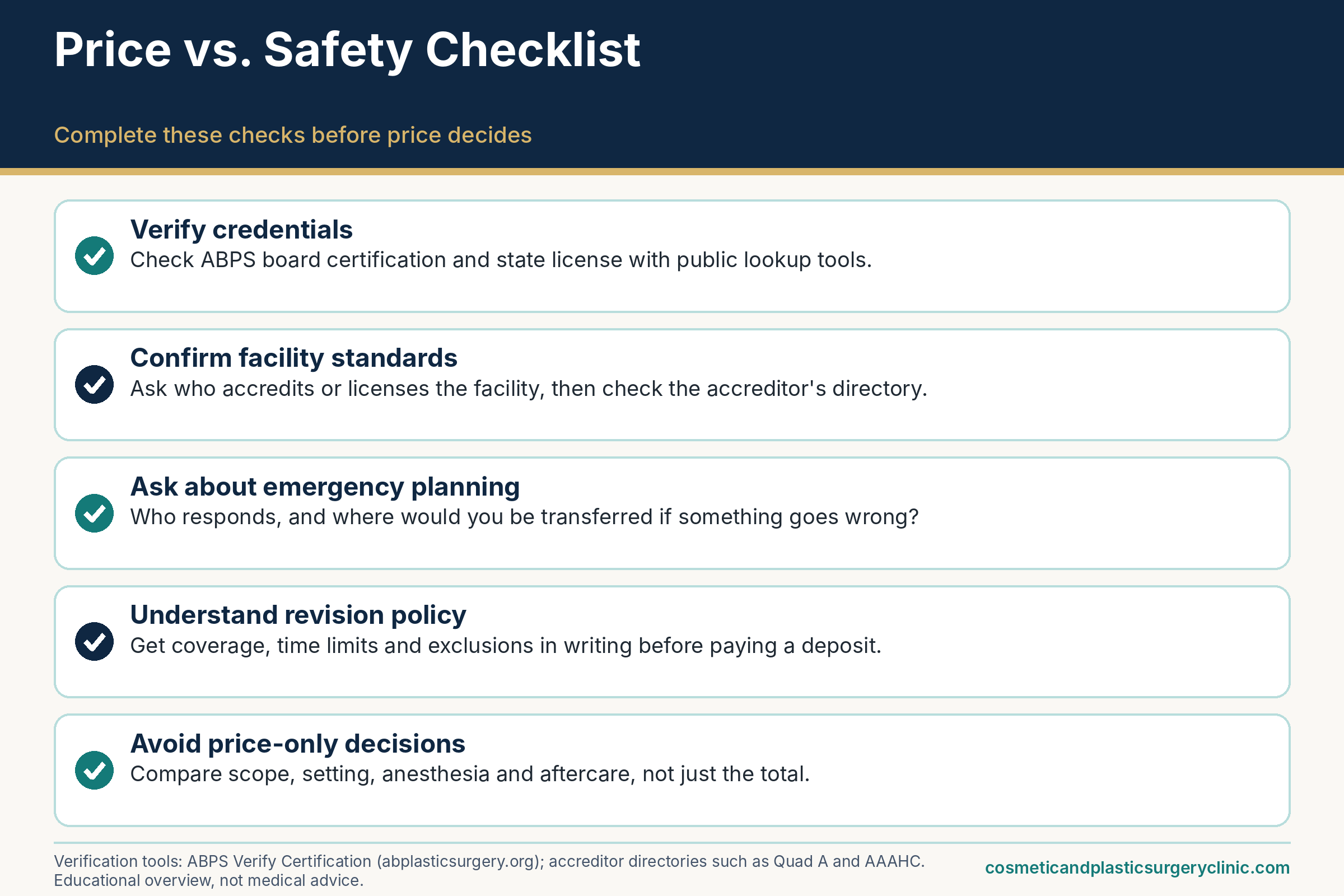
What you shouldn’t do is trade down on the items the checklist in the infographic covers: credentials, facility standards, emergency planning and a written revision policy. Those are the parts of the quote that matter most if something doesn’t go as planned, and they’re the parts a lowest-price strategy tends to put at risk. The right comparison isn’t cheap versus expensive. It’s whether you understand what you’re buying, who stands behind it, and what happens if the plan changes.
When you’re ready for a next step, a measured one looks like this: verify the surgeon’s board certification at the ABPS page and the facility’s accreditation in the accreditor’s directory; ask for an itemized, written estimate from at least two practices; take the paperwork home; and make the financial decision on your own timeline. Nothing on this page replaces an examination or a conversation with a qualified clinician, and the numbers that matter for you are the ones that appear in your own written quotes.
Frequently asked questions about tummy tuck cost
How much does a tummy tuck cost in the United States?
No single number covers every case. ASPS reported a 2024 average surgeon’s fee range of $8,000 to $13,500 for abdominoplasty, based on a survey of its member surgeons, and that range excludes anesthesia, the facility and related expenses. Your total adds those layers and varies by operation, setting, location and the practice’s aftercare terms. A realistic estimate for your situation exists only on an itemized written quote from a surgeon who has examined you. National averages help you spot outliers, but they aren’t a price list.
Does the published surgeon’s fee include anesthesia and the facility?
No. ASPS states that its average cost covers only part of the total price and does not include anesthesia, operating room facilities or other related expenses. Its cost page lists anesthesia, hospital or surgical facility costs, medical tests, post-surgery garments and prescriptions as separate items. Some practices quote an all-inclusive package that combines these, which is why a bundled quote can look higher than a surgeon’s-fee-only figure while describing the same overall arrangement. Ask each practice what its number includes, line by line.
Why is my quote higher or lower than the ASPS range?
Several reasons can apply. The ASPS range covers the surgeon’s fee alone, so an all-inclusive quote will naturally exceed it. Geography and practice setting matter, since ASPS says its range reflects both. The operation may be larger or smaller than a standard full abdominoplasty, with added liposuction, hernia repair or a combined procedure. And the ASPS data come from member surgeons who responded to a survey, so a practice outside that group may price differently. A gap is a reason to ask questions, not a conclusion about quality.
Is a mini tummy tuck always cheaper than a full tummy tuck?
Often, but not automatically. A mini abdominoplasty typically involves a shorter incision and less tissue, which can mean less operating time and a lower facility and anesthesia charge. Some practices, however, price by procedure name and not by time, and a mini combined with liposuction may cost more than a full operation alone elsewhere. More importantly, the operation should match your anatomy and goals, as judged by your surgeon. A cheaper but mismatched procedure can lead to disappointment, and a revision can cost more than choosing the right operation first.
Does insurance ever pay for a tummy tuck?
ASPS says most health insurance plans don’t cover tummy tuck surgery or its complications. Cosmetic procedures are generally excluded, and Medicare’s cosmetic surgery exclusion has narrow exceptions. Related procedures can be treated differently: a panniculectomy performed for documented functional problems, or a true hernia repair, may be evaluated against a plan’s medical criteria, which vary by insurer. If a medically necessary component is being discussed, ask the practice to request written pre-authorization and explain how a split bill would work. Don’t assume coverage from a verbal assurance.
Can I pay for a tummy tuck with an HSA or FSA?
Usually not for a purely cosmetic procedure. IRS Publication 969 ties HSA qualified expenses to the definition of medical care in the tax code, and Publication 502 says cosmetic surgery generally doesn’t qualify unless it corrects a deformity from a congenital abnormality, an accident or trauma, or a disfiguring disease. Eligibility for any medically indicated component is a determination for your plan administrator, and tax treatment is a question for a tax professional. Get the answer in writing before paying with account funds.
Is financing a tummy tuck a good idea?
That depends on your finances and the terms, which this article can’t evaluate for you. The useful framing is to compare the total cost of each option, not the monthly payment. In a 2023 report, the CFPB found that the typical medical credit card carried a 26.99 percent APR, compared with roughly 16 percent for general-purpose cards, and that deferred-interest terms can lead to retroactive interest. Compare at least one outside option, such as a personal loan, and confirm the payoff plan before signing.
What is deferred interest, and why does it matter for surgery financing?
Deferred interest means interest accrues in the background during a promotional period, typically six to eighteen months according to the CFPB, and is waived only if you pay the full balance before the period ends. If even a small amount remains, interest can be charged from the original purchase date on the full original amount. That differs from a true 0 percent APR offer, where interest begins only on the remaining balance after the promotion. Minimum monthly payments often won’t clear the balance in time, so calculate the payment needed to pay it off.
If I need a revision, who pays for it?
It depends entirely on the practice’s written policy, and policies differ. Some practices waive part of the surgeon’s fee for certain revisions, while the facility and anesthesia charges remain yours; others offer no coverage. The reason for the revision may matter, and time limits often apply. Because ASPS notes that most insurance plans don’t cover tummy tuck surgery or its complications, assume unplanned care could be out of pocket unless the policy or your insurer says otherwise. Ask for the policy in writing before you pay a deposit, including what it excludes.
Is a tummy tuck cheaper if I travel abroad?
The sticker price may be lower, but the comparison needs more than the surgeon’s fee. A 2017 study summarized by ASPS followed 42 patients at one medical center who developed complications after cosmetic surgery abroad, and the average cost to treat them was about $18,000 each. A 2026 CDC report described infections, including nontuberculous mycobacteria, and deaths among patients who traveled for cosmetic procedures. Add travel, lodging, a companion, flight timing and a plan for follow-up at home before comparing totals.
Should I ask for a Good Faith Estimate?
It’s reasonable to ask. CMS says that people who don’t have or don’t use insurance can usually get a good faith estimate when they request one or schedule care at least three business days ahead, and that a bill at least $400 above the estimate may be disputable. The CMS page doesn’t address cosmetic surgery specifically, so ask the practice how its itemized estimate relates to that process. Either way, request a written, itemized estimate before you pay a deposit.
How much time off work should I budget for a tummy tuck?
Recovery varies with the operation, the person and the job, and no single figure is reliable. ASPS recommends asking your surgeon when you can resume normal activity and exercise, and the answer depends on your plan. For budgeting, treat time away as a cost: check your employer’s paid leave and short-term disability policies, and note that federal leave rules treat conditions for cosmetic treatments as not serious health conditions unless inpatient care is required or complications develop. Build a cushion, and read the recovery guidance for planning detail.
Sources and further reading
- American Society of Plastic Surgeons — 2024 Average Surgeon/Physician Fees (accessed 2026-10-03) — abdominoplasty fee range of $8,000 to $13,500; projected range from surveyed ASPS member surgeons
- American Society of Plastic Surgeons — Tummy Tuck Cost (accessed 2026-10-03) — undated average; exclusions (anesthesia, facility, other expenses); insurance and financing note
- American Society of Plastic Surgeons — Plastic Surgery Statistics, 2025 report (accessed 2026-10-03) — tummy tuck volume and rank; latest statistics year
- American Society of Plastic Surgeons — Tummy Tuck: Procedure Steps, Recovery, Risks and Safety, and Candidates pages (accessed 2026-10-03) — anesthesia options, muscle repair, drains, garments, listed risks, candidacy factors
- American Society of Plastic Surgeons — Abdominoplasty and Panniculectomy insurance document (July 2006; accessed 2026-10-03) — historical definitions of abdominoplasty, panniculectomy, hernia repair vs diastasis repair
- American Society of Plastic Surgeons — ASPS Member Qualifications (accessed 2026-10-03) — board certification, accredited facilities and continuing education requirements for members
- American Society of Plastic Surgeons — Tummy tuck complications study looks at rates and risk factors (2015 study; accessed 2026-10-03) — complication rates alone vs combined; office-based setting observation
- American Society of Plastic Surgeons — Medical tourism for cosmetic surgery: high risk of complications, high costs for treatment (2017 study; accessed 2026-10-03) — complications and treatment cost after surgery abroad
- American Society of Plastic Surgeons — ASPS cautions plastic surgery patients to approach holiday medical tourism with vigilance (undated; accessed 2026-10-03) — flight and clot risk, infection, follow-up difficulty
- Centers for Disease Control and Prevention — CDC highlights adverse outcomes linked to travel-related cosmetic procedures (June 2, 2026; accessed 2026-10-03) — consultation review, infections, nontuberculous mycobacteria, deaths
- StatPearls — Abdominoplasty (updated March 3, 2026; accessed 2026-10-03) — technique variations, rectus plication, anesthesia, complication ranges
- Consumer Financial Protection Bureau — Medical Credit Cards and Financing Plans (May 2023; accessed 2026-10-03) — deferred interest, typical APR, point-of-care enrollment concerns
- Centers for Medicare & Medicaid Services — Medical bill rights and good faith estimates (accessed 2026-10-03) — who may receive an estimate, timing, $400 dispute threshold
- Internal Revenue Service — Publication 502, Medical and Dental Expenses (2025; accessed 2026-10-03) — definition and treatment of cosmetic surgery
- Internal Revenue Service — Publication 969, Health Savings Accounts and Other Tax-Favored Health Plans (2025; accessed 2026-10-03) — HSA qualified medical expenses defined by reference to section 213(d)
- Electronic Code of Federal Regulations — 29 CFR 825.113, Serious health condition (accessed 2026-10-03) — cosmetic treatments and serious health condition
- Centers for Medicare & Medicaid Services — National Coverage Determination 140.4 (accessed 2026-10-03) — Medicare cosmetic surgery exclusion and narrow exceptions
- Legal Information Institute — 42 CFR 414.46, Additional rules for payment of anesthesia services (accessed 2026-10-03) — base units plus 15-minute time units in Medicare anesthesia payment
- American Board of Plastic Surgery — Verify Certification (accessed 2026-10-03) — public certification lookup
- American Board of Medical Specialties — Certification Matters (accessed 2026-10-03) — public lookup for ABMS member board certification
- Quad A — About Us and Accredited Facilities Directory (accessed 2026-10-03) — accreditation of ambulatory surgery and office-based surgical facilities
- AAAHC — Accreditation programs (accessed 2026-10-03) — accreditation of ambulatory surgery centers and office-based surgery centers
- Plastic and Reconstructive Surgery Global Open — The Controversy over Price Transparency: Patients and Plastic Surgeons Disagree (October 2024; accessed 2026-10-03) — survey-based finding on online price disclosure