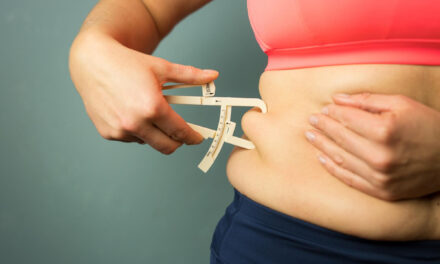

A tummy tuck (abdominoplasty) is an operation on the front of the abdominal wall. It removes loose skin and, depending on the technique, some fat below the navel, and it can tighten the stretched connective tissue that sits over the abdominal muscles. People usually start searching for it after pregnancy, after a large change in weight, or after years of noticing that the lower belly no longer responds to diet and exercise the way it once did. This guide is written for that stage of research, when you want the whole picture before you sit down with a surgeon.
It covers what a tummy tuck does and does not do, who tends to be considered a good candidate, how timing around pregnancy and weight changes matters, the main technique variations, what happens on the day of surgery, what recovery usually involves, how scars behave, what the risks are, what the money question looks like, and what the alternatives are. It does not tell you what you personally need. That decision belongs in a consultation with a board-certified plastic surgeon who can examine you, review your medical history, and explain the trade-offs in your own anatomy.
The sections below are organized the way most decisions unfold. First comes the definition and anatomy, because a lot of confusion about tummy tuck results comes from not knowing which layer is causing the concern. Next is candidacy and timing, then technique, the surgical day, recovery, results and risks, and finally cost, insurance, alternatives, and surgeon selection. Each section links to a deeper companion page where one is planned, so you can read this as an overview and follow only the threads that match your situation.
A note on numbers. Where this guide cites a statistic, it names the source, the year, and the population, because figures from one study or one database rarely transfer cleanly to another setting. Complication rates in particular depend on who was studied, how complications were defined, and what else was done in the same operation. Treat every percentage here as context for a better conversation with a surgeon, not as a prediction for any individual.
What a Tummy Tuck (Abdominoplasty) Is and What It Changes
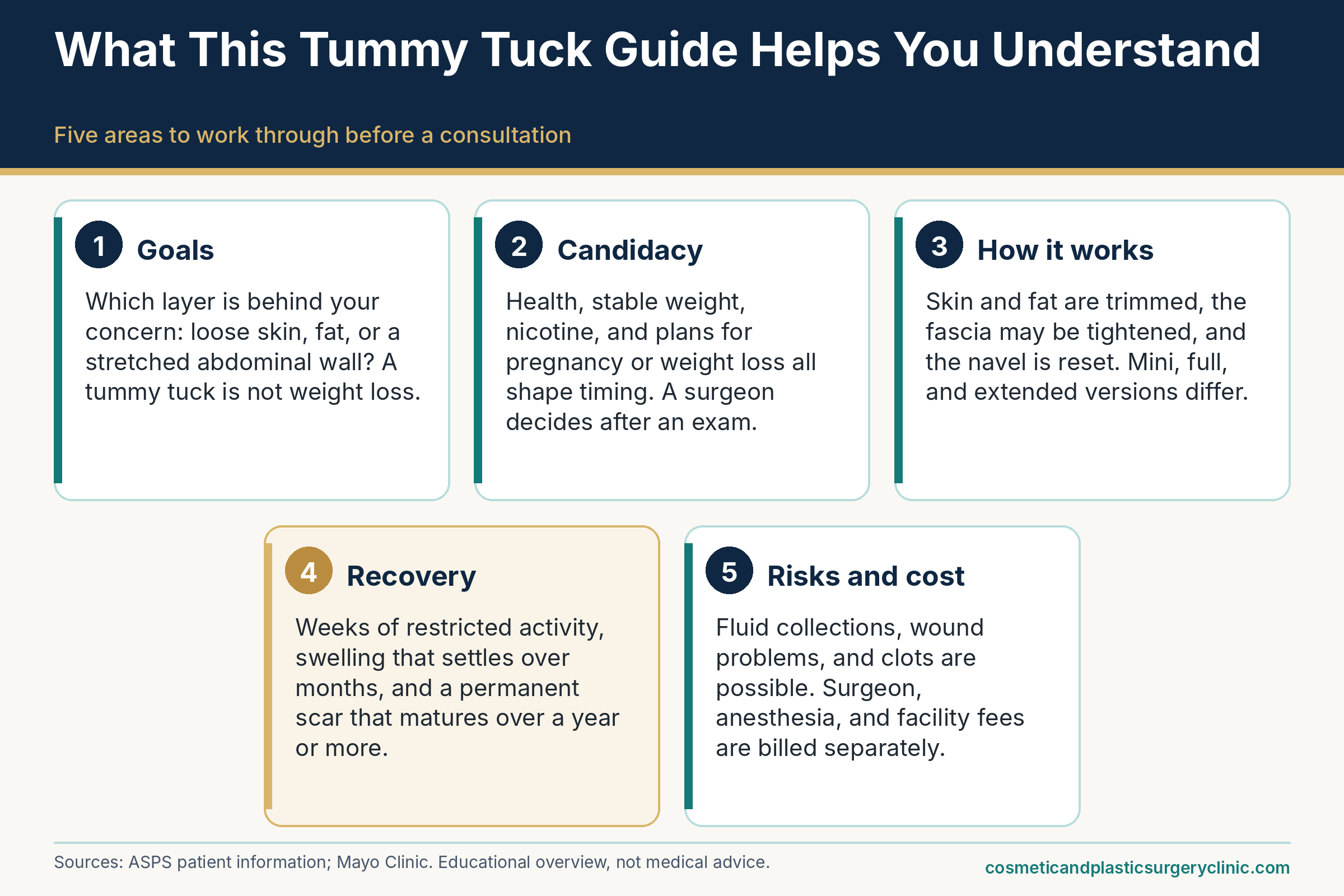
The word “tummy tuck” covers a family of operations rather than one fixed procedure. What they share is the goal of reshaping the front of the abdomen by working on three things at once: the skin, the fat layer under it, and the fibrous wall underneath. How much work each layer needs is the real question behind most consultations.
Definition and Terminology
Tummy Tuck and Abdominoplasty: Terms That Get Mixed Up
Tummy tuck is the everyday name. Abdominoplasty is the clinical name for the same family of operations, and surgeons, journal articles, and insurers use it interchangeably with the common term. The American Society of Plastic Surgeons (ASPS) describes the operation as removing excess fat and skin and, in most cases, restoring weakened or separated muscles to create a smoother, firmer abdominal profile. That definition is useful because it already contains the three layers that matter: skin, fat, and muscle with its covering fascia.
Several neighboring terms get mixed into the same searches, and it helps to separate them early. Liposuction (often shortened to lipo) removes fat through small tubes and does not remove skin or tighten muscle; the liposuction guide covers it in full. A panniculectomy removes a hanging apron of skin and fat, called the pannus, and typically does not involve tightening the muscle or repositioning the navel. A mini tummy tuck is a shorter-incision version aimed at the lower abdomen. A lipoabdominoplasty combines liposuction with a tummy tuck. A body lift extends the skin removal around the torso. A mommy makeover is a marketing bundle, not a single operation, that usually pairs a tummy tuck with breast or other procedures; the mommy makeover guide explains how those packages are put together.
Practical advice: when you read a clinic page or a quote, ask which of these operations is actually being described. Two quotes that both say “tummy tuck” can describe different amounts of surgery, which is one reason prices and recovery stories are so hard to compare. The section on types and techniques below goes through the main variations at overview depth.
What a Tummy Tuck Can and Cannot Do
It helps to think of a tummy tuck as a contour and tightness operation, not a weight operation. The ASPS is explicit that it is not a substitute for weight loss or an appropriate exercise program, and that results can be greatly diminished by significant fluctuations in weight. It is also not a treatment for the fat that sits deep inside the abdomen around the organs, which is a separate matter of metabolic health and which no skin-and-fat operation reaches.
What it can do is remove skin that has stretched beyond its ability to retract, take out some of the fat that sits above the muscle layer, and, when the surgeon judges it appropriate, bring the separated midline tissue back together so the abdominal wall sits flatter. When a person has a lower-belly bulge that is mostly stretched skin and a loosened wall, those are the changes that address it. When the bulge is mostly deep abdominal fat, the operation changes the profile much less.
It also has limits that are easy to overlook. It cannot fix stretch marks across the whole abdomen, though marks inside the removed area leave with the skin, and those above the navel or on the flanks may remain. It also cannot be done without a scar: the trade-off for removing skin is a long incision line that stays for life. And a tummy tuck does not make future weight change or pregnancy irrelevant; ASPS advises that people planning substantial weight loss or future pregnancies consider postponing.
The table below turns these ideas into a quick check. Read it as a map of the conversation to have with a surgeon, not as a diagnosis.
| Concern | Tummy tuck relevance | Why | Question to bring to a consultation |
|---|---|---|---|
| Loose, hanging lower-abdominal skin | Often directly addressed | Excess skin is trimmed and the remaining skin is repositioned | How much skin could be removed, and where will the scar end? |
| Localized fat above the muscle layer | Partly addressed | Some fat leaves with the skin; more may need liposuction | Would adding liposuction change the plan or the risk? |
| Bulge from separated midline muscles (rectus diastasis) | Often addressed when present | The fascia can be tightened with sutures in many techniques | Is the separation measurable, and is there a hernia as well? |
| Deep fat around the organs | Not addressed | It lies beneath the muscle wall, out of reach of the operation | Is my profile limited more by deep fat than by skin? |
| Stretch marks above the navel or on the flanks | Limited | Only marks within the removed skin leave | Which marks are inside the planned excision? |
| Expected future pregnancy or large weight change | Timing issue | Both can stretch or alter the repaired area | Should surgery wait, and for how long? |
One more framing point. A tummy tuck is optional surgery for most people, and wanting a flatter abdomen is a legitimate personal goal. Nothing about a normal body requires correction. The aim here is simply to match the tool to the concern, so the operation, if you choose it, is aimed at something it can actually change.
Anatomy of the Abdominal Wall
Skin, Fat, and Fascia: The Layers Behind the Bulge
From the outside in, the front of the abdomen has skin, a layer of fat, a thin sheet of connective tissue called Scarpa’s fascia that runs through that fat, then a tougher fibrous layer (the anterior rectus sheath, or simply fascia) that wraps the abdominal muscles. The muscles come next, and the abdominal cavity lies behind them. A tummy tuck mainly works on the first three layers and, in some cases, the fascia over the muscles.
Each layer can be the source of a different complaint. Skin that has been stretched by pregnancy or by a large amount of weight gain and loss may lose its elasticity and sag or fold, sometimes with a texture change that resembles crepe paper. The fat layer may be thick in some places and thin in others, and diet changes the fat but not the skin. The fascia and muscles can loosen or separate, which pushes the belly forward even when there is little fat. Seeing these as separate problems explains a pattern many people describe: a lean person with a persistent lower bulge, or a person who has lost weight and now has a flat torso covered by extra skin.
This is also why a surgeon’s exam matters more than any general rule. Pinching the tissue while you stand and then while you tense your abdominal muscles can help distinguish what is skin and fat from what is wall. Some surgeons also use imaging when a hernia or a muscle gap is suspected. Whether imaging is needed depends on the exam and your history, so it is a question to ask rather than an assumption to make.
The anatomy also explains why sensation changes. The skin of the lower abdomen receives nerves from the wall beneath it, and when the skin is lifted from the wall some of those small branches are interrupted. Numbness or an altered feeling in the lower abdomen after surgery is therefore a recognized effect, and the ASPS lists altered skin sensation among the risks. It often improves, but how much and how fast varies and cannot be promised.
Rectus Diastasis, Hernias, and the Navel
Rectus diastasis is a widening of the gap between the two vertical rectus abdominis muscles, the paired “six-pack” muscles. The muscles are not torn. The midline connective tissue between them, the linea alba, stretches and thins, so the two sides sit farther apart. During pregnancy this is common because the growing uterus pushes the wall forward. In some people the gap narrows afterward; in others it stays wide and shows as a ridge or dome when sitting up.
A hernia is different. A hernia is an actual opening or defect in the abdominal wall through which tissue, such as fat or bowel, can push. An umbilical hernia sits at the navel. The ASPS and insurers draw a firm line between these two: the ASPS insurance guidance notes that a true hernia repair should not be confused with diastasis recti repair, which is part of a standard abdominoplasty. The distinction matters because a hernia repair has its own coding and, depending on symptoms and policy, can be treated as medically necessary, while a tightening for cosmetic contour usually is not.
What the evidence says about repairing a muscle gap is more modest than clinic marketing sometimes suggests. A 2020 systematic review in Cureus by Gormley and colleagues pooled only seven studies and found that function scores generally improved after plication, but abdominal strength results were inconsistent and the studies differed too much to draw firm conclusions. The authors called for larger, standardized trials. Read plainly: tightening the wall may help how the abdomen looks and, for some people, how it feels, but the functional benefit is not guaranteed and is still being studied.
The navel (umbilicus) is part of the plan, too. In a standard tummy tuck the navel stays attached to the wall on its stalk while the skin is lifted, and then the surgeon makes a new opening in the repositioned skin and brings the navel through it. That leaves a scar around the navel, and its shape, depth, and position are part of what makes a result look natural. The planned guide to tummy tuck scars covers where scars sit and how they mature.
Who May Be a Candidate and Why Timing Matters
Candidacy for a tummy tuck is a judgment made by a surgeon after an exam, not a checklist you can pass online. Still, the factors surgeons weigh are fairly consistent, and knowing them lets you arrive at a consultation with a clearer picture of your own situation. The deeper companion page on candidacy, timing and red flags for tummy tuck expands on this section; here we stay at the framework level.
Candidacy Factors
Goals, Anatomy, and the Skin-Versus-Fat Question
The ASPS describes people who are generally considered good candidates as physically healthy, at a stable weight, nonsmokers, bothered by the appearance of their abdomen, and holding realistic expectations. It also stresses that the decision should be made for yourself rather than to meet someone else’s wishes or an idealized image. That framing is worth taking seriously, because satisfaction after any body contouring operation tends to track how closely the goal matched what the surgery can change.
The most useful anatomical question is which layer is driving the concern. If the main issue is a thin layer of loose skin with a flat wall beneath it, an operation that removes skin may be the logical match. If the main issue is a firm, protruding abdomen that does not soften when you relax, deeper fat or an internal factor may be involved, and removing skin will not change that. If the issue is a localized pocket of fat in someone whose skin still retracts well, liposuction alone may address it with a smaller scar. A surgeon can often tell these apart with a standing and seated exam.
Because people frequently compare tummy tuck with liposuction and with nonsurgical devices, the table below lines up the main options by what they act on. It is a comparison of mechanisms, not a ranking; the right choice depends on the layer involved, your skin quality, and how much scarring and recovery you are willing to accept.
| Option | Acts on | Skin removal | Muscle/fascia tightening | Typical trade-off |
|---|---|---|---|---|
| Tummy tuck (abdominoplasty) | Skin, fat, and often fascia | Yes | Often, when needed | Long scar; weeks of restricted activity |
| Liposuction | Fat layer only | No | No | Smaller incisions; loose skin may remain or look looser |
| Mini tummy tuck | Lower-abdominal skin and some fat | Limited, below the navel | Sometimes, below the navel | Shorter scar; fits fewer anatomies |
| Panniculectomy | Hanging apron of skin and fat | Yes | Typically no | Addresses overhang, not contour or muscle gap |
| Noninvasive devices (cooling, heat, ultrasound, magnetic) | Fat or skin surface, indirectly | No | No (some claim muscle stimulation) | Modest change; effects may be temporary; not a weight-loss method |
The FDA’s page on noninvasive body contouring technologies makes a point worth carrying into any comparison: these devices are cleared for specific uses such as reducing the circumference of a treated area, they do not treat obesity or cause weight loss, and their effects may be temporary. That is a different category of change from removing skin. The alternatives to tummy tuck page compares them in more detail.
Health, Weight, Nicotine, and BMI Considerations
General health shapes risk more than any aesthetic factor does. Before offering surgery, surgeons typically review chronic conditions such as diabetes, heart and lung disease, and clotting history, along with medications and supplements that affect bleeding. A tummy tuck is major surgery under anesthesia, and conditions that raise anesthesia or wound-healing risk change the calculation. That is a screening conversation, and it is a reason to be completely candid about your history, including things you may consider minor.
Nicotine deserves its own mention. The ASPS lists being a nonsmoker among its candidate criteria, and abdominoplasty is a procedure in which the skin is lifted from the wall and relies on a narrowed blood supply to heal. Nicotine narrows blood vessels. An ASPS member-written blog post explains that this applies to every form of nicotine, not only cigarettes, including patches, gum, and e-cigarettes, and suggests staying nicotine-free for roughly three to six weeks before and after surgery as a minimum. Individual surgeons set their own rules, and many ask for longer. The evidence for quitting beforehand is not specific to tummy tuck but is consistent: a Cochrane review of preoperative smoking cessation programs (Thomsen and colleagues, 2014) found that intensive programs started at least four weeks before surgery were associated with fewer complications overall and fewer wound complications. If nicotine is part of your life, say so, and ask what testing and timeline the practice uses.
Body mass index (BMI) and weight are more contested. Complication risk generally rises with higher BMI across body contouring, and the 2015 study of 25,478 abdominoplasty cases by Winocour and colleagues in Plastic and Reconstructive Surgery listed higher BMI among its risk factors, along with male sex, age 55 or older, combining multiple procedures, and operating in a hospital rather than an office setting (that last association may reflect which patients are treated where rather than the building itself). A smaller 2009 series from Momeni and colleagues of 139 patients found major complications in 20.8% of obese patients versus 9.7% of others. Yet a 2019 comparison of 82 patients with a mean BMI of 35 versus 25, summarized by the ASPS, found no statistically significant difference in complications, and its authors argued for judging each person individually rather than applying a BMI cutoff.
The honest summary is that weight and BMI matter to risk, the studies are small and conflict, and there is no universal cutoff that this guide can give you. Many surgeons set their own limits, and some prefer that weight be reduced and stable before surgery. If a practice mentions a specific number, ask what it is based on and whether it applies to your build.
Timing and Life Stage
After Pregnancy and When More Pregnancies Are Possible
Pregnancy is one of the most common reasons people start researching a tummy tuck. It stretches the skin and the midline wall, and the changes do not always resolve on their own. Both the ASPS and Mayo Clinic advise people who are planning future pregnancies to consider delaying a tummy tuck, because a new pregnancy can stretch the repaired tissue again and may undo some of the result.
That leaves a real decision point for people who are unsure about having more children. Some wait. Others proceed and accept that a later pregnancy may change the outcome. There is no correct answer, and a surgeon cannot predict how any individual abdomen will respond to a future pregnancy. If you are leaning toward more children, say so at the consultation, because it may shift both the recommended timing and the technique.
Timing right after delivery is a separate question. After a birth, the abdominal wall and skin continue to change for a period, and many people are still breastfeeding, caring for a newborn, or adjusting their weight. Questions surgeons commonly want answered are whether breastfeeding has finished, whether weight has settled, whether the midline gap has stopped changing, and whether you have realistic help at home during recovery. The right moment depends on those factors, not on an arbitrary number of months, so treat any specific interval you read online as a starting point for discussion.
Practical planning matters here too. Recovery limits lifting, and a young child is heavy. Many parents arrange help for the first weeks, because lifting and carrying restrictions are one of the most commonly underestimated parts of recovery. Plan for it before the surgery date, not after. Tummy tuck is also sometimes paired with breast procedures after childbearing, which changes recovery planning because more areas are healing at once.
After Weight Loss, GLP-1 Medications, and Weight Stability
A tummy tuck is designed for a weight that is reasonably stable. Skin that has just lost a large amount of volume may continue to change as weight settles, and further weight loss after surgery can alter the result. The ASPS says results can be greatly diminished by significant weight fluctuations. The planned guide to tummy tuck after major weight loss covers how surgeons think about the waiting period and the larger skin excess that often follows.
The rise of GLP-1 receptor agonist medications has made this question more common. In its 2025 procedural statistics, released in 2026, the ASPS reported that 82% of ASPS member surgeons who responded had received consultation requests tied to GLP-1 medications, and that tummy tuck was the body procedure surgeons most often said they discussed with those patients. The same report noted that completed tummy tuck volume stayed fairly flat, which suggests that interest in consultation does not always turn into surgery. The report counted 173,251 tummy tucks in 2025, compared with 170,544 in 2024, a 2% increase, and it showed volume rising 15% among ages 56 to 65 while falling 6% among ages 36 to 45. Those are national counts reported by surgeons and partners; they describe demand, not outcomes. The page on GLP-1 medications and plastic surgery expands on this.
There are two practical issues specific to GLP-1 medications and surgery. The first is weight trajectory: if you are still losing weight, a surgeon may reasonably advise waiting until it stabilizes. The second is anesthesia safety. These drugs slow stomach emptying, which raises the possibility of food remaining in the stomach and being aspirated during general anesthesia. A multisociety clinical guidance published in October 2024 in Anesthesiology, from anesthesiology, gastroenterology, and bariatric organizations, said that most patients should continue GLP-1 medications before elective surgery, with individualized assessment, and that people at higher risk of stomach-emptying problems might use a 24-hour liquid diet or other measures. Do not stop or change a prescribed medication on your own because of anything you read here. Tell both the surgical team and the prescriber, and let them coordinate the plan.
Types of Tummy Tuck and How Surgeons Choose Between Them
Surgeons do not use one standard tummy tuck. They choose a variation based on how much skin there is, where it sits, whether the wall needs tightening, and whether fat removal is part of the plan. For a patient, the practical effect is that the incision length, the scar shape, and the amount of recovery all depend on the variation chosen. This section keeps to overview depth; the planned page on tummy tuck techniques is the place for finer detail.
The Main Variations
Mini, Full, and Extended Tummy Tuck
A mini tummy tuck is limited to the lower abdomen. The incision is shorter, and it generally addresses skin and fat below the navel. Because it works on a smaller area, it tends to suit people whose concern is a modest lower-abdominal pouch with relatively little loose skin above the navel. It cannot reach the upper abdomen, so someone with laxity higher up may not get the change they expect from it.
A full tummy tuck (sometimes called a standard or complete tummy tuck) addresses the whole front of the abdomen. As the ASPS describes it, a horizontal incision is made between the pubic hairline and the navel, with a second incision around the navel when excess skin extends into the upper abdomen. The skin is lifted, the wall is tightened if needed, the upper skin is pulled down like a window shade, the excess is trimmed, and a new opening is made for the navel. The length and shape of the incision depend on how much skin is removed.
An extended tummy tuck carries the same idea farther around the sides, toward the hips and flanks. It is generally considered when excess skin continues around the sides of the torso and a standard incision would leave a fold, sometimes called a dog-ear, at each end. It adds length to the scar and operative work, and for some people it leads into the territory of a lower body lift. The descriptions are general; names are not used consistently, and a surgeon who offers a “mini” to one patient may do a different operation than another surgeon who uses the same word.
The easiest way to avoid miscommunication is to ask the surgeon to describe, in words and with a marked diagram, where the incision will start and end, whether the navel will be repositioned, and whether the wall will be tightened. Those three details define the operation more reliably than the label.
Lipoabdominoplasty, Fleur-de-Lis, Circumferential, and Body Lift Distinctions
Lipoabdominoplasty combines a tummy tuck with liposuction, often of the abdomen and flanks. The fat is suctioned to refine the contour, while the skin is still removed through the tummy tuck incision. Data from the American Board of Plastic Surgery’s continuous certification program, analyzed by Stein and colleagues in Plastic and Reconstructive Surgery in 2024, showed that patients treated in more recent years were more likely to have multiple procedures at once, especially liposuction. The same dataset, covering 8,990 abdominoplasty cases from 390 board-certified plastic surgeons between 2005 and 2021, also showed a slight decrease in adverse events in the more recent group, along with more heparin use for clot prevention and less undermining and drain use. Because the data come from surgeons submitting cases for certification, they describe a particular group of practitioners, not every provider.
The picture is different when everything is added at once. Winocour and colleagues found an overall complication rate of 3.1% for abdominoplasty alone in their 25,478-case dataset, compared with 10.4% when liposuction was combined with another body-contouring procedure. Combining operations is a legitimate surgical choice, but the added time and added surfaces raise the stakes, and it is one of the main places where risk and convenience pull in opposite directions. The page on combining tummy tuck with other procedures goes into that trade-off.
A fleur-de-lis tummy tuck adds a vertical excision along the midline to the usual horizontal one, creating an inverted-T pattern. It is mostly discussed for people who have both horizontal and vertical skin excess, which is typical after very large weight loss. The extra skin removal comes with an additional vertical scar and a more demanding recovery. It is the kind of choice that is worth discussing in detail rather than assuming.
A circumferential abdominoplasty continues the skin removal around the back, and a lower body lift or body lift treats the abdomen, flanks, and often the buttock region as a belt of tissue. These are larger operations, and the research flags them for higher clot risk. In a 2010 systematic review in Plastic and Reconstructive Surgery, Hatef and colleagues reported a venous thromboembolism rate of 3.40% for circumferential abdominoplasty versus 0.35% for abdominoplasty alone, and they recommended placing circumferential procedures in a higher risk category. That is an older study of pooled reports, so treat the numbers as an illustration of direction rather than a current rate. A related but narrower operation, the panniculectomy, removes only the hanging apron and is often confused with these larger procedures.
Choosing Between Techniques
How Anatomy and Goals Map to Technique
Matching a technique to a person usually starts with a few observations. Where is the loose skin: only below the navel, across the whole abdomen, or wrapping toward the back? Is the fat thin or thick? Does the wall bulge when the person tenses or sits up? Is there a previous scar, such as a cesarean scar, that can be incorporated into the plan? The ASPS notes that an existing cesarean scar may be incorporated into the new scar, and that previous abdominal surgery may limit the potential result.
Then come the personal factors: how much scar the person will accept, how much recovery they can arrange, whether they plan more pregnancies, and what other procedures are on the table. A person who is concerned mainly about avoiding a long scar might trade some of the contour benefit for a smaller operation; another person may decide a larger scar is acceptable for a more complete change. Neither is wrong. The point is to make that trade explicitly rather than let it happen by default.
| Variation | Area addressed | Navel | Scar pattern (general) | Consideration to raise |
|---|---|---|---|---|
| Mini | Lower abdomen, below the navel | Usually not repositioned | Shorter horizontal scar | Does not address skin above the navel |
| Full (standard) | Entire front of the abdomen | New opening created | Long horizontal scar plus navel scar | Longest common recovery among the three basic types |
| Extended | Front plus flank skin | New opening created | Horizontal scar carried farther toward the hips | More scar length and operative work |
| Lipoabdominoplasty | Skin plus liposuctioned fat contour | New opening created | Similar to full or extended | Added liposuction can add risk and time |
| Fleur-de-lis | Horizontal and vertical skin excess | New opening created | Inverted-T pattern with vertical scar | Extra scar and longer healing area |
| Circumferential or body lift | Abdomen plus back and flank skin | Varies | Belt-like scar around the torso | Larger operation; higher clot risk category in older reviews |
Muscle Repair, Hernia Repair, and Combined Procedures
Many full tummy tucks include sutures that pull the stretched midline fascia together, a step often called plication. When the fascia is tightened, the wall sits flatter and the waist can appear more defined. As noted earlier, the evidence on whether this improves strength or function is still limited. The Gormley review concluded that function scores tended to improve, but strength findings were inconsistent and the studies were too varied for firm answers. If a practice promises relief from back pain or core weakness, it is reasonable to ask what evidence supports that claim for your situation.
Surgeons also differ in how they limit fluid buildup after the skin is lifted. Two common approaches are surgical drains and progressive tension sutures, which anchor the skin to the underlying tissue in a pattern that reduces empty space. A 2017 meta-analysis in Aesthetic Surgery Journal by Jabbour and colleagues, covering seven studies, found that patients who had progressive tension sutures plus drains had a significantly lower seroma rate than those who had drains alone, with roughly 23 additional minutes of operating time. It found no added benefit when comparing sutures alone with sutures plus drains. The data are limited, and the choice depends on the surgeon’s training and the patient’s anatomy, so there is no universal best answer.
A true hernia is a separate matter. If a hernia is present, it can be repaired at the time of the tummy tuck by a surgeon who is qualified to do so, and hernia repair carries its own coding, as the ASPS insurance guidance notes. Some patients have a hernia repaired by a general surgeon and a tummy tuck by a plastic surgeon, either together or in stages. Whether to combine the operations is a question that depends on the size and type of the hernia, the patient’s risk factors, and how the two surgeons coordinate.
The last theme is how much to do in one session. Tummy tuck combined with breast surgery, liposuction of other areas, or other body procedures is common, but each addition lengthens anesthesia, widens the surgical field, and complicates recovery positioning. A reasonable question for any surgeon is which additional procedures they would advise against combining for your profile, and why.
Planning, Anesthesia, and What Happens on Surgery Day
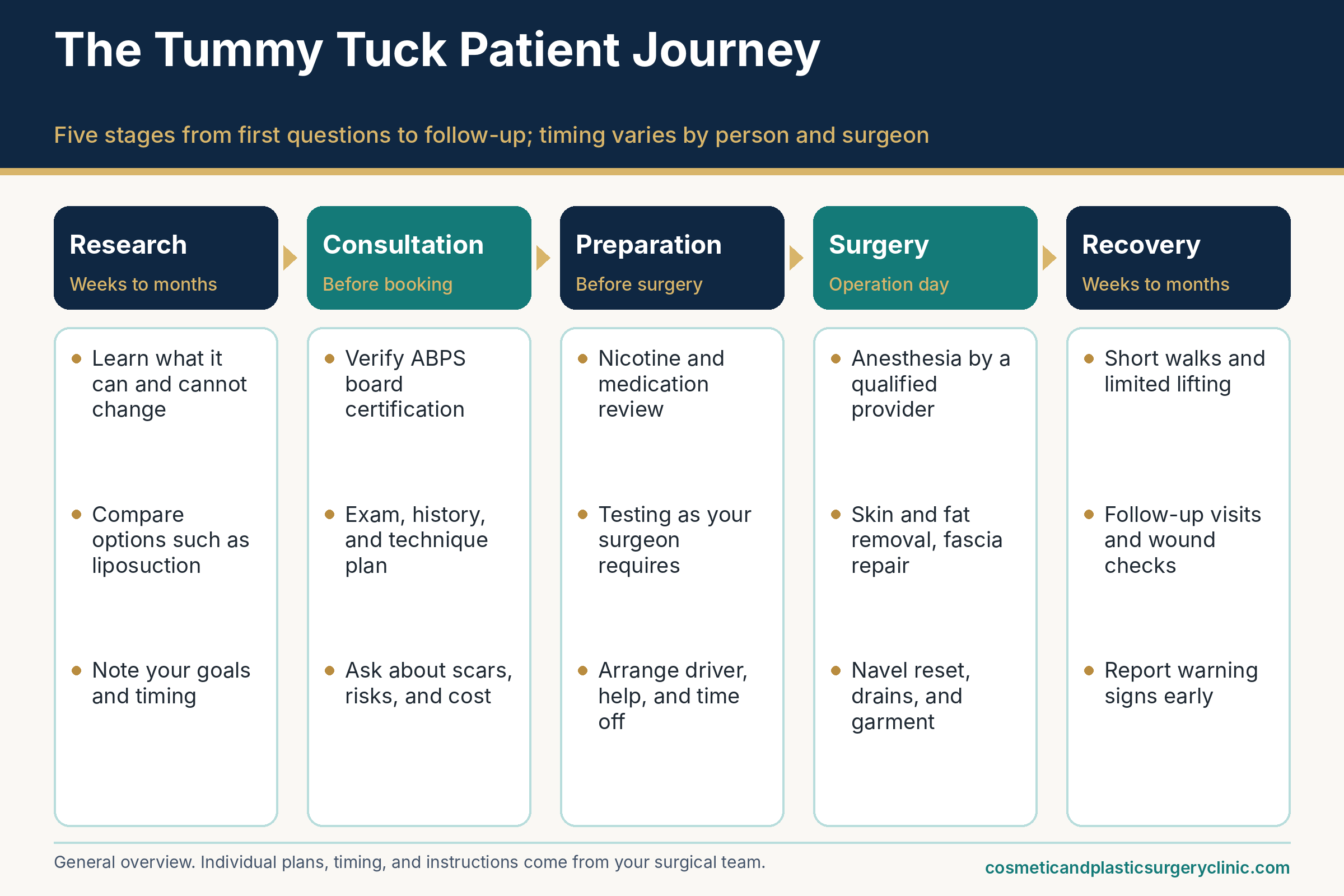
Most of the safety work in a tummy tuck happens before and around the operation itself: how thoroughly the surgeon screens, what the anesthesia plan is, where the surgery takes place, and how the first hours are managed. This section walks through that sequence in educational terms. It is not a set of instructions, and your own surgical team’s directions override anything general.
Before the Operating Room
Preoperative Evaluation and Preparation Overview
A typical preoperative process begins with a consultation in which the surgeon takes a medical and surgical history, examines the abdomen standing and lying down, discusses goals, and explains the proposed technique and its scar. Photographs are usually taken for the medical record. Expect questions about previous abdominal surgery, pregnancies and plans for more, smoking and nicotine use, weight history, medications and supplements, bleeding or clotting problems, and any family history of clots or anesthesia reactions. The more complete your answers, the more accurately risk can be assessed.
Many practices then request preoperative testing, which depends on age, health, and the planned scope of surgery. This can include blood work, an electrocardiogram, or clearance from another physician. Mayo Clinic notes that people are typically asked to stop certain medicines that increase bleeding, such as aspirin and anti-inflammatory drugs, and to stop herbal supplements, before surgery. Never stop a prescribed medication unless the surgeon and your prescribing clinician tell you to, because the safe plan for an anticoagulant, a diabetes medication, or a GLP-1 drug is individualized.
The preparation that most people underestimate is logistical. Surgery is usually performed as an outpatient or short-stay operation, and Stein and colleagues found that the share of abdominoplasty cases in their certification dataset that did not involve an overnight hospital stay rose from 77% to 81% between the 2005 to 2014 period and the 2015 to 2021 period. That means you will probably go home the same day or after a brief stay, and you need a responsible adult to drive you, to stay with you for the early period, and to help with tasks that involve bending, lifting, and getting in and out of bed.
Plan the practical items in advance. Arrange time off, childcare or help with lifting, and food that is easy to prepare. Ask the practice about the compression garment, whether to buy it ahead, and what sizes they use, because swelling changes fit. Pick up prescribed medicines before the surgery date so you are not trying to fill them while recovering. Set up a recovery space on the main floor if stairs would be difficult, with pillows to support a slightly bent posture and easy access to a bathroom.
Finally, ask for the written instructions in advance, including fasting rules, what to take or hold on the morning of surgery, and whom to call afterward. If the instructions are vague at the consultation stage, that is useful information about how the practice communicates. The recovery section below builds a planning timeline from this starting point.
Anesthesia and Facility Choices
The ASPS says the medications used for comfort during a tummy tuck include intravenous sedation and general anesthesia. Mayo Clinic describes general anesthesia, in which you are fully asleep, for the operation. The choice is made by the surgeon and anesthesia provider with you, and it depends on the scope of surgery, your medical history, and the facility. Mayo Clinic states that the operation often takes less than four hours; the actual time for a given person depends on the technique, whether liposuction or other procedures are added, and many other factors.
Who delivers the anesthesia matters as much as the type. The ASPS advises confirming that the anesthesia provider is a physician anesthesiologist or a certified registered nurse anesthetist (CRNA).
The facility counts too. An ASPS member-authored safety article recommends that surgery take place in an accredited ambulatory facility with emergency equipment and trained staff, and that you ask whether your surgeon holds hospital operating privileges for the procedure. Accreditation and privileges are not guarantees, but they are checkable signals of oversight. A site visit, or at least a clear answer to the question “where will this be done and who accredits it,” is reasonable. If a surgeon operates in a setting you cannot identify, treat that as a reason to pause.
Hospital, hospital-affiliated surgery center, and office-based suite are the typical settings. Each has trade-offs in cost, scheduling, and available backup. Hospital settings have the most immediate medical backup but can cost more and can be less flexible. Freestanding accredited surgery centers are common for elective body contouring. Office-based operating rooms vary widely in accreditation and capability. The question to ask is not which building type is best but what happens if something goes wrong: how a transfer to a hospital would work, and how long it would take.
One more anesthesia-related point is specific to nutrition and medication. GLP-1 medications can slow stomach emptying and are the subject of multisociety anesthesia guidance published in 2024; fasting and medication instructions may therefore be adjusted. Tell the surgeon and the anesthesia provider about every medication, including weekly injections, so the plan can be made in advance.
During and Immediately After Surgery
The Step-by-Step Sequence
The operation follows a fairly consistent sequence, with variations by technique. On the day of surgery, the surgeon marks the planned incision with you standing, because skin and fat shift when you lie down. After anesthesia begins, the surgeon makes the horizontal lower abdominal incision the ASPS describes, and a second incision around the navel to free it from the surrounding skin.
The skin and fat are then lifted off the abdominal wall, moving upward, so the surgeon can see and work on the fascia. If the plan includes tightening, sutures bring the stretched fascia together, usually along the midline. If liposuction is part of the plan, it may be done before or after this step. The upper skin is then drawn down, a measured amount of lower skin and fat is removed, and the remaining skin is closed along the incision. A new opening is cut for the navel, which is brought through and stitched in place.
Closure is done in layers. Deep layers use sutures that hold the tissue together, and the skin closure may use sutures, skin adhesive, tape, or clips, as the ASPS notes. Drains may be placed. Dressings are applied, and a compression garment or elastic wrap goes on before you wake up in many practices.
After surgery you spend time in a recovery area while the team monitors your breathing, pain, nausea, and circulation. Some people go home after a few hours; others stay overnight, depending on the surgery, the facility, and the surgeon’s protocol. A responsible adult needs to be with you, and you should expect to be sleepy, a little sore, and somewhat unsteady at first.
Early walking is part of the plan. Mayo Clinic notes that members of the surgical team may help you walk as early as the day after surgery, and that getting up to move lowers the risk of blood clots. Slow, short walks in a bent-forward posture are typical, not a sign that something has gone wrong.
Drains, Garments, Positioning, and Pain Management
Drains are small tubes, usually with a bulb or a collection container at the end, that pull fluid from under the skin. The ASPS says small drainage tubes may be placed temporarily under the skin to prevent fluid accumulation, and Mayo Clinic notes that they are usually left in for a few days. Many people find emptying and recording drain output one of the more tedious parts of recovery, but it is also one of the clearest ways the surgical team tracks healing. The team will explain how to measure, record, and strip the tubing, what output is expected, and when to call about changes. The research on drains is mixed, as the progressive tension suture findings show, and some practices use fewer drains or none. Ask what the practice does and why.
The compression garment or abdominal binder serves several purposes: it gives gentle pressure that may limit swelling, supports the tissues, and can make movement feel more secure. It is not a magic wand, and wearing it too tightly can cause problems of its own. The ASPS lists garment duration among the questions to ask your surgeon, because it varies. Follow the practice’s instructions on when to wear it, how tight it should be, and how to keep the skin under it clean and dry.
Positioning is another early-recovery detail. Many surgeons ask patients to keep a slightly bent posture at the hips for a period, because standing fully upright can put tension on the new closure. People often sleep propped on pillows with a pillow under the knees. How long this lasts and how strictly it is followed differs by practice, which is why it belongs on your question list. The recovery section that follows puts these early details on a timeline.
Pain management is individualized and is decided with the surgical team, so this guide does not offer medication advice. In general terms, many practices use a layered approach, which can combine local anesthetic given during surgery, regional nerve blocks, and oral medicines, so that the load on any one drug is smaller. Many people describe the early period as tight, sore, and tiring rather than sharp, but experiences vary and no source can promise a particular level of discomfort. Pain that is severe, escalating, or one-sided, or that comes with other warning signs described later, should prompt a call to the surgical team.
Tummy Tuck Recovery, Daily Life, and Scars
Recovery is the part of a tummy tuck that surprises people most, because the visible result arrives well before the body feels normal. Nobody can give you an exact schedule. What a source can offer is a range, a sequence, and a list of warning signs. This section does that, and then translates the ranges into plans for work, driving, travel, exercise, and sleep. The deeper companion page on tummy tuck recovery carries the week-by-week detail.
Recovery Timeline
The First Days and First Two Weeks
The first few days are about rest, short walks, fluid and wound management, and pain control. The abdomen feels tight, partly because the wall has been tightened and partly because swelling fills the tissue. Standing straight can feel difficult, and many people walk bent slightly forward for a period. This is expected and typically eases as the swelling and tension settle. Bruising can spread well beyond the incision, sometimes down into the groin and thighs, and it usually fades over weeks.
Drains, if used, are typically in place for a few days, as Mayo Clinic describes, and a surgeon decides when to remove them based on output. Dressings and garments are managed on the surgeon’s schedule. Early follow-up visits check the incision, the navel, the drains, and signs of fluid collection. Bring your questions about showering, wound care, and what a normal appearance looks like, because those are the details people forget once they are home.
Fatigue is real. Anesthesia, surgery, reduced sleep, and the effort of moving all contribute, and a long afternoon nap is not a sign of a problem. Appetite and bowel habits can change, partly from reduced activity and partly from medicines. Constipation is common after abdominal surgery, and straining against a fresh abdominal repair is uncomfortable, so surgeons commonly give guidance on prevention. Ask about this in advance rather than discovering it on day four.
The ASPS reports that results become visible within a week or two as swelling subsides and a person can stand upright. That statement can mislead if it is read as “back to normal in two weeks.” Standing upright is a milestone, not a finish line. Internal healing takes longer, and the ASPS notes that final results depend on it.
Weeks Three Through Twelve and the Months After
By the third and fourth weeks, many people have fewer drain or dressing tasks and are walking farther, though tightness and fatigue persist. Mayo Clinic says that many people who have tummy tucks go back to work in about two to four weeks, and that for the first six weeks you will likely need to be careful moving around. Those two statements fit together: some can work in an easy, sedentary way before they can lift, bend, or exercise freely. The surgeon’s clearance, not the calendar, decides when each step is allowed.
Swelling is the long game. It fluctuates through the day, tends to be worse in the evening, and can come and go for months, including after a long day on your feet or a workout. Areas of the lower abdomen can feel firm or lumpy during healing. That firmness often softens over time, but a new, painful, or one-sided swelling should be checked, because fluid collections can form weeks after surgery.
Sensation changes follow their own clock. Numbness or odd sensations in the lower abdomen can last for months, and for some people they persist. The ASPS lists altered skin sensation as a recognized risk. Itching, tingling, and short zaps of sensation are common during nerve recovery, and they are different from pain that is severe or escalating.
Past the three-month mark, many people feel substantially more comfortable and have resumed most of their regular activity under the surgeon’s guidance. Final contour and scar appearance continue to settle over many months. The ASPS describes scars taking several months to a year to fade as much as they will, and Mayo Clinic gives up to a year. A table is the clearest way to see how these ranges fit together.
| Stage | Commonly described range | What is typical | Planning implication |
|---|---|---|---|
| Surgery day to first follow-up | First days | Tightness, fatigue, drains if used, short assisted walks | Arrange a driver, a helper, and a recovery space |
| Early recovery | About 1 to 2 weeks | Standing upright becomes easier as swelling eases (ASPS) | Plan for minimal responsibilities; keep follow-up appointments |
| Return to light desk-type work | Many people at about 2 to 4 weeks (Mayo Clinic) | Depends on job demands and pain control | Ask about remote options and phased hours |
| Careful movement period | Roughly the first 6 weeks (Mayo Clinic) | Restricted lifting, straining, and core exercise | Arrange lifting help for children, pets, groceries |
| Return toward regular exercise | After surgeon clearance, often weeks to a few months | Staged return, not a single date | Ask for a written, stepwise plan |
| Scar and swelling maturation | Several months to a year or more (ASPS, Mayo Clinic) | Scars pink, firm, then gradually paler and softer | Plan sun protection and scar care with the surgeon |
Planning Daily Life and Understanding Scars
Work, Driving, Travel, Exercise, and Sleep
Scenarios are more useful than averages. Consider someone with a remote desk job who can sit or lie in a recliner with a laptop. For that person, a return to light work within the two-to-four-week range Mayo describes can be realistic, as long as pain is controlled and they are not taking sedating medication while working. They still cannot lift a heavy box, and they probably should not sit in a hard chair for hours.
Now consider someone whose job involves lifting, repeated bending, or standing for most of a shift, such as a nurse, a warehouse worker, a hairstylist, or a parent who carries a toddler all day. For that person, a longer absence or a phased return with modified duties is more likely, and the decision belongs to the surgeon. Ask for a note and a written restriction list early, because employers often need paperwork and disability forms take time.
Driving is usually restricted while taking prescribed pain medicine that causes drowsiness and until you can turn, brake, and look over your shoulder without pain or hesitation. The surgeon sets the date, and your auto insurance policy’s fine print about driving while on prescription medicine is worth reading too. Short trips as a passenger are another matter; most people find seat belts uncomfortable over the incision, and a small pillow can help.
Travel needs two kinds of caution. The first is blood clots: a long car or plane trip soon after surgery means long periods of sitting, and clot risk rises with immobility. Surgeons commonly advise waiting for clearance before long trips and, when travel cannot be avoided, moving regularly and following their clot-prevention advice. The second is access to your surgical team. If you travel for surgery, plan to stay near the surgeon through the early follow-up period instead of leaving right away, because complications that need attention often show up in the first weeks.
Exercise returns in stages. Walking begins almost immediately. Lower-body activity and light cardio come back when allowed. Core strengthening, heavy lifting, and high-impact exercise are held until the surgeon clears the repair, because early strain on the abdominal wall and incision can set back healing. Ask for a written, stepwise plan so you are not guessing.
Sleep itself is often the least comfortable part. Many people sleep propped on pillows with their knees supported for a period, because lying flat pulls on the incision. Rolling over is awkward, and getting in and out of bed is easier with a plan, such as rolling to the side and pushing up with the arms rather than sitting up using the abdominal muscles. Pillows and a reclining chair help. If a drain is in place, it can interfere with sleep position, and a safety pin or lanyard that keeps tubing from tugging is a common trick.
Scar Placement, the Navel Scar, and Maturation
The ASPS says a tummy tuck incision is horizontal, between the pubic hairline and the navel, with a second incision around the navel in many operations. In a full tummy tuck, the lower scar sits low enough to be covered by most underwear and swimwear, although the exact length and height depend on how much skin is removed and on the surgeon’s design. The incision may extend toward the hips, and in an extended version farther along the sides. A cesarean scar can sometimes be incorporated into the new incision, according to the ASPS.
The navel scar is a separate story. It sits inside the navel, and a well-placed one can be hard to notice; a poorly placed one can look flat, off-center, or stretched. Surgeons differ in how they create and shape the navel, and it is a detail worth asking about, including how the surgeon handles the navel when a hernia is present.
All scars mature through stages. In the first weeks, the line is raised, pink or red, and sometimes itchy or tender. Over months it may become firmer and darker before gradually softening and fading. ASPS and Mayo both frame the endpoint as taking from several months up to a year. Some people form scars that become thick, raised, or widened, called hypertrophic scars or keloids, and risk differs by person, skin tone, tension on the closure, and genetics. Nothing in this guide can predict how your scar will look.
Scar care is surgeon-specific. Options that are commonly discussed include sun protection, silicone-based products, gentle massage once cleared, and, for problem scars, treatments such as steroid injections or lasers. The quality of evidence for each varies, and applying the wrong product too early can irritate a fresh wound. Ask what the practice recommends and when you may begin.
Tummy Tuck Results, Longevity, and Risks
Results and risks belong in the same conversation because each shapes how you weigh the other. A flatter profile and a tighter wall are real possibilities, and so are fluid collections, wound-healing trouble, and clots. A fair decision holds both. This section covers what results look like, what shortens or extends them, what revision means, and the main complications, with the numbers placed in context.
Results and Longevity
What Results Look Like and When
The ASPS describes the expected outcome of a tummy tuck as a flatter, firmer abdominal contour, proportionate to the body, with a permanent scar. It also says plainly that optimal results cannot be guaranteed and that another operation may sometimes be needed. That framing is worth holding on to. A good result is typically described as a smoother, tighter lower abdomen and, when the wall has been tightened, a more defined waist profile. It is not the same as the abdomen of a younger self, an athlete’s body, or the image from social media.
Timing follows the recovery curve described earlier. Within the first couple of weeks, the abdomen looks flatter as swelling eases and posture improves, but it also looks swollen and sometimes uneven. Over the following months, swelling recedes, the tissue softens, and the contour becomes more refined. Final contour is generally described as settling over many months, with the scar continuing to mature after that. Those windows are general; the ASPS and Mayo Clinic both place scar fading in a range of several months to a year.
What a person sees depends on starting anatomy. A person with a small amount of loose skin and a flat wall may have a clear change from a limited operation. A person with a lot of excess skin and deep abdominal fat may notice a major change in skin but a smaller change in profile. Previous abdominal surgery, as the ASPS notes, may limit the potential result, and heavy scarring can restrict how much the tissues can be repositioned.
Evaluate before-and-after photos with care. Look for photos of people with a similar starting point, taken from consistent angles and lighting, at a comparable time after surgery, and ask whether they are the surgeon’s own patients. An exceptional result shown without context can mislead.
What Affects Longevity, and When Revision Comes Up
A tummy tuck removes skin and fat cells that will not grow back in the same way, so the change is long-lasting in a physical sense. But the abdomen is not a fixed structure. It responds to weight gain, weight loss, pregnancy, aging, and gravity. The ASPS warns that significant weight fluctuation can greatly diminish the result, and that pregnancy after surgery can stretch the repaired tissue again. Aging continues to change skin elasticity too, regardless of surgery.
It follows that longevity is partly in your hands and partly not. Stable weight and a sustainable fitness routine help maintain the shape; genetics, skin quality, and life events play a role you cannot control. Be wary of any promise of permanence. A better phrasing is that results can last for many years under stable conditions, with the understanding that the abdomen will keep aging.
Revision means a second operation to refine or correct something. The ASPS list of risks includes the need for revisional surgery, recurrent skin looseness, unfavorable scarring, and unsatisfactory aesthetic results. Common reasons a person and surgeon might discuss revision include excess skin or fullness at the ends of the incision, a scar that has widened or thickened, a navel that has healed in an unwanted shape, residual asymmetry, or an area of contour irregularity. Some are minor adjustments done with local anesthesia; others are larger operations.
Revision decisions are usually delayed until swelling and scar maturation have progressed, because many early irregularities improve on their own. That means the first impression at a few weeks is not final. It also means you should ask any surgeon, before surgery, what their policy is on revision: what is considered a revision, what the surgeon’s fee covers, and whether facility and anesthesia costs apply. Those policies differ widely, and they are best understood in writing before you commit.
Finally, honest expectations include the possibility that the result is good but not exactly what you pictured. Planning for that, in the same way you plan for recovery, protects you from disappointment that is about expectations rather than about the surgery.
Risks and Risk Reduction
Common Complications: Fluid, Wounds, Sensation, and Contour
The ASPS lists the risks of tummy tuck as anesthesia risks, asymmetry, bleeding, deep vein thrombosis and cardiac and pulmonary complications, fat necrosis, fluid accumulation (seroma), infection, numbness or altered skin sensation, persistent pain, poor wound healing, need for revisional surgery, recurrent skin looseness, skin discoloration and prolonged swelling, skin loss, unsatisfactory aesthetic results, and unfavorable scarring. That is a long list because the operation is a significant one: it lifts a large flap of skin, depends on the blood supply to that skin, and closes under tension.
Numbers are hard to compare because studies count different things. In a 2015 analysis of 25,478 abdominoplasty cases in Plastic and Reconstructive Surgery, Winocour and colleagues found a 4.0% overall complication rate, compared with 1.4% for other aesthetic procedures. Among the complications recorded, hematoma, infection, and venous thromboembolism were the most frequent. Abdominoplasty alone carried a rate of 3.1%, while liposuction combined with another body-contouring procedure reached 10.4%. By contrast, single-center series that count minor wound problems report higher percentages. A 139-patient series by Momeni and colleagues in 2009 found minor complications in 28.8% and major complications in 11.5%, and the 2020 Gormley review of plication studies reported an overall complication rate of 17.0%, with seroma, wound separation, and minor bleeding most common.
These figures do not contradict one another. They likely reflect different counting rules, settings, and patient groups, and none of them is your personal chance. The table below places the main complications side by side, with what each means and what to report.
| Complication | What it means | Context from sources | Report to the surgical team |
|---|---|---|---|
| Seroma | Clear fluid pooling under the skin | Among the most common problems in plication studies; progressive tension sutures plus drains lowered seroma vs drains alone in a 2017 meta-analysis | New bulging, sloshing, or tightness |
| Hematoma | Collection of blood | Hematomas were a leading recorded complication in the 2015 database analysis; 5.9% in a 219-patient 2025 French series | Rapid one-sided swelling, severe pain, tense bruising |
| Infection | Bacterial infection of the wound or deeper tissue | Listed by the ASPS; among the leading recorded complications in the 2015 analysis | Fever, spreading redness, pus, worsening pain |
| Wound-healing problems | Edge separation, delayed healing, skin or fat necrosis | Nicotine and tension increase risk; skin loss and fat necrosis are on the ASPS list | Dark or blue skin, opening incision, drainage |
| Numbness or altered sensation | Reduced or odd feeling in lower abdomen | ASPS lists it; may improve but can persist | New weakness or severe pain rather than numbness alone |
| Asymmetry or contour irregularity | Uneven scar, navel, or fullness | ASPS lists asymmetry and the need for revision | Concerns at follow-up; revision decisions are usually delayed |
| Venous thromboembolism (DVT/PE) | Blood clot in a leg vein that can travel to the lungs | 0.35% for abdominoplasty alone, higher for circumferential, in a 2010 pooled review | Calf swelling, chest pain, or breathlessness: seek emergency care |
If you want the full list with explanations, the planned page on tummy tuck risks and complications goes through each in depth.
Patient factors shift these probabilities. The Winocour analysis listed male sex, age 55 or older, higher BMI, and combining multiple procedures among its risk factors. Nicotine use affects wound healing. Diabetes, poorly controlled blood pressure, and clotting disorders can raise risk. A surgeon can explain how these apply to you; the general lesson is to be candid about your history and to ask how your own risk profile changes the plan.
Serious Risks, Clot Prevention, Anesthesia, and Risk Reduction
Venous thromboembolism (VTE) covers deep vein thrombosis, a clot in a deep leg vein, and pulmonary embolism, in which a clot travels to the lungs. It is the most feared complication after body contouring because it can be life-threatening. The 2010 systematic review by Hatef and colleagues found VTE in 0.35% of abdominoplasty-alone reports, 0.79% when combined with another plastic procedure, 2.17% when combined with an intraabdominal procedure, and 3.40% for circumferential abdominoplasty, and recommended risk stratification. A 2025 French single-center review of 219 abdominoplasties recorded one pulmonary embolism (0.45%) and argued for risk-based use of preventive medicine, while acknowledging that one event cannot support strong conclusions. All of these are small-sample or pooled data, and none gives your individual probability.
At an overview level, clot-risk reduction usually combines several practices. Many surgeons use a formal risk assessment, often a version of the Caprini score, a tool that Pannucci and colleagues reported in 2010 as predictive of clot risk in plastic surgery patients. Mechanical measures such as compression devices on the legs during surgery are common, and some patients receive blood-thinning medicine after surgery when their risk score justifies it. Early walking, avoiding long periods of immobility, staying hydrated, and managing the length of the operation matter too. Whether medication is used involves a balance, because blood thinners can raise the risk of bleeding and hematoma. That is a decision for the surgical team, not something to start or stop on your own.
Anesthesia risk depends on your health, the type of anesthesia, the length of surgery, and the facility and team. It is part of the ASPS risk list. It is reduced by thorough preoperative screening, a qualified anesthesia provider, and honest disclosure of medical history and medicines. The GLP-1 consideration discussed earlier is an example of how medication history changes anesthesia planning.
Risk reduction beyond clots rests on choices you can make in advance. Choose a board-certified plastic surgeon in an accredited facility. Stop nicotine in the window the surgeon requires. Reach a stable, healthy weight if the surgeon advises it. Think carefully before combining multiple procedures in one session. Follow the postoperative instructions, keep follow-up appointments, and report warning signs early. None of these removes risk, and a careful surgeon will say so. Stein and colleagues’ 2024 analysis of board-certified surgeons’ cases suggests that adverse events decreased slightly over time as techniques changed, but it describes a specific group of surgeons and should not be read as a promise for any individual. The decision to proceed is a trade-off between a possible aesthetic benefit and a real set of risks, and you are entitled to take your time with it.
Tummy Tuck Cost, Insurance, Alternatives, and Choosing a Surgeon
The last stretch of the decision is practical: what will this cost in total, whether insurance plays any role, whether another option would meet your goal with less, and how to find and vet the person who would operate. This section gives the national context and the questions, and leaves local pricing to the consultation. The dedicated page on tummy tuck cost covers fee components and financing in far more depth, so this overview does not try to duplicate it.
Cost and Insurance
What the Published Numbers Mean
The ASPS tummy tuck cost page gives an average of $8,174 and states that this figure does not include anesthesia, operating room facilities, or other related expenses. The page does not label the year on its face. The same number appears in the ASPS 2023 average surgeon and physician fees report, which lists $8,174 for 2023 and $7,215 for 2022. ASPS’s 2024 fee report switched to a range format and lists $8,000 to $13,500 for abdominoplasty, based on surveyed member surgeons. These reports cover fees of ASPS member surgeons only, and the format change means the 2024 range cannot be compared directly with earlier single averages.
Three cautions follow. First, a national average is not a local quote. Surgeon fees vary by geography, surgeon experience, and the type of procedure, as the ASPS notes. Second, the surgeon’s fee is one line of a larger bill. Third, a number without a scope is not a price: a quote for a mini tummy tuck and a quote for a full tummy tuck with liposuction are different products.
Table 6 breaks down the components that usually make up the total. It lists what each component covers and what to ask. No dollar amounts appear because the total depends on region, facility, and plan.
| Component | What it usually covers | Billed by | What to confirm |
|---|---|---|---|
| Surgeon’s fee | The operation itself, often with routine follow-up visits | Surgeon or practice | Which technique, which add-ons, and how many follow-up visits are included |
| Anesthesia | Anesthesia provider time and medicines | Anesthesia group or facility | Provider credentials and whether the fee is time-based |
| Facility | Operating room, recovery area, supplies, nursing | Surgery center or hospital | Accreditation, what happens if an overnight stay is needed |
| Preoperative testing and medical clearance | Lab work, ECG, specialist input where required | Lab, clinic, or other physicians | Which tests the practice requires for your history |
| Garments, dressings, and prescriptions | Compression garments, supplies, medicines | Practice or pharmacy | Whether items are included or purchased separately |
| Revision and complication coverage | Further procedures or treatment if something goes wrong | Policy varies by practice | What is covered, what is not, and what is charged for the facility and anesthesia |
| Time off and indirect costs | Lost income, childcare, travel and lodging | You | Realistic recovery calendar for your job and household |
Pricing comparisons are easy to get wrong. A lower quote may reflect a different scope, a different facility, a different anesthesia arrangement, or exclusions that appear later. Ask for an itemized estimate and ask what happens financially if you need an overnight stay, a drain, or a revision. Many practices offer payment plans or third-party financing, which can make the cost manageable while adding interest and fees, so compare the total repayment amount, not just the monthly payment. Never let a financing offer, a deadline, or a promotion pressure a medical decision.
Insurance: Cosmetic Abdominoplasty, Panniculectomy, and Hernia Repair
The ASPS states on its cost page that most health insurance plans do not cover tummy tuck or its complications. Insurers generally treat abdominoplasty performed to improve appearance as cosmetic. An ASPS-published insurance criteria document from 2006, which is older but still describes the underlying distinction, defines abdominoplasty as typically performed for cosmetic purposes and says it is considered cosmetic when done solely to enhance appearance without functional abnormalities. It describes panniculectomy as a procedure that can be functional or cosmetic.
Coverage for a panniculectomy, the removal of a hanging apron of skin and fat, is possible in some cases when documented problems such as chronic rashes, skin breakdown, or infection persist despite treatment. One commercial insurer’s publicly posted policy effective August 2026, Blue Cross NC, illustrates the pattern: it treats abdominoplasty as cosmetic and not covered, allows panniculectomy only when specific documented criteria are met, includes weight-stability requirements after weight loss, and explicitly excludes repair of diastasis recti. That is one insurer’s policy and may not match yours, but it shows how the line is typically drawn.
Hernia repair is a separate matter. A true hernia is a defect in the abdominal wall, not simply a stretched midline, and the ASPS insurance guidance notes that hernia repair is distinct from diastasis recti repair and has separate codes. If a hernia is present, its repair may be considered medically necessary under some plans, even when the aesthetic portion is not covered. How the two parts are billed and documented, and whether combining them is appropriate, should be settled before surgery, not afterward.
Practical steps: ask your insurer for its written policy on abdominoplasty, panniculectomy, and hernia repair; ask the surgeon’s office whether they handle prior authorization; and expect that documentation, such as photographs and records of treated skin problems, may be requested. Never assume coverage, and never let a practice code a cosmetic procedure as something else. Misrepresenting a procedure to an insurer can lead to denial and other consequences. Questions about financing and coverage are worth settling in writing before any deposit.
Alternatives and Decision-Making
Alternatives: Liposuction, Nonsurgical Options, and Staying Nonsurgical
The best-matched alternative depends on the layer behind your concern. If the main issue is fat in a person whose skin retracts well, liposuction is the usual comparison. It is also the most common cosmetic procedure in the ASPS data, with 317,196 procedures in 2025, compared with 173,251 tummy tucks. Liposuction uses small incisions and typically has a shorter recovery, but it does not remove skin or tighten the wall, and if skin laxity is the issue, liposuction may leave the skin looking looser. The other options are taken up below, and the choice among them depends on which tissue layer is behind your concern.
Nonsurgical devices are the next category. These include cooling, heat-based, ultrasound, and magnetic systems marketed for fat reduction or skin tightening. The FDA describes the cleared devices as intended to reduce circumference in treated areas or improve the appearance of certain tissues, states that they do not treat obesity or cause weight loss, and says results may be temporary and require maintenance. The agency also lists serious but uncommon problems, including paradoxical adipose hyperplasia, in which fat grows in the treated area. These options have no skin removal and limited effect on loose skin; they are generally considered for small pockets in people who are near their goal.
A third path is supervised core and pelvic floor rehabilitation, such as physical therapy aimed at improving abdominal-wall function after pregnancy. Whether exercise can narrow a muscle gap, and how much that matters for the way the abdomen looks, is not something this guide can assess; a physical therapist or physician can advise. Combine that with the evidence caveats about plication given earlier, and the decision becomes a question of what you want to change and which tools fit.
Staying nonsurgical is a legitimate choice. Some people decide the scar, recovery, and risk are not worth the change. Others choose to wait for life stages to settle. Clothing choices, shapewear, and acceptance are also real options. Choosing not to operate is not a failure to pursue a solution; it is a decision that can be revisited.
Choosing a Surgeon and Consultation Questions
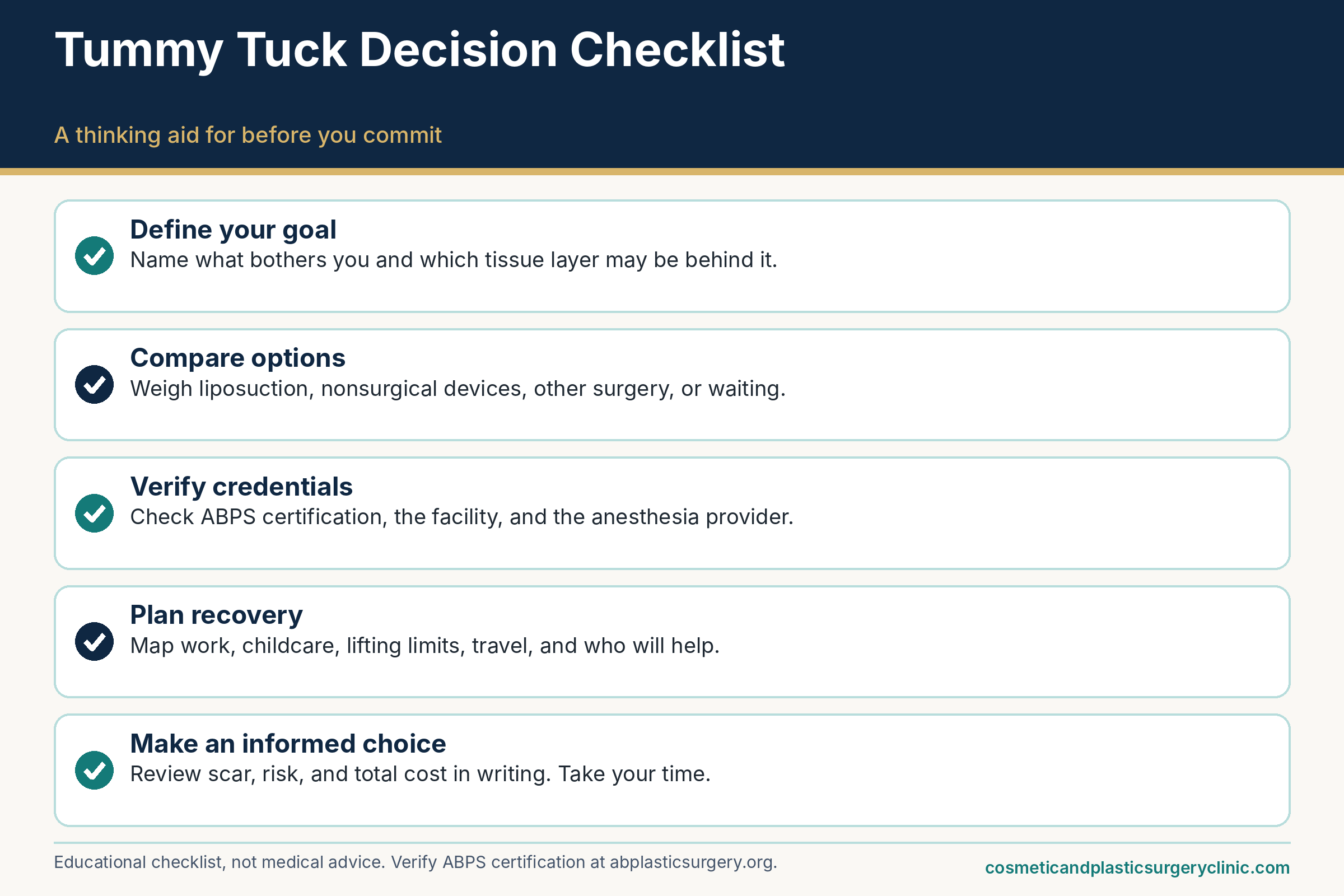
Surgeon selection is the highest-leverage decision in the whole process, because technique, judgment, and the facility all follow from it. Start with credentials. The American Board of Plastic Surgery (ABPS) maintains a public lookup at abplasticsurgery.org, where you can search by name or location to confirm board certification. The ABPS describes certification as reflecting completed training and passed written and oral examinations covering plastic surgery. Board certification and state licensure are separate things: a state medical board confirms a license, and the ABPS confirms board certification. Society membership is not the same as board certification either. Verify directly, and keep a note of the date.
Next, the facility and the team. The ASPS member-authored safety article suggests asking whether the surgery will be performed in an accredited facility, whether the surgeon holds hospital operating privileges, and whether the anesthesia provider is a physician anesthesiologist or a CRNA. It also suggests asking how often the surgeon performs the procedure. Be wary of a practice that discourages questions, offers a guarantee, or shows only polished best-case photos. The planned page on how to choose a plastic surgeon has a longer credential checklist.
Come to the consultation with specific questions rather than a general wish to learn more. The table groups the questions by what each one is meant to reveal. A good surgeon will welcome them, and the answers, taken together, tell you more about the practice than any website. Take notes, consider bringing a support person, and consider a second opinion before booking. The planned tummy tuck consultation question list is a longer version.
| Topic | Question | What a clear answer shows |
|---|---|---|
| Credentials | Are you certified by the American Board of Plastic Surgery, and where will you operate? | Verifiable training and an identifiable, accredited facility |
| Experience | How often do you perform the technique you are recommending? | Familiarity with the specific operation |
| Fit | What does my exam suggest is causing my concern: skin, fat, or the wall? | Anatomic reasoning rather than a standard package |
| Scope | Will you tighten the muscle fascia, add liposuction, or reposition the navel? | What you are actually being quoted for |
| Scar | Where will the scar begin and end, and can you mark it on me? | Realistic scar expectations |
| Risk | Which complications are most relevant for my history, and how are clots prevented? | Individualized risk discussion |
| Recovery | What are the restrictions, the follow-up schedule, and the after-hours contact? | Preparedness and accessibility |
| Cost | What is included, and what happens if I need a revision or overnight stay? | Transparent, itemized pricing |
Finally, give yourself permission to say not yet. A responsible practice will not pressure you with deadlines or limited-time offers. If the only reason to commit today is a promotion, that is a reason to step back.
A tummy tuck is a reasonable subject to research slowly. The most useful next step for most readers is not a booking but a written list: your goal in one sentence, the layer you think is causing it, the questions in Table 7, and the dates and constraints that would shape recovery. Take that list to a consultation with a board-certified plastic surgeon you have verified yourself, and consider a second opinion before deciding. Nothing in this guide replaces an examination, and the decision to proceed, wait, or choose another option is yours.
Frequently asked questions
How long does a tummy tuck take, and do I stay overnight?
Mayo Clinic says the operation often takes less than four hours, but the real figure depends on the technique, whether liposuction or other procedures are added, and the surgeon. Some patients go home the same day after a period in recovery, while others stay overnight; analysis of board-certified surgeons’ cases found that about four in five abdominoplasties in 2015 to 2021 did not involve an overnight hospital stay. Ask the practice what its usual plan is and what would change it.
Will a tummy tuck remove my stretch marks?
Only the ones located in the skin that is removed. The ASPS says a tummy tuck cannot correct stretch marks, although marks in the excised area leave with the skin. Marks above the navel, on the flanks, or elsewhere may remain, and the remaining skin is pulled downward, which can make them look different. Ask the surgeon to mark where the removal line is planned so you can see which marks fall inside it.
Is a tummy tuck a weight-loss operation, and should I lose weight first?
No. The ASPS states that it is not a substitute for weight loss or an appropriate exercise program, and the amount of tissue removed is small compared with the weight changes people usually seek. Whether to reach a different weight first depends on your health, your goals, and your surgeon’s criteria. Because weight fluctuation can diminish results, many surgeons prefer a stable weight, so ask what range the practice considers appropriate for your build.
Can I have a tummy tuck while breastfeeding?
This is a question for the surgeon, the anesthesia provider, and your obstetric or pediatric clinician together, because it involves anesthesia, medicines used around surgery, and the demands of recovery with a nursing baby. This guide cannot answer it for you. Many people choose to wait until breastfeeding has ended and weight has settled, partly for those reasons and partly because the abdomen is still changing. Raise it at the first consultation so the plan reflects it.
Is there a best age for a tummy tuck?
There is no ideal age. Candidacy depends on health, anatomy, goals, and life stage rather than a birthday. In the ASPS 2025 procedural statistics, tummy tuck counts fell 6% among ages 36 to 45 and rose 15% among ages 56 to 65 compared with 2024, which shows that people seek it across many stages of life. Older age is also listed as a risk factor in one large analysis, so a health assessment matters more than the number.
Will my belly button look natural afterward?
That is the goal, and surgeons differ in how they create the new opening and shape the navel. The ASPS describes making a new opening for the navel after the upper skin is pulled down. A navel can heal slightly off-center, flat, or with a visible scar, and some people need a minor revision. Ask to see examples of the surgeon’s navel results, and ask how the navel is handled if you have a hernia or a piercing.
Can men have a tummy tuck?
Yes, abdominoplasty is performed on people of any gender when skin laxity or a muscle gap is the concern. Fat distribution and anatomy can differ, and the 2015 Winocour analysis listed male sex among its complication risk factors, so a thorough consultation and a clear plan matter. The goals are the same: match the operation to the layer causing the concern and understand the scar and recovery before deciding.
Does a cesarean scar or earlier abdominal surgery rule out a tummy tuck?
Not automatically. The ASPS says an existing cesarean scar may be incorporated into the new scar, and it also notes that previous abdominal surgery may limit potential results. Scar tissue can affect blood supply and how far the skin can be repositioned, so tell the surgeon about every prior operation and bring operative reports if you have them. The surgeon can explain how your history changes the plan.
Is it normal for my abdomen to look swollen months after surgery?
Often, yes. Swelling can fluctuate for many months, tends to be worse later in the day, and may flare after activity. Firmness and uneven areas are also common while tissue heals. What deserves a call is new swelling on one side, swelling with fever or increasing pain, or a sudden change in size. Because fluid collections can appear weeks after surgery, report anything that seems different from your own trend rather than waiting for the next visit.
Will a tummy tuck help my back pain?
Some patients and clinicians hope that tightening the wall helps back pain or core stability, and Mayo Clinic lists low back pain relief among reasons people consider the operation. The evidence is limited, however. The 2020 Gormley systematic review found functional measures tended to improve after plication, but strength results were inconsistent and the studies varied widely, and it did not conclusively address back pain. Treat relief as a possibility, not a promise, and discuss other evaluation of back pain with your physician.
Sources and further reading
- American Society of Plastic Surgeons — Tummy Tuck (Abdominoplasty) overview (accessed 2026-10-03) — definition, limits, and timing guidance
- American Society of Plastic Surgeons — Tummy tuck candidates (accessed 2026-10-03) — candidacy criteria
- American Society of Plastic Surgeons — Tummy tuck procedure (accessed 2026-10-03) — anesthesia options, incisions, and procedure steps
- American Society of Plastic Surgeons — Tummy tuck recovery (accessed 2026-10-03) — dressings, garments, drains, and questions to ask
- American Society of Plastic Surgeons — Tummy tuck risks and safety (accessed 2026-10-03) — list of risks
- American Society of Plastic Surgeons — Tummy tuck results (accessed 2026-10-03) — results timing, scars, and limits
- American Society of Plastic Surgeons — Tummy tuck cost (accessed 2026-10-03) — $8,174 average surgeon’s fee and exclusions
- American Society of Plastic Surgeons — 2023 average surgeon/physician fees (accessed 2026-10-03) — 2023 and 2022 fee averages
- American Society of Plastic Surgeons — 2024 average surgeon/physician fees (accessed 2026-10-03) — 2024 fee range
- American Society of Plastic Surgeons — 2025 plastic surgery statistics report (accessed 2026-10-03) — procedure counts, age data, GLP-1 survey findings
- American Society of Plastic Surgeons — Abdominoplasty and panniculectomy insurance coverage criteria (2006; accessed 2026-10-03) — cosmetic versus functional definitions; diastasis versus hernia
- American Society of Plastic Surgeons — Study summary on tummy tuck in obese patients (2019; accessed 2026-10-03) — small comparison by BMI
- American Society of Plastic Surgeons — How nicotine sabotages plastic surgery (2016; accessed 2026-10-03) — nicotine forms and nicotine-free window
- American Society of Plastic Surgeons — How to ensure your plastic surgery is safe (2017; accessed 2026-10-03) — facility, privileges, and anesthesia provider questions
- Mayo Clinic — Tummy tuck (accessed 2026-10-03) — duration, drains, early walking, return to work, scar fading
- Winocour J, et al. — Abdominoplasty: risk factors, complication rates, and safety of combined procedures. Plast Reconstr Surg, 2015 (accessed 2026-10-03) — database complication rates and risk factors
- Hatef DA, et al. — Procedural risk for venous thromboembolism in abdominal contouring surgery. Plast Reconstr Surg, 2010 (accessed 2026-10-03) — VTE rates by procedure group
- Asiry S, et al. — Caprini risk assessment and VTE prophylaxis after abdominoplasty. JPRAS Open, 2025 (accessed 2026-10-03) — single-center retrospective series
- ScienceDaily — summary of Pannucci et al., Caprini model validated in plastic surgery patients, J Am Coll Surg, 2010 (accessed 2026-10-03) — risk-assessment tool
- Gormley J, et al. — Impact of rectus diastasis repair on abdominal strength and function: a systematic review. Cureus, 2020 (accessed 2026-10-03) — evidence on functional outcomes of plication
- Jabbour S, et al. — Does the addition of progressive tension sutures to drains reduce seroma incidence after abdominoplasty? Aesthet Surg J, 2017 (accessed 2026-10-03) — seroma-prevention meta-analysis
- Momeni A, et al. — Complications in abdominoplasty: a risk factor analysis. J Plast Reconstr Aesthet Surg, 2009 (accessed 2026-10-03) — single-center complication series
- Wolters Kluwer — summary of Stein et al., trends in abdominoplasty, Plast Reconstr Surg, 2024 (accessed 2026-10-03) — outpatient and concomitant liposuction trends
- Thomsen T, et al. — Interventions for preoperative smoking cessation. Cochrane Database Syst Rev, 2014 (accessed 2026-10-03) — cessation and complications
- American Society of Anesthesiologists — New multisociety clinical practice guidance on GLP-1 receptor agonists (October 2024; accessed 2026-10-03) — perioperative GLP-1 guidance
- U.S. Food and Drug Administration — Non-invasive body contouring technologies (page dated October 15, 2025; accessed 2026-10-03) — device clearance, indications, and risks
- Blue Cross NC — Abdominoplasty and panniculectomy medical policy (effective August 2026; accessed 2026-10-03) — example of one insurer’s coverage criteria
- American Board of Plastic Surgery — Verify certification (accessed 2026-10-03) — public board certification lookup