
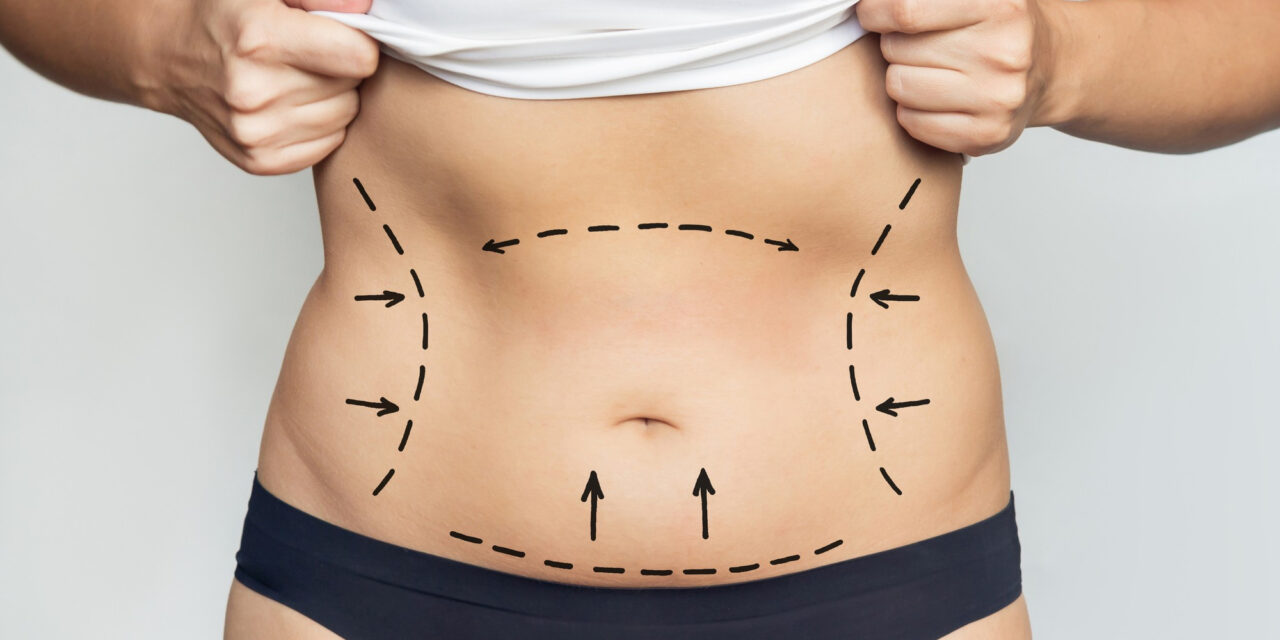
If you’ve been researching a mommy makeover, you’ve probably noticed that no two descriptions match. One clinic’s version is a tummy tuck plus breast implants. Another’s is a breast lift, liposuction and a procedure on the buttocks or labia. That variation isn’t sloppy marketing; it’s built into the term. The American Society of Plastic Surgeons (ASPS) describes the goal as restoring the shape and appearance of a woman’s body after childbearing, and it names six procedures that may be part of a plan without requiring any of them. What you end up with is a customized combination, and the details of that combination drive the recovery, the risks and the price far more than the label does.
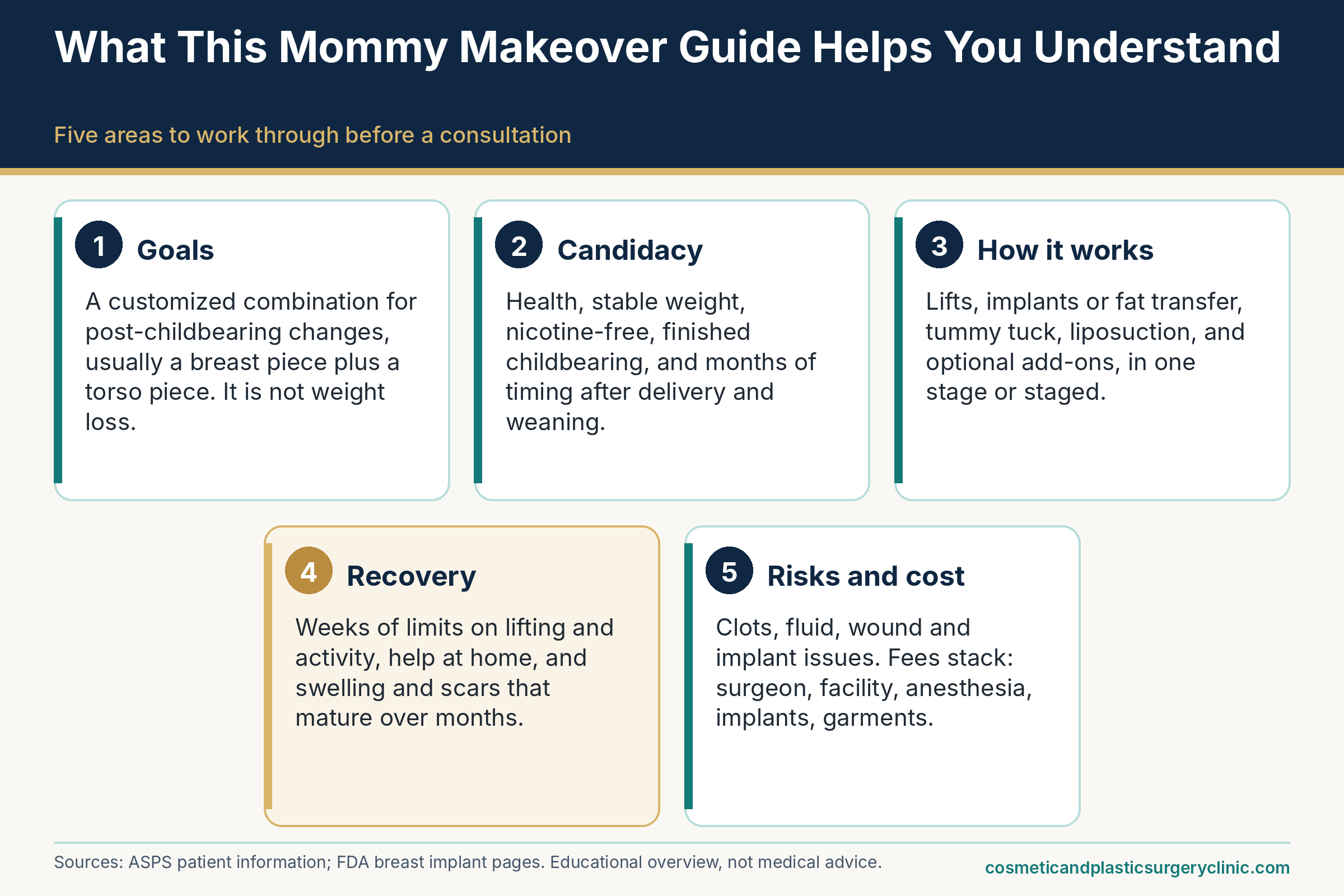
This guide is the full-picture version. It explains what the term covers, who may be an appropriate candidate and why timing after pregnancy and breastfeeding matters, how the main building blocks differ, how planning and surgery day work, what recovery looks like for someone with children at home, what results and risks the published evidence supports, how cost is built (with real, dated numbers and their limits), what the alternatives are, and how to evaluate a surgeon. Where a single topic deserves its own page, we summarize it here and link out rather than repeating it.
Some readers dislike the phrase “mommy makeover,” and that’s a reasonable reaction. It is the term most people search for and the one clinics use, so we use it, along with plainer synonyms such as post-pregnancy plastic surgery and postpartum body contouring. Nothing about the label implies that a body that has carried a pregnancy needs fixing. Surgery is one option for people who are bothered by specific changes, and choosing not to have it is an equally legitimate decision.
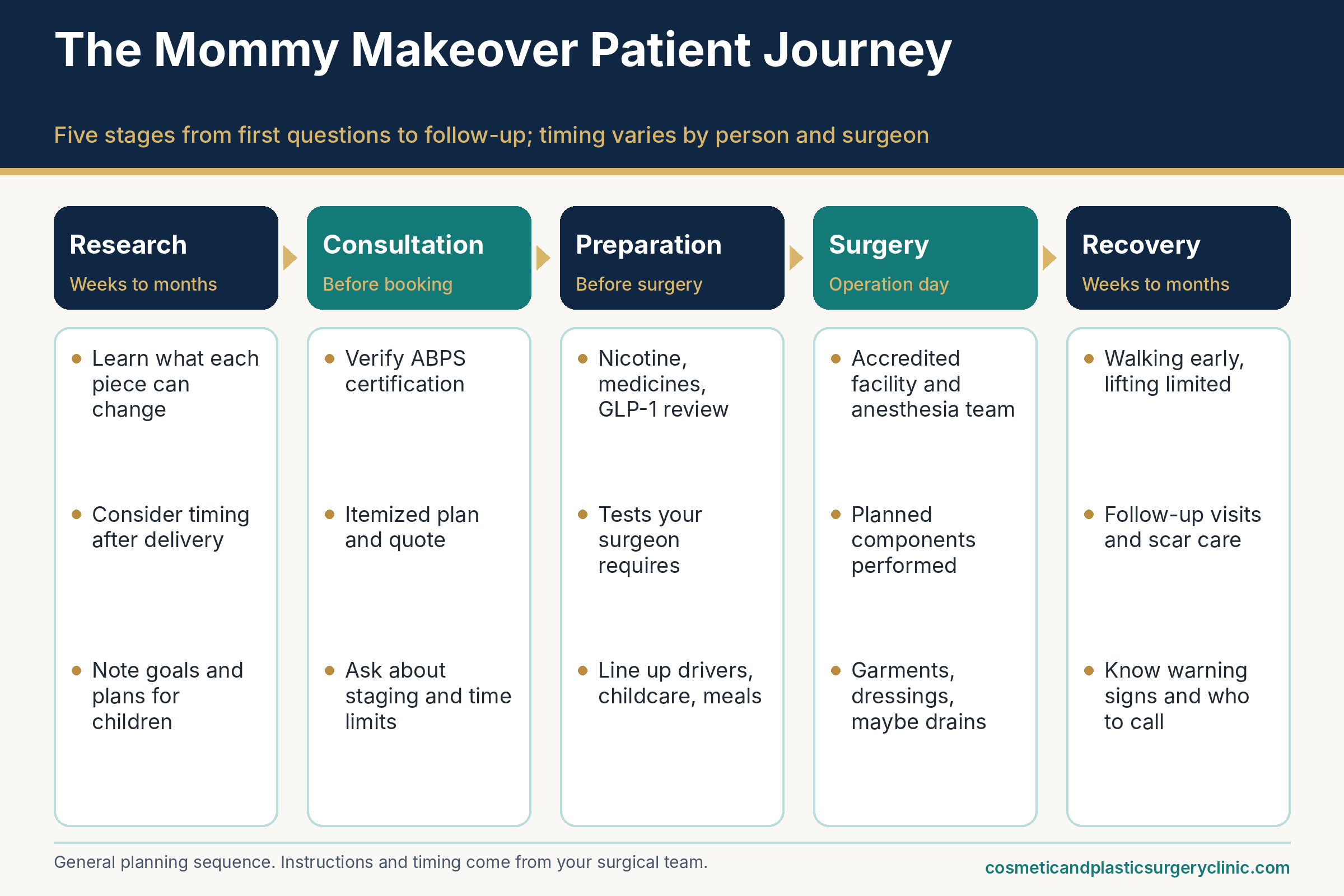
A few ground rules. This is general education drawn from published sources, not medical advice, and no article can examine you, review your history or tell you which procedures you personally need. Where sources disagree or the evidence is thin, we say so, because that is more useful than false certainty. Examples are illustrative scenarios, not patient stories, and no figure on this page is a quote or an offer. The sections run in roughly the order a real decision unfolds: what it is, whether and when it might fit, what the pieces are, how the surgery is planned, how recovery goes, what results and risks look like, what it costs, and how to choose among alternatives and surgeons.
What a Mommy Makeover Is, and What It Is Not
Before cost, recovery or risk can mean anything, the label itself needs pinning down. A mommy makeover is a planning concept more than a procedure name, and the difference shows up the first time you try to compare two consultations or two quotes that sound identical but describe different operations.
A Customized Combination, Not a Standard Operation
Two ideas sit at the center of how professional sources use the term: the goal is addressing changes that follow childbearing, and the method is a personalized mix of procedures. The next two sections take them in turn.
How Professional Sources Define the Term
ASPS frames a mommy makeover as surgery meant to restore the shape and appearance of a woman’s body after childbearing. Its patient page lists six procedures that may be included: breast augmentation, breast lift, buttock augmentation, labiaplasty, liposuction and tummy tuck. The same page says many techniques are used and that the choice depends on factors such as how much restoration is wanted, where incisions will be placed and, when implants are involved, which type. It also says a mommy makeover is typically performed as a single-stage procedure, meaning everything is done in one operation rather than several. The ASPS candidate page calls the surgery highly individualized.
Read that wording closely. It doesn’t define a required set of procedures, a minimum or a maximum, and “may include” is doing real work. Surgeons writing for ASPS’s patient-education channels describe the same flexibility in their own words. One calls it not a one-size-fits-all procedure. Another describes two major components, a breast component and a torso component, and notes that not every patient wants or needs every piece. Those are individual surgeons’ descriptions rather than society policy, but they match how the term works in practice: someone who wants a breast lift and a mini tummy tuck and someone who wants implants, a full tummy tuck and flank liposuction can both be said to have had a mommy makeover.
That flexibility has a side effect worth knowing about. ASPS’s 2025 statistics report, which draws on data from more than 3,000 board-certified plastic surgeons, counts individual procedures such as breast augmentation, tummy tuck and liposuction, but it doesn’t report mommy makeovers as a category. So claims about how many people have a mommy makeover, or how satisfied they are, usually rest on a clinic’s own definition or on studies of specific component pairs. Keep that in mind whenever you see a single confident number attached to the term.
The practical takeaway is simple. When a clinic says “mommy makeover,” you haven’t yet learned which breast technique, which abdominal technique or which add-ons are involved. All of that is still to be decided, and it’s where the meaningful differences live. Our companion page on how mommy makeover techniques differ goes deeper on the options; this guide keeps the focus on the whole decision.
A Terminology Map for Consultations
Patients and clinics use everyday words that map loosely onto clinical terms, and a consultation goes faster when you can translate between them. The table below covers phrases you’re likely to hear or read, along with the follow-up question that turns a vague term into a specific plan.
| Phrase you may hear | Clinical term | What it generally refers to | What to clarify |
|---|---|---|---|
| Tummy tuck | Abdominoplasty | Removing excess lower-abdominal skin and fat, usually with repair of separated or weakened abdominal muscles | Mini or full; whether muscle repair is included |
| Mini tummy tuck | Limited abdominoplasty | Smaller incision for loose skin and fat only below the navel | Whether your concern is limited to that zone |
| Lipo | Liposuction (lipoplasty) | Suction removal of localized fat, often from the abdomen, flanks or back | Which areas and what total volume is planned |
| Breast lift | Mastopexy | Raising and reshaping the breast and repositioning the nipple while removing excess skin | Incision pattern and where scars will sit |
| Implants or “getting volume back” | Breast augmentation | Adding volume with an implant, or with the patient’s own fat moved from elsewhere | Implant type and placement, or how much fat is expected to last |
| Muscle repair | Rectus plication (diastasis repair) | Stitching separated abdominal muscles back toward the midline | Whether it’s included in the abdominal quote |
| BBL or butt lift | Buttock augmentation with fat grafting | Moving fat harvested by liposuction into the buttocks | Technique, depth of placement and whether it’s staged |
| Vaginal rejuvenation | Labiaplasty or energy-device treatments | A loose label covering very different procedures with very different evidence | Exactly what will be done, with what device or technique |
One more practical point about wording. A quote that says only “mommy makeover, one price” is hard to evaluate. A useful quote itemizes which procedures are included, which technique is planned for each, where the surgery will take place and who will provide anesthesia. If a package price is offered, ask what happens to it if the plan changes on the day or if one component is dropped or staged. We return to quote comparison in the cost section.
What a Mommy Makeover Can and Cannot Change
Setting expectations early prevents most of the disappointment that shows up later in recovery. The useful frame is problem-first: name what bothers you, then ask which approach, if any, is designed for that specific problem.
What It May Address
Pregnancy and breastfeeding can change several things at once, and different tissues respond differently. The breasts may lose volume or shape, or the nipple may sit lower. ASPS lists pregnancy and breastfeeding, weight fluctuation, aging, gravity and heredity as reasons breasts lose their shape and firmness, which is why a lift, an implant, fat transfer, a reduction or some combination might come up. The abdomen can change in three distinct ways: skin that has stretched and doesn’t fully retract, fat that sits in stubborn pockets, and a widened gap between the two vertical abdominal muscles, called diastasis recti or rectus diastasis. A tummy tuck removes excess fat and skin and, in most cases according to ASPS, restores weakened or separated muscles.
Other areas may be added to the plan when a person is bothered by them: liposuction of the flanks or back, fat grafting to the buttocks, or a procedure on the labia. Each addition brings its own technique, recovery and risk, which is why the next sections treat them separately instead of as an undifferentiated bundle. The table below lines up common post-pregnancy concerns with the approaches that are typically discussed and what each approach does not do.
| Concern | Approaches often discussed | What the approach does not change |
|---|---|---|
| Breasts have lost volume | Implants or fat transfer | Sagging, since implants alone don’t prevent it; implants also aren’t lifetime devices |
| Breasts sag; nipple sits low | Breast lift (mastopexy), sometimes with an implant | Breast size, which a lift alone doesn’t significantly change |
| Breasts feel too large or heavy | Breast reduction, sometimes with a lift | Future changes from pregnancy or weight shifts |
| Loose lower-belly skin only | Mini tummy tuck | Skin or muscle laxity above the navel |
| Loose skin plus bulging or muscle separation | Full tummy tuck with muscle repair | Stretch marks outside the removed skin; weight changes |
| Localized fat in flanks or back | Liposuction | Loose skin, cellulite or overall weight |
| Flatter or smaller buttocks | Fat grafting (buttock augmentation) | Safety concerns with deep placement; fat survival varies |
The strongest planning habit is to ask your surgeon to tell you which of these categories your exam suggests, and why. If the answer to every concern is “add a procedure,” ask what the plan would look like with fewer pieces. That question isn’t an insult; it helps you see which components carry the most weight in the outcome you care about.
What It Cannot Do
The limits matter as much as the possibilities. A mommy makeover is not weight-loss surgery. ASPS says plainly that a tummy tuck is not a substitute for weight loss or exercise, and that liposuction is not a treatment for obesity. A surgeon quoted in an ASPS feature put it this way: these procedures aren’t weight-loss operations, they’re meant to fine-tune things. Candidates are generally expected to be at a stable, healthy weight before surgery, a point we return to in the candidacy section.
Surgery also can’t undo every change. A tummy tuck can’t correct stretch marks, although marks on skin that is removed go with it. Liposuction doesn’t treat cellulite, and ASPS notes that skin that is soft and thin from stretch marks, weight loss or aging won’t reshape as well as firmer skin. Breast surgery can’t promise a particular cup size, symmetry or nipple position, and it doesn’t stop future changes. Pregnancy, weight swings and aging continue to act on the result, and ASPS advises postponing a tummy tuck if future pregnancies are possible.
There is another category of limit that people often don’t expect: symptoms. Back pain, pelvic floor problems and urinary leakage after childbirth have many causes. Some studies of surgical muscle repair report improvements in such symptoms, but a first-line evaluation by a physician or pelvic-floor physical therapist is a separate step from deciding on a cosmetic procedure. A surgeon who frames an operation as the fix for a symptom that hasn’t been evaluated is skipping a step. Finally, surgery doesn’t change what you did or didn’t do in pregnancy, and it doesn’t carry a promise of how you’ll feel afterward. ASPS’s results page says most women feel the trade-offs are small compared with the improvement in self-confidence, but the page offers no data behind that statement, so treat it as the society’s characterization, not a measured outcome.
Who May Be a Candidate, and When Timing Matters After Pregnancy
Candidacy for a mommy makeover is less a yes-or-no label than a set of conditions that line up, or don’t, at a particular moment. Many people who aren’t a fit today become one later, and a few discover that a smaller plan suits them better than the one they came in with. Only an in-person evaluation can sort that out. What a general guide can do is explain the factors surgeons weigh and the reasoning behind them.
Candidacy Factors Surgeons Weigh
ASPS’s candidate page for the procedure boils the criteria down to a short list. The more useful reading comes from unpacking what each item means in practice, and where the published sources add detail.
Health, Weight Stability and Finished Childbearing
ASPS says an appropriate candidate is in good medical health, is at an ideal body weight, has a positive outlook with realistic expectations, is doing the surgery for themselves and is finished with childbearing. The phrase “ideal body weight” deserves a caveat, because the sources describe it in different ways. A surgeon writing for ASPS in 2017 said patients should be within a few pounds of their ideal weight. Another ASPS blog author suggested being at a goal weight for at least six months. Mayo Clinic’s tummy tuck page advises holding a stable weight for at least six to twelve months before surgery. None of these is a regulatory threshold, and none gives a number that fits everyone. The common thread is stability: results from abdominal surgery depend on keeping the weight steady afterward, and significant swings in either direction can undermine them.
Health goes beyond weight. In a large database study of roughly 25,000 abdominoplasties between 2008 and 2013, discussed in detail in the risk section, risk was higher in patients with a body mass index of 30 or more and in patients aged 55 and older, among other factors. That study can’t say what any one person’s risk is, but it explains why surgeons ask about medical history, medications, prior surgeries and smoking before they commit to a plan. Prior abdominal surgery matters for a specific reason: ASPS notes that previous abdominal surgery may limit what a tummy tuck can achieve, and that a cesarean scar may be incorporated into the new scar, so your surgical history shapes the plan.
Then there is childbearing. ASPS lists “finished with childbearing” as a criterion, and surgeons writing for the society give the reason repeatedly: another pregnancy can alter or undo the result. One said additional pregnancies will impact, and possibly reverse, surgical results. ASPS advises people considering future pregnancies to postpone a tummy tuck, and its breast reduction page notes that pregnancy-related breast changes can alter the outcome. Life is less tidy than a checklist, though. If you’re unsure whether your family is complete, say so at the consultation. A surgeon may suggest waiting, doing a smaller plan or staging the work, and each of those is a legitimate answer to uncertainty.
Finally, nicotine. ASPS’s tummy tuck candidate page lists being a nonsmoker, and a surgeon’s article for the society explains why: nicotine constricts blood vessels, which reduces blood flow to skin and tissue that surgery has already disturbed. The article recommends stopping all nicotine, including patches, gum and e-cigarettes, from three to six weeks before surgery through three to six weeks after. We return to this under preparation.
To make it concrete, consider two illustrative situations. In the first, someone is fourteen months after delivery, finished having children, at a stable weight for most of a year and has help lined up. In the second, someone is five months postpartum, still nursing and unsure about a third child. Nothing about the second person’s goals is wrong, but their timing questions are unresolved. Surgeons would likely approach the two conversations very differently, and that is the point of individual evaluation.
Motivation, Expectations and Emotional Readiness
ASPS asks candidates to be doing this for themselves and not to satisfy someone else’s wishes. That’s a screening principle, but it’s also practical advice. Pressure from a partner, social media or an upcoming event tends to compress timelines and inflate expectations, and surgery is a poor place to work out either.
Emotional readiness gets less attention than it should in the first year after birth. The National Institute of Mental Health describes perinatal depression as a mood disorder that occurs during pregnancy and after childbirth, with most cases starting within four to eight weeks after birth, and it distinguishes that from the “baby blues,” which pass in about two weeks. Symptoms it lists include persistent sadness or anxiety, hopelessness, fatigue, trouble concentrating, sleep and appetite changes, and difficulty bonding with the baby. A 2026 ASPS article on post-pregnancy surgery lists emotional readiness and mental health as considerations that matter as much as physical recovery. Surgery isn’t a treatment for depression, and a body-image concern can coexist with one. If any of these symptoms sound familiar, talking with a primary care clinician or mental health professional first is reasonable. The National Maternal Mental Health Hotline (1-833-852-6262) is free, confidential and open around the clock, and 988 is available for crisis support.
Expectations deserve their own moment. The word “restore” appears in ASPS’s description, and it can mislead. After surgery, the tissues aren’t the same as before pregnancy; they’ve been cut, repositioned and scarred, and the result is an improvement along specific dimensions rather than a return to an earlier body. Some surgeons and professional bodies also recommend screening for body dysmorphic disorder, a condition in which a person is preoccupied with perceived flaws. The American College of Obstetricians and Gynecologists says so in its opinion on genital cosmetic procedures, and the principle is broader than that one setting. A thoughtful consultation may include questions that feel personal. They are there for your protection, not as a test you can fail.
A few questions can help before a consultation. What exactly bothers me, and when do I notice it: in clothes, in photos, in function? Would a smaller plan address most of it? How would I feel if the result were a clear improvement but not what I pictured? Do I have the time and support for a recovery that could last weeks? Honest answers aren’t a pass-fail exam. They tell you, and your surgeon, which parts of the plan carry the most weight.
Timing After Pregnancy and Breastfeeding
Timing is the candidacy factor most people underestimate, partly because the published guidance is a patchwork of individual surgeons’ opinions rather than a single standard. Seeing the pieces side by side makes the pattern, and the gaps, easier to read.
How Long Surgeons Suggest Waiting
The sources reviewed for this guide agree on direction and disagree on specifics. All suggest waiting for the body to stabilize after delivery and, for breast procedures, after breastfeeding ends. None presents a trial-derived threshold; they’re expressions of surgeon judgment. The table below lists what each source says so you can see the spread.
| Source and date | Time after delivery | After breastfeeding | Other conditions |
|---|---|---|---|
| ASPS news article, June 18, 2026 | Minimum about 6 months; ideal about 9 to 12 months or longer | Breast surgery about 3 to 6 months after weaning | Body keeps changing for up to a year; emotional readiness; weight at baseline |
| ASPS news article, May 10, 2024 | Minimum about 6 months; about one year described as a sweet spot | At least 6 weeks after weaning; preferably 3 months | Healthy weight; not weight-loss surgery; help at home |
| ASPS blog, July 8, 2020 | 6 months to 1 year | Not specified | Further pregnancies may reverse results; adult help needed |
| ASPS blog, undated | Several months, no fixed minimum | Stopped breastfeeding for 6 months | Goal weight for at least 6 months; childbearing complete |
| Mayo Clinic, tummy tuck page | Not specified | Not specified | Stable weight for 6 to 12 months before surgery |
Two things stand out. First, the gap after weaning ranges from six weeks to six months, a spread that tells you surgeons weigh the same facts differently. The reasoning offered is consistent: breast size and shape keep changing as milk production winds down, and hormones affect both tissue and healing. Second, a minimum of about six months postpartum recurs, with ideal timing pushed toward a year. A surgeon quoted in the 2026 ASPS article said it more plainly than the rest: give yourself a timeline, not a deadline.
There is a physical reason for patience that goes beyond general advice. Research on first-time mothers suggests the abdominal wall is still changing months after delivery. In a Norwegian cohort of 300 first-time mothers, published in the British Journal of Sports Medicine in 2016, a palpable separation of two or more finger-widths between the abdominal muscles was found in 60.0 percent of women at six weeks after birth, 45.4 percent at six months and 32.6 percent at twelve months. Those are findings from one cohort of mostly European-descent women using a hands-on exam, not a prediction for any individual, but they illustrate why a surgeon who sees someone at three months may reasonably want to wait before deciding that a muscle repair is needed. Gentle early options also exist: the same 2026 ASPS article notes that some noninvasive skin treatments and injectables can resume soon after delivery, while surgery waits.
Our dedicated page on having a mommy makeover after pregnancy walks through timing scenarios in more depth, and who may be a mommy makeover candidate expands on the checklist above.
Reasons to Postpone or Rethink the Plan
Even after the minimum interval passes, several circumstances argue for waiting or reshaping the plan. They’re worth reading as prompts for a conversation, not disqualifiers.
Active weight loss is one. Surgeons generally want weight to plateau first, because skin and fat measurements change as weight changes, and a plan drawn up mid-loss can end up poorly matched to the final body. Weight-loss medications add a separate safety issue. A multisociety guidance statement announced by the American Society of Anesthesiologists in October 2024 says most patients should continue GLP-1 medications before elective surgery after an individualized assessment, but notes that these drugs delay stomach emptying, which raises aspiration concerns under general anesthesia or deep sedation. It advises coordination among the anesthesiologist, the surgeon and the prescriber, and suggests deferring elective procedures in the early dose-escalation phase, which it describes as typically four to eight weeks, or when gastrointestinal symptoms are active. If you take one of these medications, tell the surgical team early. ASPS’s 2025 report found that 82 percent of surveyed surgeons had received consultation requests related to GLP-1 medications, so the topic is routine in consultations.
Nicotine use, discussed above, is another reason to wait until you’ve stopped for the full window. A third is a plan that depends on help you don’t yet have. One ASPS surgeon wrote that patients cannot independently care for young children for several weeks after the surgery and that a reliable adult must be available; if that person can’t be arranged, postponing is a practical decision, not a failure. A fourth is an unevaluated symptom: a bulge that’s painful, new or changing may be a hernia, which is a different problem from muscle separation and gets handled differently, so it should be evaluated before it’s folded into a cosmetic plan. A fifth is uncertainty about future pregnancies, already covered. The last is emotional: if the main driver is an upcoming event, a comparison on social media or distress that feels bigger than the body concern itself, a pause costs little and may clarify a lot.
The Building Blocks: Breast, Abdominal and Add-On Procedures
Each piece of a mommy makeover is an operation with its own technique, scar pattern, recovery and set of questions. Treating them as separate building blocks makes quotes easier to read and helps you see which pieces drive the overall trade-offs. This section is a map, not a manual; the techniques page gives the detailed side-by-side.
Breast Procedures After Pregnancy
Breast changes after pregnancy typically involve some mix of volume, shape and position. That’s why one person’s plan includes an implant, another’s a lift and a third’s both. The choice usually starts with what the exam shows rather than with a preferred procedure.
Adding Volume: Implants and Fat Transfer
Breast augmentation adds volume. With implants, the device is placed through an incision at the edge of the areola, in the fold under the breast or in the armpit, and sits either under the chest muscle or on top of it, directly behind the breast tissue, as ASPS describes. ASPS also notes that an approach through the belly button is associated with a higher complication rate. Anesthesia is intravenous sedation or general anesthesia. In a combined operation the implant is usually part of the same anesthetic as the abdominal work, which is one reason the total time and the order of steps are worth asking about.
Because implants are medical devices, the FDA’s information belongs at the center of any decision. The agency’s breast implant pages explain that saline-filled implants are approved for breast augmentation in women 18 and older and silicone gel-filled implants in women 22 and older. The FDA states that breast implants are not considered lifetime devices, that the longer they stay in, the greater the chance of complications, and that additional surgery to remove or replace them may be needed. Local complications it lists include breast pain, capsular contracture (scar tissue tightening around the implant), rupture, deflation, infection and wrinkling or rippling. Some people who have breast augmentation can breastfeed and some cannot, the FDA says, and calcium deposits near an implant can be mistaken for cancer on a mammogram, leading to additional procedures. The agency also describes reports of systemic symptoms such as fatigue, brain fog, rash and joint pain, whose cause is not well understood, and a rare lymphoma called BIA-ALCL, which has been more commonly associated with textured implants. For silicone gel implants, the FDA says MRI is the most effective way to detect silent rupture, and Mayo Clinic summarizes the agency’s screening advice as imaging five to six years after placement and then every two to three years. Updated labeling recommendations from 2020 include a boxed warning and a patient decision checklist; ask your surgeon to walk through both and read the FDA’s pages yourself. Our page on FDA breast implant safety information goes through them in more detail.
Fat transfer is the alternative way to add volume. ASPS describes it as using liposuction to take fat from elsewhere on the body and injecting it into the breasts, and it positions the approach as suited to a relatively small increase in size. It fits naturally into a mommy makeover that already includes liposuction. The tradeoff is predictability. A 2024 systematic review in Plastic and Reconstructive Surgery pooled 35 studies and 3,757 women and reported a mean fat retention of 58 percent, with a range from 44 to 83 percent, an overall complication rate of 27.8 percent (about 44 percent of which was fat necrosis, where some fat doesn’t survive) and patient satisfaction around 92 percent at one year or longer. Those figures came from studies using varied techniques and definitions, so they describe a pattern more than a forecast: some of the transferred fat is typically lost, so ask how much change is expected and whether a second session might be needed.
Lifting and Reducing: Mastopexy and Breast Reduction
A breast lift (mastopexy) raises and reshapes the breast and repositions the nipple, and removes excess skin. ASPS describes three common incision patterns: around the areola, around the areola and vertically down to the breast crease, and an anchor pattern that adds a horizontal line along the crease. It says the incision lines are permanent but in most cases fade and improve significantly. The pattern matters for scars, and more extensive patterns are used when more lifting is needed. A lift doesn’t significantly change breast size or fill out the upper breast, which is why ASPS notes that people wanting fuller breasts may combine a lift with augmentation and people wanting smaller ones may combine it with a reduction.
The lift-versus-implant decision is one of the most common points of confusion after pregnancy. A surgeon writing for ASPS in 2020 explained the logic: if the nipples don’t point forward, a lift rather than a larger implant alone is recommended, because adding volume to sagging tissue doesn’t reposition it. Mayo Clinic makes a similar point, noting that implants don’t prevent sagging and that surgeons may recommend a lift along with augmentation. Combining the two in one breast operation, sometimes called augmentation-mastopexy, is a more complex procedure than either alone, and it’s reasonable to ask a surgeon how often they do it and what their revision approach is.
Breast reduction is the less-discussed third option for people whose breasts are large or heavy after pregnancy. ASPS says reduction may limit the ability to breastfeed, though most women can still do so, and that nipple sensation usually improves over time. It also says pregnancy-related breast changes can alter the outcome, which is a reason surgeons care about whether childbearing is finished. Breastfeeding intentions deserve a direct conversation for every breast procedure. If you might nurse again, ask the surgeon how each option and each incision could affect that, and what they would do differently if you plan another baby. When breastfeeding is still ongoing, timing also changes, as described earlier.
Abdominal and Add-On Procedures
The torso component is often the anchor of the plan, since the abdomen is where pregnancy tends to leave the most visible change for many people. Add-ons then extend the plan into the flanks, back, buttocks or genital area, each with distinct risk and evidence profiles.
Tummy Tuck, Muscle Repair and Liposuction
ASPS says a tummy tuck removes excess fat and skin and, in most cases, restores weakened or separated muscles. The operation involves a horizontal incision between the pubic hairline and the belly button, with length depending on how much skin is removed, and a second incision around the navel so the upper abdominal skin can be pulled down. The muscles are repaired, the skin is trimmed, and a new opening is made for the navel. Closure uses sutures, skin adhesives, tapes or clips. A 2024 ASPS article distinguishes a mini tummy tuck, for loose skin and fat only below the navel in someone near their ideal weight and typically leaving the navel in place, from a full tummy tuck, which runs hip to hip, repositions the navel, repairs muscle separation and often includes liposuction of the hips and flanks. A surgeon writing for ASPS in 2020 said most people after pregnancy need the full version, because a mini addresses only the skin below the navel. Whether that holds for you depends on where your loose skin and separation are, which is a clinical judgment.
Diastasis recti is the muscle separation most often mentioned. The research literature describes it as a widening of the linea alba, the connective tissue band between the two vertical muscles, with the fascia itself intact, which is why it is not a hernia. A 2019 review in Frontiers in Surgery reported that up to 66 percent of women show it in the third trimester and 30 to 60 percent still have it after delivery, concluded that evidence was insufficient to recommend physiotherapy in general or any specific routine, and found a 0 percent recurrence rate six months after open surgical repair in the series it reviewed. That follow-up is short. Cleveland Clinic describes physical therapy as the first-line approach, reserves surgery for severe cases or when a hernia develops, and warns that diastasis can return with later pregnancies. The honest summary: muscle repair is a standard part of a full tummy tuck, the early results are encouraging, and long-term durability isn’t well documented.
Liposuction removes localized fat and, ASPS says, is not a treatment for obesity or a substitute for diet and exercise. Skin elasticity limits what it can do, and it doesn’t treat cellulite. In a mommy makeover it commonly addresses the flanks, back or hips, and ASPS states it can be combined with abdominoplasty. In one large dataset the complication rate for tummy tuck with liposuction was only slightly higher than tummy tuck alone, a point returned to in the risk section. Where volume matters, an ASPS practice advisory from 2003 says limited volumes are routinely combined with other procedures but that large-volume liposuction in certain combinations has caused serious complications and should be avoided. Our page on tummy tuck covers the abdominal operation by itself.
Optional Extras: Buttocks, Genital Procedures and Larger Lifts
Buttock augmentation with fat grafting, often called a Brazilian butt lift, is on ASPS’s list of possible components, and the evidence about it is sobering. A January 2018 advisory from a multi-society task force said the death rate, approximately 1 in 3,000, was the highest of any aesthetic procedure at that time, and traced deaths to fat entering the circulation through torn gluteal veins and traveling to the heart and lungs. Its recommendations include keeping fat in the subcutaneous layer, watching the cannula tip throughout, and staging when more volume is wanted. That figure is eight years old and comes from a specific period and set of practices, so it shouldn’t be treated as a current rate, but it explains why many surgeons treat the buttock component as the highest-stakes add-on and why ASPS’s 2025 count of 25,662 buttock fat-grafting procedures sits alongside strong advice to ask about technique. If a plan includes it, ask where the fat will be placed, how depth is controlled and whether it should be staged separately.
Labiaplasty is also on ASPS’s list, and its procedure page mentions vaginal rejuvenation. The evidence base is thinner than for most other components. The American College of Obstetricians and Gynecologists says published studies and standard terminology are lacking, that data on risks and benefits are limited, and that clinicians should counsel about pain, bleeding, infection, scarring, altered sensation, painful intercourse and reoperation, and should assess for body dysmorphic disorder where appropriate. Separately, the FDA warned in a July 2018 safety communication that energy-based devices marketed for vaginal rejuvenation and cosmetic vaginal procedures had not been cleared or approved for those uses, that their safety and effectiveness had not been established, and that serious adverse events had been reported. If either is offered as an add-on, ask exactly what will be done, with what device or technique, and what regulatory status and evidence apply.
Arm lifts, thigh lifts and body lifts can also appear on larger plans. ASPS describes a body lift as improving the underlying tissue that supports skin and fat across the abdomen, flanks, lower back, buttocks or thighs, and notes that it isn’t meant strictly for fat removal; where skin elasticity is good, liposuction alone may do. In the CosmetAssure database analysis, adding other body-contouring procedures to abdominoplasty was associated with higher rates of major complications than abdominoplasty alone. That doesn’t mean extensive plans are never appropriate, but it does mean that every added region deserves a clear reason. The table below pulls the building blocks together.
| Component | Main aim | Typical access or scar pattern | Trade-offs to ask about |
|---|---|---|---|
| Breast implants | Add volume | Areola edge, breast fold or armpit | Not lifetime devices; follow-up imaging; breastfeeding effects |
| Fat transfer to breasts | Modest volume increase | Small harvest and injection sites | Some fat loss; fat necrosis; possible repeat sessions |
| Breast lift | Raise breast, move nipple | Around areola, vertical or anchor | Longer scars with more lift; size change limited |
| Breast reduction | Reduce volume and weight | Lift-type patterns, varying by technique | Breastfeeding and nipple sensation effects |
| Tummy tuck | Remove loose skin; repair muscle | Low horizontal line plus navel incision | Longest scar; drains; weight and pregnancy effects |
| Liposuction | Reduce localized fat | Small access incisions | Skin laxity; total volume; clot-risk planning |
| Buttock fat grafting | Add buttock volume | Small harvest and injection sites | Fat embolism risk; placement depth; staging |
| Labiaplasty | Reshape labia | Varies by technique | Limited evidence base; altered sensation |
How a Mommy Makeover Is Planned and Performed
The biggest safety decisions in a combined operation are made before the day of surgery: how much to do at once, where, with whom providing anesthesia, and how risks like blood clots are assessed. This section follows that order, then walks through what surgery day and the first night tend to involve.
Planning the Surgery
Planning turns a wish list into an operation that a specific team can perform within a specific time and safety margin. Two topics dominate: whether to do the work in one session or two, and the facility, anesthesia and preparation that surround it.
One Operation or Two: Time Limits and Staging
ASPS describes a mommy makeover as typically performed in a single stage, and many patients find the idea of one recovery appealing. In an ASPS feature, one surgeon noted that people find it easier to recover from surgery once than to arrange their lives around surgery more than once, and the society’s 2021 and 2022 Insights and Trends survey data, reported in two ASPS news articles, found that 80 percent of respondents said patients sought combination procedures. Single-stage plans are common for reasons that are practical as much as medical: one set of time off work, one round of childcare arrangements, one anesthetic.
The counterweight is that more procedures in one session means more time under anesthesia and more healing surfaces at once. The sources reviewed describe time limits as personal rules of thumb. A 2017 ASPS article by a plastic surgeon said the total surgical time should be no more than five hours, with two-stage plans spaced three to six months apart for maximal healing when needed. Surgeons quoted in a 2023 ASPS feature described their own limits as under six hours and four to five hours. In a single-practice series of 268 patients who had abdominoplasty plus breast surgery between 1997 and 2007, published in Aesthetic Surgery Journal in 2009, the mean operating time was 165 minutes with a range from 60 to 330 minutes. These figures aren’t safety thresholds written into regulation; they’re what experienced surgeons say they do. The useful questions are: what total time do you expect for my plan, what is your upper limit, and what would you do if the case ran long?
Evidence from a large insurance-program database points the same direction. In the 2015 analysis of about 25,000 abdominoplasties, the authors concluded that some patients at high risk of complications might be better off undergoing staged rather than combined procedures. The 2023 ASPS feature also warned that combining liposuction with certain other procedures can substantially raise the risk of life-threatening blood clots. So the question isn’t simply whether a surgeon will combine procedures. It’s whether the proposed combination fits the person, the facility and the team.
If a plan is staged, the logic of what goes first deserves explanation. Some surgeons start with the part that most affects daily function or that carries the most weight in the person’s goals; others start with the more extensive operation while energy and support are highest. Neither pattern is a rule. Staging usually means two sets of facility and anesthesia charges and two recoveries, so ask for a written comparison of the staged and single-stage versions of your plan, including cost, time off and the specific risk reasoning behind the recommendation.
Facility, Anesthesia Provider and Pre-Operative Preparation
Where the surgery happens matters. ASPS says its member surgeons must operate in accredited, state-licensed or Medicare-certified facilities, and its patient-safety page names accreditation programs from AAAASF, the Accreditation Association for Ambulatory Health Care (AAAHC), the Joint Commission and Medicare certification, applying the requirement to all procedures other than those needing only local anesthesia or mild oral sedation. Quad A and AAAHC each publish a way to look up accredited facilities, which lets you verify a claim rather than take it on faith. A 2017 article by the same surgeon added that an accredited facility with an anesthesiologist providing care is expected, and that a supervised recovery environment for at least the first 24 hours afterward is advisable. Our page on accredited plastic surgery facilities covers how to check.
The facility type is not a simple good-versus-bad choice. In the CosmetAssure analysis, procedures performed in office-based surgical suites had lower complication rates than those performed in hospitals or surgical centers, with a relative risk of 1.6 for the latter. That’s an observational finding, and patient selection can easily explain some of it, since healthier or lower-risk cases may be steered to office suites. It shouldn’t be read as proof that one setting is safer. What it does support is asking why a given setting suits your plan and what the transfer arrangement is if something goes wrong.
Anesthesia is the other pillar. ASPS says the choices for a mommy makeover are intravenous sedation or general anesthesia, and a 2017 ASPS article recommends confirming that the person giving anesthesia is a physician (MD) or a certified registered nurse anesthetist (CRNA). Ask who that is, whether they are separate from the surgeon, and how long your plan is expected to take under anesthesia. If you take weight-loss or diabetes medication, or if you are still breastfeeding, tell the anesthesia team during preoperative screening.
Preparation has several concrete parts. Mayo Clinic lists stopping smoking before tummy tuck surgery and says aspirin, anti-inflammatory drugs and herbal supplements, which can increase bleeding, are typically stopped beforehand; your surgeon’s written list governs, and you shouldn’t stop prescribed medicines on your own. ASPS lists medical tests among the costs of the procedure, which implies preoperative lab work and possibly other studies depending on your history. Blood clot assessment belongs here too. A 2010 systematic review in Plastic and Reconstructive Surgery recommended that patients undergoing abdominal contouring be risk-stratified and managed with prophylaxis accordingly, and suggested circumferential procedures and combined procedures be treated as higher-risk categories. In practice, ask which risk-assessment method your team uses and what prevention steps would apply to you; ASPS’s liposuction advisory, for example, recommends intermittent compression devices during surgery for moderate- and high-risk patients. Our guide to preparing for a mommy makeover goes through the full checklist.
Surgery Day and the First Night
People often imagine surgery day as a single scene. In reality it’s a chain of handoffs, and knowing the chain helps you ask better questions and pack better bags.
What the Day Typically Involves
The sequence of a combined operation varies by surgeon and plan, and the sources reviewed don’t describe a standard order, so treat any specific sequence you read online as one practice’s habit. What the sources do establish is the framework. Medications are given for comfort, either intravenous sedation or general anesthesia. The surgical team then performs the planned components. For the abdomen, that means the incisions, the muscle repair, the skin trimming and the new navel opening described earlier. For the breasts, it means whichever lift, implant, reduction or fat transfer is planned, with closure by sutures, skin adhesive or tape. Afterward, gauze or bandages go on the incisions, an elastic bandage or support bra supports the breasts, and a compression garment may cover the abdomen, waist and buttocks to help control swelling, per ASPS. Drains may be placed after abdominal work, and ASPS lists drain duration and management among the questions to ask.
Three durations are easy to confuse. Operating time is how long the surgeons work; anesthesia time starts earlier and ends later; and facility time runs from arrival to discharge. A plan described as taking about four hours in the operating room can mean a longer day overall. Mayo Clinic says a tummy tuck typically takes less than four hours, and the 2009 series reported a mean of 165 minutes for abdominoplasty combined with breast surgery at one center, but your own plan could run longer or shorter. Ask the surgeon for expected times at each stage and how they handle positioning if the plan includes work on the back or buttocks.
One planning point is easy to miss: the surgeon’s team may photograph and mark you beforehand, ask you to confirm the plan one more time and go through consent forms. ASPS says patients sign consent forms to ensure they understand the procedures and risks. Read them before the day, not that morning, and bring questions to the pre-operative visit. If something in the consent form doesn’t match what was discussed, the pre-operative visit is the moment to resolve it.
Going Home: Support, Supplies and the First Night
Whether you go home the same day or stay for observation depends on the plan and the facility. A 2017 ASPS article by a plastic surgeon advised supervised recovery for at least 24 hours after a mommy makeover, either at the facility or a nearby nursing setting. Mayo Clinic’s breast augmentation guidance tells patients to arrange transportation home and support for at least the first night. In practice, you want an adult who can stay through the first night, listen for problems and help you stand, because getting from lying to standing can be difficult in the first days after abdominal surgery.
For a parent, the first night also raises logistics a childless patient doesn’t face. Who covers night feeds, bath time and the school run? Where will you sleep so that stairs aren’t a daily obstacle? If you’re still nursing or pumping, ask the surgeon and anesthesiologist before surgery what medications you will receive and how they interact with breastfeeding, rather than discovering the question at midnight. The checklist below gathers the practical items that sources and common sense suggest.
- A named adult driver and a second adult who can stay overnight, with backups for each.
- The garment, support bra and any supplies your surgeon specifies, bought and washed before surgery.
- Prescriptions filled in advance, with the pharmacist’s guidance if you’re breastfeeding or pumping.
- A recovery spot on one floor with the bathroom, water, snacks and phone charger within reach.
- Written after-hours contact information and the facility’s emergency plan.
- Childcare confirmed for the first two weeks at minimum, with someone else handling lifting.
- Meals prepared or delivered, since standing and cooking may be uncomfortable early on.
Mommy Makeover Recovery: Timeline, Daily Life and Scars
Recovery is where a combined operation feels different from a single one. Several healing areas run at once, each with its own restrictions, and the strictest restriction tends to set the pace for everything. For a parent, recovery is also a logistics project: the usual household load keeps arriving while your own capacity is reduced.
The Recovery Timeline
No published source gives a single timeline for a mommy makeover as a whole, and ASPS’s own recovery page says only that healing continues for several weeks as swelling decreases. The ranges below come from sources describing the individual components and should be read as planning ranges, not predictions.
The First Days and Weeks
The first stretch is dominated by dressings, garments and gradual walking. ASPS says gauze or bandages cover the incisions, an elastic bandage or support bra supports the breasts and a compression garment may cover the abdomen, waist and buttocks. Mayo Clinic says walking can begin as early as the first day after a tummy tuck, which matters both for comfort and because movement is part of clot prevention. A surgeon writing for ASPS in 2020 called tummy tuck the component with the most downtime, about two weeks of significant downtime, with normal bending and lifting returning over three to four weeks, and recommended meal prep and childcare arrangements in advance. Mayo’s guidance is more cautious: return to work in two to four weeks depending on job demands, avoiding lifting and straining for six weeks and avoiding sports for at least eight. Its breast augmentation page adds two or more weeks of avoiding strenuous activity.
These sources are describing different procedures in different words, and that’s useful. Where they differ, a combined plan will generally follow the more conservative guidance for each affected area, since the abdomen and chest both need protection and neither can borrow time from the other. Your surgeon’s written instructions override every range here. ASPS stresses the same point in its results pages: following the surgeon’s instructions is key, and incisions shouldn’t be subjected to excessive force, abrasion or motion during healing.
The table below lays out a planning calendar assembled from those sources. It is illustrative, built to help you think about where your own obligations fall, not a schedule to follow.
| Window | What the sources describe | Planning question for you |
|---|---|---|
| Day of surgery and first days | Dressings, support bra, compression garment; drains possible; walking begins early | Who is with me overnight and handles the children? |
| Weeks 1 to 2 | Significant downtime for the abdomen; two or more weeks avoiding strenuous activity after breast surgery | Who does lifting, driving and meals? |
| Weeks 2 to 4 | Return to desk work possible for some; bending and lifting still limited | Can my job be adapted, and what leave do I have? |
| Weeks 4 to 6 | Lifting and straining restrictions commonly continue to about six weeks for the abdomen | How will I handle a toddler or a car seat? |
| Weeks 6 to 8 and beyond | Sports avoided for at least eight weeks after tummy tuck, per Mayo Clinic | When will my surgeon clear specific exercise? |
| Months 3 to 6 | Swelling keeps easing; implants settle; results may not be apparent for several months | Am I judging results too early? |
| Months 6 to 12 and later | Scars mature; tummy tuck scar may take months to a year to fade as much as it will | Which follow-up visits and scar care are planned? |
Our mommy makeover recovery page goes through the timeline in more depth, and the pain page covers what discomfort to expect and how it’s managed.
Swelling, Contour Changes and the Months Ahead
Early photos and mirror checks mislead. Swelling hides contour, and ASPS says final results may not be apparent for several months, with implants settling and scar lines improving over time. The tummy tuck page adds that people are typically standing tall within a week or two, but it separates that milestone from the final shape. Judging the outcome at three weeks is a bit like judging a haircut while the stylist is still working.
Scars follow their own clock. A 2014 review in the Journal of Korean Medical Science described normal scar maturation: wound strength is only a small fraction of normal skin in the first week, reaches about a fifth by week three and about 80 percent by three months, collagen remodeling roughly balances by six months, and scars continue to flatten and fade for up to two years. The review also separates hypertrophic scars, which stay within the wound margin, are often red and usually start to improve around six months, from keloids, which extend beyond the wound edge. Scar behavior varies by person and location, and a history of thick scarring is worth telling your surgeon about in advance. ASPS says tummy tuck scars may take several months to a year to fade as much as they will,.
The emotional arc deserves a mention too. Many people feel relief at the outset, then frustration in the second and third week when swelling, tightness and limits on lifting a baby feel at their worst. That’s a logistical and physical reality as much as an emotional one. Planning a few concrete markers helps: a follow-up date, a first walk outside, a first drive cleared by the surgeon. If low mood persists or deepens, the postpartum period carries its own risk of depression, and the resources mentioned earlier apply here too.
Recovery With a Household to Run
The generic recovery advice assumes you can rest. Parents often can’t, at least not without planning, so this part of the guide focuses on the practical layer that decides whether recovery goes smoothly.
Childcare, Lifting, Sleep and Feeding
Several ASPS surgeon-authored articles say the same thing in different ways: you need real help. One says patients need several weeks of rest and cannot independently care for young children during that time, and that a reliable adult must be available. Another from 2024 describes the transition from caregiver to patient and advises enlisting family, friends or a partner. Treat that as a design requirement. Write down every task that involves lifting, bending, driving or standing for long: carrying a baby, strapping a child into a car seat, lifting a stroller, bathing, laundry, grocery shopping. Then assign each task a named person for weeks one through six and a backup.
An illustrative example helps. Picture a parent with a toddler and a school-age child. The toddler can’t be lifted for several weeks under typical guidelines, but wants to be. Possible solutions include a changing station at waist height, a low bed so the toddler can climb up independently, a stool for the diaper changes, and one adult designated for every lift. For the school-age child, a carpool arrangement removes the driving question. For a baby, the question of who handles nighttime feeds is the central one. None of this is complicated, but all of it needs to be decided before surgery, not during week one.
If you are breastfeeding or pumping while recovering from a procedure unrelated to the breasts, or planning to resume afterward, ask the surgeon and the prescriber about every medication you’ll take, because drug safety during lactation depends on the specific drug and dose. That is a question for them and the pharmacist; this article can’t answer it for you. Sleep is also practical: ask what sleeping position your surgeon wants and for how long, since many people find abdominal and chest surgery hard to sleep after.
Work is part of the household picture too. Mayo Clinic says return to work after a tummy tuck takes two to four weeks, depending on how demanding the job is. Be careful about assuming job-protected leave. Federal regulations under the Family and Medical Leave Act say conditions for which cosmetic treatments are administered, such as most plastic surgery, are not serious health conditions unless inpatient hospital care is required or complications arise. Whether your employer’s own policies, short-term disability or state rules differ is a question for human resources, and it’s better to ask before surgery is scheduled.
Scars, Garments, Drains and Warning Signs
Scars from a combined plan can include a low line across the abdomen with a second scar around the navel, scars around or below the breasts if a lift or reduction is involved, short scars where implants were placed and tiny marks from liposuction. ASPS says breast lift incision lines are permanent but in most cases fade, and its mommy makeover results page says scars improve but never disappear completely. Scar care instructions come from your surgeon; a review of scar management in the Journal of Korean Medical Science lists silicone gel sheets, pressure therapy and injections among treatments used for hypertrophic scars, but whether and when any of them suits your scars is a decision for your clinician. Our page on mommy makeover scars covers placement and care.
Garments and drains are the unglamorous parts of recovery. ASPS says a compression garment may be used to control swelling and lists drains among the things to ask about: when they’re removed, how to manage them and what to do if the output changes. Mayo Clinic notes that small drainage tubes may be placed after a tummy tuck. Ask how long you are expected to wear the garment, whether you can wash it, how to shower and when you can resume bathing.
Results, Longevity, Risks and How to Reduce Them
This section holds the two things that deserve the most scrutiny before any decision: what the result is likely to look like and last like, and what could go wrong. Both are easier to weigh when you separate what is established, what is surgeon opinion and what is simply not known.
Results and Longevity
Results from a combined plan unfold on more than one clock. The abdomen, the breasts and any add-on areas each settle at their own pace, and each continues to respond to your life afterward.
What Results May Look Like and When
ASPS is careful in its wording. Its results page says final results may not be apparent for several months, that implants settle and scar lines improve though they never disappear completely, that good results are expected without being assured, and that in some situations another surgery may be needed to reach optimal results. That last sentence matters for planning and budgeting. It acknowledges that a single operation does not always finish the job.
What does the evidence say about satisfaction? Honestly, it’s thin and mixed, and it’s difficult to compare across studies. A 2025 congress-proceedings abstract describing a retrospective comparison of 92 women found that those who had abdominoplasty alone scored higher on satisfaction and had less visible scarring than those who had abdominoplasty as part of a mommy makeover with breast reshaping and liposuction. The groups were small, the design was retrospective and the abstract came from a congress proceeding, not a peer-reviewed paper, so it can’t prove that combining reduces satisfaction. It does show that results are not uniform and that outcome measures matter. By contrast, a systematic review of fat grafting to the breast reported patient satisfaction around 92 percent at a year or more, and the 2009 single-practice series of 268 abdominoplasty-plus-breast patients reported a 13 percent revision rate, most often scar revision. Different questions, different designs and different definitions of success mean these numbers should not be stacked into one verdict.
A helpful way to calibrate expectations is to separate the types of result. Contour changes, such as a flatter abdomen with less loose skin or a lifted breast position, are what these operations are designed to deliver, and they’re visible once swelling settles. Texture and skin quality, such as stretch marks or the finer crepe of stretched skin, change less. Scar visibility is a trade you accept, and it’s the most variable of all. Symmetry is rarely exact in any human body, before or after surgery. Our guide to mommy makeover results expands on the timeline, and how to evaluate mommy makeover before-and-after photos explains how to read gallery images without being misled by lighting, posing and timing.
What Can Change Results Over Time
Several forces continue to act after healing. Pregnancy is the most obvious. ASPS advises postponing a tummy tuck if you may have more children and says pregnancy-related changes can alter breast reduction results; a surgeon writing for ASPS in 2017 said a new pregnancy will often undo the surgical effects. Weight change is the second: ASPS says tummy tuck results depend on stable weight and that substantial fluctuation can undermine them, and Mayo Clinic cautions against major weight loss or pregnancy planning after surgery. Aging continues regardless, and breast tissue and skin change with it.
Muscle repair raises its own durability question. The best short-term data from the reviewed series show very low recurrence at six months, but that’s a short horizon, and Cleveland Clinic points out that diastasis can be healed and return, particularly after further pregnancies. Nobody has solid long-term numbers for every technique, and a surgeon who says otherwise is overstating the evidence.
Implants are the clearest case of a result with an expiry that isn’t a date. The FDA says breast implants are not considered lifetime devices, that the longer they are in place the greater the chance of complications, and that reoperation to remove or replace them may be needed. It lists reoperation reasons such as capsule removal, scar revision, hematoma drainage, repositioning and implant removal with or without replacement. Mayo Clinic summarizes imaging advice for silicone implants as a first scan five to six years after placement and then every two to three years. An implant plan therefore comes with a maintenance plan, and it’s fair to ask the surgeon what the revision terms are and what follow-up they recommend. Our guide to FDA breast implant safety goes through the agency’s information.
Finally, “longevity” has a specific meaning for fat transfer. The 2024 review’s mean retention of 58 percent shows that a meaningful share of transferred fat doesn’t survive. That loss is an expected part of the technique rather than a surgeon’s failure, but the plan should say how it is accounted for, whether through a second session or a smaller expected change.
Risks, Evidence and Risk Reduction
Risk in a combined operation isn’t one number. It’s a bundle of different risks from different components, some added together and some amplified by the combination.
The Risk Picture by Category
ASPS’s safety page lists these potential complications of a mommy makeover: bleeding, infection, poor healing of incisions, hematoma, seroma, loss of nipple sensation, inability to breastfeed, implant leak, capsular contracture, anaplastic large cell lymphoma, unfavorable scarring, recurrent looseness of skin, fat necrosis, deep venous thrombosis, cardiac and pulmonary complications, asymmetry, persistent pain, contour deformity, fat embolization and anesthesia risks. A long list can be hard to digest, so the table groups the items into categories, notes which components tend to be involved and gives the question to ask. The groupings are ours, for readability; the underlying items come from ASPS, FDA and Mayo Clinic sources.
| Category | Examples listed by sources | Components most involved | Question to ask |
|---|---|---|---|
| Wound and scar | Poor incision healing; unfavorable scarring; recurrent looseness of skin | All incisions, especially tummy tuck and lifts | What affects my wound healing, and how is it handled? |
| Bleeding and fluid | Bleeding; hematoma; seroma | Tummy tuck, liposuction, breast surgery | How are fluid collections detected and treated? |
| Infection | Superficial and deeper infection | All, with implants raising the stakes | What’s the plan if an implant becomes infected? |
| Blood clots and heart or lung events | Deep venous thrombosis; cardiac and pulmonary complications | Longer or combined operations; liposuction combinations | How will my clot risk be assessed and reduced? |
| Anesthesia | Anesthesia risks, including those tied to duration | Whole operation | Who gives anesthesia, and for how long? |
| Implant-specific | Implant leak or rupture; capsular contracture; rare lymphoma (BIA-ALCL) | Implants | What imaging and replacement planning do you recommend? |
| Sensation and function | Loss of nipple sensation; inability to breastfeed; persistent pain | Breast surgery; tummy tuck | How could my plans for breastfeeding be affected? |
| Tissue and contour | Fat necrosis; asymmetry; contour deformity; fat embolization | Fat transfer, liposuction, buttock fat grafting | Where and how deep will fat be placed? |
Two entries deserve plain language. Seroma is a collection of fluid under the skin, and Mayo Clinic lists it among tummy tuck complications; it sometimes needs draining. Fat necrosis is fat that loses its blood supply and hardens into lumps, and the nicotine article on ASPS names it among the problems smoking and nicotine can worsen. Neither is exotic, and both are common enough in surgical conversation that a surgeon should be able to explain how they handle each.
What Studies Say About Combining Procedures, and How Risk Is Reduced
The central safety question is whether doing several operations at once changes the odds. The research gives a layered answer, and it is not a clean yes or no. The table summarizes the main studies, with their limits, because the limits are as important as the findings.
| Study | Design and population | Key finding | Main limits |
|---|---|---|---|
| Winocour et al., Plast Reconstr Surg, 2015 | 25,478 abdominoplasties, 2008 to 2013, from an insurance-program database | Major complications 3.1% alone; 3.8% with liposuction; 4.3% with breast surgery; 4.6% with both; 10.4% with liposuction plus other body contouring | Observational; database definitions; selection effects |
| Plast Reconstr Surg, 2010 | Systematic review, 30 studies, abdominal contouring | Clot rates 0.35% abdominoplasty alone; 0.79% with another plastic procedure; 2.17% with intra-abdominal; 3.40% circumferential | Older studies; varied clot definitions |
| Aesthet Plast Surg, 2026 | Meta-analysis, 8 studies, 138,020 patients | No significant difference versus all isolated procedures; higher than breast surgery alone | Very high heterogeneity; certainty moderate to very low |
| Isr Med Assoc J, 2025 | 726 abdominoplasty patients, 15% with breast surgery | No significant safety difference after adjustment for confounders | Retrospective; only the abstract was reviewed |
| Aesthet Surg J, 2009 | 268 patients, abdominoplasty plus breast surgery, 1997 to 2007 | 34% had a complication (mostly seroma, minor wound problems, scar revision); 13% revision; no clots or deaths | One practice; author-reported; no comparison group |
Read across, the pattern is consistent in direction even when the numbers aren’t. More procedures and more extensive operations tend to bring somewhat higher complication rates. The 2015 database study found that pairing abdominoplasty with liposuction or with a breast procedure raised the major complication rate modestly, while adding other body contouring pushed it much higher, and after adjustment the analysis found about a 1.5-fold relative risk for multiple procedures. Risk was also higher in men, in patients 55 and older and in those with a BMI of 30 or more, and lower in office-based surgical suites, with the caveats about selection noted earlier. The abdominoplasty-plus-breast pairing, the closest match to a classic mommy makeover, sits near the lower end of that range in the database and appeared acceptable in the pooled 2026 analysis, which concluded that combined procedures are generally safe in carefully selected patients. The same analysis found combined surgery carried greater complication odds than breast surgery alone, which fits common sense: adding an abdominal operation to a breast operation adds risk.
Blood clots deserve special attention because they’re among the most serious, preventable complications. The 2010 review put clot rates at about a third of one percent after abdominoplasty alone and about ten times higher after circumferential procedures, and in the 2015 database study clots made up about a fifth of complications. A 2023 ASPS feature warned that liposuction combined with certain other procedures can substantially increase clot risk, and the ASPS liposuction advisory says large-volume liposuction in certain combinations has caused serious complications. Volume itself matters: an analysis of more than 4,500 liposuction patients in the ASPS surgeon-outcomes database, summarized by Wolters Kluwer, found overall complications of 1.5 percent, with 3.7 percent above five liters versus 1.1 percent below, and a relationship to body mass index that favored a relative, not absolute, threshold.
Risk reduction follows from the evidence. Choosing a board-certified plastic surgeon and an accredited facility with a qualified anesthesia provider addresses team and setting. Keeping the plan within a defensible time limit, or staging it, addresses the cumulative-burden problem. A structured clot risk assessment and preventive measures address one of the most dangerous complications. Not smoking or using any nicotine addresses healing. A stable weight addresses both surgical planning and durability. Early walking, which Mayo Clinic mentions from the first day after a tummy tuck, helps circulation. Following instructions about activity, garments and follow-up closes the loop. Our dedicated page on mommy makeover risks and complications goes deeper, and combined procedures covers the logic of combining in more detail.
Mommy Makeover Cost, Insurance and Financing
No honest national price exists for a mommy makeover, because there isn’t a single product to price. ASPS’s own cost page for the procedure gives no dollar figure and no year; it says the average cost varies with the surgeries chosen, the surgeon’s experience and the geographic location, and it lists what a total bill is made of. What can be done is to show the component fee ranges that ASPS publishes, explain what they leave out and give you a way to compare real quotes.
What Drives the Price
Think of the total as a stack. The surgeon’s fee sits at the top of the stack in most people’s minds, but it’s one layer among several, and the other layers can move the total as much as the first one does.
Component Fees and What the Numbers Do and Don’t Mean
The most recent ASPS fee release this guide could verify is for 2024. It changed its presentation that year, moving from a single average per procedure to a projected range, described as an aggregate projection based on averages submitted by surveyed member surgeons across different geographic locations and practice settings. The ranges for the usual mommy makeover components are in the table below. Because the release doesn’t spell out which cost components each range contains, treat them as surgeon-fee ranges and confirm what a quote includes. For context, ASPS’s tummy tuck cost page gives a single average of $8,174 without stating a year and says that figure does not include anesthesia, operating room facilities or other related expenses.
| Procedure | 2024 projected fee range | Where it fits in a mommy makeover |
|---|---|---|
| Breast augmentation (implants) | $4,575 to $8,000 | Volume restoration |
| Breast augmentation with fat grafting only | $5,500 to $9,500 | Volume from own fat |
| Breast lift | $6,500 to $11,000 | Position and shape |
| Breast reduction | $7,000 to $12,500 | Reduced size and weight |
| Abdominoplasty (tummy tuck) | $8,000 to $13,500 | Core torso component |
| Liposuction | $4,300 to $7,500 | Flanks, back, hips |
| Buttock augmentation with fat grafting | $7,000 to $11,500 | Optional add-on |
| Labiaplasty | $3,550 to $6,500 | Optional add-on |
| Lower body lift | $10,000 to $16,500 | Larger alternative for some plans |
It’s tempting to add the lines together. As purely illustrative arithmetic, a plan of a tummy tuck, breast implants and liposuction would sum to about $16,875 at the low ends and $29,000 at the high ends, and swapping implants for a breast lift gives about $18,800 to $32,000. Those sums are not prices. A real practice may discount a combined plan, bundle some elements, charge separately for others, or charge more because of complexity; surgeons also differ in how they handle the second and third procedures in a session. The sums also leave out every layer below the surgeon’s fee. Use them to see that the surgeon-fee layer alone can run well into five figures, and then ask for an itemized quote.
Two more cautions. First, national ranges blur large regional differences, and ASPS itself says geography affects cost. Second, a low quote isn’t automatically a bargain and a high one isn’t automatically better. The better question is what each quote includes, who provides each element, and what happens if things don’t go as planned. Our mommy makeover cost page expands on the fee stack and quote comparison.
Costs Beyond the Surgeon’s Fee
ASPS’s cost page names the other components of a bill: hospital or surgical facility costs, anesthesia fees, prescriptions, implants, post-surgery garments, and medical tests and X-rays. Each deserves a question. Is the facility fee quoted separately or bundled? Is anesthesia billed by time? Are the implants included, and which type and brand? Are garments, drains supplies and follow-up visits covered? Which tests are required, and where are they done?
Beyond ASPS’s list sits a second set of costs that rarely appear on a quote but often decide whether the plan works. Time away from work, and whether that time is paid, is one. Paid help, from a nanny or a postpartum helper to a family member’s travel costs, is another. Meal delivery, a recovery chair or extra pillows, a second garment so one can be washed, and transportation to follow-up visits add up. If the surgery is not near home, lodging and travel for you and a companion matter. And there is contingency: revision surgery can be necessary, as ASPS acknowledges when it says another operation may be needed. Ask what the practice’s policy is for revision fees, facility fees and anesthesia fees in that case, and get the answer in writing.
Insurance, Taxes and Paying for Surgery
The financial side of elective surgery involves three separate questions: who pays, whether any of it is tax-deductible and how you pay the part that is yours. The answers differ for each component and for each household.
Insurance and Tax Treatment
Mommy makeovers are generally treated as cosmetic. ASPS’s tummy tuck cost page says most health insurance plans do not cover tummy tuck surgery or its complications, and the mommy makeover cost page doesn’t address insurance at all. The second half of the tummy tuck statement deserves a second look: if complications from an elective procedure aren’t covered, a hospitalization or reoperation after a complication could be your financial responsibility. Ask the surgeon’s billing office what the practice’s policy is, ask your insurer how it treats complications of elective surgery and consider whether a surgical complication coverage product, if offered, covers what you think it does.
Some components can have a medical rationale. A 2006 ASPS document on insurance criteria distinguishes cosmetic abdominoplasty from a panniculectomy performed to correct functional problems and notes that a true hernia repair, which is different from the diastasis repair that is part of a standard abdominoplasty, carries separate billing codes. That document is about two decades old and describes how ASPS framed coverage criteria then; payers’ current policies vary. The practical point is that if you have a symptomatic hernia or a functional problem, ask about it at the consultation, and let your insurer decide what is covered, rather than assuming either way.
Taxes follow similar logic. The Internal Revenue Service’s Publication 502 for 2025 defines cosmetic surgery as procedures directed at improving appearance that don’t meaningfully promote proper body function or prevent or treat illness or disease, lists liposuction among examples that are not deductible and allows an exception when surgery is needed to improve a deformity arising from a congenital abnormality, an accident or trauma, or a disfiguring disease. Elective post-pregnancy contouring generally falls on the cosmetic side. A tax professional can address your situation; this article can’t.
Financing, Estimates and Comparing Quotes
ASPS says many plastic surgeons offer patient financing plans for mommy makeover surgery and tells readers to ask. Financing is where careful reading pays off. A 2023 report from the Consumer Financial Protection Bureau on medical credit cards and financing plans found that deferred-interest products, which waive interest only if the balance is paid in full by a deadline, generated about $1 billion in deferred interest from 2018 through 2020, across roughly $23 billion in health care charges on cards and plans, and that about 20 percent of healthcare deferred-interest purchases ended up with interest charges between 2015 and 2020. It reported a typical medical credit card annual percentage rate of 26.99 percent compared with a mean of about 16 percent for general-purpose credit cards in 2023, and it noted that patients often don’t realize they are signing a third-party credit agreement at the point of care. The takeaway isn’t that financing is bad; it’s that the terms matter, and you should read them away from the front desk.
The federal government also provides a tool for people paying on their own. The Centers for Medicare & Medicaid Services says that, in general, if you don’t have or use health insurance, providers must give you a good faith estimate when you schedule care at least three business days in advance or when you ask for one, and that you may be able to dispute a bill that’s $400 or more above the estimate. Request it in writing and compare it with the quote. Our page on plastic surgery financing covers payment options in more detail.
The worksheet below turns this into a practical tool. Fill it out for each practice you consult, and compare answers line by line rather than comparing totals.
| Quote line | What to ask for | Why it matters |
|---|---|---|
| Procedures and techniques | Each component named, with the technique planned | “Mommy makeover” alone is not comparable between practices |
| Surgeon fee | Itemized, with any package discount shown | Shows what changes if the plan changes |
| Facility fee and location | Name, accreditation and fee | Verifiable; differs widely by setting |
| Anesthesia | Provider type, fee and billing basis | May be billed by time; longer plans cost more |
| Implants and materials | Type, brand and whether included | Largest variable for breast plans |
| Garments, drains, supplies, medications | What is included and what you buy | Small items add up |
| Tests and follow-up | Required labs and number of included visits | Often omitted from headline price |
| Revision and complication policy | Written terms for revision, facility and anesthesia fees | Surgery may not finish the job in one operation |
| Payment terms | Deposit, refund policy, financing terms and interest | Deferred interest can add cost |
Alternatives, Choosing a Surgeon and Making the Decision
By this point you have the pieces: what the term covers, whether and when timing fits, how the building blocks differ, how planning and recovery work, what results and risks look like and what the bill is made of. The last step is turning information into a decision, which means looking at alternatives honestly, choosing who evaluates you and deciding what would make you say yes, not yet or no.
Alternatives and Different Paths
A mommy makeover is one way to address post-pregnancy changes, and sometimes it’s the most direct way. It is rarely the only one, and a good consultation includes a frank discussion of the others.
Nonsurgical and Supportive Options
For the abdominal wall, the first-line option is typically not surgery. Cleveland Clinic describes physical therapy, ideally with a therapist experienced in postpartum core and pelvic floor care, as the recommended first approach to diastasis recti, with surgery reserved for severe cases or when a hernia develops. The research is less settled than that sounds: the 2019 Frontiers in Surgery review concluded there wasn’t enough evidence to recommend physiotherapy generally or any specific exercise routine, and it cited a randomized trial that found no difference in the prevalence of rectus diastasis between exercisers and non-exercisers. In plain terms, therapy can help function and symptoms for many people, and the evidence on closing the gap itself is weak. The 2016 Norwegian cohort also found that women with and without separation reported the same amount of lumbopelvic pain a year after delivery, which complicates the assumption that closing the gap is what relieves back pain.
Nonsurgical body contouring is a different category, aimed at fat and skin rather than muscle. The FDA’s page on noninvasive body contouring technologies, updated October 15, 2025, covers cold-based fat reduction (cryolipolysis), radiofrequency, light-based, ultrasound, magnetic and mechanical approaches. It explains that FDA clearance means a device is authorized for marketing for specific uses and body sites, which is not the same as an assurance of results, and says not everyone responds or achieves the effect they want. It adds that these treatments will not result in weight loss and are distinct from surgical liposuction or tummy tuck. Reported side effects include redness, swelling and bruising, and, more rarely, permanent numbness, a paradoxical increase in fat in the treated area, and nerve damage. For someone with a small, discrete pocket of fat and good skin quality, such a treatment can be an alternative worth discussing; for someone with loose skin or muscle separation, it addresses a different problem.
For the breasts, supportive options include well-fitted bras and simply waiting, since breast size and shape continue to change for months after weaning. For skin, ASPS’s 2026 article lists noninvasive treatments such as injectables, light chemical peels, microneedling and some laser and radiofrequency treatments as things that can resume soon after delivery. These do not substitute for lifting, reducing or tightening tissue, and they’re mentioned here as complements. The table compares the main paths.
| Path | What it may address | What it leaves unchanged | Trade-offs to weigh |
|---|---|---|---|
| Combined mommy makeover | Breast and torso concerns in one recovery | Future pregnancy and weight effects | Longer anesthesia, more healing areas, higher cost in one step |
| Staged plan | Same goals over two operations | Same | Two recoveries and two sets of charges; each stage is shorter |
| Single procedure | The concern that bothers you most | Other areas | Simpler, though other areas may look different by comparison |
| Physical therapy for core and pelvic floor | Function and symptoms | Loose skin; evidence for closing the gap is weak | Needs a therapist with postpartum expertise and consistency |
| Noninvasive body contouring | Small, discrete fat pockets | Loose skin, muscle separation, breast shape | Variable response; rare serious side effects; not weight loss |
| Waiting | Time for body, weight, hormones and plans to settle | Nothing, in the short term | The concern may persist; life circumstances may change |
Our mommy makeover alternatives page examines each of these in more detail.
Smaller Plans, Staged Plans and Waiting as Real Choices
It’s easy to treat the full combined operation as the “real” version and everything else as a compromise. That framing doesn’t hold up. A smaller plan, such as a single breast procedure or a tummy tuck by itself, may deliver most of what matters to you with less anesthesia time and a more manageable recovery. A staged plan can match your calendar, budget and support network. And waiting is a legitimate option when timing, health or life circumstances aren’t settled.
One way to sort the pieces is a priority exercise. List every area you’d like to change, then rank by how much each bothers you in daily life: which concern do you notice at the start of the day, in clothes you wear most, or when you look in the mirror? Mark each as essential, would-be-nice or not sure. Then ask the surgeon how the plan would look if only the essentials were done, and what that would change in the other areas. The answer often reveals which pieces are doing the heavy lifting. If a piece is mostly there because it’s commonly packaged, you may decide to leave it out.
Staging has its own logic. A surgeon may suggest doing the breast and abdominal work separately, as the 2017 ASPS article said, three to six months apart, for the reasons discussed earlier. If you’re considering staging for budget reasons, ask whether the combined version is truly cheaper, since fixed charges for facility and anesthesia repeat in each stage. If you’re considering it for safety reasons, ask the surgeon to explain what, specifically, about your health, plan or facility makes two operations preferable. Postponing for pregnancy plans, weight stability or support issues is the option most people forget to price. Waiting costs nothing in dollars, and it can prevent paying for a result that a later pregnancy changes.
Choosing a Surgeon and Making the Decision
Surgeon selection is the highest-leverage decision in the whole process. The credentials, the facility and the willingness to say no or not yet shape the outcome more than any technique name.
Verifying Credentials, Facility and Anesthesia Provider
The American Board of Plastic Surgery (ABPS) maintains a public lookup for board certification at its verification page. The page lets you search by name or location and see certification status, including alerts. It also notes that an active, unrestricted medical license is a requirement for certification and that if the board is notified of a state medical board action against a certified surgeon, a “See FSMB” alert appears, directing you to the Federation of State Medical Boards for licensure and complaint information. Certification and licensure are different things: a medical license allows a physician to practice medicine, and board certification in plastic surgery is a separate, voluntary credential. Verify before you book, not after, and write down the date you checked.
ASPS membership is another signal, though not interchangeable with certification. ASPS says members must hold ABPS certification (or the Canadian equivalent), operate in accredited, state-licensed or Medicare-certified facilities and complete continuing education that includes patient safety each year. For the facility, use the accreditation lookup tools published by Quad A and AAAHC, and ask the practice for the facility’s name rather than just its type. For anesthesia, ask who will provide it and confirm their credentials, as a 2017 ASPS article recommends. The same article suggests asking about hospital privileges, how often the surgeon performs the procedure and getting a second opinion. Our pages on how to choose a plastic surgeon and preparing for a mommy makeover consultation cover this ground in detail.
Gallery photos are another part of the evaluation, and they’re easy to misread. ASPS suggests asking to see before-and-after photos representing reasonable results for a case like yours, and the point is comparability: similar starting anatomy, the same components, comparable timing after surgery and consistent lighting and posing. Our page on evaluating mommy makeover before-and-after photos shows how.
A Decision Framework and Consultation Questions
Decisions like this one are easier when you separate readiness gates from preferences. Four gates are worth checking. Timing: have enough months passed since delivery and weaning, and is your weight stable? Health: has a clinician evaluated your medical history, medications and any symptoms, such as a painful bulge? Support: do you have named adults for the first night, the first two weeks and the six-week lifting window? Finances: have you priced the whole stack, including recovery costs and contingency, and read the financing terms away from the sales desk? If any gate is closed, the answer might be “not yet,” which is a complete and respectable answer.
Then check the preferences. Which concerns matter most? Which trade-offs are you willing to accept: longer scars, longer anesthesia, a longer recovery, an implant that needs follow-up? Which would you not accept? A plan that fits your answers is a better plan than a more extensive one chosen by default. Consultation red flags include pressure to book quickly, refusal to itemize, dismissing your questions about risk, no discussion of alternatives and a plan that grows each time you hesitate. Those are the signals to get a second opinion.
Bring a written list to every consultation. The questions below cover what the sources reviewed recommend, adapted for a combined plan.
- Are you certified by the American Board of Plastic Surgery, and how can I verify it?
- Which procedures do you recommend for me, which would you leave out and why?
- How many times have you performed this exact combination, and what is your expected operating and anesthesia time?
- What is your upper time limit, and under what circumstances would you stage the plan?
- Where will the surgery take place, what is its accreditation, and who will give anesthesia?
- How will you assess and reduce my risk of blood clots?
- What are the risks specific to my plan, and how are complications handled, including after hours?
- What will recovery look like for me, including lifting limits with young children?
- How would my plans for breastfeeding or another pregnancy change the recommendation?
- What does your quote include and exclude, and what are your revision terms in writing?
- Can I see photographs of patients with starting anatomy like mine at several time points?
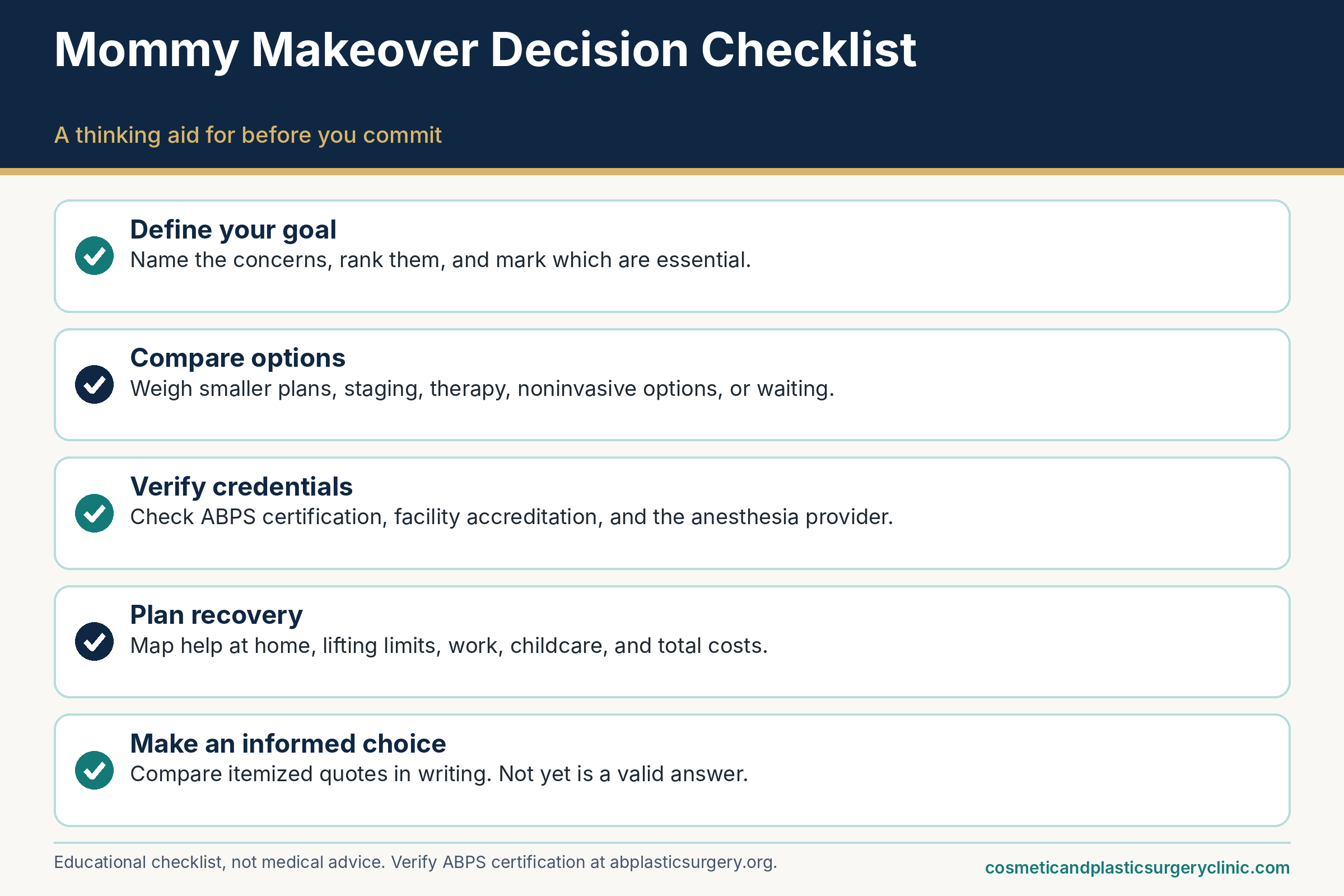
Frequently asked questions
Can I have a mommy makeover after a cesarean delivery?
A cesarean birth doesn’t rule it out, but it does belong in the conversation. ASPS says that in women who have had a cesarean, the existing scar may be incorporated into a new tummy tuck scar, and that previous abdominal surgery may limit what a tummy tuck can achieve. Tell the surgeon how many cesareans you’ve had and whether you’ve had any other abdominal or pelvic surgery. The exam, not the delivery method alone, determines what’s realistic, and the surgeon can explain where the new scar would sit relative to the old one.
Will I need surgical drains?
It depends on the plan and the surgeon’s technique. Mayo Clinic says small drainage tubes may be placed after a tummy tuck, and ASPS lists the duration and management of drains among the questions to ask about recovery. Drains collect fluid from the surgical area and are usually removed at a follow-up visit; how long they stay is the surgeon’s call. Ask whether drains are planned for your operation, who teaches you to empty them, how you record the output, and what changes should prompt a call to the office.
What if I also have a hernia?
A hernia and diastasis recti are different problems. Research describes diastasis as a widening of the connective tissue between the abdominal muscles with the fascia intact, while a hernia is a defect through which tissue protrudes. Cleveland Clinic notes that untreated severe separation can sometimes lead to a hernia, and a 2006 ASPS insurance document says true hernia repair is distinct from diastasis repair and billed separately. A bulge that’s painful, new or changing should be examined before surgery is planned, so say so at the first visit.
Will breast implants interfere with mammograms?
They can change how imaging is done. Mayo Clinic says people with implants need additional views during mammography to see all of the breast tissue around the implant, and the FDA notes that calcium deposits near an implant can be mistaken for cancer on a mammogram, which may lead to additional procedures. Tell the imaging facility that you have implants when you schedule. Questions about when to start screening and which tests are right for you are for your own clinician, and they don’t depend on the implant alone.
Is there an age limit for a mommy makeover?
ASPS doesn’t set a maximum age for a mommy makeover; its criteria center on good health, stable weight, realistic expectations and finished childbearing. The FDA does set minimum ages for breast implants used in augmentation: 18 for saline-filled and 22 for silicone gel-filled. For context, ASPS’s 2025 statistics report found patients aged 36 to 45 made up the largest age group for cosmetic surgical procedures overall. Health status matters more than age on its own, because anesthesia and healing risk depend on your medical history, which is why the evaluation includes it.
Should I get a second opinion before booking?
It’s a reasonable step, and ASPS lists it among ten things to consider before plastic surgery. Two board-certified surgeons may recommend different combinations, techniques or timing, and that difference is information rather than a contradiction. Bring the same photos, history and questions to each consultation, and ask each for an itemized plan so you can compare line by line instead of by total. A second opinion is also a chance to test whether a recommended piece is essential or optional. A surgeon who welcomes the comparison is behaving as you’d hope.
How common is a mommy makeover?
Nobody can say precisely, because ASPS’s national statistics count individual procedures, not mommy makeovers as a category. Its 2025 report, which extrapolates from data covering more than 3,000 board-certified plastic surgeons, estimated 317,196 liposuction procedures, 304,234 breast augmentations, 173,251 tummy tucks and 156,131 breast lifts that year. Those are separate procedure counts, and many of them were performed for reasons unrelated to pregnancy. They show that the building blocks are among the most common cosmetic operations, not how many people combine them.
What happens if I become pregnant after a mommy makeover?
Pregnancy can change the result, which is why surgeons prefer that childbearing be finished. ASPS says subsequent pregnancy can affect a tummy tuck’s outcome, and a surgeon writing for ASPS said additional pregnancies could alter or reverse results. The sources reviewed don’t give a safe interval between surgery and a later pregnancy, so that question belongs to your surgeon and your obstetric clinician together. If a pregnancy is a real possibility, tell your surgeon before booking rather than after, because it may change what is recommended.
How is a mommy makeover different from a body lift?
A mommy makeover is a customized combination, usually of breast and torso procedures, aimed at changes after childbearing. A body lift is a single category of operation that tightens and removes loose skin and tissue around the trunk, potentially including the abdomen, flanks, lower back, buttocks and thighs. ASPS says it isn’t meant strictly for fat removal and that good skin elasticity may make liposuction enough. In ASPS’s 2024 fee release, the lower body lift range was $10,000 to $16,500 versus $8,000 to $13,500 for abdominoplasty. A plan can include elements of each.
Do I need a certain number of children to qualify?
No number appears in the sources reviewed. ASPS’s criteria say the person should be finished with childbearing, not that they should have had a minimum number of children or pregnancies. What matters medically is the specific changes present, such as skin laxity, muscle separation or breast shape, and your health. The individual operations are also performed for people who haven’t been pregnant; the “mommy makeover” label describes a pattern of concerns and a typical combination, not eligibility rules or insurance categories.
How painful is a mommy makeover?
The sources reviewed don’t quantify pain, and experiences vary with the components, the person and the pain plan. ASPS says patients receive prescribed medications and instructions for healing, and it lists persistent pain among possible complications, so pain that is severe, worsening or different from what you were told to expect should be reported. Ask before surgery what the pain plan is, which medicines are used, how they interact with breastfeeding if you’re nursing, and when to call. Our page on mommy makeover pain covers this topic separately.
Will my belly button look different?
It can. In a full tummy tuck, ASPS explains, the upper abdominal skin is pulled down, a new opening for the navel is made and the navel is brought through and stitched in place. A 2024 ASPS article says a mini tummy tuck typically doesn’t reposition the navel. Shape, position and scar placement around the navel vary with technique and anatomy. If the navel’s appearance matters to you, ask the surgeon to describe their approach and to show examples of navels at several months after surgery on similar anatomy.
Sources and further reading
- American Society of Plastic Surgeons — Mommy makeover (accessed 2026-10-04) — goal, possible components, many techniques, typically single-stage
- American Society of Plastic Surgeons — Mommy makeover candidates (accessed 2026-10-04) — candidacy criteria, individualized surgery
- American Society of Plastic Surgeons — Mommy makeover procedure (accessed 2026-10-04) — anesthesia options and component procedures
- American Society of Plastic Surgeons — Mommy makeover recovery (accessed 2026-10-04) — dressings, garments, healing, questions to ask
- American Society of Plastic Surgeons — Mommy makeover safety (accessed 2026-10-04) — complication list and consent
- American Society of Plastic Surgeons — Mommy makeover results (accessed 2026-10-04) — gradual results, scars, no guarantee, possible further surgery
- American Society of Plastic Surgeons — Mommy makeover cost (accessed 2026-10-04) — cost components; no dollar figure or year; financing
- American Society of Plastic Surgeons — Average surgeon/physician fees, 2024 release (accessed 2026-10-04) — projected fee ranges by procedure
- American Society of Plastic Surgeons — Tummy tuck cost (accessed 2026-10-04) — average without year; exclusions; insurance statement
- American Society of Plastic Surgeons — 2025 Plastic Surgery Statistics Report (accessed 2026-10-04) — procedure counts, methodology, GLP-1 consultation survey
- American Society of Plastic Surgeons — Post-pregnancy plastic surgery: what can you do now, and what needs to wait (June 18, 2026; accessed 2026-10-04) — surgeon commentary on timing and early nonsurgical options
- American Society of Plastic Surgeons — Mommy makeovers: what women should know about postpartum surgical procedures (May 10, 2024; accessed 2026-10-04) — components, timing, help at home
- American Society of Plastic Surgeons blog — What are the most common procedures in a mommy makeover (August 30, 2017; accessed 2026-10-04) — surgical time, staging, accredited facility, supervised recovery
- American Society of Plastic Surgeons blog — Five things you need to know about a mommy makeover (November 5, 2020; accessed 2026-10-04) — customization, tummy tuck type, recovery planning
- American Society of Plastic Surgeons blog — Mommy makeover: how soon is too soon (undated; accessed 2026-10-04) — weight, breastfeeding and childbearing timing
- American Society of Plastic Surgeons blog — Finding the right time for a mommy makeover (July 8, 2020; accessed 2026-10-04) — timing, further pregnancies, adult help
- American Society of Plastic Surgeons — Two procedures in one? Why patients are opting to combine plastic surgery procedures (August 23, 2023; accessed 2026-10-04) — survey figure, surgeon time limits, clot risk
- American Society of Plastic Surgeons — Patients combine procedures for shorter recovery times and longer-lasting results (September 27, 2022; accessed 2026-10-04) — Insights and Trends survey figure
- American Society of Plastic Surgeons — Tummy tuck (accessed 2026-10-04) — what it does and cannot do; pregnancy and weight cautions
- American Society of Plastic Surgeons — Tummy tuck candidates (accessed 2026-10-04) — health, stable weight, nonsmoker
- American Society of Plastic Surgeons — Tummy tuck procedure (accessed 2026-10-04) — anesthesia, incisions, muscle repair, navel, closure
- American Society of Plastic Surgeons — Tummy tuck results (accessed 2026-10-04) — standing tall, scar fading, cesarean scars, prior surgery
- American Society of Plastic Surgeons — There’s more than one type of tummy tuck (January 30, 2024; accessed 2026-10-04) — mini and full versions
- American Society of Plastic Surgeons — Breast augmentation procedure (accessed 2026-10-04) — anesthesia, incisions, implant placement, belly-button approach
- American Society of Plastic Surgeons — Breast lift candidates (accessed 2026-10-04) — causes of breast change; lift versus size
- American Society of Plastic Surgeons — Breast lift procedure (accessed 2026-10-04) — incision patterns, nipple repositioning, scars
- American Society of Plastic Surgeons — Breast reduction safety (accessed 2026-10-04) — breastfeeding, sensation, pregnancy effects
- American Society of Plastic Surgeons — Liposuction (accessed 2026-10-04) — scope, limits, combination with abdominoplasty
- American Society of Plastic Surgeons — Fat transfer breast augmentation (accessed 2026-10-04) — how it works; relatively small increase
- American Society of Plastic Surgeons — Body lift (accessed 2026-10-04) — areas treated; not strictly for fat removal
- American Society of Plastic Surgeons — Practice Advisory on Liposuction, Executive Summary (approved March 15, 2003; accessed 2026-10-04) — combining liposuction, volume, facility, compression devices
- Multi-society gluteal fat grafting task force — Advisory on gluteal fat grafting (January 31, 2018; accessed 2026-10-04) — fat embolism mechanism and technique recommendations
- American Society of Plastic Surgeons — Tummy tuck complications: study looks at rates and risk factors (2015; accessed 2026-10-04) — CosmetAssure analysis, combination risk
- Plastic and Reconstructive Surgery (2015) — Abdominoplasty: risk factors, complication rates and safety of combined procedures, abstract record (accessed 2026-10-04) — rates by combination and risk factors
- Plastic and Reconstructive Surgery (2010) — Procedural risk for venous thromboembolism in abdominal contouring surgery, publication record (accessed 2026-10-04) — pooled clot rates and risk stratification
- Aesthetic Plastic Surgery (2026) — systematic review and meta-analysis of concomitant abdominoplasty and breast surgery, publication page (accessed 2026-10-04) — pooled complication comparison; heterogeneity
- Israel Medical Association Journal (2025) — abdominoplasty with and without concurrent breast surgery, abstract (accessed 2026-10-04) — adjusted safety comparison
- Aesthetic Surgery Journal (2009) — combined abdominoplasty and breast surgery series; copy hosted on a practice website (accessed 2026-10-04) — operating time, complications, revisions in one practice
- Congress proceedings (2025) — abdominoplasty alone versus mommy makeover, abstract record (accessed 2026-10-04) — small retrospective comparison; not peer-reviewed article
- Wolters Kluwer — How much liposuction is safe? The answer varies by body weight (accessed 2026-10-04) — volume, BMI and complications in a surgeon-outcomes database
- Plastic and Reconstructive Surgery (2024) — autologous fat grafting in breast augmentation: systematic review, publication record (accessed 2026-10-04) — retention, complications, satisfaction
- U.S. Food and Drug Administration — Breast implants (page updated December 15, 2023; accessed 2026-10-04) — labeling recommendations, boxed warning, patient decision checklist
- U.S. Food and Drug Administration — Risks and complications of breast implants (updated December 15, 2023; accessed 2026-10-04) — not lifetime devices; complications; reoperation
- U.S. Food and Drug Administration — Types of breast implants (updated January 30, 2025; accessed 2026-10-04) — approved ages; MRI for silent rupture
- U.S. Food and Drug Administration — Non-invasive body contouring technologies (page dated October 15, 2025; accessed 2026-10-04) — technologies, clearance meaning, side effects
- International Urogynecological Association — FDA warns against use of energy-based devices to perform vaginal rejuvenation or vaginal cosmetic procedures (accessed 2026-10-04) — notice of the FDA July 30, 2018 safety communication
- American College of Obstetricians and Gynecologists — Committee Opinion No. 795, Elective Female Genital Cosmetic Surgery, repository record (accessed 2026-10-04) — limited evidence, counseling, screening
- Cleveland Clinic — Diastasis recti (accessed 2026-10-04) — definition, first-line therapy, hernia distinction, recurrence
- British Journal of Sports Medicine (2016) — diastasis recti abdominis during pregnancy and 12 months after childbirth (accessed 2026-10-04) — prevalence over time in 300 first-time mothers
- Frontiers in Surgery (2019) — Treatment options for abdominal rectus diastasis (accessed 2026-10-04) — definition, prevalence, evidence on physiotherapy and surgery
- Mayo Clinic — Tummy tuck (accessed 2026-10-04) — preparation, duration, recovery milestones
- Mayo Clinic — Breast augmentation (accessed 2026-10-04) — sagging, breastfeeding, mammography, imaging advice, first night
- American Society of Plastic Surgeons blog — How nicotine sabotages plastic surgery (December 12, 2016; accessed 2026-10-04) — nicotine forms and timing
- American Society of Anesthesiologists — New multi-society GLP-1 guidance (October 29, 2024; accessed 2026-10-04) — perioperative GLP-1 management
- National Institute of Mental Health — Perinatal depression (accessed 2026-10-04) — definition, timing, symptoms, hotline
- Centers for Disease Control and Prevention — About blood clots (reviewed March 5, 2025; accessed 2026-10-04) — clot symptoms and urgency
- Journal of Korean Medical Science (2014) — surgical scar prevention and management (accessed 2026-10-04) — scar maturation and treatments
- Consumer Financial Protection Bureau — Medical credit cards and financing plans (May 2023; accessed 2026-10-04) — deferred interest and APR findings
- Internal Revenue Service — Publication 502, Medical and Dental Expenses (2025; accessed 2026-10-04) — cosmetic surgery definition and exception
- Centers for Medicare & Medicaid Services — Good faith estimate (accessed 2026-10-04) — estimates for people without or not using insurance
- Electronic Code of Federal Regulations — 29 CFR 825.113 (accessed 2026-10-04) — cosmetic treatments and serious health conditions under FMLA
- American Society of Plastic Surgeons — Abdominoplasty and panniculectomy insurance criteria (July 2006; accessed 2026-10-04) — cosmetic versus functional definitions; hernia repair distinction
- American Society of Plastic Surgeons — Accredited facilities (accessed 2026-10-04) — accrediting bodies and requirement
- American Society of Plastic Surgeons — Member qualifications (accessed 2026-10-04) — certification, facility and education requirements
- American Society of Plastic Surgeons — Questions to ask your plastic surgeon (accessed 2026-10-04) — consultation question list
- American Society of Plastic Surgeons blog — Ten things to ask before having plastic surgery (August 15, 2017; accessed 2026-10-04) — certification, privileges, anesthesia provider, second opinion
- Quad A — About us (accessed 2026-10-04) — accredits ambulatory and office-based facilities; directory
- Accreditation Association for Ambulatory Health Care — Accreditation (accessed 2026-10-04) — accredits surgery centers; lookup tool
- American Board of Plastic Surgery — Verify certification (accessed 2026-10-04) — public certification lookup; license requirement; FSMB alert