
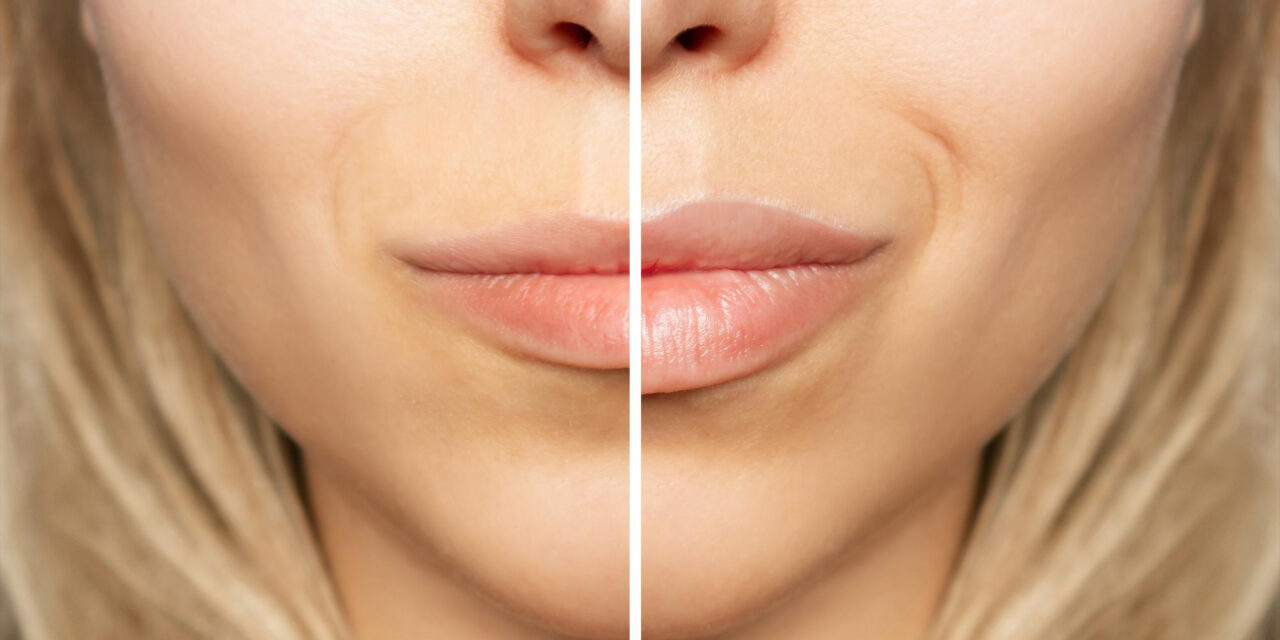
Searching for dermal fillers before and after photos usually starts with a plain question: what does this treatment look like on someone who resembles me? The trouble is that a filler photo is a record of one face, on one day, under one set of lights, after one injector’s choices about product, placement and amount. Change any of those and the picture changes. This page contains no patient photographs and no invented cases on purpose. Its job is to teach you how to read the dermal fillers before and after images you will meet on clinic websites, social media feeds and in a consultation room, so you can tell useful evidence from polished persuasion.
Dermal fillers, which the U.S. Food and Drug Administration (FDA) also calls soft tissue fillers or injectable implants, are gels or suspensions placed under the skin to smooth lines, restore volume or reshape contours in the face and, for some products, the back of the hand. The FDA regulates them as medical devices. That detail matters for photo reading, because it means each product has its own labeled uses, and a picture of one product in one area says very little about a different product in a different area.
The sections that follow move in a deliberate order. First comes what a photo should disclose about the product, the treated area and the volume, since a gallery without that information is hard to interpret. Then the clock, because swelling, settling and fading all change what a face looks like from day one to year two. Next are the photographic conditions themselves, including the difference between a face at rest and a face in motion. After that come the visual cues that raise questions about over-filling, the reasons a photo can change without the face changing, the risks that no photograph can display, and the questions of who is injecting and how galleries are assembled. The final section turns all of it into a consultation plan. For deeper dives, this article points to our complete guide to dermal fillers and to narrower pages in the same series.
Two caveats frame everything here. This is general education, not a personal assessment, and nothing on the page tells you whether you are an appropriate candidate for any filler. And photographs are one input among several. They sit beside the injector’s training and credentials, a frank talk about risk, and your own goals. Natural-looking is a worthwhile aesthetic aim, but it describes an intention that a clinician works toward, not an outcome anyone can promise from a gallery.
What Dermal Fillers Before and After Photos Leave Out: Product, Area and Volume
A before-and-after pair looks self-explanatory, which is exactly why it misleads. Two faces can show the same smoother fold or fuller cheek and have gotten there by completely different routes: a different material, a different depth, a different syringe count, a different number of appointments. Before you can judge a result, you need to know what produced it. That starts with understanding what a filler is and where it is allowed to go.
What fillers are made of and where they go
The word “filler” covers several families of materials that behave differently in the skin and last for different lengths of time. It also covers a long list of facial areas, some with clear regulatory support for a given product and some without. A photo that doesn’t name either one is leaving out the two facts that matter most.
Hyaluronic acid, calcium hydroxylapatite, poly-L-lactic acid and non-absorbable fillers
The FDA’s description of approved dermal fillers groups the materials into absorbable and non-absorbable categories. On the agency’s approved-filler page, the absorbable materials include hyaluronic acid (HA), calcium hydroxylapatite and poly-L-lactic acid, while a polymethylmethacrylate (PMMA) microsphere product is the non-absorbable example. The American Society of Plastic Surgeons (ASPS) describes the same families in plain language and adds a few details that help with photo reading. Hyaluronic acid is a substance the body already makes, calcium hydroxylapatite is a mineral-based material, and poly-L-lactic acid, sold under the name Sculptra, works by stimulating the body’s own collagen, so its effect builds gradually over a few months instead of appearing at once.
Why does the family matter in a photo? Because the look of the result in the first days is different. A hyaluronic acid gel adds volume at the moment it is injected, so an immediate “after” image shows both the product and the swelling around it. A collagen-stimulating product is designed to look different at six weeks than at six days. And a photo of a calcium-based filler in the cheek can’t tell you anything about how a hyaluronic acid filler would behave in the lips. Ask for the product name, not just the word “filler.”
Duration is the other reason. In an FDA clinical overview prepared for the agency’s dermal filler advisory panel, the staff described typical ranges: hyaluronic acid fillers roughly six to twenty-four months, calcium hydroxylapatite about a year, and poly-L-lactic acid up to two years. Those are broad ranges across products and sites, and the FDA’s consumer page makes the same point more simply: how long an effect lasts depends on the filler material and the area where it is injected. A gallery that shows only the first month can’t say where in that range a given result would land.
| Material family | How regulators and ASPS describe it | What a photo may show | Useful question |
|---|---|---|---|
| Hyaluronic acid (HA) | Absorbable; FDA notes HA products may be easier to reduce or remove than others; roughly 6 to 24 months in an FDA overview | Volume appears at injection; early images include swelling; later images may show gradual softening | Which HA product, and how does its stiffness suit this area? |
| Calcium hydroxylapatite | Absorbable; about 1 year in an FDA overview; ASPS describes it as animal-product free | Immediate contour plus later tissue response; used for deeper folds and cheek volume per ASPS | Is this product labeled for the area treated? |
| Poly-L-lactic acid (Sculptra) | Absorbable; stimulates collagen; ASPS describes results building gradually, often over several visits | Little change on day one; improvement shown at weeks to months | How many sessions, and at what interval, produced this image? |
| PMMA microspheres | Non-absorbable; FDA lists limited approved uses (nasolabial folds, cheek acne scars) | Lasts long, so the image may be a long-term record, but it is hard to reverse | What is the plan if I don’t like the look years later? |
| Injectable silicone | FDA states it has not approved liquid silicone or silicone gel to fill wrinkles or augment tissue anywhere in the body | May look striking at first; problems can emerge later | Why is this being used at all? |
The last row deserves a plain sentence of its own. If a gallery image or a provider mentions injectable silicone for cosmetic enhancement, treat that as a reason to stop and verify, because the FDA’s position is that no silicone product is approved for that purpose.
Approved areas, labeled indications and off-label use
In FDA language, an indication is the use a product’s approval is based on, and the product label spells it out. Absorbable fillers, according to the FDA’s dermal filler page, are approved for adults and are indicated for moderate to severe facial wrinkles and folds such as the nasolabial folds, and for adding volume to the lips, cheeks, chin and back of the hand. The non-absorbable products have narrower approvals. The same page says the FDA recommends against using fillers for body contouring, including breast and buttock enlargement, and lists the glabella (the space between the eyebrows), nose, area around the eyes, forehead and neck among uses that are not approved.
Here is where it gets subtle, and where honest education means admitting the picture is not static. Approvals are granted product by product, and they keep expanding. FDA’s own approval page for Restylane Eyelight, dated May 2023, lists an indication for hollowing under the eyes, and a trade report from August 2026 described a second hyaluronic acid product approved for the same region. The manufacturer of Juvederm Voluma XC announced an FDA approval for temple hollowing in March 2024, and the manufacturer of Juvederm Volux XC announced an approval for jawline definition in August 2022. So a single sentence on a consumer page that lists “area around the eyes” among unapproved uses and a product-specific approval for under-eye hollows can both be true at once: the general statement speaks in broad terms, and the specific label governs the specific product. When you see a photo of a temple, jawline or under-eye treatment, the right question is which product was used and whether that exact product’s label covers that exact area.
Off-label use means a licensed clinician uses an approved product in a way that its label doesn’t list. That is legal in the United States and common across medicine, so it isn’t inherently improper. It does mean the evidence behind the use is thinner, the manufacturer’s training and safety data may not cover it, and the patient deserves to hear that it’s off-label before consenting. In its 2021 advisory panel materials, the FDA noted that adverse event reports about vision problems involved injection sites such as the temple, cheek, lip, chin, eyelid and nose, and that reports often listed more than one site, including areas that are off-label. Those are voluntary reports, not rates, so they can’t tell you how likely any problem is. They do show why area-level transparency matters.
| Area | What the sources say | Caption question to ask |
|---|---|---|
| Nasolabial folds and facial wrinkles | FDA general page: approved indications for absorbable fillers, and for some non-absorbable ones | Which product and how many syringes? |
| Lips | FDA general page lists lip augmentation for absorbable fillers; product labels set age and technique details | Is the product labeled for lips, and how was swelling handled before the photo? |
| Cheeks and chin | FDA general page lists cheek and chin augmentation for absorbable fillers | What volume per side, and was the chin or jaw also treated? |
| Back of the hand | FDA general page lists hand augmentation for absorbable fillers | Which product, and how long since treatment? |
| Jawline | Product-specific approval announced by a manufacturer in August 2022; not named in the FDA general page text reviewed | Is this the product with the jawline indication? |
| Temples | Product-specific approval announced by a manufacturer in March 2024; not named in the FDA general page text reviewed | Was the injector trained on this product and area? |
| Under-eye hollows | FDA approval page for one product (May 2023); a second reported in August 2026; the FDA general page lists the area around the eyes as not approved | Which product, and what do the label and consent form say? |
| Nose, glabella, forehead, neck | FDA recommends against filler use in these areas and says they are not approved uses | Why is this off-label use being offered, and what are the alternatives? |
| Breast, buttocks, feet | FDA recommends against filler for these uses; no filler is approved for the décolletage as of an August 2025 FDA panel summary | Walk away from a provider offering these |
Two practical points follow from the table. First, an area missing from the “approved” column is not automatically dangerous, but it is automatically a place where you should ask for the reasoning. Second, FDA labels get updated, so the page you read last year may be out of date. Product-specific current labeling lives in the FDA’s premarket approval database and on the manufacturer’s patient information sheet, and a good clinic will hand you that sheet before you decide.
The caption test: product, areas, volume and sessions
If a gallery image is going to be useful, it should be able to pass a short test. A complete caption tells you what was injected, where, how much, how often and how long ago. Many do not, and the omissions tend to run in one direction: the details that would make a result look less impressive or less reproducible are the ones that go missing.
What a complete photo caption should disclose
Start with the product. A caption that says “lip filler” or “cheek filler” names an area, not a product, and the product determines how the filler feels, how much it swells, how long it lasts and how it can be reversed. Next comes the area, including areas treated in the same session that the crop may hide. A “cheek filler” photo that quietly includes tear trough work, a chin treatment or a neuromodulator injection tells a different story from cheek filler alone. Neuromodulators such as Botox relax muscles and are a separate treatment, covered in our guide to botulinum toxin before-and-after photos; when a face shows both, the smoothing you see may come from either.
Then ask about amount and visits. Filler is commonly supplied in small prefilled syringes, and volume is measured in milliliters (mL). Whether a clinic is willing to state the amount used is a reasonable test of how forthcoming it is. You don’t need an exact number to learn from a photo, but a statement such as “one syringe in each cheek, one visit, photographed at four weeks” is vastly more useful than none. Product labels also give a clue about visits. The FDA-hosted patient brochure for Restylane Lyft says an additional small injection may be given two to four weeks after treatment if needed, and the patient information for Revanesse Lips+ reports that 46 percent (38 of 80) of treated patients in its study received a touch-up one month after the first treatment. Those are label-level examples, not universal rules, but they show that a second visit is a normal part of how some results are reached. A photo labeled “one treatment” for a result that really took two is not a fair preview.
Finally, dates. A good caption gives the interval between the injection and the “after” photo, and ideally says whether the person had any other treatment between the two images, including earlier fillers that were still present at the “before” stage. That last point is easy to miss. Someone who was already partly filled when the “before” photo was taken is a different starting point from someone who was not.
Why volume and syringe counts need context
Once a clinic does give you a number, it’s tempting to treat it as a recipe: two syringes made that cheek, so two syringes will make mine. That reasoning breaks down quickly. The same volume behaves differently depending on the product’s stiffness, the depth of placement, the technique, the person’s existing bone structure and fat pads, the thickness of their skin, and how much of the face is already volume-depleted. A person with a lot of existing midface fullness and a person with pronounced hollowing can receive the same amount and look very different afterward.
Volume also isn’t a measure of quality. A restrained amount placed well may produce a subtle change that photographs poorly but looks right in life, while a larger amount may photograph dramatically and read as over-filled in motion. The point of asking for a number is to understand the scale of the intervention, not to compare syringe counts as if more were better or less were better. In a consultation, the more informative questions are why that amount for that area, what the plan is if the person wants more or less, and how the clinician decides when to stop.
It also helps to know that ASPS describes the treatment itself as an iterative one: the clinician injects, massages and evaluates the result, then adds filler as needed, and the whole visit can last from as little as fifteen minutes to an hour depending on the number of areas treated. Photography may be taken at the consultation as part of planning. Those details frame what a “before” image should be: a planning record taken before any product is placed, under the clinic’s standard conditions, not a casual snapshot taken minutes before the injection after the skin was already numbed and marked.
Timing: Swelling, Settling and How Long Filler Photos Stay Representative
Few variables change a filler photo as much as the clock. An image taken ten minutes after injection, one taken at three weeks and one taken at a year can all be labeled “after,” and each answers a different question. Reading them well means knowing what the face is doing at each stage and refusing to let a single flattering time point stand in for the whole arc.
The first hours to the first month
Filler treatment is a needle or cannula procedure that adds material under the skin, and the body responds to both the material and the procedure. The early weeks therefore show a mix of product effect, fluid, minor trauma and the injector’s choices about how much to place in anticipation of settling.
Immediate photos: swelling, bruising and the over-filled look
ASPS lists several conditions that can follow a filler treatment, and the list reads like a description of an early photo: an over-filled appearance, swelling or bruising that ranges from mild to severe, temporary numbness, redness, palpable lumps and, rarely, hypersensitivity reactions. The society adds that most of these can be eased with ice and gentle massage and will improve within hours or a few days, and that patients can generally resume most activities right away while avoiding intense exercise for the first twenty-four to forty-eight hours to limit swelling and bruising. That is a general statement from a professional society, not a prediction for any one person, but it explains what you’re looking at when a clinic posts a same-day image.
Product labels fill in more. The FDA-hosted patient brochure for Restylane Lyft states that most injection-site reactions are mild to moderate and disappear within a week or two. The patient information for Revanesse Lips+ says most side effects go away within two weeks, while noting that some reactions in its clinical trial lasted longer than thirty days. A manufacturer announcement for the temple indication of Juvederm Voluma XC describes common reactions such as tenderness, swelling, bruising and redness resolving over two to four weeks, and the announcement for the jawline product describes most reactions resolving within about two weeks. Across products, then, the consistent message is that early swelling is expected, usually lasts days to a couple of weeks, and sometimes lasts longer.
What does that mean for photo reading? A same-day or next-day “after” image shows the product plus the fluid and irritation around it. Lips are an obvious example, since they can look markedly fuller early on than they will once swelling recedes. Under-eye and cheek areas can also look puffier or uneven early on. If a post is captioned “immediate results,” the honest reading is “this is how the face looks right after the visit,” not “this is what you will have.” Bruising, tape, marker lines, redness at the needle points and numbness-related asymmetry are all clues that the image was taken early. A clean-looking photo of a freshly injected area, on the other hand, should prompt a gentle question about whether it was retouched, shot hours later, or photographed on a face that hadn’t swollen much.
There’s also a useful point about intention. Early photos are valuable for what they can show about technique: whether the treatment looks even from side to side, whether the injector respected the natural shape of the lip border, whether the cheek volume sits where the cheekbone is. They are poor evidence about the finished look, and a gallery made entirely of early images is telling you about the visit, not the result.
Settling, touch-up visits and the two-to-four-week window
Once the early swelling fades, the shape the injector actually produced becomes visible. Many clinicians schedule a follow-up visit for that reason, and several product labels build in a window for it. The Restylane Lyft brochure says a small additional injection is usually given two to four weeks after treatment if necessary. In the Revanesse Lips+ study described in its patient information, 46 percent (38 of 80) of patients received a touch-up one month after the first treatment. Those two examples differ in product, area and design, and neither is a rule. Together they suggest a pattern worth remembering: for many treatments, the stage at which a result is judged complete is not the day of injection but a few weeks later.
That timeline gives you a way to read a photo caption. If an image says “two weeks later,” ask whether swelling had fully resolved at that point, since reaction lengths in labels run from a few days to several weeks. If it says “four weeks,” ask whether a touch-up was part of the plan and whether the photo is before or after that second visit. A before-and-after pair that combines a first appointment and a touch-up without saying so overstates what a single visit produces, and it understates the real cost and time commitment involved.
Clinical trials give another perspective on timing. The pivotal study behind the temple indication, as described in the manufacturer’s announcement, measured its primary effectiveness at three months; the jawline study reported effectiveness at six months; and the under-eye hollow product’s FDA approval summary described a study of 333 participants in which one or two treatments with multiple injections were needed to reach the best outcome. These are different endpoints for different products, but they share a feature: they look well beyond the first few weeks before calling a result effective. A consumer photo that relies on a two-week image is working on a shorter clock than the trials that support the product.
It’s fair to say that a settled look commonly emerges somewhere in the range of a couple of weeks to about a month for many treatments, but that is a general observation drawn from label-level language, not a medical standard, and individual healing, product, area, and technique all shift it. If you are comparing images, the most reliable habit is to look for the interval written next to each one and to treat anything earlier than about a month with extra caution.
Months to years: duration, fading and maintenance
Most dermal fillers used for facial aging are temporary, which means the result at four weeks is a starting point for a process of gradual change. ASPS describes fillers as temporary treatments for facial aging that require ongoing treatment for long-term results. A gallery that shows only the high point of that curve is leaving out the part that most affects what a patient lives with.
Duration ranges by product and area
Duration is where product, area and person all interact. In the FDA staff overview mentioned earlier, hyaluronic acid fillers were described as lasting roughly six to twenty-four months, calcium hydroxylapatite about a year and poly-L-lactic acid up to two years. Label-level data are narrower and more specific. The Restylane Lyft brochure reports study durations of approximately six months for the lines around the nose and mouth, a range of two to twelve months in the cheeks, about six months in the back of the hand and up to twelve months in the chin. The FDA approval summary for Restylane Eyelight says results may last up to twelve months, and the manufacturer’s jawline announcement describes six to twelve months of observed benefit. A manufacturer announcement for the temple product said a majority of study participants maintained improvement for more than a year.
Notice what those ranges do not say. They don’t say every person gets the longest figure, they don’t say fading happens at a steady speed, and they don’t say that all areas behave the same. The range quoted for cheeks alone, from two to twelve months, shows how wide the spread can be even within a single product and site. If you want a deeper look at longevity, our article on how long dermal fillers last covers the broader discussion.
| Time since injection | What a photo may show | Evidence anchor | Question to ask |
|---|---|---|---|
| Minutes to 48 hours | Product plus swelling; possible redness, marks, early bruising; an over-filled look | ASPS lists over-filled look, swelling and bruising as early conditions | Is this image meant to show the finished result? |
| Days 3 to 14 | Swelling and bruising fading; asymmetry from uneven swelling is common | Labels describe most reactions resolving within about one to two weeks | Were there any bruises or swelling still present in this photo? |
| Weeks 2 to 4 | Closer to the injector’s real shape; touch-up window for some products | Restylane Lyft brochure cites a touch-up 2 to 4 weeks after treatment | Was a touch-up visit part of this result? |
| Months 1 to 3 | Settled look for many HA products; collagen-stimulating products still building | Pivotal trials often assess effectiveness at 3 to 6 months | Do you have images of this same patient at later visits? |
| Months 6 to 12 | Gradual softening or fading for many absorbable fillers; area and product dependent | Study durations in labels run from about 6 months to 12 months for several indications | What happened to this result at the next appointment? |
| Beyond a year | Return toward baseline for temporary fillers, plus ordinary aging changes and any repeat treatments | FDA overview describes ranges up to about 2 years for some products | Is this patient still in the gallery after repeated treatments? |
Why later photos are rare and what fading and persistence mean
Practices photograph patients at the visit, at a follow-up in a few weeks, and sometimes at a yearly appointment. Long-interval images are rare because they depend on a patient returning on a predictable schedule and being willing to be photographed again. A gallery that does include one-year or two-year images, ideally with a note on whether treatments were repeated in between, is giving you more than a gallery of early snapshots. It is also much harder to produce, which is part of why it is valuable.
It helps to picture what fading actually looks like. A temporary filler doesn’t disappear on a given date; the effect softens, usually with the face moving back toward its baseline appearance, and the aging process that created the original hollowing or fold continues underneath. Someone who had a good result at one month may look closer to their starting point at a year and, because they are a year older, may not look identical to the “before” photo. If a gallery shows a patient who has been treated repeatedly, the “before” image is also partly influenced by earlier treatments, which changes what you can infer about what a first treatment would do.
Collagen-stimulating products add a different wrinkle. ASPS says poly-L-lactic acid doesn’t produce immediate results, relies on the body’s own collagen response, and typically involves about three monthly treatments with results developing gradually over a few months. For those products, the most informative photos are the ones taken months after the series, and a photo from two weeks after the first session shows essentially nothing about the intended effect. The practical lesson is to match the photo’s time point to the product’s design.
Finally, there’s the question of what remains in the tissue after the visible effect has gone. A 2026 narrative review of facial over-filling, published in Clinical, Cosmetic and Investigational Dermatology, summarizes imaging reports in which filler material was still detectable much later than patients and clinicians might expect, with magnetic resonance imaging findings up to 27 months and ultrasound detection reported after more than seven years. That is a review of reports, not a measurement of how any one product behaves in any one person, and it should not be read as a prediction. Its relevance here is modest but real: a face that looks as if the filler has worn off may not be entirely free of it, which is one reason a thoughtful injector asks about previous treatments and may suggest waiting or reassessing before adding more. It also explains why a “before” image is trustworthy only if the clinic knows what that patient had injected earlier.
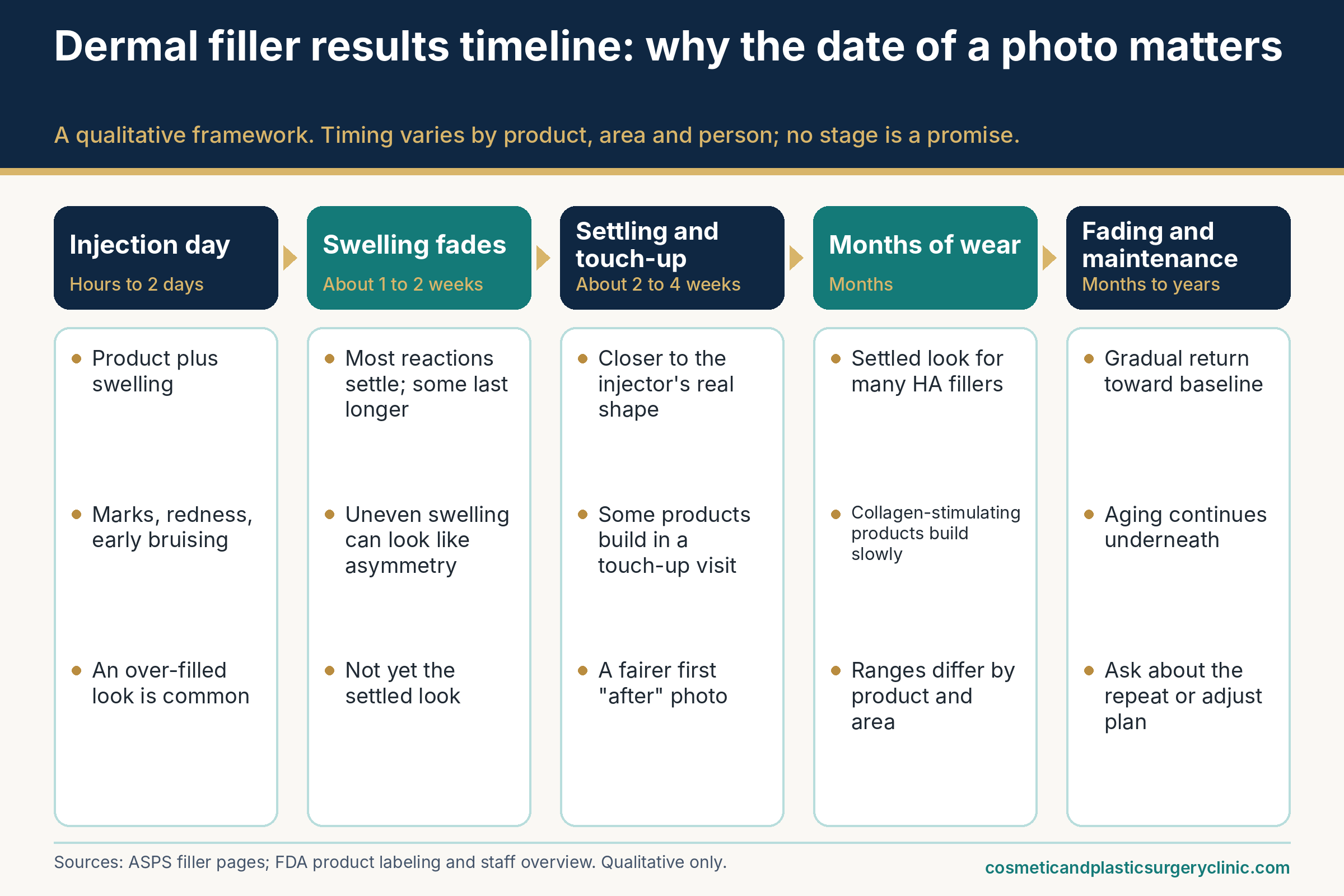
Photo Conditions: Lighting, Angles, Expression and Head Position
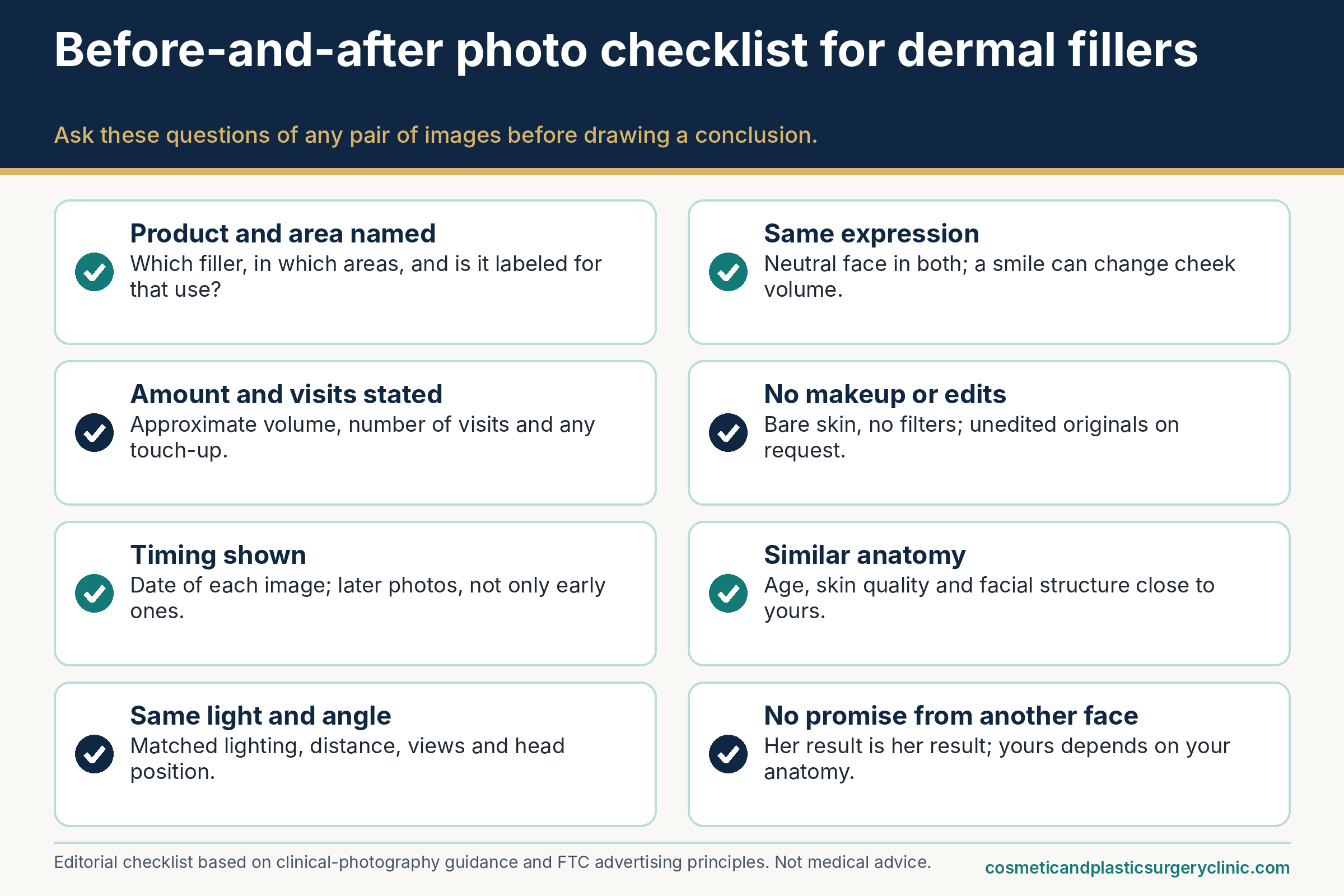
Even when product, area and timing are all disclosed, a before-and-after pair can still mislead if the two photographs were not taken the same way. Faces are three-dimensional, and a camera flattens them. How the flattening happens depends on the light, the distance, the angle and the expression, and filler results are especially sensitive to all four because they work by changing small contours: a shadow under a cheekbone, the edge of a lip, the line of a jaw.
Standardizing the photograph
Clinical photography has conventions precisely because the alternative is unreliable. They are not legal requirements for a clinic’s marketing images, and many galleries do not follow them. Knowing the conventions helps you spot when two images were taken under conditions too different to compare.
Lighting, camera distance and camera settings
Light direction is the first variable to check. Imagery guidelines published by Aesthetics Journal in 2025 advise soft, even lighting that avoids shadows and highlights that distort results, a fixed camera-to-patient distance, and the same camera settings, such as aperture, white balance and ISO, across all images. The reasons are practical. A light source placed higher or to one side creates shadow under the cheekbones, around the nasolabial fold and beneath the lower lip. Those shadows can make a face look more hollow or more full, which is exactly the change filler is supposed to produce, so lighting differences can manufacture an apparent result or hide a real one.
There is peer-reviewed support for how much light angle can matter. A 2021 study in Aesthetic Plastic Surgery by Hernandez and colleagues photographed 51 volunteers with lighting at 0, 30 and 60 degrees while holding other settings constant, and had 27 blinded raters from six countries assess the images. Ratings stayed relatively stable between the frontal light and 30 degrees, but at 60 degrees the raters judged faces as less attractive and estimated a higher body mass index, even though nothing about the people had changed. The authors treated the lower range as a zone where lighting variation had little effect on perception and recommended keeping light angles consistent when documenting results. It was a modest study of general facial perception, not a filler trial, but it shows the principle: light alone changes judgments.
Distance is next. A 2018 study in JAMA Facial Plastic Surgery by Paskhover and Fried, described in a university news release, found that a photograph taken at about twelve inches, a typical selfie distance, made the base of the nose look roughly thirty percent wider and the tip about seven percent wider than a photograph taken at five feet. The study measured noses, not fillers, but the geometry applies to anything close to a lens. A treated chin, lip or cheek photographed from a short distance will not be rendered in the same proportions as the same area photographed from a longer one. If one image of a pair looks like a phone selfie and the other looks like a studio portrait, the difference in perspective alone can change how full or prominent a feature appears.
Camera settings and software complete the list. Exposure, white balance and automatic skin-smoothing modes change skin tone and texture, and many phone cameras apply them without being asked. Redness from fresh injections can be hidden by a warmer white balance or exaggerated by a cooler one. If an “after” image is noticeably smoother, warmer or sharper than its “before,” ask whether a different camera or a filter was involved.
Views, head position and backdrop
The same Aesthetics Journal guidelines describe the standard sequence for facial documentation: a frontal view, a 45-degree oblique view and a 90-degree profile, against a plain, neutral-colored backdrop, with clothing and hair kept consistent. Each view has a job. The frontal view shows symmetry and proportion, the oblique view shows how the cheek, jawline and nasolabial fold sit in three dimensions, and the profile shows projection of the lips, chin and midface. A gallery that shows only one view, particularly only a flattering three-quarter angle, hides the others.
Head position quietly alters results. Tilting the chin up lengthens the neck and softens the shadow beneath the jaw, while tilting it down compresses it. Turning the head a few degrees changes how much of one cheek is visible. A pair in which the head is rotated, tilted or lifted differently between the two images is not a controlled comparison, and the differences in apparent fullness may have nothing to do with the injection. A useful check is to look for fixed landmarks, such as the corner of the eye, the nostril edge and the ear, and ask whether they sit in the same relationship between the two images. If they do not, the pose changed.
Hair and clothing matter more than they seem. Hair pulled back exposes the jawline and temples; hair falling forward hides them. A high collar changes how the neck and jaw read, and jewelry can pull attention to or away from a feature. Backgrounds can also shift how skin tone and contour read, which is why guidelines favor a plain, neutral backdrop. None of this requires bad intent. It just means that two pictures need to be taken as a matched set to be read as one.
| Variable | What should match | How a mismatch can change the look | How to spot it |
|---|---|---|---|
| Light direction | Soft, even light from the same angle | Side or overhead light adds shadow that mimics hollowing or fullness | Compare shadows under cheekbones, nose and lower lip |
| Camera distance | Same fixed distance and lens | Close-up shots enlarge nearer features | Look for wider-looking features in one image |
| Camera settings | Same exposure, white balance, no skin smoothing | Redness, texture and tone change | Compare skin tone and visible pores between images |
| View | Frontal, 45-degree oblique and profile | One flattering view can hide asymmetry or projection | Ask for all three views of the same visit |
| Head position | Same tilt, rotation and chin height | Changes neck and jaw shadows and perceived cheek volume | Check ear, eye corner and nostril alignment |
| Expression | Neutral at rest, plus matched animated poses | A slight smile lifts the cheeks and changes the lip and fold | Compare mouth corners and eye crinkling |
| Hair, clothing, backdrop | Consistent and plain | Changes how jawline, neck and skin tone read | Compare what the hair covers in each image |
Static versus dynamic assessment
Most before-and-after photographs are static: a frozen moment, usually at rest. A face, though, spends most of its life moving. Smiling, speaking, laughing, squinting and chewing all reshape the soft tissues the filler sits in, so a result that looks refined in a still image can read differently in animation, and the reverse can also be true.
Why a face at rest is only half the picture
Static photos are useful for what they are: a comparable record of resting volume and contour. Clinicians rely on them because rest is the one state that can be repeated. The limit is that resting appearance isn’t how other people encounter you. The 2026 narrative review on facial over-filling, mentioned earlier, makes this point directly. It observes that filler treatments are typically performed and judged while the face is at rest, and it describes how excessive filler can look acceptable in a still image yet produce exaggerated midface protrusion and impaired expression once the face smiles or speaks. The authors also note that there are no objective, quantitative standards for evaluating this problem at present and suggest that three-dimensional imaging and automated tools might help in the future.
For a reader, the lesson is to ask what the gallery shows beyond rest. Some practices include short video clips or multiple expressions, such as a neutral face, a soft smile and a full smile, and the best ones show the same expression in both the before and after images. If you only see rest-state photos, you can still ask the clinic whether they review dynamic images with patients during follow-up, since how a face moves is part of how it should be judged. A practice that is willing to show a smile or speaking clip is offering more evidence than a practice that isn’t.
Dynamic assessment also matters for lips and the area around the mouth. A lip that looks proportionate at rest can look stiff, protruding or uneven when the person talks or smiles. The same goes for cheeks: volume that elegantly supports the midface at rest can make a smile look compressed, with the cheek rolling up toward the lower lid. None of this means fillers inevitably cause these effects. It means a still photo is a partial record, and some of the problems people later regret are the ones that only appear in motion.
How expression changes apparent volume
It isn’t only the filler that responds to expression; the entire face does. A study published in Plastic and Reconstructive Surgery in January 2019, summarized in a Dermatology Times report, analyzed three-dimensional images of 20 volunteers across 22 facial expressions and measured how expression and head position changed mid- and lower-face volume. According to that report, smiling increased measured cheek volume by an average of about 13 milliliters and slightly decreased jowl volume, while frowning increased jowl volume. The authors concluded that even small differences in expression could produce changes comparable to substantial cheek augmentation, and they recommended standardizing photography around fixed landmarks, with controlled lighting, camera distance, angle and head alignment. The original journal article was not available for this review, so the figures here come from the secondary report and should be read as indicative rather than exact.
The implication for filler photos is blunt. A before image with a neutral face and an after image with a slight smile can differ in cheek fullness by more than a modest treatment adds, with no filler involved. This is why imagery guidelines ask for a neutral expression and why a suspiciously warm, relaxed “after” face beside a serious “before” face deserves a second look. Raised cheeks, softened eyes and slightly parted lips are not signs of dishonesty, because people naturally look more pleased after a treatment they chose. They are, however, variables that can quietly do some of the work attributed to the needle.
You can use the same awareness on your own photographs. When you compare how you look in the mirror with how you look in a picture, the difference is often expression, angle and light rather than anatomy. We’ll return to documenting your own starting point later, in the section on consultations. For now, the working rule is simple: if two images in a pair do not show the same expression, treat the pair as an illustration, not a measurement.
Reading the Result: Natural Look, Over-Filled Cues, Makeup and Edits
With the facts about product, timing and photographic conditions in hand, you can start reading the face itself. This is the part of photo evaluation that people expect to be about taste, and some of it is. A fuller look is a legitimate preference for some people and an unwelcome surprise for others. But a number of visual cues are worth knowing about, partly because they help you ask better questions and partly because several have a clinical meaning beyond style.
Cues that raise questions about proportion and placement
The language people use online, including “pillow face,” “overfilled” and “migration,” is vivid but vague. Clinical literature is only starting to tighten it. The aim here is to describe what a viewer can actually see, explain the range of reasons it might appear, and leave the judgment where it belongs: with an in-person assessment.
Fullness, symmetry and proportion cues
The 2026 narrative review of what the authors call facial overfilled syndrome gives a sense of how clinicians describe the problem. It lists descriptors such as “chipmunk cheeks” and “duck lips” and ties them to loss of proportion, a disrupted relationship between facial features and impaired expression. The review also states plainly that there are no objective quantitative standards for diagnosing it. In other words, whether a face is over-filled is a clinical judgment about proportion relative to that individual’s anatomy, not a fixed volume or a visual threshold anyone can measure from a photo.
Keeping that in mind, a handful of visual cues are reasonable to notice. Lips that project well beyond the natural border of the lip, or that look rigid at rest, may signal that the amount or placement is large relative to the lip’s structure. Cheeks that look rounded forward even in a neutral expression, or that seem to push the eyes into a narrower shape, may reflect more volume than the midface framework supports. A smooth, wide jawline or chin that looks out of balance with the nose and lips can raise the same question. Puffiness beneath the eyes that does not vary with posture or lighting deserves attention, and so does a bluish-gray tint under thin skin. A 2016 review in the Journal of Clinical and Aesthetic Dermatology explains that this tint, called the Tyndall effect, arises when hyaluronic acid sits too superficially or in large deposits, scattering light, and it is seen most often in the tear trough and around the mouth, where skin is thin.
The reasons behind any of these cues are many, and most are not evidence of poor work. A photo taken early can show swelling that will resolve. Some people deliberately choose a fuller, more sculpted look, and that is their prerogative. A second image may come from an angle or expression that exaggerates the effect. And some visual features reflect the person’s underlying anatomy, such as a naturally full lower face or a prominent chin, rather than the filler. This is why the table below pairs each visual cue with possible neutral explanations and a question you can ask, rather than a verdict.
| What you notice | Possible explanations | Question to ask |
|---|---|---|
| Lip projects well past its natural border or looks rigid | Early swelling; large volume relative to lip size; personal preference for fullness; angle or lighting | How long after treatment was this taken, and how does the lip look when speaking? |
| Cheeks look rounded forward at rest, eyes appear narrower | Volume exceeding what the midface supports; swelling; smile-like expression in the photo | Is this a neutral expression, and what did this person look like at a later visit? |
| Blue-gray tint under the eyes | Superficial placement of hyaluronic acid (Tyndall effect); shadow; dark circles unrelated to filler | Was filler placed here, and is there a plan if a tint appears? |
| Lumps, bumps or irregular surface | Early product settling; swelling; nodules appearing weeks or months later | Do you have images from several weeks later and a plan for lumps? |
| Jawline or chin that looks heavy or out of balance | Volume that exceeds proportion; head tilt; planned change in profile | Can I see the profile view and the same pose in both images? |
| One side noticeably fuller | Uneven swelling; natural pre-existing asymmetry; deliberate correction of asymmetry | Was asymmetry present in the before image and was it discussed? |
| Smooth, poreless skin in one image only | Different camera, retouching or filter; makeup | May I see the unedited originals? |
Notice what the table does not do: it doesn’t tell you what to conclude about any individual photograph. The goal is to turn a gut reaction (“that looks too much”) into a specific question the injector can answer with facts about the product, amount and plan.
Migration, persistence and why an old filler can look like a new problem
One of the more confusing cues is fullness that seems to appear or shift months after treatment. The FDA’s consumer information on dermal fillers lists possible migration of filler among the problems that can occur, and the 2026 over-filling review identifies migration, biofilm formation and granulomatous reactions as proposed contributors to filler accumulating in particular regions. The review also summarizes imaging reports showing that filler can remain detectable longer than many expect, and it connects this to the observation that a face can appear to change over time even without new injections.
For someone studying photos, a sequence is more informative than a single frame. If a gallery shows a patient at one month and at a year, look at whether the fullness stays where it was placed, softens evenly or becomes more prominent in one spot. A localized change that grows over time is a different story from the gradual, even fading that most people expect. In the periocular region, an ophthalmology reference from the American Academy of Ophthalmology (EyeWiki, updated in July 2026) notes that swelling of the lower eyelid region can develop long after treatment as filler absorbs water, which is a reminder that the under-eye area follows its own timetable. These are specialist observations about particular complications, not predictions about any reader.
Photos can raise the possibility of these effects, but they cannot establish them. A clinician may use physical examination, a medical history of prior injections and sometimes imaging to figure out what is present and where. The sensible response to a photo that looks like migration is not a diagnosis; it is the question “what product and when,” followed by an in-person look. Related reading on side effects and warning signs appears in our overview of dermal filler risks and complications.
Things that change a photo without changing the face
Some of the largest differences between a before image and an after image have nothing to do with fillers. They come from what is on the face, how the image was processed and who the person in the photo actually is.
Makeup, tanning, hair, filters and same-day photos
Makeup is the most common culprit. Contour products can paint the shadow beneath a cheekbone, highlighter can make a lip border pop, concealer can hide bruising, and lip liner can sharpen or redraw the lip outline. A clinic doesn’t need to be deceptive for this to happen; patients arrive at a follow-up appointment wearing what they wore that morning. The outcome is an “after” photograph in which some of the visible improvement comes from cosmetics. The cleanest comparison uses bare skin in both images, and a gallery that says so is giving you something unusual and valuable.
Tanning, hair and facial hair belong in the same category. A tan evens out skin tone and reduces visible contrast, and hair that was pulled back for one image and let down in the next changes how the jaw and temples look. Weight changes, sleep, hydration and the time of day can alter the face too, as fluid shifts through the day. These are ordinary variations, and they are why a good protocol photographs patients at a similar time of day and under the same conditions.
Software is the second category. Phone cameras apply skin smoothing and sometimes subtle feature adjustments automatically, and social platforms offer filters that can slim, lift or fill features in a tap. Retouching programs can do much more. If you suspect an image has been altered, check straight lines in the background, such as door frames or tile joints, for waviness; compare moles, freckles and fine lines across images; and zoom in on the area around the edge of the lips, where editing tools often leave smoothed or blurred transitions. The most reliable test is to ask whether the clinic can show unedited originals in the office, which is a reasonable request. Imagery guidelines published by Aesthetics Journal specifically list edited or filtered images as a category to avoid.
The third category is the same-day photo. Because early swelling, numbness and redness are part of the first hours, a same-day image is mostly a record of technique and fluid. If a post is captioned with a dramatic phrase and shows no marks, be curious about its timing. Pair that with the earlier caution about timing, and the working habit becomes automatic: check the date, check the makeup, check the lighting, check the expression, then look at the face.
Comparable anatomy, age, skin quality and what “natural-looking” means
Anatomy decides what a filler can do. The underlying bone structure, the position and volume of the facial fat pads, the thickness and quality of the skin and the strength of the muscles of expression all shape how product sits and how it looks in motion. A person with thin, sun-damaged skin and pronounced volume loss is not in the same position as someone younger with firm skin who wants a subtle change in lip shape. ASPS describes fillers as treatments for diminishing lines and restoring fullness lost to aging, and it states that they cannot achieve the same results as surgery such as a facelift, though they may help delay the time when a facelift becomes appropriate. A photo from a person whose anatomy and age differ from yours can show what a product can do in principle while telling you very little about what to expect for your face.
When you browse a gallery, look for people who resemble you in age range, skin type, facial structure and the specific concern you have. Ask whether the clinic has experience treating people like you, and what the limits are. That conversation is also where candidacy gets discussed, and our page on candidacy, timing and red flags for dermal fillers lays out the questions that tend to matter. Neither this article nor a photograph can tell you whether you are an appropriate candidate.
Finally, take care with the phrase “natural-looking.” It’s a legitimate aesthetic goal, and many people and clinicians aim for it. It isn’t a standard, a measurement or a promise. What reads as natural depends on the person’s anatomy, their culture and community, their own sense of how they want to look and how they move. A photograph can show a restrained change, but it can’t establish that the change will read as natural in motion or to the people who know you. Our article on what subtle, natural-looking dermal filler results really mean goes deeper on this. For this page, the takeaway is to describe your own goal in your own words to a clinician and ask how they would pursue it, instead of choosing a photo and asking for “that.”
What Photos Cannot Show: Risks, Reversibility and Unapproved Products
A gallery is a collection of outcomes that someone chose to show. It is not a record of everything that happens when fillers are injected, and it is structurally unable to display the events that matter most for safety. Understanding that gap is not a reason to avoid reading photos. It is a reason to pair them with questions about risk, preparedness and product authenticity that a photograph can never answer.
Risks that never appear in a gallery
Most of the complications associated with fillers are either invisible in a photograph, happen to someone who isn’t in the gallery, or occur after the last image was taken. A page of smooth, satisfied faces therefore says nothing about how often problems occur or how they are handled.
Vascular occlusion, necrosis and vision loss
The most serious known risk is unintentional injection of filler into, or compression of, a blood vessel. The FDA’s dermal filler page states that this can block blood flow and lead to tissue death (necrosis), vision abnormalities including blindness, and stroke. The agency’s consumer information tells people to seek immediate medical attention for unusual pain, vision changes, or a white, gray or blue appearance of the skin near the injection site, and for any signs of a stroke, during or shortly after treatment. ASPS likewise describes vascular occlusion as a rare but serious complication that can cause skin loss, wounds or loss of vision.
FDA materials prepared for its March 2021 advisory panel describe the mechanism as inadvertent penetration of an artery by a needle or cannula and injection of filler into the vessel. Those documents note that reports of vision loss were associated with several injection sites, that most people described symptoms immediately while some described them later, and that a safe and reliable treatment for vision loss from intravascular injection had not been identified, which puts the emphasis on prevention and rapid recognition. The agency also acknowledged that it was not clear whether published evidence shows training reduces vascular occlusion events, even though training is widely recommended. Those summaries are based on adverse event reports sent in voluntarily. Such reports can’t be turned into a rate, and no number in them should be read as the chance that any one person will experience a problem.
A systematic review published in 2026 in the journal Oral examined the clinical literature on vascular occlusion after filler injection and reached a cautious conclusion about the evidence: the 91 included studies were mostly case reports and case series, with few controlled trials, so the certainty is limited. That matters when you’re deciding what to ask. Because rigorous comparative evidence is thin, the most sensible practical posture for a patient is to ask about the specific plan for recognizing and treating a vascular event, not to rely on a general assurance. A related note appears in the trade coverage of a recently approved under-eye product: the study could not detect rare vascular events because of its size, and a lack of observed events in a trial is not evidence that a product is safer.
The photo-related lesson is straightforward. A successful result cannot tell you how often complications occur or how a clinic responds to one, because that information doesn’t exist in the image. Complication photos are rarely posted in galleries, and a patient who had a serious problem is unlikely to appear in marketing. When you ask a clinic about vascular occlusion, a good answer is specific: what warning signs they look for during and after injection, what they do if they suspect one, whether they keep the reversal enzyme on hand, and where they would send you for urgent care. For general context on the regulator’s position, see our overview of FDA status, approved uses and safety questions for dermal fillers.
Infection, nodules, granulomas and delayed reactions
Many filler problems don’t appear for days, weeks or months. The FDA lists infection, lumps and nodules, granulomas, allergic reactions and skin changes among the problems that can follow filler treatment. A 2021 review in the Journal of Clinical and Aesthetic Dermatology by Convery and colleagues defines delayed-onset nodules as nodules or areas of firmness that typically occur at least two weeks after treatment. It outlines several proposed explanations, including redistributed filler, delayed hypersensitivity, bacterial biofilm, foreign-body granulomas and, more rarely, an autoimmune-type response, and it recommends a stepped approach that can involve hyaluronidase, targeted antibiotics, anti-inflammatory treatment and, as a last resort, excision. The authors report that the prevalence has been as high as 0.8 percent in one series, and they emphasize that the underlying causes and true frequency remain uncertain.
The American Academy of Ophthalmology’s EyeWiki reference on hyaluronic acid filler complications, updated in July 2026, adds that infections can present two or more weeks after injection and that swelling in the lower eyelid region can emerge years later. These details illustrate two things. First, an “after” image at four weeks falls inside the time window for many delayed problems, so a clean photo doesn’t close the question. Second, the timelines vary by complication, so honest consent covers what to watch for in the days, weeks and months afterward, and who to call.
| Risk or effect | Visible in a photo? | Typical timing | What to ask |
|---|---|---|---|
| Swelling, bruising, redness, tenderness | Often, in early images | Hours to a couple of weeks; sometimes longer | What is normal for this area, and when should I call? |
| Asymmetry, lumps, irregular contour | Sometimes | Early, or weeks to months later | How are lumps evaluated and corrected? |
| Tyndall effect (blue-gray tint) | Yes, in thin-skinned areas | Soon after injection or later | Which depth was used, and what is the fix if a tint appears? |
| Infection | Rarely in a gallery | Days to weeks after injection | What symptoms should prompt a call? |
| Delayed-onset nodules or granulomas | Sometimes, if photographed | At least about two weeks after treatment, sometimes months | Who treats these and at what cost? |
| Vascular occlusion, necrosis | Skin color changes may appear; internal effects do not | During or soon after injection | What is your emergency protocol, and is hyaluronidase on site? |
| Vision loss, stroke | No | Usually immediate, occasionally later | What are the warning signs, and where do I go? |
Reversibility and product authenticity
Two questions determine how much margin for error a filler treatment has. Can the product be reversed if the result or a complication calls for it, and is the product what it claims to be?
Hyaluronidase and what can and cannot be dissolved
Hyaluronic acid fillers can be broken down with an enzyme called hyaluronidase. The FDA’s dermal filler page notes that removing or reducing fillers may require injections, surgery or other interventions that carry their own risks, and that it may be difficult or impossible to remove the material, especially permanent fillers or products that are not made of hyaluronic acid. The FDA-hosted patient brochure for Restylane Lyft defines hyaluronidase as a medicine used to break down hyaluronic acid in the area of injection, and an FDA staff overview lists it as a potential reversal option for HA products.
The 2026 systematic review in Oral calls hyaluronidase the cornerstone of treatment for vascular compromise caused by HA filler and stresses that results are strongly time-dependent, with better outcomes when treatment starts early. The same review points out that non-HA and permanent fillers lack a specific antidote and therefore offer more limited options. The EyeWiki reference goes further on preparedness, stating that hyaluronidase should be on hand during an HA filler procedure. Reversibility is thus a real feature of HA products, but it isn’t a safety net that covers everything: dissolving filler may not fully restore the starting appearance, the enzyme has its own considerations, and a reversal in a vascular emergency depends on speed.
For photo reading, this has two implications. A result you dislike with an HA product is potentially adjustable, which is part of why many clinicians prefer to start conservatively and add later. And a gallery that features a non-HA or semi-permanent product should come with a conversation about what happens if you want it gone. Ask three things: which product is being used, whether it can be dissolved, and whether the clinic keeps hyaluronidase on site and has a protocol for using it. Those answers say more about preparedness than any image.
Counterfeit, unapproved and silicone products
A photograph also can’t show what was in the syringe. The FDA’s dermal filler page states that the agency is aware of counterfeit products marketed and used in the United States, listing instances from March 2017, July 2018 and October 2018, and advises people not to purchase dermal fillers online because they may be counterfeit or not approved for use in the country. The FDA’s consumer update on dermal filler do’s and don’ts says that FDA-approved fillers come in properly labeled, sealed vials or prefilled syringes, advises against buying fillers sold directly to the public because they may be fake, contaminated or unapproved, and recommends requesting and reading the patient labeling for the product to be injected.
Injectable silicone deserves its own mention. The FDA has said it has not approved liquid silicone or silicone gel for injection to fill wrinkles or augment tissue anywhere in the body, and the 2021 panel materials describe warnings about unapproved silicone injections for breast and buttock enlargement and the risk of serious harm when silicone embolizes after injection into vascular areas. The FDA has also stated that the safety and effectiveness of needle-free devices for injecting dermal fillers is not known. A gallery or a provider that mentions any of these should be treated as a red flag, regardless of how dramatic the photos look.
In practice, authenticity checks are simple and polite. You can ask which product will be used, ask to see the packaging and the lot information, ask for the manufacturer’s patient information sheet, and ask where the clinic buys its products. A reputable clinic should not object. If you experience a problem after treatment, the FDA encourages reporting it through its MedWatch program. If a price seems far below what other clinics quote for what is supposedly the same product, the discrepancy is worth understanding before you book, and our dermal fillers consultation guide lists further questions about products and protocols.
Who Is Behind the Photos: Injector Credentials, Gallery Red Flags and Advertising Rules
A before-and-after image is also a statement about the person who made it. Who injected, what training they have, who selected the images and how the clinic describes them all affect how much weight a photo deserves. This section covers the credentials and verification steps that sit behind a gallery, the habits that make galleries less trustworthy, and the advertising and privacy rules that govern patient photographs.
Who is injecting, and how to verify it
Dermal fillers are not sold over the counter. The FDA describes them as prescription devices for licensed practitioners, and its consumer guidance says to seek a licensed health care provider who has experience in dermatology or plastic surgery and who is trained to perform the injection. Beyond that broad language, the question of who may legally inject which product, under what supervision, differs by state.
Physicians, nurse practitioners, physician assistants, nurses and dentists: scope varies
Injectors in the United States come from several licensed professions. A trade-association article from the American Med Spa Association, last updated in March 2026, explains that injections must be performed by a licensed physician, an independent-practice nurse practitioner or another licensed medical professional acting within their scope of practice, and that physicians, nurse practitioners, physician assistants, registered nurses and, in several states, trained dentists may be involved depending on state rules. It adds that medical assistants may be able to inject only when ordered and supervised by a physician. The same article stresses that rules vary by state and should be checked against state-specific sources. It’s a trade-group view, so it is useful as a map of the landscape more than as legal authority.
A commentary in Dermatology Times by a physician assistant, published in May 2023, describes a fragmented picture: oversight differs by state and license type, certain professions can inject under state law without any requirement for training in dermatology or plastic surgery, and no single accreditation body governs aesthetic medicine. Those observations are consistent with the FDA’s framing, which names licensure and training but doesn’t prescribe a specific profession. They also explain why two clinics with similar-looking galleries can have very different staffing models.
The practical consequence is that a title is only the start of the question. A person can be fully qualified as a nurse practitioner or physician assistant, as a dermatologist or as a plastic surgeon, and also be inexperienced with a particular product or area. Conversely, a physician with excellent credentials in another field may be new to facial injection. ASPS emphasizes being in the care of a board-certified plastic surgeon who understands the risks and is trained and prepared to deal with complications, which is one professional society’s view. Because the law varies, the useful questions are about the actual injector, not the clinic’s brand: who will inject me, what is their license, what training have they had on this specific product and area, and who is on site if something goes wrong.
| Role or title | What it indicates | What it does not settle | How to verify |
|---|---|---|---|
| Board-certified plastic surgeon | Certified by the American Board of Plastic Surgery in plastic surgery | Experience with a specific filler product or area | ABPS online verification tool |
| Physician certified by another ABMS member board (for example, dermatology) | Certification in that specialty | Certification in plastic surgery; filler-specific experience | ABMS Certification Matters lookup |
| Nurse practitioner or physician assistant | State license and scope of practice; supervision or collaboration rules vary | Training in facial anatomy or filler complications | State licensing board; ask about supervising physician and on-site backup |
| Registered nurse | State nursing license; the trade-association source says RNs may inject with training and supervision where state law allows | Whether independent practice is allowed in your state | State board of nursing; ask who evaluates complications |
| Dentist | Allowed in some states to use fillers within a defined scope | Whether the planned area falls inside that scope | State dental board and the clinic’s written policy |
| “Cosmetic surgeon” or “aesthetic physician” | Often a marketing term; ASPS notes any licensed physician may advertise as a cosmetic surgeon | Board certification or surgical training | Ask for the specific board and verify it independently |
Verification tools: ABPS, ABMS and state boards
Several free public tools let you check credentials in a few minutes. The American Board of Plastic Surgery runs an online verification search by name or location, and the page notes that certification involves ongoing self-assessment and practice improvement over ten-year certification periods. It also explains that an active, unrestricted medical license is a requirement for certification and points users to the Federation of State Medical Boards to look into licensure and any board actions. The ABPS certifies plastic surgeons only, so a physician certified in another specialty will not appear there. You can check the tool directly at the ABPS verification page.
For physicians certified in other specialties, the American Board of Medical Specialties offers a free public search at Certification Matters, requiring only a last name of at least two letters, with optional filters for first name, state and specialty. For licensure, the Federation of State Medical Boards maintains a directory that connects the public to each state’s medical board, including complaint links. Nurse practitioners, physician assistants, registered nurses and dentists are licensed by their own state boards, which usually have their own online lookups; this article didn’t review each state’s tool, so search for your state’s board by name.
Keep the distinction between a license and a board certification clear. A license is the legal permission to practice, and a certification is an additional credential from a specialty board. Membership in a professional society is a third thing and is not equivalent to either. When you verify, write down the date and the name exactly as listed, and ask the clinic which person will actually perform your treatment, since a well-credentialed physician owner does not always hold the syringe. Our pages on ABPS board-certified plastic surgeons and how to choose a plastic surgeon walk through those checks in more detail.
How galleries are built, advertising rules and patient consent
Once you know who is behind a gallery, you can look at how it was assembled. Galleries are marketing materials, and marketing choices shape which faces appear, in what order and with what captions.
Red flags: cherry-picking, stock images, AI images and missing product information
A few patterns should slow you down. The first is the all-star gallery: only exceptional results, no variation, no patients with imperfect outcomes or modest changes, and the same few faces repeated. Every practice has a range of results, and a gallery that shows none is selecting rather than documenting. The second is inconsistency: different lighting, backdrops or expressions between the two images of a pair, or between pairs, which suggests that either multiple photographers or deliberate choices are at work. The third is silence about details. If an image gives no product, area, amount or time interval, you can’t tell what it is evidence of.
Other warning signs are more modern. Stock photography and images borrowed from other websites sometimes appear in galleries, and a reverse image search can reveal whether a picture appears under another name or in a manufacturer’s materials. It’s also fair to ask whether an image shows a patient of this clinic, treated by this injector, or a patient from a manufacturer’s clinical study or a different practice. AI-generated faces and altered images are increasingly easy to produce, and nothing on the page will announce them. Signals include skin with no pores, background lines that bend, mismatched earrings or teeth, and a lack of the small asymmetries real faces carry. When you can’t tell, the answer is to ask for the originals and to treat unverifiable images as decoration.
Also notice what the gallery implies about suitability. A page that features only one age group, one skin tone or one facial structure may offer little evidence for people who differ, and a page that shows only the dramatic end of the range can nudge expectations upward. None of this means a clinic is dishonest; many clinics are simply limited by what patients consent to share. But a short, honest gallery with labeled details is better evidence than a long, uniform one without them.
FTC advertising principles, patient consent and privacy
The Federal Trade Commission regulates advertising claims, including those that rely on testimonials and before-and-after images. In its health products compliance guidance, last updated in December 2022, the FTC says that an advertiser cannot use a testimonial to make a claim it couldn’t substantiate directly and must have appropriate scientific evidence to back the effect a testimonial implies. The guidance also says that a vague disclaimer such as “results not typical” does not cure an exceptional testimonial, and that advertisers should clearly disclose what a typical consumer can expect. The FTC’s endorsement guides Q&A, last modified in July 2025, makes a related point: if an endorser’s experience isn’t typical, the advertisement must make clear what results are generally expected, and material connections between endorser and brand must be disclosed. In August 2024 the FTC announced a final rule banning fake reviews and testimonials, including AI-generated ones that misrepresent people who do not exist or who did not use the product. These are principles for advertisers; this article cannot say whether any specific clinic complies, and it isn’t legal advice. But they are a reasonable lens: a gallery that calls an exceptional result typical, or says “results vary” in small type beneath a spectacular image, falls short of the spirit of the guidance.
Privacy is a separate issue. Filler photos nearly always show the face, and the U.S. Department of Health and Human Services (HHS) lists full-face photographs and comparable images among the identifiers that must be removed to de-identify health information under the HIPAA Safe Harbor method, in guidance last modified in February 2025. Put simply, a face is the kind of information that is treated as identifying. Imagery guidelines published in 2025 by Aesthetics Journal call for written consent before photographs are captured and used, with a clear explanation of the intended uses, which can include documentation, education and marketing. You can ask a clinic whether every patient in its gallery gave written consent for public use, and, when you are the patient, ask what you are being asked to agree to: clinical records only, teaching, or public marketing, and whether declining marketing use affects your care in any way. The answers belong in writing.
Finally, remember that your own images are yours to ask about. Before you have treatment, ask how your photos will be stored, who can see them and how you can withdraw permission for later uses. These are routine questions, and a professional office will have routine answers.
From Photos to a Decision: Consultation Questions, Expectations, Cost and Alternatives
Everything above can be folded into a simple three-pass method. On the first pass, you read the provenance of the photo: who made it, what product, which area, how much, how many visits and how long ago. On the second pass, you read the conditions: light, angle, head position, expression, makeup and signs of editing. Only on the third pass do you look at the face itself and ask whether the change is the kind you want, in a person whose anatomy resembles yours. Most people do the passes in the reverse order and jump straight to the face, which is how a striking image ends up carrying more weight than the evidence under it can support.
Bringing photos to a consultation
The most productive use of a before-and-after photo is as a prop in a conversation. Choose a few images you are curious about, whether from a clinic’s gallery or from social media, and use them to ask about the clinician’s approach. You’ll learn more from how the answers are given than from the picture itself.
Questions to ask about photos, products and the treatment plan
Bring a short written list and ask for answers in writing where it matters. The table below groups questions by topic, explains why each one matters and describes what a thorough answer tends to include. It isn’t a script and not every clinic will answer every question the same way, but a practice that welcomes the questions is showing you something about its culture. You’ll find a longer list of general questions in our guide to plastic surgery consultation questions to ask.
| Topic | Question to ask | Why it matters | What a thorough answer includes |
|---|---|---|---|
| Photo provenance | Are these your patients, treated by the person who would inject me? | Ties the gallery to the actual injector | A clear yes or no, plus who treated each case |
| Product and label | Which product was used in this photo, and is it labeled for that area? | Approvals are product-specific and area-specific | Product name, label discussion, mention of off-label use if any |
| Amount and visits | How much was used, in how many visits, and with what interval? | Scale of the intervention and cost | Approximate volume per area and the touch-up pattern |
| Timing and follow-up | How long after treatment was the “after” photo taken, and do you have later images? | Swelling and fading change the look | Dates for each image and willingness to show later time points |
| Comparable patients | Can you show patients with anatomy and goals like mine, including modest results? | Fair expectations rather than best cases | Honest limits; examples across a range |
| Photo conditions | Were these taken under the same conditions, and may I see unedited originals? | Rules out lighting and editing differences | Standard protocol and a willingness to show originals |
| Complication preparedness | What is your plan for a suspected vascular problem, and is hyaluronidase on site? | Speed matters in emergencies | Specific warning signs, a written protocol and referral pathway |
| Reversibility | Can this product be dissolved, and what happens if I don’t like the result? | Options differ by material | Clear statement about dissolving, limits and any extra cost |
| Unexpected results | What is your policy and fee for adjustments and for treating complications? | Total cost and accountability | A written policy |
Pay attention to the tone of the answers as well as the content. A clinician who says “I don’t have many cases like yours” or “that product isn’t labeled for that area, here is why I would or wouldn’t use it” is telling you something valuable. Pressure to book on the spot, discounts that expire the same day or reluctance to put answers in writing are signals to pause. You are entitled to take time, collect a second opinion and compare. Nothing about a filler decision requires speed, and the products are designed for treatments that can be repeated or adjusted later.
It’s also reasonable to ask the clinic to explain how it chooses among products for the area you are considering, what experience the injector has with that product, and what they do when they decline to treat a request. A refusal to treat a requested area or amount isn’t an obstacle; it can indicate that the clinician is weighing anatomy and safety. If you hear different advice from two clinicians, the differences themselves are information, and a candid second opinion can clarify which parts are matters of preference and which are matters of safety.
Documenting your own starting point
Your own photographs can make the consultation more useful, and they help you judge later results fairly. Take them before any treatment, on a day when your face is typical for you, and take them the same way each time. Use steady daylight from a window or a consistent lamp in front of you instead of overhead light, and keep the camera at about the same distance and height. Wear no makeup, pull hair back, and hold a neutral expression, then add a soft smile. Take a frontal view, two oblique views and two profiles if you can, and write the date on a note or in the file name. Photograph again at the intervals the clinic recommends, in the same setting, so any change you see is a change in your face and not in the photography.
Keep a simple treatment record alongside the images. Note any previous filler or neuromodulator injections, the area, the product if you know it, the date and the clinic, since this history shapes what a clinician will recommend and is essential if a problem arises. If you cannot recall what you had, ask the previous clinic for your records. The same applies to medical history that your clinician needs to know, such as allergies or skin conditions; those are for your clinician to evaluate, and this page can’t tell you what applies to you.
Finally, remember that your phone and your mirror are not neutral observers. A front camera at arm’s length is the close-up distortion described earlier, and a bathroom mirror under strong overhead light adds shadows. Expect to feel that you look different in different settings. Used consistently, though, your own photographs become a reliable private record and an honest way to discuss goals.
Expectations, cost framing and alternatives
The final step is deciding what you realistically want, what you are willing to accept in trade-offs and what the whole path might cost over time. Photographs help, but they should not be allowed to substitute for these decisions.
What fillers can and cannot do
ASPS describes dermal fillers as injectable treatments that diminish facial lines and restore fullness, and it lists uses such as plumping thin lips, enhancing shallow contours, softening creases and wrinkles, improving the look of recessed scars and reducing the shadow of the lower lids. It also states plainly that fillers are temporary treatments for facial aging, that ongoing treatments are needed for long-term results, and that they cannot achieve the same results as surgical procedures such as a facelift, although they may help delay the time when considering a facelift becomes appropriate. Those are reasonable boundaries for expectations. Fillers change volume and contour; they don’t remove loose skin, reposition drooping tissue the way surgery does, or reverse the underlying aging process.
Trade-offs belong in the same picture. Early swelling and bruising are expected, a touch-up visit may be part of the plan, results fade and repeat treatment is a recurring commitment, and rare but serious complications exist. Reversibility depends on the product. And anatomy sets limits: a feature that is largely structural, such as the position of the bone or the laxity of the skin, may respond only partly to volume. When you evaluate photos, hold that frame in mind. A picture of a successful lip treatment tells you nothing about how well a filler would address a heavy lower face, and a cheek photo does not imply that all hollows respond the same way.
The question of longevity runs through all of it. Because the effects of most fillers are temporary, ask how the clinician expects your result to evolve over a year, how often people with goals like yours usually return, and what the plan is if you decide to stop.
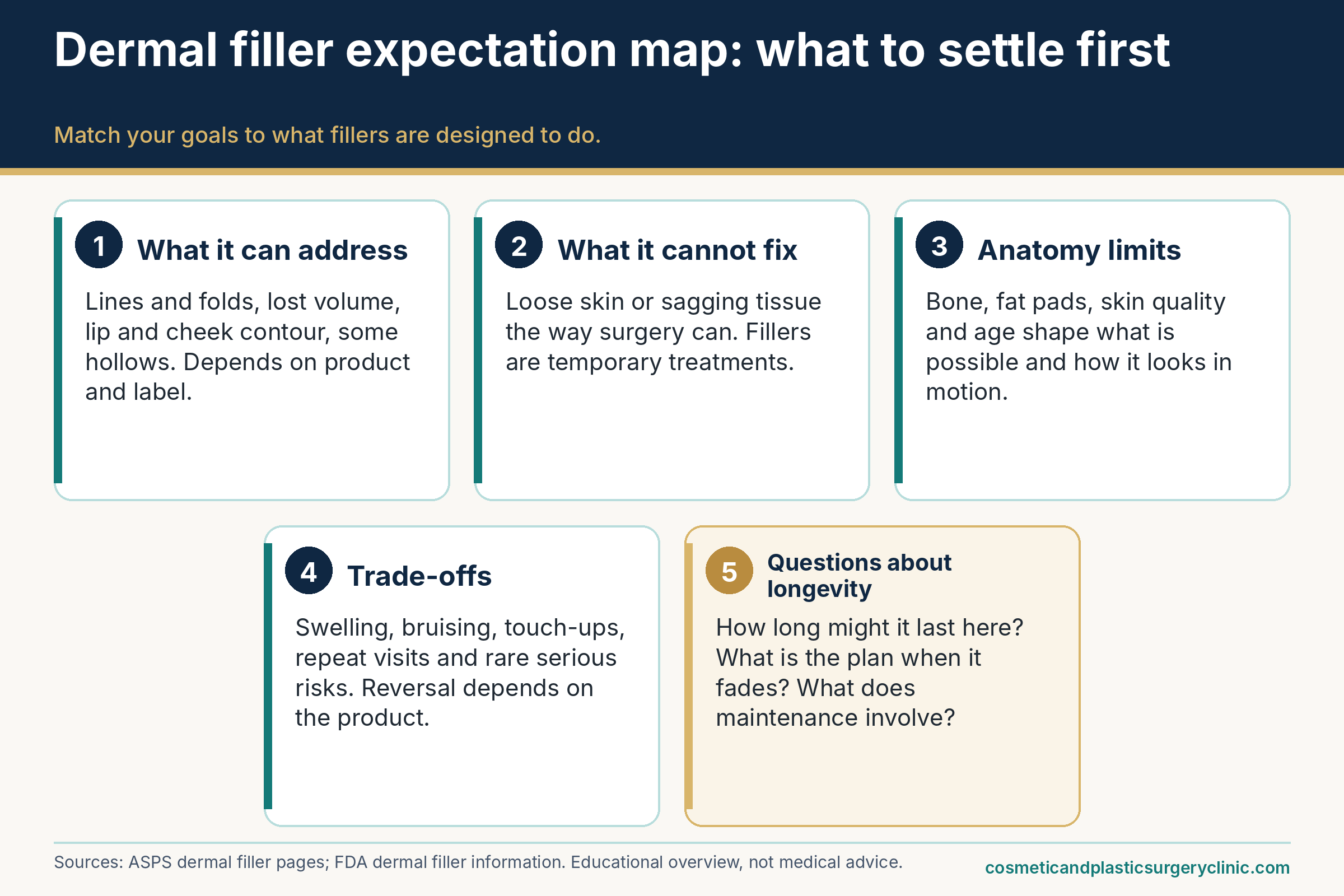
Cost framing and alternatives without a price tag
This article doesn’t quote prices. The sources opened for this research did not provide a reliable, dated, U.S.-wide figure for filler treatment that could be presented without misleading, and a national average is never a local quote. What can be said is how to frame the question. Cost depends on the product, the amount, the treated areas, the injector’s training and the clinic’s overhead, the number of visits and the follow-up and touch-up policy. Because most fillers are temporary, the relevant figure is not the cost of one session but the cost of maintaining a look over time, along with the cost of adjustments and of managing any complication. Ask what is included in a quoted price: the product and the amount, a follow-up visit, a touch-up, and the policy if something needs correcting or dissolving.
Be careful with offers framed around price per syringe or per area, which make comparison hard because syringes differ in product, volume and intended use. A price far below others should prompt a question about the product’s source, the injector’s training and what is excluded, in line with the FDA’s warnings about counterfeit and unapproved products. Pressure tactics such as limited-time pricing have no place in a medical decision. Take the quote home, compare in writing and ask about financing terms only after you have decided on a plan.
Alternatives deserve an honest hearing too. Neuromodulators relax muscles and address different concerns, skin-quality treatments address texture and tone, and surgical procedures such as a facelift address skin laxity and deeper tissue position in ways fillers cannot. Waiting and doing nothing is also a legitimate choice. Our overview of alternatives to dermal fillers describes the main options. If you are also learning how surgical results are photographed and judged, where scars and longer healing change the questions, the guide to breast lift before-and-after photos shows how the same habits apply to an operation. And if your interest is in a single area, our pages on evaluating lip filler photos, under-eye filler photos and jawline filler photos go deeper on each.
Frequently asked questions about dermal fillers before and after photos
How long after treatment should an “after” photo be taken to be a fair comparison?
No professional body sets a single interval, so the useful habit is to look for the date. FDA-hosted product information describes most injection-site reactions resolving within about one to two weeks, with some lasting longer, and some labels build in a touch-up visit two to four weeks after the first. Many readers therefore treat images from the first couple of weeks as early records and look for photos at a month or later. The best galleries also show the same patient at several months. Ask the clinic when each image was taken and whether a touch-up came between the two pictures.
Can I trust filler before-and-after photos on Instagram or TikTok?
Treat them as a starting point for questions, not as evidence. Feeds reward striking images, captions often omit the product, amount and timing, and filters or edits are easy to apply. A post is more informative when it names the injector, states the product and area, shows the date, uses matched lighting and angles, and includes a neutral expression. The FTC’s 2024 rule on fake reviews and testimonials, including AI-generated ones, is a reminder that online material can be fabricated. Verify the injector’s credentials separately, and ask to see unedited photos during a consultation.
Should a gallery show a resting face and a smiling face?
Ideally it shows both, using the same expression in the before and after images. Still photos are usually taken at rest because rest is repeatable, but a 2026 narrative review on over-filling notes that treatments are typically assessed at rest while excess filler can become obvious in animation. Ask whether the clinic reviews smiling and speaking images or short video at follow-up. If you only have rest-state photos, ask how the injector judges movement during treatment. A clinic that discusses dynamic assessment unprompted is showing you that it considers more than the still image.
How can I tell whether a filler photo has been edited or is AI-generated?
Certainty is hard. Zoom in and look for background lines that bend, skin without any pores, blurred or smoothed lip borders, mismatched jewelry or teeth, and a lack of normal asymmetry. Compare moles or freckles with other images from the same account, since a mirrored file moves them to the opposite side. A reverse image search can show whether a picture appears elsewhere under another name. The most dependable step is to ask the clinic to show the unedited originals in the office. Reluctance to do so is information you can weigh.
Is it a red flag if a clinic won’t say how many syringes were used?
It is a reason to ask more questions, not proof of a problem. Some clinics avoid quoting syringe counts because volume does not translate directly between patients, and others avoid it because they prefer to discuss a plan after examining you. Even so, a clinic should be able to tell you the product, the areas and the general scale of a treatment in the photos it shows. If every detail is withheld, you cannot interpret the image. Ask what they can share and why, and compare the answer with what other clinics disclose.
If a filler is FDA-approved, does that mean it is approved for the area in the photo?
Not necessarily. Approval is product-specific and indication-specific. The FDA’s dermal filler page lists approved uses such as facial folds and lip, cheek, chin and hand augmentation for absorbable fillers, and recommends against using fillers in several other areas. Individual products have since gained narrower approvals, such as for jawline, temples or under-eye hollows, according to FDA and manufacturer sources reviewed here. A product can be approved for one area and used off-label in another. Ask which product was used and read its current patient information for the exact indication.
What should I do if my result looks different from the photos I saw?
Contact the injector who treated you, ideally in writing, and describe what you notice, when it began and when the treatment took place. Many early differences are swelling or settling and change over days to weeks, and a follow-up visit may be part of the plan. Do not try to massage, dissolve or correct the area on your own or buy products online. Seek immediate medical care for severe pain, vision changes, or skin that turns white, gray or blue near the injection site, or any stroke signs. For lasting concerns, a second opinion from another qualified clinician is reasonable.
Can I ask a clinic to take down photos of me?
You can ask, and the first step is to review the written consent you signed, which should describe how photos may be used and how permission can be withdrawn. Send your request in writing to the practice, name the images, and keep a copy. Policies, and the legal rights that apply, depend on the circumstances and the state, so this page cannot tell you what you are entitled to. If the request is not resolved, consider talking with a healthcare or privacy attorney. Going forward, you can decline marketing use at the start and ask how your photos will be stored.
Can a photo tell me how a filler will feel?
No. Texture, firmness and tenderness are not visible in an image, and they matter, especially in the lips and areas that move. The FDA lists firmness, lumps, tenderness and swelling among the common effects of filler treatment, and product labels note that these typically settle over days to a couple of weeks, though some persist. How a filler feels depends on the product, the depth of placement, the area and your own tissue. If feel matters to you, ask the injector how the product tends to behave in that area and when you should expect it to soften.
Can I compare filler brands by looking at their photos?
Not reliably. Brand galleries and trial photographs differ in patients, areas, lighting, time points and how images were chosen, and each product is studied for specific indications. Statements about how long a product lasts come from separate studies with different designs, so one brand’s curve cannot be laid beside another’s without caution. A more useful approach is to ask the injector why a given product suits your area and goals, whether it is labeled for that use, how it can be reversed if needed, and what experience they have with it.
If you are comparing clinics, bring a short list of the questions above, look at the photos with the three-pass method and take the time you need. Nothing about a filler decision requires urgency.
Sources and further reading
- U.S. Food and Drug Administration — Dermal Fillers (Soft Tissue Fillers) (accessed 2026-10-03) — regulatory status, approved uses, uses the FDA recommends against, risks, counterfeit products, provider guidance
- U.S. Food and Drug Administration — FDA-approved dermal fillers (accessed 2026-10-03) — absorbable and non-absorbable materials; silicone not approved; pointer to the premarket approval database
- U.S. Food and Drug Administration — Dermal Filler Do’s and Don’ts for Wrinkles, Lips and More (accessed 2026-10-03) — licensed provider, patient labeling, sealed packaging, do not buy fillers sold to the public, MedWatch
- U.S. Food and Drug Administration — Restylane Eyelight (P040024/S135) (accessed 2026-10-03) — product-specific indication for infraorbital hollowing, approval date and study summary
- U.S. Food and Drug Administration — Executive Summary, General and Plastic Surgery Devices Panel meeting on dermal fillers, March 23, 2021 (accessed 2026-10-03) — adverse event reports, injection sites, vascular occlusion, training, proposed labeling
- U.S. Food and Drug Administration — Clinical Overview of Dermal Fillers, panel presentation (accessed 2026-10-03) — adverse event categories, duration ranges by material, hyaluronidase as a reversal option
- U.S. Food and Drug Administration — Executive Summary, General and Plastic Surgery Devices Panel meeting, August 13, 2025 (accessed 2026-10-03) — no filler approved for the décolletage; fillers as prescription devices for licensed practitioners
- U.S. Food and Drug Administration (accessdata) — Restylane Lyft patient brochure (accessed 2026-10-03) — indications, reaction duration, touch-up timing, study durations, hyaluronidase definition
- U.S. Food and Drug Administration (accessdata) — Revanesse Lips+ patient information (accessed 2026-10-03) — reaction duration, touch-up share at one month, six-month self-rated improvement
- American Society of Plastic Surgeons — Dermal fillers overview, with types, procedure, recovery, safety and candidate pages (accessed 2026-10-03) — uses, limits versus surgery, filler types, procedure flow, early recovery, risks
- American Society of Plastic Surgeons — 2025 Plastic Surgery Statistics Report (accessed 2026-10-03) — relative share of hyaluronic acid fillers among minimally invasive treatments; methodology
- American Society of Plastic Surgeons — How to avoid common mistakes when selecting your plastic surgeon (accessed 2026-10-03) — licensed physicians may advertise as cosmetic surgeons; board certification; accredited facilities
- American Board of Plastic Surgery — Verify certification (accessed 2026-10-03) — public verification tool; license requirement; FSMB pointer
- American Board of Medical Specialties — Certification Matters (accessed 2026-10-03) — public lookup of physician board certification across member boards
- Federation of State Medical Boards — Contact a state medical board (accessed 2026-10-03) — directory of state boards and complaint links
- American Med Spa Association — Rules for who can inject (trade association; accessed 2026-10-03) — state-by-state variation in who may inject neuromodulators and fillers
- Block — Rules and regulations on cosmetic procedures: where are they? Dermatology Times, May 16, 2023 (accessed 2026-10-03) — fragmented oversight and training variability
- Federal Trade Commission — Health Products Compliance Guidance, December 2022 (accessed 2026-10-03) — testimonials, substantiation, atypical results
- Federal Trade Commission — FTC’s Endorsement Guides: What People Are Asking (modified July 15, 2025; accessed 2026-10-03) — atypical results and disclosure of material connections
- Federal Trade Commission — Final rule banning fake reviews and testimonials, August 14, 2024 (accessed 2026-10-03) — ban on fake and AI-generated reviews and testimonials
- U.S. Department of Health and Human Services — Methods for de-identification of protected health information (modified February 3, 2025; accessed 2026-10-03) — full-face photographs and comparable images as identifiers
- Aesthetics Journal — Before and after imagery guidelines, April 2025 (accessed 2026-10-03) — lighting, distance, views, neutral expression, consistency, consent
- Hernandez et al. — Influence of different light angles during standardized photographic assessment on aesthetic perception of the face, Aesthetic Plastic Surgery, 2021 (accessed 2026-10-03) — 51 subjects, three lighting angles, blinded raters
- Dermatology Times — Facial expressions affect photo comparability (report on a Plastic and Reconstructive Surgery study, January 2019; accessed 2026-10-03) — secondary report on expression and head position effects on facial volume
- Rutgers University — news release on Paskhover and Fried, JAMA Facial Plastic Surgery, 2018 (accessed 2026-10-03) — effect of camera distance on apparent nose width
- Zhou et al. — Facial overfilled syndrome: a narrative clinical review, Clinical, Cosmetic and Investigational Dermatology, 2026 (accessed 2026-10-03) — descriptors, lack of objective standards, assessment at rest, imaging persistence reports
- Convery et al. — Delayed-onset nodules and their treatment following hyaluronic acid fillers, Journal of Clinical and Aesthetic Dermatology, 2021 (accessed 2026-10-03) — definition, proposed causes, management, uncertainty
- King — Management of Tyndall effect, Journal of Clinical and Aesthetic Dermatology, 2016 (accessed 2026-10-03) — bluish discoloration from superficial hyaluronic acid
- Barmettler and Burkat — Complications of hyaluronic acid fillers, American Academy of Ophthalmology EyeWiki (updated July 21, 2026; accessed 2026-10-03) — complication timing, hyaluronidase availability
- Sardellitti et al. — Vascular occlusion following dermal filler injections: a systematic review, Oral, 2026 (accessed 2026-10-03) — hyaluronidase, time dependence, quality of evidence
- Healio — FDA approves RHA Redensity Eye for under-eye hollowing (August 27, 2026; accessed 2026-10-03) — second hyaluronic acid product for the area; trial size and limits
- AbbVie (manufacturer announcement) — Juvéderm Voluma XC for temple hollows receives FDA approval, March 5, 2024 (accessed 2026-10-03) — product-specific indication and trial summary; manufacturer source
- AbbVie (manufacturer announcement) — FDA approves Juvéderm Volux XC for jawline definition, August 3, 2022 (accessed 2026-10-03) — product-specific indication and trial summary; manufacturer source

