
Neck lift recovery is mostly a planning problem. The operation itself takes hours; the healing that follows takes weeks to months, and the part that surprises people is rarely the surgery. It is the logistics: how to sleep with your head raised, who drives you to the first check-up, what to tell your employer, whether a wedding six weeks out is realistic. This guide walks through the stages of neck lift recovery from the first 24 hours to the one-year mark, explains why a neck lift (also called lower rhytidectomy, or neck rejuvenation surgery) heals differently depending on technique and on whether it is paired with a facelift, and gives you worksheets for turning general ranges into a calendar you can discuss with a surgeon.
One caution runs through the whole article. Every timeline below is a common range, not a promise. Recovery varies with anatomy, age, health, the exact operation, the anesthesia used, the surgeon’s protocol, and plain biology. Your written instructions from your own surgical team always outrank anything you read here.
The article is organized so you can jump to what you need. The first section explains what the operation involves, because that determines nearly everything else. The second lays out the phase-by-phase timeline. Later sections cover symptoms and dressings, activity planning, home setup, safety warning signs, scars, follow-up, the cost of time off, and the questions worth bringing to a consultation. If you are still deciding whether the surgery is right for you, start with the main neck lift guide and come back here when recovery planning becomes the question.
What a Neck Lift Involves, and Why Recovery Depends on the Plan
Before any timeline makes sense, you need a working picture of what the surgeon actually does. “Neck lift” is a family of operations, not a single standardized procedure, and the pieces that get combined in your plan decide where the incisions sit, how much tissue is moved, what you wear afterward, and how long visible swelling tends to hang around. This section is an overview only; the neck lift techniques comparison goes deeper on how approaches differ.
The Building Blocks of a Neck Lift
The American Society of Plastic Surgeons (ASPS) describes a neck lift as surgery that addresses visible aging in the jawline and neck, including excess fat under the chin, loose neck skin, jowls, and muscle banding that creates uneven contours. It also says plainly that the operation does not change your fundamental appearance and cannot stop the aging process (ASPS neck lift overview). That framing matters for recovery, because it tells you what you are healing toward: a refined contour, not a different face.
Platysmaplasty, skin redraping, and where the incisions go
The platysma is a thin, broad sheet of muscle that runs from the collarbone region up along the sides of the neck toward the jaw. With age, the front edges of this muscle can separate or tighten into visible vertical bands, which people often call neck cords. Platysmaplasty is the term for tightening, suturing, or otherwise reshaping that muscle. Some operations also release or reposition deeper tissue, and most then redrape the skin and trim the excess.
ASPS describes two broad incision patterns. A traditional neck lift uses an incision that starts near the hairline at the sideburn, travels around the ear, and ends in the hairline behind it. A limited-incision approach stays around the ear, though ASPS notes the result may be more restricted (ASPS neck lift procedure page). Many neck lifts also include a short incision under the chin, called a submental incision, which gives access to the midline of the platysma and to fat beneath the chin.
Why does this matter for recovery? Because incision length and location drive three practical things: which areas you can see in the mirror while healing (under-chin swelling is hard to hide; behind-ear incisions are usually covered by hair), where tightness and numbness concentrate, and what the dressing has to cover. A person with an under-chin incision plus incisions behind both ears has three separate healing sites, each with its own quirks.
Closure also varies. ASPS notes that incisions are closed with sutures and sometimes skin glue, and that stitches may either dissolve or need to be removed within days. Whether yours are removable shapes your first-week appointment schedule, so it is a fair question for the pre-op visit.
Submental liposuction and the under-chin incision
Fat beneath the chin is often handled separately from the muscle and skin work. Liposuction of the submental area (the region under the chin) can reduce the fullness that makes the neck look heavy. ASPS says a separate incision under the chin is often needed for that liposuction. Some surgeons also remove or reshape small amounts of fat directly under the skin or beneath the platysma while they are working in that area.
From a recovery standpoint, liposuction adds its own signature. The treated area can feel firm or lumpy for a while, and fluid can pool in a way that looks like a fuller chin during early swelling, which is one reason a neck can look worse at day five than it did on the operating table. Surgeons differ in how they manage this stage: some use a snug chin strap or garment, some use tape, and some use minimal compression. Ask what yours prefers and why.
It also helps to separate two terms people mix up. Chin liposuction on its own (a smaller, often standalone procedure) has a different recovery profile from liposuction performed as one step in a full neck lift, and the page you are reading focuses on the second situation. If you are weighing a smaller option, the alternatives section near the end of this guide covers where less invasive choices fit.
Standalone Neck Lift or Combined Surgery: Why the Recovery Story Changes
Patients often ask for a single recovery number, and that is the wrong shape of question. A neck lift performed alone, a neck lift paired with a facelift, and a neck lift paired with a chin implant or eyelid surgery are three different recovery experiences that happen to share a name.
Standalone neck lift versus neck lift with a facelift
ASPS notes that a facelift can address loose neck skin and fat as well as the lower face, and it lists a neck lift as a separate procedure option, so surgeons sometimes treat the jawline and neck together and sometimes treat the neck alone (ASPS facelift overview). When both are done in one operation, the incisions and dissection extend higher into the cheeks and temple region, and the swelling field is larger. Typically that means more places to bruise, a bigger dressing, and a longer stretch before you feel comfortable being seen socially.
A standalone neck lift can be a smaller operation, but “smaller” does not mean trivial. The neck is a tight, mobile area where swelling is noticeable and where moving, swallowing, and turning your head all use the tissue that is healing. If you are considering combining procedures, the discussion of combining a neck lift with other procedures covers trade-offs, and the facelift recovery timeline is useful for seeing how a larger operation stretches the schedule.
One practical way to think about it: the bigger the area undermined and the more layers repositioned, the more swelling and sensation change you should plan for. That is a general principle, not a measurement, and your surgeon is the only person who knows how much tissue your plan involves.
Add-ons, anesthesia, and facility: the variables that quietly shift recovery
Several choices outside the neck itself change how recovery feels. A chin implant or fat grafting adds another healing site. Skin resurfacing with a laser, if combined, can add redness and surface healing on top of surgical swelling. Eyelid or brow surgery changes what you can see in the mirror and whether you can wear glasses comfortably.
Anesthesia is another variable. ASPS lists intravenous sedation and general anesthesia as options for neck lift, with the choice depending on the plan and the facility. Grogginess, nausea, and sore throat in the first day or two are tied to anesthesia and to whether a breathing tube was used, which is why the first night can feel rough for reasons that have little to do with the neck itself. The ASPS patient safety guidance also recommends confirming that the surgical facility is accredited by a recognized agency, state-licensed, or Medicare-certified, and that matters for recovery because it affects who is monitoring you in the hours right after surgery.
Your own health background is the final variable. Blood pressure, medications that affect bleeding, tobacco or nicotine use, a history of scarring problems, and previous neck or facial surgery can all change both the plan and the healing course. None of that can be judged from an article, which is exactly why the consultation exists.
| Clinical term | Everyday term | What it refers to | Recovery planning relevance |
|---|---|---|---|
| Lower rhytidectomy | Neck lift | Surgery to address loose neck skin, banding, and fullness along the jaw and neck | Umbrella term; ask which specific steps are in your plan |
| Platysmaplasty | Tightening neck cords or bands | Muscle tightening or reshaping in the front or sides of the neck | Tightness and a “pulled” feeling are commonly discussed during healing |
| Submental incision | Under-chin cut | Short incision beneath the chin for midline muscle work or liposuction | Visible area during healing; affects how you plan social exposure |
| Lateral or postauricular incisions | Cuts around and behind the ears | Incisions that follow the ear and hairline to redrape skin | Often hidden by hair; affects hair-washing and styling instructions |
| Submental liposuction | Double chin lipo | Suction removal of fat beneath the chin | May add firmness, lumpiness, or fluid pockets early on |
| Drain | Drainage tube | Small tube used by some surgeons to remove fluid from the surgical site | Adds care tasks and a drain-removal visit when used |
| Hematoma | Blood collection under the skin | Pocket of blood in the surgical area | A reason for urgent contact; see the safety section |
| Plan type | Main healing sites | What may be heavier | Questions to ask |
|---|---|---|---|
| Liposuction-focused under-chin work | Under-chin incision, fat-removal channels | Early fluid, firmness, skin settling | Is a chin strap or garment needed, and for how long? |
| Neck lift with platysmaplasty and under-chin incision | Under-chin and behind-ear incisions | Tightness, cord sensation, neck stiffness | Which sutures dissolve, and when are check-ups? |
| Neck lift with extended lateral incisions | Around and behind the ears, hairline | Ear-area numbness, hairline sensation | When can I wash and style my hair? |
| Neck lift combined with a facelift | Cheeks, jawline, neck, ears | Larger swelling and bruising field; longer social downtime | How will recovery differ from a neck lift alone? |
| Neck lift with chin implant, fat grafting, or resurfacing | All of the above plus added sites | More areas of swelling, possible surface redness | What extra restrictions does each add-on bring? |
The Neck Lift Recovery Timeline, Phase by Phase
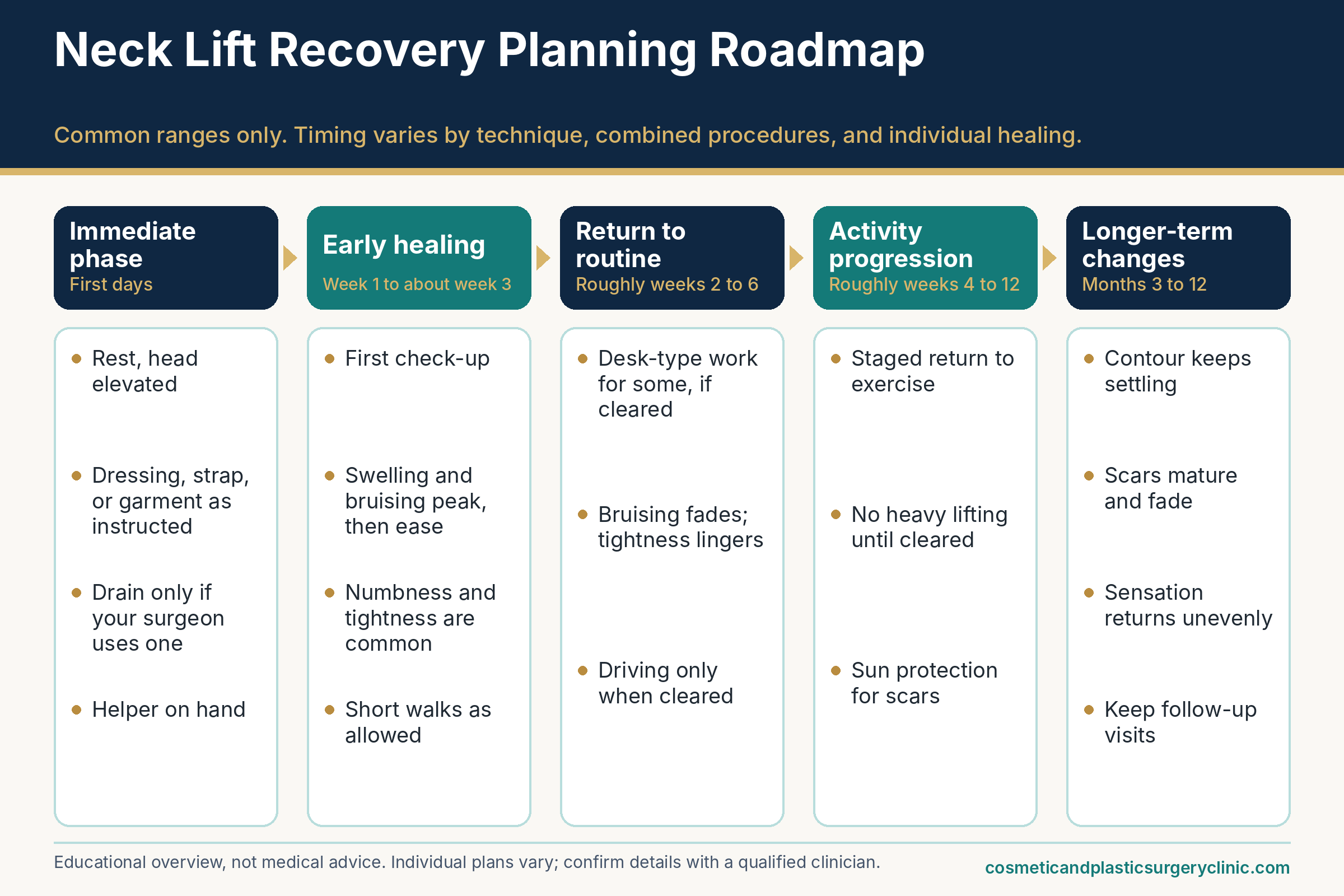
The phases below follow the framework most surgical teams use when they talk through neck lift recovery time: the first 24 to 72 hours, the first week, weeks two and three, weeks four to six, and then months two through twelve. The boundaries are soft. Someone who had a standalone neck lift with a small incision plan may feel ready for a coffee run on day nine, while someone who had a combined facelift and neck lift may still be planning to stay home at week three. Both can be completely normal.
Public sources that give precise day counts are mostly about facelift rather than neck lift specifically. MedlinePlus, for example, describes swelling and bruising after a facelift lasting 10 to 14 days or longer, with the face looking normal by roughly four to six weeks (MedlinePlus facelift entry). ASPS, for its part, declines to give neck lift day counts at all and tells patients to settle bandage removal, suture removal, driving, and exercise timing with their own surgeon (ASPS neck lift recovery page). The ranges here borrow from those cautious frames and from general surgical convention, and they are labeled as ranges for that reason.
The First Week
The first seven days are the most instruction-heavy stretch of neck lift recovery. Most of what surgeons ask of you in this window is about protecting the surgical site, watching for early problems, and letting swelling start to drain.
The first 24 to 72 hours
Depending on the plan and the facility, you may go home the same day or after a short observation period, groggy from anesthesia and wearing whatever dressing your surgeon uses. ASPS says a bandage may be placed around the face and neck to limit swelling and bruising, and that a drainage tube may be present to carry off excess blood or fluid. You will typically be told to keep your head elevated above heart level and to keep your head straight, without much twisting or bending (ASPS neck lift recovery page).
These first days tend to feel more like fatigue and tightness than sharp pain. Many people describe the neck as feeling stiff, as if wearing a snug collar, with sensation changes that can be confusing: some patches feel numb, others feel tender or tingly. Appetite can be low. Nausea from anesthesia or from pain medication is common enough that surgeons often plan around it with instructions on eating light foods and staying hydrated.
This is also the window when swelling is rising rather than falling. Swelling commonly keeps building for a day or two before it levels off, which surprises people who expected to look better each morning. A bruise that starts under the chin can migrate downward toward the chest over several days because gravity moves the blood-stained fluid; that spreading is a common reason for alarm that is often benign, but you should still mention it when you call or at your first visit. Judging benign from concerning is exactly what your team is for, and a quick call costs far less than a missed problem.
Rest does not mean lying flat. Walking around the house for short stretches is typically encouraged, in part because movement supports circulation. The Centers for Disease Control and Prevention (CDC) notes that moving around after surgery helps prevent blood clots (CDC blood clot signs and symptoms). Your written instructions will say how much walking is right for you.
Days 4 to 7: first check-up, dressing changes, and drains
Somewhere in the first several days, you will usually see the surgical team for a check. MedlinePlus describes drains after facelift being removed within one to two days and bandages coming off within one to five days (MedlinePlus facelift entry). Neck lift protocols can differ, and some surgeons use no drains at all. A 2025 randomized trial of deep plane facelift patients, for example, compared surgical drains with a hemostatic net and found comparable fluid-collection and swelling outcomes, with drains and net sutures both removed at about 48 hours in that study (Springer-hosted trial report, 2025). That study was in women having deep plane facelifts, so treat it as a window into how the field thinks about drains, not as a neck lift rule.
At the first check-up, the team typically looks at skin color and tension, asks about sensation and pain, and may remove the drain or dressing. You may see your neck uncovered for the first time since surgery. Many people react strongly to the sight: yellow-green bruising, swelling that blurs the jawline, and a tight, pulled look. That is a very common emotional beat, and it is worth planning for. Knowing that the unwrapped neck in week one is not the final result can prevent a lot of unnecessary worry.
StatPearls, an NIH-hosted clinical reference, lists suture or staple removal around day seven after facelift surgery as a typical timing (StatPearls cervicofacial rhytidectomy review, updated March 2026). Again, closure type varies; if your sutures dissolve, this visit may be about inspection instead of removal.
By the end of week one, the pattern you hope to see is one of gradual, not necessarily steady, improvement: pain easing, sleeping a little better, bruise colors shifting from purple toward yellow. If instead you see a rapid, one-sided swelling, worsening pain, or trouble breathing or swallowing, that is the moment to contact the surgical team or seek emergency care; the safety section lays out those signs in detail.
Weeks 2 Through 12 and Beyond
After the first week, recovery shifts from a medical-supervision phase to a return-to-life phase. The questions change from “is this normal” to “what can I do now” and “when will this look the way I want.”
Weeks 2 to 6: returning to routine, visible improvement, and lingering tightness
Weeks two and three are where many people notice the biggest day-to-day change. Bruising typically fades toward yellow or becomes concealable, swelling shrinks enough that the jawline starts to show, and daily tasks feel less effortful. The MedlinePlus facelift entry frames swelling and bruising as lasting about 10 to 14 days or longer. For a neck lift, plan for the possibility that some swelling lingers beyond that, especially under the chin and along the sides of the neck.
Many surgeons let patients return to desk-type work and light household activity during this window, while holding back heavy lifting, vigorous exercise, and anything that strains the neck. StatPearls describes avoiding heavy lifting and strenuous exercise for four to six weeks after facelift surgery. Your surgeon may set a different schedule for your plan, but the four-to-six-week figure gives a fair sense of the general order of magnitude.
Weeks four through six are often described as the “mostly presentable” stage. By this point, MedlinePlus notes, the face looks normal to many facelift patients (four to six weeks). Neck-specific symptoms, however, often outlast the facial ones: tightness when looking up, a stiff feeling at the end of the day, and patchy numbness behind the ears and under the chin are frequently reported. These tend to feel more noticeable when you are tired.
The practical lesson of this phase is pacing. Feeling better invites overdoing it, and the day after a long outing often brings extra puffiness. Treat weeks two to six as a staged return, adding one new demand at a time, rather than flipping a switch.
Months 2 to 12: settling, softening, and the long tail
From about the second month on, the changes are quieter. Swelling that was visible in the mirror becomes something you feel more than see: a bit of firmness along the incision lines, a neck that looks slightly different in the morning than in the evening, a jawline that sharpens gradually. Surgeons commonly describe a continuing refinement over several months, with the incisions maturing over a year or more.
Sensation tends to recover on its own schedule. MedlinePlus notes that numbness after facelift generally resolves within months, though that is a general statement rather than a promise for any one person. Some patients notice itching, tingling, or “zinging” sensations as nerves wake up, which can be unsettling but is a common part of the later phase. Tell your surgeon at follow-up visits if sensations are changing in unexpected ways or becoming painful.
The third to twelfth month is also when most revision conversations happen, if they are going to happen at all. Surgeons usually advise waiting until swelling and scars have matured before judging the result, since early assessments can mislead in either direction. Problems that can lead to revision are covered in the safety section, and a separate section below covers how to tell when results look settled.
| Phase (common range) | What people often experience | Planning focus | Ask your surgeon |
|---|---|---|---|
| First 24 to 72 hours | Grogginess, tightness, rising swelling, dressing or strap in place, possible drain | Rest with head elevated; helper at home; medication schedule | Which symptoms mean I should call at any hour? |
| Days 4 to 7 | Peak bruising color change, first check-up, dressing or drain changes | Transport to the visit; wound-care routine | When do the dressing, drain, and sutures come out? |
| Weeks 2 to 3 | Visible easing of bruising, daily routine becomes easier, tightness persists | Light return to work for some jobs; no heavy lifting | What can I add each week? |
| Weeks 4 to 6 | More social comfort for many; neck feels stiff late in day; scars still pink or red | Staged return to exercise as cleared; sun protection | When can I resume specific workouts? |
| Months 2 to 3 | Residual swelling and firmness; sensation changes gradually shift | Normal routines; keep follow-up visits | What is expected at this stage versus a concern? |
| Months 3 to 12 | Contour settles; scars mature and fade for many people | Scar care as advised; judge results later rather than sooner | When is the result considered settled for my plan? |
What Neck Lift Recovery Feels and Looks Like: Symptoms, Dressings, and Comfort
Timelines describe when things happen. This section describes what the things actually are: the swelling, bruising, odd sensations, and gear you will live with, and how surgeons commonly manage them. It is general education. The specifics of your dressing, drain, and positioning plan come from your surgeon, and where this article and your instructions differ, follow your instructions.
Swelling, Bruising, Numbness, Tightness, and Neck Cords
These five are the symptoms most people mean when they ask what neck lift healing is like. They overlap, they change from day to day, and they do not all follow the same schedule.
Swelling and bruising: why the neck holds on to fluid
Swelling (edema) is the body’s response to tissue being cut, stretched, and repositioned. The neck is a particularly stubborn place for it: you move it all day, every swallow and sentence flexes the healing tissue, and gravity pulls fluid toward the neck whenever you are upright. Those everyday realities help explain why neck swelling can seem slow to clear even when the face looks fine.
Bruising (ecchymosis) is blood that has leaked into tissue, and it follows predictable color changes: dark red or purple at first, then green, then yellow-brown as the body clears the pigment. It can extend well beyond the incisions. Bruising on the jawline, behind the ears, and down toward the collarbones is within the expected range for many people. Because it can travel, a bruise that shows up in a new spot a few days after surgery is not by itself a warning sign, though it is worth mentioning.
Several things commonly make swelling look worse: staying upright and active for long stretches, salty meals, and bending forward. Several things commonly help: keeping your head elevated as your surgeon directs, avoiding bending and straining, and following any lymphatic or compression guidance your surgeon gives. ASPS adds one point that is easy to miss and worth emphasizing: its neck lift recovery guidance says not to apply ice to the neck, because it can compromise blood flow and cause tissue damage (ASPS neck lift recovery page). Some general facelift references mention cold compresses, so you may see conflicting advice online. The rule of thumb is simple: do not use ice or cold packs on your neck unless your surgeon specifically tells you to, and ask how they want you to handle cold on the face.
Swelling that behaves in ways your instructions did not describe is always worth a call, and it is the subject of the safety section later in this guide.
Numbness, tightness, cords, and the “pulling” feeling
Sensory nerves in the skin are cut when skin is separated from deeper tissue, so numbness is expected. ASPS lists numbness or altered sensation among the recognized neck lift risks, and MedlinePlus says some numbness after facelift is normal and generally resolves over months. Typical areas are the earlobes, the skin behind the ears, and the under-chin and side-neck zones. Sensation commonly returns unevenly: tingling, itching, or sudden “zaps” are often signs of nerves recovering, not new damage.
Tightness comes from several sources at once: swollen tissue, healing incisions, and the platysma itself if it was tightened. Many surgeons describe a stretch of weeks in which the neck feels less flexible than before. Gentle range-of-motion work may be allowed at some point, but only when your surgeon says so, because stretching a fresh closure too early can stress it.
Neck cords deserve their own mention because they appear in two different ways. Existing platysmal bands that bothered you before surgery are what the operation aims to address. In recovery, however, temporary tight-feeling cords can show up as swelling shifts, and some people notice them most when turning their head or tightening the neck while speaking. A 2024 systematic review pooling 12 studies and 2,106 neck lift patients reported platysma band recurrence in 1.4% of patients, a hematoma rate of 1.8%, and nerve damage in 0.9%, with the authors cautioning that outcome reporting varied across studies and that the underlying evidence was level III (Thieme systematic review and pooled analysis, 2024). Those pooled numbers describe groups of patients in published studies, not an individual’s chance, and they cannot be mapped onto one person.
The takeaway for planning: expect your neck to feel odd for longer than your face looks odd. That mismatch is one of the most commonly reported frustrations and one reason follow-up visits matter. A surgeon who sees you at several time points can tell expected tightening from a problem.
Dressings, Drains, Positioning, and Pain Planning
This is the hardware-and-habits side of neck lift recovery: what you wear, what is attached to you, how you sleep, and how you manage discomfort. Protocols differ among surgeons, which is why it helps to ask specific questions before surgery.
Dressings, chin straps, compression garments, and drains
ASPS says a bandage may be placed around the face and neck to minimize swelling and bruising, and a drainage tube may be used to remove excess blood or fluid. Beyond that general statement, practices vary. Some surgeons use a wraparound head dressing for a day or two and then switch to an elastic chin strap or neck garment for a set number of days, sometimes worn mainly at night after the first stretch. Others use lighter dressings. A neck garment is not decoration: its job is to provide even, gentle support so that skin settles against the underlying tissue rather than pooling fluid.
Drains, when used, are usually thin tubes that exit near the incision and connect to a small bulb or reservoir. Your job is typically to empty and record the output, keep the tubing from tugging, and call if the amount or color changes in ways your instructions flag. Not every neck lift involves a drain, and a drain is not a sign that something went wrong. If you want a full explanation of how drains work across procedures, see the guide to surgical drains after plastic surgery.
A fit problem is common with garments: too loose and it does nothing, too tight and it can press on skin or the airway. If a strap or garment feels like it is tightening your throat, causing numbness in your lips, or leaving a deep groove, contact your surgical team the same day rather than adjusting it on your own. Also ask what to do about showering: some teams want you to avoid wetting dressings for the first days, others permit gentle washing sooner.
Questions worth asking at the pre-op visit: What will be on my neck when I wake up? How many days do I wear a strap or garment, and does that include sleeping? Will I have a drain, and who removes it? Which parts of the dressing can I touch or change myself?
Head elevation, sleeping position, and pain-medication planning
Raising your head above the level of your heart is the most consistent instruction in neck lift aftercare. ASPS says to keep the head elevated above the heart to limit swelling and to keep it straight, without excessive twisting or bending. MedlinePlus, speaking about facelift, describes propping the head on two or three pillows for several days, and StatPearls lists head elevation for one to two weeks. Different sources, different durations, which is one more reason to rely on your own surgeon’s number.
In practice this means sleeping on your back with your upper body angled, often using a wedge pillow or stacked pillows, or a recliner for the first nights. Side sleeping is usually discouraged early because it presses on one side of the neck, can cause neck twisting, and can shift dressings. Many people find the first few nights of semi-upright sleeping the hardest part of recovery: back strain, restless sleep, and the sense of being locked in place. A travel pillow can keep your head from rolling sideways, and setting up the recliner or bed wedge before surgery day saves a scramble later.
Pain after neck lift is often described as moderate soreness and tightness rather than sharp pain, though experiences vary widely and nobody can promise you a pain level. The planning questions are about logistics: which pain medications will be prescribed, which over-the-counter products are allowed or off-limits, how to space them around meals, whether to expect constipation or drowsiness, and who to call if pain is not controlled. MedlinePlus notes that blood-thinning products such as aspirin, ibuprofen, and vitamin E are commonly addressed before a facelift, so ask your team to put your medication and supplement rules in writing, including what to avoid after surgery as well as before it.
Do not self-adjust. Increasing, combining, or stopping medications without your surgeon’s guidance can cause problems, and pain that is escalating or not responding to the prescribed plan is itself a reason to call.
Planning Work, Driving, Exercise, Travel, and Daily Life Around Healing
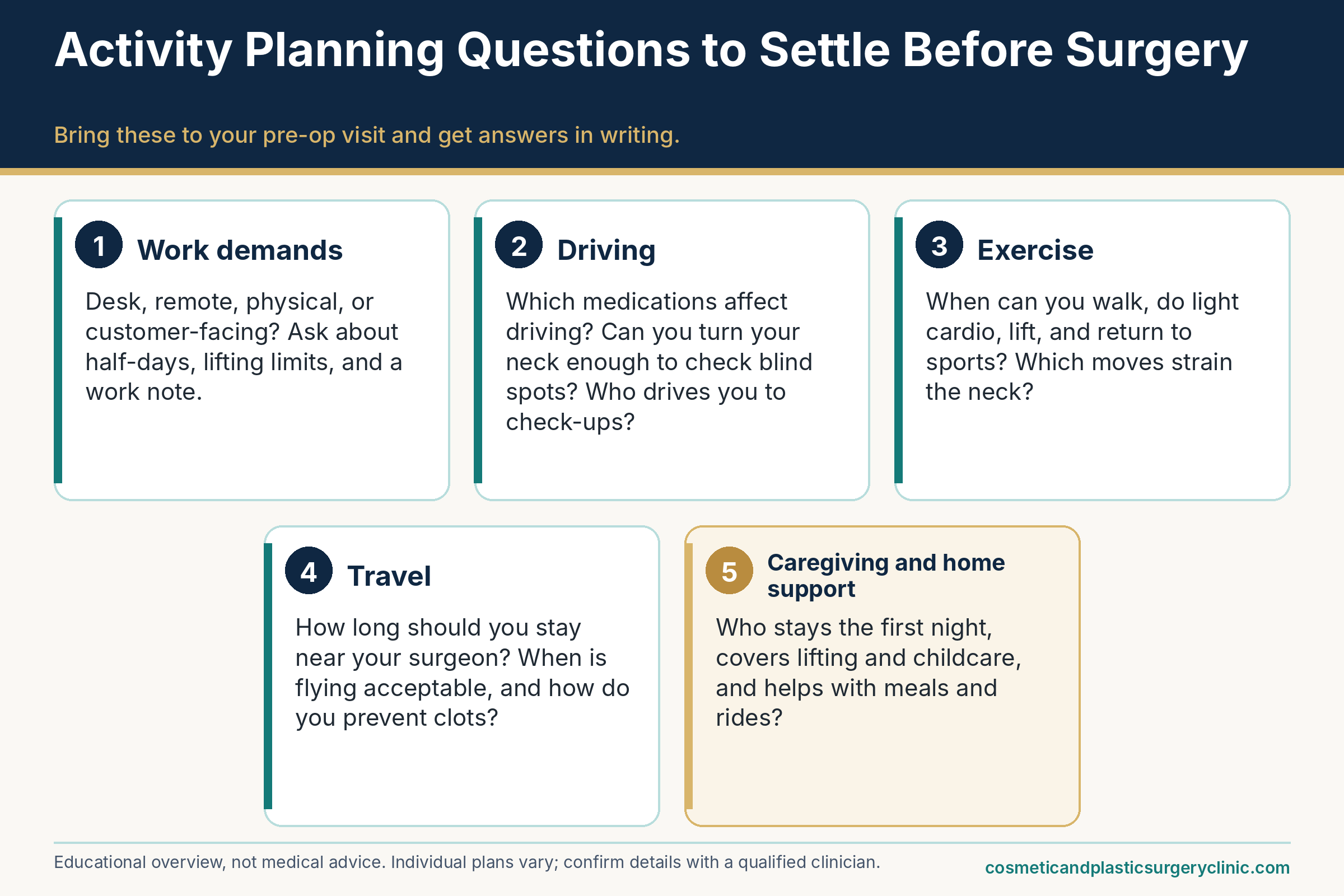
A recovery timeline is only useful if you can translate it into your own calendar. That means sorting your life into categories (job, driving, exercise, travel, intimacy, grooming, sun exposure) and getting an answer from your surgeon for each one. Nothing here clears you for anything. The point is to arrive at the pre-op visit with the right questions already written down.
ASPS frames it the same way. Its neck lift recovery page lists the items to settle with your surgeon: medications, when the bandage comes off, when sutures come out, when you may drive, when normal activity and exercise can resume, and when follow-up visits happen (ASPS neck lift recovery page). Its facelift recovery page adds face washing, makeup, and hair treatments to the list (ASPS facelift recovery page).
Work, Driving, and Exercise
These three are the activities that most often decide how long you are effectively out of circulation. They also happen to be the three where a one-size answer is least useful.
Work demands and getting behind the wheel
Think about your job in terms of what it demands from your neck and from your appearance, not just its title. A remote desk job needs focus and comfortable sitting, and it may allow you to keep your camera off during video calls. A customer-facing role raises the question of how you look in week two. A job with lifting, bending, or overhead work asks your neck and upper body to do exactly what surgeons usually restrict. A role involving long driving, machinery, or safety-sensitive decisions adds the problem of pain medications and restricted neck rotation.
Many surgeons allow desk-type work to resume sooner than physical work, and the commonly described window for light office tasks starts around the end of the first week or into the second or third week. Treat that as a conversation starter, not an entitlement. Brain fog from anesthesia and prescription medication, fatigue, and the discomfort of sitting with limited neck movement can make full days at a desk harder than expected. Some people ease back with half-days or flexible hours; if your employer permits that, it can shape your plan more than the calendar does. The page on returning to work after a neck lift goes through job categories in more detail.
Driving is separate from working. The usual logic runs along three lines: you should not drive while taking medication that causes drowsiness, you need enough neck rotation to check blind spots without a struggle, and you need to be able to react quickly without pulling on fresh incisions. ASPS lists “when can I drive” as a question for your surgeon rather than giving a number. Plan for someone else to drive you home and to your first check-up, and have a backup for the days after. If you are in a profession where license, insurance, or safety rules matter, ask for written guidance.
A realistic way to plan: write down your three most important work obligations in the first month, then ask the surgical team whether each is plausible at one week, two weeks, and four weeks. That specificity gets better answers than “when can I go back to work?”
Exercise, lifting, and neck strain
Exercise restrictions after neck lift tend to be stricter than people expect, and the reasons are mechanical. Anything that raises blood pressure or heart rate sharply can increase bleeding risk at a fresh surgical site, and anything that strains the neck or jaw tugs on closures. StatPearls describes avoiding heavy lifting and strenuous exercise for four to six weeks after facelift surgery, and its review identifies hypertension as the primary risk factor for postoperative hematoma (StatPearls cervicofacial rhytidectomy review). An ASPS scar-care article similarly mentions limiting lifting to under ten pounds for the first six weeks after surgery, as a general scar-tension principle rather than a neck lift protocol (ASPS scar tips).
Those are different sources describing different operations, and they land in a similar neighborhood: weeks, not days, before strenuous exercise is on the table. Walking comes first in most plans. Light cardio, lower-body work, and heavy lifting then come back in stages that your surgeon defines. Exercises that put the head below the heart, such as yoga inversions, or that load the neck, such as heavy overhead presses and some swimming strokes, are common items to ask about specifically.
Another trap is the “feel good” stretch. Around weeks three and four, plenty of people feel strong enough to return to a full workout, and the swelling that creeps back that evening is a fair sign the body was not asked yet. The detailed question list for the later stages lives in the guide to exercise after neck lift.
If you wear a posture-heavy or gear-heavy kit for sport, such as a helmet, a chin-strap, or a snug collar, add that to your question list. The contact points matter for incisions behind the ears and under the chin.
Travel, Intimacy, Hair, Makeup, and Sun
The remaining categories tend to get less attention in consultations, then turn into practical headaches in week two.
Travel, flying, and intimacy
Travel questions break down into two parts: the first few days after surgery, when you probably want to be within easy reach of your surgical team, and later, when it is mostly about comfort, swelling, and clot prevention. Staying near your surgeon for the first stretch, however long they specify, is a common request, particularly if you are coming from out of town. Flying, in particular, brings pressure changes, long sitting periods, and the CDC’s guidance that moving around after surgery helps lower clot risk; ask your surgeon when flying is acceptable and what to do about movement and hydration en route (CDC blood clot information). There is a separate guide to travel after neck lift covering flying, driving, and trip planning in more depth.
Other practical points: pack the garment, extra supplies, and the prescription list in your carry-on; leave buffer days for delays; and check the facility’s after-hours contact before leaving town. Surgery far from home also complicates follow-up care, so settle who will see you for check-ups and for problems before you book travel.
Intimacy is a category people hesitate to raise. The relevant concerns are the same as for exercise: raised heart rate and blood pressure, pressure on the neck and head, and positioning. Surgeons usually address it under general activity restrictions. Asking directly is entirely routine; they have heard the question before.
Hair coloring, makeup, and sun protection
Incisions behind the ears and along the hairline sit right where hair products land. ASPS lists hair treatments, face washing, and makeup among the items to clear with your surgeon after facelift, and similar questions apply to the neck. Chemical dyes, bleach, and perms near healing incisions raise concerns about irritation and wound care, so many people schedule color appointments before surgery and again after clearance. Washing hair gently, drying with low heat, and handling the ear region carefully are typical early instructions, but yours may differ.
Makeup is similarly a “when cleared” item. Concealer on bruised skin is a common wish at the two-week mark, but products on or near incision lines may be restricted until the skin has sealed. Ask whether mineral powders or particular brands are acceptable, and how to remove them without rubbing.
Sun protection is not optional later. The American Academy of Dermatology advises broad-spectrum sunscreen with SPF 30 or higher on scars (AAD scar treatment overview), and ASPS articles suggest more cautious ranges, such as keeping new scars out of direct sun for months and favoring a mineral sunscreen of SPF 50 or higher once cleared (ASPS scar healing article). Because incisions behind the ears and under the chin are often exposed, hats, scarves, and shade matter. Ask your surgeon when sunscreen can be applied near incisions, because the first few weeks may call for covering rather than applying anything.
| Category | Why it matters in neck lift recovery | What to ask or bring | Planning note |
|---|---|---|---|
| Desk or remote work | Fatigue, medication effects, neck stiffness, and visible bruising on video | Job description; meeting schedule; whether half-days are possible | Build a buffer; do not schedule major deadlines in the first weeks |
| Physical or customer-facing work | Lifting strains the neck; appearance matters in week two | Tasks involving lifting, bending, overhead work; dress code | Ask about phased duties or leave documentation |
| Driving | Sedating medications and limited neck rotation | Medication list; vehicle type; commute length | Arrange rides for the first check-up |
| Exercise and lifting | Blood pressure spikes and neck strain at fresh closures | Typical workout routine; sports gear | Walking usually comes before anything strenuous |
| Flying and travel | Clot prevention, swelling, distance from your surgical team | Itinerary; time zone; how to reach the team while away | Avoid scheduling trips early in recovery unless cleared |
| Hair coloring, makeup, and washing | Products near healing incisions | Product list; salon schedule | Book color before surgery or after clearance |
| Sun exposure and scars | Fresh scars can darken or widen with UV exposure | Sunscreen type; hats and coverage plan | Plan shade and clothing for outdoor events |
Home Planning, the Recovery Calendar, and Social Events
Good recovery planning is unglamorous. It is mostly about removing small frictions before they pile up on a day when your neck is sore and your patience is short. This section turns the general phases into a home setup and a calendar you can fill in, then deals with the question many people care about most: what to do about weddings, reunions, holidays, and other dates that do not move.
Setting Up Your Home and Your Support Team
People often underestimate the support side of recovery because the surgery itself gets all the attention. The first several days involve restrictions on bending, lifting, driving, and sleeping flat, which means ordinary tasks need a plan.
The helper, the meals, and the pillow setup
Many surgeons ask that a responsible adult stay with you for the first night, and sometimes longer, especially if you had sedation or general anesthesia. Beyond the safety reason, there is a practical one: someone needs to drive, fetch medication, handle the drain log if there is a drain, notice changes, and make a call if something looks wrong. Choose that person early, give them a copy of your discharge instructions and the surgical team’s phone number, and make sure they know what the red-flag signs are (the safety section below lists them).
Meals are the next friction point. Chewing and wide yawning can pull on neck and jaw tissue, and some people have a sore throat from anesthesia, so soft foods are common in the first days. Stocking easy options before surgery (soups, yogurt, eggs, smoothies, pasta, protein-forward items that need little cutting) removes decision-making when you are tired. Ask whether your plan includes any dietary guidance, and whether there are foods or supplements to avoid. Hydration matters, and drinking from a cup with a straw can be easier than tilting your head back, although some surgeons prefer you avoid certain motions, so ask first.
Then the pillows. A wedge pillow that lifts the whole upper body usually works better than stacking pillows that slide, and a recliner or an adjustable bed can be a lifesaver. Think about where your head will rest, how you will get in and out of bed without using your neck muscles, and where you will keep the items you need within reach: water, tissues, medication list, phone charger, the surgical team’s number, and a notepad for symptoms and questions. A small mirror and a good flashlight help you check the incisions and drains if your team has asked you to.
A few additional supplies appear on many surgeons’ lists: button-front or zip-front tops so that you do not pull clothes over your head, a soft scarf or turtleneck-free wardrobe that does not press on the chin strap, dry shampoo or a plan for hair washing, and extra gauze or supplies if your team recommends them. If you have pets or children, plan who handles lifting, bending, and unpredictable tugs. A dog on a leash can strain a neck in one instant; a toddler who wants to be picked up is a real weight problem in the first weeks.
Caregiving duties, work notes, and paperwork
If you care for children, an older relative, or anyone else, caregiving is the largest hidden variable in neck lift recovery. Lifting a child, helping someone out of a chair, or lifting a wheelchair into a car all load the neck and shoulders. The honest planning approach is to list every physical caregiving task in a typical week, then ask your surgeon which ones are off-limits during which phase, and to arrange substitutes. Some people ask a family member to move in for a week or two, trade shifts with a partner, or use temporary paid help. These arrangements work best when they are set up weeks ahead rather than negotiated from the couch.
Work paperwork is the other piece. Employers vary in what they require, and a few things are helpful to ask the surgeon’s office about in advance: whether they provide a work note, what the note will say (you may prefer it not to name the procedure), how far in advance to submit forms, and whether short-term disability or family leave applies to elective surgery in your situation. Insurance and leave policies differ by employer and by state, so verify with your own human resources department rather than assuming. If you are self-employed, think about client deadlines, availability for calls, and whether anyone can cover urgent tasks.
Finally, plan the logistics of the surgery day: arrival time, who drives, the fasting instructions your team gives you, the clothing you will wear home, and where your prescriptions will be picked up. Many people ask a friend to fill prescriptions before surgery day when possible, so that nothing is delayed after anesthesia. These steps are not medical advice, just ordinary sequencing; your team’s checklist overrides mine.
Building the Recovery Calendar and Handling Social Events
A calendar converts ranges into a plan you can adjust. Use the worksheet below as a conversation tool: fill in column two with your surgeon’s actual guidance, and keep column three for your own plans.
A recovery calendar worksheet you can adapt
Begin with the date that cannot move. If you have a wedding, graduation, milestone birthday, or work event on the calendar, mark it first and count backward. Many surgeons advise not scheduling elective surgery close to a major event, partly because swelling, bruising, and numbness are unpredictable and partly because a revision or complication would collide with the date. Everything else is flexible around that anchor.
The worksheet below covers the usual checkpoints. Column one lists the phase, column two the question to settle with your surgeon, and column three is left for your own date and notes. Fill it in at the pre-op appointment and revisit it at each follow-up visit; recovery rarely goes exactly to plan, and an updated version is more useful than the first draft.
| Checkpoint | Question for your surgeon | Your date or answer | Who helps |
|---|---|---|---|
| Surgery day | Arrival time, fasting rules, who stays overnight? | Write in | Driver and overnight helper |
| First 72 hours | Head position, dressing care, drain care, medication schedule? | Write in | Helper handles meals and reminders |
| First check-up | When is it, and when do dressings, drain, and sutures come out? | Write in | Driver to appointment |
| End of week 1 | What changes: showering, hair washing, sleeping position? | Write in | Helper on call |
| Return to desk work | Earliest realistic date and a plan for half-days? | Write in | Employer or manager |
| Driving | When, and what must I be off first? | Write in | Backup rides until cleared |
| Walking and light exercise | What is allowed each week? | Write in | Self-paced, as cleared |
| Strenuous exercise and lifting | What is the earliest clearance and how do I restart? | Write in | Trainer, if you use one |
| Social events | When can I plan to be photographed? | Write in | Stylist or friend for makeup help |
| Follow-up visits | Which visits are scheduled at which stages? | Write in | Driver as needed |
One more tip: set phone reminders for medication, garment-wearing schedules, and appointments. Anesthesia, pain medication, and sleep disruption make memory unreliable in the first days, and your helper can then check the calendar rather than rely on recall.
Planning around weddings, photos, and other social events
The question “when will I look presentable?” has two answers because there are two kinds of downtime. Physical downtime is about what your body should and should not do. Social downtime is about when you feel comfortable being seen. They rarely line up. Someone can be physically cleared for desk work in the second week and still prefer to avoid face-to-face meetings until bruising is concealable. Someone else can look very good by week four and yet not be allowed to lift anything heavy.
For many facelift patients, MedlinePlus suggests the face looks normal in about four to six weeks. For a neck lift, a rough planning range of several weeks before you feel comfortable in close-up photographs is reasonable, with the caveat that swelling, tightness, and scar redness can persist. Build in a margin on top of that, because a result that is still settling is not the result you want in a professional photo or on a wedding video.
A practical rule is to work backward from the event and ask your surgeon how much lead time they suggest, then add a buffer. For events that matter greatly, some people choose to schedule surgery several months ahead of the date. Others decide to postpone surgery until after the event, because the best protection against disappointing photographs is simply not having surgery near the date.
For smaller social exposure, plan the logistics. Think about clothing that hides a garment line, scarves that do not press on the neck, hairstyles that cover postauricular incisions without pulling on them, and sunglasses or hats if cleared. Know your talking points: some people are comfortable saying they had surgery; others prefer a simple “I had a minor procedure and am healing.” Either is fine. Privacy is a personal choice, and being prepared to answer the question gracefully relieves a lot of stress.
Finally, do not use this planning to rush yourself. Pressure to look presentable on a deadline is one of the stronger reasons recovery goes sideways: people start exercising too early, skip rest, or resume activities against their instructions. If the date is more important than the surgery, move the surgery.
Safety During Recovery: Red Flags, Nerve Weakness, and Nicotine
Most neck lift recoveries are uncomplicated in the sense that the problems patients meet are the expected ones: swelling, bruising, tightness, numbness, fatigue. Still, a small minority of patients develop complications, and some complications are time-sensitive. This section is about recognizing the difference between a normal bad day and a symptom that needs a prompt call. It is general education, not triage advice for you personally. If you are worried about anything, contact your surgical team. If you cannot reach them and the symptom is severe, or if you have trouble breathing, seek emergency care.
For a full catalogue of what can go wrong and how often, the dedicated guide to neck lift risks and complications goes deeper. ASPS lists the recognized risks of neck lift as including anesthesia risks, bleeding, facial asymmetry, hematoma, infection, numbness, persistent pain, poor wound healing, prolonged swelling, rare nerve injury causing lower-lip weakness, rare deep venous thrombosis, skin irregularities or loss, sutures that surface through the skin, hair loss along incisions, and unfavorable scarring that may need revision (ASPS neck lift safety page).
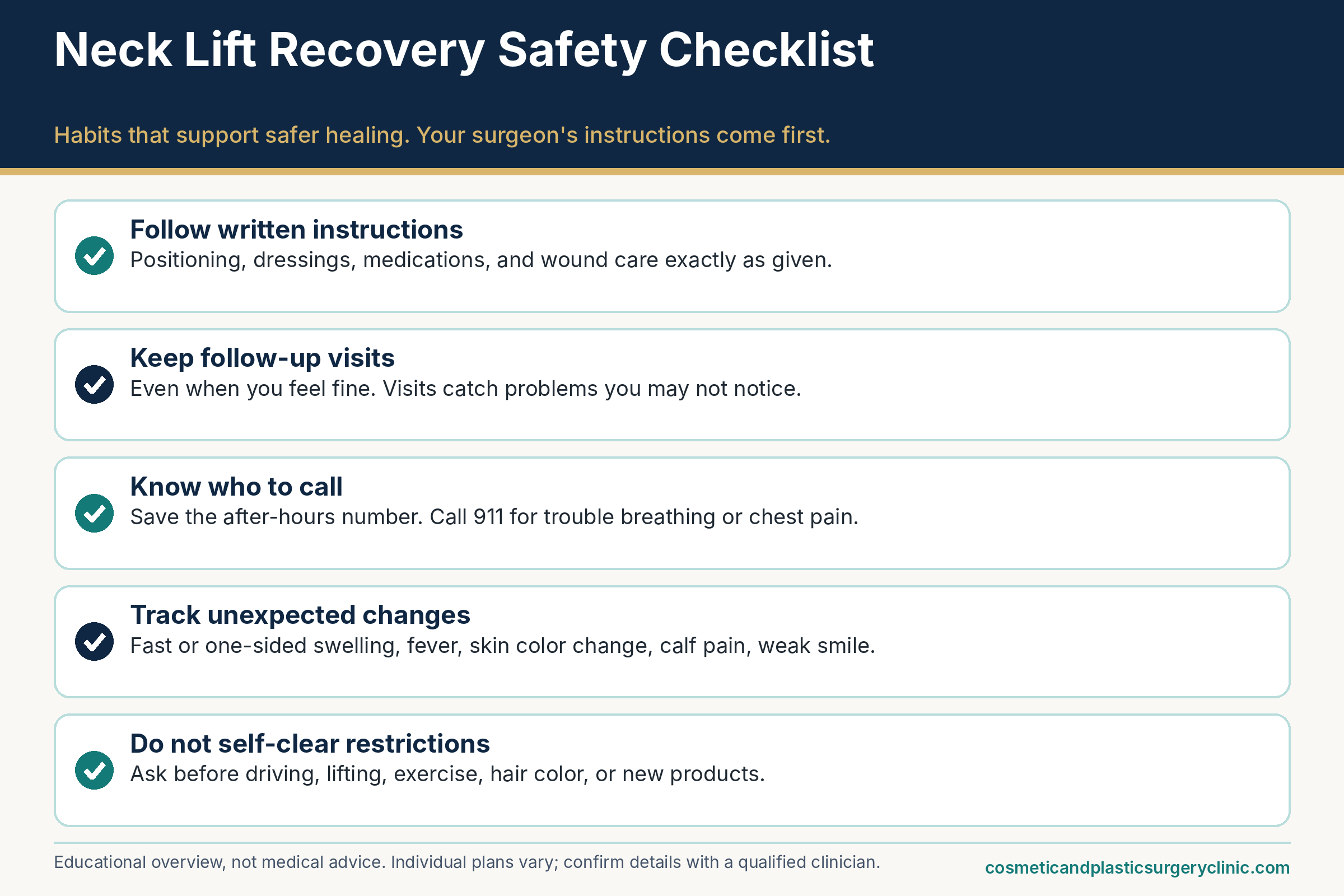
Symptoms That Warrant Prompt Contact
The big idea is to separate three tiers: things worth mentioning at your next visit, things worth calling about the same day, and things that call for emergency care. Your own written instructions should assign specific symptoms to each tier, and they take priority over the lists below.
Rapid swelling, hematoma, and breathing or swallowing difficulty
A hematoma is a collection of blood under the skin in the surgical area. It is the complication most closely associated with early neck and face lifts, and it is the one surgeons most want patients to report quickly. Reported rates vary widely depending on the operation and the study. StatPearls gives a range of 0.2% to 8% for facelift surgery and names hypertension as the main risk factor (StatPearls cervicofacial rhytidectomy review). A 2024 pooled analysis of neck lift studies reported hematoma in 1.8% of 2,106 patients (Thieme systematic review, 2024). A 2025 meta-analysis of 31 deep plane facelift studies covering 8,841 patients found a pooled hematoma rate of 2.7%, with major hematomas in 0.97% (ReachMD summary of the 2025 meta-analysis). These numbers come from different procedures, different definitions, and different populations, so they should not be compared line by line. What they share is a message: hematoma is uncommon but recognized, and it is the reason the first days of recovery are watched closely.
What might hematoma look or feel like? Typical descriptions include swelling that is increasing quickly, often more on one side than the other; a neck or cheek that feels tight, hard, or tense rather than merely puffy; pain that is growing rather than easing; and sometimes dark discoloration over the area. In a plan with a drain, a sudden change in output can be another clue. None of these on its own proves a hematoma, and some are also seen in ordinary swelling. The point is that fast change, one-sided swelling, and worsening pain are the pattern that surgeons ask patients to report immediately, at any hour.
Difficulty breathing or swallowing is different in kind. It is an emergency in any context after neck surgery, because swelling in the neck can affect the airway. If you experience trouble breathing, noisy breathing, a feeling that your throat is closing, or inability to swallow your saliva, call 911 or your local emergency number rather than driving yourself, and then notify the surgical team. This is not the moment for waiting to see whether it passes.
It also helps to know your surgeon’s own rules about timing. Surgeons generally watch most closely in the first day or two, but problems can be reported at any time during recovery, so the instruction to call applies throughout. Keep the after-hours number somewhere easy to find, and put it in your helper’s phone as well.
Infection, skin color changes, clot warning signs, and uncontrolled pain
Infection after neck lift is described as uncommon; StatPearls says it is rare after facelift because of the face’s rich blood supply. Warning signs your team may list include increasing redness spreading from an incision, warmth, swelling that returns after improving, pus or foul-smelling drainage, fever, and pain that worsens after initially improving. The American Academy of Dermatology advises medical care for skin that becomes infected after an injury, but the fever threshold and wound-care instructions for your surgery are the ones your team gives you (AAD wound care guidance). Call the same day if you notice these.
Skin color matters because the skin of the neck relies on a fragile blood supply after it has been lifted. ASPS lists skin discoloration and skin loss among the recognized risks. Dusky, bluish, gray, dark, or unusually pale patches, blisters, or skin that feels cool compared with surrounding areas should be reported promptly. Do not wait for the next scheduled visit. Pressure from a garment that is too tight, ice applied directly to the skin, and nicotine use are among the factors that can aggravate circulation problems, which is one reason your team gives specific instructions about each.
Clot warning signs apply to any surgery under anesthesia. The CDC lists swelling, pain or tenderness, warmth, and redness in a limb as possible deep vein thrombosis symptoms, notes that roughly half of people with DVT have no symptoms, and describes pulmonary embolism signs such as difficulty breathing, a fast or irregular heartbeat, chest pain that is worse with a deep breath or cough, coughing up blood, and lightheadedness or fainting (CDC signs and symptoms of blood clots). New calf or leg swelling with pain should lead to a prompt call. Chest pain, breathing difficulty, or fainting warrants emergency services. ASPS describes deep venous thrombosis after neck lift as rare, and your surgeon may have specific prevention steps such as walking, compression devices, or assessment of your personal risk factors.
Pain that is not controlled by the plan you were given is also a reason to call. So is persistent vomiting that keeps you from taking medication or drinking fluids, a fever your team told you to report, bleeding that soaks through dressings, or any allergic reaction signs such as hives, swelling of the lips or tongue, or wheezing. When in doubt, call; no team will regret hearing from you early.
| Symptom or situation | Often within the expected range | Contact your surgical team promptly | Seek emergency care |
|---|---|---|---|
| Swelling | Puffiness that fluctuates, is worse in the evening, and is fairly even | Fast, increasing, tense, or one-sided swelling; swelling that returns after improving | Swelling with trouble breathing or swallowing |
| Bruising | Color changes and spreading toward the chest or jaw | Rapidly darkening area with new tightness | Bruising with breathing difficulty |
| Pain | Soreness and tightness that improve gradually | Pain that is increasing or not controlled by the plan | Severe pain with chest symptoms or fainting |
| Skin color | Pink or red along incisions; yellow-green bruising | Dusky, gray, dark, blistered, or very pale skin | Rarely an emergency alone; follow team instructions |
| Fever or wound changes | Mild warmth or tenderness along incisions | Spreading redness, pus, foul odor, or fever above your team’s stated limit | Fever with confusion, rapid heartbeat, or severe illness |
| Legs and chest | General fatigue and tiredness after surgery | New calf swelling, pain, warmth, or redness | Chest pain, shortness of breath, coughing blood, fainting |
| Face movement | Stiff smile from swelling that is symmetric | New lower-lip weakness or uneven smile | Facial drooping with other stroke symptoms |
Nerve-Related Weakness and Nicotine: Two Factors Patients Ask About
Two topics deserve their own space because they are widely misunderstood: the facial nerve branch that controls the lower lip, and the effect of nicotine on healing.
Temporary lip or smile weakness: the marginal mandibular nerve
The marginal mandibular nerve is a branch of the facial nerve that runs along the jawline and helps pull the lower lip down and sideways. It is close to the area where neck lift surgeons work. If it is bruised, stretched, or swollen, the lower lip on one side may not move normally: the smile can look lopsided, or the corner of the mouth may seem to droop when talking or showing teeth. ASPS lists a rare nerve injury causing weakness of the lower lip as a recognized risk. MedlinePlus says nerve damage after facelift is usually temporary. StatPearls reports nerve injury in 0.7% to 2.5% of facelifts, with the great auricular nerve (the one that supplies sensation around the ear) injured most often and the marginal mandibular and frontal branches among the common motor nerve injuries. The 2024 neck lift pooled analysis reported nerve damage in 0.9% of 2,106 patients.
The important distinction is between weakness and ordinary swelling. Early on, a stiff or unnatural smile can result from swollen tissue on both sides, without any nerve injury at all. Nerve weakness tends to be asymmetric and may be more obvious when you talk or smile broadly. It is also not painful in itself. If you notice it, tell your surgical team. They can examine you, track it over time, and discuss next steps.
How long does temporary weakness last? This article could not verify a neck-lift-specific timeline from an authoritative source, and timelines differ with the cause and severity, so it does not give a number. Your surgeon is the right person to describe what is expected for your case and when they would reassess. What you can do is document the change, avoid self-testing excessively, and keep follow-up appointments.
Nicotine, wound healing, and skin circulation
Nicotine narrows small blood vessels, and neck lift surgery depends on a reliable blood supply to the skin that has been lifted. MedlinePlus explains that smoking reduces the amount of oxygen reaching surgical wound cells, which slows healing and increases infection risk, and that smokers have a higher likelihood of blood clots after surgery. It also says clinicians commonly ask people to stop at least four weeks before surgery, with ten weeks offering greater protection, and it cautions that nicotine gum still interferes with wound healing (MedlinePlus: smoking and surgery). StatPearls states that in facelift surgery, smokers experienced skin sloughing in 7.5% of cases versus 2.7% in nonsmokers, and it suggests stopping nicotine at least two to four weeks before surgery and staying off it for a month afterward.
Notice that these two sources suggest slightly different windows. That is common; surgeons set their own requirements, and many require complete nicotine abstinence in every form, including vaping, patches, gum, and lozenges, before and after surgery. Some surgeons test for nicotine before operating. If you use nicotine, the kindest and most practical step is to say so at consultation, ask about their rules, and ask about cessation support. A frank conversation costs nothing; hiding nicotine use can raise the risk to your skin. The site has a separate guide on smoking and plastic surgery with more detail.
Scars, When Results Look Settled, and Follow-Up Visits
The last stretch of neck lift recovery is the longest and the least dramatic. Nothing alarming usually happens, and nothing changes overnight. Scars mature, swelling resolves in small increments, sensation returns unevenly, and your surgeon checks in at intervals. People who understand this stage tend to be calmer in it, so this section sets expectations about scars, about when the neck can reasonably be judged, and about what follow-up visits are for.
Scars: Where They Sit, How They Mature, and How to Care for Them
Every incision leaves a scar. A neck lift’s incisions are chosen partly because they are easy to conceal, but concealed does not mean invisible. The neck lift scars guide covers location and care in depth; the essentials follow.
Behind the ear, under the chin: visibility and the maturing timeline
Scars from a traditional neck lift follow the ear and the hairline, which keeps much of the line hidden behind the ear or in hair. An under-chin incision, if used, lies in a natural crease beneath the chin and is usually short. Those placements make them less noticeable than scars in open skin, but they are still scars: early on they look pink or red, may be slightly raised or firm, and feel different from surrounding skin.
ASPS describes three stages of scar healing. In the first two weeks, the priority is keeping incisions covered and undisturbed and following instructions. Over the next several months, up to roughly six, scars commonly look red and feel textured as blood supply remains rich. From about six months to a year, collagen remodels, redness recedes, and scars flatten for most people (ASPS: what to expect as a scar heals). A second ASPS article puts full maturation at about 12 months (ASPS surgery scar tips). Scars sometimes take longer than a year to finish softening and fading, and they vary a great deal between people. Genetics, skin tone, tension on the closure, nicotine, and sun exposure are among the factors surgeons mention.
Also worth knowing: scars can behave unexpectedly. Hypertrophic scars (thick and raised, but staying within the incision) and keloids (growing beyond the original wound) are recognized possibilities. ASPS lists unfavorable scarring among neck lift risks, and its scar-healing article says hypertrophic scars and keloids can be treated with steroid injections or surgical revision. If you have scarred badly in the past, tell your surgeon at consultation, because it can change the plan.
The ear region deserves special attention for one practical reason: incisions there sit under some tension, and it is an area people touch, sleep on, and catch with hair products. Surgeons plan closures to limit pulling, and you can help by following instructions about garments, sleeping position, and sun protection. Tell your surgeon about concerns early rather than late, since some scar treatments are most useful in the first months.
Scar care and sun protection: what authoritative sources say and where they differ
Scar care guidance has a small set of consistent themes and a few differences. The consistent themes are to follow your surgeon’s wound care instructions, keep strain off the closure, avoid smoking and nicotine, and protect the scar from the sun. The differences are in the details: when to start silicone, how long to protect from sun, and which products to use.
The AAD recommends broad-spectrum sunscreen of SPF 30 or higher on scars, notes that silicone gel sheets can reduce the size, hardness, redness, and itch of scars when worn daily for months, and advises seeing a dermatologist to identify the scar type and rule out other skin issues (AAD scar treatment overview). ASPS pieces lean toward a more cautious sun approach: one article advises avoiding direct sun on a new scar for the first six months and using a mineral sunscreen of SPF 50 or higher once appropriate, and another suggests avoiding sun for the first year. A third ASPS item says SPF 30 is a minimum and describes SPF 50 as a sweet spot for surgical patients, with UPF clothing as an alternative (ASPS: protecting surgical scars from the sun).
These pieces differ in timing, but they agree on the direction: sun on a maturing scar can leave it darker, and shade, clothing, and sunscreen reduce that risk. The AAD wound-care article also suggests keeping minor wounds moist with petroleum jelly and covering them, which is general advice for ordinary skin injuries and not a protocol for a surgical incision. Do not apply ointments, oils, silicone, or any scar product to a neck lift incision until your surgeon says it is time.
Scar massage and professional treatments, such as laser or injections, come later, if at all, and typically at your surgeon’s direction. The ASPS scar articles describe silicone and massage as commonly used and some professional options as available after the early phase. Whether you would benefit is individual.
When Results Look Settled and What Follow-Up Visits Are For
Patients ask “when can I see the final result?” more than almost any other recovery question. The honest answer is a range with a fuzzy edge.
When the result looks settled: ranges, not deadlines
Think in three layers. The first is the obvious change, which becomes visible as bruising fades and the worst swelling subsides, in the weeks after surgery. The second is the refined contour, which emerges over the next two to three months as residual swelling shrinks and tissue softens. The third is the fully mature result, in which swelling is gone, scars have faded, sensation has largely recovered, and the neck’s appearance no longer changes week to week. For many surgical patients that third layer takes somewhere in the range of six to twelve months, though some changes continue after that.
The neck can lag behind the face. Swelling under the chin and along the jawline often resolves later than facial swelling, and tightness may linger beyond what the mirror shows. If a surgeon reviews the neck at two months, they may well be judging a neck still in transition. That is one reason many surgeons wait for a period before discussing touch-ups or revision, and why a request for a revision at week three is typically met with “let’s wait.”
Also be realistic about the baseline. A neck lift is described by ASPS as restorative: it does not change your fundamental appearance and cannot stop the aging process. Your neck will continue to age after surgery, at a rate that varies with genetics, skin quality, sun exposure, weight changes, and other factors. Longevity and realistic expectations are a separate topic from recovery, and worth raising at consultation.
A word about comparisons. It is natural to compare your week-six neck to photographs of other people, and to online posts from patients who seem to have healed faster. Social posts and clinic photographs are not reliable timelines for you. They often show best-case lighting, selective timing, and hand-picked examples, and they cannot show your anatomy or your instructions. A healthier approach is to take your own photographs in the same lighting and pose at consistent intervals (for example, weekly for the first month and monthly after), then compare yourself to yourself.
Follow-up visits: what they check and how to use them
Follow-up visits are part of the operation, not an add-on. A typical schedule includes a visit within the first week or so, others in the first month, and then spaced visits over several months, sometimes up to a year. The exact schedule is the surgeon’s, and it is worth asking whether visits are included in the surgical fee or billed separately.
At each visit the team usually checks the incisions, skin color and circulation, swelling pattern, drain output if relevant, facial movement, and sensation. Early visits focus on safety; later visits focus on healing, scars, and contour. This is also the time to ask the questions that accumulate: when can I wash my hair normally, when can I resume running, is this tight band normal, what should I do about the scar behind my ear?
Come prepared. Keep a short symptom log in your phone with dates and observations. Bring photographs if something changed overnight, write down questions before you arrive, and ask your helper to attend the first visit so someone else hears the instructions. After you leave, jot down what was said while it is fresh. Instructions given while you are fatigued and on pain medication are easy to forget.
Finally, keep your appointments even if you feel great. A symptom-free neck at week four does not make the week-four visit unnecessary. Surgeons see problems at visits that patients do not notice, and the relationship you build at these visits matters if a revision discussion ever arises.
The Cost of Downtime, Alternatives, Choosing a Surgeon, and Questions to Ask
Recovery has a price that never appears on a surgical estimate: the time, income, help, and flexibility it consumes. This final section treats downtime as part of the decision, briefly considers how less invasive options compare on recovery, and gives you a verification routine and a question list for the consultation.
Pricing Your Downtime and Weighing Alternatives
Two separate questions belong in this part of your planning: what the recovery will cost you beyond the fee, and whether a shorter-recovery option could meet your goals.
The cost of downtime: a planning ledger, not a price list
This article does not quote prices, because a neck lift’s fee depends on the surgeon, the geography, the facility, the anesthesia, and the scope of the operation, and a national average is never a local quote. The neck lift cost guide covers fee anatomy. What belongs here is the less visible side: the personal costs that recovery adds to the sticker price.
Start with income. If you are paid hourly, work on commission, or run a business, the weeks of reduced work are a real cost. If you have paid leave, check how it applies to elective surgery. Add the cost of help: a paid caregiver, a family member’s lost wages, child care, pet care, meal delivery, rides. Then add recovery supplies: pillows or a wedge, garments, scar products, and prescriptions, which can be small items that add up. Travel adds lodging, flights, and a buffer for delays if your surgeon is not near home.
The last category is contingency. Even uncomplicated recoveries can run longer than planned, and complications can require extra visits, medications, or procedures. Ask your surgeon’s office what is included in the fee for follow-up and for revision-related issues, and what is billed separately, such as facility fees, anesthesia, and treatment of complications. It is much easier to ask before booking than after a problem arises. If you plan to finance any part of the cost, ask exactly what the payment plan covers before you commit to it.
Use the table below as a worksheet. Each row is a category to estimate in your own numbers; none of the columns contain prices.
| Cost category | What to consider | How to estimate it | Common blind spot |
|---|---|---|---|
| Lost or reduced income | Unpaid days, reduced hours, missed commissions | Multiply your daily earnings by the days you expect off, then add a buffer | Assuming the shortest range will apply to you |
| Help at home | Overnight helper, rides, meals, chores | Price paid help or the wages a family member forgoes | Forgetting the first-visit driver |
| Care duties | Children, older relatives, pets | List each lifting or bending task and who covers it | Underestimating school-pickup and toddler lifting |
| Supplies and prescriptions | Garments, wedge pillow, scar products, medications | Ask the office for a supply list | Skipping items until the day they are needed |
| Travel and lodging | Flights, hotel near the surgeon, extended stay | Add buffer days beyond the earliest return date | Booking nonrefundable travel too tightly |
| Follow-up and contingencies | Visits, possible extra care, revision policy | Ask what the surgical fee does and does not cover | Not asking until a problem occurs |
Alternatives, briefly: when a shorter recovery is a trade-off, not a free lunch
People searching for neck lift downtime often wonder whether a lighter option exists. There are several, and each has trade-offs. Liposuction alone targets fat but not loose skin or muscle banding. Injectable treatments aimed at the jawline or neck, energy-based skin tightening devices, and thread procedures are marketed with shorter recovery times, but ASPS notes that minimally invasive alternatives to facelift cannot achieve the same results as surgery. The same logic generally applies to the neck: a lighter option usually produces a lighter change.
The right question is not “which has less downtime?” but “which addresses my actual concern, and what do I give up?” Fat under the chin, skin laxity, platysmal banding, and jowl descent are different problems, and a single treatment rarely fixes all of them. Some people find a smaller procedure meets their goals; others find it delays an operation they eventually choose anyway. The guide to neck lift alternatives is where that comparison lives, and a consultation with a board-certified plastic surgeon is the place to match options to anatomy.
Recovery from nonsurgical treatments is not zero either. Every injectable, device, or thread-based option has its own recovery pattern and its own risk profile, and some of them are tied to specific labeling and regulatory status. Ask about recovery and complications for every option, not only surgery, and ask a qualified clinician which of them is appropriate for your anatomy.
Choosing the Surgeon Who Will Guide Your Recovery
The surgeon you choose shapes your recovery because they set the protocol, respond when you call, and manage anything unexpected. Choosing on price or on a photo gallery alone misses what happens after the operating room.
Verifying credentials and the facility
Start with board certification. ASPS advises patients to confirm that their surgeon is certified by the American Board of Plastic Surgery (ABPS), and it explains why this matters for cosmetic surgery in particular: cosmetic procedures are paid out of pocket, so insurers do not vet credentials, and surgeons working in office-based settings may not be credentialed through a hospital system (ASPS: is your plastic surgeon board certified?). ASPS also recommends asking whether the board is recognized by the American Board of Medical Specialties, because some non-recognized boards use similar-sounding names.
The ABPS provides a public lookup tool at its surgeon verification page. The ABPS notes that certification is voluntary, that certified surgeons have completed training and passed written and oral exams, that certificates issued since 1995 are valid for ten years with ongoing requirements, and that its site links to the Federation of State Medical Boards for state license and disciplinary information. Board certification and a state medical license are separate things, so check both. The site’s guide to verifying a plastic surgeon’s ABPS board certification walks through the steps.
Then the facility. ASPS recommends confirming that the facility is accredited by a nationally or state-recognized agency, is state-licensed, or is Medicare-certified. Ask who administers the anesthesia and what their credentials are, what happens if you need to be transferred to a hospital, and who will be available after hours. Recovery safety depends on these basics. Certification and accreditation say nothing certain about your particular outcome, but they are verifiable signals you can check before you commit.
Finally, ask how the team handles problems. The ASPS consultation checklist suggests asking how the surgeon deals with unhappy patients and adverse outcomes, whether the surgeon will personally perform the operation, and who covers when the surgeon is away (ASPS consultation checklist). A team that answers openly is showing you how recovery support will feel.
Recovery questions to bring to the consultation
Take this list to the consultation, or to the pre-op visit if you have already chosen your surgeon. The point is to leave with a written, personalized plan instead of generalities. A fuller question set is in the neck lift consultation guide.
About the operation: Which specific steps will my plan include (platysmaplasty, submental incision, liposuction, lateral incisions)? Will anything else be combined with it? What type of anesthesia is planned, and where will surgery take place?
About the first week: What will be on my neck when I wake up? Will I have drains? How long do I wear a chin strap or garment, and does that include nighttime? How should I sleep and for how long? When is my first visit and what happens there? Are my stitches dissolvable?
About medications and habits: Which prescriptions will I get, and which over-the-counter products and supplements must I avoid? What are your rules about nicotine in any form? When can I shower and wash my hair? Is cold therapy allowed on my face or not at all on my neck?
About activities: When can I drive, return to my kind of work, travel by air, exercise, and resume intimacy? What is your guidance on hair color and makeup? When can I use sunscreen near my incisions?
About safety: Which symptoms should make me call you at any hour? What is the after-hours number? Where do I go if I cannot reach you? What are your protocols for hematoma, infection, or nerve weakness? How are complications and revisions handled, and what is included in the fee?
About results and follow-up: How many visits are scheduled and over what period? When would you judge the result settled? What scar care do you recommend, and when does it start? Ask for the answers in writing, and ask the surgeon to point out any places where your anatomy or health history changes the usual plan.
Frequently asked questions about neck lift recovery
How do I know when I am “recovered” from a neck lift?
There is no single finish line. Surgeons and patients tend to use three different yardsticks: medical clearance (your surgeon says the incisions are sound and restrictions can lift), functional recovery (you can do your job, driving, and exercise comfortably), and aesthetic recovery (swelling, scar color, and sensation have largely settled). Those milestones commonly arrive at different times, with the last often taking months. Ask your surgeon which milestone each follow-up visit is measuring, so you know what “doing well” means at that stage.
Can I sleep on my side after a neck lift?
Most surgeons ask patients to sleep on their back with the head elevated for a period, and to avoid pressing the neck or ear region into a pillow. How long that lasts differs by surgeon, so get a specific answer for your plan. When side sleeping is eventually allowed, many people find it helps to use a firm pillow that keeps the neck in line with the spine and to avoid lying on a side that still feels tender. Do not test it on your own early, since pressure on fresh incisions or a garment can matter.
Does a neck lift hurt?
Discomfort is common, but experiences differ and nobody can predict yours. Patients often describe soreness, tightness, and a pulling feeling more than sharp pain, along with numbness in some areas that can mask pain. Surgeons typically prescribe or recommend a medication plan, and they want to hear about pain that escalates or does not respond to it. Because pain control involves your medical history and other medications, it is a conversation for your surgical team, not something to adjust by yourself based on general information.
Will I have a drain after a neck lift?
Some surgeons use drains and others do not, and the decision depends on the operation, the surgeon’s habits, and sometimes the patient’s bleeding risk or other factors. ASPS notes that a drainage tube may be present after a neck lift. If you do have one, you will likely get instructions on emptying and recording output and on when it will be removed. A drain is a tool for managing fluid, not an indication that something went wrong. Ask at the consultation whether drains are part of your surgeon’s usual plan.
How long will I wear the chin strap or compression garment?
The duration is set by your surgeon, and practices vary a lot: some teams use a wraparound dressing for the first day or two, then a strap or garment for days to a few weeks, sometimes mostly at night after the early stage. The purpose is gentle, even support while swelling settles. Ask whether it is meant to be worn around the clock or only during certain hours, how to wash it, and what to do if it slips or feels too tight. If it feels like it is pressing on your throat, call the office.
When can I wash and color my hair?
Washing and chemical treatments are timing questions that depend on your incisions and your surgeon’s wound-care plan. ASPS lists hair treatments among the items to clear with your surgeon after facelift surgery, and the same caution applies near neck lift incisions behind the ears and at the hairline. Many surgeons let patients gently wash hair sooner than they allow dye, bleach, or perms. Tell the salon about your surgery dates, book color appointments before surgery when possible, and wait for clearance before scheduling chemical services after it.
Can I fly home right after a neck lift?
That depends on your surgeon and on how far you are traveling. Some surgeons want out-of-town patients to stay nearby for a set number of days so that early problems can be assessed in person. Flying also involves sitting for long periods, which matters for clot prevention, and cabin conditions can be uncomfortable with a swollen neck. The CDC advises movement after surgery to help prevent clots. Ask for a written travel plan, including how to reach the team from another city.
Do I really need someone to stay with me?
Many surgeons require a responsible adult to drive you home and stay for at least the first night, particularly after sedation or general anesthesia. Even when it is not mandatory, help makes the first days easier and safer: someone can fetch medication, handle meals, notice changes in swelling or breathing, and call for help. If staying with you is not possible, ask the surgical facility whether it offers an overnight recovery option or can recommend a recovery arrangement. Decide before surgery rather than after.
What if one side is more swollen than the other?
Some asymmetry in swelling and bruising is common, partly because bodies heal unevenly and partly because people tend to sleep or rest tilted to one side. What matters is the pattern. Slight, stable unevenness that gradually shrinks is often within the expected range, while rapid, increasing, tense, or painful swelling on one side is the kind of change surgeons ask patients to report right away. Take a photo each day in the same light, and call your team if you are unsure whether the change is gradual or fast.
What can I do to support healing, aside from following instructions?
Most of the useful steps are ordinary: follow your written plan, stay hydrated, eat regular meals, get as much rest as you can, walk as allowed, keep appointments, and avoid nicotine in every form. Be wary of unproven supplements, creams, and devices marketed for faster healing, since some can affect bleeding or irritate incisions, and ask before using anything beyond what your team recommends. Gentle patience is also part of the plan: swelling and sensation recover on their own timeline, and checking the mirror constantly tends to increase worry without adding information.
Is it normal for my neck to feel hard or lumpy for weeks?
Firmness along incisions and under the chin is commonly reported as tissue heals, especially if liposuction was part of the plan. Swelling, fluid, and early scar tissue can all create a sense of hardness that changes over weeks to months. Still, a new lump, a firm area that is growing, or hardness with increasing pain, redness, or warmth should be reported rather than assumed to be normal. Your surgeon can examine the area and tell you whether it fits the usual healing pattern for your operation.
Sources and further reading
- American Society of Plastic Surgeons — Neck lift overview (accessed 2026-10-03) — definition, what a neck lift addresses, and its limits
- American Society of Plastic Surgeons — Neck lift procedure (accessed 2026-10-03) — anesthesia options, incision patterns, platysma tightening, under-chin liposuction incision, closure
- American Society of Plastic Surgeons — Neck lift recovery (accessed 2026-10-03) — bandage and drain, head elevation, no ice on the neck, questions for your surgeon
- American Society of Plastic Surgeons — Neck lift safety (accessed 2026-10-03) — recognized risks, including hematoma, nerve injury, and skin loss
- American Society of Plastic Surgeons — Facelift overview (accessed 2026-10-03) — relationship between facelift and neck contour; alternatives cannot match surgical results
- American Society of Plastic Surgeons — Facelift recovery (accessed 2026-10-03) — face washing, makeup, hair treatment, and activity questions
- StatPearls (NCBI Bookshelf) — Cervicofacial Rhytidectomy, updated March 2026 (accessed 2026-10-03) — facelift hematoma, nerve injury, skin sloughing in smokers, postoperative care ranges
- MedlinePlus — Facelift (accessed 2026-10-03) — typical facelift swelling, drains, bandage and numbness timing
- MedlinePlus — Smoking and surgery (accessed 2026-10-03) — wound healing, clots, and cessation timing
- Centers for Disease Control and Prevention — Signs and symptoms of blood clots (accessed 2026-10-03) — DVT and pulmonary embolism warning signs
- Thieme — Neck Lift to Treat Platysma Bands and Defining Cervical Angle: A Systematic Review and Pooled Analysis (2024; accessed 2026-10-03) — pooled complication rates across 12 studies
- ReachMD — Systematic review examines hematoma reduction techniques in facelifts (accessed 2026-10-03) — summary of a 2025 meta-analysis of deep plane facelift hematoma
- Springer — Hemostatic Net Versus Surgical Drain After Deep Plane Facelift Surgery: A Prospective Randomized Controlled Trial (2025; accessed 2026-10-03) — drain removal timing and comparable fluid outcomes in one trial
- American Society of Plastic Surgeons — What to expect as a scar heals following plastic surgery (accessed 2026-10-03) — scar stages and sun-avoidance advice
- American Society of Plastic Surgeons — Worried about surgery scars? Here are some tips (accessed 2026-10-03) — maturation time, silicone, tension, lifting
- American Society of Plastic Surgeons — Fun in the sun: protecting your plastic surgery scars (accessed 2026-10-03) — sunscreen and clothing guidance for surgical scars
- American Academy of Dermatology Association — Scars: diagnosis and treatment (accessed 2026-10-03) — SPF 30 or higher on scars, silicone, dermatology evaluation
- American Academy of Dermatology Association — Minimize a scar: proper wound care tips (accessed 2026-10-03) — general wound care and medical care for infection
- American Board of Plastic Surgery — Verify certification (accessed 2026-10-03) — public certification lookup and FSMB link
- American Society of Plastic Surgeons — Is your plastic surgeon board certified? (accessed 2026-10-03) — why ABPS certification matters for cosmetic surgery
- American Society of Plastic Surgeons — Patient safety: questions to ask your plastic surgeon (accessed 2026-10-03) — facility accreditation and recovery questions
- American Society of Plastic Surgeons — Your consultation checklist (accessed 2026-10-03) — consultation questions on complications and unhappy outcomes