

Ask three people what a neck lift is and you may hear three different answers: a tightened muscle, a strip of skin removed from under the chin, or a facelift that happens to include the neck. All three descriptions are accurate for somebody, which is exactly why neck lift techniques deserve a closer look before a consultation. This guide explains how the main approaches differ, which layer of the neck each one is designed to change, how the surgeon reaches that layer, and what you trade away for the access.
It is a technique-level companion to our complete guide to neck lift surgery, so it skips the full story of recovery, cost and candidacy, and concentrates on the point where one operation stops looking like another. If your question is about the weeks after surgery, the neck lift recovery timeline covers that in detail.
Two ground rules apply to everything below. First, this page is general education and not a recommendation for any individual; it cannot tell you which approach fits you. Second, where the research is thin, it says so. Many technique questions in neck rejuvenation rest on single-surgeon series and expert opinion rather than controlled studies, and you will see phrases such as “reported in one series” and “low-certainty evidence” on purpose.
The sections are ordered the way a surgeon tends to think. The first explains the layers of the neck, because every technique is a choice about which layers to touch. The next three cover fat- and skin-focused approaches, muscle-based approaches, and deeper work combined with a facelift. After that come the evidence, anesthesia, incisions and safety, a framework for matching technique to anatomy, and finally a decision section with scenarios, cost logic and questions to bring to a consultation.
The Neck in Layers: What Neck Lift Techniques Are Trying to Change
Neck surgery is popular enough that the vocabulary has spread faster than the shared definitions. The American Society of Plastic Surgeons (ASPS) estimated about 27,315 neck lift procedures in the United States in 2025, up from about 22,592 in 2024, in a report that combined data from member surgeons, an ASPS-endorsed insurance partner and a national claims-based dataset, then extrapolated to national figures (ASPS 2025 statistics report). Those are extrapolated estimates, not a registry count. What they suggest is a lot of people comparing options that go by overlapping names.
The cleanest way to sort them is by anatomy. Every technique is a decision about which layers to treat, and the differences between named procedures mostly come down to that decision plus the route used to get there.
Skin, Fat and Muscle: The Layers Behind Every Technique
Think of the front and sides of the neck as a stack. At the top sits skin, then a layer of fat, then the platysma muscle, then deeper tissue that includes more fat, two small bellies of the digastric muscle and the lower portions of the salivary glands under the jaw. A researcher who reviewed a series of 480 patients organized neck aging into three such “lamellae”: skin with its fat, the platysma with its covering fascia, and the subplatysmal structures (Revista Brasileira de Cirurgia Plástica, 2013). That framework is one author’s classification, not an industry standard, but it makes the logic of technique choice easy to see.
Skin and Superficial Fat: The Outer Envelope
Start from the outside. The skin of the neck is thin and constantly in motion, and how well it recoils varies a great deal from person to person with age, sun exposure, genetics and weight history. Beneath it sits a layer of fat in front of the platysma, which surgeons call supraplatysmal or pre-platysmal fat. This is the layer that liposuction through a small incision under the chin reaches most directly.
The distinction between fat in front of the muscle and fat behind it matters more than it first appears. A 2023 clinical review of submental fat (the fullness under the chin) separated pre-platysmal fat, which less invasive options can reach, from post-platysmal fat, which generally calls for surgery (CosmoDerma, 2023). If a person’s fullness sits mostly behind the muscle, techniques that only work in front of it may leave much of the contour unchanged.
Two technique questions follow from this layer. Will the skin shrink back onto a thinner neck? And if it will not, is the excess removed or only redraped? Approaches that remove fat alone assume the skin will retract. Approaches that redrape the skin lift it up and back, typically from incisions near the ear, and trim the surplus there. A third family removes skin directly from the front of the neck, which buys access to skin that sideways lifting cannot reach at the cost of a scar in a more visible place. Each of those is covered in the next section.
The Platysma: Bands, Crossing Fibers and the Center of the Debate
The platysma is a thin, wide sheet of muscle that begins in the fascia over the upper chest and shoulder region and fans upward, attaching along the jaw and to tissue around the mouth. Its main nerve supply is the cervical branch of the facial nerve, and its function is modest; StatPearls describes it as contributing to expressions of surprise or distaste and notes that its exact role is still debated (StatPearls, Anatomy of the Platysma, updated August 2023).
Two features of this muscle drive much of the technique debate. The first is that the inner edges of the two sides cross in the midline in different ways. The same reference describes fibers that interlace for a short distance below the chin in about 75 percent of people, extend down toward the thyroid cartilage in about 15 percent, and do not cross at all in about 10 percent. Those proportions are a textbook summary of anatomical studies, and individual surgeons quote slightly different figures, but the underlying point is not in dispute: the muscle is not identical from one neck to the next, which is one reason a single standardized operation has never emerged.
The second feature is that the muscle changes with age. Its front edges can separate and then show as vertical cords when the neck is tensed. A 2025 review by two surgeons draws a practical line between soft bands, which they link to horizontal laxity of the muscle, and hard or firm bands, which they link to overactivity along the length of the muscle and say may need the muscle to be divided in addition to tightened (Facial Plastic Surgery, 2025). That is an expert framework from a narrative review and not a validated grading scale, yet it explains why you may hear “tighten the muscle” from one surgeon and “release the muscle” from another. They may be describing different bands.
Deep Structures, the Jawline and the Chin-to-Neck Angle
Fat and muscle are only part of the picture. When someone says a neck looks heavy or poorly defined, bone and deeper soft tissue sometimes contribute as much as the visible layers do. This is the part of the topic where technique choice becomes most contested.
Subplatysmal Fat, Digastric Muscles and the Submandibular Glands
Behind the platysma lie three structures that some surgeons treat directly: deeper fat, the front bellies of the digastric muscles, and the submandibular glands, which are salivary glands that sit just under the jaw on each side. The 2025 deep neck contouring review cites a cadaver study in which neck fat was distributed roughly 45 percent in front of the platysma, 31 percent behind it and 25 percent in the gland region. Those numbers are second-hand through a review and come from a small anatomical study, so treat them as an illustration of the principle rather than a measurement of your neck.
The same authors, who describe a practice built around deep contouring, report that many of their patients needed work behind the platysma and argue that surgeons who skip it can leave a recognizable fullness. Others in the field are more selective, and a 2025 review of facelift and neck lift trends notes that opinions differ on whether various techniques are necessary at all (Journal of Clinical Medicine, 2025). Both views exist in the literature, and neither has been settled by a randomized comparison.
Gland and digastric work also adds risk categories that simpler approaches do not have, such as fluid collections near the gland and temporary weakness of a facial nerve branch. The deep neck contouring section later in this guide returns to that trade-off. For now the key point is that “deep” does not mean “better”; it means “more layers, more potential for change, and more things to go wrong.”
Hyoid Position, Jaw Shape and the Cervicomental Angle
The cervicomental angle is the angle formed where the underside of the chin meets the front of the neck. It is the geometry people notice when they call a neck “defined” or “undefined.” The Brazilian classification study mentioned earlier cites an aesthetic reference range of about 105 to 120 degrees, but that figure is a convention from the aesthetic literature, not a clinical target that any one person should aim for. Faces differ, and a neck that reads as natural on one person may not on another.
Several fixed or semi-fixed features limit what soft-tissue surgery can do to that angle. These include the position of the hyoid bone (the small U-shaped bone above the voice box), the size and projection of the lower jaw and chin, and the amount of tissue sitting in front of the muscles. A 2024 preprint review, which has not been peer reviewed and should be read that way, lists mandible size, fat distribution and hyoid position among the anatomical variables that individualized planning should consider (Borisenko and colleagues, preprint, March 2024).
The practical takeaway is that a sharper angle is not purely a muscle or skin problem for every person. A receding chin, for example, is a skeletal projection question, and tightening the neck will not change it. Some consultations therefore discuss chin augmentation or other facial work alongside the neck, and the guide to combining a neck lift with other procedures explains how that conversation tends to go.
Before moving on, the terminology below pulls together the names you are most likely to hear and the layer each one usually refers to. Definitions overlap, and individual surgeons use some of these terms loosely, so ask what a term means in your plan rather than assuming.
| Term | Plain-English meaning | Layer mostly involved | Where you may see it |
|---|---|---|---|
| Neck lift (lower rhytidectomy) | Surgery on the jawline and neck, usually with skin, fat and muscle components | Skin, fat, often platysma | ASPS patient pages |
| Submental liposuction or lipectomy | Removing fat under the chin through a small incision | Fat in front of, and sometimes behind, the platysma | Consultation notes, chin and neck packages |
| Platysmaplasty | Tightening, suturing or reshaping the platysma | Muscle | Operative descriptions, reviews |
| Corset platysmaplasty | Midline stitches that cinch the two muscle edges together like lacing | Muscle at the midline | Surgical literature, surgeon websites |
| Lateral platysma suspension | Anchoring the sides of the muscle upward and back, near the ear and mastoid area | Muscle, lateral | Facelift and neck lift descriptions |
| Platysma transection (myotomy) | Dividing the muscle to release its downward pull | Muscle | Reviews on hard platysmal bands |
| Deep neck contouring | Work behind the platysma on fat, digastric muscles or salivary glands | Subplatysmal structures | Facial plastic surgery articles |
| Cervicoplasty or direct neck lift | Removing loose skin from the front of the neck | Skin | Reports on heavier or post-weight-loss necks |
| Cervicofacial rhytidectomy | A facelift that includes the neck in one operation | All layers | Medical references such as StatPearls |
Fat-First and Skin-First Approaches: Liposuction, Energy Devices and Skin Excision
Some neck concerns are mostly about volume, and some are mostly about skin that has stretched. The approaches in this section treat the outer layers and leave the muscle alone or touch it only lightly. They are the least invasive surgical options and also the ones with the most specific requirements for who they suit, which is why they are often the first thing a surgeon rules in or out.
Submental Liposuction and Energy-Assisted Fat Work
Fat removal under the chin is the simplest surgical neck procedure to describe. It is also the one where marketing language has moved furthest from the clinical record, because the same small incision can host a plain cannula or one of several heat-producing devices.
Liposuction Alone: What It Can Do and What It Leaves Behind
In submental liposuction, the surgeon makes a small incision beneath the chin and uses a thin cannula to remove fat from the layer in front of the platysma. ASPS notes that a separate incision under the chin is often needed for liposuction in this region, and that the same incision commonly gives access for muscle repair when that is part of the plan (ASPS, neck lift procedure). Tumescent fluid is typically placed first to limit bleeding and ease fat removal. The guide to liposuction techniques covers how those fluids and cannulas work in general, and the chin liposuction techniques guide goes deeper on the chin-only operation.
What liposuction cannot do is tighten muscle or remove skin. When skin recoils well and the fullness sits in front of the platysma, fat removal alone can be a reasonable match. When the skin is loose, taking out fat may leave a thinner but still sagging envelope. When bands are the main concern, removing fat does not touch them. Those limits are why a surgeon will often examine the neck at rest and with the muscle tensed before suggesting anything.
The data from surgical practice point the same way. In the 480-patient lamellar classification series, only about 12 percent of operated necks were assigned to the grade that was treated with liposuction alone (Revista Brasileira de Cirurgia Plástica, 2013). That does not mean 88 percent of all people need more than liposuction, since the series only included people who came for neck and face surgery. It does show that, among people seeking operative help, fat alone was the less common answer in at least one large practice.
Risks specific to this approach include contour irregularities such as dimpling or visible ridges, fluid collections, bruising, numbness and, rarely, nerve injury. A narrative review of submental fat options describes liposuction as the benchmark treatment while noting that hematoma and nerve injury must be weighed, and that is a fair summary of how most clinicians frame it (CosmoDerma, 2023).
Energy-Assisted Submental Work: Radiofrequency, Plasma and Laser
Energy devices add heat to the fat and the underside of the skin, with the aim of helping the skin contract after the fat is removed. In neck surgery they are used either alongside liposuction or as the main tool in a smaller procedure. Names change by manufacturer, but the categories are radiofrequency-assisted liposuction, laser-assisted liposuction and plasma-based skin contraction.
The published evidence is mostly small and mostly from single clinics. One example is a 2024 prospective series of 80 consecutive patients treated with radiofrequency-assisted neck liposuction under tumescent local anesthesia between 2016 and 2023. The authors measured an average reduction in submental length of 23 millimeters at six months and reported sensory changes in 5 percent and residual skin laxity needing revision in 7.5 percent (Aesthetic Plastic Surgery, 2024). It was a single private clinic with no comparison group, so it tells you what one team observed with one device, not whether heat-assisted work beats plain liposuction.
Regulatory language needs care here. In a safety communication the U.S. Food and Drug Administration (FDA) described the history of one plasma device: a March 2022 warning against use for dermal resurfacing and skin contraction, followed by a July 2022 clearance of a specific handpiece for improving the appearance of lax skin in the neck and submental regions (FDA safety communication on Renuvion/J-Plasma). The FDA also uses the word “cleared” for this pathway, which is different from “approved.” Under the 510(k) route, a device is cleared when it is shown to be substantially equivalent to a legally marketed predicate device (FDA, Premarket Notification 510(k)). That tells you the device can be marketed for a stated use. It does not say the device produces better results than liposuction alone.
If a plan includes an energy device, three questions are fair. Which cleared indication does this use fall under? What would the plan look like without it? And how are burns and skin injury prevented and handled? A surgeon who can answer those plainly is giving you the information you need to compare offers.
Skin-Focused Approaches: Direct Excision and Shorter Incisions
When skin excess is the dominant issue, two groups of operations come up. One takes skin out through the front of the neck. The other moves skin with shorter or more limited incisions than a full lower-face-and-neck lift.
Direct Neck Skin Excision (Cervicoplasty)
Direct excision removes a defined piece of loose skin from the front of the neck and closes the edges, which leaves a scar along the skin you see. Surgeons have described several incision designs, including a wave-shaped pattern, to reduce tension and break up the scar line. The method is usually discussed for necks with a lot of loose skin and little elasticity, and for people who decline a full face-and-neck lift.
Evidence is limited to small series. A 2016 report on a wave-patterned version described 37 patients aged 43 to 75, many with other health conditions, followed for six months. About 81 percent said they were satisfied. One patient had partial wound separation, one developed a thick scar, and four (10.8 percent) had recurrent laxity, two of whom had a revision (Archives of Plastic Surgery, 2016). The follow-up was short and the group small, so these numbers should be read as one surgeon’s early experience.
The central trade-off is visible scarring versus access. A scar on the front of the neck is harder to hide than one tucked behind the ear. The benefit is that you reach the excess directly rather than hoping a sideways lift gathers it. Our neck lift scars guide discusses placement and maturation in more detail.
Limited-Incision, Short-Scar and Subcutaneous Neck Lifts
ASPS distinguishes a traditional neck lift, with an incision that begins at the hairline near the sideburn, continues around the ear and ends in the hair behind it, from a limited-incision approach, with cuts only around the ear. The society notes that limited incisions mean shorter scars but potentially more limited results (ASPS, neck lift procedure). That one sentence captures the whole trade-off: less exposure usually means less ability to lift, redistribute and trim.
The medical reference StatPearls groups related operations under facelift terms. A subcutaneous or “S-lift” uses limited dissection and shorter incisions with a faster recovery but less neck recontouring, while a MACS (minimal access cranial suspension) lift uses purse-string sutures through a short incision in front of the ear and temple (StatPearls, Cervicofacial Rhytidectomy, updated March 2026). A 2026 meta-analysis of just four retrospective studies and 286 patients found that MACS operations were shorter than deep SMAS lifts, with no clear difference in overall complications or hematoma, but the authors cited scarce high-quality data and non-standardized aesthetic assessment (Medicina, 2026). It concerns facelifts, not neck-only surgery, so it supports a general point about short-scar designs and nothing more.
Who tends to consider shorter-scar neck work? People with mild to moderate skin laxity, limited muscle banding and a desire for less recovery. Who tends to be steered away? People whose main concern is heavy skin or strong bands, because a limited route may not reach them. Neither statement is a rule; it is how the logic tends to run in consultations.
Muscle-Based Neck Lift Techniques: How Platysmaplasty Approaches Differ
Most of the genuine disagreement among surgeons sits in this section. Fat can be suctioned and skin can be trimmed with fairly settled methods, but there are many ways to tighten, release or reposition the platysma, and each has its own advocates. Understanding the main families makes consultation language much easier to decode.
Midline Approaches: Plication, Corset Designs and Transection
Midline techniques work through the incision under the chin, where the two front edges of the platysma are within reach. The surgeon either brings those edges together or divides the muscle to change its pull.
Midline Plication and Corset Platysmaplasty
In midline plication, the surgeon exposes the front edges of the platysma, usually after removing fat under direct vision, and stitches them together so the cords no longer separate when the neck is tensed. “Corset” platysmaplasty extends the idea: a series of sutures runs along the midline, drawing the muscle edges together like lacing, and the tension is set against fixed anchor points at the sides. A 2024 preprint review summarizes the corset approach as tightening medially relative to fixed lateral anchorages, with modifications that aim to prevent bands from returning (preprint, not peer reviewed).
The strongest claims for these methods come from the people who developed or favor them. A 2014 article describing a “complete corset” design says in its abstract that the authors’ experience showed greater immediate and long-term satisfaction with less recurrence than other methods (Facial Plastic Surgery, 2014, abstract). That is a reasonable thing for a surgeon to report, and it is also not independent evidence. The abstract does not describe complications, and no comparative study is cited.
A more informative data point is a review of a very large practice. A Plastic and Reconstructive Surgery study counted 1,089 neck lift procedures and identified 101 patients, about 10 percent, who came back for a second operation, on average roughly 10 years after the first. Recurrent platysmal bands were the most common concern in this group, at 87 percent, followed by jowling at 48 percent. The authors concluded that opening the area under the chin and bringing the muscle edges together in patients with midline bands gave long-lasting results (Plastic and Reconstructive Surgery, 2016). Because everyone in that study had already needed a second procedure, it cannot tell you how often the first operation succeeded, and one practice’s technique may not travel to another.
A 2024 systematic review pooled 12 studies and 2,106 patients who had platysma intervention as part of a neck lift and reported platysmal band recurrence in 1.4 percent, with nerve damage in 0.9 percent and hematoma in 1.8 percent, rated as level III evidence. The authors themselves called redefining the cervicomental angle controversial and asked for long-term reports and standardized complication reporting (Thieme, 2024). Those pooled figures look reassuring, but short follow-up and varied definitions of “recurrence” in the underlying studies are likely reasons they sit so far from the 87 percent seen in the revision cohort. The two numbers answer different questions.
Platysma Transection and Myotomy: When Bands Are Firm
Transection means dividing the muscle rather than tightening it. The reasoning is that a muscle which stays tense and pulls downward will keep working against stitches placed at the midline. In the soft-versus-hard band framework from the 2025 deep neck review, soft bands signal laxity that plication can address, while firm bands signal over-activity and may call for division of the muscle in addition to plication (Facial Plastic Surgery, 2025). StatPearls lists an optional transverse division at the level of the hyoid among the standard options in a platysmaplasty (StatPearls, 2026), and a 2025 trends review names vertical midline platysmaplasty and complete platysmal transection with suspension among recent innovations (Journal of Clinical Medicine, 2025).
The trade-offs are practical. Dividing the muscle adds dissection, which can mean more swelling and more attention to bleeding control. It also changes how the muscle behaves afterward, and whether that matters for facial expression or swallowing is something the literature treats as largely theoretical rather than measured. The pooled systematic review above did not break out transection from plication, so a direct comparison of the two is not available from it.
For readers, the useful question is simple. Ask whether your surgeon sees soft or firm bands, whether the plan is to tighten, divide or both, and what the alternative would be. A botulinum toxin option exists for bands as well, and the FDA status of that option is covered in the nonsurgical section later in this guide.
Lateral Approaches and the Open-Versus-Closed Question
The other axis of muscle technique is direction. Instead of pulling the muscle edges toward the middle, lateral approaches lift the sides of the muscle upward and backward toward tissue near the ear and the bony mastoid prominence behind it. Separately, the field has argued about whether the surgeon should work through an opened incision under direct sight or through smaller access points.
Lateral Platysma Suspension and Sling Concepts
Lateral suspension anchors the muscle to a fixed point behind the ear, giving the neck a lift more like a hammock than a corset. A 2025 trends review lists lateral platysmal suspension as one of three key neck treatment areas, next to the anterior platysma and the structures beneath it (Journal of Clinical Medicine, 2025). The deep neck review describes a “mastoid crevasse” version, and the 2024 preprint says lateral platysmaplasty is used for mild sagging, often as part of a facelift using composite flaps.
Why add lateral work to midline work, or substitute for it? One explanation in the StatPearls platysma entry is that an aging muscle is thin and may not hold traditional fixation well, which is why several recent approaches use more than one point of support. That is a statement of surgical rationale from a reference text, not a finding that lateral support lasts longer; no comparison in the sources reviewed here tests that idea directly.
The costs of lateral work are mostly about access. It happens through incisions near or behind the ear, so it is usually part of a lower-face-and-neck lift rather than a standalone fat procedure. It also brings the dissection nearer to the sensory nerve that supplies the ear region and the skin of the neck, and StatPearls identifies the great auricular nerve, which carries sensation from the ear region, as the nerve most often affected in facelift-type surgery. Both points are covered in the safety section.
Open Versus Closed Access: What a 2026 Meta-Analysis Found
“Open” and “closed” describe how directly the surgeon reaches the muscle. In an open approach, the incision under the chin lets the surgeon see and sew the muscle. In a closed approach, less is done under direct vision, for example with liposuction alone or sutures placed through small access points. A 2026 systematic review and meta-analysis compared them using the FACE-Q questionnaire, a patient-reported measure of satisfaction (ASJ Open Forum, 2026, abstract record).
The review pooled nine studies and 847 patients. Where liposuction was used, neck satisfaction was higher with open techniques (a mean score of about 81.5 versus 77.5, a statistically significant difference), while chin satisfaction was similar between the two. The highest scores of all, about 86 for both chin and neck, belonged to closed techniques without liposuction. The authors concluded that closed techniques without liposuction gave superior patient-reported outcomes in appropriately selected candidates, and that open methods keep their value when extensive correction is needed.
That conclusion deserves caution on two counts. First, “appropriately selected” is doing a lot of work: people who qualify for a minimal approach usually have milder anatomy to begin with, so higher satisfaction may reflect who got which operation instead of what the operation did. Second, only the abstract record was available for this guide, so details such as how each study defined its categories and how much the underlying studies differed are not verified here. The finding still carries a useful message. A bigger operation is not automatically a better one, and a surgeon who recommends the smallest procedure that fits is not being lazy.
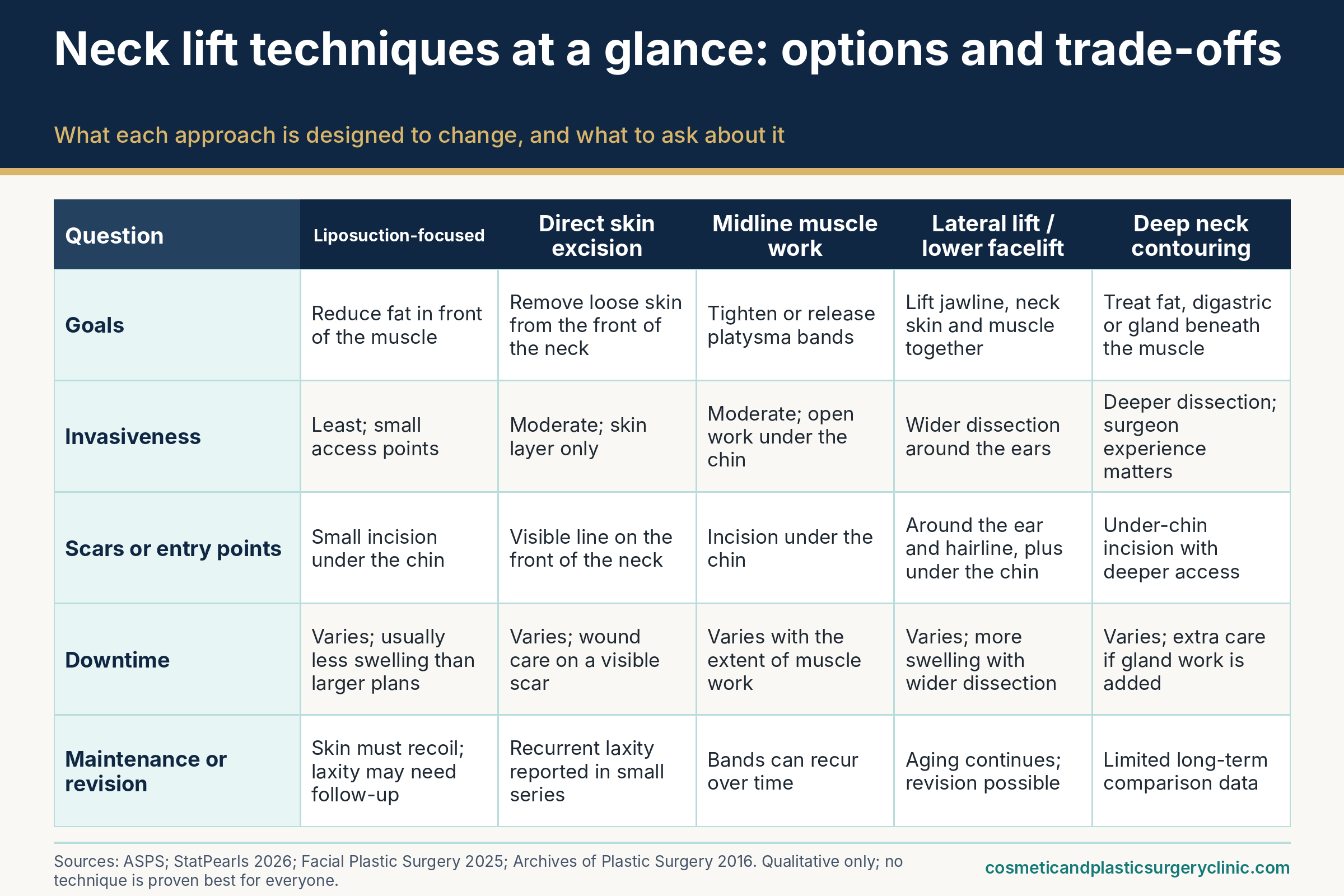
| Technique family | Layer and goal | Typical access | Trade-offs to ask about |
|---|---|---|---|
| Submental liposuction alone | Fat in front of the platysma; reduce fullness under the chin | Small incision under the chin | Needs skin that recoils; does not tighten muscle; contour irregularity |
| Energy-assisted liposuction | Fat plus heat to encourage skin contraction | Small incisions; probe or fiber under the skin | Burn risk; evidence from small single-clinic series; device clearance wording |
| Direct skin excision | Skin; remove loose skin from the front of the neck | Incision on the front of the neck | Visible scar line; recurrent laxity reported; small published series |
| Midline plication or corset | Platysma bands; bring muscle edges together | Incision under the chin, open | Band recurrence over time; expert-opinion evidence; tightness sensation |
| Platysma transection | Firm bands; release the muscle’s pull | Under the chin or lateral incisions | More dissection; limited comparative data |
| Lateral suspension (lower facelift neck) | Jawline and neck lift; anchor muscle sides near ear | Incisions around the ear and into the hairline | Longer scars; ear-region numbness; hairline changes |
| Deep neck contouring | Subplatysmal fat, digastric, gland | Under-chin incision, deeper dissection | Fluid collections, temporary nerve weakness, expertise needed |
| Facelift with neck | Midface, jawline and neck together | Facelift incisions plus under chin | Larger operation; longer swelling; more combined risks |
Deep Neck Contouring and the Facelift Connection: Subplatysmal Work and Combined Operations
The techniques so far treat what lies in front of or within the platysma. Two more branches of the family extend the plan in different directions: down into the structures beneath the muscle, and outward into the cheeks and jawline when the neck is lifted as part of a facelift. Both enlarge what the surgeon can change, and both enlarge the list of things that need to go right.
Working Behind the Muscle: Subplatysmal and Gland Procedures
Deep neck contouring has gained attention in the plastic surgery literature over the past several years. It is also the area where the strongest claims come from surgeons who practice it, so the evidence deserves a careful read.
Deep Fat, Digastric Reduction and Submandibular Gland Reduction
In the 2025 review by Bogari and Cakmak, the operation begins with an under-chin incision placed about 1 to 1.5 centimeters behind the natural crease, which gives access beneath the platysma. From there the authors describe a sequence that runs from dividing the platysma through removing subplatysmal fat, partially removing the superficial part of each submandibular gland when it hangs below the jaw line, and trimming the front bellies of the digastric muscles when they bulge, then tightening the platysma. They suggest finishing with fat refinement in front of the muscle, so that the remaining excess is judged after the deep work is done (Facial Plastic Surgery, 2025).
The same review reports complication figures that are worth knowing and worth qualifying. It cites a pooled analysis of about 1,200 partial gland resections with hematoma in under 0.1 percent, sialoceles (salivary fluid collections) in roughly 1 percent and transient marginal mandibular nerve injury in about 5 percent. It gives a literature range for sialoceles of roughly 1 to 3 percent and notes one case of lasting dry mouth in the authors’ own series. After gland reduction, patients in that protocol keep to a soft diet for about ten days. All of these figures come second-hand through a narrative review by surgeons who perform the operation, so they illustrate the kinds of events to ask about rather than serve as rates to expect.
Independent signals are sparse. A 2026 systematic review of revision neck lifts, which covered five retrospective series and 188 procedures, found that gland reduction occurred in only 13 percent of revisions and was documented in detail by just one study; recurrent platysmal banding, persistent fullness under the chin and gland ptosis were the leading reasons for revision (Aesthetic Plastic Surgery, 2026). A 2024 preprint adds that working beneath the platysma is claimed to last longer but with a higher risk of seroma and hematoma, a statement that has not been peer reviewed.
If deep work is part of a proposed plan, the sensible follow-ups are why it is needed for your neck, what would be lost by leaving it out, how salivary and nerve problems are handled, and how many such operations the surgeon has done. Those are not accusatory questions; they are the same ones a careful colleague would ask.
Hyoid Anchoring and Other Newer Suspension Methods
New named techniques appear regularly, and each deserves a look at its evidence tier before its label. A 2026 report in ASJ Open Forum describes a “neo-ligament” that connects the hyoid bone to tissue near the mastoid to support the deep neck, with or without partial gland removal. It involved 25 patients treated by one surgeon, reviewed retrospectively, with an average follow-up of about 215 days (ASJ Open Forum, 2026). The authors reported meaningful changes in measured angles, and seven patients had a reported complication, including temporary nerve weakness. They openly listed limitations: a small group, a single surgeon, a single evaluator for measurements, no control group and short follow-up. The copy read for this guide was hosted on a practice website.
None of that makes the technique wrong. It makes it new. The authors also trace the idea to earlier suspension methods named after other surgeons, which is how many techniques evolve: one group publishes a variation, others adopt or modify it, and years pass before anyone compares it carefully with alternatives.
For a patient, the practical lesson is to separate the maturity of a method from its marketing. Ask whether the approach is established or recently introduced, what has been published about it beyond the originator’s own series, and what the plan would be if the new element were left out. A surgeon who welcomes those questions is easier to trust than one who treats a novel name as self-explanatory.
Neck Lift on Its Own or Inside a Facelift
Because the neck and the lower face share a skin envelope and a muscle-fascia layer, many surgeons treat them together. Whether a person needs both, or the neck alone, is one of the most common early questions.
How Facelift Techniques Interact With the Neck
Facelift methods are usually sorted by depth. StatPearls describes SMAS plication, imbrication and transposition (folding, overlapping or repositioning the SMAS, the layer of connective tissue and muscle beneath the facial skin), deep-plane lifts, and short-incision lifts such as the MACS lift (StatPearls, 2026). A 2025 review groups them as superficial approaches, SMAS manipulation and SMAS elevation, and notes that comparable aesthetic outcomes have been reported across several techniques when experienced surgeons perform them. It also points out an unsettled debate about whether the SMAS is a true distinct layer or a surgically dissected flap of variable thickness (Journal of Clinical Medicine, 2025).
The same review reports that techniques working beneath the SMAS carried higher odds of temporary facial nerve paralysis (odds ratios of about 2.2 to 2.7) without a difference in permanent injury. A 2026 meta-analysis of deep-plane facelifts covering 45 studies and 10,784 patients reported an overall complication rate of 6.6 percent, temporary facial nerve injury in 1.2 percent, hematoma in 1.8 percent and no permanent nerve injury, with observational (level III) evidence and subjective aesthetic assessment (Aesthetic Plastic Surgery, 2026). A separate 2025 meta-analysis of 31 deep-plane studies and 8,841 patients put the pooled hematoma rate at 2.7 percent and found no clearly superior adjunct among tranexamic acid, tissue sealants and hemostatic nets (ReachMD summary, 2025).
These are facelift figures, not neck-lift-only figures, and they come from different populations, so the numbers should not be stacked into a single risk estimate. Ranges for hematoma illustrate how definitions shift: 0.2 to 8 percent in one reference, 1 to 14 percent in another. For the technique question, the useful message is that depth changes the nerve-related risk profile and that the neck component rides along with whichever facelift method is chosen. Our guides to facelift techniques and deep plane facelift techniques cover the face side of that decision.
The Isolated Neck Lift: When the Neck Is Treated on Its Own
ASPS says that people with pleasing upper facial features but an aging neck may be good candidates for a neck lift, and it lists jowls, fullness under the chin, loose neck skin and muscle banding among the concerns it addresses (ASPS, neck lift). Its facelift page, in turn, lists loose neck skin, the so-called double chin or turkey neck, among the signs a facelift treats (ASPS, facelift). The two procedures therefore overlap, and the dividing line is a matter of where the surgeon believes the concern originates.
In practice, the question is how far the problem extends. If fullness, bands and skin looseness sit mainly below the jawline, the plan may stay in the neck. If jowls or cheek descent are a significant part of the picture, a neck-only operation can leave them unchanged by design, and combining treatments may be discussed. The lamellar classification series described earlier showed this gradation: the lowest grades were treated with liposuction or platysma plication alone, while the higher grades involved short-scar or full facelift incisions combined with neck work.
The honest summary is that no objective threshold decides this for everyone. Two good surgeons may look at the same neck and reasonably differ on whether the face needs to be included. Asking each one to point out, in the mirror, which of your concerns the plan will change and which it will not is usually more productive than asking which operation is “better.” Candidacy factors beyond anatomy are covered in the neck lift candidacy guide.
What the Evidence Can and Cannot Tell You About Neck Lift Techniques
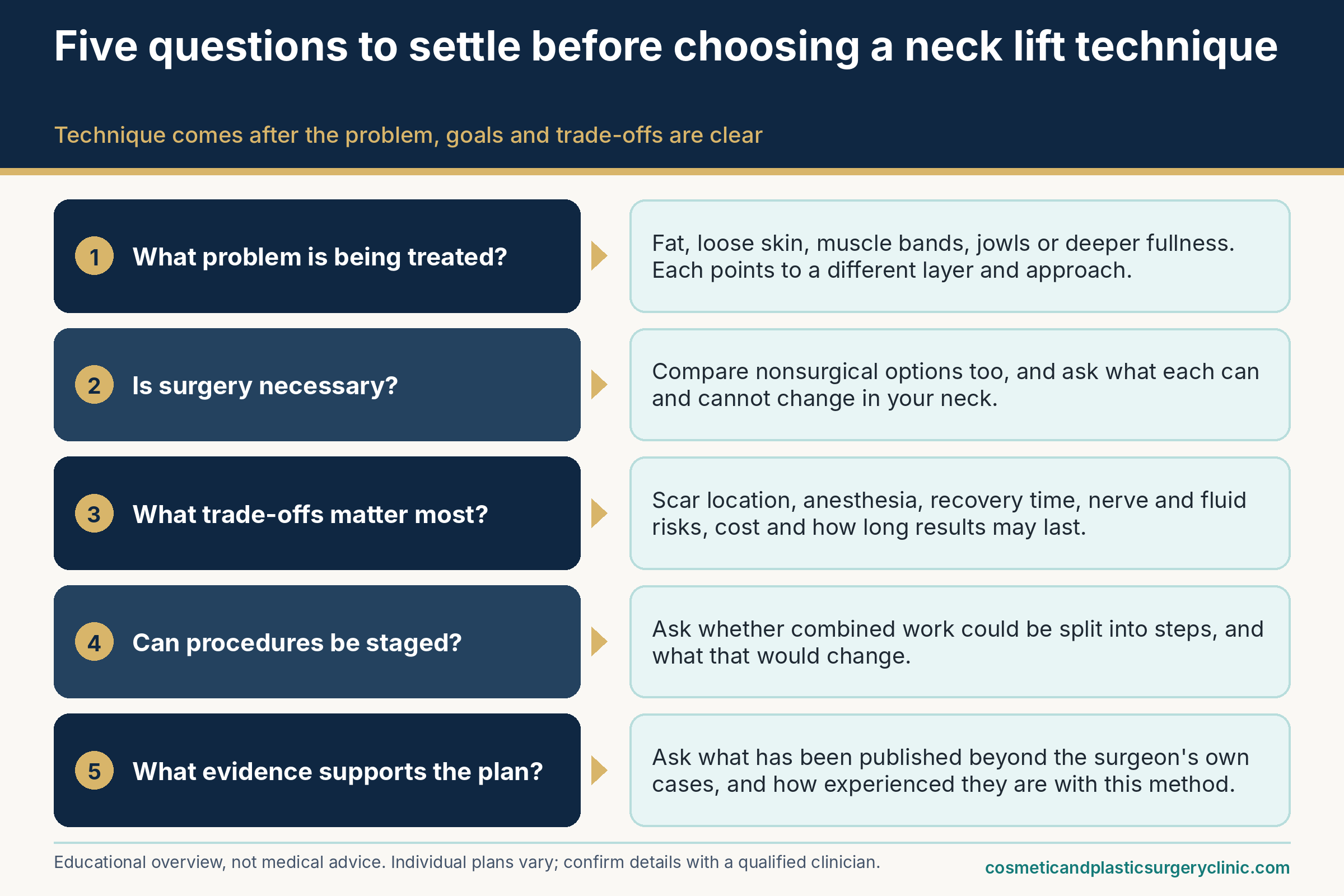
After a few consultations it is tempting to ask which technique the research favors. The honest answer is that the research is not built to give one. That does not make it useless. Knowing what kind of evidence sits behind each claim is one of the better protections a prospective patient has against confident-sounding marketing.
Reading Technique Research Without Being Misled
Neck lift papers vary enormously in quality, and the label on the study often matters less than who ran it, how many people were followed, for how long, and whether anyone outside the operating team judged the result.
What Systematic Reviews Can and Cannot Settle
The systematic reviews and meta-analyses available for neck and facelift work share a profile. They pool retrospective case series and a few small comparative studies, they rate their own evidence as level III observational, and they tell the reader that standardized outcome reporting is missing. The 2024 pooled analysis of 2,106 patients called for long-term outcome reports and standardized complication measures. The 2026 open-versus-closed analysis relied on nine studies. The 2026 revision review drew on five retrospective series. The deep-plane meta-analysis, with 45 studies, still described its aesthetic assessment as subjective.
Pooled numbers also depend on definitions. Hematoma illustrates this well: depending on the source and on whether the count includes small collections or only those needing a return to the operating room, published ranges run from 0.2 to 8 percent, from 1 to 14 percent, from 1.8 percent in a pooled neck lift analysis and 2.7 percent in a separate deep-plane analysis. Those figures are all legitimate and they do not contradict each other so much as measure different things in different populations. A pooled rate tells you roughly what has been reported across studies, not what is likely for a particular person.
No randomized comparison of the main neck lift techniques turned up in the sources reviewed for this guide. That absence is common in surgery, where blinding is difficult, techniques evolve faster than trials can run, and surgeons often have strong preferences. It means the question “which technique is best?” cannot be answered from the evidence. It can be partly answered by how well a given approach fits a given set of anatomical problems, which is where the matching framework later in this guide comes in.
Single-Surgeon Series, Preprints and Technique-Originator Papers
A large share of neck lift technique literature comes from one surgeon or one practice describing what they do and how patients fared. This material is valuable for understanding how a technique works and what its originators see as pitfalls. It is weaker for judging whether the technique does better than alternatives, because of selection (patients choose or are chosen for an approach), measurement (the same team often judges its own results) and incentives (the surgeon may build a practice around the method).
Preprints add another layer. A preprint is a manuscript posted before peer review, so its claims have not yet faced independent scrutiny; the 2024 review cited in this guide is one, and it is labeled that way wherever it appears. The 2026 revision review makes a related point from the other direction: it noted that aesthetic outcomes across the revision literature were predominantly qualitative and surgeon-reported, with few standardized or patient-reported measures.
Stronger signals look like this: a comparison group, patient-reported outcomes using a validated questionnaire, evaluation by someone who did not do the operation, follow-up measured in years, clear reporting of complications and drop-outs, and a statement of conflicts of interest. Few neck lift papers have all of those. You can use the checklist informally by asking a surgeon what published evidence supports a recommended technique, who produced it, and whether it included independent assessment.
| Source and type | What it reports | Population | Main caveat |
|---|---|---|---|
| Pooled analysis of platysma neck lifts (2024, systematic review) | Band recurrence 1.4%; nerve damage 0.9%; hematoma 1.8% | 12 studies, 2,106 patients | Level III evidence; authors call technique comparison premature |
| Open versus closed neck rejuvenation (2026, meta-analysis) | Open scored higher with liposuction; closed without liposuction highest | 9 studies, 847 patients | Abstract-level reading; selection of candidates likely differs by group |
| Secondary neck lift review (2016, single practice) | About 10% needed a second operation; recurrent bands in 87% of them | 1,089 neck lifts, 101 secondary | One practice; cannot show first-operation success rate |
| Revision neck lift (2026, systematic review) | Complications uncommon and mainly transient; reasons for revision listed | 5 retrospective series, 188 revisions | Outcomes mostly qualitative and surgeon-reported |
| Deep-plane facelift (2026, meta-analysis) | Overall complications 6.6%; temporary nerve injury 1.2%; no permanent injury | 45 studies, 10,784 patients | Facelift, not neck-only; subjective aesthetic assessment |
| Radiofrequency-assisted neck liposuction (2024, single clinic) | Average 23 mm reduction in submental length at 6 months | 80 patients | No comparison group; one private clinic |
| Hyoid anchoring technique (2026, single surgeon) | Measured angle improvements; some temporary complications | 25 patients | Short follow-up; no control group |
Longevity, Recurrence and Revision
People often ask whether a technique lasts longer than another. The question is reasonable, and it is also the one the literature handles worst, because long follow-up is expensive and rarely reported.
What Tends to Recur, and Why Results Are Not Permanent
ASPS states plainly that a neck lift is a restorative operation that does not change a person’s fundamental appearance and cannot stop the aging process (ASPS, neck lift). Cleveland Clinic similarly says results last years and vary with genetics, lifestyle, sun exposure and individual healing, without offering a number (Cleveland Clinic, neck lift). Those two statements are about as much as the public-facing authorities commit to.
What tends to return, according to the clinical literature, is a short list. Platysmal bands can re-form, and the StatPearls platysma entry notes recurrence after traditional facelifts attributed to poor tissue retention in an aging muscle. Jowls and skin laxity can progress as the tissues continue to age. In the 101-patient secondary neck lift series, the most frequent reasons for returning to surgery were recurrent bands, recurrent jowling and irregularities in fat contour. Weight change can alter the result in either direction, and a plan built around a specific weight should be discussed with that in mind.
Because it is the aging process itself that continues, it is hard to say how much of any difference in longevity belongs to the technique. A neck treated at 50 and a neck treated at 65 start from different tissue quality and have different amounts of time ahead of them. For a deeper look at timelines and what influences them, see our guide to how long neck lift results last.
Revision Neck Lift: What the 2026 Review Reports
Revision surgery shows which problems technique choices leave behind. The 2026 systematic review of revision neck lifts pooled five retrospective case series and 188 procedures, with 95 percent women among those with reported sex and ages from 31 to 77. The most common reasons for revision were recurrent platysmal banding, persistent fullness under the chin and submandibular gland ptosis. Platysmal maneuvers were the most commonly reported interventions, though the way they were reported varied. The authors found complications to be uncommon and mainly transient, with temporary marginal mandibular nerve problems and isolated hematomas, and no permanent nerve injury (Aesthetic Plastic Surgery, 2026).
Read alongside the 10 percent secondary rate from one large practice, the lesson is not that neck lifts commonly fail. It is that a meaningful minority of people eventually want a second look, usually many years later, and that the original plan affects what the second one involves. Scar tissue and altered anatomy make revision a different operation from the first.
That makes policy questions part of technique selection. Ask whether the practice has a revision policy, what it covers and for how long, and whether fees for a touch-up differ from the fees for the original. Our neck lift revision guide covers the topic in more depth. A practice that explains these terms up front is one whose answers you can compare across offers.
Anesthesia, Incisions, Risks and Recovery: How Technique Shapes the Experience
Technique does not change the basic safety framework of an operation under anesthesia, but it does change where the cuts go, how long the procedure runs, which nerves and vessels are nearby and how the first weeks feel. This section connects the technique families to those practical consequences. It stays general on purpose, since your own plan, health history and surgeon’s protocol will set the details.
Anesthesia, Setting and Incision Maps
Two decisions travel with every technique choice before anyone talks about the muscle: how you will be anesthetized and where the scars will sit. Both vary more between plans than most brochures suggest.
Anesthesia Options and Facility Questions
ASPS lists intravenous sedation and general anesthesia as the options for a neck lift, with the choice made by the surgical team (ASPS, neck lift procedure). MedlinePlus describes facelift surgery as done with conscious sedation or general anesthesia, and StatPearls says general anesthesia is typical for rhytidectomy, with tumescent solution infiltrated to limit bleeding and bruising (MedlinePlus, facelift; StatPearls, 2026). Smaller, fat-focused procedures are sometimes reported under tumescent local anesthesia; the 80-patient radiofrequency series mentioned earlier used it. Longer operations that include muscle work, deep dissection or a facelift are more likely to involve sedation or general anesthesia, though the actual plan is the surgeon’s call.
Anesthesia choice may also interact with technique through bleeding. A 2025 review observed that local anesthesia may lower hematoma incidence by keeping blood pressure stable, and that tranexamic acid has been reported to reduce swelling and bruising (Journal of Clinical Medicine, 2025). Neither point makes one method of anesthesia right for everyone, and both are best treated as questions to raise with the anesthesia provider.
Facility and personnel matter as much as the drug. ASPS advises asking whether an office-based operating room is accredited by a nationally or state-recognized agency, or is state-licensed or Medicare-certified, and whether the surgeon has hospital privileges (ASPS patient safety questions). Reasonable follow-ups are who will provide the anesthesia and what their credentials are, how monitoring is handled, and what the plan is if you need to be transferred to a hospital. Our plastic surgery anesthesia guide and the accredited facility guide go through those questions in more depth.
Incision Maps: Under the Chin, Around the Ear and Into the Hairline
Almost every surgical neck lift involves a short incision under the chin, because that is where fat and the midline muscle can be reached. The 2025 deep neck review places it about 1 to 1.5 centimeters behind the natural crease a position the authors say keeps the scar less visible. Beyond that, the map depends on the technique. Liposuction-only plans may stop there. Skin-redraping and lateral suspension plans add incisions that, per ASPS, begin at the hairline near the sideburn, continue around the ear and end in the hair behind it, with a limited version staying around the ear. ASPS notes that incision lines are generally concealed within the hairline and the contours of the ear.
Concealment is relative. Hair loss along the incision lines is on ASPS’s list of risks, and so is unfavorable scarring. Where the lines end up relative to your hairline, whether the hairline is shifted, and how your hair is cut and styled all affect how visible they are. Ask to be shown where the incisions would go on your own head, not just on a diagram.
Scars change with time. ASPS divides healing into roughly three phases: the first two weeks, when the incision should be protected and left undisturbed; months two through six, when redness and mild texture are normal; and months six through twelve, when collagen flattens and redness fades. It recommends avoiding direct sun on a scar for the first six months and using a mineral sunscreen of SPF 50 or higher (ASPS, scar healing). The neck lift scars guide expands on that.
Risks That Differ by Technique, and Recovery in Broad Strokes
Most risks of neck surgery are shared across techniques. The differences lie in which risks are added when more tissue is moved, divided or removed, and in how long the early phase lasts.
Shared Risks and Technique-Linked Risks
ASPS lists the general risks of a neck lift as anesthesia reactions, bleeding and fluid collections (hematoma), asymmetry and skin irregularities, infection and poor healing, numbness or altered sensation, persistent pain and swelling, rare nerve injury causing lower-lip weakness, rare deep vein thrombosis with possible heart or lung complications, skin discoloration or loss, visible or irritating sutures, hair loss along the incision lines, unfavorable scarring and the possibility of revision (ASPS, neck lift safety). Our neck lift risks and complications guide treats each in depth.
Technique changes the emphasis. Fat-only procedures lean toward contour irregularity and fluid. Skin excision leans toward wound-edge problems and scarring. Muscle work adds the possibility of tightness, cords or suture-related irritation. Deep work adds salivary-gland-related collections and temporary weakness of a facial nerve branch. Operations with extensive dissection raise hematoma and skin-flap concerns. Smoking is a particular issue for flap-type operations: StatPearls reports skin necrosis in a facelift setting of 7.5 percent in smokers versus 2.7 percent in nonsmokers, and recommends stopping nicotine two to four weeks before and after surgery. MedlinePlus advises quitting at least four weeks before surgery, with ten weeks giving more benefit, and it does not encourage nicotine gum around surgery.
Nerve questions deserve specific mention because the numbers quoted differ so much. StatPearls’ rhytidectomy entry gives 0.7 to 2.5 percent for nerve injury overall, with the great auricular nerve (sensory) most often involved, while its platysma anatomy entry cites great auricular injury at 6 to 7 percent in cervicofacial rhytidectomy. The difference likely reflects definitions, since a brief patch of numbness near the ear is a very different outcome from lasting weakness. The marginal mandibular branch, which moves the corner of the lower lip, runs below the jaw’s lower border in the zone surgeons work, and injury usually shows up as a lopsided smile. Reviews generally describe it as temporary.
| Technique family | Risks emphasized in the sources | Evidence basis | Question to ask |
|---|---|---|---|
| Submental liposuction | Contour irregularity, fluid, bruising, residual loose skin | Reviews and single-clinic series | How will you check that my skin can retract? |
| Energy-assisted work | Burns, sensory changes, residual laxity needing revision | Small single-clinic series; FDA communication | Which cleared use applies, and how are burns prevented? |
| Direct skin excision | Wound separation, thick scar, recurrent laxity | Small series with short follow-up | Where will the scar sit and how will it be camouflaged? |
| Midline or lateral platysma work | Band recurrence, hematoma, temporary nerve weakness | Pooled analysis, single-practice series | What is the plan if bands return? |
| Deep neck contouring | Salivary fluid collections, temporary marginal mandibular weakness, dry mouth reports | Narrative review by practicing surgeons | How many gland procedures have you done, and how are collections handled? |
| Neck lift within a facelift | Hematoma, temporary facial nerve paralysis, skin flap problems | Facelift meta-analyses | Which layer will be lifted and why? |
Recovery Differences by Approach and the Warning Signs That Matter
Recovery scales with how much was done. A small incision under the chin for liposuction causes less swelling than extended dissection around both ears, and a combined facelift stretches the bruising area further. That is the general principle, not a schedule. Reference sources give broad figures for facelift-type surgery: MedlinePlus says bandages typically come off within one to five days, drains within one to two days, and facial swelling usually settles within four to six weeks, with numbness lasting weeks to months. StatPearls recommends head elevation for one to two weeks and avoiding heavy lifting for four to six weeks (MedlinePlus, facelift).
Surgeon protocols differ widely. The deep neck contouring review describes a regimen of no traditional dressing, a hemostatic net suture removed on day two or three, sutures out at about a week, and an expected recovery of seven to ten days for that team’s patients. Another team may use a wrap, a chin strap or drains. Those are one practice’s choices, not benchmarks. Our neck lift recovery guide compares timelines, and the fair question to bring to any consultation is how recovery would differ between the approach recommended to you and the next smaller one.
Matching Neck Lift Technique to Anatomy: A Decision Framework
With the families laid out, the next question is how a surgeon decides among them. No validated algorithm governs this, and experienced surgeons weigh the same neck differently. The framework below distills the common reasoning that appears across the sources: identify the layer causing the concern, check the factors that limit or favor each option, and consider what nonsurgical tools might add or replace. It is an educational model, not a diagnostic tool.
Sorting the Neck by Problem
Before comparing operations, it helps to name the problem in anatomical terms. “My neck looks old” is a good starting description, but it cannot guide technique. “I have fullness under the chin that doesn’t change when I tense my neck” and “I have cords that appear when I speak” point to different layers.
A Problem-to-Technique Map
The map below links common concerns to the approaches most often discussed for them in the literature and in consultations. It is built from the sources cited throughout this guide plus ordinary surgical reasoning; where evidence is thin, the table says so. Treat it as a way to prepare questions, not as a menu to order from.
A few patterns recur. Fullness that is mostly soft and sits in front of the muscle, with skin that recoils, is the textbook case for fat removal. Fullness combined with skin that does not recoil is the textbook case for adding a lift or a skin-focused step. Vertical cords bring the muscle into the plan, with a choice between tightening, division or both depending on whether they feel soft or firm. Jowls and neck laxity together often lead to a lower-face-and-neck operation. Heavy skin with limited elasticity, especially when a person prefers to avoid hairline incisions, is where direct excision is discussed despite the trade-off in scar visibility. Fullness that seems deep, with prominent tissue under the jaw that does not respond to liposuction, is where the gland and digastric work enters the conversation. And a neck that has had previous surgery is its own category, since scarring and altered anatomy change the options.
| Main concern | Approaches often discussed | Why they come up | What to weigh |
|---|---|---|---|
| Fullness under the chin, skin recoils well | Submental liposuction | Targets fat in front of the platysma with a small incision | Does not tighten muscle or remove skin; contour irregularity possible |
| Fullness plus loose skin | Liposuction with a lift, or energy-assisted work in milder cases | Skin must be redraped or encouraged to contract | Heat devices have limited comparative evidence; burns reported |
| Soft, spreading vertical bands | Midline plication or corset platysmaplasty | Brings separated muscle edges together | Recurrence over years; expert-opinion evidence |
| Firm, strongly contracting bands | Plication with transection, or lateral suspension | Releases or re-routes a muscle that keeps pulling | More dissection; limited head-to-head data |
| Jowls and neck laxity together | Lower facelift with neck work, or a full facelift | Lifts the jawline and neck as one unit | Longer incisions and recovery; facelift-level risks |
| Heavy skin in front, limited elasticity | Direct skin excision, sometimes with muscle work | Reaches skin that sideways lifting may not | Front-of-neck scar; recurrent laxity reported in small series |
| Deep fullness or prominent tissue under the jaw | Deep neck contouring | Treats structures behind the platysma | Gland-related collections; temporary nerve weakness; surgeon experience |
| Bands or fullness after an earlier neck lift | Individualized revision | Scar tissue and prior anatomy change the plan | Revision data are retrospective and surgeon-reported |
Age, Skin Quality, Weight, Health and Prior Surgery
Anatomy is one input. Others change which options are on the table or how safe a particular plan is. Skin quality is the first: elasticity affects whether fat removal alone is reasonable and how well any lifted skin holds its new position. Skin quality is partly genetic, partly a record of sun exposure and weight history, and a photograph rarely captures it.
Weight stability is the second. StatPearls lists weight instability or anticipated weight change among the situations that complicate facelift-type surgery, alongside diabetes and immune compromise, active smoking, prior radiation to the area, bleeding disorders or anticoagulant use, and uncontrolled high blood pressure. The same entry lists suspected body dysmorphic disorder, which is why surgeons often ask how long a concern has bothered you and what you expect to change. Those are factors that a surgeon screens for and discusses; they are not self-diagnosis tools. If you have a condition on that list, the right step is to raise it early so the plan can account for it.
Age shows up in the literature mostly as context. The revision review reported patient ages from 31 to 77, and one small direct-excision series ran from 43 to 75. No source reviewed here sets a best age for any technique, and a chronological age tells less than the quality of the tissue and the specific concern. Candidacy and timing questions are covered in the neck lift candidacy guide.
Prior surgery matters because earlier neck work leaves scar tissue and altered planes. That includes previous neck lifts, facelifts, thyroid or other neck operations and radiation. Share the full history, including any procedures done elsewhere or abroad, since a surgeon planning dissection in the area needs to know what has already been changed.
Where Nonsurgical Treatments Overlap
Surgical technique is not the only way to change how a neck looks, and some nonsurgical tools target the same problem layers. Knowing what the FDA has actually authorized for the neck helps you read offers more clearly. The complete comparison of surgical and nonsurgical choices belongs to our neck lift alternatives guide; here the focus is on how they relate to technique.
What the FDA Has Actually Authorized for the Neck
Drugs and devices reach the market by different routes. A drug such as an injectable is approved, and the approval comes with a label stating the indication. Many energy devices are cleared through the 510(k) route, which rests on equivalence to an existing device, as discussed earlier. Using any product outside its labeled indication is called off-label use, and while that is legal and common in medicine, it is a different regulatory situation from a labeled use.
For deoxycholic acid injections, the original 2015 label states an indication for moderate to severe fullness associated with submental fat in adults and carries warnings about marginal mandibular nerve injury, difficulty swallowing and injection-site reactions. In its trials, swelling, bruising, pain and numbness at the injection sites were very common (FDA label, 2015 version). The current label should be checked for any updates before relying on those details. For botulinum toxin, the prescribing information for BOTOX Cosmetic, revised in October 2024, lists moderate to severe platysma bands among its indications, carries the boxed warning about spread of toxin effect, and instructs injectors to avoid deep structures and to stay at least a centimeter below the jaw (BOTOX Cosmetic prescribing information). A 2013 FDA clearance covers an ultrasound system for lifting loose skin beneath the chin and in the neck region (FDA 510(k) K132028). The plasma handpiece clearance was described in the energy-device section above.
| Option | Neck-related target | Status verified here | Caveats |
|---|---|---|---|
| Deoxycholic acid injection | Submental fat | FDA-approved drug; 2015 label indicates moderate to severe submental fat | Not approved for other areas; nerve injury and swallowing warnings; does not tighten skin |
| Botulinum toxin (BOTOX Cosmetic) | Platysma bands | FDA-approved for moderate to severe platysma bands (label revised October 2024) | Boxed warning on toxin spread; injection depth and location matter; effect is temporary |
| Microfocused ultrasound | Loose skin under the chin and neck | FDA-cleared in 2013 (510(k)) for lifting lax skin beneath chin and neck | Clearance is for a stated use, not proof of superiority over surgery |
| Plasma-based device | Loose neck and submental skin | One handpiece cleared in July 2022 for neck and submental lax skin, per FDA communication | FDA cautioned against other skin uses; read the communication |
| Other options named by ASPS | Skin quality, volume, texture | Not reviewed for FDA status here | Fractionated laser, fillers and radiofrequency microneedling are listed as nonsurgical options |
Staging and Combining: Before, After or Instead of Surgery
ASPS lists botulinum toxin, fractionated laser, dermal fillers, deoxycholic acid injections, radiofrequency microneedling and ultrasound among nonsurgical options for the neck and jawline (ASPS, neck lift). Cleveland Clinic lists a similar group. ASPS’s facelift page adds that surgery achieves results minimally invasive treatments cannot match, while nonsurgical options may delay the point at which surgery becomes necessary.
People combine them in several ways. Some start with a nonsurgical treatment for mild concerns and keep surgery in mind for later. Some use injectables or devices to fine-tune a surgical result after healing. Some stage procedures, which means spreading separate treatments across time rather than doing everything at once, for convenience, risk management or budget. The submental fat review above cites a small study in which sequential cryolipolysis and deoxycholic acid produced at least one grade of improvement in all participants, which shows that combination is studied, though the sample was small and the outcome measure modest.
One point is easy to overlook. A treatment aimed at fat in front of the muscle cannot reach fat behind it, and a treatment aimed at the muscle cannot tighten skin. That is why the earlier question, which layer is causing the concern, comes before the choice of tool. If a plan combines surgical and nonsurgical steps, ask for the sequence in writing: what is done first, when each step is judged complete and what each one is expected to change.
Making the Decision: Scenarios, Cost Logic, Credentials and Consultation Questions
The sections above explain how approaches differ. This final section turns that into decisions: how the same list of techniques produces different conversations for different necks, how technique influences cost without setting it, how to check who is recommending a plan, and what to ask so that two recommendations can be compared fairly.
Scenarios and Cost Logic
Abstract comparisons only go so far. Short scenarios help show how the reasoning works, and a few paragraphs on cost keep expectations realistic about what a technique choice does and does not change.
Four Illustrative Scenarios
The four examples below are invented illustrations, not patient stories and not recommendations. They show how the vocabulary in this guide turns into questions.
Scenario A. A person in their forties has soft fullness under the chin that stays the same whether the neck is relaxed or tensed, no visible cords and skin that looks smooth when pinched and released. The consultation may start with liposuction alone. Good questions are how the surgeon will judge whether the skin will retract, what happens if it does not, and whether energy-assisted work is being proposed and why. The open-versus-closed analysis suggests that smaller, closed approaches can fit well in carefully chosen cases.
Scenario B. A person in their late fifties has vertical cords that appear when speaking, moderate jowls and skin with some crepey looseness. The discussion likely compares a neck-focused operation with midline muscle work against a lower facelift that includes the neck. Useful questions include whether the cords feel soft or firm to the surgeon, whether lateral support is part of the plan, and what the jowls will look like if only the neck is treated.
Scenario C. A person who had a neck lift roughly a decade ago notices bands returning and some fullness near the jaw. This is the profile that the revision literature describes. Questions include whether the original operative details are available, what the surgeon believes caused the recurrence, whether deeper structures are involved, and what the revision policy covers.
Scenario D. A person in their sixties has heavy, inelastic skin across the front of the neck and prefers not to have incisions that reach into the hairline. Direct excision may come up, along with its visible scar. They would want to see how scars from the same technique looked after a year, ask what recurrence has been reported, and compare that offer with a lateral lift that hides its scars but may not reach the same skin.
In each case the outcome of the consultation depends on an examination that this guide cannot replace. The scenarios illustrate the questions, not the answers.
How Technique Affects Cost, in Qualitative Terms
Start with what is known. ASPS reports an average surgeon fee for a neck lift (lower rhytidectomy) of $7,885, on a page that does not state the statistics year, and it specifies that the figure excludes anesthesia, operating room facility charges and other expenses. The same page lists medical tests, post-surgery garments and prescriptions as additional costs, says most health insurance plans do not cover neck lift surgery or its complications, and notes that fees depend on the surgeon’s experience, the procedure type and geography (ASPS, neck lift cost). A national average is not a local quote, and it is not an offer. Our neck lift cost guide covers fee components in depth.
Technique influences cost mostly through time, setting and scope. A longer operation with more steps generally means more operating-room time and a larger anesthesia fee. Deep work or a facelift component can increase scope. Whether the procedure is done in a hospital, an ambulatory surgery center or an accredited office changes the facility line. Staging procedures across sessions splits expenses over time but may add fees. Revision terms, such as whether touch-ups are discounted or covered by a fee, can matter more over a decade than the initial difference between two quotes.
When comparing quotes, line up scope before price. Two offers with the same headline number may describe different techniques, different anesthesia providers and different facilities. A lower number can reflect less work, a different setting, a different geography or a different level of experience, and none of those is automatically a flaw or a bargain. Ask each practice to itemize what is included and what is not.
Verifying the Surgeon and Comparing Recommendations
Technique names matter less than the training and judgment of the person recommending them. Verification is quick and worth doing before any consultation fee or deposit changes hands.
Board Certification, Licensure and Facility Checks
The American Board of Plastic Surgery (ABPS) runs a public lookup where you can search a surgeon by name or location to confirm certification. The ABPS site describes certification as a voluntary credential, indicating that the surgeon completed appropriate training and passed written and oral examinations, and it requires an active, unrestricted medical license for certification. For license status and any board actions, it directs people to the Federation of State Medical Boards (ABPS, verify certification). Certification and licensure are separate checks, and membership in a professional society is separate from both.
Neck and facial procedures are also performed by surgeons trained in other specialties. The principle is the same: ask which board certified the surgeon, in what specialty, and verify it with that board. ASPS suggests asking about hospital privileges, whether the operating room is accredited or state-licensed, how many procedures of this type the surgeon has done, what recovery help you will need and what the options are if you are dissatisfied (ASPS patient safety questions). For a fuller walk-through, see our guide to how to choose a plastic surgeon.
A practical habit: write down the surgeon’s full name, check the credential yourself rather than relying on a website badge, and save the date you checked. If the practice cannot tell you which facility will be used or who will provide anesthesia before you commit, treat that as information.
Consultation Questions, Scripted, and How to Compare Offers
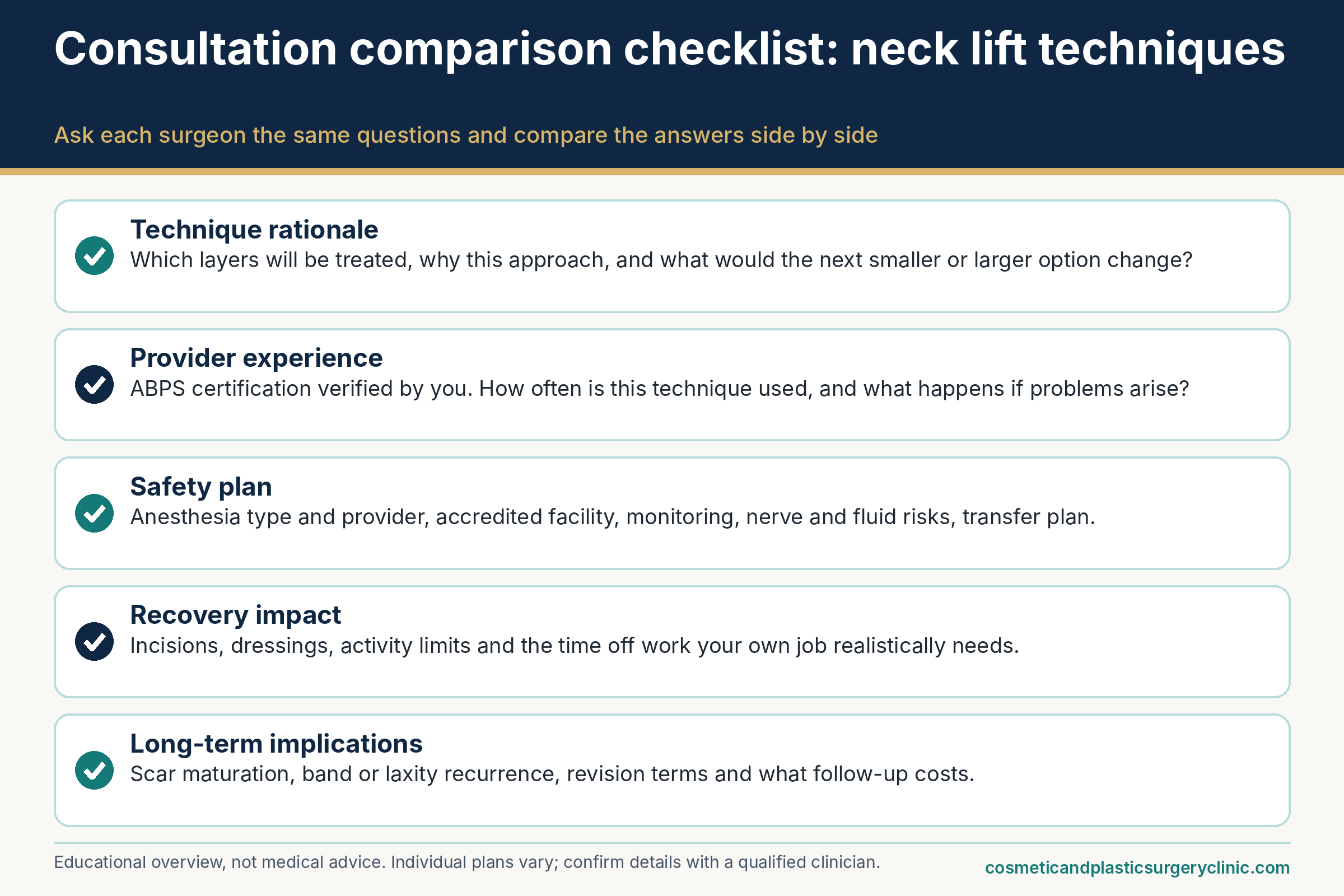
The easiest way to compare two recommendations is to ask both surgeons the same questions and record the answers side by side. The table below offers a script. You do not need all of them, and a good surgeon will not be thrown by any of them.
| Question | Why it matters | What a clear answer includes |
|---|---|---|
| Which layers will you treat in my plan, and which will you leave alone? | Shows whether fat, skin, muscle or deeper structures are involved | A layer-by-layer description, in plain language, using your photos or mirror |
| Why this technique instead of the next smaller or larger one? | Reveals the reasoning and what the alternative would change | A specific anatomical reason, not a brand name |
| What evidence supports this approach, and how often do you use it? | Separates established methods from newer or promoted ones | Candid references to published work and the surgeon’s own experience |
| Where will every incision go, and what will the scars look like at one year? | Scar placement differs by technique | Marked locations on you and photos from comparable cases shown with context |
| Which risks are most relevant to this plan, and how are they handled? | Risks differ by technique and by person | Named risks, prevention steps and a clear after-hours contact plan |
| What will anesthesia and the facility be, and who will be monitoring me? | Safety depends on the setting as well as the technique | Anesthesia type and provider, accreditation status and transfer plan |
| What is the revision or touch-up policy? | Some people eventually want a second procedure | Written terms covering what is included and for how long |
| What would change your recommendation? | Tests whether the plan is flexible | Specific findings, such as skin quality or weight change, that would shift the plan |
When you compare, look for consistency of reasoning more than agreement on technique. Two surgeons can recommend different operations for good reasons. What should concern you is a recommendation that cannot be explained in terms of your anatomy, a refusal to discuss alternatives, or pressure to decide quickly. It is entirely reasonable to take time, request a second opinion and ask for written estimates. Our combined procedures guide may help if the plan involves more than the neck.
Frequently asked questions
What is the difference between a neck lift and a platysmaplasty?
Platysmaplasty is one component: reshaping or tightening the platysma muscle. A neck lift is the broader operation, which can include fat removal, muscle work, redraping and trimming skin, and sometimes deeper steps. Some surgeons and clinics use the two words interchangeably, which creates confusion. A person could have platysmaplasty with almost no skin work, or a skin-focused lift with little muscle work. When a quote uses either term, ask the practice to list which layers will be treated and through which incisions, so you are comparing the same operation across offers.
Can liposuction alone treat a double chin?
It can for some people. Liposuction removes fat in front of the platysma through a small incision, and it fits best when the skin recoils well and no muscle bands are present. It does not tighten muscle or remove skin, and it cannot reach every layer of fullness. If the heaviness sits behind the muscle, or the skin is loose, liposuction by itself may leave the contour only partly changed. A surgeon typically checks skin elasticity and looks at the neck at rest and with the muscle tensed before suggesting fat removal alone.
What is a corset platysmaplasty?
It is a muscle technique done through an incision under the chin. The surgeon uses a series of stitches along the midline to bring the two front edges of the platysma together, somewhat like lacing a corset, and sets that tightening against fixed anchor points at the sides. The aim is to reduce cords and sharpen the line between chin and neck. Published support comes largely from surgeons who use it, including a 2014 article in which the authors reported less recurrence than other methods; independent head-to-head comparisons are lacking.
Is a deep plane technique better for the neck?
The evidence does not say so. “Deep plane” refers to a facelift method that lifts tissue beneath the SMAS layer, and a 2025 review reported comparable aesthetic outcomes across several facelift techniques when experienced surgeons perform them. Meta-analyses of deep-plane facelifts report low rates of permanent nerve injury, though sub-SMAS techniques showed higher odds of temporary facial nerve weakness in one analysis. Neck results also depend on the platysma and deeper work, which are separate choices. The sensible question is which layer each technique lifts and what the trade-offs are.
Do different neck lift techniques leave scars in different places?
Yes. Fat-only procedures use a small incision under the chin. Skin-redraping and lateral suspension plans add incisions that, per ASPS, begin near the sideburn hairline, go around the ear and end in the hair behind it, with a limited version staying around the ear. Direct skin excision places the scar on the front of the neck. Scars typically take about a year to mature and need sun protection. Ask to see where each line would sit on you and request photos of healed scars from the same technique, shown with context.
Will platysma bands come back after surgery?
They can. A pooled analysis of 2,106 patients reported band recurrence of 1.4 percent, yet that figure comes from studies with short follow-up and varied definitions. A review from one large practice found that about 10 percent of neck lift patients later needed a second operation, most often for recurrent bands, on average about ten years after the first. Aging continues after surgery, and muscle quality differs between people. No technique has been proven to prevent recurrence permanently, so ask what the plan would be if bands return.
Can Botox replace surgery for platysma bands?
It can reduce the appearance of bands temporarily, but it does not tighten skin or remove fat. In October 2024, the label for BOTOX Cosmetic added moderate to severe platysma bands as an approved indication. The label carries a boxed warning about spread of toxin effect and cautions about swallowing difficulty, and it directs injectors to avoid deep structures and keep a distance below the jaw. Effects wear off, so treatment repeats. Whether it suits a given person depends on the bands, the skin and the goals, and a clinician should assess that.
How does a deoxycholic acid injection compare with surgical fat removal under the chin?
They address the same layer of fat by different routes. Deoxycholic acid is an injected drug approved by the FDA for moderate to severe submental fat, given in a series of sessions, and its original label warns about marginal mandibular nerve injury, swallowing difficulty and common swelling, bruising and numbness. Liposuction removes fat in one session through a small incision under the chin. Neither tightens loose skin. The better fit depends on the amount of fat, skin quality and tolerance for downtime and repeat visits.
Can a neck lift be done under local anesthesia?
Some smaller, fat-focused procedures have been reported under tumescent local anesthesia, such as an 80-patient radiofrequency series. ASPS lists intravenous sedation and general anesthesia as the options for a neck lift generally, and StatPearls says general anesthesia is typical for rhytidectomy. A 2025 review suggested local anesthesia may lower hematoma incidence by keeping blood pressure stable. The choice depends on how extensive the plan is, the facility and your health. Ask who will give the anesthesia and what the monitoring plan is.
Is submandibular gland reduction part of every neck lift?
No. It is a deeper, selective step used by some surgeons when the glands hang below the jaw line. In the 2026 revision-neck-lift review, gland reduction occurred in only 13 percent of revision cases and was documented in detail by one study. Reported issues include salivary fluid collections and temporary weakness of a facial nerve branch. If gland work is proposed, ask why it is needed in your case, how many the surgeon has done and how fluid collections or dry mouth would be handled.
Is a limited-incision neck lift as effective as a traditional one?
It depends on the problem. ASPS notes that a limited incision around the ear gives shorter scars but potentially more limited results. For mild laxity, a limited approach may be enough; for heavy skin or strong bands it may not reach the problem. A 2026 meta-analysis of short-incision MACS lifts versus deep SMAS lifts found shorter operations with the MACS approach and no clear difference in complications, though it was based on four retrospective studies. Ask what the short-scar option would leave unchanged in your neck.
How can I tell whether a technique is established or still new?
Look at how the evidence is described. Established methods usually appear in reference texts and reviews, with several groups reporting results over years. Newer ones may be backed by a single surgeon’s series, a short follow-up and no comparison group. Ask your surgeon what has been published beyond their own cases, whether independent evaluators or patient-reported measures were used, and how long patients were followed. Brand names and catchy labels are not evidence. A surgeon who welcomes those questions and answers without defensiveness is giving you useful information.
Sources and further reading
- American Society of Plastic Surgeons — Neck lift (accessed 2026-10-04) — scope, concerns addressed, limits, nonsurgical options listed
- American Society of Plastic Surgeons — Neck lift procedure (accessed 2026-10-04) — anesthesia, traditional vs limited incisions, platysma tightening, under-chin incision
- American Society of Plastic Surgeons — Neck lift safety (accessed 2026-10-04) — risk list
- American Society of Plastic Surgeons — Neck lift cost (accessed 2026-10-04) — average surgeon fee, exclusions, insurance (statistics year not stated)
- American Society of Plastic Surgeons — Facelift (accessed 2026-10-04) — facelift scope including loose neck skin
- American Society of Plastic Surgeons — 2025 Plastic Surgery Statistics Report (accessed 2026-10-04) — neck lift and facelift volume estimates and methodology
- American Society of Plastic Surgeons — Questions to ask your plastic surgeon (accessed 2026-10-04) — certification, facility and experience questions
- American Society of Plastic Surgeons — What to expect as a scar heals (accessed 2026-10-04) — scar phases and sun protection
- American Board of Plastic Surgery — Verify certification (accessed 2026-10-04) — public lookup; certification voluntary; license verification is separate
- Cleveland Clinic — Neck lift (platysmaplasty) (updated June 28, 2022; accessed 2026-10-04) — overview, anesthesia, longevity statement
- MedlinePlus — Facelift (reviewed November 17, 2025; accessed 2026-10-04) — anesthesia, drains, swelling, numbness
- MedlinePlus — Smoking and surgery (accessed 2026-10-04) — nicotine and wound healing; quitting timeline
- Centers for Disease Control and Prevention — About blood clots (accessed 2026-10-04) — clot symptoms and emergency care
- StatPearls — Cervicofacial rhytidectomy (updated March 22, 2026; accessed 2026-10-04) — facelift techniques, platysmaplasty options, complication ranges, contraindications
- StatPearls — Anatomy, head and neck, platysma (updated August 7, 2023; accessed 2026-10-04) — platysma anatomy, decussation patterns, nerve relationships
- Thieme — Neck lift to treat platysma bands and defining cervical angle: a systematic review and pooled analysis (October 2024; accessed 2026-10-04) — 12 studies, 2,106 patients; level III evidence
- ASJ Open Forum (2026) — Systematic review and meta-analysis of open platysmaplasty in face and neck lift surgery, abstract record (accessed 2026-10-04) — FACE-Q comparison of open and closed techniques
- Facial Plastic Surgery (2025) — Deep neck contouring: indications and techniques (accessed 2026-10-04) — subplatysmal procedures, band classification, complication figures (surgeon-authored review)
- Journal of Clinical Medicine (June 2025) — Current trends in facelift and necklift procedures (accessed 2026-10-04) — technique categories, neck management, hematoma and nerve findings
- Aesthetic Plastic Surgery (2026) — Deep plane facelifts: systematic review and meta-analysis of outcomes, repository record (accessed 2026-10-04) — 45 studies, 10,784 patients
- Medicina (2026) — Comparison of deep SMAS lift and MACS in facelift: a meta-analysis (accessed 2026-10-04) — four retrospective studies, 286 patients
- ReachMD — Systematic review examines hematoma reduction techniques in facelifts (2025; accessed 2026-10-04) — news summary of a 31-study meta-analysis
- Plastic and Reconstructive Surgery (2016) — Secondary neck lift and the importance of midline platysmaplasty: review of 101 cases (accessed 2026-10-04) — secondary neck lift reasons and timing; single practice
- Aesthetic Plastic Surgery (2026) — Revision neck lift surgery: a systematic review of indications, techniques, and outcomes, repository record (accessed 2026-10-04) — 188 revisions in five series
- ASJ Open Forum (2026) — Redefining neck rejuvenation: hyoid-to-mastoid neo-ligament in deep plane neck lift, copy hosted on a practice website (accessed 2026-10-04) — 25-patient single-surgeon series
- Archives of Plastic Surgery (2016) — A modified, direct neck lift technique: the cervical wave-plasty (accessed 2026-10-04) — 37-patient direct excision series
- Revista Brasileira de Cirurgia Plástica (2013) — Classification based on neck lamellas for aesthetic variations of the cervical region (accessed 2026-10-04) — layered classification; 480-patient series
- Aesthetic Plastic Surgery (2024) — Radiofrequency-assisted liposuction with FaceTite and buccal fat pad excision for face and neck contouring (accessed 2026-10-04) — 80-patient single-clinic series
- CosmoDerma (2023) — Tackling submental fat: a review of management strategies (accessed 2026-10-04) — pre- vs post-platysmal fat; nonsurgical options
- Preprints.org (March 2024) — Advanced surgical approaches for submental and cervicofacial rejuvenation (preprint, not peer reviewed; accessed 2026-10-04) — medial and lateral platysmaplasty overview
- Facial Plastic Surgery (2014) — Complete corset platysmaplasty: evolution of addressing the aging neck, abstract (accessed 2026-10-04) — authors’ description and claims
- U.S. Food and Drug Administration — KYBELLA prescribing information, 2015 label (accessed 2026-10-04) — indication, warnings, adverse reactions (original label; check current version)
- AbbVie — BOTOX Cosmetic prescribing information (revised October 2024; accessed 2026-10-04) — platysma band indication, boxed warning, injection cautions
- U.S. Food and Drug Administration — 510(k) K132028, Ulthera System (decision December 11, 2013; accessed 2026-10-04) — indications for use
- U.S. Food and Drug Administration — Update: use of Renuvion/J-Plasma device for certain aesthetic procedures, safety communication (accessed 2026-10-04) — cleared and non-cleared uses
- U.S. Food and Drug Administration — Premarket notification 510(k) (accessed 2026-10-04) — meaning of clearance and substantial equivalence