

A gynecomastia surgery consultation is the appointment where a surgeon examines your chest, reviews your history, explains what an operation could and could not change, and gives you a written plan and price to consider. It is also the one moment in the process when you hold most of the leverage: you have not signed anything, you have not paid a surgical deposit, and you can ask any question you like. This guide is a playbook for using that appointment well, from what to gather beforehand to what to do in the days afterward.
It assumes you already know the basics of male breast reduction. If you want the full explanation of the condition, techniques, recovery, and risks, start with the complete guide to gynecomastia surgery and come back. Here we stay on the consultation itself: preparing, being evaluated, checking credentials, asking the right questions, reading a quote, spotting problems, getting a second opinion, and deciding without pressure.
A note on tone and scope. Nothing in this article tells you that you need surgery, that you are or are not a candidate, or which technique suits your chest. Those judgments belong to an in-person clinician who has examined you. Many men with gynecomastia choose to watch, to treat a contributing cause, or to leave their chests as they are, and a good consultation makes each of those choices easier to make, not harder.
The sections that follow are ordered the way the process unfolds: preparation, evaluation, verification, the question bank, the quote and insurance, red flags and second opinions, special considerations for teens and for mental health, and the decision itself. Where a source supports a statement, the sentence says so, and where the evidence is thin or the practice varies, we say that too.
Before the Visit: Preparing So the Consultation Is Useful
Most consultations run between thirty minutes and an hour, though practices differ, and a surprising amount of that time can be spent reconstructing facts that you could have written down at home. The more organized your information is, the more of the visit goes to judgment: what is going on in your chest, what the options are, and what the surgeon would do differently from the next surgeon. Preparation also protects you from the common experience of leaving a room and realizing you forgot to mention the supplement you take every morning.
Gather What the Surgeon Will Ask For
Surgeons and anesthesia teams ask for the same few categories of information in almost every case. None of it is unusual, and none of it is meant to judge you. It exists because gynecomastia can be linked to medications, substances, and medical conditions, and because anesthesia and healing depend on your overall health.
Your medical history, medications, supplements, and substances
Start with a written list of everything you take or use, including prescriptions, over-the-counter products, vitamins, protein powders, pre-workout products, herbal items, and anything you use recreationally. The reason this list matters for gynecomastia specifically is that the condition has a long list of associated contributors. The Mayo Clinic’s overview describes an imbalance between estrogen and testosterone as the common thread and lists medication groups that have been linked to breast enlargement in men, including medicines for prostate conditions, anabolic steroids, some HIV treatments, some stimulants used for attention-deficit disorders, some anti-anxiety drugs and antidepressants, certain antibiotics, opioids, ulcer medications, chemotherapy, and some heart medications. It also lists alcohol, marijuana, amphetamines, heroin, and methadone among substances with a link, and mentions that certain herbal oils may have estrogen-like effects.
Read that as a map of what to disclose, not as a verdict about any one product. An association in the literature does not mean a given drug caused a given person’s gynecomastia, and it certainly does not mean you should stop a prescription. Stopping a heart, mental health, or hormone medication on your own can cause harm. The right move is to bring the full list, note roughly when you started each item relative to when you first noticed the change, and let the clinician decide whether anything needs a conversation with whoever prescribes it.
Honesty about substances is the part people most want to skip, and it is the part that matters most. Anabolic steroid use, current or past, changes both the diagnosis and the surgical conversation, because the American Society of Plastic Surgeons (ASPS) notes that results can reverse when the original cause involved medications, drugs, or steroids and that cause continues. Anesthesia teams also need accurate information about alcohol, nicotine, cannabis, and other substances because these can interact with sedatives and affect healing. Clinicians who treat this condition routinely ask about it, and one who reacts with judgment instead of questions is telling you something useful about the practice.
Add your broader history as well: surgeries, prior anesthesia reactions, bleeding or clotting problems in you or close relatives, heart and lung conditions, sleep apnea, diabetes, liver or kidney disease, thyroid problems, and any history of testicular or breast problems. ASPS lists good general health and not smoking or using drugs among the characteristics of a typical candidate, and nicotine in particular is something many surgeons ask about directly because of its effect on wound healing. If you smoke or vape, expect the conversation to include a plan for stopping, and ask what the practice does to verify nicotine status.
Prior workup, your timeline, and photos or records
If anyone has examined your chest before, collect the records: office notes, blood test results, imaging reports, and the name of the clinician who ordered them. You are legally entitled to your own records. The U.S. Department of Health and Human Services explains that providers may not charge for searching and retrieving records, may charge reasonable costs for copying and mailing, and cannot withhold records because of an unpaid bill. If a prior clinician told you your hormone levels were normal or that an ultrasound showed no mass, the actual report is far more useful than your memory of it.
Then write a short timeline. When did you first notice the change? Has it grown, shrunk, or stayed the same over the past year? Is one side larger? Is it tender, and is the tenderness constant or occasional? Did the change coincide with a new medication, a weight change, a training program, or an illness? Reviews of the clinical approach treat duration as a central variable. StatPearls, for example, describes surgery as something to consider after about a year if the condition persists despite treatment of any underlying cause, and notes that a healthy man with long-standing, symptom-free gynecomastia and a normal exam may need no further testing. Your timeline gives the surgeon that information in thirty seconds.
Photos help in a specific way. If your chest changes with weight, flexing, or time of day, a few dated photos from different periods can show what a single exam cannot. Take them in consistent lighting and keep them private. A practice will usually take its own clinical photographs, which are part of your medical record, and it is fair to ask how they are stored and who can see them.
Clarify Your Goals and Constraints
The second half of preparation is about you, not your chart. A surgeon can only plan toward a target you have described, and a consultation goes much better when you arrive with priorities instead of a general wish to look better in a shirt.
Goals, priorities, and what you would accept
Try writing three sentences. The first describes what bothers you now: a visible fullness under a T-shirt, puffy nipples, tenderness, a soft lower edge, avoiding the pool, avoiding intimacy. The second describes what you hope will be different. The third describes what you would trade to get it. Would you accept a short scar around the edge of the areola for a flatter contour? Would you accept some chance of a second procedure? Would you accept several weeks of restricted workouts?
These trade-offs are real, and they differ from person to person. ASPS describes the aim of surgery as reducing breast size and improving the chest contour, and in more severe cases with excess skin it describes techniques that can reposition the areola and remove skin. What it does not and cannot do is change the underlying muscle, ribcage, or hormone drivers. Stating your priorities early lets the surgeon tell you honestly when a goal is a stretch, for example if your main hope is a very defined, athletic chest that surgery alone is unlikely to deliver.
It also helps to separate what you want from what others have said. Teasing, comments, and online images have a way of becoming internalized as goals. The ASPS candidacy page describes suitable patients as those who are bothered by the size of their breasts and who hold realistic expectations, which is a useful test: is this your concern, in your words, or someone else’s?
Budget, schedule, and support at home
Decide in advance what range you can manage and whether you would use savings, financing, or a health savings account, because a surgeon’s coordinator will ask. Knowing your boundary also keeps you from being steered toward add-ons you did not plan for. Our gynecomastia surgery cost guide covers the price landscape in more detail; for the consultation, what matters is that you know your own ceiling.
Think about the calendar as well. If you have a work deadline, a wedding, a vacation, a sports season, or a school exam period, mention it, and ask how the surgeon would sequence things around it. Recovery is a planning problem as much as a medical one, and our gynecomastia surgery recovery guide describes how people typically structure those weeks. Finally, think about who could drive you, stay with you the first night, and help for a few days. Practices commonly require a responsible adult to be present after anesthesia, and asking early about that requirement avoids surprises.
| Item to prepare | Why the clinic asks for it | If you cannot get it |
|---|---|---|
| Complete medication and supplement list, with start dates | Some drugs and products are linked to breast enlargement; others affect bleeding or anesthesia | Bring the bottles or a phone photo of labels; do not stop anything on your own |
| Substance use history (alcohol, nicotine, cannabis, steroids, other) | Affects the diagnosis, anesthesia, healing, and the chance of recurrence | Say so plainly; a partial history is better than none |
| Timeline of onset and change | Duration and stability influence whether to wait, test, or plan surgery | Write a best estimate and label it as such |
| Prior labs, imaging, and clinician notes | Avoids repeating tests and shows what has already been ruled out | Request records through the prior office; you have a right to your own records |
| Past surgery and anesthesia history; family bleeding or clotting history | Helps the anesthesia team plan and flags risk factors | Ask relatives; note what you do not know |
| Written goals and trade-offs you would accept | Lets the surgeon judge whether your goals are realistic for your anatomy | Even three bullet points are enough to start |
| Budget range, financing plan, and calendar constraints | Shapes timing, staging, and which quote components matter most | Say what you do not yet know and ask for an itemized estimate |
| Name of a support person for the day of surgery and the first night | Many practices require a responsible adult after anesthesia | Ask what alternatives the practice offers, if any |
What a Surgeon’s Evaluation Typically Includes
A consultation for gynecomastia is not only a sales conversation, and it should not feel like one. The first job of the visit is diagnostic: figuring out what kind of tissue is there, whether something should be checked before anyone talks about incisions, and whether the timing makes sense. Knowing what a thorough evaluation looks like helps you recognize one, and notice when part of it is missing.
The History and the Hands-On Exam
Expect the visit to open with questions before anyone touches you. Then expect an exam that is specific to the chest and, depending on what the surgeon finds or hears, may reach beyond it.
The history conversation and the gland-versus-fat question
The history covers much of what you prepared: onset, change over time, tenderness, one side versus both, medications, supplements, substances, weight changes, and other health conditions. The American Family Physician review of gynecomastia treats this conversation as the foundation of evaluation and lists red-flag features such as nipple discharge, skin changes, a rapidly enlarging firm mass, a testicular mass, and systemic symptoms such as unexplained weight loss. A surgeon who skips straight to measurements has skipped the part of the visit that can change the plan.
The central exam question is whether the fullness is mostly glandular tissue, mostly fat, or a mix. The distinction has a name. Pseudogynecomastia is an increase in fat in the male breast area without a matching increase in glandular tissue; the Mayo Clinic describes it in just those terms. True gynecomastia, in the American Family Physician’s description, shows up as firm, palpable glandular tissue arranged in a concentric mass around the nipple and areola, usually on both sides. Many men have a blend of the two, which is part of why photos and mirrors are unreliable and why a hands-on exam matters.
Why does this matter for you as a patient? Because the answer shapes everything downstream. Fat responds to liposuction and to weight change, while firm gland generally does not respond to either and, if removed, calls for a different technique. If a surgeon recommends a plan without telling you which tissue they think you have, ask. A good answer sounds like a description of what they felt and saw, not a label. If the surgeon examines you lying down and standing, compares the two sides, checks the nipple and the skin, and feels the armpit area, that is consistent with the examination elements the clinical reviews describe.
Be ready for the surgeon to look at more than your chest. The reviews describe examining for signs of conditions linked to gynecomastia, which can include thyroid findings, abdominal findings such as an enlarged liver, and testicular findings. Some men find this unexpected at a cosmetic consultation. It is routine when a clinician is trying to rule out contributors, and you can ask what each part of the exam is meant to check. If a particular exam would make you uncomfortable, say so; a chaperone or a referral to a primary care clinician for that portion are both reasonable requests.
The grading concept, and why different grading systems exist
You will probably hear a grade. Grading systems classify gynecomastia by the amount of enlargement and by whether there is extra skin, so they are really shorthand for how a surgeon thinks about the operation. StatPearls summarizes a four-tier scheme that distinguishes small enlargement with no excess skin, moderate enlargement with no excess skin, moderate enlargement with extra skin, and marked enlargement with extra skin, and it states that the lower grades tend to be treated with liposuction and excision, while the grade with extra skin may call for skin resection.
The wrinkle is that more than one grading system exists, and they do not use identical labels. The ASPS insurance criteria document refers to grades I through IV, and a Blue Shield of California policy effective September 1, 2026 cites ASPS-based grades II through IV and describes them as enlargement that extends beyond the boundaries of the areola. A “grade 2” in one system is not necessarily a “grade 2” in another. So the useful questions are: which system are you using, what does my grade mean for the operation you are proposing, and would you document it the same way for an insurer?
Two cautions about grades. First, a grade describes size and skin, not tissue type, so it cannot tell you whether you have gland, fat, or both. Second, a grade is not a measure of how much you should be bothered. Someone with a lower grade may be significantly distressed, and someone with a higher grade may not be. Grading is a planning and documentation tool, and a surgeon should not use it to talk you into or out of anything.
| Evaluation element | What it helps clarify | How it may change what happens next |
|---|---|---|
| Onset and change over time | Recent versus long-standing; growing versus stable | Recent change may favor observation or medical review first; long-standing, stable tissue is more often a surgical conversation |
| Medication, supplement, and substance review | Possible contributors that could be addressed | May lead to a conversation with the prescriber, a delay, or a plan to stop a substance before surgery |
| Hands-on chest exam | Gland, fat, or mixed; symmetry; nipple and skin findings | Informs technique (liposuction, excision, or both) and whether skin management will be discussed |
| Grading | Degree of enlargement and extra skin, in a given system | Helps frame the type of operation and supports documentation for an insurer if coverage is being sought |
| Exam beyond the chest | Signs of thyroid, liver, or testicular problems | May prompt blood tests or a referral to primary care or endocrinology |
| Findings such as a hard mass, skin change, or discharge | Features that do not fit typical benign gynecomastia | Evaluation, often with breast imaging, comes before any cosmetic planning |
| General health and anesthesia risk review | Fitness for the planned anesthesia and facility | May lead to clearance from another physician, a change of setting, or a decision to postpone |
When Medical Workup or Imaging Is Indicated
One of the most common misunderstandings about gynecomastia consultations is that every patient gets a battery of blood tests, or that none do. The clinical reviews describe something in between: testing scaled to the history and exam.
Blood tests, endocrine referral, and who coordinates them
The American Family Physician review lists liver enzymes, creatinine, and thyroid-stimulating hormone as baseline tests, with additional hormone tests, such as testosterone, estradiol, luteinizing hormone, and follicle-stimulating hormone, used when the history or exam points to a hormonal question. StatPearls describes a more selective approach in which testing follows the exam: hormone and tumor-marker testing for testicular findings, thyroid testing for thyroid findings, and so on, while noting that a man with symptom-free gynecomastia that has been present for more than twelve months may need no further workup. Reviews differ in how broad the baseline should be, which is one reason it is reasonable to ask a surgeon what testing they want and why.
Plastic surgeons do not always order these tests themselves. Some do; others ask your primary care clinician to do so, or refer you to an endocrinologist, particularly when something in the history suggests a hormonal cause. Neither approach is wrong. What matters is that someone is responsible for the question and that you know who. If you hear “your labs are probably fine, let’s just schedule,” a fair follow-up is: what would make you want testing, and has anything in my history or exam crossed that line?
If you have recent results from a primary care visit, bring them. If you have none and the surgeon recommends testing, ask whether the practice will accept results from your own physician, what the turnaround is, and whether the cost is part of the quote or billed separately through your insurance. Blood tests are usually inexpensive relative to surgery, but they are a line item you should know about.
Imaging, pathology, and findings that change the plan
Imaging is selective, too. The American Family Physician review describes breast imaging, meaning mammography or ultrasound, for cases where the exam suggests malignancy, and testicular ultrasound for a palpable testicular mass, for gynecomastia larger than about five centimeters, or for unexplained cases. If a surgeon recommends imaging, ask what finding prompted it. If the surgeon does not recommend imaging and your presentation includes a one-sided firm lump or skin change, ask why not. Our gynecomastia surgery guide covers the warning features in detail and puts male breast cancer in proportion, so we will not repeat it here beyond one point: a new hard lump is evaluated before it is operated on cosmetically.
Pathology is the related surgical question. Some surgeons send removed tissue to a laboratory for examination and some do not. A 2016 report in the journal Breast Disease reviewed 74 young men who had gynecomastia surgery and found low-grade ductal carcinoma in situ in five of them (about 6.8 percent) on examination of the removed tissue, and the authors recommended histopathology for all patients. That is a small retrospective series from a single center, available to us only as an abstract, and it should not be read as a rate that applies to you or to a typical patient. It does explain why the question belongs on your list. Ask whether tissue will be sent for pathology, who will review the report, how you will be told the result, and whether the lab fee is in the quote.
Finally, ask what findings would make the surgeon pause. Reasonable answers include a mass that does not fit the pattern of benign gynecomastia, recent rapid change, laboratory results that suggest a medical cause, and active use of a substance linked to breast enlargement. A surgeon who can name the circumstances in which they would send you elsewhere first is demonstrating the kind of judgment you want in the operating room.
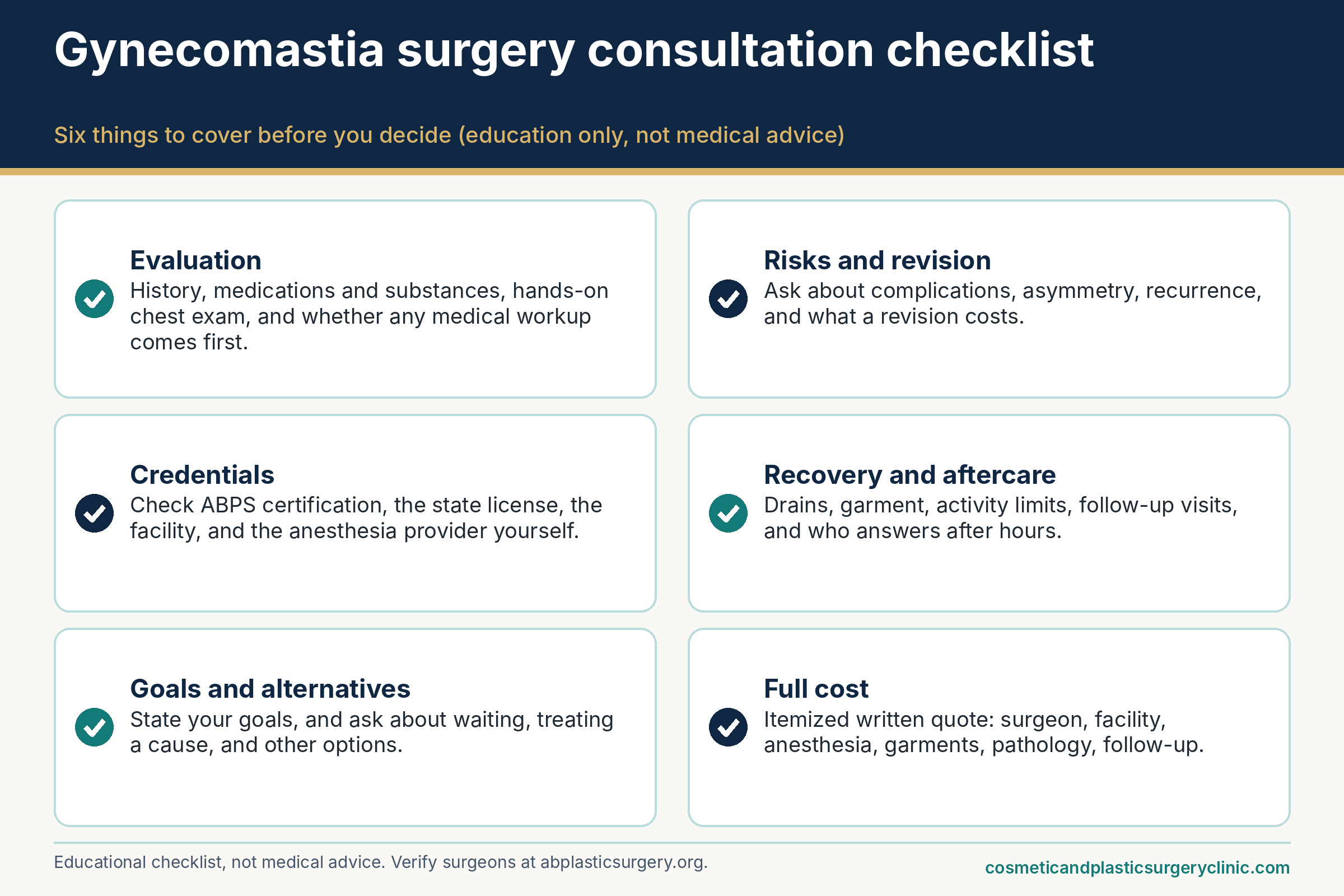
Verifying Credentials, Facility, and Anesthesia Before You Commit
Credential checks are the most objective part of choosing a surgeon, and they are also the part that costs nothing and takes minutes. The goal is not to distrust the person in front of you. It is to confirm the facts that a polished office, a friendly coordinator, or a photo gallery cannot confirm for you. Do these checks before you pay a surgical deposit, and ideally before you attend the visit, so that the consultation time goes to judgment rather than to basics.
Verifying the Surgeon
Three separate things are usually blurred together when people talk about a surgeon’s “credentials”: board certification, a state license, and everything else (society memberships, hospital affiliations, years in practice, awards). Treat them as distinct and verify each on its own.
ABPS board certification and the state medical license
The American Board of Plastic Surgery (ABPS) runs a public verification page where you can search by surgeon name or by location. According to ABPS, board certification is a voluntary credential, certificates issued since 1995 are valid for ten years and are renewed through continuing self-assessment and practice improvement, and if a state medical board reports disciplinary action against a certified surgeon, the verification result shows an alert pointing to the Federation of State Medical Boards (FSMB). The page also notes that physicians can hold certifications in other specialties, and it points to the American Board of Medical Specialties (ABMS) directory for those.
ASPS adds context that helps you read a surgeon’s marketing. It says a plastic surgeon certified by ABPS (or by the Royal College of Physicians and Surgeons of Canada) has completed at least six years of surgical training after medical school, including at least three years of plastic surgery residency, and passed comprehensive exams. It also states that no ABMS-recognized certifying board has “cosmetic surgery” in its name and cautions patients about other official-sounding boards and certifications. In practice, that means a certificate on the wall from a body you have never heard of is a prompt to look it up, not a substitute for the ABPS check. Our guide to verifying a plastic surgeon’s ABPS board certification walks through the lookup, and the ABPS verification page is where you run it.
The state license is a separate lookup. State medical boards license physicians and handle complaints, and the FSMB maintains a directory of boards with contact details for every state and territory; it also describes a consumer tool, DocInfo, for learning about a physician. A license shows that a physician is permitted to practice medicine in that state. It does not show training in plastic surgery, and a license in good standing is the minimum, not the credential that distinguishes one surgeon from another. When you look up the license, note the name exactly as it appears so you can match it to the ABPS result, and check for any public disciplinary actions the state board lists.
Be precise with your own language when you ask. “Are you board certified?” invites a yes that may refer to a different specialty. “Are you certified by the American Board of Plastic Surgery, and may I look up your certificate before I book?” leaves no room for a vague answer, and the response itself is information.
Experience, hospital privileges, and who does what
Experience is harder to verify, but it is fair to ask about. Useful versions of the question are: how often do you perform gynecomastia surgery, what techniques do you use for tissue like mine, and what do you do when results are less than planned? A number by itself, such as a count of cases per year, tells you less than the way the surgeon talks about the cases that did not go as expected. You cannot check a surgeon’s self-reported volume from the outside, so treat it as context, not proof.
Hospital privileges deserve a careful, honest framing. Privileges are granted by an individual hospital, and what a surgeon holds depends on that hospital’s own credentialing process; the ASPS page on choosing a surgeon does not discuss them, so we are not citing a standard. It is still a legitimate question, because it can bear on what happens if an operation or a recovery goes badly: if you needed to be admitted, would your surgeon be able to follow your care, or would a stranger? Ask which hospital the surgeon is affiliated with, whether they hold privileges to perform this procedure there, and what the practice’s relationship is to that hospital in an emergency.
Finally, ask who does what. Many practices use a team: a nurse practitioner or physician assistant may run the intake, a coordinator may present pricing, and an assistant may help in the operating room. None of that is unusual. What you want to confirm is that the surgeon personally examines you, personally performs the operation or the critical portions of it, and personally oversees your follow-up. If your consultation was with someone other than the surgeon, ask when you will meet the surgeon and whether you can do so before paying a deposit.
| Check | What it tells you | What it does not tell you | Where to verify |
|---|---|---|---|
| ABPS board certification | Completed plastic surgery training and passed exams; current certification status; alerts about state board actions | Skill with gynecomastia specifically, bedside manner, outcomes | ABPS public verification page |
| State medical license | Permitted to practice medicine in that state; public board actions, where listed | Specialty training in plastic surgery | The state medical board, via the FSMB directory |
| Society membership (for example, ASPS) | Belongs to a professional organization with its own membership requirements | Not the same as board certification; verify each separately | The society’s own member directory |
| Facility accreditation or license | The surgical facility has been reviewed by an accrediting body, is state licensed, or is Medicare certified | The surgeon’s qualifications; the quality of any one operation | The accrediting body’s directory (for example AAAHC or QUAD A), state licensing agency, or the facility itself |
| Hospital privileges | The surgeon has been credentialed by a specific hospital for specific procedures | Varies by hospital; not a universal standard | Ask the practice, and ask the hospital’s medical staff office if needed |
| Anesthesia provider credentials | Who will provide anesthesia and under what supervision | How the team handles an emergency in this specific facility | Ask for the name and credential; look them up with the relevant state board |
Verifying the Setting and the Anesthesia Team
Surgeons get most of the attention, but the room and the people around the surgeon matter just as much when something unexpected happens. Verification here is a matter of asking for names and then looking them up yourself.
Facility accreditation, licensing, and emergency planning
ASPS recommends that procedures be performed in accredited, state-licensed, or Medicare-certified surgical facilities. Those are three different routes, and a facility may satisfy one or more. Accreditation comes from private organizations that inspect facilities against published standards. AAAHC says it accredits ambulatory surgical settings, including office-based surgery, and maintains a directory of accredited organizations. QUAD A describes itself as a nonprofit that accredits office-based surgical facilities and offers a searchable list of accredited facilities. Other accrediting bodies exist as well. Ask the practice which one applies, ask for the facility’s exact name, and run the lookup yourself rather than relying on a logo on a website.
Three settings are common: a hospital operating room, a freestanding ambulatory surgery center, and a surgeon’s own office-based operating room. The setting itself is not a verdict on quality. The question is whether the facility is accredited, licensed, or certified, whether it is staffed and equipped for the anesthesia being planned, and what happens if you need a higher level of care. Ask where you would be taken, how far it is, whether there is a written transfer arrangement, and who stays with you overnight if you recover at the facility. A surgeon who answers promptly and specifically is usually one who has thought about it before.
The same logic applies to the overnight and after-hours period. Problems of the kind that matter after gynecomastia surgery, such as a fast-growing swelling or a fever, can appear after you have gone home. Ask who answers the practice phone at 2 a.m., whether it is the surgeon, a covering surgeon, or an answering service, and how quickly you could be seen. We discuss specific warning signs in the gynecomastia surgery risks and complications guide.
The anesthesia provider and the safety routine
ASPS lists intravenous sedation and general anesthesia as the usual options for gynecomastia surgery, with the surgeon recommending whichever suits the patient. Whichever is planned, ask four things: who will provide it, what that person’s credential is, whether they work independently of the surgeon, and whether they will meet you or speak with you before the day of surgery. In the United States, anesthesia may be provided by a physician anesthesiologist, by a nurse anesthetist, or by a team that includes both; the details of supervision differ by state and setting, so ask rather than assume. A vague answer, such as “we have someone who handles that”, is a red flag. Our plastic surgery anesthesia guide covers the topic more fully.
Ask also about the safety routine in the operating room. The World Health Organization’s Surgical Safety Checklist is a 19-item tool built around three pauses: before anesthesia (sign in), before the incision (time out), and before the patient leaves the room (sign out). WHO states that it was developed to reduce errors and improve teamwork and communication. Not every facility uses that exact document, so the question is not “do you use the WHO checklist?” as a test of knowledge but a prompt: what structured verification does your team perform before the incision?
The consent discussion belongs here too. The American Medical Association’s Code of Medical Ethics describes informed consent as a conversation in which a physician explains the diagnosis, the purpose of the recommended intervention, and the burdens, risks, and expected benefits of the options, including not treating, and documents it. A form handed to you at the front desk five minutes before surgery is not that conversation. Ask to see the consent forms before the day of surgery, take them home, and bring your questions back.
The Gynecomastia Surgery Consultation Question Bank
This is the core of the playbook. The questions below are organized by topic so you can scan for the ones that matter to you, and they are written to elicit explanations instead of yes-or-no answers. You do not need to ask all of them. Pick the ten or twelve that reflect your own worries, write them down, and ask the surgeon to answer in their own words. Pay attention to whether answers are specific to your chest or generic enough to be given to anyone.
Two habits improve the quality of answers. First, ask the same question in a slightly different form later in the visit; consistent answers are reassuring, and inconsistent ones are worth noticing. Second, ask for important answers to appear in writing, in the treatment plan or the quote, rather than relying on conversation alone. You can say it without suspicion: “I’d like to be able to refer back to this, could you put that in the plan?”
Questions About the Plan Itself
The first group covers what the surgeon would do, how, and why that approach rather than another. ASPS describes the major building blocks as liposuction for fatty tissue, excision for glandular tissue or extra skin, and a combination of the two, along with options for reducing the areola or repositioning the nipple when needed. Your job in the consultation is to find out how those building blocks apply to your chest.
Technique rationale, anesthesia, and setting
The most revealing question is also the simplest: “Why this approach for me?” A strong answer ties the plan to what the surgeon found on exam, for example the proportion of firm tissue, the amount of extra skin, and the quality of the skin, and acknowledges alternatives. A weak answer recites a brand name or says that this is how the practice does everything. Follow up with: “What would make you change the plan, either before surgery or once you are in the operating room?” It is normal for a plan to have contingencies, such as adding excision if liposuction alone does not address firm tissue, and you should hear and understand them in advance and consent to them in writing.
If the surgeon uses a named or branded technology, ask what it is expected to add, what the evidence for it is, and whether there is an added fee. Some are well established as tools; others are marketing labels for variations on liposuction. Our overview of gynecomastia surgery alternatives and guide to combining gynecomastia surgery with other procedures cover how options compare and what combining adds.
On anesthesia and setting, you will have verified the facts already. In the consultation, ask how the type of anesthesia was chosen for you, what the plan is if you do not tolerate sedation well, and how long you should expect to be at the facility. If the plan also includes procedures on other body areas, ask how that changes anesthesia time and recovery, and whether the surgeon would stage the operations instead.
Scars, drains, garments, and the first weeks
Ask the surgeon to show you, on your own chest, where the incisions would be. Liposuction uses small incisions for the cannula; excision of gland commonly involves an incision at the edge of the areola; larger skin removal leaves longer scars. ASPS notes that incision patterns vary with the extent of correction. Scar quality varies with skin type, healing, and tension, and no one can promise how a scar will look, so ask how the surgeon manages scars and what the plan is if they become thick or discolored. Our gynecomastia surgery scars guide goes deeper on location and healing.
ASPS says bandages and an elastic support garment are typical after surgery and that a small, thin tube may temporarily be placed under the skin to drain extra blood or fluid. So the practical questions are: Do you expect to use drains for me? Who removes them and when? How long will I wear the garment, and is it provided or billed separately? Can I shower, and when? Who will teach me or a helper to care for drains if they are used? These are the details that determine whether the first week feels manageable.
Then ask about the calendar in the most concrete terms you can. When can I drive, return to a desk job, return to physical work, lift, and resume chest and upper-body training? ASPS notes that restrictions are given individually and that the surgeon should clarify them, which is a reminder that any number you read online, including in our return-to-work guide, is a starting point for this conversation and not a substitute for it. Ask the surgeon to describe a typical week-by-week sequence and what makes someone slower or faster.
| Topic | Questions to ask | What a helpful answer includes | Cause for a second look |
|---|---|---|---|
| Technique rationale | Why this approach for my tissue? What alternatives did you consider? What would change the plan? | Links the plan to exam findings; names trade-offs and contingencies | One method for everyone; no mention of alternatives |
| Anesthesia | Who provides it, and with what credential? Sedation or general, and why? Will I meet them beforehand? | A named provider and a clear reason for the type chosen | “We have someone”; no pre-op contact |
| Facility | What is the name and accreditation of the facility? Where would I go in an emergency? | Exact name, accrediting body or license, transfer plan | Reluctance to name the facility or its status |
| Incisions and scars | Where will the incisions be? How long? How are scars managed? | Shows locations on your chest; explains variability | Promises about invisible scars |
| Drains and garments | Will I have drains? Who removes them? How long is the garment worn, and is it included? | A plan tailored to your technique; clear care instructions | No plan, or “we’ll see” with no criteria |
| Recovery calendar | When can I drive, work, lift, and train? What slows recovery? | A sequence with ranges and criteria, not a single date | Fixed dates for everyone; “back to normal in days” |
| Combined procedures | If I add another area, how does time, risk, and recovery change? | Honest discussion of total anesthesia time and staging | Pressure to add procedures |
Questions About Results, Risks, and Aftercare
The second group of questions is the one that many patients skip, because it feels pessimistic. It is not. Asking how a surgeon handles problems tells you more about their practice than asking how they handle uneventful outcomes.
Recurrence, asymmetry, revision, complications, and follow-up
Start with what results can realistically look like. ASPS says outcomes are typically permanent but that results may reverse if the original cause involved prescription medications, drugs, or steroids, or if weight is gained, and the cause is not eliminated or controlled. So ask: what could cause the problem to return in my case, what can I do to lower that chance, and what would you do if it did? The guide to how long gynecomastia surgery results last covers the evidence on longevity.
On asymmetry and contour, it helps to know that both are on the ASPS list of potential problems, alongside bleeding, infection, fluid collection, fat necrosis, poor healing, changes in sensation, and, rarely, injury to deeper structures. Ask: what level of asymmetry is expected, how do you decide whether something needs correction, and how long do we wait before deciding? Surgeons often wait for swelling to settle before judging a result, but how long they wait, and what they consider a meaningful problem, are things to hear in advance.
Revision policy deserves its own few minutes. The questions that matter: What do you count as a revision? Is there a window of time? Is the surgeon’s fee waived, reduced, or charged again? Are the facility and anesthesia fees charged separately? Is any of this written in the consent or the quote? ASPS notes that adolescents who have surgery before breast development has stabilized may need secondary procedures, which is one illustration of why revision terms should not be an afterthought. Practices differ widely on how they handle these costs, so the answer for one practice tells you nothing about another.
For complications, ask the surgeon to walk you through what happens if you develop a hematoma, an infection, or a fluid collection. Who evaluates you, where, and how quickly? Who pays for treatment of a complication, including facility costs, if you need to return to the operating room? And what symptoms should prompt an immediate call? ASPS specifically lists shortness of breath, chest pain, or an unusual heartbeat as reasons to seek urgent medical attention. Finally, ask about follow-up: how many visits are scheduled, over what period, and whether they are included in the quote. ASPS describes regular follow-up appointments as an essential part of recovery.
Photos of comparable cases and the pathology question
Asking to see photographs of patients with a similar tissue type and size is reasonable and common. What you do with those photographs is where caution applies. A gallery is a selection made by the practice. It can show style and typical contour, but it cannot predict your outcome. Check that photos are of the surgeon’s own patients, that they were taken with consistent angles, lighting, and posture, and that the time since surgery is stated. Ask what portion of patients had results like those shown and what the less favorable results looked like. Be cautious about images that look retouched, show only one angle, or lack follow-up time. Our guide to evaluating gynecomastia before-and-after photos offers a fuller framework.
Patient photographs are also medical information. Ask whether your own photographs will be used for marketing, and decline if you prefer. Consent for clinical photography and consent for public display are separate questions, and a practice should treat them separately in writing.
The pathology question, discussed earlier, belongs on your list for the surgical plan too: will removed tissue be examined, who reviews the result, and how will you receive it? Together with the photo questions, it rounds out a set of queries that shows you whether the surgeon is comfortable being asked.
| Topic | Questions to ask | Why it matters |
|---|---|---|
| Recurrence | What could cause the tissue to return for me? What can I do to lower the chance? | Results can reverse if medications, drugs, steroids, or weight gain continue to act (ASPS) |
| Asymmetry and contour | What differences between sides are expected? How long do you wait before judging? | Sets expectations and avoids reacting to early swelling |
| Revision policy | What counts as a revision, what is the window, and what fees apply? | Secondary procedures can occur; fee rules vary by practice |
| Complication management | What happens if I develop bleeding, infection, or a fluid collection? Who pays for treatment? | Clarifies cost and access if something goes wrong |
| Emergency plan | Where would I go, who would I call, and who answers after hours? | Some problems need rapid evaluation |
| Follow-up schedule | How many visits, over what period, and are they included? | Follow-up is part of safe recovery (ASPS) and part of the true cost |
| Comparable photos | Are these your patients? How long after surgery? What did less favorable results look like? | Galleries are curated and cannot predict individual results |
| Pathology | Will tissue be examined? Who reviews it, and how will I be told? | Surgeons differ; a small series supports routine examination |
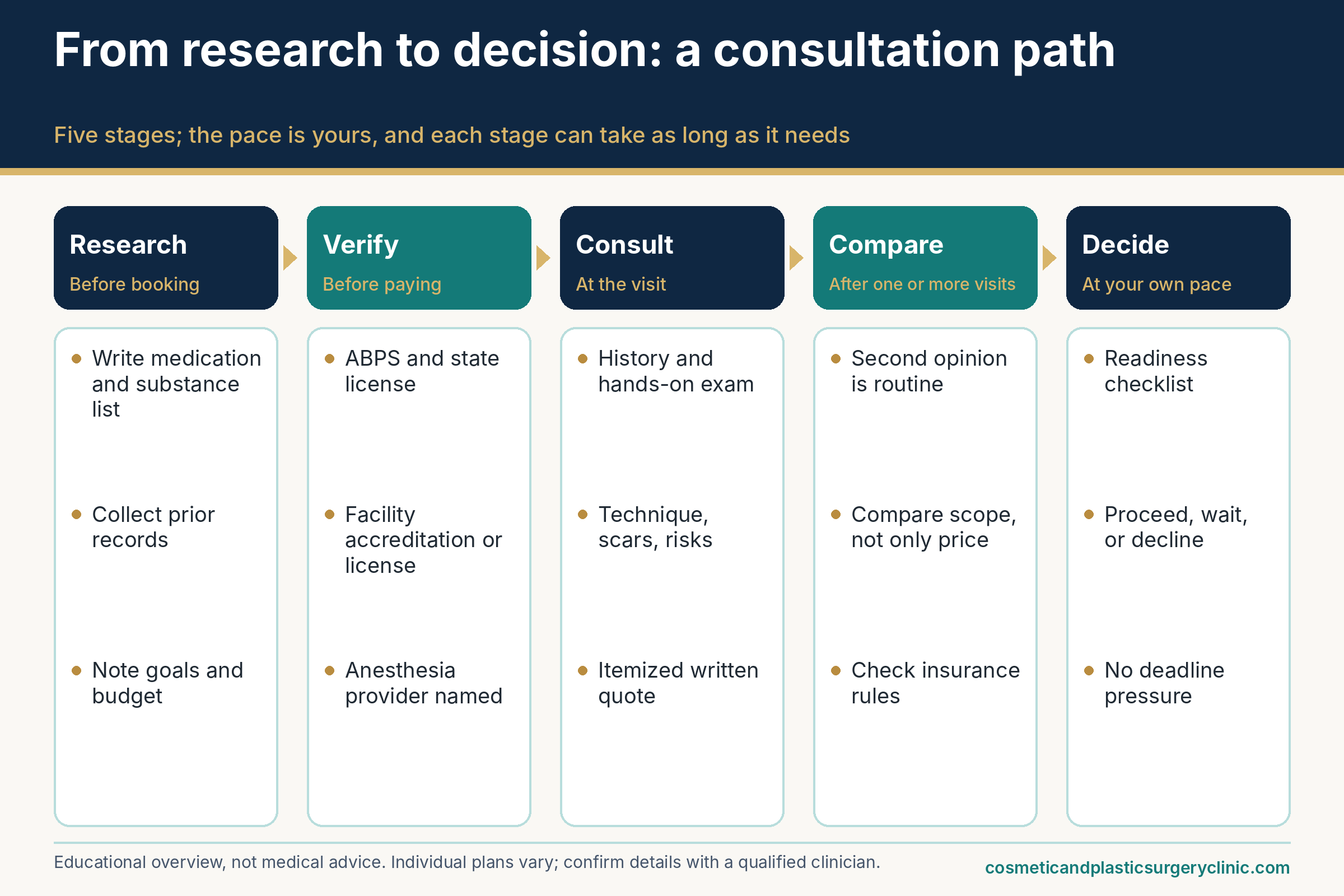
Reading the Quote: Itemized Costs, Insurance, and Pre-Authorization
Money is where consultations most often become confusing, because the number you hear first is rarely the number you pay. The goal of this section is not to tell you what male breast reduction should cost; that depends on geography, technique, setting, and extent, and our gynecomastia surgery cost guide covers the landscape. The goal is to help you leave the consultation with a document you can compare line by line, and with a clear sense of whether insurance is a realistic path.
Getting an Itemized, Comparable Quote
A quote that says “gynecomastia surgery: one total” is a number without a scope. The sections below describe how to ask for something more useful and how to understand what you receive.
The line items that belong in a written quote
ASPS draws the first and most important distinction. Its cost page states that the average it reports is the surgeon’s fee and does not include anesthesia, operating room facilities, or related expenses, and its 2024 fee summary lists a projected range of $5,000 to $9,000 for male breast reduction, built from averages submitted by surveyed ASPS member surgeons. The ASPS cost page reports its average without a statistics year in the text we reviewed. Neither figure is a quote, a typical total, or a price you should expect to be offered. They matter here for one reason: they show that surgeon fees are only one component, and that other components are billed on top.
Ask the practice to list each component separately, and to say which are included, which are billed by someone else, and which are estimates. The usual categories are the surgeon’s fee, the facility fee (operating room, recovery room, nursing, supplies), the anesthesia fee, preoperative testing, pathology if tissue is sent to a lab, the compression garment and other supplies, prescriptions, postoperative visits, and any charges tied to a revision or a complication. Ask who bills each one. If the anesthesia professional is an independent contractor, the bill may arrive separately, and you should know that before the day of surgery.
Ask what happens to the price if the plan changes. Perhaps liposuction alone proves insufficient and the surgeon adds excision, or the operation takes longer than scheduled and anesthesia time increases. Some practices quote a fixed price for a defined scope; others bill by time or by extent. Neither is wrong, but you should know which you are being offered and what “scope” means in writing. Ask also what is excluded: travel, time off work, extra garments, scar treatments, and follow-up care outside the postoperative window are common items that sit outside a quote.
Use the same list when you request a second quote so that you can compare the two on a like-for-like basis. A cheaper quote that excludes anesthesia and the facility is not cheaper; it is incomplete. The table below turns the list into a worksheet you can fill in at or after the consultation.
| Quote item | What to ask | Why it can differ between practices |
|---|---|---|
| Surgeon’s fee | Is this a flat fee for the planned scope? What changes it? | Experience, technique, and region affect fees (ASPS) |
| Facility fee | Who bills it, and what does it cover? | Hospital, surgery center, and office-based settings structure charges differently |
| Anesthesia fee | Is it billed by the practice or a separate group? Is it time-based? | Type of anesthesia and the provider arrangement vary |
| Preoperative testing and clearance | Which tests are needed, and who pays? | Depends on health history and facility policy |
| Pathology | Will tissue be sent, and is the lab fee included? | Practices differ on routine pathology |
| Garments, supplies, prescriptions | What is provided, and how many garments? | Bundled in some quotes, separate in others |
| Follow-up visits | How many, over what period, and are they included? | Duration of included care varies |
| Revision and complication costs | What is covered, for how long, and which fees (surgeon, facility, anesthesia) apply? | Policies are set by each practice and facility |
| Deposits, cancellation, and payment terms | What is refundable, and when? Is there a financing fee or interest? | Payment arrangements and lenders differ |
Deposits, good faith estimates, and financing
If you are paying yourself, rather than billing insurance, federal rules give you a tool that many people do not know about. The Centers for Medicare & Medicaid Services (CMS) says that, usually, if you do not have or use health insurance, providers must give you a good faith estimate of what your care will cost when you schedule services at least three business days in advance or ask for one, and that you may be able to dispute a bill that is at least $400 more than the estimate. The CMS page does not spell out every detail of what the estimate must include, so confirm the specifics with the practice, but the principle is useful: you can ask in advance for an estimate in writing, and you can hold the final bill up against it.
Deposits are normal in elective surgery, but their terms deserve a careful read. Ask how much the deposit is, what it secures (a date, a facility slot, the surgeon’s time), whether it is applied to the final bill, and under what conditions it is refundable, such as a medical reason for postponement, a clearance problem, or your decision to change course. Terms are set by the practice, and cancellation windows vary. Get them in writing before you pay.
On financing, ASPS says many plastic surgeons offer patient financing plans. Ask who the lender is, what the interest rate and any fees are, whether interest is deferred and what triggers it, and what happens if you need a revision. Third-party health financing products work differently from a bank loan, and a low monthly payment can hide a large total cost. If a financing offer arrives with a time limit, that is a reason to take a day, not a reason to hurry.
Insurance, Pre-Authorization, and Realistic Expectations
Most men who pursue gynecomastia surgery are told it is cosmetic, but the picture is less uniform than that. It is worth understanding how coverage decisions are made before you assume either answer.
What coverage criteria look like in practice
ASPS states that, in most cases, correction of gynecomastia is not eligible for insurance coverage, though policies vary, and that it has published criteria for reconstructive cases that patients can submit to insurers. Those criteria, approved by the ASPS Board of Directors in March 2002, describe persistence of the condition after pathological causes have been excluded, a complete history and examination with appropriate testing before surgical consultation, symptoms such as pain or discomfort, and documentation beyond photographs. The document is more than two decades old and reflects one society’s position, not a rule that insurers must follow.
Insurers write their own policies, and they differ. Aetna’s clinical policy bulletin on gynecomastia surgery, last reviewed March 12, 2026, classifies breast reduction, mastectomy, or liposuction for gynecomastia as cosmetic and notes insufficient evidence that surgery relieves pain better than conservative management. A Blue Shield of California policy effective September 1, 2026 sets criteria that include age (older than 18, or 18 months past puberty, whichever is earlier), a grade of II through IV, confirmation of glandular tissue, evaluation of reversible causes, and anterior and lateral photographs. These are two examples from two insurers at two moments, and a plan’s actual coverage depends on your specific plan documents and your state. Policies are revised over time, so what you read here may not match the version that applies to you.
| Source | What it says in summary | Date or version | Caveat |
|---|---|---|---|
| ASPS cost page | In most cases gynecomastia correction is not eligible for coverage; policies vary | Current page, accessed October 2026 | General statement, not a plan-specific rule |
| ASPS recommended criteria | Persistence after workup, symptoms, documentation beyond photos; separate criteria for adolescents and adults | Approved March 2002 | Professional-society recommendation; old; insurers are not bound by it |
| Aetna clinical policy bulletin 0017 | Treats gynecomastia surgery as cosmetic; conservative management first | Last review March 12, 2026 | One insurer; your Aetna plan may have its own terms |
| Blue Shield of California policy | Criteria include age, grade II to IV, glandular confirmation, evaluation of reversible causes, and photos | Effective September 1, 2026 | One insurer in one state; criteria differ elsewhere |
Pre-authorization steps, denials, and avoiding surprises
If you want to find out whether insurance might apply, do it before you schedule surgery, not after. Start by asking the practice whether it bills insurance for gynecomastia, whether it participates in your plan’s network, and what documentation it would submit. Then call your insurer or check your plan documents for the coverage policy on gynecomastia surgery, and ask whether pre-authorization is required. Ask for the policy by name and number, because a summary from a phone representative is less reliable than the document itself.
Typical documentation, based on the policies above, includes a clear history and examination, evaluation or treatment of reversible causes, symptom documentation, and standardized photographs. That is another reason the pre-visit preparation matters: a good timeline and prior records can support a request if you pursue one. Pre-authorization generally means the insurer has agreed that a service meets its criteria, and it is not by itself a promise that every related bill will be paid, so ask what remains your responsibility, including facility, anesthesia, and pathology charges.
If a request is denied, ask for the denial in writing, including the reason and the appeal process and deadlines, and ask the practice whether it will support an appeal. Do not let an insurer’s deadline or a practice’s openings push you into a decision you have not made. If coverage is not available, you can still decide whether a self-pay route makes sense; the itemized quote and good faith estimate become your tools. And if the plan is to submit to insurance, tell the surgeon, because what is photographed, written, and documented at the consultation may differ from a purely cosmetic visit.
Red Flags, Second Opinions, and Comparing Two Surgeons
By this point you have a plan, a quote, and a set of answers. The next question is whether the consultation itself told you something about the practice. How a surgeon behaves when you are asking questions is data. This section covers what to treat as warning signs, how a second opinion works, and how to compare two surgeons without relying on gut feeling alone.
Red Flags During a Gynecomastia Consultation
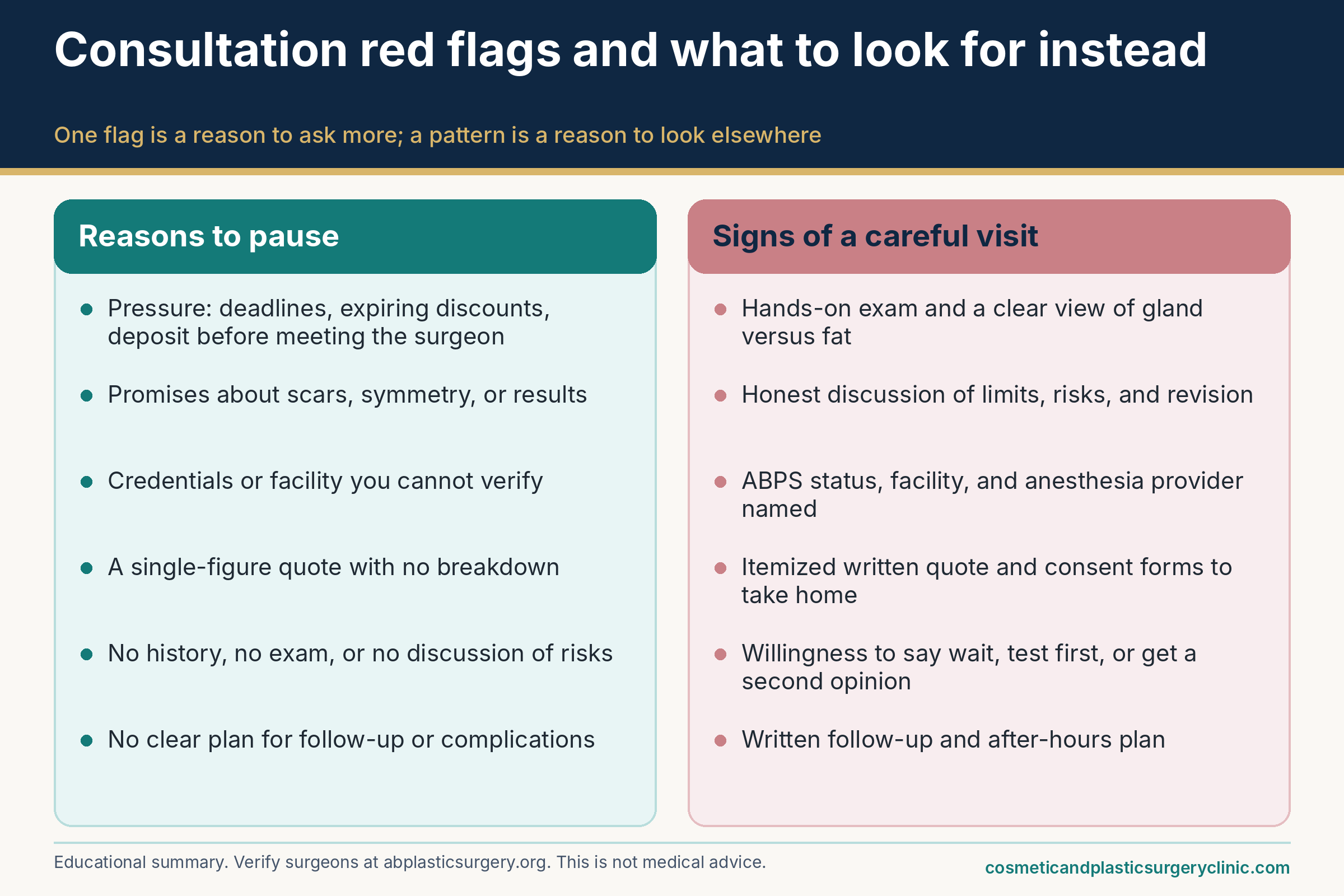
One red flag is a reason to ask more questions, not proof of bad care. A pattern of them is a reason to leave and keep looking. It also helps to remember that red flags describe behavior, not people: a rushed coordinator or a clumsy pricing sheet may reflect a busy office rather than poor surgical judgment, but you are entitled to take them into account.
Pressure, promises, and shortcuts on the money side
Pressure takes many forms. Time-limited discounts, a “this slot won’t be available” script, requests for a deposit before you have met the surgeon, and suggestions that you should decide today are all attempts to compress your decision time. Elective surgery has no medical deadline of that kind. If a date is limited by real scheduling, the practice should be able to tell you simply what the next opening is, and a legitimate one will not penalize you for taking it.
Promises are the next category. No clinician can truthfully tell you how a scar will look, how symmetrical your chest will be, how a specific result will feel, or that you will never need another procedure. Phrases such as “you’ll be back at the gym in a week” or “this will definitely fix it” are a mismatch with how the medical literature and ASPS describe the procedure: recovery is individualized, results can change with medications, steroids, or weight, and secondary procedures sometimes occur. A surgeon who is honest about uncertainty is giving you a better signal than one who is not.
On the money side, watch for quotes that arrive as a single figure with no breakdown, a reluctance to put anything in writing, financing offered as the main selling point, and add-ons presented as necessary without explanation. Also watch for a plan that changes depending on what you say your budget is. A technique recommendation should follow from your tissue, not from your wallet.
Gaps in the medical conversation and in verification
The more serious flags are medical. No review of your medications or substance use, no hands-on exam, no discussion of whether the tissue is glandular or fatty, no question about how long it has been there, and no mention of risks beyond a reassurance that complications are rare are all signs that the visit is not an evaluation. Equally concerning is a surgeon who dismisses a symptom that deserves attention, such as a firm one-sided lump, skin change, or nipple discharge, with “that’s just gynecomastia.” Those need evaluation first.
Gaps in verification count too. If the practice cannot tell you who will provide anesthesia, will not name the facility, cannot explain its accreditation or license, or points to a certificate from a board you cannot verify, that matters. ASPS cautions about official-sounding boards, and a clear answer to “may I check your ABPS status?” takes five seconds. Another flag is a surgeon who discourages you from getting a second opinion or who reacts defensively to questions about complications and revision policy. A long list of promises with a short list of risks usually signals a practice optimized for booking, not for informed consent.
It is worth saying what the opposite looks like, because many consultations are good ones. A well-run visit includes a hands-on exam, direct explanation of limits, honest discussion of trade-offs, written materials, an itemized quote, and a surgeon who tells you when waiting, a medical workup, or a different option might be better. If a surgeon says that surgery is not the right next step for you right now, that is not a failed consultation. It may be the most valuable thing you hear.
Second Opinions and Comparing Two Surgeons
Seeking a second opinion is routine in elective surgery, and surgeons who regularly do this work expect it. It does not signal distrust or indecision. It is simply how you learn whether an unfamiliar recommendation is mainstream or unusual. Our guide to second opinions in plastic surgery covers the general process; the practical points specific to gynecomastia follow.
How to get a second opinion without starting over
Start with records. The U.S. Department of Health and Human Services explains that you have a right to a copy of your medical records, that providers may charge reasonable copying and mailing costs but not search and retrieval, and that they cannot withhold records for an unpaid bill. Request the notes from your first consultation, any test results, and the written treatment plan and quote. If the first practice took clinical photographs, ask for copies. Bring your own timeline, medication list, and a short list of what concerned you about the first visit.
You can tell the second surgeon what the first one recommended, or you can ask for an independent assessment first and share the other plan afterward. Both are fine. The second approach can reveal whether two surgeons independently reach the same conclusion about your tissue, while the first gives the second surgeon context to respond to. Either way, explain what you are trying to learn, such as whether a different technique makes sense, whether a medical workup should come first, or whether the price and scope are reasonable.
Be prepared for differences. Techniques overlap, and clinical reviews describe a range of reasonable approaches, so two competent surgeons can propose different plans. When they do, do not count votes. Ask each to explain why they favor their approach, what trade-offs they see, and what they would do if they were wrong. If a difference stems from different assessments of your tissue (one says mostly glandular, the other says mostly fatty), ask whether imaging or another exam would resolve it. For medical questions, such as a possible hormonal contributor, a primary care clinician or endocrinologist may be the better second opinion than another surgeon. Some practices charge a consultation fee; ask when you book so the fee is not a surprise.
A framework for comparing two surgeons
It helps to treat the comparison in two stages. The first stage is a gate: credentials, license, facility, and anesthesia provider. If either surgeon does not clear verification, the comparison is over, no matter how appealing the price or the photos. The second stage compares the rest, and here it is easy to over-weight what is easy to measure, such as price, while under-weighting what matters more, such as the quality of the evaluation, the clarity of the plan, and the handling of complications.
Try this sequence. Score each surgeon, honestly and privately, on how well they explained your tissue and your options, how specifically they answered your questions, how comfortable you felt asking about problems, how complete and clear the quote was, and how confident you feel about the aftercare. Then look at the total cost, not the surgeon’s fee alone. If one surgeon is much cheaper, find out why: a smaller scope, a different facility, fewer follow-up visits, or no coverage for revisions may explain it. If one is much more expensive, find out what the difference buys. Neither low nor high price is a sign of quality.
Finally, factor in logistics: travel distance for follow-up visits, availability in the early postoperative period, and how well each practice communicates. A surgeon who is excellent but two time zones away may be a worse fit if you will need frequent early visits. The table below outlines the comparison.
| Dimension | What to compare | How a difference might matter | Common trap |
|---|---|---|---|
| Verification (gate) | ABPS status, state license, facility accreditation, anesthesia provider | A failed check ends the comparison | Accepting a logo or a verbal assurance |
| Quality of evaluation | History, exam, tissue assessment, workup advice | Shapes whether the plan fits your anatomy | Equating a quick visit with efficiency |
| Plan fit and clarity | Technique rationale, scars, drains, contingencies | Differences may reflect different tissue assessments | Choosing the plan with the fewest scars without asking about trade-offs |
| Handling problems | Complication plan, revision terms, after-hours coverage | Determines cost and access when things go off-plan | Never asking, because it feels negative |
| Total cost and terms | Itemized quote, deposit and cancellation terms, included visits | Different scopes make headline prices incomparable | Comparing only the surgeon’s fee |
| Communication and trust | Responsiveness, tone when asked about risks | Matters in the weeks after surgery as much as before | Being persuaded by charm or confidence alone |
| Logistics | Distance, scheduling, follow-up access | Affects how easily you can be seen early | Ignoring travel for follow-up visits |
Teens, Parents, and Body-Image Sensitivity in the Consultation
Two situations change the shape of a gynecomastia consultation more than any other: when the patient is a teenager, and when the emotional weight of the condition is a large part of the story. Both deserve their own treatment, because the questions are different and the stakes of getting the conversation wrong are higher.
Adolescents and Their Parents
Breast enlargement during puberty is common, and it often resolves without treatment. That single fact shapes almost everything about how a thoughtful clinician approaches a teenager’s consultation, and it is why many adolescents leave a first visit with a plan to watch and return rather than a surgical date.
Stability, maturity, and consent
A 2017 review in Acta Biomedica describes pubertal gynecomastia as the most common form of breast swelling in adolescent males and reports that 75 to 90 percent of cases resolve spontaneously, typically within one to three years. The Mayo Clinic gives a somewhat shorter window for puberty-related enlargement, usually resolving within six months to two years. Sources differ on the exact range, and individual courses vary, which is itself a reason surgeons often prefer to observe first. The Acta Biomedica authors add that surgery is reserved for special circumstances and that the two anti-estrogen medications sometimes discussed are not officially approved for gynecomastia because their risks and benefits have not been fully studied.
ASPS says breast development must stabilize before surgery and that adolescents may benefit from surgery, although secondary procedures may be needed if development continues. An insurer example points in the same direction: the Blue Shield of California policy cited earlier requires a patient to be older than 18 or at least 18 months past puberty, whichever is earlier. So the questions to ask are direct. How does this surgeon judge that development has stabilized? How long do they typically observe? What would change the timing, such as significant distress, pain, or a medical finding? And what does the surgeon recommend for a teenager who is still growing?
Consent works differently for minors. In general, a parent or legal guardian gives permission for surgery on a minor, and good practice also seeks the teenager’s own agreement, often called assent. Rules differ by state and by facility, so ask the practice what it requires. The AMA’s description of informed consent as a dialogue, in which risks, benefits, and alternatives including not treating are explained and the patient’s understanding is assessed, applies with extra force here. A teen who is nodding along while a parent talks has not been consulted.
Ask whether part of the visit can be one-on-one with the teenager. Many teens will not say what they actually feel in front of a parent, whether that is how much the condition bothers them, whether the pressure to have surgery comes from home, or whether they are hoping surgery will fix something else. It is reasonable for a parent to request this, and a practice comfortable with adolescent care will usually be used to it. Maturity matters in the other direction too: surgery requires following restrictions for weeks, wearing a garment, and reporting problems, and the teen has to be part of that plan.
What parents should ask, and what the evidence can and cannot say
Parents often ask whether the operation is worth the risk. A June 2022 study in Plastic and Reconstructive Surgery, described in an ASPS press release, followed 145 males aged 12 to 21 who had persistent gynecomastia unresponsive to weight loss and medication; most were overweight or obese with severe enlargement, and surgery involved 270 breasts. The press release reports that about 10 percent of breasts had early complications, including 7.8 percent with hematoma and 2.2 percent with minor infection, and that at a median follow-up of 8.6 months, 34.3 percent of breasts had at least one complication, including residual tissue (12.6 percent) and contour irregularities (9.2 percent). In a subset of 51 patients followed a median of 33.3 months, self-esteem and quality-of-life measures improved, and the authors concluded that the potential for complications should not limit treatment in younger patients.
Read this carefully. These figures are per breast, not per patient. They come from a single study, summarized in a society press release rather than the full paper, in a group that was selected: mostly overweight or obese teens with severe enlargement. The quality-of-life data come from a smaller subset of patients. The study supports two points at once, that complications and residual tissue are not rare in this group and that many patients reported better quality of life. It does not tell you what will happen to a particular teenager, and a different population, such as a lean teen with mild enlargement, may have a different profile. Ask the surgeon what they tell families about complication and revision, and how their experience compares in a way that is specific to the teen.
Other questions for parents: has a pediatrician or adolescent medicine specialist evaluated the teen for contributing causes, including medications and substances? Has the family considered counseling for distress or for bullying that stems from the condition? What would waiting six or twelve months cost the teen, emotionally and socially, and what would it gain medically? How would surgery fit around sports, exams, and summer? Our guide to the best age for gynecomastia surgery discusses timing factors in more depth, and our candidacy and timing guide covers who may be a good fit.
Mental Health, Body Image, and Decision Pressure
Gynecomastia is a medical condition that happens to be visible, and its emotional weight can be heavy. The consultation is a good place to say so, and a good surgeon makes room for it.
Distress that is real, and the question of what surgery can do
ASPS notes that the condition can cause emotional discomfort and impair self-confidence, sometimes leading men to avoid physical activities and intimacy, and StatPearls lists depression, social isolation, and low self-esteem among its psychological effects. None of this is a character flaw. Wanting to change how your chest looks because it affects your daily life is a legitimate reason to consider surgery.
At the same time, a consultation should explore what you hope surgery will do. Surgery can reduce breast tissue and improve chest contour. It cannot fix a general sense of inadequacy, repair relationships, or ensure that you will feel different when you remove your shirt in public. The Mayo Clinic’s description of body dysmorphic disorder (BDD) is relevant here: BDD involves intense preoccupation with perceived flaws that are minor or not observable by others, with significant distress and repetitive behaviors such as mirror-checking and reassurance-seeking, and Mayo lists muscle tone among common areas of fixation. It adds that cosmetic procedures may bring temporary relief but that the anxiety often returns, and that treatment generally involves cognitive behavioral therapy and sometimes medication.
That is not a suggestion that men with gynecomastia have BDD; most do not, and gynecomastia is an observable, physical finding. It is a reason a careful surgeon may ask about your mood, how much time you spend thinking about your chest, whether the concern extends to other features, and whether you have talked to anyone about it. If you are asked, answer honestly. These questions are meant to protect you from an operation that would not address what is actually wrong. If a surgeon never asks about your goals or emotional state, that is information about the practice.
Supporting your own decision, and where to turn if you are struggling
Take care that the decision stays yours. Pressure comes from many directions: teasing, comparisons on social media, a partner’s offhand comment, an advertisement that frames your chest as a problem. Ask yourself what you would decide if no one else could see your chest. If surgery still seems right, fine. If the honest answer is that you mostly want the teasing to stop, consider addressing that directly as well, and consider talking with a counselor before or alongside a surgical decision.
If you live with significant anxiety, low mood, or avoidance because of your chest, a primary care clinician, therapist, or school counselor can help in parallel to the physical question. They do not compete with surgery, and they often make the surgical decision clearer. If you or someone you know is thinking about suicide or self-harm, the 988 Suicide & Crisis Lifeline is available by call or text to 988, and by chat, at any hour, free and confidential.
For friends and family, the most useful things are to listen and to avoid the reflex to reassure the concern away. “It’s not that noticeable” often lands as dismissal. “Tell me what it’s like for you” opens a conversation. And support an evaluation by a qualified clinician without making surgery the expected outcome.
Deciding, and What to Do After the Consultation
The consultation ends, but the decision does not. This final section is about the days and weeks that follow: how to tell whether you are ready to proceed, how to work through the common situations that make decisions harder, and what to do with the information you collected. A good decision at this stage is not always a yes. Sometimes it is a yes to waiting, a yes to a medical workup, or a yes to a second opinion.
Deciding Whether You Are Ready
Readiness is not a feeling of certainty. Almost no one feels certain about elective surgery, and a sense of unease is not a reason to cancel. Readiness is a set of conditions you can check, and when they are met, any remaining nerves are a normal reaction to a significant decision.
A readiness checklist
Consider whether you can truthfully say yes to each of the following. You have been examined by a clinician who looked at your tissue, reviewed your medications and substances, and told you whether any medical workup should come first. Any contributors, such as a medication or substance, have been discussed with the right people. You have verified the surgeon’s ABPS certification and state license, and you know the facility’s name and its accreditation or licensing and the anesthesia provider. You can explain in your own words why this technique, where the scars will be, what the recovery will involve, and what the main risks are. You have a written, itemized quote and understand revision and complication terms. You have a realistic recovery plan, including time off and help at home. Your goals are your own, and you can say what you would regard as an acceptable result. And no one has pressured you with a deadline.
If one or two of these are missing, that is usually fixable and is a reason to pause for a week, not a reason to abandon the plan. If several are missing, particularly the evaluation, verification, or the written quote, you are not yet in a position to decide, and no appointment date should rush you. Our gynecomastia surgery candidacy guide goes deeper on the medical side of timing, while this checklist focuses on the consultation process.
One more thing to test is stability of your own view. Write down your reasons for and against surgery the night after the consultation, and read them again a week later. If your reasons have changed dramatically, you may have been swayed by the conversation, positively or negatively. If they are stable, they are probably yours.
Illustrative situations that often complicate the decision
The following examples are illustrative, not drawn from any real person or practice, and they are not recommendations. They show how the same consultation tools lead to different next steps depending on circumstances.
Consider a man in his late twenties with firm, tender tissue under both nipples that has been the same size for several years. He has no unusual symptoms and takes no regular medications. For him, the consultation tools are mostly about technique, scars, setting, and aftercare, and the decision is likely to rest on whether the quote, schedule, and surgeon’s approach fit his priorities. Whether his tissue needs any testing is a question for the clinician, and he should ask what would prompt it.
Consider a college student who first noticed enlargement six months ago, shortly after he began a new supplement and a heavier training schedule. The surgeon’s most useful contribution may be to ask about the supplement, suggest a medical review, and recommend observation, with a follow-up visit, before talking about an operation. A student in this position who is told to book immediately, without any questions about the supplement, has been given a reason to seek another opinion.
Consider a man in his forties whose chest has grown with weight gain over a decade, and who is considering a staged approach: weight management first, then reassessment. He may be told that fat responds to weight change and that firm tissue does not, and that the chest after weight loss may look different from the chest now. The question for him is how to sequence decisions without postponing indefinitely, and that is a conversation to have with the surgeon and, ideally, with his primary care clinician.
Finally, consider someone who has used anabolic steroids in the past or is still using them. ASPS indicates that results may reverse if steroids or similar causes continue, and the Mayo Clinic lists anabolic steroids among known contributors. Full disclosure is essential; an honest surgeon will discuss whether to wait, how to plan around continued use, and the effect on anesthesia and recovery. A practice that does not ask about this has not done its job.
| Signal after the consultation | What it may suggest | Reasonable next step |
|---|---|---|
| No history review, no exam, or no tissue assessment | The visit was not a real evaluation | Request a full evaluation or seek another opinion before any deposit |
| Surgeon recommended labs, imaging, or a medical referral | Something in the history or exam warrants checking first | Complete the workup; revisit surgical planning after results |
| Credentials or facility could not be verified | A gate was not passed | Pause; ask for exact names and verify independently |
| Two surgeons proposed different techniques | Different tissue assessments or preferences | Ask each to explain; consider a third opinion on the specific disagreement |
| Quote was a single number, or terms were verbal only | Scope and revision costs are unclear | Request an itemized written quote and the consent forms |
| Tissue is recent or still changing | Observation may be appropriate | Ask about a follow-up schedule and what would change the plan |
| You feel pushed, rushed, or sold to | The practice may not suit you | Step back for at least several days and compare alternatives |
| All checks passed, and you understand the trade-offs | You have the information to decide | Take the decision at your own pace; plan logistics if you proceed |
After the Consultation
What you do in the days after the appointment often matters as much as what happened during it. The information is freshest right away, and the temptation to act on momentum is strongest then, in either direction.
The first forty-eight hours: debrief and documents
Write down what you remember while it is fresh: what the surgeon found, what was recommended, what surprised you, and what you did not understand. Note which questions were answered well and which were deflected. If you were accompanied by someone, compare notes. If you recorded the key points with permission, listen again.
Then gather documents. Ask for the written treatment plan, the itemized quote with its expiration date if any, the consent forms, preoperative instructions, the practice’s policies on revisions, cancellation, and complications, and the clinical photographs taken at the visit. Request copies of your records if you are seeking a second opinion. Confirm any information you were given verbally and want to rely on, such as the facility name, the anesthesia provider, and the follow-up schedule.
Run your own verification if you have not: the ABPS check, the state license, and the facility lookup. If a workup was recommended, schedule it. If you plan to pursue insurance, contact your plan about pre-authorization before scheduling. Our guide to choosing a plastic surgeon offers a broader checklist if you want one.
If you proceed, if you wait, and if you decide not to
If you decide to proceed, the next steps are logistics, and the surgeon’s written instructions are the authority. Typical themes include nicotine, medications and supplements, fasting, transportation, and arrangements at home, but specifics belong to your surgeon and anesthesia team and should be followed as given. Do not adjust a prescription because of something you read online. Arrange time off, a recovery space, and a helper, and review the gynecomastia surgery recovery guide so that the first week does not surprise you. Confirm who to call with questions, and put that number in your phone.
If you decide to wait, record why: tissue that may still change, a workup in progress, a substance you plan to stop, cost, timing, or ambivalence. Set a date to revisit. Waiting is a legitimate decision and does not mean the consultation was wasted. Keep your notes, quote, and photos so that you can compare if you return, and expect that prices and policies may differ later.
If you decide not to have surgery, that is also a complete outcome. Many men find that understanding what the operation involves, or learning that their chest is within the range of ordinary male anatomy, is enough. If the reason is something you can still address, such as cost or fear, you can return to the question later. If it is that the surgeon or the practice did not feel right, trust that and keep looking, or step away. The aim of a consultation is a good decision, whichever way it points.
Frequently asked questions about the gynecomastia surgery consultation
How long does a gynecomastia surgery consultation take?
It varies by practice, and the length of the visit is less important than what it contains. A thorough appointment includes history, an exam, a discussion of options, and time for your questions, and some practices split this across a nurse or coordinator visit and a surgeon visit. Ask when you book how long the surgeon will personally spend with you and whether the visit is in person. If you will be expected to decide or pay a deposit at the end of a short appointment, treat that as a reason to schedule a follow-up conversation instead.
Should I bring someone with me?
Many people find it helpful. A second person can remember details, ask questions you forgot, and notice if you feel pressured. Choose someone you trust to respect your privacy, because the visit involves a chest exam and personal medical history, and tell the practice in advance. For a teenager, a parent or guardian typically attends, and it is reasonable to ask for a portion of the visit one-on-one. If you prefer to go alone, take notes on your phone or ask permission to record key explanations.
Do I need blood tests or an endocrinologist before I see a plastic surgeon?
Not necessarily. Clinical reviews describe testing that is scaled to the history and exam, and some men with long-standing, symptom-free gynecomastia and a normal exam need little or none. Others, particularly if there is recent onset, a testicular finding, or a suspicious breast finding, may be sent for tests first. A primary care visit before the consultation can be a sensible shortcut, because you arrive with results in hand. If you are unsure, ask the surgeon’s office whether they want any testing done in advance.
How many surgeons should I consult before choosing?
There is no required number. Two is a common and reasonable minimum if cost and travel allow, because it lets you compare technique reasoning, quotes, and the tone of the evaluation. A third opinion makes sense when the first two disagree about something specific, such as the type of tissue or the need for skin removal. More consultations are not always better, since each adds cost and time and can add confusion. The point is to understand the reasoning behind each plan, not to collect votes.
Is it normal to pay a consultation fee?
Practices handle this differently. Some charge a consultation fee, some apply it toward surgery if you proceed, and some waive it. There is no universal rule, so ask when you book what the fee is, what it includes, and whether it is credited later. Also ask whether a virtual consultation is available, although an in-person exam is central to evaluating gynecomastia. If a fee is charged, request an itemized receipt.
What should I wear, and what should I expect during the exam?
Wear something easy to remove from the chest, because the surgeon will need to see and feel your chest and may ask you to stand, lie down, and raise your arms. Expect clinical photographs for your record, which you can ask about in advance. The exam may extend beyond the chest, depending on the surgeon’s approach. If you are uncomfortable, say so; you can ask for a chaperone, ask what each part of the exam is for, or reschedule. A respectful practice will explain before it examines.
Will the surgeon tell me if I am a candidate?
A surgeon who has examined you can give an opinion about whether surgery is a reasonable option for your anatomy, health, goals, and timing. A general article cannot. Expect the answer to be conditional, such as “possibly, after a medical review” or “reasonable once your tissue has been stable for longer.” Be wary of an immediate yes without any questions. Be equally open to a not-yet or a no, which can be the most useful result of a consultation. Our candidacy guide explains the factors involved.
Should I admit past steroid or recreational drug use?
Yes, with as much accuracy as you can manage. Substances can contribute to breast enlargement, affect anesthesia, and influence healing, and ASPS notes that results can reverse if the original cause continues. Clinicians record this information in your confidential medical record, and it is part of their job to ask without judgment. If you are worried about how it will be recorded or who can see it, ask about the practice’s privacy policy before you disclose. Leaving it out can put you at greater risk than telling the truth.
Is ABPS board certification required to perform gynecomastia surgery?
ABPS describes board certification as a voluntary credential, so it is not the same thing as a license, and the rules about who may perform surgery vary by state and facility. What the certification shows is training and examination in plastic surgery. That is why ASPS recommends verifying credentials rather than assuming. If a surgeon is not ABPS certified, ask about their training and which board, if any, certifies them, then verify that board is recognized by the American Board of Medical Specialties.
What if the surgeon recommends against surgery or says to wait?
Treat it as information, not rejection. Reasons might include tissue that is recent or changing, a possible medical contributor to investigate, ongoing substance use, unrealistic goals, or health factors that raise anesthesia risk. Ask what would need to change for the answer to become yes, and what follow-up the surgeon suggests. You may still want a second opinion, which is reasonable, but ask yourself whether the second surgeon is addressing the first one’s concern or simply providing an easier yes.
How soon after the consultation can surgery be scheduled?
That depends on the surgeon’s calendar, the facility, any workup you need, and your own plans. Practices often have waiting periods, and there is rarely a medical reason to rush. Use the gap productively: verify credentials, complete tests, review the consent forms, arrange time off, and prepare your home. If a practice offers an unusually early date, ask whether that is because of a cancellation or a sales tactic, and whether it still allows for the preparation you need.
Can I ask the surgeon to speak with a former patient?
You can ask, but many practices cannot share patient information without consent, and a patient the practice selects will not be a neutral reference. A more useful request is to see unretouched photos with stated follow-up times, to ask how the surgeon handled complications, and to read independent, verifiable information. Avoid relying on testimonials or social media posts as evidence of quality or safety, because they are selected and unverifiable. Credentials, the plan, and the written terms are more reliable.
Sources and further reading
- American Society of Plastic Surgeons — Choose a plastic surgeon you can trust (accessed 2026-10-03) — ABPS certification, training, facility standards, official-sounding boards
- American Board of Plastic Surgery — Verify certification (accessed 2026-10-03) — public lookup, voluntary credential, ten-year certificates, FSMB alert
- American Society of Plastic Surgeons — Gynecomastia surgery overview (accessed 2026-10-03) — definition, causes, emotional impact
- American Society of Plastic Surgeons — Gynecomastia surgery candidates (accessed 2026-10-03) — candidacy, stability, adolescents
- American Society of Plastic Surgeons — Gynecomastia surgery procedure (accessed 2026-10-03) — anesthesia options and technique categories
- American Society of Plastic Surgeons — Gynecomastia surgery safety (accessed 2026-10-03) — listed risks and consent
- American Society of Plastic Surgeons — Gynecomastia surgery recovery (accessed 2026-10-03) — dressings, garment, drain, follow-up, warning symptoms, durability
- American Society of Plastic Surgeons — Gynecomastia surgery cost (accessed 2026-10-03) — surgeon-fee average, exclusions, insurance and financing statements
- American Society of Plastic Surgeons — 2024 average surgeon/physician fees (accessed 2026-10-03) — projected surgeon-fee range and method note
- American Society of Plastic Surgeons — Recommended insurance coverage criteria for gynecomastia (approved March 2002; accessed 2026-10-03) — society coverage criteria
- American Society of Plastic Surgeons — Male breast reduction surgery improves quality of life for teens, even with complications (press release on a 2022 study; accessed 2026-10-03) — adolescent sample, complication and quality-of-life findings
- StatPearls (NCBI Bookshelf) — Gynecomastia (accessed 2026-10-03) — grading scheme, pseudogynecomastia, evaluation, timing, psychological impact
- American Family Physician — Gynecomastia: evaluation and management (2012; accessed 2026-10-03) — history and exam, baseline and targeted tests, imaging indications
- Mayo Clinic — Gynecomastia: symptoms and causes (accessed 2026-10-03) — causes, medications, substances, pseudogynecomastia
- MedlinePlus — Breast enlargement in males (accessed 2026-10-03) — causes, when to contact a provider, tests
- Acta Biomedica — Pubertal gynecomastia review (2017; accessed 2026-10-03) — natural course in adolescents, psychological stress, drug approval status
- Breast Disease — Histopathology of resected gynecomastia tissue (2016 abstract; accessed 2026-10-03) — small single-center series supporting pathology review
- Mayo Clinic — Body dysmorphic disorder (accessed 2026-10-03) — signs, cosmetic procedures, treatment
- 988 Suicide & Crisis Lifeline (accessed 2026-10-03) — call, text, or chat support
- Centers for Medicare & Medicaid Services — Good faith estimates for uninsured and self-pay patients (accessed 2026-10-03) — estimates and billing disputes
- U.S. Department of Health and Human Services — Your medical records (accessed 2026-10-03) — right to copies, fees
- Federation of State Medical Boards — Contact a state medical board (accessed 2026-10-03) — state board directory
- AAAHC — Accreditation (accessed 2026-10-03) — ambulatory surgery accreditation and directory
- QUAD A — Accreditation of office-based surgical facilities (accessed 2026-10-03) — accreditation and facility directory
- American Medical Association — Code of Medical Ethics, informed consent (accessed 2026-10-03) — consent as a dialogue
- World Health Organization — Surgical safety checklist (accessed 2026-10-03) — three-phase safety checklist
- Aetna — Clinical policy bulletin 0017, breast reduction surgery and gynecomastia surgery (last review March 12, 2026; accessed 2026-10-03) — example insurer policy
- Blue Shield of California — Surgical treatment of gynecomastia (effective September 1, 2026; accessed 2026-10-03) — example insurer criteria
- NHS — Gynaecomastia (accessed 2026-10-03) — when to seek help, treatment overview